
1 Samuel 7:13

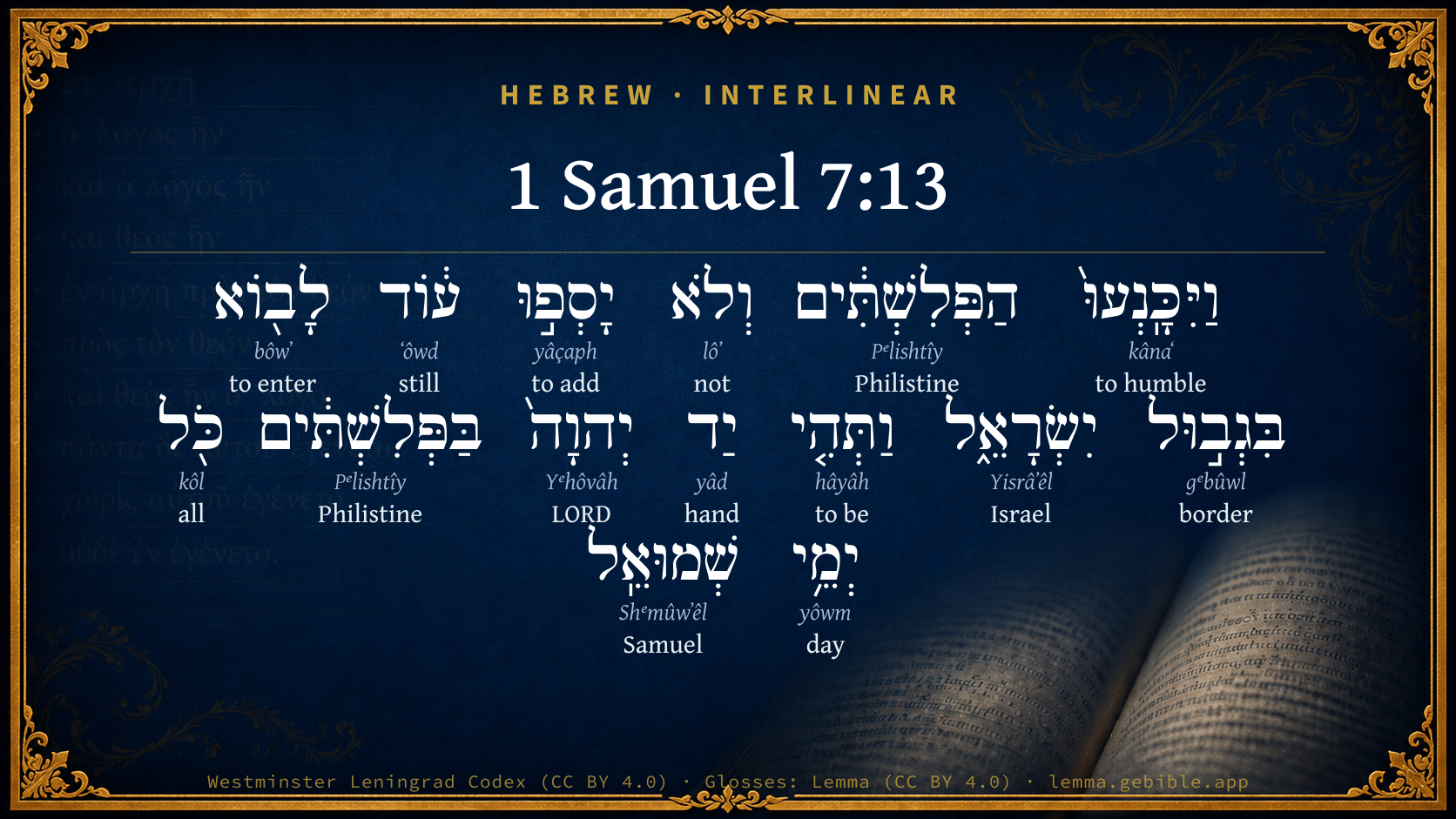
Hebrew (Westminster Leningrad Codex) 1 Samuel 7:13 appears in the Hebrew Old Testament. The text above is from the Westminster Leningrad Codex. Each word links to its Strong’s number, a concise gloss, and parsing drawn from the Open Scriptures Hebrew Bible morphology. Click any word for its full Brown-Driver-Briggs (BDB) entry.
Download image
Cite this verse

1 Samuel 7:13 (World English Bible). Public Domain. Lemma interlinear Bible study tool, https://lemma.gebible.app/v/1-samuel/7/13.

Show BibTeX & RIS
BibTeX
RIS
English Translation
So the Philistines were subdued, and they came no more within the border of Israel: and the hand of Yahweh was against the Philistines all the days of Samuel.
World English Bible · Public Domain
Download a study sheet

One document with this verse’s original text, its word-by-word gloss line, the meaning frame, cross-references with their text, attributed commentary, and full source and license credits — printable, and it pastes into notes with its structure intact.

This verse Autodidact and up

Study sheet (.html) Plain text (.txt)

A passage Seminary Student

Up to 50 verses in one chapter. A passage sheet keeps up to 6 commentary sources and 12 cross-references per verse, in the order this page ranks them, and says so on the sheet whenever that leaves anything out. Ask for a single verse and you get the Autodidact verse sheet above.

Everything on this page stays free to read, with no account — the sheet is a download of what is already on screen, not access to it.

Want to remove ads? Support Godless Engineer
Compare translations 3

The same verse in 3 English versions, stacked beneath the original-language interlinear above. Click any original word for its lexicon entry.

Each is an independent rendering of the whole verse — the interlinear is not word-aligned to these translations.

Highlighted words mark where these versions differ — a whole-verse word diff, not a word-by-word alignment.

  • World English Bible Public Domain
    So the Philistines were subdued, and they came no more within the border of Israel: and the hand of Yahweh was against the Philistines all the days of Samuel.
  • King James Version Public Domain
    So the Philistines were subdued, and they came no more into the coast of Israel: and the hand of the LORD was against the Philistines all the days of Samuel.
  • unfoldingWord Literal Text CC BY-SA 4.0
    So the Philistines were subdued, and they did not resume again to enter into the border of Israel. And the hand of Yahweh was against the Philistines all of the days of Samuel.

unfoldingWord Literal Text — © unfoldingWord, licensed CC BY-SA 4.0. Word-aligned USFM3 via Door43 (git.door43.org/unfoldingWord/en_ult).

Versions to compare (up to 4)

3 of 4 selected

Show all 18 translations

Every available English version of this verse, each an independent rendering of the whole verse.

  • World English Bible Public Domain
    So the Philistines were subdued, and they came no more within the border of Israel: and the hand of Yahweh was against the Philistines all the days of Samuel.
  • Berean Standard Bible Public Domain
    So the Philistines were subdued, and they stopped invading the territory of Israel. And the hand of the LORD was against the Philistines all the days of Samuel.
  • Majority Standard Bible Public Domain
    So the Philistines were subdued, and they stopped invading the territory of Israel. And the hand of the LORD was against the Philistines all the days of Samuel.
  • King James Version Public Domain
    So the Philistines were subdued, and they came no more into the coast of Israel: and the hand of the LORD was against the Philistines all the days of Samuel.
  • American Standard Version (1901) Public Domain
    So the Philistines were subdued, and they came no more within the border of Israel: and the hand of Jehovah was against the Philistines all the days of Samuel.
  • Revised Version (1885) Public Domain
    So the Philistines were subdued, and they came no more within the border of Israel: and the hand of the LORD was against the Philistines all the days of Samuel.
  • Geneva Bible (1599) Public Domain
    So the Philistims were brought vnder, and they came no more againe into the coastes of Israel: and the hand of the Lord was against the Philistims all the dayes of Samuel.
  • Douay-Rheims (1899) Public Domain
    And the Philistines were humbled, and they did not come any more into the borders of Israel. And the hand of the Lord was against the Philistines, all the days of Samuel.
  • Young's Literal Translation Public Domain
    And the Philistines are humbled, and have not added any more to come into the border of Israel, and the hand of Jehovah is on the Philistines all the days of Samuel.
  • Literal Standard Version CC BY-SA 4.0
    And the Philistines are humbled, and have not added anymore to come into the border of Israel, and the hand of YHWH is on the Philistines all the days of Samuel.
  • Unlocked Literal Bible CC BY-SA 4.0
    So the Philistines were subdued and they did not enter the border of Israel. The hand of Yahweh was against the Philistines all the days of Samuel.
  • unfoldingWord Literal Text CC BY-SA 4.0
    So the Philistines were subdued, and they did not resume again to enter into the border of Israel. And the hand of Yahweh was against the Philistines all of the days of Samuel.
  • Darby Bible Public Domain
    And the Philistines were subdued, and came no more into the borders of Israel; and the hand of Jehovah was against the Philistines all the days of Samuel.
  • World Messianic Bible Public Domain
    So the Philistines were subdued, and they stopped coming within the border of Israel. The LORD’s hand was against the Philistines all the days of Samuel.
  • Webster's Bible Public Domain
    So the Philistines were subdued, and they came no more into the borders of Israel: and the hand of the LORD was against the Philistines all the days of Samuel.
  • Free Bible Version CC BY-SA 4.0
    In this way the Philistines were kept under control and did not invade Israel again. During Samuel's lifetime the Lord used his power against the Philistines.
  • Bible in Basic English Public Domain
    So the Philistines were overcome, and did not come into the country of Israel again: and all the days of Samuel the hand of the Lord was against the Philistines.
  • JPS Tanakh (1917) Public Domain
    So the Philistines were subdued, and they came no more within the border of Israel; and the hand of the LORD was against the Philistines all the days of Samuel.

Literal Standard Version (2020), Covenant Press — licensed CC BY-SA 4.0. Text via the HelloAO Bible API (eBible.org). Unlocked Literal Bible (unfoldingWord) — licensed CC BY-SA 4.0. Text via the HelloAO Bible API (eBible.org). unfoldingWord Literal Text — © unfoldingWord, licensed CC BY-SA 4.0. Word-aligned USFM3 via Door43 (git.door43.org/unfoldingWord/en_ult). Free Bible Version, Dr. Jonathan Gallagher — licensed CC BY-SA 4.0. Text via the HelloAO Bible API (eBible.org).

Word by word

More ways to search: Search by grammar → Find every occurrence → Compare this word →

Practice this passage: Drill this verse → Learn its vocabulary →

וַיִּכָּֽנְעוּ֙
kânaʻ
H3665
“and · to humble”
Conjunction + Verb, Niphal, Sequential Imperfect, 3rd Person, Masculine, Plural
Part of Speech
Conjunction + Verb
Stem
Niphal
Form
Sequential Imperfect
Person
3rd Person
Gender
Masculine
Number
Plural
Full BDB Definition

Origin: a primitive root

TWOT: 1001

to be humble, be humbled, be subdued, be brought down, be low, be under, be brought into subjection - (Niphal) - to humble oneself - to be humbled, be subdued - (Hiphil) - to humble - to subdue
  1. הַפְּלִשְׁתִּ֔ים Pᵉlishtîy H6430 “the · Philistines” Particle, Definite Article + Noun, Gentilic, Masculine, Plural, Absolute
  2. וְלֹא lôʼ H3808 “and · not” Conjunction + Particle, Negative
  3. יָסְפ֣וּ yâçaph H3254 “to add” Verb, Qal, Perfect, 3rd Person, Common, Plural
  4. ע֔וֹד ʻôwd H5750 “still” Adverb
  5. לָב֖וֹא bôwʼ H935 “to enter” Preposition + Verb, Qal, Infinitive Construct
  6. בִּגְב֣וּל gᵉbûwl H1366 “in/at · border of” Preposition + Noun, Common, Masculine, Singular, Construct
  7. יִשְׂרָאֵ֑ל Yisrâʼêl H3478 “Israel” Noun, Proper
  8. וַתְּהִ֤י hâyâh H1961 “and · to be” Conjunction + Verb, Qal, Sequential Imperfect, 3rd Person, Feminine, Singular
  9. יַד yâd H3027 “hand of” Noun, Common, Both, Singular, Construct
  10. יְהוָה֙ Yᵉhôvâh H3068 “LORD” Noun, Proper
  11. בַּפְּלִשְׁתִּ֔ים Pᵉlishtîy H6430 “in/at the · Philistines” Preposition, Determined + Noun, Gentilic, Masculine, Plural, Absolute
  12. כֹּ֖ל kôl H3605 “all of” Noun, Common, Masculine, Singular, Construct
  13. יְמֵ֥י yôwm H3117 “days of” Noun, Common, Masculine, Plural, Construct
  14. שְׁמוּאֵֽל Shᵉmûwʼêl H8050 “Samuel” Noun, Proper

About this verse

These counts appear in no published source. They are computed here, from the morphology-tagged text and Lemma’s own curated glosses. What Lemma adds →

15
words
14
distinct lemmas
Historical
section

Shared distinctive vocabulary

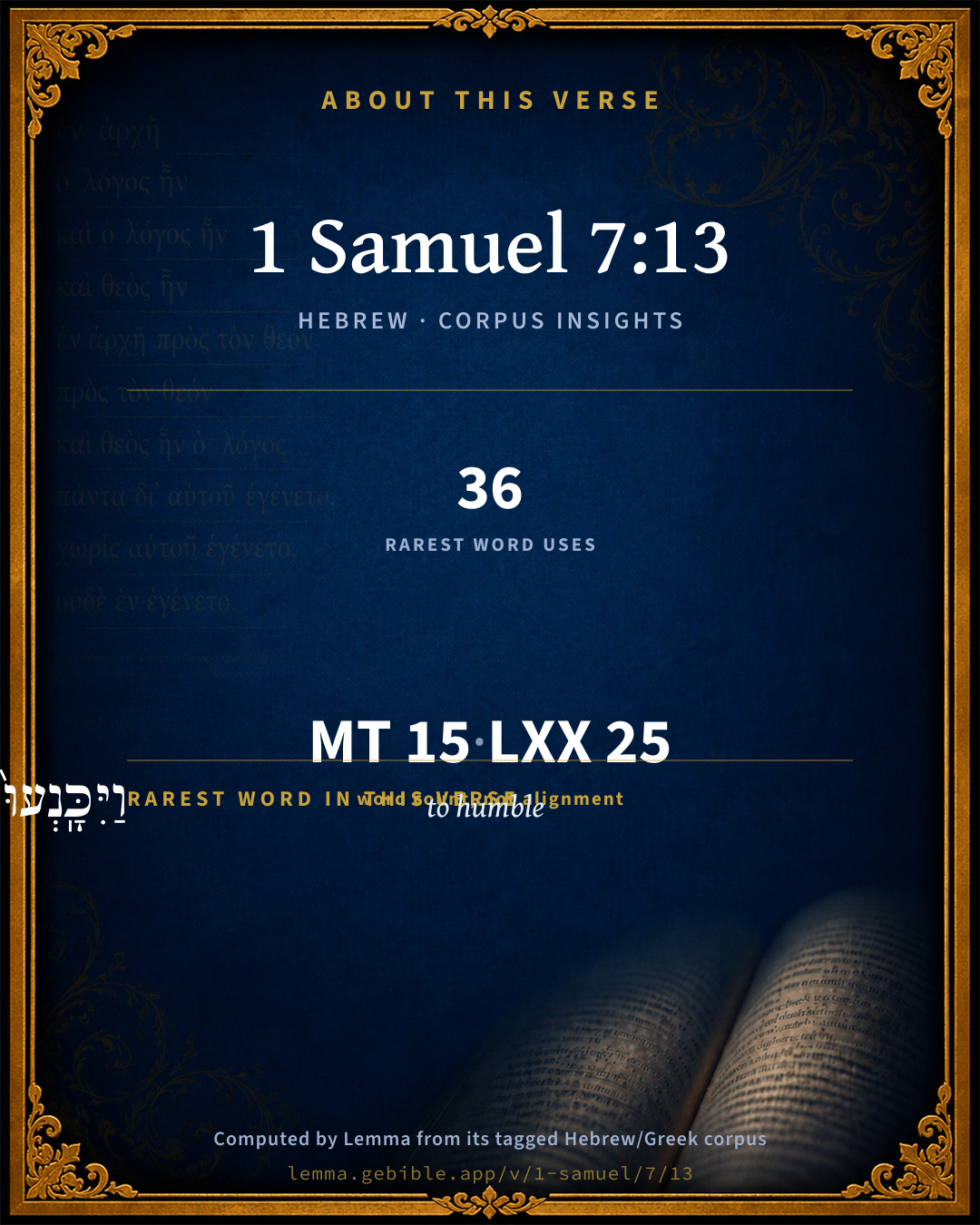
וַיִּכָּֽנְעוּ֙ to humble H3665 occurs in 32 verses of the Hebrew Bible. Also found in:

Grammatical profile

  • 4 verbs
  • 9 nouns
  • 1 adverb
  • 1 particle

Verb forms

  • וַיִּכָּֽנְעוּ֙ Niphal · Sequential Imperfect
  • יָסְפ֣וּ Qal · Perfect
  • לָב֖וֹא Qal · Infinitive Construct
  • וַתְּהִ֤י Qal · Sequential Imperfect

Repetition

A word recurs within this verse — often emphatic in Hebrew:

  • הַפְּלִשְׁתִּ֔ים Philistine H6430 ×2

Hebrew & Septuagint length

In English translation the verse runs 29 words from the Hebrew and 32 from the Septuagint (LXX English) — closely comparable.

A rough comparison of the two English renderings, which tokenize alike — not a word-level alignment.

Word counts can differ between the Hebrew and the Greek without any difference in meaning — e.g. the Hebrew direct-object marker אֵת has no separate Greek word, and Greek often adds the article ὁ.

In the original languages it is 15 Hebrew tokens and 25 Greek tokens — but the two are counted differently (Hebrew bundles its prefixes and suffixes into one token; the Greek is in lemma form), so that isn’t a like-for-like length.

Cross-references

8

Topical passages linked to 1 Samuel 7:13 in the Treasury of Scripture Knowledge — connected by theme and wording, ordered by reader-vote popularity; previews shown in the World English Bible.

  • Judges 13:1 The children of Israel again did that which was evil in the sight of Yahweh; and Yahweh delivered them into the hand of the Philistines forty years.
  • 1 Samuel 17:49–53 David put his hand in his bag, and took there a stone, and slang it, and struck the Philistine in his forehead; and the stone sank into his forehead, and he fell on his face to the earth.
  • Judges 13:5 for, behold, you shall conceive, and bear a son; and no razor shall come on his head; for the child shall be a Nazirite to God from the womb: and he shall begin to save Israel out of the hand of the Philistines.
  • 1 Samuel 13:1–5 Saul was [forty] years old when he began to reign; and when he had reigned two years over Israel,
  • 1 Samuel 14:6–16 Jonathan said to the young man who bore his armor, Come, and let us go over to the garrison of these uncircumcised: it may be that Yahweh will work for us; for there is no restraint to Yahweh to save by many or by few.
  • 1 Samuel 14:20–23 Saul and all the people who were with him were gathered together, and came to the battle: and, behold, every man's sword was against his fellow, [and there was] a very great confusion.
  • 1 Samuel 28:3–5 Now Samuel was dead, and all Israel had lamented him, and buried him in Ramah, even in his own city. Saul had put away those who had familiar spirits, and the wizards, out of the land.
  • 1 Samuel 31:1–7 Now the Philistines fought against Israel: and the men of Israel fled from before the Philistines, and fell down slain on Mount Gilboa.

Cross-references courtesy of OpenBible.info (CC BY 4.0).

Hebrew and Greek witnesses Masoretic Hebrew ↔ Greek Septuagint

The same verse in the two great witnesses to the Old Testament, shown verse-for-verse.

These are two independent witnesses, not word-aligned to each other, and the Septuagint is shown in lemma (dictionary) form.

Hebrew 1 Samuel 7:13 Masoretic · Westminster Leningrad Codex

וַיִּכָּֽנְעוּ֙ הַפְּלִשְׁתִּ֔ים וְלֹא יָסְפ֣וּ ע֔וֹד לָב֖וֹא בִּגְב֣וּל יִשְׂרָאֵ֑ל וַתְּהִ֤י יַד יְהוָה֙ בַּפְּלִשְׁתִּ֔ים כֹּ֖ל יְמֵ֥י שְׁמוּאֵֽל

So the Philistines were subdued, and they came no more within the border of Israel: and the hand of Yahweh was against the Philistines all the days of Samuel.

World English Bible · Public Domain

Greek LXX 1 Samuel 7:13 Septuagint · lemma form

καί ταπεινόω κύριος ὁ ἀλλόφυλος καί οὐ προςτίθημι ἔτι προςἔρχομαι εἰς ὅριον ἰσραήλ καί γίγνομαι χείρ κύριος ἐπί ὁ ἀλλόφυλος πᾶς ὁ ἡμέρα ὁ σαμουηλ

So the Lord humbled the Philistines, and they did not anymore come into the border of Israel; and the hand of the Lord was against the Philistines all the days of Samuel.

LXX2012 (modern English Septuagint) · Public Domain

Hebrew: Westminster Leningrad Codex (CC BY 4.0). Greek: Septuagint (public domain); English from LXX2012 (modern English Septuagint) (Public Domain). How the Septuagint differs from the Hebrew →

Targum (Aramaic paraphrase)

1

The Targum is the ancient Jewish Aramaic paraphrase of the Hebrew Scriptures — an interpretive translation, not the Hebrew text itself. Onkelos (literal) and Pseudo-Jonathan (expansive) render the Torah, and Jonathan the Prophets. Coverage is partial: where no permissively-licensed English translation exists for a verse, only the Aramaic is shown. This is verse-level text, not a word-by-word alignment to the Hebrew.

  1. Targum Jonathan Prophets (Joshua–Malachi)
    וְאִתְבָּרוּ פְּלִשְׁתָּאֵי וְלָא אוֹסִיפוּ עוֹד לְמֵיעַל בִּתְחוּם יִשְׂרָאֵל וַהֲוַת מְחָתָא דַייָ בִּפְלִשְׁתָּאֵי כָּל יוֹמֵי שְׁמוּאֵל:

    (no public-domain English translation for this verse)

    Targum Jonathan — Aramaic: “Mikraot Gedolot” (public domain). English: “Sefaria Community Translation” (CC0 1.0 (public-domain dedication)); “London "Chaldee Paraphrase," 1871” (public domain). Text via Sefaria.

Commentary

Notes on 1 Samuel 7:13 from classic Christian and Jewish commentators (each source and its license shown beneath its notes). The classic Christian expositions comment on the surrounding passage and are grouped to its opening verse, so a note may address several verses; the Jewish commentaries on the Tanakh (Rashi and others) are per-verse, so they appear only where the commentator wrote on this verse.

Lemma curates 59 commentaries, every one of them public domain or Creative Commons licensed, each selected and text-cleaned for this edition rather than reprinted as found. About our sources →

Matthew Henry's Commentary

We have here a short account of the further good services that Samuel did to Israel. Having parted them from their idols, and brought them home to their God, he had put them into a capacity of receiving further benefits by his ministry. Having prevailed in that, he becomes, in other instances, a great blessing to them; yet, writing it himself, he is brief in the relation. We are not told here, but it appears (Ch2 35:18) that in the days of Samuel the prophet the people of Israel kept the ordinance of the passover with more than ordinary devotion, notwithstanding the distance of the ark and the desolations of Shiloh. Many good offices, no doubt, he did for Israel, but here we are only told how instrumental he was, 1. In securing the public peace (Sa1 7:13): "In his days the Philistines came no more into the coast of Israel, made no inroads or incursions upon them; they perceived that God now fought for Israel and that his hand was against the Philistines, and this kept them in awe, and restrained the remainder of their wrath." Samuel was a protector and deliverer to Israel, not by dint of sword, as Gideon, nor by strength of arm, as Samson, but by the power of prayer to God and carrying on a work of reformation among the people. Religion and piety are the best securities of a nation. 2. In recovering the public rights, Sa1 7:14. By his influence Israel had the courage to demand the cities which the Philistines had unjustly taken from them and had long detained; and the Philistines, not daring to contend with one that had so great an interest in heaven, tamely yielded to the demand, and restored (some think) even Ekron and Gath, two of the capital cities, though afterwards they retook them; others think some small towns that lay between Ekron and Gath, which were forced out of the Philistines' hands. This they got by their reformation and religion, they got ground of their enemies and got forward in their affairs. It is added, There was peace between Israel and the Amorites, that is, the Canaanites, the remains of the natives. Not that Israel made any league with them, but they were quiet, and not so mischievous to Israel as they had sometimes been. Thus when a man's ways please the Lord he maketh even his enemies to be at peace with him and give him no disturbance, Pro 16:7. 3. In administering public justice (Sa1 7:15, Sa1 7:16): He judged Israel; as a prophet he taught them their duty and reproved them for their sins, which is called judging, Eze 20:4; Eze 22:2. Moses judged Israel when he made them know the statutes of God and his laws (Exo 18:16); and thus Samuel judged them to the last, even after Saul was made king; so he promised them then, when Saul was inaugurated (Sa1 12:23), I will not cease to teach you the good and the right way. As a magistrate, he received appeals from the inferior courts and gave judgment upon them, tried causes and determined them, tried prisoners and acquitted or condemned them, according to the law. This he did all his days, till he grew old and past service, and resigned to Saul; and afterwards he exercised authority when application was made to him; nay, he judged even Agag, and Saul himself. But when he was in his prime he rode the circuit, for the convenience of the country, at least of that part of it which lay most under his influence. He kept courts at Beth-el, Gilgal, and Mizpeh, all in the tribe of Benjamin; but his constant residence was at Ramah, his father's city, and there he judged Israel, thither they resorted to him from all parts with their complaints, Sa1 7:17. 4. In keeping up the public exercises of religion; for there, where he lived, he built an altar to the Lord, not in contempt of the altar that was at Nob, or Gibeon, or wherever the tabernacle was; but divine justice having laid Sholoh waste, and no other place being yet chosen for them to bring their offerings to (Deu 12:11), he looked upon the law which confined them to one place to be for the present suspended, and therefore, being a prophet, and under divine direction, he did as the patriarchs did, he built an altar where he lived, both for the use of his own family and for the good of the country that resorted to it. Great men should use their wealth, power, and interest, for the keeping up of religion in the places where they live.

Matthew Henry's Commentary on the Whole Bible (1708–1710) — public domain (CC PDM 1.0). Text via the HelloAO Bible API.

Trapp's Complete Commentary

John Trapp

1Sa 7:13 So the Philistines were subdued, and they came no more into the coast of Israel: and the hand of the LORD was against the Philistines all the days of Samuel.

Ver. 13. And they came no more,] sc., With any success; or they did no more at this time rally their scattered troops and recruit their army, they were so terrified.

John Trapp, A Commentary or Exposition upon All the Books of the Old and New Testament (1647–1656) — public domain. Text from a community e-Sword module.

Joseph Benson's Commentary

1Sa 7:13. Came no more — That is, with a great host, but only molested them with straggling parties, or garrisons. All the days of Samuel — That is, while Samuel was their sole judge, or ruler; for in Saul’s time they did come.

Joseph Benson's Commentary on the Old and New Testaments (1811–1818) — public domain. Text from a community e-Sword module.

The Preacher's Complete Homiletical Commentary

Joseph S. Exell (gen. ed.)

CRITICAL AND EXPOSITORY NOTES—

1Sa_7:13. “They came no more.” “They no more invaded the territory of Israel with lasting success as they had done before.” The words which immediately follow—“the hand of Jehovah was against the Philistines,” etc., show that they made attempts to recover their lost supremacy, but that so long as Samuel lived they were unable to effect anything against Israel” (Keil). The forty years domination, mentioned in Jdg_13:1, now terminated.

1Sa_7:14. “From Ekron even unto Gath.” “This definition is probably to be understood as exclusive, i.e., as signifying that the Israelites received back their cities up to the very borders of the Philistines, measuring these borders from Ekron to Gath. For although these chief cities of the Philistines had been allotted to the tribes of Judah and Dan, in the time of Joshua (Jos_13:3-4; Jos_15:45-46), yet, notwithstanding the fact that Judah and Simeon conquered Ekron, together with Gaza and Askelon, after the death of Joshua (Jdg_1:18), the Israelites did not obtain any permanent possession.”—(Keil).

“And there was peace,” etc. “These words suggest what is in itself very probable, that in this war the Amorites, finding the Philistines worse masters than the Israelites, made common cause with Samuel, and assisted the Israelites in their wars against the Philistines.”—(Biblical Commentary.)

MAIN HOMILETICS OF THE PARAGRAPH.—1Sa_7:13-14

VICTORY, REST, AND RESTORATION

I. One decisive victory brings a long season of rest. This victory at Ebenezer brought peace to Israel for many years, and so the human soul, by a decisive victory over one strong temptation, gains often a long season of rest from the tempter’s snares. He gives by such a victory such a proof to the powers of evil of his moral courage that it is deemed hopeless to renew the conflict while the soul remains so strong and watchful. It is written concerning the Son of God, after His decisive victory over the devil in the wilderness, that the tempter “departed from Him for a season” (Luk_4:13). The total defeat he had experienced told him how vain it would be to renew the assault while the being whom he desired to overthrow remained in His present frame of soul. In all warfare it is best to decide at once who is to be the master of the field by a decisive blow, and if a Christian desires any rest of soul there must be no parleying with his spiritual enemies, he must—with the help of the same God by whom Israel routed the Philistines at Ebenezer—let them know without delay who is to be the conqueror. Even then the devil will “depart for a season” only, but these seasons of repose will enable him to gather strength for the next attack.

II. Victory brings restoration of that which has been lost by subjection. When Israel had conquered her oppressors she regained the cities which had been taken from her in the day of her subjection. The human race does not now possess all that belonged to it when God created the first man, and bade him “replenish the earth and subdue it” (Gen_1:28). God at first “put all things under his feet” (Psa_8:6). But now it is plain that man is not the absolute lord, either of the earth and the phenomena of nature, or of the animal creation. He has lost his rule by sin. “We see not yet all things put under him” (Heb_2:8). But when man is restored to his original position in the universe by victory over sin, he will recover his lost rule over material things. There is to be a “time of restitution” (Act_3:21), when the powers which now hold man in subjection will be finally defeated, and he will recover his former dominion, not only over himself, but over the world and over all the creatures below him in the scale of creation.

OUTLINES AND SUGGESTIVE COMMENTS

The revival of religion has ever had a most important bearing on social and moral improvement. The return of man to God restores him to his brother. Restoration to the earnest and hearty performance of religious duties towards God, leads to a corresponding reformation in relative and political duties. Those countries in Europe which have had the greatest religious reforms, have advanced most in liberty, civilisation, and commerce. They are not trodden by the iron heel of despotism, and they possess the greatest amount of domestic quiet. It was the revival of religion which secured the Protestant succession to England, and many of the liberties we now enjoy. It was the revival of religion that gave such a martyr-roll to the Scottish Covenanters, and led to the revolution settlement of 1688. In Israel every revival of religion was succeeded by national prosperity and political independence.—Steel.

The Preacher's Complete Homiletical Commentary (gen. ed. Joseph S. Exell; Funk & Wagnalls, c. 1892) — public domain (pre-1929). A full-Bible homiletical/sermon-outline anthology covering 65 of 66 books (2 John is absent from the source module). Text from a community e-Sword module.

Tyndale Open Study Notes

Tyndale Open Resources

7:13 The Philistines were quiet for some time—until Saul became king (see 13:5). • God’s powerful hand, not Samuel’s giftedness, was the key factor in Israel’s deliverance from the Philistines.

Tyndale Open Study Notes — © Tyndale Open Resources, licensed CC BY-SA 4.0. Text via the HelloAO Bible API.

Adam Clarke's Commentary

Verse 13. They came no more into the coast of Israel] Perhaps a more signal victory was never gained by Israel; the Lord had brought them low, almost to extermination; and now, by his miraculous interference, he lifts them completely up, and humbles to the dust their proud oppressors. God often suffers nations and individuals to be brought to the lowest extremity, that he may show his mercy and goodness by suddenly rescuing them from destruction, when all human help has most evidently failed.

Adam Clarke's Commentary on the Bible (1810–1826) — public domain. Text from a community e-Sword/MySword module.

Ellicott's Commentary for English Readers

(13) So the Philistines were subdued.—The work of Samuel had been thorough. It was no mere solitary victory, this success of Israel at Ebenezer, but was the sign of a new spirit in Israel, which animated the nation during the lifetime of Samuel, and the reigns of David and Solomon and the great Hebrew kings. The petty jealousies had disappeared, and had given place to a great national desire for unity. In the several tribal districts it was no longer the glory and prosperity of Judah, Ephraim, or Benjamin, but the glory and prosperity of Israel that was aimed at. The old idol worship of Canaan, which corrupted and degraded every nationality which practised it, was in a great measure swept away from among the chosen people, while the pure religion of the Eternal of Hosts was no longer confided solely to the care and guardianship of the tribe of Levi, which had shown itself unworthy of the mighty trust. The Levites still ministered in the sanctuary, and when the Temple took its place, alone officiated in its sacred courts; and the chosen race of Aaron, in the family first of Ithamar, then of Eleazar, alone wore the jewels and the official robe of the high priest; but in religious matters the power of the priestly tribe was never again supreme in the Land of Promise. From the days of Samuel a new order—that of the Prophets, whose exact functions with regard to the ritual of the worship of the Eternal were undefined—was acknowledged by the people as the regular medium of communication with the Jewish King of Israel.

The hand of the Lord was against the Philistines.—The Philistines never entirely recovered their supremacy in Canaan. There was. it is true, a long fierce struggle, but with the exception of the short period which immediately preceded the election of Saul, and the temporary disasters of the children of Israel which were the punishments of that king’s disobedience—from this time forward the power of the Philistines gradually decayed. while the strength of Israel steadily increased, until King David completely subdued them, and the old oppressors of Israel were absorbed into the subject races of Canaan.

A Bible Commentary for English Readers, edited by Charles John Ellicott (1878–1897) — public domain. Text from a community e-Sword module.

The Cambridge Bible for Schools and Colleges

gen. ed. J. J. S. Perowne

13–17. Summary Account of Samuel’s Judgeship

13. So the Philistines were subdued] Cp. Jdg_3:30; Jdg_4:23-24. The word signifies “were brought low,” but does not imply complete subjugation. The forty years oppression (Jdg_13:1) now came to an end.

they came no more into the coast of Israel] The same phrase is used in 2Ki_6:23, where the very next verse speaks of a fresh invasion. It is obvious therefore that the Hebrew historian could use the expression relatively and not absolutely, to describe a cessation of the Philistine inroads for the time being. How long it lasted we are not told, but

the hand of the Lord was against the Philistines all the days of Samuel] Yet we find the people groaning under the Philistine oppression (1Sa_9:16): a garrison or a tribute-collector stationed at Gibeah (1Sa_10:5, 1Sa_13:3): a general disarmament of the nation by the Philistines (1Sa_13:19): Hebrew slaves in the Philistine camp (1Sa_14:21): and three invasions of the land (1Sa_13:5, 1Sa_17:1, 1Sa_23:27): all during Samuel’s lifetime. We must then understand the statement in the text as either (a) “a general expression allowable in such a brief survey as is here given:” or (b) as referring only to the period of Samuel’s active judgeship. In the latter case we may conjecture that the Philistines re-established their ascendancy in his old age, in consequence of the weak and corrupt government of his sons.

The Cambridge Bible for Schools and Colleges (gen. ed. J. J. S. Perowne; Cambridge University Press, 1878–1918) — public domain. Text from a community e-Sword module.

John Gill's Exposition

So the Philistines were subdued,.... Not that their country was conquered, or they made subject and become tributaries to Israel; but they were so humbled, as not to attempt to give the people of Israel any further trouble and distress, who were now delivered from their oppression and tyranny:

and came no more into the coast of Israel; at this time they did not gather together their forces dispersed, nor raise and bring a new army into the land of Israel; they contented themselves with placing garrisons on the coast, but did not attempt to enter and invade them any more; that is, for a long time, even until Samuel was grown old, and the people would have a king, and had one, which offended the Lord, and then he suffered them to be distressed by them again; but while Samuel was alone governor they came no more, though they did quickly after Saul was made king, as it follows:

the hand of the Lord was against the Philistines all the days of Samuel; not all the days of his life, but all the days of his sole government, which restrained them from making incursions into the land of Israel; and indeed in later times, when they did come forth to make war with them, the battle was against them during the times of Samuel.

John Gill's Exposition of the Whole Bible (1746–1763) — public domain (CC PDM 1.0). Text via the HelloAO Bible API.

Albert Barnes' Notes on the Bible

All the days of Samuel - Not (as in 1Sa 7:15), all the days of his life, but all the days of his “government”, when as Judge he ruled over Israel, before they asked for a king.

Albert Barnes' Notes on the Bible (1834–1885) — public domain. Text from a community e-Sword/MySword module.

Haydock's Catholic Bible Commentary

Any more, for a long time, (Menochius) during Samuel’s administration; for we find them again attacking Saul, chap. xiii. This expression is often used to denote a cessation of some continuance, Isaias xxiii. 12, 15., and 2 Kings vii. 10.

George Leo Haydock (1774–1849), Haydock's Catholic Family Bible and Commentary, 1859 edition — public domain. Excludes Psalms (Douay-Rheims chapter numbering differs from Protestant) and Deuterocanonical books (Catholic canon only).

Matthew Poole's English Annotations

They came no more into the coast of Israel, i.e. they came not with a great host, as now they did, but only molested them with straggling parties, or garrisons; as 1Sa 10:5; and they came not, to wit,

all the days of Samuel, as it follows, i.e. while Samuel was their sole judge, or ruler; for in Saul’s time they did come, 1Sa 13:5,17; 1Sa 14:52; 17:1, &c.

Matthew Poole's English Annotations on the Holy Bible (1683–1685) — public domain. Text from a community e-Sword/MySword module.

Whedon's Commentary on the Bible

Daniel D. Whedon

13. Came no more into the coast of Israel — They did not succeed in regaining what they had lost in Israel; they came no more as they had been wont to come, driving Israel before them and bringing them into subjection. The passage does not mean that the Philistines made no further attempt to enter the territory of Israel, for the contrary is implied in the words that immediately follow.

The hand of the Lord was against the Philistines all the days of Samuel — They made repeated attempts to regain their lost cause, and Saul kept up a constant war against them all his days, (1Sa_14:52,) but not until after the death of Samuel did they enter triumphantly the coasts of Israel. 1Sa_31:1. While the holy Samuel lived, all their efforts to conquer Israel resulted in defeat. He thus completed the deliverance which Samson began many years before. Jdg_13:5.

Daniel D. Whedon (gen. ed.), Commentary on the Old and New Testaments (1874–1909) — public domain. Text from a community e-Sword module.

The Pulpit Commentary

So the Philistines were subdued. Not completely, for we find that they had garrisons in Israel when Saul was made king; but it was a thorough victory for the time, and was followed up, moreover, by an invasion of Philistia, in which Samuel recovered the towns which had been wrested from Israel upon the western borders of Judah and Benjamin. Moreover, the enemy came no more into the coast of Israel. That is, all invasions ceased. And the hand of Jehovah was against the philistines all the days of Samuel. This, of course, includes the reign of Saul, till within four years of his death; for Samuel continued to he prophet, and to a certain extent shophet, even when Saul was king. The words, moreover, imply a struggle, during which there was a gradual growth in strength on Israel"s part, and a gradual enfeeblement on the part of the Philistines, until David completely vanquished them, though they appear again as powerful enemies in the days of King Jehoram. (2Ch_21:16) It is certain, however, that fifteen or twenty years after this battle the Philistines were again in the ascendant, (1Sa_13:19-23) and it was this which made the Israelites demand a king. (1Sa_9:16) But it is the method of the Divine historians to include the ultimate results, however distant, in their account of an event; (see on 1Sa_16:21 1Sa_17:55-58) and Israel"s freedom and the final subjugation of the Philistines were both contained in Samuel"s victory at Mizpah.

Vers. 13-17.

First fruits of repentance.

The facts are

1. Israel enjoy freedom from the oppression of the Philistines and regainlost cities.

2. Their restless ancestral enemy the Amorite is quiet.

3. Samuel quietly and happily attends to his civil functions.

4. Ramah, the home of Samuel, is blessed with an altar to Jehovah. The mention of these suggestive facts immediately after the reference to the call to repentance and its response exhibit the natural results of the efforts of prophet and people. A fruitful theme is given.

I In RELATION TO ISRAEL THESE FRUITS WERE MOST IMPORTANT; just such as a nation might well prize. An active, powerful foe was held in restraint. Territory and cities were restored to the government and general influence of a true man of God. Their fathers" foe, who disputed the march of Joshua, and ever lay as a savage beast by their side, was controlled by an unseen hand. An orderly and beneficent civil administration, diligently maintained on religious principles, was enjoyed by the various districts, and the residence of the ruler of the people was conspicuously a centre of religious influence. Blessed fruits of national repentance! When will nations learn the clear lessons of this precious book of God?

II In RELATION TO THE RELIGIOUS LIFE OF CHRISTIANS THESE FACTS ARE FULL OF SIGNIFICANCE. It is not wise to seek out spiritual meanings from every simple historic fact in the Old Testament. Plain history is not given as a religious enigma to be solved by some transcendental insight. Yet there are analogies between national and individual life, and principles of holiness and righteousness work in the same directions in both. As there is a Babylon both spiritual and historical, so there is the Philistine and Amorite of our great warfare. As treasures change hands in Israel"s conflict, so there are valuable possessions in man which may be dominated by opposing powers. Thus, then, we may consider some of the firstfruits of repentance in Christian life.

1. The great world power is largely subdued and cast off. The man who in his life has passed through what Israel did in answer to Samuel"s call finds that the evil influences of the world around have less hold on him. They are repressed. Their force has been weakened, if not annihilated.

2. Faculties once governed by unhallowed tendencies are restored to therightful ruler. There are, so to speak, cities seats of power and resource in every man"s nature. While in a sinful course of life these aredominated largely by principles alien to God, and adverse to true self-interest: true repentance brings every faculty, thought, and desire into a willing subordination to him whose right it is to reign. The soul is a "holy land" in which Christ is King.

1. Deep seated, corrupt passions are quieted. There are ancient, very corrupt passions of a fleshly character embedded in human nature. These Amorites of our experience are unusually powerful during a life of sinful indulgence. They grow fat and flourish. One of the first consequences of the new life is to tone them down. The causes of their extreme activity and restlessness are partially removed. A strong hand holds them down in comparative quietude. Their destiny, like that of Israel"s cruel foe, is to be utterly destroyed; but even now, compared with former almost irresistible aggressions, there is peace with them.

1. A considerable degree of prosperity anal order is maintained. The reformed soul has law administered within itself. Every interest, every claim of striving powers and tendencies, is considered and decided in harmony with the law of Christ. The intellect does not absorb the time and

2. energy due to the culture of the emotions, and vice versa. To some degree the inner man is in an orderly, prosperous condition. He is an improved being.

3. The holy, elevating power of devotion is cherished at the centre of influence. Samuel"s home was the centre of influence in Israel, and it was made by express arrangement conspicuously devout. There is in our nature a seat of supreme influence. The faculties and tendencies of the soul act in subordination to the commanding affection of life. True repentance issues in the heart becoming the seat of a powerful influence dominating all else. There is an altar there on which the inextinguishable fire burns, filling with its heavenly, glory the entire man. "Old things have passed away; all things are become new." Are these fruits found in all lives called Christian? They ought to be, and are, if "Christian" is more than a name.

The Pulpit Commentary (1880–1919), ed. H.D.M. Spence-Jones & Joseph S. Exell — public domain. Text from a community e-Sword module.

John Wesley's Explanatory Notes

Came no more - That is, with a great host, but only with straggling parties, or garrisons. All the days, &c. - All the days of Samuel that is, while Samuel was their sole judge, or ruler; for in Saul's time they did come.

John Wesley, Explanatory Notes Upon the Whole Bible (1754–1765) — public domain. Text via the GEBible commentary corpus.

unfoldingWord translationNotes

Door43 World Missions Community

So the Philistines were subdued

The writer has just finished telling how the Philistines were subdued. If your language has a way of marking the end of a description, you could use it here.

the Philistines were subdued

This can be translated in active form. AT: "Yahweh subdued the Philistines" or "Yahweh kept the Philistines from causing harm" (See: Active or Passive)

they did not enter the border of Israel

The Philistines did not enter Israel's border to attack them.

The hand of Yahweh was against the Philistines

The word "hand" is a metonym for power. AT: "Yahweh used his power against the Philistines" (See: Metonymy)

The towns ... from Israel were restored to Israel

This can be stated in active form. Possible meanings are 1) Here "Israel" refers to the "land" of Israel. "Yahweh restored to the land of Israel the towns ... from Israel" or 2) "Israel" is a metonym for the people who live there. AT: "the people of Israel were able to reclaim the towns ... from Israel" (See: Active or Passive and Metonymy)

translationWords

Philistines

Israel

hand

Yahweh

Samuel

restore

Ekron

Gath

peace

Amorite

unfoldingWord translationNotes — © Distant Shores Media and the Door43 World Missions Community, licensed CC BY-SA 4.0. Source: git.door43.org/Door43/en_tn.

Lesson kit

Teaching starters — assembled from the data on this page, not authored interpretation. Every prompt links to the verse data it draws on. Edit before teaching.

1 Samuel, in the Historical, opens this verse with 15 words (14 distinct Hebrew lemmas). Its most distinctive word is kânaʻ (“to humble”). A historical commentator’s framing appears above. Read the whole chapter for the surrounding context.

Discussion questions

  1. The word kânaʻ carries the sense “to humble.” How does it shape the verse?
  2. How does Leviticus 26:41, which shares the word «to humble», read alongside this verse?
  3. What does the repetition of “Philistine” (2× in this one verse) do in this verse?
  4. These translations render this verse differently; the difference is in the English rendering, not the original. What questions does that raise?
  5. «וַיִּכָּֽנְעוּ֙» is a Niphal Sequential Imperfect verb. How does that grammatical form shape the action described?
  6. Compare how Matthew Henry's Commentary and Trapp's Complete Commentary read this verse. Where do they agree or differ?

Things to notice

Reading settings

Reading text

Shown beneath each verse's original-language words.

Old Testament
Old Testament edition

Read the OT as the Masoretic Hebrew (MT) or the Greek Septuagint (LXX).

English shown for the Greek Septuagint (in the Hebrew ↔ Greek comparison).

Comparing translations? Open the Compare panel on any verse page to stack up to four side by side.