
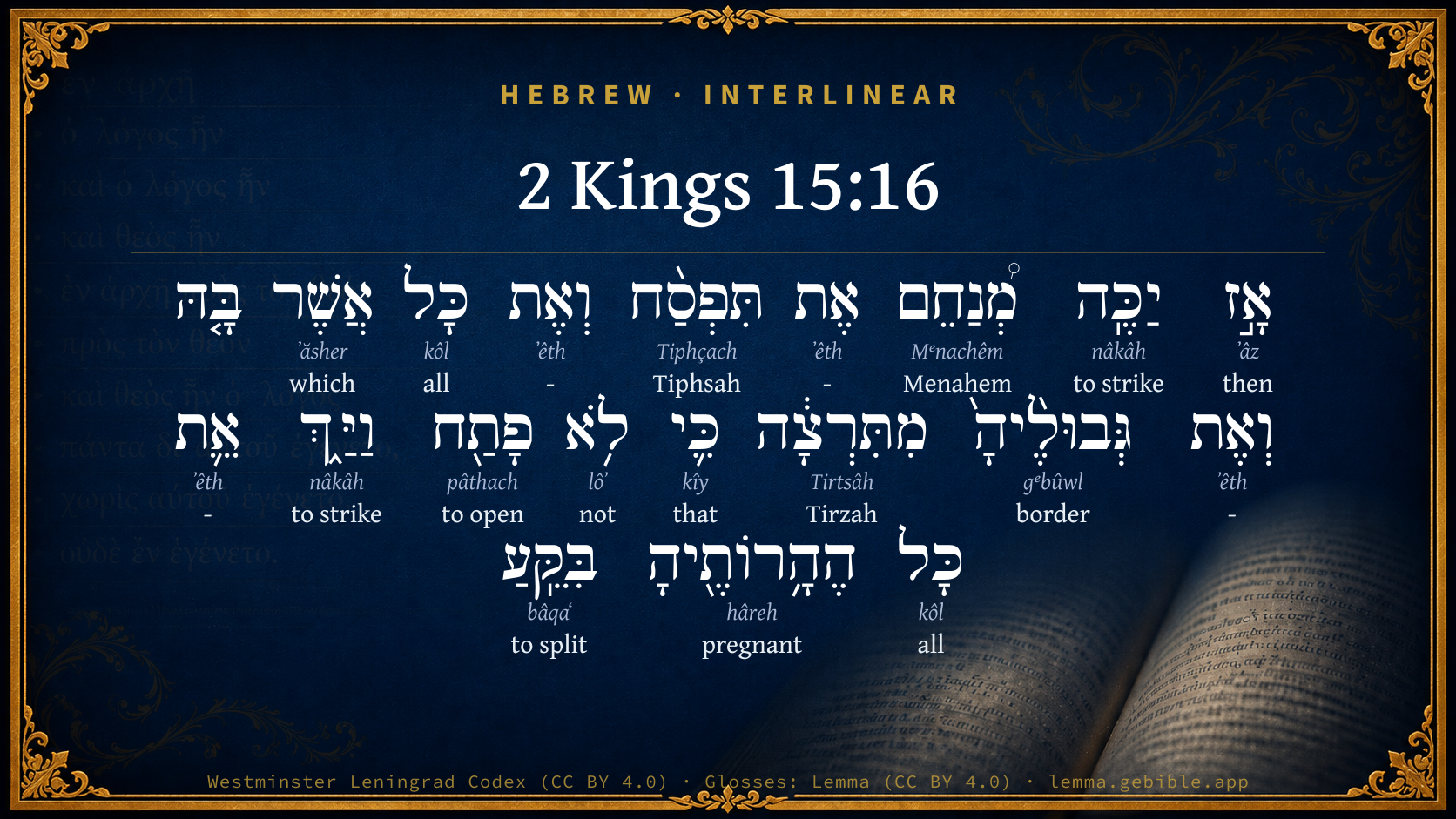
2 Kings 15:16

Hebrew (Westminster Leningrad Codex) 2 Kings 15:16 appears in the Hebrew Old Testament. The text above is from the Westminster Leningrad Codex. Each word links to its Strong’s number, a concise gloss, and parsing drawn from the Open Scriptures Hebrew Bible morphology. Click any word for its full Brown-Driver-Briggs (BDB) entry.
Download image
Cite this verse

2 Kings 15:16 (World English Bible). Public Domain. Lemma interlinear Bible study tool, https://lemma.gebible.app/v/2-kings/15/16.

Show BibTeX & RIS
BibTeX
RIS
English Translation
Then Menahem struck Tiphsah, and all who were therein, and the borders of it, from Tirzah: because they didn't open to him, therefore he struck it; and all the women therein who were with child he ripped up.
World English Bible · Public Domain
Download a study sheet

One document with this verse’s original text, its word-by-word gloss line, the meaning frame, cross-references with their text, attributed commentary, and full source and license credits — printable, and it pastes into notes with its structure intact.

This verse Autodidact and up

Study sheet (.html) Plain text (.txt)

A passage Seminary Student

Up to 50 verses in one chapter. A passage sheet keeps up to 6 commentary sources and 12 cross-references per verse, in the order this page ranks them, and says so on the sheet whenever that leaves anything out. Ask for a single verse and you get the Autodidact verse sheet above.

Everything on this page stays free to read, with no account — the sheet is a download of what is already on screen, not access to it.

Want to remove ads? Support Godless Engineer
Compare translations 3

The same verse in 3 English versions, stacked beneath the original-language interlinear above. Click any original word for its lexicon entry.

Each is an independent rendering of the whole verse — the interlinear is not word-aligned to these translations.

Highlighted words mark where these versions differ — a whole-verse word diff, not a word-by-word alignment.

  • World English Bible Public Domain
    Then Menahem struck Tiphsah, and all who were therein, and the borders of it, from Tirzah: because they didn't open to him, therefore he struck it; and all the women therein who were with child he ripped up.
  • King James Version Public Domain
    Then Menahem smote Tiphsah, and all that were therein, and the coasts thereof from Tirzah: because they opened not to him, therefore he smote it; and all the women therein that were with child he ripped up.
  • unfoldingWord Literal Text CC BY-SA 4.0
    Then Menahem struck Tiphsah and all who in it and its borders, from Tirzah, because one did not open. And he struck, all of its pregnant women he ripped open.

unfoldingWord Literal Text — © unfoldingWord, licensed CC BY-SA 4.0. Word-aligned USFM3 via Door43 (git.door43.org/unfoldingWord/en_ult).

Versions to compare (up to 4)

3 of 4 selected

Show all 18 translations

Every available English version of this verse, each an independent rendering of the whole verse.

  • World English Bible Public Domain
    Then Menahem struck Tiphsah, and all who were therein, and the borders of it, from Tirzah: because they didn't open to him, therefore he struck it; and all the women therein who were with child he ripped up.
  • Berean Standard Bible Public Domain
    At that time Menahem, starting from Tirzah, attacked Tiphsah and everyone in its vicinity, because they would not open their gates. So he attacked Tiphsah and ripped open all the pregnant women.
  • Majority Standard Bible Public Domain
    At that time Menahem, starting from Tirzah, attacked Tiphsah and everyone in its vicinity, because they would not open their gates. So he attacked Tiphsah and ripped open all the pregnant women.
  • King James Version Public Domain
    Then Menahem smote Tiphsah, and all that were therein, and the coasts thereof from Tirzah: because they opened not to him, therefore he smote it; and all the women therein that were with child he ripped up.
  • American Standard Version (1901) Public Domain
    Then Menahem smote Tiphsah, and all that were therein, and the borders thereof, from Tirzah: because they opened not to him, therefore he smote it; and all the women therein that were with child he ripped up.
  • Revised Version (1885) Public Domain
    Then Menahem smote Tiphsah, and all that were therein, and the borders thereof, from Tirzah: because they opened not to him, therefore he smote it; and all the women therein that were with child he ripped up.
  • Geneva Bible (1599) Public Domain
    Then Menahem destroyed Tiphsah, and all that were therein, and the coastes thereof from Tirzah, because they opened not to him, and he smote it, and ript vp all their women with childe.
  • Douay-Rheims (1899) Public Domain
    Then Manahem destroyed Thapsa and all that were in it and the borders thereof from Thersa, because they would not open to him: and he slew all the women thereof that were with child, and ripped them up.
  • Young's Literal Translation Public Domain
    Then doth Menahem smite Tiphsah, and all who `are' in it, and its borders from Tirzah, for it opened not `to him', and he smiteth `it', all its pregnant women he hath ripped up.
  • Literal Standard Version CC BY-SA 4.0
    Then Menahem strikes Tiphsah, and all who [are] in it, and its borders from Tirzah, for it did not open [to him], and he strikes [it], [and] he has ripped up all its pregnant women.
  • Unlocked Literal Bible CC BY-SA 4.0
    Then Menahem attacked Tiphsah and all who were there, and the borders around Tirzah, because they did not open up the city to him. So he attacked it, and he ripped open all the pregnant women in that village.
  • unfoldingWord Literal Text CC BY-SA 4.0
    Then Menahem struck Tiphsah and all who in it and its borders, from Tirzah, because one did not open. And he struck, all of its pregnant women he ripped open.
  • Darby Bible Public Domain
    Then Menahem smote Tiphsah, and all that were therein, and its territory from Tirzah, because they did not open [to him]; and he smote [it]: all the women in it that were with child he ripped up.
  • World Messianic Bible Public Domain
    Then Menahem attacked Tiphsah and all who were in it and its border areas, from Tirzah. He attacked it because they didn’t open their gates to him, and he ripped up all their women who were with child.
  • Webster's Bible Public Domain
    Then Menahem smote Tiphsah, and all that were in it, and the borders of it from Tirzah: because they opened not to him, therefore he smote it; and all the women in it that were with child he ripped up.
  • Free Bible Version CC BY-SA 4.0
    At that time Menahem, starting from Tirzah, attacked Tiphsah and the region nearby, because they would not surrender the town to him. So he destroyed Tiphsah and ripped open all the pregnant women.
  • Bible in Basic English Public Domain
    Then Menahem sent destruction on Tappuah and all the people in it, and its limits, from Tirzah, because they would not let him come in; and he had all the women who were with child cut open.
  • JPS Tanakh (1917) Public Domain
    Then Menahem smote Tiphsah, and all that were therein, and the borders thereof, from Tirzah; because they opened not to him, therefore he smote it; and all the women therein that were with child he ripped up.

Literal Standard Version (2020), Covenant Press — licensed CC BY-SA 4.0. Text via the HelloAO Bible API (eBible.org). Unlocked Literal Bible (unfoldingWord) — licensed CC BY-SA 4.0. Text via the HelloAO Bible API (eBible.org). unfoldingWord Literal Text — © unfoldingWord, licensed CC BY-SA 4.0. Word-aligned USFM3 via Door43 (git.door43.org/unfoldingWord/en_ult). Free Bible Version, Dr. Jonathan Gallagher — licensed CC BY-SA 4.0. Text via the HelloAO Bible API (eBible.org).

Word by word

More ways to search: Search by grammar → Find every occurrence → Compare this word →

Practice this passage: Drill this verse → Learn its vocabulary →

תִּפְסַ֨ח
Tiphçach
H8607
“Tiphsah”
Noun, Proper
Part of Speech
Noun
Type
Proper
Full BDB Definition

Origin: from H6452

TWOT: None

Tiphsah = "cross over" - a place at the northeast limit of Solomon's empire; located on the Euphrates river - a place in the northern kingdom of Israel which king Menahem attacked and where he ripped open all the pregnant women - might be the same as 1
  1. אָ֣ז ʼâz H227 “then” Adverb
  2. יַכֶּֽה nâkâh H5221 “to strike” Verb, Hiphil, Imperfect, 3rd Person, Masculine, Singular
  3. מְ֠נַחֵם Mᵉnachêm H4505 “Menahem” Noun, Proper
  4. אֶת ʼêth H853 “-” Particle, Direct Object
  5. וְאֶת ʼêth H853 “and · -” Conjunction + Particle, Direct Object
  6. כָּל kôl H3605 “all of” Noun, Common, Masculine, Singular, Construct
  7. אֲשֶׁר ʼăsher H834 “which” Particle, Relative
  8. וְאֶת ʼêth H853 “and · -” Conjunction + Particle, Direct Object
  9. גְּבוּלֶ֨יהָ֙ gᵉbûwl H1366 “borders · her” Noun, Common, Masculine, Plural, Construct + Suffix, Personal, 3rd Person, Feminine, Singular
  10. מִתִּרְצָ֔ה Tirtsâh H8656 “from · Tirzah” Preposition + Noun, Proper
  11. כִּ֛י kîy H3588 “that” Conjunction
  12. לֹ֥א lôʼ H3808 “not” Particle, Negative
  13. פָתַ֖ח pâthach H6605 “to open” Verb, Qal, Perfect, 3rd Person, Masculine, Singular
  14. וַיַּ֑ךְ nâkâh H5221 “and · to strike” Conjunction + Verb, Hiphil, Sequential Imperfect, 3rd Person, Masculine, Singular
  15. אֵ֛ת ʼêth H853 “-” Particle, Direct Object
  16. כָּל kôl H3605 “all of” Noun, Common, Masculine, Singular, Construct
  17. הֶהָ֥רוֹתֶ֖יהָ hâreh H2030 “the · pregnant · her” Particle, Definite Article + Adjective, Adjective, Feminine, Plural, Construct + Suffix, Personal, 3rd Person, Feminine, Singular
  18. בִּקֵּֽעַ bâqaʻ H1234 “to split” Verb, Piel, Perfect, 3rd Person, Masculine, Singular

About this verse

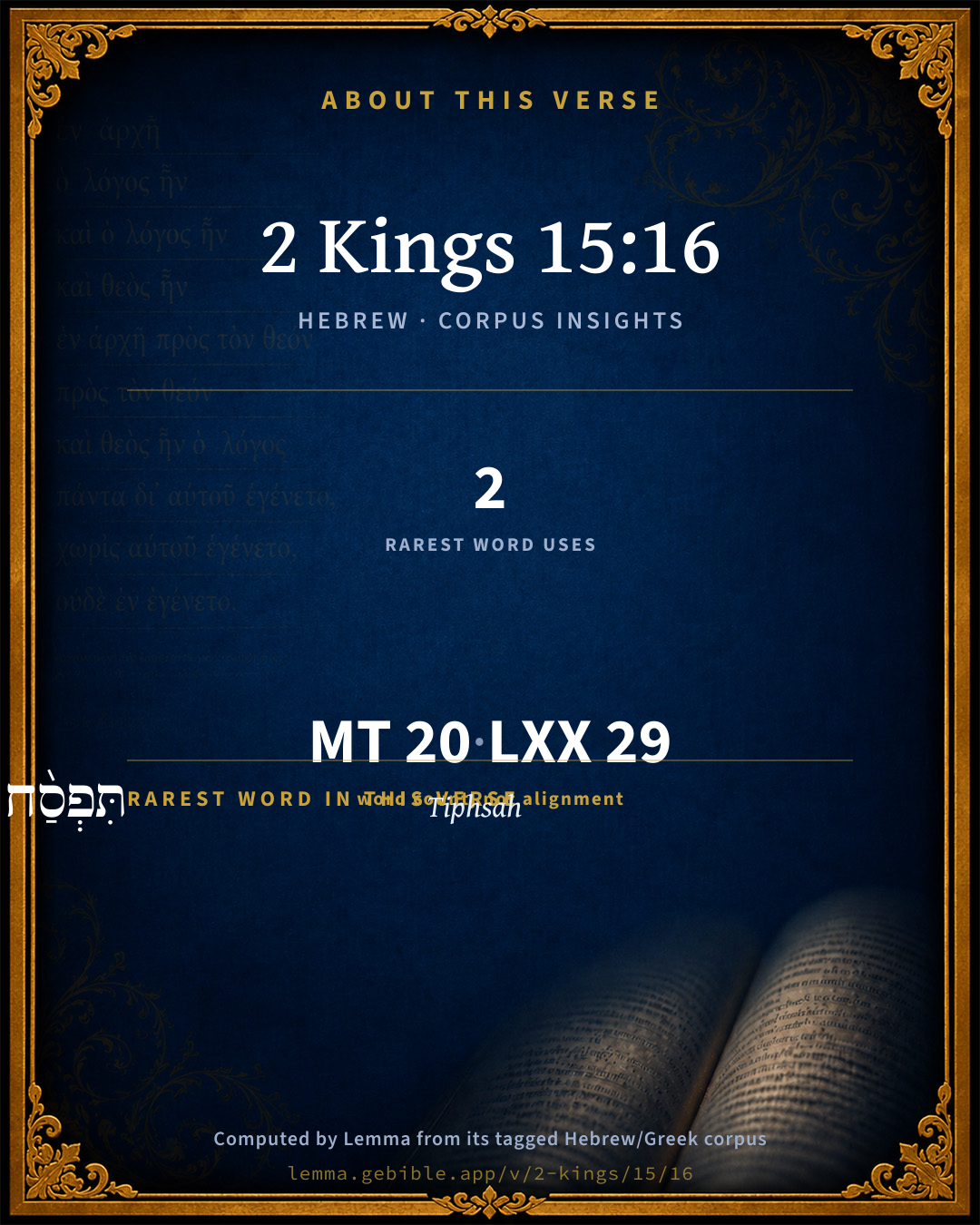
These counts appear in no published source. They are computed here, from the morphology-tagged text and Lemma’s own curated glosses. What Lemma adds →

20
words
14
distinct lemmas
Historical
section

Notable vocabulary

The rarest word here is תִּפְסַ֨ח Tiphsah H8607 — appearing just 2 times in the whole Hebrew Bible.

Shared distinctive vocabulary

תִּפְסַ֨ח Tiphsah H8607 occurs in 2 verses of the Hebrew Bible. Also found in:

Grammatical profile

  • 4 verbs
  • 6 nouns
  • 1 adjective
  • 1 preposition
  • 1 conjunction
  • 1 adverb
  • 6 particles

Verb forms

  • יַכֶּֽה Hiphil · Imperfect
  • פָתַ֖ח Qal · Perfect
  • וַיַּ֑ךְ Hiphil · Sequential Imperfect
  • בִּקֵּֽעַ Piel · Perfect

Repetition

Words recur within this verse — often emphatic in Hebrew:

  • יַכֶּֽה to strike H5221 ×2
  • כָּל all H3605 ×2

Hebrew & Septuagint length

In English translation the verse runs 38 words from the Hebrew and 34 from the Septuagint (LXX English) — closely comparable.

A rough comparison of the two English renderings, which tokenize alike — not a word-level alignment.

Word counts can differ between the Hebrew and the Greek without any difference in meaning — e.g. the Hebrew direct-object marker אֵת has no separate Greek word, and Greek often adds the article ὁ.

In the original languages it is 20 Hebrew tokens and 29 Greek tokens — but the two are counted differently (Hebrew bundles its prefixes and suffixes into one token; the Greek is in lemma form), so that isn’t a like-for-like length.

Cross-references

4

Topical passages linked to 2 Kings 15:16 in the Treasury of Scripture Knowledge — connected by theme and wording, ordered by reader-vote popularity; previews shown in the World English Bible.

  • 2 Kings 8:12 Hazael said, Why weeps my lord? He answered, Because I know the evil that you will do to the children of Israel: their strongholds will you set on fire, and their young men will you kill with the sword, and will dash in pieces their little ones, and rip up their women with child.
  • 1 Kings 4:24 For he had dominion over all [the region] on this side the River, from Tiphsah even to Gaza, over all the kings on this side the River: and he had peace on all sides round about him.
  • Hosea 13:16 Samaria will bear her guilt; For she has rebelled against her God. They will fall by the sword. Their infants will be dashed in pieces, And their pregnant women will be ripped open."
  • Amos 1:13 Thus says Yahweh: "For three transgressions of the children of Ammon, yes, for four, I will not turn away its punishment; Because they have ripped open the pregnant women of Gilead, That they may enlarge their border.

Cross-references courtesy of OpenBible.info (CC BY 4.0).

Hebrew and Greek witnesses Masoretic Hebrew ↔ Greek Septuagint

The same verse in the two great witnesses to the Old Testament, shown verse-for-verse.

These are two independent witnesses, not word-aligned to each other, and the Septuagint is shown in lemma (dictionary) form.

Hebrew 2 Kings 15:16 Masoretic · Westminster Leningrad Codex

אָ֣ז יַכֶּֽה מְ֠נַחֵם אֶת תִּפְסַ֨ח וְאֶת כָּל אֲשֶׁר בָּ֤הּ וְאֶת גְּבוּלֶ֨יהָ֙ מִתִּרְצָ֔ה כִּ֛י לֹ֥א פָתַ֖ח וַיַּ֑ךְ אֵ֛ת כָּל הֶהָ֥רוֹתֶ֖יהָ בִּקֵּֽעַ

Then Menahem struck Tiphsah, and all who were therein, and the borders of it, from Tirzah: because they didn't open to him, therefore he struck it; and all the women therein who were with child he ripped up.

World English Bible · Public Domain

Greek LXX 2 Kings 15:16 Septuagint · lemma form

τότε πατάσσω μαναημ ὁ θερσα καί πᾶς ὁ ἐν αὐτός καί ὁ ὅριον αὐτός ἀπό θερσα ὅτι οὐ ἀναοἴγω αὐτός καί πατάσσω αὐτός καί ὁ ἐν γαστήρ ἔχω ἀναῥήγνυμι

Then Manaem struck both Thersa and all that was in it, and its borders extending beyond Thersa, because they opened not to him: and he struck it, and ripped up the women with child.

LXX2012 (modern English Septuagint) · Public Domain

Hebrew: Westminster Leningrad Codex (CC BY 4.0). Greek: Septuagint (public domain); English from LXX2012 (modern English Septuagint) (Public Domain). How the Septuagint differs from the Hebrew →

Targum (Aramaic paraphrase)

1

The Targum is the ancient Jewish Aramaic paraphrase of the Hebrew Scriptures — an interpretive translation, not the Hebrew text itself. Onkelos (literal) and Pseudo-Jonathan (expansive) render the Torah, and Jonathan the Prophets. Coverage is partial: where no permissively-licensed English translation exists for a verse, only the Aramaic is shown. This is verse-level text, not a word-by-word alignment to the Hebrew.

  1. Targum Jonathan Prophets (Joshua–Malachi)
    בְּכֵן מְחָא מְנַחֵם יַת תִפְסַח וְיַת כָּל דִי בָהּ וְיַת תְּחוּמָהָא מִתִּרְצָה אֲרֵי לָא פְתָחַת תַּרְעָהָא לְאַשְׁלָמָא וּמְחָא וְיַת כָּל מְעַדְיָתָהָא בְּזַע:

    (no public-domain English translation for this verse)

    Targum Jonathan — Aramaic: “Mikraot Gedolot” (public domain). English: “Sefaria Community Translation” (CC0 1.0 (public-domain dedication)); “London "Chaldee Paraphrase," 1871” (public domain). Text via Sefaria.

Commentary

Notes on 2 Kings 15:16 from classic Christian and Jewish commentators (each source and its license shown beneath its notes). The classic Christian expositions comment on the surrounding passage and are grouped to its opening verse, so a note may address several verses; the Jewish commentaries on the Tanakh (Rashi and others) are per-verse, so they appear only where the commentator wrote on this verse.

Lemma curates 59 commentaries, every one of them public domain or Creative Commons licensed, each selected and text-cleaned for this edition rather than reprinted as found. About our sources →

Trapp's Complete Commentary

John Trapp

2Ki 15:16 Then Menahem smote Tiphsah, and all that [were] therein, and the coasts thereof from Tirzah: because they opened not [to him], therefore he smote [it; and] all the women therein that were with child he ripped up.

Ver. 16. He smote it, and all the women he ripped up.] Opening their wombs crudelitate immani et barbara, because their husbands opened not the gates of their city unto him. {a} This abhorred cruelty Josephus mentioneth not; as being ashamed that other nations should be acquainted with it. The like was done, {Hos 13:16 Amo 1:13} and at the Sicilian vespers, by those pseudo-Catholics.

{a} Here Manes showed himself to be Epimanes.

John Trapp, A Commentary or Exposition upon All the Books of the Old and New Testament (1647–1656) — public domain. Text from a community e-Sword module.

Joseph Benson's Commentary

2Ki 15:16. Then Menahem smote Tiphsah — Either that Tiphsah mentioned 1Ki 4:24, or another city of the same name. And the coasts thereof, from Tirzah — All the people dwelling between those places. Because they opened not to him — Refused to open the gates of their city, and submit to him as conqueror. All the women that were with child he ripped up — That by this example of severity he might affright all the rest of the people into obedience. The frequent mention of this kind of cruelty, shows how inhumanly barbarous the eastern people were in those ages.

Joseph Benson's Commentary on the Old and New Testaments (1811–1818) — public domain. Text from a community e-Sword module.

Whedon's Commentary on the Bible

Daniel D. Whedon

REIGN OF MENAHEM, 2Ki_15:16-22.

16. Smote Tiphsah — Ewald, Thenius, and others, think this must have been a city in Palestine near Tirzah. But in the absence of any mention of a city of this name near Tirzah, it is better to understand the border city of Solomon’s kingdom, the Thapsacus of the Greeks, mentioned 1Ki_4:24, where see note. Wordsworth well remarks: “In the state of confusion in which Israel was at this time, we need not be surprised that a restless and aspiring man, like Menahem, going forth from Tirzah, should have been able to carry his marauding and desolating conquests even to the banks of the Euphrates.”

The coasts thereof from Tirzah — These words do not sufficiently authorize us to maintain that Menahem wasted all the land between Tirzah and Tiphsah, but they clearly show that his conquests were not confined to Tiphsah. We understand that he set out on his expedition from Tirzah, and no doubt many parts of the country between that place and the Euphrates suffered from his march.

Because they opened not — The inhabitants of Tiphsah offered resistance to Menahem’s forces, and this so enraged him that he not only ravished the coasts thereof, but having taken the city, he perpetrated on its inhabitants, even to women and children, the most barbarous cruelties.

Daniel D. Whedon (gen. ed.), Commentary on the Old and New Testaments (1874–1909) — public domain. Text from a community e-Sword module.

Tyndale Open Study Notes

Tyndale Open Resources

15:16 At Tirzah, Menahem heard of King Zechariah’s assassination by Shallum. Menahem gathered his forces and moved against Samaria. • ripped open the pregnant women: This horrible wartime practice, noted in Assyrian and Babylonian documents, is also attributed to King Hazael of Aram (8:12). See also Hos 10:14; 13:16; Amos 1:13.

Tyndale Open Study Notes — © Tyndale Open Resources, licensed CC BY-SA 4.0. Text via the HelloAO Bible API.

Geneva Bible (1599)

Geneva Bible translators

Which was a city of Israel that would not receive him to be king.

Geneva Bible (1599) marginal notes — public domain. Text via Bolls.life.

Jamieson, Fausset & Brown

Robert Jamieson, A. R. Fausset & David Brown

Menahem . . . smote Tiphsah--Thapsacus, on the Euphrates, the border city of Solomon's kingdom (Kg1 4:24). The inhabitants refusing to open their gates to him, Menahem took it by storm. Then having spoiled it, he committed the most barbarous excesses, without regard either to age or sex.

Jamieson, Fausset & Brown — Commentary Critical and Explanatory on the Whole Bible (1871) — public domain (CC PDM 1.0). Text via the HelloAO Bible API.

Ellicott's Commentary for English Readers

(16) Then.—After slaying Shallum, and seizing the supreme power.

Tiphsah.—The name means ford, and elsewhere denotes the well-known Thapsacus on the Euphrates (1Ki_4:24). Here, however, an Israelite city in the neighbourhood of Tirzah is obviously intended. The course of events was apparently this: after slaying Shallum, Menahem returned to Tirzah, and set out thence at the head of his entire army to bring the rest of the country to acknowledge him as king. Tiphsah resisting his claims, he made an example of it which proved efficient to terrorise other towns into submission. [Thenius would read Tappuah for Tiphsah by a slight change in one Hebrew letter. This agrees very well with the local indications of the text (comp. Jos_17:7-8), though, of course, there may have been an otherwise unknown Tiphsah near Tirzah.]

The coasts thereof.—Literally, her borders (or, territories). (Comp. Jos_17:8.)

From Tirzah—i.e., starting from Tirzah. This shows that the districts of Tirzah and Tiphsah (or, Tappuah) were conterminous.

Because they opened not to him.—Literally, for one opened not; an impersonal construction. The meaning is: the gates were closed against him. The to him is added by all the versions except the Targum.

And all the women.—Comp. 2Ki_8:21; Hos_13:16; Amo_1:13.

A Bible Commentary for English Readers, edited by Charles John Ellicott (1878–1897) — public domain. Text from a community e-Sword module.

The Cambridge Bible for Schools and Colleges

gen. ed. J. J. S. Perowne

16–22. Menahem king of Israel. He smites Tiphsah. Pul, king of Assyria, comes against Israel but is bought off. Death of Menahem (Not in Chronicles)

16. Menahem smote Tiphsah] Tiphsah is mentioned 1Ki_4:24 as at one boundary of the dominion of Solomon. The place there intended is Thapsacus on the west side of the Euphrates, and is famous in classic history as the point at which Cyrus with his 10000 Greeks crossed that river. If that be the place here spoken of, we must understand Menahem to have carried his victorious arms from Samaria to the Euphrates. For a king who had put himself on the throne by force, at a time when Israel was thoroughly disorganised, this seems inconceivable. For this reason most people consider the place here mentioned to have been within the kingdom of Israel. Josephus (Ant. IX. 11. 1) calls it Thapsa, and speaks of it as a place which refused to admit the usurper. If this be so, it is mentioned nowhere else, and this seems to be by far the most natural explanation.

and the coasts [R.V. borders] thereof] That is, all the country round about this offending town.

from Tirzah] Menahem’s proceeding appears to have been this. After the slaughter of Shallum in Samaria, he returned to Tirzah, and, making that his headquarters, went forth thence to reduce the country to subjection.

they opened not to him] Josephus says they closed their gates and barred them against him. At a time when the king was changing every few months the citizens might naturally feel unwilling to admit a new claimant for the rule, till they were certain of what was happening elsewhere.

ript up] This savage conduct is mentioned (2Ki_8:12) among the enormities which Hazael was likely to perpetrate, and in the prophets (Hos_13:16; Amo_1:13) it is specified as part of the sufferings of Samaria from her invaders, and as inflicted by the Ammonites on the women of Gilead. But nowhere except here do we find such cruelty exercised by an Israelite. It marks the time as one of great degradation and barbarity.

The Cambridge Bible for Schools and Colleges (gen. ed. J. J. S. Perowne; Cambridge University Press, 1878–1918) — public domain. Text from a community e-Sword module.

John Gill's Exposition

And the rest of the acts of Menahem,.... We are referred to the same book of chronicles for them as for those of the rest of the kings, which seems to be a form the historian uses of them all.

And the rest of the acts of Menahem,.... We are referred to the same book of chronicles for them as for those of the rest of the kings, which seems to be a form the historian uses of them all.

2 Kings 15:22

kg2 15:22

kg2 15:22

kg2 15:22And Menahem slept with his fathers,.... Died a natural death, and in peace, though an usurper and a tyrant:

and Pekahiah his son reigned in his stead; the kingdom he had usurped continued in his family.

John Gill's Exposition of the Whole Bible (1746–1763) — public domain (CC PDM 1.0). Text via the HelloAO Bible API.

Albert Barnes' Notes on the Bible

With respect to the supposed inability of Menahem to lead an expedition to Tiphsah (Thapsacus, see the marginal reference) on the Euphrates, we may note in the first place that such an expedition was a natural sequel to Jeroboam’s occupation of Hamath 2Ki 14:28; and further, that it would have been greatly facilitated by the weakness of Assyria at this time, that empire having fallen into a state of depression about 780 B.C.

Albert Barnes' Notes on the Bible (1834–1885) — public domain. Text from a community e-Sword/MySword module.

Matthew Poole's English Annotations

Tiphsah; either that Tiphsah mentioned 1Ki 4:24, or another city of that name.

The coasts thereof from Tirzah, i.e. all the people dwelling between Tirzah and Tiphsah.

Because they opened not to him; because they refused to open the gates of their city to him, and to submit to him as conqueror.

The women he ripped up; that by this example of severity he might affright all the rest of the people into obedience.

Matthew Poole's English Annotations on the Holy Bible (1683–1685) — public domain. Text from a community e-Sword/MySword module.

The Pulpit Commentary

Vers. 16-22. REIGN OF MENAHEM, AND EXPEDITION OF PUL AGAINST SAMARIA. Two events only of Menahem"s reign receive notice from the writer.

(1) His capture of Tiphsah, and severe treatment of the inhabitants (ver. 16).

(2) The invasion of his land by an Assyrian monarch, called "Pul" or "Phul," and his submission to that monarch"s authority. Pul"s retirement was bought by a large sum of money, which Menahem collected from his subjects (vers. 19, 20). Then Menahem smote Tiphsah. The only town of this name known to history or geography is the famous city on the Euphrates, (1Ki_4:24) called by the Greeks Thapsacus. It has been thought that Menahem could not have pushed his conquests so far, and a second Tiphsah has been invented in the Israelite highland, between Tirzah and Samaria, of which there is no other notice anywhere. But "Tiphsah," which means "passage" or "fordway," is an unsuitable name for a city in such a situation. The view of Keil is clearly tenable that Zachariah had intended to carry on his father"s warlike policy, and had collected an army for a great Eastern expedition, which had its head-quarters at the royal city of Tirzah, and was under the command of Menahem. As the expedition was about to start, the news came that Shallum had murdered Zachariah and usurped the throne. Menahem upon this proceeded from Tirzah to Samaria, crushed Shallum, and, returning to his army, carried out without further delay the expedition already resolved upon. The Assyrian records show that, at the probable date of the expedition, Assyria was exceptionally weak, and in no condition to resist an attack, though a little later, under Tiglath-pileser, she recovered herself. And all that were therein, and the coasts thereof, from Tirzah. "From Tirzah" means "starting from Tir-zah," as in ver. 14. It is to be connected with "smote," not with "coasts." Because they opened not to him, therefore he smote it. Determined resistance on the part of a city summoned to surrender has always been regarded as justifying an extreme severity of treatment. It is not clear that Menahem transgressed the ordinary usages of war in what he did, however much he transgressed the laws of humanity. And all the women therein that were with child he ripped up. (comp. 2Ki_8:12, with the comment; and see also Isa_13:18; Hos_10:14; Amo_1:13)

The Pulpit Commentary (1880–1919), ed. H.D.M. Spence-Jones & Joseph S. Exell — public domain. Text from a community e-Sword module.

Kretzmann's Popular Commentary

Paul E. Kretzmann

Menahem in Israel

v. 16. Then Menahem, making use of the army to reduce the country to obedience to himself, smote Tiphsah, a fortress on the western hank of the Euphrates, which revolted against his rule, and all that were therein, and the coasts thereof from Tirzah, the base from which he went out on his campaign; because they opened not to him, they refused to receive his officers and to do him homage, therefore he smote it; and all the women therein that were with child he ripped up, a most bestial form of cruelty.

v. 17. In the nine and thirtieth year of Azariah, king of Judah, began Menahem, the son of Gadi, to reign over Israel, and reigned ten years in Samaria, having established himself on the throne and holding his position by main force.

v. 18. And he did that which was evil in the sight of the Lord; he departed not all his days from the sins of Jeroboam, the son of Nebat, who made Israel to sin.

v. 19. And Pul, the king of Assyria, under whom this country assumed the position of a world monarchy, came against the land; and Menahem, not feeling strong enough to repel the invaders, gave Pul a thousand talents of silver (almost two million dollars), that his hand might be with him to confirm the kingdom in his hand, since a party hostile to Menahem had probably taken the opportunity of Pail’s approach to gain followers. When the Assyrians withdrew, Menahem was again in undisputed possession of power.

v. 20. And Menahem exacted the money of Israel, by simply levying certain assessments, even of all the mighty men of wealth, of each man fifty shekels of silver (about $32), to give to the king of Assyria. So the king of Assyria, satisfied with this rich tributary gift, turned back and stayed not there in the land.

v. 21. And the rest of the acts of Menahem, and all that he did, are they not written in the Book of the Chronicles of the Kings of Israel?

v. 22. And Menahem slept with his fathers; and Pekahiah, his son, reigned in his stead. The kingdom of Israel was hastening to its dissolution. When backsliders despise both the goodness and the severity of God, then the Lord will at last withdraw His hand and let them hasten to their own condemnation.

Paul E. Kretzmann, Popular Commentary of the Bible (1921–1924) — public domain. Text from a community e-Sword module.

Rashi

Rabbi Shlomo Yitzchaki (Rashi)

Because it would not open. The governor of the city did not open the city for him, to accept him as king over them.

Its pregnant women. The pregnant women therein, he ripped open.

Rashi on the Tanakh — English translations: “The Judaica Press complete Tanach with Rashi, translated by A. J. Rosenberg” (CC BY 4.0); “Pentateuch with Rashi's commentary by M. Rosenbaum and A.M. Silbermann, 1929-1934” (public domain); “The Metsudah Tanach series, Lakewood, N.J” (CC BY 4.0); and “The Book of Joshua, Metsudah Publications, 1997” (CC BY 4.0). Text via Sefaria.

Radak

Rabbi David Kimhi (Radak)

...He split open all the pregnant women as an act of vengeance and disgrace...

Radak on the Tanakh — English translations: “Sefaria Community Translation” (CC0 1.0 (public-domain dedication)); “Eliyahu Munk, HaChut Hameshulash” (CC BY 4.0); “Rabbi Mike Feuer, Jerusalem Anthology” (CC BY 4.0); and “R. David Kimhi on the first book of Psalms, Translated by R.G. Finch, London, 1919” (public domain). Text via Sefaria.

Lesson kit

Teaching starters — assembled from the data on this page, not authored interpretation. Every prompt links to the verse data it draws on. Edit before teaching.

2 Kings, in the Historical, opens this verse with 20 words (14 distinct Hebrew lemmas). Its most distinctive word is Tiphçach (“Tiphsah”). A historical commentator’s framing appears above. Read the whole chapter for the surrounding context.

Discussion questions

  1. The word Tiphçach carries the sense “Tiphsah.” How does it shape the verse?
  2. How does 1 Kings 4:24, which shares the word «Tiphsah», read alongside this verse?
  3. What does the repetition of “to strike” (2× in this one verse) do in this verse?
  4. The translations on this page render this verse differently — a whole-verse word diff, not a word-by-word alignment. What might account for the different wordings?
  5. «יַכֶּֽה» is a Hiphil Imperfect verb. How does that grammatical form shape the action described?
  6. Compare how Trapp's Complete Commentary and Joseph Benson's Commentary read this verse. Where do they agree or differ?

Things to notice

Reading settings

Reading text

Shown beneath each verse's original-language words.

Old Testament
Old Testament edition

Read the OT as the Masoretic Hebrew (MT) or the Greek Septuagint (LXX).

English shown for the Greek Septuagint (in the Hebrew ↔ Greek comparison).

Comparing translations? Open the Compare panel on any verse page to stack up to four side by side.