
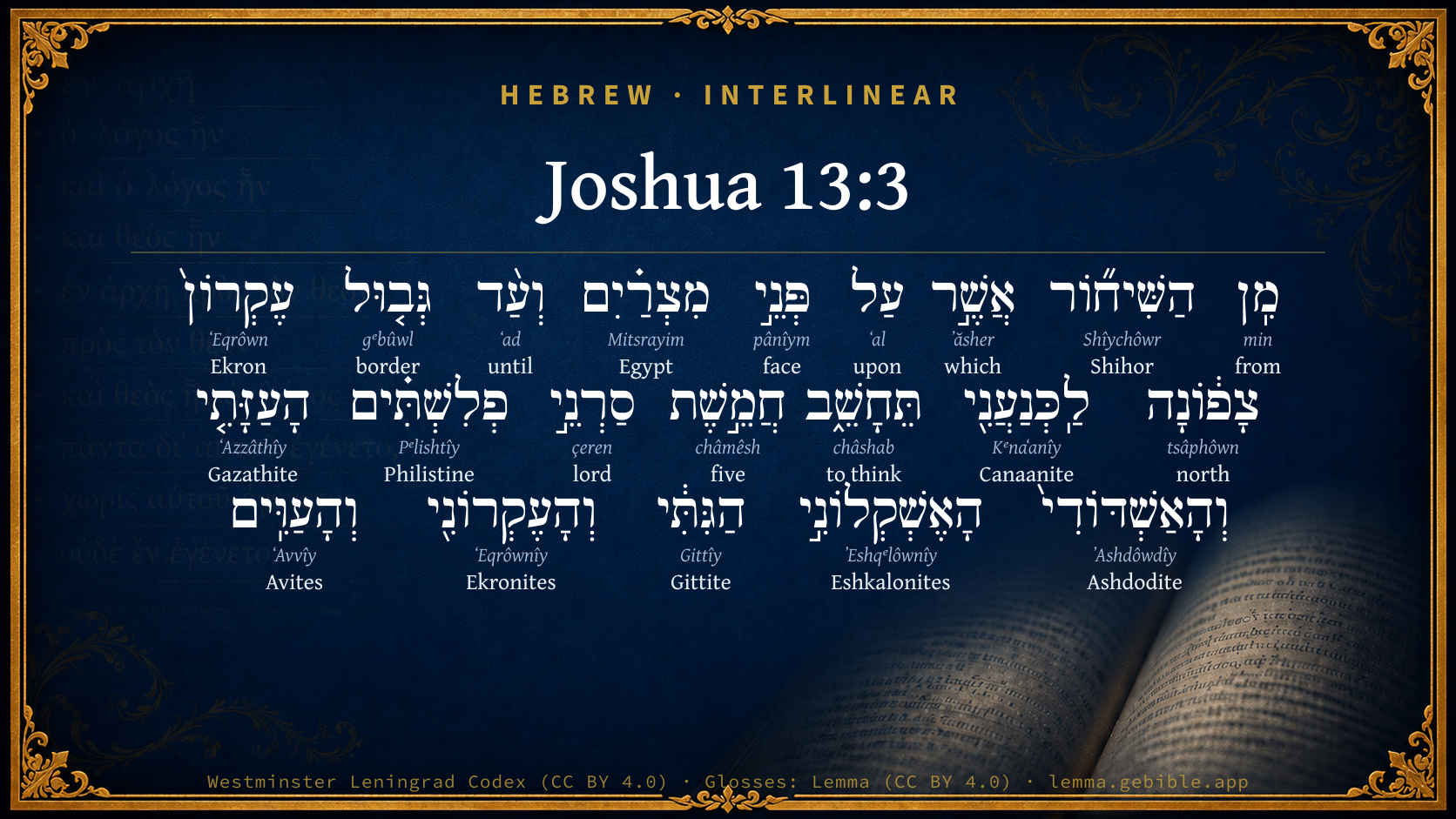
Joshua 13:3

Hebrew (Westminster Leningrad Codex) Joshua 13:3 appears in the Hebrew Old Testament. The text above is from the Westminster Leningrad Codex. Each word links to its Strong’s number, a concise gloss, and parsing drawn from the Open Scriptures Hebrew Bible morphology. Click any word for its full Brown-Driver-Briggs (BDB) entry.
Download image
Cite this verse

Joshua 13:3 (World English Bible). Public Domain. Lemma interlinear Bible study tool, https://lemma.gebible.app/v/joshua/13/3.

Show BibTeX & RIS
BibTeX
RIS
English Translation
from the Shihor, which is before Egypt, even to the border of Ekron northward, [which] is reckoned to the Canaanites; the five lords of the Philistines; the Gazites, and the Ashdodites, the Ashkelonites, the Gittites, and the Ekronites; also the Avvim,
World English Bible · Public Domain
Highlights
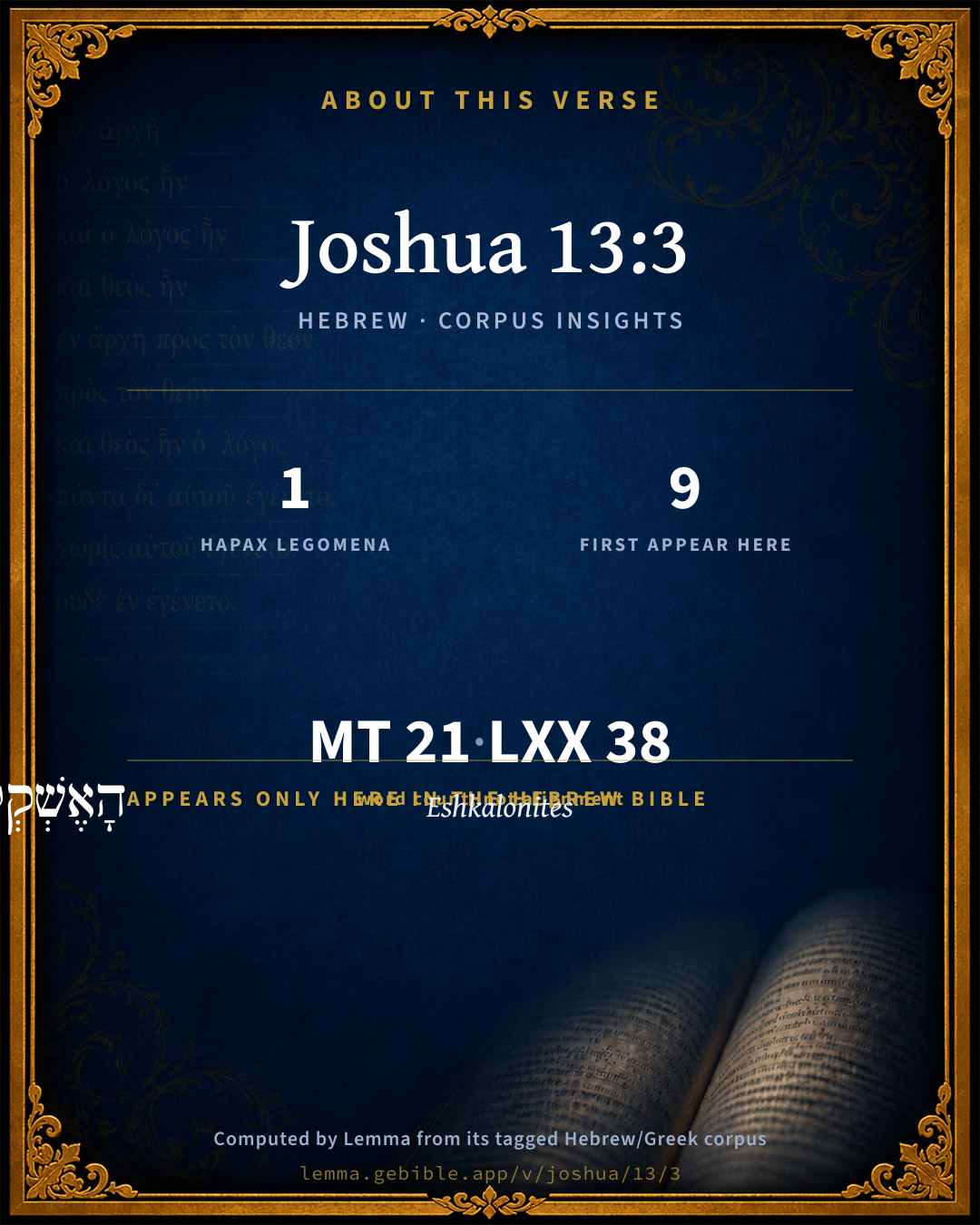
  • 1 hapax legomenon — only here in the Hebrew Bible
  • 9 first appearances in the Hebrew Bible
Full analysis ↓
Download a study sheet

One document with this verse’s original text, its word-by-word gloss line, the meaning frame, cross-references with their text, attributed commentary, and full source and license credits — printable, and it pastes into notes with its structure intact.

This verse Autodidact and up

Study sheet (.html) Plain text (.txt)

A passage Seminary Student

Up to 50 verses in one chapter. A passage sheet keeps up to 6 commentary sources and 12 cross-references per verse, in the order this page ranks them, and says so on the sheet whenever that leaves anything out. Ask for a single verse and you get the Autodidact verse sheet above.

Everything on this page stays free to read, with no account — the sheet is a download of what is already on screen, not access to it.

Want to remove ads? Support Godless Engineer
Compare translations 3

The same verse in 3 English versions, stacked beneath the original-language interlinear above. Click any original word for its lexicon entry.

Each is an independent rendering of the whole verse — the interlinear is not word-aligned to these translations.

Highlighted words mark where these versions differ — a whole-verse word diff, not a word-by-word alignment.

  • World English Bible Public Domain
    from the Shihor, which is before Egypt, even to the border of Ekron northward, [which] is reckoned to the Canaanites; the five lords of the Philistines; the Gazites, and the Ashdodites, the Ashkelonites, the Gittites, and the Ekronites; also the Avvim,
  • King James Version Public Domain
    From Sihor, which is before Egypt, even unto the borders of Ekron northward, which is counted to the Canaanite: five lords of the Philistines; the Gazathites, and the Ashdothites, the Eshkalonites, the Gittites, and the Ekronites; also the Avites:
  • unfoldingWord Literal Text CC BY-SA 4.0
    from Shihor, which at the face of Egypt, and unto the border of Ekron northward (it shall be reckoned to the Canaanite); the five lords of the Philistines: the Gazite and the Ashdodite, the Ashkelonite, the Gathite, and the Ekronite; and the Avvites

unfoldingWord Literal Text — © unfoldingWord, licensed CC BY-SA 4.0. Word-aligned USFM3 via Door43 (git.door43.org/unfoldingWord/en_ult).

Versions to compare (up to 4)

3 of 4 selected

Show all 18 translations

Every available English version of this verse, each an independent rendering of the whole verse.

  • World English Bible Public Domain
    from the Shihor, which is before Egypt, even to the border of Ekron northward, [which] is reckoned to the Canaanites; the five lords of the Philistines; the Gazites, and the Ashdodites, the Ashkelonites, the Gittites, and the Ekronites; also the Avvim,
  • Berean Standard Bible Public Domain
    from the Shihor east of Egypt to the territory of Ekron on the north (considered to be Canaanite territory)—that of the five Philistine rulers of Gaza, Ashdod, Ashkelon, Gath, and Ekron, as well as that of the Avvites;
  • Majority Standard Bible Public Domain
    from the Shihor east of Egypt to the territory of Ekron on the north (considered to be Canaanite territory)—that of the five Philistine rulers of Gaza, Ashdod, Ashkelon, Gath, and Ekron, as well as that of the Avvites;
  • King James Version Public Domain
    From Sihor, which is before Egypt, even unto the borders of Ekron northward, which is counted to the Canaanite: five lords of the Philistines; the Gazathites, and the Ashdothites, the Eshkalonites, the Gittites, and the Ekronites; also the Avites:
  • American Standard Version (1901) Public Domain
    from the Shihor, which is before Egypt, even unto the border of Ekron northward, `which' is reckoned to the Canaanites; the five lords of the Philistines; the Gazites, and the Ashdodites, the Ashkelonites, the Gittites, and the Ekronites; also the Avvim,
  • Revised Version (1885) Public Domain
    from the Shihor, which is before Egypt, even unto the border of Ekron northward, which is counted to the Canaanites: the five lords of the Philistines. the Gazites, and the Ashdodites, the Ashkelonites, the Gittites, and the Ekronites; also the Avvim,
  • Geneva Bible (1599) Public Domain
    From Nilus which is in Egypt, euen vnto the borders of Ekron Northward: this is counted of the Canaanites, euen fiue Lordships of the Philistims, the Azzithites, and the Ashdodites, the Eshkelonites, the Gittites, and the Ekronites, and the Auites:
  • Douay-Rheims (1899) Public Domain
    From the troubled river, that watereth Egypt, unto the borders of Accaron northward: the land of Chanaan, which is divided among the lords of the Philistines, the Gazites, the Azotians, the Ascalonites, the Gethites, and the Accronites.
  • Young's Literal Translation Public Domain
    from Sihor which `is' on the front of Egypt, and unto the border of Ekron northward, to the Canaanite it is reckoned, five princes of the Philistines, the Gazathite, and the Ashdothite, the Eshkalonite, the Gittite, and the Ekronite, also the Avim.
  • Literal Standard Version CC BY-SA 4.0
    from Sihor which [is] on the front of Egypt, and to the border of Ekron northward (it is reckoned to the Canaanite), five princes of the Philistines, the Gazathite, and the Ashdothite, the Eshkalonite, the Gittite, and the Ekronite, also the Avim;
  • Unlocked Literal Bible CC BY-SA 4.0
    from Shihor, which is east of Egypt, and northward to the border of Ekron, which is considered property of the Canaanites; the five rulers of the Philistines, those of Gaza, Ashdod, Ashkelon, Gath, and Ekron—the territory of the Avvites.
  • unfoldingWord Literal Text CC BY-SA 4.0
    from Shihor, which at the face of Egypt, and unto the border of Ekron northward (it shall be reckoned to the Canaanite); the five lords of the Philistines: the Gazite and the Ashdodite, the Ashkelonite, the Gathite, and the Ekronite; and the Avvites
  • Darby Bible Public Domain
    from the Shihor, which [floweth] before Egypt, as far as the borders of Ekron northward, [and which] is counted to the Canaanite; five lordships of the Philistines: of Gazah, and of Ashdod, of Eshkalon, of Gath, and of Ekron; also the Avvites;
  • World Messianic Bible Public Domain
    from the Shihor, which is before Egypt, even to the border of Ekron northward, which is counted as Canaanite; the five lords of the Philistines; the Gazites, and the Ashdodites, the Ashkelonites, the Gittites, and the Ekronites; also the Avvim,
  • Webster's Bible Public Domain
    From Sihor, which is before Egypt, even to the borders of Ekron northward, which is counted to the Canaanite: five lords of the Philistines; the Gazathites, and the Ashdothites, the Eshkalonites, the Gittites, and the Ekronites; also the Avites:
  • Free Bible Version CC BY-SA 4.0
    from the Shihur River on the border with Egypt north to the border of Ekron—all of which is counted as Canaanite but comes under the five Philistine lords of Gaza, Ashdod, Ashkelon, Gath, and Ekron. In addition there's the land of the Avvites
  • Bible in Basic English Public Domain
    From the Shihor, which is before Egypt, to the edge of Ekron to the north, which is taken to be Canaanite property: the five chiefs of the Philistines; the Gazites, and the Ashdodites, the Ashkelonites, the Gittites, and the Ekronites, as well as the Avvim;
  • JPS Tanakh (1917) Public Domain
    from the Shihor, which is before Egypt, even unto the border of Ekron northward — which is counted to the Canaanites; the five lords of the Philistines: the Gazite, and the Ashdodite, the Ashkelonite, the Gittite, and the Ekronite; also the Avvim

Literal Standard Version (2020), Covenant Press — licensed CC BY-SA 4.0. Text via the HelloAO Bible API (eBible.org). Unlocked Literal Bible (unfoldingWord) — licensed CC BY-SA 4.0. Text via the HelloAO Bible API (eBible.org). unfoldingWord Literal Text — © unfoldingWord, licensed CC BY-SA 4.0. Word-aligned USFM3 via Door43 (git.door43.org/unfoldingWord/en_ult). Free Bible Version, Dr. Jonathan Gallagher — licensed CC BY-SA 4.0. Text via the HelloAO Bible API (eBible.org).

Word by word

More ways to search: Search by grammar → Find every occurrence → Compare this word →

Practice this passage: Drill this verse → Learn its vocabulary →

הָאֶשְׁקְלוֹנִ֣י
ʼEshqᵉlôwnîy
H832
“the · Eshkalonites”
Particle, Definite Article + Noun, Gentilic, Masculine, Singular, Absolute
Part of Speech
Particle + Noun
Type
Gentilic
Gender
Masculine
Number
Singular
State
Absolute
Full BDB Definition

Origin: patrial from H831

TWOT: None

Eshkalonites = "the fire of infamy: I shall be weighed" - an inhabitant of Ashkelon
  1. מִֽן min H4480 “from” Preposition
  2. הַשִּׁיח֞וֹר Shîychôwr H7883 “the · Shihor” Particle, Definite Article + Noun, Proper
  3. אֲשֶׁ֣ר ʼăsher H834 “which” Particle, Relative
  4. עַל ʻal H5921 “upon” Preposition
  5. פְּנֵ֣י pânîym H6440 “face(s) of” Noun, Common, Both, Plural, Construct
  6. מִצְרַ֗יִם Mitsrayim H4714 “Egypt” Noun, Proper
  7. וְעַ֨ד ʻad H5704 “and · until” Conjunction + Preposition
  8. גְּב֤וּל gᵉbûwl H1366 “border of” Noun, Common, Masculine, Singular, Construct
  9. עֶקְרוֹן֙ ʻEqrôwn H6138 “Ekron” Noun, Proper
  10. צָפ֔וֹנָה tsâphôwn H6828 “north · toward” Noun, Common, Feminine, Singular, Absolute + Suffix, Demonstrative
  11. לַֽכְּנַעֲנִ֖י Kᵉnaʻanîy H3669 “to/for the · Canaanite” Preposition, Determined + Noun, Gentilic, Masculine, Singular, Absolute
  12. תֵּחָשֵׁ֑ב châshab H2803 “to think” Verb, Niphal, Imperfect, 3rd Person, Feminine, Singular
  13. חֲמֵ֣שֶׁת châmêsh H2568 “five” Adjective, Cardinal number, Masculine, Singular, Construct
  14. סַרְנֵ֣י çeren H5633 “lords of” Noun, Common, Masculine, Plural, Construct
  15. פְלִשְׁתִּ֗ים Pᵉlishtîy H6430 “Philistines” Noun, Gentilic, Masculine, Plural, Absolute
  16. הָעַזָּתִ֤י ʻAzzâthîy H5841 “the · Gazathite” Particle, Definite Article + Noun, Gentilic, Masculine, Singular, Absolute
  17. וְהָאַשְׁדּוֹדִי֙ ʼAshdôwdîy H796 “and · the · Ashdodite” Conjunction + Particle, Definite Article + Noun, Gentilic, Masculine, Singular, Absolute
  18. הַגִּתִּ֔י Gittîy H1663 “the · Gittite” Particle, Definite Article + Noun, Gentilic, Masculine, Singular, Absolute
  19. וְהָעֶקְרוֹנִ֖י ʻEqrôwnîy H6139 “and · the · Ekronites” Conjunction + Particle, Definite Article + Noun, Gentilic, Masculine, Singular, Absolute
  20. וְהָעַוִּֽים ʻAvvîy H5757 “and · the · Avites” Conjunction + Particle, Definite Article + Noun, Proper

About this verse

These counts appear in no published source. They are computed here, from the morphology-tagged text and Lemma’s own curated glosses. What Lemma adds →

21
words
21
distinct lemmas
Historical
section

Notable vocabulary

1 hapax legomenon — a word that appears only here in the entire Hebrew Bible:

  • הָאֶשְׁקְלוֹנִ֣י Eshkalonites H832

First appearance in Scripture

These words make their first canonical appearance in the Hebrew Bible here (9 in total — showing 8):

  • הַשִּׁיח֞וֹר Shihor H7883
  • עֶקְרוֹן֙ Ekron H6138
  • סַרְנֵ֣י lord H5633
  • הָעַזָּתִ֤י Gazathite H5841
  • וְהָאַשְׁדּוֹדִי֙ Ashdodite H796
  • הָאֶשְׁקְלוֹנִ֣י Eshkalonites H832
  • הַגִּתִּ֔י Gittite H1663
  • וְהָעֶקְרוֹנִ֖י Ekronites H6139

Shared distinctive vocabulary

הָעַזָּתִ֤י Gazathite H5841 occurs in 2 verses of the Hebrew Bible. Also found in:

Grammatical profile

  • 1 verb
  • 15 nouns
  • 1 adjective
  • 3 prepositions
  • 1 particle

Verb forms

  • תֵּחָשֵׁ֑ב Niphal · Imperfect

Hebrew & Septuagint length

In English translation the verse runs 41 words from the Hebrew and 50 from the Septuagint (LXX English) — closely comparable.

A rough comparison of the two English renderings, which tokenize alike — not a word-level alignment.

Word counts can differ between the Hebrew and the Greek without any difference in meaning — e.g. the Hebrew direct-object marker אֵת has no separate Greek word, and Greek often adds the article ὁ.

In the original languages it is 21 Hebrew tokens and 38 Greek tokens — but the two are counted differently (Hebrew bundles its prefixes and suffixes into one token; the Greek is in lemma form), so that isn’t a like-for-like length.

Cross-references

10

Topical passages linked to Joshua 13:3 in the Treasury of Scripture Knowledge — connected by theme and wording, ordered by reader-vote popularity; previews shown in the World English Bible.

  • Deuteronomy 2:23 and the Avvim, who lived in villages as far as Gaza, the Caphtorim, who came forth out of Caphtor, destroyed them, and lived in their place.)
  • Judges 3:3 [namely], the five lords of the Philistines, and all the Canaanites, and the Sidonians, and the Hivites who lived on Mount Lebanon, from Mount Baal Hermon to the entrance of Hamath.
  • Jeremiah 2:18 Now what have you to do in the way to Egypt, to drink the waters of the Shihor? or what have you to do in the way to Assyria, to drink the waters of the River?
  • Genesis 10:6 The sons of Ham: Cush, Mizraim, Put, and Canaan.
  • Genesis 10:15–19 Canaan became the father of Sidon (his firstborn), Heth,
  • Numbers 34:2–14 Command the children of Israel, and tell them, When you come into the land of Canaan (this is the land that shall fall to you for an inheritance, even the land of Canaan according to the borders of it),
  • Joshua 13:13 Nevertheless the children of Israel didn't drive out the Geshurites, nor the Maacathites: but Geshur and Maacath dwell in the midst of Israel to this day.
  • 1 Samuel 6:4 Then they said, "What shall be the trespass-offering which we shall return to him?" They said, "Five golden tumors, and five golden mice, [according to] the number of the lords of the Philistines; for one plague was on you all, and on your lords.
  • 1 Samuel 6:16–17 When the five lords of the Philistines had seen it, they returned to Ekron the same day.
  • Zephaniah 2:4–5 For Gaza will be forsaken, and Ashkelon a desolation. They will drive out Ashdod at noonday, and Ekron will be rooted up.

Cross-references courtesy of OpenBible.info (CC BY 4.0).

Hebrew and Greek witnesses Masoretic Hebrew ↔ Greek Septuagint

The same verse in the two great witnesses to the Old Testament, shown verse-for-verse.

These are two independent witnesses, not word-aligned to each other, and the Septuagint is shown in lemma (dictionary) form.

Hebrew Joshua 13:3 Masoretic · Westminster Leningrad Codex

מִֽן הַשִּׁיח֞וֹר אֲשֶׁ֣ר עַל פְּנֵ֣י מִצְרַ֗יִם וְעַ֨ד גְּב֤וּל עֶקְרוֹן֙ צָפ֔וֹנָה לַֽכְּנַעֲנִ֖י תֵּחָשֵׁ֑ב חֲמֵ֣שֶׁת סַרְנֵ֣י פְלִשְׁתִּ֗ים הָעַזָּתִ֤י וְהָאַשְׁדּוֹדִי֙ הָאֶשְׁקְלוֹנִ֣י הַגִּתִּ֔י וְהָעֶקְרוֹנִ֖י וְהָעַוִּֽים

from the Shihor, which is before Egypt, even to the border of Ekron northward, [which] is reckoned to the Canaanites; the five lords of the Philistines; the Gazites, and the Ashdodites, the Ashkelonites, the Gittites, and the Ekronites; also the Avvim,

World English Bible · Public Domain

Greek LXX Joshua 13:3 Septuagint · lemma form

ἀπό ὁ ἀοίκητος ὁ κατά πρόσωπον αἴγυπτος ἕως ὁ ὅριον ακκαρων ἐκ εὐώνυμος ὁ χαναναῖος προςλογίζομαι ὁ πέντε σατραπεία ὁ φυλιστιιμ ὁ γαζαῖος καί ὁ ἀζώτιος καί ὁ ἀσκαλωνίτης καί ὁ γεθθαῖος καί ὁ ακκαρωνίτης καί ὁ ευαῖος

from the wilderness before Egypt, as far as the borders of Accaron on the left of the Chananites the land is reckoned to the five principalities of the Phylistines, to the inhabitant of Gaza, and of Azotus, and of Ascalon, and of Geth, and of Accaron, and to the Evite;

LXX2012 (modern English Septuagint) · Public Domain

On this verse, Jamieson, Fausset & Brown discusses the Septuagint’s reading. Read the note in Commentary ↓

Hebrew: Westminster Leningrad Codex (CC BY 4.0). Greek: Septuagint (public domain); English from LXX2012 (modern English Septuagint) (Public Domain). How the Septuagint differs from the Hebrew →

Targum (Aramaic paraphrase)

1

The Targum is the ancient Jewish Aramaic paraphrase of the Hebrew Scriptures — an interpretive translation, not the Hebrew text itself. Onkelos (literal) and Pseudo-Jonathan (expansive) render the Torah, and Jonathan the Prophets. Coverage is partial: where no permissively-licensed English translation exists for a verse, only the Aramaic is shown. This is verse-level text, not a word-by-word alignment to the Hebrew.

  1. Targum Jonathan Prophets (Joshua–Malachi)
    מִן שִׁיחוֹר דִי עַל אַפֵּי מִצְרַיִם וְעַד תְּחוּם עֶקְרוֹן צִפּוּנָא עַל אַרְעָא כְנַעֲנָאֵי תִּתְמְנִי חַמְשָׁא טוּרְנֵי פְּלִשְׁתָּאֵי עֲזָתָאֵי וְאַשְׁדוֹדָאֵי אַשְׁקְלוֹנָאֵי גִתָּאֵי וְעֶקְרוֹנָאֵי וְעַוָאֵי:

    (no public-domain English translation for this verse)

    Targum Jonathan — Aramaic: “Mikraot Gedolot” (public domain). English: “Sefaria Community Translation” (CC0 1.0 (public-domain dedication)); “London "Chaldee Paraphrase," 1871” (public domain). Text via Sefaria.

Commentary

Notes on Joshua 13:3 from classic Christian and Jewish commentators (each source and its license shown beneath its notes). The classic Christian expositions comment on the surrounding passage and are grouped to its opening verse, so a note may address several verses; the Jewish commentaries on the Tanakh (Rashi and others) are per-verse, so they appear only where the commentator wrote on this verse.

Lemma curates 59 commentaries, every one of them public domain or Creative Commons licensed, each selected and text-cleaned for this edition rather than reprinted as found. About our sources →

Trapp's Complete Commentary

John Trapp

Jos 13:3 From Sihor, which [is] before Egypt, even unto the borders of Ekron northward, [which] is counted to the Canaanite: five lords of the Philistines; the Gazathites, and the Ashdothites, the Eshkalonites, the Gittites, and the Ekronites; also the Avites:

Ver. 3. From Sihor.] Or Nile, which hath its name Sihor from blackness, and Nile from muddiness. So much of Egypt as this river watereth, is a black mould, so fruitful, as they do but throw in the seed, and have four rich harvests in less than four months, as travellers tell us.

Also the Avites.] Who, belike, still held part of their old possession. {Deu 2:22-23}

John Trapp, A Commentary or Exposition upon All the Books of the Old and New Testament (1647–1656) — public domain. Text from a community e-Sword module.

Tyndale Open Study Notes

Tyndale Open Resources

13:3 The stream of Shihor probably marked the traditional boundary between Canaan and Egypt, bisecting the northern Sinai Peninsula. • The Philistine territory included five main cities: Gaza, Ashdod, and Ashkelon were on the Mediterranean coast, and Gath and Ekron were a few miles inland. • The Philistines displaced the Avvites (Deut 2:23).

Tyndale Open Study Notes — © Tyndale Open Resources, licensed CC BY-SA 4.0. Text via the HelloAO Bible API.

Geneva Bible (1599)

Geneva Bible translators

Hebrew, upon the face of Egypt.

Hebrew, Sihor.

Geneva Bible (1599) marginal notes — public domain. Text via Bolls.life.

Jamieson, Fausset & Brown

Robert Jamieson, A. R. Fausset & David Brown

also the Avites: From [on] the south--The two clauses are thus connected in the Septuagint and many other versions. On being driven out (Deu 2:23), they established themselves in the south of Philistia. The second division of the unconquered country comprised

Jamieson, Fausset & Brown — Commentary Critical and Explanatory on the Whole Bible (1871) — public domain (CC PDM 1.0). Text via the HelloAO Bible API.

Adam Clarke's Commentary

Verse 3. From Sihor, which is before Egypt] Supposed by some to be the Pelusiac branch of the Nile, near to the Arabian Desert; called also the river of Egypt, Nu 34:5; Jer 2:18. On this subject an intelligent friend favours me with the following opinion: -

"The river Sihor is supposed by some to be the Nile, or a branch of it. Others think it the same as what is frequently called the river of Egypt, which lay before or towards the borders of Egypt; which arose out of the mountains of Paran, and ran westward, falling into that bay of the Mediterranean which lies south of the land of the Philistines. This river is often mentioned as the boundary of the Israelites to the southwest, as Euphrates, the great river, was on the northeast.

"There was a desert of considerable distance between what is called the river of Egypt and the isthmus of Suez. Solomon reigned to the borders of Egypt, i.e., to this desert; but not in Egypt, nor to the river Nile.

"Upon the whole, (though there are difficulties in the matter,) I incline to think that the river in question was not the Nile. Sihor (black) might, from some circumstances, be applied to another river as well as the Nile; though some places in Isaiah and Jeremiah seem to restrict it to the Nile." - J. C.

Ekron northward] Ekron was one of the five lordships of the Philistines, and the most northern of all the districts they possessed. Baal-zebub, its idol, is famous in Scripture; see 2Kg 1:2, c. The five lordships of the Philistines were Gaza, Ashdod, Askalon, Gath, and Ekron. There is no proof that ever the Israelites possessed Ekron though, from Jos 15:11, some think it was originally given to Judah, but the text does not say so; it only states that the border of the tribe of Judah went out UNTO THE SIDE of Ekron. From Jos 19:43, we learn that it was a part of the lot of Dan, but it does not appear to have been possessed by any of those tribes.

Counted to the Canaanite] It is generally allowed that the original possessors of this country were the descendants of Canaan, the youngest son of Ham. The Philistines sprang from Mizraim, the second son of Ham, and, having dispossessed the Avim from the places they held in this land, dwelt in their stead. See Ge 10:13-14.

Five lords of the Philistines] These dynasties are famous in the Scriptures for their successful wars against the Israelites, of whom they were almost the perpetual scourge.

Also the Avites] These must not be confounded with the Hivites. The Avites seem to have been a very inconsiderable tribe, who dwelt in some of the skirts of Palestine. They had been originally deprived of their country by the Caphtorim; and though they lived as a distinct people, they had never afterwards arrived to any authority.

Adam Clarke's Commentary on the Bible (1810–1826) — public domain. Text from a community e-Sword/MySword module.

The Cambridge Bible for Schools and Colleges

gen. ed. J. J. S. Perowne

3. from Sihor] = “the Black Stream,” the usual name of the Nile. Here probably it is “the river of Egypt,” the Wady el Arish (1Ch_13:5), the Rhinokolura or Rhinokorura. Wyclif, following the Vulg., “a fluvio turbido qui irrigat Ægyptum,” renders it, “the trubli flood that weetith Egipt.”

which is before Egypt] The “brook of Egypt” flows actually before, i.e. in a N. E. direction from Egypt, while the Nile takes its course through the middle of that country.

unto the borders of Ekron] The most northerly of the five towns belonging to the lords of the Philistines. The city of the fly-god Beelzebub. In the Apocrypha it appears as Accaron (1Ma_10:89).

which is counted to the Canaanite] Or better, shall it be counted to the Canaanites. The western strip of country beginning at Sihor, and extending northward to Ekron, was to be regarded as Canaanitish, and so subject to conquest; although the Philistines were not Canaanites, but were sprung from Mizraim (Gen_10:13) and had dispossessed the Canaanite Avites or Avim.

five lords] A special word is here used, and the cities over which they held sway are enumerated as (i) Gaza; (ii) Ashdod; (iii) Ashkelon; (iv) Gath; (v) Ekron.

the Gazathites] See above, Jos_10:41, Jos_11:22.

the Ashdothites] See above, Jos_11:22.

the Eshkalonites] Or Ashkalonites of Ashkelon, which is mentioned nowhere else in the book of Joshua. Next to Gaza it was probably the most important city of the Philistines. Hither Samson repaired from Timnath (Jdg_14:19); there David would not have the deaths of Saul and Jonathan proclaimed (2Sa_1:20), lest the daughters of the Philistines should rejoice. Like the other Philistine cities, it was threatened by the prophets with the Divine judgment (see Jer_25:20; Jer_47:5; Jer_47:7; Amo_1:8; Zep_2:7; Zec_9:5). Near the town afterwards rose the celebrated temple of Derceto, the Syrian Venus. It played a conspicuous part in the struggles of the Crusades, and within the walls and towers now standing Richard I. held his court. See Smith’s Dictionary of the Bible, sub voc.

the Gittites] i.e. the people of Gath, the home of Goliath (1Sa_17:4); connected with Ashkelon in David’s lamentation (2Sa_1:20); conquered by David (1Ch_18:1). See above, Jos_11:22.

also the Avites] Avim, or Avims. These people, a portion of the early inhabitants of Palestine, are mentioned in Deu_2:23 as dwelling in the villages in the southern part of the great western lowland as far as Gaza. Here they were attacked by the invading Philistines, who drove them northwards and occupied their rich possessions.

The Cambridge Bible for Schools and Colleges (gen. ed. J. J. S. Perowne; Cambridge University Press, 1878–1918) — public domain. Text from a community e-Sword module.

John Gill's Exposition

From Sihor, which is before Egypt,.... Which Jarchi and Kimchi interpret of the river Nile, and so that river is called, Jer 2:18; it seems to have this name from the waters of it being black and turbid; and hence it was called by the Greeks "Melas"; and by the Latins "Melo"; though it is thought, that not properly the river itself is here meant, which did not reach to the borders of Palestine, but a branch of it, a rivulet from it, for so a traveller (a) writes,"in a journey of about five days from Gaza towards Egypt, the hithermost arm of the Nile is received by the sea, and is commonly called Carabus?"

even unto the borders of Ekron northward: that is, from the southwest of Palestine, near to which was the river Nile, to the northern part of it, where stood the principality of Ekron, one of the five which belonged to the Philistines:

which is counted to the Canaanite; which was reckoned as belonging to the posterity of Canaan, though the Philistines got possession of it, who descended from Mizraim; and indeed it was only accounted as belonging to Canaan and his sons; of right, and according to the grant of God, it belonged to the seed of Abraham:

five lords of the Philistines; who had not kings, as other countries and cities in the land of Canaan had, and their cities were called lordships, principalities, and not kingdoms, and are as follow:

the Gazathites, and the Ashdothites, the Eshkalonites, the Gittites,

and the Ekronites: so called from Gaza, Ashdod, Ashkelon, Gath, and Ekron, the cities they were in possession of:

also the Avites; it is not certain whether these were a distinct principality from the other five, or a people dispersed among them; which seems most likely, since those were the original inhabitants, but were driven out or destroyed by the Philistines, though it seems some remained and dwelt among them; see Deu 2:23.

(a) Jodocus a Gistella apud Drusium in loc.

John Gill's Exposition of the Whole Bible (1746–1763) — public domain (CC PDM 1.0). Text via the HelloAO Bible API.

Albert Barnes' Notes on the Bible

Sihor is derived from a root signifying “to be black,” and is suitable enough as an appellative of the Nile Isa 23:3. Here it most probably stands for “the river of Egypt” (Num 34:3 note), the modern “Wady el Arish”.

Ekron (“Akir”) lay on the northern boundary of Judah Jos 15:11, and was actually conquered by the men of that tribe Jdg 1:18, though assigned in the allotment of the land to Dan Jos 19:43. It seems to have fallen again into the hands of the Philistines in the days of the Judges 1Sa 5:10, was reconquered by Samuel (compare 1Sa 7:14), but figures in subsequent times as a Philistine city only (compare 1Sa 17:52; 2Ki 1:2, 2Ki 1:16, etc.).

Lords - The Hebrew word סרן seren means “an axle,” and is applied as a title special to the chiefs (compare Jdg 3:3 and marginal references) of the Philistines Gen 10:14.

Gaza was the most southern of the Philistine cities (compare Jos 10:41; Jos 11:22). It was allotted to the tribe of Judah Jos 15:47, and was, with Askalon, taken by the warriors of that tribe Jdg 1:18. Both cities were soon re-occupied by the Philistines, and subsequently are always mentioned as Philistine cities. Gaza lay on the direct route of the Egyptian armies in their invasions of Syria, by whom it was captured more than once. Special judgments are denounced against Gaza for the cruelty of its people toward the Jews in the time of their humiliation Amo 1:6-7; Zep 2:4; Zec 9:5, and in the time of Jerome the ancient city was a ruin of which the foundations could hardly be traced, and the then existing town was built on another site. Gaza was in later times an episcopal see, and is now a thriving place containing some 15,000 inhabitants, a larger population than that of Jerusalem.

Ashdod (“Esdud;” Azotus, Act 8:40) was, like Gaza, allotted to Judah (see Jos 15:46-47), but was soon regained by the Philistines, and became a principal seat of their Dagon worship. Here the ark of God was taken after its capture by the Philistines (1Sa 5:1 ff). Its name ( “fortress,” “castle”), no less than its history (compare 2Ch 26:6; Isa 20:1; Neh 4:7, etc.) indicates its importance as a stronghold; it withstood for twenty-nine years the longest siege on record by the Egyptian king Psammetichus. Like Gaza, it was doomed by the Jewish prophets to desolation, and it was utterly destroyed by the Maccabees (1 Macc. 10:77-84; 11:4). It was, however, rebuilt by the Romans, and figures in Christian times as an episcopal city.

Askelon (see Jdg 1:18), the birthplace of Herod the Great, figures as an important town and seaport in the history of the Crusades, and very massive ruins still attest the ancient strength and grandeur of the place. It is situated about midway between Gaza and Ashdod.

Gath seems to have been first taken by David 1Ch 18:1. It is not named again in the book of Joshua. It was the town of Goliath 1Sa 17:4, and is mentioned in David’s elegy over Saul as a leading Philistine city 2Sa 1:20. It was the nearest of the Philistine cities to Jerusalem, but both the name and the city have perished; its site is conjecturally placed (by Condor) at Tell es Safi.

Avites - See Deu 2:23 note.

Albert Barnes' Notes on the Bible (1834–1885) — public domain. Text from a community e-Sword/MySword module.

Haydock's Catholic Bible Commentary

Egypt. Hebrew, "from the Shicor, (or Sichor) which is on the face, (or over-against) Egypt." Jeremias (ii. 18,) informs us that this river was in Egypt which is not true of the torrent of Rhinocorure; which the Septuagint and many commentators, understand in this place to be the boundary fixed for the promised land. Strabo, &c., attribute that torrent to Phœnicia; which they extend as far as Pelusium. St. Jerome (in Amos vi.) seems dubious whether the branch of the Nile passes by that city, or the aforesaid torrent be meant. David collected all his forces from the Sichor, or the torrent of Egypt, to the entrance of Emath, 1 Paralipomenon xiii. 5. Epiphanes constituted Lysanias governor of all the countries between the Euphrates and the river of Egypt, (2 Machabees iii. 32,) and he undoubtedly had extended his conquests as far as the Nile. Though the country beyond Gaza be now mostly barren, and therefore little inhabited or noticed, yet the Israelites were entitled to assert their right to it, as they seem to have done by taking possession of Gosen, chap. x. 41. Some parts were formerly well peopled, 1 Kings xxvii. 8. It is not unusual for the Nile, and other great rivers, to be styled torrents. The Hebrew nel, is often applied to rivers, Ecclesiastes i. 7. The troubled state in which the waters of the Nile generally appear, is very remarkable, as their taste is most excellent. The natives have discovered a method of rendering them clear, by the mixture of almond powder. The names of this river bear some relation to the Hebrew term which is here used. It was formerly called Sirius. The Ethiopians style it Schichri. Another name was Melas, or Egyptus, denoting "blackness." The people of the country idolized this river, because it supplied the want of rain. (Tibul, i. 8.) (Calmet) --- Accaron, the most northern city of the Philistian principalities, (Haydock) attributed to Juda or Dan, though neither held it for any length of time. Beelzebub was chiefly adored here, 4 Kings i. 2. --- Lords, who seem to have been independent. They are styled Sornim, as the next in dignity to the king of Persia was a Surena. (Marcellin. 24.) The Philistines took this country from the Chanaanites, or Eveans, (Calmet) who are a different people from the Hevites. (Bochart)

George Leo Haydock (1774–1849), Haydock's Catholic Family Bible and Commentary, 1859 edition — public domain. Excludes Psalms (Douay-Rheims chapter numbering differs from Protestant) and Deuterocanonical books (Catholic canon only).

Matthew Poole's English Annotations

Sihor; a river, of which see Isa 23:3; Jer 2:18.

Which is counted to the Canaanite, i.e. which, though now possessed by the Philistines, who drove out the Canaanites, the old inhabitants of it, Deu 2:23; Amo 9:7; yet is a part of the land of Canaan, and therefore belongs to the Israelites.

The Avites, or the Avims, as they are called, Deu 2:23; who though they were expelled out of their ancient seat, and most of them destroyed by the Caphtorims or Philistines, as is there said, yet many of them probably escaped, and planted themselves in some other place not very far from the former.

Matthew Poole's English Annotations on the Holy Bible (1683–1685) — public domain. Text from a community e-Sword/MySword module.

Whedon's Commentary on the Bible

Daniel D. Whedon

3. Sihor is not, in this passage, the Nile, as some have supposed, but rather the Wady el-Arish or Rhinocorura, which is before Egypt, that is, east of Egypt, constituting the southern boundary of Canaan. It is also called “the river of Egypt.” Jos_15:4. Ekron, the most northerly city of the Philistines, is represented by the modern village of Akir twenty-four miles west of Jerusalem, containing about fifty mud houses, without a remnant of antiquity except two large, finely built wells. [

Which is counted to the Canaanite — As all that belonged to the Canaanite was now to be divided among the nine and one half tribes of Israel, it was important to know the whole extent of their ancient territory. The Philistines were not of Canaanitish but Egyptian origin, being descended from Mizraim.

Gen_10:14. They seem to have expelled the original Canaanites, and dwelt in their coasts by the sea.]

Gazathites, and Ashdothites — See Jos_11:22, note. Eshkalon stood upon the Mediterranean, about fifteen miles north of Gaza. Retaining nearly the same name, it now consists of very thick walls and ruins of temples and theatres.

Gittites — People of Gath.

Avites — An early, but probably not an aboriginal, people in Philistia.

Daniel D. Whedon (gen. ed.), Commentary on the Old and New Testaments (1874–1909) — public domain. Text from a community e-Sword module.

The Pulpit Commentary

From Sihor. This word, which has the article in Hebrew, is literally the black river. This has been thought to be the Nile, known to both Greeks and Latins by that title. The Greeks called it melav . So Virgil says of it, "AEgyptum nigra foecundat arena." The Vulgate has "a fluvio turbido qui irrigat Aegyptum." The LXX translates by aoikhtov . The phrase which is "before" (ynepAl) Egypt seems to exclude the idea of the Nile, since the Nile flowed through the centre of Egypt, and it is impossible to make nepAl equivalent to brqB. As Drusins remarks, moreover, the Nile is always called either raoy or "the river of Egypt." The interpretation which has found most favour of late, therefore, refers this expression to a small river that flows into the sea at the extreme southern border of Palestine. This river was known as the "river of Egypt", (cf. Gen_15:18) and is now called the Wady-el-Arisch (cf. also Jos_15:4, Jos_15:47, as well as Num_34:5 1Ki_8:65 Isa_27:12, where the word is nahal, or winter torrent, a word inapplicable to the Nile). For Sihor, or Shichor, see Isa_23:3 Jer_2:18, and especially 1Ch_13:5, which seems decisive against the Nile. Which is counted to the Canaanite. These words are connected by the Masorites with what follows: The five lords of the Philistines are reckoned to the Canaanite. The five lords of the Philistines. The Philistines (Deu_2:23 Gen_10:14, and 1Ch_1:12) are supposed to be of Egyptian origin. Ewald (also Hitzig, "Geschichte des Volkes Israel," p. 20) believes Caphtor to be Crete, and supposes the Cherethites and Pelethites who formed David"s body-guard (2Sa_15:18) to be Cretans and Philistines. (see Eze_25:16) But this opinion is disputed by many commentators of note, and is far from probable in itself. They were David"s most trusted and faithful troops, and it seems hardly probable that so truly national a monarch would have assigned the post of honour around his person to the hereditary enemies of his race. Ritter, however, believes the Cherethites and Pelethites to be Philistines, and appeals to 1Sa_30:14, and still more forcibly to Zep_2:4, Zep_2:5. It should be remembered, too, that Ittai was a Gittite, or native of Gath. (see 2Sa_15:21) The term here used, translated lords (satraps, LXX), is peculiar to the Philistines. It is to be found also in Jud_1:3:3 1Sa_5:8, etc. In 1Ki_7:30 the word means an axle, or perhaps the outside plating of the wheel, and in the kindred languages it signifies a wheel. The expression is remarkable in connection with the phrase "circles of the Philistines." The Eshkalalonites. The inhabitants of Ashkelon, as the Gittites are of Gath. Also the Avites. Literally, "and the Avites." There is no "also" in the original, though the Avites or Avim are supposed (see Deu_2:23, and note on Geshuri in the last verse) to have been aborigines preceding the Canaanites, and dispossessed by the Philistines. Keil, however, disputes this view, and holds that we have no evidence that any but a Canaanitish people dwelt in southwestern Palestine. This Canaanitish tribe, he thinks, was driven out by the Philistines. Some few of the Avites, or rather Avvites, continued to dwell among their conquerors. But the coincidence between Deu_2:22, Deu_2:23, and 1Sa_27:8, makes strongly for Ewald"s view above. And Keil and Delitzsch, in their later joint work, incline to it. See Introduction III The word Avvim, like Havoth, or Havvoth (see ver. 30), is supposed to mean villages, or inhabited enclosures.

The Pulpit Commentary (1880–1919), ed. H.D.M. Spence-Jones & Joseph S. Exell — public domain. Text from a community e-Sword module.

John Wesley's Explanatory Notes

Counted to the Canaanites - That is, which though now possessed by the Philistines, who drove out the Canaanites the old inhabitants of it, Deut. ii, 23 Amos ix, 7, yet is a part of the land of Canaan, and therefore belongs to the Israelites. The Avites - Or, the Avims, as they are called, Deut. ii, 23, who though they were expelled out of their ancient seat, and most of them destroyed by the Caphtorims or Philistines, as is there said, yet many of them escaped, and planted themselves not very far from the former.

John Wesley, Explanatory Notes Upon the Whole Bible (1754–1765) — public domain. Text via the GEBible commentary corpus.

Rashi

Rabbi Shlomo Yitzchaki (Rashi)

From Shichor. This is the Nile River, which is also referred to as the Egyptian brook. It is close to the southwestern border of Eretz Yisroel, as it is said in Parshas, “These are the journeys.” From here we learn that in Yehoshua’s lifetime, he did not conquer the entire southern border except from the wilderness of Tzin, which is synonymous with the bare, divided mountain that goes up to Seir; to the Nile. This is the boundry of Gaza mentioned above, “From Kodeish-Barneia to Gaza.

To the border of Ekron, to the north. The Ekronites lived near the Sea, and they spread out northward further than the others.

Which is considered the territory of Canaan. It is of the land of Canaan that I gave to Avrohom [as an inheritance].

The territory of the five Philistine rulers. This is the territory from the end of the border to the Great [Mediterranean] Sea, westward.

The Azites, the Ashdodites, the Ashkelonites. There are six rulers counted in the verse and he previously called them five [rulers]. Said Rav Yochanan, “Five of them were prominent. There were five prominent rulers [that were counted], for the Avites were not counted among the prominent rulers. It can be explained in an other way: The five Philistine rulers were: the Azites, the Ashdodites, the Ashkelonites, the Gittites, and the Ekronites. These are the five [rulers mentioned]. The land of the Avites remained unconquered for they were not of the Philistine people.

Rashi on the Tanakh — English translations: “The Judaica Press complete Tanach with Rashi, translated by A. J. Rosenberg” (CC BY 4.0); “Pentateuch with Rashi's commentary by M. Rosenbaum and A.M. Silbermann, 1929-1934” (public domain); “The Metsudah Tanach series, Lakewood, N.J” (CC BY 4.0); and “The Book of Joshua, Metsudah Publications, 1997” (CC BY 4.0). Text via Sefaria.

Lesson kit

Teaching starters — assembled from the data on this page, not authored interpretation. Every prompt links to the verse data it draws on. Edit before teaching.

Joshua, in the Historical, opens this verse with 21 words (21 distinct Hebrew lemmas). Its most distinctive word is ʼEshqᵉlôwnîy (“Eshkalonites”). A historical commentator’s framing appears above. Read the whole chapter for the surrounding context.

Discussion questions

  1. The word ʼEshqᵉlôwnîy carries the sense “Eshkalonites.” How does it shape the verse?
  2. 1 word here appears nowhere else in the Hebrew Bible. Why might the author reach for such rare wording?
  3. 9 words make their first appearance in Scripture here. What does this debut establish?
  4. How does Judges 16:2, which shares the word «Gazathite», read alongside this verse?
  5. The translations on this page render this verse differently — a whole-verse word diff, not a word-by-word alignment. What might account for the different wordings?
  6. «תֵּחָשֵׁ֑ב» is a Niphal Imperfect verb. How does that grammatical form shape the action described?
  7. Compare how Trapp's Complete Commentary and Tyndale Open Study Notes read this verse. Where do they agree or differ?

Things to notice

Reading settings

Reading text

Shown beneath each verse's original-language words.

Old Testament
Old Testament edition

Read the OT as the Masoretic Hebrew (MT) or the Greek Septuagint (LXX).

English shown for the Greek Septuagint (in the Hebrew ↔ Greek comparison).

Comparing translations? Open the Compare panel on any verse page to stack up to four side by side.