Joshua 13:25

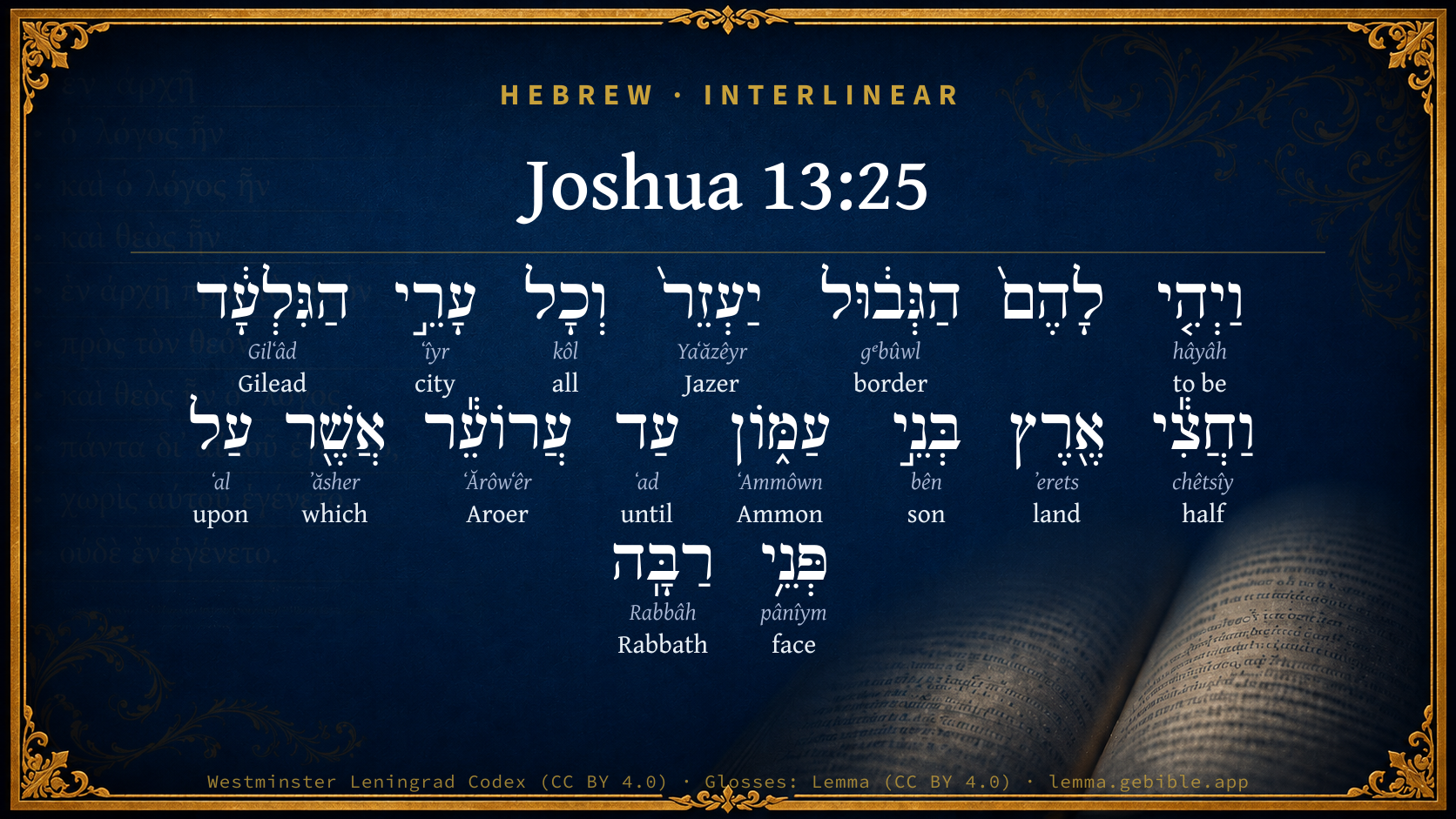
Hebrew (Westminster Leningrad Codex) Joshua 13:25 appears in the Hebrew Old Testament. The text above is from the Westminster Leningrad Codex. Each word links to its Strong’s number, a concise gloss, and parsing drawn from the Open Scriptures Hebrew Bible morphology. Click any word for its full Brown-Driver-Briggs (BDB) entry.
Download image
Cite this verse

Joshua 13:25 (World English Bible). Public Domain. Lemma interlinear Bible study tool, https://lemma.gebible.app/v/joshua/13/25.

Show BibTeX & RIS
BibTeX
RIS
English Translation
Their border was Jazer, and all the cities of Gilead, and half the land of the children of Ammon, to Aroer that is before Rabbah;
World English Bible · Public Domain
Download a study sheet

One document with this verse’s original text, its word-by-word gloss line, the meaning frame, cross-references with their text, attributed commentary, and full source and license credits — printable, and it pastes into notes with its structure intact.

This verse Autodidact and up

Study sheet (.html) Plain text (.txt)

A passage Seminary Student

Up to 50 verses in one chapter. A passage sheet keeps up to 6 commentary sources and 12 cross-references per verse, in the order this page ranks them, and says so on the sheet whenever that leaves anything out. Ask for a single verse and you get the Autodidact verse sheet above.

Everything on this page stays free to read, with no account — the sheet is a download of what is already on screen, not access to it.

Want to remove ads? Support Godless Engineer
Compare translations 3

The same verse in 3 English versions, stacked beneath the original-language interlinear above. Click any original word for its lexicon entry.

Each is an independent rendering of the whole verse — the interlinear is not word-aligned to these translations.

Highlighted words mark where these versions differ — a whole-verse word diff, not a word-by-word alignment.

  • World English Bible Public Domain
    Their border was Jazer, and all the cities of Gilead, and half the land of the children of Ammon, to Aroer that is before Rabbah;
  • King James Version Public Domain
    And their coast was Jazer, and all the cities of Gilead, and half the land of the children of Ammon, unto Aroer that is before Rabbah;
  • unfoldingWord Literal Text CC BY-SA 4.0
    And the border for them was Jazer and all of the cities of Gilead and half of the land of the sons of Ammon, unto Aroer, which at the face of Rabbah,

unfoldingWord Literal Text — © unfoldingWord, licensed CC BY-SA 4.0. Word-aligned USFM3 via Door43 (git.door43.org/unfoldingWord/en_ult).

Versions to compare (up to 4)

3 of 4 selected

Show all 18 translations

Every available English version of this verse, each an independent rendering of the whole verse.

  • World English Bible Public Domain
    Their border was Jazer, and all the cities of Gilead, and half the land of the children of Ammon, to Aroer that is before Rabbah;
  • Berean Standard Bible Public Domain
    The territory of Jazer, all the cities of Gilead, and half the land of the Ammonites as far as Aroer, near Rabbah;
  • Majority Standard Bible Public Domain
    The territory of Jazer, all the cities of Gilead, and half the land of the Ammonites as far as Aroer, near Rabbah;
  • King James Version Public Domain
    And their coast was Jazer, and all the cities of Gilead, and half the land of the children of Ammon, unto Aroer that is before Rabbah;
  • American Standard Version (1901) Public Domain
    And their border was Jazer, and all the cities of Gilead, and half the land of the children of Ammon, unto Aroer that is before Rabbah;
  • Revised Version (1885) Public Domain
    And their border was Jazer, and all the cities of Gilead, and half the land of the children of Ammon, unto Aroer that is before Rabbah;
  • Geneva Bible (1599) Public Domain
    And their coastes were Iazer, and all the cities of Gilead and halfe the lande of the children of Ammon vnto Aroer, which is before Rabbah:
  • Douay-Rheims (1899) Public Domain
    The border of Jaser, and all the cities of Galaad, and half the land of the children of Ammon: as far as Aroer which is over against Rabba:
  • Young's Literal Translation Public Domain
    and the border is to them Jazer, and all the cities of Gilead, and the half of the land of the Bene-Ammon, unto Aroer which `is' on the front of Rabbah,
  • Literal Standard Version CC BY-SA 4.0
    and the border to them is Jazer, and all the cities of Gilead, and half of the land of the sons of Ammon, to Aroer which [is] on the front of Rabbah,
  • Unlocked Literal Bible CC BY-SA 4.0
    Their territory was Jazer, all the cities of Gilead and half the land of the Ammonites, to Aroer, which is east of Rabbah,
  • unfoldingWord Literal Text CC BY-SA 4.0
    And the border for them was Jazer and all of the cities of Gilead and half of the land of the sons of Ammon, unto Aroer, which at the face of Rabbah,
  • Darby Bible Public Domain
    And their territory was Jaazer, and all the cities of Gilead, and half the land of the children of Ammon, to Aroer which is before Rabbah;
  • World Messianic Bible Public Domain
    Their border was Jazer, and all the cities of Gilead, and half the land of the children of Ammon, to Aroer that is near Rabbah;
  • Webster's Bible Public Domain
    And their border was Jazer, and all the cities of Gilead, and half the land of the children of Ammon, to Aroer that is before Rabbah;
  • Free Bible Version CC BY-SA 4.0
    Their territory was Jazer, all the towns of Gilead, and half of the land of the Ammonites up to Aroer, near Rabbah;
  • Bible in Basic English Public Domain
    And their limit was Jazer, and all the towns of Gilead, and half the land of the children of Ammon, to Aroer before Rabbah;
  • JPS Tanakh (1917) Public Domain
    And their border was Jazer, and all the cities of Gilead, and half the land of the children of Ammon, unto Aroer that is before Rabbah;

Literal Standard Version (2020), Covenant Press — licensed CC BY-SA 4.0. Text via the HelloAO Bible API (eBible.org). Unlocked Literal Bible (unfoldingWord) — licensed CC BY-SA 4.0. Text via the HelloAO Bible API (eBible.org). unfoldingWord Literal Text — © unfoldingWord, licensed CC BY-SA 4.0. Word-aligned USFM3 via Door43 (git.door43.org/unfoldingWord/en_ult). Free Bible Version, Dr. Jonathan Gallagher — licensed CC BY-SA 4.0. Text via the HelloAO Bible API (eBible.org).

Word by word

More ways to search: Search by grammar → Find every occurrence → Compare this word →

Practice this passage: Drill this verse → Learn its vocabulary →

יַעְזֵר֙
Yaʻăzêyr
H3270
“Jazer”
Noun, Proper
Part of Speech
Noun
Type
Proper
Full BDB Definition

Origin: from H5826

TWOT: None

Jazer or Jaazer = "helped" - a Levitical city east of the Jordan, in Gilead in the territory of Gad, formerly an Amorite city; site uncertain
  1. וַיְהִ֤י hâyâh H1961 “and · to be” Conjunction + Verb, Qal, Sequential Imperfect, 3rd Person, Masculine, Singular
  2. הַגְּב֔וּל gᵉbûwl H1366 “the · border” Particle, Definite Article + Noun, Common, Masculine, Singular, Absolute
  3. וְכָל kôl H3605 “and · all of” Conjunction + Noun, Common, Masculine, Singular, Construct
  4. עָרֵ֣י ʻîyr H5892 “cities of” Noun, Common, Feminine, Plural, Construct
  5. הַגִּלְעָ֔ד Gilʻâd H1568 “the · Gilead” Particle, Definite Article + Noun, Proper
  6. וַחֲצִ֕י chêtsîy H2677 “and · half of” Conjunction + Noun, Common, Masculine, Singular, Construct
  7. אֶ֖רֶץ ʼerets H776 “land of” Noun, Common, Both, Singular, Construct
  8. בְּנֵ֣י bên H1121 “sons of” Noun, Common, Masculine, Plural, Construct
  9. עַמּ֑וֹן ʻAmmôwn H5983 “Ammon” Noun, Proper
  10. עַד ʻad H5704 “until” Preposition
  11. עֲרוֹעֵ֕ר ʻĂrôwʻêr H6177 “Aroer” Noun, Proper
  12. אֲשֶׁ֖ר ʼăsher H834 “which” Particle, Relative
  13. עַל ʻal H5921 “upon” Preposition
  14. פְּנֵ֥י pânîym H6440 “face(s) of” Noun, Common, Both, Plural, Construct
  15. רַבָּֽה Rabbâh H7237 “Rabbath” Noun, Proper

About this verse

These counts appear in no published source. They are computed here, from the morphology-tagged text and Lemma’s own curated glosses. What Lemma adds →

17
words
16
distinct lemmas
Historical
section

Notable vocabulary

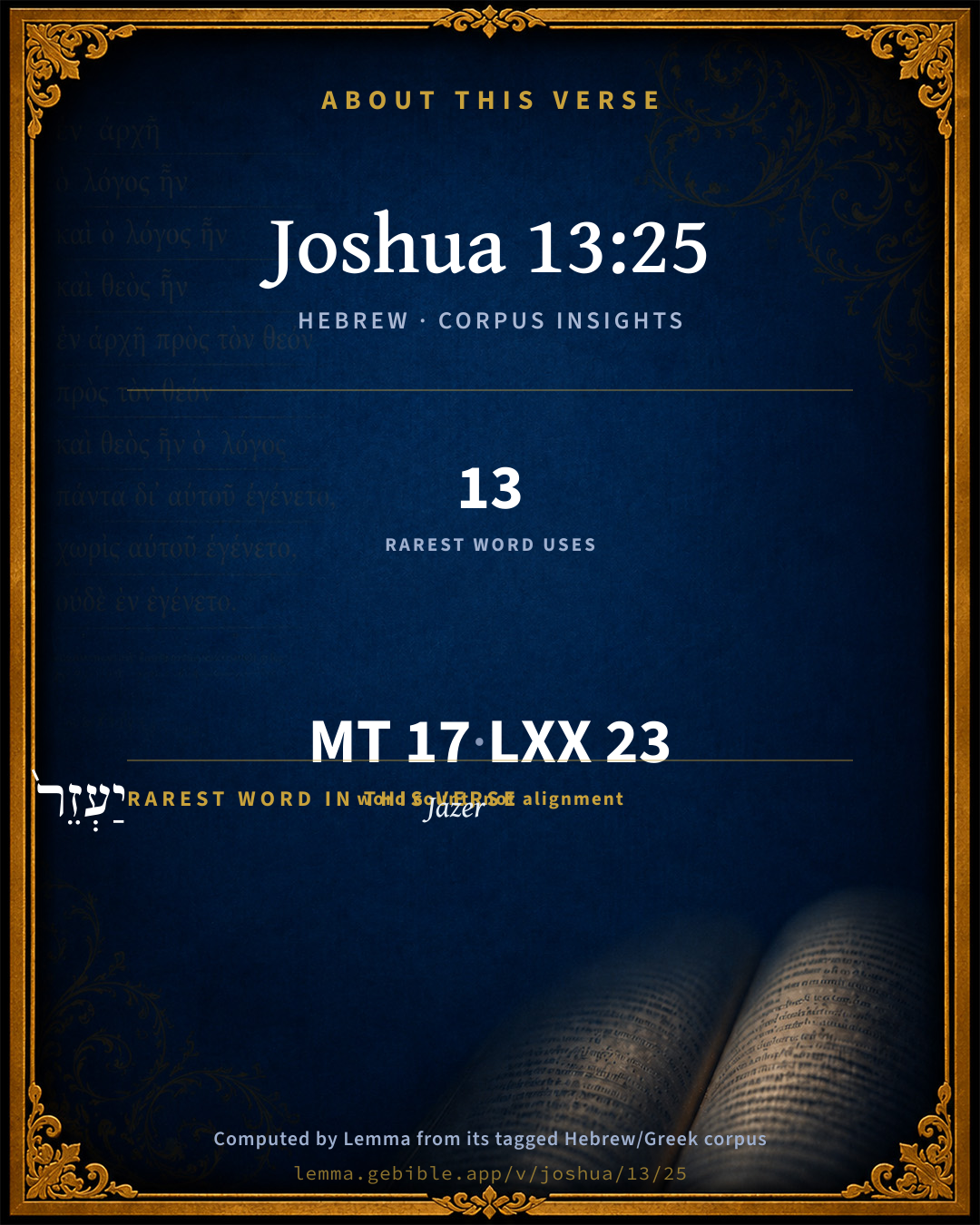
The rarest word here is יַעְזֵר֙ Jazer H3270 — appearing just 13 times in the whole Hebrew Bible.

Shared distinctive vocabulary

יַעְזֵר֙ Jazer H3270 occurs in 12 verses of the Hebrew Bible. Also found in:

Grammatical profile

  • 1 verb
  • 12 nouns
  • 3 prepositions
  • 1 particle

Verb forms

  • וַיְהִ֤י Qal · Sequential Imperfect

Hebrew & Septuagint length

In English translation the verse runs 25 words from the Hebrew and 25 from the Septuagint (LXX English) — the same length.

A rough comparison of the two English renderings, which tokenize alike — not a word-level alignment.

Word counts can differ between the Hebrew and the Greek without any difference in meaning — e.g. the Hebrew direct-object marker אֵת has no separate Greek word, and Greek often adds the article ὁ.

In the original languages it is 17 Hebrew tokens and 23 Greek tokens — but the two are counted differently (Hebrew bundles its prefixes and suffixes into one token; the Greek is in lemma form), so that isn’t a like-for-like length.

Cross-references

11

Topical passages linked to Joshua 13:25 in the Treasury of Scripture Knowledge — connected by theme and wording, ordered by reader-vote popularity; previews shown in the World English Bible.

  • Numbers 32:35 and Atrothshophan, and Jazer, and Jogbehah,
  • Deuteronomy 3:11 (For only Og king of Bashan remained of the remnant of the Rephaim; behold, his bedstead was a bedstead of iron; isn't it in Rabbah of the children of Ammon? nine cubits was the length of it, and four cubits the breadth of it, after the cubit of a man.)
  • 2 Samuel 11:1 It happened, at the return of the year, at the time when kings go out [to battle], that David sent Joab, and his servants with him, and all Israel; and they destroyed the children of Ammon, and besieged Rabbah. But David stayed at Jerusalem.
  • 2 Samuel 12:26 Now Joab fought against Rabbah of the children of Ammon, and took the royal city.
  • Numbers 21:26–30 For Heshbon was the city of Sihon the king of the Amorites, who had fought against the former king of Moab, and taken all his land out of his hand, even to the Arnon.
  • Numbers 21:32 Moses sent to spy out Jazer; and they took the towns of it, and drove out the Amorites who were there.
  • Deuteronomy 2:19 and when you come near over against the children of Ammon, don't bother them, nor contend with them; for I will not give you of the land of the children of Ammon for a possession; because I have given it to the children of Lot for a possession.
  • Joshua 21:39 Heshbon with its suburbs, Jazer with its suburbs; four cities in all.
  • Judges 11:13–27 The king of the children of Ammon answered to the messengers of Jephthah, Because Israel took away my land, when he came up out of Egypt, from the Arnon even to the Jabbok, and to the Jordan: now therefore restore those [lands] again peaceably.
  • Ezekiel 21:20 You shall appoint a way for the sword to come to Rabbah of the children of Ammon, and to Judah in Jerusalem the fortified.
  • Amos 1:14 But I will kindle a fire in the wall of Rabbah, And it will devour its palaces, With shouting in the day of battle, With a tempest in the day of the whirlwind;

Cross-references courtesy of OpenBible.info (CC BY 4.0).

Hebrew and Greek witnesses Masoretic Hebrew ↔ Greek Septuagint

The same verse in the two great witnesses to the Old Testament, shown verse-for-verse.

These are two independent witnesses, not word-aligned to each other, and the Septuagint is shown in lemma (dictionary) form.

Hebrew Joshua 13:25 Masoretic · Westminster Leningrad Codex

וַיְהִ֤י לָהֶם֙ הַגְּב֔וּל יַעְזֵר֙ וְכָל עָרֵ֣י הַגִּלְעָ֔ד וַחֲצִ֕י אֶ֖רֶץ בְּנֵ֣י עַמּ֑וֹן עַד עֲרוֹעֵ֕ר אֲשֶׁ֖ר עַל פְּנֵ֥י רַבָּֽה

Their border was Jazer, and all the cities of Gilead, and half the land of the children of Ammon, to Aroer that is before Rabbah;

World English Bible · Public Domain

Greek LXX Joshua 13:25 Septuagint · lemma form

καί γίγνομαι ὁ ὅριον αὐτός ιαζηρ πᾶς ὁ πόλις γαλαάδ καί ὁ ἥμισυς γῆ υἱός αμμων ἕως αροηρ ὅς εἰμί κατά πρόσωπον ραββα

And their borders were Jazer, all the cities of Galaad, and half the land of the children of Ammon to Araba, which is before Arad.

LXX2012 (modern English Septuagint) · Public Domain

On this verse, John Gill's Exposition discusses the Septuagint’s reading. Read the note in Commentary ↓

Hebrew: Westminster Leningrad Codex (CC BY 4.0). Greek: Septuagint (public domain); English from LXX2012 (modern English Septuagint) (Public Domain). How the Septuagint differs from the Hebrew →

Targum (Aramaic paraphrase)

1

The Targum is the ancient Jewish Aramaic paraphrase of the Hebrew Scriptures — an interpretive translation, not the Hebrew text itself. Onkelos (literal) and Pseudo-Jonathan (expansive) render the Torah, and Jonathan the Prophets. Coverage is partial: where no permissively-licensed English translation exists for a verse, only the Aramaic is shown. This is verse-level text, not a word-by-word alignment to the Hebrew.

  1. Targum Jonathan Prophets (Joshua–Malachi)
    וַהֲוָה לְהוֹן תְּחוּמָא יַעְזֵר וְכָל קִרְוֵי גִלְעָד וּפַלְגוּת אַרְעָא בְּנֵי עַמוֹן עַד עֲרוֹעֵר דִי עַל אַפֵּי רַבָּה:

    (no public-domain English translation for this verse)

    Targum Jonathan — Aramaic: “Mikraot Gedolot” (public domain). English: “Sefaria Community Translation” (CC0 1.0 (public-domain dedication)); “London "Chaldee Paraphrase," 1871” (public domain). Text via Sefaria.

Commentary

Notes on Joshua 13:25 from classic Christian and Jewish commentators (each source and its license shown beneath its notes). The classic Christian expositions comment on the surrounding passage and are grouped to its opening verse, so a note may address several verses; the Jewish commentaries on the Tanakh (Rashi and others) are per-verse, so they appear only where the commentator wrote on this verse.

Lemma curates 59 commentaries, every one of them public domain or Creative Commons licensed, each selected and text-cleaned for this edition rather than reprinted as found. About our sources →

Trapp's Complete Commentary

John Trapp

Jos 13:25 And their coast was Jazer, and all the cities of Gilead, and half the land of the children of Ammon, unto Aroer that [is] before Rabbah;

Ver. 25. Half the land of the children of Ammon.] Which Sihon had taken from them. See Jdg 11:15 Num 21:6.

John Trapp, A Commentary or Exposition upon All the Books of the Old and New Testament (1647–1656) — public domain. Text from a community e-Sword module.

Matthew Poole's English Annotations

All the cities of Gilead, i.e. all the cities of note and eminency; all cities properly so called, which it seems lay in that part of Gilead; and so this may well agree with Jos 13:25, where half the country of Gilead is said to be given to the Manassites; but there is no mention of any cities there.

Half the land of the children of Ammon; not of that which now was theirs, for that they were forbidden to meddle with, Deu 2:9, but of that which was anciently theirs, but taken from them by the Amorites, Num 21:26, from whom the Israelites took it, Jdg 11:15.

Unto Aroer, the border between them and Moab.

Rabbah, the chief city of the Ammonites, 2Sa 11:1; 12:26,27.

Matthew Poole's English Annotations on the Holy Bible (1683–1685) — public domain. Text from a community e-Sword/MySword module.

Joseph Benson's Commentary

Jos 13:25. All the cities of Gilead — All the cities of eminence; all the cities properly so called, which lay in that part of Gilead; and thus what is here assured may well agree with Jos 13:31, where half the country of Gilead is said to be given to the Manassites, for there is no mention of any cities being there. Half the land of the children of Ammon — Not of that which was now theirs, for that the Israelites were forbidden to meddle with; but of that which was anciently theirs, till taken from them by the Amorites, from whom the Israelites took it. Aroer — The border between them and Moab. Rabbah — The chief city of the Ammonites.

Joseph Benson's Commentary on the Old and New Testaments (1811–1818) — public domain. Text from a community e-Sword module.

Adam Clarke's Commentary

Verse 25. Half the land on the children of Ammon] This probably was land which had been taken from the Ammonites by Sihon, king of the Amorites, and which the Israelites possessed by right of conquest. For although the Israelites were forbidden to take the land of the Ammonites, De 2:37, yet this part, as having been united to the territories of Sihon, they might possess when they defeated that king and subdued his kingdom.

Adam Clarke's Commentary on the Bible (1810–1826) — public domain. Text from a community e-Sword/MySword module.

The Cambridge Bible for Schools and Colleges

gen. ed. J. J. S. Perowne

24–28. The Possession of the Tribe of Gad

25. their coast was Jazer] or Jaazer. We first hear of it in possession of the Amorites, and as taken by Israel after Heshbon, and on their way from thence to Bashan (Num_21:32). At present it is identified with Szîr, or Seir, nine Roman miles west of Ammân, and about 12 from Heshbon. For coast see above, Jos_13:16.

all the cities of Gilead] i.e. of the southern part of Gilead, which belonged to the kingdom of Sihon, for the other half, on the north of the Jabbok, which was governed by king Og, was allotted to the half tribe of Manasseh.

half the land of the children of Ammon] i.e. that portion of the land which had been taken from them by the Amorites under Sihon, for the Israelites were not allowed to attack the land of the Ammonites themselves (Deu_2:19; Jdg_11:13 sq.).

unto Aroer] i.e. unto Aroer of Gad (Num_32:34), not the Aroer near the Arnon (of Jos_13:16), that is before Rabbah, the capital of the Ammonites, famous (a) in the history of Jephthah (Jdg_11:33), and (b) in the history of David (2Sa_24:5).

The Cambridge Bible for Schools and Colleges (gen. ed. J. J. S. Perowne; Cambridge University Press, 1878–1918) — public domain. Text from a community e-Sword module.

John Gill's Exposition

And from Heshbon unto Ramathmizpeh, and Betonim,.... This was their coast from the south to the north, and so describes their eastern border, which reached from Heshbon, given to the tribe of Reuben, Jos 13:7; to these places mentioned; Ramathmizpeh, the same with Ramothgilead, which Jerom (o) says was a village in his time, and lay two miles from Philadelphia or Rabbath before mentioned, to the east; it should be to the west; of Betonim we nowhere else read, it seems to have been near to Ramath:

and from Mahanaim unto the border of Debir; the former of these was the place where the angels met Jacob, and who gave it the name from thence; and in later times a city of this name was built there, and was near the river Jabbok, Gen 32:2; Debir is different from that in the tribe of Judah, Jos 15:15; in the Septuagint version here it is called Daibon, perhaps the same with Dibon, the tribe of Gad rebuilt, and is called Dibongad, Num 32:34; unless Lidbar here should be the same with Lodebar in Gilead, Sa2 17:27.

(o) De loc. Heb. fol. 99. A.

John Gill's Exposition of the Whole Bible (1746–1763) — public domain (CC PDM 1.0). Text via the HelloAO Bible API.

Haydock's Catholic Bible Commentary

Rabba, "the great," being a title of Ar, the capital of the Moabites. The Israelites thought themselves justified in keeping what had been taken from the children of Ammon, by Sehon, (Judges xi. 13.; Calmet) and the Amorrhites. (Worthington)

George Leo Haydock (1774–1849), Haydock's Catholic Family Bible and Commentary, 1859 edition — public domain. Excludes Psalms (Douay-Rheims chapter numbering differs from Protestant) and Deuterocanonical books (Catholic canon only).

Whedon's Commentary on the Bible

Daniel D. Whedon

25. Jazer — Written also Jaazer. It was an important city, having dependent villages, (Num_21:32,) and giving its name to the surrounding country, “the land of Jazer.” Num_32:1. It was one of the four cities of Gad assigned to the Levites. Jos_21:39. Jeremiah (Jer_48:32) speaks of the “sea of Jazer,” which may have been some lake or pool in the vicinity. Burckhardt, Van de Velde, and others, identify it with a ruined town called Seir or Sir, some twelve miles north of Heshbon.

All the cities of Gilead — That is, of the southern portion of Gilead, for the northern was given to Manasseh. Jos_13:31.

Half the land of the children of Ammon — The country between the Arnon and the Jabbok. See Jdg_11:13, note. This ancient possession of the children of Lot Israel captured, not of Ammon, but of Sihon, king of the Amorites, who had previously taken it out of the hand of the king of Moab.

Num_21:26. Yet it retained the name of its ancient owners.

Aroer that is before Rabbah — That is, Aroer is before or in front of Rabbah to one who advances towards Rabbah from the Jordan. This Aroeris supposed by many to be identical with the ruined site Ayra, which Burckhardt discovered about seven miles southwest of es-Salt, and nearly half way between the Jordan and Rabbah. Rabbah was the great city and capital of the Ammonites, and is called in Deu_3:11 Rabbath of the children of Ammon, and here Og’s great iron bedstead was preserved. But as Israel was not to meddle with the children of Ammon, (Deu_2:19,) Rabbah was not disturbed, nor included in the territory of Gad. It was afterwards besieged and taken by David. 2Sa_12:29. Its ruins are known under the modern name of Amman, about twenty-two miles east of the Jordan.

Daniel D. Whedon (gen. ed.), Commentary on the Old and New Testaments (1874–1909) — public domain. Text from a community e-Sword module.

The Pulpit Commentary

Aroer that is before Rabbah. A different Aroer to that mentioned in ver. 9. This was near (Hebrew, opposite to, the expression being equivalent to the French en face) Rabbah, or the great city of the children of Ammon. Keil supposes that this territory had been taken from the Ammonites by Sihon, since the Israelites were not permitted to possess themselves of the land of the Ammonites. (Deu_2:19) For Rabbah, see 2Sa_11:1 2Sa_12:26. It is called Rabbath in Deu_3:11.

The Pulpit Commentary (1880–1919), ed. H.D.M. Spence-Jones & Joseph S. Exell — public domain. Text from a community e-Sword module.

John Wesley's Explanatory Notes

The cities of Gilead - That is, all the cities of eminency; all the cities properly so called, which lay in that part of Gilead; and so this may well agree with ver. 31, where half the country of Gilead is said to be given to the Manassites; but there is no mention of any cities there. The land of the children of Ammon - Not of that which was now theirs, for that they were forbidden to meddle with, but of that which was anciently theirs, 'till taken from them by the Amorites, from whom the Israelites took it. Aroer - The border between them and Moab. Rabbah - The chief city of the Ammonites.

John Wesley, Explanatory Notes Upon the Whole Bible (1754–1765) — public domain. Text via the GEBible commentary corpus.

Rashi

Rabbi Shlomo Yitzchaki (Rashi)

And half the land of the Bnei Amon. Half the land they conquered from the Bnei Amon and from Sichon.

Rashi on the Tanakh — English translations: “The Judaica Press complete Tanach with Rashi, translated by A. J. Rosenberg” (CC BY 4.0); “Pentateuch with Rashi's commentary by M. Rosenbaum and A.M. Silbermann, 1929-1934” (public domain); “The Metsudah Tanach series, Lakewood, N.J” (CC BY 4.0); and “The Book of Joshua, Metsudah Publications, 1997” (CC BY 4.0). Text via Sefaria.

Lesson kit

Teaching starters — assembled from the data on this page, not authored interpretation. Every prompt links to the verse data it draws on. Edit before teaching.

Joshua, in the Historical, opens this verse with 17 words (16 distinct Hebrew lemmas). Its most distinctive word is Yaʻăzêyr (“Jazer”). A historical commentator’s framing appears above. Read the whole chapter for the surrounding context.

Discussion questions

  1. What does “Jazer” (Yaʻăzêyr) contribute to the verse as a whole?
  2. How does Numbers 21:32, which shares the word «Jazer», read alongside this verse?
  3. These translations render this verse differently; the difference is in the English rendering, not the original. What questions does that raise?
  4. «וַיְהִ֤י» is a Qal Sequential Imperfect verb. How does that grammatical form shape the action described?
  5. Compare how Trapp's Complete Commentary and Matthew Poole's English Annotations read this verse. Where do they agree or differ?

Things to notice

Reading settings

Reading text

Shown beneath each verse's original-language words.

Old Testament
Old Testament edition

Read the OT as the Masoretic Hebrew (MT) or the Greek Septuagint (LXX).

English shown for the Greek Septuagint (in the Hebrew ↔ Greek comparison).

Comparing translations? Open the Compare panel on any verse page to stack up to four side by side.