Judges 2:9

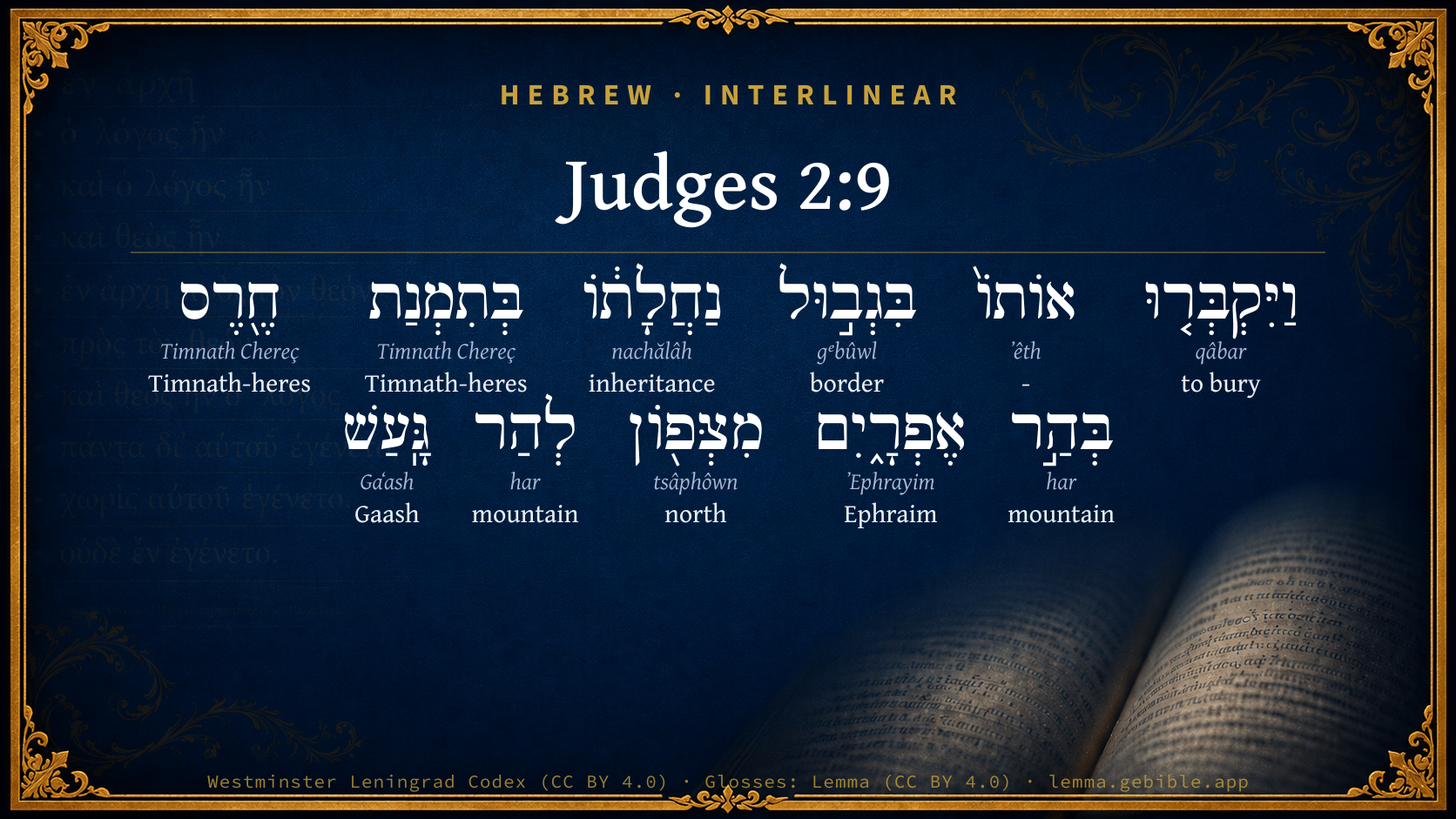
Hebrew (Westminster Leningrad Codex) Judges 2:9 appears in the Hebrew Old Testament. The text above is from the Westminster Leningrad Codex. Each word links to its Strong’s number, a concise gloss, and parsing drawn from the Open Scriptures Hebrew Bible morphology. Click any word for its full Brown-Driver-Briggs (BDB) entry.
Download image
Cite this verse

Judges 2:9 (World English Bible). Public Domain. Lemma interlinear Bible study tool, https://lemma.gebible.app/v/judges/2/9.

Show BibTeX & RIS
BibTeX
RIS
English Translation
They buried him in the border of his inheritance in Timnath Heres, in the hill country of Ephraim, on the north of the mountain of Gaash.
World English Bible · Public Domain
Download a study sheet

One document with this verse’s original text, its word-by-word gloss line, the meaning frame, cross-references with their text, attributed commentary, and full source and license credits — printable, and it pastes into notes with its structure intact.

This verse Autodidact and up

Study sheet (.html) Plain text (.txt)

A passage Seminary Student

Up to 50 verses in one chapter. A passage sheet keeps up to 6 commentary sources and 12 cross-references per verse, in the order this page ranks them, and says so on the sheet whenever that leaves anything out. Ask for a single verse and you get the Autodidact verse sheet above.

Everything on this page stays free to read, with no account — the sheet is a download of what is already on screen, not access to it.

Want to remove ads? Support Godless Engineer
Compare translations 3

The same verse in 3 English versions, stacked beneath the original-language interlinear above. Click any original word for its lexicon entry.

Each is an independent rendering of the whole verse — the interlinear is not word-aligned to these translations.

Highlighted words mark where these versions differ — a whole-verse word diff, not a word-by-word alignment.

  • World English Bible Public Domain
    They buried him in the border of his inheritance in Timnath Heres, in the hill country of Ephraim, on the north of the mountain of Gaash.
  • King James Version Public Domain
    And they buried him in the border of his inheritance in Timnathheres, in the mount of Ephraim, on the north side of the hill Gaash.
  • unfoldingWord Literal Text CC BY-SA 4.0
    And they buried him within the border of his inheritance in Timnath Heres, in the hill country of Ephraim, to the north of Mount Gaash.

unfoldingWord Literal Text — © unfoldingWord, licensed CC BY-SA 4.0. Word-aligned USFM3 via Door43 (git.door43.org/unfoldingWord/en_ult).

Versions to compare (up to 4)

3 of 4 selected

Show all 18 translations

Every available English version of this verse, each an independent rendering of the whole verse.

  • World English Bible Public Domain
    They buried him in the border of his inheritance in Timnath Heres, in the hill country of Ephraim, on the north of the mountain of Gaash.
  • Berean Standard Bible Public Domain
    They buried him in the land of his inheritance, at Timnath-heres in the hill country of Ephraim, north of Mount Gaash.
  • Majority Standard Bible Public Domain
    They buried him in the land of his inheritance, at Timnath-heres in the hill country of Ephraim, north of Mount Gaash.
  • King James Version Public Domain
    And they buried him in the border of his inheritance in Timnathheres, in the mount of Ephraim, on the north side of the hill Gaash.
  • American Standard Version (1901) Public Domain
    And they buried him in the border of his inheritance in Timnath-heres, in the hill-country of Ephraim, on the north of the mountain of Gaash.
  • Revised Version (1885) Public Domain
    And they buried him in the border of his inheritance in Timnath-heres, in the hill country of Ephraim, on the north of the mountain of Gaash.
  • Geneva Bible (1599) Public Domain
    And they buryed him in the coastes of his inheritance, in Timnath-heres in mount Ephraim, on the Northside of mount Gaash.
  • Douay-Rheims (1899) Public Domain
    And they buried him in the borders of his possession in Thamnathsare in mount Ephraim, on the north side of mount Gaas.
  • Young's Literal Translation Public Domain
    and they bury him in the border of his inheritance, in Timnath-Heres, in the hill-country of Ephraim, on the north of mount Gaash;
  • Literal Standard Version CC BY-SA 4.0
    and they bury him in the border of his inheritance, in Timnath-Heres, in the hill-country of Ephraim, on the north of Mount Gaash;
  • Unlocked Literal Bible CC BY-SA 4.0
    They buried him within the border of the land he was assigned in Timnath Heres, in the hill country of Ephraim, north of Mount Gaash.
  • unfoldingWord Literal Text CC BY-SA 4.0
    And they buried him within the border of his inheritance in Timnath Heres, in the hill country of Ephraim, to the north of Mount Gaash.
  • Darby Bible Public Domain
    And they buried him within the bounds of his inheritance in Tim'nath-he'res, in the hill country of E'phraim, north of the mountain of Ga'ash.
  • World Messianic Bible Public Domain
    They buried him in the border of his inheritance in Timnath Heres, in the hill country of Ephraim, on the north of the mountain of Gaash.
  • Webster's Bible Public Domain
    And they buried him in the border of his inheritance in Timnath-heres, in the mount of Ephraim, on the north side of the hill Gaash.
  • Free Bible Version CC BY-SA 4.0
    They buried him in Timnath-heres in the hill country of Ephraim, north of Mount Gaash, the land he had been allocated.
  • Bible in Basic English Public Domain
    And they put his body in the earth in the land of his heritage in Timnath-heres, in the hill-country of Ephraim to the north of Mount Gaash.
  • JPS Tanakh (1917) Public Domain
    And they buried him in the border of his inheritance in Timnath-heres, in the hill-country of Ephraim, on the north of the mountain of Gaash.

Literal Standard Version (2020), Covenant Press — licensed CC BY-SA 4.0. Text via the HelloAO Bible API (eBible.org). Unlocked Literal Bible (unfoldingWord) — licensed CC BY-SA 4.0. Text via the HelloAO Bible API (eBible.org). unfoldingWord Literal Text — © unfoldingWord, licensed CC BY-SA 4.0. Word-aligned USFM3 via Door43 (git.door43.org/unfoldingWord/en_ult). Free Bible Version, Dr. Jonathan Gallagher — licensed CC BY-SA 4.0. Text via the HelloAO Bible API (eBible.org).

Word by word

More ways to search: Search by grammar → Find every occurrence → Compare this word →

Practice this passage: Drill this verse → Learn its vocabulary →

גָּֽעַשׁ
Gaʻash
H1608
“Gaash”
Noun, Proper
Part of Speech
Noun
Type
Proper
Full BDB Definition

Origin: from H1607

TWOT: None

Gaash = "quaking" - a mountain of Ephraim where Joshua was buried
  1. וַיִּקְבְּר֤וּ qâbar H6912 “and · to bury” Conjunction + Verb, Qal, Sequential Imperfect, 3rd Person, Masculine, Plural
  2. אוֹתוֹ֙ ʼêth H853 “- · him” Particle, Direct Object + Suffix, Personal, 3rd Person, Masculine, Singular
  3. בִּגְב֣וּל gᵉbûwl H1366 “in/at · border of” Preposition + Noun, Common, Masculine, Singular, Construct
  4. נַחֲלָת֔וֹ nachălâh H5159 “inheritance · his” Noun, Common, Feminine, Singular, Construct + Suffix, Personal, 3rd Person, Masculine, Singular
  5. בְּתִמְנַת Timnath Chereç H8556 “in/at · Timnath-heres” Preposition + Noun, Proper
  6. חֶ֖רֶס Timnath Chereç H8556 “Timnath-heres” Noun, Proper
  7. בְּהַ֣ר har H2022 “in/at · mountain of” Preposition + Noun, Common, Masculine, Singular, Construct
  8. אֶפְרָ֑יִם ʼEphrayim H669 “Ephraim” Noun, Proper
  9. מִצְּפ֖וֹן tsâphôwn H6828 “from · north of” Preposition + Noun, Common, Feminine, Singular, Construct
  10. לְהַר har H2022 “to/for · mountain of” Preposition + Noun, Common, Masculine, Singular, Construct

About this verse

These counts appear in no published source. They are computed here, from the morphology-tagged text and Lemma’s own curated glosses. What Lemma adds →

11
words
9
distinct lemmas
Historical
section

Notable vocabulary

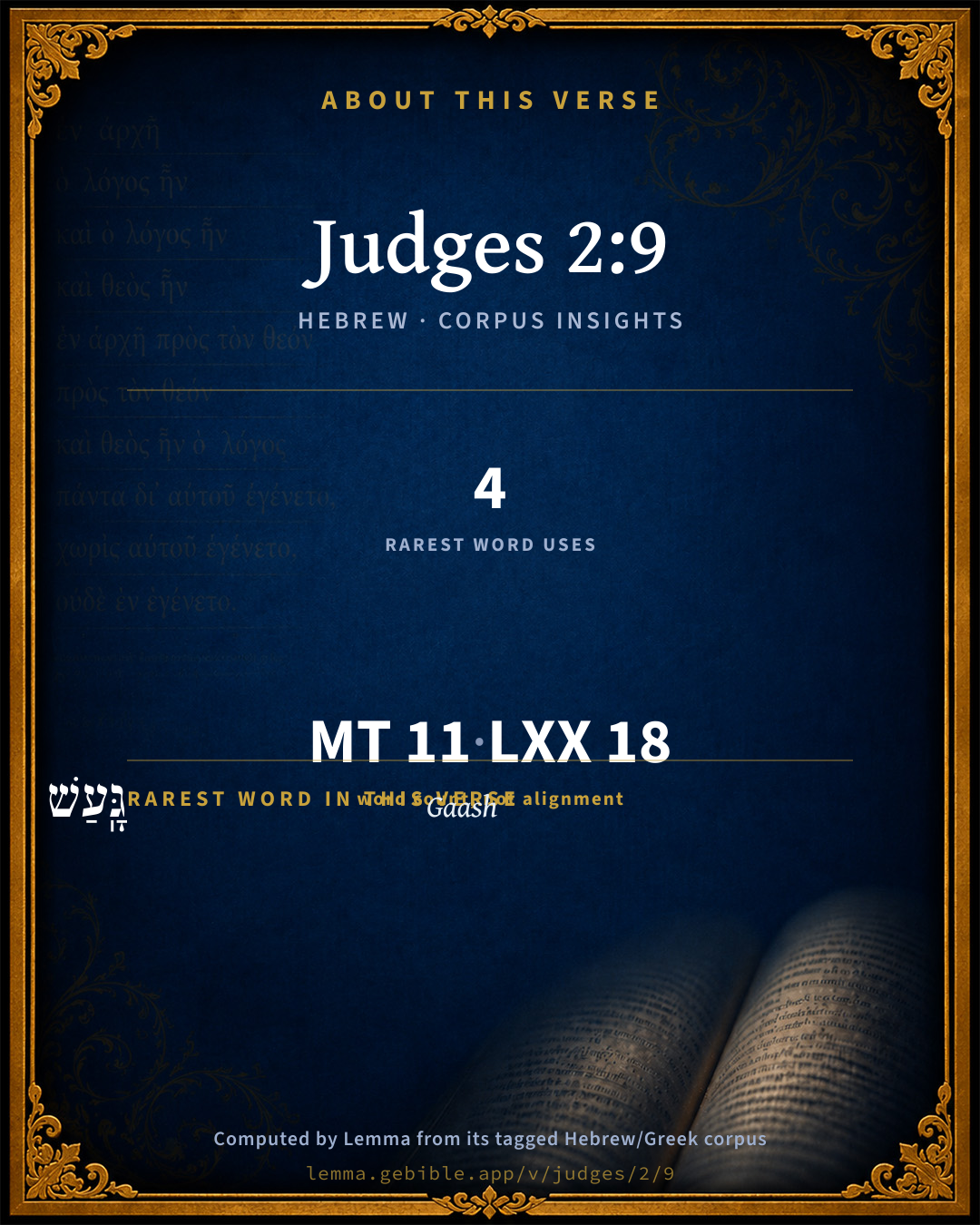
The rarest word here is גָּֽעַשׁ Gaash H1608 — appearing just 4 times in the whole Hebrew Bible.

Shared distinctive vocabulary

גָּֽעַשׁ Gaash H1608 occurs in 4 verses of the Hebrew Bible. Also found in:

Grammatical profile

  • 1 verb
  • 9 nouns
  • 1 particle

Verb forms

  • וַיִּקְבְּר֤וּ Qal · Sequential Imperfect

Repetition

Words recur within this verse — often emphatic in Hebrew:

  • בְּתִמְנַת Timnath-heres H8556 ×2
  • בְּהַ֣ר mountain H2022 ×2

Hebrew & Septuagint length

In English translation the verse runs 26 words from the Hebrew and 23 from the Septuagint (LXX English) — closely comparable.

A rough comparison of the two English renderings, which tokenize alike — not a word-level alignment.

Word counts can differ between the Hebrew and the Greek without any difference in meaning — e.g. the Hebrew direct-object marker אֵת has no separate Greek word, and Greek often adds the article ὁ.

In the original languages it is 11 Hebrew tokens and 18 Greek tokens — but the two are counted differently (Hebrew bundles its prefixes and suffixes into one token; the Greek is in lemma form), so that isn’t a like-for-like length.

Cross-references

2

Topical passages linked to Judges 2:9 in the Treasury of Scripture Knowledge — connected by theme and wording, ordered by reader-vote popularity; previews shown in the World English Bible.

  • Joshua 19:50 according to the commandment of Yahweh they gave him the city which he asked, even Timnathserah in the hill-country of Ephraim; and he built the city, and lived therein.
  • Joshua 24:30 They buried him in the border of his inheritance in Timnathserah, which is in the hill-country of Ephraim, on the north of the mountain of Gaash.

Cross-references courtesy of OpenBible.info (CC BY 4.0).

Hebrew and Greek witnesses Masoretic Hebrew ↔ Greek Septuagint

The same verse in the two great witnesses to the Old Testament, shown verse-for-verse.

These are two independent witnesses, not word-aligned to each other, and the Septuagint is shown in lemma (dictionary) form.

Hebrew Judges 2:9 Masoretic · Westminster Leningrad Codex

וַיִּקְבְּר֤וּ אוֹתוֹ֙ בִּגְב֣וּל נַחֲלָת֔וֹ בְּתִמְנַת חֶ֖רֶס בְּהַ֣ר אֶפְרָ֑יִם מִצְּפ֖וֹן לְהַר גָּֽעַשׁ

They buried him in the border of his inheritance in Timnath Heres, in the hill country of Ephraim, on the north of the mountain of Gaash.

World English Bible · Public Domain

Greek LXX Judges 2:9 Septuagint · lemma form

καί θάπτω αὐτός ἐν ὅριον ὁ κληρονομία αὐτός ἐν θαμναθαρες ἐν ὄρος ἐφράιμ ἀπό βορέας ὁ ὄρος γαας

And they buried him in the border of his inheritance, in Thamnathares, in mount Ephraim, on the north of the mountain of Gaas.

LXX2012 (modern English Septuagint) · Public Domain

On this verse, Ellicott's Commentary for English Readers discusses the Septuagint’s reading. Read the note in Commentary ↓

Hebrew: Westminster Leningrad Codex (CC BY 4.0). Greek: Septuagint (public domain); English from LXX2012 (modern English Septuagint) (Public Domain). How the Septuagint differs from the Hebrew →

Targum (Aramaic paraphrase)

1

The Targum is the ancient Jewish Aramaic paraphrase of the Hebrew Scriptures — an interpretive translation, not the Hebrew text itself. Onkelos (literal) and Pseudo-Jonathan (expansive) render the Torah, and Jonathan the Prophets. Coverage is partial: where no permissively-licensed English translation exists for a verse, only the Aramaic is shown. This is verse-level text, not a word-by-word alignment to the Hebrew.

  1. Targum Jonathan Prophets (Joshua–Malachi)
    וּקְבַרוּ יָתֵיהּ בִּתְחוּם אַחְסַנְתֵּיהּ בְּתִמְנַת חֶרֶס בְּטוּרָא דְבֵית אֶפְרַיִם מִצִיפּוּנָא לְטוּר גָעַשׁ:

    (no public-domain English translation for this verse)

    Targum Jonathan — Aramaic: “Mikraot Gedolot” (public domain). English: “Sefaria Community Translation” (CC0 1.0 (public-domain dedication)); “London "Chaldee Paraphrase," 1871” (public domain). Text via Sefaria.

Commentary

Notes on Judges 2:9 from classic Christian and Jewish commentators (each source and its license shown beneath its notes). The classic Christian expositions comment on the surrounding passage and are grouped to its opening verse, so a note may address several verses; the Jewish commentaries on the Tanakh (Rashi and others) are per-verse, so they appear only where the commentator wrote on this verse.

Lemma curates 59 commentaries, every one of them public domain or Creative Commons licensed, each selected and text-cleaned for this edition rather than reprinted as found. About our sources →

Trapp's Complete Commentary

John Trapp

Jdg 2:9 And they buried him in the border of his inheritance in Timnathheres, in the mount of Ephraim, on the north side of the hill Gaash.

Ver. 9. And they buried him.] Burial is a mercy, whatever the Cynics held to the contrary: and places of burial are to be kept decent, in token that we expect a resurrection.

In Timnathheres.] That is, The picture of the sun which was there worshipped. In detestation whereof, it may seem, the name was altered by transposition of letters in Timnathserah.

John Trapp, A Commentary or Exposition upon All the Books of the Old and New Testament (1647–1656) — public domain. Text from a community e-Sword module.

Geneva Bible (1599)

Geneva Bible translators

Here, by turning the letters backward is Sereh, as Josh. 24:30.

Geneva Bible (1599) marginal notes — public domain. Text via Bolls.life.

Ellicott's Commentary for English Readers

(9) They buried him.—This circumstance is usually added in the case of kings, heroes, &c. (Gen_23:19; Jer_22:18, &c.), and this care about burial seems to point to at least a dim hope of that immortality which had not as yet been fully “brought to light.”

In the border of his inheritance.—(See Jos_19:49-50. It was in Mount Ephraim, and in a rugged and barren district—a circumstance which raised the astonishment of Paula at the self-denial of Joshua (Jer., Ep. 108): “She was much astonished that the distributor of possessions had chosen rough mountain districts for himself.”

Timnath-heres.—“The portion of the sun.” This seems to be a mere “slip of the pen” (Ewald)—an accidental transposition of letters for Timnath-serah (“the portion that remains”), which is the reading of Jos_19:50, and of the best versions, and of some MSS. here. The mistake is, however, ancient, for it originated the Rabbinic story that it is a reference to “the sun standing still upon Gibeah,” and that the image of the sun (temunath ha-cheres) was sculptured on his tomb. The LXX., after Jos_24:30, add the interesting Hagadah (traditional legend), that the people buried in Joshua’s tomb the flint knives with which they had performed the neglected rite of circumcision, after the passage of the Jordan (Jos_5:2). The name Timnath has been, perhaps, preserved in the modern Tibneh, about six miles from Shiloh. Its ruins yet contain some richly decorated tombs. There was another Timnath in Dan.

The hill Gaash.—The name means “mount earthquake.” Its torrent beds are mentioned in 2Sa_23:30. It has not been identified.

A Bible Commentary for English Readers, edited by Charles John Ellicott (1878–1897) — public domain. Text from a community e-Sword module.

The Cambridge Bible for Schools and Colleges

gen. ed. J. J. S. Perowne

9. in the border of his inheritance] i.e. within the district allotted to him, Jos_19:49.

Timnath-heres] An early tradition, mentioned by Eusebius (Onom.Sacr. 261, 33) and Jerome, pointed out the tomb of Joshua at Thamna, a fortified place of some importance in Maccabaean and Roman times (1Ma_9:50; Jos., Ant. xiv. 11, 2, War iv. 8, 1), which, from the topographical notices of Josephus ll. cc., may be identified with the modern Tibneh, about 10 m. N.W. of Beth-el, in the Central Highlands. It is not unlikely that this was Timnath-ḥeres; remarkable tombs are still to be seen on the N. slope of the hill to the S.W. of the town. A later, mediaeval, tradition fixes the site at Hâris, about 9 m. S.W. of Shechem (Nâblus). Timnath-ḥeres, lit. ‘(sacred) territory of the Sun’ (cf. Mount Heres i. 35, Beth-shemesh), is written Timnath-seraḥ in Jos_19:50; Jos_24:30, and by Syr.and Vulgate here, perhaps to avoid idolatrous associations; cf. Isa_19:18, where ḥeres ‘sun’ has been changed to heres ‘destruction.’

Gaash] has not been identified; 2Sa_23:30 = 1Ch_11:32 mention ‘the wadis of G.’

The Cambridge Bible for Schools and Colleges (gen. ed. J. J. S. Perowne; Cambridge University Press, 1878–1918) — public domain. Text from a community e-Sword module.

John Gill's Exposition

And they buried him in the border of his inheritance in Timnathheres,.... In Jos 24:30; it is called Timnathserah, the letters of "serah" being here inverted, make "heres", which sometimes is used for the sun, Job 9:7; and therefore some observe, that the whole name signifies the figure of the sun, which the Jews say was put on his monument, in commemoration of the miracle of the sun standing still at his request, and had this inscription on it,"this is he that caused the sun to stand still;''but this is not very probable, since it might have had a tendency to idolatry, the sun being what was the first object of idolatrous worship among the Heathens, and had the greatest show of reason for it:

in the mount of Ephraim, on the north side of the hill Gaash; See Gill on Jos 24:30.

John Gill's Exposition of the Whole Bible (1746–1763) — public domain (CC PDM 1.0). Text via the HelloAO Bible API.

Matthew Poole's English Annotations

Timnath-heres, called Timnath-serah, Jos 19:50; 24:30.

Matthew Poole's English Annotations on the Holy Bible (1683–1685) — public domain. Text from a community e-Sword/MySword module.

The Pulpit Commentary

Timnath-heres. Probably, though not certainly, the modern Tibneh, six miles from Jifna. It is called in Jos_19:50 and Jos_24:30 Timnath-serah, the letters of which are identical, but the order is inverted. Timnath-heres is probably the right form. It means "The portion of the Sun." We have Mount Heres in Jud 1:35, near Ajalon. Ir-shemesh (city of the sun) and Beth-shemesh (house of the sun) are other instances of places called from the sun. Some have supposed some connection between the name Timnath. heres, as Joshua"s inheritance, and the miracle of the sun standing still upon Gibeon at the word of Joshua. (Jos_10:12, Jos_10:13) The neighbourhood of Timnath-heres to Ajalon (Jud 1:35) may give some countenance to this. The hill Gaash is only elsewhere mentioned as the birthplace of Hiddai or Hurai, (2Sa_23:30 1Ch_11:32) but the exact site is unknown.

The Pulpit Commentary (1880–1919), ed. H.D.M. Spence-Jones & Joseph S. Exell — public domain. Text from a community e-Sword module.

Scofield Reference Notes

C. I. Scofield

Timmathheres

Timnathserah. Jos 19:50.

The Scofield Reference Bible (1917 edition), notes by C. I. Scofield — public domain. Text from a community e-Sword module.

unfoldingWord translationNotes

Door43 World Missions Community

he was assigned

This can be stated in active form. AT: "that God gave him" (See: Active or Passive)

Timnath Heres

This is the name of an area of land. (See: How to Translate Names)

Mount Gaash

This is the name of a mountain. (See: How to Translate Names)

All that generation was also gathered to their fathers

The phrase "was also gathered to their fathers" means that as the people of that generation died, their souls went to the same place as their ancestors who died before them. It is a polite way of saying they died. (See: Euphemism)

fathers

Here this means the ancestors of a certain person or people group.

grew up

"grew older" or "became older"

who did not know Yahweh

Here "did not know" means they had not experienced Yahweh or his power the way the previous generation had.

translationWords

assign

Ephraim

generation

ancestor

Yahweh

Israel

unfoldingWord translationNotes — © Distant Shores Media and the Door43 World Missions Community, licensed CC BY-SA 4.0. Source: git.door43.org/Door43/en_tn.

Rashi

Rabbi Shlomo Yitzchaki (Rashi)

At Timnas Cheres. So entitled because a likeness of the sun was placed over his grave, as if to say, "Alas, that a man who halted the sun lies in the grave."

Rashi on the Tanakh — English translations: “The Judaica Press complete Tanach with Rashi, translated by A. J. Rosenberg” (CC BY 4.0); “Pentateuch with Rashi's commentary by M. Rosenbaum and A.M. Silbermann, 1929-1934” (public domain); “The Metsudah Tanach series, Lakewood, N.J” (CC BY 4.0); and “The Book of Joshua, Metsudah Publications, 1997” (CC BY 4.0). Text via Sefaria.

Lesson kit

Teaching starters — assembled from the data on this page, not authored interpretation. Every prompt links to the verse data it draws on. Edit before teaching.

Judges, in the Historical, opens this verse with 11 words (9 distinct Hebrew lemmas). Its most distinctive word is Gaʻash (“Gaash”). A historical commentator’s framing appears above. Read the whole chapter for the surrounding context.

Discussion questions

  1. What does “Gaash” (Gaʻash) contribute to the verse as a whole?
  2. How does Joshua 24:30, which shares the word «Gaash», read alongside this verse?
  3. What does the repetition of “Timnath-heres” (2× in this one verse) do in this verse?
  4. These translations render this verse differently. What is at stake in choosing one wording over another?
  5. «וַיִּקְבְּר֤וּ» is a Qal Sequential Imperfect verb. How does that grammatical form shape the action described?
  6. Compare how Trapp's Complete Commentary and Geneva Bible (1599) read this verse. Where do they agree or differ?

Things to notice

Reading settings

Reading text

Shown beneath each verse's original-language words.

Old Testament
Old Testament edition

Read the OT as the Masoretic Hebrew (MT) or the Greek Septuagint (LXX).

English shown for the Greek Septuagint (in the Hebrew ↔ Greek comparison).

Comparing translations? Open the Compare panel on any verse page to stack up to four side by side.