
Micah 5:6

Hebrew (Westminster Leningrad Codex) Micah 5:6 appears in the Hebrew Old Testament. The text above is from the Westminster Leningrad Codex. Each word links to its Strong’s number, a concise gloss, and parsing drawn from the Open Scriptures Hebrew Bible morphology. Click any word for its full Brown-Driver-Briggs (BDB) entry.
Download image
Cite this verse

Micah 5:6 (World English Bible). Public Domain. Lemma interlinear Bible study tool, https://lemma.gebible.app/v/micah/5/6.

Show BibTeX & RIS
BibTeX
RIS
English Translation
They will rule the land of Assyria with the sword, And the land of Nimrod in its gates. He will deliver us from the Assyrian, When he invades our land, And when he marches within our border.
World English Bible · Public Domain
Download a study sheet

One document with this verse’s original text, its word-by-word gloss line, the meaning frame, cross-references with their text, attributed commentary, and full source and license credits — printable, and it pastes into notes with its structure intact.

This verse Autodidact and up

Study sheet (.html) Plain text (.txt)

A passage Seminary Student

Up to 50 verses in one chapter. A passage sheet keeps up to 6 commentary sources and 12 cross-references per verse, in the order this page ranks them, and says so on the sheet whenever that leaves anything out. Ask for a single verse and you get the Autodidact verse sheet above.

Everything on this page stays free to read, with no account — the sheet is a download of what is already on screen, not access to it.

Want to remove ads? Support Godless Engineer
Compare translations 3

The same verse in 3 English versions, stacked beneath the original-language interlinear above. Click any original word for its lexicon entry.

Each is an independent rendering of the whole verse — the interlinear is not word-aligned to these translations.

Highlighted words mark where these versions differ — a whole-verse word diff, not a word-by-word alignment.

  • World English Bible Public Domain
    They will rule the land of Assyria with the sword, And the land of Nimrod in its gates. He will deliver us from the Assyrian, When he invades our land, And when he marches within our border.
  • King James Version Public Domain
    And they shall waste the land of Assyria with the sword, and the land of Nimrod in the entrances thereof: thus shall he deliver us from the Assyrian, when he cometh into our land, and when he treadeth within our borders.
  • unfoldingWord Literal Text CC BY-SA 4.0
    And they will shepherd the land of Assyria with the sword, and the land of Nimrod in its entrances. And he will deliver from Assyria, when he comes into our land, and when he treads within our border.

unfoldingWord Literal Text — © unfoldingWord, licensed CC BY-SA 4.0. Word-aligned USFM3 via Door43 (git.door43.org/unfoldingWord/en_ult).

Versions to compare (up to 4)

3 of 4 selected

Show all 18 translations

Every available English version of this verse, each an independent rendering of the whole verse.

  • World English Bible Public Domain
    They will rule the land of Assyria with the sword, And the land of Nimrod in its gates. He will deliver us from the Assyrian, When he invades our land, And when he marches within our border.
  • Berean Standard Bible Public Domain
    And they will rule the land of Assyria with the sword, and the land of Nimrod with the blade drawn. So He will deliver us when Assyria invades our land and marches into our borders.
  • Majority Standard Bible Public Domain
    And they will rule the land of Assyria with the sword, and the land of Nimrod with the blade drawn. So He will deliver us when Assyria invades our land and marches into our borders.
  • King James Version Public Domain
    And they shall waste the land of Assyria with the sword, and the land of Nimrod in the entrances thereof: thus shall he deliver us from the Assyrian, when he cometh into our land, and when he treadeth within our borders.
  • American Standard Version (1901) Public Domain
    And they shall waste the land of Assyria with the sword, and the land of Nimrod in the entrances thereof: and he shall deliver us from the Assyrian, when he cometh into our land, and when he treadeth within our border.
  • Revised Version (1885) Public Domain
    And they shall waste the land of Assyria with the sword, and the land of Nimrod in the entrances thereof: and he shall deliver us from the Assyrian, when he cometh into our land, and when he treadeth within our border.
  • Geneva Bible (1599) Public Domain
    And they shall destroy Asshur with the sword, and the land of Nimrod with their swordes: thus shall he deliuer vs from Asshur, when hee commeth into our lande, and when he shall tread within our borders.
  • Douay-Rheims (1899) Public Domain
    And they shall feed the land of Assyria with the sword, and the land of Nemrod with the spears thereof: and he shall deliver us from the Assyrian, when he shall come into our land, and when he shall tread in our borders.
  • Young's Literal Translation Public Domain
    And they have afflicted the land of Asshur with the sword, And the land of Nimrod at its openings, And he hath delivered from Asshur when he doth come into our land, And when he treadeth in our borders.
  • Literal Standard Version CC BY-SA 4.0
    And they have afflicted the land of Asshur with the sword, || And the land of Nimrod at its openings, || And He has delivered from Asshur when he comes into our land, || And when he treads in our borders.
  • Unlocked Literal Bible CC BY-SA 4.0
    They will shepherd the land of Assyria with the sword, and the land of Nimrod in its entrances. He will rescue us from the Assyrians, when they come into our land, when they march inside our borders.
  • unfoldingWord Literal Text CC BY-SA 4.0
    And they will shepherd the land of Assyria with the sword, and the land of Nimrod in its entrances. And he will deliver from Assyria, when he comes into our land, and when he treads within our border.
  • Darby Bible Public Domain
    And they shall waste the land of Asshur with the sword, and the land of Nimrod in the entrances thereof; and he shall deliver [us] from the Assyrian, when he cometh into our land, and when he treadeth within our borders.
  • World Messianic Bible Public Domain
    They will rule the land of Assyria with the sword, and the land of Nimrod in its gates. He will deliver us from the Assyrian, when he invades our land, and when he marches within our border.
  • Webster's Bible Public Domain
    \\5:7\\And the remnant of Jacob shall be in the midst of many people as a dew from the LORD, as the showers upon the grass, that tarrieth not for man, nor waiteth for the sons of men.
  • Free Bible Version CC BY-SA 4.0
    and they will rule Assyria with their swords, the land of Nimrod with drawn swords. He shall rescue us from the Assyrians when they invade our land, marching across our borders.
  • Bible in Basic English Public Domain
    And the rest of Jacob will be among the mass of peoples like dew from the Lord, like showers on the grass, which may not be kept back by man, or be waiting for the sons of men.
  • JPS Tanakh (1917) Public Domain
    (5-5) And they shall waste the land of Assyria with the sword, and the land of Nimrod with the keen-edged sword; and he shall deliver us from the Assyrian, when he cometh into our land, and when he treadeth within our border.

Literal Standard Version (2020), Covenant Press — licensed CC BY-SA 4.0. Text via the HelloAO Bible API (eBible.org). Unlocked Literal Bible (unfoldingWord) — licensed CC BY-SA 4.0. Text via the HelloAO Bible API (eBible.org). unfoldingWord Literal Text — © unfoldingWord, licensed CC BY-SA 4.0. Word-aligned USFM3 via Door43 (git.door43.org/unfoldingWord/en_ult). Free Bible Version, Dr. Jonathan Gallagher — licensed CC BY-SA 4.0. Text via the HelloAO Bible API (eBible.org).

Word by word

More ways to search: Search by grammar → Find every occurrence → Compare this word →

Practice this passage: Drill this verse → Learn its vocabulary →

נִמְרֹ֖ד
Nimrôwd
H5248
“Nimrod”
Noun, Proper
Part of Speech
Noun
Type
Proper
Full BDB Definition

Origin: probably of foreign origin

TWOT: None

Nimrod = "rebellion" or " the valiant" - the son of Cush, grandson of Ham, and great grandson of Noah; a mighty hunter, he established an empire in the area of Babylon and Assyria
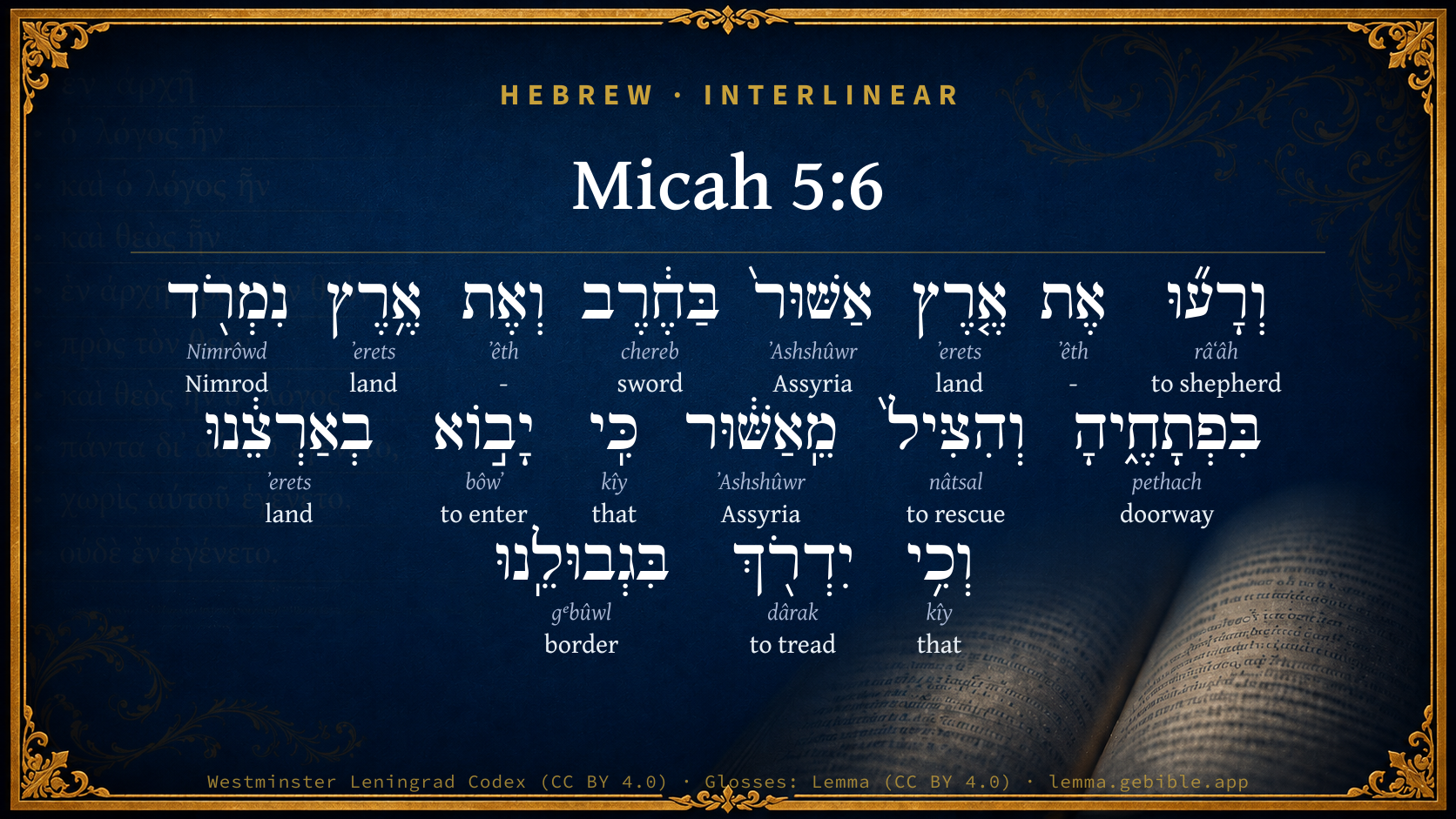
  1. וְרָע֞וּ râʻâh H7462 “and · to shepherd” Conjunction + Verb, Qal, Sequential Perfect, 3rd Person, Common, Plural
  2. אֶת ʼêth H853 “-” Particle, Direct Object
  3. אֶ֤רֶץ ʼerets H776 “land of” Noun, Common, Both, Singular, Construct
  4. אַשּׁוּר֙ ʼAshshûwr H804 “Assyria” Noun, Proper
  5. בַּחֶ֔רֶב chereb H2719 “in/at the · sword” Preposition, Determined + Noun, Common, Feminine, Singular, Absolute
  6. וְאֶת ʼêth H853 “and · -” Conjunction + Particle, Direct Object
  7. אֶ֥רֶץ ʼerets H776 “land of” Noun, Common, Both, Singular, Construct
  8. בִּפְתָחֶ֑יהָ pethach H6607 “in/at · doorways · her” Preposition + Noun, Common, Masculine, Plural, Construct + Suffix, Personal, 3rd Person, Feminine, Singular
  9. וְהִצִּיל֙ nâtsal H5337 “and · to rescue” Conjunction + Verb, Hiphil, Sequential Perfect, 3rd Person, Masculine, Singular
  10. מֵֽאַשּׁ֔וּר ʼAshshûwr H804 “from · Assyria” Preposition + Noun, Proper
  11. כִּֽי kîy H3588 “that” Conjunction
  12. יָב֣וֹא bôwʼ H935 “to enter” Verb, Qal, Imperfect, 3rd Person, Masculine, Singular
  13. בְאַרְצֵ֔נוּ ʼerets H776 “in/at · land · our” Preposition + Noun, Common, Both, Singular, Construct + Suffix, Personal, 1st Person, Common, Plural
  14. וְכִ֥י kîy H3588 “and · that” Conjunction + Conjunction
  15. יִדְרֹ֖ךְ dârak H1869 “to tread” Verb, Qal, Imperfect, 3rd Person, Masculine, Singular
  16. בִּגְבוּלֵֽנוּ gᵉbûwl H1366 “in/at · border · our” Preposition + Noun, Common, Masculine, Singular, Construct + Suffix, Personal, 1st Person, Common, Plural

About this verse

These counts appear in no published source. They are computed here, from the morphology-tagged text and Lemma’s own curated glosses. What Lemma adds →

17
words
12
distinct lemmas
Prophets
section

Notable vocabulary

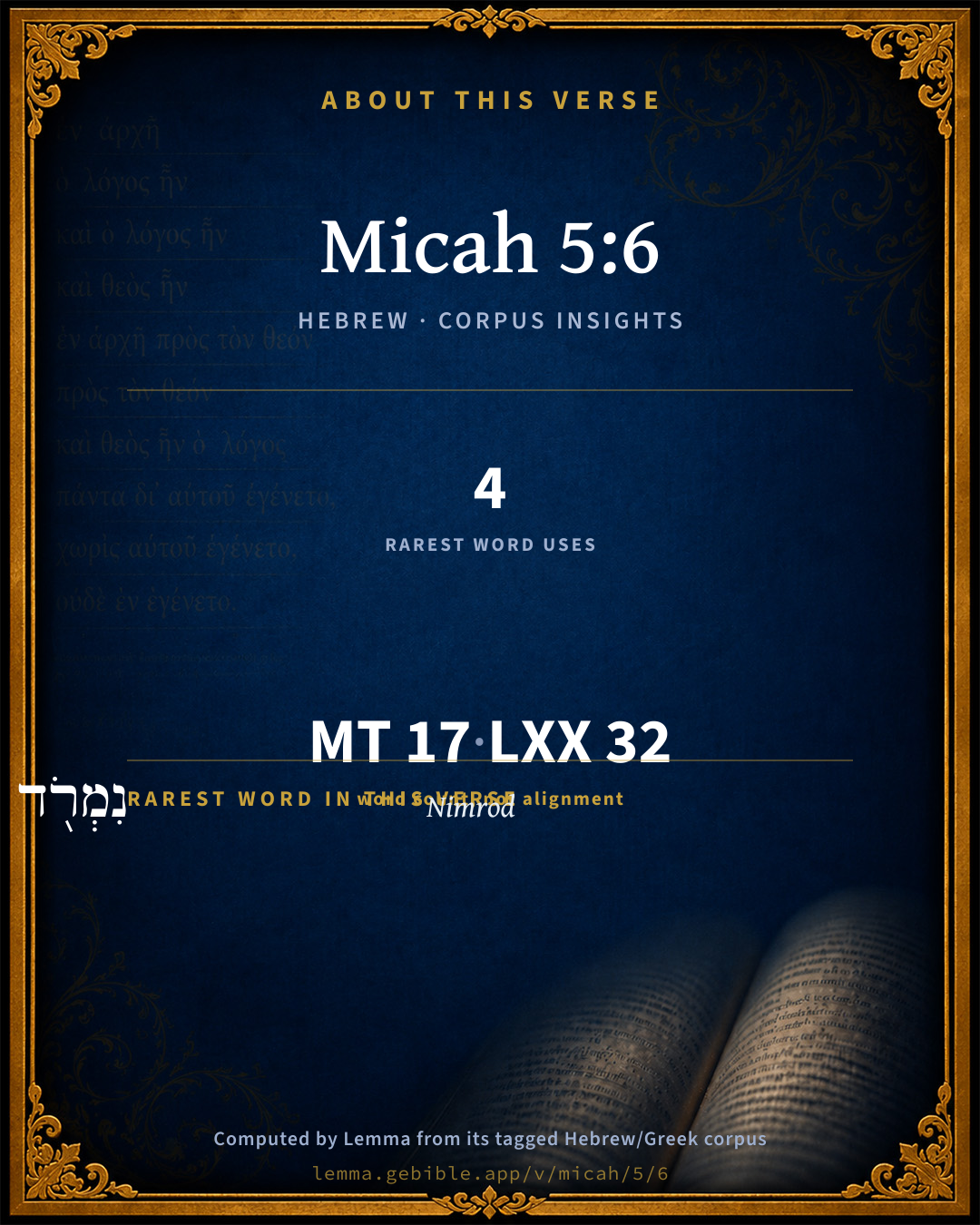
The rarest word here is נִמְרֹ֖ד Nimrod H5248 — appearing just 4 times in the whole Hebrew Bible.

Shared distinctive vocabulary

נִמְרֹ֖ד Nimrod H5248 occurs in 4 verses of the Hebrew Bible. Also found in:

Grammatical profile

  • 4 verbs
  • 9 nouns
  • 2 conjunctions
  • 2 particles

Verb forms

  • וְרָע֞וּ Qal · Sequential Perfect
  • וְהִצִּיל֙ Hiphil · Sequential Perfect
  • יָב֣וֹא Qal · Imperfect
  • יִדְרֹ֖ךְ Qal · Imperfect

Repetition

Words recur within this verse — often emphatic in Hebrew:

  • אֶ֤רֶץ land H776 ×3
  • אַשּׁוּר֙ Assyria H804 ×2
  • כִּֽי that H3588 ×2

Hebrew & Septuagint length

In English translation the verse runs 37 words from the Hebrew and 39 from the Septuagint (LXX English) — closely comparable.

A rough comparison of the two English renderings, which tokenize alike — not a word-level alignment.

Word counts can differ between the Hebrew and the Greek without any difference in meaning — e.g. the Hebrew direct-object marker אֵת has no separate Greek word, and Greek often adds the article ὁ.

In the original languages it is 17 Hebrew tokens and 32 Greek tokens — but the two are counted differently (Hebrew bundles its prefixes and suffixes into one token; the Greek is in lemma form), so that isn’t a like-for-like length.

Cross-references

14

Topical passages linked to Micah 5:6 in the Treasury of Scripture Knowledge — connected by theme and wording, ordered by reader-vote popularity; previews shown in the World English Bible.

  • Genesis 10:8–11 Cush became the father of Nimrod: he began to be a mighty one in the earth.
  • Isaiah 14:25 that I will break the Assyrian in my land, and on my mountains tread him under foot: then shall his yoke depart from off them, and his burden depart from off their shoulder.
  • Luke 1:74 To grant to us that we, being delivered out of the hand of our enemies, should serve him without fear,
  • 2 Kings 15:29 In the days of Pekah king of Israel came Tiglath Pileser king of Assyria, and took Ijon, and Abel Beth Maacah, and Janoah, and Kedesh, and Hazor, and Gilead, and Galilee, all the land of Naphtali; and he carried them captive to Assyria.
  • 2 Kings 17:3–5 Against him came up Shalmaneser king of Assyria; and Hoshea became his servant, and brought him tribute.
  • 2 Kings 18:9–15 It happened in the fourth year of king Hezekiah, which was the seventh year of Hoshea son of Elah king of Israel, that Shalmaneser king of Assyria came up against Samaria, and besieged it.
  • 2 Kings 19:32–35 Therefore thus says Yahweh concerning the king of Assyria, He shall not come to this city, nor shoot an arrow there, neither shall he come before it with shield, nor cast up a mound against it.
  • 2 Chronicles 33:11 Therefore Yahweh brought on them the captains of the host of the king of Assyria, who took Manasseh in chains, and bound him with fetters, and carried him to Babylon.
  • Isaiah 10:5–12 Ho Assyrian, the rod of my anger, the staff in whose hand is my indignation!
  • Isaiah 14:2 The peoples shall take them, and bring them to their place; and the house of Israel shall possess them in the land of Yahweh for servants and for handmaids: and they shall take them captive whose captives they were; and they shall rule over their oppressors.
  • Isaiah 33:1 Woe to you who destroy, and you weren't destroyed; and deal treacherously, and they didn't deal treacherously with you! When you have ceased to destroy, you shall be destroyed; and when you have made an end of dealing treacherously, they shall deal treacherously with you.
  • Nahum 2:11–3:3 Where is the den of the lions, and the feeding-place of the young lions, where the lion and the lioness walked, the lion's cubs, and no one made them afraid?
  • Zephaniah 2:13 He will stretch out his hand against the north, destroy Assyria, and will make Nineveh a desolation, and dry like the wilderness.
  • Luke 1:71 Salvation from our enemies, and from the hand of all who hate us;

Cross-references courtesy of OpenBible.info (CC BY 4.0).

Hebrew and Greek witnesses Masoretic Hebrew ↔ Greek Septuagint

The same verse in the two great witnesses to the Old Testament, shown verse-for-verse.

These are two independent witnesses, not word-aligned to each other, and the Septuagint is shown in lemma (dictionary) form.

Hebrew Micah 5:6 Masoretic · Westminster Leningrad Codex

וְרָע֞וּ אֶת אֶ֤רֶץ אַשּׁוּר֙ בַּחֶ֔רֶב וְאֶת אֶ֥רֶץ נִמְרֹ֖ד בִּפְתָחֶ֑יהָ וְהִצִּיל֙ מֵֽאַשּׁ֔וּר כִּֽי יָב֣וֹא בְאַרְצֵ֔נוּ וְכִ֥י יִדְרֹ֖ךְ בִּגְבוּלֵֽנוּ

They will rule the land of Assyria with the sword, And the land of Nimrod in its gates. He will deliver us from the Assyrian, When he invades our land, And when he marches within our border.

World English Bible · Public Domain

Greek LXX Micah 5:6 Septuagint · lemma form

καί εἰμί ὁ ὑπόλειμμα ὁ ἰακώβ ἐν ὁ ἔθνος ἐν μέσος λαός πολύς ὡς δρόσος παρά κύριος πίπτω καί ὡς ἀρνός ἐπί ἄγρωστις ὅπως μή συνἄγω μηδείς μηδέ ὑποἵστημι ἐν υἱός ἄνθρωπος

And they shall tend the Assyrian with a sword, and the land of Nebrod with her trench: and he shall deliver you from the Assyrian, when he shall come upon your land, and when he shall invade your coasts.

LXX2012 (modern English Septuagint) · Public Domain

On this verse, Haydock's Catholic Bible Commentary discusses the Septuagint’s reading. Read the note in Commentary ↓

Hebrew: Westminster Leningrad Codex (CC BY 4.0). Greek: Septuagint (public domain); English from LXX2012 (modern English Septuagint) (Public Domain). How the Septuagint differs from the Hebrew →

Targum (Aramaic paraphrase)

1

The Targum is the ancient Jewish Aramaic paraphrase of the Hebrew Scriptures — an interpretive translation, not the Hebrew text itself. Onkelos (literal) and Pseudo-Jonathan (expansive) render the Torah, and Jonathan the Prophets. Coverage is partial: where no permissively-licensed English translation exists for a verse, only the Aramaic is shown. This is verse-level text, not a word-by-word alignment to the Hebrew.

  1. Targum Jonathan Prophets (Joshua–Malachi)
    וִיהֵי שְׁאָרָא דְבֵית יַעֲקֹב בְּגוֹ עַמְמִין סַגִיאִין כְּטַלָא קֳדָם יְיָ וְכִרְסִיסֵי מַלְקוֹשָׁא דִי עַל עִסְבָּא דִי לָא מוֹרִיךְ לֶאֱנָשָׁא וְלָא מַכְתַּר לְבַר אֱנָשָׁא:

    (no public-domain English translation for this verse)

    Targum Jonathan — Aramaic: “Mikraot Gedolot” (public domain). English: “Sefaria Community Translation” (CC0 1.0 (public-domain dedication)); “London "Chaldee Paraphrase," 1871” (public domain). Text via Sefaria.

Commentary

Notes on Micah 5:6 from classic Christian and Jewish commentators (each source and its license shown beneath its notes). The classic Christian expositions comment on the surrounding passage and are grouped to its opening verse, so a note may address several verses; the Jewish commentaries on the Tanakh (Rashi and others) are per-verse, so they appear only where the commentator wrote on this verse.

Lemma curates 59 commentaries, every one of them public domain or Creative Commons licensed, each selected and text-cleaned for this edition rather than reprinted as found. About our sources →

Trapp's Complete Commentary

John Trapp

Mic 5:6 And they shall waste the land of Assyria with the sword, and the land of Nimrod in the entrances thereof: thus shall he deliver [us] from the Assyrian, when he cometh into our land, and when he treadeth within our borders.

Ver. 6. And they shall waste the land of Assyria] Heb. They shall eat it down, as shepherds do pastures with their flocks. Pascere to graze is put for perdere, to destroy, saith Calvin; they shall leave nothing there safe or sound, but either bend or break the Church’s enemies, bring them to Christ by the sword of God’s word, or utterly ruin them by temporal slaughters. Aut poenitendum, aut pereundum. Either repent or perish.

Thus shall he deliver us from the Assyrian] It is Christ that delivereth his, what instruments soever he please to make use of, Luk 1:71 1Co 15:24, and he must have the praise of it. The Grecians thankfully acknowledged to Jupiter their deliverance from the Persians, wrought by Themistocles; and therehence called him ελευθεριος, as the Romans for like cause Sospitator , presenting a palm to him, and sacrificing a white ox (Liv. lib. 6), so acknowledging it was his power whereby the conquest was achieved. Our Edward III, after his victory at Poictiers (where he took the French king, A.D. 1356), took speedy order by Simon, Archbishop of Canterbury, that eight days together should be spent in giving God the thanks and glory. How much more should we praise him for spiritual deliverances from sin, Satan, the world, &c., and consecrate ourselves wholly to his service, since Servati sumus ut serviamus, Luk 1:74, deliverance commands obedience, Ezr 9:14.

John Trapp, A Commentary or Exposition upon All the Books of the Old and New Testament (1647–1656) — public domain. Text from a community e-Sword module.

Joseph Benson's Commentary

Mic 5:6. And they — The seven shepherds and eight principal men; or, the rulers and princes of men, mentioned in the preceding clause; those great and successful instruments of God’s revenge, and his church’s deliverance, shall waste the land of Assyria with the sword — Which the Medes and Babylonians did, under the conduct of Merodach-baladan, king of Babylon, who, taking advantage of the weakness of the Assyrian kingdom, humbled partly by the great destruction of Sennacherib’s army, and the murder of that mighty monarch, and partly by the civil wars which ensued between the regicides and Esar-haddon, took arms, and succeeded in the attempt of subduing the Assyrian kingdom, with much slaughter and bloodshed. This Merodach-baladan was the person who sent the congratulatory letter and embassy to Hezekiah, lately cured by a miracle of his otherwise mortal disease, and delivered from the Assyrian power, Isa 39:1-2. And the land of Nimrod — The same with the land of Assyria. In the entrances thereof — The fortified frontiers, the garrisons, which kept all the entrances of the kingdom. Or, by the land of Nimrod, the Babylonish empire may be understood, which afterward by Nebuchadnezzar’s hand destroyed the Jews, Jerusalem, and the temple, and was overthrown by the Medes and Persians, whom God raised up to punish Babylon, and release the Jews. Thus shall he deliver us from the Assyrian — Whether considered literally as the present enemies of God’s people, or as types of all their other and future enemies.

Joseph Benson's Commentary on the Old and New Testaments (1811–1818) — public domain. Text from a community e-Sword module.

Tyndale Open Study Notes

Tyndale Open Resources

5:6 the land of Nimrod: Nimrod laid the foundations of the ancient Assyrian and Babylonian civilizations (Gen 10:8-11).

Tyndale Open Study Notes — © Tyndale Open Resources, licensed CC BY-SA 4.0. Text via the HelloAO Bible API.

Geneva Bible (1599)

Geneva Bible translators

By these governors will God deliver us when the enemy cometh into our land.

These whom God shall raise up for the deliverance of his Church, shall destroy all the enemies thereof, which are meant here by the Assyrians and Babylonians which were the chief at that time.

Geneva Bible (1599) marginal notes — public domain. Text via Bolls.life.

Jamieson, Fausset & Brown

Robert Jamieson, A. R. Fausset & David Brown

waste--literally, "eat up": following up the metaphor of "shepherds" (compare Num 22:4; Jer 6:3).

land of Nimrod--Babylon (Mic 4:10; Gen 10:10); or, including Assyria also, to which he extended his borders (Gen 10:11).

in the entrances--the passes into Assyria (Kg2 3:21). The Margin and JEROME, misled by a needless attention to the parallelism, "with the sword," translate, "with her own naked swords"; as in Psa 55:21 the Hebrew is translated. But "in the entrances" of Assyria, answers to, "within our borders." As the Assyrians invade our borders, so shall their own borders or "entrances" be invaded.

he . . . he--Messiah shall deliver us, when the Assyrian shall come.

Jamieson, Fausset & Brown — Commentary Critical and Explanatory on the Whole Bible (1871) — public domain (CC PDM 1.0). Text via the HelloAO Bible API.

Adam Clarke's Commentary

Verse 6. The land of Nimrod] Assyria, and Nineveh its capital; and Babylon, which was also built by Nimrod, who was its first king, Ge 10:11-12, in the margin.

In the entrances thereof] At its posts or watergates; for it was by rendering themselves masters of the Euphrates that the Medes and Persians took the city, according to the prediction of Jeremiah, Jer 51:32; Jer 51:36.

Calmet thinks that this refers to the deliverance of the land from Cambyses by his death, and the insurrection of the eight princes mentioned above, who made themselves masters of the whole Babylonian empire, c. Perhaps it is best to refer it to the invasion of Judea by Nebuchadnezzar and the final destruction of the Babylonish empire by Cyrus, who took Babylon, slew Belshazzar, and possessed himself of the kingdom.

Adam Clarke's Commentary on the Bible (1810–1826) — public domain. Text from a community e-Sword/MySword module.

John Calvin's Commentaries

In this verse the Prophet says, that the shepherds, chosen by the Church, after it had been miserably oppressed by the tyranny of its enemies, would have a twofold office. They shall first feed; that is, nourish the Church of God; — and, secondly, they shall feed; that is, destroy the land of Asshur, so that nothing may remain there whole and entire. God will then arm these shepherds with warlike courage; for they must fight boldly and courageously against their enemies: he says, They shall feed on the land of Nimrod with their swords Nimrod, we know, reigned in Chaldea; and we know also that the ten tribes were led away by Shalmanezer, and that the kingdom of Israel was thus demolished: when the Chaldeans obtained the empire, the kingdom of Judah was also laid waste by them. Now the import of the words is, that these shepherds would be sufficiently strong to oppose all the enemies of the Church, whether they were the Babylonians or the Assyrians. And he names the Assyrians and Babylonians, because they had then a contest with the people of God; and this continued to the coming of Christ, though it is certain that they suffered more troubles from Antiochus than from others: but as he was one of the successors of Alexander, the Prophet here, taking a part for the whole, means, by the Assyrians and Chaldeans, all the enemies of the Church, whoever they might be. Waste, he says, shall these shepherds the land of Asshur by the sword, and the land of Nimrod, and that by their swords

But this shall not be until the Chaldeans and the Assyrians shall penetrate into our land, and tread in our borders The Prophet again reminds the faithful, that they stood in need of patience, and that they were to know that God had not made a vain promise. The import of the whole is, that no deliverance was to be expected from God’s hand until the faithful yielded their necks to his yoke, and patiently sustained the evils which were then approaching. The Prophet then mentions the intervening time between that state in which the Jews gloried and their deliverance. Why so? Because they were soon after to be smitten heavily by God’s hand; but this, as we have seen, they did not think would take place. Hence he says, — “Since you cannot yet be made to believe that merited punishment is nigh you, experience shall be your teacher. In the meantime, let the faithful provide themselves with courage and, with a meek heart, patiently to submit to God, the righteous Judge: but, at the same time, let them expect a sure deliverance, when they shall have gone through all their evils; for when the ripened time shall come, the Lord will look on his Church; but she must be first afflicted.”

John Calvin's Commentaries (1540-1563) — public domain. Text from the Calvin Translation Society English edition (1840s-50s) via the Christian Classics Ethereal Library (ccel.org). Calvin's coverage is partial (roughly two-thirds of the Bible); uncommented books and verses are honest gaps, never fabricated. The 19th-century editor's footnotes and remarks are omitted so the notes are faithfully Calvin's own voice.

Ellicott's Commentary for English Readers

(6) They shall waste.—Literally, feed upon, consume, depasture. The Land of Nimrod represents the opposing world-power.

A Bible Commentary for English Readers, edited by Charles John Ellicott (1878–1897) — public domain. Text from a community e-Sword module.

The Cambridge Bible for Schools and Colleges

gen. ed. J. J. S. Perowne

6. they shall waste] Lit. ‘feed off.’

the land of Nimrod] Comp. Gen_10:11, ‘Out of that land he [Nimrod] went forth into Assyria.’ There is a special significance in the phrase, for a Hebrew could hardly help connecting Nimrod with mârad, ‘to rebel.’ Assyria was one of those ‘disobedient’ nations spoken of in Mic_5:15.

in the entrances thereof] Lit., ‘in the gates thereof.’ Comp. Nah_3:13, ‘The gates of thy land.’

The Cambridge Bible for Schools and Colleges (gen. ed. J. J. S. Perowne; Cambridge University Press, 1878–1918) — public domain. Text from a community e-Sword module.

John Gill's Exposition

And they shall waste the land of Assyria with the sword,.... Or "feed (e) upon it" with the sword, destroy the inhabitants of it; either spiritually subdue the nations of the world to the obedience of Christ, the sword of the Spirit, which is the word of God; the preaching of the Gospel, the ministry of the apostles, and others, in the Gentile world; see Co2 10:3; or literally, meaning that the angels of the vials, the Christian princes, shall destroy the Ottoman empire with the sword:

and the land of Nimrod in the entrances thereof; the same with Babylon, the empire of which was first set up by Nimrod, the beginning of whose kingdom was Babel, Gen 10:11; the same with Nebrodas, a name of Bacchus, which is no other than Barchus the son of Chus, as Nimrod was the son of Cush, and Bacchus was a mighty hunter, as he was; all which Bochart (f) has observed: now his country was Babel, Erech, Accad, and Calneh, in the land of Shinar, that is, the land of Babylon, as the Targum of Onkelos and Jerusalem in Gen 10:10, render it; though some think Nimrod extended his dominions into Assyria; and translate (g) Mic 5:11 "out of that land, he" (that is, Nimrod) "went forth into Assyria, and builded Nineveh, and the city Rehoboth, and Calah"; and the Targum of Jonathan is very express for it, which paraphrases the words thus,

"out of that land went forth Nimrod, and he reigned in Assyria, because he would not be in the counsel of the generation of the division, and he left these four cities; and the Lord gave him a place (or Assyria), and he built four other cities, Nineveh, &c.''

hence some (h) have thought that the land of Assyria and the land of Nimrod here design one and the same country; but Ashur, in the text in Genesis, seems rather to be the name of a man than of a place, even of the son of Shem so called, from whom the country of Assyria had its name; whereas, if had been so soon in the hands of Nimrod, and so many cities had been built by him in it, it would rather have been called by his name than Ashur's; and it seems most reasonable to conclude that the cities of Nineveh, &c. were built by the latter, and not the former; and the two countries of Assyria and Nimrod, or Babylon, are very plainly in this text distinguished from one another; though they might at the time of this prophecy be united under Esarhaddon, who was both king of Assyria and Babylon; and at this present time they are both in the hands of the Turks, and in all probability will be until this prophecy is fulfilled in the destruction of them by the Christian princes: the same thing is meant as before; and the word rendered "in the entrances thereof" may as well be translated "with its sword" (i); or, as the margin of our Bibles, "with her own naked swords"; so Kimchi and Aben Ezra interpret it:

thus shall he deliver us from the Assyrian, when he cometh into our land, and when he treadeth within our borders; that is, the King Messiah shall work this deliverance, as Kimchi and others (k) explain it; Christ delivered his people from all their spiritual enemies when he made peace for them; and he will deliver them in the latter day from both Pope and Turk, when he will destroy the man of sin by the breath of his mouth, and dry up the river Euphrates, and cast both beast and false prophet into the lake that burns with fire and brimstone; though all that is said in this verse and Mic 5:5 may have had its accomplishment already, at least in part, in the Saracens and their empire, which begun in the year 623, and who prevailed very much in Arabia, Palestine, Syria, Persia, Egypt, and Africa, and even penetrated into Spain and France, in all which places were Christian churches; and so may be called "our land", as the churches therein "our palaces", which these people entered into, trod upon, profaned, or destroyed; and the seven or eight principal men raised against them may be the Christian princes that fought with them, and drove them back, and destroyed their land; such as Hugh the great, brother to Philip king of France; Robert earl of Flanders; Robert earl of Normandy, brother to William the Conqueror, king of England; Stephen earl of Blois; Raymund earl of Tholouse; Godfrey duke of Lorrain, and his brothers Baldwin and Eustachius, and others. These beginning at Nice, where once a famous Christian council was held, and driving the army of Solyman from thence, in the space off our years subdued many provinces of Asia, Lycaonia, Cilicia, Syria, Mesopotamia, and Comagena; and at length having put to flight the Turks, and ejected the Saracens, took Jerusalem, and made Godfrey of Bullein king of it (l). Some (m) have interpreted it of the emperor of Germany, and the seven electors in the empire (for formerly they were no more), happily and with success carrying on a war against the Turks, Tartars, and Saracens, when they broke into Europe; but the former sense seems better; and it is best of all to understand the prophecy of the destruction of the Turk or Ottoman empire in the latter day by the Christian princes.

(e) "et depascent", Montanus, Drusius; "pascent", Piscator, Grotius, Cocceius. (f) Phaleg. l. 1. c. 2. col. 12. (g) Vatablus, Junius and Tremellius, Bochart, Cocceius, and others. (h) Bochart, Phaleg. l. 4. c. 12. c. 229. Bedford's Chronology, p. 773. (i) "gladiis suis", Pagninus, Montanus, Munster, Tigurine version; so R. Sol. Urbin. Ohel Moed, fol. 31. 2. (k) R. Isaac, ib. p. 283. Abarbinel, &c. (l) Vid. Witsii Exercitat. 8. de Assyriis in Miscel. Sacr. tom. 2. p. 218, 219, 220. (m) Vid. Gurtler. Voc. Typic. Prophetic. Explicat. p. 18.

John Gill's Exposition of the Whole Bible (1746–1763) — public domain (CC PDM 1.0). Text via the HelloAO Bible API.

Albert Barnes' Notes on the Bible

And they shall waste - Literally, feed on, and so eat up. They who were shepherds of their own people, should consume their enemies. Jeremiah uses the same image. “The shepherds with their flocks shall come unto her; they shall pitch tents against her round about; they shall feed, each his space” Jer 6:3. So Joshua and Caleb say, “They, (the inhabitants of Canaan,) are bread for us” Num 14:9. So it was said to Peter, “arise, Peter, kill and eat” Act 10:13; and what once was common, defiled and unclean, shall turn to the nourishment and growth of the Church, and be incorporated into Christ, being made part of His Body.

And the land of Nimrod - Babylon, which should displace Assyria, but should carry on its work of chastising God’s people, is joined by Micah, as by Isaiah Isa. 10:5-34; 13–14:27, as an object of His judgment. In Isaiah, they are the actual Assyria Isa 10:12-15 and Babylon Isa 14:13-15 whose destruction is foretold, yet so as to shadow out rebellion against God in its intensest form, making itself independent of, or measuring itself against, God. Hence, probably, here alone in holy Scripture, Babylon is called “the land of Nimrod,” as indeed he founded it Gen 10:10, but therewith was the author of the tower of Babel also, which was built in rebellion against God, whence his own name was derived . Assyria then, and the world-empire which should succeed it, stand as representing the God-opposed world.

In the entrances thereof - (Literally, in the gates thereof.) The shepherds of Israel shall not act on the defensive only, but shall have victory over the world and Satan, carrying back the battle into his own dominions, and overthrowing him there. Satan’s malice, so far from hurting the Church, shall turn to its good. Wherein he hoped to waste it, he shall be wasted; wherein he seemed to triumph, he shall be foiled. So it has been ever seen, how, under every persecution, the Church grew. : “The more it was pressed down, the more it rose up and flourished;” , “Shivering the assault of the Pagans, and strengthened more and more, not by resisting, but by enduring.” Yet all, by whomsoever done, shall be the work of Christ alone, enduring in martyrs, teaching in pastors, converting through the Apostles of pagan nations. Wherefore he adds:

Thus (And) He shall deliver us from the Assyrian - Not they, the subordinate shepherds, but He, the Chief Shepherd until the last enemy shall be destroyed and death shall be swallowed up in victory, shall deliver, whether by them or by Himself as He often so doth, - not us only (the saying is the larger because unlimited) but - He shall deliver, absolutely. Whosoever shall be delivered, He shall be their deliverer; all, whom He alone knoweth, who alone “knoweth them that are His” 2Ti 2:19. “Neither is there salvation in any other” Act 4:12. “Whoso glorieth, let him glory in the Lord” 2Co 10:17. Every member of Christ has part in this, who, through the grace of God, “has power and strength to have victory and to triumph against the devil, the world, and the flesh” - not he, but the grace of God which is with him; and much more, all, whether Apostles or Apostolic men, or Pastors, or Bishops and Overseers, who, by preaching or teaching or prayer, bring those to the knowledge of the truth, who “sat in darkness and the shadow of death” Psa 107:10, and by whom “God translates us into the kingdom of His dear Son” Col 1:13.

Albert Barnes' Notes on the Bible (1834–1885) — public domain. Text from a community e-Sword/MySword module.

Haydock's Catholic Bible Commentary

They. Hystaspes first laid a tax of money on the Persians, who hence styled him a merchant. (Herodotus iii. 89.) --- He was severe, and often at war. (Calmet) --- Feed. They shall make spiritual conquests in the lands of their persecutors, with the sword of the Spirit which is the word of God, Ephesians vi. 17. (Challoner) --- With, &c. Septuagint, "in the ditch." Theodotion, &c., "gates," where sentence was given. --- Borders. Seven or eight princes have taken the place of Cambyses, who had invaded Judea, ver. 5. (Calmet)

George Leo Haydock (1774–1849), Haydock's Catholic Family Bible and Commentary, 1859 edition — public domain. Excludes Psalms (Douay-Rheims chapter numbering differs from Protestant) and Deuterocanonical books (Catholic canon only).

Matthew Poole's English Annotations

And they, the seven shepherds and eight principal men, i.e. those great, wise, and successful instruments of God’s revenge, and of his church’s deliverance,

shall waste the land of Assyria with the sword: this passage seems to point to the Babylonians, who did invade, waste, and subdue the Assyrian kingdom under the conduct of Merodach-baladan, king of Babylon, called also Berodach, 2Ki 20:12. He sent the congratulatory embassy to Hezekiah, newly by miracle cured of his mortal disease and delivered from the Assyrian, Isa 39:1,2. This Merodach taking the opportunity of the weakness of the Assyrian kingdom, partly by the great slaughter of Sennacherib’s army, and the murder of that mighty, daring monarch, and partly by the civil wars which ensued between the regicides and Esarhaddon, took arms, and succeeded in the attempt, subduing the Assyrian kingdom with force and bloodshed enough.

The land of Nimrod; the same, say some, with the land of Assyria but others, perhaps with better reason, refer this to Babylon, and the kingdom thereof, which by Nebuchadnezzar’s hand destroyed the Jews, Jerusalem, and temple, and was afterwards destroyed by the Medes and Persians, whom God raised to punish Babylon and release the Jews.

In the entrances: as we read, it denoteth the fortified frontiers, the garrisons which keep all the entrances of the kingdom; it denoteth also their cities, through the gates of which was great entrance, or their courts of judicature, which were kept in the gates: both their military power should be reduced and their civil power also by the prevailing conqueror.

Thus shall he; in this manner shall he, i.e. the Messiah,

deliver us, the Jews his people,

from the Assyrian; both as type of all other enemies, and he an enemy to the people of God.

When he cometh into our land, and when he treadeth in our borders: see this explained Mic 5:1. I add, that what is rendered when might be rendered because, and note the reason why the Lord Messiah doth so deal with Assyria first and Babylon next.

Matthew Poole's English Annotations on the Holy Bible (1683–1685) — public domain. Text from a community e-Sword/MySword module.

The Pulpit Commentary

They shall waste. The word rendered "waste" (raah) is capable of two interpretations according as it is derived. It may mean "to break" or "to feed;" and in the latter sense may signify either "to eat up" or "to be shepherd over," as the Septuagint, poimanousi , The addition, with the sword, however, limits the explanation, whichever verb we refer it to. These leaders shall not only defend their own land against the enemy, but shall carry the war into the hostile territory, conquer it, and rule with rigour. (for the phrase, comp. Psa_2:9 Rev_2:27 Rev_12:5) True religion has always a war to wage with error and worldliness, but shall conquer in the power of Christ. The land of Nimrod. This is taken by some commentators to mean Babylon, the other great enemy of the Church of God. But Babylon is nowhere in Scripture called "the land of Nimrod," though Nimrod is connected with Babel in Gen_10:10; and the term is better explained here as a synonym of Assyria, used to recall the "rebel" (so Nimrod is interpreted) who founded the first empire, (Gen_10:8-12) and gives the character to the kingdom of this world. In the entrances thereof; literally, in the gates thereof; i.e. in the cities and fortresses, corresponding to the "palaces" of ver. 5. (comp. Isa_3:26 Nah_3:13) Septuagint, en th tafrw authv , with her trench;" Vulgate, in lanceis ejus, which, if the Hebrew he taken as Jerome reads it, will he in close parallelism with the words in the preceding clause, "with the sword." Thus (and) he shall deliver us. Israel has to undergo much tribulation and many struggles, but Messiah shall save her.

The Pulpit Commentary (1880–1919), ed. H.D.M. Spence-Jones & Joseph S. Exell — public domain. Text from a community e-Sword module.

John Wesley's Explanatory Notes

They - The seven shepherds, and eight principal men, those great instruments of God's revenge, and his church's deliverance. Waste the land - So did Merodach Baladan, king of Babylon. The land of Nimrod - The same with the land of Assyria. The entrance - The fortified frontiers. In this manner shall he, the Messiah, deliver the Jews, his people. The Assyrian - The type of all other enemies, to the people of God.

John Wesley, Explanatory Notes Upon the Whole Bible (1754–1765) — public domain. Text via the GEBible commentary corpus.

unfoldingWord translationNotes

Door43 World Missions Community

They will shepherd the land of Assyria with the sword, and the land of Nimrod in its entrances

The sword is a metonym for killing in war. Here the Israelites ruling over the Assyrians is spoken of ironically as if they were killing sheep instead of herding them. The land of Assyria is a metonym for the people who live there. The entrances to cities were where official business took place. AT: "They will make war against the people of Assyria, and they will rule the cities of the land of Nimrod" (See: Metaphor and Irony and Metonymy)

and the land of Nimrod

The words "they will shepherd" are understood from the beginning of the sentence. They can be repeated. AT: "and they will shepherd the land of Nimrod" (See: Ellipsis)

land of Nimrod

This is another name for the land of Assyria. Nimrod was a hunter and early ruler. Translators may add this footnote: "The name 'Nimrod' means 'rebellion.'" (See: How to Translate Names)

He will rescue

The ruler will rescue

like dew from Yahweh, like showers on the grass

Dew and rain showers refresh the land and cause things to grow. The Israelites will cause the people among whom they live to live will. (See: Simile)

grass, that do not wait for a man, and they do not wait for the children

"grass. It is not for a man that they wait, nor is it for the children." It is Yahweh alone who causes dew and rain showers.

translationWords

Assyria

sword

hand

remnant

Jacob

people group

Yahweh

unfoldingWord translationNotes — © Distant Shores Media and the Door43 World Missions Community, licensed CC BY-SA 4.0. Source: git.door43.org/Door43/en_tn.

Rashi

Rabbi Shlomo Yitzchaki (Rashi)

like dew sent by the Lord—which does not come to the world through man, and people do not ask for it, so Israel will not hope for the help of man, but for the Lord.

Rashi on the Tanakh — English translations: “The Judaica Press complete Tanach with Rashi, translated by A. J. Rosenberg” (CC BY 4.0); “Pentateuch with Rashi's commentary by M. Rosenbaum and A.M. Silbermann, 1929-1934” (public domain); “The Metsudah Tanach series, Lakewood, N.J” (CC BY 4.0); and “The Book of Joshua, Metsudah Publications, 1997” (CC BY 4.0). Text via Sefaria.

Lesson kit

Teaching starters — assembled from the data on this page, not authored interpretation. Every prompt links to the verse data it draws on. Edit before teaching.

Micah, in the Prophets, opens this verse with 17 words (12 distinct Hebrew lemmas). Its most distinctive word is Nimrôwd (“Nimrod”). A historical commentator’s framing appears above. Read the whole chapter for the surrounding context.

Discussion questions

  1. How does “Nimrod” (Nimrôwd) shape what this verse is saying?
  2. How does Genesis 10:8, which shares the word «Nimrod», read alongside this verse?
  3. What does the repetition of “land” (3× in this one verse) do in this verse?
  4. The translations on this page render this verse differently — a whole-verse word diff, not a word-by-word alignment. What might account for the different wordings?
  5. «וְרָע֞וּ» is a Qal Sequential Perfect verb. How does that grammatical form shape the action described?
  6. Compare how Trapp's Complete Commentary and Joseph Benson's Commentary read this verse. Where do they agree or differ?

Things to notice

Reading settings

Reading text

Shown beneath each verse's original-language words.

Old Testament
Old Testament edition

Read the OT as the Masoretic Hebrew (MT) or the Greek Septuagint (LXX).

English shown for the Greek Septuagint (in the Hebrew ↔ Greek comparison).

Comparing translations? Open the Compare panel on any verse page to stack up to four side by side.