
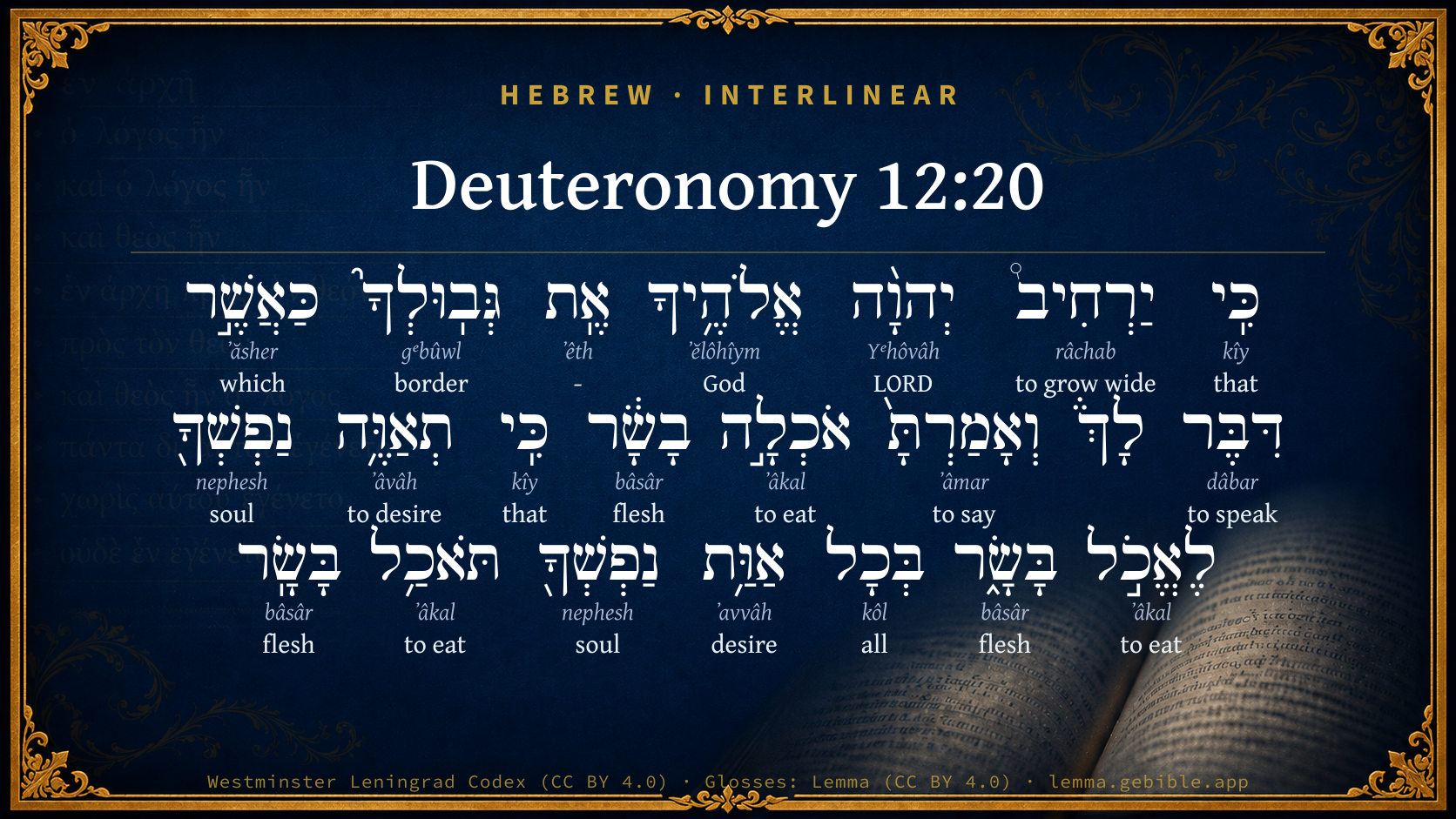
Deuteronomy 12:20

Hebrew (Westminster Leningrad Codex) Deuteronomy 12:20 appears in the Hebrew Old Testament. The text above is from the Westminster Leningrad Codex. Each word links to its Strong’s number, a concise gloss, and parsing drawn from the Open Scriptures Hebrew Bible morphology. Click any word for its full Brown-Driver-Briggs (BDB) entry.
Download image
Cite this verse

Deuteronomy 12:20 (World English Bible). Public Domain. Lemma interlinear Bible study tool, https://lemma.gebible.app/v/deuteronomy/12/20.

Show BibTeX & RIS
BibTeX
RIS
English Translation
When Yahweh your God shall enlarge your border, as he has promised you, and you shall say, I will eat flesh, because your soul desires to eat flesh; you may eat flesh, after all the desire of your soul.
World English Bible · Public Domain
Download a study sheet

One document with this verse’s original text, its word-by-word gloss line, the meaning frame, cross-references with their text, attributed commentary, and full source and license credits — printable, and it pastes into notes with its structure intact.

This verse Autodidact and up

Study sheet (.html) Plain text (.txt)

A passage Seminary Student

Up to 50 verses in one chapter. A passage sheet keeps up to 6 commentary sources and 12 cross-references per verse, in the order this page ranks them, and says so on the sheet whenever that leaves anything out. Ask for a single verse and you get the Autodidact verse sheet above.

Everything on this page stays free to read, with no account — the sheet is a download of what is already on screen, not access to it.

Want to remove ads? Support Godless Engineer
Compare translations 3

The same verse in 3 English versions, stacked beneath the original-language interlinear above. Click any original word for its lexicon entry.

Each is an independent rendering of the whole verse — the interlinear is not word-aligned to these translations.

Highlighted words mark where these versions differ — a whole-verse word diff, not a word-by-word alignment.

  • World English Bible Public Domain
    When Yahweh your God shall enlarge your border, as he has promised you, and you shall say, I will eat flesh, because your soul desires to eat flesh; you may eat flesh, after all the desire of your soul.
  • King James Version Public Domain
    When the LORD thy God shall enlarge thy border, as he hath promised thee, and thou shalt say, I will eat flesh, because thy soul longeth to eat flesh; thou mayest eat flesh, whatsoever thy soul lusteth after.
  • unfoldingWord Literal Text CC BY-SA 4.0
    When Yahweh your God broadens your borders, as he has spoken to you, and you say, ‘I will eat meat,’ due to the desire of your soul to eat meat, you may eat meat in all the desire of your soul.

unfoldingWord Literal Text — © unfoldingWord, licensed CC BY-SA 4.0. Word-aligned USFM3 via Door43 (git.door43.org/unfoldingWord/en_ult).

Versions to compare (up to 4)

3 of 4 selected

Show all 18 translations

Every available English version of this verse, each an independent rendering of the whole verse.

  • World English Bible Public Domain
    When Yahweh your God shall enlarge your border, as he has promised you, and you shall say, I will eat flesh, because your soul desires to eat flesh; you may eat flesh, after all the desire of your soul.
  • Berean Standard Bible Public Domain
    When the LORD your God expands your territory as He has promised, and you crave meat and say, “I want to eat meat,” you may eat it whenever you want.
  • Majority Standard Bible Public Domain
    When the LORD your God expands your territory as He has promised, and you crave meat and say, “I want to eat meat,” you may eat it whenever you want.
  • King James Version Public Domain
    When the LORD thy God shall enlarge thy border, as he hath promised thee, and thou shalt say, I will eat flesh, because thy soul longeth to eat flesh; thou mayest eat flesh, whatsoever thy soul lusteth after.
  • American Standard Version (1901) Public Domain
    When Jehovah thy God shall enlarge thy border, as he hath promised thee, and thou shalt say, I will eat flesh, because thy soul desireth to eat flesh; thou mayest eat flesh, after all the desire of thy soul.
  • Revised Version (1885) Public Domain
    When the LORD thy God shall enlarge thy border, as he hath promised thee, and thou shalt say, I will eat flesh, because thy soul desireth to eat flesh; thou mayest eat flesh, after all the desire of thy soul.
  • Geneva Bible (1599) Public Domain
    When the Lord thy God shall enlarge thy border, as hee hath promised thee, and thou shalt say, I wil eate flesh, (because thine heart longeth to eate flesh) thou maiest eate flesh, whatsoeuer thine heart desireth.
  • Douay-Rheims (1899) Public Domain
    When the Lord thy God shall have enlarged thy borders, as he hath spoken to thee, and thou wilt eat the flesh that thy soul desireth:
  • Young's Literal Translation Public Domain
    `When Jehovah thy God doth enlarge thy border, as He hath spoken to thee, and thou hast said, Let me eat flesh -- for thy soul desireth to eat flesh -- of all the desire of thy soul thou dost eat flesh.
  • Literal Standard Version CC BY-SA 4.0
    When your God YHWH enlarges your border, as He has spoken to you, and you have said, Let me eat flesh—for your soul desires to eat flesh—you eat flesh of all the desire of your soul.
  • Unlocked Literal Bible CC BY-SA 4.0
    When Yahweh your God enlarges your borders, as he has promised you, and you say, 'I will eat flesh,' because of your desire to eat meat, you may eat meat, as your soul desires.
  • unfoldingWord Literal Text CC BY-SA 4.0
    When Yahweh your God broadens your borders, as he has spoken to you, and you say, ‘I will eat meat,’ due to the desire of your soul to eat meat, you may eat meat in all the desire of your soul.
  • Darby Bible Public Domain
    When Jehovah thy God shall enlarge thy border, as he promised thee, and thou say, I will eat flesh, because thy soul longeth to eat flesh, thou mayest eat flesh, according to all the desire of thy soul.
  • World Messianic Bible Public Domain
    When the LORD your God enlarges your border, as he has promised you, and you say, “I want to eat meat,” because your soul desires to eat meat, you may eat meat, after all the desire of your soul.
  • Webster's Bible Public Domain
    When the LORD thy God shall enlarge thy border, as he hath promised thee, and thou shalt say, I will eat flesh, because thy soul longeth to eat flesh; thou mayest eat flesh, whatever thy soul desireth.
  • Free Bible Version CC BY-SA 4.0
    When the Lord your God gives you more land as he promised, and you feel like some meat, and say, “I want to have some meat,” you can eat it whenever you want.
  • Bible in Basic English Public Domain
    When the Lord your God makes wide the limit of your land, as he has said, and you say, I will take flesh for my food, because you have a desire for it; then you may take whatever flesh you have a desire for.
  • JPS Tanakh (1917) Public Domain
    When the LORD thy God shall enlarge thy border, as He hath promised thee, and thou shalt say: 'I will eat flesh', because thy soul desireth to eat flesh; thou mayest eat flesh, after all the desire of thy soul.

Literal Standard Version (2020), Covenant Press — licensed CC BY-SA 4.0. Text via the HelloAO Bible API (eBible.org). Unlocked Literal Bible (unfoldingWord) — licensed CC BY-SA 4.0. Text via the HelloAO Bible API (eBible.org). unfoldingWord Literal Text — © unfoldingWord, licensed CC BY-SA 4.0. Word-aligned USFM3 via Door43 (git.door43.org/unfoldingWord/en_ult). Free Bible Version, Dr. Jonathan Gallagher — licensed CC BY-SA 4.0. Text via the HelloAO Bible API (eBible.org).

Word by word

More ways to search: Search by grammar → Find every occurrence → Compare this word →

Practice this passage: Drill this verse → Learn its vocabulary →

אַוַּ֥ת
ʼavvâh
H185
“desire of”
Noun, Common, Feminine, Singular, Construct
Part of Speech
Noun
Type
Common
Gender
Feminine
Number
Singular
State
Construct
Full BDB Definition

Origin: from H183

TWOT: 40b

desire, lust, will (not necessarily evil)
  1. כִּֽי kîy H3588 “that” Conjunction
  2. יַרְחִיב֩ râchab H7337 “to grow wide” Verb, Hiphil, Imperfect, 3rd Person, Masculine, Singular
  3. יְהוָ֨ה Yᵉhôvâh H3068 “LORD” Noun, Proper
  4. אֱלֹהֶ֥יךָ ʼĕlôhîym H430 “God(s) · your” Noun, Common, Masculine, Plural, Construct + Suffix, Personal, 2nd Person, Masculine, Singular
  5. אֶֽת ʼêth H853 “-” Particle, Direct Object
  6. גְּבֽוּלְךָ֮ gᵉbûwl H1366 “border · your” Noun, Common, Masculine, Singular, Construct + Suffix, Personal, 2nd Person, Masculine, Singular
  7. כַּאֲשֶׁ֣ר ʼăsher H834 “like/as · which” Preposition + Particle, Relative
  8. דִּבֶּר dâbar H1696 “to speak” Verb, Piel, Perfect, 3rd Person, Masculine, Singular
  9. וְאָמַרְתָּ֙ ʼâmar H559 “and · to say” Conjunction + Verb, Qal, Sequential Perfect, 2nd Person, Masculine, Singular
  10. אֹכְלָ֣ה ʼâkal H398 “to eat” Verb, Qal, Cohortative, 1st Person, Common, Singular
  11. בָשָׂ֔ר bâsâr H1320 “flesh” Noun, Common, Masculine, Singular, Absolute
  12. כִּֽי kîy H3588 “that” Conjunction
  13. תְאַוֶּ֥ה ʼâvâh H183 “to desire” Verb, Piel, Imperfect, 3rd Person, Feminine, Singular
  14. נַפְשְׁךָ֖ nephesh H5315 “soul · your” Noun, Common, Both, Singular, Construct + Suffix, Personal, 2nd Person, Masculine, Singular
  15. לֶאֱכֹ֣ל ʼâkal H398 “to eat” Preposition + Verb, Qal, Infinitive Construct
  16. בָּשָׂ֑ר bâsâr H1320 “flesh” Noun, Common, Masculine, Singular, Absolute
  17. בְּכָל kôl H3605 “in/at · all of” Preposition + Noun, Common, Masculine, Singular, Construct
  18. נַפְשְׁךָ֖ nephesh H5315 “soul · your” Noun, Common, Both, Singular, Construct + Suffix, Personal, 2nd Person, Masculine, Singular
  19. תֹּאכַ֥ל ʼâkal H398 “to eat” Verb, Qal, Imperfect, 2nd Person, Masculine, Singular
  20. בָּשָֽׂר bâsâr H1320 “flesh” Noun, Common, Masculine, Singular, Absolute

About this verse

These counts appear in no published source. They are computed here, from the morphology-tagged text and Lemma’s own curated glosses. What Lemma adds →

22
words
15
distinct lemmas
Pentateuch
section

Notable vocabulary

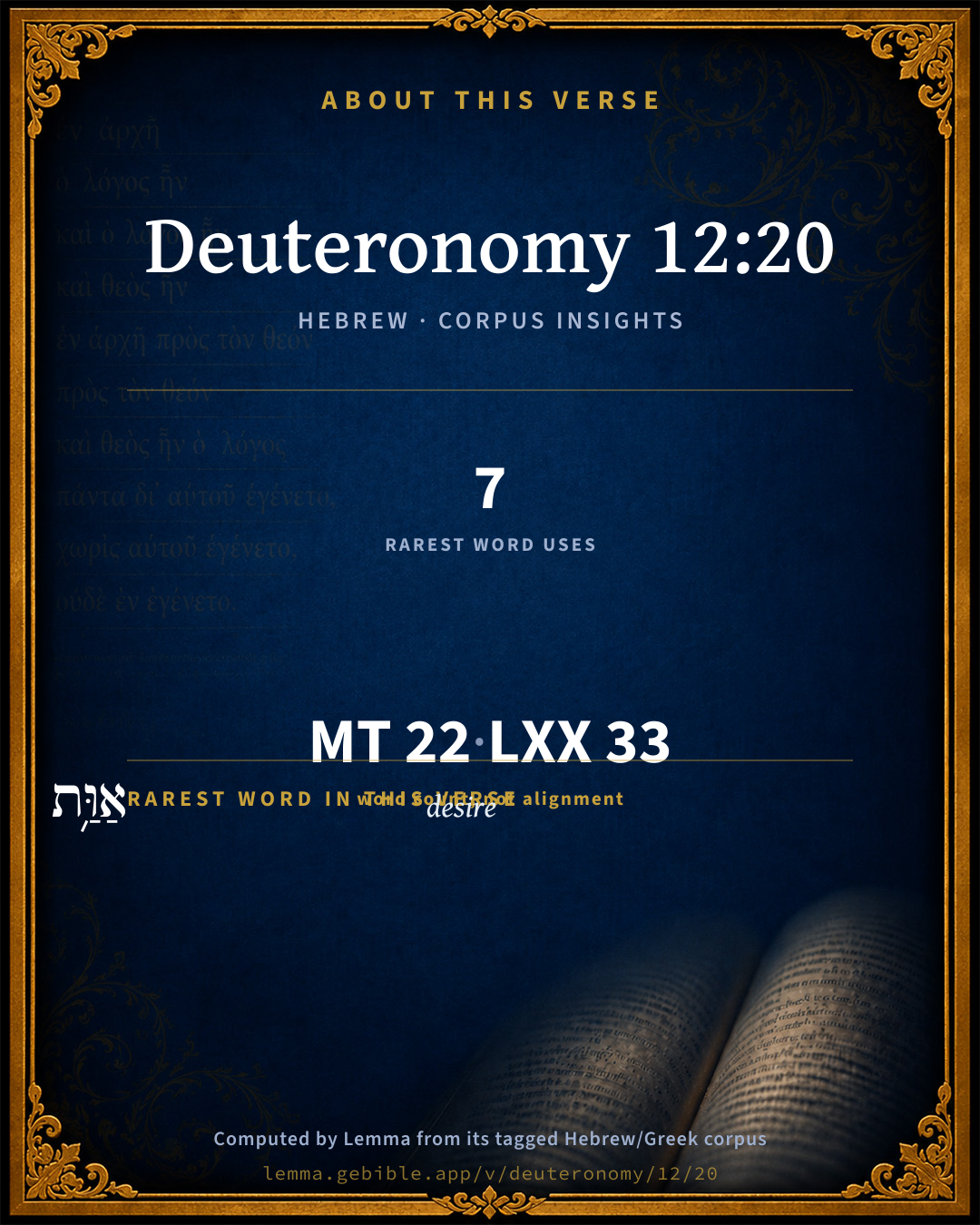
The rarest word here is אַוַּ֥ת desire H185 — appearing just 7 times in the whole Hebrew Bible.

Shared distinctive vocabulary

אַוַּ֥ת desire H185 occurs in 7 verses of the Hebrew Bible. Also found in:

Grammatical profile

  • 7 verbs
  • 10 nouns
  • 1 preposition
  • 2 conjunctions
  • 2 particles

Verb forms

  • יַרְחִיב֩ Hiphil · Imperfect
  • דִּבֶּר Piel · Perfect
  • וְאָמַרְתָּ֙ Qal · Sequential Perfect
  • אֹכְלָ֣ה Qal · Cohortative
  • תְאַוֶּ֥ה Piel · Imperfect
  • לֶאֱכֹ֣ל Qal · Infinitive Construct
  • תֹּאכַ֥ל Qal · Imperfect

Repetition

Words recur within this verse — often emphatic in Hebrew:

  • אֹכְלָ֣ה to eat H398 ×3
  • בָשָׂ֔ר flesh H1320 ×3
  • נַפְשְׁךָ֖ soul H5315 ×2
  • כִּֽי that H3588 ×2

Hebrew & Septuagint length

In English translation the verse runs 39 words from the Hebrew and 43 from the Septuagint (LXX English) — closely comparable.

A rough comparison of the two English renderings, which tokenize alike — not a word-level alignment.

Word counts can differ between the Hebrew and the Greek without any difference in meaning — e.g. the Hebrew direct-object marker אֵת has no separate Greek word, and Greek often adds the article ὁ.

In the original languages it is 22 Hebrew tokens and 33 Greek tokens — but the two are counted differently (Hebrew bundles its prefixes and suffixes into one token; the Greek is in lemma form), so that isn’t a like-for-like length.

Cross-references

23

Topical passages linked to Deuteronomy 12:20 in the Treasury of Scripture Knowledge — connected by theme and wording, ordered by reader-vote popularity; previews shown in the World English Bible.

  • Deuteronomy 19:8 If Yahweh your God enlarge your border, as he has sworn to your fathers, and give you all the land which he promised to give to your fathers;
  • Deuteronomy 11:24 Every place whereon the sole of your foot shall tread shall be yours: from the wilderness, and Lebanon, from the river, the river Euphrates, even to the hinder sea shall be your border.
  • Exodus 34:24 For I will drive out nations before you and enlarge your borders; neither shall any man desire your land when you go up to appear before Yahweh, your God, three times in the year.
  • Genesis 28:14 Your seed will be as the dust of the earth, and you will spread abroad to the west, and to the east, and to the north, and to the south. In you and in your seed will all the families of the earth be blessed.
  • 1 Chronicles 4:10 Jabez called on the God of Israel, saying, Oh that you would bless me indeed, and enlarge my border, and that your hand might be with me, and that you would keep me from evil, that it not be to my sorrow! God granted him that which he requested.
  • Genesis 15:18–21 In that day Yahweh made a covenant with Abram, saying, "To your seed have I given this land, from the river of Egypt to the great river, the river Euphrates:
  • Exodus 23:31 I will set your border from the Red Sea even to the sea of the Philistines, and from the wilderness to the River; for I will deliver the inhabitants of the land into your hand, and you shall drive them out before you.
  • Deuteronomy 12:15 Notwithstanding, you may kill and eat flesh within all your gates, after all the desire of your soul, according to the blessing of Yahweh your God which he has given you: the unclean and the clean may eat of it, as of the gazelle, and as of the hart.
  • Psalms 63:1 God, you are my God. I will earnestly seek you. My soul thirsts for you, My flesh longs for you, In a dry and weary land, where there is no water.
  • Psalms 107:9 For he satisfies the longing soul. He fills the hungry soul with good.
  • Genesis 31:30 Now, you want to be gone, because you sore longed after your father's house, but why have you stolen my gods?"
  • Numbers 11:4 The mixed multitude that was among them lusted exceedingly: and the children of Israel also wept again, and said, Who shall give us flesh to eat?
  • Numbers 11:20 but a whole month, until it come out at your nostrils, and it be loathsome to you; because that you have rejected Yahweh who is among you, and have wept before him, saying, Why came we forth out of Egypt?
  • Numbers 11:34 The name of that place was called Kibrothhattaavah, because there they buried the people who lusted.
  • 2 Samuel 13:39 [the soul of] king David longed to go forth to Absalom: for he was comforted concerning Amnon, seeing he was dead.
  • 2 Samuel 23:15 David longed, and said, Oh that one would give me water to drink of the well of Bethlehem, which is by the gate!
  • Psalms 84:2 My soul longs, and even faints for the courts of Yahweh. My heart and my flesh cry out for the living God.
  • Psalms 119:20 My soul is consumed with longing for your ordinances at all times.
  • Psalms 119:40 Behold, I long for your precepts! Revive me in your righteousness.
  • Psalms 119:174 I have longed for your salvation, Yahweh. Your law is my delight.
  • 2 Corinthians 9:14 while they themselves also, with supplication on your behalf, yearn for you by reason of the exceeding grace of God in you.
  • Philippians 1:8 For God is my witness, how I long after all of you in the tender mercies of Christ Jesus.
  • Philippians 2:26 since he longed for you all, and was very troubled, because you had heard that he was sick.

Cross-references courtesy of OpenBible.info (CC BY 4.0).

Hebrew and Greek witnesses Masoretic Hebrew ↔ Greek Septuagint

The same verse in the two great witnesses to the Old Testament, shown verse-for-verse.

These are two independent witnesses, not word-aligned to each other, and the Septuagint is shown in lemma (dictionary) form.

Hebrew Deuteronomy 12:20 Masoretic · Westminster Leningrad Codex

כִּֽי יַרְחִיב֩ יְהוָ֨ה אֱלֹהֶ֥יךָ אֶֽת גְּבֽוּלְךָ֮ כַּאֲשֶׁ֣ר דִּבֶּר לָךְ֒ וְאָמַרְתָּ֙ אֹכְלָ֣ה בָשָׂ֔ר כִּֽי תְאַוֶּ֥ה נַפְשְׁךָ֖ לֶאֱכֹ֣ל בָּשָׂ֑ר בְּכָל אַוַּ֥ת נַפְשְׁךָ֖ תֹּאכַ֥ל בָּשָֽׂר

When Yahweh your God shall enlarge your border, as he has promised you, and you shall say, I will eat flesh, because your soul desires to eat flesh; you may eat flesh, after all the desire of your soul.

World English Bible · Public Domain

Greek LXX Deuteronomy 12:20 Septuagint · lemma form

ἐάν δέ ἐνπλατύνω κύριος ὁ θεός σύ ὁ ὅριον σύ καθάπερ λαλέω σύ καί εἶπον ἐσθίω κρέας ἐάν ἐπιθυμέω ὁ ψυχή σύ ὥστε ἐσθίω κρέας ἐν πᾶς ἐπιθυμία ὁ ψυχή σύ ἐσθίω κρέας

And if the Lord your God shall enlarge your borders, as he said to you, and you shall say, I will eat flesh; if your soul should desire to eat flesh, you shall eat flesh according to all the desire of your soul.

LXX2012 (modern English Septuagint) · Public Domain

On this verse, The Cambridge Bible for Schools and Colleges discusses the Septuagint’s reading. Read the note in Commentary ↓

Hebrew: Westminster Leningrad Codex (CC BY 4.0). Greek: Septuagint (public domain); English from LXX2012 (modern English Septuagint) (Public Domain). How the Septuagint differs from the Hebrew →

Targum (Aramaic paraphrase)

2

The Targum is the ancient Jewish Aramaic paraphrase of the Hebrew Scriptures — an interpretive translation, not the Hebrew text itself. Onkelos (literal) and Pseudo-Jonathan (expansive) render the Torah, and Jonathan the Prophets. Coverage is partial: where no permissively-licensed English translation exists for a verse, only the Aramaic is shown. This is verse-level text, not a word-by-word alignment to the Hebrew.

  1. Targum Onkelos Torah (Genesis–Deuteronomy)
    אֲרֵי יַפְתֵּי יְיָ אֱלָהָךְ יָת תְּחוּמָךְ כְּמָא דִי מַלִיל לָךְ וְתֵימַר אֵיכוּל בִּשְׂרָא אֲרֵי תִתִּרְעֵי נַפְשָׁךְ לְמֵיכַל בִּשְׂרָא בְּכָל רְעוּת נַפְשָׁךְ תֵּיכוּל בִּשְׂרָא

    (no public-domain English translation for this verse)

    Targum Onkelos — Aramaic: “Onkelos Genesis” (public domain); “Onkelos Exodus” (public domain); “Onkelos Leviticus” (public domain); “Onkelos Numbers” (public domain); “Onkelos Deuteronomy” (public domain). English: “Sefaria Community Translation” (CC0 1.0 (public-domain dedication)); “J.W. Etheridge. The Targums of Onkelos and Jonathan Ben Uzziel on the Pentateuch. London: Longmans, Green, 1862” (public domain). Text via Sefaria.

  2. Targum Pseudo-Jonathan Torah (Genesis–Deuteronomy)
    אֲרוּם יַפְתֵּי יְיָ אֱלָהָכוֹן יַת תְּחוּמְכוֹן הֵיכְמָא דְמַלֵּיל לְכוֹן וְתֵימַר אֵיכוֹל בִּישְרָא אֲרוּם תֵירוּג נַפְשָׁךְ לְמֵיכוֹל בִּישְרָא בְּכָל רְגוּג נַפְשָׁךְ תֵּיכוּל בִּישְרָא

    When the Lord your God will have enlarged your border, as He hath said unto you; and thou sayest, I would eat flesh, because thy soul may desire to eat flesh, thou mayest eat flesh according to all thy desire.

    Targum Pseudo-Jonathan — Aramaic: “Targum Jonathan on Genesis” (public domain); “Targum Jonathan on Exodus” (public domain); “Targum Jonathan on Leviticus” (public domain); “Targum Jonathan on Numbers” (public domain); “Targum Jonathan on Deuteronomy” (public domain). English: “The Targum of Jonathan ben Uzziel, trans. J. W. Etheridge, London, 1862” (public domain). Text via Sefaria.

Commentary

Notes on Deuteronomy 12:20 from classic Christian and Jewish commentators (each source and its license shown beneath its notes). The classic Christian expositions comment on the surrounding passage and are grouped to its opening verse, so a note may address several verses; the Jewish commentaries on the Tanakh (Rashi and others) are per-verse, so they appear only where the commentator wrote on this verse.

Lemma curates 59 commentaries, every one of them public domain or Creative Commons licensed, each selected and text-cleaned for this edition rather than reprinted as found. About our sources →

The Cambridge Bible for Schools and Colleges

gen. ed. J. J. S. Perowne

20–28. Practical Corollary to the Law of the One Altar

Originally among the Semites as among some other races all slaughter of domestic animals was sacramental1[132]: cp. the Heb. and Arab. word ‘for altar, lit. slaughter-place (see on Deu_12:3). But if this law was still to prevail when sacrifice was limited to one altar the flesh of these animals could only be enjoyed at it, and the lawful or ‘clean’ enjoyment of flesh became impossible to all who lived out of reach of the altar. Compare the analogy in Hos_9:3 f. where it is said that when Israel are exiled and cease to dwell in Jehovah’s land, where alone sacrifice is legal for them, they must eat unclean food, and become polluted for their food has not first come into a house of Jehovah (cp. Amo_7:17). The confinement of sacrifice to one place therefore rendered it necessary to sanction non-ritual slaughter and eating of animals. This is done in the following verses but on two conditions, (1) that God shall have enlarged Israel’s territory, and (2) that the eaters do not live in the neighbourhood of the altar. On these conditions the eating of domestic animals shall be as that of game, in need of no ritual sanction (Deu_12:22). Only their blood must be poured on the ground (Deu_12:23-25). And all holy things, specially consecrated, must be brought to the one altar, and the ‘olôth and the blood of the zebaḥim put upon it (Deu_12:26 f.). The section closes with a general injunction of obedience (Deu_12:28).—There appears no reason to doubt the unity of this supplement to the law of the one sanctuary (apart from small, possibly editorial, insertions). It is throughout in the Sg. address, and logical in its arrangement. The return to the keynote of the law is natural. Note the religious advance which it involves. By separating the enjoyment of animal food from religious rites (as well as by directing the blood of the animals to be poured on the ground), the law cut off the ancient primitive superstitions of the physical kinship of a tribe and their god with their animals, and rendered less possible the animal idolatry which these engendered.

[132] For the argument that this practice was due to belief in the kinship of the tribe (and its god) with its animals and that in consequence these were too sacred to be slain except with solemn rites and in the presence and with the consent of the whole family, clan or tribe, who all partook of the flesh and set apart certain portions and the blood for their god, see W. R. Smith, Rel. Sem. Lects. viii., ix.

Deu_12:20. shall enlarge thy border] So Deu_19:8, also Exo_34:24, probably editorial.

as he hath promised thee] Heb. has said. To regard this as an editorial addition, on the ground that it anticipates 21 b (Steuern., Berth.), is precarious. The spirit of such a promise is in several previous passages: e.g. Deu_1:21.

thy soul desireth] On the soul as seat of the appetite see Deu_14:26, Deu_24:15; Gen_27:9; Pro_27:7. The frankness of this statement is noteworthy.

after all the (or every) desire of thy soul] The utmost freedom is granted. But the whole passage implies that flesh was eaten only seldom in early Israel, which is confirmed by Nathan’s parable and the Book of Ruth (W. R. Smith, OTJC2, 249 n.).

Deu_12:21. If] Rather, Because.

the place which the Lord thy God shall choose, etc.] See on Deu_12:5.

thou shalt kill] The same vb. as is used of sacrifice but here in a non-ritual sense.

as I have commanded thee] Can only refer to Deu_12:15 and if that, as we have seen probable, is a later insertion, this must be of the same character (Steuern., Bertholet).

within thy gates] See on Deu_12:17.

Deu_12:22. Even as the gazelle and as the hart is eaten] Gazelle. Heb. Ṣebî, and Ar. ẓaby or thobby (Doughty, Ar. Des. ii. 468) are both properly the gazella Dorcas, a horned animal about the size of a roebuck, but more graceful, numerous in Arabia and Syria; but as ẓaby was used as the more general term for ghazâl or gazelle (Lane), so ṣebî probably covered several species of gazelle and antelope. Hart, Heb. ’ayyal, from ’ul to precede, as leader of the herd, perhaps the fallow deer cervus dama; but Ar. ’iyyal is mountain-goat (Lane). The two names occurring together here, Deu_12:15, Deu_14:5, Deu_15:22, are not to be taken specifically, but generally of many kinds of gazelle, antelope and deer eaten by Israel and the Arabs, but not allowed for sacrifice (except in certain cases among the Arabs, Wellh. Reste d. Arab. Heid. 112). The reason was that wild animals taken in hunting were not akin to man, and therefore needed not to be eaten sacramentally. Hence the following clause—

unclean and clean shall eat thereof alike] Both adj., used also in physical and ethical sense, here mean ritually unclean and clean: the injunction is found elsewhere in D, Deu_12:15, Deu_15:22, and in P. Sam., LXX add among thee. Alike, Heb. together, the one as well as the other.

so thou shalt eat thereof] i.e. of domestic animals: out of reach of the sanctuary they may be slain and eaten without rites. What freedom the deuteronomic law thus effected, in contrast to petty and embarrassing scrupulousness engendered by the legislation of P and its elaboration in later Judaism, can be appreciated only by a study of the N.T. texts on the question of meats. Cp. Act_10:15, what God hath cleansed make not thou common; 1Co_10:25; 1Co_11:20 ff.; Rom_14:20; 1Ti_4:4, and for the expression of a still higher principle Mat_15:11.

Deu_12:23. Only] Heb. raḳ, see on Deu_10:15, and Deu_12:15-16.

be sure] Lit. be firm or strong: usually in D with another verb—be strong and courageous; see on Deu_1:38, Deu_3:28.

that thou eat not the blood] That there was at once a strong temptation to partake of the blood and from the earliest times a national conscience against doing so, is seen in 1Sa_14:32 ff., according to which the people flew upon the spoil—sheep, oxen and calves—and slew them on the ground, without altar or rites, and ate them with the blood.… So the people sin against Jehovah in that they eat with the blood, and he said, Ye have transgressed. For a similar conscience, and violation of it, among the Arabs, see Doughty, Ar. Des. ii. 238.

for the blood is the life] The identification of blood and life was a matter of ordinary observation; as the one ebbed so did the other. As life, the blood belonged to the Deity. Cp. P (Gen_9:4; Lev_17:11; Lev_17:14), in which, however, the belief was strengthened by the stress that P lays on the expiatory value of sacrifice. Other Semitic peoples shared the same belief. ‘In all Arabian sacrifices, except the holocaust … the godward side of the ritual is summed up in the shedding of the victim’s blood, so that it flows over the sacred symbol, or gathers in a pit (ghabghab) at the foot of the altar idol.… What enters the pit is held to be conveyed to the deity’ (W. R. Smith, Rel. Sem. 321). The same authority points out that the practice existed also in some Syrian sanctuaries. That it was still older than the Semites is proved by Mr R. A. S. Macalister’s discovery of the neolithic sanctuary at Gezer. Note, however, that D (unlike P) sets no atoning value on the shedding of the blood or life, nor any ritual significance on the slaughter of animals apart from the one altar, but simply states—

Deu_12:24. Thou shalt not eat it; thou shalt pour it out upon the earth as water] It shall have no other significance than that!

Deu_12:26-27. The return to the fact that solemn sacrifices shall nevertheless be made at the one altar is natural. On holy things cp. Num_5:9 f., Deu_18:19. On burnt offerings which, of course, included the blood, and on sacrifices see on Deu_12:6. Of both the blood had a religious significance.

Deu_12:28. A closing injunction to keep the whole law of the One Sanctuary.

Observe and hear] See on Deu_6:3, Deu_7:12.

that it may go well with thee] Deu_4:40.

The Cambridge Bible for Schools and Colleges (gen. ed. J. J. S. Perowne; Cambridge University Press, 1878–1918) — public domain. Text from a community e-Sword module.

Trapp's Complete Commentary

John Trapp

Deu 12:20 When the LORD thy God shall enlarge thy border, as he hath promised thee, and thou shalt say, I will eat flesh, because thy soul longeth to eat flesh; thou mayest eat flesh, whatsoever thy soul lusteth after.

Ver. 20. Thou mayest eat flesh.] Only it is noted as a fault to "feed without fear." {Jdg 1:12} And flesh mongers are taxed by Solomon. Nos etiam animas incarnavimus, saith an ancient, complaining of the arrogance of his times.

John Trapp, A Commentary or Exposition upon All the Books of the Old and New Testament (1647–1656) — public domain. Text from a community e-Sword module.

Joseph Benson's Commentary

Deu 12:20-21. Enlarge thy border — Which will make it impossible to bring all the cattle thou usest to the tabernacle. If the place be too far — Being obliged to carry their sacrifices to the place of worship, they might think themselves obliged to carry their other cattle thither to be killed. They are therefore released from all such obligations, and left at liberty to kill them at home whether they lived nearer that place, or farther from it; only the latter is here mentioned, as being the matter of the scruple. As I have commanded — In such a manner as the blood may be poured forth.

Joseph Benson's Commentary on the Old and New Testaments (1811–1818) — public domain. Text from a community e-Sword module.

Keil & Delitzsch

C. F. Keil & F. Delitzsch

These rules were still to remain in force, even when God should extend the borders of the land in accordance with His promise. This extension relates partly to the gradual but complete extermination of the Canaanites (Deu 7:22, comp. with Exo 23:27-33), and partly to the extension of the territory of the Israelites beyond the limits of Canaan Proper, in accordance with the divine promise in Gen 15:18. The words "as He hath spoken to thee" refer primarily to Exo 23:27-33. (On Deu 12:20, see Deu 12:15). - In Deu 12:21, "if the place...be too far from thee," supplies the reason for the repeal of the law in Lev 17:3, which restricted all slaughtering to the place of the sanctuary. The words "kill...as I have commanded thee" refer back to Deu 12:15.

Keil & Delitzsch — Biblical Commentary on the Old Testament (1861–1891) — public domain (CC PDM 1.0). Text via the HelloAO Bible API. (Old Testament only.)

Ellicott's Commentary for English Readers

(20) When the Lord thy God shall enlarge thy border. . . .—This and the following verses (20-25) are perfectly intelligible as an expansion of Deu_12:15-16, and a modification of the strict rule introduced in Lev_18:2, &c. The distance from the central place of worship to the borders of the land would be manifestly too great for all feasting to be limited to that one spot.

A Bible Commentary for English Readers, edited by Charles John Ellicott (1878–1897) — public domain. Text from a community e-Sword module.

John Gill's Exposition

When the Lord thy God shall enlarge thy border, as he hath promised thee,.... Brought them into the land of Canaan, where they should have large and good pastures for the feeding of their cattle, which they had not in the wilderness, and so a greater increase of them:

and thou shalt say, I will eat flesh; which they were shorts of, or ate but little of in the wilderness, lest their herds and their flocks should be consumed; but now having room to feed them, and an increase of them, they would give themselves a greater liberty of eating flesh:

because thy soul longeth to eat flesh; would have a craving appetite unto it, having so long ate none, or very little:

thou mayest eat flesh, whatsoever thy soul lusteth after; of any sort that is clean, and allowed to be eaten, and as much of it as is craved, only intemperance must be guarded against.

John Gill's Exposition of the Whole Bible (1746–1763) — public domain (CC PDM 1.0). Text via the HelloAO Bible API.

Matthew Poole's English Annotations

When the Lord shall enlarge thy border, which will make it inconvenient and impossible to do what now thou dost, and because of the narrow bounds of thy camp canst conveniently do, to wit, to bring all the cattle thou usest to the tabernacle, which it seems probable they did, to prevent their eating of blood. Compare Lev 17:3; 1Sa 14:34.

Matthew Poole's English Annotations on the Holy Bible (1683–1685) — public domain. Text from a community e-Sword/MySword module.

The Pulpit Commentary

When the Lord thy God shall enlarge thy border. These laws were to continue in force even when God should, according to his promise, (Gen_15:18 Exo_23:27-31) extend the boundaries of their land.

Vers. 20-28. The sanctity of blood.

The central altar was for the reception of the blood. And while the Jews remained in pilgrimage, every time they killed an animal out of their flocks or herds for family use they carried the blood to the tabernacle, that it might be duly disposed of by the priest. In case of the roebucks and harts, their blood was not sacrificial; it was therefore ordained that it should be poured out on the earth, and carefully and solemnly covered up. When they were settled in the land of Canaan, they were too far from the central altar to carry the blood of every animal out of the herd or flock which was slain to the appointed place. Hence they were allowed to deal with the domestic animals as with the products of the chase (ver. 22). It is to this fact of the sanctity of blood that we would now direct attention.

I THE HEATHEN NATIONS WERE ACCUSTOMED TO MAKE DRINK OFFERINGS OF BLOOD. David refers to the fact when he says, "Their sorrows shall be multiplied that hasten after another god: their drink offerings of blood will I not offer, nor take up their names into my lips". (Psa_16:4) These drink offerings of blood arose, doubtless, out of the bloodthirstiness of the heathen themselves. Men of blood thought their god delighted in blood shedding as they did; it was human passion projected into the religious domain.

II GOD SO DIRECTED HIS WORSHIPPERS ABOUT THE DISPOSAL OF THE BLOOD THAT THEY COULD NOT REGARD IT IN ANY OTHER LIGHT THAN AS A MOST SACRED THING. It was to be carefully carried to his altar and disposed of by the officiating priests, or, if this was not possible, it was solemnly poured into the earth, and covered carefully from all profane uses. On no account was it to be eaten: this would have profaned it.

III THE REASON ASSIGNED WAS THAT THE LIFE WAS IN THE BLOOD. "Life" is the gift of God, the mysterious something which escapes our observation in analysis, which baffles our productive powers, and which works such wonders in the world of nature. As God"s gift, it is to be holy in our eyes, and disposed of as he sees best.

IV THE VICARIOUSNESS OF SUFFERING GAVE IT ADDITIONAL SANCTITY. For shed blood meant life sacrificed to sustain other life. Our bodies depend upon vicarious suffering for their sustenance. Sacrifice underlies the constitution of the world. It was meet, then, that this principle should be recognized and sanctified in the sight of men.

V BLOOD HAD ITS RELIGIOUS FUNCTION, NOT A PHYSICAL FUNCTION, TO DISCHARGE IN THE MOSAIC ECONOMY. The God of Israel did not delight in blood, as the gods of the heathen were supposed to do. He singled it out for a religious use. It was to be the material of a holy act, wherever shed. This was undoubtedly to keep it so out of the sphere of physical elements that it could symbolize fully "the blood of Jesus Christ," by which the world is to be saved. R.M.E.

The Pulpit Commentary (1880–1919), ed. H.D.M. Spence-Jones & Joseph S. Exell — public domain. Text from a community e-Sword module.

John Wesley's Explanatory Notes

Enlarge thy border - Which will make it impossible to bring all the cattle thou usest to the tabernacle.

John Wesley, Explanatory Notes Upon the Whole Bible (1754–1765) — public domain. Text via the GEBible commentary corpus.

unfoldingWord translationNotes

Door43 World Missions Community

enlarges your borders

"enlarges your territory" or "gives you even more land"

you say, 'I will eat flesh,' because of your desire to eat meat

This is a quotation within a quotation. This direct quotation can be stated as an indirect quotation. AT: "and you decide that you want to eat meat" (See:Quotes Within Quotes and Direct and Indirect Quotations)

as your soul desires

Here "soul" refers to the whole person. AT: "as you want" or "as you crave" (See: Synecdoche)

translationWords

promise

soul

unfoldingWord translationNotes — © Distant Shores Media and the Door43 World Missions Community, licensed CC BY-SA 4.0. Source: git.door43.org/Door43/en_tn.

Rashi

Rabbi Shlomo Yitzchaki (Rashi)

כי ירחיב וגו׳ WHEN [THE LORD THY GOD] SHALL ENLARGE [YOUR BOUNDARY … AND YOU SHALL SAY, I WILL EAT FLESH … YOU MAY EAT FLESH] — The Torah teaches the proper rule of life — that one should not desire to eat flesh unless he lives amidst abundance and wealth (cf. Sifrei Devarim 75:5; Chullin 84a; see also Rashi on Leviticus 17:13).

בכל אות נפשך וגו׳ [YOU MAY EAT FLESH] IN EVERY LONGING OF YOUR SOUL — In the wilderness, however, the flesh of a non-holy animal was forbidden to them as food, unless one first dedicated it to the altar and offered it as a peace-offering (Sifrei Devarim 75:4; Chullin 16b).

Rashi on the Tanakh — English translations: “The Judaica Press complete Tanach with Rashi, translated by A. J. Rosenberg” (CC BY 4.0); “Pentateuch with Rashi's commentary by M. Rosenbaum and A.M. Silbermann, 1929-1934” (public domain); “The Metsudah Tanach series, Lakewood, N.J” (CC BY 4.0); and “The Book of Joshua, Metsudah Publications, 1997” (CC BY 4.0). Text via Sefaria.

Ramban (Nachmanides)

Rabbi Moshe ben Nachman (Ramban / Nachmanides)

WHEN THE ETERNAL THY G-D SHALL ENLARGE THY BORDER. The meaning of this “enlargement” is not like that which he stated, And if the Eternal thy G-d enlarge thy border [by giving you the land of the Kenites, Kenizzites, and Kadmonites] etc. then shalt thou add three cities more for thee, Verse 9. for if it were, then meat of desire [meaning a meat meal prepared solely to satisfy the appetite rather than as a product of a peace-offering] would not have been permissible upon coming into the Land [but only after the enlargement of the border, an event that has yet to take place]. But there it is said, When the Eternal thy G-d shall cut off the nations, whose land the Eternal thy G-d giveth thee, Verse 1. these being the seven nations that he mentions in all places, and then we are to separate three cities [as cities of refuge], and so Joshua did. Afterwards he said, when the Eternal thy G-d enlarge thy border, as He hath sworn unto thy fathers, this being a reference to the ten nations that were given to Abraham. But here he said, as He hath promised thee, meaning these [seven] nations whose land the Eternal your G-d gives you [now], thus indicating that immediately after they captured and apportioned the Land, a secular meal of meat became permitted to them.Now, the purport of the expression If the place which the Eternal thy G-d shall choose to put His Name there be too far from thee is not that meat of desire [i.e., meat from an animal that has been slaughtered for food rather than as an offering] is permissible only at a distance from the Sanctuary, for if so, dwellers in Jerusalem would have been forbidden to eat meat of desire. Instead he [Moses] speaks to all Israel, saying to them that “when G-d will enlarge your border and not all of you will be dwelling around the Tabernacle as you are today in the wilderness, unconsecrated meat will be permitted, because it will be impossible for all of you to go from a distant place to the place that G-d will choose and slaughter sacrifices of peace-offerings as much as you wish to eat.”

Ramban (Nachmanides) on the Tanakh — English translation: “Commentary on the Torah by Ramban (Nachmanides). Translated and annotated by Charles B. Chavel. New York, Shilo Pub. House, 1971-1976” (CC BY 4.0). Text via Sefaria.

Lesson kit

Teaching starters — assembled from the data on this page, not authored interpretation. Every prompt links to the verse data it draws on. Edit before teaching.

Deuteronomy, in the Pentateuch, opens this verse with 22 words (15 distinct Hebrew lemmas). Its most distinctive word is ʼavvâh (“desire”). A historical commentator’s framing appears above. Read the whole chapter for the surrounding context.

Discussion questions

  1. How does “desire” (ʼavvâh) shape what this verse is saying?
  2. Deuteronomy 12:15 shares the word «desire» with this verse. How do the two illuminate each other?
  3. “to eat” occurs 3× in this one verse. What is the effect of the repetition?
  4. These translations render this verse differently. What is at stake in choosing one wording over another?
  5. The verb «יַרְחִיב֩» is Hiphil Imperfect. How does its form color the action?
  6. Reading how The Cambridge Bible for Schools and Colleges and Trapp's Complete Commentary read this verse, where do the two commentators agree and where do they part?

Things to notice

Reading settings

Reading text

Shown beneath each verse's original-language words.

Old Testament
Old Testament edition

Read the OT as the Masoretic Hebrew (MT) or the Greek Septuagint (LXX).

English shown for the Greek Septuagint (in the Hebrew ↔ Greek comparison).

Comparing translations? Open the Compare panel on any verse page to stack up to four side by side.