Joshua 13:4

Hebrew (Westminster Leningrad Codex) Joshua 13:4 appears in the Hebrew Old Testament. The text above is from the Westminster Leningrad Codex. Each word links to its Strong’s number, a concise gloss, and parsing drawn from the Open Scriptures Hebrew Bible morphology. Click any word for its full Brown-Driver-Briggs (BDB) entry.
Download image
Cite this verse

Joshua 13:4 (World English Bible). Public Domain. Lemma interlinear Bible study tool, https://lemma.gebible.app/v/joshua/13/4.

Show BibTeX & RIS
BibTeX
RIS
English Translation
on the south; all the land of the Canaanites, and Mearah that belongs to the Sidonians, to Aphek, to the border of the Amorites;
World English Bible · Public Domain
Highlights
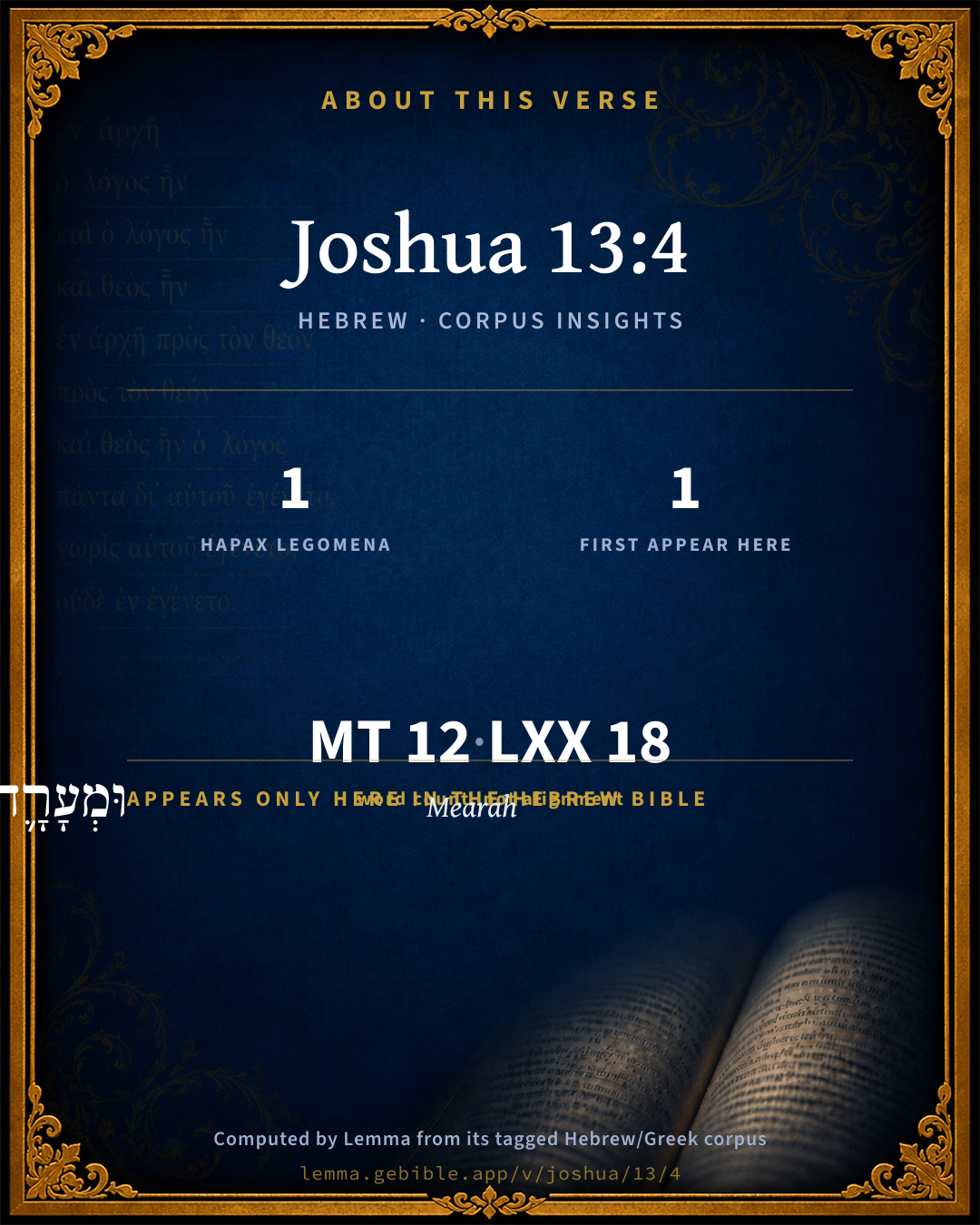
  • 1 hapax legomenon — only here in the Hebrew Bible
  • 1 first appearance in the Hebrew Bible
Full analysis ↓
Download a study sheet

One document with this verse’s original text, its word-by-word gloss line, the meaning frame, cross-references with their text, attributed commentary, and full source and license credits — printable, and it pastes into notes with its structure intact.

This verse Autodidact and up

Study sheet (.html) Plain text (.txt)

A passage Seminary Student

Up to 50 verses in one chapter. A passage sheet keeps up to 6 commentary sources and 12 cross-references per verse, in the order this page ranks them, and says so on the sheet whenever that leaves anything out. Ask for a single verse and you get the Autodidact verse sheet above.

Everything on this page stays free to read, with no account — the sheet is a download of what is already on screen, not access to it.

Want to remove ads? Support Godless Engineer
Compare translations 3

The same verse in 3 English versions, stacked beneath the original-language interlinear above. Click any original word for its lexicon entry.

Each is an independent rendering of the whole verse — the interlinear is not word-aligned to these translations.

Highlighted words mark where these versions differ — a whole-verse word diff, not a word-by-word alignment.

  • World English Bible Public Domain
    on the south; all the land of the Canaanites, and Mearah that belongs to the Sidonians, to Aphek, to the border of the Amorites;
  • King James Version Public Domain
    From the south, all the land of the Canaanites, and Mearah that is beside the Sidonians unto Aphek, to the borders of the Amorites:
  • unfoldingWord Literal Text CC BY-SA 4.0
    from the south; all of the land of the Canaanite, and Mearah, which to the Sidonians, unto Aphek, unto the border of the Amorite;

unfoldingWord Literal Text — © unfoldingWord, licensed CC BY-SA 4.0. Word-aligned USFM3 via Door43 (git.door43.org/unfoldingWord/en_ult).

Versions to compare (up to 4)

3 of 4 selected

Show all 18 translations

Every available English version of this verse, each an independent rendering of the whole verse.

  • World English Bible Public Domain
    on the south; all the land of the Canaanites, and Mearah that belongs to the Sidonians, to Aphek, to the border of the Amorites;
  • Berean Standard Bible Public Domain
    to the south, all the land of the Canaanites, from Mearah of the Sidonians to Aphek, as far as the border of the Amorites;
  • Majority Standard Bible Public Domain
    to the south, all the land of the Canaanites, from Mearah of the Sidonians to Aphek, as far as the border of the Amorites;
  • King James Version Public Domain
    From the south, all the land of the Canaanites, and Mearah that is beside the Sidonians unto Aphek, to the borders of the Amorites:
  • American Standard Version (1901) Public Domain
    on the south; all the land of the Canaanites, and Mearah that belongeth to the Sidonians, unto Aphek, to the border of the Amorites;
  • Revised Version (1885) Public Domain
    on the south: all the land of the Canaanites, and Mearah that belongeth to the Zidonians, unto Aphek, to the border of the Amorites:
  • Geneva Bible (1599) Public Domain
    From the South, all the land of the Canaanites, and the caue that is beside the Sidonians, vnto Aphek, and to the borders of the Amorites:
  • Douay-Rheims (1899) Public Domain
    And on the south side are the Hevites, all the land of Chanaan, and Maara of the Sidonians as far as Apheca, and the borders of the Amorrhite,
  • Young's Literal Translation Public Domain
    `From the south, all the land of the Canaanite, and Mearah, which `is' to the Sidonians, unto Aphek, unto the border of the Amorite;
  • Literal Standard Version CC BY-SA 4.0
    from the south, all the land of the Canaanite, and Mearah, which [is] to the Sidonians, to Aphek, to the border of the Amorite;
  • Unlocked Literal Bible CC BY-SA 4.0
    In the south (the territory of the Avvites); all the lands of the Canaanites, from Arah that belongs to the Sidonians, as far as Aphek which is on the border of the Amorites;
  • unfoldingWord Literal Text CC BY-SA 4.0
    from the south; all of the land of the Canaanite, and Mearah, which to the Sidonians, unto Aphek, unto the border of the Amorite;
  • Darby Bible Public Domain
    in the south, the whole land of the Canaanites, and Mearah which [belongeth] to the Sidonians, unto Aphek, to the border of the Amorites;
  • World Messianic Bible Public Domain
    on the south; all the land of the Canaanites, and Mearah that belongs to the Sidonians, to Aphek, to the border of the Amorites;
  • Webster's Bible Public Domain
    From the south all the land of the Canaanites, and Mearah that is beside the Sidonians, to Aphek to the borders of the Amorites:
  • Free Bible Version CC BY-SA 4.0
    in the south, all the land of the Canaanites, and Mearah that belongs to the Sidonians, all the way to Aphek on the border with the Amorites,
  • Bible in Basic English Public Domain
    On the south: all the land of the Canaanites, and Mearah which is the property of the Zidonians, to Aphek, as far as the limit of the Amorites:
  • JPS Tanakh (1917) Public Domain
    on the south; all the land of the Canaanites, and Mearah that belongeth to the Zidonians, unto Aphek, to the border of the Amorites;

Literal Standard Version (2020), Covenant Press — licensed CC BY-SA 4.0. Text via the HelloAO Bible API (eBible.org). Unlocked Literal Bible (unfoldingWord) — licensed CC BY-SA 4.0. Text via the HelloAO Bible API (eBible.org). unfoldingWord Literal Text — © unfoldingWord, licensed CC BY-SA 4.0. Word-aligned USFM3 via Door43 (git.door43.org/unfoldingWord/en_ult). Free Bible Version, Dr. Jonathan Gallagher — licensed CC BY-SA 4.0. Text via the HelloAO Bible API (eBible.org).

Word by word

More ways to search: Search by grammar → Find every occurrence → Compare this word →

Practice this passage: Drill this verse → Learn its vocabulary →

וּמְעָרָ֛ה
Mᵉʻârâh
H4632
“and · Mearah”
Conjunction + Noun, Proper
Part of Speech
Conjunction + Noun
Type
Proper
Full BDB Definition

Origin: the same as H4631

TWOT: None

Mearah = "cave" - an area or cavern in the neighbourhood east of Sidon
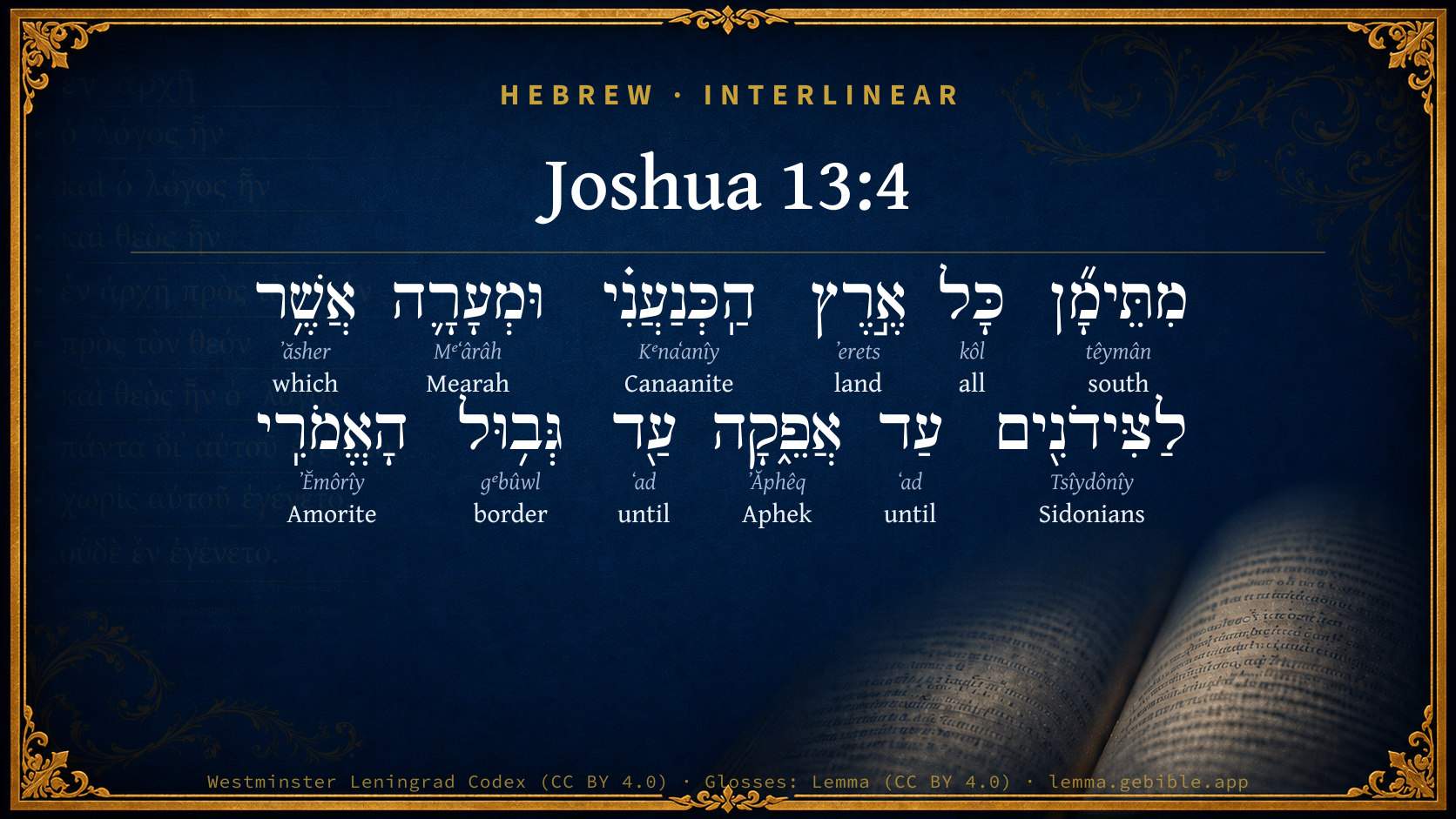
  1. מִתֵּימָ֞ן têymân H8486 “from · south” Preposition + Noun, Common, Feminine, Singular, Absolute
  2. כָּל kôl H3605 “all of” Noun, Common, Masculine, Singular, Construct
  3. אֶ֣רֶץ ʼerets H776 “land of” Noun, Common, Both, Singular, Construct
  4. הַֽכְּנַעֲנִ֗י Kᵉnaʻanîy H3669 “the · Canaanite” Particle, Definite Article + Noun, Gentilic, Masculine, Singular, Absolute
  5. אֲשֶׁ֥ר ʼăsher H834 “which” Particle, Relative
  6. לַצִּידֹנִ֖ים Tsîydônîy H6722 “to/for the · Sidonians” Preposition, Determined + Noun, Gentilic, Masculine, Plural, Absolute
  7. עַד ʻad H5704 “until” Preposition
  8. אֲפֵ֑קָה ʼĂphêq H663 “Aphek · toward” Noun, Proper + Suffix, Demonstrative
  9. עַ֖ד ʻad H5704 “until” Preposition
  10. גְּב֥וּל gᵉbûwl H1366 “border of” Noun, Common, Masculine, Singular, Construct
  11. הָאֱמֹרִֽי ʼĔmôrîy H567 “the · Amorite” Particle, Definite Article + Noun, Gentilic, Masculine, Singular, Absolute

About this verse

These counts appear in no published source. They are computed here, from the morphology-tagged text and Lemma’s own curated glosses. What Lemma adds →

12
words
11
distinct lemmas
Historical
section

Notable vocabulary

1 hapax legomenon — a word that appears only here in the entire Hebrew Bible:

  • וּמְעָרָ֛ה Mearah H4632

First appearance in Scripture

This word makes its first canonical appearance in the Hebrew Bible here:

  • וּמְעָרָ֛ה Mearah H4632

Shared distinctive vocabulary

אֲפֵ֑קָה Aphek H663 occurs in 9 verses of the Hebrew Bible. Also found in:

Grammatical profile

  • 9 nouns
  • 2 prepositions
  • 1 particle

Repetition

A word recurs within this verse — often emphatic in Hebrew:

Hebrew & Septuagint length

In English translation the verse runs 24 words from the Hebrew and 26 from the Septuagint (LXX English) — closely comparable.

A rough comparison of the two English renderings, which tokenize alike — not a word-level alignment.

Word counts can differ between the Hebrew and the Greek without any difference in meaning — e.g. the Hebrew direct-object marker אֵת has no separate Greek word, and Greek often adds the article ὁ.

In the original languages it is 12 Hebrew tokens and 18 Greek tokens — but the two are counted differently (Hebrew bundles its prefixes and suffixes into one token; the Greek is in lemma form), so that isn’t a like-for-like length.

Cross-references

8

Topical passages linked to Joshua 13:4 in the Treasury of Scripture Knowledge — connected by theme and wording, ordered by reader-vote popularity; previews shown in the World English Bible.

  • Joshua 19:30 Ummah also, and Aphek, and Rehob: twenty-two cities with their villages.
  • Judges 1:34–36 The Amorites forced the children of Dan into the hill-country; for they would not allow them to come down to the valley;
  • 1 Samuel 4:1 The word of Samuel came to all Israel. Now Israel went out against the Philistines to battle, and encamped beside Ebenezer: and the Philistines encamped in Aphek.
  • Joshua 10:40 So Joshua struck all the land, the hill-country, and the South, and the lowland, and the slopes, and all their kings: he left none remaining, but he utterly destroyed all that breathed, as Yahweh, the God of Israel, commanded.
  • Joshua 11:3 to the Canaanite on the east and on the west, and the Amorite, and the Hittite, and the Perizzite, and the Jebusite in the hill-country, and the Hivite under Hermon in the land of Mizpah.
  • Joshua 12:7–8 These are the kings of the land whom Joshua and the children of Israel struck beyond the Jordan westward, from Baal Gad in the valley of Lebanon even to Mount Halak, that goes up to Seir; and Joshua gave it to the tribes of Israel for a possession according to their divisions;
  • Joshua 12:18 the king of Aphek, one; the king of Lassharon, one;
  • Amos 2:10 Also I brought you up out of the land of Egypt, And led you forty years in the wilderness, To possess the land of the Amorite.

Cross-references courtesy of OpenBible.info (CC BY 4.0).

Hebrew and Greek witnesses Masoretic Hebrew ↔ Greek Septuagint

The same verse in the two great witnesses to the Old Testament, shown verse-for-verse.

These are two independent witnesses, not word-aligned to each other, and the Septuagint is shown in lemma (dictionary) form.

Hebrew Joshua 13:4 Masoretic · Westminster Leningrad Codex

מִתֵּימָ֞ן כָּל אֶ֣רֶץ הַֽכְּנַעֲנִ֗י וּמְעָרָ֛ה אֲשֶׁ֥ר לַצִּידֹנִ֖ים עַד אֲפֵ֑קָה עַ֖ד גְּב֥וּל הָאֱמֹרִֽי

on the south; all the land of the Canaanites, and Mearah that belongs to the Sidonians, to Aphek, to the border of the Amorites;

World English Bible · Public Domain

Greek LXX Joshua 13:4 Septuagint · lemma form

ἐκ θαιμαν καί πᾶς γῆ χανααν ἐναντίον γάζα καί ὁ σιδώνιος ἕως αφεκ ἕως ὁ ὅριον ὁ ἀμορραῖος

from Thaeman even to all the land of Chanaan before Gaza, and the Sidonians as far as Aphec, as far as the borders of the Amorites.

LXX2012 (modern English Septuagint) · Public Domain

On this verse, The Cambridge Bible for Schools and Colleges discusses the Septuagint’s reading. Read the note in Commentary ↓

Hebrew: Westminster Leningrad Codex (CC BY 4.0). Greek: Septuagint (public domain); English from LXX2012 (modern English Septuagint) (Public Domain). How the Septuagint differs from the Hebrew →

Targum (Aramaic paraphrase)

1

The Targum is the ancient Jewish Aramaic paraphrase of the Hebrew Scriptures — an interpretive translation, not the Hebrew text itself. Onkelos (literal) and Pseudo-Jonathan (expansive) render the Torah, and Jonathan the Prophets. Coverage is partial: where no permissively-licensed English translation exists for a verse, only the Aramaic is shown. This is verse-level text, not a word-by-word alignment to the Hebrew.

  1. Targum Jonathan Prophets (Joshua–Malachi)
    מִדָרוֹמָא כָּל אַרְעָא כְנַעֲנָאֵי וּמְעַרְתָּא דִי לְצִידוֹנָאָה עַד אֲפֵק עַד תְחוּם אֱמוֹרָאָה:

    (no public-domain English translation for this verse)

    Targum Jonathan — Aramaic: “Mikraot Gedolot” (public domain). English: “Sefaria Community Translation” (CC0 1.0 (public-domain dedication)); “London "Chaldee Paraphrase," 1871” (public domain). Text via Sefaria.

Commentary

Notes on Joshua 13:4 from classic Christian and Jewish commentators (each source and its license shown beneath its notes). The classic Christian expositions comment on the surrounding passage and are grouped to its opening verse, so a note may address several verses; the Jewish commentaries on the Tanakh (Rashi and others) are per-verse, so they appear only where the commentator wrote on this verse.

Lemma curates 59 commentaries, every one of them public domain or Creative Commons licensed, each selected and text-cleaned for this edition rather than reprinted as found. About our sources →

Trapp's Complete Commentary

John Trapp

Jos 13:4 From the south, all the land of the Canaanites, and Mearah that [is] beside the Sidonians, unto Aphek, to the borders of the Amorites:

Ver. 4. All the land of the Canaanites.] Who yet held out against the Israelites, but hindered them not from dividing the land. No more shall those remnants of corruption hinder the saints from possession of their mansions prepared for them by Christ. {Joh 14:2}

John Trapp, A Commentary or Exposition upon All the Books of the Old and New Testament (1647–1656) — public domain. Text from a community e-Sword module.

Joseph Benson's Commentary

Jos 13:4. From the south — That is, from those southern parts of the sea- coast now possessed by the Philistines, all the more northern parts of the sea-coast being yet inhabited by the Canaanites, almost as far as Sidon. The Amorites — The Amorites were a very strong and numerous people, and we find them dispersed in several parts, some within Jordan, and some without it, some in the south, and others in the north, of whom he speaks here.

Joseph Benson's Commentary on the Old and New Testaments (1811–1818) — public domain. Text from a community e-Sword module.

Whedon's Commentary on the Bible

Daniel D. Whedon

4. [From the south — This is to be connected with the Avites in the preceding verse, and stands in contrast with northward in the same verse. The Masoretic pointing is here noticeably wrong. Jos_13:2-3 describe the unconquered territory in the south, from its northern limit, Ekron, to its southern, the land occupied by the Avites; Jos_13:4-6 describe the northern lands.] Mearah belonged to the Sidonians. The word beside is a mis-translation. Mearah signifies a cavern. Its location is a matter of conjecture. Aphek is identified by Gesenius with Aphaca of classical times, famous for its temple of Venus. Its modern name is Afka, situated some eighteen miles northeast of Beyroot. It was assigned to the tribe of Asher. Jos_19:30.

To the borders of the Amorites — This is taken by most interpreters to refer to the land of Bashan, which formerly belonged to the Amorites and was ruled by Og.

Daniel D. Whedon (gen. ed.), Commentary on the Old and New Testaments (1874–1909) — public domain. Text from a community e-Sword module.

Tyndale Open Study Notes

Tyndale Open Resources

13:4-6a The Sidonians (that is, Phoenicians; see Isa 23:11; Obad 1:20; Acts 11:19) lived in the north along the coast, from north of Mount Carmel to above Gebal (Byblos). They also apparently occupied the Lebanon and Anti-Lebanon mountain ranges. Sidon was the dominant Phoenician city when Israel entered Canaan.

Tyndale Open Study Notes — © Tyndale Open Resources, licensed CC BY-SA 4.0. Text via the HelloAO Bible API.

Geneva Bible (1599)

Geneva Bible translators

Or, Mearah.

Geneva Bible (1599) marginal notes — public domain. Text via Bolls.life.

Jamieson, Fausset & Brown

Robert Jamieson, A. R. Fausset & David Brown

all the land of the Canaanites, and Mearah--("the cave")

that is beside the Sidonians--a mountainous region of Upper Galilee, remarkable for its caves and fastnesses.

unto Aphek--now Afka; eastward, in Lebanon.

to the borders of the Amorites--a portion of the northeastern territory that had belonged to Og. The third district that remained unsubdued:

Jamieson, Fausset & Brown — Commentary Critical and Explanatory on the Whole Bible (1871) — public domain (CC PDM 1.0). Text via the HelloAO Bible API.

Adam Clarke's Commentary

Verse 4. The land of the Canaanites] This lay on the south of the country of the Philistines, towards the sea-coast.

Mearah] Supposed to be the city Maratha, on the Mediterranean Sea. - Calmet. Or the river Majora, which falls into the Mediterranean Sea, between Sidon and Berytus. See PLINY, Hist. Nat. lib. v., c. 20.

Aphek] See Clarke on Jos 12:18.

To the borders of the Amorites] Though the term Amorite is sometimes used to designate the inhabitants in general of the land of Canaan, yet it must be considered in a much more restricted sense in this place. As no Amorites are known to have dwelt in this quarter, Calmet supposes we should read Aramites or Syrians. Joshua, says he, proceeds from Sidon to Aphek, a city of Syria, between Heliopolis and Babylon where was the temple of the Venus of Aphek, and which is spoken of in 1Kg 20:26; 2Kg 13:17, as the capital of the kings of Syria. From this Joshua passes on to the frontiers of the Syrians, towards Gebal or Gabala, which, according to Ptolemy, was situated in Phoenicia. This conjecture of Calmet is not supported by any authority either from the ancient versions or MSS. Houbigant, however, approves of it: the emendation is simple as it consists in the interchange of only two letters in the same word, הארמי haarammi, for האמרי haemori.

Adam Clarke's Commentary on the Bible (1810–1826) — public domain. Text from a community e-Sword/MySword module.

The Cambridge Bible for Schools and Colleges

gen. ed. J. J. S. Perowne

4. from the south] The LXX. here gives a proper name, “from Teman.” This was the former southern limit of the Avites’ territory.

all the land of the Canaanites] Here some would insert a full stop, as though the words summed up what had gone before.

and Mearah] “Mara of Sydonys,” Wyclif. This place is only mentioned in this passage. The word meârâh means in Hebrew “a cave” (see margin), and it has been commonly supposed that the reference is to a remarkable cavern near Zidon. A village called el-Mughâr has been found in the mountains of Naphtali some 10 miles west of the northern extremity of the Sea of Galilee, which it has been thought may possibly represent the ancient Mearab. See Menke’s Bible Atlas, Plate iii.

unto Aphek] A city in the extreme north of Asher, now Afka, N. E. of Beyrout, and apparently beyond Sidon. It was called by the Greeks Aphaca, and was noted for a temple of Venus destroyed by Constantine.

to the borders of the Amorites] i.e. on the extreme north border of the Amorites, or the land once inhabited by them, and which afterwards passed to Og, king of Bashan.

The Cambridge Bible for Schools and Colleges (gen. ed. J. J. S. Perowne; Cambridge University Press, 1878–1918) — public domain. Text from a community e-Sword module.

John Gill's Exposition

From the south, all the land of the Canaanites,.... That is, of those Canaanites who were particularly so called, in distinction from those of the other nations or tribes, and who dwelt in several parts of the land, some in the east and others in the west, see Jos 11:3; and, as it seems here, some in the south: now on the side of the south, as Kimchi interprets it, all the land of the Canaanites was left, that is, remained unconquered and not possessed:

and Mearah that is beside the Sidonians; the inhabitants of Sidon, and parts adjacent: what this place was, which belonged to the Sidonians, for so it may better be rendered, is not certain; some take it to be a cave belonging to them: Sandys (b) speaks of a number of caves cut out of the rock in those parts, called the caves of the Sidonians, and afterwards the caves of Tyre; so it is interpreted by the Targum, and in the Syriac and Arabic versions others take it to be the river Magoras, Pliny (c) makes mention of as on the borders of Lebanon near Zidon and Berytus: mention is made of the waters of Mearah along with the waters of Tiberias in Jewish writings (d); but rather something of more importance than a cave or a river is meant; most likely a tract of land near Sidon, and which belonged to it, and reached

unto Aphek, to the borders of the Amorites; of this place; see Gill on Jos 12:18.

(b) Travels, l. 3. p. 169. Ed. 5. (c) Nat. Hist. l. 5. c. 20. (d) Misn. Sabbat. c. 22. sect. 5. T. Hieros. Sabbat, fol. 6. 1.

John Gill's Exposition of the Whole Bible (1746–1763) — public domain (CC PDM 1.0). Text via the HelloAO Bible API.

Albert Barnes' Notes on the Bible

Read “on the south,” and connect the words with the verse preceding. They indicate the southern limit of the still unconquered territory in this neighborhood, as Jos 13:3 gives the northern one.

Mearah - The “cave” (see the margin) has been referred to “Mugar Jczzin” (“cave of Jezzin”), between Tyre and Sidon, or to a district characterized by deep cave-like ravines near Sidon and Dan-Laish.

Albert Barnes' Notes on the Bible (1834–1885) — public domain. Text from a community e-Sword/MySword module.

Haydock's Catholic Bible Commentary

Chanaan. From the south to Sidon was yet undivided, and thence eastward, (Haydock) to Apheca of Syria, were was the capital of the kings of that country, and a famous temple of Venus, 3 Kings xx. 26. (Sozom. i. 58.) --- Amorrhite, or perhaps Aramean, (Calmet) though we may understand that all the country of the Amorrhite on the south, as well as the northern parts of Chanaan, were to be divided, (Haydock) as far as Emesa. --- Will, &c., provided the Israelites observe their part of the covenant. (Calmet)

George Leo Haydock (1774–1849), Haydock's Catholic Family Bible and Commentary, 1859 edition — public domain. Excludes Psalms (Douay-Rheims chapter numbering differs from Protestant) and Deuterocanonical books (Catholic canon only).

Matthew Poole's English Annotations

i.e. From those southern parts of the sea-coast now possessed by the Philistines, all the more northern parts of the sea-coast being yet inhabited by the Canaanites, almost as far as Sidon, as it here follows; for there is no mention made of any conquests of Joshua upon the sea-coast. The Canaanites, properly so called, are said to

dwell by the sea, Num 13:29, and these are here spoken of, though some of them dwelt in other parts of the land.

Mearah; a strong place; it matters not whether it was a city, or an impregnable cave, which some writers mention to be in those parts.

Aphek; not that of Judah, of which Jos 15:53 but another in the tribe of Asher, of which Jos 12:18; Jdg 1:31.

To the borders of the Amorites: the Amorites were a strong and very numerous people, and we find them dispersed in several parts, some within Jordan, and some without it; some in the south, and others in the north, of whom he speaks there.

Matthew Poole's English Annotations on the Holy Bible (1683–1685) — public domain. Text from a community e-Sword/MySword module.

The Pulpit Commentary

From the south. The LXX and the best modern commentators connect these words with what precedes. This gives a better sense than joining it to what follows. For the south was not "all the land of the Canaanites," but a large part of it belonged, as we have just seen, to a tribe not of Canaanitish origin, while the land of the Canaanites (see note on Jos_3:10) extended far to the northward. Therefore we must understand the words "all the land of the Canaanites" to begin a fresh section, and to be descriptive of the territory extending from Philistia northward towards Sidon. So the Chaldee, Syriac, and Arabic. Mearah. The margin has "the cave." But there is no article in the original The LXX reads apo Gazhv for Mearah, having clearly, as Masius observes, substituted Zain for Resh. But this mistaken reading compels a mistranslation of the passage. Vandevelde supposes it to be a remarkable cave still existing near Sidon, which is mentioned by William of Tyre as having been fortified by the Crusaders. He speaks of it as municipium quoddam, and states that it was commonly known as the "cave of Tyre." "spelunca inexpugnabilis." It was afterwards "the last retreat of the Emir Fakkr-ed-Din" (Vandevelde, s.v. Mearah). There is a village now, north of Sidon, called Mog-heiriyeh, or the village of the cave. So also Kuobel. Beside the Sidonians. Rather, near, or in the direction of, or which belong to the Sidonians. Aphek. Or Aphekah. This (Knobel) was the northern Aphek, (Jos_19:30 Jud 1:31) in the tribe of Asher, known later as Aphaca, and now as Afka. Not the Aphekah of Jos_15:53, probably the Aphek of 1Sa_4:1. It is the same Aphek which in later times was captured by the Syrians, and was the scene of several decisive victories of Israel. (1Ki_20:26, 30 2Ki_13:17) It is doubtful which Aphek is meant in Jos_12:18, though it is probablythe southern Aphek. The situation is described as one of "rare beauty" (Delitzsch), "on the north.west slopes of Lebanon," amid exquisite groves (Conder). Here the Syrian Astarte was worshipped, and the ruins of her temple, dedicated to her as mourning for Tammuz, or Adonis, may still be seen. See Kenrick, "Phoenicia," 310, 311, and Mover"s "Die Phonizier," 1:192. Perhaps it was never actually occupied by the Asherites, but remained in the hands of Syria, and as a place of great resort was the natural point to which the attacks of Israel would be directed. Vandevelde, however, believes in four and Conder in seven cities of this name, and they suppose the Aphek which was the scene of the battle with the Syrians to have been on the east of Jordan, from the occurrence of the word "Mishor" in the narrative in 1Ki 20. The term "Mishor" is, however, applied to other places beside the territory east of Jordan (see Gesenius, s.v. Mishor). The Aphek in 1Sa_29:1 cannot be identified with any that have been named. To the borders of the Amorites. This can hardly be anything but the northern border of the kingdom of Bashan, in the neighbourhood of Mount Hermon.

The Pulpit Commentary (1880–1919), ed. H.D.M. Spence-Jones & Joseph S. Exell — public domain. Text from a community e-Sword module.

John Wesley's Explanatory Notes

From the south - That is, from those southern parts of the sea- coast, now possessed by the Philistines, all the more northern parts of the sea-coast being yet inhibited by the Canaanites, almost as far as Sidon. The Amorites - The Amorites were a very strong and numerous people, and we find them dispersed in several parts, some within Jordan, and some without it, some in the south and others in the north, of whom he speaks here.

John Wesley, Explanatory Notes Upon the Whole Bible (1754–1765) — public domain. Text via the GEBible commentary corpus.

unfoldingWord translationNotes

Door43 World Missions Community

Arah ... Aphek ... Baal Gad ... Mount Hermon

These are the names of places. (See: How to Translate Names)

Gebalites

This is the name of a people group who lived in Geba. (See: How to Translate Names)

translationWords

Sidon

Amorite

Lebanon

Hamath

unfoldingWord translationNotes — © Distant Shores Media and the Door43 World Missions Community, licensed CC BY-SA 4.0. Source: git.door43.org/Door43/en_tn.

Rashi

Rabbi Shlomo Yitzchaki (Rashi)

From the south, all the land of Canaanites. The preceding verse described the southern border going from east to west, and this verse describes the width of that area that remained to be conquered; describing how much there was from south to north.

From the south, all the land of the Canaanites. From the south which is Gaza belonging to the Sidonites, to Apheik, to the Emorites.

Rashi on the Tanakh — English translations: “The Judaica Press complete Tanach with Rashi, translated by A. J. Rosenberg” (CC BY 4.0); “Pentateuch with Rashi's commentary by M. Rosenbaum and A.M. Silbermann, 1929-1934” (public domain); “The Metsudah Tanach series, Lakewood, N.J” (CC BY 4.0); and “The Book of Joshua, Metsudah Publications, 1997” (CC BY 4.0). Text via Sefaria.

Lesson kit

Teaching starters — assembled from the data on this page, not authored interpretation. Every prompt links to the verse data it draws on. Edit before teaching.

Joshua, in the Historical, opens this verse with 12 words (11 distinct Hebrew lemmas). Its most distinctive word is Mᵉʻârâh (“Mearah”). A historical commentator’s framing appears above. Read the whole chapter for the surrounding context.

Discussion questions

  1. How does “Mearah” (Mᵉʻârâh) shape what this verse is saying?
  2. This verse holds 1 word here found nowhere else in the Hebrew Bible. What might the rare word draw attention to?
  3. The word “Mearah” first appears here in Scripture. What is being introduced at this debut?
  4. Joshua 12:18 shares the word «Aphek» with this verse. How do the two illuminate each other?
  5. “until” occurs 2× in this one verse. What is the effect of the repetition?
  6. The translations on this page render this verse differently — a whole-verse word diff, not a word-by-word alignment. What might account for the different wordings?
  7. Reading how Trapp's Complete Commentary and Joseph Benson's Commentary read this verse, where do the two commentators agree and where do they part?

Things to notice

  • 1 word in this verse appears nowhere else in the Hebrew Bible.
  • 1 word makes its first canonical appearance in Scripture here.
  • This verse counts 12 Hebrew ↔ 18 Greek words.
  • These translations choose different wording for 9 words in this verse.
  • “until” occurs 2× in this single verse.

Reading settings

Reading text

Shown beneath each verse's original-language words.

Old Testament
Old Testament edition

Read the OT as the Masoretic Hebrew (MT) or the Greek Septuagint (LXX).

English shown for the Greek Septuagint (in the Hebrew ↔ Greek comparison).

Comparing translations? Open the Compare panel on any verse page to stack up to four side by side.