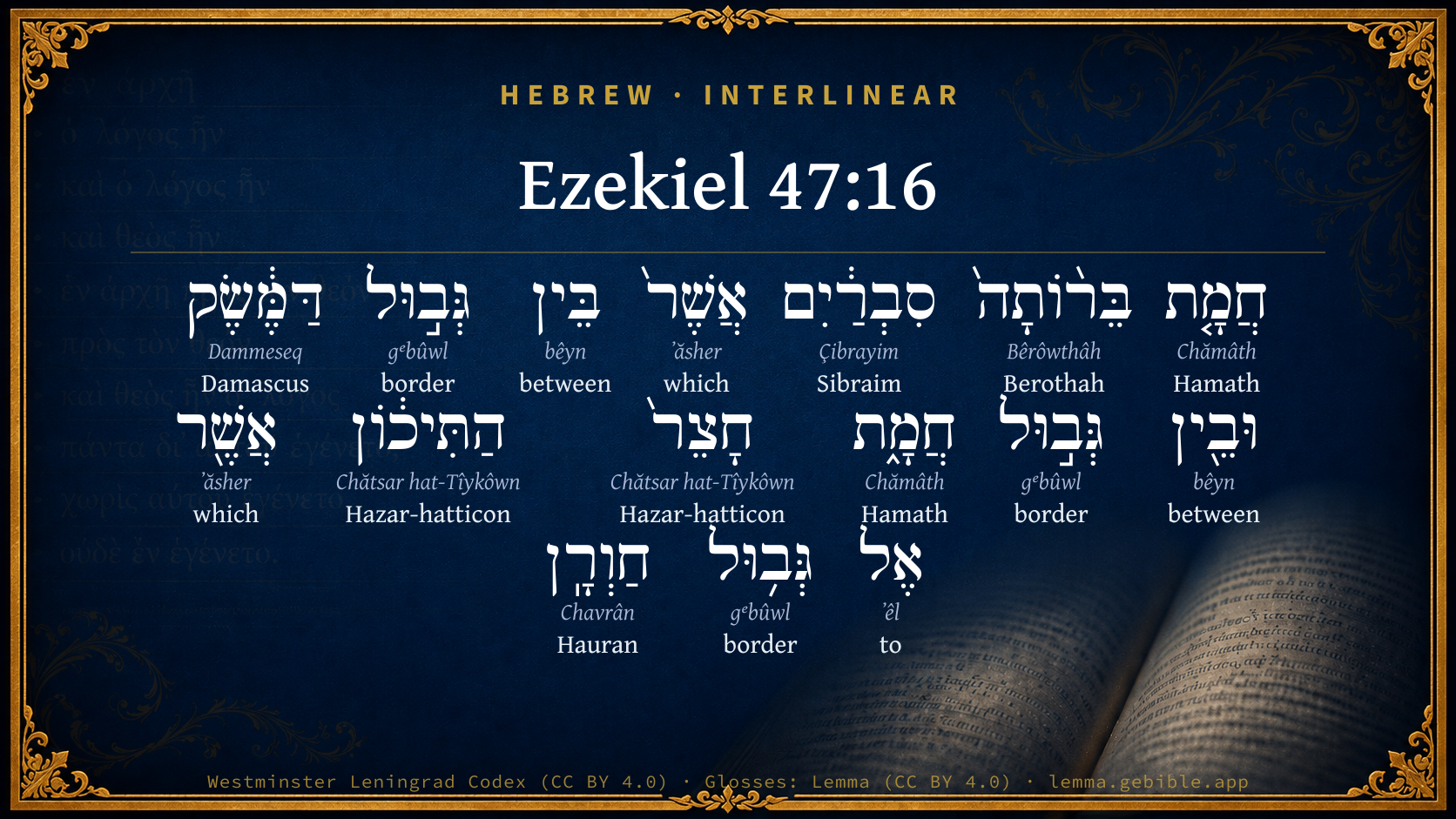
Ezekiel 47:16

Hebrew (Westminster Leningrad Codex) Ezekiel 47:16 appears in the Hebrew Old Testament. The text above is from the Westminster Leningrad Codex. Each word links to its Strong’s number, a concise gloss, and parsing drawn from the Open Scriptures Hebrew Bible morphology. Click any word for its full Brown-Driver-Briggs (BDB) entry.
Download image
Cite this verse

Ezekiel 47:16 (World English Bible). Public Domain. Lemma interlinear Bible study tool, https://lemma.gebible.app/v/ezekiel/47/16.

Show BibTeX & RIS
BibTeX
RIS
English Translation
Hamath, Berothah, Sibraim, which is between the border of Damascus and the border of Hamath; Hazer Hatticon, which is by the border of Hauran.
World English Bible · Public Domain
Highlights
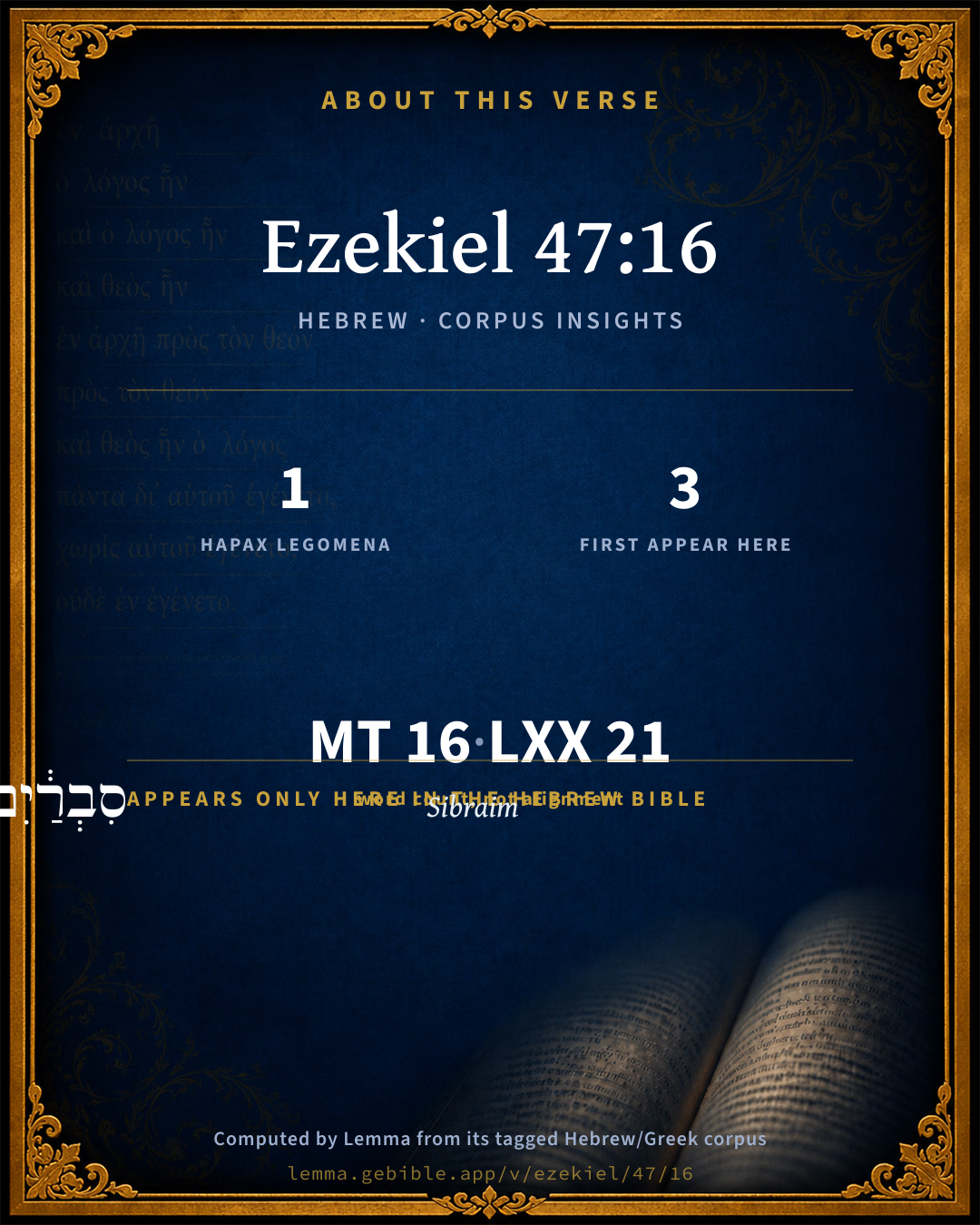
  • 1 hapax legomenon — only here in the Hebrew Bible
  • 3 first appearances in the Hebrew Bible
Full analysis ↓
Download a study sheet

One document with this verse’s original text, its word-by-word gloss line, the meaning frame, cross-references with their text, attributed commentary, and full source and license credits — printable, and it pastes into notes with its structure intact.

This verse Autodidact and up

Study sheet (.html) Plain text (.txt)

A passage Seminary Student

Up to 50 verses in one chapter. A passage sheet keeps up to 6 commentary sources and 12 cross-references per verse, in the order this page ranks them, and says so on the sheet whenever that leaves anything out. Ask for a single verse and you get the Autodidact verse sheet above.

Everything on this page stays free to read, with no account — the sheet is a download of what is already on screen, not access to it.

Want to remove ads? Support Godless Engineer
Compare translations 3

The same verse in 3 English versions, stacked beneath the original-language interlinear above. Click any original word for its lexicon entry.

Each is an independent rendering of the whole verse — the interlinear is not word-aligned to these translations.

Highlighted words mark where these versions differ — a whole-verse word diff, not a word-by-word alignment.

  • World English Bible Public Domain
    Hamath, Berothah, Sibraim, which is between the border of Damascus and the border of Hamath; Hazer Hatticon, which is by the border of Hauran.
  • King James Version Public Domain
    Hamath, Berothah, Sibraim, which is between the border of Damascus and the border of Hamath; Hazarhatticon, which is by the coast of Hauran.
  • unfoldingWord Literal Text CC BY-SA 4.0
    Then the boundary will go to Berothah, to Sibraim, which is between Damascus and Hamath, and then to Hazer Hattikon, which is beside the boundary of Hauran.

unfoldingWord Literal Text — © unfoldingWord, licensed CC BY-SA 4.0. Word-aligned USFM3 via Door43 (git.door43.org/unfoldingWord/en_ult).

Versions to compare (up to 4)

3 of 4 selected

Show all 18 translations

Every available English version of this verse, each an independent rendering of the whole verse.

  • World English Bible Public Domain
    Hamath, Berothah, Sibraim, which is between the border of Damascus and the border of Hamath; Hazer Hatticon, which is by the border of Hauran.
  • Berean Standard Bible Public Domain
    Berothah, and Sibraim (which is on the border between Damascus and Hamath), as far as Hazer-hatticon, which is on the border of Hauran.
  • Majority Standard Bible Public Domain
    Berothah, and Sibraim (which is on the border between Damascus and Hamath), as far as Hazer-hatticon, which is on the border of Hauran.
  • King James Version Public Domain
    Hamath, Berothah, Sibraim, which is between the border of Damascus and the border of Hamath; Hazarhatticon, which is by the coast of Hauran.
  • American Standard Version (1901) Public Domain
    Hamath, Berothah, Sibraim, which is between the border of Damascus and the border of Hamath; Hazer-hatticon, which is by the border of Hauran.
  • Revised Version (1885) Public Domain
    Hamath, Berothah, Sibraim, which is between the border of Damascus and the border of Hamath; Hazer-hatticon, which is by the border of Hauran.
  • Geneva Bible (1599) Public Domain
    Hamath, Berothah, Sibraim, which is betweene the border of Damascus, and the border of Hamath, and Hazar, Hatticon, which is by the coast of Hauran.
  • Douay-Rheims (1899) Public Domain
    Emath, Berotha, Sabarim, which is between the border of Damascus and the border of Emath, the house of Tichon, which is by the border of Auran.
  • Young's Literal Translation Public Domain
    Hamath, Berothah, Sibraim, that `is' between the border of Damascus and the border of Hamath; Hazar-Hatticon, that `is' at the coast of Havran.
  • Literal Standard Version CC BY-SA 4.0
    Hamath, Berothah, Sibraim, that [is] between the border of Damascus and the border of Hamath; Hazar-Hatticon, that [is] at the coast of Havran.
  • Unlocked Literal Bible CC BY-SA 4.0
    Then the boundary will go to Berothah, to Sibraim, which is between Damascus and Hamath, and then to Hazer Hattikon, which is beside the boundary of Hauran.
  • unfoldingWord Literal Text CC BY-SA 4.0
    Then the boundary will go to Berothah, to Sibraim, which is between Damascus and Hamath, and then to Hazer Hattikon, which is beside the boundary of Hauran.
  • Darby Bible Public Domain
    Hamath, Berothah, Sibraim, which is between the border of Damascus and the border of Hamath; Hazer-hatticon, which is by the border of Hauran.
  • World Messianic Bible Public Domain
    Hamath, Berothah, Sibraim (which is between the border of Damascus and the border of Hamath), to Hazer Hatticon, which is by the border of Hauran.
  • Webster's Bible Public Domain
    Hamath, Berothah, Sibraim, which is between the border of Damascus and the border of Hamath; Hazar-hatticon, which is by the border of Hauran.
  • Free Bible Version CC BY-SA 4.0
    then on to Berothah, and Sibraim on the border between Damascus and Hamath, and all the way to Hazer-hatticon, on the border of Hauran.
  • Bible in Basic English Public Domain
    To Zedad, Berothah, Sibraim, which is between the limit of Damascus and the limit of Hazar-hatticon, which is on the limit of Hauran.
  • JPS Tanakh (1917) Public Domain
    Hamath, Berothah, Sibraim, which is between the border of Damascus and the border of Hamath; Hazer-hatticon, which is by the border of Hauran.

Literal Standard Version (2020), Covenant Press — licensed CC BY-SA 4.0. Text via the HelloAO Bible API (eBible.org). Unlocked Literal Bible (unfoldingWord) — licensed CC BY-SA 4.0. Text via the HelloAO Bible API (eBible.org). unfoldingWord Literal Text — © unfoldingWord, licensed CC BY-SA 4.0. Word-aligned USFM3 via Door43 (git.door43.org/unfoldingWord/en_ult). Free Bible Version, Dr. Jonathan Gallagher — licensed CC BY-SA 4.0. Text via the HelloAO Bible API (eBible.org).

Word by word

More ways to search: Search by grammar → Find every occurrence → Compare this word →

Practice this passage: Drill this verse → Learn its vocabulary →

סִבְרַ֔יִם
Çibrayim
H5453
“Sibraim”
Noun, Proper
Part of Speech
Noun
Type
Proper
Full BDB Definition

Origin: dual from a root corresponding to H5452

TWOT: None

Sibraim = "twofold hope" - town between the borders of Damascus and that of Hamath
  1. חֲמָ֤ת Chămâth H2574 “Hamath” Noun, Proper
  2. בֵּר֨וֹתָה֙ Bêrôwthâh H1268 “Berothah” Noun, Proper
  3. אֲשֶׁר֙ ʼăsher H834 “which” Particle, Relative
  4. בֵּין bêyn H996 “between” Preposition
  5. גְּב֣וּל gᵉbûwl H1366 “border of” Noun, Common, Masculine, Singular, Construct
  6. דַּמֶּ֔שֶׂק Dammeseq H1834 “Damascus” Noun, Proper
  7. וּבֵ֖ין bêyn H996 “and · between” Conjunction + Preposition
  8. גְּב֣וּל gᵉbûwl H1366 “border of” Noun, Common, Masculine, Singular, Construct
  9. חֲמָ֑ת Chămâth H2574 “Hamath” Noun, Proper
  10. חָצֵר֙ Chătsar hat-Tîykôwn H2694 “Hazar-hatticon” Noun, Proper
  11. הַתִּיכ֔וֹן Chătsar hat-Tîykôwn H2694 “Hazar-hatticon” Noun, Proper
  12. אֲשֶׁ֖ר ʼăsher H834 “which” Particle, Relative
  13. אֶל ʼêl H413 “to” Preposition
  14. גְּב֥וּל gᵉbûwl H1366 “border of” Noun, Common, Masculine, Singular, Construct
  15. חַוְרָֽן Chavrân H2362 “Hauran” Noun, Proper

About this verse

These counts appear in no published source. They are computed here, from the morphology-tagged text and Lemma’s own curated glosses. What Lemma adds →

16
words
10
distinct lemmas
Prophets
section

Notable vocabulary

1 hapax legomenon — a word that appears only here in the entire Hebrew Bible:

  • סִבְרַ֔יִם Sibraim H5453

First appearance in Scripture

These words make their first canonical appearance in the Hebrew Bible here:

  • סִבְרַ֔יִם Sibraim H5453
  • חָצֵר֙ Hazar-hatticon H2694
  • חַוְרָֽן Hauran H2362

Shared distinctive vocabulary

בֵּר֨וֹתָה֙ Berothah H1268 occurs in 2 verses of the Hebrew Bible. Also found in:

Grammatical profile

  • 11 nouns
  • 3 prepositions
  • 2 particles

Repetition

Words recur within this verse — often emphatic in Hebrew:

  • גְּב֣וּל border H1366 ×3
  • חֲמָ֤ת Hamath H2574 ×2
  • בֵּין between H996 ×2
  • חָצֵר֙ Hazar-hatticon H2694 ×2
  • אֲשֶׁר֙ which H834 ×2

Hebrew & Septuagint length

In English translation the verse runs 24 words from the Hebrew and 24 from the Septuagint (LXX English) — the same length.

A rough comparison of the two English renderings, which tokenize alike — not a word-level alignment.

Word counts can differ between the Hebrew and the Greek without any difference in meaning — e.g. the Hebrew direct-object marker אֵת has no separate Greek word, and Greek often adds the article ὁ.

In the original languages it is 16 Hebrew tokens and 21 Greek tokens — but the two are counted differently (Hebrew bundles its prefixes and suffixes into one token; the Greek is in lemma form), so that isn’t a like-for-like length.

Cross-references

11

Topical passages linked to Ezekiel 47:16 in the Treasury of Scripture Knowledge — connected by theme and wording, ordered by reader-vote popularity; previews shown in the World English Bible.

  • Numbers 13:21 So they went up, and spied out the land from the wilderness of Zin to Rehob, to the entrance of Hamath.
  • 2 Samuel 8:8 From Betah and from Berothai, cities of Hadadezer, king David took exceeding much brass.
  • Ezekiel 48:1 Now these are the names of the tribes: From the north end, beside the way of Hethlon to the entrance of Hamath, Hazar Enan at the border of Damascus, northward beside Hamath, (and they shall have their sides east [and] west), Dan, one [portion].
  • Genesis 14:15 He divided himself against them by night, he and his servants, and struck them, and pursued them to Hobah, which is on the left hand of Damascus.
  • Zechariah 9:2 And Hamath, also, which borders on it; Tyre and Sidon, because they are very wise.
  • Numbers 34:8 from Mount Hor you shall mark out to the entrance of Hamath; and the goings out of the border shall be at Zedad;
  • 1 Kings 8:65 So Solomon held the feast at that time, and all Israel with him, a great assembly, from the entrance of Hamath to the brook of Egypt, before Yahweh our God, seven days and seven days, even fourteen days.
  • 1 Chronicles 18:5 When the Syrians of Damascus came to help Hadarezer king of Zobah, David struck of the Syrians twenty-two thousand men.
  • Ezekiel 47:17 The border from the sea, shall be Hazar Enon at the border of Damascus; and on the north northward is the border of Hamath. This is the north side.
  • Amos 6:14 For, behold, I will raise up against you a nation, house of Israel," Says Yahweh, the God of hosts; "And they will afflict you from the entrance of Hamath to the brook of the Arabah."
  • Acts 9:2 and asked for letters from him to the synagogues of Damascus, that if he found any who were of the Way, whether men or women, he might bring them bound to Jerusalem.

Cross-references courtesy of OpenBible.info (CC BY 4.0).

Hebrew and Greek witnesses Masoretic Hebrew ↔ Greek Septuagint

The same verse in the two great witnesses to the Old Testament, shown verse-for-verse.

These are two independent witnesses, not word-aligned to each other, and the Septuagint is shown in lemma (dictionary) form.

Hebrew Ezekiel 47:16 Masoretic · Westminster Leningrad Codex

חֲמָ֤ת בֵּר֨וֹתָה֙ סִבְרַ֔יִם אֲשֶׁר֙ בֵּין גְּב֣וּל דַּמֶּ֔שֶׂק וּבֵ֖ין גְּב֣וּל חֲמָ֑ת חָצֵר֙ הַתִּיכ֔וֹן אֲשֶׁ֖ר אֶל גְּב֥וּל חַוְרָֽן

Hamath, Berothah, Sibraim, which is between the border of Damascus and the border of Hamath; Hazer Hatticon, which is by the border of Hauran.

World English Bible · Public Domain

Greek LXX Ezekiel 47:16 Septuagint · lemma form

βηρωθα σεβραιμ ηλιαμ ἀνά μέσος ὅριον δαμασκός καί ἀνά μέσος ὅριον ημαθ αὐλή ὁ σαυναν ὅς εἰμί ἐπάνω ὁ ὅριον αυρανίτις

Maabthera, Ebrameliam, between the coasts of Damascus and the coasts of Emathi, the habitation of Saunan, which places are above the coasts of Auranitis.

LXX2012 (modern English Septuagint) · Public Domain

On this verse, John Gill's Exposition discusses the Septuagint’s reading. Read the note in Commentary ↓

Hebrew: Westminster Leningrad Codex (CC BY 4.0). Greek: Septuagint (public domain); English from LXX2012 (modern English Septuagint) (Public Domain). How the Septuagint differs from the Hebrew →

Targum (Aramaic paraphrase)

1

The Targum is the ancient Jewish Aramaic paraphrase of the Hebrew Scriptures — an interpretive translation, not the Hebrew text itself. Onkelos (literal) and Pseudo-Jonathan (expansive) render the Torah, and Jonathan the Prophets. Coverage is partial: where no permissively-licensed English translation exists for a verse, only the Aramaic is shown. This is verse-level text, not a word-by-word alignment to the Hebrew.

  1. Targum Jonathan Prophets (Joshua–Malachi)
    חֲמָת בְּרוֹתָא סִבְרַיִם דִי בֵּין תְּחוּם דַמֶשֶׂק וּבֵין תְּחוּם חֲמָת בְּרֵכַת עַגְבָאֵי דִי עַל תְּחוּם חַוְרָן:

    (no public-domain English translation for this verse)

    Targum Jonathan — Aramaic: “Mikraot Gedolot” (public domain). English: “Sefaria Community Translation” (CC0 1.0 (public-domain dedication)); “London "Chaldee Paraphrase," 1871” (public domain). Text via Sefaria.

Commentary

Notes on Ezekiel 47:16 from classic Christian and Jewish commentators (each source and its license shown beneath its notes). The classic Christian expositions comment on the surrounding passage and are grouped to its opening verse, so a note may address several verses; the Jewish commentaries on the Tanakh (Rashi and others) are per-verse, so they appear only where the commentator wrote on this verse.

Lemma curates 59 commentaries, every one of them public domain or Creative Commons licensed, each selected and text-cleaned for this edition rather than reprinted as found. About our sources →

Trapp's Complete Commentary

John Trapp

Eze 47:16 Hamath, Berothah, Sibraim, which [is] between the border of Damascus and the border of Hamath; Hazarhatticon, which [is] by the coast of Hauran.

Ver. 16. Hamath, Berothah, Sibraim.] Towns of Arabia Deserta. All this is to set forth the amplitude of the Christian Church, spread far and near upon the face of the whole earth, and therefore rightly called Catholic. Roman Catholic is contradictio in adiecto, for it is a particular universal

John Trapp, A Commentary or Exposition upon All the Books of the Old and New Testament (1647–1656) — public domain. Text from a community e-Sword module.

Jamieson, Fausset & Brown

Robert Jamieson, A. R. Fausset & David Brown

Hamath--As Israel was a separate people, so their land was a separate land. On no scene could the sacred history have been so well transacted as on it. On the east was the sandy desert. On the north and south, mountains. On the west, an inhospitable sea-shore. But it was not always to be a separate land. Between the parallel ranges of Lebanon is the long valley of El-Bekaa, leading to "the entering in of Hamath" on the Orontes, in the Syrian frontier. Roman roads, and the harbor made at Cæsarea, opened out doors through which the Gospel should go from it to all lands. So in the last days, when all shall flock to Jerusalem as the religious center of the world.

Berothah--a city in Syria conquered by David (Sa2 8:8); meaning "wells."

Hazar-hatticon--meaning "the middle village."

Hauran--a tract in Syria, south of Damascus; Auranitis.

Jamieson, Fausset & Brown — Commentary Critical and Explanatory on the Whole Bible (1871) — public domain (CC PDM 1.0). Text via the HelloAO Bible API.

Adam Clarke's Commentary

Verse 16. Hamath] Emesa or Amesa, in Syria. - Calmet.

Berothah] Berytus, now Baruth or Beeroth, which David took from Hadarezer, king of Syria, 2Sa 8:8; but these things are very uncertain.

Sibraim] Sabarim or Sepharvaim, according to the Syriac, between Hamath and Damascus.

Hazar-hatticon] The middle Hazar; or middle village, as the margin.

Hauran.] The city Aurana, and the district Auranitis, are in the north-east limit of the Holy Land.

Adam Clarke's Commentary on the Bible (1810–1826) — public domain. Text from a community e-Sword/MySword module.

Ellicott's Commentary for English Readers

(16) Hamath is not to be understood of the city of Hamath on the Orontes (which was much too far to the north), but of the boundary of the district of Hamath; this cannot be now precisely fixed, but certainly came as far south as the “entrance of Hamath” (Num_34:8), or the defile between the Lebanon and Antilebanon Mountains which leads to Hamath. This defile, however, is many miles in length, and the authorities differ as to whether its southern end or its northern (where the Lebanon and Antilebanon ranges end, and a rolling country several miles broad intervenes between them and the next ranges) should be called “the entrance to Hamath.’

Berothah is also mentioned in 2Sa_8:8, as one of the cities conquered by David from the king of Zobah, and it is evident from this passage that it was between “Hamath” and Damascus; but nothing further is known of its situation.

Sibraim may be the same with Ziphron of Num_34:9, and must have been on the confines of the two kingdoms of Hamath and Damascus; but nothing more is known of it, and it is not mentioned elsewhere.

Hazar-hatticon.—That is, as noted in the margin, the middle Hazar, to distinguish it from the Hazar-enan mentioned in the next verse. All that is known of it is from this passage, that it was on the border of the district of Hauran. Hauran, here and in Eze_47:18, is used in a wider sense than the classic Auranitis, and includes also Gaulanitis (Golan), and Batanœa (Bashan), in fact the whole land between the territories of Damascus and Gilead (Eze_47:18).

A Bible Commentary for English Readers, edited by Charles John Ellicott (1878–1897) — public domain. Text from a community e-Sword module.

John Gill's Exposition

Hamath, Berothah, Sibraim,.... The line of the northern border should be drawn on by Hamath, the same with Antiochia in Syria, since called Epiphania, as Jerom observes, from Antiochus Epiphanies; and go on by Berothah, a city of Hadadezer king of Zobah, Sa2 8:8, the same with the Barothena of Ptolemy (q), placed by him in Syria; and from thence the line would be carried on to Sibraim, a city in Arabia Deserta:

which is between the border of Damascus; the chief city in Syria: and the border of Hamath; before mentioned. Calmet (r) imagines it to be that which Ishmael Abulfeda calls Hovvarin; which he says is a village of the country of Ems or Hamath, to the southeast of the city.

Hazarhatticon, which is by the coast of Hauran; this seems to be explanative of Sibraim, which lay between the border of Damascus and the border of Hamath; and therefore is called the middle town or village, as "Hazarhatticon" signifies; and lay by the coast of Hauran, which Jerom calls a town of Damascus, with which it is mentioned, Eze 47:18, from whence the country adjacent is called Auranitis, as this place is here by the Septuagint. The Targum calls Hazar the fish pool of the Agbeans; but for what reason, and what is meant by it, I know not.

(q) Geograph. l. 5. c. 19. (r) Dictionary, in the word "Sibraim".

John Gill's Exposition of the Whole Bible (1746–1763) — public domain (CC PDM 1.0). Text via the HelloAO Bible API.

Albert Barnes' Notes on the Bible

“Berothah,” probably the same as “Berothai” (marginal reference), lay between Hamath and Damascus, as did “Sibraim.”

“Hazar-hatticon” is probably, as in the margin, “the middle Hazar,” to distinguish it from Hazar-enan Eze 47:17.

Albert Barnes' Notes on the Bible (1834–1885) — public domain. Text from a community e-Sword/MySword module.

Haydock's Catholic Bible Commentary

Berotha, conquered by David, 2 Kings viii. 8.

George Leo Haydock (1774–1849), Haydock's Catholic Family Bible and Commentary, 1859 edition — public domain. Excludes Psalms (Douay-Rheims chapter numbering differs from Protestant) and Deuterocanonical books (Catholic canon only).

Matthew Poole's English Annotations

Hamath; very near to the head of Eleutherus, or Gebat, and to Sedada: it is likely to be that mentioned Isa 10:9, situate about the middle of the north boundary of the land, called sometime Epiphania, from Antiochus Epiphanes, who repaired it, and some say now called Enimas.

Berothah; Berotha, a small and inconsiderable town or village lying east of Sedada. Sibraim, or Sabarim, a place of no further note than the former, known thus by being a boundary. It lay between these two, Hamath to the west of it, and Damascus to the east by north, somewhat nearer to Hamath than to Damascus.

Hazar-hatticon; though we render it as a proper name, some render it otherwise. The small villages between them two, (so the French,) i.e. between Hamath and Hauran.

Hauran, or Auran, some miles beyond Jordan, eastward from Hamath, which also gives name to the country called Auranitis.

Matthew Poole's English Annotations on the Holy Bible (1683–1685) — public domain. Text from a community e-Sword/MySword module.

The Pulpit Commentary

The four names here mentioned belong to towns or places lying on the road to Zedad, and stretching from west to east. Hamath, called also Hamath the Great, (Amo_6:2) situated on the Orontes, north of Hermon and Antilibanus (Jos_13:5; Jud_1:3:3) was the capital of a kingdom to which also belonged Riblah. (2Ki_23:33) Originally colonized by the Canaanites, (Gen_10:18) it became in David"s time a flourishing kingdom under Toi, who formed an alliance with the Hebrew sore-reign against Hadadezer of Zoba. (2Sa_8:9; 1Ch_18:9) It was subsequently conquered by the King of Assyria. (2Ki_18:34) Winer thinks it never belonged to Israel; but Schurer 1Ki_9:19 and 2Ch_8:3, 4 to show that at least in Solomon"s reign it was temporarily annexed to the empire of David"s son. In Ezekiel"s chart the territory of united Israel should extend, not to the town of Hamath, but to the southern boundary of the land of Hamath. Berothah was probably the same as Berothai, (2Sa_8:8) afterwards called Chun, (1Ch_18:8) if Chun is not a textual corruption. The town in question cannot be identified either with the modern Beirut on the Phoenician coast (Conder), since it must have lain west of Hamath, and therefore at a considerable distance from the sea; or with Birtha, the present day El-Bir, or Birah, on the east bank of the Euphrates, which is too far east; or with the Galilaean Berotha, near Kadesh (Josephus), as this is too far south; but must be sought for between Hamath and Damascus, and most likely close to the former. Sibraim, occurring here only, may, on the other hand, be assumed to have lain nearer Damascus, and may, perhaps, be identified with Ziphron, (Num_34:9) though the site of this town cannot be where Wetstein placed it, at Zifran, north-east of Damascus, and on the road to Palmyra. Smend compares it with Sepharvaim. (2Ki_17:24) Damascus was the well-known capital of Syria, (Isa_7:8) and the principal emporium of commerce between East and West Asia. (Eze_27:18) Its high antiquity is testified by both Scripture (Gen_14:15 Gen_15:2) and the cuneiform inscriptions, in which it appears as Dimaski and Dimaska (Schrader, "Die Keilinschriften und das Alte Testament," p. 138). Hazar-hatticon; or, the middle Hazar, was probably so styled to distinguish it from Hazar-enan (ver. 17). (On the import of Hatticon, see Exo_26:28 and 2Ki_20:4, in both of which places it signifies "the middle. The word Hazar (rxj) "an enclosure," or "place fenced off," was employed to denote villages or townships, of which at least six are mentioned in Scripture (see Gesenius, "Lexicon," sub voce). Hauran, Aujranitiv (LXX), "Cave-land," so called because of the number of its caverns, was most likely designed to designate "the whole tract of land between Damascus and the country of Gilead" (Keil).

The Pulpit Commentary (1880–1919), ed. H.D.M. Spence-Jones & Joseph S. Exell — public domain. Text from a community e-Sword module.

Rashi

Rabbi Shlomo Yitzchaki (Rashi)

Hazer-hatticon Jonathan renders: the pond of the Agebeans.

which is by the border of Hauran The border of Damascus is in the east, near the corner.

Rashi on the Tanakh — English translations: “The Judaica Press complete Tanach with Rashi, translated by A. J. Rosenberg” (CC BY 4.0); “Pentateuch with Rashi's commentary by M. Rosenbaum and A.M. Silbermann, 1929-1934” (public domain); “The Metsudah Tanach series, Lakewood, N.J” (CC BY 4.0); and “The Book of Joshua, Metsudah Publications, 1997” (CC BY 4.0). Text via Sefaria.

Lesson kit

Teaching starters — assembled from the data on this page, not authored interpretation. Every prompt links to the verse data it draws on. Edit before teaching.

Ezekiel, in the Prophets, opens this verse with 16 words (10 distinct Hebrew lemmas). Its most distinctive word is Çibrayim (“Sibraim”). A historical commentator’s framing appears above. Read the whole chapter for the surrounding context.

Discussion questions

  1. The word Çibrayim carries the sense “Sibraim.” How does it shape the verse?
  2. 1 word here appears nowhere else in the Hebrew Bible. Why might the author reach for such rare wording?
  3. 3 words make their first appearance in Scripture here. What does this debut establish?
  4. How does 2 Samuel 8:8, which shares the word «Berothah», read alongside this verse?
  5. What does the repetition of “border” (3× in this one verse) do in this verse?
  6. These translations render this verse differently; the difference is in the English rendering, not the original. What questions does that raise?
  7. Compare how Trapp's Complete Commentary and Jamieson, Fausset & Brown read this verse. Where do they agree or differ?

Things to notice

  • 1 word in this verse appears nowhere else in the Hebrew Bible.
  • 3 words make their first canonical appearance in Scripture here.
  • This verse counts 16 Hebrew ↔ 21 Greek words.
  • These translations choose different wording for 10 words in this verse.
  • “border” occurs 3× in this single verse.

Reading settings

Reading text

Shown beneath each verse's original-language words.

Old Testament
Old Testament edition

Read the OT as the Masoretic Hebrew (MT) or the Greek Septuagint (LXX).

English shown for the Greek Septuagint (in the Hebrew ↔ Greek comparison).

Comparing translations? Open the Compare panel on any verse page to stack up to four side by side.