
Deuteronomy 3:14

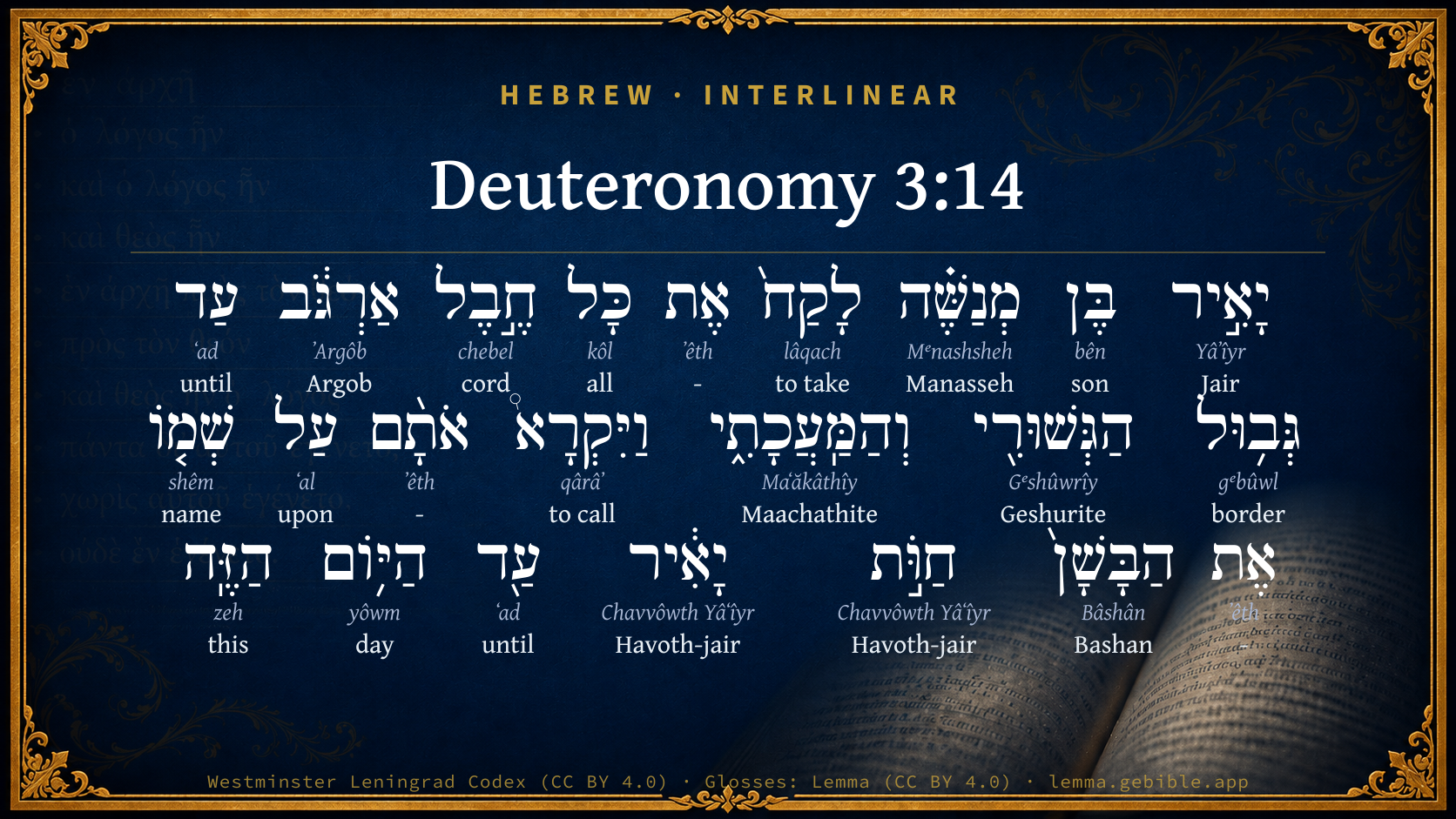
Hebrew (Westminster Leningrad Codex) Deuteronomy 3:14 appears in the Hebrew Old Testament. The text above is from the Westminster Leningrad Codex. Each word links to its Strong’s number, a concise gloss, and parsing drawn from the Open Scriptures Hebrew Bible morphology. Click any word for its full Brown-Driver-Briggs (BDB) entry.
Download image
Cite this verse

Deuteronomy 3:14 (World English Bible). Public Domain. Lemma interlinear Bible study tool, https://lemma.gebible.app/v/deuteronomy/3/14.

Show BibTeX & RIS
BibTeX
RIS
English Translation
Jair the son of Manasseh took all the region of Argob, to the border of the Geshurites and the Maacathites, and called them, even Bashan, after his own name, Havvoth Jair, to this day.)
World English Bible · Public Domain
Highlights
  • 2 first appearances in the Hebrew Bible
Full analysis ↓
Download a study sheet

One document with this verse’s original text, its word-by-word gloss line, the meaning frame, cross-references with their text, attributed commentary, and full source and license credits — printable, and it pastes into notes with its structure intact.

This verse Autodidact and up

Study sheet (.html) Plain text (.txt)

A passage Seminary Student

Up to 50 verses in one chapter. A passage sheet keeps up to 6 commentary sources and 12 cross-references per verse, in the order this page ranks them, and says so on the sheet whenever that leaves anything out. Ask for a single verse and you get the Autodidact verse sheet above.

Everything on this page stays free to read, with no account — the sheet is a download of what is already on screen, not access to it.

Want to remove ads? Support Godless Engineer
Compare translations 3

The same verse in 3 English versions, stacked beneath the original-language interlinear above. Click any original word for its lexicon entry.

Each is an independent rendering of the whole verse — the interlinear is not word-aligned to these translations.

Highlighted words mark where these versions differ — a whole-verse word diff, not a word-by-word alignment.

  • World English Bible Public Domain
    Jair the son of Manasseh took all the region of Argob, to the border of the Geshurites and the Maacathites, and called them, even Bashan, after his own name, Havvoth Jair, to this day.)
  • King James Version Public Domain
    Jair the son of Manasseh took all the country of Argob unto the coasts of Geshuri and Maachathi; and called them after his own name, Bashanhavothjair, unto this day.
  • unfoldingWord Literal Text CC BY-SA 4.0
    Jair, son of Manasseh, took all the region of Argob as far as the border of the Geshurites and the Maacathites. And he called it, Bashan, by his name, Havvoth Jair, to this day.)

unfoldingWord Literal Text — © unfoldingWord, licensed CC BY-SA 4.0. Word-aligned USFM3 via Door43 (git.door43.org/unfoldingWord/en_ult).

Versions to compare (up to 4)

3 of 4 selected

Show all 18 translations

Every available English version of this verse, each an independent rendering of the whole verse.

  • World English Bible Public Domain
    Jair the son of Manasseh took all the region of Argob, to the border of the Geshurites and the Maacathites, and called them, even Bashan, after his own name, Havvoth Jair, to this day.)
  • Berean Standard Bible Public Domain
    Jair, a descendant of Manasseh, took the whole region of Argob as far as the border of the Geshurites and Maacathites. He renamed Bashan after himself, Havvoth-jair, by which it is called to this day.
  • Majority Standard Bible Public Domain
    Jair, a descendant of Manasseh, took the whole region of Argob as far as the border of the Geshurites and Maacathites. He renamed Bashan after himself, Havvoth-jair, by which it is called to this day.
  • King James Version Public Domain
    Jair the son of Manasseh took all the country of Argob unto the coasts of Geshuri and Maachathi; and called them after his own name, Bashanhavothjair, unto this day.
  • American Standard Version (1901) Public Domain
    Jair the son of Manasseh took all the region of Argob, unto the border of the Geshurites and the Maacathites, and called them, even Bashan, after his own name, Havvoth-jair, unto this day.)
  • Revised Version (1885) Public Domain
    Jair the son of Manasseh took all the region of Argob, unto the border of the Geshurites and the Maacathites; and called them, even Bashan, after his own name, Havvoth-jair, unto this day.)
  • Geneva Bible (1599) Public Domain
    Iair the sonne of Manasseh tooke all the countrey of Argob, vnto the coastes of Geshuri, and of Maachathi: and called them after his owne name, Bashan, Hauoth Iair vnto this day.
  • Douay-Rheims (1899) Public Domain
    Jair the son of Manasses possessed all the country of d Argob unto the borders of Gessuri, and Machati. And he called Basan by his own name, Havoth Jair, that is to say, the towns of Jair, until this present day.
  • Young's Literal Translation Public Domain
    `Jair son of Manasseh hath taken all the region of Argob, unto the border of Geshuri, and Maachathi, and calleth them by his own name, Bashan-Havoth-Jair, unto this day.
  • Literal Standard Version CC BY-SA 4.0
    Jair son of Manasseh has taken all the region of Argob, as far as the border of Geshuri and Maachathi ([namely] Bashan), and calls them by his own name, Havoth-Jair, to this day.
  • Unlocked Literal Bible CC BY-SA 4.0
    Jair, a descendant of Manasseh, took all the region of Argob to the border of the Geshurites and the Maakathites. He called the region, even Bashan, by his own name, Havvoth Jair, to this day.)
  • unfoldingWord Literal Text CC BY-SA 4.0
    Jair, son of Manasseh, took all the region of Argob as far as the border of the Geshurites and the Maacathites. And he called it, Bashan, by his name, Havvoth Jair, to this day.)
  • Darby Bible Public Domain
    Jair the son of Manasseh took the whole region of Argob as far as the border of the Geshurites and Maachathites, and called Bashan after his own name, Havoth-Jair, to this day.)
  • World Messianic Bible Public Domain
    Jair the son of Manasseh took all the region of Argob, to the border of the Geshurites and the Maacathites, and called them, even Bashan, after his own name, Havvoth Jair, to this day.)
  • Webster's Bible Public Domain
    Jair the son of Manasseh took all the country of Argob, to the borders of Geshuri, and Maachathi; and called them after his own name, Bashan-havoth-jair, to this day.
  • Free Bible Version CC BY-SA 4.0
    Jair, a descendant of Manasseh, took over the whole region of Argob right up to the border of the Geshurites and Maacathites and changed the name of Bashan to Havvoth-jair after himself, which is still its name to this day.
  • Bible in Basic English Public Domain
    Jair, the son of Manasseh, took all the land of Argob, as far as the country of the Geshurites and the Maacathites, naming it, Bashan, Havvoth-Jair after himself, as it is to this day.)
  • JPS Tanakh (1917) Public Domain
    Jair the son of Manasseh took all the region of Argob, unto the border of the Geshurites and the Maacathites, and called them, even Bashan, after his own name, Havvoth-jair, unto this day. —

Literal Standard Version (2020), Covenant Press — licensed CC BY-SA 4.0. Text via the HelloAO Bible API (eBible.org). Unlocked Literal Bible (unfoldingWord) — licensed CC BY-SA 4.0. Text via the HelloAO Bible API (eBible.org). unfoldingWord Literal Text — © unfoldingWord, licensed CC BY-SA 4.0. Word-aligned USFM3 via Door43 (git.door43.org/unfoldingWord/en_ult). Free Bible Version, Dr. Jonathan Gallagher — licensed CC BY-SA 4.0. Text via the HelloAO Bible API (eBible.org).

Word by word

More ways to search: Search by grammar → Find every occurrence → Compare this word →

Practice this passage: Drill this verse → Learn its vocabulary →

אַרְגֹּ֔ב
ʼArgôb
H709
“Argob”
Noun, Proper
Part of Speech
Noun
Type
Proper
Full BDB Definition

Origin: from the same as H7263

TWOT: None

Argob = "heap of clods" - a district or area in Bashan (noun proper locative) - one of king Pekah's officers (noun proper masculine)
  1. יָאִ֣יר Yâʼîyr H2971 “Jair” Noun, Proper
  2. בֶּן bên H1121 “son of” Noun, Common, Masculine, Singular, Construct
  3. מְנַשֶּׁ֗ה Mᵉnashsheh H4519 “Manasseh” Noun, Proper
  4. לָקַח֙ lâqach H3947 “to take” Verb, Qal, Perfect, 3rd Person, Masculine, Singular
  5. אֶת ʼêth H853 “-” Particle, Direct Object
  6. כָּל kôl H3605 “all of” Noun, Common, Masculine, Singular, Construct
  7. חֶ֣בֶל chebel H2256 “cord of” Noun, Common, Both, Singular, Construct
  8. עַד ʻad H5704 “until” Preposition
  9. גְּב֥וּל gᵉbûwl H1366 “border of” Noun, Common, Masculine, Singular, Construct
  10. הַגְּשׁוּרִ֖י Gᵉshûwrîy H1651 “the · Geshurite” Particle, Definite Article + Noun, Gentilic, Masculine, Singular, Absolute
  11. וְהַמַּֽעֲכָתִ֑י Maʻăkâthîy H4602 “and · the · Maachathite” Conjunction + Particle, Definite Article + Noun, Gentilic, Masculine, Singular, Absolute
  12. וַיִּקְרָא֩ qârâʼ H7121 “and · to call” Conjunction + Verb, Qal, Sequential Imperfect, 3rd Person, Masculine, Singular
  13. אֹתָ֨ם ʼêth H853 “- · them” Particle, Direct Object + Suffix, Personal, 3rd Person, Masculine, Plural
  14. עַל ʻal H5921 “upon” Preposition
  15. שְׁמ֤וֹ shêm H8034 “name · his” Noun, Common, Masculine, Singular, Construct + Suffix, Personal, 3rd Person, Masculine, Singular
  16. אֶת ʼêth H853 “-” Particle, Direct Object
  17. הַבָּשָׁן֙ Bâshân H1316 “the · Bashan” Particle, Definite Article + Noun, Proper
  18. חַוֺּ֣ת Chavvôwth Yâʻîyr H2334 “Havoth-jair of” Noun, Common, Feminine, Plural, Construct
  19. יָאִ֔יר Chavvôwth Yâʻîyr H2334 “Havoth-jair” Noun, Proper
  20. עַ֖ד ʻad H5704 “until” Preposition
  21. הַיּ֥וֹם yôwm H3117 “the · day” Particle, Definite Article + Noun, Common, Masculine, Singular, Absolute
  22. הַזֶּֽה zeh H2088 “the · this” Particle, Definite Article + Pronoun, Demonstrative, Masculine, Singular

About this verse

These counts appear in no published source. They are computed here, from the morphology-tagged text and Lemma’s own curated glosses. What Lemma adds →

23
words
19
distinct lemmas
Pentateuch
section

Notable vocabulary

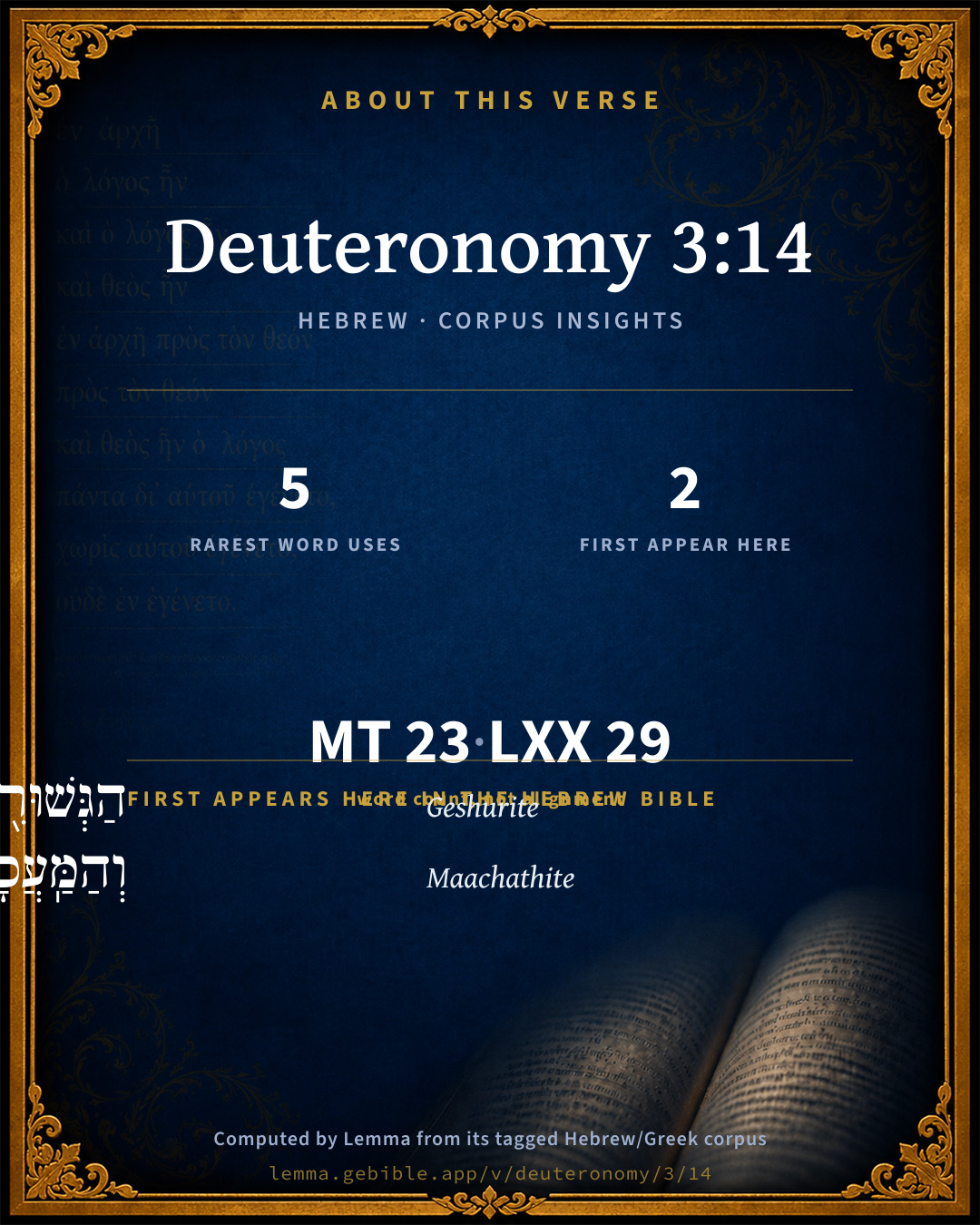
The rarest word here is אַרְגֹּ֔ב Argob H709 — appearing just 5 times in the whole Hebrew Bible.

First appearance in Scripture

These words make their first canonical appearance in the Hebrew Bible here:

  • הַגְּשׁוּרִ֖י Geshurite H1651
  • וְהַמַּֽעֲכָתִ֑י Maachathite H4602

Shared distinctive vocabulary

אַרְגֹּ֔ב Argob H709 occurs in 5 verses of the Hebrew Bible. Also found in:

Grammatical profile

  • 2 verbs
  • 14 nouns
  • 1 pronoun
  • 3 prepositions
  • 3 particles

Verb forms

  • לָקַח֙ Qal · Perfect
  • וַיִּקְרָא֩ Qal · Sequential Imperfect

Repetition

Words recur within this verse — often emphatic in Hebrew:

  • עַד until H5704 ×2
  • חַוֺּ֣ת Havoth-jair H2334 ×2

Hebrew & Septuagint length

In English translation the verse runs 34 words from the Hebrew and 34 from the Septuagint (LXX English) — the same length.

A rough comparison of the two English renderings, which tokenize alike — not a word-level alignment.

Word counts can differ between the Hebrew and the Greek without any difference in meaning — e.g. the Hebrew direct-object marker אֵת has no separate Greek word, and Greek often adds the article ὁ.

In the original languages it is 23 Hebrew tokens and 29 Greek tokens — but the two are counted differently (Hebrew bundles its prefixes and suffixes into one token; the Greek is in lemma form), so that isn’t a like-for-like length.

Cross-references

6

Topical passages linked to Deuteronomy 3:14 in the Treasury of Scripture Knowledge — connected by theme and wording, ordered by reader-vote popularity; previews shown in the World English Bible.

  • Numbers 32:41 Jair the son of Manasseh went and took the towns of it, and called them Havvoth Jair.
  • Joshua 13:13 Nevertheless the children of Israel didn't drive out the Geshurites, nor the Maacathites: but Geshur and Maacath dwell in the midst of Israel to this day.
  • 2 Samuel 3:3 and his second, Chileab, of Abigail the wife of Nabal the Carmelite; and the third, Absalom the son of Maacah the daughter of Talmai king of Geshur;
  • 2 Samuel 10:6 When the children of Ammon saw that they were become odious to David, the children of Ammon sent and hired the Syrians of Beth Rehob, and the Syrians of Zobah, twenty thousand footmen, and the king of Maacah with one thousand men, and the men of Tob twelve thousand men.
  • 2 Samuel 13:37 But Absalom fled, and went to Talmai the son of Ammihur, king of Geshur. [David] mourned for his son every day.
  • 1 Chronicles 2:21–23 Afterward Hezron went in to the daughter of Machir the father of Gilead, whom he took [as wife] when he was sixty years old; and she bore him Segub.

Cross-references courtesy of OpenBible.info (CC BY 4.0).

Hebrew and Greek witnesses Masoretic Hebrew ↔ Greek Septuagint

The same verse in the two great witnesses to the Old Testament, shown verse-for-verse.

These are two independent witnesses, not word-aligned to each other, and the Septuagint is shown in lemma (dictionary) form.

Hebrew Deuteronomy 3:14 Masoretic · Westminster Leningrad Codex

יָאִ֣יר בֶּן מְנַשֶּׁ֗ה לָקַח֙ אֶת כָּל חֶ֣בֶל אַרְגֹּ֔ב עַד גְּב֥וּל הַגְּשׁוּרִ֖י וְהַמַּֽעֲכָתִ֑י וַיִּקְרָא֩ אֹתָ֨ם עַל שְׁמ֤וֹ אֶת הַבָּשָׁן֙ חַוֺּ֣ת יָאִ֔יר עַ֖ד הַיּ֥וֹם הַזֶּֽה

Jair the son of Manasseh took all the region of Argob, to the border of the Geshurites and the Maacathites, and called them, even Bashan, after his own name, Havvoth Jair, to this day.)

World English Bible · Public Domain

Greek LXX Deuteronomy 3:14 Septuagint · lemma form

καί ιαϊρ υἱός μανασσή λαμβάνω πᾶς ὁ περίχωρος αργοβ ἕως ὁ ὅριον γαργασι καί ομαχαθι ἐπιὀνομάζω αὐτός ἐπί ὁ ὄνομα αὐτός ὁ βασαν αυωθ ιαϊρ ἕως ὁ ἡμέρα οὗτος

And Jair the son of Manasse took all the country round about Argob as far as the borders of Gargasi and Machathi: he called them by his name Basan Thavoth Jair until this day.

LXX2012 (modern English Septuagint) · Public Domain

On this verse, The Cambridge Bible for Schools and Colleges discusses the Septuagint’s reading. Read the note in Commentary ↓

Hebrew: Westminster Leningrad Codex (CC BY 4.0). Greek: Septuagint (public domain); English from LXX2012 (modern English Septuagint) (Public Domain). How the Septuagint differs from the Hebrew →

Targum (Aramaic paraphrase)

2

The Targum is the ancient Jewish Aramaic paraphrase of the Hebrew Scriptures — an interpretive translation, not the Hebrew text itself. Onkelos (literal) and Pseudo-Jonathan (expansive) render the Torah, and Jonathan the Prophets. Coverage is partial: where no permissively-licensed English translation exists for a verse, only the Aramaic is shown. This is verse-level text, not a word-by-word alignment to the Hebrew.

  1. Targum Onkelos Torah (Genesis–Deuteronomy)
    יָאִיר בַּר מְנַשֶׁה נְסִיב יָת כָּל בֵּית פְּלַךְ טְרָכוֹנָא עַד תְּחוּם גְשׁוּרָאָה וְאַפְקֵירוֹס וּקְרָא יָתְהוֹן עַל שְׁמֵהּ יָת מַתְנָן כַּפְרָנֵי יָאִיר עַד יוֹמָא הָדֵין

    (no public-domain English translation for this verse)

    Targum Onkelos — Aramaic: “Onkelos Genesis” (public domain); “Onkelos Exodus” (public domain); “Onkelos Leviticus” (public domain); “Onkelos Numbers” (public domain); “Onkelos Deuteronomy” (public domain). English: “Sefaria Community Translation” (CC0 1.0 (public-domain dedication)); “J.W. Etheridge. The Targums of Onkelos and Jonathan Ben Uzziel on the Pentateuch. London: Longmans, Green, 1862” (public domain). Text via Sefaria.

  2. Targum Pseudo-Jonathan Torah (Genesis–Deuteronomy)
    וְיָאִיר בַּר מְנַשֶּׁה נְסִיב יַת כָּל תְּחוּם פְּלַךְ טַרְגוֹנָא עַד תְּחוּם קִרְוֵי וְאַנְטִיקֵירוֹס וּקְרָא יַתְהוֹן עַל שְׁמֵיהּ יַת מַתְנָן כַּפְרָנֵי יָאִיר עַד יוֹמָא הָדֵין

    And Jair bar Menasheh took the whole limit of the region of Targona, unto the limit of Korze and Antikiros, and called them by his own name Mathnan, the towns of Jair, unto this day.

    Targum Pseudo-Jonathan — Aramaic: “Targum Jonathan on Genesis” (public domain); “Targum Jonathan on Exodus” (public domain); “Targum Jonathan on Leviticus” (public domain); “Targum Jonathan on Numbers” (public domain); “Targum Jonathan on Deuteronomy” (public domain). English: “The Targum of Jonathan ben Uzziel, trans. J. W. Etheridge, London, 1862” (public domain). Text via Sefaria.

Commentary

Notes on Deuteronomy 3:14 from classic Christian and Jewish commentators (each source and its license shown beneath its notes). The classic Christian expositions comment on the surrounding passage and are grouped to its opening verse, so a note may address several verses; the Jewish commentaries on the Tanakh (Rashi and others) are per-verse, so they appear only where the commentator wrote on this verse.

Lemma curates 59 commentaries, every one of them public domain or Creative Commons licensed, each selected and text-cleaned for this edition rather than reprinted as found. About our sources →

Joseph Benson's Commentary

Deu 3:14. Unto this day — This must be put among those passages which were not written by Moses, but added by those holy men who digested the books of Moses into this order, and inserted some few passages to accommodate things to their own time and people.

Joseph Benson's Commentary on the Old and New Testaments (1811–1818) — public domain. Text from a community e-Sword module.

Tyndale Open Study Notes

Tyndale Open Resources

3:14 Jair was a descendant of Manasseh from Makir and Gilead (1 Chr 2:22). • Geshurites and Maacathites, kingdoms of Bashan, lay along the west side of the Golan Heights, east of the Sea of Galilee. • The Towns of Jair was the name given Argob (see Deut 3:4) after Jair brought it under Israelite control.

Tyndale Open Study Notes — © Tyndale Open Resources, licensed CC BY-SA 4.0. Text via the HelloAO Bible API.

Geneva Bible (1599)

Geneva Bible translators

Meaning, when he wrote this history.

Geneva Bible (1599) marginal notes — public domain. Text via Bolls.life.

Jamieson, Fausset & Brown

Robert Jamieson, A. R. Fausset & David Brown

Jair the son of Manasseh took all the country of Argob--The original inhabitants of the province north of Bashan, comprising sixty cities (Deu 3:4), not having been extirpated along with Og, this people were afterwards brought into subjection by the energy of Jair. This chief, of the tribe of Manasseh, in accordance with the pastoral habits of his people, called these newly acquired towns by a name which signifies "Jair's Bedouin Villages of Tents."

unto this day--This remark must evidently have been introduced by Ezra, or some of the pious men who arranged and collected the books of Moses.

Jamieson, Fausset & Brown — Commentary Critical and Explanatory on the Whole Bible (1871) — public domain (CC PDM 1.0). Text via the HelloAO Bible API.

Adam Clarke's Commentary

Verse 14. Bashan-havoth-jair] Bashan of the cities of Jair; see Nu 32:41.

Adam Clarke's Commentary on the Bible (1810–1826) — public domain. Text from a community e-Sword/MySword module.

Ellicott's Commentary for English Readers

(14) Jair took . . . unto this day.—The last words of this chapter seem to point to a later hand, as of Joshua, describing the completion of the conquest. The expression “unto this day” is characteristically common in Joshua, or in the editorial notes inserted throughout that book. (See Introduction to Joshua, “On the Style of the Book.”)

Geshuri and Maachathi—i.e., the Geshurite and the Maachathite, the inhabitants of Geshur and Maachah. “The Maachathites, near the Jordan springs (comp. Abel-Beth-maachah, 2Sa_20:14-15), and the Geshurites, rather farther east” (Conder, Bible Handbook, p. 254). Talmai, king of Geshur, was the grandfather of Absalom (2Sa_3:3), who took refuge with him after he killed Ammon (2Sa_13:37). “Argob, Trachonitis, or El-Lejja, has been an asylum for all malefactors and refugees ever since” (Giant Cities of Bashan, p. 92).

A Bible Commentary for English Readers, edited by Charles John Ellicott (1878–1897) — public domain. Text from a community e-Sword module.

The Cambridge Bible for Schools and Colleges

gen. ed. J. J. S. Perowne

14. Archaeological Note. It begins with the last clause of Deu_3:13; see above. This reference of the conquest of Argob to Ya’îr contrasts with Deu_3:4-6, which assign it to Israel under Moses, and differs from Num_32:41, which places the Ḥawwôth-Ya’îr in Gilead; cp. 1Ki_4:13, and 1Ch_2:22, and as we have seen, on Deu_3:13, Ya’îr is assigned by Jdg_10:3 ff. to the time of the Judges. The phrase unto this day also implies a date for this note later than that of Moses, which is assumed through the rest of the discourse. The opinion, therefore, is reasonable, that the note is a harmonising insertion altered from Num_32:41. Note the awkward construction. The word them in called them Ḥawwôth Ya’îr, confirmed by Sam. and LXX., has no proper antecedent (it cannot of course be explained by the preceding border), while in Num_32:41 it correctly refers to the preceding tent-villages. Note, too, the awkwardness of all Bashan as it stands. Moreover, the characteristic of Argob was not tent-villages but fenced cities (Deu_3:4).—The Geshuri and Ma‘akathi are placed by Jos_12:5; Jos_13:11 between Gile‘ad and Ḥermon to the W. of Bashan; that is the mod. Jaulan (Gaulanitis), but the Ma‘akathi spread across Jordan N.W. to Abel-beth-Ma‘akah in Naphtali, 2Sa_20:14 f., etc. These two were Aramean (Gen_22:24; 2Sa_15:8; 1Ch_19:6); Israel failed to expel them (Jos_13:3); David fought the king of Ma‘akah (2Sa_10:6, where the LXX Ἀμαλήκ is probably an error; the Geshur of 2Sa_3:3; 2Sa_13:37 f. may be another tribe of that name S. of Judah, Jos_13:2; 1Sa_27:8); 1Ch_2:33, where Geshur is said to have taken the Ḥ. Ja’ir, and Deu_19:6, are corrupt.—Ḥawwoth, cp. Ar. ḥiwa‘at “a collection of tents.”

The Cambridge Bible for Schools and Colleges (gen. ed. J. J. S. Perowne; Cambridge University Press, 1878–1918) — public domain. Text from a community e-Sword module.

John Gill's Exposition

Jair the son of Manasseh took all the country of Argob,.... Or Trachonitis; the small towns belonging to Gilead, as in Num 32:41.

unto the coasts of Geshuri and Maachathi; these were little kingdoms in Syria, on which the country of Argob bordered, and had kings over them in the time of David, and came not into the possession of the Israelites; see Jos 13:13.

and called them after his own name, Bashanhavothjair, unto this day; see Num 32:41.

John Gill's Exposition of the Whole Bible (1746–1763) — public domain (CC PDM 1.0). Text via the HelloAO Bible API.

Albert Barnes' Notes on the Bible

These Geshurites held territory adjoining, if not included within, Bashan. They are not to be confounded with those mentioned in Jos 13:2, who were neighbors of the Philistines 1Sa 17:8.

The exact position of Maachah like that of Geshur cannot be ascertained; but it was no doubt among the fastnesses which lay between Bashan and the kingdom of Damascus, and on the skirts of Mount Hermon.

Unto this day - This expression, like our “until now,” does not, as used in the Bible, necessarily imply that the time spoken of as elapsed is long. It may here denote the duration to the time then present of that which had been already some months accomplished.

Albert Barnes' Notes on the Bible (1834–1885) — public domain. Text from a community e-Sword/MySword module.

Haydock's Catholic Bible Commentary

Jair. Some have supposed that this was one of the judges of Israel, but without foundation. He was a son or descendant of Manasses, Numbers xxxii. 41., and Judges x. 4. --- And Machati. These were the most southern towns of this half tribe. (Calmet) --- Day. If Esdras added these words, he did it not against the law, but to explain it. (Worthington)

George Leo Haydock (1774–1849), Haydock's Catholic Family Bible and Commentary, 1859 edition — public domain. Excludes Psalms (Douay-Rheims chapter numbering differs from Protestant) and Deuterocanonical books (Catholic canon only).

Matthew Poole's English Annotations

Geshuri, or Geshurites, a people towards the north of Canaan, 2Sa 3:3; 15:8. See also Jos 13:13. Maachathi; of whom see 2Sa 3:3; 10:6. Unto this day: this must be put among those other passages which were not written by Moses, but added by those holy men who digested the books of Moses into this order, and inserted some very few passages to accommodate things to their own time and people.

Matthew Poole's English Annotations on the Holy Bible (1683–1685) — public domain. Text from a community e-Sword/MySword module.

Whedon's Commentary on the Bible

Daniel D. Whedon

14. Jair the son of Manasseh — Meaning, descendant of Manasseh. He was of the tribe of Manasseh on his mother’s side.

Coasts of Geshuri and Maachathi — That is, the Geshurites and Maachathites. The Geshurites are often named in connexion with Bashan. David married the daughter of Talmai, king of the Geshurites. Absalom was born of this marriage. After the murder of his brother Amnon by his command, Absalom fled to Geshur, and lived three years in exile among his mother’s kindred. 2Sa_13:37. The precise location of Geshur is not decided. It was somewhere near Hermon, on the eastern side of the upper Jordan. The exact location of Maachathi is not settled. It was probably in the neighbourhood of Hermon, not far from Geshur.

Havoth-jair — The dwellings or abodes of Jair. Havoth is from the Hebrew word which means life, as the Germans use Leben in such forms as Eisleben.

Daniel D. Whedon (gen. ed.), Commentary on the Old and New Testaments (1874–1909) — public domain. Text from a community e-Sword module.

The Pulpit Commentary

Jair, a descendant of Manasseh by the mother"s side (his father was of the tribe of Judah, (1Ch_2:22) obtained the Argob region untoi.e., inclusive of. (see Jos_13:13) the territory of the Geshuri and Maachathi. These were small Syrian tribes located to the east of Hermon. As Geshur signifies a bridge, it has been conjectured that the Geshurites were located near some well-known bridge across the Jordan, of which, perhaps, they were the keepers, and from this took their name. Maachah is called Aram (Syria) Maachah in 1Ch_19:6. According to the "Ono-masticon," it was "a city of the Amorites, by the Jordan, near Mount Hermon" (s.v. Macaqi) It had in later times a king, who allied himself with the Ammonites against David. (1Ch_19:7) These tribes were subdued, but not destroyed, by the Israelites; and at a later period seem to have regained their independence, and to have formed one kingdom. (comp. 2Sa_3:3 2Sa_10:6 2Sa_13:37 2Sa_15:8; 1Ch_3:2) And called them after his own name, Bashan-havoth-jair. The word havoth (properly chavvoth , tWOj) is the plural of a word meaning life, and Char-voth-Jair probably signifies Jair"s livings, not Jair"s villages, for these were apparently fortified cities. (vers. 4, 5; 1Ki_4:13) These were recaptured by the Geshurites, aided by the Arameans; (1Ch_2:23, "And Geshur and Aram took Chavvoth-Jair from them," etc.) at what time is unknown. From Num_32:42, it appears that Nobah, also a family descended from Machir, took certain towns, viz. "Kenath and her daughters" in this district; these, with the twenty-three Hay-voth-Jair, made up the sixty towns which "belonged to the sons of Machir the father of Gilead". (1Ch_2:23) Nobah was probably in some way subordinate to Jair, and so in this rhetorical discourse, where it is not the purpose of the author to enter on minute details, the whole of these cities are included under the name Havvoth-Jair. Unto this day. "This does not necessarily imply a long time; and Moses himself may have used this expression, though only shortly after the event, in order to give prominence to the capture of the fortified cities of the giant" king Og, by the Manassites for the encouragement of the Israelites" (Herzheimer).

The Pulpit Commentary (1880–1919), ed. H.D.M. Spence-Jones & Joseph S. Exell — public domain. Text from a community e-Sword module.

John Wesley's Explanatory Notes

Unto this day - This must be put among those passages which were not written by Moses, but added by those holy men, who digested the books of Moses into this order, and inserted some few passages to accommodate things to their own time and people.

John Wesley, Explanatory Notes Upon the Whole Bible (1754–1765) — public domain. Text via the GEBible commentary corpus.

Keil & Delitzsch

C. F. Keil & F. Delitzsch

The region of Argob, or the country of Bashan, was given to Jair (see Num 32:41), as far as the territory of the Geshurites and Maachathites (cf. Jos 12:5; Jos 13:11). "Unto," as far as, is to be understood as inclusive. This is evident from the statement in Jos 13:13 : "The children of Israel expelled not the Geshurites nor the Maachathites; but the Geshurites and the Maachathites dwell among the Israelites until this day." Consequently Moses allotted the territory of these two tribes to the Manassites, because it formed part of the kingdom of Og. "Geshuri and Maachathi" are the inhabitants of Geshur and Maachah, two provinces which formed small independent kingdoms even in David's time (Sa2 3:3; Sa2 13:37, and Sa2 10:6). Geshur bordered on Aram. The Geshurites and Aramaeans afterwards took from the Israelites the Jair-towns and Kenath, with their daughter towns (Ch1 2:23). In David's time Geshur had a king Thalmai, whose daughter David married. This daughter was the mother of Absalom; and it was in Geshur that Absalom lived for a time in exile (Sa2 3:3; Sa2 13:37; Sa2 14:23; Sa2 15:8). The exact situation of Geshur has not yet been determined. It was certainly somewhere near Hermon, on the eastern side of the upper Jordan, and by a bridge over the Jordan, as Geshur signifies bridge in all the Semitic dialects. Maachah, which is referred to in Ch1 19:6 as a kingdom under the name of Aram-Maachah (Eng. V. Syria-Maachah), is probably to be sought for to the north-east of Geshur. According to the Onomast. (s. v. Μαχαθί), it was in the neighbourhood of the Hermon. "And he called them (the towns of the region of Argob) after his own name; Bashan (sc., he called) Havvoth Jair unto this day" (cf. Num 32:41). The word חוּת (Havvoth), which only occurs in connection with the Jair-towns, does not mean towns or camps of a particular kind, viz., tent villages, as some suppose, but is the plural of חוּה, life (Leben, a common German termination, e.g., Eisleben), for which afterwards the word חיּה was used (comp. Sa2 23:13 with Ch1 11:15). It applies to any kind of dwelling-place, being used in the passages just mentioned to denote even a warlike encampment. The Jair's-lives (Jairsleben) were not a particular class of towns, therefore, in the district of Argob, but Jair gave this collective name to all the sixty fortified towns, as is perfectly evident from the verse before us when compared with Deu 3:5 and Num 32:41, and expressly confirmed by Jos 13:30 and Kg1 4:13, where the sixty fortified towns of the district of Argob are called Havvoth Jair. - The statement in Ch1 2:22-23, that "Jair had twenty-three towns in Gilead (which is used here as in Deu 34:1; Jos 22:9; Jos 13:15; Jdg 5:17; Jdg 20:1, to denote the whole of Palestine to the east of the Jordan), and Geshur and Aram took the Havvoth Jair from them, (and) Kenath and its daughters, sixty towns (sc., in all)," is by no means at variance with this, but, on the contrary, in the most perfect harmony with it. For it is evident from this passage, that the twenty-three Havvoth Jair, with Kenath and its daughters, formed sixty towns altogether. The distinction between the twenty-three Havvoth Jair and the other thirty-seven towns, viz., Kenath and its daughters, is to be explained from the simple fact that, according to Num 32:42, Nobah, no doubt a family of sons of Machir related to Jair, conquered Kenath and its daughters, and called the conquered towns by his name, namely, when they had been allotted to him by Moses. Consequently Bashan, or the region of Argob, with its sixty fortified towns, was divided between two of the leading families of Machir the Manassite, viz., the families of Jair and Nobah, each family receiving the districts which it had conquered, together with their towns; namely, the family of Nobah, Kenath and its daughter towns, or the eastern portion of Bashan; and the family of Jair, twenty-three towns in the west, which are called Havvoth Jair in Ch1 2:23, in harmony with Num 32:41, where Jair is said to have given this name to the towns which were conquered by him. In the address before us, however, in which Moses had no intention to enter into historical details, all the (sixty) towns of the whole district of Argob, or the whole of Bashan, are comprehended under the name of Havvoth Jair, probably because Nobah was a subordinate branch of the family of Jair, and the towns conquered by him were under the supremacy of Jair. The expression "unto this day" certainly does not point to a later period than the Mosaic age. This definition of time is simply a relative one. It does not necessarily presuppose a very long duration, and here it merely serves to bring out the marvellous change which was due to the divine grace, viz., that the sixty fortified towns of the giant king Og of Bashan had now become Jair's lives.

(Note: The conquest of these towns, in fact, does not seem to have been of long duration, and the possession of them by the Israelites was a very disputed one (cf. Ch1 2:22-23). In the time of the judges we find thirty in the possession of the judge Jair (Jdg 10:4), which caused the old name Havvoth Jair to be revived.)

Keil & Delitzsch — Biblical Commentary on the Old Testament (1861–1891) — public domain (CC PDM 1.0). Text via the HelloAO Bible API. (Old Testament only.)

unfoldingWord translationNotes

Door43 World Missions Community

General Information:

This continues the background information about the land the people of Israel captured. (See: Deuteronomy 3:13)

Jair

This is the name of a man. (See: How to Translate Names)

the Geshurites and the Maakathites

These are people groups who lived west of Bashan. (See: How to Translate Names)

Havvoth Jair

Translators may make a footnote that says: "The name 'Havvoth Jair' means 'tent villages of Jair' or 'realm of Jair.'"

translationWords

descend

Manasseh

Geshur

Bashan

unfoldingWord translationNotes — © Distant Shores Media and the Door43 World Missions Community, licensed CC BY-SA 4.0. Source: git.door43.org/Door43/en_tn.

Lesson kit

Teaching starters — assembled from the data on this page, not authored interpretation. Every prompt links to the verse data it draws on. Edit before teaching.

Deuteronomy, in the Pentateuch, opens this verse with 23 words (19 distinct Hebrew lemmas). Its most distinctive word is ʼArgôb (“Argob”). A historical commentator’s framing appears above. Read the whole chapter for the surrounding context.

Discussion questions

  1. What does “Argob” (ʼArgôb) contribute to the verse as a whole?
  2. 2 words make their first appearance in Scripture here. What does this debut establish?
  3. How does Deuteronomy 3:4, which shares the word «Argob», read alongside this verse?
  4. What does the repetition of “until” (2× in this one verse) do in this verse?
  5. These translations render this verse differently; the difference is in the English rendering, not the original. What questions does that raise?
  6. «לָקַח֙» is a Qal Perfect verb. How does that grammatical form shape the action described?
  7. Compare how Joseph Benson's Commentary and Tyndale Open Study Notes read this verse. Where do they agree or differ?

Things to notice

Reading settings

Reading text

Shown beneath each verse's original-language words.

Old Testament
Old Testament edition

Read the OT as the Masoretic Hebrew (MT) or the Greek Septuagint (LXX).

English shown for the Greek Septuagint (in the Hebrew ↔ Greek comparison).

Comparing translations? Open the Compare panel on any verse page to stack up to four side by side.