
Ezekiel 48:22

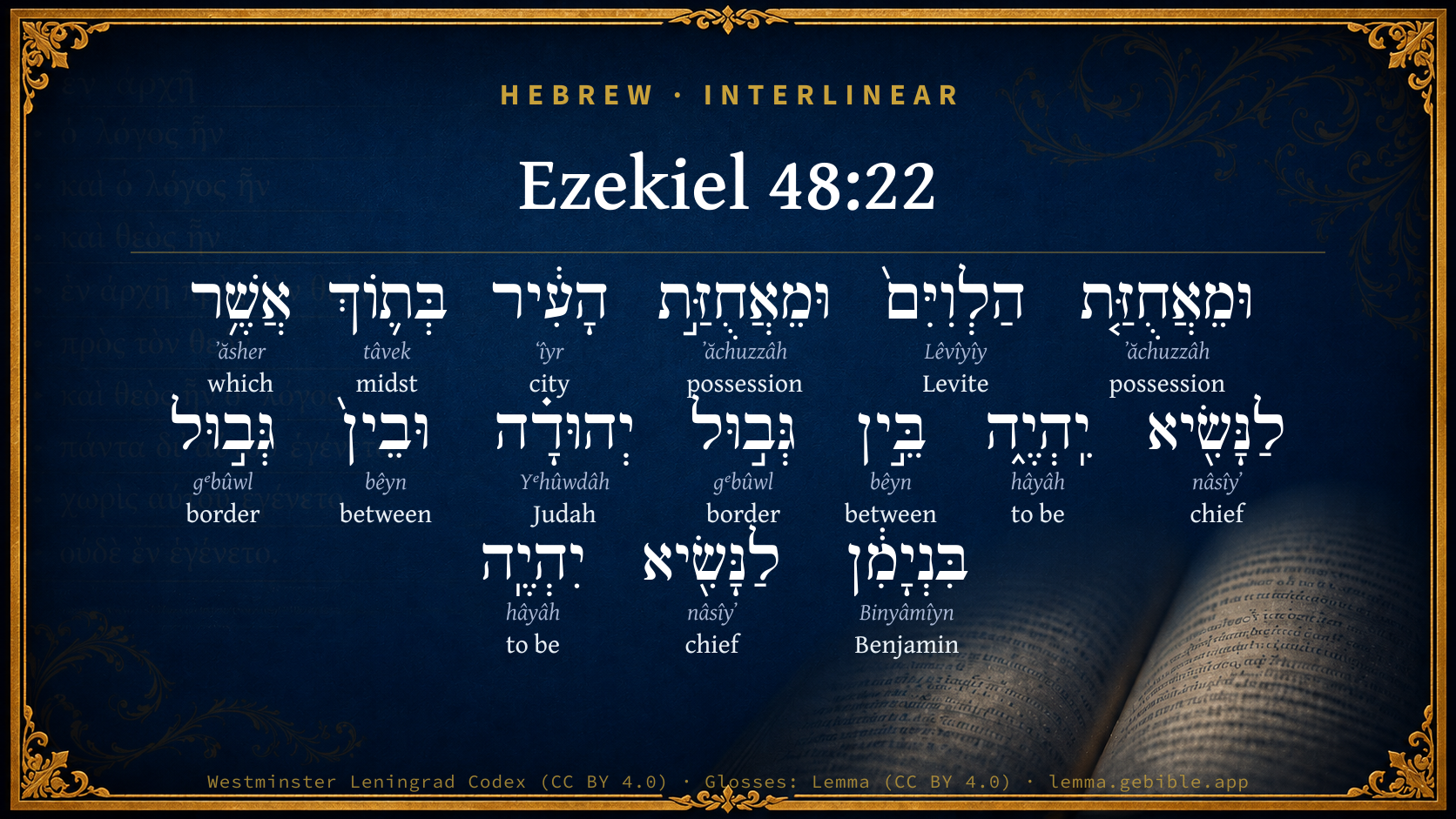
Hebrew (Westminster Leningrad Codex) Ezekiel 48:22 appears in the Hebrew Old Testament. The text above is from the Westminster Leningrad Codex. Each word links to its Strong’s number, a concise gloss, and parsing drawn from the Open Scriptures Hebrew Bible morphology. Click any word for its full Brown-Driver-Briggs (BDB) entry.
Download image
Cite this verse

Ezekiel 48:22 (World English Bible). Public Domain. Lemma interlinear Bible study tool, https://lemma.gebible.app/v/ezekiel/48/22.

Show BibTeX & RIS
BibTeX
RIS
English Translation
Moreover from the possession of the Levites, and from the possession of the city, being in the midst of that which is the prince's, between the border of Judah and the border of Benjamin, it shall be for the prince.
World English Bible · Public Domain
Download a study sheet

One document with this verse’s original text, its word-by-word gloss line, the meaning frame, cross-references with their text, attributed commentary, and full source and license credits — printable, and it pastes into notes with its structure intact.

This verse Autodidact and up

Study sheet (.html) Plain text (.txt)

A passage Seminary Student

Up to 50 verses in one chapter. A passage sheet keeps up to 6 commentary sources and 12 cross-references per verse, in the order this page ranks them, and says so on the sheet whenever that leaves anything out. Ask for a single verse and you get the Autodidact verse sheet above.

Everything on this page stays free to read, with no account — the sheet is a download of what is already on screen, not access to it.

Want to remove ads? Support Godless Engineer
Compare translations 3

The same verse in 3 English versions, stacked beneath the original-language interlinear above. Click any original word for its lexicon entry.

Each is an independent rendering of the whole verse — the interlinear is not word-aligned to these translations.

Highlighted words mark where these versions differ — a whole-verse word diff, not a word-by-word alignment.

  • World English Bible Public Domain
    Moreover from the possession of the Levites, and from the possession of the city, being in the midst of that which is the prince's, between the border of Judah and the border of Benjamin, it shall be for the prince.
  • King James Version Public Domain
    Moreover from the possession of the Levites, and from the possession of the city, being in the midst of that which is the prince's, between the border of Judah and the border of Benjamin, shall be for the prince.
  • unfoldingWord Literal Text CC BY-SA 4.0
    The land extending from the property of the Levites and the area of the city in its midst will be for the prince; it will be between the border of Judah and the border of Benjamin—this land will be for the prince.

unfoldingWord Literal Text — © unfoldingWord, licensed CC BY-SA 4.0. Word-aligned USFM3 via Door43 (git.door43.org/unfoldingWord/en_ult).

Versions to compare (up to 4)

3 of 4 selected

Show all 18 translations

Every available English version of this verse, each an independent rendering of the whole verse.

  • World English Bible Public Domain
    Moreover from the possession of the Levites, and from the possession of the city, being in the midst of that which is the prince's, between the border of Judah and the border of Benjamin, it shall be for the prince.
  • Berean Standard Bible Public Domain
    So the Levitical property and the city property will lie in the center of the area belonging to the prince—the area between the borders of Judah and Benjamin.
  • Majority Standard Bible Public Domain
    So the Levitical property and the city property will lie in the center of the area belonging to the prince—the area between the borders of Judah and Benjamin.
  • King James Version Public Domain
    Moreover from the possession of the Levites, and from the possession of the city, being in the midst of that which is the prince's, between the border of Judah and the border of Benjamin, shall be for the prince.
  • American Standard Version (1901) Public Domain
    Moreover from the possession of the Levites, and from the possession of the city, being in the midst of that which is the prince's, between the border of Judah and the border of Benjamin, it shall be for the prince.
  • Revised Version (1885) Public Domain
    Moreover from the possession of the Levites, and from the possession of the city, being in the midst of that which is the prince’s, between the border of Judah and the border of Benjamin, shall be for the prince.
  • Geneva Bible (1599) Public Domain
    Moreouer, from the possession of the Leuites, and from the possession of the citie, that which is in the middes shall be the princes: betweene the border of Iudah, and betweene the border of Beniamin shall be the princes.
  • Douay-Rheims (1899) Public Domain
    And from the possession of the Levites, and from the possession of the city which ale in the midst of the prince's portions: what shall be to the border of Juda, and to the border of Benjamin, shall also belong to the prince.
  • Young's Literal Translation Public Domain
    And from the possession of the Levites, from the possession of the city, in the midst of that which is to the prince, between the border of Judah and the border of Benjamin, there is to the prince.
  • Literal Standard Version CC BY-SA 4.0
    And from the possession of the Levites, from the possession of the city, in the midst of that which is for the prince, between the border of Judah and the border of Benjamin, there is for the prince.
  • Unlocked Literal Bible CC BY-SA 4.0
    The land extending from the property of the Levites and the area of the city in its midst will be for for the prince; it will be between the border of Judah and the border of Benjamin—this land will be for the prince.
  • unfoldingWord Literal Text CC BY-SA 4.0
    The land extending from the property of the Levites and the area of the city in its midst will be for the prince; it will be between the border of Judah and the border of Benjamin—this land will be for the prince.
  • Darby Bible Public Domain
    And from the possession of the Levites and from the possession of the city, being in the midst of that which shall be the prince's, between the border of Judah and the border of Benjamin, shall be for the prince.
  • World Messianic Bible Public Domain
    Moreover, from the possession of the Levites, and from the possession of the city, being in the middle of that which is the prince’s, between the border of Judah and the border of Benjamin, shall be for the prince.
  • Webster's Bible Public Domain
    Moreover from the possession of the Levites, and from the possession of the city, being in the midst of that which is the prince's, between the border of Judah and the border of Benjamin, shall be for the prince.
  • Free Bible Version CC BY-SA 4.0
    The Levites area and the city's area will lie in the middle of the prince's allocation, and will lie between the borders of the allocations of Judah and Benjamin.
  • Bible in Basic English Public Domain
    And the property of the Levites and the property of the town will be in the middle of the prince's property; between the limit of Judah's part and the limit of Benjamin's part will be for the prince.
  • JPS Tanakh (1917) Public Domain
    Thus the possession of the Levites, and the possession of the city, shall be in the midst of that which is the prince's; between the border of Judah and the border of Benjamin shall be the prince's.

Literal Standard Version (2020), Covenant Press — licensed CC BY-SA 4.0. Text via the HelloAO Bible API (eBible.org). Unlocked Literal Bible (unfoldingWord) — licensed CC BY-SA 4.0. Text via the HelloAO Bible API (eBible.org). unfoldingWord Literal Text — © unfoldingWord, licensed CC BY-SA 4.0. Word-aligned USFM3 via Door43 (git.door43.org/unfoldingWord/en_ult). Free Bible Version, Dr. Jonathan Gallagher — licensed CC BY-SA 4.0. Text via the HelloAO Bible API (eBible.org).

Word by word

More ways to search: Search by grammar → Find every occurrence → Compare this word →

Practice this passage: Drill this verse → Learn its vocabulary →

וּמֵאֲחֻזַּ֤ת
ʼăchuzzâh
H272
“and · from · possession of”
Conjunction + Preposition + Noun, Common, Feminine, Singular, Construct
Part of Speech
Conjunction + Preposition + Noun
Type
Common
Gender
Feminine
Number
Singular
State
Construct
Full BDB Definition

Origin: from passive participle from H270

TWOT: 64a

possession, property - land - possession by inheritance
  1. הַלְוִיִּם֙ Lêvîyîy H3881 “the · Levites” Particle, Definite Article + Noun, Gentilic, Masculine, Plural, Absolute
  2. וּמֵאֲחֻזַּ֣ת ʼăchuzzâh H272 “and · from · possession of” Conjunction + Preposition + Noun, Common, Feminine, Singular, Construct
  3. הָעִ֔יר ʻîyr H5892 “the · city” Particle, Definite Article + Noun, Common, Feminine, Singular, Absolute
  4. בְּת֛וֹךְ tâvek H8432 “in/at · midst of” Preposition + Noun, Common, Masculine, Singular, Construct
  5. אֲשֶׁ֥ר ʼăsher H834 “which” Particle, Relative
  6. לַנָּשִׂ֖יא nâsîyʼ H5387 “to/for the · chief” Preposition, Determined + Noun, Common, Masculine, Singular, Absolute
  7. יִֽהְיֶ֑ה hâyâh H1961 “to be” Verb, Qal, Imperfect, 3rd Person, Masculine, Singular
  8. בֵּ֣ין bêyn H996 “between” Preposition
  9. גְּב֣וּל gᵉbûwl H1366 “border of” Noun, Common, Masculine, Singular, Construct
  10. יְהוּדָ֗ה Yᵉhûwdâh H3063 “Judah” Noun, Proper
  11. וּבֵין֙ bêyn H996 “and · between” Conjunction + Preposition
  12. גְּב֣וּל gᵉbûwl H1366 “border of” Noun, Common, Masculine, Singular, Construct
  13. בִּנְיָמִ֔ן Binyâmîyn H1144 “Benjamin” Noun, Proper
  14. לַנָּשִׂ֖יא nâsîyʼ H5387 “to/for the · chief” Preposition, Determined + Noun, Common, Masculine, Singular, Absolute
  15. יִהְיֶֽה hâyâh H1961 “to be” Verb, Qal, Imperfect, 3rd Person, Masculine, Singular

About this verse

These counts appear in no published source. They are computed here, from the morphology-tagged text and Lemma’s own curated glosses. What Lemma adds →

16
words
11
distinct lemmas
Prophets
section

Grammatical profile

  • 2 verbs
  • 11 nouns
  • 2 prepositions
  • 1 particle

Verb forms

  • יִֽהְיֶ֑ה Qal · Imperfect
  • יִהְיֶֽה Qal · Imperfect

Repetition

Words recur within this verse — often emphatic in Hebrew:

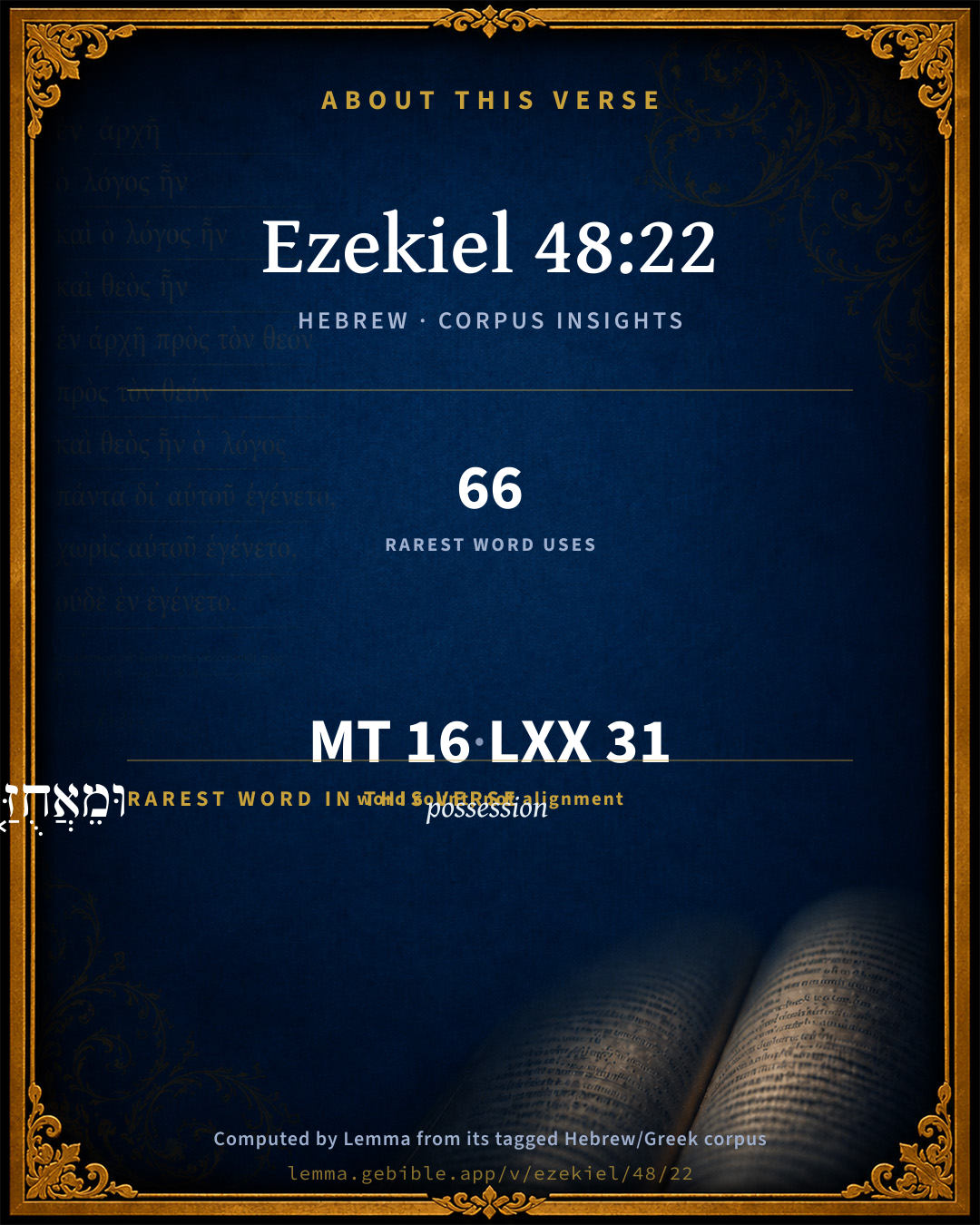
  • וּמֵאֲחֻזַּ֤ת possession H272 ×2
  • לַנָּשִׂ֖יא chief H5387 ×2
  • יִֽהְיֶ֑ה to be H1961 ×2
  • בֵּ֣ין between H996 ×2
  • גְּב֣וּל border H1366 ×2

Hebrew & Septuagint length

In English translation the verse runs 40 words from the Hebrew and 41 from the Septuagint (LXX English) — closely comparable.

A rough comparison of the two English renderings, which tokenize alike — not a word-level alignment.

Word counts can differ between the Hebrew and the Greek without any difference in meaning — e.g. the Hebrew direct-object marker אֵת has no separate Greek word, and Greek often adds the article ὁ.

In the original languages it is 16 Hebrew tokens and 31 Greek tokens — but the two are counted differently (Hebrew bundles its prefixes and suffixes into one token; the Greek is in lemma form), so that isn’t a like-for-like length.

Hebrew and Greek witnesses Masoretic Hebrew ↔ Greek Septuagint

The same verse in the two great witnesses to the Old Testament, shown verse-for-verse.

These are two independent witnesses, not word-aligned to each other, and the Septuagint is shown in lemma (dictionary) form.

Hebrew Ezekiel 48:22 Masoretic · Westminster Leningrad Codex

וּמֵאֲחֻזַּ֤ת הַלְוִיִּם֙ וּמֵאֲחֻזַּ֣ת הָעִ֔יר בְּת֛וֹךְ אֲשֶׁ֥ר לַנָּשִׂ֖יא יִֽהְיֶ֑ה בֵּ֣ין גְּב֣וּל יְהוּדָ֗ה וּבֵין֙ גְּב֣וּל בִּנְיָמִ֔ן לַנָּשִׂ֖יא יִהְיֶֽה

Moreover from the possession of the Levites, and from the possession of the city, being in the midst of that which is the prince's, between the border of Judah and the border of Benjamin, it shall be for the prince.

World English Bible · Public Domain

Greek LXX Ezekiel 48:22 Septuagint · lemma form

καί ἀπό ὁ κατάσχεσις ὁ λευίτης καί ἀπό ὁ κατάσχεσις ὁ πόλις ἐν μέσος ὁ ἀποἡγέομαι εἰμί ἀνά μέσος ὁ ὅριον ιουδα καί ἀνά μέσος ὁ ὅριον βενιαμίν ὁ ἀποἡγέομαι εἰμί

And there shall be a portion taken from the Levites, from the possession of the city in the midst of the princes between the borders of Juda and the borders of Benjamin, and it shall be the portion of the princes.

LXX2012 (modern English Septuagint) · Public Domain

Hebrew: Westminster Leningrad Codex (CC BY 4.0). Greek: Septuagint (public domain); English from LXX2012 (modern English Septuagint) (Public Domain). How the Septuagint differs from the Hebrew →

Targum (Aramaic paraphrase)

1

The Targum is the ancient Jewish Aramaic paraphrase of the Hebrew Scriptures — an interpretive translation, not the Hebrew text itself. Onkelos (literal) and Pseudo-Jonathan (expansive) render the Torah, and Jonathan the Prophets. Coverage is partial: where no permissively-licensed English translation exists for a verse, only the Aramaic is shown. This is verse-level text, not a word-by-word alignment to the Hebrew.

  1. Targum Jonathan Prophets (Joshua–Malachi)
    וּמֵאַחֲסָנַת לֵיוָאֵי וּמֵאַחְסָנַת קַרְתָּא בִּמְצִיעִין דִלְרַבָּא יְהֵי בֵּין תְּחוּם יְהוּדָה וּבֵין תְּחוּם בִּנְיָמִן לְרַבָּא יְהֵי:

    (no public-domain English translation for this verse)

    Targum Jonathan — Aramaic: “Mikraot Gedolot” (public domain). English: “Sefaria Community Translation” (CC0 1.0 (public-domain dedication)); “London "Chaldee Paraphrase," 1871” (public domain). Text via Sefaria.

Commentary

Notes on Ezekiel 48:22 from classic Christian and Jewish commentators (each source and its license shown beneath its notes). The classic Christian expositions comment on the surrounding passage and are grouped to its opening verse, so a note may address several verses; the Jewish commentaries on the Tanakh (Rashi and others) are per-verse, so they appear only where the commentator wrote on this verse.

Lemma curates 59 commentaries, every one of them public domain or Creative Commons licensed, each selected and text-cleaned for this edition rather than reprinted as found. About our sources →

Trapp's Complete Commentary

John Trapp

Eze 48:22 Moreover from the possession of the Levites, and from the possession of the city, [being] in the midst [of that] which is the prince’s, between the border of Judah and the border of Benjamin, shall be for the prince.

Ver. 22. Being in the midst of that which is the prince’s.] The prince was taught, by this position of his portion, to have an equal care of Church and State.

John Trapp, A Commentary or Exposition upon All the Books of the Old and New Testament (1647–1656) — public domain. Text from a community e-Sword module.

Joseph Benson's Commentary

Eze 48:22. Moreover from, or rather, beyond, the possession of the Levites, and beyond the possession of the city — That is, the possessions belonging to the priests and Levites, and the city, were to be bounded on the east and west side with the prince’s portion; so those were to lie in the middle, and this beyond them. Between the border of Judah and the border of Benjamin shall be for the prince — The border of Judah was to extend from east to west, next to the holy portion, on the north side, (see Eze 48:1-8,) and the border of Benjamin from east to west, next the allotment set apart for the city, on the south side: see Eze 48:23-28. The several portions allotted for the priests, the Levites, and the city, were to extend only to the length of twenty-five thousand cubits from east to west; so that wherever ground ran in a parallel line eastward and westward beyond that boundary, even to the land’s end, was to belong to the prince. And, supposing the whole country to be sixty miles in breadth, and the holy portion about seven miles square, there will remain above twenty-six miles, both on the east and west side, for the prince’s share.

Joseph Benson's Commentary on the Old and New Testaments (1811–1818) — public domain. Text from a community e-Sword module.

Geneva Bible (1599)

Geneva Bible translators

So that Judah was on the North side of the Prince’s and Levites’ portions, and Benjamin on the South side.

Geneva Bible (1599) marginal notes — public domain. Text via Bolls.life.

The Cambridge Bible for Schools and Colleges

gen. ed. J. J. S. Perowne

22. Moreover from the possession] And from. The verse gives again the breadth of the prince’s possession, by stating the two limits N. (the Levites) and S. (the city) of the central oblation. All the land lying between these limits, in other words between the tribes of Judah and Benjamin, shall belong to the prince.

being in the midst] i. e. lying between the two halves of the prince’s portion.

The Cambridge Bible for Schools and Colleges (gen. ed. J. J. S. Perowne; Cambridge University Press, 1878–1918) — public domain. Text from a community e-Sword module.

John Gill's Exposition

This is the land which ye shall divide by lot unto the tribes of Israel for inheritance,.... This is the land, as thus described; and these the tribes of Israel, or the Israelites indeed, who shall have their respective shares in it, as thus allotted to them for their inheritance; which is not of a worldly, but spiritual nature; and a goodly heritage it is, a place and a name better than sons and daughters; namely, a place in the house and church of God; and a right to enjoy all the ordinances of it:

and these are their portions, saith the Lord God; which he has appointed to them, of his grace bestows on them, and of which they may be assured, since he has said it: no mention is made of any cities of refuge in this division of the land, as in Joshua's time, because now the antitype of them is come, the Messiah, to whom all sensible sinners are directed to flee; and there is no other asylum for them, nor salvation in any other but in him; and besides, in this period there will be no manslayers, nor any that will hurt and destroy in all the holy mountain; and so no need of cities of refuge, Isa 11:9.

John Gill's Exposition of the Whole Bible (1746–1763) — public domain (CC PDM 1.0). Text via the HelloAO Bible API.

Haydock's Catholic Bible Commentary

CHAPTER XLVIII.

George Leo Haydock (1774–1849), Haydock's Catholic Family Bible and Commentary, 1859 edition — public domain. Excludes Psalms (Douay-Rheims chapter numbering differs from Protestant) and Deuterocanonical books (Catholic canon only).

Matthew Poole's English Annotations

That we may clearly understand this, we must remember that the portion of Judah was laid from west to east next to the holy portion, and the portion of Benjamin is in Eze 48:23 laid likewise from west to east next to the possession of the city. So that on each side the extent of Judah and Benjamin run out to twenty-three miles and three quarters farther than the holy portion and possession of the city did; and all the land contained between the borders of Judah and Benjamin were the prince’s right, both the twelve miles and half broad, twenty-three and three quarters long on the west, and the same proportion on the east; and this is the sum of the 22nd verse.

Matthew Poole's English Annotations on the Holy Bible (1683–1685) — public domain. Text from a community e-Sword/MySword module.

Rashi

Rabbi Shlomo Yitzchaki (Rashi)

Both the possession of the Levites and the possession of the city That, too, shall be in the midst of what belongs to the prince.

between the border of Judah and the border of Benjamin The entire width of the strip that is between these two tribes, Judah on the north and Benjamin on the south, shall belong to the prince, and that is the strip that was separated first, a width of 25,000, with a length [that follows] the portions of the tribes.

Rashi on the Tanakh — English translations: “The Judaica Press complete Tanach with Rashi, translated by A. J. Rosenberg” (CC BY 4.0); “Pentateuch with Rashi's commentary by M. Rosenbaum and A.M. Silbermann, 1929-1934” (public domain); “The Metsudah Tanach series, Lakewood, N.J” (CC BY 4.0); and “The Book of Joshua, Metsudah Publications, 1997” (CC BY 4.0). Text via Sefaria.

Lesson kit

Teaching starters — assembled from the data on this page, not authored interpretation. Every prompt links to the verse data it draws on. Edit before teaching.

Ezekiel, in the Prophets, opens this verse with 16 words (11 distinct Hebrew lemmas). Its most distinctive word is ʼăchuzzâh (“possession”). A historical commentator’s framing appears above. Read the whole chapter for the surrounding context.

Discussion questions

  1. What does “possession” (ʼăchuzzâh) contribute to the verse as a whole?
  2. What does the repetition of “possession” (2× in this one verse) do in this verse?
  3. The translations on this page render this verse differently — a whole-verse word diff, not a word-by-word alignment. What might account for the different wordings?
  4. «יִֽהְיֶ֑ה» is a Qal Imperfect verb. How does that grammatical form shape the action described?
  5. Compare how Trapp's Complete Commentary and Joseph Benson's Commentary read this verse. Where do they agree or differ?

Things to notice

Reading settings

Reading text

Shown beneath each verse's original-language words.

Old Testament
Old Testament edition

Read the OT as the Masoretic Hebrew (MT) or the Greek Septuagint (LXX).

English shown for the Greek Septuagint (in the Hebrew ↔ Greek comparison).

Comparing translations? Open the Compare panel on any verse page to stack up to four side by side.