
Joshua 19:18

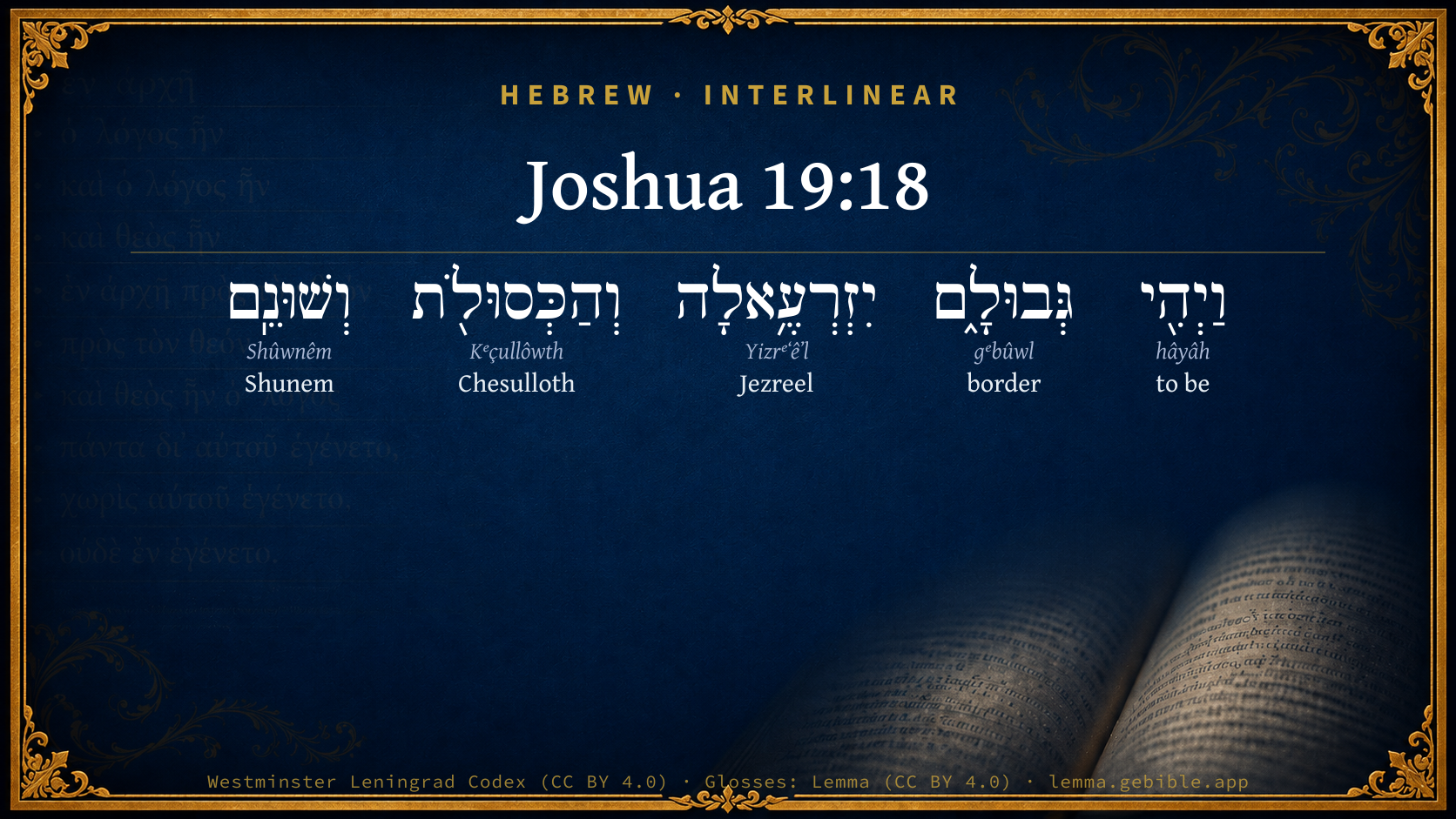
Hebrew (Westminster Leningrad Codex) Joshua 19:18 appears in the Hebrew Old Testament. The text above is from the Westminster Leningrad Codex. Each word links to its Strong’s number, a concise gloss, and parsing drawn from the Open Scriptures Hebrew Bible morphology. Click any word for its full Brown-Driver-Briggs (BDB) entry.
Download image
Cite this verse

Joshua 19:18 (World English Bible). Public Domain. Lemma interlinear Bible study tool, https://lemma.gebible.app/v/joshua/19/18.

Show BibTeX & RIS
BibTeX
RIS
English Translation
Their border was to Jezreel, and Chesulloth, and Shunem,
World English Bible · Public Domain
Highlights
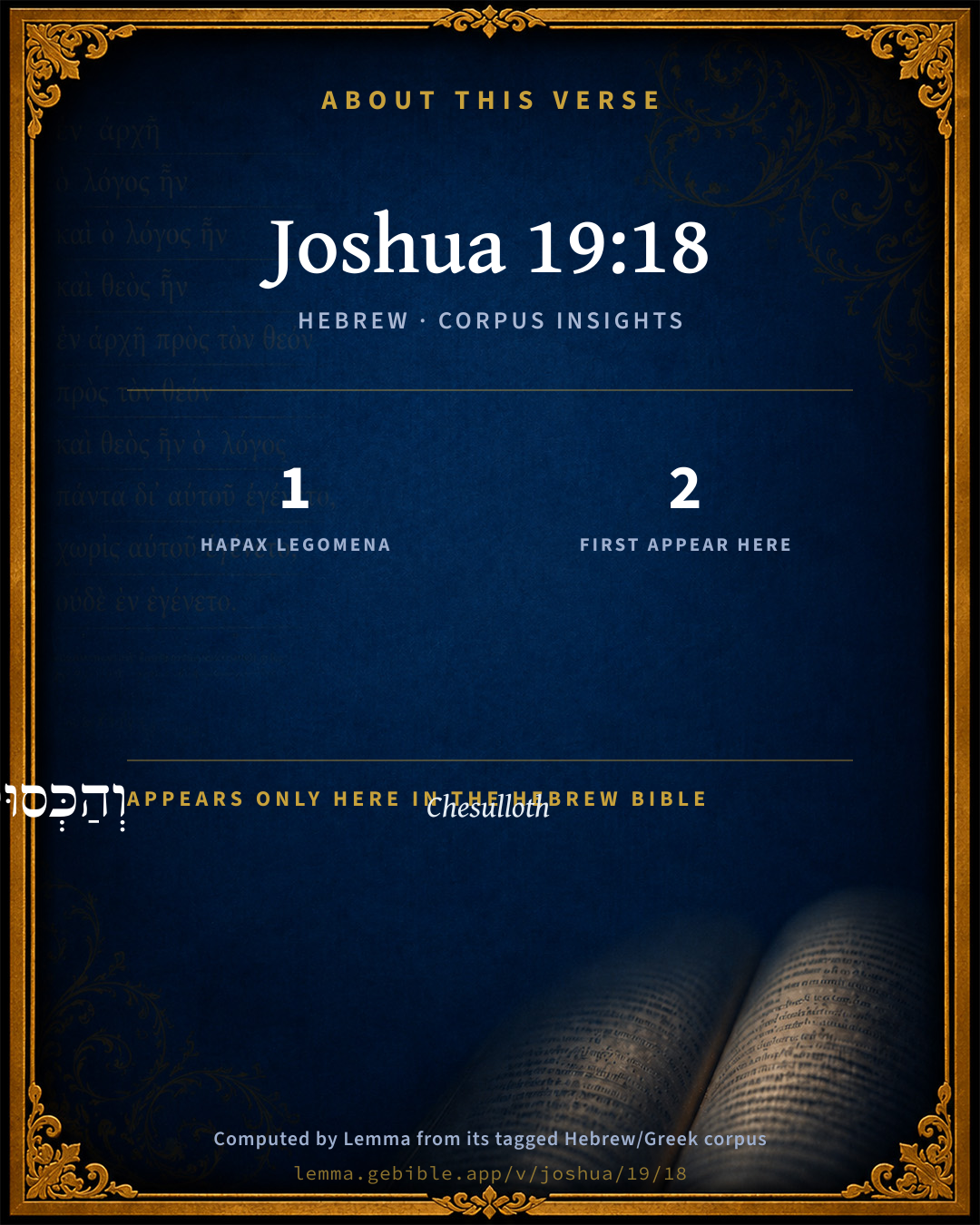
  • 1 hapax legomenon — only here in the Hebrew Bible
  • 2 first appearances in the Hebrew Bible
Full analysis ↓
Download a study sheet

One document with this verse’s original text, its word-by-word gloss line, the meaning frame, cross-references with their text, attributed commentary, and full source and license credits — printable, and it pastes into notes with its structure intact.

This verse Autodidact and up

Study sheet (.html) Plain text (.txt)

A passage Seminary Student

Up to 50 verses in one chapter. A passage sheet keeps up to 6 commentary sources and 12 cross-references per verse, in the order this page ranks them, and says so on the sheet whenever that leaves anything out. Ask for a single verse and you get the Autodidact verse sheet above.

Everything on this page stays free to read, with no account — the sheet is a download of what is already on screen, not access to it.

Want to remove ads? Support Godless Engineer
Compare translations 3

The same verse in 3 English versions, stacked beneath the original-language interlinear above. Click any original word for its lexicon entry.

Each is an independent rendering of the whole verse — the interlinear is not word-aligned to these translations.

Highlighted words mark where these versions differ — a whole-verse word diff, not a word-by-word alignment.

  • World English Bible Public Domain
    Their border was to Jezreel, and Chesulloth, and Shunem,
  • King James Version Public Domain
    And their border was toward Jezreel, and Chesulloth, and Shunem,
  • unfoldingWord Literal Text CC BY-SA 4.0
    And their border Jezreel and Chesulloth and Shunem

unfoldingWord Literal Text — © unfoldingWord, licensed CC BY-SA 4.0. Word-aligned USFM3 via Door43 (git.door43.org/unfoldingWord/en_ult).

Versions to compare (up to 4)

3 of 4 selected

Show all 18 translations

Every available English version of this verse, each an independent rendering of the whole verse.

  • World English Bible Public Domain
    Their border was to Jezreel, and Chesulloth, and Shunem,
  • Berean Standard Bible Public Domain
    Their territory included Jezreel, Chesulloth, Shunem,
  • Majority Standard Bible Public Domain
    Their territory included Jezreel, Chesulloth, Shunem,
  • King James Version Public Domain
    And their border was toward Jezreel, and Chesulloth, and Shunem,
  • American Standard Version (1901) Public Domain
    And their border was unto Jezreel, and Chesulloth, and Shunem,
  • Revised Version (1885) Public Domain
    And their border was unto Jezreel, and Chesulloth, and Shunem;
  • Geneva Bible (1599) Public Domain
    And their coast was Izreelah, and Chesulloth, and Shunem,
  • Douay-Rheims (1899) Public Domain
    And his inheritance was Jezrael and Casaloth and Sunem,
  • Young's Literal Translation Public Domain
    and their border is `at' Jezreel, and Chesulloth, and Shunem,
  • Literal Standard Version CC BY-SA 4.0
    and their border is [at] Jezreel, and Chesulloth, and Shunem,
  • Unlocked Literal Bible CC BY-SA 4.0
    Their territory included Jezreel, Chesulloth, Shunem,
  • unfoldingWord Literal Text CC BY-SA 4.0
    And their border Jezreel and Chesulloth and Shunem
  • Darby Bible Public Domain
    And their territory was toward Jizreel, and Chesulloth, and Shunem,
  • World Messianic Bible Public Domain
    Their border was to Jezreel, Chesulloth, Shunem,
  • Webster's Bible Public Domain
    And their border was towards Jezreel, and Chesulloth, and Shunem,
  • Free Bible Version CC BY-SA 4.0
    Their land included these towns: Jezreel, Kesulloth, Shunem,
  • Bible in Basic English Public Domain
    And their limit was to Jezreel and Chesulloth and Shunem
  • JPS Tanakh (1917) Public Domain
    And their border was Jezreel, and Chesulloth, and Shunem;

Literal Standard Version (2020), Covenant Press — licensed CC BY-SA 4.0. Text via the HelloAO Bible API (eBible.org). Unlocked Literal Bible (unfoldingWord) — licensed CC BY-SA 4.0. Text via the HelloAO Bible API (eBible.org). unfoldingWord Literal Text — © unfoldingWord, licensed CC BY-SA 4.0. Word-aligned USFM3 via Door43 (git.door43.org/unfoldingWord/en_ult). Free Bible Version, Dr. Jonathan Gallagher — licensed CC BY-SA 4.0. Text via the HelloAO Bible API (eBible.org).

Word by word

More ways to search: Search by grammar → Find every occurrence → Compare this word →

Practice this passage: Drill this verse → Learn its vocabulary →

About this verse

These counts appear in no published source. They are computed here, from the morphology-tagged text and Lemma’s own curated glosses. What Lemma adds →

5
words
5
distinct lemmas
Historical
section

Notable vocabulary

1 hapax legomenon — a word that appears only here in the entire Hebrew Bible:

  • וְהַכְּסוּלֹ֖ת Chesulloth H3694

First appearance in Scripture

These words make their first canonical appearance in the Hebrew Bible here:

  • וְהַכְּסוּלֹ֖ת Chesulloth H3694
  • וְשׁוּנֵֽם Shunem H7766

Shared distinctive vocabulary

וְשׁוּנֵֽם Shunem H7766 occurs in 3 verses of the Hebrew Bible. Also found in:

Grammatical profile

  • 1 verb
  • 4 nouns

Verb forms

  • וַיְהִ֖י Qal · Sequential Imperfect

Hebrew & Septuagint length

In English translation the verse runs 9 words from the Hebrew and 9 from the Septuagint (LXX English) — the same length.

A rough comparison of the two English renderings, which tokenize alike — not a word-level alignment.

Word counts can differ between the Hebrew and the Greek without any difference in meaning — e.g. the Hebrew direct-object marker אֵת has no separate Greek word, and Greek often adds the article ὁ.

Cross-references

12

Topical passages linked to Joshua 19:18 in the Treasury of Scripture Knowledge — connected by theme and wording, ordered by reader-vote popularity; previews shown in the World English Bible.

  • 1 Samuel 28:4 The Philistines gathered themselves together, and came and encamped in Shunem: and Saul gathered all Israel together, and they encamped in Gilboa.
  • 2 Kings 4:8 It fell on a day, that Elisha passed to Shunem, where was a great woman; and she constrained him to eat bread. So it was, that as often as he passed by, he turned in there to eat bread.
  • 1 Kings 1:3 So they sought for a beautiful young lady throughout all the borders of Israel, and found Abishag the Shunammite, and brought her to the king.
  • 1 Kings 2:17 He said, Please speak to Solomon the king (for he will not tell you 'no'), that he give me Abishag the Shunammite as wife.
  • 1 Kings 2:21 She said, Let Abishag the Shunammite be given to Adonijah your brother as wife.
  • 1 Kings 21:1 It happened after these things, that Naboth the Jezreelite had a vineyard, which was in Jezreel, hard by the palace of Ahab king of Samaria.
  • 1 Kings 21:15–16 It happened, when Jezebel heard that Naboth was stoned, and was dead, that Jezebel said to Ahab, Arise, take possession of the vineyard of Naboth the Jezreelite, which he refused to give you for money; for Naboth is not alive, but dead.
  • 2 Kings 4:12 He said to Gehazi his servant, Call this Shunammite. When he had called her, she stood before him.
  • 2 Kings 8:29 King Joram returned to be healed in Jezreel of the wounds which the Syrians had given him at Ramah, when he fought against Hazael king of Syria. Ahaziah the son of Jehoram king of Judah went down to see Joram the son of Ahab in Jezreel, because he was sick.
  • 2 Kings 9:15 but king Joram was returned to be healed in Jezreel of the wounds which the Syrians had given him, when he fought with Hazael king of Syria.) Jehu said, If this be your mind, then let none escape and go forth out of the city, to go to tell it in Jezreel.
  • 2 Kings 9:30 When Jehu was come to Jezreel, Jezebel heard of it; and she painted her eyes, and attired her head, and looked out at the window.
  • Hosea 1:4–5 Yahweh said to him, "Call his name Jezreel; for yet a little while, and I will avenge the blood of Jezreel on the house of Jehu, and will cause the kingdom of the house of Israel to cease.

Cross-references courtesy of OpenBible.info (CC BY 4.0).

Hebrew and Greek witnesses Masoretic Hebrew ↔ Greek Septuagint

The same verse in the two great witnesses to the Old Testament, shown verse-for-verse.

These are two independent witnesses, not word-aligned to each other, and the Septuagint is shown in lemma (dictionary) form.

Hebrew Joshua 19:18 Masoretic · Westminster Leningrad Codex

וַיְהִ֖י גְּבוּלָ֑ם יִזְרְעֶ֥אלָה וְהַכְּסוּלֹ֖ת וְשׁוּנֵֽם

Their border was to Jezreel, and Chesulloth, and Shunem,

World English Bible · Public Domain

Greek LXX Joshua 19:18 Septuagint · lemma form

καί γίγνομαι ὁ ὅριον αὐτός ιαζηλ καί χασαλωθ καί σουναν

And their borders were Jazel, and Chasaloth, and Sunam,

LXX2012 (modern English Septuagint) · Public Domain

Hebrew: Westminster Leningrad Codex (CC BY 4.0). Greek: Septuagint (public domain); English from LXX2012 (modern English Septuagint) (Public Domain). How the Septuagint differs from the Hebrew →

Targum (Aramaic paraphrase)

1

The Targum is the ancient Jewish Aramaic paraphrase of the Hebrew Scriptures — an interpretive translation, not the Hebrew text itself. Onkelos (literal) and Pseudo-Jonathan (expansive) render the Torah, and Jonathan the Prophets. Coverage is partial: where no permissively-licensed English translation exists for a verse, only the Aramaic is shown. This is verse-level text, not a word-by-word alignment to the Hebrew.

  1. Targum Jonathan Prophets (Joshua–Malachi)
    וַהֲוָה תְּחוּמְהוֹן יִזְרְעֶאל וּכְסֻלוֹת וְשׁוּנֵם:

    (no public-domain English translation for this verse)

    Targum Jonathan — Aramaic: “Mikraot Gedolot” (public domain). English: “Sefaria Community Translation” (CC0 1.0 (public-domain dedication)); “London "Chaldee Paraphrase," 1871” (public domain). Text via Sefaria.

Commentary

Notes on Joshua 19:18 from classic Christian and Jewish commentators (each source and its license shown beneath its notes). The classic Christian expositions comment on the surrounding passage and are grouped to its opening verse, so a note may address several verses; the Jewish commentaries on the Tanakh (Rashi and others) are per-verse, so they appear only where the commentator wrote on this verse.

Lemma curates 59 commentaries, every one of them public domain or Creative Commons licensed, each selected and text-cleaned for this edition rather than reprinted as found. About our sources →

Trapp's Complete Commentary

John Trapp

Jos 19:18 And their border was toward Jezreel, and Chesulloth, and Shunem,

Ver. 18. And their border was toward Jezreel, &c.] In a rich and fat soil, according to that was foretold by Jacob and Moses; {Gen 49:14-15 Deu 33:18-19} - "And he saw that rest was good, and the land that it was pleasant: and he bowed his shoulders to bear, and became a servant to tribute." This was a low poor spirit, and his posterity were, for the general, very unworthy and vile: for his lot here fell in Galilee. Now "doth any good come from Galilee?" saith good Nathanael.

John Trapp, A Commentary or Exposition upon All the Books of the Old and New Testament (1647–1656) — public domain. Text from a community e-Sword module.

Joseph Benson's Commentary

Jos 19:18. Jezreel — The royal city, 1Ki 21:1. This tribe, because it lay between Benjamin on the south and Zebulun on the north, is not here described by its borders, which were the same with theirs, but by some of its cities.

Joseph Benson's Commentary on the Old and New Testaments (1811–1818) — public domain. Text from a community e-Sword module.

Adam Clarke's Commentary

Verse 18. Jezreel] This city, according to Calmet, was situated in an open country, having the town of Legion on the west, Bethshan on the east, on the south the mountains of Gilboa, and on the north those of Hermon.

Shunem] This city was rendered famous by being the occasional abode of the prophet Elisha, and the place where he restored the son of a pious woman to life. 2Kg 4:8. It was the place where the Philistines were encamped on that ruinous day in which the Israelites were totally routed at Gilboa, and Saul and his sons Jonathan, Abinadab, and Malchi-shua, killed. 1Sa 28:4; 1Sa 31:1, &c.

Adam Clarke's Commentary on the Bible (1810–1826) — public domain. Text from a community e-Sword/MySword module.

Ellicott's Commentary for English Readers

(18) Zerin (sheet 8), Iksal (sheet 6), Sûlem (sheet 9).

A Bible Commentary for English Readers, edited by Charles John Ellicott (1878–1897) — public domain. Text from a community e-Sword module.

The Cambridge Bible for Schools and Colleges

gen. ed. J. J. S. Perowne

18. And their border] lay above that of Manasseh, and, according to Josephus, “extended in length from Carmel to the Jordan, and in breadth to Mount Tabor.”

was toward Jezreel] Observe in this verse that the description of the boundaries of this tribe, though begun, is not continued. Instead, the names of the cities are given, which were included in it.

Jezreel] (= the planting, or seed-plot, of God, now Zerin), stood in the celebrated plain of the name between Gilboa and little Hermon on the brow of a very steep rocky slope of at least 100 feet in a strong and central position, commanding the view towards the Jordan on the east (2Ki_9:17), and visible from Carmel on the west (1Ki_18:46). The splendid site induced Ahab to make it his chief residence. Here (a) he had his palace and “ivory house” (1Ki_21:1; 1Ki_22:39); here (b) he had a watch-tower whence sentinels were able to give timely notice of danger (2Ki_9:17); here (c) Jezebel lived, and from her high window facing eastward watched the entrance of the conquering Jehu (2Ki_9:30).

Chesulloth] (= “the loins”) was probably so called from its position on the slopes of some mountain, possibly between Jezreel and Shunem. On Mr Grove’s map it is marked direct north of Jezreel, and is identified with Chisloth-tabor, the “Xaloth” of Josephus (B. J. iii. 3.1), the “Chasalus” of Jerome.

and Shunem] Now Solâm, three miles to the N.E. of Jezreel in the Esdraelon plain, “full in view of the sacred spot on Mount Carmel, and situated in the midst of the finest corn-fields in the world.” Here (a) the Philistines encamped before the fatal battle of Gilboa (1Sa_28:4); here (b) was the native place of Abishag (1Ki_1:3); here (c) Elisha often lodged in the house of the “Shunammite woman,” and here (d) he raised her son to life (2Ki_4:8-37; 2Ki_8:1-6).

The Cambridge Bible for Schools and Colleges (gen. ed. J. J. S. Perowne; Cambridge University Press, 1878–1918) — public domain. Text from a community e-Sword module.

John Gill's Exposition

And Hapharaim,.... The first of these is by Jerom (y) called Aphraim, a city of the tribe of Issachar; and adds, there is at this day a village called Affarea, six miles from Legion to the north:

and Shion; of Seon or Soen, the same with Shion here, he says (z), there was a village of this name shown in his time near Mount Tabor:

and Anaharath, of which we have no account elsewhere.

(y) Ut supra, (De loc. Heb.) fol. 88. I. (z) lbid. fol. 94. K.

John Gill's Exposition of the Whole Bible (1746–1763) — public domain (CC PDM 1.0). Text via the HelloAO Bible API.

Albert Barnes' Notes on the Bible

Jezreel and its famous and fertile plain are the choicest part of the inheritance of Issachar Jos 17:16.

Shunem - Here the Philistines pitched before the battle of Gilboa 1Sa 28:4. The place is also known as the home of Abishag 1Ki 1:3, and in connection with Elisha 2Ki 4:8; 2Ki 8:1. It is identified with “Solam” (or, Sulem), a small and poor village on the slope of Little Hermon.

Albert Barnes' Notes on the Bible (1834–1885) — public domain. Text from a community e-Sword/MySword module.

Haydock's Catholic Bible Commentary

Jezrael. This was a city of the first note, (Menochius) situated in the vale between Mount Hermon and Gelboe, having Bethsan on the east. --- Sunem, where Eliseus raised the child to life, five miles south of Thabor. (St. Jerome) --- Here the Philistines were encamped the day before the battle, in which Saul was slain and Israel dispersed, 1 Kings xxviii. 4. (Calmet)

George Leo Haydock (1774–1849), Haydock's Catholic Family Bible and Commentary, 1859 edition — public domain. Excludes Psalms (Douay-Rheims chapter numbering differs from Protestant) and Deuterocanonical books (Catholic canon only).

Matthew Poole's English Annotations

Jezreel, the royal city, 1Ki 21:1. This tribe, because it lay between Benjamin on the south and Zebulun on the north, is not here described by its borders, which were the same with theirs; but by some of its cities. Shunera, the birth-place of Abishag, 1Ki 1:3.

Matthew Poole's English Annotations on the Holy Bible (1683–1685) — public domain. Text from a community e-Sword/MySword module.

Whedon's Commentary on the Bible

Daniel D. Whedon

18. Their border was toward Jezreel — Or, rather, it encompassed this city. The writer begins to trace the border, but really enumerates the cities included within it. These were all in the eastern part of the plain of Esdraelon. Jezreel, a name often applied to the plain of Esdraelon, is here limited to a city standing on a gentle swell which rises out of it. It was the chief residence of King Ahab, and seat of the worship of Baal and Astarte, the cult of the Phenician Jezebel. It was remarkable for its central location, and the great beauty and commanding character of its site. Its modern name is Zerin, containing only a few wretched hovels clustering around an old, ruined tower.

Chesulloth — Probably the same as Chisloth-tabor in Jos_19:12. [Shunem was at the modern village of Solam, which lies at the western base of the Little Hermon, and about three miles north of Jezreel. Here the Philistines encamped before Saul’s last battle, (1Sa_28:4,) and here was the home of the Shunammite woman whose son Elisha raised to life. 2Ki_4:8.

Daniel D. Whedon (gen. ed.), Commentary on the Old and New Testaments (1874–1909) — public domain. Text from a community e-Sword module.

The Pulpit Commentary

Jezreel. The valley (qme) of Jezreel, known in later Greek as the plain of Esdrsela or Esdraclon (RAPC Jdt 1:8 7:2 2Ma 12:4-9) was "the perennial battlefield of Palestine from that time to the present" (Cooper, "Egyptian Obelisks," p. 33). Lieut. Conder ("Quart. Paper, Pal. Expl. Fund," Jan., 1873), however, takes exception to this statement. "The great battles of Joshua," he says, "were fought far to the south." We presume he would make an exception on behalf of the action by the waters of Merom, and that he does not wish us to forget that the majority of Joshua"s other "battles" were sieges. "David"s wars were fought with the Philistines," he continues, "while the invasions of the Syrians were directed to the neighbourhood of Samaria." But here, again, he would seem to have forgotten 1Sa_29:1 1Ki_20:26 2Ki_13:17, 2Ki_13:25, while he expressly admits that the great battles of Gilboa and Megiddo, in which Saul and Josiah were defeated and met their deaths, were fought here. And we have already seen that twice did the Egyptians invade Syria by this plain. One of these invasions took place while Moses was in Egypt, under Thothmes III The other was the famous expedition of Rameses II against Syria, about the time of Deborah and Barak. If we add to these the victory of Gideon over the Midianites and the overthrow of Sisera, we shall have reason to think that the epithet "the battlefield of Palestine" applied to this plain is not altogether misplaced, especially if, with a large number of critics, we regard the Book of Judith as founded on fact, but relating to events of some other time than that of Nebuchadnezzar. "Well may it be fertile," exclaims Mr. Bartlett ("From Egypt to Palestine," p. 478), "for it has drunk the blood of the Midianite, the Philistine, the Jew, the Roman, the Babylonian, the Egyptian, the Frenchman, the Englishman, the Saracen, and the Turk. It is a singular group to summon up to the imagination, Gideon, Saul, and Jonathan, Deborah, Barak, and Sisera, Ahab, Jezebel, Jehu, Josiah, Omri, and Azariah, Holofernes and Judith, Vespasian and Josephus, Saladin and the Knights Templar, Bonaparte and Kleber." The list is a striking one. But certain it is that the plains of Jezreel have been noted as the highway of every conqueror who wished to make the fertile fields of Palestine his own. The Israelitish invasion alone seems to have been decided elsewhere than on that plain, stretching as it does from the foot of Carmel in a southeasterly direction, and divided in the direction of Jordan by Mount Gilboa and Little Hermon into three distinct branches, in the midst of the southernmost and most extensive of which stands the famous city of Jezreel God"s acre, or sowing ground, as the name indicates. Here Barak and Deborah fell upon the hosts of Jabin, (Jud_1:4:14) descending suddenly from the heights of Tabor with 10, 000 men upon the vast and evidently undisciplined host that lay in the plain. Here Gideon encountered the vast host of the Midianites, (Jud_1:7:12) who, after laying waste the south country, finally encamped in this fertile plain (accurately called qme in Jud_1:6:38), and with their leaders Oreb and Zeeb, and their princes Zebah and Zalmunna, were swept away in one of those sudden and irrational panics so often fatal to Eastern armies. Here Saul, hard by Jezreel, dispirited by his visit to the witch of Endor, on the north of Gilboa, gathered his men together as a forlorn hope, to await the attack of the Philistines, their numbers at first swelled by a number of Israelites whom Saul"s tyranny and oppression had driven into exile. (1Sa 29) Advancing to Jezreel, the Philistine host carried all before them, and drove the Israelites in headlong flight up the steeps of Gilboa, where Saul and his sons fell fighting bravely to the last. (1Sa 30) In the later and sadder days of the Israelitish monarchy, when the ten tribes had been carried into captivity by the Assyrian conqueror, Josiah courted disaster by a rash onslaught upon the Egyptian troops as they marched against Assyria. No details of this fight at Megiddo are preserved, save the fatal fire of the Egyptian archers, who marked Josiah as their victim, and drove, no doubt, his leaderless troops from the field. (2Ki_23:29 2Ch_35:22) At Jezreel, too, Ahab made his capital. Hither Elijah, when "the hand of the Lord was upon him", (1Ki_18:46) ran after the wondrous scene on Mount Carmel, when he alone, in a strength not his own, withstood the "prophets of Baal, even four hundred and fifty men." Here Jehoram stood on the hill, with its commanding view, watching with an uneasy distrust the furious rush of Jehu with his troop from the other side Jordan, and here, in the plat of Naboth the Jezreelite, so fatal to Ahab and his house, did the vengeance decreed overtake the unhappy monarch, (2Ki_9:25) The spot may be still identified. It is the modern Zerin. Ritter describes it (and so does Robinson) as standing on the edge of a precipice 100 feet high, and commanding a fine view of the plain of Beth-shean on the east, and of Esdraelon on the west. There is a tower here which commands the same view as the watchmen of Jehoram commanded, bearing witness to the accuracy of the historian. So in 1Ki_4:12, the mention of Taanach, Megiddo, and the region of Bethshean, as beneath (ltjJmi). Jezreel is another instance of topographical detail which marks the correctness of the record. Another point is that we read in the narrative above mentioned of "chariots." Wilson ("Lands of the Bible," 2:303) was surprised, on leaving the rugged heights of the hill country, to find how easily, if the civilisation of Palestine permitted, excellent roads might be made throughout this region; and Canon Tristram ("Land of Israel," p. 421) has remarked on the desolate appearance now presented by that fertile region, the result of the insecurity for life and property which is so commonly remarked by all who have travelled in the East. Here, where under a better rule would be the abode of peace and plenty, no cultivator of the land dare venture to pass the night, exposed to the depredations of the wild tribes that infest the country. Only a mountain fastness, hard to climb and comparatively easy to defend, affords a secure retreat for those who would live peaceably in that once favoured land. Shunem. Now Sulem: the place of the encampment of the Philistines before they "pitched in Aphek". (1Sa_28:4 1Sa_29:1) It was "five Roman miles south of Mount Tabor" (Vandevelde) and an hour and a half (i.e. about six miles) north of Jezreel (Keil and Delitzsch). Here Abishag the Shunammite lived, (1Ki_1:3 1Ki_2:17, 1Ki_2:21) and here Elisha lodged, and afterwards restored the son of his entertainers to life. (2Ki 4 2Ki 8)

The Pulpit Commentary (1880–1919), ed. H.D.M. Spence-Jones & Joseph S. Exell — public domain. Text from a community e-Sword module.

John Wesley's Explanatory Notes

Jezreel - The royal city, 1 Kings xxi, 1. This tribe, because it lay between Benjamin on the south, and Zebulun on the north, is not here described by its borders, which were the same with theirs; but by some of its cities.

John Wesley, Explanatory Notes Upon the Whole Bible (1754–1765) — public domain. Text via the GEBible commentary corpus.

Lesson kit

Teaching starters — assembled from the data on this page, not authored interpretation. Every prompt links to the verse data it draws on. Edit before teaching.

Joshua, in the Historical, opens this verse with 5 words (5 distinct Hebrew lemmas). Its most distinctive word is Kᵉçullôwth (“Chesulloth”). A historical commentator’s framing appears above. Read the whole chapter for the surrounding context.

Discussion questions

  1. What does “Chesulloth” (Kᵉçullôwth) contribute to the verse as a whole?
  2. 1 word here appears nowhere else in the Hebrew Bible. Why might the author reach for such rare wording?
  3. 2 words make their first appearance in Scripture here. What does this debut establish?
  4. How does 1 Samuel 28:4, which shares the word «Shunem», read alongside this verse?
  5. The translations on this page render this verse differently — a whole-verse word diff, not a word-by-word alignment. What might account for the different wordings?
  6. «וַיְהִ֖י» is a Qal Sequential Imperfect verb. How does that grammatical form shape the action described?
  7. Compare how Trapp's Complete Commentary and Joseph Benson's Commentary read this verse. Where do they agree or differ?

Things to notice

  • 1 word in this verse appears nowhere else in the Hebrew Bible.
  • 2 words make their first canonical appearance in Scripture here.
  • These translations choose different wording for 1 word in this verse.
  • 5 distinct Hebrew lemmas span 5 words in this verse.

Reading settings

Reading text

Shown beneath each verse's original-language words.

Old Testament
Old Testament edition

Read the OT as the Masoretic Hebrew (MT) or the Greek Septuagint (LXX).

English shown for the Greek Septuagint (in the Hebrew ↔ Greek comparison).

Comparing translations? Open the Compare panel on any verse page to stack up to four side by side.