Numbers 34:9

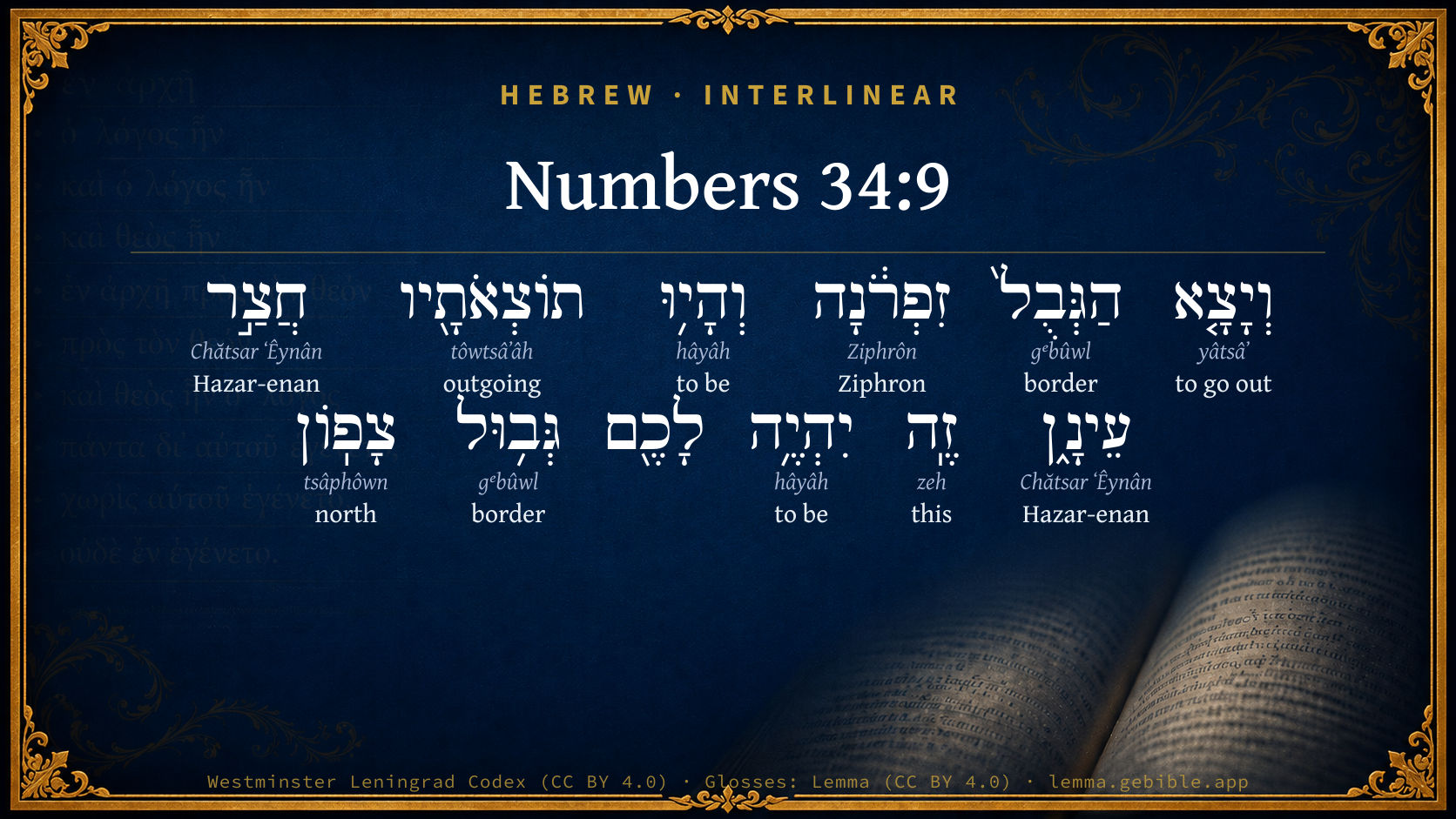
Hebrew (Westminster Leningrad Codex) Numbers 34:9 appears in the Hebrew Old Testament. The text above is from the Westminster Leningrad Codex. Each word links to its Strong’s number, a concise gloss, and parsing drawn from the Open Scriptures Hebrew Bible morphology. Click any word for its full Brown-Driver-Briggs (BDB) entry.
Download image
Cite this verse

Numbers 34:9 (World English Bible). Public Domain. Lemma interlinear Bible study tool, https://lemma.gebible.app/v/numbers/34/9.

Show BibTeX & RIS
BibTeX
RIS
English Translation
and the border shall go forth to Ziphron, and the goings out of it shall be at Hazar Enan: this shall be your north border.
World English Bible · Public Domain
Highlights
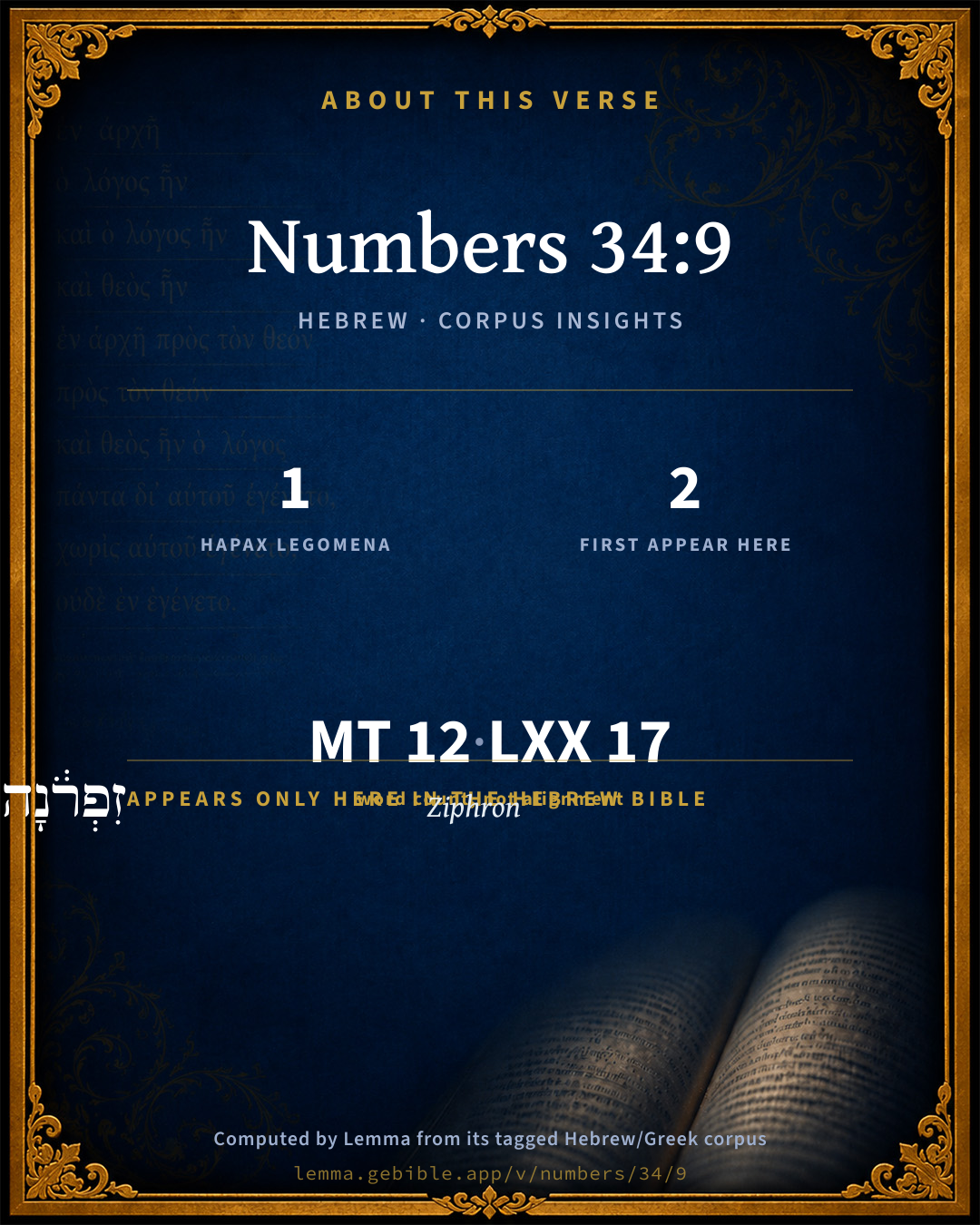
  • 1 hapax legomenon — only here in the Hebrew Bible
  • 2 first appearances in the Hebrew Bible
Full analysis ↓
Download a study sheet

One document with this verse’s original text, its word-by-word gloss line, the meaning frame, cross-references with their text, attributed commentary, and full source and license credits — printable, and it pastes into notes with its structure intact.

This verse Autodidact and up

Study sheet (.html) Plain text (.txt)

A passage Seminary Student

Up to 50 verses in one chapter. A passage sheet keeps up to 6 commentary sources and 12 cross-references per verse, in the order this page ranks them, and says so on the sheet whenever that leaves anything out. Ask for a single verse and you get the Autodidact verse sheet above.

Everything on this page stays free to read, with no account — the sheet is a download of what is already on screen, not access to it.

Want to remove ads? Support Godless Engineer
Compare translations 3

The same verse in 3 English versions, stacked beneath the original-language interlinear above. Click any original word for its lexicon entry.

Each is an independent rendering of the whole verse — the interlinear is not word-aligned to these translations.

Highlighted words mark where these versions differ — a whole-verse word diff, not a word-by-word alignment.

  • World English Bible Public Domain
    and the border shall go forth to Ziphron, and the goings out of it shall be at Hazar Enan: this shall be your north border.
  • King James Version Public Domain
    And the border shall go on to Ziphron, and the goings out of it shall be at Hazarenan: this shall be your north border.
  • unfoldingWord Literal Text CC BY-SA 4.0
    And the border will go out to Ziphron and its outer limits will be at Hazar Enan. This will be for you the border of the north.

unfoldingWord Literal Text — © unfoldingWord, licensed CC BY-SA 4.0. Word-aligned USFM3 via Door43 (git.door43.org/unfoldingWord/en_ult).

Versions to compare (up to 4)

3 of 4 selected

Show all 18 translations

Every available English version of this verse, each an independent rendering of the whole verse.

  • World English Bible Public Domain
    and the border shall go forth to Ziphron, and the goings out of it shall be at Hazar Enan: this shall be your north border.
  • Berean Standard Bible Public Domain
    continue to Ziphron, and end at Hazar-enan. This will be your boundary on the north.
  • Majority Standard Bible Public Domain
    continue to Ziphron, and end at Hazar-enan. This will be your boundary on the north.
  • King James Version Public Domain
    And the border shall go on to Ziphron, and the goings out of it shall be at Hazarenan: this shall be your north border.
  • American Standard Version (1901) Public Domain
    and the border shall go forth to Ziphron, and the goings out thereof shall be at Hazar-enan: this shall be your north border.
  • Revised Version (1885) Public Domain
    and the border shall go forth to Ziphron, and the goings out thereof shall be at Hazar-enan: this shall be your north border.
  • Geneva Bible (1599) Public Domain
    And the coast shall reach out to Ziphron, and goe out at Hazar-enan. this shalbe your Northquarter.
  • Douay-Rheims (1899) Public Domain
    nod the limits shall go as far as Zephrona, and the village of Enan. These shall be the borders on the north side.
  • Young's Literal Translation Public Domain
    and the border hath gone out to Ziphron, and its outgoings have been at Hazar-Enan; this is to you the north border.
  • Literal Standard Version CC BY-SA 4.0
    and the border has gone out to Ziphron, and its outgoings have been at Hazar-Enan; this is the north border to you.
  • Unlocked Literal Bible CC BY-SA 4.0
    Then the border will continue to Ziphron and end at Hazar Enan. This will be your northern border.
  • unfoldingWord Literal Text CC BY-SA 4.0
    And the border will go out to Ziphron and its outer limits will be at Hazar Enan. This will be for you the border of the north.
  • Darby Bible Public Domain
    and the border shall go to Ziphron, and shall end at Hazar-enan. This shall be your north border.
  • World Messianic Bible Public Domain
    Then the border shall go to Ziphron, and it shall end at Hazar Enan. This shall be your north border.
  • Webster's Bible Public Domain
    And the border shall go on to Ziphron, and the limits of it shall be at Hazar-enan: this shall be your north border.
  • Free Bible Version CC BY-SA 4.0
    to Ziphron, ending at Hazar-enan. This will be your boundary to the north.
  • Bible in Basic English Public Domain
    And the limit will go on to Ziphron, with its farthest point at Hazar-enan: this will be your limit on the north.
  • JPS Tanakh (1917) Public Domain
    and the border shall go forth to Ziphron, and the goings out thereof shall be at Hazar-enan; this shall be your north border.

Literal Standard Version (2020), Covenant Press — licensed CC BY-SA 4.0. Text via the HelloAO Bible API (eBible.org). Unlocked Literal Bible (unfoldingWord) — licensed CC BY-SA 4.0. Text via the HelloAO Bible API (eBible.org). unfoldingWord Literal Text — © unfoldingWord, licensed CC BY-SA 4.0. Word-aligned USFM3 via Door43 (git.door43.org/unfoldingWord/en_ult). Free Bible Version, Dr. Jonathan Gallagher — licensed CC BY-SA 4.0. Text via the HelloAO Bible API (eBible.org).

Word by word

More ways to search: Search by grammar → Find every occurrence → Compare this word →

Practice this passage: Drill this verse → Learn its vocabulary →

זִפְרֹ֔נָה
Ziphrôn
H2202
“Ziphron · toward”
Noun, Proper + Suffix, Demonstrative
Part of Speech
Noun
Type
Proper
Full BDB Definition

Origin: from an unused root (meaning to be fragrant)

TWOT: None

Ziphron = "fragrance" - a place on the north boundary of the promised land as specified by Moses
  1. וְיָצָ֤א yâtsâʼ H3318 “and · to go out” Conjunction + Verb, Qal, Sequential Perfect, 3rd Person, Masculine, Singular
  2. הַגְּבֻל֙ gᵉbûwl H1366 “the · border” Particle, Definite Article + Noun, Common, Masculine, Singular, Absolute
  3. וְהָי֥וּ hâyâh H1961 “and · to be” Conjunction + Verb, Qal, Sequential Perfect, 3rd Person, Common, Plural
  4. תוֹצְאֹתָ֖יו tôwtsâʼâh H8444 “outgoings · his” Noun, Common, Feminine, Plural, Construct + Suffix, Personal, 3rd Person, Masculine, Singular
  5. חֲצַ֣ר Chătsar ʻÊynân H2704 “Hazar-enan” Noun, Proper
  6. עֵינָ֑ן Chătsar ʻÊynân H2704 “Hazar-enan” Noun, Proper
  7. זֶֽה zeh H2088 “this” Pronoun, Demonstrative, Masculine, Singular
  8. יִהְיֶ֥ה hâyâh H1961 “to be” Verb, Qal, Imperfect, 3rd Person, Masculine, Singular
  9. גְּב֥וּל gᵉbûwl H1366 “border of” Noun, Common, Masculine, Singular, Construct
  10. צָפֽוֹן tsâphôwn H6828 “north” Noun, Common, Feminine, Singular, Absolute

About this verse

These counts appear in no published source. They are computed here, from the morphology-tagged text and Lemma’s own curated glosses. What Lemma adds →

12
words
8
distinct lemmas
Pentateuch
section

Notable vocabulary

1 hapax legomenon — a word that appears only here in the entire Hebrew Bible:

  • זִפְרֹ֔נָה Ziphron H2202

First appearance in Scripture

These words make their first canonical appearance in the Hebrew Bible here:

  • זִפְרֹ֔נָה Ziphron H2202
  • חֲצַ֣ר Hazar-enan H2704

Shared distinctive vocabulary

חֲצַ֣ר Hazar-enan H2704 occurs in 3 verses of the Hebrew Bible. Also found in:

Grammatical profile

  • 3 verbs
  • 7 nouns
  • 1 pronoun
  • 1 preposition

Verb forms

  • וְיָצָ֤א Qal · Sequential Perfect
  • וְהָי֥וּ Qal · Sequential Perfect
  • יִהְיֶ֥ה Qal · Imperfect

Repetition

Words recur within this verse — often emphatic in Hebrew:

  • הַגְּבֻל֙ border H1366 ×2
  • וְהָי֥וּ to be H1961 ×2
  • חֲצַ֣ר Hazar-enan H2704 ×2

Hebrew & Septuagint length

In English translation the verse runs 25 words from the Hebrew and 23 from the Septuagint (LXX English) — closely comparable.

A rough comparison of the two English renderings, which tokenize alike — not a word-level alignment.

Word counts can differ between the Hebrew and the Greek without any difference in meaning — e.g. the Hebrew direct-object marker אֵת has no separate Greek word, and Greek often adds the article ὁ.

In the original languages it is 12 Hebrew tokens and 17 Greek tokens — but the two are counted differently (Hebrew bundles its prefixes and suffixes into one token; the Greek is in lemma form), so that isn’t a like-for-like length.

Cross-references

1

Topical passages linked to Numbers 34:9 in the Treasury of Scripture Knowledge — connected by theme and wording, ordered by reader-vote popularity; previews shown in the World English Bible.

  • Ezekiel 47:17 The border from the sea, shall be Hazar Enon at the border of Damascus; and on the north northward is the border of Hamath. This is the north side.

Cross-references courtesy of OpenBible.info (CC BY 4.0).

Hebrew and Greek witnesses Masoretic Hebrew ↔ Greek Septuagint

The same verse in the two great witnesses to the Old Testament, shown verse-for-verse.

These are two independent witnesses, not word-aligned to each other, and the Septuagint is shown in lemma (dictionary) form.

Hebrew Numbers 34:9 Masoretic · Westminster Leningrad Codex

וְיָצָ֤א הַגְּבֻל֙ זִפְרֹ֔נָה וְהָי֥וּ תוֹצְאֹתָ֖יו חֲצַ֣ר עֵינָ֑ן זֶֽה יִהְיֶ֥ה לָכֶ֖ם גְּב֥וּל צָפֽוֹן

and the border shall go forth to Ziphron, and the goings out of it shall be at Hazar Enan: this shall be your north border.

World English Bible · Public Domain

Greek LXX Numbers 34:9 Septuagint · lemma form

καί ἐκἔρχομαι ὁ ὅριον δεφρωνα καί εἰμί ὁ διέξοδος αὐτός ασερναιν οὗτος εἰμί σύ ὅριον ἀπό βορέας

And the border shall go out to Dephrona, and its termination shall be at Arsenain; this shall be your border from the north.

LXX2012 (modern English Septuagint) · Public Domain

Hebrew: Westminster Leningrad Codex (CC BY 4.0). Greek: Septuagint (public domain); English from LXX2012 (modern English Septuagint) (Public Domain). How the Septuagint differs from the Hebrew →

Targum (Aramaic paraphrase)

2

The Targum is the ancient Jewish Aramaic paraphrase of the Hebrew Scriptures — an interpretive translation, not the Hebrew text itself. Onkelos (literal) and Pseudo-Jonathan (expansive) render the Torah, and Jonathan the Prophets. Coverage is partial: where no permissively-licensed English translation exists for a verse, only the Aramaic is shown. This is verse-level text, not a word-by-word alignment to the Hebrew.

  1. Targum Onkelos Torah (Genesis–Deuteronomy)
    וְיִפּוֹק תְּחוּמָא לְזִפְרוֹן וִיהוֹן מַפְּקָנוֹהִי לַחֲצַר עֵינָן דֵין יְהֵי לְכוֹן תְּחוּם צִפּוּנָא

    (no public-domain English translation for this verse)

    Targum Onkelos — Aramaic: “Onkelos Genesis” (public domain); “Onkelos Exodus” (public domain); “Onkelos Leviticus” (public domain); “Onkelos Numbers” (public domain); “Onkelos Deuteronomy” (public domain). English: “Sefaria Community Translation” (CC0 1.0 (public-domain dedication)); “J.W. Etheridge. The Targums of Onkelos and Jonathan Ben Uzziel on the Pentateuch. London: Longmans, Green, 1862” (public domain). Text via Sefaria.

  2. Targum Pseudo-Jonathan Torah (Genesis–Deuteronomy)
    וְיִפּוֹק תְּחוּמָא לְקֶרֶן זְכוּתָא וּלְגַבְתָּא דְחַטְמוֹנָא וִיהוֹן מַפְקָנוֹי לְכִירַיָא דְבֵית סָכָל וְלִמְצִיעוּת דָרָתָא רַבְּתָא דִמְמִצְעָא בֵּין טִירַת עִינְוְותָא לְבֵית דַרְמָשֶק דֵין יֶהֱוֵי לְכוֹן תְּחוּם צִיפּוּנָא

    And the border shall go on unto Keren Zekutha, and to Gibra Hatmona, and its outgoings shall be at Keria Bethsekel, and to the midst of the great court (darela rabtha), which is at Mizeha, between the towers of Hinvetha and Darmeshek: this shall be your northern limit.

    Targum Pseudo-Jonathan — Aramaic: “Targum Jonathan on Genesis” (public domain); “Targum Jonathan on Exodus” (public domain); “Targum Jonathan on Leviticus” (public domain); “Targum Jonathan on Numbers” (public domain); “Targum Jonathan on Deuteronomy” (public domain). English: “The Targum of Jonathan ben Uzziel, trans. J. W. Etheridge, London, 1862” (public domain). Text via Sefaria.

Commentary

Notes on Numbers 34:9 from classic Christian and Jewish commentators (each source and its license shown beneath its notes). The classic Christian expositions comment on the surrounding passage and are grouped to its opening verse, so a note may address several verses; the Jewish commentaries on the Tanakh (Rashi and others) are per-verse, so they appear only where the commentator wrote on this verse.

Lemma curates 59 commentaries, every one of them public domain or Creative Commons licensed, each selected and text-cleaned for this edition rather than reprinted as found. About our sources →

Jamieson, Fausset & Brown

Robert Jamieson, A. R. Fausset & David Brown

Ziphron--("sweet odor").

Hazar-enan--("village of fountains"); but the places are unknown. "An imaginary line from mount Cassius, on the coast along the northern base of Lebanon to the entering into the Bekaa (Valley of Lebanon) at the Kamosa Hermel," must be regarded as the frontier that is meant [VAN DE VELDE].

Jamieson, Fausset & Brown — Commentary Critical and Explanatory on the Whole Bible (1871) — public domain (CC PDM 1.0). Text via the HelloAO Bible API.

John Gill's Exposition

And the border shall go on to Ziphron,.... Which in the Jerusalem Targum is called Zapherin; and Jerom (s) says, that in his time this city was called Zephyrium, a town in Cilicia; but this seems to be at too great a distance:

and the goings out of it shall be at Hazarenan; which was the utmost of the northern border, and so it is in Eze 47:17 and there called the border of Damascus: Reland (t) takes it to be the same with Enhazor, a city in the tribe of Naphtali, Jos 19:37, the words only inverted:

this shall be your northern border: from the Mediterranean sea to Hazarenan in Naphtali.

(s) Comment. in ver. 15. (t) Palestin. lllustrat. par. 1. l. 1. p. 123.

John Gill's Exposition of the Whole Bible (1746–1763) — public domain (CC PDM 1.0). Text via the HelloAO Bible API.

Haydock's Catholic Bible Commentary

Enan. Hebrew, "Hazer Henan." In Ezechiel, (xlvii. 17,) it is called the court of Enon. It may be Gaana, north of Damascus, or rather Inna, placed to the south of that city by Ptolemy.

George Leo Haydock (1774–1849), Haydock's Catholic Family Bible and Commentary, 1859 edition — public domain. Excludes Psalms (Douay-Rheims chapter numbering differs from Protestant) and Deuterocanonical books (Catholic canon only).

The Pulpit Commentary

Ziphron. A town called Sibraim is mentioned by Ezekiel (Eze_47:16) as lying on the boundary between Damascus and Hamath, and there is a modern village of Zifran about forty miles northeast of Damascus, but there is no probable ground for supposing that either of these are the Ziphron of this verse. Hazar-enan, i.e., " fountain court." There are of course many places in and about the Lebanon and anti-Lebanon ranges to which such a name would be suitable, but we have no means of identifying it with any one of them. It must be confessed that this "north border" of Israel is extremely obscure, because we are not told whence it started, nor can we fix, except by conjecture, one single point upon it. A certain amount of light is thrown upon the subject by the description of the tribal boundaries and possessions as given in Jos 19, and by the enumeration of places left unconquered in Jos 13 and Jud_1:3. The most northerly of the tribes were Asher and Naphtali, and it doesnot appear that their allotted territory extended beyond the lower valley of the Leontes where it makes its sharp turn towards the west. It is true that a portion of the tribe of Dan afterwards occupied a district further north, but Dan-Laish itself, which was the extreme of Jewish settlement in this direction, as Beersheba in the other, was southward of Mount Hermon. The passage in Jos_13:4-6 does indeed go to prove that theIsraelites never occupied all their intended territory in this direction, but as far as we can tell the line of promised conquest did not extend further north than alden and Mount Hermon. "All Lebanon toward the sunrising" cannot well mean the whole range from south to north, but all the mountain country lying to the east of Zidon. One other passage promises to throw additional light upon the question, viz., the ideal delimitation of the Holy Land in Ezekiel 47; and here it is true that we find a northern frontier (verses 15-17) apparently far beyond the line of actual settlement, and yet containing two names at least (Zedad and Hazar-enan) which appear in the present list. It is, however, quite uncertain whether the prophet is describing any possible boundary line at all, or whether he is only mentioning( humanly speaking at random)certain points in the far north; his very object would seem to be to picture an enlarged Canaan extending beyond its utmost historical limits. Even if it should be thought that these passages require a frontier further to the north than the one advocated above, it will yet be impossible to carry it to the northern end of the valley between Lebanon and anti-Lebanon. For in that case the northern frontier will not be a northern frontier at all, but will actually descend from the "entrance of Hamath" in a southerly or south-westerly direction, and distinctly form part of the eastern boundary.

The Pulpit Commentary (1880–1919), ed. H.D.M. Spence-Jones & Joseph S. Exell — public domain. Text from a community e-Sword module.

Rashi

Rabbi Shlomo Yitzchaki (Rashi)

והיו תוצאתיו חצר עינן AND THE GOINGS OUT OF IT SHALL BE AT HAZAR-ENAN — This place was the end of the northern boundary. It follows therefore that Hazar-Enan was in the north-east corner. And from there, “you shall then turn yourselves" toward the eastern border.

Rashi on the Tanakh — English translations: “The Judaica Press complete Tanach with Rashi, translated by A. J. Rosenberg” (CC BY 4.0); “Pentateuch with Rashi's commentary by M. Rosenbaum and A.M. Silbermann, 1929-1934” (public domain); “The Metsudah Tanach series, Lakewood, N.J” (CC BY 4.0); and “The Book of Joshua, Metsudah Publications, 1997” (CC BY 4.0). Text via Sefaria.

Lesson kit

Teaching starters — assembled from the data on this page, not authored interpretation. Every prompt links to the verse data it draws on. Edit before teaching.

Numbers, in the Pentateuch, opens this verse with 12 words (8 distinct Hebrew lemmas). Its most distinctive word is Ziphrôn (“Ziphron”). A historical commentator’s framing appears above. Read the whole chapter for the surrounding context.

Discussion questions

  1. How does “Ziphron” (Ziphrôn) shape what this verse is saying?
  2. This verse holds 1 word here found nowhere else in the Hebrew Bible. What might the rare word draw attention to?
  3. 2 words here appear for the first time in Scripture. What is being introduced at this debut?
  4. Numbers 34:10 shares the word «Hazar-enan» with this verse. How do the two illuminate each other?
  5. “border” occurs 2× in this one verse. What is the effect of the repetition?
  6. The translations on this page render this verse differently — a whole-verse word diff, not a word-by-word alignment. What might account for the different wordings?
  7. The verb «וְיָצָ֤א» is Qal Sequential Perfect. How does its form color the action?
  8. Reading how Jamieson, Fausset & Brown and John Gill's Exposition read this verse, where do the two commentators agree and where do they part?

Things to notice

  • 1 word in this verse appears nowhere else in the Hebrew Bible.
  • 2 words make their first canonical appearance in Scripture here.
  • This verse counts 12 Hebrew ↔ 17 Greek words.
  • These translations choose different wording for 10 words in this verse.
  • “border” occurs 2× in this single verse.

Reading settings

Reading text

Shown beneath each verse's original-language words.

Old Testament
Old Testament edition

Read the OT as the Masoretic Hebrew (MT) or the Greek Septuagint (LXX).

English shown for the Greek Septuagint (in the Hebrew ↔ Greek comparison).

Comparing translations? Open the Compare panel on any verse page to stack up to four side by side.