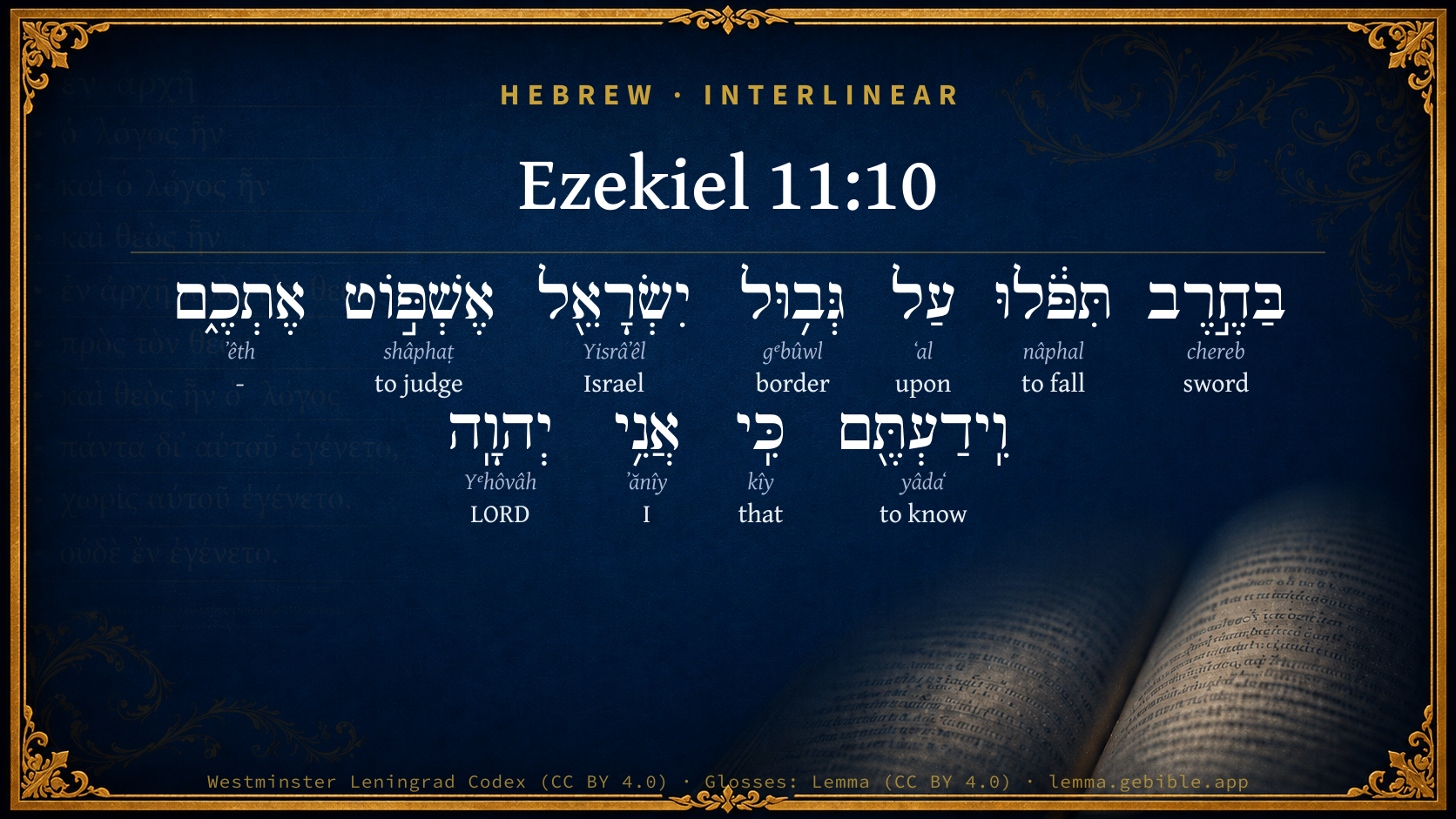
Ezekiel 11:10

Hebrew (Westminster Leningrad Codex) Ezekiel 11:10 appears in the Hebrew Old Testament. The text above is from the Westminster Leningrad Codex. Each word links to its Strong’s number, a concise gloss, and parsing drawn from the Open Scriptures Hebrew Bible morphology. Click any word for its full Brown-Driver-Briggs (BDB) entry.
Download image
Cite this verse

Ezekiel 11:10 (World English Bible). Public Domain. Lemma interlinear Bible study tool, https://lemma.gebible.app/v/ezekiel/11/10.

Show BibTeX & RIS
BibTeX
RIS
English Translation
You shall fall by the sword; I will judge you in the border of Israel; and you shall know that I am Yahweh.
World English Bible · Public Domain
Download a study sheet

One document with this verse’s original text, its word-by-word gloss line, the meaning frame, cross-references with their text, attributed commentary, and full source and license credits — printable, and it pastes into notes with its structure intact.

This verse Autodidact and up

Study sheet (.html) Plain text (.txt)

A passage Seminary Student

Up to 50 verses in one chapter. A passage sheet keeps up to 6 commentary sources and 12 cross-references per verse, in the order this page ranks them, and says so on the sheet whenever that leaves anything out. Ask for a single verse and you get the Autodidact verse sheet above.

Everything on this page stays free to read, with no account — the sheet is a download of what is already on screen, not access to it.

Want to remove ads? Support Godless Engineer
Compare translations 3

The same verse in 3 English versions, stacked beneath the original-language interlinear above. Click any original word for its lexicon entry.

Each is an independent rendering of the whole verse — the interlinear is not word-aligned to these translations.

Highlighted words mark where these versions differ — a whole-verse word diff, not a word-by-word alignment.

  • World English Bible Public Domain
    You shall fall by the sword; I will judge you in the border of Israel; and you shall know that I am Yahweh.
  • King James Version Public Domain
    Ye shall fall by the sword; I will judge you in the border of Israel; and ye shall know that I am the LORD.
  • unfoldingWord Literal Text CC BY-SA 4.0
    You will fall by the sword. I will judge you within the borders of Israel so you will know that I am Yahweh.

unfoldingWord Literal Text — © unfoldingWord, licensed CC BY-SA 4.0. Word-aligned USFM3 via Door43 (git.door43.org/unfoldingWord/en_ult).

Versions to compare (up to 4)

3 of 4 selected

Show all 18 translations

Every available English version of this verse, each an independent rendering of the whole verse.

  • World English Bible Public Domain
    You shall fall by the sword; I will judge you in the border of Israel; and you shall know that I am Yahweh.
  • Berean Standard Bible Public Domain
    You will fall by the sword, and I will judge you even to the borders of Israel. Then you will know that I am the LORD.
  • Majority Standard Bible Public Domain
    You will fall by the sword, and I will judge you even to the borders of Israel. Then you will know that I am the LORD.
  • King James Version Public Domain
    Ye shall fall by the sword; I will judge you in the border of Israel; and ye shall know that I am the LORD.
  • American Standard Version (1901) Public Domain
    Ye shall fall by the sword; I will judge you in the border of Israel; and ye shall know that I am Jehovah.
  • Revised Version (1885) Public Domain
    Ye shall fall by the sword; I will judge you in the border of Israel; and ye shall know that I am the LORD.
  • Geneva Bible (1599) Public Domain
    Ye shall fall by the sworde, and I wil iudge you in the border of Israel, and ye shall knowe that I am the Lord.
  • Douay-Rheims (1899) Public Domain
    You shall fall by the sword: I will judge you in the borders of Israel, and you shall know that I am the Lord.
  • Young's Literal Translation Public Domain
    By the sword ye do fall, On the border of Israel I do judge you, And ye have known that I `am' Jehovah.
  • Literal Standard Version CC BY-SA 4.0
    You fall by the sword, || I judge you on the border of Israel, || And you have known that I [am] YHWH.
  • Unlocked Literal Bible CC BY-SA 4.0
    You will fall by the sword. I will judge you within the borders of Israel so you will know that I am Yahweh.
  • unfoldingWord Literal Text CC BY-SA 4.0
    You will fall by the sword. I will judge you within the borders of Israel so you will know that I am Yahweh.
  • Darby Bible Public Domain
    Ye shall fall by the sword; I will judge you in the borders of Israel; and ye shall know that I [am] Jehovah.
  • World Messianic Bible Public Domain
    You will fall by the sword. I will judge you in the border of Israel. Then you will know that I am the LORD.
  • Webster's Bible Public Domain
    Ye shall fall by the sword; I will judge you in the border of Israel; and ye shall know that I am the LORD.
  • Free Bible Version CC BY-SA 4.0
    You will be killed by the sword, and I will punish you right up to the borders of Israel. Then you will know that I am the Lord.
  • Bible in Basic English Public Domain
    You will come to your death by the sword; and I will be your judge in the land of Israel; and you will be certain that I am the Lord.
  • JPS Tanakh (1917) Public Domain
    Ye shall fall by the sword: I will judge you upon the border of Israel; and ye shall know that I am the LORD.

Literal Standard Version (2020), Covenant Press — licensed CC BY-SA 4.0. Text via the HelloAO Bible API (eBible.org). Unlocked Literal Bible (unfoldingWord) — licensed CC BY-SA 4.0. Text via the HelloAO Bible API (eBible.org). unfoldingWord Literal Text — © unfoldingWord, licensed CC BY-SA 4.0. Word-aligned USFM3 via Door43 (git.door43.org/unfoldingWord/en_ult). Free Bible Version, Dr. Jonathan Gallagher — licensed CC BY-SA 4.0. Text via the HelloAO Bible API (eBible.org).

Word by word

More ways to search: Search by grammar → Find every occurrence → Compare this word →

Practice this passage: Drill this verse → Learn its vocabulary →

אֶשְׁפּ֣וֹט
shâphaṭ
H8199
“to judge”
Verb, Qal, Imperfect, 1st Person, Common, Singular
Part of Speech
Verb
Stem
Qal
Form
Imperfect
Person
1st Person
Gender
Common
Number
Singular
Full BDB Definition

Origin: a primitive root

TWOT: 2443

to judge, govern, vindicate, punish - (Qal) - to act as law-giver or judge or governor (of God, man) - to rule, govern, judge - to decide controversy (of God, man) - to execute judgment - discriminating (of man) - vindicating - condemning and punishing - at theophanic advent for final judgment - (Niphal) - to enter into controversy, plead, have controversy together - to be judged - (Poel) judge, opponent-at-law (participle)
  1. בַּחֶ֣רֶב chereb H2719 “in/at the · sword” Preposition, Determined + Noun, Common, Feminine, Singular, Absolute
  2. תִּפֹּ֔לוּ nâphal H5307 “to fall” Verb, Qal, Imperfect, 2nd Person, Masculine, Plural
  3. עַל ʻal H5921 “upon” Preposition
  4. גְּב֥וּל gᵉbûwl H1366 “border of” Noun, Common, Masculine, Singular, Construct
  5. יִשְׂרָאֵ֖ל Yisrâʼêl H3478 “Israel” Noun, Proper
  6. אֶתְכֶ֑ם ʼêth H853 “- · you” Particle, Direct Object + Suffix, Personal, 2nd Person, Masculine, Plural
  7. וִֽידַעְתֶּ֖ם yâdaʻ H3045 “and · to know” Conjunction + Verb, Qal, Sequential Perfect, 2nd Person, Masculine, Plural
  8. כִּֽי kîy H3588 “that” Conjunction
  9. אֲנִ֥י ʼănîy H589 “I” Pronoun, Personal, 1st Person, Common, Singular
  10. יְהוָֽה Yᵉhôvâh H3068 “LORD” Noun, Proper

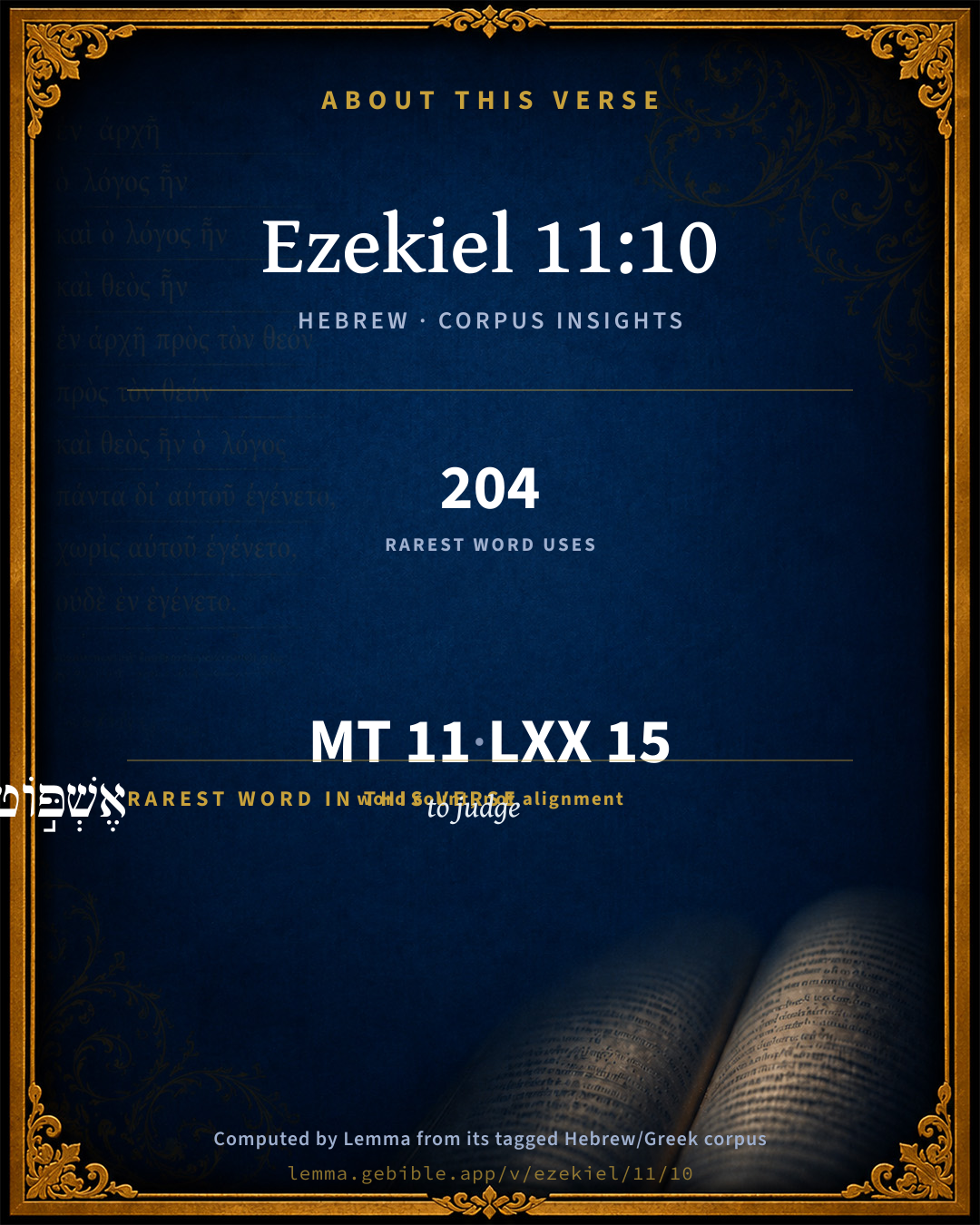
About this verse

These counts appear in no published source. They are computed here, from the morphology-tagged text and Lemma’s own curated glosses. What Lemma adds →

11
words
11
distinct lemmas
Prophets
section

Grammatical profile

  • 3 verbs
  • 4 nouns
  • 1 pronoun
  • 1 preposition
  • 1 conjunction
  • 1 particle

Verb forms

  • תִּפֹּ֔לוּ Qal · Imperfect
  • אֶשְׁפּ֣וֹט Qal · Imperfect
  • וִֽידַעְתֶּ֖ם Qal · Sequential Perfect

Hebrew & Septuagint length

In English translation the verse runs 23 words from the Hebrew and 24 from the Septuagint (LXX English) — closely comparable.

A rough comparison of the two English renderings, which tokenize alike — not a word-level alignment.

Word counts can differ between the Hebrew and the Greek without any difference in meaning — e.g. the Hebrew direct-object marker אֵת has no separate Greek word, and Greek often adds the article ὁ.

In the original languages it is 11 Hebrew tokens and 15 Greek tokens — but the two are counted differently (Hebrew bundles its prefixes and suffixes into one token; the Greek is in lemma form), so that isn’t a like-for-like length.

Cross-references

15

Topical passages linked to Ezekiel 11:10 in the Treasury of Scripture Knowledge — connected by theme and wording, ordered by reader-vote popularity; previews shown in the World English Bible.

  • 2 Kings 14:25 He restored the border of Israel from the entrance of Hamath to the sea of the Arabah, according to the word of Yahweh, the God of Israel, which he spoke by his servant Jonah the son of Amittai, the prophet, who was of Gath Hepher.
  • 2 Kings 25:19–21 and out of the city he took an officer who was set over the men of war; and five men of those who saw the king's face, who were found in the city; and the scribe, the captain of the host, who mustered the people of the land; and sixty men of the people of the land, who were found in the city.
  • Jeremiah 39:6 Then the king of Babylon killed the sons of Zedekiah in Riblah before his eyes: also the king of Babylon killed all the nobles of Judah.
  • Jeremiah 52:9–10 Then they took the king, and carried him up to the king of Babylon to Riblah in the land of Hamath; and he gave judgment on him.
  • Ezekiel 6:7 The slain shall fall in the midst of you, and you shall know that I am Yahweh.
  • Numbers 34:8–9 from Mount Hor you shall mark out to the entrance of Hamath; and the goings out of the border shall be at Zedad;
  • Joshua 13:5 and the land of the Gebalites, and all Lebanon, toward the sunrise, from Baal Gad under Mount Hermon to the entrance of Hamath;
  • 1 Kings 8:65 So Solomon held the feast at that time, and all Israel with him, a great assembly, from the entrance of Hamath to the brook of Egypt, before Yahweh our God, seven days and seven days, even fourteen days.
  • Psalms 9:16 Yahweh has made himself known. He has executed judgment. The wicked is snared by the work of his own hands. Meditation. Selah.
  • Jeremiah 9:24 but let him who glories glory in this, that he has understanding, and knows me, that I am Yahweh who exercises loving kindness, justice, and righteousness, in the earth: for in these things I delight, says Yahweh.
  • Jeremiah 52:24–27 The captain of the guard took Seraiah the chief priest, and Zephaniah the second priest, and the three keepers of the threshold:
  • Ezekiel 13:9 My hand shall be against the prophets who see false visions, and who divine lies: they shall not be in the council of my people, neither shall they be written in the writing of the house of Israel, neither shall they enter into the land of Israel; and you shall know that I am the Lord Yahweh.
  • Ezekiel 13:14 So will I break down the wall that you have daubed with whitewash, and bring it down to the ground, so that the foundation of it shall be uncovered; and it shall fall, and you shall be consumed in the midst of it: and you shall know that I am Yahweh.
  • Ezekiel 13:21 Your kerchiefs also will I tear, and deliver my people out of your hand, and they shall be no more in your hand to be hunted; and you shall know that I am Yahweh.
  • Ezekiel 13:23 Therefore you shall no more see false visions, nor practice divination. I will deliver my people out of your hand; and you shall know that I am Yahweh.

Cross-references courtesy of OpenBible.info (CC BY 4.0).

Hebrew and Greek witnesses Masoretic Hebrew ↔ Greek Septuagint

The same verse in the two great witnesses to the Old Testament, shown verse-for-verse.

These are two independent witnesses, not word-aligned to each other, and the Septuagint is shown in lemma (dictionary) form.

Hebrew Ezekiel 11:10 Masoretic · Westminster Leningrad Codex

בַּחֶ֣רֶב תִּפֹּ֔לוּ עַל גְּב֥וּל יִשְׂרָאֵ֖ל אֶשְׁפּ֣וֹט אֶתְכֶ֑ם וִֽידַעְתֶּ֖ם כִּֽי אֲנִ֥י יְהוָֽה

You shall fall by the sword; I will judge you in the border of Israel; and you shall know that I am Yahweh.

World English Bible · Public Domain

Greek LXX Ezekiel 11:10 Septuagint · lemma form

ἐν ῥομφαία πίπτω ἐπί ὁ ὅριον ὁ ἰσραήλ κρίνω σύ καί ἐπιγιγνώσκω ὅτι ἐγώ κύριος

You⌃ shall fall by the sword; I will judge you on the mountains of Israel; and you⌃ shall know that I am the Lord.

LXX2012 (modern English Septuagint) · Public Domain

Hebrew: Westminster Leningrad Codex (CC BY 4.0). Greek: Septuagint (public domain); English from LXX2012 (modern English Septuagint) (Public Domain). How the Septuagint differs from the Hebrew →

Targum (Aramaic paraphrase)

1

The Targum is the ancient Jewish Aramaic paraphrase of the Hebrew Scriptures — an interpretive translation, not the Hebrew text itself. Onkelos (literal) and Pseudo-Jonathan (expansive) render the Torah, and Jonathan the Prophets. Coverage is partial: where no permissively-licensed English translation exists for a verse, only the Aramaic is shown. This is verse-level text, not a word-by-word alignment to the Hebrew.

  1. Targum Jonathan Prophets (Joshua–Malachi)
    בְּחַרְבָּא תִּתְקַטְלוּן עַל תְּחוּם אַרְעָא דְיִשְׂרָאֵל אִתְפְּרַע מִנְכוֹן וְתֵידְעוּן אֲרֵי אֲנָא יְיָ:

    (no public-domain English translation for this verse)

    Targum Jonathan — Aramaic: “Mikraot Gedolot” (public domain). English: “Sefaria Community Translation” (CC0 1.0 (public-domain dedication)); “London "Chaldee Paraphrase," 1871” (public domain). Text via Sefaria.

Commentary

Notes on Ezekiel 11:10 from classic Christian and Jewish commentators (each source and its license shown beneath its notes). The classic Christian expositions comment on the surrounding passage and are grouped to its opening verse, so a note may address several verses; the Jewish commentaries on the Tanakh (Rashi and others) are per-verse, so they appear only where the commentator wrote on this verse.

Lemma curates 59 commentaries, every one of them public domain or Creative Commons licensed, each selected and text-cleaned for this edition rather than reprinted as found. About our sources →

Trapp's Complete Commentary

John Trapp

Eze 11:10 Ye shall fall by the sword; I will judge you in the border of Israel; and ye shall know that I [am] the LORD.

Ver. 10. I will judge you in the border of Israel.] In the northern border, even at Riblah. {2Ki 25:6; 2Ki 25:21 Jer 52:10; Jer 52:24; Jer 52:27}

John Trapp, A Commentary or Exposition upon All the Books of the Old and New Testament (1647–1656) — public domain. Text from a community e-Sword module.

Geneva Bible (1599)

Geneva Bible translators

That is, in Riblah, read 2 Kings 25:6.

Geneva Bible (1599) marginal notes — public domain. Text via Bolls.life.

Jamieson, Fausset & Brown

Robert Jamieson, A. R. Fausset & David Brown

in the border of Israel--on the frontier: at Riblah, in the land of Hamath (compare Kg2 25:19-21, with Kg1 8:65).

ye shall know that I am the Lord--by the judgments I inflict (Psa 9:16).

Jamieson, Fausset & Brown — Commentary Critical and Explanatory on the Whole Bible (1871) — public domain (CC PDM 1.0). Text via the HelloAO Bible API.

Ellicott's Commentary for English Readers

(10) In the border of Israel.—The judgment should be cumulative: first, the sword should come upon them (Eze_11:8); then they should be driven out of the city in which they trusted, and delivered into the hands of strangers (Eze_11:9); and then, finally—what was most terrible to a Jew—they were to be arraigned and punished “in the border,” i.e., at the extremity or outside of the land of Israel. Historically, it appears from 2Ki_25:20-21, and Jer_52:9-11, that the general of Nebuchadnezzar, after the capture of the city, carried the people of the land to the king at Riblah, just on the northern confines of Palestine. There Nebuchadnezzar pronounced his cruel judgments upon them, slaying the king’s sons before his eyes, and executing many others, and then, putting out Zedekiah’s eyes, carried him and the rest captive to Babylon. By all this, not in repentance, but through the experiencing of the Divine judgments, they should be at last forced to recognise Jehovah as the Almighty Ruler and Disposer of events. This place of the judgment, and this consequence of it, are emphatically repeated in Eze_11:11-12.

A Bible Commentary for English Readers, edited by Charles John Ellicott (1878–1897) — public domain. Text from a community e-Sword module.

The Cambridge Bible for Schools and Colleges

gen. ed. J. J. S. Perowne

10. in the border of Israel] far away from the city, which they hoped would protect them. Cf. Jer_52:26, “So Nebuzaradan, the captain of the guard took them and brought them to the king of Babylon to Riblah; and he smote them and put them to death in Riblah, in the land of Hamath.” 2Ki_25:18 seq.

The Cambridge Bible for Schools and Colleges (gen. ed. J. J. S. Perowne; Cambridge University Press, 1878–1918) — public domain. Text from a community e-Sword module.

John Gill's Exposition

Ye shall fall by the sword,.... Of the Chaldeans; not in the city of Jerusalem, but out of it, when it was broken up, and they fled:

I will judge you in the border of Israel; that is, inflict punishment on them, particularly by the sword; which was done at Riblah in the land of Hamath, where the sons of Zedekiah were slain, and all the princes of Judah, Jer 52:9; and this was on the border of the land of Israel, Num 34:8;

and ye shall know that I am the Lord; who knows things, and foretells them before they are; and am able to accomplish all that is threatened; and am just and righteous in all my ways and works; and who am known by the judgments executed by me.

John Gill's Exposition of the Whole Bible (1746–1763) — public domain (CC PDM 1.0). Text via the HelloAO Bible API.

Albert Barnes' Notes on the Bible

In the border of Israel - Hamath was the northern border of Israel (margin reference). At Riblah in Hamath the king of Babylon judged and condemned Zedekiah and the princes of Judah Jer 52:9-10.

Albert Barnes' Notes on the Bible (1834–1885) — public domain. Text from a community e-Sword/MySword module.

Haydock's Catholic Bible Commentary

Israel. They pretended that they should die in peace in Jerusalem: God tells them it should not be so, but that they should be judged and condemned, and fall by the sword in the borders of Israel; viz., in Reblatha, in the land of Emath, where all their chief men were put to death by order of Nabuchodonosor, 4 Kings xxv., and Jeremias lii. 10, 27. (Challoner)

George Leo Haydock (1774–1849), Haydock's Catholic Family Bible and Commentary, 1859 edition — public domain. Excludes Psalms (Douay-Rheims chapter numbering differs from Protestant) and Deuterocanonical books (Catholic canon only).

Matthew Poole's English Annotations

The enemies’ sword shall slay you; my just judgments shall pursue you whithersoever you flee, and overtake some of you; and ye shall know, Zedekiah and others who were judged at Riblah, 2Ki 25:20,

that I am the Lord.

Matthew Poole's English Annotations on the Holy Bible (1683–1685) — public domain. Text from a community e-Sword/MySword module.

Whedon's Commentary on the Bible

Daniel D. Whedon

10. In [literally, upon] the border of Israel — This was literally fulfilled. These captains and chief rulers of Israel were not put to death within the walls of the city, but on the northern frontier. The strong walls of the iron pot could not protect them (Eze_11:11; Jer_52:9; Jer_52:26-27; Num_34:11; 2Ki_25:18-21).

Daniel D. Whedon (gen. ed.), Commentary on the Old and New Testaments (1874–1909) — public domain. Text from a community e-Sword module.

John Wesley's Explanatory Notes

Will judge - My just judgments shall pursue you, whithersoever you fly.

John Wesley, Explanatory Notes Upon the Whole Bible (1754–1765) — public domain. Text via the GEBible commentary corpus.

Rashi

Rabbi Shlomo Yitzchaki (Rashi)

by the border of Israel At the end of the boundary; that is Riblah, the land of Hamath, which is Antioch. There Zedekiah was judged by Nebuchadnezzar, as is stated in the Book of (II) Kings (25: 6f.). There he slaughtered his sons, there he put out his eyes. And it is the end of the boundary, as is said concerning the spies and in many places (Num. 13:21): “until... coming to Hamath.”

Rashi on the Tanakh — English translations: “The Judaica Press complete Tanach with Rashi, translated by A. J. Rosenberg” (CC BY 4.0); “Pentateuch with Rashi's commentary by M. Rosenbaum and A.M. Silbermann, 1929-1934” (public domain); “The Metsudah Tanach series, Lakewood, N.J” (CC BY 4.0); and “The Book of Joshua, Metsudah Publications, 1997” (CC BY 4.0). Text via Sefaria.

Lesson kit

Teaching starters — assembled from the data on this page, not authored interpretation. Every prompt links to the verse data it draws on. Edit before teaching.

Ezekiel, in the Prophets, opens this verse with 11 words (11 distinct Hebrew lemmas). Its most distinctive word is shâphaṭ (“to judge”). A historical commentator’s framing appears above. Read the whole chapter for the surrounding context.

Discussion questions

  1. What does “to judge” (shâphaṭ) contribute to the verse as a whole?
  2. 2 Kings 14:25 shares this passage’s theme. How do the two illuminate each other?
  3. These translations render this verse differently; the difference is in the English rendering, not the original. What questions does that raise?
  4. The verb «תִּפֹּ֔לוּ» is Qal Imperfect. How does its form color the action?
  5. Reading how Trapp's Complete Commentary and Geneva Bible (1599) read this verse, where do the two commentators agree and where do they part?

Things to notice

Reading settings

Reading text

Shown beneath each verse's original-language words.

Old Testament
Old Testament edition

Read the OT as the Masoretic Hebrew (MT) or the Greek Septuagint (LXX).

English shown for the Greek Septuagint (in the Hebrew ↔ Greek comparison).

Comparing translations? Open the Compare panel on any verse page to stack up to four side by side.