
Malachi 1:5

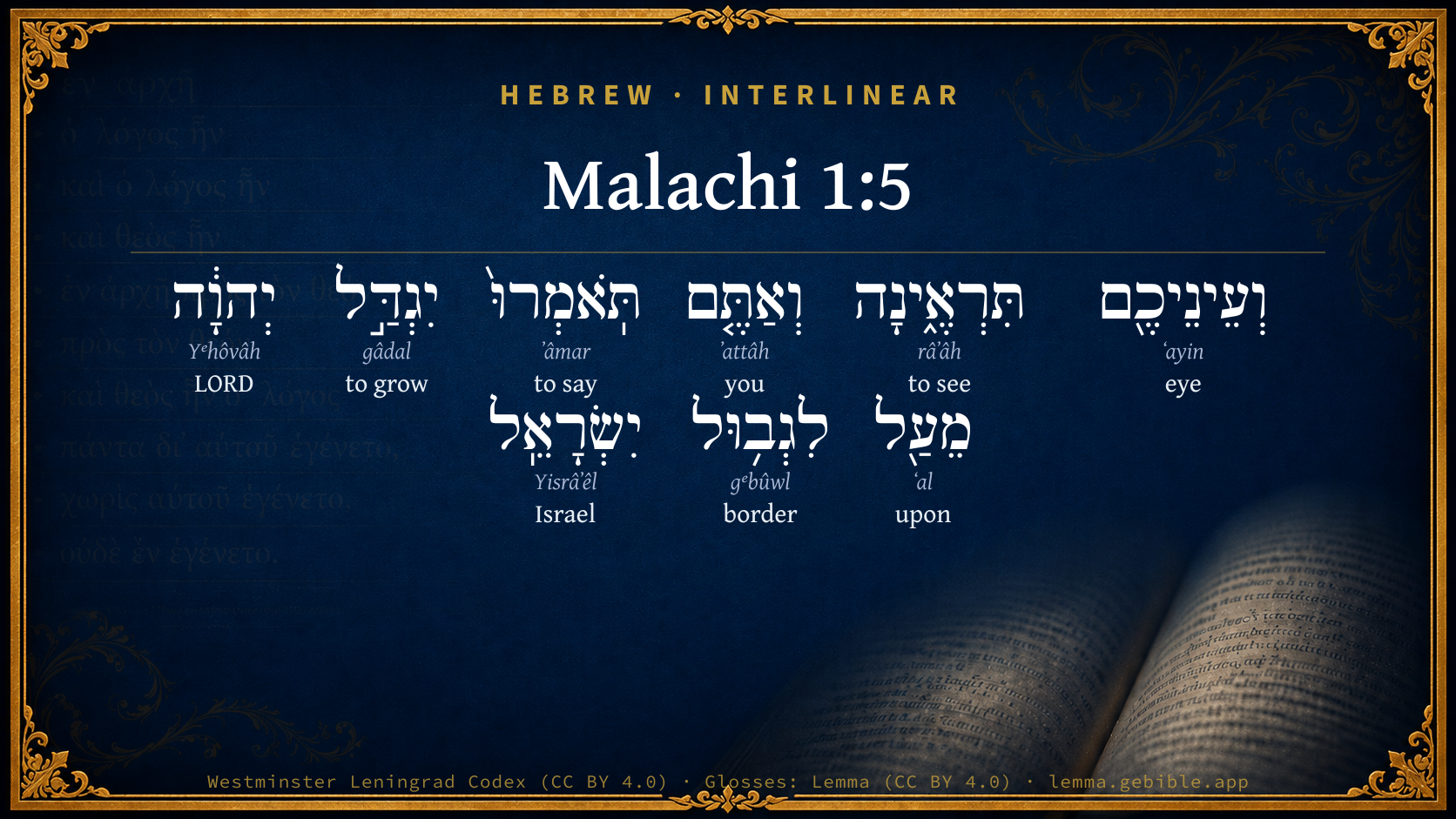
Hebrew (Westminster Leningrad Codex) Malachi 1:5 appears in the Hebrew Old Testament. The text above is from the Westminster Leningrad Codex. Each word links to its Strong’s number, a concise gloss, and parsing drawn from the Open Scriptures Hebrew Bible morphology. Click any word for its full Brown-Driver-Briggs (BDB) entry.
Download image
Cite this verse

Malachi 1:5 (World English Bible). Public Domain. Lemma interlinear Bible study tool, https://lemma.gebible.app/v/malachi/1/5.

Show BibTeX & RIS
BibTeX
RIS
English Translation
Your eyes will see, and you will say, "Yahweh is great--even beyond the border of Israel!"
World English Bible · Public Domain
Download a study sheet

One document with this verse’s original text, its word-by-word gloss line, the meaning frame, cross-references with their text, attributed commentary, and full source and license credits — printable, and it pastes into notes with its structure intact.

This verse Autodidact and up

Study sheet (.html) Plain text (.txt)

A passage Seminary Student

Up to 50 verses in one chapter. A passage sheet keeps up to 6 commentary sources and 12 cross-references per verse, in the order this page ranks them, and says so on the sheet whenever that leaves anything out. Ask for a single verse and you get the Autodidact verse sheet above.

Everything on this page stays free to read, with no account — the sheet is a download of what is already on screen, not access to it.

Want to remove ads? Support Godless Engineer
Compare translations 3

The same verse in 3 English versions, stacked beneath the original-language interlinear above. Click any original word for its lexicon entry.

Each is an independent rendering of the whole verse — the interlinear is not word-aligned to these translations.

Highlighted words mark where these versions differ — a whole-verse word diff, not a word-by-word alignment.

  • World English Bible Public Domain
    Your eyes will see, and you will say, "Yahweh is great--even beyond the border of Israel!"
  • King James Version Public Domain
    And your eyes shall see, and ye shall say, The LORD will be magnified from the border of Israel.
  • unfoldingWord Literal Text CC BY-SA 4.0
    And your eyes will see, and you yourselves will say, ‘Great is Yahweh beyond the border of Israel!’

unfoldingWord Literal Text — © unfoldingWord, licensed CC BY-SA 4.0. Word-aligned USFM3 via Door43 (git.door43.org/unfoldingWord/en_ult).

Versions to compare (up to 4)

3 of 4 selected

Show all 18 translations

Every available English version of this verse, each an independent rendering of the whole verse.

  • World English Bible Public Domain
    Your eyes will see, and you will say, "Yahweh is great--even beyond the border of Israel!"
  • Berean Standard Bible Public Domain
    You will see this with your own eyes, and you yourselves will say, ‘The LORD is great—even beyond the borders of Israel.’”
  • Majority Standard Bible Public Domain
    You will see this with your own eyes, and you yourselves will say, ‘The LORD is great—even beyond the borders of Israel.’”
  • King James Version Public Domain
    And your eyes shall see, and ye shall say, The LORD will be magnified from the border of Israel.
  • American Standard Version (1901) Public Domain
    And your eyes shall see, and ye shall say, Jehovah be magnified beyond the border of Israel.
  • Revised Version (1885) Public Domain
    And your eyes shall see, and ye shall say, The LORD be magnified beyond the border of Israel.
  • Geneva Bible (1599) Public Domain
    And your eyes shall see it, and yee shall say, The Lord will be magnified vpon the border of Israel.
  • Douay-Rheims (1899) Public Domain
    And your eyes shall see, and you shall say: The Lord be magnified upon the border of Israel.
  • Young's Literal Translation Public Domain
    And your eyes do see, and ye say, `Magnified is Jehovah beyond the border of Israel,
  • Literal Standard Version CC BY-SA 4.0
    And your eyes see, and you say, || YHWH is magnified beyond the border of Israel,
  • Unlocked Literal Bible CC BY-SA 4.0
    Your own eyes will see this, and you will say, 'Yahweh is great beyond the borders of Israel.'”
  • unfoldingWord Literal Text CC BY-SA 4.0
    And your eyes will see, and you yourselves will say, ‘Great is Yahweh beyond the border of Israel!’
  • Darby Bible Public Domain
    And your eyes shall see [it], and ye shall say, Jehovah is magnified beyond the border of Israel.
  • World Messianic Bible Public Domain
    Your eyes will see, and you will say, “The LORD is great—even beyond the border of Israel!”
  • Webster's Bible Public Domain
    And your eyes shall see, and ye shall say, The LORD will be magnified from the border of Israel.
  • Free Bible Version CC BY-SA 4.0
    You will see this destruction with your own eyes, and you will say, “The Lord is great, even beyond the borders of Israel.”
  • Bible in Basic English Public Domain
    And your eyes will see it; and you will say, The Lord is great even outside the limits of Israel.
  • JPS Tanakh (1917) Public Domain
    And your eyes shall see, and ye shall say: 'The LORD is great beyond the border of Israel.'

Literal Standard Version (2020), Covenant Press — licensed CC BY-SA 4.0. Text via the HelloAO Bible API (eBible.org). Unlocked Literal Bible (unfoldingWord) — licensed CC BY-SA 4.0. Text via the HelloAO Bible API (eBible.org). unfoldingWord Literal Text — © unfoldingWord, licensed CC BY-SA 4.0. Word-aligned USFM3 via Door43 (git.door43.org/unfoldingWord/en_ult). Free Bible Version, Dr. Jonathan Gallagher — licensed CC BY-SA 4.0. Text via the HelloAO Bible API (eBible.org).

Word by word

More ways to search: Search by grammar → Find every occurrence → Compare this word →

Practice this passage: Drill this verse → Learn its vocabulary →

יִגְדַּ֣ל
gâdal
H1431
“to grow”
Verb, Qal, Jussive, 3rd Person, Masculine, Singular
Part of Speech
Verb
Stem
Qal
Form
Jussive
Person
3rd Person
Gender
Masculine
Number
Singular
Full BDB Definition

Origin: a primitive root

TWOT: 315

to grow, become great or important, promote, make powerful, praise, magnify, do great things - (Qal) - to grow up - to become great - to be magnified - (Piel) - to cause to grow - to make great, powerful - to magnify - (Pual) to be brought up - (Hiphil) - to make great - to magnify - to do great things - (Hithpael) to magnify oneself
  1. וְעֵינֵיכֶ֖ם ʻayin H5869 “and · eyes · your” Conjunction + Noun, Common, Both, Dual, Construct + Suffix, Personal, 2nd Person, Masculine, Plural
  2. תִּרְאֶ֑ינָה râʼâh H7200 “to see” Verb, Qal, Imperfect, 3rd Person, Feminine, Plural
  3. וְאַתֶּ֤ם ʼattâh H859 “and · you” Conjunction + Pronoun, Personal, 2nd Person, Masculine, Plural
  4. תֹּֽאמְרוּ֙ ʼâmar H559 “to say” Verb, Qal, Imperfect, 2nd Person, Masculine, Plural
  5. יְהוָ֔ה Yᵉhôvâh H3068 “LORD” Noun, Proper
  6. מֵעַ֖ל ʻal H5921 “from · upon” Preposition + Preposition
  7. לִגְב֥וּל gᵉbûwl H1366 “to/for · border of” Preposition + Noun, Common, Masculine, Singular, Construct
  8. יִשְׂרָאֵֽל Yisrâʼêl H3478 “Israel” Noun, Proper

About this verse

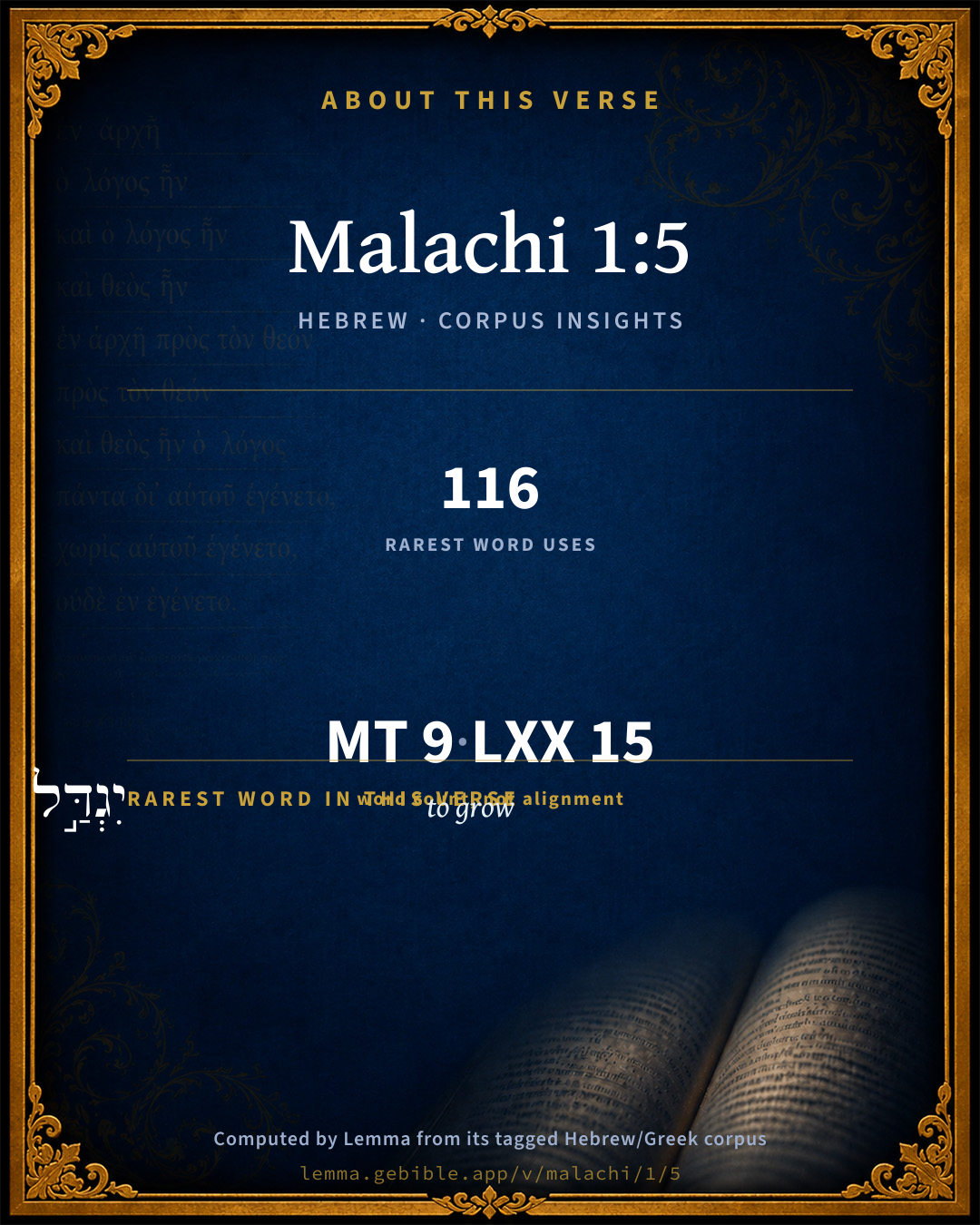
These counts appear in no published source. They are computed here, from the morphology-tagged text and Lemma’s own curated glosses. What Lemma adds →

9
words
9
distinct lemmas
Prophets
section

Grammatical profile

  • 3 verbs
  • 4 nouns
  • 1 pronoun
  • 1 preposition

Verb forms

  • תִּרְאֶ֑ינָה Qal · Imperfect
  • תֹּֽאמְרוּ֙ Qal · Imperfect
  • יִגְדַּ֣ל Qal · Jussive

Hebrew & Septuagint length

In English translation the verse runs 16 words from the Hebrew and 19 from the Septuagint (LXX English) — closely comparable.

A rough comparison of the two English renderings, which tokenize alike — not a word-level alignment.

Word counts can differ between the Hebrew and the Greek without any difference in meaning — e.g. the Hebrew direct-object marker אֵת has no separate Greek word, and Greek often adds the article ὁ.

In the original languages it is 9 Hebrew tokens and 15 Greek tokens — but the two are counted differently (Hebrew bundles its prefixes and suffixes into one token; the Greek is in lemma form), so that isn’t a like-for-like length.

Cross-references

13

Topical passages linked to Malachi 1:5 in the Treasury of Scripture Knowledge — connected by theme and wording, ordered by reader-vote popularity; previews shown in the World English Bible.

  • Deuteronomy 11:7 but your eyes have seen all the great work of Yahweh which he did.
  • Luke 10:23–24 Turning to the disciples, he said privately, "Blessed are the eyes which see the things that you see,
  • Psalms 35:26–27 Let them be disappointed and confounded together who rejoice at my calamity. Let them be clothed with shame and dishonor who magnify themselves against me.
  • Psalms 58:10–11 The righteous shall rejoice when he sees the vengeance. He shall wash his feet in the blood of the wicked;
  • Psalms 83:17–18 Let them be disappointed and dismayed forever. Yes, let them be confounded and perish;
  • Ezekiel 38:16 and you shall come up against my people Israel, as a cloud to cover the land: it shall happen in the latter days, that I will bring you against my land, that the nations may know me, when I shall be sanctified in you, Gog, before their eyes.
  • 1 Samuel 12:16 Now therefore stand still and see this great thing, which Yahweh will do before your eyes.
  • 2 Chronicles 29:8 Therefore the wrath of Yahweh was on Judah and Jerusalem, and he has delivered them to be tossed back and forth, to be an astonishment, and a hissing, as you see with your eyes.
  • Deuteronomy 4:3 Your eyes have seen what Yahweh did because of Baal Peor; for all the men who followed Baal Peor, Yahweh your God has destroyed them from the midst of you.
  • Joshua 24:7 When they cried out to Yahweh, he put darkness between you and the Egyptians, and brought the sea on them, and covered them; and your eyes saw what I did in Egypt: and you lived in the wilderness many days.
  • Ezekiel 38:23 I will magnify myself, and sanctify myself, and I will make myself known in the eyes of many nations; and they shall know that I am Yahweh.
  • Micah 5:4 He shall stand, and shall shepherd in the strength of Yahweh, In the majesty of the name of Yahweh his God: And they will live, for then he will be great to the ends of the earth.
  • Ezekiel 39:21–22 I will set my glory among the nations; and all the nations shall see my judgment that I have executed, and my hand that I have laid on them.

Cross-references courtesy of OpenBible.info (CC BY 4.0).

Hebrew and Greek witnesses Masoretic Hebrew ↔ Greek Septuagint

The same verse in the two great witnesses to the Old Testament, shown verse-for-verse.

These are two independent witnesses, not word-aligned to each other, and the Septuagint is shown in lemma (dictionary) form.

Hebrew Malachi 1:5 Masoretic · Westminster Leningrad Codex

וְעֵינֵיכֶ֖ם תִּרְאֶ֑ינָה וְאַתֶּ֤ם תֹּֽאמְרוּ֙ יִגְדַּ֣ל יְהוָ֔ה מֵעַ֖ל לִגְב֥וּל יִשְׂרָאֵֽל

Your eyes will see, and you will say, "Yahweh is great--even beyond the border of Israel!"

World English Bible · Public Domain

Greek LXX Malachi 1:5 Septuagint · lemma form

καί ὁ ὀφθαλμός σύ ὁράω καί σύ εἶπον μεγαλύνω κύριος ὑπεράνω ὁ ὅριον ὁ ἰσραήλ

And your eyes shall see, and you⌃ shall say, The Lord has been magnified upon the borders of Israel.

LXX2012 (modern English Septuagint) · Public Domain

On this verse, The Pulpit Commentary discusses the Septuagint’s reading. Read the note in Commentary ↓

Hebrew: Westminster Leningrad Codex (CC BY 4.0). Greek: Septuagint (public domain); English from LXX2012 (modern English Septuagint) (Public Domain). How the Septuagint differs from the Hebrew →

Targum (Aramaic paraphrase)

1

The Targum is the ancient Jewish Aramaic paraphrase of the Hebrew Scriptures — an interpretive translation, not the Hebrew text itself. Onkelos (literal) and Pseudo-Jonathan (expansive) render the Torah, and Jonathan the Prophets. Coverage is partial: where no permissively-licensed English translation exists for a verse, only the Aramaic is shown. This is verse-level text, not a word-by-word alignment to the Hebrew.

  1. Targum Jonathan Prophets (Joshua–Malachi)
    וְעֵינֵיכוֹן יֶחְזְיָן וְאַתּוּן תֵּימְרוּן יִסְגֵי יְקָרָא דַייָ וְאַפְתֵּי יַת תְּחוּם יִשְׂרָאֵל:

    (no public-domain English translation for this verse)

    Targum Jonathan — Aramaic: “Mikraot Gedolot” (public domain). English: “Sefaria Community Translation” (CC0 1.0 (public-domain dedication)); “London "Chaldee Paraphrase," 1871” (public domain). Text via Sefaria.

Commentary

Notes on Malachi 1:5 from classic Christian and Jewish commentators (each source and its license shown beneath its notes). The classic Christian expositions comment on the surrounding passage and are grouped to its opening verse, so a note may address several verses; the Jewish commentaries on the Tanakh (Rashi and others) are per-verse, so they appear only where the commentator wrote on this verse.

Lemma curates 59 commentaries, every one of them public domain or Creative Commons licensed, each selected and text-cleaned for this edition rather than reprinted as found. About our sources →

Trapp's Complete Commentary

John Trapp

Mal 1:5 And your eyes shall see, and ye shall say, The LORD will be magnified from the border of Israel.

Ver. 5. And your eyes shall see] "The righteous shall see and fear, and shall laugh at him," and say, "Lo, this is the man," &c., said David of Doeg the Edomite, Psa 52:7. And the same is here promised by God to his people as a pledge of his love, and a special privilege: others should hiss at Edom, and say by way of byword, "This is the border of wickedness," &c., but the saints should make more of it (a bee can suck honey out of a flower, so cannot a fly), they should busy their eyes, and regard the work of the Lord; yea, they should so consider the operation of his hand, as to say sensibly, "Let the Lord be magnified. Blessed be the glory of the Lord from his place," Isa 5:12 Psa 35:27 Eze 3:12. God hath delivered me out of all trouble, saith David, and mine eye hath seen his desire upon mine enemies. The Edomites stood looking on and laughing at the Israelites’ destruction, Oba 1:12-13. God saw this, and it displeased him (as he is wondrously sensible of the least indignity done to his people); he therefore pays them home in their own coin, and promiseth his Israel that they shall rejoice when they see the vengeance, they shall wash their feet in the blood of these wicked ones; become more cautious by their just destruction, Psa 58:10. Learn we hence, First, to have our eyes open upon the judgments of God, whether general or personal; that nothing of this nature pass our observation, lest we incur the curse denounced, Isa 5:12, and be made examples to others, because we would not be warned by the example of others. Lege historiam ne fiat historia. Sodom and Gomorrah are thrown forth (as St Jude hath it) for an example; suffering the vengeance of eternal fire. And Herodotus saith, that the ruins and rubbish of Troy are set forth for an example of this rule, that national sins bring national plagues, and that God greatly punisheth great offences. Ingentia, beneficia, flagitia, supplicia. Let him that looketh upon me learn to fear God. Eμε τις ορεων ευσεβης εστω. These words were engraven upon the standing picture of Sennacherib (after that God had by an angel slain his army, and sent him back with shame to his own country), as the same Herodotus testifieth.

Secondly, learn we how far forth we may look upon the overthrow of the wicked with delight: viz. not as our own private, but as God’s professed enemies; not simply as their ruin, but as it is a clearing of God’s glory, and of our integrity, Psa 9:16 1Sa 25:39; not out of private revenge, but pure zeal for God and his cause. I say pure zeal; for it is difficult to kindle and keep quick the fire of zeal without all smoke of sinister and self-respect.

And ye shall say, The Lord will be magnified, &c.] Or, The Lord hath magnified himself, i.e. hath declared himself mightily to be a great King above all gods, by executing judgment upon these grandees of the earth, and making out, that "In the thing wherein they dealt proudly he was above them," Exo 18:11. Hence it is that "praise waiteth for God in Zion, his name is great in Israel." He is sent unto (as sometime Joab sent to David, 2Sa 12:28, to come and take the city of Rabbah), to take the glory of all their deliverances and victories. Not unto us, Lord, not unto us, say they, but to thy name be the praise. Hunniades would not own or accept the people’s applauses and acclamations, but ascribed all to God. So did our Henry V at the battle of Agincourt, where he won the day. He would not admit his broken crown or bruised armour to be borne before him in show (which are the usual ensign of warlike triumphs). He also gave strait order that no ballad or song should be made or sung, more than of thanksgiving to the Lord for his happy victory and safe return, &c. So our Edward III after his victory at Poictiers, (where he took the French king prisoner, A. D. 1356), took speedy order by Simon, Archbishop of Canterbury, that eight days together should be spent in magnifying the Lord from the border of England.

From the borders of Israel] Or, from beyond the borders of Israel; viz., throughout the wide world. The saints have large hearts, and could give the Lord much more praise and service then they have for him. They would praise him infinitely, and according to his excellent greatness; filling up the distance, as it were, and calling in all the help they can get, of angels, men, unreasonable and insensible creatures, as David did, Psa 145:2; Psa 48:10; Psa 103:20.

John Trapp, A Commentary or Exposition upon All the Books of the Old and New Testament (1647–1656) — public domain. Text from a community e-Sword module.

The Biblical Illustrator

Joseph S. Exell

Mal_1:5

The Lord will be magnified from (or upon) the border of Israel.

Each nation had its God

The deities were made to rival each other in the protection and blessing which they afforded to the nations that worshipped them.

I. This prophetic utterance. Evils abounded when the prophet lived. The sins of the people were eclipsing Gods glory; but the prophet knew that it would shine forth as the sun. It is therefore an utterance--

(1) Of holy faith;

(2) of firm assurance;

(3) of exultant expectation.

God must be magnified. It is necessary--

1. For the furtherance of His purposes.

2. For the vindication of His righteousness.

3. For the good of the universe.

II. How this utterance was, and may be fulfilled. The history of the Israelites abounds with confirmations of the prophets words. His faith would be strengthened as he remembered past dispensations. Though Gods ancient people were dispersed, the spiritual Israel remains. He has been magnified.

1. In the redemption of the cross.

2. In the interposition of providence in behalf of His Church.

3. In the holy lives and sufferings of His people.

4. In the missionary enterprises of His Church.

III. Where this should be fulfilled. In the border of Israel. The spiritual Israel must ever magnify God. This is the duty of the Church.

1. The Church should interpret all events so as to do this.

2. It should do it under all circumstances.

3. It should seek this first in all its organisations and evangelistic efforts.

Application. Let this be our aim continually--to magnify God. We often seek to magnify ourselves. Our truest greatness is in making Him great. (W. Osborne Lilley.)

The Biblical Illustrator, edited by Joseph S. Exell (c. 1880s–1900s) — public domain. Text from a community e-Sword module.

Jamieson, Fausset & Brown

Robert Jamieson, A. R. Fausset & David Brown

from the border of Israel--Ye, restored to your own "borders" in Israel, "from" them shall raise your voices to "magnify the Lord," acknowledging that Jehovah has shown to you a gratuitous favor not shown to Edom, and so ought to be especially "magnified from the borders of Israel."

Jamieson, Fausset & Brown — Commentary Critical and Explanatory on the Whole Bible (1871) — public domain (CC PDM 1.0). Text via the HelloAO Bible API.

Adam Clarke's Commentary

Verse 5. Your eyes] Ye Israelites shall see, in your succeeding generations, that -

The Lord will be magnified] By his kindness in Israel, and his judgments beyond.

Adam Clarke's Commentary on the Bible (1810–1826) — public domain. Text from a community e-Sword/MySword module.

John Calvin's Commentaries

He adds, Your eyes shall see. The Jews had already begun in part to witness this spectacle, but the Prophet speaks here of what was to continue. See then shall your eyes; that is, “As it has already appeared of what avail gratuitous election has been to you, by which I have chosen you as my people, and as ye have also seen on the other hand how it has been with your relations the Edomites, because they had been rejected in the person of their father Esau; so also this same difference shall ever be evident to you in their posterity: see then shall your eyes

And ye shall say, Magnified let Jehovah be over the border of Israel; that is, “The event itself will extort this confession, — that I greatly enhance my goodness towards you.” For though tokens of God’s grace shone forth everywhere, and the earth, as the Psalmist says, is full of his goodness, (Psalm 104:24;) yet there was in Judea something special, so that.our Prophet does not in vain say, that there would be always reasons for the Jews to celebrate God’s praises on account of his bounty to them more than to the rest of the world. And the Prophet no doubt reproves here indirectly the wickedness of the people, as though he had said, — “Ye indeed, as far as you can, bury God’s benefits, or at least extenuate them; but facts themselves must draw from you this confession — that God deals bountifully with the border of Israel, that he exercises there his favor more remarkably than among any of the nations.”

After having briefly referred to those benefits which ought to have filled the Jews with shame, he comes at length to the subject he had in view; for his main object, as I have already stated, was to show, that it was God’s complaint that he was deprived of his own right and in a double sense, for the Jews did not reverence him as their Father, nor fear him as their Lord. He might indeed have called himself Lord and Father by the right of creation; but he preferred, as I have already explained, to appeal to their adoption; for it was a remarkable favor, when the Lord chose some out of all the human race; and we cannot say that the cause of this was to be found in men. Whom then he designs to choose, he binds to himself by a holier bond. But if they disappoint him, wholly inexcusable is their perfidy.

As we now understand the Prophet’s meaning, and the object of this expostulation, it remains for us to learn how to accommodate what is taught to ourselves. We are not indeed descended fronm Abraham or from Jacob according to the flesh; but as God has engraved on us certain marks of his adoption, by which he has distinguished us from other nations, while we were yet nothing better, we hence see that we are justly exposed to the same reproof with the Jews, if we do not respond to the calling of God. I wished thus briefly to touch on this point, in order that we may know that this doctrine is no less useful to us at this day than it was to the Jews; for though the adoption is not exactly the same, as it then belonged to one seed and to one family, yet we are not superior to others through our own worthiness, but because God has gratuitously chosen us as a people to himself. Since this has been the case, we are his; for he has redeemed us by the blood of his own Son, and by rendering us partakers, by the gospel, of a favor so ineffably great, he has made us his sons and his servants. Except then we love and reverence him as our Father, and except we fear him as our Lord, there is found in us at this day an ingratitude no less base than in that ancient people. But as I wished now only to refer to the chief point, I shall speak tomorrow, as the passage requires, on the subject of election: but it was necessary first briefly to show the Prophet’s design, as I have done; and then to treat particular points more at large, as the case may require.

John Calvin's Commentaries (1540-1563) — public domain. Text from the Calvin Translation Society English edition (1840s-50s) via the Christian Classics Ethereal Library (ccel.org). Calvin's coverage is partial (roughly two-thirds of the Bible); uncommented books and verses are honest gaps, never fabricated. The 19th-century editor's footnotes and remarks are omitted so the notes are faithfully Calvin's own voice.

Ellicott's Commentary for English Readers

(5) And your eyes shall see.—Comp. such expressions as Psa_37:34; Psa_52:6; Psa_91:8. As with the individual, so with a nation: to stand in safety and be a witness to the destruction of the enemy is looked on as a sign of God’s favour.

The Lord will be magnified . . . Israel.—Some render, let the Lord be magnified, as in Psa_35:27; Psa_40:16; others, the Lord is great: i.e., has exerted His greatness. The latter seems the more appropriate rendering here.

From the border.—Some say, beyond the border. This translation is not in accordance with the usage of the expression, which means simply “over” or “above.” (Comp. Jer_4:6.) The meaning seems to be this: The Lord, whose protecting presence hovers specially over the border of Israel, is now great, in that He has restored Israel, but hath destroyed the nationality of the wicked descendants of the godless Esau. “Border of Israel” is purposely used in contrast to “border of wickedness.”

Mal_1:6; Mal_2:9.—The priesthood rebuked. A close connection subsists between the different parts of this section; it ought therefore to be read as one continuous paragraph. The sub-divisions of it are Mal_1:6-14; Mal_2:1-9.

A Bible Commentary for English Readers, edited by Charles John Ellicott (1878–1897) — public domain. Text from a community e-Sword module.

The Cambridge Bible for Schools and Colleges

gen. ed. J. J. S. Perowne

5. your eyes shall see] Unharmed and in safety yourselves you shall witness the overthrow of Edom (comp. Psa_91:7-8).

will be magnified from] Rather, be magnified over. It is an ascription of praise (comp. Psa_48:1) to God who extends, as it were, His tutelary care over Israel, while utter destruction overtakes Edom. The contrast with Edom is emphasized by the insertion of the personal pronoun, “ye (Jews) shall say.”

The Cambridge Bible for Schools and Colleges (gen. ed. J. J. S. Perowne; Cambridge University Press, 1878–1918) — public domain. Text from a community e-Sword module.

John Gill's Exposition

And your eyes shall see,.... The destruction of the Edomites, and their fruitless attempts to rebuild their desolate places; and the difference between them and the Israelites, who were returned to their own land, and inherited it, when they could not; and the love of God to the one, and his hatred of the other:

and ye shall say, The Lord will be magnified from the border of Israel; Aben Ezra interprets it, ye that dwelt in the border of Israel shall say, the Lord shall be magnified, or let him be magnified; let greatness and glory be ascribed to him for what he has done: or, as Kimchi, give him praise and greatness because you are dwelling in your border, and their border is desolate; and your border is called the border of Israel, but theirs the border of wickedness; and so the Targum,

"let the glory of the Lord be multiplied, because he hath enlarged the border of Israel;''

and, according to Jarchi, the sense is, he shall show his greatness from our border, to make it known that we are his people: all show and own that God had loved them more than others, and therefore they ought to have honoured and obeyed him, in which they were deficient, and so ungrateful.

John Gill's Exposition of the Whole Bible (1746–1763) — public domain (CC PDM 1.0). Text via the HelloAO Bible API.

Albert Barnes' Notes on the Bible

And your eyes shall see - Malicious pleasure in looking on at the misery of Judaea and Jerusalem, had been a special sin of Edom: now God would show Judah the fruit of its reversal, and His goodness toward themselves. , “Ye have assurance of His love toward you and providence over you, when ye see that ye are returned to your own land, and can inhabit it, but they cannot do this: but “they build and I throw down,” and ye, therefore, praise and magnify My name for this, and ye shall say, “The Lord shall be magnified on the border of Israel, i. e., His greatness shall be always manifest upon you;” high above and exalted over the border of Israel which shall retain its name, while Edom shall have ceased to be. Wickedness gives its name to Edom’s border, as in Zechariah’s vision it was removed and settled in Babylon Zec 5:8, Zec 5:11.

Albert Barnes' Notes on the Bible (1834–1885) — public domain. Text from a community e-Sword/MySword module.

Matthew Poole's English Annotations

You Jews who are now returned from captivity, and are blest with a rebuilt temple and city, who are settled in civil and sacred concerns,

your eyes shall see; some of you must needs, more will, and all might, observe what I have said, that my love is toward you, whom I plant, build up, and prosper, while I root up, pull down, and destroy your neighbouring kindred Edom.

Ye shall say; you should in point of duty, and some of you will take notice of it, and confess it.

The Lord will be magnified; or, Let the Lord be magnified, let his name be great and his praise great for his free love to Israel, for his great displeasure against the border of wickedness, for his truth in both.

From the border of Israel; let Israel from all his borders give God this praise.

Matthew Poole's English Annotations on the Holy Bible (1683–1685) — public domain. Text from a community e-Sword/MySword module.

The Pulpit Commentary

Your eyes shall see. Jacob is addressed. When you see these proofs of God"s love for you, you shall leave off murmuring and be ready to praise God for his goodness and power. The Lord will be magnified; better, the Lord is great; Septuagint, Emegalunyh Kuriov , "The Lord was magnified." God makes his greatness known. From (over) the border of Israel. This means either beyond the limits of Israel, i.e. in all the world, or upon Israel, i.e. by the protection which he vouchsafes to Israel.

The Pulpit Commentary (1880–1919), ed. H.D.M. Spence-Jones & Joseph S. Exell — public domain. Text from a community e-Sword module.

Rashi

Rabbi Shlomo Yitzchaki (Rashi)

“The Lord is great beyond the border of Israel.” He will show His greatness over our border, to make known that we are His people. And Jonathan rendered: May the glory of the Lord be magnified, and He has widened the border of Israel.

Rashi on the Tanakh — English translations: “The Judaica Press complete Tanach with Rashi, translated by A. J. Rosenberg” (CC BY 4.0); “Pentateuch with Rashi's commentary by M. Rosenbaum and A.M. Silbermann, 1929-1934” (public domain); “The Metsudah Tanach series, Lakewood, N.J” (CC BY 4.0); and “The Book of Joshua, Metsudah Publications, 1997” (CC BY 4.0). Text via Sefaria.

Lesson kit

Teaching starters — assembled from the data on this page, not authored interpretation. Every prompt links to the verse data it draws on. Edit before teaching.

Malachi, in the Prophets, opens this verse with 9 words (9 distinct Hebrew lemmas). Its most distinctive word is gâdal (“to grow”). A historical commentator’s framing appears above. Read the whole chapter for the surrounding context.

Discussion questions

  1. How does “to grow” (gâdal) shape what this verse is saying?
  2. How does Deuteronomy 11:7, which shares this passage’s theme, read alongside this verse?
  3. The translations on this page render this verse differently — a whole-verse word diff, not a word-by-word alignment. What might account for the different wordings?
  4. «תִּרְאֶ֑ינָה» is a Qal Imperfect verb. How does that grammatical form shape the action described?
  5. Compare how Trapp's Complete Commentary and The Biblical Illustrator read this verse. Where do they agree or differ?

Things to notice

Reading settings

Reading text

Shown beneath each verse's original-language words.

Old Testament
Old Testament edition

Read the OT as the Masoretic Hebrew (MT) or the Greek Septuagint (LXX).

English shown for the Greek Septuagint (in the Hebrew ↔ Greek comparison).

Comparing translations? Open the Compare panel on any verse page to stack up to four side by side.