
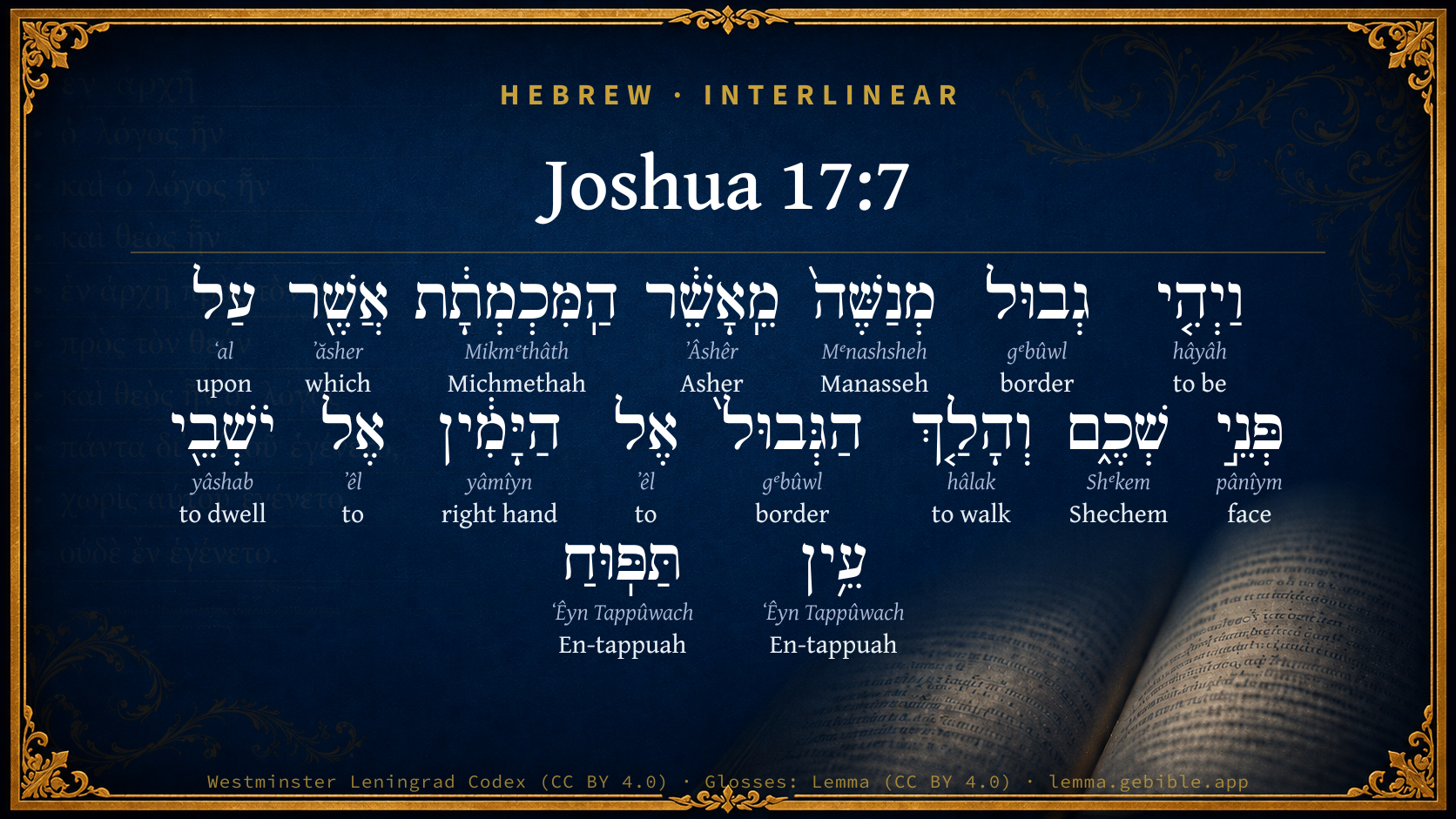
Joshua 17:7

Hebrew (Westminster Leningrad Codex) Joshua 17:7 appears in the Hebrew Old Testament. The text above is from the Westminster Leningrad Codex. Each word links to its Strong’s number, a concise gloss, and parsing drawn from the Open Scriptures Hebrew Bible morphology. Click any word for its full Brown-Driver-Briggs (BDB) entry.
Download image
Cite this verse

Joshua 17:7 (World English Bible). Public Domain. Lemma interlinear Bible study tool, https://lemma.gebible.app/v/joshua/17/7.

Show BibTeX & RIS
BibTeX
RIS
English Translation
The border of Manasseh was from Asher to Michmethath, which is before Shechem; and the border went along to the right hand, to the inhabitants of En Tappuah.
World English Bible · Public Domain
Highlights
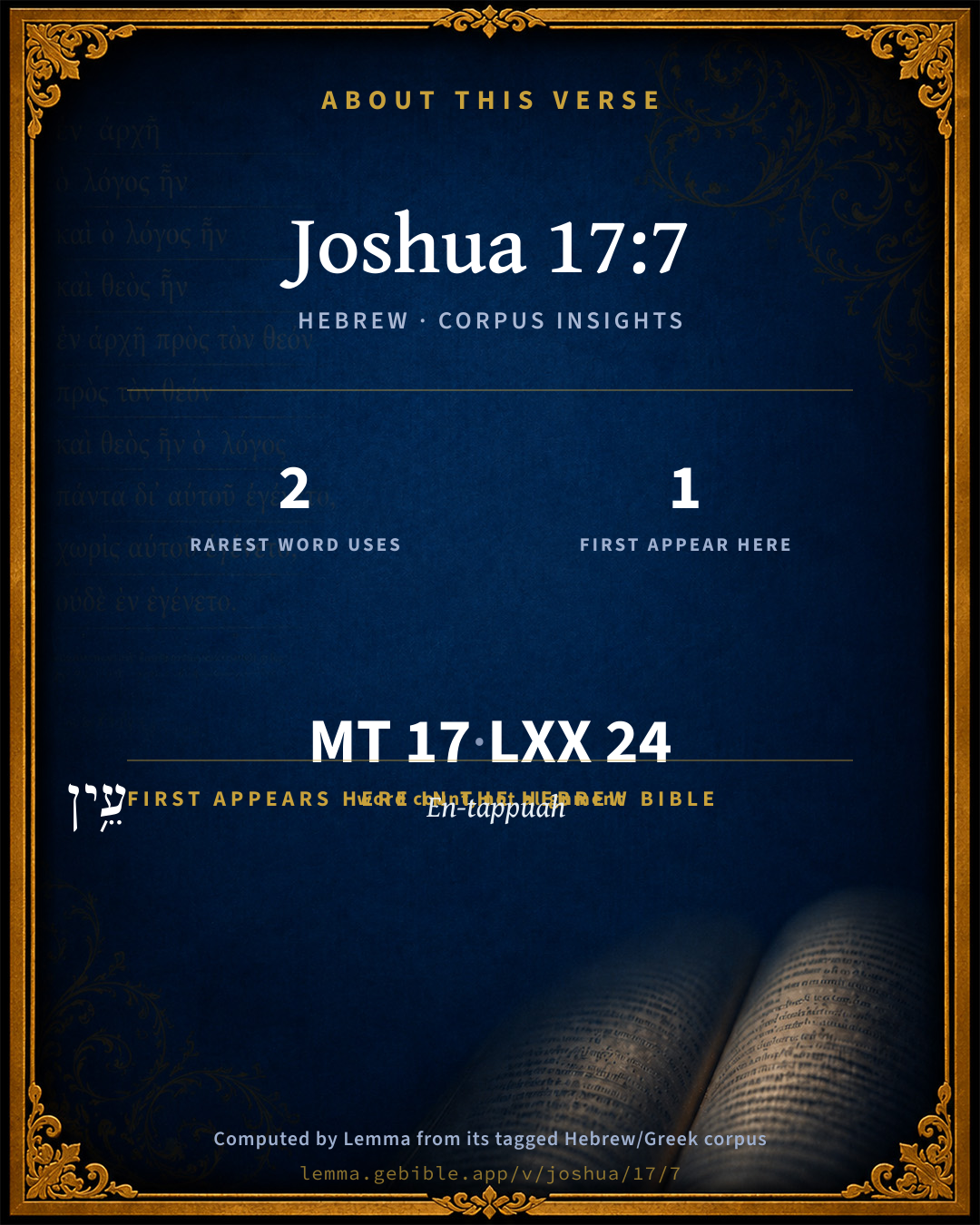
  • 1 first appearance in the Hebrew Bible
Full analysis ↓
Download a study sheet

One document with this verse’s original text, its word-by-word gloss line, the meaning frame, cross-references with their text, attributed commentary, and full source and license credits — printable, and it pastes into notes with its structure intact.

This verse Autodidact and up

Study sheet (.html) Plain text (.txt)

A passage Seminary Student

Up to 50 verses in one chapter. A passage sheet keeps up to 6 commentary sources and 12 cross-references per verse, in the order this page ranks them, and says so on the sheet whenever that leaves anything out. Ask for a single verse and you get the Autodidact verse sheet above.

Everything on this page stays free to read, with no account — the sheet is a download of what is already on screen, not access to it.

Want to remove ads? Support Godless Engineer
Compare translations 3

The same verse in 3 English versions, stacked beneath the original-language interlinear above. Click any original word for its lexicon entry.

Each is an independent rendering of the whole verse — the interlinear is not word-aligned to these translations.

Highlighted words mark where these versions differ — a whole-verse word diff, not a word-by-word alignment.

  • World English Bible Public Domain
    The border of Manasseh was from Asher to Michmethath, which is before Shechem; and the border went along to the right hand, to the inhabitants of En Tappuah.
  • King James Version Public Domain
    And the coast of Manasseh was from Asher to Michmethah, that lieth before Shechem; and the border went along on the right hand unto the inhabitants of Entappuah.
  • unfoldingWord Literal Text CC BY-SA 4.0
    And the border of Manasseh was from Asher to Mikmethath, which on the face of Shechem. And the border went to the right to the dwellers of En Tappuah.

unfoldingWord Literal Text — © unfoldingWord, licensed CC BY-SA 4.0. Word-aligned USFM3 via Door43 (git.door43.org/unfoldingWord/en_ult).

Versions to compare (up to 4)

3 of 4 selected

Show all 18 translations

Every available English version of this verse, each an independent rendering of the whole verse.

  • World English Bible Public Domain
    The border of Manasseh was from Asher to Michmethath, which is before Shechem; and the border went along to the right hand, to the inhabitants of En Tappuah.
  • Berean Standard Bible Public Domain
    Now the border of Manasseh went from Asher to Michmethath near Shechem, then southward to include the inhabitants of En-tappuah.
  • Majority Standard Bible Public Domain
    Now the border of Manasseh went from Asher to Michmethath near Shechem, then southward to include the inhabitants of En-tappuah.
  • King James Version Public Domain
    And the coast of Manasseh was from Asher to Michmethah, that lieth before Shechem; and the border went along on the right hand unto the inhabitants of Entappuah.
  • American Standard Version (1901) Public Domain
    And the border of Manasseh was from Asher to Michmethath, which is before Shechem; and the border went along to the right hand, unto the inhabitants of En-tappuah.
  • Revised Version (1885) Public Domain
    And the border of Manasseh was from Asher to Michmethath, which is before Shechem; and the border went along to the right hand, unto the inhabitants of En-tappuah.
  • Geneva Bible (1599) Public Domain
    So the borders of Manasseh were from Asher to Michmethah that lieth before Shechem, and this border goeth on the right hand, euen vnto the inhabitants of En-tappuah.
  • Douay-Rheims (1899) Public Domain
    And the border of Manasses was from Aser, Machmethath which looketh towards Sichem: and it goeth out on the right hand by the inhabitants of the fountain of Taphua.
  • Young's Literal Translation Public Domain
    And the border of Manasseh is from Asher to Michmethah, which `is' on the front of Shechem, and the border hath gone on unto the right, unto the inhabitants of En-Tappuah.
  • Literal Standard Version CC BY-SA 4.0
    And the border of Manasseh is from Asher to Michmethah, which [is] on the front of Shechem, and the border has gone on to the right, to the inhabitants of En-Tappuah.
  • Unlocked Literal Bible CC BY-SA 4.0
    The territory of Manasseh reached from Asher to Mikmethath, which is east of Shechem. Then the border went southward to those living near the spring of Tappuah.
  • unfoldingWord Literal Text CC BY-SA 4.0
    And the border of Manasseh was from Asher to Mikmethath, which on the face of Shechem. And the border went to the right to the dwellers of En Tappuah.
  • Darby Bible Public Domain
    And the territory of Manasseh was from Asher to Micmethath, which is before Shechem, and the border went on the right hand toward the inhabitants of En-Tappuah.
  • World Messianic Bible Public Domain
    The border of Manasseh was from Asher to Michmethath, which is before Shechem. The border went along to the right hand, to the inhabitants of En Tappuah.
  • Webster's Bible Public Domain
    And the border of Manasseh was from Asher to Michmethah, that lieth before Shechem; and the border went along on the right hand to the inhabitants of En-tappuah.
  • Free Bible Version CC BY-SA 4.0
    The boundary of the tribe of Manasseh ran from Asher to Michmethath, near Shechem, then south to the spring of Tappuah.
  • Bible in Basic English Public Domain
    And the limit of Manasseh's land was from Asher to Michmethath, which is before Shechem; the line goes on to the right hand, to the people of En-tappuah.
  • JPS Tanakh (1917) Public Domain
    And the border of Manasseh was, beginning from Asher, Michmethath, which is before Shechem; and the border went along to the right hand, unto the inhabitants of En-tappuah. —

Literal Standard Version (2020), Covenant Press — licensed CC BY-SA 4.0. Text via the HelloAO Bible API (eBible.org). Unlocked Literal Bible (unfoldingWord) — licensed CC BY-SA 4.0. Text via the HelloAO Bible API (eBible.org). unfoldingWord Literal Text — © unfoldingWord, licensed CC BY-SA 4.0. Word-aligned USFM3 via Door43 (git.door43.org/unfoldingWord/en_ult). Free Bible Version, Dr. Jonathan Gallagher — licensed CC BY-SA 4.0. Text via the HelloAO Bible API (eBible.org).

Word by word

More ways to search: Search by grammar → Find every occurrence → Compare this word →

Practice this passage: Drill this verse → Learn its vocabulary →

הַֽמִּכְמְתָ֔ת
Mikmᵉthâth
H4366
“the · Michmethah”
Particle, Definite Article + Noun, Proper
Part of Speech
Particle + Noun
Type
Proper
Full BDB Definition

Origin: apparently from an unused root meaning to hide

TWOT: None

Michmethah = "hiding place" - a place in northeast Ephraim near the border of Manasseh between Shechem and Taanath-shilo
  1. וַיְהִ֤י hâyâh H1961 “and · to be” Conjunction + Verb, Qal, Sequential Imperfect, 3rd Person, Masculine, Singular
  2. גְבוּל gᵉbûwl H1366 “border of” Noun, Common, Masculine, Singular, Construct
  3. מְנַשֶּׁה֙ Mᵉnashsheh H4519 “Manasseh” Noun, Proper
  4. מֵֽאָשֵׁ֔ר ʼÂshêr H836 “from · Asher” Preposition + Noun, Proper
  5. אֲשֶׁ֖ר ʼăsher H834 “which” Particle, Relative
  6. עַל ʻal H5921 “upon” Preposition
  7. פְּנֵ֣י pânîym H6440 “face(s) of” Noun, Common, Both, Plural, Construct
  8. שְׁכֶ֑ם Shᵉkem H7927 “Shechem” Noun, Proper
  9. וְהָלַ֤ךְ hâlak H1980 “and · to walk” Conjunction + Verb, Qal, Perfect, 3rd Person, Masculine, Singular
  10. הַגְּבוּל֙ gᵉbûwl H1366 “the · border” Particle, Definite Article + Noun, Common, Masculine, Singular, Absolute
  11. אֶל ʼêl H413 “to” Preposition
  12. הַיָּמִ֔ין yâmîyn H3225 “the · right hand” Particle, Definite Article + Noun, Common, Feminine, Singular, Absolute
  13. אֶל ʼêl H413 “to” Preposition
  14. יֹשְׁבֵ֖י yâshab H3427 “dwelling” Verb, Qal, Participle Active, Masculine, Plural, Construct
  15. עֵ֥ין ʻÊyn Tappûwach H5887 “En-tappuah” Noun, Proper
  16. תַּפּֽוּחַ ʻÊyn Tappûwach H5887 “En-tappuah” Noun, Proper

About this verse

These counts appear in no published source. They are computed here, from the morphology-tagged text and Lemma’s own curated glosses. What Lemma adds →

17
words
14
distinct lemmas
Historical
section

Notable vocabulary

The rarest word here is הַֽמִּכְמְתָ֔ת Michmethah H4366 — appearing just 2 times in the whole Hebrew Bible.

First appearance in Scripture

This word makes its first canonical appearance in the Hebrew Bible here:

  • עֵ֥ין En-tappuah H5887

Shared distinctive vocabulary

הַֽמִּכְמְתָ֔ת Michmethah H4366 occurs in 2 verses of the Hebrew Bible. Also found in:

Grammatical profile

  • 3 verbs
  • 10 nouns
  • 3 prepositions
  • 1 particle

Verb forms

  • וַיְהִ֤י Qal · Sequential Imperfect
  • וְהָלַ֤ךְ Qal · Perfect
  • יֹשְׁבֵ֖י Qal · Participle Active

Repetition

Words recur within this verse — often emphatic in Hebrew:

  • גְבוּל border H1366 ×2
  • עֵ֥ין En-tappuah H5887 ×2
  • אֶל to H413 ×2

Hebrew & Septuagint length

In English translation the verse runs 28 words from the Hebrew and 33 from the Septuagint (LXX English) — closely comparable.

A rough comparison of the two English renderings, which tokenize alike — not a word-level alignment.

Word counts can differ between the Hebrew and the Greek without any difference in meaning — e.g. the Hebrew direct-object marker אֵת has no separate Greek word, and Greek often adds the article ὁ.

In the original languages it is 17 Hebrew tokens and 24 Greek tokens — but the two are counted differently (Hebrew bundles its prefixes and suffixes into one token; the Greek is in lemma form), so that isn’t a like-for-like length.

Cross-references

12

Topical passages linked to Joshua 17:7 in the Treasury of Scripture Knowledge — connected by theme and wording, ordered by reader-vote popularity; previews shown in the World English Bible.

  • Joshua 21:21 They gave them Shechem with its suburbs in the hill-country of Ephraim, the city of refuge for the manslayer, and Gezer with its suburbs,
  • Genesis 34:2 Shechem the son of Hamor the Hivite, the prince of the land, saw her. He took her, lay with her, and humbled her.
  • Genesis 37:12 His brothers went to feed their father's flock in Shechem.
  • Genesis 37:14 He said to him, "Go now, see whether it is well with your brothers, and well with the flock; and bring me word again." So he sent him out of the valley of Hebron, and he came to Shechem.
  • Joshua 16:6–8 and the border went out westward at Michmethath on the north; and the border turned about eastward to Taanath Shiloh, and passed along it on the east of Janoah;
  • Joshua 20:7 They set apart Kedesh in Galilee in the hill-country of Naphtali, and Shechem in the hill-country of Ephraim, and Kiriath Arba (the same is Hebron) in the hill-country of Judah.
  • Joshua 24:1 Joshua gathered all the tribes of Israel to Shechem, and called for the elders of Israel, and for their heads, and for their judges, and for their officers; and they presented themselves before God.
  • Joshua 24:32 The bones of Joseph, which the children of Israel brought up out of Egypt, buried they in Shechem, in the parcel of ground which Jacob bought of the sons of Hamor the father of Shechem for a hundred pieces of money: and they became the inheritance of the children of Joseph.
  • Judges 9:1 Abimelech the son of Jerubbaal went to Shechem to his mother's brothers, and spoke with them, and with all the family of the house of his mother's father, saying,
  • 1 Kings 12:1 Rehoboam went to Shechem: for all Israel were come to Shechem to make him king.
  • 1 Kings 12:25 Then Jeroboam built Shechem in the hill-country of Ephraim, and lived therein; and he went out from there, and built Penuel.
  • 1 Chronicles 6:67 They gave to them the cities of refuge, Shechem in the hill-country of Ephraim with its suburbs; Gezer also with its suburbs,

Cross-references courtesy of OpenBible.info (CC BY 4.0).

Hebrew and Greek witnesses Masoretic Hebrew ↔ Greek Septuagint

The same verse in the two great witnesses to the Old Testament, shown verse-for-verse.

These are two independent witnesses, not word-aligned to each other, and the Septuagint is shown in lemma (dictionary) form.

Hebrew Joshua 17:7 Masoretic · Westminster Leningrad Codex

וַיְהִ֤י גְבוּל מְנַשֶּׁה֙ מֵֽאָשֵׁ֔ר הַֽמִּכְמְתָ֔ת אֲשֶׁ֖ר עַל פְּנֵ֣י שְׁכֶ֑ם וְהָלַ֤ךְ הַגְּבוּל֙ אֶל הַיָּמִ֔ין אֶל יֹשְׁבֵ֖י עֵ֥ין תַּפּֽוּחַ

The border of Manasseh was from Asher to Michmethath, which is before Shechem; and the border went along to the right hand, to the inhabitants of En Tappuah.

World English Bible · Public Domain

Greek LXX Joshua 17:7 Septuagint · lemma form

καί γίγνομαι ὅριον υἱός μανασσή δηλαναθ ὅς εἰμί κατά πρόσωπον υἱός αναθ καί πορεύομαι ἐπί ὁ ὅριον ἐπί ιαμιν καί ιασσιβ ἐπί πηγή θαφθωθ

And the borders of the sons of Manasse were Delanath, which is before the sons of Anath, and it proceeds to the borders even to Jamin and Jassib to the fountain of Thaphthoth.

LXX2012 (modern English Septuagint) · Public Domain

Hebrew: Westminster Leningrad Codex (CC BY 4.0). Greek: Septuagint (public domain); English from LXX2012 (modern English Septuagint) (Public Domain). How the Septuagint differs from the Hebrew →

Targum (Aramaic paraphrase)

1

The Targum is the ancient Jewish Aramaic paraphrase of the Hebrew Scriptures — an interpretive translation, not the Hebrew text itself. Onkelos (literal) and Pseudo-Jonathan (expansive) render the Torah, and Jonathan the Prophets. Coverage is partial: where no permissively-licensed English translation exists for a verse, only the Aramaic is shown. This is verse-level text, not a word-by-word alignment to the Hebrew.

  1. Targum Jonathan Prophets (Joshua–Malachi)
    וַהֲוָה תְּחוּם מְנַשֶׁה מֵאָשֵׁר לְמִכְמְתָת דִי עַל אַפֵּי שְׁכֶם וַאֲזַל תְּחוּמָא לִימִינָא לְיַתְבֵי עֵין תַּפּוּחַ:

    (no public-domain English translation for this verse)

    Targum Jonathan — Aramaic: “Mikraot Gedolot” (public domain). English: “Sefaria Community Translation” (CC0 1.0 (public-domain dedication)); “London "Chaldee Paraphrase," 1871” (public domain). Text via Sefaria.

Commentary

Notes on Joshua 17:7 from classic Christian and Jewish commentators (each source and its license shown beneath its notes). The classic Christian expositions comment on the surrounding passage and are grouped to its opening verse, so a note may address several verses; the Jewish commentaries on the Tanakh (Rashi and others) are per-verse, so they appear only where the commentator wrote on this verse.

Lemma curates 59 commentaries, every one of them public domain or Creative Commons licensed, each selected and text-cleaned for this edition rather than reprinted as found. About our sources →

Jamieson, Fausset & Brown

Robert Jamieson, A. R. Fausset & David Brown

THIS COAST. (Jos 17:7-11)

the coast of Manasseh was from Asher to Michmethah--The southern boundary is here traced from the east. Asher (now Yasir), the starting point, was a town fifteen Roman miles east of Shechem, and anciently a place of importance.

Jamieson, Fausset & Brown — Commentary Critical and Explanatory on the Whole Bible (1871) — public domain (CC PDM 1.0). Text via the HelloAO Bible API.

The Cambridge Bible for Schools and Colleges

gen. ed. J. J. S. Perowne

7–13. Boundaries of Western Manasseh

7. And the coast] We now have a description of the boundaries of Manasseh. And first (a), Jos_17:7-10, of the southern boundary towards Ephraim; and (b), second, Jos_17:10-11, of the northern and eastern boundaries.

was from Asher] The description of the southern boundary commences at the eastern end. The Asher here spoken of is not the tribe of Asher, but a city on the east of Shechem. Eusebius places it on the road from Shechem to Bethshean. “Three quarters of an hour from Tûbâs is the hamlet of Teyâsîr, which may probably be identified with Asher, a town of Manasseh.” Porter’s Handbook, ii. 348.

to Michmethah] See ch. Jos_16:6. It is described as facing Shechem (Nablûs).

the border went along] The boundary now turned towards the right in a northerly direction, to the inhabitants of En-tappuah.

The Cambridge Bible for Schools and Colleges (gen. ed. J. J. S. Perowne; Cambridge University Press, 1878–1918) — public domain. Text from a community e-Sword module.

Trapp's Complete Commentary

John Trapp

Jos 17:7 And the coast of Manasseh was from Asher to Michmethah, that [lieth] before Shechem; and the border went along on the right hand unto the inhabitants of Entappuah.

Ver. 7. And the coast of Manasseh was from Asher.] Which was a town, say some, seated at the south-east end of Manasseh’s lot.

John Trapp, A Commentary or Exposition upon All the Books of the Old and New Testament (1647–1656) — public domain. Text from a community e-Sword module.

Tyndale Open Study Notes

Tyndale Open Resources

17:7-13 As with the tribe of Ephraim, Manasseh’s territory was defined by a general description of its borders.

17:7 Asher was north-northwest of Manasseh, across the Jezreel Valley.

Tyndale Open Study Notes — © Tyndale Open Resources, licensed CC BY-SA 4.0. Text via the HelloAO Bible API.

Matthew Henry's Commentary

We have here a short account of the lot of this half tribe. It reached from Jordan on the east to the great sea on the west; on the south it lay all along contiguous to Ephraim, but on the north it abutted upon Asher and Issachar. Asher lay north-west, and Issachar north-east, which seems to be the meaning of that (Jos 17:10), that they (that is, Manasseh and Ephraim, as related to it, both together making the tribe of Joseph) met in Asher on the north and Issachar on the east, for Ephraim itself reached not those tribes. Some things are particularly observed concerning this lot: - 1. That there was great communication between this tribe and that of Ephraim. The city of Tappuah belonged to Ephraim, but the country adjoining to Manasseh (Jos 17:8); there were likewise many cities of Ephraim that lay within the border of Manasseh (Jos 17:9), of which before, Jos 16:9. 2. That Manasseh likewise had cities with their appurtenances in the tribes of Issachar and Asher (Jos 17:11), God so ordering it, that though every tribe had its peculiar inheritance, which might not be alienated from it, yet they should thus intermix one with another, to keep up mutual acquaintance and correspondence among the tribes, and to give occasion for the doing of good offices one to another, as became those who, though of different tribes, were all one Israel, and were bound to love as brethren. 3. That they suffered the Canaanites to live among them, contrary to the command of God, serving their own ends by conniving at them, for they made them tributaries, Jos 17:12, Jos 17:13. The Ephraimites had done the same (Jos 16:10), and from them perhaps the Manassites learned it, and with their example excused themselves in it. The most remarkable person of this half tribe in after-time was Gideon, whose great actions were done within this lot. He was of the family of Abiezer; Cesarea was in this lot, and Antipatris, famed in the latter ages of the Jewish state.

Matthew Henry's Commentary on the Whole Bible (1708–1710) — public domain (CC PDM 1.0). Text via the HelloAO Bible API.

John Gill's Exposition

And the coast of Manasseh was from Asher,.... Not from the border of the tribe of Asher, as Kimchi, in which he is followed by Vatablus; for that was at too great a distance; but a city of the tribe of Manasseh; and in Jerom's (l) time a village of this name was shown fifteen miles from Neapolis or Shechem, as you go from thence to Scythopolis, near the public road:

to Michmethah, that lieth before Shechem; the same place mentioned in the description of the border of Ephraim; see Gill on Jos 16:6,

and the border went along on the right hand, unto the inhabitants of Entappuah; that is, leaving this place, and its inhabitants to the right, which was a place in the land of that name, next mentioned; and seems to be so called from a fountain in it, or near it, as well as from a multitude of apples growing there, and with which perhaps the country abounded, of which in Jos 17:8.

(l) De loc. Heb. fol. 88. G.

John Gill's Exposition of the Whole Bible (1746–1763) — public domain (CC PDM 1.0). Text via the HelloAO Bible API.

Albert Barnes' Notes on the Bible

Asher - Not the tribe so called, but a place somewhere toward the eastern end of the boundary line here drawn: perhaps “Teyasir,” on the road from Sichem to Beth-shean.

Albert Barnes' Notes on the Bible (1834–1885) — public domain. Text from a community e-Sword/MySword module.

Haydock's Catholic Bible Commentary

Aser was contiguous to Machmethath, 15 miles from Sichem, towards Scythopolis. (St. Jerome) (Calmet) --- The limits of Manasses are described from the south, where he joins Ephraim, chap. xvi. 6. (Calmet)

George Leo Haydock (1774–1849), Haydock's Catholic Family Bible and Commentary, 1859 edition — public domain. Excludes Psalms (Douay-Rheims chapter numbering differs from Protestant) and Deuterocanonical books (Catholic canon only).

Whedon's Commentary on the Bible

Daniel D. Whedon

7. Coast of Manasseh — The southern boundary from east to west. “The author gives the boundary again from east to west, as in the case of Judah, (Jos_15:2, ff,) the sons of Joseph (Jos_16:1, ff,) and Benjamin, Jos_18:12, ff. So the author of the Apocalypse, also, names the gates of the New Jerusalem, beginning from the east, (Rev_21:13,) and Ezekiel (Eze_48:1, ff) designates the several tribe divisions in the like manner from east to west.” — Fay.] Asher is here not the portion of the tribe, which could not constitute a starting point for a line, but a city, probably the modern Yasir, about half way between Shechem and Beth-shean, or about fifteen miles northeast of the former city. For Michmethah and river Kanah, see on Jos_16:6-8. Shechem is a very ancient city, called Neapolis, corrupted to Nabulus and Nablus, in the narrow valley between Mounts Ebal and Gerizim. See note and cuts at Joh_4:5. “The streets are narrow; the houses high and in general well built, all of stone, with domes upon the roofs, as at Jerusalem.” — Robinson. En-tappuah some understand of a fountain near the city of Tappuah, (Jos_16:8;) others, as another name of the city itself. The land of Tappuah mentioned in the next verse must mean the country in the neighbourhood of Tappuah.

Daniel D. Whedon (gen. ed.), Commentary on the Old and New Testaments (1874–1909) — public domain. Text from a community e-Sword module.

The Pulpit Commentary

Coast. Rather, border. Asher. This has been supposed not to be the tribe of Asher, for this was on the north, but a city which has been identified with the modern Yasir, about five hours" distance from Nablous, or Neapolis, on the road to Beisan,or Beth-shean, where, says Delitzsch, there are "magnificent ruins" now to be seen. See, however, note ver. 10. Michmethah. (see Jos_16:6) This place has not been identified. All we know is that it is opposite (ynepAl) Shechem. Some have thought that this is simply the denominative of Asher, to distinguish it from the tribe, and that for "Asher to Michmethah" we should read "Asher-ham-Michmethah." But this could hardly be the Yasir above, since it is opposite Shechem. Shechem. Now Nablous. This place is famous both in the Old and the New Testament. We first read of it, under the name of Sichem, in Gen_12:6. It was the abode of Shechem and Hamor his son, when Jacob abode in Canaan after his return from Padan-aram. It was situated between Gerizim and Ebal, and became an important city in the days of the Judges. (Jud_1:9) It was destroyed by Abimelech, (Jud_1:9:45) but it seems to have recovered. It was thither that Rehoboam went to be crowned, and there that his injudicious answer alienated forever the ten tribes from his rule. Jeroboam made it his capital and is said to have "built" it. (1Ki_12:25) He afterwards, however, abandoned it for Penuel, and Penuel again apparently for Tirzah, (1Ki_14:17) and Tirzah for Jezreel, which remained the capital until Omri built Samaria. (1Ki_16:24) It is no doubt the Sychar mentioned in St. John 4. Most travelers have admired the picturesque situation of Shechem. It has even extorted a tribute from Dr. Peterman, in his "Reisen im Orient," a work which, however full of valuable information regarding the condition and customs of the people, does not abound m description of scenery. He becomes almost poetical as he speaks of this town, resting on the slopes of Gerizim, a mountain fruitful to its summit, and having opposite the bare, stony el Ebal, its outline unrelieved by verdure, the haunt of jackals, whose howls, like the cry of wailing children in distress, disturb the silence of the night. Thomson ("Land and the Book," p. 470) thus describes the scene: "A valley green with grass, grey with olives, gardens sloping down on each side, fresh springs rushing down in all directions; at the end a white town embosomed in all this verdure lodged between the two high mountains which extend on each side of the valley; this is the aspect of Nablous, the most beautiful, perhaps it might be said the only beautiful, spot in Central Palestine. Thirty-two springs can be traced in different parts. Here the bilbul delights to sit and sing, and thousands of other birds delight to swell the chorus."

The Pulpit Commentary (1880–1919), ed. H.D.M. Spence-Jones & Joseph S. Exell — public domain. Text from a community e-Sword module.

unfoldingWord translationNotes

Door43 World Missions Community

southward

toward the south

Mikmethath ... Tappuah

These are the names of places. (See: How to Translate Names)

translationWords

Asher

Shechem

unfoldingWord translationNotes — © Distant Shores Media and the Door43 World Missions Community, licensed CC BY-SA 4.0. Source: git.door43.org/Door43/en_tn.

Lesson kit

Teaching starters — assembled from the data on this page, not authored interpretation. Every prompt links to the verse data it draws on. Edit before teaching.

Joshua, in the Historical, opens this verse with 17 words (14 distinct Hebrew lemmas). Its most distinctive word is Mikmᵉthâth (“Michmethah”). A historical commentator’s framing appears above. Read the whole chapter for the surrounding context.

Discussion questions

  1. What does “Michmethah” (Mikmᵉthâth) contribute to the verse as a whole?
  2. This is the first place “En-tappuah” appears in Scripture (first appears here). What does its debut here establish?
  3. How does Joshua 16:6, which shares the word «Michmethah», read alongside this verse?
  4. What does the repetition of “border” (2× in this one verse) do in this verse?
  5. These translations render this verse differently; the difference is in the English rendering, not the original. What questions does that raise?
  6. «וַיְהִ֤י» is a Qal Sequential Imperfect verb. How does that grammatical form shape the action described?
  7. Compare how Jamieson, Fausset & Brown and The Cambridge Bible for Schools and Colleges read this verse. Where do they agree or differ?

Things to notice

Reading settings

Reading text

Shown beneath each verse's original-language words.

Old Testament
Old Testament edition

Read the OT as the Masoretic Hebrew (MT) or the Greek Septuagint (LXX).

English shown for the Greek Septuagint (in the Hebrew ↔ Greek comparison).

Comparing translations? Open the Compare panel on any verse page to stack up to four side by side.