
Ezekiel 43:17

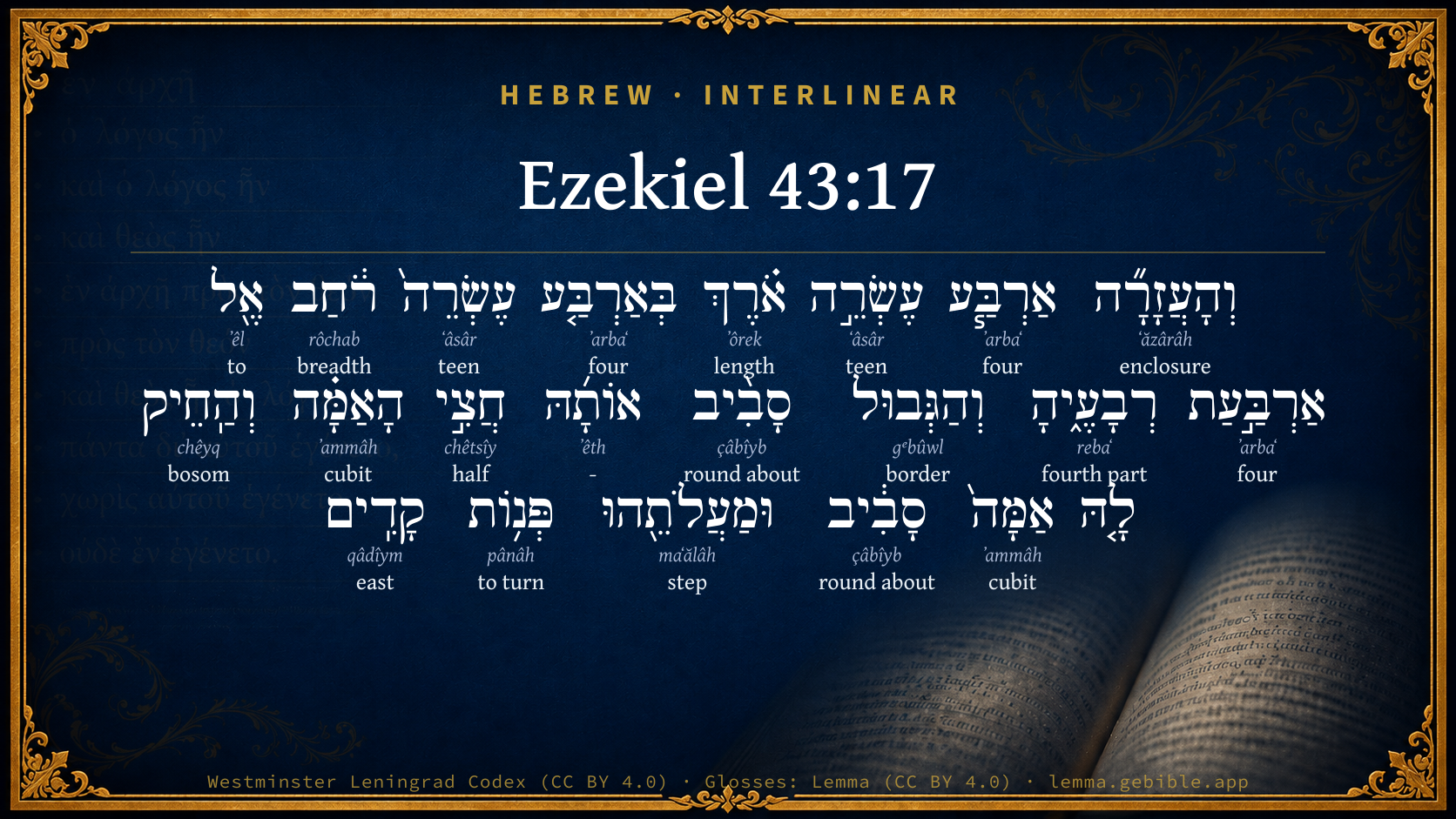
Hebrew (Westminster Leningrad Codex) Ezekiel 43:17 appears in the Hebrew Old Testament. The text above is from the Westminster Leningrad Codex. Each word links to its Strong’s number, a concise gloss, and parsing drawn from the Open Scriptures Hebrew Bible morphology. Click any word for its full Brown-Driver-Briggs (BDB) entry.
Download image
Cite this verse

Ezekiel 43:17 (World English Bible). Public Domain. Lemma interlinear Bible study tool, https://lemma.gebible.app/v/ezekiel/43/17.

Show BibTeX & RIS
BibTeX
RIS
English Translation
The ledge shall be fourteen [cubits] long by fourteen broad in the four sides of it; and the border about it shall be half a cubit; and the bottom of it shall be a cubit round about; and the steps of it shall look toward the east.
World English Bible · Public Domain
Download a study sheet

One document with this verse’s original text, its word-by-word gloss line, the meaning frame, cross-references with their text, attributed commentary, and full source and license credits — printable, and it pastes into notes with its structure intact.

This verse Autodidact and up

Study sheet (.html) Plain text (.txt)

A passage Seminary Student

Up to 50 verses in one chapter. A passage sheet keeps up to 6 commentary sources and 12 cross-references per verse, in the order this page ranks them, and says so on the sheet whenever that leaves anything out. Ask for a single verse and you get the Autodidact verse sheet above.

Everything on this page stays free to read, with no account — the sheet is a download of what is already on screen, not access to it.

Want to remove ads? Support Godless Engineer
Compare translations 3

The same verse in 3 English versions, stacked beneath the original-language interlinear above. Click any original word for its lexicon entry.

Each is an independent rendering of the whole verse — the interlinear is not word-aligned to these translations.

Highlighted words mark where these versions differ — a whole-verse word diff, not a word-by-word alignment.

  • World English Bible Public Domain
    The ledge shall be fourteen [cubits] long by fourteen broad in the four sides of it; and the border about it shall be half a cubit; and the bottom of it shall be a cubit round about; and the steps of it shall look toward the east.
  • King James Version Public Domain
    And the settle shall be fourteen cubits long and fourteen broad in the four squares thereof; and the border about it shall be half a cubit; and the bottom thereof shall be a cubit about; and his stairs shall look toward the east.
  • unfoldingWord Literal Text CC BY-SA 4.0
    Its border is fourteen cubits in length and fourteen cubits in width on each of its four sides, and its rim is a half cubit in width. The gutter is a cubit in width all around with its steps facing east.”

unfoldingWord Literal Text — © unfoldingWord, licensed CC BY-SA 4.0. Word-aligned USFM3 via Door43 (git.door43.org/unfoldingWord/en_ult).

Versions to compare (up to 4)

3 of 4 selected

Show all 18 translations

Every available English version of this verse, each an independent rendering of the whole verse.

  • World English Bible Public Domain
    The ledge shall be fourteen [cubits] long by fourteen broad in the four sides of it; and the border about it shall be half a cubit; and the bottom of it shall be a cubit round about; and the steps of it shall look toward the east.
  • Berean Standard Bible Public Domain
    The ledge shall also be square, fourteen cubits long and fourteen cubits wide, with a rim of half a cubit and a gutter of a cubit all around it. The steps of the altar shall face east.”
  • Majority Standard Bible Public Domain
    The ledge shall also be square, fourteen cubits long and fourteen cubits wide, with a rim of half a cubit and a gutter of a cubit all around it. The steps of the altar shall face east.”
  • King James Version Public Domain
    And the settle shall be fourteen cubits long and fourteen broad in the four squares thereof; and the border about it shall be half a cubit; and the bottom thereof shall be a cubit about; and his stairs shall look toward the east.
  • American Standard Version (1901) Public Domain
    And the ledge shall be fourteen `cubits' long by fourteen broad in the four sides thereof; and the border about it shall be half a cubit; and the bottom thereof shall be a cubit round about; and the steps thereof shall look toward the east.
  • Revised Version (1885) Public Domain
    And the settle shall be fourteen cubits long by fourteen broad in the four sides thereof; and the border about it shall be half a cubit; and the bottom thereof shall be a cubit about; and the steps thereof shall look toward the east.
  • Geneva Bible (1599) Public Domain
    And ye frame shalbe foureteene cubites log, and fourteene broade in the fouresquare corners thereof, and the border about it shalbe halfe a cubite, and the bottome therof shalbe a cubite about, and the steps thereof shalbe turned towarde ye East.
  • Douay-Rheims (1899) Public Domain
    And the Ariel was twelve cubits long, and twelve cubits broad, foursquare, with equal sides.
  • Young's Literal Translation Public Domain
    And the border `is' fourteen long by fourteen broad, at its four squares, and the border round about it `is' half a cubit, and the centre to it `is' a cubit round about, and its steps are looking eastward.'
  • Literal Standard Version CC BY-SA 4.0
    And the border [is] fourteen long by fourteen broad, at its four sides, and the border around it [is] half a cubit, and the center of it [is] a cubit around, and its steps are looking eastward.”
  • Unlocked Literal Bible CC BY-SA 4.0
    Its border is fourteen cubits in length and fourteen cubits in width on each of its four sides, and its rim is a half cubit in width. The gutter is a cubit in width all around with its steps facing east.”
  • unfoldingWord Literal Text CC BY-SA 4.0
    Its border is fourteen cubits in length and fourteen cubits in width on each of its four sides, and its rim is a half cubit in width. The gutter is a cubit in width all around with its steps facing east.”
  • Darby Bible Public Domain
    And the settle was fourteen [cubits] long by fourteen broad in the four sides thereof; and the border about it, half a cubit; and the bottom thereof a cubit round about: and its steps looked toward the east.
  • World Messianic Bible Public Domain
    The ledge shall be fourteen cubits long by fourteen wide in its four sides; and the border about it shall be half a cubit; and its bottom shall be a cubit around; and its steps shall look toward the east.”
  • Webster's Bible Public Domain
    And the settle shall be fourteen cubits long and fourteen broad in its four squares; and the border about it shall be half a cubit; and the bottom of it shall be a cubit about; and its stairs shall look towards the east.
  • Free Bible Version CC BY-SA 4.0
    The ledge is also to be square, measuring fourteen cubits by fourteen cubits, with a half-cubit rim and a one-cubit gutter all around it. The altar steps are to face the east.”
  • Bible in Basic English Public Domain
    And the shelf is fourteen cubits long and fourteen cubits wide, on its four sides; the edge round it is half a cubit; the base of it is a cubit all round, and its steps are facing the east.
  • JPS Tanakh (1917) Public Domain
    And the settle shall be fourteen cubits long by fourteen broad in the four sides thereof; and the border about it shall be half a cubit; and the bottom thereof shall be a cubit about; and the steps thereof shall look toward the east.'

Literal Standard Version (2020), Covenant Press — licensed CC BY-SA 4.0. Text via the HelloAO Bible API (eBible.org). Unlocked Literal Bible (unfoldingWord) — licensed CC BY-SA 4.0. Text via the HelloAO Bible API (eBible.org). unfoldingWord Literal Text — © unfoldingWord, licensed CC BY-SA 4.0. Word-aligned USFM3 via Door43 (git.door43.org/unfoldingWord/en_ult). Free Bible Version, Dr. Jonathan Gallagher — licensed CC BY-SA 4.0. Text via the HelloAO Bible API (eBible.org).

Word by word

More ways to search: Search by grammar → Find every occurrence → Compare this word →

Practice this passage: Drill this verse → Learn its vocabulary →

רְבָעֶ֑יהָ
rebaʻ
H7253
“sides · her”
Noun, Common, Masculine, Plural, Construct + Suffix, Personal, 3rd Person, Feminine, Singular
Part of Speech
Noun
Type
Common
Gender
Masculine
Number
Plural
State
Construct
Full BDB Definition

Origin: from H7251

TWOT: 2107a

fourth part, four sides - fourth part - four sides
  1. וְהָעֲזָרָ֞ה ʻăzârâh H5835 “and · the · enclosure” Conjunction + Particle, Definite Article + Noun, Common, Feminine, Singular, Absolute
  2. אַרְבַּ֧ע ʼarbaʻ H702 “four” Adjective, Cardinal number, Feminine, Singular, Absolute
  3. עֶשְׂרֵ֣ה ʻâsâr H6240 “teen” Adjective, Cardinal number, Feminine, Singular, Absolute
  4. אֹ֗רֶךְ ʼôrek H753 “length” Noun, Common, Masculine, Singular, Absolute
  5. בְּאַרְבַּ֤ע ʼarbaʻ H702 “in/at · four” Preposition + Adjective, Cardinal number, Feminine, Singular, Absolute
  6. עֶשְׂרֵה֙ ʻâsâr H6240 “teen” Adjective, Cardinal number, Feminine, Singular, Absolute
  7. רֹ֔חַב rôchab H7341 “breadth” Noun, Common, Masculine, Singular, Absolute
  8. אֶ֖ל ʼêl H413 “to” Preposition
  9. אַרְבַּ֣עַת ʼarbaʻ H702 “four” Adjective, Cardinal number, Masculine, Singular, Construct
  10. וְהַגְּבוּל gᵉbûwl H1366 “and · the · border” Conjunction + Particle, Definite Article + Noun, Common, Masculine, Singular, Absolute
  11. סָבִ֨יב çâbîyb H5439 “round about” Noun, Common, Both, Singular, Absolute
  12. אוֹתָ֜הּ ʼêth H853 “- · her” Particle, Direct Object + Suffix, Personal, 3rd Person, Feminine, Singular
  13. חֲצִ֣י chêtsîy H2677 “half of” Noun, Common, Masculine, Singular, Construct
  14. הָאַמָּ֗ה ʼammâh H520 “the · cubit” Particle, Definite Article + Noun, Common, Feminine, Singular, Absolute
  15. וְהַֽחֵיק chêyq H2436 “and · the · bosom” Conjunction + Particle, Definite Article + Noun, Common, Masculine, Singular, Absolute
  16. אַמָּה֙ ʼammâh H520 “cubit” Noun, Common, Feminine, Singular, Absolute
  17. סָבִ֔יב çâbîyb H5439 “round about” Noun, Common, Both, Singular, Absolute
  18. וּמַעֲלֹתֵ֖הוּ maʻălâh H4609 “and · steps · his” Conjunction + Noun, Common, Feminine, Plural, Construct + Suffix, Personal, 3rd Person, Masculine, Singular
  19. פְּנ֥וֹת pânâh H6437 “to turn” Verb, Qal, Infinitive Construct
  20. קָדִֽים qâdîym H6921 “east” Noun, Common, Masculine, Singular, Absolute

About this verse

These counts appear in no published source. They are computed here, from the morphology-tagged text and Lemma’s own curated glosses. What Lemma adds →

22
words
16
distinct lemmas
Prophets
section

Notable vocabulary

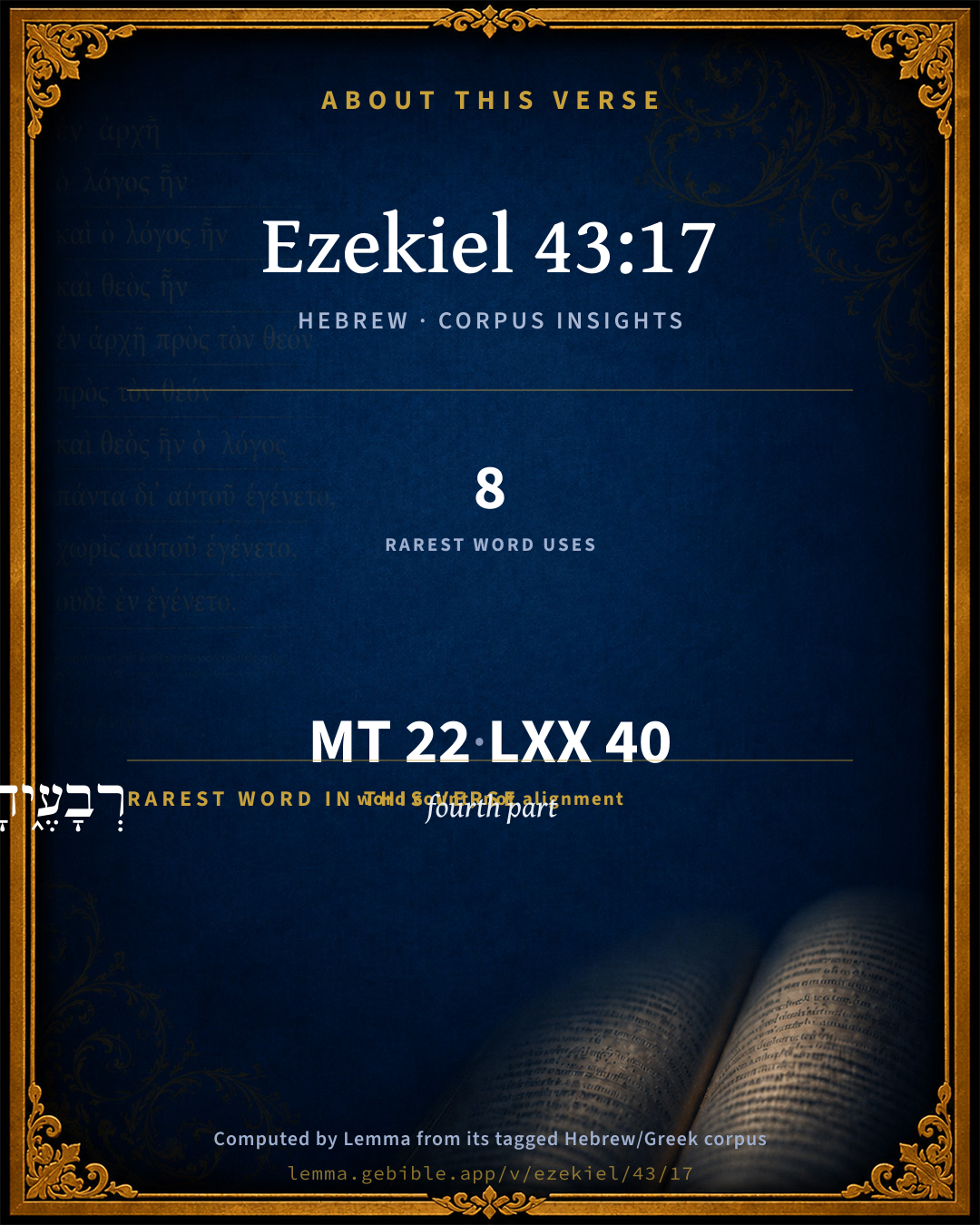
The rarest word here is רְבָעֶ֑יהָ fourth part H7253 — appearing just 8 times in the whole Hebrew Bible.

Shared distinctive vocabulary

רְבָעֶ֑יהָ fourth part H7253 occurs in 7 verses of the Hebrew Bible. Also found in:

Grammatical profile

  • 1 verb
  • 13 nouns
  • 5 adjectives
  • 2 prepositions
  • 1 particle

Verb forms

  • פְּנ֥וֹת Qal · Infinitive Construct

Repetition

Words recur within this verse — often emphatic in Hebrew:

  • אַרְבַּ֧ע four H702 ×3
  • עֶשְׂרֵ֣ה teen H6240 ×2
  • סָבִ֨יב round about H5439 ×2
  • הָאַמָּ֗ה cubit H520 ×2

Hebrew & Septuagint length

In English translation the verse runs 47 words from the Hebrew and 51 from the Septuagint (LXX English) — closely comparable.

A rough comparison of the two English renderings, which tokenize alike — not a word-level alignment.

Word counts can differ between the Hebrew and the Greek without any difference in meaning — e.g. the Hebrew direct-object marker אֵת has no separate Greek word, and Greek often adds the article ὁ.

In the original languages it is 22 Hebrew tokens and 40 Greek tokens — but the two are counted differently (Hebrew bundles its prefixes and suffixes into one token; the Greek is in lemma form), so that isn’t a like-for-like length.

Cross-references

8

Topical passages linked to Ezekiel 43:17 in the Treasury of Scripture Knowledge — connected by theme and wording, ordered by reader-vote popularity; previews shown in the World English Bible.

  • Exodus 20:26 Neither shall you go up by steps to my altar, that your nakedness may not be exposed to it.'
  • Ezekiel 40:6 Then came he to the gate which looks toward the east, and went up the steps of it: and he measured the threshold of the gate, one reed broad; and the other threshold, one reed broad.
  • Exodus 25:25 You shall make a rim of a handbreadth around it. You shall make a golden molding on its rim around it.
  • Exodus 30:3 You shall overlay it with pure gold, the top of it, the sides of it around it, and its horns; and you shall make a gold molding around it.
  • 1 Kings 6:8 The door for the middle side-chambers was in the right side of the house: and they went up by winding stairs into the middle [story], and out of the middle into the third.
  • 1 Kings 18:32 With the stones he built an altar in the name of Yahweh; and he made a trench about the altar, as great as would contain two measures of seed.
  • Nehemiah 9:4 Then stood up on the stairs of the Levites, Jeshua, and Bani, Kadmiel, Shebaniah, Bunni, Sherebiah, Bani, [and] Chenani, and cried with a loud voice to Yahweh their God.
  • Ezekiel 8:16 He brought me into the inner court of Yahweh's house; and see, at the door of the temple of Yahweh, between the porch and the altar, were about twenty-five men, with their backs toward the temple of Yahweh, and their faces toward the east; and they were worshipping the sun toward the east.

Cross-references courtesy of OpenBible.info (CC BY 4.0).

Hebrew and Greek witnesses Masoretic Hebrew ↔ Greek Septuagint

The same verse in the two great witnesses to the Old Testament, shown verse-for-verse.

These are two independent witnesses, not word-aligned to each other, and the Septuagint is shown in lemma (dictionary) form.

Hebrew Ezekiel 43:17 Masoretic · Westminster Leningrad Codex

וְהָעֲזָרָ֞ה אַרְבַּ֧ע עֶשְׂרֵ֣ה אֹ֗רֶךְ בְּאַרְבַּ֤ע עֶשְׂרֵה֙ רֹ֔חַב אֶ֖ל אַרְבַּ֣עַת רְבָעֶ֑יהָ וְהַגְּבוּל סָבִ֨יב אוֹתָ֜הּ חֲצִ֣י הָאַמָּ֗ה וְהַֽחֵיק לָ֤הּ אַמָּה֙ סָבִ֔יב וּמַעֲלֹתֵ֖הוּ פְּנ֥וֹת קָדִֽים

The ledge shall be fourteen [cubits] long by fourteen broad in the four sides of it; and the border about it shall be half a cubit; and the bottom of it shall be a cubit round about; and the steps of it shall look toward the east.

World English Bible · Public Domain

Greek LXX Ezekiel 43:17 Septuagint · lemma form

καί ὁ ἱλαστήριον πηχύς δέκα τέσσαρες ὁ μῆκος ἐπί πῆχυς δέκα τέσσαρες ὁ εὖρος ἐπί τέσσαρες μέρος αὐτός καί ὁ γεῖσος αὐτός κυκλόθεν κυκλόω αὐτός ἥμισυς πῆχυς καί ὁ κύκλωμα αὐτός πῆχυς κυκλόθεν καί ὁ κλιμακτήρ αὐτός βλέπω κατά ἀνατολή

And the mercy-seat shall be fourteen cubits in length, by fourteen cubits in breadth on its four sides; and there shall be a border to it carried round about it of half a cubit; and the rim of it shall be a cubit round about; and the steps thereof looking eastward.

LXX2012 (modern English Septuagint) · Public Domain

Hebrew: Westminster Leningrad Codex (CC BY 4.0). Greek: Septuagint (public domain); English from LXX2012 (modern English Septuagint) (Public Domain). How the Septuagint differs from the Hebrew →

Targum (Aramaic paraphrase)

1

The Targum is the ancient Jewish Aramaic paraphrase of the Hebrew Scriptures — an interpretive translation, not the Hebrew text itself. Onkelos (literal) and Pseudo-Jonathan (expansive) render the Torah, and Jonathan the Prophets. Coverage is partial: where no permissively-licensed English translation exists for a verse, only the Aramaic is shown. This is verse-level text, not a word-by-word alignment to the Hebrew.

  1. Targum Jonathan Prophets (Joshua–Malachi)
    וּמִסַמְתָּא אַרְבַּע אַסְרֵי פוּתְיָא עַל אַרְבַּע סִיטְרָהָא וּגְדַנְפָא מַקַף לָהּ סְחוֹר סְחוֹר פַּלְגוּת אַמְתָא וְתַשְׁוִיתָא לָהּ אַמְתָא סְחוֹר סְחוֹר וְדַרְגָן דְסָלְקִין לָה מִתְפַּנָן לְמַדִינְחָא:

    (no public-domain English translation for this verse)

    Targum Jonathan — Aramaic: “Mikraot Gedolot” (public domain). English: “Sefaria Community Translation” (CC0 1.0 (public-domain dedication)); “London "Chaldee Paraphrase," 1871” (public domain). Text via Sefaria.

Commentary

Notes on Ezekiel 43:17 from classic Christian and Jewish commentators (each source and its license shown beneath its notes). The classic Christian expositions comment on the surrounding passage and are grouped to its opening verse, so a note may address several verses; the Jewish commentaries on the Tanakh (Rashi and others) are per-verse, so they appear only where the commentator wrote on this verse.

Lemma curates 59 commentaries, every one of them public domain or Creative Commons licensed, each selected and text-cleaned for this edition rather than reprinted as found. About our sources →

Adam Clarke's Commentary

Verse 17. And the settle] The ledge on which the priests walked round the altar, see Eze 43:14. By these settles or ledges the altar was narrowed towards the top. "The ascent shall look toward the east;" this ascent was an inclined plane. But these settles, or more properly ledges, as Bp. Newcome translates, may be thus computed. The altar itself was ten feet high and twenty broad; the same as that of Solomon, 2Ch 4:1.

Cubits

For the base, Eze 43:13, is in height . . .

1

From the surface of the base to the first ledge, Eze 43:14, is . . .

1

From the lower ledge to the upper, Eze 43:14, are . . . .

4

From the upper ledge to the ariel or hearth, Eze 43:15, are . . .

4

___ In all . . . .

10

And as to the breadth, the upper ledge, Eze 43:17, was. . . .

14

Add a cubit on each side for the higher ledge, Eze 43:14, latter part . .

2

Add a cubit on each side for the lower ledge, Eze 43:14, former part . .

2

Add a cubit on each side for the base, Eze 43:13, . . .

2

___ In all . . . .

20

The altar of burnt-offerings, described Ex 27:1; Ex 38:1, was smaller than this, because it was to be removed from place to place with the tabernacle. This was designed for a permanent temple. See Bp. Newcome on this chapter.

Adam Clarke's Commentary on the Bible (1810–1826) — public domain. Text from a community e-Sword/MySword module.

The Cambridge Bible for Schools and Colleges

gen. ed. J. J. S. Perowne

17. The “settle” referred to here is the higher or greater one (Eze_43:14). Its area was a square of 14 cubits. The verse appears to say that this uppermost ledge had a border and an “enclosure” or setting just as the basement had. If so the “setting” or bosom was that for the Harel arising out of the block, and its size, a cubit, is simply the ledge itself. There is no ground at least to suppose that the “border” and setting refer to the altar-hearth—from which the measurer has descended and come down at any rate as far as the uppermost ledge. It may be made a question whether in the last half of Eze_43:17 he has not descended to the foot of the edifice, and whether the “border” and “bosom” be not those already referred to in connection with the basement (Eze_43:13). For (1) the measurements are the same—a span (Eze_43:13) being equivalent to half a cubit (Eze_43:17). (2) Immediately after mention of the “border” and bosom or setting the “steps” are referred to by which the altar as a whole was ascended, which seems to imply that the speaker conceived himself upon the ground (Eze_43:17.) (3) Further in Eze_43:20 blood is to be put upon the horns of the altar-hearth, upon the four corners of the upper ledge (settle) and upon the “border” round about; and it is certainly natural that the blood should be put on all the stages of the altar, the top, the middle and the basement.

For squares read sides; for bottom basement; and by stairs is meant steps. The whole height of the altar was probably 12 cubits and the basement a square of 18. Thus height of basement 1 (Eze_43:13) + 2 (lowest block) + 4 (higher block) + 4 (block of altar-hearth) + 1 (horn) = 12. On breadth see preliminary remark to Eze_43:13-17.

The Cambridge Bible for Schools and Colleges (gen. ed. J. J. S. Perowne; Cambridge University Press, 1878–1918) — public domain. Text from a community e-Sword module.

Trapp's Complete Commentary

John Trapp

Eze 43:17 And the settle [shall be] fourteen [cubits] long and fourteen broad in the four squares thereof; and the border about it [shall be] half a cubit; and the bottom thereof [shall be] a cubit about; and his stairs shall look toward the east.

Ver. 17. And his stairs shall look toward the east.] As leading to the Sun of righteousness, and the light of eternal blessedness, arising out of heaven.

John Trapp, A Commentary or Exposition upon All the Books of the Old and New Testament (1647–1656) — public domain. Text from a community e-Sword module.

Tyndale Open Study Notes

Tyndale Open Resources

43:17 This altar was approached by steps going up the east side. This reversal of the normal ancient Near Eastern practice of having the steps approach from the west was possibly to avoid any hint of sun worship (see 8:16).

Tyndale Open Study Notes — © Tyndale Open Resources, licensed CC BY-SA 4.0. Text via the HelloAO Bible API.

Jamieson, Fausset & Brown

Robert Jamieson, A. R. Fausset & David Brown

settle--ledge [FAIRBAIRN].

stairs--rather, "the ascent," as "steps" up to God's altar were forbidden in Exo 20:26.

Jamieson, Fausset & Brown — Commentary Critical and Explanatory on the Whole Bible (1871) — public domain (CC PDM 1.0). Text via the HelloAO Bible API.

John Gill's Exposition

And the settle shall be fourteen cubits long and fourteen broad in the four squares thereof,.... Here Kimchi confesses his ignorance. Jarchi interprets it, the top of the altar, with the place of the horns, and of the feet of the priests, and was twenty eight cubits by twenty eight, the fourteen mentioned being to be measured from the middle (z); and he seems to be right in making it to be the upper part of the altar, and not the lower settle, as some; the focus or hearth where the wood was laid, and the sacrifice burnt; and which had a projection of a cubit on each side, and so made the twelve cubits, the length and breadth of the altar, fourteen:

and the border about it shall be half a cubit; or the enclosure, as the Targum; the ledge about it, which went round the altar, to keep the fire or sacrifice from falling, or that the feet of the priests might not slip: the Jews expound it of the horns:

and the bottom thereof shall be a cubit about; or the foundation, as the Targum; which was between the altar, and the border on which the priests walked, when they went round it, to do the business of it: here Kimchi owns his ignorance again;

and his stairs shall look towards the east; steps to the altar were forbidden by the law of Moses, Exo 20:26 wherefore, as the height of the altar of Solomon, and so of the second temple, required some way and method of ascent to the top of it, to do the business upon it; the Jews had what they call "kibbesh", a way made of earth thrown up, which rose gradually, and led to the top of it, and was about two and thirty cubits long, and sixteen broad (a); but here steps or stairs are expressly mentioned, which show that this refers to times when the Mosaic and ceremonial laws should be abolished. These stairs were placed eastward, so that those that went up them looked toward the west, toward the temple and house of God, where he dwelt; and turned their backs to the east, or rising sun, in direct opposition to the worshippers of the sun, whose faces were to the east. How many steps or stairs there were to the altar is not said; Starckius conjectures there might be twelve or fourteen of them, and allows for each step half a cubit; but as the altar was ten, or, as others, eleven cubits high, there should be twenty steps or more, of such a measure. These may signify the several ways and means of coming to, and increasing in, the knowledge of the doctrine of the altar, or of Christ's satisfaction for sin; as hearing, reading, prayer, meditation, &c.

(z) So Lipman. Tzurath Beth Hamikdash, sect. 40. Vid. Misn. Middot, c. 3. sect. 1. (a) So Lipman. Tzurath Beth Hamikdash, sect. 43.

John Gill's Exposition of the Whole Bible (1746–1763) — public domain (CC PDM 1.0). Text via the HelloAO Bible API.

Albert Barnes' Notes on the Bible

The settle - The “lower settle” (L), projecting beyond the “upper settle” (M) one cubit on every side.

His stairs - Jewish tradition says that the approach to the altar was by an inclined plane, because to go up “by steps” was forbidden Exo 20:26.

The number “twelve” was symbolic of the twelve tribes, “four,” of the earth; “sixteen” is the square of “four,” and “fourteen” the double of “seven,” the number of the covenant, as being composed of “three,” the number of God, and of “four,” the number of the world. Thus we have in the altar a special instance of Hebrew symbolism.

Albert Barnes' Notes on the Bible (1834–1885) — public domain. Text from a community e-Sword/MySword module.

Haydock's Catholic Bible Commentary

Crown, which was usually placed round altars and tables, that nothing might fall down. --- Bottom of the altar, or base, mentioned [in] ver. 13. --- Steps, boarded one each side, Exodus xx. 26.

George Leo Haydock (1774–1849), Haydock's Catholic Family Bible and Commentary, 1859 edition — public domain. Excludes Psalms (Douay-Rheims chapter numbering differs from Protestant) and Deuterocanonical books (Catholic canon only).

Matthew Poole's English Annotations

The settle; so called now, since the uppermost carrieth the name of altar, proper to itself.

Fourteen cubits, as said in the former verse: nor can it be otherwise, since it is one cubit on each side broader than the altar, which was twelve cubits square.

The border; or a border, or ledge, fastened to the edge of the outside of this bench, that goes round about the settle.

Half a cubit; about eleven inches, being the half of this great cubit: now this border was for security to the priests in their going round the altar, that if a foot slipped, this border might stay it.

The bottom, the superficies, on which the priest treads when he is doing any thing on the altar, or the breadth of this bench within the border,

a cubit.

Stairs, or steps, for such they needed; and probably each stair about one fourth of a cubit, to carry them up to the first and second settles. These stairs were placed eastward, that he who went up should have his face to the west, his back to the east; his face toward God, not toward the rising sun, as they who made the sun their idol.

Matthew Poole's English Annotations on the Holy Bible (1683–1685) — public domain. Text from a community e-Sword/MySword module.

John Wesley's Explanatory Notes

Stairs - Or steps, for such they needed, (probably each stair about one fourth of a cubit,) to carry them, up to the first and second settles.

John Wesley, Explanatory Notes Upon the Whole Bible (1754–1765) — public domain. Text via the GEBible commentary corpus.

Rashi

Rabbi Shlomo Yitzchaki (Rashi)

And the ledge, fourteen [cubits in] length The top of the altar, including the area for the horns and including the area for the feet of the priests, was 28 by 28 [cubits], and the 14 mentioned here were measured from its center, as is explained by “to its four sides.”

and the boundary around it Jonathan renders: and the rim, but our Sages explained it as referring to the horns.

half a cubit He measures from its center; hence it was a cubit by a cubit.

and its base a cubit This is the recession of the base.

and its ascents will look towards the east The ramp upon which they ascended was in the south in order that the one who ascended it would face east, for all the [priests’] turns were made toward the right, and when you place the ramp in the south, the one who ascends it and turns right faces east.

Rashi on the Tanakh — English translations: “The Judaica Press complete Tanach with Rashi, translated by A. J. Rosenberg” (CC BY 4.0); “Pentateuch with Rashi's commentary by M. Rosenbaum and A.M. Silbermann, 1929-1934” (public domain); “The Metsudah Tanach series, Lakewood, N.J” (CC BY 4.0); and “The Book of Joshua, Metsudah Publications, 1997” (CC BY 4.0). Text via Sefaria.

Lesson kit

Teaching starters — assembled from the data on this page, not authored interpretation. Every prompt links to the verse data it draws on. Edit before teaching.

Ezekiel, in the Prophets, opens this verse with 22 words (16 distinct Hebrew lemmas). Its most distinctive word is rebaʻ (“fourth part”). A historical commentator’s framing appears above. Read the whole chapter for the surrounding context.

Discussion questions

  1. The word rebaʻ carries the sense “fourth part.” How does it shape the verse?
  2. Exodus 29:40 shares the word «fourth part» with this verse. How do the two illuminate each other?
  3. “four” occurs 3× in this one verse. What is the effect of the repetition?
  4. The translations on this page render this verse differently — a whole-verse word diff, not a word-by-word alignment. What might account for the different wordings?
  5. The verb «פְּנ֥וֹת» is Qal Infinitive Construct. How does its form color the action?
  6. Reading how Adam Clarke's Commentary and The Cambridge Bible for Schools and Colleges read this verse, where do the two commentators agree and where do they part?

Things to notice

Reading settings

Reading text

Shown beneath each verse's original-language words.

Old Testament
Old Testament edition

Read the OT as the Masoretic Hebrew (MT) or the Greek Septuagint (LXX).

English shown for the Greek Septuagint (in the Hebrew ↔ Greek comparison).

Comparing translations? Open the Compare panel on any verse page to stack up to four side by side.