Joel 3:6

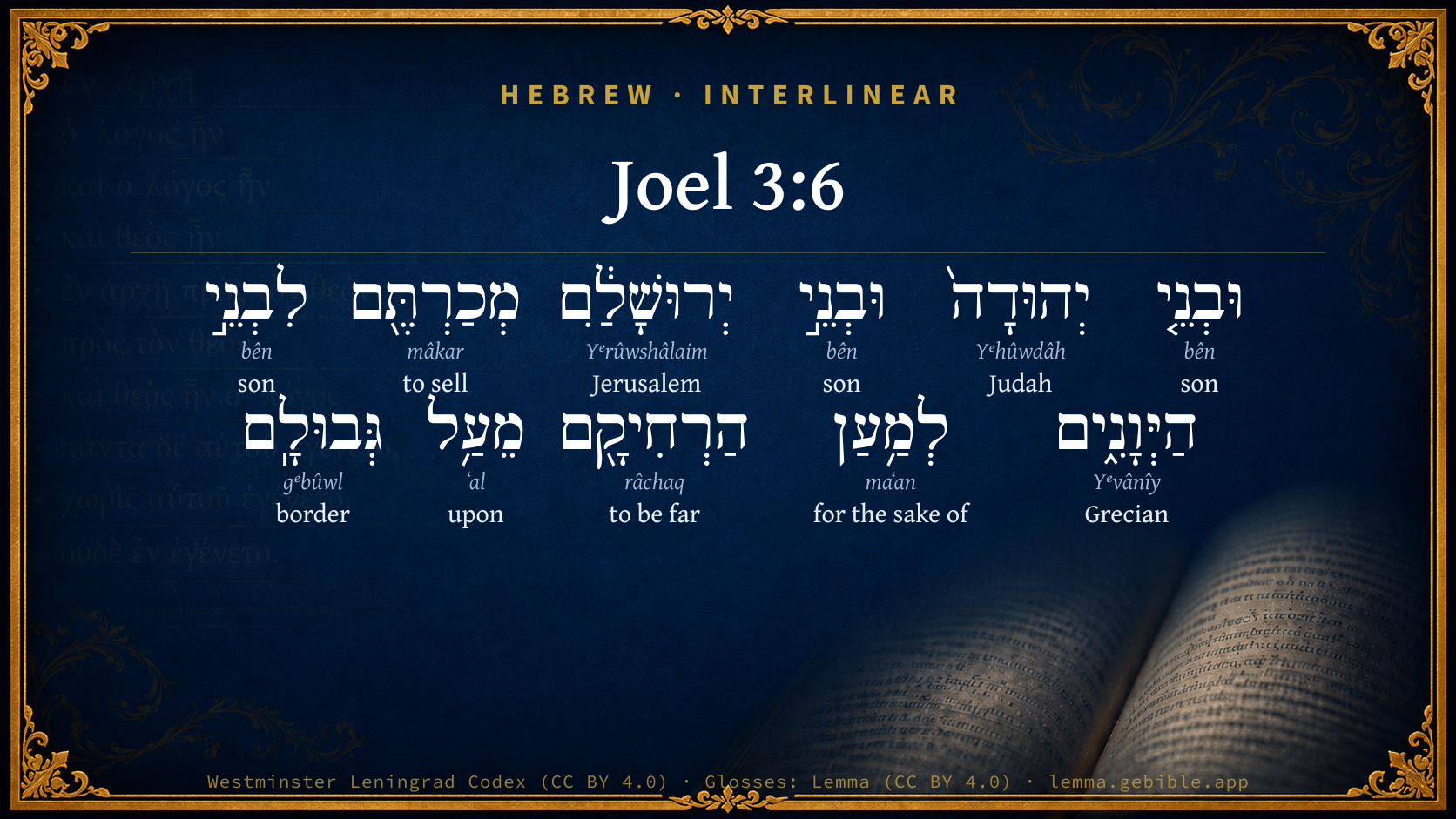
Hebrew (Westminster Leningrad Codex) Joel 3:6 appears in the Hebrew Old Testament. The text above is from the Westminster Leningrad Codex. Each word links to its Strong’s number, a concise gloss, and parsing drawn from the Open Scriptures Hebrew Bible morphology. Click any word for its full Brown-Driver-Briggs (BDB) entry.
Download image
Cite this verse

Joel 3:6 (World English Bible). Public Domain. Lemma interlinear Bible study tool, https://lemma.gebible.app/v/joel/3/6.

Show BibTeX & RIS
BibTeX
RIS
English Translation
And have sold the children of Judah and the children of Jerusalem to the sons of the Greeks, That you may remove them far from their border.
World English Bible · Public Domain
Highlights
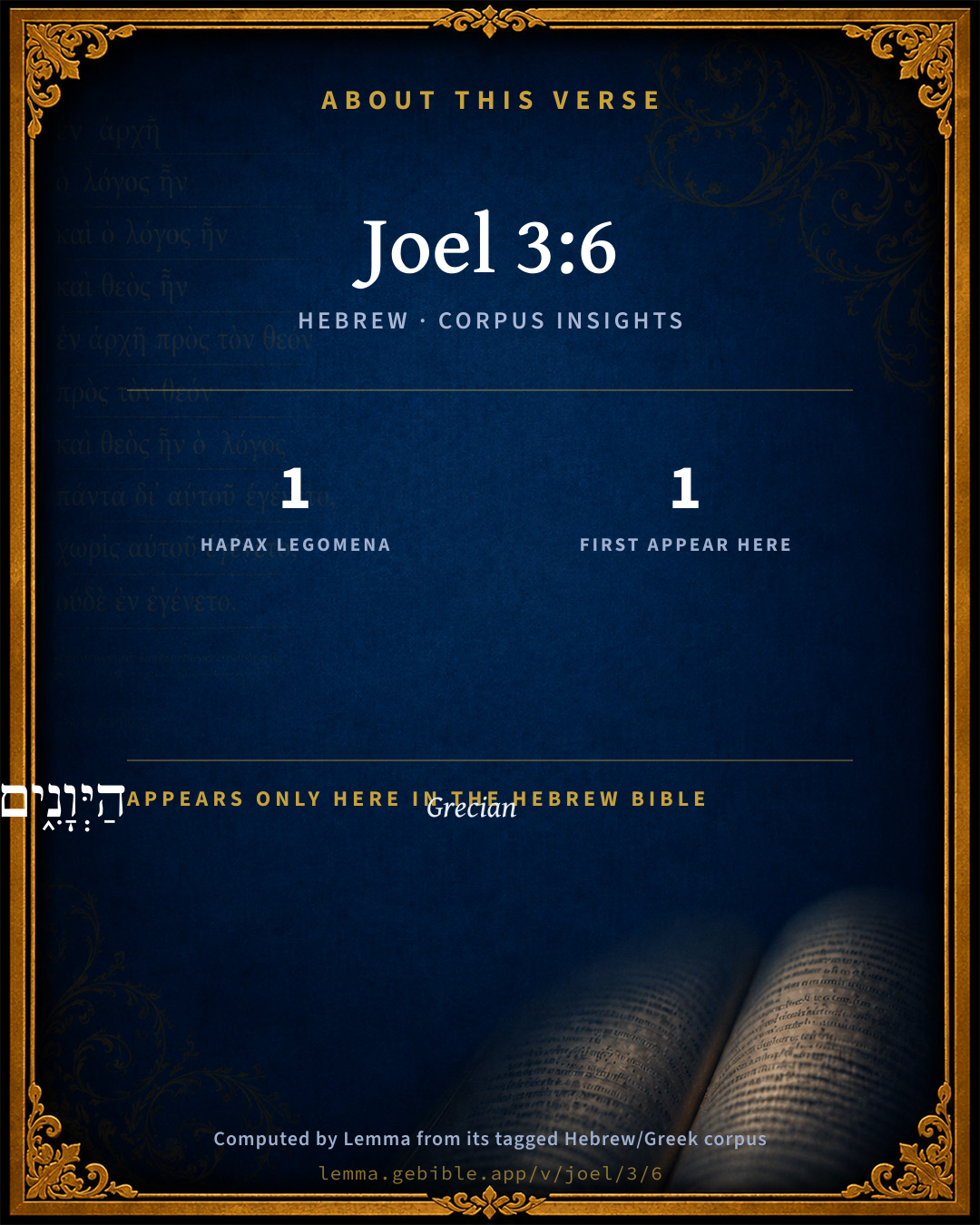
  • 1 hapax legomenon — only here in the Hebrew Bible
  • 1 first appearance in the Hebrew Bible
Full analysis ↓
Download a study sheet

One document with this verse’s original text, its word-by-word gloss line, the meaning frame, cross-references with their text, attributed commentary, and full source and license credits — printable, and it pastes into notes with its structure intact.

This verse Autodidact and up

Study sheet (.html) Plain text (.txt)

A passage Seminary Student

Up to 50 verses in one chapter. A passage sheet keeps up to 6 commentary sources and 12 cross-references per verse, in the order this page ranks them, and says so on the sheet whenever that leaves anything out. Ask for a single verse and you get the Autodidact verse sheet above.

Everything on this page stays free to read, with no account — the sheet is a download of what is already on screen, not access to it.

Want to remove ads? Support Godless Engineer
Compare translations 3

The same verse in 3 English versions, stacked beneath the original-language interlinear above. Click any original word for its lexicon entry.

Each is an independent rendering of the whole verse — the interlinear is not word-aligned to these translations.

Highlighted words mark where these versions differ — a whole-verse word diff, not a word-by-word alignment.

  • World English Bible Public Domain
    And have sold the children of Judah and the children of Jerusalem to the sons of the Greeks, That you may remove them far from their border.
  • King James Version Public Domain
    The children also of Judah and the children of Jerusalem have ye sold unto the Grecians, that ye might remove them far from their border.
  • unfoldingWord Literal Text CC BY-SA 4.0
    And you sold the sons of Judah and the sons of Jerusalem to the sons of Javan, in order to remove them far from their territory.

unfoldingWord Literal Text — © unfoldingWord, licensed CC BY-SA 4.0. Word-aligned USFM3 via Door43 (git.door43.org/unfoldingWord/en_ult).

Versions to compare (up to 4)

3 of 4 selected

Show all 18 translations

Every available English version of this verse, each an independent rendering of the whole verse.

  • World English Bible Public Domain
    And have sold the children of Judah and the children of Jerusalem to the sons of the Greeks, That you may remove them far from their border.
  • Berean Standard Bible Public Domain
    You sold the people of Judah and Jerusalem to the Greeks, to send them far from their homeland.
  • Majority Standard Bible Public Domain
    You sold the people of Judah and Jerusalem to the Greeks, to send them far from their homeland.
  • King James Version Public Domain
    The children also of Judah and the children of Jerusalem have ye sold unto the Grecians, that ye might remove them far from their border.
  • American Standard Version (1901) Public Domain
    and have sold the children of Judah and the children of Jerusalem unto the sons of the Grecians, that ye may remove them far from their border;
  • Revised Version (1885) Public Domain
    the children also of Judah and the children of Jerusalem have ye sold unto the sons of the Grecians, that ye might remove them far from their border:
  • Geneva Bible (1599) Public Domain
    The children also of Iudah and the children of Ierusalem haue you solde vnto the Grecians, that ye might send them farre from their border.
  • Douay-Rheims (1899) Public Domain
    And the children of Juda, and the children of Jerusalem you have sold to the children of the Greeks, that you might remove them far off from their own country.
  • Young's Literal Translation Public Domain
    And sons of Judah, and sons of Jerusalem, Ye have sold to the sons of Javan, To put them far off from their border.
  • Literal Standard Version CC BY-SA 4.0
    And sons of Judah, and sons of Jerusalem, || You have sold to the sons of Javan, || To put them far off from their border.
  • Unlocked Literal Bible CC BY-SA 4.0
    You sold the people of Judah and Jerusalem to the Greeks, in order to remove them far from their territory.
  • unfoldingWord Literal Text CC BY-SA 4.0
    And you sold the sons of Judah and the sons of Jerusalem to the sons of Javan, in order to remove them far from their territory.
  • Darby Bible Public Domain
    and the children of Judah and the children of Jerusalem have ye sold unto the children of the Greeks, that ye might remove them far from their border.
  • World Messianic Bible Public Domain
    and have sold the children of Judah and the children of Jerusalem to the sons of the Greeks, that you may remove them far from their border.
  • Webster's Bible Public Domain
    \\3:1\\For behold, in those days, and in that time, when I shall bring again the captivity of Judah and Jerusalem,
  • Free Bible Version CC BY-SA 4.0
    You sold the people of Judah and Jerusalem to the Greeks so they could be sent far away from their land.
  • Bible in Basic English Public Domain
    For in those days and in that time, when I let the fate of Judah and Jerusalem be changed,
  • JPS Tanakh (1917) Public Domain
    (4-6) the children also of Judah and the children of Jerusalem have ye sold unto the sons of Jevanim, that ye might remove them far from their border;

Literal Standard Version (2020), Covenant Press — licensed CC BY-SA 4.0. Text via the HelloAO Bible API (eBible.org). Unlocked Literal Bible (unfoldingWord) — licensed CC BY-SA 4.0. Text via the HelloAO Bible API (eBible.org). unfoldingWord Literal Text — © unfoldingWord, licensed CC BY-SA 4.0. Word-aligned USFM3 via Door43 (git.door43.org/unfoldingWord/en_ult). Free Bible Version, Dr. Jonathan Gallagher — licensed CC BY-SA 4.0. Text via the HelloAO Bible API (eBible.org).

Word by word

More ways to search: Search by grammar → Find every occurrence → Compare this word →

Practice this passage: Drill this verse → Learn its vocabulary →

הַיְּוָנִ֑ים
Yᵉvânîy
H3125
“the · Grecians”
Particle, Definite Article + Noun, Gentilic, Masculine, Plural, Absolute
Part of Speech
Particle + Noun
Type
Gentilic
Gender
Masculine
Number
Plural
State
Absolute
Full BDB Definition

Origin: patronymically from H3121

TWOT: None

Grecian, Ionian
  1. וּבְנֵ֤י bên H1121 “and · sons of” Conjunction + Noun, Common, Masculine, Plural, Construct
  2. יְהוּדָה֙ Yᵉhûwdâh H3063 “Judah” Noun, Proper
  3. וּבְנֵ֣י bên H1121 “and · sons of” Conjunction + Noun, Common, Masculine, Plural, Construct
  4. יְרוּשָׁלִַ֔ם Yᵉrûwshâlaim H3389 “Jerusalem” Noun, Proper
  5. מְכַרְתֶּ֖ם mâkar H4376 “to sell” Verb, Qal, Perfect, 2nd Person, Masculine, Plural
  6. לִבְנֵ֣י bên H1121 “to/for · sons of” Preposition + Noun, Common, Masculine, Plural, Construct
  7. לְמַ֥עַן maʻan H4616 “for the sake of” Preposition
  8. הַרְחִיקָ֖ם râchaq H7368 “to be far · them” Verb, Hiphil, Infinitive Construct + Suffix, Personal, 3rd Person, Masculine, Plural
  9. מֵעַ֥ל ʻal H5921 “from · upon” Preposition + Preposition
  10. גְּבוּלָֽם gᵉbûwl H1366 “border · their” Noun, Common, Masculine, Singular, Construct + Suffix, Personal, 3rd Person, Masculine, Plural

About this verse

These counts appear in no published source. They are computed here, from the morphology-tagged text and Lemma’s own curated glosses. What Lemma adds →

11
words
9
distinct lemmas
Prophets
section

Notable vocabulary

1 hapax legomenon — a word that appears only here in the entire Hebrew Bible:

  • הַיְּוָנִ֑ים Grecian H3125

First appearance in Scripture

This word makes its first canonical appearance in the Hebrew Bible here:

  • הַיְּוָנִ֑ים Grecian H3125

Shared distinctive vocabulary

הַרְחִיקָ֖ם to be far H7368 occurs in 56 verses of the Hebrew Bible. Also found in:

Grammatical profile

  • 2 verbs
  • 7 nouns
  • 2 prepositions

Verb forms

  • מְכַרְתֶּ֖ם Qal · Perfect
  • הַרְחִיקָ֖ם Hiphil · Infinitive Construct

Repetition

A word recurs within this verse — often emphatic in Hebrew:

  • וּבְנֵ֤י son H1121 ×3

Hebrew & Septuagint length

In English translation the verse runs 27 words from the Hebrew and 27 from the Septuagint (LXX English) — the same length.

A rough comparison of the two English renderings, which tokenize alike — not a word-level alignment.

Word counts can differ between the Hebrew and the Greek without any difference in meaning — e.g. the Hebrew direct-object marker אֵת has no separate Greek word, and Greek often adds the article ὁ.

Cross-references

5

Topical passages linked to Joel 3:6 in the Treasury of Scripture Knowledge — connected by theme and wording, ordered by reader-vote popularity; previews shown in the World English Bible.

  • Ezekiel 27:13 Javan, Tubal, and Meshech, they were your traffickers; they traded the persons of men and vessels of brass for your merchandise.
  • Joel 3:3 And have cast lots for my people, And have given a boy for a prostitute, And sold a girl for wine, that they may drink.
  • Deuteronomy 28:68 Yahweh will bring you into Egypt again with ships, by the way of which I said to you, You shall see it no more again: and there you shall sell yourselves to your enemies for bondservants and for bondmaids, and no man shall buy you.
  • Joel 3:8 And I will sell your sons and your daughters into the hands of the children of Judah, And they will sell them to the men of Sheba, To a faraway nation, For Yahweh has spoken it."
  • Deuteronomy 28:32 Your sons and your daughters shall be given to another people; and your eyes shall look, and fail with longing for them all the day: and there shall be nothing in the power of your hand.

Cross-references courtesy of OpenBible.info (CC BY 4.0).

Hebrew and Greek witnesses Masoretic Hebrew ↔ Greek Septuagint

The same verse in the two great witnesses to the Old Testament, shown verse-for-verse.

These are two independent witnesses, not word-aligned to each other, and the Septuagint is shown in lemma (dictionary) form.

Hebrew Joel 3:6 Masoretic · Westminster Leningrad Codex

וּבְנֵ֤י יְהוּדָה֙ וּבְנֵ֣י יְרוּשָׁלִַ֔ם מְכַרְתֶּ֖ם לִבְנֵ֣י הַיְּוָנִ֑ים לְמַ֥עַן הַרְחִיקָ֖ם מֵעַ֥ל גְּבוּלָֽם

And have sold the children of Judah and the children of Jerusalem to the sons of the Greeks, That you may remove them far from their border.

World English Bible · Public Domain

Greek LXX Joel 3:6 Septuagint · lemma form
and you⌃ have sold the children of Juda and the children of Jerusalem to the children of the Greeks, that you⌃ might expel them from their coasts.

LXX2012 (modern English Septuagint) · Public Domain

Hebrew: Westminster Leningrad Codex (CC BY 4.0). Greek: Septuagint (public domain); English from LXX2012 (modern English Septuagint) (Public Domain). How the Septuagint differs from the Hebrew →

Commentary

Notes on Joel 3:6 from classic Christian and Jewish commentators (each source and its license shown beneath its notes). The classic Christian expositions comment on the surrounding passage and are grouped to its opening verse, so a note may address several verses; the Jewish commentaries on the Tanakh (Rashi and others) are per-verse, so they appear only where the commentator wrote on this verse.

Lemma curates 59 commentaries, every one of them public domain or Creative Commons licensed, each selected and text-cleaned for this edition rather than reprinted as found. About our sources →

Trapp's Complete Commentary

John Trapp

Joe 3:6 The children also of Judah and the children of Jerusalem have ye sold unto the Grecians, that ye might remove them far from their border.

Ver. 6. The children also of Judah, and the children of Jerusalem] "The precious sons of Zion, comparable to fine gold," Lam 4:2, with whom you were anciently confederate in the days of Solomon, 1Ki 4:25, and seemed to be then their prosperity proselytes.

Have ye sold unto the Grecians] That is, to the Gentiles in general, for so St Paul often useth the word Grecians, as contradistinct to Jews; who were barbarously sold, as if they had been brute beasts, and that into the farthest countries, that they might never ransom themselves, nor return to their native soil again. This was singular, yea, savage cruelty, which the merciful God cannot abide, but will severely punish, Jas 2:13-14 Isa 47:6, "Thou didst show them no mercy; upon the ancient hast thou very heavily laid thy yoke." See the Babylonian cruelty graphically described, and accordingly recompensed, Jer 51:34-35, &c. The Spanish cruelty to the poor Indians is unspeakable. They have made away 50,000,000 of them in 42 years, as Acosta the Jesuit testieth, and that under pretence of converting them to the faith. They suppose they show the wretches great favour when they do not (for their pleasure) whip them with cords, and day by day drop their naked bodies with burning bacon: such a devil is one man to another, when set to work by the devil, and spurred on by him. But "shall they thus escape by iniquity? in thine anger cast down the people, O God," Psa 56:7. He will do it: for those words are not more a prayer than a prophecy.

John Trapp, A Commentary or Exposition upon All the Books of the Old and New Testament (1647–1656) — public domain. Text from a community e-Sword module.

Joseph Benson's Commentary

Joe 3:6. The children also of Judah, &c., have ye sold unto the Grecians — The descendants of Javan, Gen 10:2; Gen 10:5. They trafficked with Tyre, and traded in slaves, Eze 27:13. It was customary for the merchants of the neighbouring countries, particularly of Tyre and Sidon, to buy the children of Israel for slaves of their conquerors, in order to sell them again: see 1Ma 3:41. The histories which record the calamities of the Jews, speak of great numbers of them being made captives, and then sold and dispersed into foreign countries. Thus forty thousand were sold by Antiochus Epiphanes, 2Ma 5:14; and about ninety-seven thousand at the destruction of Jerusalem by Titus.

Joseph Benson's Commentary on the Old and New Testaments (1811–1818) — public domain. Text from a community e-Sword module.

Jamieson, Fausset & Brown

Robert Jamieson, A. R. Fausset & David Brown

Grecians--literally, "Javanites," that is, the Ionians, a Greek colony on the coast of Asia Minor who were the first Greeks known to the Jews. The Greeks themselves, however, in their original descent came from Javan (Gen 10:2, Gen 10:4). Probably the germ of Greek civilization in part came through the Jewish slaves imported into Greece from Phœnicia by traffickers. Eze 27:13 mentions Javan and Tyre as trading in the persons of men.

far from their border--far from Judea; so that the captive Jews were cut off from all hope of return.

Jamieson, Fausset & Brown — Commentary Critical and Explanatory on the Whole Bible (1871) — public domain (CC PDM 1.0). Text via the HelloAO Bible API.

Adam Clarke's Commentary

Verse 6. Sold unto the Grecians] These were the descendants of Javan, Ge 10:2-5. And with them the Tyrians trafficked, Eze 27:19.

That ye might remove them far from their border.] Intending to send them as far off as possible, that it might be impossible for them to get back to reclaim the land of which you had dispossessed them.

Adam Clarke's Commentary on the Bible (1810–1826) — public domain. Text from a community e-Sword/MySword module.

John Calvin's Commentaries

It follows, And the children of Judah, and the children of Jerusalem, have ye sold to the children of the Grecians . There is here another complaint subjoined, — that the Syrians and Sidonians had been sacrilegious towards God, that they had cruelly treated God’s afflicted people. In the last verse, God inveighed against the Syrians, and Sidonians for having prostituted to their idols gold and silver stolen from him; he now again returns to the Jews themselves, who, he says, had been sold to the children of the Grecians; that is, to people beyond the sea: for as Javan passed into Europe, he includes under that name the nations beyond the sea. And he says, that they sold the Jews to the Greeks that they might drive them far from their own borders, so that there might be no hope of return. Here the cruelty of the Syrians and Sidonians becomes more evident; for they took care to drive those wretched men far away, that no return to their country might be open to them, but that they might be wholly expatriated.

We now perceive what the Prophet had in view: He intended that the faithful though trodden under foot by the nations, should yet have allayed their grief by some consolation, and know that they were not neglected by God; and that though he connived at their evils for a time, he would yet be their defender, and would contend for them as for his own heritage, because they had been so unjustly treated. He afterwards adds —

John Calvin's Commentaries (1540-1563) — public domain. Text from the Calvin Translation Society English edition (1840s-50s) via the Christian Classics Ethereal Library (ccel.org). Calvin's coverage is partial (roughly two-thirds of the Bible); uncommented books and verses are honest gaps, never fabricated. The 19th-century editor's footnotes and remarks are omitted so the notes are faithfully Calvin's own voice.

Ellicott's Commentary for English Readers

(6) Unto the Grecians.—Javan, the Hebrew name for Greece, is mentioned in Ezekiel as one of the representatives of the heathen nations who “traded (with Tyre) the persons of men and vessels in her market” (Eze_27:13). The Grecian traffic in slaves was enormous.

A Bible Commentary for English Readers, edited by Charles John Ellicott (1878–1897) — public domain. Text from a community e-Sword module.

The Cambridge Bible for Schools and Colleges

gen. ed. J. J. S. Perowne

6. The Phoenicians had further played the part of slave-dealers, and had sold Judahite captives into the hands of the Greeks. The slave-traffic of the Phoenicians is often mentioned; they sometimes kidnapped women and children themselves, sometimes obtained slaves by purchase from uncivilized tribes, or purchased captives taken in war: cf. Amo_1:9, Eze_27:13, 1Ma_3:41, 2Ma_8:11, and the stories in Hom. Od. xiv. 288 ff., xv. 402 ff., Hdt. i. 1, ii. 54. In the classical period, Syrians were very common as slaves in Greece, and the designation probably included Jews as well (cf. Movers, Die Phönizier ii. iii.75 ff.).

the Grecians] Heb. Yewânîm, elsewhere in the sing. (collectively) Yâwân (Gen_10:2; Gen_10:4; Eze_27:13; Eze_27:19 (?); Isa_66:19; Zec_9:13; Dan_8:21; Dan_10:20; Dan_11:2); i.e. the Ionians (Ἰάϝονες, in Homer constantly), the name by which the Greeks were regularly known among both the Hebrews, and other Eastern nations, on account, viz., of the fact that the Ionians (whose colonies extended over a large part of the W. coast of Asia Minor, and many of the Aegean islands) were most active commercially in ancient times, and hence were best known to other nations.

that ye might remove them far from their border] in order to minimize the chances of their return. The real motive of the Phoenician slave-dealers was, no doubt, simply their own gain: but Joel represents pointedly the result of their action as though it were their design.

The Cambridge Bible for Schools and Colleges (gen. ed. J. J. S. Perowne; Cambridge University Press, 1878–1918) — public domain. Text from a community e-Sword module.

John Gill's Exposition

The children also of Judah and the children of Jerusalem,.... Not children in age literally, as Kimchi, kidnapped or bought by the Tyrians; but the inhabitants of Judah and Jerusalem:

have ye sold unto the Grecians; or sons of Javan; it was one part of the merchandise of Tyre to trade in the persons of men; and Javan, or the Greeks, with others, were their merchants for them, Eze 27:13; and the souls of men are a part of the trade of the merchants of Rome, typified by the Tyrians, Rev 18:13;

that ye might remove them far from their border; from their own land, or place of dwelling, that so they might not be easily redeemed, and return to it any more. Rome, the antichristian Tyre, trading with the souls of men, is to their eternal damnation, as much as in them lies. Cocceius interprets this of the children of the church being trained up in the doctrine of Aristotle, in the times of the schoolmen.

John Gill's Exposition of the Whole Bible (1746–1763) — public domain (CC PDM 1.0). Text via the HelloAO Bible API.

Albert Barnes' Notes on the Bible

The children also - Literally, “And the sons of Judah and the sons of Jerusalem have ye sold to the sons of the Greeks.” This sin of the Tyrians was probably old and inveterate. The Tyrians, as they were the great carriers of the world’s traffic, so they were slave-dealers, and, in the earliest times, men-stealers. The Greek ante-historic tradition exhibits them, as trading and selling women, from both Greece and Egypt . As their trade became more fixed, they themselves stole no more, but, like Christian nations, sold those whom others stole or made captive. Ezekiel speaks of their trade in “the souls of men” Eze 27:13 with “Greece” on the one side, and “Tubal and Mesech” near the Black Sea on the other. The beautiful youth of Greece of both sexes were sold even into Persia .

In regard to the Moschi and Tibareni, it remains uncertain, whether they sold those whom they took in war (and, like the tribes of Africa in modern times, warred the more, because they had a market for their prisoners,) or whether, like the modern Cireassians, they sold their daughters. Ezekiel however, says “men,” so that he cannot mean, exclusively, women. From the times of the Judges, Israel was exposed in part both to the violence and fraud of Tyre and Sidon. The tribe of Asher seems to have lived in the open country among fortified towns of the Zidonians. For whereas of Benjamin, Manasseh, Ephraim, Zabulon, it is said that the old inhabitants of the land dwelt among them Jdg 1:21, Jdg 1:27, Jdg 1:29-30, of Asher it is said, that they “dwelt among the Canaanites,” the “inhabitants of the land” Jdg 1:31-32, as though these were the more numerous. And not only so, but since they did “not drive out the inhabitants” of seven cities, “Accho, Zidon, Ahlab, Achzib, Helbah, Aphek, Rehob,” they must have been liable to incursions from them.

The Zidonians were among those who “oppressed Israel” (Jdg 5:30; see Jdg 4:3, Jdg 4:7, Jdg 4:13, Jdg 4:15-16). Sisera’s army came from their territory, (for Jabin was king of Hazor,) and Deborah speaks of “a damsel or two,” as the expected prey of each man in the whole multitude of his host. An old proverb, mentioned 427 b.c., implies that the Phoenicians sent circumcised slaves into the fields to reap their harvest . But there were no other circumcised there besides Israel.

But the Phoenician slave-trade was also probably, even in the time of the Judges, exercised against Israel. In Joel and Amos, the Philistines and Tyrians appear as combined in the traffic. In Amos, the Philistines are the robbers of men; the Phoenicians are the receivers and the sellers Amo 1:6, Amo 1:9. Pagan nations retain for centuries the same inherited character, the same natural nobleness, or, still more, the same natural vices. The Phoenicians, at the date of the Judges, are known as dishonest traders, and that, in slaves. The Philistines were then also inveterate oppressors. On one occasion “the captivity of the land” coincided with the great victory of the Philistines, when Eli died and the ark of God was taken. For these two dates are given in the same place as the close of the idolatry of Micah’s graven image. It endured “unto the captivity of the land” Jdg 18:30-31 and, “and all the time that the house of God was at Shiloh,” from where the ark was removed, never to return, in that battle when it was taken.

But “the captivity of the land” is not merely a subdual, whereby the inhabitants would remain tributary or even enslaved, yet still remain. A captivity implies a removal of the inhabitants; and such a removal could not have been the direct act of the Philistines. For dwelling themselves in the land only, they had no means of removing the inhabitants from it, except by selling them; and the only nation, who could export them in such numbers as would be expressed by the words “a captivity of the land,” were the Zidonians. Probably such acts were expressly prohibited “by the brotherly covenant” (see the note at Amo 1:9) or treaty between Solomon and Hiram King of Tyre. For Amos says that Tyre forgot that treaty, when she sold wholesale the captive Israelites whom the Philistines had carried off. Soon after Joel, Obadiah speaks of a captivity at “Sepharad,” or “Sardis” (see the note at Oba 1:20), the capital of the Lydian empire.

The Tyrian merchants were “the” connecting link between Palestine and the coasts of Asia Minor. The Israelites must have been sold there as slaves, and that by the Phoenicians. In yet later times the Tyrian merchants followed, like vultures, on the rear of armies to make a prey of the living, as the vultures of the dead. They hung on the march of Alexander as far as India . In the wars of the Maccabees, at Nicanor’s proclamation, a thousand (2 Macc. 8:34) merchants gathered to the camp of Gorgias “with silver and gold, very much, to buy the children of Israel as slaves” (1 Macc. 3:41), and with chains , wherewith to secure them. They assembled in the rear of the Roman armies , “seeking wealth amid the clash of arms, and slaughter, and fleeing poverty through peril.” Reckless of human life, the slave-merchants commonly, in their wholesale purchase of captives, abandoned the children as difficult of transport, whence the Spartan king was praised for providing for them .

The temptation to Tyrian covetousness was aggravated by the ease with which they could possess themselves of the Jews, the facility of transport, and, as it seems, their value. It is mentioned as the inducement to slave-piracy among the Cilicians. “The export of the slaves especially invited to misdeeds, being most gainful, for they were easily taken, and the market was not so very far off and was most wealthy .

The Jewish slaves appear also to have been valued, until those times after the taking of Jerusalem, when they had become demoralized, and there was a plethora of them, as God had predicted . The post occupied by the “little maid” who “waited on Naaman’s wife” 2Ki 5:2, was that of a favorite slave, as Greek tradition represented Grecian maidens to have been an object of coveting to the wife of the Persian Monarch . The “damsel or two” for the wives of each man in Jabin’s host appear as a valuable part of the spoil. The wholesale price at which Nicanor set the Jews his expected prisoners, and at which he hoped to sell some 180,000 , shows the extent of the then traffic and their relative value. 2 British pounds. 14 shillings, 9d. as the average price of each of 90 slaves in Judea, implies a retail-price at the place of sale, above the then ordinary price of man.

This wholesale price for what was expected to be a mixed multitude of nearly 200,000, (for “Nicanor undertook to make so much money of the captive Jews as should defray the tribute of 2000 talents which the king was to pay to the Romans” (2 Macc. 8:10)), was nearly 5 times as much as that at which Carthaginian soldiers were sold at the close of the first Punic war . It was two-thirds of the retail price of a good slave at Athens , or of that at which, about 340 b.c., the law of Greece prescribed that captives should be redeemed ; or of that, (which was nearly the same) at which the Mosaic law commanded compensation to be made for a slave accidentally killed Exo 21:30. The facility of transport increased the value. For, although Pontus supplied both the best and the most of the Roman slaves , yet in the war with Mithridates, amid a great abundance of all things, slaves were sold at 3 shillings 3d. .

The special favors also shown to the Jewish captives at Rome and Alexandria show the estimation in which they were held. At Rome, in the reign of Augustus , “the large section of Rome beyond the Tiber was possessed and inhabited by Jews, most of them Roman citizens, having been brought as captives into Italy and made freedmen by their owners.” On whatever ground Ptolemy Philadelphus redeemed 100,000 Jews whom his father had taken and sold , the fact can hardly be without foundation, or his enrolling them in his armies, or his employing them in public offices or about his own person.

Joel lived before the historic times of Greece. But there are early traces of slavetrade carried on by Greeks . According to Theopompus, the Chians, first among the Greeks, acquired barbarian slaves in the way of trade . The Ionian migration had tilled the islands and part of the coasts of Asia Minor with Greek traders about two centuries before Joel, 1069 b.c. . Greeks inhabited both the coasts and islands between Tyre and Sardis, where we know them to have been carried. Cyprus and Crete, both inhabited by Greeks and both in near contact with Phoenicia, were close at hand.

The demand for slaves must have been enormous. For wives were but seldom allowed them; and Athens, Aegina, Corinth alone had in the days of their prosperity 1,330,000 slaves . At the great slave-mart at Delos, 10,000 were brought, sold, removed in a single day .

That ye might remove them far from their border - The Philistines hoped thus to weaken the Jews, by selling their fighting men afar, from where they could no more return. There was doubtless also in this removal an anti-religious malice, in that the Jews clung to their land, as ““the Lord’s land,” the land given by Him to their fathers; so that they, at once, weakened their rivals, aggravated and enjoyed their distress, and seemed again to triumph over God. Tyre and Sidon took no active share in making the Jews prisoners, yet, partaking in the profit and aiding in the disposal of the captives, they became, according to that true proverb “the receiver is as bad as the thief,” equally guilty of the sin, in the sight of God.

Albert Barnes' Notes on the Bible (1834–1885) — public domain. Text from a community e-Sword/MySword module.

Haydock's Catholic Bible Commentary

Greeks: the Ionians carried on such a traffic, Ezechiel xxvii. 13. Tyre and the Philistines were ready to sell, Ezechiel xxvi. 2., and xxv. 15.

George Leo Haydock (1774–1849), Haydock's Catholic Family Bible and Commentary, 1859 edition — public domain. Excludes Psalms (Douay-Rheims chapter numbering differs from Protestant) and Deuterocanonical books (Catholic canon only).

Matthew Poole's English Annotations

The children also of Judah, the Jews who dwelt in the land, and the children of Jerusalem, the citizens of Jerusalem; or perhaps the young ones, boys and girls, as Joe 3:3, both of city and country.

Ye; Tyrians, Zidonians, and Philistines, though neighbours, and oftentimes befriended by the Jews, yet you have done this.

Sold unto the Grecians; or sons of Grecians, who either employed them as slaves in Greece, or else sold them to other nations for slaves.

That ye might remove them far from their border; that there might be no hope to these poor captives ever to return to their country, nor fear to the Tyrians and Zidonians of being called to account for the injury by them it was done unto. Amo 1:6,9, mentions this sin of the Philistines, and God’s displeasure at it.

Matthew Poole's English Annotations on the Holy Bible (1683–1685) — public domain. Text from a community e-Sword/MySword module.

John Wesley's Explanatory Notes

Remove them - That there might be no hope of their return to their country.

John Wesley, Explanatory Notes Upon the Whole Bible (1754–1765) — public domain. Text via the GEBible commentary corpus.

Lesson kit

Teaching starters — assembled from the data on this page, not authored interpretation. Every prompt links to the verse data it draws on. Edit before teaching.

Joel, in the Prophets, opens this verse with 11 words (9 distinct Hebrew lemmas). Its most distinctive word is Yᵉvânîy (“Grecian”). A historical commentator’s framing appears above. Read the whole chapter for the surrounding context.

Discussion questions

  1. The word Yᵉvânîy carries the sense “Grecian.” How does it shape the verse?
  2. 1 word here appears nowhere else in the Hebrew Bible. Why might the author reach for such rare wording?
  3. This is the first place “Grecian” appears in Scripture (first appears here). What does its debut here establish?
  4. How does Genesis 21:16, which shares the word «to be far», read alongside this verse?
  5. What does the repetition of “son” (3× in this one verse) do in this verse?
  6. The translations on this page render this verse differently — a whole-verse word diff, not a word-by-word alignment. What might account for the different wordings?
  7. «מְכַרְתֶּ֖ם» is a Qal Perfect verb. How does that grammatical form shape the action described?
  8. Compare how Trapp's Complete Commentary and Joseph Benson's Commentary read this verse. Where do they agree or differ?

Things to notice

  • 1 word in this verse appears nowhere else in the Hebrew Bible.
  • 1 word makes its first canonical appearance in Scripture here.
  • These translations choose different wording for 13 words in this verse.
  • “son” occurs 3× in this single verse.
  • 9 distinct Hebrew lemmas span 11 words in this verse.

Reading settings

Reading text

Shown beneath each verse's original-language words.

Old Testament
Old Testament edition

Read the OT as the Masoretic Hebrew (MT) or the Greek Septuagint (LXX).

English shown for the Greek Septuagint (in the Hebrew ↔ Greek comparison).

Comparing translations? Open the Compare panel on any verse page to stack up to four side by side.