
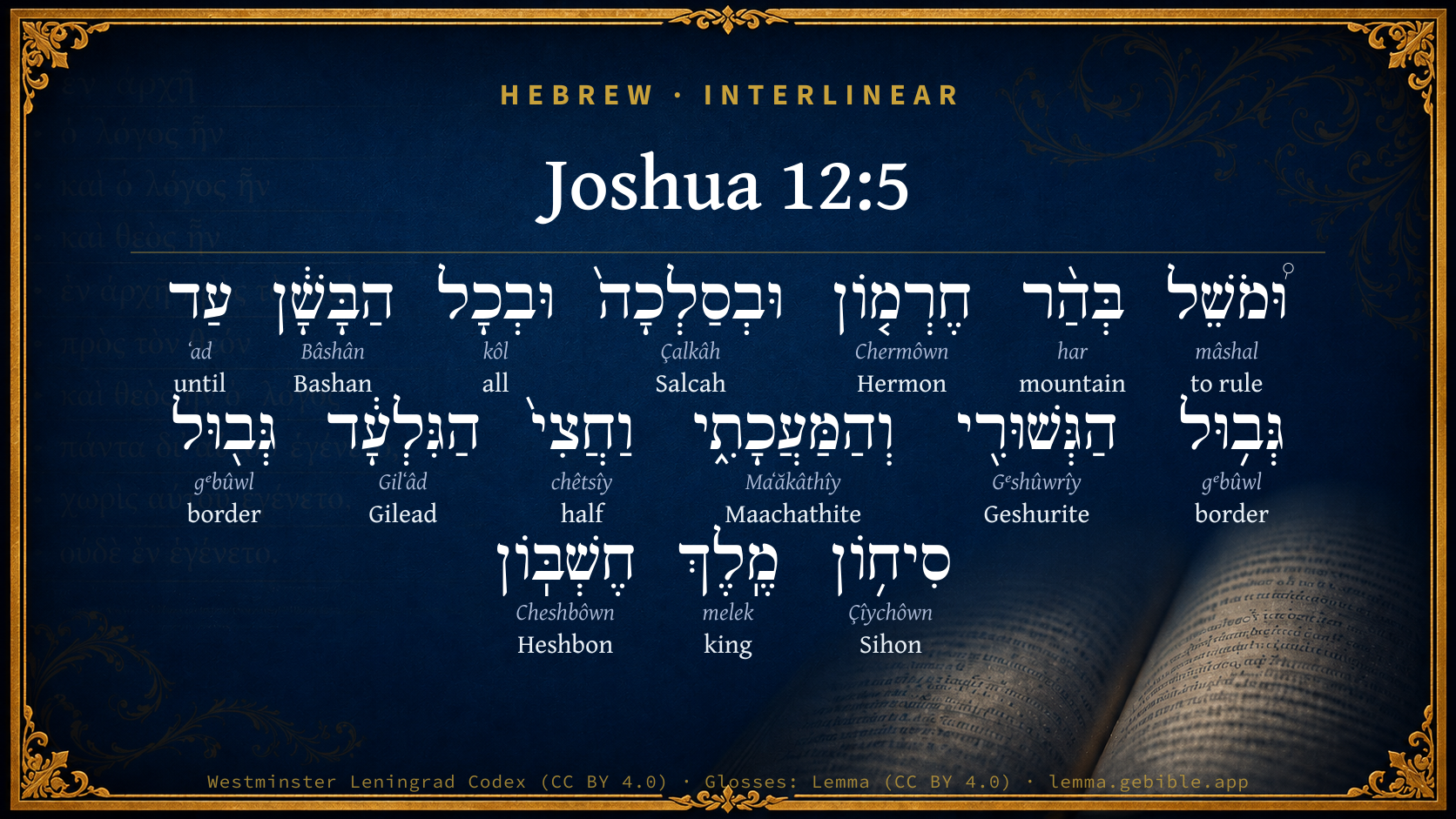
Joshua 12:5

Hebrew (Westminster Leningrad Codex) Joshua 12:5 appears in the Hebrew Old Testament. The text above is from the Westminster Leningrad Codex. Each word links to its Strong’s number, a concise gloss, and parsing drawn from the Open Scriptures Hebrew Bible morphology. Click any word for its full Brown-Driver-Briggs (BDB) entry.
Download image
Cite this verse

Joshua 12:5 (World English Bible). Public Domain. Lemma interlinear Bible study tool, https://lemma.gebible.app/v/joshua/12/5.

Show BibTeX & RIS
BibTeX
RIS
English Translation
and ruled in Mount Hermon, and in Salecah, and in all Bashan, to the border of the Geshurites and the Maacathites, and half Gilead, the border of Sihon king of Heshbon.
World English Bible · Public Domain
Download a study sheet

One document with this verse’s original text, its word-by-word gloss line, the meaning frame, cross-references with their text, attributed commentary, and full source and license credits — printable, and it pastes into notes with its structure intact.

This verse Autodidact and up

Study sheet (.html) Plain text (.txt)

A passage Seminary Student

Up to 50 verses in one chapter. A passage sheet keeps up to 6 commentary sources and 12 cross-references per verse, in the order this page ranks them, and says so on the sheet whenever that leaves anything out. Ask for a single verse and you get the Autodidact verse sheet above.

Everything on this page stays free to read, with no account — the sheet is a download of what is already on screen, not access to it.

Want to remove ads? Support Godless Engineer
Compare translations 3

The same verse in 3 English versions, stacked beneath the original-language interlinear above. Click any original word for its lexicon entry.

Each is an independent rendering of the whole verse — the interlinear is not word-aligned to these translations.

Highlighted words mark where these versions differ — a whole-verse word diff, not a word-by-word alignment.

  • World English Bible Public Domain
    and ruled in Mount Hermon, and in Salecah, and in all Bashan, to the border of the Geshurites and the Maacathites, and half Gilead, the border of Sihon king of Heshbon.
  • King James Version Public Domain
    And reigned in mount Hermon, and in Salcah, and in all Bashan, unto the border of the Geshurites and the Maachathites, and half Gilead, the border of Sihon king of Heshbon.
  • unfoldingWord Literal Text CC BY-SA 4.0
    and ruling in Mount Hermon, and in Salekah, and in all of Bashan unto the border of the Geshurite and the Maacathite, and half of Gilead, the border of Sihon, the king of Heshbon.

unfoldingWord Literal Text — © unfoldingWord, licensed CC BY-SA 4.0. Word-aligned USFM3 via Door43 (git.door43.org/unfoldingWord/en_ult).

Versions to compare (up to 4)

3 of 4 selected

Show all 18 translations

Every available English version of this verse, each an independent rendering of the whole verse.

  • World English Bible Public Domain
    and ruled in Mount Hermon, and in Salecah, and in all Bashan, to the border of the Geshurites and the Maacathites, and half Gilead, the border of Sihon king of Heshbon.
  • Berean Standard Bible Public Domain
    He ruled over Mount Hermon, Salecah, all of Bashan up to the border of the Geshurites and Maacathites, and half of Gilead to the border of Sihon king of Heshbon.
  • Majority Standard Bible Public Domain
    He ruled over Mount Hermon, Salecah, all of Bashan up to the border of the Geshurites and Maacathites, and half of Gilead to the border of Sihon king of Heshbon.
  • King James Version Public Domain
    And reigned in mount Hermon, and in Salcah, and in all Bashan, unto the border of the Geshurites and the Maachathites, and half Gilead, the border of Sihon king of Heshbon.
  • American Standard Version (1901) Public Domain
    and ruled in mount Hermon, and in Salecah, and in all Bashan, unto the border of the Geshurites and the Maacathites, and half Gilead, the border of Sihon king of Heshbon.
  • Revised Version (1885) Public Domain
    and ruled in mount Hermon, and in Salecah, and in all Bashan, unto the border of the Geshurites and the Maacathites, and half Gilead, the border of Sihon king of Heshbon.
  • Geneva Bible (1599) Public Domain
    And reigned in mount Hermon, and in Salcah, and in all Bashan, vnto the border of the Geshurites, and the Maachathites, and halfe Gilead, euen the border of Sihon King of Heshbon.
  • Douay-Rheims (1899) Public Domain
    Of Gessuri and Machati, and of half Galaad: the borders of Sehon the king of Hesebon.
  • Young's Literal Translation Public Domain
    and ruling in mount Hermon, and in Salcah, and in all Bashan, unto the border of the Geshurite, and the Maachathite, and the half of Gilead, the border of Sihon king of Heshbon.
  • Literal Standard Version CC BY-SA 4.0
    and ruling in Mount Hermon, and in Salcah, and in all Bashan, to the border of the Geshurite, and the Maachathite, and the half of Gilead, the border of Sihon king of Heshbon.
  • Unlocked Literal Bible CC BY-SA 4.0
    He ruled over Mount Hermon, Salekah, and all Bashan, to the border of the people of Geshur and the Maacathites, and half of Gilead, to the border of Sihon, king of Heshbon.
  • unfoldingWord Literal Text CC BY-SA 4.0
    and ruling in Mount Hermon, and in Salekah, and in all of Bashan unto the border of the Geshurite and the Maacathite, and half of Gilead, the border of Sihon, the king of Heshbon.
  • Darby Bible Public Domain
    and ruled over mount Hermon, and over Salcah, and over all Bashan, as far as the border of the Geshurites and the Maachathites, and [over] half Gilead [as far as] the border of Sihon the king of Heshbon.
  • World Messianic Bible Public Domain
    and ruled in Mount Hermon, and in Salecah, and in all Bashan, to the border of the Geshurites and the Maacathites, and half Gilead, the border of Sihon king of Heshbon.
  • Webster's Bible Public Domain
    And reigned in mount Hermon, and in Salcah, and in all Bashan, to the border of the Geshurites, and the Maachathites, and half Gilead, the border of Sihon king of Heshbon.
  • Free Bible Version CC BY-SA 4.0
    ruled in the north from Mount Hermon to Sacaleh, and all of Bashan to the east, and west to the borders of the Geshurites and Maacathites, together with half of Gilead up to the border of Sihon, king of Heshbon.
  • Bible in Basic English Public Domain
    Ruling in the mountain of Hermon, and in Salecah, and in all Bashan, as far as the limits of the Geshurites and the Maacathites, and half Gilead, to the land of Sihon, king of Heshbon.
  • JPS Tanakh (1917) Public Domain
    and ruled in mount Hermon, and in Salcah, and in all Bashan, unto the border of the Geshurites and the Maacathites, and half Gilead, even unto the border of Sihon king of Heshbon.

Literal Standard Version (2020), Covenant Press — licensed CC BY-SA 4.0. Text via the HelloAO Bible API (eBible.org). Unlocked Literal Bible (unfoldingWord) — licensed CC BY-SA 4.0. Text via the HelloAO Bible API (eBible.org). unfoldingWord Literal Text — © unfoldingWord, licensed CC BY-SA 4.0. Word-aligned USFM3 via Door43 (git.door43.org/unfoldingWord/en_ult). Free Bible Version, Dr. Jonathan Gallagher — licensed CC BY-SA 4.0. Text via the HelloAO Bible API (eBible.org).

Word by word

More ways to search: Search by grammar → Find every occurrence → Compare this word →

Practice this passage: Drill this verse → Learn its vocabulary →

וּבְסַלְכָה֙
Çalkâh
H5548
“and · in/at · Salcah”
Conjunction + Preposition + Noun, Proper
Part of Speech
Conjunction + Preposition + Noun
Type
Proper
Full BDB Definition

Origin: from an unused root meaning to walk

TWOT: None

Salcah or Salchah = "migration" - a town or district at the extreme eastern limit of Bashan and allocated to the tribe of Gad; modern 'Sulkhad' which is 56 miles
  1. וּ֠מֹשֵׁל mâshal H4910 “and · ruling” Conjunction + Verb, Qal, Participle Active, Masculine, Singular, Absolute
  2. בְּהַ֨ר har H2022 “in/at · mountain of” Preposition + Noun, Common, Masculine, Singular, Construct
  3. חֶרְמ֤וֹן Chermôwn H2768 “Hermon” Noun, Proper
  4. וּבְכָל kôl H3605 “and · in/at · all of” Conjunction + Preposition + Noun, Common, Masculine, Singular, Construct
  5. הַבָּשָׁ֔ן Bâshân H1316 “the · Bashan” Particle, Definite Article + Noun, Proper
  6. עַד ʻad H5704 “until” Preposition
  7. גְּב֥וּל gᵉbûwl H1366 “border of” Noun, Common, Masculine, Singular, Construct
  8. הַגְּשׁוּרִ֖י Gᵉshûwrîy H1651 “the · Geshurite” Particle, Definite Article + Noun, Gentilic, Masculine, Singular, Absolute
  9. וְהַמַּעֲכָתִ֑י Maʻăkâthîy H4602 “and · the · Maachathite” Conjunction + Particle, Definite Article + Noun, Gentilic, Masculine, Singular, Absolute
  10. וַחֲצִי֙ chêtsîy H2677 “and · half of” Conjunction + Noun, Common, Masculine, Singular, Construct
  11. הַגִּלְעָ֔ד Gilʻâd H1568 “the · Gilead” Particle, Definite Article + Noun, Proper
  12. גְּב֖וּל gᵉbûwl H1366 “border of” Noun, Common, Masculine, Singular, Construct
  13. סִיח֥וֹן Çîychôwn H5511 “Sihon” Noun, Proper
  14. מֶֽלֶךְ melek H4428 “king of” Noun, Common, Masculine, Singular, Construct
  15. חֶשְׁבּֽוֹן Cheshbôwn H2809 “Heshbon” Noun, Proper

About this verse

These counts appear in no published source. They are computed here, from the morphology-tagged text and Lemma’s own curated glosses. What Lemma adds →

16
words
15
distinct lemmas
Historical
section

Notable vocabulary

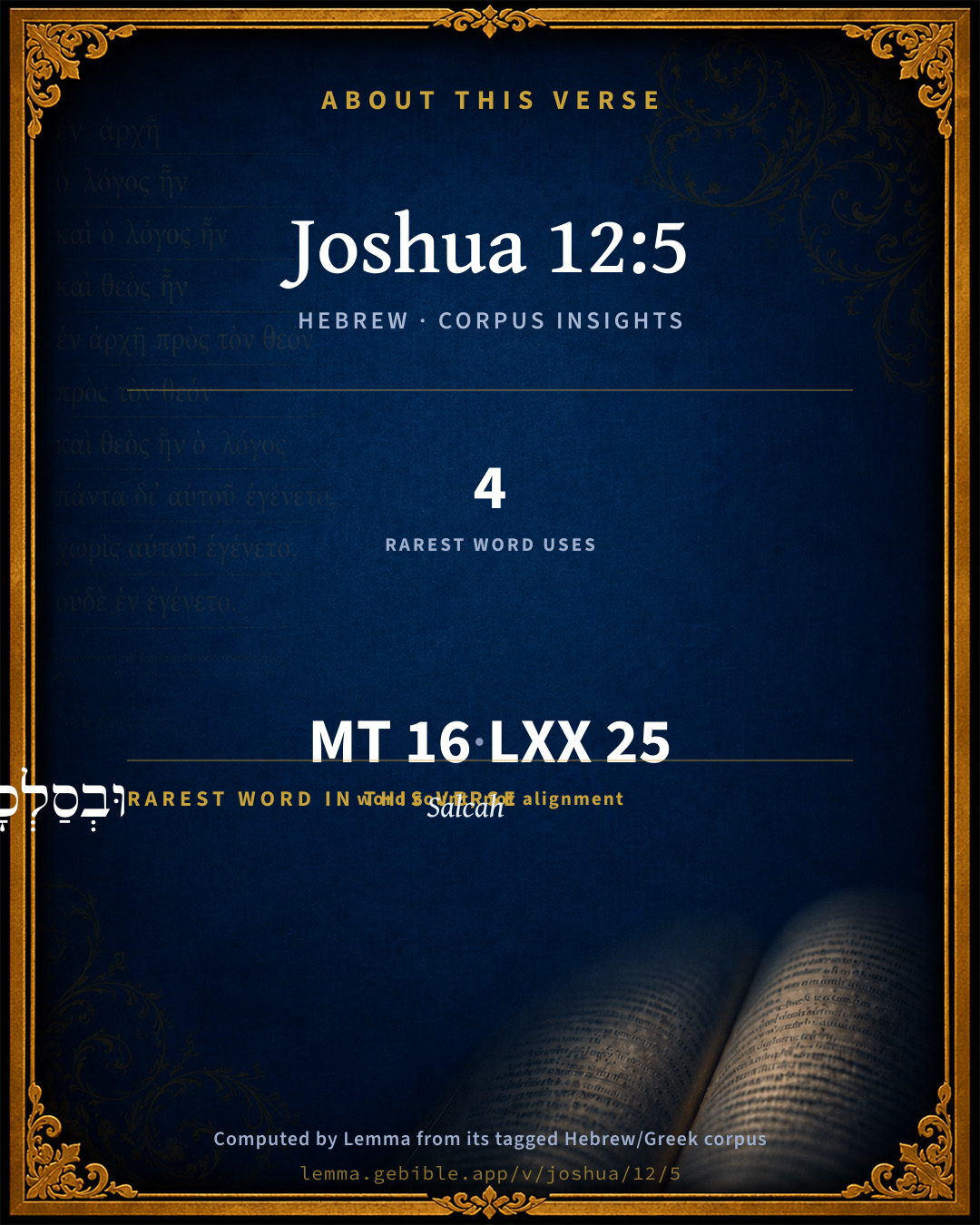
The rarest word here is וּבְסַלְכָה֙ Salcah H5548 — appearing just 4 times in the whole Hebrew Bible.

Shared distinctive vocabulary

וּבְסַלְכָה֙ Salcah H5548 occurs in 4 verses of the Hebrew Bible. Also found in:

Grammatical profile

  • 1 verb
  • 14 nouns
  • 1 preposition

Verb forms

  • וּ֠מֹשֵׁל Qal · Participle Active

Repetition

A word recurs within this verse — often emphatic in Hebrew:

  • גְּב֥וּל border H1366 ×2

Hebrew & Septuagint length

In English translation the verse runs 31 words from the Hebrew and 34 from the Septuagint (LXX English) — closely comparable.

A rough comparison of the two English renderings, which tokenize alike — not a word-level alignment.

Word counts can differ between the Hebrew and the Greek without any difference in meaning — e.g. the Hebrew direct-object marker אֵת has no separate Greek word, and Greek often adds the article ὁ.

In the original languages it is 16 Hebrew tokens and 25 Greek tokens — but the two are counted differently (Hebrew bundles its prefixes and suffixes into one token; the Greek is in lemma form), so that isn’t a like-for-like length.

Cross-references

12

Topical passages linked to Joshua 12:5 in the Treasury of Scripture Knowledge — connected by theme and wording, ordered by reader-vote popularity; previews shown in the World English Bible.

  • Deuteronomy 3:14 Jair the son of Manasseh took all the region of Argob, to the border of the Geshurites and the Maacathites, and called them, even Bashan, after his own name, Havvoth Jair, to this day.)
  • Joshua 13:11 and Gilead, and the border of the Geshurites and Maacathites, and all Mount Hermon, and all Bashan to Salecah;
  • 1 Samuel 27:8 David and his men went up, and made a raid on the Geshurites, and the Girzites, and the Amalekites; for those [nations] were the inhabitants of the land, who were of old, as you go to Shur, even to the land of Egypt.
  • Deuteronomy 3:8–10 We took the land at that time out of the hand of the two kings of the Amorites who were beyond the Jordan, from the valley of the Arnon to Mount Hermon;
  • Deuteronomy 4:47–48 They took his land in possession, and the land of Og king of Bashan, the two kings of the Amorites, who were beyond the Jordan toward the sunrise;
  • Joshua 11:3 to the Canaanite on the east and on the west, and the Amorite, and the Hittite, and the Perizzite, and the Jebusite in the hill-country, and the Hivite under Hermon in the land of Mizpah.
  • Joshua 12:1 Now these are the kings of the land, whom the children of Israel struck, and possessed their land beyond the Jordan toward the sunrise, from the valley of the Arnon to Mount Hermon, and all the Arabah eastward:
  • 2 Samuel 3:3 and his second, Chileab, of Abigail the wife of Nabal the Carmelite; and the third, Absalom the son of Maacah the daughter of Talmai king of Geshur;
  • 2 Samuel 13:37 But Absalom fled, and went to Talmai the son of Ammihur, king of Geshur. [David] mourned for his son every day.
  • 2 Samuel 15:8 For your servant vowed a vow while I abode at Geshur in Syria, saying, If Yahweh shall indeed bring me again to Jerusalem, then I will serve Yahweh.
  • 2 Samuel 23:34 Eliphelet the son of Ahasbai, the son of the Maacathite, Eliam the son of Ahithophel the Gilonite,
  • 2 Kings 25:23 Now when all the captains of the forces, they and their men, heard that the king of Babylon had made Gedaliah governor, they came to Gedaliah to Mizpah, even Ishmael the son of Nethaniah, and Johanan the son of Kareah, and Seraiah the son of Tanhumeth the Netophathite, and Jaazaniah the son of the Maacathite, they and their men.

Cross-references courtesy of OpenBible.info (CC BY 4.0).

Hebrew and Greek witnesses Masoretic Hebrew ↔ Greek Septuagint

The same verse in the two great witnesses to the Old Testament, shown verse-for-verse.

These are two independent witnesses, not word-aligned to each other, and the Septuagint is shown in lemma (dictionary) form.

Hebrew Joshua 12:5 Masoretic · Westminster Leningrad Codex

וּ֠מֹשֵׁל בְּהַ֨ר חֶרְמ֤וֹן וּבְסַלְכָה֙ וּבְכָל הַבָּשָׁ֔ן עַד גְּב֥וּל הַגְּשׁוּרִ֖י וְהַמַּעֲכָתִ֑י וַחֲצִי֙ הַגִּלְעָ֔ד גְּב֖וּל סִיח֥וֹן מֶֽלֶךְ חֶשְׁבּֽוֹן

and ruled in Mount Hermon, and in Salecah, and in all Bashan, to the border of the Geshurites and the Maacathites, and half Gilead, the border of Sihon king of Heshbon.

World English Bible · Public Domain

Greek LXX Joshua 12:5 Septuagint · lemma form

ἄρχω ἀπό ὄρος αερμων καί ἀπό σελχα καί πᾶς ὁ βασαν ἕως ὅριον γεσουρι καί ὁ μαχατι καί ὁ ἥμισυς γαλαάδ ὅριον σηων βασιλεύς εσεβων

ruling from mount Aermon and from Secchai, and over all the land of Basan to the borders of Gergesi, and Machi, and the half of Galaad of the borders of Seon king of Esebon.

LXX2012 (modern English Septuagint) · Public Domain

Hebrew: Westminster Leningrad Codex (CC BY 4.0). Greek: Septuagint (public domain); English from LXX2012 (modern English Septuagint) (Public Domain). How the Septuagint differs from the Hebrew →

Targum (Aramaic paraphrase)

1

The Targum is the ancient Jewish Aramaic paraphrase of the Hebrew Scriptures — an interpretive translation, not the Hebrew text itself. Onkelos (literal) and Pseudo-Jonathan (expansive) render the Torah, and Jonathan the Prophets. Coverage is partial: where no permissively-licensed English translation exists for a verse, only the Aramaic is shown. This is verse-level text, not a word-by-word alignment to the Hebrew.

  1. Targum Jonathan Prophets (Joshua–Malachi)
    וְשַׁלִיט בְּטוּרָא דְחֶרְמוֹן וּבְסַלְכָה וּבְכָל מַתְנָן עַד תְּחוּם גְשׁוּרָאָה וְאַפְקֵירוֹס וּפַלְגוּת אֲרַע דְגִלְעָד תְּחוּם סִיחוֹן מַלְכָּא דְחֶשְׁבוֹן:

    (no public-domain English translation for this verse)

    Targum Jonathan — Aramaic: “Mikraot Gedolot” (public domain). English: “Sefaria Community Translation” (CC0 1.0 (public-domain dedication)); “London "Chaldee Paraphrase," 1871” (public domain). Text via Sefaria.

Commentary

Notes on Joshua 12:5 from classic Christian and Jewish commentators (each source and its license shown beneath its notes). The classic Christian expositions comment on the surrounding passage and are grouped to its opening verse, so a note may address several verses; the Jewish commentaries on the Tanakh (Rashi and others) are per-verse, so they appear only where the commentator wrote on this verse.

Lemma curates 59 commentaries, every one of them public domain or Creative Commons licensed, each selected and text-cleaned for this edition rather than reprinted as found. About our sources →

Trapp's Complete Commentary

John Trapp

Jos 12:5 And reigned in mount Hermon, and in Salcah, and in all Bashan, unto the border of the Geshurites and the Maachathites, and half Gilead, the border of Sihon king of Heshbon.

Ver. 5. In mount Hermon.] Which is conceived to be the utmost part of mount Gilead, joining mount Lebanon and Gilead together.

John Trapp, A Commentary or Exposition upon All the Books of the Old and New Testament (1647–1656) — public domain. Text from a community e-Sword module.

Adam Clarke's Commentary

Verse 5. The border of the Geshurites] The country of Bashan, in the days of Moses and Joshua, extended from the river Jabbok on the south to the frontiers of the Geshurites and Maachathites on the north, to the foot of the mountains of Hermon.

Adam Clarke's Commentary on the Bible (1810–1826) — public domain. Text from a community e-Sword/MySword module.

The Cambridge Bible for Schools and Colleges

gen. ed. J. J. S. Perowne

5. and in Salcah] Identical with the town of Sûlkhad at the southern extremity of the Jebel Haurân. It was conquered by the Israelites, Deu_3:10. The town is of considerable size, two or three miles in circumference, surrounding a castle on a lofty isolated hill. “The country is stony and undulating; but the soil is rich, and traces of former cultivation are everywhere visible. The view from the top of the castle is extensive and strangely interesting.… On the segment of the plain, extending from the south to the east, I counted the towns or large villages, none of them more than 12 miles distant, and almost all of them, so far as I could see by the aid of a telescope, still habitable like Sulkhad, but entirely deserted. Well may we exclaim with the prophet, as we look over this mournful scene of utter desolation, ‘Moab is confounded; for it is broken down; howl and cry; tell ye it in Arnon, that Moab is spoiled, and judgment is come upon the plain country … upon Beth-gamul, and upon Beth-meon, and upon Kerioth, and upon Bozrah, and upon all the cities of the land of Moab, far or near’ (Jer_48:19-24).” Porter’s Handbook, 11. 522.

the border of the Geshurites] Geshur was a little principality in the N.E. corner of Bashan, adjoining the province of Argob (Deu_3:14), and the kingdom of Aram or Syria (2Sa_15:8). Hither Absalom fled after the murder of Amnon (2Sa_13:37).

the Maachathites] The people of Maacha dwelt on the south-west slope of Hermon at the sources of the Jordan (Deu_3:14).

The Cambridge Bible for Schools and Colleges (gen. ed. J. J. S. Perowne; Cambridge University Press, 1878–1918) — public domain. Text from a community e-Sword module.

John Gill's Exposition

And reigned in Mount Hermon,.... That is, over all the people that inhabited that mount or dwelt under it, Jos 11:17, and adjacent to it, of which mountain; see Gill on Deu 3:8 and See Gill on Deu 3:9,

and in Salcah: which was a city belonging to the kingdom of Og, Deu 3:10,

and in all Bashan; or Batanea, a country famous for pasturage, Mic 7:14, and for fat cattle, Eze 39:18, and for oaks, Isa 2:13, frequently mentioned in Scripture:

unto the border of the Geshurites, and the Maachathites; which were two nations the Israelites never expelled, Jos 13:13; of which see Deu 3:14,

and half Gilead; which belonged to Og, as the other half did to Sihon, before observed, which was as follows:

the border of Sihon king of Heshbon; here the two kingdoms joined, even in the midst of Gilead, which was divided between them, but now wholly fell into the hands of Israel.

John Gill's Exposition of the Whole Bible (1746–1763) — public domain (CC PDM 1.0). Text via the HelloAO Bible API.

Matthew Poole's English Annotations

The Geshurites, of which see Deu 3:14; Jos 13:13; 2Sa 13:37; 15:8.

Matthew Poole's English Annotations on the Holy Bible (1683–1685) — public domain. Text from a community e-Sword/MySword module.

The Pulpit Commentary

The Geshurites. See Jos_13:2, Jos_13:11, Jos_13:13; and Deu_3:14; also 2Sa_13:37, where we find the principality of Geshur still in possession of its independence. It was in the northeast corner of Bashan, abutting upon Syria, and is called "Geshur in Syria". (2Sa_15:8) It is perhaps an instance of undesigned coincidence that Maachah, the mother of Absalom and the daughter of the king of Geshur, was so named, since she probably derived her name from the adjoining territory of Maachah. (see note on Jos_13:2)

The Pulpit Commentary (1880–1919), ed. H.D.M. Spence-Jones & Joseph S. Exell — public domain. Text from a community e-Sword module.

Rashi

Rabbi Shlomo Yitzchaki (Rashi)

Half of the Gilod, the boundry of Sichon. That was the border of Sichon’s domain, as we said above, that half of Gilod was his, and this second half was Og’s.

Rashi on the Tanakh — English translations: “The Judaica Press complete Tanach with Rashi, translated by A. J. Rosenberg” (CC BY 4.0); “Pentateuch with Rashi's commentary by M. Rosenbaum and A.M. Silbermann, 1929-1934” (public domain); “The Metsudah Tanach series, Lakewood, N.J” (CC BY 4.0); and “The Book of Joshua, Metsudah Publications, 1997” (CC BY 4.0). Text via Sefaria.

Lesson kit

Teaching starters — assembled from the data on this page, not authored interpretation. Every prompt links to the verse data it draws on. Edit before teaching.

Joshua, in the Historical, opens this verse with 16 words (15 distinct Hebrew lemmas). Its most distinctive word is Çalkâh (“Salcah”). A historical commentator’s framing appears above. Read the whole chapter for the surrounding context.

Discussion questions

  1. What does “Salcah” (Çalkâh) contribute to the verse as a whole?
  2. Deuteronomy 3:10 shares the word «Salcah» with this verse. How do the two illuminate each other?
  3. “border” occurs 2× in this one verse. What is the effect of the repetition?
  4. These translations render this verse differently. What is at stake in choosing one wording over another?
  5. The verb «וּ֠מֹשֵׁל» is Qal Participle Active. How does its form color the action?
  6. Reading how Trapp's Complete Commentary and Adam Clarke's Commentary read this verse, where do the two commentators agree and where do they part?

Things to notice

Reading settings

Reading text

Shown beneath each verse's original-language words.

Old Testament
Old Testament edition

Read the OT as the Masoretic Hebrew (MT) or the Greek Septuagint (LXX).

English shown for the Greek Septuagint (in the Hebrew ↔ Greek comparison).

Comparing translations? Open the Compare panel on any verse page to stack up to four side by side.