Hosea 5:10

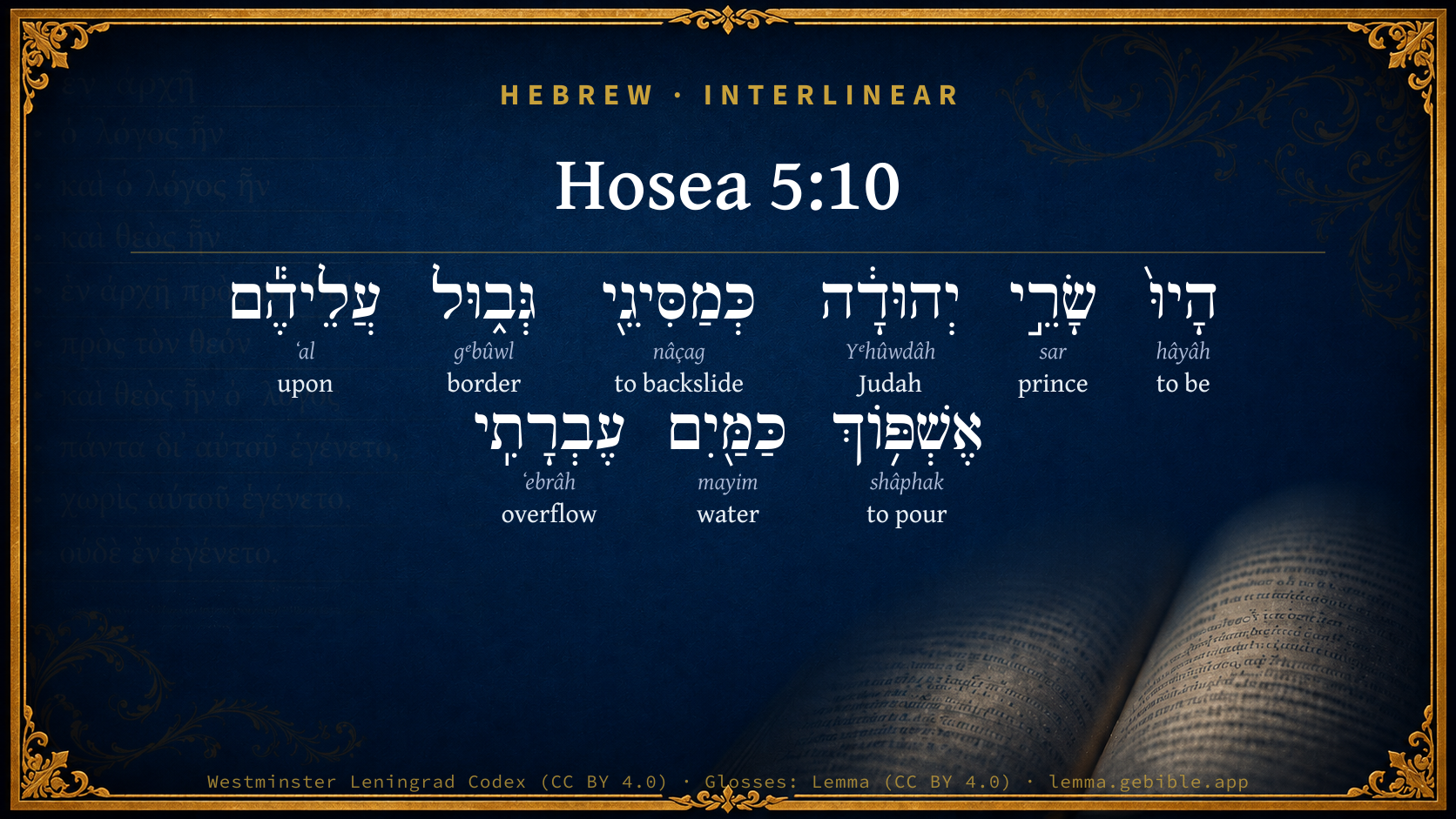
Hebrew (Westminster Leningrad Codex) Hosea 5:10 appears in the Hebrew Old Testament. The text above is from the Westminster Leningrad Codex. Each word links to its Strong’s number, a concise gloss, and parsing drawn from the Open Scriptures Hebrew Bible morphology. Click any word for its full Brown-Driver-Briggs (BDB) entry.
Download image
Cite this verse

Hosea 5:10 (World English Bible). Public Domain. Lemma interlinear Bible study tool, https://lemma.gebible.app/v/hosea/5/10.

Show BibTeX & RIS
BibTeX
RIS
English Translation
The princes of Judah are like those who remove a landmark. I will pour out my wrath on them like water.
World English Bible · Public Domain
Download a study sheet

One document with this verse’s original text, its word-by-word gloss line, the meaning frame, cross-references with their text, attributed commentary, and full source and license credits — printable, and it pastes into notes with its structure intact.

This verse Autodidact and up

Study sheet (.html) Plain text (.txt)

A passage Seminary Student

Up to 50 verses in one chapter. A passage sheet keeps up to 6 commentary sources and 12 cross-references per verse, in the order this page ranks them, and says so on the sheet whenever that leaves anything out. Ask for a single verse and you get the Autodidact verse sheet above.

Everything on this page stays free to read, with no account — the sheet is a download of what is already on screen, not access to it.

Want to remove ads? Support Godless Engineer
Compare translations 3

The same verse in 3 English versions, stacked beneath the original-language interlinear above. Click any original word for its lexicon entry.

Each is an independent rendering of the whole verse — the interlinear is not word-aligned to these translations.

Highlighted words mark where these versions differ — a whole-verse word diff, not a word-by-word alignment.

  • World English Bible Public Domain
    The princes of Judah are like those who remove a landmark. I will pour out my wrath on them like water.
  • King James Version Public Domain
    The princes of Judah were like them that remove the bound: therefore I will pour out my wrath upon them like water.
  • unfoldingWord Literal Text CC BY-SA 4.0
    The princes of Judah have become like the movers of a boundary. I will pour out my wrath on them like water.

unfoldingWord Literal Text — © unfoldingWord, licensed CC BY-SA 4.0. Word-aligned USFM3 via Door43 (git.door43.org/unfoldingWord/en_ult).

Versions to compare (up to 4)

3 of 4 selected

Show all 18 translations

Every available English version of this verse, each an independent rendering of the whole verse.

  • World English Bible Public Domain
    The princes of Judah are like those who remove a landmark. I will pour out my wrath on them like water.
  • Berean Standard Bible Public Domain
    The princes of Judah are like those who move boundary stones; I will pour out My fury upon them like water.
  • Majority Standard Bible Public Domain
    The princes of Judah are like those who move boundary stones; I will pour out My fury upon them like water.
  • King James Version Public Domain
    The princes of Judah were like them that remove the bound: therefore I will pour out my wrath upon them like water.
  • American Standard Version (1901) Public Domain
    The princes of Judah are like them that remove the landmark: I will pour out my wrath upon them like water.
  • Revised Version (1885) Public Domain
    The princes of Judah are like them that remove the landmark: I will pour out my wrath upon them like water.
  • Geneva Bible (1599) Public Domain
    The princes of Iudah were like them that remoue the bounde: therefore will I powre out my wrath vpon them like water.
  • Douay-Rheims (1899) Public Domain
    The princes of Juda are become as they that take up the bound: I will pour out my wrath upon them like water.
  • Young's Literal Translation Public Domain
    Princes of Judah have been as those removing a border, On them I do pour out as water My wrath.
  • Literal Standard Version CC BY-SA 4.0
    Princes of Judah have been as those removing a border, || I pour out My wrath as water on them.
  • Unlocked Literal Bible CC BY-SA 4.0
    The leaders of Judah are like those who move a boundary stone. I will pour my wrath on them like water.
  • unfoldingWord Literal Text CC BY-SA 4.0
    The princes of Judah have become like the movers of a boundary. I will pour out my wrath on them like water.
  • Darby Bible Public Domain
    The princes of Judah are become like them that remove the landmark: I will pour out my wrath upon them like water.
  • World Messianic Bible Public Domain
    The princes of Judah are like those who remove a landmark. I will pour out my wrath on them like water.
  • Webster's Bible Public Domain
    The princes of Judah were like them that remove the bound: therefore I will pour out my wrath upon them like water.
  • Free Bible Version CC BY-SA 4.0
    The rulers of Judah have become thieves like those who illegally move boundaries. I will pour out my anger like water upon them.
  • Bible in Basic English Public Domain
    The rulers of Judah are like those who take away a landmark; I will let loose my wrath on them like flowing water.
  • JPS Tanakh (1917) Public Domain
    The princes of Judah are like them that remove the landmark; I will pour out My wrath upon them like water.

Literal Standard Version (2020), Covenant Press — licensed CC BY-SA 4.0. Text via the HelloAO Bible API (eBible.org). Unlocked Literal Bible (unfoldingWord) — licensed CC BY-SA 4.0. Text via the HelloAO Bible API (eBible.org). unfoldingWord Literal Text — © unfoldingWord, licensed CC BY-SA 4.0. Word-aligned USFM3 via Door43 (git.door43.org/unfoldingWord/en_ult). Free Bible Version, Dr. Jonathan Gallagher — licensed CC BY-SA 4.0. Text via the HelloAO Bible API (eBible.org).

Word by word

More ways to search: Search by grammar → Find every occurrence → Compare this word →

Practice this passage: Drill this verse → Learn its vocabulary →

כְּמַסִּיגֵ֖י
nâçag
H5253
“like/as · backsliding”
Preposition + Verb, Hiphil, Participle Active, Masculine, Plural, Construct
Part of Speech
Preposition + Verb
Stem
Hiphil
Form
Participle Active
Gender
Masculine
Number
Plural
State
Construct
Full BDB Definition

Origin: a primitive root

TWOT: 1469

to move away, backslide, move, go, turn back - (Qal) to backslide, prove recreant to - (Hiphil) - to displace, move back - to remove, carry away - (Hophal) to be driven back, be moved back
  1. הָיוּ֙ hâyâh H1961 “to be” Verb, Qal, Perfect, 3rd Person, Common, Plural
  2. שָׂרֵ֣י sar H8269 “princes of” Noun, Common, Masculine, Plural, Construct
  3. יְהוּדָ֔ה Yᵉhûwdâh H3063 “Judah” Noun, Proper
  4. גְּב֑וּל gᵉbûwl H1366 “border” Noun, Common, Masculine, Singular, Absolute
  5. עֲלֵיהֶ֕ם ʻal H5921 “upon · them” Preposition + Suffix, Personal, 3rd Person, Masculine, Plural
  6. אֶשְׁפּ֥וֹךְ shâphak H8210 “to pour” Verb, Qal, Imperfect, 1st Person, Common, Singular
  7. כַּמַּ֖יִם mayim H4325 “like/as the · water(s)” Preposition, Determined + Noun, Common, Masculine, Plural, Absolute
  8. עֶבְרָתִֽי ʻebrâh H5678 “overflow · my” Noun, Common, Feminine, Singular, Construct + Suffix, Personal, 1st Person, Common, Singular

About this verse

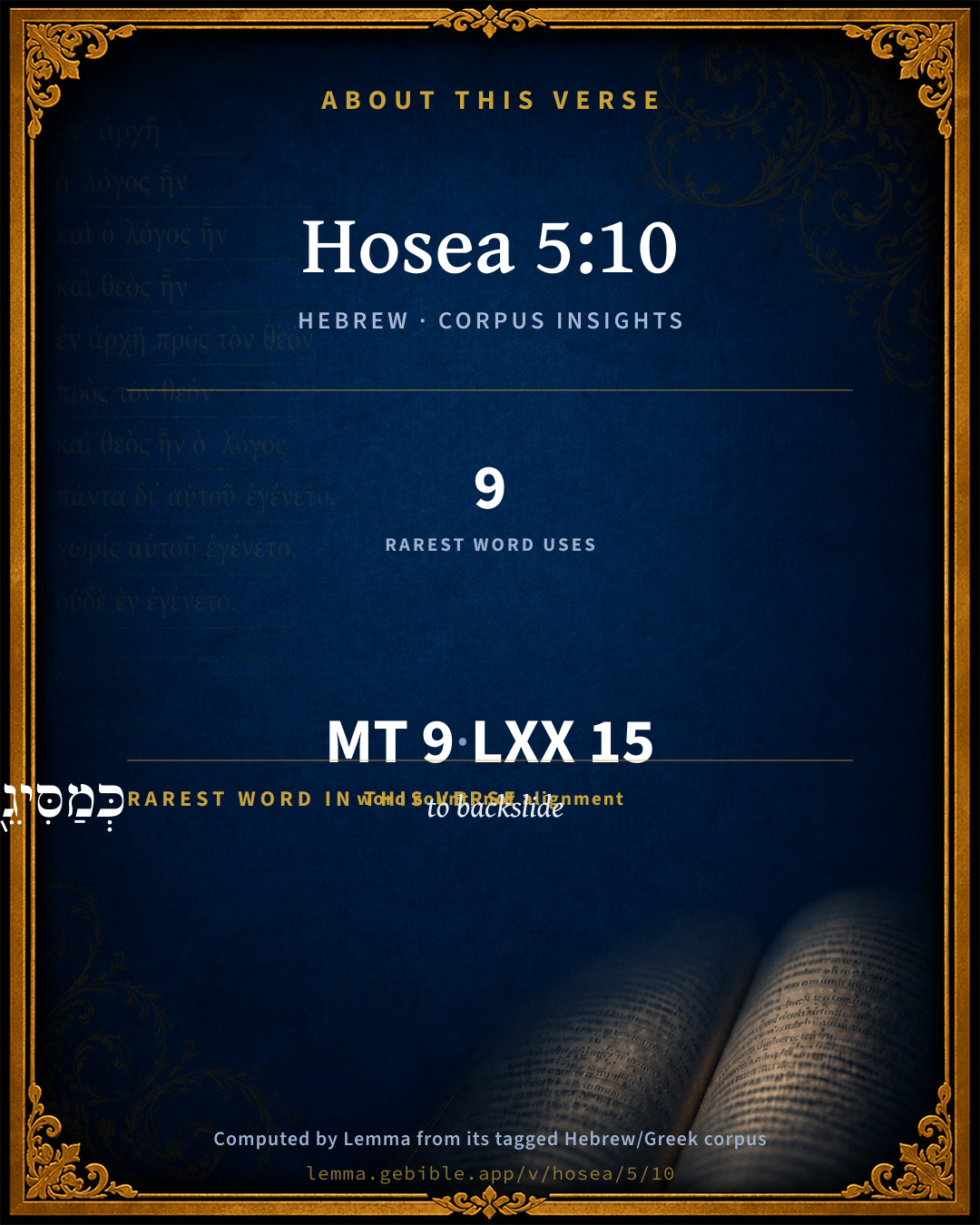
These counts appear in no published source. They are computed here, from the morphology-tagged text and Lemma’s own curated glosses. What Lemma adds →

9
words
9
distinct lemmas
Prophets
section

Notable vocabulary

The rarest word here is כְּמַסִּיגֵ֖י to backslide H5253 — appearing just 9 times in the whole Hebrew Bible.

Shared distinctive vocabulary

כְּמַסִּיגֵ֖י to backslide H5253 occurs in 9 verses of the Hebrew Bible. Also found in:

Grammatical profile

  • 3 verbs
  • 5 nouns
  • 1 preposition

Verb forms

  • הָיוּ֙ Qal · Perfect
  • כְּמַסִּיגֵ֖י Hiphil · Participle Active
  • אֶשְׁפּ֥וֹךְ Qal · Imperfect

Hebrew & Septuagint length

In English translation the verse runs 21 words from the Hebrew and 21 from the Septuagint (LXX English) — the same length.

A rough comparison of the two English renderings, which tokenize alike — not a word-level alignment.

Word counts can differ between the Hebrew and the Greek without any difference in meaning — e.g. the Hebrew direct-object marker אֵת has no separate Greek word, and Greek often adds the article ὁ.

In the original languages it is 9 Hebrew tokens and 15 Greek tokens — but the two are counted differently (Hebrew bundles its prefixes and suffixes into one token; the Greek is in lemma form), so that isn’t a like-for-like length.

Cross-references

12

Topical passages linked to Hosea 5:10 in the Treasury of Scripture Knowledge — connected by theme and wording, ordered by reader-vote popularity; previews shown in the World English Bible.

  • Deuteronomy 19:14 You shall not remove your neighbor's landmark, which they of old time have set, in your inheritance which you shall inherit, in the land that Yahweh your God gives you to possess it.
  • Psalms 32:6 For this, let everyone who is godly pray to you in a time when you may be found. Surely when the great waters overflow, they shall not reach to him.
  • Psalms 93:3–4 The floods have lifted up, Yahweh, The floods have lifted up their voice. The floods lift up their waves.
  • Deuteronomy 27:17 Cursed be he who removes his neighbor's landmark. All the people shall say, Amen.
  • 2 Kings 16:7–9 So Ahaz sent messengers to Tiglath Pileser king of Assyria, saying, I am your servant and your son: come up, and save me out of the hand of the king of Syria, and out of the hand of the king of Israel, who rise up against me.
  • 2 Chronicles 28:16–22 At that time did king Ahaz send to the kings of Assyria to help him.
  • Psalms 88:17 They came around me like water all day long. They completely engulfed me.
  • Proverbs 17:14 The beginning of strife is like breaching a dam, Therefore stop contention before quarreling breaks out.
  • Proverbs 22:28 Don't move the ancient boundary stone, Which your fathers have set up.
  • Ezekiel 7:8 Now will I shortly pour out my wrath on you, and accomplish my anger against you, and will judge you according to your ways; and I will bring on you all your abominations.
  • Matthew 7:27 The rain came down, the floods came, and the winds blew, and beat on that house; and it fell--and great was its fall."
  • Luke 6:49 But he who hears, and doesn't do, is like a man who built a house on the earth without a foundation, against which the stream broke, and immediately it fell, and the ruin of that house was great."

Cross-references courtesy of OpenBible.info (CC BY 4.0).

Hebrew and Greek witnesses Masoretic Hebrew ↔ Greek Septuagint

The same verse in the two great witnesses to the Old Testament, shown verse-for-verse.

These are two independent witnesses, not word-aligned to each other, and the Septuagint is shown in lemma (dictionary) form.

Hebrew Hosea 5:10 Masoretic · Westminster Leningrad Codex

הָיוּ֙ שָׂרֵ֣י יְהוּדָ֔ה כְּמַסִּיגֵ֖י גְּב֑וּל עֲלֵיהֶ֕ם אֶשְׁפּ֥וֹךְ כַּמַּ֖יִם עֶבְרָתִֽי

The princes of Judah are like those who remove a landmark. I will pour out my wrath on them like water.

World English Bible · Public Domain

Greek LXX Hosea 5:10 Septuagint · lemma form

γίγνομαι ὁ ἄρχων ιουδα ὡς μετατίθημι ὅριον ἐπί αὐτός ἐκχέω ὡς ὕδωρ ὁ ὅρμημα ἐγώ

The princes of Juda became as they that removed the bounds: I will pour out upon them my fury as water.

LXX2012 (modern English Septuagint) · Public Domain

Hebrew: Westminster Leningrad Codex (CC BY 4.0). Greek: Septuagint (public domain); English from LXX2012 (modern English Septuagint) (Public Domain). How the Septuagint differs from the Hebrew →

Targum (Aramaic paraphrase)

1

The Targum is the ancient Jewish Aramaic paraphrase of the Hebrew Scriptures — an interpretive translation, not the Hebrew text itself. Onkelos (literal) and Pseudo-Jonathan (expansive) render the Torah, and Jonathan the Prophets. Coverage is partial: where no permissively-licensed English translation exists for a verse, only the Aramaic is shown. This is verse-level text, not a word-by-word alignment to the Hebrew.

  1. Targum Jonathan Prophets (Joshua–Malachi)
    הֲווֹ רַבְרְבֵי יְהוּדָה כִּמְשַׁנֵי תְּחוּם עֲלֵיהוֹן אֶשְׁפּוֹךְ כְּמַיָא חֵימְתִי:

    (no public-domain English translation for this verse)

    Targum Jonathan — Aramaic: “Mikraot Gedolot” (public domain). English: “Sefaria Community Translation” (CC0 1.0 (public-domain dedication)); “London "Chaldee Paraphrase," 1871” (public domain). Text via Sefaria.

Commentary

Notes on Hosea 5:10 from classic Christian and Jewish commentators (each source and its license shown beneath its notes). The classic Christian expositions comment on the surrounding passage and are grouped to its opening verse, so a note may address several verses; the Jewish commentaries on the Tanakh (Rashi and others) are per-verse, so they appear only where the commentator wrote on this verse.

Lemma curates 59 commentaries, every one of them public domain or Creative Commons licensed, each selected and text-cleaned for this edition rather than reprinted as found. About our sources →

Trapp's Complete Commentary

John Trapp

Hos 5:10 The princes of Judah were like them that remove the bound: [therefore] I will pour out my wrath upon them like water.

Ver. 10. The princes of Judah were like them that remove the bound] A wickedness condemned by the law and light both of nature and Scripture, Deu 27:17; Deu 19:14 Pro 22:28. The princes are mentioned, because corruption in a people (as putrefication in a fish) begins at the head. Now the landmark of limit is removed many ways: as, first, religione, in religion; when the true is changed into that which is false, as was here in Queen Mary’s days, against her promise to the Suffolk men (Tarnon.). Secondly, in regione, in the civil state; when one man violently invadeth the right of another (as Ahab did Naboth’s vineyard), and no man must question them, because it is facinus maioris abollae (Juvenal), the fact of a great one. Thirdly, in officio, in a man’s office or particular station, when he keeps not within his circle, but takes liberty to transgress, prescribing new worships, as 2Ki 16:10-11 2Ch 28:23; taking upon them to teach ministers what to teach them, as Mic 2:6; or themselves invading the ministerial office uncalled thereunto, as did Jeroboam, 1Ki 12:33; 1Ki 16:3, and Uzziah, 2Ch 26:16, to their cost. This (saith an interpreter) is grandis culpa, et atrox crimen, a foul fault, a crimson crime. Let our lay preachers and levellers look to it, unless they covet a curse. Deu 27:17, "He that breaketh a hedge, a serpent shall bite him." Fourthly, in negotio, in businesses and transactions, in contracts and covenants: he removeth bounds who defrauds and circumventeth another in any matters, 1Th 4:6. These must remember that God is the avenger of all such; and that it is a fearful thing to fall into the punishing hands of the living God, Heb 10:31. The Papists fall foul upon us as innovators, and removers of the ancient bounds, because we reject their ecclesiastical traditions and unwritten verities (as they call them) commended unto us by the ancients, and embraced by whole nations tbr many ages. To whom we answer, that multitude and antiquity are but ciphers in divinity; they must (at least) have no more authority than what they can maintain. Let them boast, with the Gibeonites, of their old shoes, mouldy bread, &c., we hold us to the Scriptures, for our limits and landmarks unmoveable and immutable. And when they shall ask us, as they often do, where was your religion before Luther? we answer, as one once did, In the Bible, where yours never was. Erasmus met with an adversary so silly as to charge him for a remover of the ancient bounds, because he had anew translated the New Testament; a work of singular use to the Church of Christ in those dark times. (Erasm. in Apolog.).

Therefore I will pour out my wrath upon them like water] Which shall overflow the banks to overwhelm those that remove the bounds. Yea, God will pour it upon them by whole pailfuls, or spouts (as they call them at sea). Or if but by vials, {as Rev 16:1, which are vessels of narrow mouths, and pour out slowly, howbeit} they drench deeply, and distil effectually the wrath of God, which wretched sinners shall never be able to avoid or abide. Oh when God shall set himself to set open the cataracts of his wrath as once at Noah’s flood, and to come against a sinner with a deluge of destruction, to pour out his indignation upon him, as water hastily, heavily, irresistibly, what will he do, and where will he find refuge? This made David pray so hard, "Let not the waterfloods overflow me; nor the deep swallow me up," Psa 69:15. It is the privilege of every godly person, that in the floods of great waters they shall not come nigh to him, Psa 32:6. Or if they come up to his neck, yet they shall not take away his breath: for his head is ever above water. Washed he may be (as Paul was in the shipwreck), drowned he cannot be. Sink he may seem to do once and again to the bottom; but he shall up again with Jonah, if out of the deep he call upon the Lord, who will set him on a rock that is higher than he.

John Trapp, A Commentary or Exposition upon All the Books of the Old and New Testament (1647–1656) — public domain. Text from a community e-Sword module.

The Biblical Illustrator

Joseph S. Exell

Hos_5:10

The princes of Judah were like them that remove the bound.

Breaking bounds

It was a custom among the heathen and the Romans, if any man removed the bound, the ancient landmark, to adjudge them, if poor, to slavery, to dig in deep pits; if rich, to banishment, and a forfeiture of the third part of their estates. The princes of Judah broke down the bounds in a fourfold manner.

1. They took away other mens estates, as Ahab did Naboths.

2. They broke all bounds; all laws and liberties. They will not be bound by laws, saying thus, Laws were made for subjects, not princes.

3. They broke the bonds of religion. This is the great breach of bonds, when people provoke God.

4. They broke the bonds of their own covenants, and regarded them not. The bounds of religion and laws, as they keep in obedience, so they keep out judgments. And we ought to look on laws in both these points of view, not only as means to keep us in order and duty, but also to keep out wrath. If we break our bounds, we must look that wrath should break in upon us; therefore we had need do as men that live near the sea, when the sea breaks in upon them, they presently leave all other businesses, to make up the breaches. (Jeremiah Burroughs.)

Landmarks, or bounds

In the East, advantage was taken, wherever possible, of natural divisions, such as river beds, tributary stream lines, or edges of valleys; but in the open ground, the separate properties were only marked by a deeper furrow, or by large stones almost buried in the soil. Stealthy encroachments might easily be made by shifting these stones.

The Biblical Illustrator, edited by Joseph S. Exell (c. 1880s–1900s) — public domain. Text from a community e-Sword module.

Joseph Benson's Commentary

Hos 5:10. The princes of Judah, &c. — The prophet in this chapter passes frequently from the one kingdom to the other, that he might set forth the crimes, and foretel the punishments of both, unless they averted them by their repentance. Instead of the princes, Bishop Horsley reads, the rulers of Judah, observing, “I prefer the word rulers to princes, because, in the modern acceptation of the word princes, royalty, or at least, royal blood, is included in the notion of it. But these שׂרי, saree, [princes,] of the Old Testament, were not persons of royal extraction, or connected by blood or marriage with the royal family; but the chief priests and elders, who composed the secular as well as the ecclesiastical magistracy of the country.” Like them that remove the bound — They have violated the most sacred laws of God: upon which, not only the ordinances of his worship, but likewise the rights and properties of men depend, and are become guilty of the same injustice and confusion with those that remove the ancient bounds and landmarks, Eze 46:18. Therefore I will pour out my wrath upon them like water — That is, with great violence, like an impetuous torrent, or the hasty unexpected overflowing of a river, which overwhelms every thing near. Great calamities are often compared to the overflowing of water.

Joseph Benson's Commentary on the Old and New Testaments (1811–1818) — public domain. Text from a community e-Sword module.

Tyndale Open Study Notes

Tyndale Open Resources

5:10 thieves (literally those who move a boundary marker): The Lord was the owner of the land, which he entrusted to the tribes following the conquest (see Josh 13:8–19:51). To move a boundary marker and change God’s allotted boundaries was to steal from God (Deut 19:14). Such an act rightly invoked divine punishment (Deut 27:17).

Tyndale Open Study Notes — © Tyndale Open Resources, licensed CC BY-SA 4.0. Text via the HelloAO Bible API.

Geneva Bible (1599)

Geneva Bible translators

They have turned upside down all political order and all manner of religion.

Geneva Bible (1599) marginal notes — public domain. Text via Bolls.life.

Jamieson, Fausset & Brown

Robert Jamieson, A. R. Fausset & David Brown

remove the bound-- (Deu 19:14; Deu 27:17; Job 24:2; Pro 22:28; Pro 23:10). Proverbial for the rash setting aside of the ancestral laws by which men are kept to their duty. Ahaz and his courtiers ("the princes of Judah"), setting aside the ancient ordinances of God, removed the borders of the bases and the layer and the sea and introduced an idolatrous altar from Damascus (Kg2 16:10-18); also he burnt his children in the valley of Hinnom, after the abominations of the heathen (Ch2 28:3).

Jamieson, Fausset & Brown — Commentary Critical and Explanatory on the Whole Bible (1871) — public domain (CC PDM 1.0). Text via the HelloAO Bible API.

Adam Clarke's Commentary

Verse 10. Like them that remove the bound] As execrable as they who remove the land-mark. They have leaped over law's enclosure, and scaled all the walls of right; they have despised and broken all laws, human and Divine.

Adam Clarke's Commentary on the Bible (1810–1826) — public domain. Text from a community e-Sword/MySword module.

John Calvin's Commentaries

Here the Prophet transfers the blame of all the evils which then reigned in the tribe of Judah to their princes. He says, that the people had fallen away and departed from God through their fault, and he uses a most fit similitude. We know that there is nothing certain in the possessions of men, except the boundaries of fields be fixed; for no one can otherwise keep his own. But by the metaphor of boundaries in fields, the Prophet refers to the whole political order. The meaning is, that all things were now in a state of disorder and confusion among the Jews; because their leaders who ought to have ruled the people and kept them in obedience, had destroyed the whole order of things. We now then understand what the Prophet had really in view.

But it must be observed that the tribe of Judah had been hitherto kept separate, as it were by limits, as God’s heritage; for Israel had become alienated. The possession of God had been diminished by the defection of Jeroboam; and he retained only one tribe and a half in his service. The Prophet says now, that the Jews had mixed with the Israelites, and had thus become themselves alienated from the Lord; for the princes themselves had taken away the boundaries, that is, they had, through indolence and other vices, destroyed all reverence for God, all care for religion, and also every concern for what was just and right: he therefore severely threatens them, “I will pour out”, he says, “my wrath upon them like waters”.

By this metaphor, he means that God would deal much more severely with them than with the common people: “I,” he says, “will with full force pour forth upon them my fury, as if it were the deluge of antiquity.” The meaning is, “I will overwhelm them in my vengeance, because they have done more evil by their bad examples, than if they had been private individuals.” We hence see that the corruption of the people is imputed to the princes, and therefore God’s more dreadful vengeance is denounced on them.

But we must bear in mind what I have before said, that the Prophet gives here metaphorically the name of boundaries to the lawful worship of God, and to whatever he had enjoined on the people, that they might be his certain possession, as fields among men are usually separated by bounds that every one may keep his own. It follows. —

John Calvin's Commentaries (1540-1563) — public domain. Text from the Calvin Translation Society English edition (1840s-50s) via the Christian Classics Ethereal Library (ccel.org). Calvin's coverage is partial (roughly two-thirds of the Bible); uncommented books and verses are honest gaps, never fabricated. The 19th-century editor's footnotes and remarks are omitted so the notes are faithfully Calvin's own voice.

Ellicott's Commentary for English Readers

(10) The princes of Judah, such as Ahaz, whose pusillanimity brought untold evil on both Israel and Judah (2Ki_16:10-18).

Like them that remove the bound (landmark).—A practice prohibited in Deu_19:14, and included in the curses of Mount Ebal (Deu_27:17), an indication that this very legislation existed before the time of the prophet. They break down the barrier between right and wrong, between truth and falsehood, between Jehovah and Baalim.

A Bible Commentary for English Readers, edited by Charles John Ellicott (1878–1897) — public domain. Text from a community e-Sword module.

The Cambridge Bible for Schools and Colleges

gen. ed. J. J. S. Perowne

10. were like them that remove the bound] Rather, are become like them that remove the landmark. The landmarks were under the protection of religion (Pro_22:28; Pro_23:10; Deu_19:14), and to remove them laid the offender under a curse, according to Deu_27:17. Hosea cites the offence as the greatest conceivable example of revolutionary caprice. Judah, it would seem, was not more fortunate now in its upper classes than Israel (comp. Hos_6:10-11 Sept., and Isaiah’s ‘these also’, viz. the chief men of Jerusalem, Isa_28:7).

like water] Jehovah’s wrath is like fire in its destructiveness, and like a swollen stream in its abundant volume.

The Cambridge Bible for Schools and Colleges (gen. ed. J. J. S. Perowne; Cambridge University Press, 1878–1918) — public domain. Text from a community e-Sword module.

John Gill's Exposition

The princes of Judah were like them that remove the bound,.... Or landmark, which to do was contrary to the law, Deu 19:14; and has always been reckoned a heinous sin among all nations, and is only done by such who have no regard to right and wrong, and by them secretly; and such were the kings, princes, and nobles of Judah; they secretly committed the grossest iniquities, yea, were abandoned to their vile lusts, and could not be contained within any bounds. The "caph" here used is, according to Kimchi and Ben Melech, not a note of similitude, but of certainty; and then the sense is, that the princes of Judah did remove the bound; either, in a literal sense, by force and violence seized on the possessions and inheritances of their neighbours which lay next to theirs; or, in a figurative sense, they broke through all bounds and limits, and transgressed the laws of God and men, being not to be restrained by either:

therefore I will pour out my wrath upon them like water; in great abundance, and with such force and vehemence, as not to be stopped, but utterly destroy; like a flood of water, which overflows the banks, or breaks them down, and carries all before it; or like the flood of water that came upon the earth, and carried off the world of the ungodly; in like manner should the wrath of God be poured down from heaven upon these princes without measure, exceeding all bounds, in just retaliation for their removing the bounds of their neighbours, or transgressing the laws of God: this was fulfilled either in the times of Ahaz, when Rezin king of Syria, and Pekah king of Israel, as well as Tiglathpileser king of Assyria, greatly afflicted Judah, Ch2 28:1; or at the time of the Babylonish captivity.

John Gill's Exposition of the Whole Bible (1746–1763) — public domain (CC PDM 1.0). Text via the HelloAO Bible API.

Albert Barnes' Notes on the Bible

The princes of Judah were like them that remove the bound - All avaricious encroachment on the paternal inheritance of others, was strictly forbidden by God in the law, under the penalty of His curse. “Cursed is he that removeth his neighbor’s landmark” Deu 27:17. “The princes of Judah,” i. e., those who were the king’s counselors and chief in the civil polity, had committed sin, like to this. Since the prophet had just pronounced the desolation of Israel, perhaps that sin was, that instead of taking warning from the threatened destruction, and turning to God, they thought only how the removal of Ephraim would benefit them, by the enlargement of their borders. They might hope also to increase their private estates out of the desolate lands of Ephraim, their brother. The unregenerate heart, instead of being awed by God’s judgment on others, looks out to see, what advantages it may gain from them. Times of calamity are also times of greediness. Israel had been a continual sore to Judah. The princes of Judah rejoiced in the prospect of their removal, instead of mourning their sin and fearing for themselves. More widely yet, the words may mean, that the “princes of Judah” “burst all bounds, set to them by the law of God, to which nothing was to be added, from which nothing was to be diminished,” transferring to idols or devils, to sun, moon and stars, or to the beings supposed to preside over them, the love, honor, and worship, due to God Alone.

I will pour out My wrath like water - So long as those bounds were not broken through, the justice of God, although manifoldly provoked, was yet stayed. When Judah should break them, they would, as it were, make a way for the chastisement of God, which should burst in like a flood upon them, over-spreading the whole land, yet bringing, not renewed life, but death. Like a flood, it overwhelmed the land; but it was a flood, not of water, but of the wrath of God. They had burst the bounds which divided them from Israel, and had let in upon themselves its chastisements.

Albert Barnes' Notes on the Bible (1834–1885) — public domain. Text from a community e-Sword/MySword module.

Haydock's Catholic Bible Commentary

Bound. This was a capital crime, under Numa, and forbidden, Deuteronomy xix. 14. (Calmet) --- Juda hoped to seize what was abandoned. (St. Jerome) --- They deferred doing penance, and removed the boundaries set by their fathers, (Theodoret; Calmet) the virtuous patriarchs, whom they would not imitate.

George Leo Haydock (1774–1849), Haydock's Catholic Family Bible and Commentary, 1859 edition — public domain. Excludes Psalms (Douay-Rheims chapter numbering differs from Protestant) and Deuterocanonical books (Catholic canon only).

Matthew Poole's English Annotations

The princes; the great men about the king and court, the rulers and governors, who by the law of God and man should have been the maintainers of equity and justice among the people.

Of Judah; of the kingdom of Judah, or the two tribes.

Were; have been, and now are in the days of Ahaz, for to this man’s time the prophet now pointeth.

Like them that remove the bound; the ancient bounds which limited every one, prevented controversies and oppressions of encroaching, covetous men. The prophet, I doubt not, aims at reproving the sin of these great ones in changing the laws of religion, as well as altering the bounds of civil rights, whether by encroaching upon foreigners, and enlarging the kingdom of Judah by entrenching on the neighbouring kingdoms, or, which is more certain, by injustice and violence seizing what was another’s.

Therefore I will pour out my wrath upon them: this was sin and forbidden, Deu 19:14; this practice is cursed, Deu 27:17, and God now will punish it.

Like water; like an overflowing flood.

Matthew Poole's English Annotations on the Holy Bible (1683–1685) — public domain. Text from a community e-Sword/MySword module.

The Pulpit Commentary

The princes of Judah were like them that remove the bound. The individual who had the temerity to remove his neighbor"s landmark was not only guilty of a great sin, but obnoxious to a grievous curse. Thus Deu_19:14, "Thou shall not remove thy neighbor"s landmark, which they of old time have set in thine inheritance;" and again Deu_27:17, "Cursed be he that removeth his neighbor"s landmark. And all the people shall say, Amen." The removal of the landmark characterizes the conduct of men entirely regardless of the rights of others utterly reckless. The Jewish nobles, the king"s ministers and high officers of state, are compared to those who remove the landmark, disregarding alike what was due to their fellow-men and to their God. The Jewish commentators differ in their exposition between tact and figure some of them taking the removal of the boundary as a matter of fact, the caph being for confirmation; thus D. Kimchi; while I Kimchi explains it of the rejection of the appeal for justice against removers of landmarks; others understanding it figuratively, and the whole as expressing general lawlessness, thus Rashi: "Like a man who removes his neighbor"s landmark, just so they hasten to hold fast the ways of Israel their neighbors... according to the literal sense, They grasped at the fields; but this, in my opinion, is harsh, for then the prophet must have written merely ygysm, and not ygysmn." Similarly Aben Ezra: "They exercise violence towards those who are in their power, whilst they are like those who secretly remove the landmark." The people of Judah had also sinned, and, like Israel in sin, they resemble them in suffering. There-tore I will pour out my wrath upon them like water. The word "wrath" here is from a root which signifies "to overflow;" it is thus the overflowing of Divine indignation; while the outpouring thereof denotes the full flood of wrath that will overwhelm those lawless leaders of a misguided and misgoverned people. The execution of the threatening was reserved for the Assyrians. who, under Tiglath-pileser and Sennacherib, invaded and laid waste the land. And yet those judgments, though so severe and plentiful, were not to end in total and lasting devastation as in the case of Israel. The following vers. 11-15 teach the inevitable nature of the judgments that were coming upon both Israel and Judah, and from which no earthly power could deliver them. The only relief possible depended on their seeking God in the day of their distress.

Landmark-removers.

The Jews were not a mercantile nor a manufacturing people, but a nation of agriculturists. Each citizen had his own piece of ground allotted to him as the family inheritance; and great pains were taken that his descendants should be secured in it forever. A man might pledge his portion until the year of jubilee, but it was not lawful absolutely to sell it. (Num_36:7) Hence the sacredness of landmarks, as a means of preserving accurately the boundaries of family possessions. One of the curses spoken from Ebal was directed against the man who should remove them. (Deu_27:17) Elijah pronounced doom upon Ahab, not for the murder of Naboth alone, but also for removing the bound" of his vineyard. (1Ki_21:19) Our text, however, invites us to consider rather the spiritual truth which this offence suggests. "The princes of Judah" were guilty of still deeper sin than the removal of boundary-stones. They had broken down moral and religious harriers. And this form of evil is a crying one in the world still.

I SOME "REMOVE THE BOUND" OF THE INSPIRED WORD. The Bible closes with a curse upon such. (Rev_22:18, Rev_22:19) Yet the Jews committed this sin in relation to the Old Testament Scriptures by venerating the traditional law, as written in the Talmud, more than the commandment of God" itself. (Mat_15:6) The Church of Rome errs in the same way, by giving the Apocrypha a place alongside of the canonical Books, and by insisting upon apostolical and ecclesiastical tradition as the complement of Scripture equally inspired with it, and equally authoritative as a rule of faith. And those Protestants also "remove the bound" who deny the plenary inspiration of the Bible, and adopt the theory of partial inspiration in any of its forms.

II SOME "REMOVE THE BOUND" BETWEEN CHURCH AND STATE. Both of these are Divine institutions the one spiritual in its nature, and the other secular. The spheres of the two are distinct; and each within its own sphere is independent of the other. But bow hard have men found it to let the landmarks between Church and state remain where God set them! In one country the Church invades the domain of the state, directing and controlling it a usurpation which, in its fully developed form, is Vaticanism. In another country the state encroaches upon the domain of the Church, and exercises rule in sacred things which is Erastianism. "Render therefore unto Caesar," etc. (Mat_22:21)

III SOME "REMOVE THE BOUND" AS REGARDS PURITY OF WORSHIP. "The princes of Judah" had shifted the landmarks between the worship of Jehovah and idolatry. And this offence is committed still by all who introduce modes of worship which are not in accordance with the Word of God. An elaborate sensuous ceremonial, and any form of service which assumes that ministers belong to a distinct sacerdotal order, are a removing of the bound. The secularization of the sabbath belongs to the same class of sins. Those who teach that now every day is alike sacred to the Christian are doing their best, although without intending it, to undermine one of the foundations of morality. For the sabbath law is imbedded in the Decalogue. Not only so, but "Christ hath took in this piece of ground" (George Herbert). So it is at our peril if we remove the boundary-stones which separate the Lord"s day from the other days of the week.

IV SOME "REMOVE THE BOUND" BETWEEN SCIENCE AND RELIGION. The conflict between the two is concerned very much about the landmarks of their respective provinces. In old times it was the theologian who was generally the chief offender. It was the Church that forced Galileo to abjure the sublime truths of his scientific creed, and that condemned the three laws of Kepler as heretical. At present, however, the chief "remover of the bound" is the scientist. The student of physical nature, unless he be decidedly a Christian, is prone to lack ability to appreciate moral evidence. Thus some of our most eminent scientific investigators in these times would have us give up our faith in moral freedom, in personal immortality, and in the existence of God himself. But the domain of physical science is one province of truth, while that of religion is another. Scientific questions are to be settled on scientific grounds, and by men who have had a scientific training. The theologian, on the other hand, must keep within his own frontier, and resolutely defend those moral facts and religious truths with which it belongs to him to deal. It is his function to assert the reality of moral freedom, the supremacy of conscience, the intuition of immortality, and those deep experiences of guilt and soul-hunger to which only the gospel of Christ can respond. A curse shall fall upon those who remove these landmarks.

V SOME "REMOVE THE BOUND" OF EVANGELICAL DOCTRINE. Orthodoxy has its landmarks which separate the apostolic doctrine from another gospel." What are the great historical creeds and confessions, but so many bounds which the Church has erected in order to discriminate truth from error? And is not every article in one of these creeds, as it were, a boundary-stone? Experience has shown Christendom that the most effectual way of exposing heresies is to translate the doctrinal teaching of Scripture into the philosophical language of a confession. Yet there have always been "removers of the bound" of "sound doctrine." The Broad Churchman and the rationalist object to the evangelical boundaries; and they have never done so more loudly than at the present day. Even in some orthodox Churches, doctrines contained in the standards are from some of the pulpits unblushingly contravened. We must "hold fast the form of sound words." It is at our peril if we "remove the bound.

VI SOME "REMOVE THE BOUND" AS REGARDS NONCONFORMITY TO THE WORLD. The evil one labors to obliterate as much as possible all distinct boundary-lines between the Church and the world. He tempts ministers always to preach "smooth things." He tempts the rulers of the Church to neglect the administration of discipline. He tempts the members of our congregations to imbibe the spirit of the world, and to try to serve both God and mammon. The Ten Commandments are so many boundary-stones which mark the track of the narrow way; but we often regard the path as too strait, and would fain remove the stones back a little. We ask concerning certain worldly pleasures, harm is there in them?" instead of inquiring what good there is. The tendency of the Church in these times is by no means towards asceticism or Puritanism. Few Christian people are too strait-laced; the danger is rather that we become spiritually lax, and that we "remove the bound. C.J.

HOMILIES BY A. ROWLAND Vers. 10-13. The misuse of Divine judgments.

It is well for our rest and strength when, like the prophet, we can exercise steadfast faith in the unseen Ruler of all human affairs. Many events appear to contradict the theory of a wise and loving government. Causes which are seen seem adequate to produce the effects which arise from them, and we fail to discern God behind the ambitions and the follies of men. Happy is he who, like Hosea, hears God"s voice amidst the tumult, believes in a plan underlying confusion, and recognizes a hand which moulds and shapes all events to a wise end. He can "rest in the Lord, and wait patiently for him." It is more difficult to see God in passing events than in past history. The mists of antiquity envelop the actors and they become less real; whereas in modern events the actors project themselves in all the greatness of their individuality upon our thought, to the exclusion of him who is greater than they. Coming from Chamounix towards Geneva, the tourist sees the near hills, but does not catch a glimpse of the snowy peaks of Mont Blanc till he is far away; but in the greater distance the lower hills fade into indistinctness, and the everlasting heaven-lighted mountain once more asserts itself. In the study of these far-off scenes we see something of him who rules over all things, God blessed for ever. "Our lives through various scenes are drawn," etc. Learn from the passage

I THAT THE SHARING OF SIN INVOLVES MEN IN THE SHARING OF SIN"S PUNISHMENT.

1. The sin of Israel is mentioned in ver. 11 "He was oppressed because he willingly walked after the commandment." The Hebrew (tsar) signifies a human ordinance as opposed to a Divine law, and refers here to the commandment of Jeroboam which inculcated calf-worship, on which the kingdom of Israel, established by his revolt, was founded. (see 1Ki_12:26-33) This idolatry was willingly, willfully chosen by Ephraim, and it destroyed him. How often the thing chosen by the sinner is the means of his destruction! The Jews cried, "We have no king but Caesar," and Caesar destroyed them. A nation chooses prosperity, not righteousness, and the prosperity of fools destroys them. Instances from history.

2. The princes of Judah shared this sin of idolatry. (Ver. 10) They "were like them that remove the bound." In a literal sense no doubt this was true. Deu_27:17 was disobeyed. The infringement of another"s rights, whether in business or policy, ever brings a curse. Probably Judah would speculate as to the profit that might be made out of Israel"s loss how its own bounds might be extended when the kingdom of the ten tribes was removed; but the reference in the text is not to that. Hosea alludes to the sin of Judah in breaking down that barrier which idolatry had raised between the two kingdoms, which separated between God"s people and Baal"s people. The act was fatal. It was like the opening of a dyke, which no longer could keep out the floods around; and the tide of invasion swept over Benjamin and Judah. The cornet and trumpet on the beacon-hills of Gibeah and Ramah (ver. 8) proclaimed this woe too late to avert it. "I will pour out my wrath upon them like water." Show how the breaking down of the barriers between the Church and the world, between Christianity and paganism, between the Christian and the godless, in business, society, etc., brings desolation to spiritual life and to the kingdom of Christ.

II THAT THE WARNING OF GOD IS TO BE SEEN SOMETIMES IN SIGNS OF GRADUAL DECAY. The gradualness of the earlier judgments is pointed out in ver. 12 as distinguished from the overwhelming destruction suggested by ver. 14. The "moth" and the "rottenness" do their work stealthily and slowly. You take out the cloth laid by: it is consumed. You rest your weight on the furniture: it breaks down with a crash. Perhaps a distinction is suggested here. "The moth" destroys the softer cloth more rapidly than "rottenness" the harder wood. An indication that Judah would be more slowly consumed. The main idea, however, is that destruction would not come at first suddenly and without warning. This is true of the method of him to whom judgment is a strange work. Examples:

1. A nation suffers, from its want of integrity, justice, etc., in depressed trade, severance and suspicion between various classes of society, wars costly in treasure and blood. All this comes far short of national destruction; yet each is a call to sobriety, self-rule, integrity, humiliation before God, lest worse things befall it.

2. An invalid finds his health slowly Impaired. Weakness gradually increases. Senses become less keen. All such symptoms are reminders that he should be seeking after a forgotten God.

3. There is a consuming of character which may be illustrated from this verse. A distaste for what is good creeps over the heart; doubts which at first seem trivial bring insecurity to the religious profession; indulged sins honeycomb the spiritual life, etc. As the moth is hidden and makes no sound, yet does its fatal work, so may men lose innocency and truth, till nothing is left of the old fabric of faith and hope. Therefore pray, "Cleanse thou me from secret faults.

III THAT THE TEMPTATION TO THE DISTRESSED IS TO FIND HELP IN MAN RATHER THIS IN GOD. (Ver. 13) The "sickness," or inward disease, refers to moral corruption; the "wound," caused by a blow from without, to national weakness resulting from wars and political disasters. The first recognition of these evils produced this effect went Ephraim to the Assyrian, and sent to King Jareb." Not two persons, but one referred to here. Jareb (equivalent to "the warrior") is Hosea"s epithet for Assyria"s king. An account of this incident is given in 2Ch_28:19, 2Ch_28:20, where it is expressly stated that Assyria "helped him not." The sin and curse involved are pointed out in Jer_17:5, Jer_17:6. How ready we are to fellow Ephraim in this I We involve ourselves in difficulties by our folly and self-seeking, and then try to disentangle ourselves by force or fraud. Examples: A nation bound by cords of its own weaving cuts its way to deliverance by the sword. A man in business becomes embarrassed by overtrading, and tries to right himself by further speculation, which ruins himself and others. A Church fails of the outward prosperity it seeks, and resorts to unholy methods to win transient success. This was the temptation our Lord endured and conquered: (Mat_4:8-10) "All these things wilt I give thee, if thou wilt fall down and worship me.

APPLICATION. To those in sorrow about sin. Beware of getting rid of your anxiety by plunging into gaiety or companionship, but pray to the Father who seeth in secret. Resist the temptation to trust to outward observances, to self-improvement, etc., instead of falling at the feet of him who says, "Come unto me, all ye that labor and are heavy laden, and I wilt give you rest." For none are the words (Hos_6:1) more intended than for you, "Come, and let us return unto the Lord: for he hath torn, and he will heal us; he hath smitten, and he will bind us up. A.R.

The Pulpit Commentary (1880–1919), ed. H.D.M. Spence-Jones & Joseph S. Exell — public domain. Text from a community e-Sword module.

John Wesley's Explanatory Notes

The bound - The ancient bounds which limited every one, and prevented the encroaching of covetous men. Like water - Like an overflowing flood.

John Wesley, Explanatory Notes Upon the Whole Bible (1754–1765) — public domain. Text via the GEBible commentary corpus.

unfoldingWord translationNotes

Door43 World Missions Community

General Information:

Yahweh is talking about Judah and Israel.

The leaders of Judah are like those who move a boundary stone

To "move a boundary stone" refers to moving the landmark that marked the border of some property, which was a crime under Israelite law. (See: Simile)

I will pour my wrath on them like water

Yahweh's wrath against Judah will be like a large stream of water that destroys them. In the scriptures, emotions and moral qualities are often spoken of as if they were liquids. (See: Metaphor)

Ephraim is crushed; he is crushed in judgment

This can be stated in active form. This statement is made twice for emphasis. Here "Ephraim" refers to the people of the northern kingdom of Israel. AT: "I will punish the people of Israel severely" (See: Parallelism and Synecdoche and Active or Passive)

walked after idols

Here "walked" represents the idea of worshiping. (See: Metaphor)

idols

The Hebrew word translated here as "idols" is uncertain in its meaning, and is translated by modern versions in many different ways.

translationWords

Judah

wrath

water

Ephraim

judge

false god

unfoldingWord translationNotes — © Distant Shores Media and the Door43 World Missions Community, licensed CC BY-SA 4.0. Source: git.door43.org/Door43/en_tn.

Rashi

Rabbi Shlomo Yitzchaki (Rashi)

like those who remove the landmark As a person who attaches the landmark of his neighbor, so did they hasten to grasp the ways of Israel, their colleagues, the kings. Therefore, “upon them will I pour My wrath like water.” And, according to its apparent meaning, they were stealing fields. But it is difficult to me, since he should have written. מַסִיגֵי גְבוּל, those who remove the landmark, not כְּמַסִיגֵי like those who remove.

Rashi on the Tanakh — English translations: “The Judaica Press complete Tanach with Rashi, translated by A. J. Rosenberg” (CC BY 4.0); “Pentateuch with Rashi's commentary by M. Rosenbaum and A.M. Silbermann, 1929-1934” (public domain); “The Metsudah Tanach series, Lakewood, N.J” (CC BY 4.0); and “The Book of Joshua, Metsudah Publications, 1997” (CC BY 4.0). Text via Sefaria.

Lesson kit

Teaching starters — assembled from the data on this page, not authored interpretation. Every prompt links to the verse data it draws on. Edit before teaching.

Hosea, in the Prophets, opens this verse with 9 words (9 distinct Hebrew lemmas). Its most distinctive word is nâçag (“to backslide”). A historical commentator’s framing appears above. Read the whole chapter for the surrounding context.

Discussion questions

  1. What does “to backslide” (nâçag) contribute to the verse as a whole?
  2. Deuteronomy 19:14 shares the word «to backslide» with this verse. How do the two illuminate each other?
  3. These translations render this verse differently. What is at stake in choosing one wording over another?
  4. The verb «הָיוּ֙» is Qal Perfect. How does its form color the action?
  5. Reading how Trapp's Complete Commentary and The Biblical Illustrator read this verse, where do the two commentators agree and where do they part?

Things to notice

Reading settings

Reading text

Shown beneath each verse's original-language words.

Old Testament
Old Testament edition

Read the OT as the Masoretic Hebrew (MT) or the Greek Septuagint (LXX).

English shown for the Greek Septuagint (in the Hebrew ↔ Greek comparison).

Comparing translations? Open the Compare panel on any verse page to stack up to four side by side.