Deuteronomy 28:40

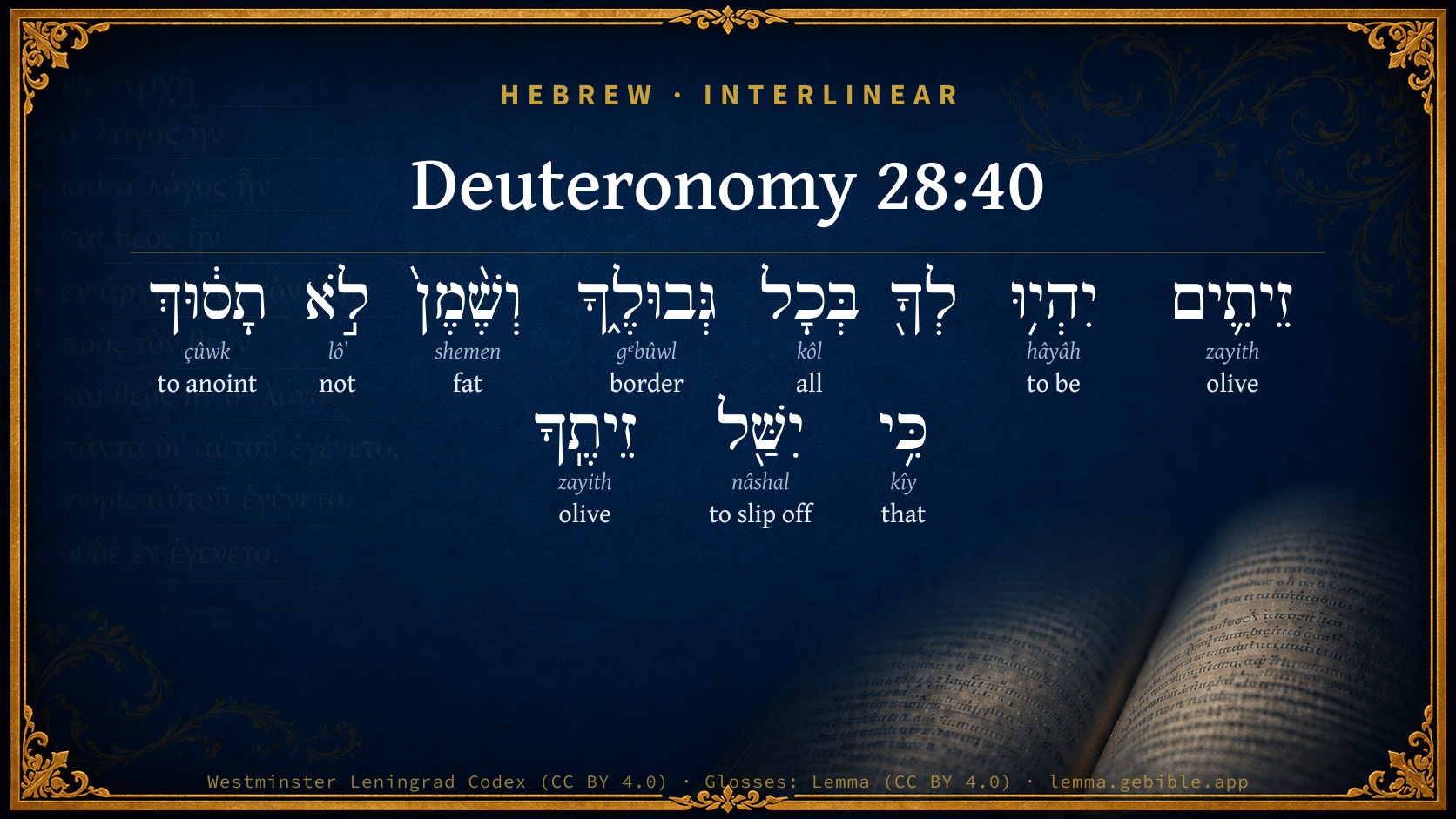
Hebrew (Westminster Leningrad Codex) Deuteronomy 28:40 appears in the Hebrew Old Testament. The text above is from the Westminster Leningrad Codex. Each word links to its Strong’s number, a concise gloss, and parsing drawn from the Open Scriptures Hebrew Bible morphology. Click any word for its full Brown-Driver-Briggs (BDB) entry.
Download image
Cite this verse

Deuteronomy 28:40 (World English Bible). Public Domain. Lemma interlinear Bible study tool, https://lemma.gebible.app/v/deuteronomy/28/40.

Show BibTeX & RIS
BibTeX
RIS
English Translation
You shall have olive trees throughout all your borders, but you shall not anoint yourself with the oil; for your olive shall cast [its fruit].
World English Bible · Public Domain
Highlights
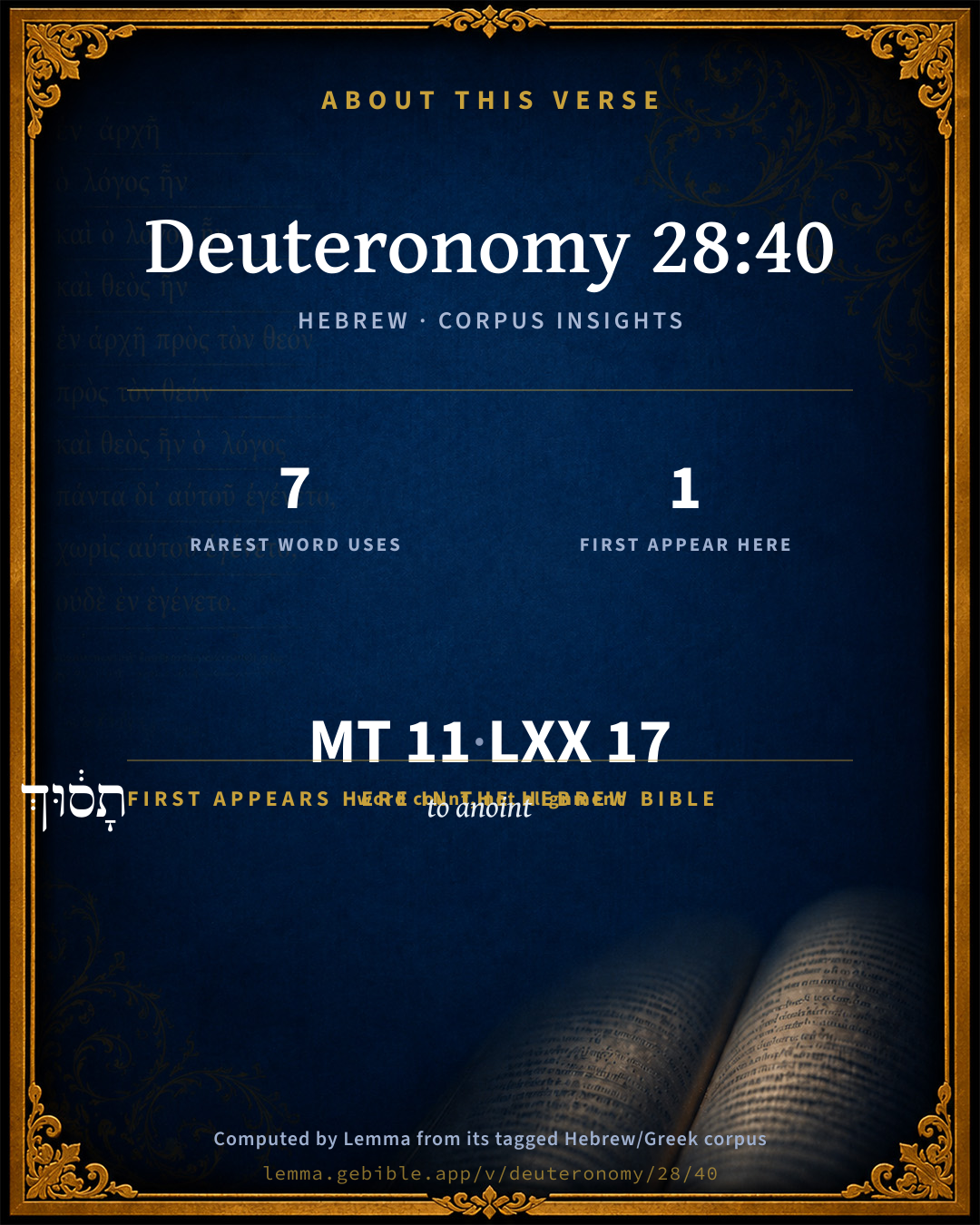
  • 1 first appearance in the Hebrew Bible
Full analysis ↓
Download a study sheet

One document with this verse’s original text, its word-by-word gloss line, the meaning frame, cross-references with their text, attributed commentary, and full source and license credits — printable, and it pastes into notes with its structure intact.

This verse Autodidact and up

Study sheet (.html) Plain text (.txt)

A passage Seminary Student

Up to 50 verses in one chapter. A passage sheet keeps up to 6 commentary sources and 12 cross-references per verse, in the order this page ranks them, and says so on the sheet whenever that leaves anything out. Ask for a single verse and you get the Autodidact verse sheet above.

Everything on this page stays free to read, with no account — the sheet is a download of what is already on screen, not access to it.

Want to remove ads? Support Godless Engineer
Compare translations 3

The same verse in 3 English versions, stacked beneath the original-language interlinear above. Click any original word for its lexicon entry.

Each is an independent rendering of the whole verse — the interlinear is not word-aligned to these translations.

Highlighted words mark where these versions differ — a whole-verse word diff, not a word-by-word alignment.

  • World English Bible Public Domain
    You shall have olive trees throughout all your borders, but you shall not anoint yourself with the oil; for your olive shall cast [its fruit].
  • King James Version Public Domain
    Thou shalt have olive trees throughout all thy coasts, but thou shalt not anoint thyself with the oil; for thine olive shall cast his fruit.
  • unfoldingWord Literal Text CC BY-SA 4.0
    You will have olive trees within all your territory, but you will not grease yourself the oil, for your olives will become detached.

unfoldingWord Literal Text — © unfoldingWord, licensed CC BY-SA 4.0. Word-aligned USFM3 via Door43 (git.door43.org/unfoldingWord/en_ult).

Versions to compare (up to 4)

3 of 4 selected

Show all 18 translations

Every available English version of this verse, each an independent rendering of the whole verse.

  • World English Bible Public Domain
    You shall have olive trees throughout all your borders, but you shall not anoint yourself with the oil; for your olive shall cast [its fruit].
  • Berean Standard Bible Public Domain
    You will have olive trees throughout your territory but will never anoint yourself with oil, because the olives will drop off.
  • Majority Standard Bible Public Domain
    You will have olive trees throughout your territory but will never anoint yourself with oil, because the olives will drop off.
  • King James Version Public Domain
    Thou shalt have olive trees throughout all thy coasts, but thou shalt not anoint thyself with the oil; for thine olive shall cast his fruit.
  • American Standard Version (1901) Public Domain
    Thou shalt have olive-trees throughout all thy borders, but thou shalt not anoint thyself with the oil; for thine olive shall cast `its fruit'.
  • Revised Version (1885) Public Domain
    Thou shalt have olive trees throughout all thy borders, but thou shalt not anoint thyself with the oil: for thine olive shall cast its fruit.
  • Geneva Bible (1599) Public Domain
    Thou shalt haue Oliue trees in all thy coastes, but shalt not anoynt thy selfe with the oyle: for thine oliues shall fall.
  • Douay-Rheims (1899) Public Domain
    Thou shalt have olive trees in all thy borders, and shalt not be anointed with the oil: for the olives shall fall off and perish.
  • Young's Literal Translation Public Domain
    olives are to thee in all thy border, and oil thou dost not pour out, for thine olive doth fall off.
  • Literal Standard Version CC BY-SA 4.0
    olives are yours in all your border, but you do not pour out oil, for your olive falls off.
  • Unlocked Literal Bible CC BY-SA 4.0
    You will have olive trees within all your territory, but you will not rub any of the oil on yourself, for your olive trees will drop their fruit.
  • unfoldingWord Literal Text CC BY-SA 4.0
    You will have olive trees within all your territory, but you will not grease yourself the oil, for your olives will become detached.
  • Darby Bible Public Domain
    Olive-trees shalt thou have throughout all thy borders, but thou shalt not anoint thyself with oil; for thine olive-tree shall cast its fruit.
  • World Messianic Bible Public Domain
    You will have olive trees throughout all your borders, but you won’t anoint yourself with the oil, for your olives will drop off.
  • Webster's Bible Public Domain
    Thou shalt have olive-trees throughout all thy coasts, but thou shalt not anoint thyself with the oil: for thy olive shall cast its fruit.
  • Free Bible Version CC BY-SA 4.0
    You will have olive trees all over the country but you won't have any olive oil to use, because the olives will drop early from the trees.
  • Bible in Basic English Public Domain
    Your land will be full of olive-trees, but there will be no oil for the comfort of your body; for your olive-tree will give no fruit.
  • JPS Tanakh (1917) Public Domain
    Thou shalt have olive-trees throughout all thy borders, but thou shalt not anoint thyself with the oil; for thine olives shall drop off.

Literal Standard Version (2020), Covenant Press — licensed CC BY-SA 4.0. Text via the HelloAO Bible API (eBible.org). Unlocked Literal Bible (unfoldingWord) — licensed CC BY-SA 4.0. Text via the HelloAO Bible API (eBible.org). unfoldingWord Literal Text — © unfoldingWord, licensed CC BY-SA 4.0. Word-aligned USFM3 via Door43 (git.door43.org/unfoldingWord/en_ult). Free Bible Version, Dr. Jonathan Gallagher — licensed CC BY-SA 4.0. Text via the HelloAO Bible API (eBible.org).

Word by word

More ways to search: Search by grammar → Find every occurrence → Compare this word →

Practice this passage: Drill this verse → Learn its vocabulary →

יִשַּׁ֖ל
nâshal
H5394
“to slip off”
Verb, Qal, Imperfect, 3rd Person, Masculine, Singular
Part of Speech
Verb
Stem
Qal
Form
Imperfect
Person
3rd Person
Gender
Masculine
Number
Singular
Full BDB Definition

Origin: a primitive root

TWOT: 1432

to slip off, drop off, clear away, draw off - (Qal) - to slip or drop off - to draw off - to clear away - (Piel) to clear out completely, clear entirely
  1. זֵיתִ֛ים zayith H2132 “olives” Noun, Common, Masculine, Plural, Absolute
  2. יִהְי֥וּ hâyâh H1961 “to be” Verb, Qal, Imperfect, 3rd Person, Masculine, Plural
  3. בְּכָל kôl H3605 “in/at · all of” Preposition + Noun, Common, Masculine, Singular, Construct
  4. גְּבוּלֶ֑ךָ gᵉbûwl H1366 “border · your” Noun, Common, Masculine, Singular, Construct + Suffix, Personal, 2nd Person, Masculine, Singular
  5. וְשֶׁ֨מֶן֙ shemen H8081 “and · fat” Conjunction + Noun, Common, Masculine, Singular, Absolute
  6. לֹ֣א lôʼ H3808 “not” Particle, Negative
  7. תָס֔וּךְ çûwk H5480 “to anoint” Verb, Qal, Imperfect, 2nd Person, Masculine, Singular
  8. כִּ֥י kîy H3588 “that” Conjunction
  9. זֵיתֶֽךָ zayith H2132 “olive · your” Noun, Common, Masculine, Singular, Construct + Suffix, Personal, 2nd Person, Masculine, Singular

About this verse

These counts appear in no published source. They are computed here, from the morphology-tagged text and Lemma’s own curated glosses. What Lemma adds →

11
words
9
distinct lemmas
Pentateuch
section

Notable vocabulary

The rarest word here is יִשַּׁ֖ל to slip off H5394 — appearing just 7 times in the whole Hebrew Bible.

First appearance in Scripture

This word makes its first canonical appearance in the Hebrew Bible here:

  • תָס֔וּךְ to anoint H5480

Shared distinctive vocabulary

יִשַּׁ֖ל to slip off H5394 occurs in 7 verses of the Hebrew Bible. Also found in:

Grammatical profile

  • 3 verbs
  • 5 nouns
  • 1 preposition
  • 1 conjunction
  • 1 particle

Verb forms

  • יִהְי֥וּ Qal · Imperfect
  • תָס֔וּךְ Qal · Imperfect
  • יִשַּׁ֖ל Qal · Imperfect

Repetition

A word recurs within this verse — often emphatic in Hebrew:

  • זֵיתִ֛ים olive H2132 ×2

Hebrew & Septuagint length

In English translation the verse runs 25 words from the Hebrew and 25 from the Septuagint (LXX English) — the same length.

A rough comparison of the two English renderings, which tokenize alike — not a word-level alignment.

Word counts can differ between the Hebrew and the Greek without any difference in meaning — e.g. the Hebrew direct-object marker אֵת has no separate Greek word, and Greek often adds the article ὁ.

In the original languages it is 11 Hebrew tokens and 17 Greek tokens — but the two are counted differently (Hebrew bundles its prefixes and suffixes into one token; the Greek is in lemma form), so that isn’t a like-for-like length.

Cross-references

3

Topical passages linked to Deuteronomy 28:40 in the Treasury of Scripture Knowledge — connected by theme and wording, ordered by reader-vote popularity; previews shown in the World English Bible.

  • Micah 6:15 You will sow, but won't reap. You will tread the olives, but won't anoint yourself with oil; And crush grapes, but won't drink the wine.
  • Psalms 23:5 You prepare a table before me in the presence of my enemies. You anoint my head with oil. My cup runs over.
  • Psalms 104:15 Wine that makes glad the heart of man, Oil to make his face to shine, And bread that strengthens man's heart.

Cross-references courtesy of OpenBible.info (CC BY 4.0).

Hebrew and Greek witnesses Masoretic Hebrew ↔ Greek Septuagint

The same verse in the two great witnesses to the Old Testament, shown verse-for-verse.

These are two independent witnesses, not word-aligned to each other, and the Septuagint is shown in lemma (dictionary) form.

Hebrew Deuteronomy 28:40 Masoretic · Westminster Leningrad Codex

זֵיתִ֛ים יִהְי֥וּ לְךָ֖ בְּכָל גְּבוּלֶ֑ךָ וְשֶׁ֨מֶן֙ לֹ֣א תָס֔וּךְ כִּ֥י יִשַּׁ֖ל זֵיתֶֽךָ

You shall have olive trees throughout all your borders, but you shall not anoint yourself with the oil; for your olive shall cast [its fruit].

World English Bible · Public Domain

Greek LXX Deuteronomy 28:40 Septuagint · lemma form

ἐλαία εἰμί σύ ἐν πᾶς ὁ ὅριον σύ καί ἔλαιον οὐ χρίω ὅτι ἐκρέω ὁ ἐλαία σύ

You shall have olive trees in all your borders, and you shall not anoint you with oil, because your olive shall utterly cast its fruit.

LXX2012 (modern English Septuagint) · Public Domain

Hebrew: Westminster Leningrad Codex (CC BY 4.0). Greek: Septuagint (public domain); English from LXX2012 (modern English Septuagint) (Public Domain). How the Septuagint differs from the Hebrew →

Targum (Aramaic paraphrase)

2

The Targum is the ancient Jewish Aramaic paraphrase of the Hebrew Scriptures — an interpretive translation, not the Hebrew text itself. Onkelos (literal) and Pseudo-Jonathan (expansive) render the Torah, and Jonathan the Prophets. Coverage is partial: where no permissively-licensed English translation exists for a verse, only the Aramaic is shown. This is verse-level text, not a word-by-word alignment to the Hebrew.

  1. Targum Onkelos Torah (Genesis–Deuteronomy)
    זֵיתִין יְהוֹן לָךְ בְּכָל תְּחוּמָךְ וּמִשְׁחָא לָא תְסוּךְ אֲרֵי יִתְּרוּן זֵיתָיךְ

    (no public-domain English translation for this verse)

    Targum Onkelos — Aramaic: “Onkelos Genesis” (public domain); “Onkelos Exodus” (public domain); “Onkelos Leviticus” (public domain); “Onkelos Numbers” (public domain); “Onkelos Deuteronomy” (public domain). English: “Sefaria Community Translation” (CC0 1.0 (public-domain dedication)); “J.W. Etheridge. The Targums of Onkelos and Jonathan Ben Uzziel on the Pentateuch. London: Longmans, Green, 1862” (public domain). Text via Sefaria.

  2. Targum Pseudo-Jonathan Torah (Genesis–Deuteronomy)
    זֵיתִין יְהוֹן לְכוֹן בְּכָל תְּחוּמְכוֹן וּמְשַׁח לָא תְשׁוּטוּן אֲרוּם יְנַתְּרוּן זֵיתֵיכוֹן

    You will have olive trees in all your borders, but will not be anointed with oil, for your olive trees will fail.

    Targum Pseudo-Jonathan — Aramaic: “Targum Jonathan on Genesis” (public domain); “Targum Jonathan on Exodus” (public domain); “Targum Jonathan on Leviticus” (public domain); “Targum Jonathan on Numbers” (public domain); “Targum Jonathan on Deuteronomy” (public domain). English: “The Targum of Jonathan ben Uzziel, trans. J. W. Etheridge, London, 1862” (public domain). Text via Sefaria.

Commentary

Notes on Deuteronomy 28:40 from classic Christian and Jewish commentators (each source and its license shown beneath its notes). The classic Christian expositions comment on the surrounding passage and are grouped to its opening verse, so a note may address several verses; the Jewish commentaries on the Tanakh (Rashi and others) are per-verse, so they appear only where the commentator wrote on this verse.

Lemma curates 59 commentaries, every one of them public domain or Creative Commons licensed, each selected and text-cleaned for this edition rather than reprinted as found. About our sources →

Geneva Bible (1599)

Geneva Bible translators

Or, be shaken before they be ripe.

Geneva Bible (1599) marginal notes — public domain. Text via Bolls.life.

John Gill's Exposition

He shall lend to thee, and thou shall not lend to him,.... The stranger, or one of another nation, shall be in a capacity of lending to the Jew, when the Jew would not be able to lend to the Gentile, his circumstances being so low and mean; to show which is the design of the expression, and not the kindness or unkindness of either; see Deu 28:12,

he shall be the head, and thou shalt be the tail; he shall be ruler and governor, and thou shalt be subject to him; see Deu 28:13.

John Gill's Exposition of the Whole Bible (1746–1763) — public domain (CC PDM 1.0). Text via the HelloAO Bible API.

The Pulpit Commentary

Thine olive shall cast his fruit. Some would render here "shall be plundered or rooted out," taking the verb lVyi as the Niph. of llv but the majority regard it as part of the verb lvn and render "shall drop off," or as in the Authorized Version. There is some doubt, however, whether the verb lvn can be used intransitively.

The Pulpit Commentary (1880–1919), ed. H.D.M. Spence-Jones & Joseph S. Exell — public domain. Text from a community e-Sword module.

unfoldingWord translationNotes

Door43 World Missions Community

General Information:

Moses continues describing God's curses if the people disobey him. He speaks to the Israelites as if they were one man, so the words "you" and "your" here are singular. (See: Forms of You)

but you will not rub any of the oil on yourself

People would rub olive oil on themselves to make their skin healthy.

your olive trees will drop their fruit

You may need to make explicit that the fruit drops before it is ripe. AT: "your olive trees will drop their fruit before the fruit is ripe" or "the olives will fall off your olive trees before they are ripe" (See: Assumed Knowledge and Implicit Information)

translationWords

olive

oil

fruit

son

captive

unfoldingWord translationNotes — © Distant Shores Media and the Door43 World Missions Community, licensed CC BY-SA 4.0. Source: git.door43.org/Door43/en_tn.

Rashi

Rabbi Shlomo Yitzchaki (Rashi)

ישל means, it (the olivetree) shall drop its fruits. It is similar in meaning to the verb in (Deuteronomy 19:5), "And the iron falleth off (ונשל).

Rashi on the Tanakh — English translations: “The Judaica Press complete Tanach with Rashi, translated by A. J. Rosenberg” (CC BY 4.0); “Pentateuch with Rashi's commentary by M. Rosenbaum and A.M. Silbermann, 1929-1934” (public domain); “The Metsudah Tanach series, Lakewood, N.J” (CC BY 4.0); and “The Book of Joshua, Metsudah Publications, 1997” (CC BY 4.0). Text via Sefaria.

Lesson kit

Teaching starters — assembled from the data on this page, not authored interpretation. Every prompt links to the verse data it draws on. Edit before teaching.

Deuteronomy, in the Pentateuch, opens this verse with 11 words (9 distinct Hebrew lemmas). Its most distinctive word is nâshal (“to slip off”). A historical commentator’s framing appears above. Read the whole chapter for the surrounding context.

Discussion questions

  1. What does “to slip off” (nâshal) contribute to the verse as a whole?
  2. This is the first place “to anoint” appears in Scripture (first appears here). What does its debut here establish?
  3. How does Exodus 3:5, which shares the word «to slip off», read alongside this verse?
  4. What does the repetition of “olive” (2× in this one verse) do in this verse?
  5. The translations on this page render this verse differently — a whole-verse word diff, not a word-by-word alignment. What might account for the different wordings?
  6. «יִהְי֥וּ» is a Qal Imperfect verb. How does that grammatical form shape the action described?
  7. Compare how Geneva Bible (1599) and John Gill's Exposition read this verse. Where do they agree or differ?

Things to notice

Reading settings

Reading text

Shown beneath each verse's original-language words.

Old Testament
Old Testament edition

Read the OT as the Masoretic Hebrew (MT) or the Greek Septuagint (LXX).

English shown for the Greek Septuagint (in the Hebrew ↔ Greek comparison).

Comparing translations? Open the Compare panel on any verse page to stack up to four side by side.