Joshua 19:14

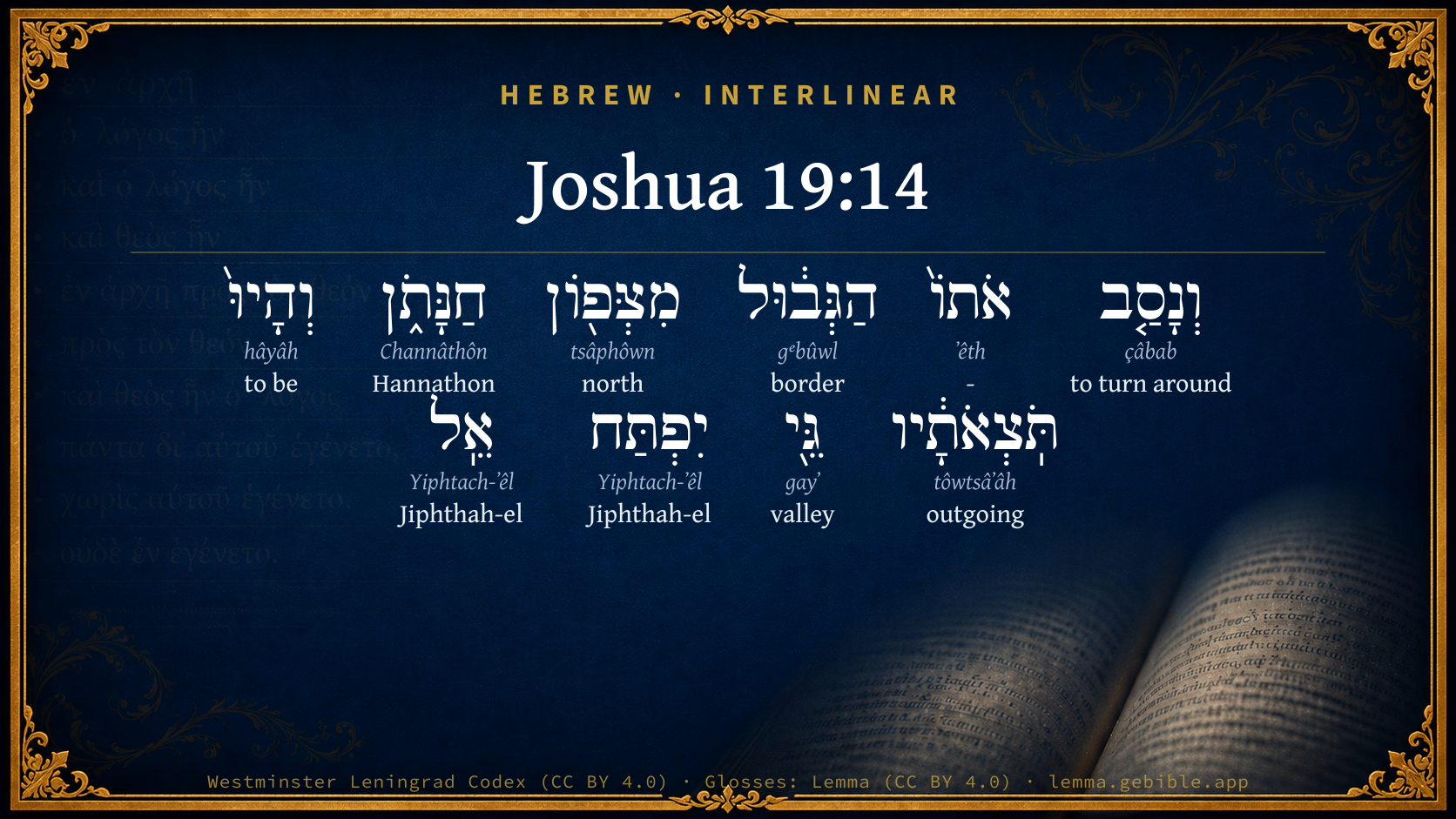
Hebrew (Westminster Leningrad Codex) Joshua 19:14 appears in the Hebrew Old Testament. The text above is from the Westminster Leningrad Codex. Each word links to its Strong’s number, a concise gloss, and parsing drawn from the Open Scriptures Hebrew Bible morphology. Click any word for its full Brown-Driver-Briggs (BDB) entry.
Download image
Cite this verse

Joshua 19:14 (World English Bible). Public Domain. Lemma interlinear Bible study tool, https://lemma.gebible.app/v/joshua/19/14.

Show BibTeX & RIS
BibTeX
RIS
English Translation
and the border turned about it on the north to Hannathon; and the goings out of it were at the valley of Iphtah El;
World English Bible · Public Domain
Highlights Full analysis ↓
Download a study sheet

One document with this verse’s original text, its word-by-word gloss line, the meaning frame, cross-references with their text, attributed commentary, and full source and license credits — printable, and it pastes into notes with its structure intact.

This verse Autodidact and up

Study sheet (.html) Plain text (.txt)

A passage Seminary Student

Up to 50 verses in one chapter. A passage sheet keeps up to 6 commentary sources and 12 cross-references per verse, in the order this page ranks them, and says so on the sheet whenever that leaves anything out. Ask for a single verse and you get the Autodidact verse sheet above.

Everything on this page stays free to read, with no account — the sheet is a download of what is already on screen, not access to it.

Want to remove ads? Support Godless Engineer
Compare translations 3

The same verse in 3 English versions, stacked beneath the original-language interlinear above. Click any original word for its lexicon entry.

Each is an independent rendering of the whole verse — the interlinear is not word-aligned to these translations.

Highlighted words mark where these versions differ — a whole-verse word diff, not a word-by-word alignment.

  • World English Bible Public Domain
    and the border turned about it on the north to Hannathon; and the goings out of it were at the valley of Iphtah El;
  • King James Version Public Domain
    And the border compasseth it on the north side to Hannathon: and the outgoings thereof are in the valley of Jiphthahel:
  • unfoldingWord Literal Text CC BY-SA 4.0
    And the border went around it from the north of Hannathon, and its goings out were the Valley of Iphtah El.

unfoldingWord Literal Text — © unfoldingWord, licensed CC BY-SA 4.0. Word-aligned USFM3 via Door43 (git.door43.org/unfoldingWord/en_ult).

Versions to compare (up to 4)

3 of 4 selected

Show all 18 translations

Every available English version of this verse, each an independent rendering of the whole verse.

  • World English Bible Public Domain
    and the border turned about it on the north to Hannathon; and the goings out of it were at the valley of Iphtah El;
  • Berean Standard Bible Public Domain
    Then the border circled around the north side of Neah to Hannathon and ended at the Valley of Iphtah-el.
  • Majority Standard Bible Public Domain
    Then the border circled around the north side of Neah to Hannathon and ended at the Valley of Iphtah-el.
  • King James Version Public Domain
    And the border compasseth it on the north side to Hannathon: and the outgoings thereof are in the valley of Jiphthahel:
  • American Standard Version (1901) Public Domain
    and the border turned about it on the north to Hannathon; and the goings out thereof were at the valley of Iphtah-el;
  • Revised Version (1885) Public Domain
    and the border turned about it on the north to Hannathon: and the goings out thereof were at the valley of Iphtah-el;
  • Geneva Bible (1599) Public Domain
    And this border compasseth it on ye North side to Hannathon, and the endes thereof are in the valley of Iiphtah-el,
  • Douay-Rheims (1899) Public Domain
    And it turneth about to the north of Hanathon: and the outgoings thereof are the valley of Jephtahel,
  • Young's Literal Translation Public Domain
    and the border hath gone round about it, from the north to Hannathon; and its outgoings have been `in' the valley of Jiphthah-El,
  • Literal Standard Version CC BY-SA 4.0
    and the border has gone around it, from the north to Hannathon; and its outgoings have been [in] the Valley of Jiphthah-El,
  • Unlocked Literal Bible CC BY-SA 4.0
    The border made a turn to the north to Hannathon and ended at the Valley of Iphtah El.
  • unfoldingWord Literal Text CC BY-SA 4.0
    And the border went around it from the north of Hannathon, and its goings out were the Valley of Iphtah El.
  • Darby Bible Public Domain
    and the border turned round it northwards to Hannathon: and ended in the valley of Jiphthah-el;...
  • World Messianic Bible Public Domain
    The border turned around it on the north to Hannathon; and it ended at the valley of Iphtah El;
  • Webster's Bible Public Domain
    And the border compasseth it on the north side to Hannathon: and the limits of it are in the valley of Jiphthah-el:
  • Free Bible Version CC BY-SA 4.0
    There the boundary turned north to Hannathon, ending at the valley of Iphtah-el.
  • Bible in Basic English Public Domain
    And the line goes round it on the north to Hannathon, ending at the valley of Iphtah-el;
  • JPS Tanakh (1917) Public Domain
    And the border turned about it on the north to Hannathon; and the goings out thereof were at the valley of Iphtahel;

Literal Standard Version (2020), Covenant Press — licensed CC BY-SA 4.0. Text via the HelloAO Bible API (eBible.org). Unlocked Literal Bible (unfoldingWord) — licensed CC BY-SA 4.0. Text via the HelloAO Bible API (eBible.org). unfoldingWord Literal Text — © unfoldingWord, licensed CC BY-SA 4.0. Word-aligned USFM3 via Door43 (git.door43.org/unfoldingWord/en_ult). Free Bible Version, Dr. Jonathan Gallagher — licensed CC BY-SA 4.0. Text via the HelloAO Bible API (eBible.org).

Word by word

More ways to search: Search by grammar → Find every occurrence → Compare this word →

Practice this passage: Drill this verse → Learn its vocabulary →

About this verse

These counts appear in no published source. They are computed here, from the morphology-tagged text and Lemma’s own curated glosses. What Lemma adds →

10
words
9
distinct lemmas
Historical
section

Notable vocabulary

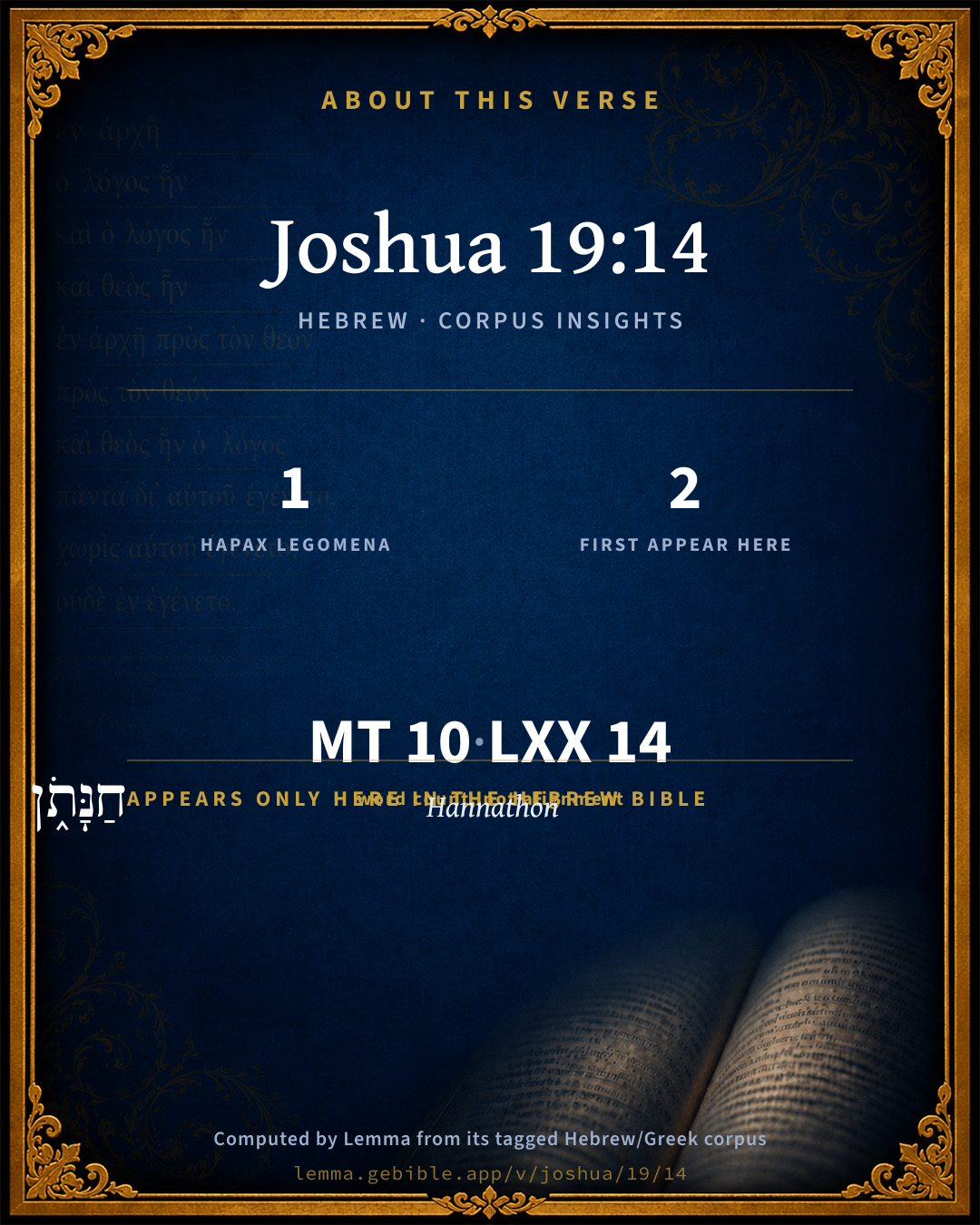
1 hapax legomenon — a word that appears only here in the entire Hebrew Bible:

  • חַנָּתֹ֑ן Hannathon H2615

First appearance in Scripture

These words make their first canonical appearance in the Hebrew Bible here:

  • חַנָּתֹ֑ן Hannathon H2615
  • יִפְתַּח Jiphthah-el H3317

Shared distinctive vocabulary

יִפְתַּח Jiphthah-el H3317 occurs in 2 verses of the Hebrew Bible. Also found in:

Grammatical profile

  • 2 verbs
  • 7 nouns
  • 1 particle

Verb forms

  • וְנָסַ֤ב Niphal · Perfect
  • וְהָיוּ֙ Qal · Perfect

Repetition

A word recurs within this verse — often emphatic in Hebrew:

  • יִפְתַּח Jiphthah-el H3317 ×2

Hebrew & Septuagint length

In English translation the verse runs 24 words from the Hebrew and 17 from the Septuagint (LXX English) — the Septuagint runs noticeably shorter here. See the side-by-side →

A rough comparison of the two English renderings, which tokenize alike — not a word-level alignment.

Word counts can differ between the Hebrew and the Greek without any difference in meaning — e.g. the Hebrew direct-object marker אֵת has no separate Greek word, and Greek often adds the article ὁ.

In the original languages it is 10 Hebrew tokens and 14 Greek tokens — but the two are counted differently (Hebrew bundles its prefixes and suffixes into one token; the Greek is in lemma form), so that isn’t a like-for-like length.

Hebrew and Greek witnesses Masoretic Hebrew ↔ Greek Septuagint

The same verse in the two great witnesses to the Old Testament, shown verse-for-verse.

Here the Septuagint runs noticeably shorter than the Hebrew — LXX2012 (modern English Septuagint) 17 words vs World English Bible 24. A rough length comparison of the two English translations, not a word-level alignment — read both below.

These are two independent witnesses, not word-aligned to each other, and the Septuagint is shown in lemma (dictionary) form.

Hebrew Joshua 19:14 Masoretic · Westminster Leningrad Codex

וְנָסַ֤ב אֹתוֹ֙ הַגְּב֔וּל מִצְּפ֖וֹן חַנָּתֹ֑ן וְהָיוּ֙ תֹּֽצְאֹתָ֔יו גֵּ֖י יִפְתַּח אֵֽל

and the border turned about it on the north to Hannathon; and the goings out of it were at the valley of Iphtah El;

World English Bible · Public Domain

Greek LXX Joshua 19:14 Septuagint · lemma form

καί περιἔρχομαι ὅριον ἐπί βορέας ἐπί αμωθ καί εἰμί ὁ διέξοδος αὐτός ἐπί γαιφαηλ

And the borders shall come round northward to Amoth, and their going out shall be at Gaephael,

LXX2012 (modern English Septuagint) · Public Domain

Hebrew: Westminster Leningrad Codex (CC BY 4.0). Greek: Septuagint (public domain); English from LXX2012 (modern English Septuagint) (Public Domain). How the Septuagint differs from the Hebrew →

Targum (Aramaic paraphrase)

1

The Targum is the ancient Jewish Aramaic paraphrase of the Hebrew Scriptures — an interpretive translation, not the Hebrew text itself. Onkelos (literal) and Pseudo-Jonathan (expansive) render the Torah, and Jonathan the Prophets. Coverage is partial: where no permissively-licensed English translation exists for a verse, only the Aramaic is shown. This is verse-level text, not a word-by-word alignment to the Hebrew.

  1. Targum Jonathan Prophets (Joshua–Malachi)
    וּמִסְתְּחַר לֵיהּ תְּחוּמָא מִצִפּוּנָא לְחַנָתוֹן וַהֲווֹן מַפְקָנוֹהִי לְחֵילַת יִפְתַּח אֵל:

    (no public-domain English translation for this verse)

    Targum Jonathan — Aramaic: “Mikraot Gedolot” (public domain). English: “Sefaria Community Translation” (CC0 1.0 (public-domain dedication)); “London "Chaldee Paraphrase," 1871” (public domain). Text via Sefaria.

Commentary

Notes on Joshua 19:14 from classic Christian and Jewish commentators (each source and its license shown beneath its notes). The classic Christian expositions comment on the surrounding passage and are grouped to its opening verse, so a note may address several verses; the Jewish commentaries on the Tanakh (Rashi and others) are per-verse, so they appear only where the commentator wrote on this verse.

Lemma curates 59 commentaries, every one of them public domain or Creative Commons licensed, each selected and text-cleaned for this edition rather than reprinted as found. About our sources →

Ellicott's Commentary for English Readers

(14) Hannathon (Kefr-’Andn, sheet 9) is the northeast corner of the boundary. The valley (ravine) of Jiphthah-el (God’s opening) seems to be the gorge running south-west from the north of Hannathon towards the plain.

A Bible Commentary for English Readers, edited by Charles John Ellicott (1878–1897) — public domain. Text from a community e-Sword module.

The Cambridge Bible for Schools and Colleges

gen. ed. J. J. S. Perowne

14. and the border compasseth it] The meaning seems to be “and the border went round it (Neah) northward to Hannathon; and the outgoings thereof were in the valley of Jiphthah-el.”

compasseth it] For “compass” see above, note on ch. Jos_15:3.

Hannathon] (= “pleasant”), which some have identified with the Cana of the New Testament (Joh_2:1), the present Kana-el-Jelil.

the valley of Jiphthah-el] Dr Robinson suggests that it was identical with Istapata, and that both names survive in the modern Jefât, a village in the mountains of Galilee half way between the bay of Acre and the lake of Gennesareth. But the northern boundary of Zebulun is not easy to trace.

The Cambridge Bible for Schools and Colleges (gen. ed. J. J. S. Perowne; Cambridge University Press, 1878–1918) — public domain. Text from a community e-Sword module.

John Gill's Exposition

And Kattath, and Nahallal,.... Of the two first of these we read nowhere else, but in Jos 21:34,

and Shimron was a royal city, the king of which Joshua took and hanged, Jos 11:1,

and Idalah is a place Bochart conjectures (t) where the goddess Venus was worshipped, Idalia being one of her names:

and Bethlehem is a different place from that which was the birthplace of our Lord, called Bethlehem of Judah, to distinguish it from this:

twelve cities with their villages; more are named, but some of them belonged to other tribes, and only lay on the borders of this; and others might not be properly cities, but small towns.

(t) Canaan, l. 1. c. 3. col. 356.

John Gill's Exposition of the Whole Bible (1746–1763) — public domain (CC PDM 1.0). Text via the HelloAO Bible API.

Albert Barnes' Notes on the Bible

Hannathon, more properly Channathon, has been supposed by some to be the Cana of Galilee of the New Testament, and Jiphthah-el is probably the present “Jefat”; the “Jotapata” of Roman times, which was so long and valiantly defended by Josephus against the legions of Vespasian. The “Valley” is the “Wady Abilin”; and Bethlehem Jos 19:15 is the present miserable village of “Beit-Lahin.”

Albert Barnes' Notes on the Bible (1834–1885) — public domain. Text from a community e-Sword/MySword module.

The Pulpit Commentary

Compasseth it. The verb bsn is here used transitively. The meaning is that the border makes a curve round the city of Neah. Neah seems to have been the extreme eastern border. Methoar is supposed to be the Pual participle, and has been freely translated, "which is marked out," or, "which belongs to," Neah. But the passage is obscure. Knobel could alter the reading, in view of the grammatical difficulty. Yet this, perhaps, is not insuperable in view of Jos_3:14 (see Gesen, "Grammar," sec. 108, 2. c.). Valley. yge. (see note on Jos_8:13 Jos_15:8) So in ver.

27.

The Pulpit Commentary (1880–1919), ed. H.D.M. Spence-Jones & Joseph S. Exell — public domain. Text from a community e-Sword module.

unfoldingWord translationNotes

Door43 World Missions Community

Hannathon ... Iphtah El ... Kattath ... Nahalal ... Shimron ... Idalah ... Bethlehem

These are names of places. (See: How to Translate Names)

Bethlehem

This is not the same "Bethlehem" that is south of Jerusalem in Judah. (See: How to Translate Names)

This was the inheritance of the tribe of Zebulun

The land and cities that the tribe of Zebulun received are spoken of as if they were an inheritance that they received as a permanent possession. AT: "This was the land and the cities that the tribe of Zebulun received as an inheritance" (See: Metaphor)

translationWords

Bethlehem

unfoldingWord translationNotes — © Distant Shores Media and the Door43 World Missions Community, licensed CC BY-SA 4.0. Source: git.door43.org/Door43/en_tn.

Lesson kit

Teaching starters — assembled from the data on this page, not authored interpretation. Every prompt links to the verse data it draws on. Edit before teaching.

Joshua, in the Historical, opens this verse with 10 words (9 distinct Hebrew lemmas). Its most distinctive word is Channâthôn (“Hannathon”). The Greek Septuagint runs shorter here. A historical commentator’s framing appears above. Read the whole chapter for the surrounding context.

Discussion questions

  1. What does “Hannathon” (Channâthôn) contribute to the verse as a whole?
  2. 1 word here appears nowhere else in the Hebrew Bible. Why might the author reach for such rare wording?
  3. 2 words make their first appearance in Scripture here. What does this debut establish?
  4. How does Joshua 19:27, which shares the word «Jiphthah-el», read alongside this verse?
  5. What does the repetition of “Jiphthah-el” (2× in this one verse) do in this verse?
  6. The Septuagint runs shorter here than the Hebrew. What might account for the difference?
  7. These translations render this verse differently; the difference is in the English rendering, not the original. What questions does that raise?
  8. «וְנָסַ֤ב» is a Niphal Perfect verb. How does that grammatical form shape the action described?

Things to notice

  • 1 word in this verse appears nowhere else in the Hebrew Bible.
  • 2 words make their first canonical appearance in Scripture here.
  • This verse counts 10 Hebrew ↔ 14 Greek words.
  • These translations choose different wording for 13 words in this verse.
  • “Jiphthah-el” occurs 2× in this single verse.

Reading settings

Reading text

Shown beneath each verse's original-language words.

Old Testament
Old Testament edition

Read the OT as the Masoretic Hebrew (MT) or the Greek Septuagint (LXX).

English shown for the Greek Septuagint (in the Hebrew ↔ Greek comparison).

Comparing translations? Open the Compare panel on any verse page to stack up to four side by side.