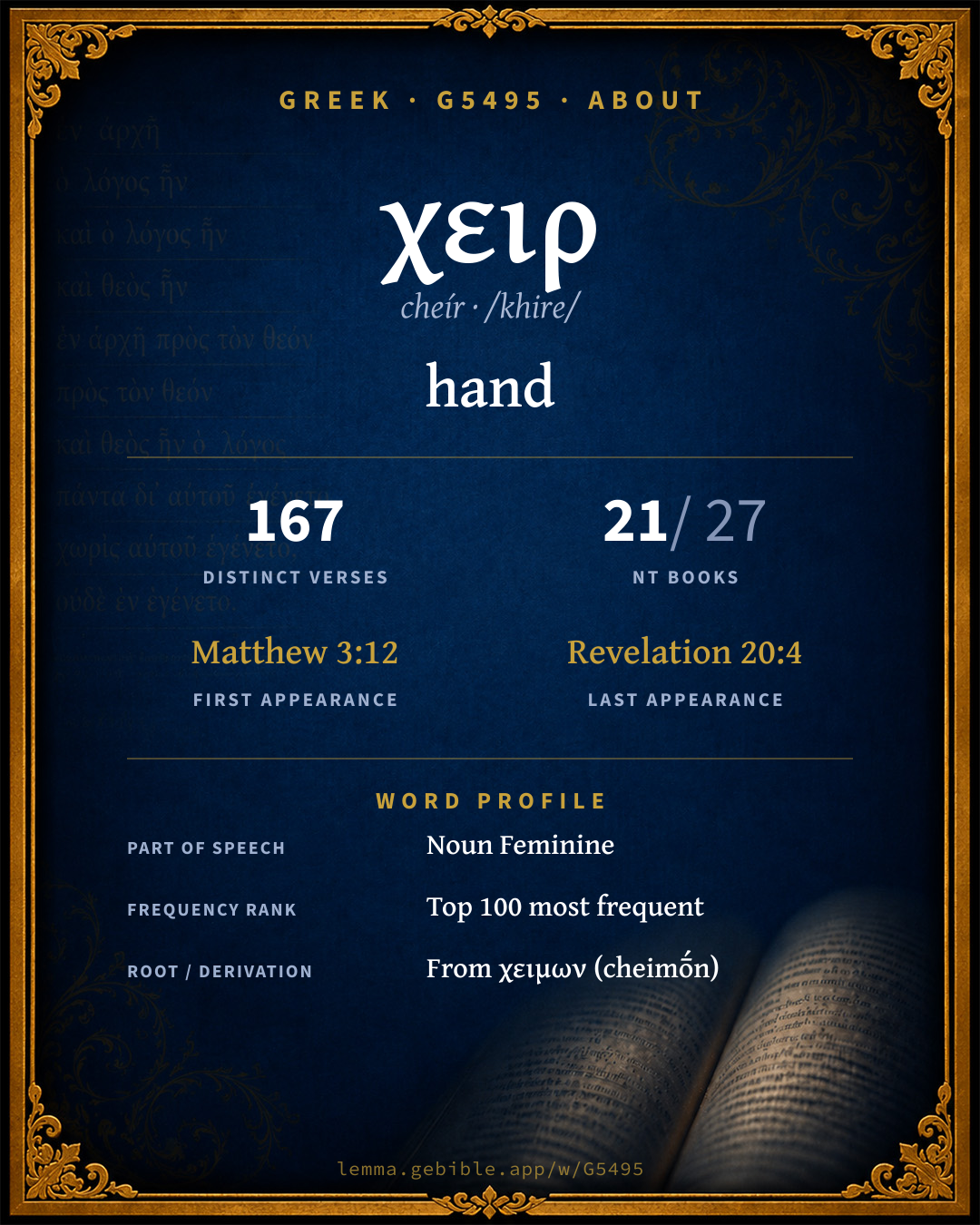
χείρ
hand
‘hand’ is one of 2 main senses fuller range ↓
Full lexicon entry — Thayer's Greek Lexicon
From Thayer's Greek Lexicon
Where this word appears
See every Accusative-case word in the Greek New Testament →
Grammar key — what these labels mean
Part of speech
- Noun
- A naming word — a person, place, thing, or idea.
Case
- Accusative
- The case of the direct object and of extent.
- Genitive
- The case of source, possession, or “of” — answers “whose / from what.”
- Dative
- The case of the indirect object, means, or location — “to / for / with / in.”
- Nominative
- The case of the subject (and the predicate nominative).
Gender
- Feminine
- Grammatically feminine.
Number
- Plural
- More than one.
- Singular
- One.
Grammatical forms
- Noun, Accusative, Plural, Feminine 59 times (34%)
- Noun, Accusative, Singular, Feminine 30 times (17%)
- Noun, Genitive, Singular, Feminine 26 times (15%)
- Noun, Dative, Singular, Feminine 20 times (11%)
- Noun, Genitive, Plural, Feminine 16 times (9%)
- Noun, Nominative, Singular, Feminine 13 times (7%)
- Noun, Dative, Plural, Feminine 9 times (5%)
- Noun, Nominative, Plural, Feminine 2 times (1%)
Parsed forms decoded from the imported morphology (Robinson–Tischendorf, public domain), counted across 175 parsed occurrences — not distinct verses.
Every verse where G5495 appears — 167 distinct verses across 21 books. Click any verse to open its interlinear word-by-word view. Verse text shown in the World English Bible for context — . Each verse’s Greek form is shown with its reference; the English is not keyword-highlighted, since the data carries no word-level English alignment. Use “Compare translations” on any verse to read it across multiple English versions. This concordance covers the Greek New Testament; Septuagint (Greek Old Testament) occurrences of this word are not indexed here.
Matthew 23 verses
- Matthew 3:12 χειρὶ n dat sg fem His winnowing fork is in his hand, and he will thoroughly cleanse his threshing floor. He will gather his wheat into the barn, but the chaff he will burn up with unquenchable fire."
- Matthew 4:6 χειρῶν n gen pl fem and said to him, "If you are the Son of God, throw yourself down, for it is written, 'He will give his angels charge concerning you.' and, 'On their hands they will bear you up, So that you don't dash your foot against a stone.'"
- Matthew 5:30 χεὶρ n nom sg fem If your right hand causes you to stumble, cut it off, and throw it away from you: for it is profitable for you that one of your members should perish, and not your whole body be thrown into Gehenna.
- Matthew 8:3 χεῖρα n acc sg fem Jesus stretched out his hand, and touched him, saying, "I want to. Be made clean." Immediately his leprosy was cleansed.
- Matthew 8:15 χειρὸς n gen sg fem He touched her hand, and the fever left her. She got up and served him.
- Matthew 9:18 χεῖρά n acc sg fem While he told these things to them, behold, a ruler came and worshiped him, saying, "My daughter has just died, but come and lay your hand on her, and she will live."
- Matthew 9:25 χειρὸς n gen sg fem But when the crowd was put out, he entered in, took her by the hand, and the girl arose.
- Matthew 12:10 χεῖρα n acc sg fem And behold there was a man with a withered hand. They asked him, "Is it lawful to heal on the Sabbath day?" that they might accuse him.
- Matthew 12:13 χεῖρα n acc sg fem Then he told the man, "Stretch out your hand." He stretched it out; and it was restored whole, just like the other.
- Matthew 12:49 χεῖρα n acc sg fem He stretched out his hand towards his disciples, and said, "Behold, my mother and my brothers!
- Matthew 14:31 χεῖρα n acc sg fem Immediately Jesus stretched out his hand, took hold of him, and said to him, "You of little faith, why did you doubt?"
- Matthew 15:2 χεῖρας n acc pl fem "Why do your disciples disobey the tradition of the elders? For they don't wash their hands when they eat bread."
- Matthew 15:20 χερσὶν n dat pl fem These are the things which defile the man; but to eat with unwashed hands doesn't defile the man."
- Matthew 17:22 χεῖρας n acc pl fem While they were staying in Galilee, Jesus said to them, "The Son of Man is about to be delivered up into the hands of men,
- Matthew 18:8 χείρ χεῖρας n nom sg fem n acc pl fem If your hand or your foot causes you to stumble, cut it off, and cast it from you. It is better for you to enter into life maimed or crippled, rather than having two hands or two feet to be cast into the eternal fire.
- Matthew 19:13 χεῖρας n acc pl fem Then little children were brought to him, that he should lay his hands on them and pray; and the disciples rebuked them.
- Matthew 19:15 χεῖρας n acc pl fem He laid his hands on them, and departed from there.
- Matthew 22:13 χεῖρας n acc pl fem Then the king said to the servants, 'Bind him hand and foot, take him away, and throw him into the outer darkness; there is where the weeping and grinding of teeth will be.'
- Matthew 26:23 χεῖρα n acc sg fem He answered, "He who dipped his hand with me in the dish, the same will betray me.
- Matthew 26:45 χεῖρας n acc pl fem Then he came to his disciples, and said to them, "Sleep on now, and take your rest. Behold, the hour is at hand, and the Son of Man is betrayed into the hands of sinners.
- Matthew 26:50 χεῖρας n acc pl fem Jesus said to him, "Friend, why are you here?" Then they came and laid hands on Jesus, and took him.
- Matthew 26:51 χεῖρα n acc sg fem Behold, one of those who were with Jesus stretched out his hand, and drew his sword, and struck the servant of the high priest, and struck off his ear.
- Matthew 27:24 χεῖρας n acc pl fem So when Pilate saw that nothing was being gained, but rather that a disturbance was starting, he took water, and washed his hands before the multitude, saying, "I am innocent of the blood of this righteous person. You see to it."
Mark 22 verses
- Mark 1:31 χειρός n gen sg fem He came and took her by the hand, and raised her up. The fever left her, and she served them.
- Mark 1:41 χεῖρα n acc sg fem Being moved with compassion, he stretched out his hand, and touched him, and said to him, "I want to. Be made clean."
- Mark 3:1 χεῖρα n acc sg fem He entered again into the synagogue, and there was a man there who had his hand withered.
- Mark 3:3 χεῖρα n acc sg fem He said to the man who had his hand withered, "Stand up."
- Mark 3:5 χεῖρα χεὶρ n acc sg fem n nom sg fem When he had looked around at them with anger, being grieved at the hardening of their hearts, he said to the man, "Stretch out your hand." He stretched it out, and his hand was restored as healthy as the other.
- Mark 5:23 χεῖρας n acc pl fem and begged him much, saying, "My little daughter is at the point of death. Please come and lay your hands on her, that she may be made healthy, and live."
- Mark 5:41 χειρὸς n gen sg fem Taking the child by the hand, he said to her, "Talitha cumi;" which means, being interpreted, "Girl, I tell you, get up."
- Mark 6:2 χειρῶν n gen pl fem When the Sabbath had come, he began to teach in the synagogue, and many hearing him were astonished, saying, "Where did this man get these things?" and, "What is the wisdom that is given to this man, that such mighty works come about by his hands?
- Mark 6:5 χεῖρας n acc pl fem He could do no mighty work there, except that he laid his hands on a few sick people, and healed them.
- Mark 7:2 χερσίν n dat pl fem Now when they saw some of his disciples eating bread with defiled, that is, unwashed, hands, they found fault.
- Mark 7:3 χεῖρας n acc pl fem (For the Pharisees, and all the Jews, don't eat unless they wash their hands and forearms, holding to the tradition of the elders.
- Mark 7:5 χερσὶν n dat pl fem The Pharisees and the scribes asked him, "Why don't your disciples walk according to the tradition of the elders, but eat their bread with unwashed hands?"
- Mark 7:32 χεῖρα n acc sg fem They brought to him one who was deaf and had an impediment in his speech. They begged him to lay his hand on him.
- Mark 8:23 χειρὸς χεῖρας n gen sg fem n acc pl fem He took hold of the blind man by the hand, and brought him out of the village. When he had spit on his eyes, and laid his hands on him, he asked him if he saw anything.
- Mark 8:25 χεῖρας n acc pl fem Then again he laid his hands on his eyes. He looked intently, and was restored, and saw everyone clearly.
- Mark 9:27 χειρὸς n gen sg fem But Jesus took him by the hand, and raised him up; and he arose.
- Mark 9:31 χεῖρας n acc pl fem For he was teaching his disciples, and said to them, "The Son of Man is being handed over to the hands of men, and they will kill him; and when he is killed, on the third day he will rise again."
- Mark 9:43 χείρ χεῖρας n nom sg fem n acc pl fem If your hand causes you to stumble, cut it off. It is better for you to enter into life maimed, rather than having your two hands to go into Gehenna, into the unquenchable fire,
- Mark 10:16 χεῖρας n acc pl fem He took them in his arms, and blessed them, laying his hands on them.
- Mark 14:41 χεῖρας n acc pl fem He came the third time, and said to them, "Sleep on now, and take your rest. It is enough. The hour has come. Behold, the Son of Man is betrayed into the hands of sinners.
- Mark 14:46 χεῖρας n acc pl fem They laid their hands on him, and seized him.
- Mark 16:18 χεῖρας n acc pl fem they will take up serpents; and if they drink any deadly thing, it will in no way hurt them; they will lay hands on the sick, and they will recover."
Luke 24 verses
- Luke 1:66 χεὶρ n nom sg fem All who heard them laid them up in their heart, saying, "What then will this child be?" The hand of the Lord was with him.
- Luke 1:71 χειρὸς n gen sg fem Salvation from our enemies, and from the hand of all who hate us;
- Luke 1:74 χειρὸς n gen sg fem To grant to us that we, being delivered out of the hand of our enemies, should serve him without fear,
- Luke 3:17 χειρὶ n dat sg fem whose fan is in his hand, and he will thoroughly cleanse his threshing floor, and will gather the wheat into his barn; but he will burn up the chaff with unquenchable fire."
- Luke 4:11 χειρῶν n gen pl fem and, 'On their hands they will bear you up, Lest perhaps you dash your foot against a stone.'"
- Luke 4:40 χεῖρας n acc pl fem When the sun was setting, all those who had any sick with various diseases brought them to him; and he laid his hands on every one of them, and healed them.
- Luke 5:13 χεῖρα n acc sg fem He stretched out his hand, and touched him, saying, "I want to. Be made clean." Immediately the leprosy left him.
- Luke 6:1 χερσίν n dat pl fem Now it happened on the second Sabbath after the first, that he was going through the grain fields. His disciples plucked the heads of grain, and ate, rubbing them in their hands.
- Luke 6:6 χεὶρ n nom sg fem It also happened on another Sabbath that he entered into the synagogue and taught. There was a man there, and his right hand was withered.
- Luke 6:8 χεῖρα n acc sg fem But he knew their thoughts; and he said to the man who had the withered hand, "Rise up, and stand in the middle." He arose and stood.
- Luke 6:10 χεῖρά χεὶρ n acc sg fem n nom sg fem He looked around at them all, and said to the man, "Stretch out your hand." He did, and his hand was restored as sound as the other.
- Luke 8:54 χειρὸς n gen sg fem But he put them all outside, and taking her by the hand, he called, saying, "Child, arise!"
- Luke 9:44 χεῖρας n acc pl fem "Let these words sink into your ears, for the Son of Man will be delivered up into the hands of men."
- Luke 9:62 χεῖρα n acc sg fem But Jesus said to him, "No one, having put his hand to the plow, and looking back, is fit for the Kingdom of God."
- Luke 13:13 χεῖρας n acc pl fem He laid his hands on her, and immediately she stood up straight, and glorified God.
- Luke 15:22 χεῖρα n acc sg fem "But the father said to his servants, 'Bring out the best robe, and put it on him. Put a ring on his hand, and shoes on his feet.
- Luke 20:19 χεῖρας n acc pl fem The chief priests and the scribes sought to lay hands on Him that very hour, but they feared the people--for they knew He had spoken this parable against them.
- Luke 21:12 χεῖρας n acc pl fem But before all these things, they will lay their hands on you and will persecute you, delivering you up to synagogues and prisons, bringing you before kings and governors for my name's sake.
- Luke 22:21 χεὶρ n nom sg fem But behold, the hand of him who betrays me is with me on the table.
- Luke 22:53 χεῖρας n acc pl fem When I was with you in the temple daily, you didn't stretch out your hands against me. But this is your hour, and the power of darkness."
- Luke 23:46 χεῖράς n acc pl fem Jesus, crying with a loud voice, said, "Father, into your hands I commit my spirit!" Having said this, he breathed his last.
- Luke 24:7 χεῖρας n acc pl fem saying that the Son of Man must be delivered up into the hands of sinful men, and be crucified, and the third day rise again?"
- Luke 24:39 χεῖράς n acc pl fem See my hands and my feet, that it is truly me. Touch me and see, for a spirit doesn't have flesh and bones, as you see that I have."
- Luke 24:50 χεῖρας n acc pl fem He led them out as far as Bethany, and he lifted up his hands, and blessed them.
John 13 verses
- John 3:35 χειρὶ n dat sg fem The Father loves the Son, and has given all things into his hand.
- John 7:30 χεῖρα n acc sg fem They sought therefore to take him; but no one laid a hand on him, because his hour had not yet come.
- John 7:44 χεῖρας n acc pl fem Some of them would have arrested him, but no one laid hands on him.
- John 10:28 χειρός n gen sg fem I give eternal life to them. They will never perish, and no one will snatch them out of my hand.
- John 10:29 χειρὸς n gen sg fem My Father, who has given them to me, is greater than all. No one is able to snatch them out of my Father's hand.
- John 10:39 χειρὸς n gen sg fem They sought again to seize him, and he went out of their hand.
- John 11:44 χεῖρας n acc pl fem He who was dead came out, bound hand and foot with wrappings, and his face was wrapped around with a cloth. Jesus said to them, "Free him, and let him go."
- John 13:3 χεῖρας n acc pl fem Jesus, knowing that the Father had given all things into his hands, and that he came forth from God, and was going to God,
- John 13:9 χεῖρας n acc pl fem Simon Peter said to him, "Lord, not my feet only, but also my hands and my head!"
- John 20:20 χεῖρας n acc pl fem When he had said this, he showed them his hands and his side. The disciples therefore were glad when they saw the Lord.
- John 20:25 χερσὶν χεῖρα n dat pl fem n acc sg fem The other disciples therefore said to him, "We have seen the Lord!" But he said to them, "Unless I see in his hands the print of the nails, and put my hand into his side, I will not believe."
- John 20:27 χεῖράς χεῖρά n acc pl fem n acc sg fem Then he said to Thomas, "Reach here your finger, and see my hands. Reach here your hand, and put it into my side. Don't be unbelieving, but believing."
- John 21:18 χεῖράς n acc pl fem Most assuredly I tell you, when you were young, you dressed yourself, and walked where you wanted to. But when you are old, you will stretch out your hands, and another will dress you, and carry you where you don't want to go."
Acts 44 verses
- Acts 2:23 χειρὸς n gen sg fem him, being delivered up by the determined counsel and foreknowledge of God, you have taken by the hand of lawless men, crucified and killed;
- Acts 3:7 χειρὸς n gen sg fem He took him by the right hand, and raised him up. Immediately his feet and his ankle bones received strength.
- Acts 4:3 χεῖρας n acc pl fem They laid hands on them, and put them in custody until the next day, for it was now evening.
- Acts 4:28 χείρ n nom sg fem to do whatever your hand and your council foreordained to happen.
- Acts 4:30 χεῖρά n acc sg fem while you stretch out your hand to heal; and that signs and wonders may be done through the name of your holy Servant Jesus."
- Acts 5:12 χειρῶν n gen pl fem By the hands of the apostles many signs and wonders were done among the people. They were all with one accord in Solomon's porch.
- Acts 5:18 χεῖρας n acc pl fem and laid hands on the apostles, and put them in public custody.
- Acts 6:6 χεῖρας n acc pl fem whom they set before the apostles. When they had prayed, they laid their hands on them.
- Acts 7:25 χειρὸς n gen sg fem He supposed that his brothers understood that God, by his hand, was giving them deliverance; but they didn't understand.
- Acts 7:35 χειρὶ n dat sg fem "This Moses, whom they refused, saying, 'Who made you a ruler and a judge?'--God has sent him as both a ruler and a deliverer by the hand of the angel who appeared to him in the bush.
- Acts 7:41 χειρῶν n gen pl fem They made a calf in those days, and brought a sacrifice to the idol, and rejoiced in the works of their hands.
- Acts 7:50 χείρ n nom sg fem Didn't my hand make all these things?'
- Acts 8:17 χεῖρας n acc pl fem Then they laid their hands on them, and they received the Holy Spirit.
- Acts 8:18 χειρῶν n gen pl fem Now when Simon saw that the Holy Spirit was given through the laying on of the apostles' hands, he offered them money,
- Acts 8:19 χεῖρας n acc pl fem saying, "Give me also this power, that whoever I lay my hands on may receive the Holy Spirit."
- Acts 9:12 χεῖρας n acc pl fem and in a vision he has seen a man named Ananias coming in, and laying his hands on him, that he might receive his sight."
- Acts 9:17 χεῖρας n acc pl fem Ananias departed, and entered into the house. Laying his hands on him, he said, "Brother Saul, the Lord, who appeared to you on the road by which you came, has sent me, that you may receive your sight, and be filled with the Holy Spirit."
- Acts 9:41 χεῖρα n acc sg fem He gave her his hand, and raised her up. Calling the saints and widows, he presented her alive.
- Acts 11:21 χεὶρ n nom sg fem The hand of the Lord was with them, and a great number believed and turned to the Lord.
- Acts 11:30 χειρὸς n gen sg fem which they also did, sending it to the elders by the hands of Barnabas and Saul.
- Acts 12:1 χεῖρας n acc pl fem Now about that time, Herod the king stretched out his hands to oppress some of the assembly.
- Acts 12:7 χειρῶν n gen pl fem And behold, an angel of the Lord stood by him, and a light shone in the cell. He struck Peter on the side, and woke him up, saying, "Stand up quickly!" His chains fell off from his hands.
- Acts 12:11 χειρὸς n gen sg fem When Peter had come to himself, he said, "Now I truly know that the Lord has sent out his angel and delivered me out of the hand of Herod, and from everything the Jewish people were expecting."
- Acts 12:17 χειρὶ n dat sg fem But he, beckoning to them with his hand to be silent, declared to them how the Lord had brought him out of the prison. He said, "Tell these things to James, and to the brothers." Then he departed, and went to another place.
- Acts 13:3 χεῖρας n acc pl fem Then, when they had fasted and prayed and laid their hands on them, they sent them away.
- Acts 13:11 χεὶρ n nom sg fem Now, behold, the hand of the Lord is on you, and you will be blind, not seeing the sun for a season!" Immediately there fell on him a mist and darkness. He went around seeking someone to lead him by the hand.
- Acts 13:16 χειρὶ n dat sg fem Paul stood up, and beckoning with his hand said, "Men of Israel, and you who fear God, listen.
- Acts 14:3 χειρῶν n gen pl fem Therefore they stayed there a long time, speaking boldly in the Lord, who testified to the word of his grace, granting signs and wonders to be done by their hands.
- Acts 15:23 χειρὸς n gen sg fem They wrote these things by their hand: "The apostles, the elders, and the brothers, to the brothers who are of the Gentiles in Antioch, Syria, and Cilicia: greetings.
- Acts 17:25 χειρῶν n gen pl fem neither is he served by men's hands, as though he needed anything, seeing he himself gives to all life and breath, and all things.
- Acts 19:6 χεῖρας n acc pl fem When Paul had laid his hands on them, the Holy Spirit came on them, and they spoke with other languages and prophesied.
- Acts 19:11 χειρῶν n gen pl fem God worked special miracles by the hands of Paul,
- Acts 19:26 χειρῶν n gen pl fem You see and hear, that not at Ephesus alone, but almost throughout all Asia, this Paul has persuaded and turned away many people, saying that they are no gods, that are made with hands.
- Acts 19:33 χεῖρα n acc sg fem They brought Alexander out of the multitude, the Jews putting him forward. Alexander beckoned with his hand, and would have made a defense to the people.
- Acts 20:34 χεῖρες n nom pl fem You yourselves know that these hands ministered to my necessities, and to those who were with me.
- Acts 21:11 χεῖρας χεῖρας n acc pl fem n acc pl fem Coming to us, and taking Paul's belt, he bound his own feet and hands, and said, "Thus says the Holy Spirit: 'So will the Jews at Jerusalem bind the man who owns this belt, and will deliver him into the hands of the Gentiles.'"
- Acts 21:27 χεῖρας n acc pl fem When the seven days were almost completed, the Jews from Asia, when they saw him in the temple, stirred up all the multitude and laid hands on him,
- Acts 21:40 χειρὶ n dat sg fem When he had given him permission, Paul, standing on the stairs, beckoned with his hand to the people. When there was a great silence, he spoke to them in the Hebrew language, saying,
- Acts 23:19 χειρὸς n gen sg fem The commanding officer took him by the hand, and going aside, asked him privately, "What is it that you have to tell me?"
- Acts 26:1 χεῖρα n acc sg fem Agrippa said to Paul, "You may speak for yourself." Then Paul stretched out his hand, and made his defense.
- Acts 28:3 χειρὸς n gen sg fem But when Paul had gathered a bundle of sticks and laid them on the fire, a viper came out because of the heat, and fastened on his hand.
- Acts 28:4 χειρὸς n gen sg fem When the natives saw the creature hanging from his hand, they said one to another, "No doubt this man is a murderer, whom, though he has escaped from the sea, yet Justice has not allowed to live."
- Acts 28:8 χεῖρας n acc pl fem It happened that the father of Publius lay sick of fever and dysentery. Paul entered in to him, prayed, and laying his hands on him, healed him.
- Acts 28:17 χεῖρας n acc pl fem It happened that after three days Paul called together those who were the leaders of the Jews. When they had come together, he said to them, "I, brothers, though I had done nothing against the people, or the customs of our fathers, still was delivered prisoner from Jerusalem into the hands of the Romans,
Romans 1 verse
1 Corinthians 4 verses
- 1 Corinthians 4:12 χερσίν n dat pl fem We toil, working with our own hands. When people curse us, we bless. Being persecuted, we endure.
- 1 Corinthians 12:15 χείρ n nom sg fem If the foot would say, "Because I'm not the hand, I'm not part of the body," it is not therefore not part of the body.
- 1 Corinthians 12:21 χειρί n dat sg fem The eye can't tell the hand, "I have no need for you," or again the head to the feet, "I have no need for you."
- 1 Corinthians 16:21 χειρὶ n dat sg fem This greeting is by me, Paul, with my own hand.
2 Corinthians 1 verse
Galatians 2 verses
- Galatians 3:19 χειρὶ n dat sg fem What then is the law? It was added because of transgressions, until the seed should come to whom the promise has been made. It was ordained through angels by the hand of a mediator.
- Galatians 6:11 χειρί n dat sg fem See with what large letters I write to you with my own hand.
Ephesians 1 verse
Colossians 1 verse
1 Thessalonians 1 verse
2 Thessalonians 1 verse
1 Timothy 3 verses
- 1 Timothy 2:8 χεῖρας n acc pl fem I desire therefore that the men in every place pray, lifting up holy hands without wrath and doubting.
- 1 Timothy 4:14 χειρῶν n gen pl fem Don't neglect the gift that is in you, which was given to you by prophecy, with the laying on of the hands of the elders.
- 1 Timothy 5:22 Χεῖρας n acc pl fem Lay hands hastily on no one, neither be a participant in other men's sins. Keep yourself pure.
2 Timothy 1 verse
Philemon 1 verse
Hebrews 5 verses
- Hebrews 1:10 χειρῶν n gen pl fem And, "You, Lord, in the beginning, laid the foundation of the earth. The heavens are the works of your hands.
- Hebrews 6:2 χειρῶν n gen pl fem of the teaching of baptisms, of laying on of hands, of resurrection of the dead, and of eternal judgment.
- Hebrews 8:9 χειρὸς n gen sg fem Not according to the covenant that I made with their fathers, In the day that I took them by the hand to lead them out of the land of Egypt; For they didn't continue in my covenant, And I disregarded them," says the Lord.
- Hebrews 10:31 χεῖρας n acc pl fem It is a fearful thing to fall into the hands of the living God.
- Hebrews 12:12 χεῖρας n acc pl fem Therefore, lift up the hands that hang down and the feeble knees,
James 1 verse
1 Peter 1 verse
1 John 1 verse
Revelation 16 verses
- Revelation 1:16 χειρὶ n dat sg fem He had seven stars in his right hand. Out of his mouth proceeded a sharp two-edged sword. His face was like the sun shining at its brightest.
- Revelation 6:5 χειρὶ n dat sg fem When he opened the third seal, I heard the third living creature saying, "Come and see!" And behold, a black horse, and he who sat on it had a balance in his hand.
- Revelation 7:9 χερσὶν n dat pl fem After these things I looked, and behold, a great multitude, which no man could number, out of every nation and of all tribes, peoples, and languages, standing before the throne and before the Lamb, dressed in white robes, with palm branches in their hands.
- Revelation 8:4 χειρὸς n gen sg fem The smoke of the incense, with the prayers of the saints, went up before God out of the angel's hand.
- Revelation 9:20 χειρῶν n gen pl fem The rest of mankind, who were not killed with these plagues, didn't repent of the works of their hands, that they wouldn't worship demons, and the idols of gold, and of silver, and of brass, and of stone, and of wood; which can neither see, nor hear, nor walk.
- Revelation 10:2 χειρὶ n dat sg fem He had in his hand a little open book. He set his right foot on the sea, and his left on the land.
- Revelation 10:5 χεῖρα n acc sg fem The angel who I saw standing on the sea and on the land lifted up his right hand to the sky,
- Revelation 10:8 χειρὶ n dat sg fem The voice which I heard from heaven, again speaking with me, said, "Go, take the book which is open in the hand of the angel who stands on the sea and on the land."
- Revelation 10:10 χειρὸς n gen sg fem I took the little book out of the angel's hand, and ate it up. It was as sweet as honey in my mouth. When I had eaten it, my stomach was made bitter.
- Revelation 13:16 χειρὸς n gen sg fem He causes all, the small and the great, the rich and the poor, and the free and the slave, to be given marks on their right hands, or on their foreheads;
- Revelation 14:9 χεῖρα n acc sg fem Another angel, a third, followed them, saying with a great voice, "If anyone worships the beast and his image, and receives a mark on his forehead, or on his hand,
- Revelation 14:14 χειρὶ n dat sg fem I looked, and behold, a white cloud; and on the cloud one sitting like a son of man, having on his head a golden crown, and in his hand a sharp sickle.
- Revelation 17:4 χειρὶ n dat sg fem The woman was dressed in purple and scarlet, and decked with gold and precious stones and pearls, having in her hand a golden cup full of abominations and the impurities of the sexual immorality of the earth.
- Revelation 19:2 χειρὸς n gen sg fem for true and righteous are his judgments. For he has judged the great prostitute, who corrupted the earth with her sexual immorality, and he has avenged the blood of his servants at her hand."
- Revelation 20:1 χεῖρα n acc sg fem I saw an angel coming down out of heaven, having the key of the abyss and a great chain in his hand.
- Revelation 20:4 χεῖρα n acc sg fem I saw thrones, and they sat on them, and judgment was given to them. I saw the souls of those who had been beheaded for the testimony of Jesus, and for the word of God, and such as didn't worship the beast nor his image, and didn't receive the mark on their forehead and on their hand. They lived, and reigned with Christ for the thousand years.
About this entry
At a glance — auto-summarized from this page’s data, not written by a person. Every figure links to its source below. This summary describes the numbers; it doesn’t interpret them.
χειρ — transliterated cheír — is a Greek noun carrying the sense “hand.” Its earliest occurrence is Matthew 3:12. It appears 167 verses across 21 books of the Greek New Testament, among its common vocabulary. More than a quarter of its appearances fall in Acts. Thayer's distinguishes 2 senses for it. Each statement above links to its evidence; the full detail follows below.
Gloss history
Strong's 1890 vs modern scholarship

About this word
Strong's G5495 catalogs a Greek word from the Greek New Testament.
These counts are not copied from any lexicon or concordance. They are computed here, from the morphology-tagged Greek New Testament. What Lemma adds →
- 167
- distinct verses
- The word appears in 167 distinct verses.
- 21 / 27
- NT books
- The word appears in 21 of 27 New Testament books.
- #90
- by frequency
- Top 100 most frequent Greek words (rank 90 of 5,347 Greek words by occurrence).
View all 167 occurrences in the concordance →
By section of the New Testament
By traditional corpus
Conventional, traditional groupings — biblical authorship is debated, so this is a traditional corpus grouping, not an authorship claim. Some books belong to more than one corpus (Luke is in both the Gospels and the Lukan corpus, and so on), so these shares overlap and need not total 100%. Each figure is a share of the word’s 167 distinct verses.
- Gospels 82 verses · 49%
- Lukan (Luke–Acts) 68 verses · 41%
- Johannine 30 verses · 18%
- Pauline corpus 17 verses · 10%
- Revelation 16 verses · 10%
- Hebrews 5 verses · 3%
- General (Catholic) Epistles 3 verses · 2%
How translations render this word
Counts come from each version’s own published word-to-Strong’s tagging or interlinear alignment — an approximate guide to how each version renders this word, not a word-level alignment the data otherwise carries. Because each total is that version’s own tagged count, the per-version totals vary from one another and need not match the appearance or distinct-verse counts above. These counts may also differ from a printed concordance because Lemma counts each distinctly tagged rendering and does not collapse phrase taggings into a single head-word total. This is a fixed set of word-tagged versions (KJV, ASV, BSB, ULT) and does not change with the reading translation you choose elsewhere. Each version’s license is shown beside its name below (and on Sources).
- King James Version: Hands 90×, Hand 86×
- American Standard Version: Hand 85×, Hands 81×, With 4×
- Berean Standard Bible: Hand 74×, Hands 73×, Grasp 3×
- unfoldingWord Literal Text: Hand 88×, Hands 88×, With 8×
King James Version Public Domain
Renders G5495 across 177 tagged occurrences — most commonly:
Plus 1 rendering that appears only once — usually multi-word phrases or single function words the recovered tagging swept in, not distinct renderings. Not rendered by a distinct English word in 2 further occurrences.
American Standard Version Public Domain
Renders G5495 across 181 tagged occurrences — most commonly:
Plus 8 renderings that appear only once — usually multi-word phrases or single function words the recovered tagging swept in, not distinct renderings.
Berean Standard Bible Public Domain
Renders G5495 across 155 tagged occurrences — most commonly:
Plus 5 renderings that appear only once — usually multi-word phrases or single function words the recovered tagging swept in, not distinct renderings. Not rendered by a distinct English word in 19 further occurrences.
unfoldingWord Literal Text CC BY-SA 4.0
Renders G5495 across 197 tagged occurrences — most commonly:
Plus 6 renderings that appear only once — usually multi-word phrases or single function words the recovered tagging swept in, not distinct renderings.
Senses in Thayer's
The 2 senses Thayer's distinguishes for this word, in lexicon order (not ranked by frequency or importance). The full entry — with sub-senses — is in the Lexicon Entry tab.
- by the help or agency of any one, by means of any one
- fig. applied to God symbolising his might, activity, power
Word origin
Derived from χειμων (cheimṓn) (G5494) — winter.
Forms in the corpus
The 16 distinct written forms G5495 takes in the Greek New Testament, most frequent first — each parse links to that case’s occurrences in the concordance.
Same root — word family
Other Thayer's entries built from the same root as G5495, grouped by Strong’s listed origin. These share a root / origin per the lexicon — not necessarily a shared meaning. Each links to that word’s own entry.
Derives from
Shares the same root
- χειμαζω cheimázō G5492 to toss about
- χειμαρρος cheímarrhos G5493 winter torrent
- χοος chóos G5522 earth
Derived from this word
- χειραγωγος cheiragōgós G5497 hand-leading
- χειρογραφον cheirógraphon G5498 handwriting
- χειροποιητος cheiropoíētos G5499 handmade
- χειροτονεω cheirotonéō G5500 to elect
- χραομαι chráomai G5530 to borrow
Compare all same-root words → Showing 4 of 10 — not the complete family. They share a root, not necessarily a meaning.
Septuagint usage
The same Greek word χειρ appears 1,593 times in the Greek Old Testament (Septuagint), across 1,423 verses in 37 books.
- 1,593
- LXX occurrences
- Tagged occurrences of this Greek word in the Septuagint.
- 1,423
- verses
- Distinct Septuagint verses containing this word.
- 37 / 39
- OT books
- The word appears in 37 of the 39 Old Testament books.
Sample Septuagint occurrences
- Genesis 3:22 χείρ
- Exodus 3:8 χείρ
- Leviticus 1:4 χείρ
- Numbers 3:3 χείρ
- Deuteronomy 1:25 χείρ
- Joshua 2:24 χείρ
- Judges 1:2 χείρ
- Ruth 1:13 χείρ
- 1 Samuel 2:13 χείρ
- 2 Samuel 1:14 χείρ
- 1 Kings 2:25 χείρ
- 2 Kings 3:10 χείρ
Septuagint occurrences (same lexeme)
Every verse where the same Strong’s number (G5495) appears in the Greek Septuagint — showing the first 50 of 1,423. Verse text shown in the World English Bible for context; the Greek form is the matched word — the English is not keyword-highlighted.
- Genesis 3:22 χείρ Yahweh God said, "Behold, the man has become like one of us, knowing good and evil. Now, lest he put forth his hand, and also take of the tree of life, and eat, and live forever..."
- Genesis 4:11 χείρ Now you are cursed because of the ground, which has opened its mouth to receive your brother's blood from your hand.
- Genesis 5:29 χείρ and he named him Noah, saying, "This same will comfort us in our work and in the toil of our hands, because of the ground which Yahweh has cursed."
- Genesis 8:9 χείρ but the dove found no place to rest her foot, and she returned to him into the ark; for the waters were on the surface of the whole earth. He put forth his hand, and took her, and brought her to him into the ark.
- Genesis 9:2 χείρ The fear of you and the dread of you will be on every animal of the earth, and on every bird of the sky. Everything that the ground teems with, and all the fish of the sea are delivered into your hand.
- Genesis 9:5 χείρ I will surely require your blood of your lives. At the hand of every animal I will require it. At the hand of man, even at the hand of every man's brother, I will require the life of man.
- Genesis 14:22 χείρ Abram said to the king of Sodom, "I have lifted up my hand to Yahweh, God Most High, possessor of heaven and earth,
- Genesis 16:6 χείρ But Abram said to Sarai, "Behold, your maid is in your hand. Do to her whatever is good in your eyes." Sarai dealt harshly with her, and she fled from her face.
- Genesis 16:9 χείρ The angel of Yahweh said to her, "Return to your mistress, and submit yourself under her hands."
- Genesis 16:12 χείρ He will be like a wild donkey among men. His hand will be against every man, and every man's hand against him. He will live opposite all of his brothers."
- Genesis 19:10 χείρ But the men put forth their hand, and brought Lot into the house to them, and shut the door.
- Genesis 19:16 χείρ But he lingered; and the men laid hold on his hand, and on the hand of his wife, and on the hand of his two daughters, Yahweh being merciful to him; and they took him out, and set him outside of the city.
- Genesis 20:5 χείρ Didn't he tell me, 'She is my sister?' She, even she herself said, 'He is my brother.' In the integrity of my heart and the innocence of my hands have I done this."
- Genesis 21:18 χείρ Get up, lift up the boy, and hold him in your hand. For I will make him a great nation."
- Genesis 22:6 χείρ Abraham took the wood of the burnt offering and laid it on Isaac his son. He took in his hand the fire and the knife. They both went together.
- Genesis 22:10 χείρ Abraham stretched forth his hand, and took the knife to kill his son.
- Genesis 22:12 χείρ He said, "Don't lay your hand on the boy, neither do anything to him. For now I know that you fear God, seeing you have not withheld your son, your only son, from me."
- Genesis 24:2 χείρ Abraham said to his servant, the elder of his house, who ruled over all that he had, "Please put your hand under my thigh.
- Genesis 24:9 χείρ The servant put his hand under the thigh of Abraham his master, and swore to him concerning this matter.
- Genesis 24:22 χείρ It happened, as the camels had done drinking, that the man took a golden ring of half a shekel weight, and two bracelets for her hands of ten shekels weight of gold,
- Genesis 24:30 χείρ It happened, when he saw the ring, and the bracelets on his sister's hands, and when he heard the words of Rebekah his sister, saying, "This is what the man said to me," that he came to the man. Behold, he was standing by the camels at the spring.
- Genesis 24:47 χείρ I asked her, and said, 'Whose daughter are you?' She said, 'The daughter of Bethuel, Nahor's son, whom Milcah bare to him.' I put the ring on her nose, and the bracelets on her hands.
- Genesis 25:26 χείρ After that, his brother came out, and his hand had hold on Esau's heel. He was named Jacob. Isaac was sixty years old when she bore them.
- Genesis 27:17 χείρ She gave the savory food and the bread, which she had prepared, into the hand of her son Jacob.
- Genesis 27:22 χείρ Jacob went near to Isaac his father. He felt him, and said, "The voice is Jacob's voice, but the hands are the hands of Esau."
- Genesis 27:23 χείρ He didn't recognize him, because his hands were hairy, like his brother, Esau's hands. So he blessed him.
- Genesis 30:35 χείρ That day, he removed the male goats that were streaked and spotted, and all the female goats that were speckled and spotted, every one that had white in it, and all the black ones among the sheep, and gave them into the hand of his sons.
- Genesis 31:29 χείρ It is in the power of my hand to hurt you, but the God of your father spoke to me last night, saying, 'Take heed to yourself that you don't speak to Jacob either good or bad.'
- Genesis 31:42 χείρ Unless the God of my father, the God of Abraham, and the fear of Isaac, had been with me, surely now you would have sent me away empty. God has seen my affliction and the labor of my hands, and rebuked you last night."
- Genesis 32:12 χείρ You said, 'I will surely do you good, and make your seed as the sand of the sea, which can't be numbered because there are so many.'"
- Genesis 32:17 χείρ He commanded the foremost, saying, "When Esau, my brother, meets you, and asks you, saying, 'Whose are you? Where are you going? Whose are these before you?'
- Genesis 33:10 χείρ Jacob said, "Please, no, if I have now found favor in your sight, then receive my present at my hand, because I have seen your face, as one sees the face of God, and you were pleased with me.
- Genesis 35:4 χείρ They gave to Jacob all the foreign gods which were in their hands, and the rings which were in their ears; and Jacob hid them under the oak which was by Shechem.
- Genesis 37:21 χείρ Reuben heard it, and delivered him out of their hand, and said, "Let's not take his life."
- Genesis 37:22 χείρ Reuben said to them, "Shed no blood. Throw him into this pit that is in the wilderness, but lay no hand on him"-- that he might deliver him out of their hand, to restore him to his father.
- Genesis 37:27 χείρ Come, and let's sell him to the Ishmaelites, and not let our hand be on him; for he is our brother, our flesh." His brothers listened to him.
- Genesis 38:18 χείρ He said, "What pledge will I give you?" She said, "Your signet and your cord, and your staff that is in your hand." He gave them to her, and came in to her, and she conceived by him.
- Genesis 38:20 χείρ Judah sent the kid of the goats by the hand of his friend, the Adullamite, to receive the pledge from the woman's hand, but he didn't find her.
- Genesis 38:28 χείρ It happened, when she travailed, that one put out a hand: and the midwife took and tied a scarlet thread on his hand, saying, "This came out first."
- Genesis 38:29 χείρ It happened, as he drew back his hand, that behold, his brother came out, and she said, "Why have you made a breach for yourself?" Therefore his name was called Perez.
- Genesis 38:30 χείρ Afterward his brother came out, that had the scarlet thread on his hand, and his name was called Zerah.
- Genesis 39:1 χείρ Joseph was brought down to Egypt. Potiphar, an officer of Pharaoh's, the captain of the guard, an Egyptian, bought him from the hand of the Ishmaelites that had brought him down there.
- Genesis 39:3 χείρ His master saw that Yahweh was with him, and that Yahweh made all that he did prosper in his hand.
- Genesis 39:4 χείρ Joseph found favor in his sight. He ministered to him, and he made him overseer over his house, and all that he had he put into his hand.
- Genesis 39:6 χείρ He left all that he had in Joseph's hand. He didn't concern himself with anything, except for the food which he ate. Joseph was well-built and handsome.
- Genesis 39:8 χείρ But he refused, and said to his master's wife, "Behold, my master doesn't know what is with me in the house, and he has put all that he has into my hand.
- Genesis 39:12 χείρ She caught him by his garment, saying, "Lie with me!" He left his garment in her hand, and ran outside.
- Genesis 39:13 χείρ It happened, when she saw that he had left his garment in her hand, and had run outside,
- Genesis 39:22 χείρ The keeper of the prison committed to Joseph's hand all the prisoners who were in the prison. Whatever they did there, he was the doer of it.
- Genesis 39:23 χείρ The keeper of the prison didn't look after anything that was under his hand, because Yahweh was with him; and that which he did, Yahweh made it prosper.
These are occurrences of the same Greek lexeme (G5495) in the Septuagint — not a translation of any one Hebrew word. The store carries no word-level Hebrew↔Greek alignment, so no Hebrew original is asserted here. Counts come from the recovered LXX Strong's tagging — high-frequency vocabulary is well covered, while rare or late forms may be untagged — so they reflect tagged occurrences and may slightly undercount.