
Luke 24:7

Greek (Tischendorf 8th ed.) Luke 24:7 appears in the Greek New Testament. The text above is from the Tischendorf 8th edition. Each word links to its Strong’s number and a concise gloss. Click any word for its full Thayer’s Greek Lexicon entry.
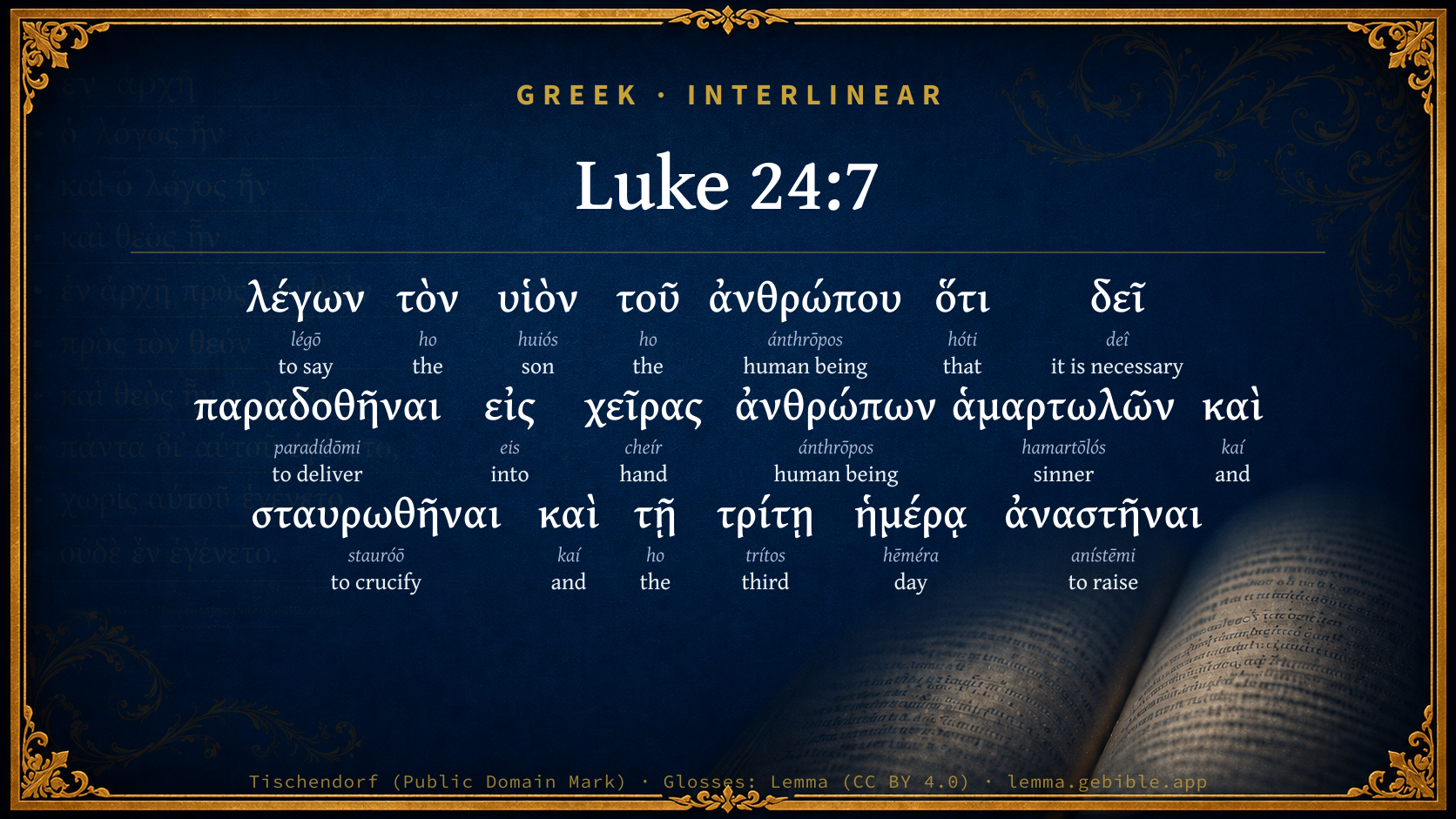
Download image
Cite this verse

Luke 24:7 (World English Bible). Public Domain. Lemma interlinear Bible study tool, https://lemma.gebible.app/v/luke/24/7.

Show BibTeX & RIS
BibTeX
RIS
English Translation
saying that the Son of Man must be delivered up into the hands of sinful men, and be crucified, and the third day rise again?"
World English Bible · Public Domain
Download a study sheet

One document with this verse’s original text, its word-by-word gloss line, the meaning frame, cross-references with their text, attributed commentary, and full source and license credits — printable, and it pastes into notes with its structure intact.

This verse Autodidact and up

Study sheet (.html) Plain text (.txt)

A passage Seminary Student

Up to 50 verses in one chapter. A passage sheet keeps up to 6 commentary sources and 12 cross-references per verse, in the order this page ranks them, and says so on the sheet whenever that leaves anything out. Ask for a single verse and you get the Autodidact verse sheet above.

Everything on this page stays free to read, with no account — the sheet is a download of what is already on screen, not access to it.

Want to remove ads? Support Godless Engineer
Compare translations 3

The same verse in 3 English versions, stacked beneath the original-language interlinear above. Click any original word for its lexicon entry.

Each is an independent rendering of the whole verse — the interlinear is not word-aligned to these translations.

Highlighted words mark where these versions differ — a whole-verse word diff, not a word-by-word alignment.

  • World English Bible Public Domain
    saying that the Son of Man must be delivered up into the hands of sinful men, and be crucified, and the third day rise again?"
  • King James Version Public Domain
    Saying, The Son of man must be delivered into the hands of sinful men, and be crucified, and the third day rise again.
  • unfoldingWord Literal Text CC BY-SA 4.0
    saying that it was necessary for the Son of Man to be handed over into the hands of sinful men and to be crucified, and on the third day to rise up.”

unfoldingWord Literal Text — © unfoldingWord, licensed CC BY-SA 4.0. Word-aligned USFM3 via Door43 (git.door43.org/unfoldingWord/en_ult).

Versions to compare (up to 4)

3 of 4 selected

Show all 19 translations

Every available English version of this verse, each an independent rendering of the whole verse.

  • World English Bible Public Domain
    saying that the Son of Man must be delivered up into the hands of sinful men, and be crucified, and the third day rise again?"
  • Berean Standard Bible Public Domain
    ‘The Son of Man must be delivered into the hands of sinful men, and be crucified, and on the third day rise again.’”
  • Majority Standard Bible Public Domain
    ‘The Son of Man must be delivered into the hands of sinful men, and be crucified, and on the third day rise again.’”
  • King James Version Public Domain
    Saying, The Son of man must be delivered into the hands of sinful men, and be crucified, and the third day rise again.
  • American Standard Version (1901) Public Domain
    saying that the Son of man must be delivered up into the hands of sinful men, and be crucified, and the third day rise again.
  • Revised Version (1885) Public Domain
    saying that the Son of man must be delivered up into the hands of sinful men, and be crucified, and the third day rise again.
  • Geneva Bible (1599) Public Domain
    Saying, that the sonne of man must be deliuered into the hands of sinfull men, and be crucified, and the third day rise againe.
  • Douay-Rheims (1899) Public Domain
    Saying: The Son of man must be delivered into the hands of sinful men, and be crucified, and the third day rise again.
  • Young's Literal Translation Public Domain
    saying -- It behoveth the Son of Man to be delivered up to the hands of sinful men, and to be crucified, and the third day to rise again.'
  • Literal Standard Version CC BY-SA 4.0
    saying, It is necessary for the Son of Man to be delivered up into the hands of sinful men, and to be crucified, and to rise again [on] the third day.”
  • Unlocked Literal Bible CC BY-SA 4.0
    saying that the Son of Man must be delivered up into the hands of sinful men and be crucified, and on the third day rise again.”
  • unfoldingWord Literal Text CC BY-SA 4.0
    saying that it was necessary for the Son of Man to be handed over into the hands of sinful men and to be crucified, and on the third day to rise up.”
  • Darby Bible Public Domain
    saying, The Son of man must be delivered up into the hands of sinners, and be crucified, and rise the third day.
  • World Messianic Bible Public Domain
    saying that the Son of Man must be delivered up into the hands of sinful men and be crucified, and the third day rise again?”
  • Webster's Bible Public Domain
    Saying, The Son of man must be delivered into the hands of sinful men, and be crucified, and the third day rise again.
  • Free Bible Version CC BY-SA 4.0
    ‘The Son of man must be betrayed into the hands of evil men, be crucified, and on the third day rise again.’”
  • Bible in Basic English Public Domain
    The Son of man will be given up into the hands of evil-doers, and be put to death on the cross, and on the third day he will come back to life.
  • Text-Critical English NT CC BY 4.0
    that the Son of Man must be delivered up into the hands of sinful men, be crucified, and on the third day rise again.”
  • Tyndale New Testament (1534) Public Domain
    sayinge: that the sonne of man must be delyvered into the hondes of synfull men and be crucified and the thyrde daye ryse agayne.

Literal Standard Version (2020), Covenant Press — licensed CC BY-SA 4.0. Text via the HelloAO Bible API (eBible.org). Unlocked Literal Bible (unfoldingWord) — licensed CC BY-SA 4.0. Text via the HelloAO Bible API (eBible.org). unfoldingWord Literal Text — © unfoldingWord, licensed CC BY-SA 4.0. Word-aligned USFM3 via Door43 (git.door43.org/unfoldingWord/en_ult). Free Bible Version, Dr. Jonathan Gallagher — licensed CC BY-SA 4.0. Text via the HelloAO Bible API (eBible.org).

Word by word

More ways to search: Search by grammar → Find every occurrence → Compare this word →

Practice this passage: Drill this verse → Learn its vocabulary →

σταυρωθῆναι
stauróō
G4717
“to crucify”
Verb, Aorist, Passive, Infinitive
Part of Speech
Verb
Tense
Aorist
Voice
Passive
Mood
Infinitive
Full Thayer's Definition

Origin: from G4716

TDNT: 16:41,1

1. to stake, drive down stakes 2. to fortify with driven stakes, to palisade 3. to crucify a. to crucify one b. metaph. to crucify the flesh, destroy its power utterly (the nature of the figure implying that the destruction is attended with intense pain)
  1. λέγων légō G3004 “to say” Verb, Present, Active, Participle, Nominative, Singular, Masculine
  2. τὸν ho G3588 “the” Article, Accusative, Singular, Masculine
  3. υἱὸν huiós G5207 “son” Noun, Accusative, Singular, Masculine
  4. τοῦ ho G3588 “the” Article, Genitive, Singular, Masculine
  5. ἀνθρώπου ánthrōpos G444 “human being” Noun, Genitive, Singular, Masculine
  6. ὅτι hóti G3754 “that” Conjunction
  7. δεῖ deî G1163 “it is necessary” Verb, Present, Active, Indicative, 3rd person, Singular
  8. παραδοθῆναι paradídōmi G3860 “to deliver” Verb, Aorist, Passive, Infinitive
  9. εἰς eis G1519 “into” Preposition
  10. χεῖρας cheír G5495 “hand” Noun, Accusative, Plural, Feminine
  11. ἀνθρώπων ánthrōpos G444 “human being” Noun, Genitive, Plural, Masculine
  12. ἁμαρτωλῶν hamartōlós G268 “sinner” Adjective, Genitive, Plural, Masculine
  13. καὶ kaí G2532 “and” Conjunction
  14. καὶ kaí G2532 “and” Conjunction
  15. τῇ ho G3588 “the” Article, Dative, Singular, Feminine
  16. τρίτῃ trítos G5154 “third” Adjective, Dative, Singular, Feminine
  17. ἡμέρᾳ hēméra G2250 “day” Noun, Dative, Singular, Feminine
  18. ἀναστῆναι anístēmi G450 “to raise” Verb, Aorist, Active, Infinitive

About this verse

These counts appear in no published source. They are computed here, from the morphology-tagged text and Lemma’s own curated glosses. What Lemma adds →

19
words
15
distinct lemmas
Gospels
section

Shared distinctive vocabulary

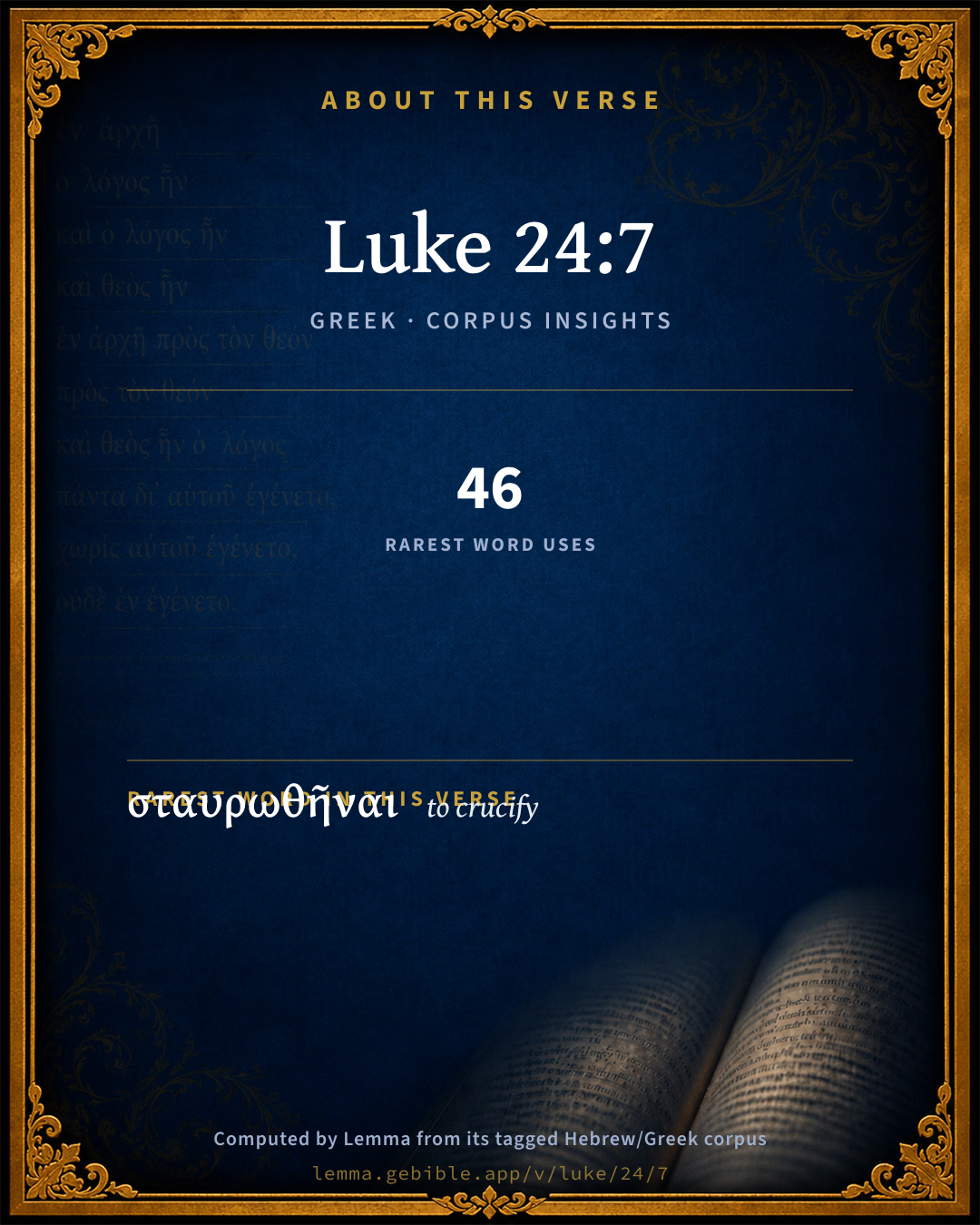
σταυρωθῆναι to crucify G4717 occurs in 42 verses of the Greek New Testament. Also found in:
Repetition

Words recur within this verse:

  • ἀνθρώπου human being G444 ×2
  • τὸν the G3588 ×3
  • καὶ and G2532 ×2

Cross-references

1

Topical passages linked to Luke 24:7 in the Treasury of Scripture Knowledge — connected by theme and wording, ordered by reader-vote popularity; previews shown in the World English Bible.

  • Matthew 16:21 From that time, Jesus began to show his disciples that he must go to Jerusalem and suffer many things from the elders, chief priests, and scribes, and be killed, and the third day be raised up.

Cross-references courtesy of OpenBible.info (CC BY 4.0).

Commentary

Notes on Luke 24:7 from classic Christian and Jewish commentators (each source and its license shown beneath its notes). The classic Christian expositions comment on the surrounding passage and are grouped to its opening verse, so a note may address several verses; the Jewish commentaries on the Tanakh (Rashi and others) are per-verse, so they appear only where the commentator wrote on this verse.

Lemma curates 59 commentaries, every one of them public domain or Creative Commons licensed, each selected and text-cleaned for this edition rather than reprinted as found. About our sources →

Tyndale Open Study Notes

Tyndale Open Resources

24:7 Jesus rose on the third day, counting Friday as the first day and Sunday as the third.

Tyndale Open Study Notes — © Tyndale Open Resources, licensed CC BY-SA 4.0. Text via the HelloAO Bible API.

Bengel's Gnomon

Johann Albrecht Bengel

Luk 24:7. Τὸν Υἱὸν τοῦ ἀνθρώπου, the Son of man) This is repeated from the discourses which were delivered by the Lord before His passion. But the Lord Himself did not give Himself the appellation, Son of man, after His resurrection, but either spake in the first person, or else employed the express appellation, Christ.—ἁμαρτωλῶν, of sinful men) viz. the Gentiles.

Bengel's Gnomon of the New Testament — English translation (T&T Clark, Edinburgh, 1860) — public domain. Text from a community e-Sword module.

Expositor's Greek Testament

ed. W. Robertson Nicoll

Luk 24:7 . τὸν υἱὸν τ . ἀ .: standing before ὅτι δεῖ may be taken as an accusative of reference = saying as to the Son of Man that, etc. ἀνθρώπων ἁμαρτωλῶν , sinful men, not necessarily Gentiles only (Meyer, J. Weiss, etc.), but men generally (Hahn) Jesus actually expressed Himself in much more definite terms.

The Expositor's Greek Testament, edited by W. Robertson Nicoll (1897–1910) — public domain. Text from a community e-Sword module.

Jamieson, Fausset & Brown

Robert Jamieson, A. R. Fausset & David Brown

Saying, &c.--How remarkable it is to hear angels quoting a whole sentence of Christ's to the disciples, mentioning where it was uttered, and wondering it was not fresh in their memory, as doubtless it was in theirs! (Ti1 3:16, "seen of angels," and Pe1 1:12).

Jamieson, Fausset & Brown — Commentary Critical and Explanatory on the Whole Bible (1871) — public domain (CC PDM 1.0). Text via the HelloAO Bible API.

Adam Clarke's Commentary

Verse 7. Sinful men] Or heathens, ανθρωπων ἁμαρτωλων, i.e. the Romans, by whom only he could be put to death; for the Jews themselves acknowledged that this power was now vested in the hands of the Roman governor alone. See Joh 19:15.

Adam Clarke's Commentary on the Bible (1810–1826) — public domain. Text from a community e-Sword/MySword module.

Ellicott's Commentary for English Readers

(7) Into the hands of sinful men.—The adjective does not appear in the earlier report. It is probably used here, more or less, in its popular Jewish meaning, as applied to “sinners of the Gentiles” (Gal_2:15).

A Bible Commentary for English Readers, edited by Charles John Ellicott (1878–1897) — public domain. Text from a community e-Sword module.

John Gill's Exposition

And they remembered his words. That is, the words of Christ, as the Persic version expresses it; which they had forgot, and it may be had never truly understood until now; and had now their memories refreshed with them by the angels, and their understandings opened by the Spirit of God. Saints are sometimes apt to forget even the gracious promises of God, they have understood and received comfort from; the word, or words, on which they have been caused to hope, until the Spirit of God, who is their best remembrancer, puts them in mind of them.

And they remembered his words. That is, the words of Christ, as the Persic version expresses it; which they had forgot, and it may be had never truly understood until now; and had now their memories refreshed with them by the angels, and their understandings opened by the Spirit of God. Saints are sometimes apt to forget even the gracious promises of God, they have understood and received comfort from; the word, or words, on which they have been caused to hope, until the Spirit of God, who is their best remembrancer, puts them in mind of them.

Luke 24:9

luk 24:9

luk 24:9

luk 24:9And returned from the sepulchre,.... Quickly, immediately, as soon as ever the angel had done speaking to them; they fled from the sepulchre in great haste, as persons frightened and amazed, with fear and reverence, on account of the vision they saw, and with joy at what was told them; see Mat 28:8

and told all these things; as that the stone was rolled away from the sepulchre: and that they found not the body of Jesus in it; that they had seen a vision of angels, who had told them, that Christ was risen, and had put them in mind of some words of his spoken to the disciples in their hearing in Galilee:

unto the eleven, and to all the rest; of the disciples: not only to the eleven apostles, but the seventy disciples, and as many others as were assembled together, perhaps the hundred and twenty, Act 1:15. The Persic version very wrongly reads, "to all the twelve"; for Judas was not now one of them, nor alive; and Matthias was not yet chosen.

John Gill's Exposition of the Whole Bible (1746–1763) — public domain (CC PDM 1.0). Text via the HelloAO Bible API.

Trapp's Complete Commentary

John Trapp

7 Saying, The Son of man must be delivered into the hands of sinful men, and be crucified, and the third day rise again.

Ver. 7. See Mat 17:23; Mar 9:31; Luk 9:22.

John Trapp, A Commentary or Exposition upon All the Books of the Old and New Testament (1647–1656) — public domain. Text from a community e-Sword module.

MacLaren's Expositions of Holy Scripture

Alexander MacLaren

Luke

THE FIRST EASTER SUNRISE

Luk 24:1 - Luk 24:12.

No Evangelist narrates the act of Resurrection. Apocryphal Gospels cannot resist the temptation of describing it. Why did the Four preserve such singular reticence about what would have been irresistible to ‘myth’ makers? Because they were not myth-makers, but witnesses, and had nothing to say as to an act that no man had seen. No doubt, the Resurrection took place in the earliest hours of the first day of the week. The Sun of Righteousness rose before the Easter Day sun. It was midsummer day for Him, while it was but spring for earth’s calendar. That early rising has no setting to follow.

The divergences of the Evangelists reach their maximum in the accounts of the Resurrection, as is natural if we realise the fragmentary character of all the versions, the severely condensed style of Matthew’s, the incompleteness of the genuine Mark’s, the evidently selective purpose in Luke’s, and the supplementary design of John’s. If we add the perturbed state of the disciples, their separation from each other, and the number of distinct incidents embraced in the records, we shall not wonder at the differences, but see in them confirmation of the good faith of the witnesses, and a reflection of the hurry and wonderfulness of that momentous day. Differences there are; contradictions there are not, except between the doubtful verses added to Mark and the other accounts. We cannot put all the pieces together, when we have only them to guide us. If we had a complete and independent narrative to go by, we could, no doubt, arrange our fragments. But the great certainties are unaffected by the small divergences, and the points of agreement are vital. They are, for example, that none saw the Resurrection, that the first to know of it were the women, that angels appeared to them at the tomb, that Jesus showed Himself first to Mary Magdalene, that the reports of the Resurrection were not believed. Whether the group with whom this passage has to do were the same as that whose experience Matthew records we leave undetermined. If so, they must have made two visits to the tomb, and two returns to the Apostles,-one, with only the tidings of the empty sepulchre, which Luke tells; one, with the tidings of Christ’s appearance, as in Matthew. But harmonistic considerations do not need to detain us at present.

Sorrow and love are light sleepers, and early dawn found the brave women on their way. Nicodemus had bound spices in with the body, and these women’s love-gift was as ‘useless’ and as fragrant as Mary’s box of ointment. Whatever love offers, love welcomes, though Judas may ask ‘To what purpose is this waste?’ Angel hands had rolled away the stone, not to allow of Jesus’ exit, for He had risen while it was in its place, but to permit the entrance of the ‘witnesses of the Resurrection.’ So little did these women dream of such a thing that the empty tomb brought no flash of joy, but only perplexity to their wistful gaze. ‘What does it mean?’ was their thought. They and all the disciples expected nothing less than they did a Resurrection, therefore their testimony to it is the more reliable.

Luke marks the appearance of the angels as sudden by that ‘behold.’ They were not seen approaching, but at one moment the bewildered women were alone, looking at each other with faces of dreary wonder, and the next, ‘two men’ were standing beside them, and the tomb was lighted by the sheen of their dazzling robes. Much foolish fuss has been made about the varying reports of the angels, and ‘contradictions’ have been found in the facts that some saw them and some did not, that some saw one and some saw two, that some saw them seated and some saw them standing, and so on. We know so little of the laws that govern angelic appearances that our opinion as to the probability or veracity of the accounts is mere guess-work. Where should a flight of angels have gathered and hovered if not there? And should they not ‘sit in order serviceable’ about the tomb, as around the ‘stable’ at Bethlehem? Their function was to prepare a way in the hearts of the women for the Lord Himself, to lessen the shock,-for sudden joy shocks and may hurt,-as well as to witness that these ‘things angels desire to look into.’

Their message flooded the women’s hearts with better light than their garments had spread through the tomb. Luke’s version of it agrees with Mark and Matthew in the all-important central part, ‘He is not here, but is risen’ {though these words in Luke are not beyond doubt}, but diverges from them otherwise. Surely the message was not the mere curt announcement preserved by any one of the Evangelists. We may well believe that much more was said than any or all of them have recorded. The angels’ question is half a rebuke, wholly a revelation, of the essential nature of ‘the Living One,’ who was so from all eternity, but is declared to be so by His rising, of the incongruity of supposing that He could be gathered to, and remain with, the dim company of the dead, and a blessed word, which turns sorrow into hope, and diverts sad eyes from the grave to the skies, for all the ages since and to come. The angels recall Christ’s prophecies of death and resurrection, which, like so many of His words to the disciples and to us, had been heard, and not heard, being neglected or misinterpreted. They had questioned ‘what the rising from the dead should mean,’ never supposing that it meant exactly what it said. That way of dealing with Christ’s words did not end on the Easter morning, but is still too often practised.

If we are to follow Luke’s account, we must recognise that the women in a company, as well as Mary Magdalene separately, came back first with the announcement of the empty tomb and the angels’ message, and later with the full announcement of having seen the Lord. But apart from the complexities of attempted combination of the narratives, the main point in all the Evangelists is the disbelief of the disciples, ‘Idle tales,’ said they, using a very strong word which appears only here in the New Testament, and likens the eager story of the excited women to a sick man’s senseless ramblings. That was the mood of the whole company, apostles and all. Is that mood likely to breed hallucinations? The evidential value of the disciples’ slowness to believe cannot be overrated.

Peter’s race to the sepulchre, in Luk 24:12, is omitted by several good authorities, and is, perhaps, spurious here. If allowed to stand as Luke’s, it seems to show that the Evangelist had a less complete knowledge of the facts than John. Mark, Peter’s ‘interpreter,’ has told us of the special message to him from the risen, but as yet unseen, Lord, and we may well believe that that quickened his speed. The assurance of forgiveness and the hope of a possible future that might cover over the cowardly past, with the yearning to sob his heart out on the Lord’s breast, sent him swiftly to the tomb. Luke does not say that he went in, as John, with one of his fine touches, which bring out character in a word, tells us that he did; but he agrees with John in describing the effect of what Peter saw as being only ‘wonder,’ and the result as being only that he went away pondering over it all, and not yet able to grasp the joy of the transcendent fact. Perhaps, if he had not had a troubled conscience, he would have had a quicker faith. He was not given to hesitation, but his sin darkened his mind. He needed that secret interview, of which many knew the fact but none the details, ere he could feel the full glow of the Risen Sun thawing his heart and scattering his doubts like morning mists on the hills.

Alexander MacLaren, Expositions of Holy Scripture (1904–1910) — public domain. Text from a community e-Sword module.

Scofield Reference Notes

C. I. Scofield

Son of man (See Scofield "Mat 8:20"), See Scofield "Rom 3:23".

The Scofield Reference Bible (1917 edition), notes by C. I. Scofield — public domain. Text from a community e-Sword module.

Cambridge Greek Testament for Schools and Colleges

7. To seven Apostles at the Lake of Galilee. Joh 21:1-24.

Cambridge Greek Testament for Schools and Colleges (Cambridge University Press, 1896; 21 vols, various authors incl. Carr, Maclear, Plummer, Farrar, Lumby, Moule, M. R. James, Simcox) — public domain. Text from a community e-Sword module.

Alford’s Greek Testament

Henry Alford

7.] See ch. 9:22; 18:32. The mention of Galilee is remarkable, as occurring in the angelic speeches in Matt. and Mark in quite another connexion. Here it is said to the women, as being from Galilee, see ch. 23:55—and meaning, ‘when He was yet with you.’

Henry Alford, The Greek Testament (1849–1861) — public domain. Text from a community e-Sword module.

International Critical Commentary

7. The result was a conviction, which nothing ever shook, that “the Lord own indeed” and present with them (see Wsctt. on Joh 20:1: he gives a tentative arrangement of the events of the first Easter Day, which at least shows that there is no serious discrepancy between the four narratives)

Sadler asserts, and Godet endeavours to show, that each narrative is determined by the purpose which each Evangelist had in view in writing; but in most cases the distinctions are not very convincing. Nearly the whole of Lk.’s narrative is peculiar to him, the partial exceptions being vv. 1-6 and 9, 10. The nucleus of the whole is the account of the walk to Emmaus (vv. 13-43); and the first part of the chapter is an introduction to this graphic account, with special reference to vv. 22, 23.See Loofs, Die Aufstehungsberichte.

An excellent opportunity of comparing six forms of the Old Latin (a b c d e f) with one another and with the Vulgate is given in Scrivener’s edition of Codex Bezae in connexion with a large portion of this chapter. He prints the first twenty-four verses of this chapter as given in these authorities in seven parallel columns (pp. 36, 37). This passage is “rich in peculiar and idiomatic expressions, and little liable to be corrupted from the Synoptic Gospels.” The result, he thinks, is to show that the Latin of Codex Bezae was made “immediately from its Greek text,” which it generally servilely follows; but that occasionally the translator was led away by his recollection of the Old Latin, “sometimes for whole verses together,” even when the Old Latin differed from e Greek text which be was translating. Adhuc sub judice lis est.

7. δεῖ. See on 4:43 and 9:22.

International Critical Commentary — older volumes (1896–1929), various authors — public domain. Text from a community e-Sword module.

Lesson kit

Teaching starters — assembled from the data on this page, not authored interpretation. Every prompt links to the verse data it draws on. Edit before teaching.

Luke, in the Gospels, opens this verse with 19 words (15 distinct Greek lemmas). Its most distinctive word is stauróō (“to crucify”). A historical commentator’s framing appears above. Read the whole chapter for the surrounding context.

Discussion questions

  1. What does “to crucify” (stauróō) contribute to the verse as a whole?
  2. Matthew 20:19 shares the word «to crucify» with this verse. How do the two illuminate each other?
  3. “human being” occurs 2× in this one verse. What is the effect of the repetition?
  4. The translations on this page render this verse differently — a whole-verse word diff, not a word-by-word alignment. What might account for the different wordings?
  5. Reading how Tyndale Open Study Notes and Bengel's Gnomon read this verse, where do the two commentators agree and where do they part?

Things to notice

  • These translations choose different wording for 7 words in this verse.
  • “human being” occurs 2× in this single verse.
  • 15 distinct Greek lemmas span 19 words in this verse.

Reading settings

Reading text

Shown beneath each verse's original-language words.

Old Testament
Old Testament edition

Read the OT as the Masoretic Hebrew (MT) or the Greek Septuagint (LXX).

English shown for the Greek Septuagint (in the Hebrew ↔ Greek comparison).

Comparing translations? Open the Compare panel on any verse page to stack up to four side by side.