John 13:9

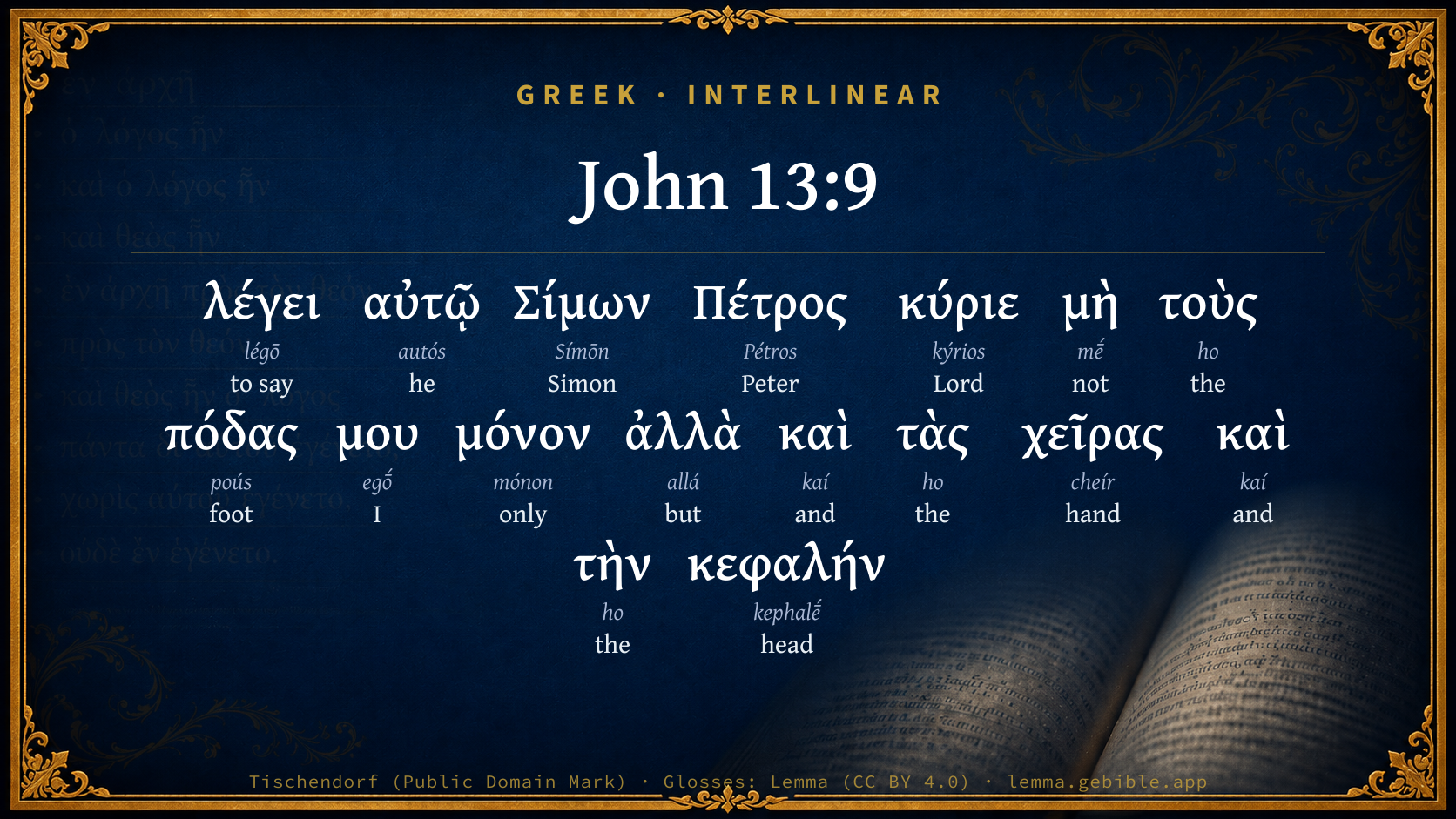
Greek (Tischendorf 8th ed.) John 13:9 appears in the Greek New Testament. The text above is from the Tischendorf 8th edition. Each word links to its Strong’s number and a concise gloss. Click any word for its full Thayer’s Greek Lexicon entry.
Download image
Cite this verse

John 13:9 (World English Bible). Public Domain. Lemma interlinear Bible study tool, https://lemma.gebible.app/v/john/13/9.

Show BibTeX & RIS
BibTeX
RIS
English Translation
Simon Peter said to him, "Lord, not my feet only, but also my hands and my head!"
World English Bible · Public Domain
Download a study sheet

One document with this verse’s original text, its word-by-word gloss line, the meaning frame, cross-references with their text, attributed commentary, and full source and license credits — printable, and it pastes into notes with its structure intact.

This verse Autodidact and up

Study sheet (.html) Plain text (.txt)

A passage Seminary Student

Up to 50 verses in one chapter. A passage sheet keeps up to 6 commentary sources and 12 cross-references per verse, in the order this page ranks them, and says so on the sheet whenever that leaves anything out. Ask for a single verse and you get the Autodidact verse sheet above.

Everything on this page stays free to read, with no account — the sheet is a download of what is already on screen, not access to it.

Want to remove ads? Support Godless Engineer
Compare translations 3

The same verse in 3 English versions, stacked beneath the original-language interlinear above. Click any original word for its lexicon entry.

Each is an independent rendering of the whole verse — the interlinear is not word-aligned to these translations.

Highlighted words mark where these versions differ — a whole-verse word diff, not a word-by-word alignment.

  • World English Bible Public Domain
    Simon Peter said to him, "Lord, not my feet only, but also my hands and my head!"
  • King James Version Public Domain
    Simon Peter saith unto him, Lord, not my feet only, but also my hands and my head.
  • unfoldingWord Literal Text CC BY-SA 4.0
    Simon Peter says to him, “Lord, not only my feet, but also my hands and my head.”

unfoldingWord Literal Text — © unfoldingWord, licensed CC BY-SA 4.0. Word-aligned USFM3 via Door43 (git.door43.org/unfoldingWord/en_ult).

Versions to compare (up to 4)

3 of 4 selected

Show all 19 translations

Every available English version of this verse, each an independent rendering of the whole verse.

  • World English Bible Public Domain
    Simon Peter said to him, "Lord, not my feet only, but also my hands and my head!"
  • Berean Standard Bible Public Domain
    “Then, Lord,” Simon Peter replied, “not only my feet, but my hands and my head as well!”
  • Majority Standard Bible Public Domain
    “Then, Lord,” Simon Peter replied, “not only my feet, but my hands and my head as well!”
  • King James Version Public Domain
    Simon Peter saith unto him, Lord, not my feet only, but also my hands and my head.
  • American Standard Version (1901) Public Domain
    Simon Peter saith unto him, Lord, not my feet only, but also my hands and my head.
  • Revised Version (1885) Public Domain
    Simon Peter saith unto him, Lord, not my feet only, but also my hands and my head.
  • Geneva Bible (1599) Public Domain
    Simon Peter sayd vnto him, Lord, not my feete onely, but also the hands and the head.
  • Douay-Rheims (1899) Public Domain
    Simon Peter saith to him: Lord, not only my feet, but also my hands and my head.
  • Young's Literal Translation Public Domain
    Simon Peter saith to him, `Sir, not my feet only, but also the hands and the head.'
  • Literal Standard Version CC BY-SA 4.0
    Simon Peter says to Him, “Lord, not my feet only, but also the hands and the head.”
  • Unlocked Literal Bible CC BY-SA 4.0
    Simon Peter said to him, “Lord, do not only wash my feet, but also my hands and my head.”
  • unfoldingWord Literal Text CC BY-SA 4.0
    Simon Peter says to him, “Lord, not only my feet, but also my hands and my head.”
  • Darby Bible Public Domain
    Simon Peter says to him, Lord, not my feet only, but also my hands and my head.
  • World Messianic Bible Public Domain
    Simon Peter said to him, “Lord, not my feet only, but also my hands and my head!”
  • Webster's Bible Public Domain
    Simon Peter saith to him, Lord, not my feet only, but also my hands and my head.
  • Free Bible Version CC BY-SA 4.0
    “Then, Lord, wash not just my feet but my hands and my head as well!” Simon Peter exclaimed.
  • Bible in Basic English Public Domain
    Simon Peter said to him, Lord, not my feet only, but my hands and my head.
  • Text-Critical English NT CC BY 4.0
    Simon Peter said to him, “Lord, then wash not only my feet, but also my hands and my head.”
  • Tyndale New Testament (1534) Public Domain
    Simon Peter sayde vnto him: Lorde not my fete only: but also my handes and my heed.

Literal Standard Version (2020), Covenant Press — licensed CC BY-SA 4.0. Text via the HelloAO Bible API (eBible.org). Unlocked Literal Bible (unfoldingWord) — licensed CC BY-SA 4.0. Text via the HelloAO Bible API (eBible.org). unfoldingWord Literal Text — © unfoldingWord, licensed CC BY-SA 4.0. Word-aligned USFM3 via Door43 (git.door43.org/unfoldingWord/en_ult). Free Bible Version, Dr. Jonathan Gallagher — licensed CC BY-SA 4.0. Text via the HelloAO Bible API (eBible.org).

Word by word

More ways to search: Search by grammar → Find every occurrence → Compare this word →

Practice this passage: Drill this verse → Learn its vocabulary →

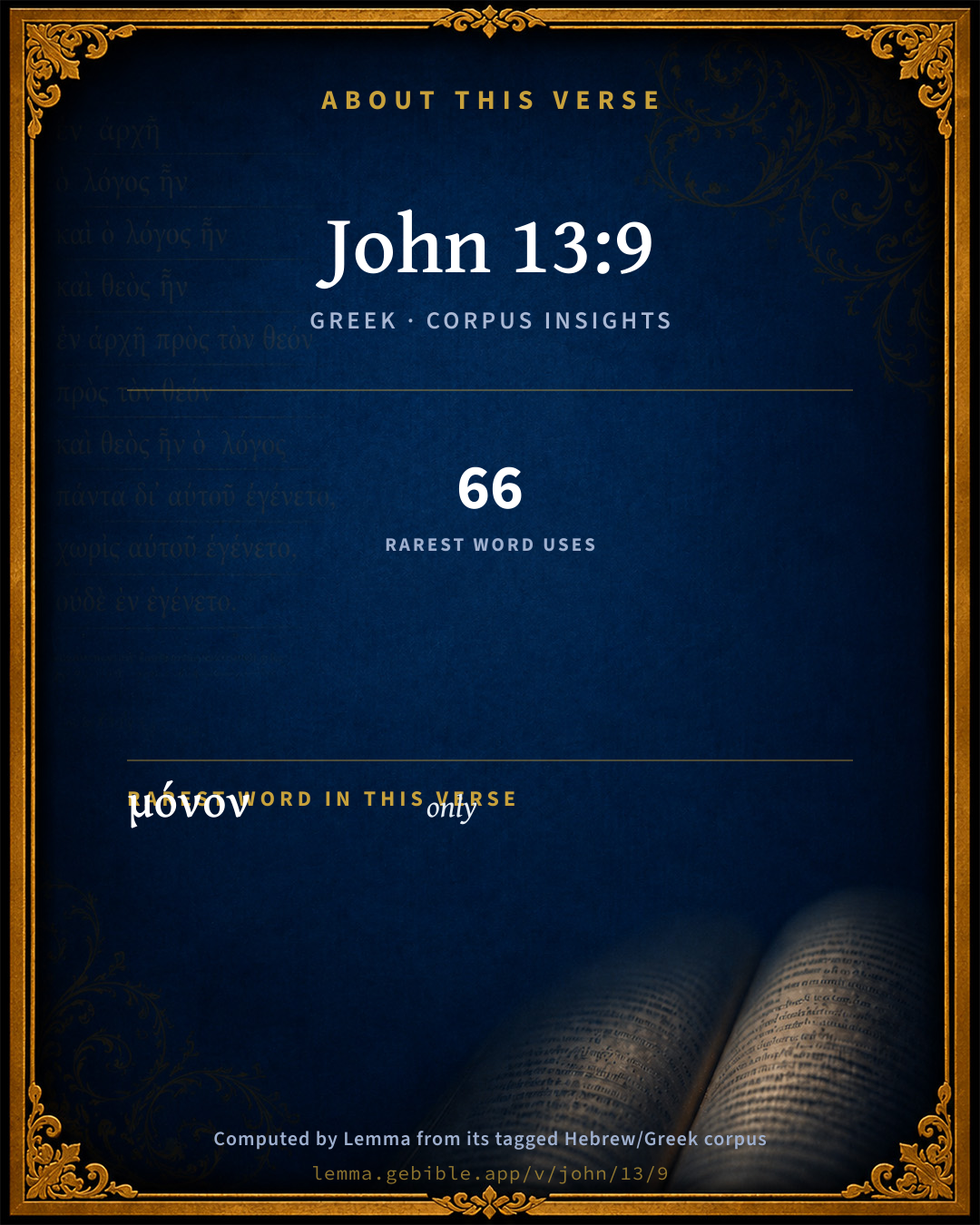
About this verse

These counts appear in no published source. They are computed here, from the morphology-tagged text and Lemma’s own curated glosses. What Lemma adds →

17
words
14
distinct lemmas
Gospels
section

Repetition

Words recur within this verse:

Cross-references

7

Topical passages linked to John 13:9 in the Treasury of Scripture Knowledge — connected by theme and wording, ordered by reader-vote popularity; previews shown in the World English Bible.

  • Psalms 51:2 Wash me thoroughly from my iniquity. Cleanse me from my sin.
  • Psalms 51:7 Purify me with hyssop, and I will be clean. Wash me, and I will be whiter than snow.
  • Psalms 26:6 I will wash my hands in innocence, So I will go about your altar, Yahweh;
  • 1 Peter 3:21 This is a symbol of baptism, which now saves you-- not the putting away of the filth of the flesh, but the answer of a good conscience toward God, through the resurrection of Jesus Christ,
  • Hebrews 10:22 let's draw near with a true heart in fullness of faith, having our hearts sprinkled from an evil conscience, and having our body washed with pure water,
  • Jeremiah 4:14 Jerusalem, wash your heart from wickedness, that you may be saved. How long shall your evil thoughts lodge within you?
  • Matthew 27:24 So when Pilate saw that nothing was being gained, but rather that a disturbance was starting, he took water, and washed his hands before the multitude, saying, "I am innocent of the blood of this righteous person. You see to it."

Cross-references courtesy of OpenBible.info (CC BY 4.0).

Commentary

Notes on John 13:9 from classic Christian and Jewish commentators (each source and its license shown beneath its notes). The classic Christian expositions comment on the surrounding passage and are grouped to its opening verse, so a note may address several verses; the Jewish commentaries on the Tanakh (Rashi and others) are per-verse, so they appear only where the commentator wrote on this verse.

Lemma curates 59 commentaries, every one of them public domain or Creative Commons licensed, each selected and text-cleaned for this edition rather than reprinted as found. About our sources →

Tyndale Open Study Notes

Tyndale Open Resources

13:9 wash my hands and head as well: Peter misunderstood Jesus (cp. 2:19-20; 3:3-4). Peter thought that to have more water was to have more of Jesus. Only when Peter received the Spirit did everything become clear (e.g., see Acts 2:14-36).

Tyndale Open Study Notes — © Tyndale Open Resources, licensed CC BY-SA 4.0. Text via the HelloAO Bible API.

Bengel's Gnomon

Johann Albrecht Bengel

Joh 13:9. Μή, not) Since washing keeps me as one having part with Thee, I give myself up to be washed all over by Thee.—χεῖρας, κεφαλήν, hands, head) A gradation is here presented. A sense of his own uncleanness overwhelming Peter, by reason of the majesty of the Lord, which stooped so low in condescension, dictated these words. Comp. Luk 5:8, [Peter at the draught of fishes] “Depart from me, for I am a sinful man, O Lord.”

Bengel's Gnomon of the New Testament — English translation (T&T Clark, Edinburgh, 1860) — public domain. Text from a community e-Sword module.

Expositor's Greek Testament

ed. W. Robertson Nicoll

Joh 13:9 . Κύριε … κεφαλήν . A moment ago he told his Master He was doing too much: now he tells Him He is doing too little. Self-will gives place slowly. Yet this was the unmistakable expression of devotion. If washing is any requirement for fellowship with Thee, wash me wholly. [“Non pedes solum, quos soli ministri vident; sed manus et caput, quod convivae adspiciunt.” Wetstein.] He is still in error.

The Expositor's Greek Testament, edited by W. Robertson Nicoll (1897–1910) — public domain. Text from a community e-Sword module.

Jamieson, Fausset & Brown

Robert Jamieson, A. R. Fausset & David Brown

Lord, not my feet only, but also my hands and my head--that is, "To be severed from Thee, Lord, is death to me: If that be the meaning of my speech, I tread upon it; and if to be washed of Thee have such significance, then not my feet only, but hands, head, and all, be washed!" This artless expression of clinging, life-and-death attachment to Jesus, and felt dependence upon Him for his whole spiritual well-being, compared with the similar saying in Joh 6:68-69 (see on Joh 6:68-69), furnishes such evidence of historic verity such as no thoroughly honest mind can resist.

Jamieson, Fausset & Brown — Commentary Critical and Explanatory on the Whole Bible (1871) — public domain (CC PDM 1.0). Text via the HelloAO Bible API.

Adam Clarke's Commentary

Verse 9. Lord, not my feet only, &c.] It appears that Peter entered into our Lord's meaning, and saw that this was emblematical of a spiritual cleansing: therefore he wishes to be completely washed.

Adam Clarke's Commentary on the Bible (1810–1826) — public domain. Text from a community e-Sword/MySword module.

John Calvin's Commentaries

9. Lord, not my feet only. When Peter heard that he was ruined, if he did not accept the cleansing which was offered to him by Christ, this necessity proved, at length, to be a sufficient instructor to tame him. He therefore lays aside opposition and yields, but wishes to be entirely washed, and, indeed, acknowledges that, for his own part, he is altogether covered with pollution, and, therefore, that it is doing nothing, if he be only washed in one part. But here too he goes wrong through thoughtlessness, in treating, as a thing of no value, the benefit which he had already received; for he speaks as if he had not yet obtained any pardon of sins, or any sanctification by the Holy Spirit. On this account, Christ justly reproves him, for he recalls to his recollection what he had formerly bestowed on him; at the same time, reminding all his disciples in the person of one man, that, while they remembered the grace which they had received, they should consider what they still needed for the future.

John Calvin's Commentaries (1540-1563) — public domain. Text from the Calvin Translation Society English edition (1840s-50s) via the Christian Classics Ethereal Library (ccel.org). Calvin's coverage is partial (roughly two-thirds of the Bible); uncommented books and verses are honest gaps, never fabricated. The 19th-century editor's footnotes and remarks are omitted so the notes are faithfully Calvin's own voice.

Ellicott's Commentary for English Readers

(9) Lord, not my feet only, but also my hands and my head.—Peter still misunderstands the meaning; but he is true to his loving impulsive character. No part with his Master! He will give up anything, everything. He knows not what this washing means, and cannot conceive that it is fitting for Christ to wash his feet; but if it in any sense can mean having a part with Christ, then not the feet only, but the whole man.

A Bible Commentary for English Readers, edited by Charles John Ellicott (1878–1897) — public domain. Text from a community e-Sword module.

The Cambridge Bible for Schools and Colleges

gen. ed. J. J. S. Perowne

9. not my feet only] The impetuosity which is so marked a characteristic of S. Peter in the first three Gospels (comp. especially Luk_5:8 and Mat_16:22), comes out very strongly in his three utterances here. It is incredible that this should be deliberate invention; and if not, the independent authority of this narrative is manifest.

The Cambridge Bible for Schools and Colleges (gen. ed. J. J. S. Perowne; Cambridge University Press, 1878–1918) — public domain. Text from a community e-Sword module.

John Gill's Exposition

Simon Peter saith unto him,.... Being convinced of his mistake in not submitting to Christ, fearing he should he deprived of communion with him, than which nothing was more desirable to him, or more highly esteemed of by him, says,

Lord, not my feet only, but also my hands and my head; which shows the sense he had of the general pollution of his nature, and the need he stood in particularly of having his feet, hands, and head washed both as a minister, and a believer. By his "feet" may be meant, either the grace of faith, which is the foot of the soul, by which it goes to Christ, and walks on in him, and was not without its imperfections; or the affections of the mind, which are that to the soul, as feet are to the body; and when they move right, move heavenward, Godward, and Christward; but sometimes they are inordinate, and cleave to the things of this world: or the outward life and conversation is meant, which is attended with daily infirmities; and each of these need washing in the blood of Christ. His "hands" may design all his actions, works, services, duties, and performances, the hand being the instrument of action; and not only the hands of wicked men, but even of saints, need washing, their best righteousnesses being as filthy rags. By his "head" may be meant doctrines and principles imbibed in the mind, and expressed by the lips, which were not free from mistake and pollution, and needed purging and cleansing; for the disciples were not as yet clear from the prejudices of the Jewish nation, especially relating to the nature of the Messiah's kingdom.

John Gill's Exposition of the Whole Bible (1746–1763) — public domain (CC PDM 1.0). Text via the HelloAO Bible API.

Trapp's Complete Commentary

John Trapp

9 Simon Peter saith unto him, Lord, not my feet only, but also my hands and my head.

Ver. 9. Lord, not my feet only] Here he seems to be as far out on the other side. How hard is it to hold a mean. Medio tutissimus ibis. (Ovid.) Virtue is placed between two extremes, as the planet Jupiter between cold Saturn and fiery Mars.

John Trapp, A Commentary or Exposition upon All the Books of the Old and New Testament (1647–1656) — public domain. Text from a community e-Sword module.

Albert Barnes' Notes on the Bible

Not my feet only ... - Peter, with characteristic readiness and ardor, saw now that everything depended on this. His whole salvation, the entire question of his attachment to his Master, was involved. If to refuse to have his feet washed was to be regarded as evidence that he had no part with Jesus, he was not only willing, but desirous that it should be done; not only anxious that his feet should be cleansed, but his hands and his head - that is, that he should be cleansed entirely, thoroughly. Perhaps he saw the spiritual meaning of the Saviour, and expressed his ardent wish that his whole soul might be made pure by the work of Christ. A true Christian is desirous of being cleansed from all sin. He has no reserve. He wishes not merely that one evil propensity should be removed, but all; that every thought should be brought into captivity to the obedience of Christ 2Co 10:5; and that his whole body, soul, and spirit should be sanctified wholly and be preserved blameless unto the coming of the Lord Jesus Christ, 1Th 5:23. His intellect, his will, his affections, his fancy, memory, judgment, he desires should be all brought under the influence of the gospel, and every power of the body and mind be consecrated unto God.

Albert Barnes' Notes on the Bible (1834–1885) — public domain. Text from a community e-Sword/MySword module.

Matthew Poole's English Annotations

Peter now understandeth what washing it is which our Saviour last spake of, and wholly submits to the will of his Lord and Master; acknowledging himself to be wholly defiled, and to stand in need of a washing all over:

Lord, saith he, not my feet only, but also my hands and my head; that is, my whole man.

Matthew Poole's English Annotations on the Holy Bible (1683–1685) — public domain. Text from a community e-Sword/MySword module.

Whedon's Commentary on the Bible

Daniel D. Whedon

9. Not my feet only—Peter is now brought to his senses. He sees that his wilful humility is pride and disobedience. He perceives the spiritual import of our Saviour’s language and purpose. He had early in his apostleship bid his Lord depart from him, for he was a sinful man. He sees that this washing implies the cleansing of the soul from sin, and now he prays that that sanctification may be complete. His every member is impregnated with sin, and becomes the instrument of sin. If thou wilt cleanse me at all, Lord, let the work be complete.

Daniel D. Whedon (gen. ed.), Commentary on the Old and New Testaments (1874–1909) — public domain. Text from a community e-Sword module.

The Pulpit Commentary

Simon Peter makes another impetuous and characteristic outburst, and another of his almost glorious mistakes. Once more he will go before and give advice to his Master. The very same Peter who drew the sword in Gethsemane and then fled, who went to the high priest"s palace and then denied his Lord; the very same Peter who rushed into the water anal then cried, "Lord, save me, I perish," who cried, even on the Mount of Transfiguration, "Let us build three tabernacles;" and when our Lord spoke of his cross said, "This shall not be done unto thee; the same Simon Peter now said to him, "If it comes to the primal experience of being washed by thee in thine unutterable love, if there be any question of part and share with thee in thy work, I will (cf. ver. 37) go with thee to prison and to death, then, blessed Lord, not my feet only, but also my hands and my head; i.e. all my uncovered body; seeing that my power of thinking and all my capacity for service alike need cleansing." Peter not unreasonably felt the weakness and corruption of his nature, and cried out, as we all are often disposed to do, for renewal and sanctification of every faculty and energy of his being. In this he showed a lack of realization of the new world into which grace had brought him, and once more needed correction. Chrysostom says, "In his deprecation be was vehement, in his yielding more vehement, but both came from his love." But even here we see the same eagerness to go beyond the Lord, and dictate the course to be pursued.

The Pulpit Commentary (1880–1919), ed. H.D.M. Spence-Jones & Joseph S. Exell — public domain. Text from a community e-Sword module.

John Wesley's Explanatory Notes

Lord, not my feet only - How fain would man be wiser than God! Yet this was well meant, though ignorant earnestness.

John Wesley, Explanatory Notes Upon the Whole Bible (1754–1765) — public domain. Text via the GEBible commentary corpus.

Cambridge Greek Testament for Schools and Colleges

9. μὴ τ. πόδας μ. μόνον. The impetuosity which is so marked a characteristic of S. Peter in the first three Gospels (comp. especially Luk 5:8 and Mat 16:22) comes out very strongly in his three utterances here. It is incredible that this should be invention; and if not, the independent authority of S. John’s narrative is manifest.

Cambridge Greek Testament for Schools and Colleges (Cambridge University Press, 1896; 21 vols, various authors incl. Carr, Maclear, Plummer, Farrar, Lumby, Moule, M. R. James, Simcox) — public domain. Text from a community e-Sword module.

Alford’s Greek Testament

Henry Alford

9.] The warm-hearted Peter, on learning that exclusion would be the consequence of not being washed, can hardly have enough of a cleansing so precious. There surely is implied in this answer an incipient apprehension of the meaning of our Lord’s words. The ἐὰν μὴ νίψω σε has awakened in him, as the Lord’s presence did, Luk 5:8, a feeling of his own want of cleansing, his entire pollution. This sense (Stier, Bengel, Baumgarten-Crusius) is denied by Lücke and Olsh.

Henry Alford, The Greek Testament (1849–1861) — public domain. Text from a community e-Sword module.

International Critical Commentary

9. The Eucharist is instituted (Mar 14:22f., Mat 26:26f., Luk 22:19f.; not in Jn., but cf. Joh 6:51-58).

9. For Σίμων Πέτρος, B has Πέτρος Σίμων, by inadvertence: D omits Σίμων.

Peter does not yet understand what is meant by the strange act of his Master. He now thinks that the “washing” of which Jesus has spoken is for bodily cleansing, or (perhaps) is a symbol of spiritual cleansing; and he cries with his accustomed impulsiveness, “Lord (א* om. κύριε), not my feet only, but also my hands and my head,” thus missing the point of the action of Jesus. It was not a symbol of cleansing, but an illustration of the dignity of service, even menial service; and therefore the washing was of the feet, rather than of the hands or the head.

International Critical Commentary — older volumes (1896–1929), various authors — public domain. Text from a community e-Sword module.

Godet's Commentaries

Frédéric Louis Godet

Vv. 9 presents to us, in the case of Peter, one of those sudden changes of impression which we frequently observe in him, in the Synoptic narrative. Here is the same Peter who rushes upon the water and a moment afterward cries “I perish!” who strikes with the sword and who takes to flight, who enters into the house of the high-priest and yet denies his Master. The perfect accordance between these scattered features, and the image full of life which results from them, admirably prove in this case as in all the others, as Luthardt has so well set forth, the complete reality of the Gospel history. The whole meaning of the act of Jesus was in the fact of washing the feet.

The nature of the act changed absolutely as soon as it concerned the head, for in that case it was no longer an act of humiliation. Jesus follows Peter on this new ground and this is what introduces the different meaning given to the act in His answer. At the foundation, what Peter asked for, without being conscious of it, was, instead of the removal of a stain, a complete renovation and, as it were, a second baptism; he implicitly denied the work already done in him (Joh 15:3). This is what gives the key to the answer of Jesus. This answer has of course a double meaning. Jesus rises immediately, as in the conversation with the Samaritan woman, from the material to the spiritual domain. As after having bathed in the morning a man regards himself as clean for the whole day and contents himself with washing his feet when he returns from without, that he may remove the accidental soiling which they have contracted in walking, so he who, by earnestly attaching himself to Christ, has broken with sin once for all, has no need at each particular defilement to begin anew this general consecration; he has only to cleanse himself from this stain by confession and recourse to Christ.

We must recall here what Jesus says to His disciples, Joh 15:3 : “You are already clean through the word which I have declared to you.” In receiving His word, they had received in principle the perfect holiness of which it is the standard in the life in Him. There is nothing more except to change the law into act by ever placing oneself anew on the foundation which has been laid. Weiss thinks that all notion of pardon in the symbol of washing is foreign to this context. But the fundamental rupture with sin which Jesus compares to the complete bath implies a general pardon and reconciliation with God, and each act of destroying a particular sin, represented by the washing of the feet, implies the particular pardon of that sin. Reuss objects that the answer of Jesus, thus explained, would turn aside the symbol from its primitive sense. We have seen that the sense of the symbol was altogether different from that of the disposition towards kindness to one’s neighbor; that Jesus desired to eradicate a bad propensity from the hearts of the disciples. This is what gives occasion to the new turn which the explanation of the symbol takes in consequence of the demand of Peter. I believe with Reuss, that, whatever Weiss may say, Jesus is here thinking of the baptism of water, the symbol of general purification, and means that it is no more necessary to renew this act (that which Peter asked) than that of faith itself whose symbol it is. The reading εἰ μή, if it is not, in a few Alexandrian documents, is a correction of the ἤ, in the T. R., which is slightly irregular; ἤ, than, for οὐδενὸς ἄλλου ἤ, nothing else than. The rejection of the words ἢ τοὺς πόδας, in the Sinaitic MS., completely changes the meaning: “He who is bathed has no need to wash himself; but he is all clean.” This reading is a correction occasioned by the difficulty of distinguishing between the total bath and the partial washing. The last words: “but he is clean altogether,” are to be explained thus: “But, far from having to bathe entirely a second time, as thou dost demand, his body is in general clean. It is enough to cleanse the local defilement which the feet have contracted.”

But is this state of reconciliation and consecration indeed the state of all? No; there is a disciple who has broken the bond connecting him with Jesus or in whose heart this bond has never existed. He it is who would really have need of the inward act of which Peter had just asked for the symbol. Here is the first revelation of the treachery of Judas, in the course of the supper. By expressing in this way the grief which the thought of this crime causes Him to feel, Jesus makes a last effort to bring Judas to repentance. And if He does not succeed, He will, at least, have shown to His disciples that He was not the dupe of his hypocrisy (Joh 13:19).

Frédéric Louis Godet — Commentaries on Luke, John, Romans, and 1 Corinthians — English translation (T&T Clark, Edinburgh, 1870s–1890s) — public domain. Text from a community e-Sword module.

Lesson kit

Teaching starters — assembled from the data on this page, not authored interpretation. Every prompt links to the verse data it draws on. Edit before teaching.

John, in the Gospels, opens this verse with 17 words (14 distinct Greek lemmas). Its most distinctive word is mónon (“only”). A historical commentator’s framing appears above. Read the whole chapter for the surrounding context.

Discussion questions

  1. How does “only” (mónon) shape what this verse is saying?
  2. Psalms 51:2 shares this passage’s theme. How do the two illuminate each other?
  3. “the” occurs 3× in this one verse. What is the effect of the repetition?
  4. These translations render this verse differently. What is at stake in choosing one wording over another?
  5. Reading how Tyndale Open Study Notes and Bengel's Gnomon read this verse, where do the two commentators agree and where do they part?

Things to notice

Reading settings

Reading text

Shown beneath each verse's original-language words.

Old Testament
Old Testament edition

Read the OT as the Masoretic Hebrew (MT) or the Greek Septuagint (LXX).

English shown for the Greek Septuagint (in the Hebrew ↔ Greek comparison).

Comparing translations? Open the Compare panel on any verse page to stack up to four side by side.