Genesis 16:12

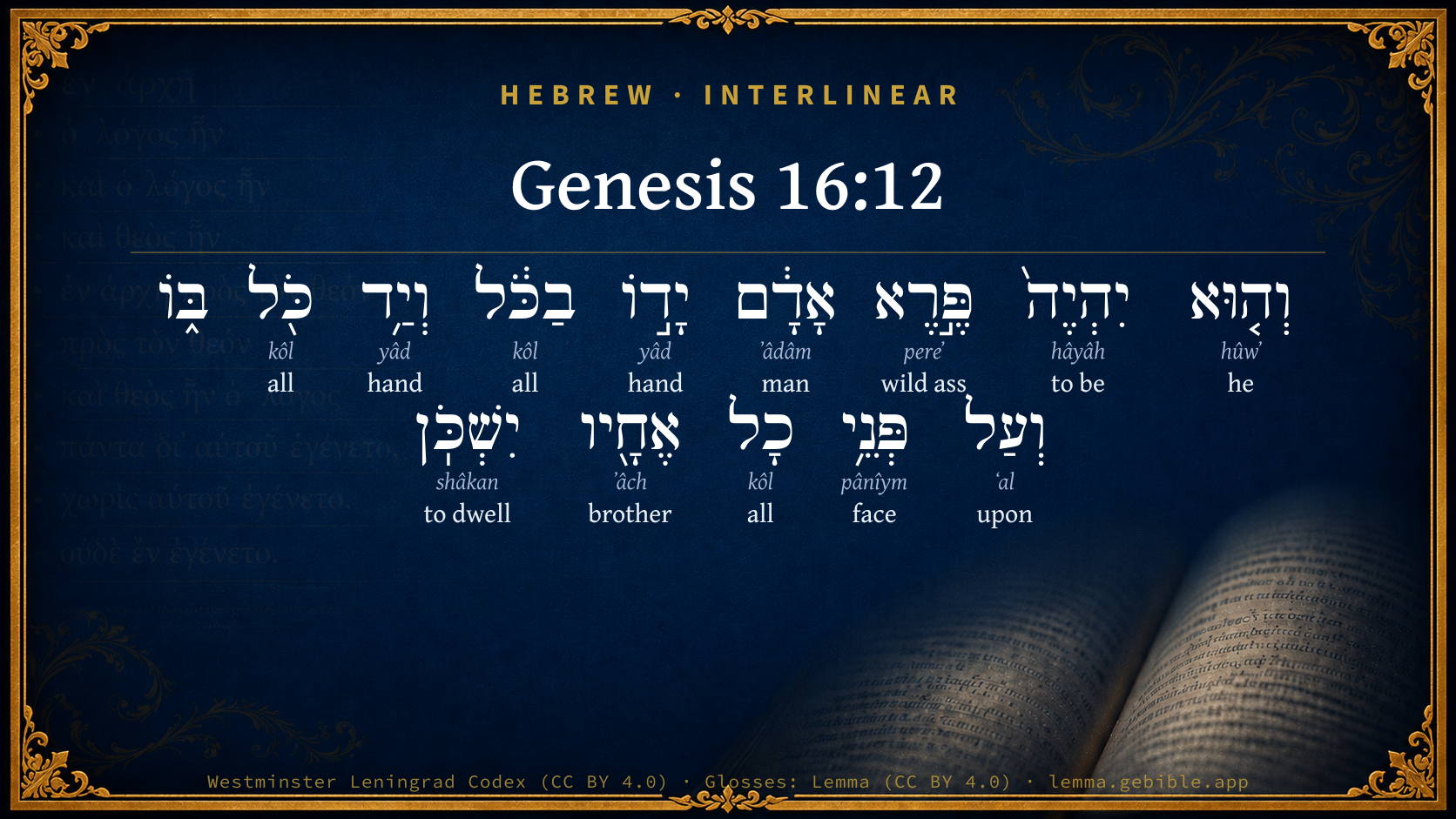
Hebrew (Westminster Leningrad Codex) Genesis 16:12 appears in the Hebrew Old Testament. The text above is from the Westminster Leningrad Codex. Each word links to its Strong’s number, a concise gloss, and parsing drawn from the Open Scriptures Hebrew Bible morphology. Click any word for its full Brown-Driver-Briggs (BDB) entry.
Download image
Cite this verse

Genesis 16:12 (World English Bible). Public Domain. Lemma interlinear Bible study tool, https://lemma.gebible.app/v/genesis/16/12.

Show BibTeX & RIS
BibTeX
RIS
English Translation
He will be like a wild donkey among men. His hand will be against every man, and every man's hand against him. He will live opposite all of his brothers."
World English Bible · Public Domain
Highlights
  • 1 first appearance in the Hebrew Bible
Full analysis ↓
Download a study sheet

One document with this verse’s original text, its word-by-word gloss line, the meaning frame, cross-references with their text, attributed commentary, and full source and license credits — printable, and it pastes into notes with its structure intact.

This verse Autodidact and up

Study sheet (.html) Plain text (.txt)

A passage Seminary Student

Up to 50 verses in one chapter. A passage sheet keeps up to 6 commentary sources and 12 cross-references per verse, in the order this page ranks them, and says so on the sheet whenever that leaves anything out. Ask for a single verse and you get the Autodidact verse sheet above.

Everything on this page stays free to read, with no account — the sheet is a download of what is already on screen, not access to it.

Want to remove ads? Support Godless Engineer
Compare translations 3

The same verse in 3 English versions, stacked beneath the original-language interlinear above. Click any original word for its lexicon entry.

Each is an independent rendering of the whole verse — the interlinear is not word-aligned to these translations.

Highlighted words mark where these versions differ — a whole-verse word diff, not a word-by-word alignment.

  • World English Bible Public Domain
    He will be like a wild donkey among men. His hand will be against every man, and every man's hand against him. He will live opposite all of his brothers."
  • King James Version Public Domain
    And he will be a wild man; his hand will be against every man, and every man's hand against him; and he shall dwell in the presence of all his brethren.
  • unfoldingWord Literal Text CC BY-SA 4.0
    And he will be a wild donkey of a man, his hand against everyone and the hand of everyone against him, and he will live in the faces of all of his brothers.”

unfoldingWord Literal Text — © unfoldingWord, licensed CC BY-SA 4.0. Word-aligned USFM3 via Door43 (git.door43.org/unfoldingWord/en_ult).

Versions to compare (up to 4)

3 of 4 selected

Show all 18 translations

Every available English version of this verse, each an independent rendering of the whole verse.

  • World English Bible Public Domain
    He will be like a wild donkey among men. His hand will be against every man, and every man's hand against him. He will live opposite all of his brothers."
  • Berean Standard Bible Public Domain
    He will be a wild donkey of a man, and his hand will be against everyone, and everyone’s hand against him; he will live in hostility toward all his brothers.”
  • Majority Standard Bible Public Domain
    He will be a wild donkey of a man, and his hand will be against everyone, and everyone’s hand against him; he will live in hostility toward all his brothers.”
  • King James Version Public Domain
    And he will be a wild man; his hand will be against every man, and every man's hand against him; and he shall dwell in the presence of all his brethren.
  • American Standard Version (1901) Public Domain
    And he shall be `as' a wild ass among men; his hand `shall be' against every man, and every man's hand against him; and he shall dwell over against all his brethren.
  • Revised Version (1885) Public Domain
    And he shall be as a wild-ass among men; his hand shall be against every man, and every man’s hand against him; and he shall dwell in the presence of all his brethren.
  • Geneva Bible (1599) Public Domain
    And he shalbe a wilde man: his hande shall be against euery man, and euery mans hand against him. and he shall dwell in the presence of all his brethren.
  • Douay-Rheims (1899) Public Domain
    He shall be a wild man: his hand will be against all men, and all men's hands against him: and he shall pitch his tents over against all his brethren.
  • Young's Literal Translation Public Domain
    and he is a wild-ass man, his hand against every one, and every one's hand against him -- and before the face of all his brethren he dwelleth.'
  • Literal Standard Version CC BY-SA 4.0
    and he is a wild-donkey man, his hand against everyone, and everyone’s hand against him—and before the face of all his brothers he dwells.”
  • Unlocked Literal Bible CC BY-SA 4.0
    He will be a wild donkey of a man. He will be hostile against every man, and every man will be hostile to him, and he will live apart from all his brothers.”
  • unfoldingWord Literal Text CC BY-SA 4.0
    And he will be a wild donkey of a man, his hand against everyone and the hand of everyone against him, and he will live in the faces of all of his brothers.”
  • Darby Bible Public Domain
    And he will be a wild-ass of a man, his hand against every man, and every man's hand against him; and he shall dwell before the face of all his brethren.
  • World Messianic Bible Public Domain
    He will be like a wild donkey among men. His hand will be against every man, and every man’s hand against him. He will live opposed to all of his brothers.”
  • Webster's Bible Public Domain
    And he will be a wild man; his hand will be against every man, and every man's hand against him; and he shall dwell in the presence of all his brethren.
  • Free Bible Version CC BY-SA 4.0
    He'll be a wild donkey kind of man—he will fight with everyone, and everyone will fight with him. He will forever be fighting with his relatives.”
  • Bible in Basic English Public Domain
    And he will be like a mountain ass among men; his hand will be against every man and every man's hand against him, and he will keep his place against all his brothers.
  • JPS Tanakh (1917) Public Domain
    And he shall be a wild ass of a man: his hand shall be against every man, and every man's hand against him; and he shall dwell in the face of all his brethren.'

Literal Standard Version (2020), Covenant Press — licensed CC BY-SA 4.0. Text via the HelloAO Bible API (eBible.org). Unlocked Literal Bible (unfoldingWord) — licensed CC BY-SA 4.0. Text via the HelloAO Bible API (eBible.org). unfoldingWord Literal Text — © unfoldingWord, licensed CC BY-SA 4.0. Word-aligned USFM3 via Door43 (git.door43.org/unfoldingWord/en_ult). Free Bible Version, Dr. Jonathan Gallagher — licensed CC BY-SA 4.0. Text via the HelloAO Bible API (eBible.org).

Word by word

More ways to search: Search by grammar → Find every occurrence → Compare this word →

Practice this passage: Drill this verse → Learn its vocabulary →

פֶּ֣רֶא
pereʼ
H6501
“wild ass of”
Noun, Common, Masculine, Singular, Construct
Part of Speech
Noun
Type
Common
Gender
Masculine
Number
Singular
State
Construct
Full BDB Definition

Origin: from H6500

TWOT: 1805a

wild ass
  1. וְה֤וּא hûwʼ H1931 “and · he” Conjunction + Pronoun, Personal, 3rd Person, Masculine, Singular
  2. יִהְיֶה֙ hâyâh H1961 “to be” Verb, Qal, Imperfect, 3rd Person, Masculine, Singular
  3. אָדָ֔ם ʼâdâm H120 “man” Noun, Common, Masculine, Singular, Absolute
  4. יָד֣וֹ yâd H3027 “hand · his” Noun, Common, Both, Singular, Construct + Suffix, Personal, 3rd Person, Masculine, Singular
  5. בַכֹּ֔ל kôl H3605 “in/at the · all” Preposition, Determined + Noun, Common, Masculine, Singular, Absolute
  6. וְיַ֥ד yâd H3027 “and · hand of” Conjunction + Noun, Common, Both, Singular, Construct
  7. כֹּ֖ל kôl H3605 “all” Noun, Common, Masculine, Singular, Absolute
  8. וְעַל ʻal H5921 “and · upon” Conjunction + Preposition
  9. פְּנֵ֥י pânîym H6440 “face(s) of” Noun, Common, Both, Plural, Construct
  10. כָל kôl H3605 “all of” Noun, Common, Masculine, Singular, Construct
  11. אֶחָ֖יו ʼâch H251 “brothers · his” Noun, Common, Masculine, Plural, Construct + Suffix, Personal, 3rd Person, Masculine, Singular
  12. יִשְׁכֹּֽן shâkan H7931 “to dwell” Verb, Qal, Imperfect, 3rd Person, Masculine, Singular

About this verse

These counts appear in no published source. They are computed here, from the morphology-tagged text and Lemma’s own curated glosses. What Lemma adds →

14
words
10
distinct lemmas
Pentateuch
section

Notable vocabulary

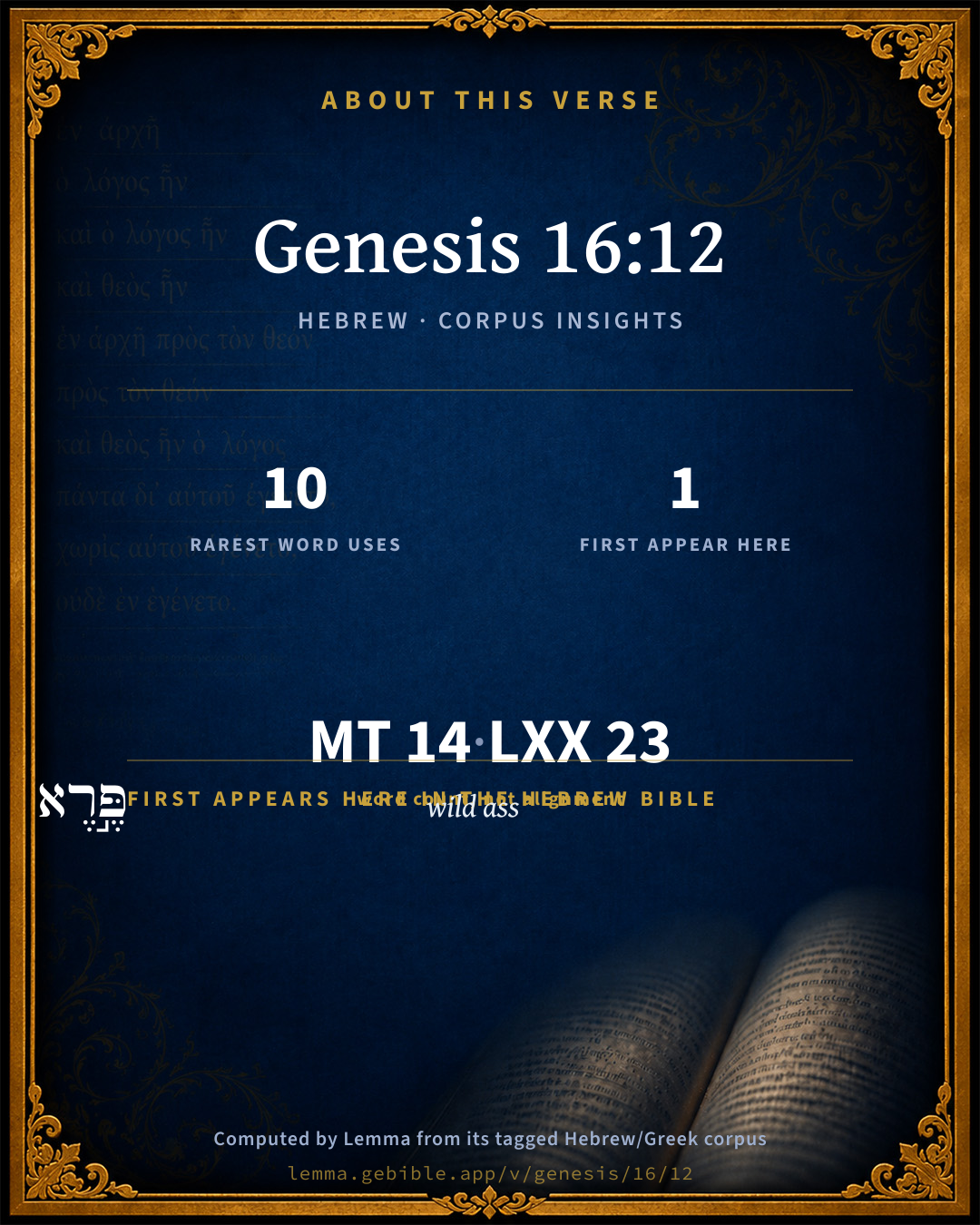
The rarest word here is פֶּ֣רֶא wild ass H6501 — appearing just 10 times in the whole Hebrew Bible.

First appearance in Scripture

This word makes its first canonical appearance in the Hebrew Bible here:

  • פֶּ֣רֶא wild ass H6501

Shared distinctive vocabulary

פֶּ֣רֶא wild ass H6501 occurs in 10 verses of the Hebrew Bible. Also found in:

Grammatical profile

  • 2 verbs
  • 9 nouns
  • 1 pronoun
  • 2 prepositions

Verb forms

  • יִהְיֶה֙ Qal · Imperfect
  • יִשְׁכֹּֽן Qal · Imperfect

Repetition

Words recur within this verse — often emphatic in Hebrew:

  • בַכֹּ֔ל all H3605 ×3
  • יָד֣וֹ hand H3027 ×2

Hebrew & Septuagint length

In English translation the verse runs 30 words from the Hebrew and 28 from the Septuagint (LXX English) — closely comparable.

A rough comparison of the two English renderings, which tokenize alike — not a word-level alignment.

Word counts can differ between the Hebrew and the Greek without any difference in meaning — e.g. the Hebrew direct-object marker אֵת has no separate Greek word, and Greek often adds the article ὁ.

In the original languages it is 14 Hebrew tokens and 23 Greek tokens — but the two are counted differently (Hebrew bundles its prefixes and suffixes into one token; the Greek is in lemma form), so that isn’t a like-for-like length.

Cross-references

5

Topical passages linked to Genesis 16:12 in the Treasury of Scripture Knowledge — connected by theme and wording, ordered by reader-vote popularity; previews shown in the World English Bible.

  • Genesis 21:20 God was with the boy, and he grew. He lived in the wilderness, and became, as he grew up, an archer.
  • Genesis 25:18 They lived from Havilah to Shur that is before Egypt, as you go toward Assyria. He lived opposite all his relatives.
  • Job 39:5–8 "Who has set the wild donkey free? Or who has loosened the bonds of the swift donkey,
  • Genesis 27:40 By your sword will you live, and you will serve your brother. It will happen, when you will break loose, That you shall shake his yoke from off your neck."
  • Job 11:12 But vain man can become wise If a man can be born as a wild donkey's colt.

Cross-references courtesy of OpenBible.info (CC BY 4.0).

Hebrew and Greek witnesses Masoretic Hebrew ↔ Greek Septuagint

The same verse in the two great witnesses to the Old Testament, shown verse-for-verse.

These are two independent witnesses, not word-aligned to each other, and the Septuagint is shown in lemma (dictionary) form.

Hebrew Genesis 16:12 Masoretic · Westminster Leningrad Codex

וְה֤וּא יִהְיֶה֙ פֶּ֣רֶא אָדָ֔ם יָד֣וֹ בַכֹּ֔ל וְיַ֥ד כֹּ֖ל בּ֑וֹ וְעַל פְּנֵ֥י כָל אֶחָ֖יו יִשְׁכֹּֽן

He will be like a wild donkey among men. His hand will be against every man, and every man's hand against him. He will live opposite all of his brothers."

World English Bible · Public Domain

Greek LXX Genesis 16:12 Septuagint · lemma form

οὗτος εἰμί ἄγροικος ἄνθρωπος ὁ χείρ αὐτός ἐπί πᾶς καί ὁ χείρ πᾶς ἐπί αὐτός καί κατά πρόσωπον πᾶς ὁ ἀδελφός αὐτός καταοἰκέω

He shall be a wild man, his hands against all, and the hands of all against him, and he shall dwell in the presence of all his brethren.

LXX2012 (modern English Septuagint) · Public Domain

Hebrew: Westminster Leningrad Codex (CC BY 4.0). Greek: Septuagint (public domain); English from LXX2012 (modern English Septuagint) (Public Domain). How the Septuagint differs from the Hebrew →

Targum (Aramaic paraphrase)

2

The Targum is the ancient Jewish Aramaic paraphrase of the Hebrew Scriptures — an interpretive translation, not the Hebrew text itself. Onkelos (literal) and Pseudo-Jonathan (expansive) render the Torah, and Jonathan the Prophets. Coverage is partial: where no permissively-licensed English translation exists for a verse, only the Aramaic is shown. This is verse-level text, not a word-by-word alignment to the Hebrew.

  1. Targum Onkelos Torah (Genesis–Deuteronomy)
    וְהוּא יְהֵא מָרוֹד בֶּאֱנָשָׁא הוּא יְהֵא צְרִיךְ לְכֹלָא וְאַף כָּל בְנֵי אֲנָשָׁא יְהוֹן צְרִיכִין לֵהּ וְעַל אַפֵּי כָל אֲחוֹהִי יִשְׁרֵי

    (no public-domain English translation for this verse)

    Targum Onkelos — Aramaic: “Onkelos Genesis” (public domain); “Onkelos Exodus” (public domain); “Onkelos Leviticus” (public domain); “Onkelos Numbers” (public domain); “Onkelos Deuteronomy” (public domain). English: “Sefaria Community Translation” (CC0 1.0 (public-domain dedication)); “J.W. Etheridge. The Targums of Onkelos and Jonathan Ben Uzziel on the Pentateuch. London: Longmans, Green, 1862” (public domain). Text via Sefaria.

  2. Targum Pseudo-Jonathan Torah (Genesis–Deuteronomy)
    וְאִיהוּ יֶהֱוֵי מְדַמֵי לַעֲרוֹד בִּבְנֵי נְשָׁא יְדוֹי יִתְפַּרְעוּן מִן בַּעֲלֵי דְבָבוֹי וִידֵי דְבַּעֲלֵי דְבָבוֹי יְתוֹשְׁטוּן לְאַבְאָשָׁא בֵּיהּ וְעַל אַנְפֵּי כָּל אָחוֹי יִתְעַרְבֵּב וְיִשְׁרֵי

    And he shall be like the wild ass among men: his hands shall take vengeance of his adversaries, and the hands of his adversaries be put forth to do him evil; and in the presence of all his brethren shall he be commingled, (yitharbeb, Arabized,) and shall dwell.

    Targum Pseudo-Jonathan — Aramaic: “Targum Jonathan on Genesis” (public domain); “Targum Jonathan on Exodus” (public domain); “Targum Jonathan on Leviticus” (public domain); “Targum Jonathan on Numbers” (public domain); “Targum Jonathan on Deuteronomy” (public domain). English: “The Targum of Jonathan ben Uzziel, trans. J. W. Etheridge, London, 1862” (public domain). Text via Sefaria.

Commentary

Notes on Genesis 16:12 from classic Christian and Jewish commentators (each source and its license shown beneath its notes). The classic Christian expositions comment on the surrounding passage and are grouped to its opening verse, so a note may address several verses; the Jewish commentaries on the Tanakh (Rashi and others) are per-verse, so they appear only where the commentator wrote on this verse.

Lemma curates 59 commentaries, every one of them public domain or Creative Commons licensed, each selected and text-cleaned for this edition rather than reprinted as found. About our sources →

John Gill's Exposition

And he will be a wild man,.... Living in a wilderness, delighting in hunting and killing wild beasts, and robbing and plundering all that pass by; and such an one Ishmael was, see Gen 21:20; and such the Saracens, his posterity, were, and such the wild Arabs are to this day, who descended from him; or "the wild ass of a man" (t); or "a wild ass among men", as Onkelos; or "like to a wild ass among men", as the Targum of Jonathan; wild, fierce, untamed, not subject to a yoke, and impatient of it, see Job 11:12; such was Ishmael, and such are his posterity, who never could be subdued or brought into bondage, neither by the Assyrians, nor Medes and Persians, nor by the Greeks nor Romans, nor any other people (u); and at this day the Arabs live independent on the Turks, nay, oblige the Turks to pay a yearly tribute for the passage of their pilgrims to Mecca, and also to pay for their caravans that pass through their country, as travellers into those parts unanimously report; wherefore Aben Ezra translates the word rendered "wild", or "wild ass", by "free", and refers to the passage in Job 39:5. These people having been always free, and never in bondage, always lived as free booters upon others:

his hand will be against every man, and every man's hand against him; signifying, that he would be of a quarrelsome temper and warlike disposition, continually engaged in fighting with his neighbours, and they with him in their own defence; and such the Arabs his posterity always have been, and still are, given to rapine and plunder, harassing their neighbours by continual excursions and robberies, and pillaging passengers of all nations, which they think they have a right to do; their father Ishmael being turned out into the plains and deserts, which were given him as his patrimony, and as they suppose a permission from God to take whatever he could get. And a late traveller into those parts observes (w), that they are not to be accused of plundering strangers only, or whomsoever they may find unarmed or defenceless; but for those many implacable and hereditary animosities which continually subsist among themselves, literally fulfilling to this day the prophecy of the angel to Hagar, Gen 16:12; the greatest as well as the smallest tribes are perpetually at variance with one another, frequently occasioned upon the most trivial account, as if they were from the very days of their first ancestor naturally prone to discord and contention.

And he shall dwell in the presence of all his brethren; the sons of Abram by Keturah, the Midianites, and others; and the Edomites that sprung from Esau, the son of his brother Isaac; and the Israelites, the descendants of Jacob, another son of Isaac; and his kinsmen the Moabites and Ammonites, upon all which he and his posterity bordered, see Gen 25:18. It may be rendered, "he shall tabernacle" (x), or dwell in tents, as he did, and his posterity afterwards; particularly the Scenite Arabs, so called from their dwelling in tents, and the Bedouins, such were the tents of Kedar, one of his sons, Sol 1:5; the same with them to this day: according to Jarchi, the sense of the phrase is, that his seed should be large and numerous, and spread themselves, and reach to the borders of all their brethren.

(t) "onager hominis", Cocceius, Schmidt. (u) Vid. Diodor. Sicul. Bibliothec. l. 2. p. 131. (w) Dr. Shaw's Travels, p. 238, 239. Ed. 2. (x) "figet tabernacula", V. L. "tabernaculabit", Malvenda.

John Gill's Exposition of the Whole Bible (1746–1763) — public domain (CC PDM 1.0). Text via the HelloAO Bible API.

Trapp's Complete Commentary

John Trapp

Gen 16:12 And he will be a wild man; his hand [will be] against every man, and every man’s hand against him; and he shall dwell in the presence of all his brethren.

Ver. 12. And he will be a wild man.] Heb., A wild ass, which is fierce, untractable, and untameable. And such by nature is every mother’s child of us, {Job 11:12} "a wild ass’s colt." An ass is none of the wisest of creatures, much less an ass’s colt; least of all, a wild ass’s colt. Lo, such is man.

His hand will be against every man.] This was first accomplished in his person, and then in his posterity. For himself, he was ferus et pugnax , ever quarrelling and contending. {a} Now a quarrelsome man is like a cock of the game, that is still bloody with the blood of others, and of himself. As for his posterity the Saracens, Mohammed, the mischief of mankind, had his generation from this wild ass. And Sarai was utterly disappointed; for these Agarens were ever enemies, and so continue to be to her seed.

{a} Figimus, inque vicem praebemus tela sagittis .

John Trapp, A Commentary or Exposition upon All the Books of the Old and New Testament (1647–1656) — public domain. Text from a community e-Sword module.

The Biblical Illustrator

Joseph S. Exell

Gen_16:12

He will be a wild man

The national character of the Arabs foretold

I.

THESE WORDS CONTAIN NOT A MERE CONTINGENT PROMISE, BUT A SPECIFIC PREDICTION OF FUTURE EVENTS. A bare announcement of what would be the physical, moral, and social condition of the person or persons to whom the passage refers.

II. THESE WORDS ARE INTENDED TO APPLY, NOT MERELY TO THE PERSONAL HISTORY AND CHARACTER OF ISHMAEL, BUT TO THE HISTORY AND CHARACTER OF HIS OFFSPRING. Some of the terms employed and some of the things affirmed are not only unintelligible, but absurd, if they are to be understood of Ishmael rather than of his offspring; for in what sense can it be affirmed, that his hand was against every man, and every mans hand against him? Individually, that strife at all events would very soon be brought to an end. How, either, could it be affirmed that he should dwell in the presence of all his brethren, if a single dwelling, and that a tent in the wilderness, were the only thing intended to be set forth?

III. THE ARABIANS ARE THE DESCENDANTS OF ISHMAEL.

IV. THE ARABIANS HAVE EXEMPLIFIED IN THEIR WHOLE HISTORY AND CHARACTER ALL THE PECULIARITIES MENTIONED IN THIS PASSAGE. The term here employed is singularly strong in relation to the first part of the subject. That subject is divided into three particulars: the first, declarative of their freedom; the second, of their hostile dispositions; the third, of their numbers and their power.

1. Here, I say, you have a declaration concerning their freedom: He will be a wild man. The language is peculiarly strong; and literally, the affirmation is, that Ishmael should be the same as the animal described in the thirty-ninth chapter of the Book of Job. There the word is literally rendered the wild ass: and we read, Who hath sent out the wild ass free? or who has loosed the hands of the wild ass? whose house I have made the wilderness, and the barren land his dwellings; he scorneth the multitude of the city, neither regardeth he the crying of the driver; the range of the mountains is his pasture, and he searcheth after every green thing. No terms could have been employed, more fitly or more vividly describing the roaming liberty, or, if you will, licentiousness of the entire Arab nation, whether you regard their internal condition or their external relation.

2. Secondly, we are assured not only of their freedom, but also of the singular hostility of their disposition: His hand will be against every man, and every mans hand against him. During the lapse of three thousand years, they have by turns assaulted all their neighbours, and been assaulted by them. At this present moment they seek not the alliance of the great or the small, the rich or the poor; they care not who wins or who loses in the strife of the world, if they can remain--the hated of the whole family of mankind besides. What is sacrificed or what is gained is to them matter of perfect indifference if still they may frown upon a world they deem their foe. This has been the case, while all other nations have passed through the phases of slavery and of freedom, of poverty and of wealth, of luxury and of hardihood, of disaster and of danger. Still the Arab is the same.

3. Thirdly, these words exhibit to us their numbers and their power. I will multiply thy seed exceedingly, that it shall not be numbered for multitude; and he shall dwell in the presence of all his brethren. Not an easy thing this, to affirm concerning any individual, in the early period of time to which reference is made. Few, indeed, could ever have attained to such distinction, because there are but few nations who ever arrive to any great degree of honour; much less to such a state of renown, as to secure observation in the pages of inspired truth, or in the general history of the world. Yet if you have been called upon, at all events, to point out those individuals, perhaps the very last you would have fixed upon would have been the son of that poor outcast slave, without a father, without a friend, without a prospect excepting the wilderness for his home. Yet these wanderers in the desert and amongst the rocks were the objects and the sources of surprise and of terror to their early neighbours. It was they who first gave to commerce its gold, its spices, its gems. It was they who furnished to the navies of Tyre that for which they were renowned. It was they who gave to monarchs that by which they decorated their halls and their palaces. It was they who gave to arms honour and renown, while with one hand they seized on the fertile plains of Egypt and with the other laid hold on the mountains of Assyria. Thus during successive ages did they continue dwelling in the presence of all their brethren; whether the Babylonian or the Macedonian, whether the Persian or the Roman swayed the destinies of the world, the Arab occupied the same position, and exerted to a great extent the same power. In later days, however, they came forth under another form, and their course was followed by far deadlier consequences. They lifted up in one hand the Koran, which they regarded as at once the product and the instrument of their great prophet, who said he came from God; with the other they brandished the sword, while nations trembled and fell. They passed off to the east--rushed through the turbid and impetuous waters of the Euphrates and the Tigris--and laid prostrate the millions of India, even to the walls of China. Theypassed to the north, swept the sacred shrines and hollow mummeries of Palestine; laid prostrate the cities and temples and towers of Greece--rushed through the Bosphorus--reared the tokens of their power, and at length became consolidated into a mighty empire, in the eastern part of Europe. They passed to the west--overflowed the plains of Egypt with more resistlessness than the waters of the Nile--dashed along the coast of Barbary--rolled away to Central and Western Africa--overleaped the pillars of Hercules and the barriers of Spain--planted the crescent on the walls of Grenada--illumined darkened Europe with a ray of science--and then returned, leaving the marks of their science and their power in arithmetical characters, used in every one of our schools. And so their history, so unique and so marvellous, has been interwoven with the history of all people, to gather from them all some increasing attestation of the truth of this book, the pillar on which our hopes rest; and resting where we can defy the dashing of every wave, assured that we are in the truth of Him, in whose hand our breath is, and whose are all our ways. (J. Aldis.)

The Biblical Illustrator, edited by Joseph S. Exell (c. 1880s–1900s) — public domain. Text from a community e-Sword module.

Joseph Benson's Commentary

Gen 16:12. He will be a wild man — A wild ass of a man; so the word is: rude, and bold, and fearing no man; untamed, untractable, living at large, and impatient of service and restraint. His hand will be against every man — That is his sin; and every man’s hand against him — That is his punishment. Those that have turbulent spirits, have commonly troublesome lives: they that are provoking and injurious to others, must expect to be repaid in their own coin. But this prediction chiefly respects the seed of Ishmael, who, it is here foretold, should be wild, free men, like wild asses, mischievous to all around them, and extremely numerous. Such they have been for almost four thousand years; infamous for theft, pillage, robbery, revenge, and murder. “It hath, therefore,” as Mr. Brown justly observes, “been the continued and common interest of mankind to extirpate them from the earth. But though almost every noted conqueror who hath appeared in the world, whether Persian, Grecian, Roman, Tartar, or Turkish, hath pushed his conquests to their borders, or even beyond them, into Egypt or Arabia Felix, not one hath ever been able to subdue these Ishmaelites, or deprive them of their freedom.” Here then we have another remarkable prophecy most evidently fulfilled, and a continued and standing proof, before the face of the whole world, exactly like that which arises from the present state of the Jews, of the truth of divine revelation. He shall dwell in the presence of all his brethren — Although threatened and insulted by all his neighbours, he shall keep his ground; and, for Abram’s sake, more than his own, shall be able to make his part good against them. Accordingly, we read, Gen 25:18, that he died, as he lived, in the presence of all his brethren. But this also was chiefly intended of his posterity: for Ishmael had twelve sons, who gave rise to as many tribes or nations, called by their names, and who dwelt southward in Arabia, before the face, or in the presence of the Ammonites and Moabites, of the descendants of Keturah, and of the Edomites and Jews, all nearly related to them.

Joseph Benson's Commentary on the Old and New Testaments (1811–1818) — public domain. Text from a community e-Sword module.

Geneva Bible (1599)

Geneva Bible translators

That is, the Ishmaelites shall be a peculiar people by themselves, and not a portion of another people.

Or, fierce and cruel, or; as a wild ass.

Geneva Bible (1599) marginal notes — public domain. Text via Bolls.life.

Jamieson, Fausset & Brown

Robert Jamieson, A. R. Fausset & David Brown

he will be a wild man--literally, "a wild ass man," expressing how the wildness of Ishmael and his descendants resembles that of the wild ass.

his hand will be against every man--descriptive of the rude, turbulent, and plundering character of the Arabs.

dwell in the presence of all his brethren--dwell, that is, pitch tents; and the meaning is that they maintain their independence in spite of all attempts to extirpate or subdue them.

Jamieson, Fausset & Brown — Commentary Critical and Explanatory on the Whole Bible (1871) — public domain (CC PDM 1.0). Text via the HelloAO Bible API.

Adam Clarke's Commentary

Verse 12. He will be a wild man] פרא אדם pere adam. As the root of this word does not appear in the Hebrew Bible, it is probably found in the Arabic [Arabic] farra, to run away, to run wild; and hence the wild ass, from its fleetness and its untamable nature. What is said of the wild ass, Job 39:5-8, affords the very best description that can be given of the Ishmaelites, (the Bedouins and wandering Arabs,) the descendants of Ishmael: "Who hath sent out the wild ass (פרא pere) free? or who hath loosed the bands (ערוד arod) of the brayer? Whose house I have made the wilderness, and the barren land his dwellings. He scorneth the multitude of the city, neither regardeth he the crying of the driver. The range of the mountains is his pasture, and he searcheth after every green thing." Nothing can be more descriptive of the wandering, lawless, freebooting life of the Arabs than this.

God himself has sent them out free - he has loosed them from all political restraint. The wilderness is their habitation; and in the parched land, where no other human beings could live, they have their dwellings. They scorn the city, and therefore have no fixed habitations; for their multitude, they are not afraid; for when they make depredations on cities and towns, they retire into the desert with so much precipitancy that all pursuit is eluded. In this respect the crying of the driver is disregarded. They may be said to have no lands, and yet the range of the mountains is their pasture - they pitch their tents and feed their flocks, wherever they please; and they search after every green thing - are continually looking after prey, and seize on every kind of property that comes in their way.

It is farther said, His hand will be against every man, and every man's hand against him. - Many potentates among the Abyssinians, Persians, Egyptians, and Turks, have endeavoured to subjugate the wandering or wild Arabs; but, though they have had temporary triumphs, they have been ultimately unsuccessful. Sesostris, Cyrus, Pompey, and Trajan, all endeavoured to conquer Arabia, but in vain. From the beginning to the present day they have maintained their independency, and God preserves them as a lasting monument of his providential care, and an incontestable argument of the truth of Divine Revelation. Had the Pentateuch no other argument to evince its Divine origin, the account of Ishmael and the prophecy concerning his descendants, collated with their history and manner of life during a period of nearly four thousand years, would be sufficient. Indeed the argument is so absolutely demonstrative, that the man who would attempt its refutation, in the sight of reason and common sense would stand convicted of the most ridiculous presumption and folly.

The country which these free descendants of Ishmael may be properly said to possess, stretches from Aleppo to the Arabian Sea, and from Egypt to the Persian Gulf; a tract of land not less than 1800 miles in length, by 900 in breadth; see Ge 17:20.

Adam Clarke's Commentary on the Bible (1810–1826) — public domain. Text from a community e-Sword/MySword module.

John Calvin's Commentaries

12. And he will be a wild man. The angel declares what kind of person Ishmael will be. The simple meaning is, (in my judgment,) that he will be a warlike man, and so formidable to his enemies, that none shall injure him with impunity. Some expound the word פרא (pereh) to mean a forester, and one addicted to the hunting of wild beasts. But the explanation must not, it seems, be sought elsewhere than in the context; for it follows immediately after, ‘His hand shall be against all men, and the hand of all men against him.’ It is however asked, whether this ought to be reckoned among benefits conferred by God, that he is to preserve his rank in life by force of arms; seeing that nothing is, in itself, more desirable than peace. The difficulty may be thus solved; that Ishmael, although all his neighbors should make war upon him, and should, on every side, conspire to destroy him; shall yet though alone, be endued with sufficient power to repel all their attacks. I think, however, that the angel, by no means, promises Ishmael complete favor, but only that which is limited. Among our chief blessings, we must desire to have peace with all men. Now, since this is denied to Ishmael, that blessing which is next in order is granted to him; namely, that he shall not be overcome by his enemies; but shall be brave and powerful to resist their force. He does not, however, speak of Ishmael’s person, but of his whole progeny; for what follows is not strictly suitable to one man. Should this exposition be approved, no simple or unmixed blessing is here promised; but only a tolerable or moderate condition; so that Ishmael and his posterity might perceive that something was divinely granted to them, for the sake of their father Abram. Therefore, it is, by no means, to be reckoned among the benefits given by God, that he shall have all around him as enemies, and shall resist them all by violence: but this is added as a remedy and an alleviation of the evil; that he, who would have many enemies, should be equal to bear up against them.

And he shall dwell in the presence of all his brethren. As this is properly applicable only to a nation, we hence the more easily perceive, that they are deceived who restrict the passage to the person of Ishmael. Again, others understand, that the posterity of Ishmael was to have a fixed habitation in the presence of their brethren, who would be unwilling to allow it; as if it were said, that they should forcibly occupy the land they inhabit, although their brethren might attempt to resist them. Others adduce a contrary opinion; namely, that the Ishmaelites, though living among a great number of enemies, should yet not be destitute of friends and brethren. I approve, however, of neither opinion: for the angel rather intimates, that this people should be separate from others; as if he would say, ‘They shall not form a part or member of any one nation; but shall be a complete body, having a distinct and special name.’

John Calvin's Commentaries (1540-1563) — public domain. Text from the Calvin Translation Society English edition (1840s-50s) via the Christian Classics Ethereal Library (ccel.org). Calvin's coverage is partial (roughly two-thirds of the Bible); uncommented books and verses are honest gaps, never fabricated. The 19th-century editor's footnotes and remarks are omitted so the notes are faithfully Calvin's own voice.

Ellicott's Commentary for English Readers

(12) He will be a wild man.—Heb., he will be a wild-ass man. The wild ass of the Arabian deserts is a very noble creature, and is one of the animals selected in the Book of Job as especially exemplifying the greatness of God (Job_39:5-8). Its characteristics are great speed, love of solitude, and an untamable fondness of liberty. It is thus the very type of the Bedaween Arabs, whose delight is to rove at will over the desert, and who despise the ease and luxury of a settled life.

His hand will be against every man . .·.—The Bedaween can be bound by no treaties, submit to no law, and count plunder as legitimate gain. Nevertheless—

He shall dwell in the presence of all his brethren.—That is, he shall maintain his independence, and his descendants shall continue to exist as a free race in the presence of the other Abrahamic nations. Many commentators, however, consider that the more exact rendering is, he shall dwell to the east of all his brethren. This is certainly the meaning of the word in Gen_25:6, but does not suit equally well there in Gen_25:18.

A Bible Commentary for English Readers, edited by Charles John Ellicott (1878–1897) — public domain. Text from a community e-Sword module.

The Cambridge Bible for Schools and Colleges

gen. ed. J. J. S. Perowne

12. as a wild-ass among men] Lit. “a wild-ass of a man.” This description of Ishmael vividly portrays the characteristics of his descendants. The wild ass, for which see Job_39:5-8, Hos_8:9, is the typically untameable, strong, free, roaming, suspicious, and untrustworthy animal, living wild in the desert, far from the haunts of men.

in the presence of all his brethren] R.V. marg. over against. Cf. Gen_25:18. “Brethren”: see notes on Gen_13:8, Gen_14:14. While “in the presence,” or “in the face of” all his brethren, might legitimately be rendered “to the east of” the Israelites, the east was scarcely the quarter in which the Ishmaelites were chiefly found. A better explanation gives to the words the meaning of a foe, dwelling close at hand and “over against” his brethren, ever ready to attack and raid their territory.

The Cambridge Bible for Schools and Colleges (gen. ed. J. J. S. Perowne; Cambridge University Press, 1878–1918) — public domain. Text from a community e-Sword module.

Haydock's Catholic Bible Commentary

Wild. Hebrew: like a wild ass, not to be tamed or subdued. The Saracens or Arabs, have almost all along maintained their independence. --- Over against, ready to fight, without any dread of any one. (Calmet)

George Leo Haydock (1774–1849), Haydock's Catholic Family Bible and Commentary, 1859 edition — public domain. Excludes Psalms (Douay-Rheims chapter numbering differs from Protestant) and Deuterocanonical books (Catholic canon only).

Matthew Poole's English Annotations

He will be a wild man; Heb. A wild-ass man, i.e. a man like a wild ass, fierce and untamed, and unsettled in his habitation; or as that creature is, Job 39:5,8; Jer 2:24; Hos 8:9, living in deserts and mountains, warlike and violent, exercising himself continually in hunting beasts, and oppressing men. See Gen 21:20. He will provoke and injure all that converse with him, and thereby will multiply his enemies; which is to be understood not only of him, but also of his posterity.

And he shall dwell in the borders of the other sons and kindred of Abram and Isaac, who though they shall be vexed and annoyed with his neighbourhood, yet shall not be able to make him quit his habitation. See Gen 25:18.

Matthew Poole's English Annotations on the Holy Bible (1683–1685) — public domain. Text from a community e-Sword/MySword module.

Whedon's Commentary on the Bible

Daniel D. Whedon

12. He will be a wild man — Hebrews, a wild ass man, that is, a man like the wild, free, untamable creature described in Job_39:5-8, that makes the wilderness his dwelling, and “scorneth the multitude of the city, neither regardeth he the crying of the driver.” Hagar is to be the mother of a numerous and mighty race, but not of the chosen seed. Her progeny were to become the lawless rovers of the desert. “The character of the Ishmaelites, or the Bedouins,” observes Kalisch, “could not be described more aptly or more powerfully. They have preserved it almost unaltered during three or four thousand years. Against them alone time seems to have no sickle, and the conqueror’s sword no edge. They have defied the softening influences of civilization, and mocked the attacks of the invader. Ungovernable and roaming, obeying no law but their spirit of adventure, regarding all mankind as their enemies, whom they must either attack with their spears or elude with their faithful steeds, and cherishing their deserts as heartily as they despise the constraint of towns and communities; the Bedouins are the outlaws among the nations.”

His hand… against every man — Such a wild and lawless race could never be at peace with a civilized community, and hence, whenever there is any contact with other peoples, there is continual discord. They are also known to have constant feuds among themselves.

In the presence of all his brethren — The brethren here are doubtless to be understood of other descendants of Abram, especially those by Keturah, (see Gen_25:1-4,) and the fact that the descendants of Ishmael have ever occupied the deserts south and east of Palestine is to serve in interpreting these words. Many critics understand the phrase in the presence of as equivalent to east of, a meaning which the words will bear. The persons of whom the words are thus used are supposed to be looking toward the sunrise. But the expression may with equal propriety be used in the sense of contiguity. The Ishmaelites occupied the country in front of the Hebrews, — bordering on the south and east, and especially dwelt in immediate proximity to the Midianites, Edomites, and other descendants of Abram.

Daniel D. Whedon (gen. ed.), Commentary on the Old and New Testaments (1874–1909) — public domain. Text from a community e-Sword module.

The Pulpit Commentary

And he will be a wild man. Literally, a wild ass (of a) man; the Ar,p, snarler, being so called from its swiftness of foot (cf., Job_39:5-8) and aptly depicting "the Bedouin s boundless love of freedom as he rides about in the desert, spear in hand, upon his camel or his horse, hardy, frugal, reveling in the varied beauty of nature, and despising town life in every form" (Keil). As Ishmael and his offspring are here called "wild ass men," so Israel is designated by the prophet "sheep men". (Eze_36:37, Eze_36:38) His hand will be against every man, and every man"s hand against him. Exemplified in the turbulent and lawless character of the Bedouin Arabs and Saracens for upwards of thirty centuries. "The Bedouins are the outlaws among the nations. Plunder is legitimate gain, and daring robbery is praised as valor (Kalisch). And he shall dwell in the presence of literally, before the face of, L e. to the east of (Rosenm Gesenius, Tuch, Knobel, Delitzsch); or, everywhere before the eyes of" (Kalisch, Wordsworth); or, independently of (Calvin, Keil, Lunge, Murphy) all his brethren. The Arabs of today are "just as they were described by the spirit of prophecy nearly 4000 years ago" (Porter"s "Giant Cities of Bashan," pp. 28, 31, 324).

The Pulpit Commentary (1880–1919), ed. H.D.M. Spence-Jones & Joseph S. Exell — public domain. Text from a community e-Sword module.

John Wesley's Explanatory Notes

He will be a wild man - A wild ass of a man, so the word is: rude, and bold and fearing no man; untamed, untractable, living at large, and impatient of service and restraint. His hand will be against every man - That is his sin, and every man's hand against him - That is his punishment. Note, Those that have turbulent spirits have commonly troublesome lives: they that are provoking, and injurious to others, must expect to be repaid in their own coin. And yet, he shall dwell in the presence of all his brethren -- though threatened and insulted by all his neighbours, yet he shall keep his ground, and, for Abram's sake more than his own, shall be able to make his part good with them. Accordingly we read, chap. xxv, 18, that he died, as he lived, in the presence of all his brethren.

John Wesley, Explanatory Notes Upon the Whole Bible (1754–1765) — public domain. Text via the GEBible commentary corpus.

Rashi

Rabbi Shlomo Yitzchaki (Rashi)

פרא אדם A WILD MAN — One who loves the open spaces to hunt wild animals, as it is written of him (Genesis 21:20) “And he dwelt in the wilderness and became an archer.”

ידו בכל HIS HAND SHALL BE AGAINST EVERY ONE — a highwayman.

ויד כל בו AND EVERYONE’S HAND AGAINST HIM — everyone will hate him and attack him.

ועל פני כל אחיו ישכון AND HE SHALL DWELL IN THE PRESENCE OF ALL HIS BRETHREN — his descendants will be numerous, (so that his territory must extend over that which his brethren have; cf. Genesis 25:18).

Rashi on the Tanakh — English translations: “The Judaica Press complete Tanach with Rashi, translated by A. J. Rosenberg” (CC BY 4.0); “Pentateuch with Rashi's commentary by M. Rosenbaum and A.M. Silbermann, 1929-1934” (public domain); “The Metsudah Tanach series, Lakewood, N.J” (CC BY 4.0); and “The Book of Joshua, Metsudah Publications, 1997” (CC BY 4.0). Text via Sefaria.

Ramban (Nachmanides)

Rabbi Moshe ben Nachman (Ramban / Nachmanides)

‘PERE ADAM.’ Rashi comments: “One who loves the deserts is thus, according to Rashi, synonymous with “desert,” as it says peraim bamidbar (Job 24:5). Pere adam is thus: “a man who loves the desert.” (Mizrachi.) [and] to hunt wild animals, as it is written, And he dwelt in the wilderness and became an archer. His hand shall be against every man. This means that he will be a highway man. And every man’s hand against him. Everyone will hate him and attack him.”The correct interpretation is that pere adam is a construct form, meaning that he will be a wild-ass man accustomed to the wilderness, going forth to his work, seeking for food, devouring all and being devoured by all. The subject pertains to his children who will increase, and they will have wars with all the nations.Rabbi Abraham ibn Ezra said: “His hand shall be against every man in that he will be victorious at first over all nations, and afterwards, every man’s hand shall be against him, meaning that he will be vanquished in the end. And in the face of all his brethren, who are the sons of Keturah, he should dwell, meaning that Ishmael’s children will outnumber those of Keturah.”

Ramban (Nachmanides) on the Tanakh — English translation: “Commentary on the Torah by Ramban (Nachmanides). Translated and annotated by Charles B. Chavel. New York, Shilo Pub. House, 1971-1976” (CC BY 4.0). Text via Sefaria.

Radak

Rabbi David Kimhi (Radak)

והוא יהיה; the letter ה at the beginning of the word והוא means that the angel's prophecy referred not only to Yishmael, but to his offspring as well. He foretold the characteristics of the Ishmaelites based on their founder's genes.

פרא אדם, a desert Bedouin, known as such because most Bedouins live in tents instead of in permanent dwellings. Compare Jeremiah 3,2 כערבי במדבר, "as an Arab, at home in the desert." [the word describes people who do not impose the restrictions upon themselves that civilized people accept in the interest of forming communities. Ed.] The Arabs are the people descended from the Ishmaelites.

ידו בכל, seeing that he will dwell in the desert, [a region in which there are no laws governing private property, Ed.] he will violate people's rights, and they in turn will outlaw him, putting a price on his head. In spite of living in constant friction with his neighbours he will not flee but will continue to dwell in their presence. When the angel concludes with the statement that he will ultimately die in the presence of כל אחיו, the word אחיו is used as a simile for the word שכניו, "his neighbours."

Radak on the Tanakh — English translations: “Sefaria Community Translation” (CC0 1.0 (public-domain dedication)); “Eliyahu Munk, HaChut Hameshulash” (CC BY 4.0); “Rabbi Mike Feuer, Jerusalem Anthology” (CC BY 4.0); and “R. David Kimhi on the first book of Psalms, Translated by R.G. Finch, London, 1919” (public domain). Text via Sefaria.

Lesson kit

Teaching starters — assembled from the data on this page, not authored interpretation. Every prompt links to the verse data it draws on. Edit before teaching.

Genesis, in the Pentateuch, opens this verse with 14 words (10 distinct Hebrew lemmas). Its most distinctive word is pereʼ (“wild ass”). A historical commentator’s framing appears above. Read the whole chapter for the surrounding context.

Discussion questions

  1. What does “wild ass” (pereʼ) contribute to the verse as a whole?
  2. The word “wild ass” first appears here in Scripture. What is being introduced at this debut?
  3. Job 6:5 shares the word «wild ass» with this verse. How do the two illuminate each other?
  4. “all” occurs 3× in this one verse. What is the effect of the repetition?
  5. The translations on this page render this verse differently — a whole-verse word diff, not a word-by-word alignment. What might account for the different wordings?
  6. The verb «יִהְיֶה֙» is Qal Imperfect. How does its form color the action?
  7. Reading how John Gill's Exposition and Trapp's Complete Commentary read this verse, where do the two commentators agree and where do they part?

Things to notice

Reading settings

Reading text

Shown beneath each verse's original-language words.

Old Testament
Old Testament edition

Read the OT as the Masoretic Hebrew (MT) or the Greek Septuagint (LXX).

English shown for the Greek Septuagint (in the Hebrew ↔ Greek comparison).

Comparing translations? Open the Compare panel on any verse page to stack up to four side by side.