Acts 14:3

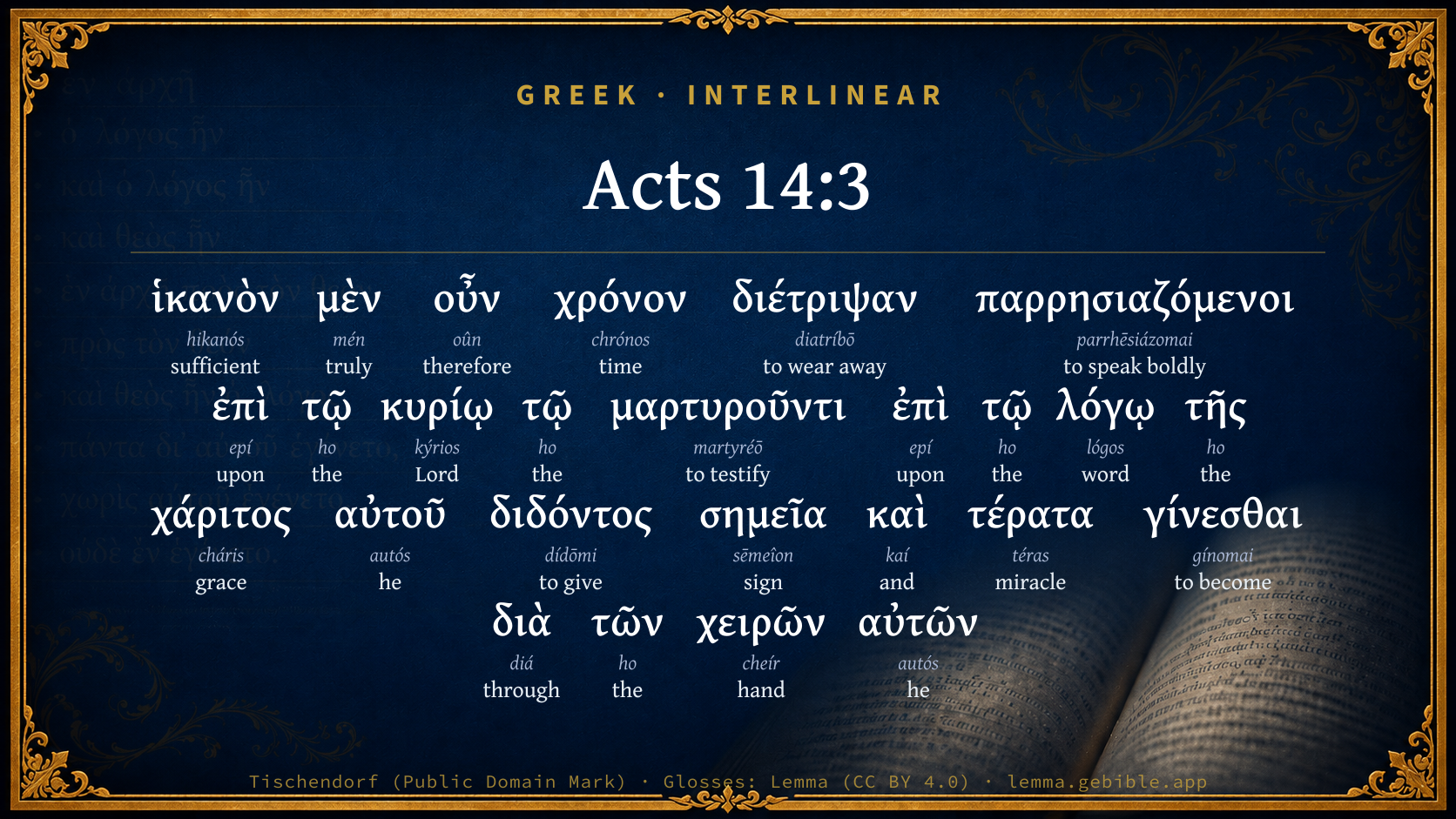
Greek (Tischendorf 8th ed.) Acts 14:3 appears in the Greek New Testament. The text above is from the Tischendorf 8th edition. Each word links to its Strong’s number and a concise gloss. Click any word for its full Thayer’s Greek Lexicon entry.
Download image
Cite this verse

Acts 14:3 (World English Bible). Public Domain. Lemma interlinear Bible study tool, https://lemma.gebible.app/v/acts/14/3.

Show BibTeX & RIS
BibTeX
RIS
English Translation
Therefore they stayed there a long time, speaking boldly in the Lord, who testified to the word of his grace, granting signs and wonders to be done by their hands.
World English Bible · Public Domain
Download a study sheet

One document with this verse’s original text, its word-by-word gloss line, the meaning frame, cross-references with their text, attributed commentary, and full source and license credits — printable, and it pastes into notes with its structure intact.

This verse Autodidact and up

Study sheet (.html) Plain text (.txt)

A passage Seminary Student

Up to 50 verses in one chapter. A passage sheet keeps up to 6 commentary sources and 12 cross-references per verse, in the order this page ranks them, and says so on the sheet whenever that leaves anything out. Ask for a single verse and you get the Autodidact verse sheet above.

Everything on this page stays free to read, with no account — the sheet is a download of what is already on screen, not access to it.

Want to remove ads? Support Godless Engineer
Compare translations 3

The same verse in 3 English versions, stacked beneath the original-language interlinear above. Click any original word for its lexicon entry.

Each is an independent rendering of the whole verse — the interlinear is not word-aligned to these translations.

Highlighted words mark where these versions differ — a whole-verse word diff, not a word-by-word alignment.

  • World English Bible Public Domain
    Therefore they stayed there a long time, speaking boldly in the Lord, who testified to the word of his grace, granting signs and wonders to be done by their hands.
  • King James Version Public Domain
    Long time therefore abode they speaking boldly in the Lord, which gave testimony unto the word of his grace, and granted signs and wonders to be done by their hands.
  • unfoldingWord Literal Text CC BY-SA 4.0
    But indeed they stayed there for a long time, speaking boldly for the Lord, who was testifying to the word of his grace by granting signs and wonders to happen by their hands.

unfoldingWord Literal Text — © unfoldingWord, licensed CC BY-SA 4.0. Word-aligned USFM3 via Door43 (git.door43.org/unfoldingWord/en_ult).

Versions to compare (up to 4)

3 of 4 selected

Show all 19 translations

Every available English version of this verse, each an independent rendering of the whole verse.

  • World English Bible Public Domain
    Therefore they stayed there a long time, speaking boldly in the Lord, who testified to the word of his grace, granting signs and wonders to be done by their hands.
  • Berean Standard Bible Public Domain
    So Paul and Barnabas spent considerable time there, speaking boldly for the Lord, who affirmed the message of His grace by enabling them to perform signs and wonders.
  • Majority Standard Bible Public Domain
    So Paul and Barnabas spent considerable time there, speaking boldly for the Lord, who affirmed the message of His grace by enabling them to perform signs and wonders.
  • King James Version Public Domain
    Long time therefore abode they speaking boldly in the Lord, which gave testimony unto the word of his grace, and granted signs and wonders to be done by their hands.
  • American Standard Version (1901) Public Domain
    Long time therefore they tarried `there' speaking boldly in the Lord, who bare witness unto the word of his grace, granting signs and wonders to be done by their hands.
  • Revised Version (1885) Public Domain
    Long time therefore they tarried there speaking boldly in the Lord, which bare witness unto the word of his grace, granting signs and wonders to be done by their hands.
  • Geneva Bible (1599) Public Domain
    So therefore they abode there a long time, and spake boldly in the Lord, which gaue testimonie vnto the woord of his grace, and caused signes and woders to be done by their hands.
  • Douay-Rheims (1899) Public Domain
    A long time therefore they abode there, dealing confidently in the Lord, who gave testimony to the word of his grace, granting signs and wonders to be done by their hands.
  • Young's Literal Translation Public Domain
    long time, indeed, therefore, did they abide speaking boldly in the Lord, who is testifying to the word of His grace, and granting signs and wonders to come to pass through their hands.
  • Literal Standard Version CC BY-SA 4.0
    [for a] long time, indeed, therefore, they abided speaking boldly in the LORD, who is testifying to the word of His grace, and granting signs and wonders to come to pass through their hands.
  • Unlocked Literal Bible CC BY-SA 4.0
    So they stayed there for a long time, speaking boldly with the Lord's power, while he gave evidence about the message of his grace. He did this by granting signs and wonders to be done by the hands of Paul and Barnabas.
  • unfoldingWord Literal Text CC BY-SA 4.0
    But indeed they stayed there for a long time, speaking boldly for the Lord, who was testifying to the word of his grace by granting signs and wonders to happen by their hands.
  • Darby Bible Public Domain
    They stayed therefore a good while, speaking boldly, [confiding] in the Lord, who gave witness to the word of his grace, giving signs and wonders to be done by their hands.
  • World Messianic Bible Public Domain
    Therefore they stayed there a long time, speaking boldly in the Lord, who testified to the word of his grace, granting signs and wonders to be done by their hands.
  • Webster's Bible Public Domain
    A long time therefore they abode speaking boldly in the Lord, who gave testimony to the word of his grace, and granted signs and wonders to be done by their hands.
  • Free Bible Version CC BY-SA 4.0
    Paul and Barnabas stayed there a long time, speaking to them boldly in the Lord, who confirmed their message of grace through the miraculous signs that they were enabled to perform.
  • Bible in Basic English Public Domain
    So they kept there for a long time, taking heart in the Lord, who gave witness to the word of his grace by causing signs and wonders to be done by their hands.
  • Text-Critical English NT CC BY 4.0
    So Paul and Barnabas spent a long time there, speaking boldly for the Lord, who was testifying to the message of his grace by granting signs and wonders to be done by their hands.
  • Tyndale New Testament (1534) Public Domain
    Longe tyme a bode they there and quyt them selves boldly with the helpe of the Lorde the which gave testimony vnto the worde of his grace and caused signes and wondres to be done by their hondes.

Literal Standard Version (2020), Covenant Press — licensed CC BY-SA 4.0. Text via the HelloAO Bible API (eBible.org). Unlocked Literal Bible (unfoldingWord) — licensed CC BY-SA 4.0. Text via the HelloAO Bible API (eBible.org). unfoldingWord Literal Text — © unfoldingWord, licensed CC BY-SA 4.0. Word-aligned USFM3 via Door43 (git.door43.org/unfoldingWord/en_ult). Free Bible Version, Dr. Jonathan Gallagher — licensed CC BY-SA 4.0. Text via the HelloAO Bible API (eBible.org).

Word by word

More ways to search: Search by grammar → Find every occurrence → Compare this word →

Practice this passage: Drill this verse → Learn its vocabulary →

παρρησιαζόμενοι
parrhēsiázomai
G3955
“to speak boldly”
Verb, Present, Middle or Passive deponent, Participle, Nominative, Plural, Masculine
Part of Speech
Verb
Tense
Present
Voice
Middle or Passive deponent
Mood
Participle
Case
Nominative
Number
Plural
Gender
Masculine
Full Thayer's Definition

Origin: middle voice from G3954

TDNT: 19:31,8

1. to use freedom in speaking, be free spoken a. to speak freely 2. to grow confident, have boldness, show assurance, assume a bold bearing
  1. ἱκανὸν hikanós G2425 “sufficient” Adjective, Accusative, Singular, Masculine
  2. μὲν mén G3303 “truly” Particle
  3. οὖν oûn G3767 “therefore” Conjunction
  4. χρόνον chrónos G5550 “time” Noun, Accusative, Singular, Masculine
  5. διέτριψαν diatríbō G1304 “to wear away” Verb, Aorist, Active, Indicative, 3rd person, Plural
  6. ἐπὶ epí G1909 “upon” Preposition
  7. τῷ ho G3588 “the” Article, Dative, Singular, Masculine
  8. κυρίῳ kýrios G2962 “Lord” Noun, Dative, Singular, Masculine
  9. τῷ ho G3588 “the” Article, Dative, Singular, Masculine
  10. μαρτυροῦντι martyréō G3140 “to testify” Verb, Present, Active, Participle, Dative, Singular, Masculine
  11. ἐπὶ epí G1909 “upon” Preposition
  12. τῷ ho G3588 “the” Article, Dative, Singular, Masculine
  13. λόγῳ lógos G3056 “word” Noun, Dative, Singular, Masculine
  14. τῆς ho G3588 “the” Article, Genitive, Singular, Feminine
  15. χάριτος cháris G5485 “grace” Noun, Genitive, Singular, Feminine
  16. αὐτοῦ autós G846 “he” Personal pronoun, Genitive, Singular, Masculine
  17. διδόντος dídōmi G1325 “to give” Verb, Present, Active, Participle, Genitive, Singular, Masculine
  18. σημεῖα sēmeîon G4592 “sign” Noun, Accusative, Plural, Neuter
  19. καὶ kaí G2532 “and” Conjunction
  20. τέρατα téras G5059 “miracle” Noun, Accusative, Plural, Neuter
  21. γίνεσθαι gínomai G1096 “to become” Verb, Present, Middle or Passive deponent, Infinitive
  22. διὰ diá G1223 “through” Preposition
  23. τῶν ho G3588 “the” Article, Genitive, Plural, Feminine
  24. χειρῶν cheír G5495 “hand” Noun, Genitive, Plural, Feminine
  25. αὐτῶν autós G846 “he” Personal pronoun, Genitive, Plural, Masculine

About this verse

These counts appear in no published source. They are computed here, from the morphology-tagged text and Lemma’s own curated glosses. What Lemma adds →

26
words
20
distinct lemmas
Acts
section

Notable vocabulary

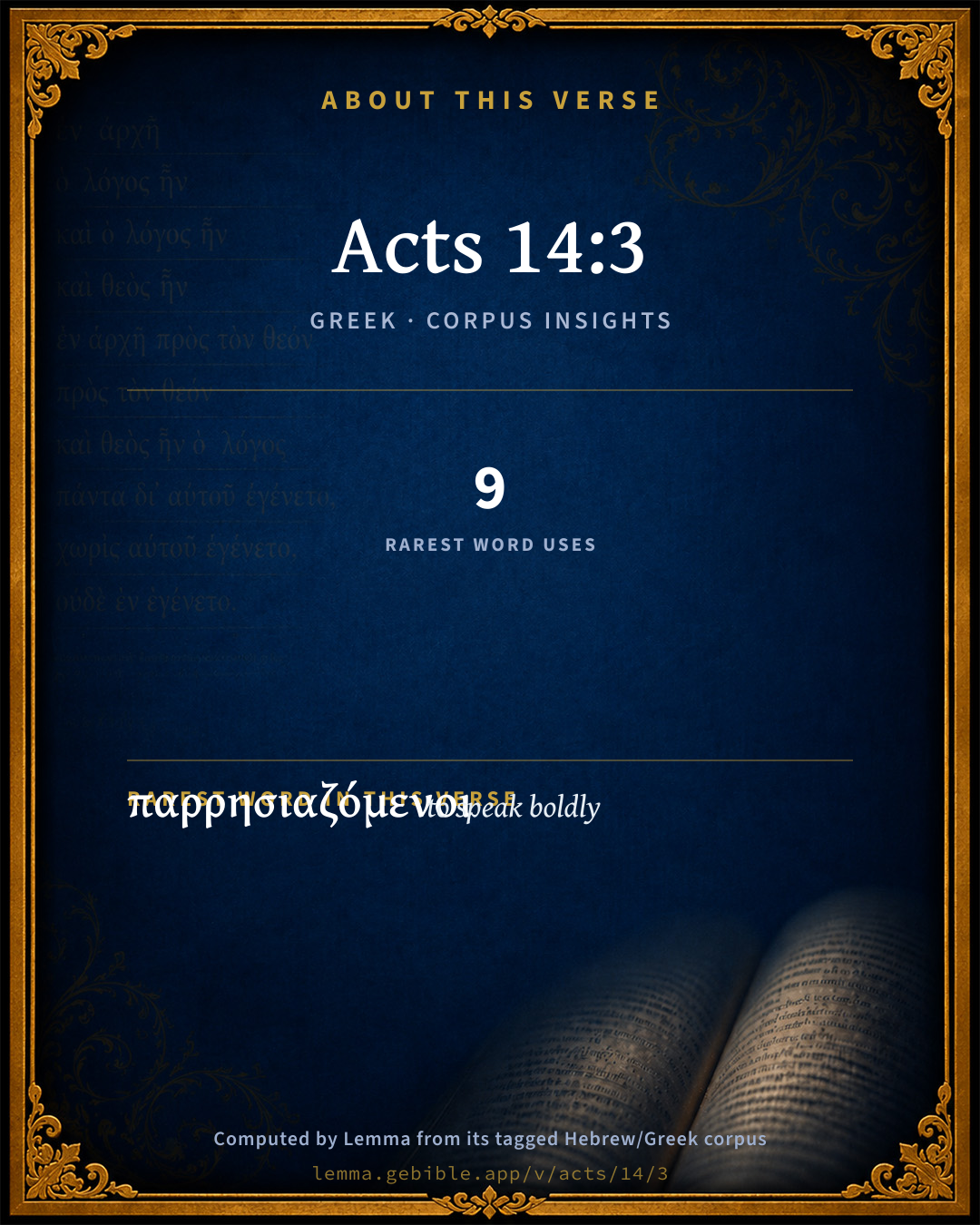
The rarest word here is παρρησιαζόμενοι to speak boldly G3955 — appearing just 9 times in the whole Greek New Testament.

Shared distinctive vocabulary

παρρησιαζόμενοι to speak boldly G3955 occurs in 9 verses of the Greek New Testament. Also found in:

Repetition

Words recur within this verse:

  • ἐπὶ upon G1909 ×2
  • τῷ the G3588 ×5
  • αὐτοῦ he G846 ×2

Cross-references

16

Topical passages linked to Acts 14:3 in the Treasury of Scripture Knowledge — connected by theme and wording, ordered by reader-vote popularity; previews shown in the World English Bible.

  • Hebrews 2:4 God also bearing witness with them, both by signs and wonders, and by various works of power, and by gifts of the Holy Spirit, according to his own will?
  • Acts 20:32 Now, brothers, I entrust you to God, and to the word of his grace, which is able to build up, and to give you the inheritance among all those who are sanctified.
  • Ephesians 6:18–20 with all prayer and requests, praying at all times in the Spirit, and being watchful to this end in all perseverance and requests for all the saints:
  • Acts 20:24 But these things don't count; nor do I hold my life dear to myself, so that I may finish my race with joy, and the ministry which I received from the Lord Jesus, to fully testify to the Gospel of the grace of God.
  • Mark 16:20 They went out, and preached everywhere, the Lord working with them, and confirming the word by the signs that followed. Amen.
  • Acts 4:29–30 Now, Lord, look at their threats, and grant to your servants to speak your word with all boldness,
  • Romans 1:16 For I am not ashamed of the Gospel of Christ, for it is the power of God for salvation for everyone who believes; for the Jew first, and also for the Greek.
  • Acts 19:10–12 This continued for two years, so that all those who lived in Asia heard the word of the Lord Jesus, both Jews and Greeks.
  • 1 Thessalonians 2:2 but having suffered before and been shamefully treated, as you know, at Philippi, we grew bold in our God to tell you the Gospel of God in much conflict.
  • Acts 2:22 "Men of Israel, hear these words! Jesus of Nazareth, a man approved by God to you by mighty works and wonders and signs which God did by him in the midst of you, even as you yourselves know,
  • Acts 5:32 We are His witnesses of these things; and so also is the Holy Spirit, whom God has given to those who obey him."
  • Acts 18:9–11 The Lord said to Paul in the night by a vision, "Don't be afraid, but speak and don't be silent;
  • 1 Corinthians 16:8–9 But I will stay at Ephesus until Pentecost,
  • John 4:48 Jesus therefore said to him, "Unless you see signs and wonders, you will in no way believe."
  • Acts 5:12–14 By the hands of the apostles many signs and wonders were done among the people. They were all with one accord in Solomon's porch.
  • Acts 13:46 Paul and Barnabas spoke out boldly, and said, "It was necessary that God's word should be spoken to you first. Since indeed you thrust it from you, and judge yourselves unworthy of eternal life, behold, we turn to the Gentiles.

Cross-references courtesy of OpenBible.info (CC BY 4.0).

Commentary

Notes on Acts 14:3 from classic Christian and Jewish commentators (each source and its license shown beneath its notes). The classic Christian expositions comment on the surrounding passage and are grouped to its opening verse, so a note may address several verses; the Jewish commentaries on the Tanakh (Rashi and others) are per-verse, so they appear only where the commentator wrote on this verse.

Lemma curates 59 commentaries, every one of them public domain or Creative Commons licensed, each selected and text-cleaned for this edition rather than reprinted as found. About our sources →

Tyndale Open Study Notes

Tyndale Open Resources

14:3 The Spirit-inspired apostles were resilient to withstand the verbal attack against them, and they persisted in preaching the Good News that God’s grace was available to Gentiles as well as to Jews. • boldly: Spirit-inspired boldness is evident throughout Acts (see 2:14; 4:9-10, 13; 7:2-53; 8:30-35; 9:27-28; 18:26; 19:8; 22:3-21; 23:1-6; 28:16-20, 23-31). • In addition, the Holy Spirit confirmed the Christian message with miraculous signs and wonders (cp. 5:12-16; 15:12; 16:18; 19:11).

Tyndale Open Study Notes — © Tyndale Open Resources, licensed CC BY-SA 4.0. Text via the HelloAO Bible API.

Bengel's Gnomon

Johann Albrecht Bengel

Act 14:3. [Ἱκανὸν χρόνον, for no short time) not thinking that they ought to give way to violence.—V. g.]—ἐπὶ, concerning [super]) The object.[83]—μαρτυροῦντι, who gave testimony) The Lord by the testimony of miracles confirmed the word of grace.—λόγῳ τῆς χάριτος, unto the word of His grace) A noble definition of the Gospel.

[83] Engl. Vers. “in the Lord,” i.e. ἐπὶ implying that their bold confidence rested upon the Lord.—E. and T.

Bengel's Gnomon of the New Testament — English translation (T&T Clark, Edinburgh, 1860) — public domain. Text from a community e-Sword module.

Meyer's Critical & Exegetical Commentary

Heinrich August Wilhelm Meyer

Act_14:3-4. Οὖν represents Act_14:3-4 as a consequence of Act_14:1-2. In consequence of that approval (Act_14:1) and this hostility (Act_14:2), they spent indeed (μέν) a considerable time in free-spoken preaching (Act_14:3), but (δέ) there arose a division among the multitude (Act_14:4).

ἐπὶ τῷ Κυρίῳ] states on what their bold teaching restedhad its stay and support. See Bernhardy, p. 250. Hence as regards sense: freti Domino. Elsewhere in the N.T. with ἐν. Κύριος may as well be Jesus (Heinrichs, Olshausen) as God (Grotius, Morus, Kuinoel); the mode of conception of the apostolic church admits both the former (Mar_16:20) and the latter. The latter, however, is preponderantly supported partly by Act_20:32, where τῆς χάριτος αὐτοῦ is to be referred to God, and partly by Act_4:29-30, where διδόντι σημεῖα κ.τ.λ likewise points to God. Comp. Heb_2:4.

τῷ μαρτυροῦντι … αὐτῶν] who gave (practically confirmatory) testimony (comp. Act_10:43, Act_13:22, Act_15:8) to the word of His grace (to the gospel, Act_20:24), in granting that signs and wonders should be done by their hands. The second participle διδόντι, added without copula, denotes the form, in which the μαρτυρεῖν was presented.

ἐσχίσθη] comp. Joh_7:43. Scinditur incertum studia in contraria vulgus. Virg. Aen. ii. 39. Examples in Wetstein.

καί] and indeed.

Meyer — Critical and Exegetical Commentary on the New Testament — English translation by Peter Christie, edited by Frederick Crombie (T&T Clark, 1880) — public domain. Text from a community e-Sword module.

Expositor's Greek Testament

ed. W. Robertson Nicoll

Act 14:3 . ἱκανὸν μὲν οὖν χ . οὖν : as a result from the two previous verses, the accession to their numbers and the disaffection. Blass sees in the aorists ἐπήγ . and ἐκάκ . a proof that the disaffected Jews succeeded in their attempts, and he asks if this was so, how were the Apostles able to remain? The answer is to be found, he thinks, in , see above, so Hilgenfeld, who holds that this reading makes it conceivable how Paul and Barnabas could continue their work. On ἱκανός with χρόνος , peculiar to St. Luke, see p. 215. Ramsay sees the same force in the aorists, and therefore Act 14:3 seems so disconnected that he can only regard it as an early gloss similar to many which have crept into the Bezan text. He thus inclines to adopt here Spitta’s hypothesis, and to regard Act 14:1-2 ; Act 14:4-7 as a primitive document. The Bezan text is to him simply an attempt to remedy the discrepancy which was felt to exist between Act 14:2-3 , and it presupposes two tumults: one in Act 14:2 , and the other in Act 14:4-5 . But there seems nothing unnatural in taking οὖν as marking a result from the events of the two previous verses, not from the second alone, or in the extended stay of the Apostles in the divided city. (Wendt (1899) supposes that in the original source Act 14:3 preceded Act 14:2 , which makes the sequence quite easy. Clemen is much more drastic in his methods, and refers Act 14:2 and Act 14:4-6 a to his Redactor Antijudaicus.) παῤῥησ .: speaking boldly in spite of the opposition of the Jews, see above on the verb, p. 242. ἐπὶ , cf. Act 4:17-18 (elsewhere with ἐν ), the Lord being the ground and support of their preaching; Calvin notes that the words may mean that they spoke boldly in the cause of the Lord, or that relying on His grace they took courage, but that both meanings really run into each other. τῷ Κυρίῳ : difficult to decide whether the reference is to Jesus; Nösgen takes it so, not only on account of St. Luke’s usual way of giving Him this title, but also because the Acts speak expressly of the miracles of the Apostles as works of Christ, Act 3:16 , cf. Act 4:30 . On the other hand Meyer-Wendt appeals to Act 4:29 . Act 20:24 ; Act 20:32 (but for last passage see var. lect.), Heb 2:4 .

The Expositor's Greek Testament, edited by W. Robertson Nicoll (1897–1910) — public domain. Text from a community e-Sword module.

Geneva Bible (1599)

Geneva Bible translators

We ought not to leave our places and give place to threatenings, neither to open rage, but when there is no other remedy, and that not for our own quietness’ sake, but that the Gospel of Christ may be spread further abroad.

Geneva Bible (1599) marginal notes — public domain. Text via Bolls.life.

Jamieson, Fausset & Brown

Robert Jamieson, A. R. Fausset & David Brown

Long time therefore abode they--because in spite of opposition they were meeting with so much success.

speaking boldly in the Lord--rather, "in dependence on the Lord," that is, on their glorified Head.

who gave testimony to the word of his grace--a notable definition of the Gospel, whose whole burden is GRACE.

and granted--"granting," that is, who confirmed the Gospel by granting miraculous attestation to it. (The "and" is wanting in the best manuscripts).

Jamieson, Fausset & Brown — Commentary Critical and Explanatory on the Whole Bible (1871) — public domain (CC PDM 1.0). Text via the HelloAO Bible API.

Adam Clarke's Commentary

Verse 3. Long time therefore abode they] Because they had great success, therefore they continued a long time, gaining many converts, and building up those who had believed, in their most holy faith; notwithstanding the opposition they met with, both from the unbelieving Jews and heathens.

Speaking boldly] παρρησιαζομενοι, Having great liberty of speech, a copious and commanding eloquence, springing from a consciousness of the truth which they preached.

The word of his grace] The Gospel of Jesus Christ, which is the doctrine of God's grace, mercy, or favour to mankind.

And granted signs and wonders to be done] For no apostle could work a miracle by himself; nor was any sign or wonder wrought even by the greatest apostle, but by an especial grant or dispensation of God. This power was not resident in them at all times; it was only now and then communicated, when a miracle was necessary for the confirmation of the truth preached.

Adam Clarke's Commentary on the Bible (1810–1826) — public domain. Text from a community e-Sword/MySword module.

John Calvin's Commentaries

3. A long time. Luke declareth here, that Paul and Barnabas did not depart the city so soon as they saw some set against them, for when he saith that they behaved themselves boldly, he giveth us an inkling that there was cause of fear offered them. Whence we gather that they stood stoutly, and that through rare constancy and courage they counted all dangers as nothing, until they were compelled by violence to depart to another place. This clause, επι κυριω, may be expounded diversely, either that they behaved themselves stoutly in the Lord’s cause, or that they trusted to his grace, and were thereby encouraged. I have followed that which was more common, that they behaved themselves freely and boldly in the Lord, that is, being holpen not by their own strength, but by his grace. He showeth immediately after, after what sort they were encouraged in the Lord; to wit, because [that] he approveth the doctrine by signs and miracles. For seeing that they knew thereby that the Lord was present with them, and that his hand was nigh to help them, they were worthily pricked forward to behave themselves stoutly. But in noting one kind, he doth not exclude other kinds, for the Lord did lift them up unto boldness, and establish them in constancy by other means. But it seemeth that Luke did speak of miracles expressly, because the Lord showed in them his power openly before all the people. Therefore, Paul and Barnabas were not a little emboldened when the Lord did so deliver their doctrine from contempt.

Furthermore, we must note this phrase, that the Lord gave witness to the gospel in miracles, for it showeth the true use of miracles. This is, indeed, the first end, that they may show to us the power and grace of God; but because we be wrong and perverse interpreters of them, lest they be drawn unto abuse and corruption, God doth never suffer them to be separated from his word. For if miracles were wrought at any time without his word; first, that was very seldom; secondly, there came but small fruit thereof; and God hath wrought miracles, for the most part, whereby the world might know him not simply, or in his bare majesty, but in his word. So Luke saith, in this place, that the gospel was established by miracles, not that some confused religion might possess the minds of men, but that Paul’s doctrine going before they might be brought unto the pure worship of God.

Whence we may easily gather how foolishly the Papists deal, when as they endeavor to lead away the world from the reverence of God and the gospel by bare miracles. For we must hold that principle, that those miracles which came from God at any time did never tend to any other end but that the gospel might have his perfect and full authority.

Now must we see whether the gospel command us to call upon the dead, to burn incense to idols, to translate unto reigned saints the grace of Christ to take in hand vowed pilgrimages, to invent profane worshippings, whereof there is no mention made in the Word of God; but there is nothing more contrary to the gospel than that these superstitions should take place. Whereupon it followeth that the Papists do wickedly make engines of the shoars of the gospel to oppugn it. To the same end tendeth that which Luke saith, that the Lord granted that by the hands of his servants miracles might be done; in which words he teacheth that those were only ministers who obeyed God, and that he was the author, who used their hand and industry. Wherefore, in speaking properly, we cannot say that they were Paul and Barnabas’s miracles, but the miracles of God alone, who doth so work by men, that he will not have his glory darkened by their ministry.

Furthermore, we must note the title of the gospel, which Luke putteth in here, that it may be made to us more amiable; for in calling it the word of grace, it hath a most pleasant taste, because salvation is offered to the world in it through Christ. And we must understand the contrariety with the law, wherein only the curse is set before us. Therefore, let us remember that God speaketh to us in the gospel to this end, that he may reconcile himself to us, and may testify that he is merciful to us.: Neither doth this hinder that it is the savor of death unto death to the reprobate, (2 Corinthians 2:16) because they change not the nature thereof by their fault. Read those things which we have spoken in the second chapter touching signs and wonders.

John Calvin's Commentaries (1540-1563) — public domain. Text from the Calvin Translation Society English edition (1840s-50s) via the Christian Classics Ethereal Library (ccel.org). Calvin's coverage is partial (roughly two-thirds of the Bible); uncommented books and verses are honest gaps, never fabricated. The 19th-century editor's footnotes and remarks are omitted so the notes are faithfully Calvin's own voice.

Ellicott's Commentary for English Readers

(3) Long time therefore abode they.—This can hardly be understood as involving a stay of less than several months, during which, Paul and Barnabas, as before, were working for their livelihood.

Speaking boldly.—The “boldness” consisted, as the context shows, in a full declaration of the gospel of the grace of God as contrasted with the narrowing Judaism with which the Greek proselytes had previously been familiar.

Granted signs and wonders to be done by their hands.—It will be noted that here also, as so often elsewhere, the miracles that were wrought came as the confirmation of faith, not as its foundation.

A Bible Commentary for English Readers, edited by Charles John Ellicott (1878–1897) — public domain. Text from a community e-Sword module.

The Cambridge Bible for Schools and Colleges

gen. ed. J. J. S. Perowne

3. Long time therefore abode they] There are two results described in this and the following verse as the consequences of the Jewish opposition. First, a long stay was necessary that by the words of the Apostles and by the mighty deeds following wherewith God confirmed them, the faith of the new converts might be fully established before the Apostles departed. Secondly, there came about a division among the people, the Christians and non-Christians became distinctly marked parties.

speaking boldly] The original word expresses that “freedom of speech” for which the Apostles prayed (Act_4:29), and it is to be noted that as in their prayer so in God’s working, the freedom of speech is in close connection with the stretching forth of God’s hand to heal, and with the signs and wonders that were done in the name of Jesus.

the word of his grace] i.e. the word of the truth of the Gospel, which is glad tidings, a word of grace. It is to be remarked that the signs mentioned here, as elsewhere, follow after the faith and do not precede it.

The Cambridge Bible for Schools and Colleges (gen. ed. J. J. S. Perowne; Cambridge University Press, 1878–1918) — public domain. Text from a community e-Sword module.

John Gill's Exposition

Long time therefore abode they,.... At Iconium, undaunted and not discouraged, at the treatment they met with: but continued,

speaking boldly in the Lord; using great freedom of speech, and showing great courage and intrepidity of mind; speaking out, without fear, the doctrines of the Gospel, in the name of the Lord, and depending upon strength, assistance, and support, from him:

which gave testimony unto the word of his grace; the Gospel, so called, because it is a publication of the grace and favour of God to the sons of men; in the choice of some of them to everlasting life, in the mission of his Son to redeem them, in the justification of them by his righteousness, and in the forgiveness of them through his blood, in the regeneration of them by his Spirit, in adopting them into his family, and making them heirs of eternal life; and because it is a means of implanting his grace in their souls; to this he bore witness, by giving it success, notwithstanding the opposition made against it, and by miracles wrought in confirmation of it, as follows:

and granted signs and wonders to be done by their hands; such as healing the sick, curing the lame, casting out devils; and the like, whereby a testimony was given to the truth of the doctrine they preached: and it may be observed, that these miraculous works were not wrought by the power of the apostles, but by the power of God; they were only instruments by whom they were done; it was owing to a grant from the Lord, and to his power, that they were performed.

John Gill's Exposition of the Whole Bible (1746–1763) — public domain (CC PDM 1.0). Text via the HelloAO Bible API.

Trapp's Complete Commentary

John Trapp

3 Long time therefore abode they speaking boldly in the Lord, which gave testimony unto the word of his grace, and granted signs and wonders to be done by their hands.

Ver. 3. Which gave testimony to the word] It is usual with St Luke to oppose the good success of the gospel to the malicious actings of the mad world against it; that God’s people might not be discouraged.

John Trapp, A Commentary or Exposition upon All the Books of the Old and New Testament (1647–1656) — public domain. Text from a community e-Sword module.

Albert Barnes' Notes on the Bible

Long time therefore - It seems probable that there were here no forcible or public measures to expel them, as there had been at Antioch Act 13:50, and they therefore regarded it as their duty to remain. God granted them here also great success, which was the main reason for their continuing a long time. Persecution and opposition may be attended often with signal success to the gospel.

Spake boldly in the Lord - In the cause of the Lord Jesus, or in his name and by his authority. Perhaps, also, the expression includes the idea of their trusting in the Lord.

Which gave testimony - Bore witness to the truth of their message by working miracles, etc. Compare Mar 16:20. This was evidently the Lord Jesus to whom reference is here made, and it shows that he was still, though bodily absent from them, clothed with power, and still displayed that power in the advancement of his cause. The conversion of sinners accomplished by him is always a testimony as decided as it is cheering to the labors and messages of his servants.

Unto the word of his grace - His gracious word, or message.

And granted signs ... - Miracles. See the notes on Act 2:22.

Albert Barnes' Notes on the Bible (1834–1885) — public domain. Text from a community e-Sword/MySword module.

Haydock's Catholic Bible Commentary

To the word of his grace. That is, of the gospel, and the law of grace. (Witham)

George Leo Haydock (1774–1849), Haydock's Catholic Family Bible and Commentary, 1859 edition — public domain. Excludes Psalms (Douay-Rheims chapter numbering differs from Protestant) and Deuterocanonical books (Catholic canon only).

Matthew Poole's English Annotations

Long time therefore abode they, to strengthen the new converts against the opposition they met with in the way of Christ, willingly partaking with them in their afflictions for Christ’s sake.

Speaking boldly; with great courage, and humble confidence, as knowing in whom they had believed.

In the Lord;

1. In the Lord’s cause, a business which he had sent them about. Secondly, And in the Lord’s strength, who enabled them in it. The word of his grace; the gospel: first, Wherein the grace of God is manifested.

2. Whereby it is offered.

3. Wherewith, to such as receive, it is conveyed.

4. And out of grace disputed and allowed to some, hidden and withdrawn from others.

Granted signs and wonders to be done by their hands; God, by his miraculous confirming the doctrine of the apostles, showed that it was from him.

Matthew Poole's English Annotations on the Holy Bible (1683–1685) — public domain. Text from a community e-Sword/MySword module.

The Pulpit Commentary

They tarried there for abode they, A.V.; bare witness for gave testimony, A.V.; granting for and granted, A.V. For the phrase long time (iJkanonon), comp. rai Act_27:9, "much time," and "many days" (hJme iJkanai), Act_9:23. So alsonwn Luk_8:27, "long time," or "for a long time" (ejk cro iJkanwn). Speaking boldly (parrhsiazomenoi) in the Lord (ejpiw); i.e. having the Lord for their support. It was the special prayer of the Church that God would "grant to his servants that they might speak the Word with all boldness (metaav pashv)," and in answer to that prayer they were enabled to speak "the Word of God with boldness" (Act_4:29, Act_4:31; Act_9:29 Act_18:26 Act_19:8; 1Th_2:2, etc.) It was no small evidence of the power of the Holy Ghost that the apostles were able to speak with such uncompromising fidelity in the face of such bitter opposition. Signs and wonders, etc. See Mar_16:17-20; comp. toow Act_4:30, which also indicates that we ought, perhaps, to understand here tw Kurri) of God the Father rather than of "his holy Servant Jesus."

The Pulpit Commentary (1880–1919), ed. H.D.M. Spence-Jones & Joseph S. Exell — public domain. Text from a community e-Sword module.

Burkitt's Expository Notes on the New Testament

William Burkitt

Note here, 1. The manner of the apostles’ preaching at Iconium: They spake boldly: that is, openly in the synagogues: and there with great freedom and plainness of speech asserted truth, condemned error, reproved sin, and denounced judgments against impenitent sinners; and this with a wise, but convincing boldness; with a meek, but zealous boldness; knowing, that if they had not now been bold for Christ, they could not at the great day be bold before him. That minister that is afraid to speak and plead for Christ now, will certainly be ashamed to look him in the face then. A serious thought of this, when we are going to preach, will make us shut all base fear out of the pulpit.

Note, 2. The time of their preaching at Iconium: it was not a single sermon or two, in transitu, but long time they abode, speaking boldly in the Lord. A constant course of preaching is needful to root that word which one or two sermons oft leaveth loose; the end of the ministry is to build up, as well as to bring in, and this is done by our constancy in preaching, and exemplariness in holy living.

Note, 3. How God honoured his word in the mouth of his ministers, confirming their doctrine by miracles: He gave testimony by the word of his grace, and granted signs and wonders to be done by their hands. The miracles, which the apostles wrought, were the convincing cause of the credibility of the apostles’ testimony.

William Burkitt's Expository Notes on the New Testament (1700–1703) — public domain. Text from a community e-Sword module.

McGarvey & Pendleton's Commentaries

J. W. McGarvey

3-7. This divided and excited state of the public mind continued during the whole time that Paul and Barnabas remained in the city. (3) " They continued there a long time, speaking boldly respecting the Lord, who bore testimony to the word of his favor, and granted signs and wonders to be done through their hands. (4) Yet the multitude of the city was divided: some were with the Jews, and others with the apostles. (5) But when an onset was made by both Gentiles and Jews, with their rulers, to abuse and stone time, (6) they, being aware of it, fled down to the cities of Lycaonia, Lystra, and Derbe, and the surrounding country; (7) and there they preached the gospel. " In the rapid sketch which Luke is giving us of this rather hurried missionary tour, he makes no definite note of time, to indicate how long the two missionaries remained at any particular place. The above remark, that they continued in Iconium "a long time," is the only note of the kind in the tour, and it is very indefinite. It only indicates that their stay here was long in comparison with that at most other places during this tour.

Though their preaching here was not as successful as might have been expected from the length of time employed, it received abundant attestations of the Lord's approval. The proof of this fact adduced by Luke is quite different from that often adduced for a similar purpose by modern writers. Now, the proof that a man's ministry is "owned and accepted" by the Lord, is found in the "abundant outpourings of the Spirit" which attend it; and this, in other words, means the number of "powerful conversions" with which it is rewarded. But the Lord's method of bearing testimony to the word of his favor, according to Luke, was by "granting signs and wonders to be done" by the hands of the preachers; while not a word is said, either by him or any other inspired writer, of such a spiritual attestation as is now confidently referred to. This shows that our modern revivalists have confounded the attestations of the word by signs and miracles, which was common, in apostolic times, with the exciting scenes which now occur in their revivals. This mistake not only confounds things essentially different, but assumes that the apostles were accustomed to scenes of which they never dreamed. Moreover, it erects a false and very injurious standard by which to judge whether a man's ministry is acceptable to God. If the preacher who is most successful in gaining converts is the one whose ministry is most acceptable to God, then there is not the same value in earnest piety, a blameless life, and watchful oversight of the flock which the apostolic epistles would lead us to believe; since it sometimes occurs that men who obtain the fame of great "revivalists," are quite deficient in these essential characteristics of an acceptable minister of the Word.

The onset made by the multitude, like the similar proceedings in Antioch, was instigated by the unbelieving Jews, though effected chiefly by the Gentiles and the rulers of the city. The escape of the missionaries must have been narrow, and was probably owing to the kindness of some stranger, whom Paul and Barnabas may have remembered with gratitude, but whose name will not be known to the great world till the day of eternity.

J. W. McGarvey (with Philip Y. Pendleton), Commentaries on the New Testament (The Fourfold Gospel, 1914; Acts; and the epistles) — public domain. Text from a community e-Sword/MySword module.

unfoldingWord translationNotes

Door43 World Missions Community

General Information:

Here the word "He" refers to the Lord.

So they stayed there

"Nevertheless they stayed there." Paul and Barnabas stayed in Iconium to help the many people who had believed in Acts 14:1. "So" could be omitted if it adds confusion to the text.

gave evidence about the message of his grace

"demonstrated that the message about his grace was true"

about the message of his grace

"about the message of the Lord's grace"

by granting signs and wonders to be done by the hands of Paul and Barnabas

This can be stated in active form. AT: "by enabling Paul and Barnabas to perform signs and wonders" (See: Active or Passive)

by the hands of Paul and Barnabas

Here "hands" refers to the will and effort of these two men as guided by the Holy Spirit. AT: "by the ministry of Paul and Barnabas" (See: Synecdoche)

the majority of the city was divided

Here "city"refers to the people in the city. AT: "most of the people of the city were divided" or "most of the people of the city did not agree with each other" (See: Metonymy)

sided with the Jews

"supported the Jews" or "agreed with the Jews." The first group mentioned did not agree with the message about grace.

with the apostles

The second group mentioned agreed with the message about grace. It may be helpful to restate the verb. AT: "sided with the apostles" (See: Ellipsis)

the apostles

Luke refers to Paul and Barnabas. Here "apostle" might be used in the general sense of "ones sent out."

translationWords

lord

power

grace

miracle

apostle

unfoldingWord translationNotes — © Distant Shores Media and the Door43 World Missions Community, licensed CC BY-SA 4.0. Source: git.door43.org/Door43/en_tn.

Cambridge Greek Testament for Schools and Colleges

3. καὶ before διδόντι omitted with ABDEP. Not represented in Vulg.

3. ἱκανὸν μὲν οὖν χρόνον διέτριψαν, long time therefore abode they. There are two results described in this and the following verse as the consequences of the Jewish opposition. First, a long stay was necessary that, by the words of the Apostles and by the mighty deeds following wherewith God confirmed them, the faith of the new converts might be fully established before the Apostles departed. Secondly, there came about a division among the people; the Christians and non-Christians became distinctly marked parties.

παρρησιαζόμενοι ἐπὶ τῷ κυρίῳ, speaking boldly in the Lord. The preposition implies dependence and rest upon something. The παρρησία of the Apostles came from the Lord, and was sustained by Him. He made them bold by His works of power in support of their message.

τῷ λόγῳ τῆς χάριτος αὐτοῦ, the word of His grace. So named because the word of the truth of the Gospel is a message of grace and favour.

Cambridge Greek Testament for Schools and Colleges (Cambridge University Press, 1896; 21 vols, various authors incl. Carr, Maclear, Plummer, Farrar, Lumby, Moule, M. R. James, Simcox) — public domain. Text from a community e-Sword module.

Alford’s Greek Testament

Henry Alford

3. παῤῥ. ἐπὶ τ. κυρ.] A pregnant construction:—‘speaking with boldness, which boldness was grounded on confidence in the Lord.’

τῷ κυρίῳ is God: see ch. 4:29, 30, and ch. 20:32, τῷ θεῷ κ. τῷ λόγῳ τῆς χάριτος αὐτοῦ.

διδόντι, without καί, defines μαρτυροῦντι: viz. by giving, &c.

Henry Alford, The Greek Testament (1849–1861) — public domain. Text from a community e-Sword module.

Vincent's Word Studies in the New Testament

Marvin R. Vincent

Long [ικανον] . See on Luk 7:6.

Abode. See on ch. Act 12:19.

In the Lord. Lit., upon [επι] the Lord : in reliance on him.

Marvin R. Vincent, Word Studies in the New Testament (1887–1900) — public domain. Text from a community e-Sword/MySword module.

Lesson kit

Teaching starters — assembled from the data on this page, not authored interpretation. Every prompt links to the verse data it draws on. Edit before teaching.

Acts, in the Acts, opens this verse with 26 words (20 distinct Greek lemmas). Its most distinctive word is parrhēsiázomai (“to speak boldly”). A historical commentator’s framing appears above. Read the whole chapter for the surrounding context.

Discussion questions

  1. The word parrhēsiázomai carries the sense “to speak boldly.” How does it shape the verse?
  2. How does Acts 9:27, which shares the word «to speak boldly», read alongside this verse?
  3. What does the repetition of “upon” (2× in this one verse) do in this verse?
  4. These translations render this verse differently; the difference is in the English rendering, not the original. What questions does that raise?
  5. Compare how Tyndale Open Study Notes and Bengel's Gnomon read this verse. Where do they agree or differ?

Things to notice

Reading settings

Reading text

Shown beneath each verse's original-language words.

Old Testament
Old Testament edition

Read the OT as the Masoretic Hebrew (MT) or the Greek Septuagint (LXX).

English shown for the Greek Septuagint (in the Hebrew ↔ Greek comparison).

Comparing translations? Open the Compare panel on any verse page to stack up to four side by side.