
Mark 8:25

Greek (Tischendorf 8th ed.) Mark 8:25 appears in the Greek New Testament. The text above is from the Tischendorf 8th edition. Each word links to its Strong’s number and a concise gloss. Click any word for its full Thayer’s Greek Lexicon entry.
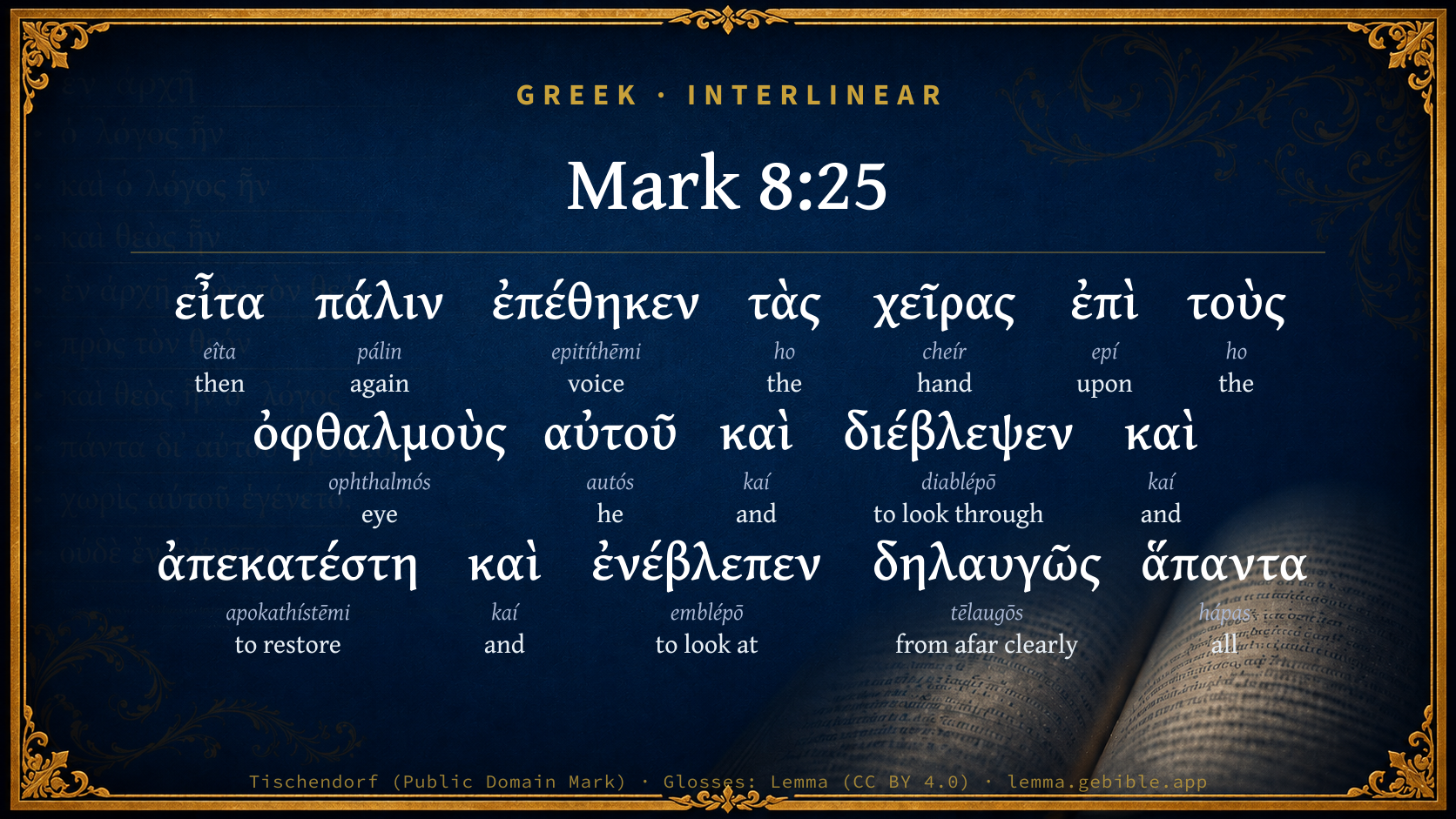
Download image
Cite this verse

Mark 8:25 (World English Bible). Public Domain. Lemma interlinear Bible study tool, https://lemma.gebible.app/v/mark/8/25.

Show BibTeX & RIS
BibTeX
RIS
English Translation
Then again he laid his hands on his eyes. He looked intently, and was restored, and saw everyone clearly.
World English Bible · Public Domain
Highlights
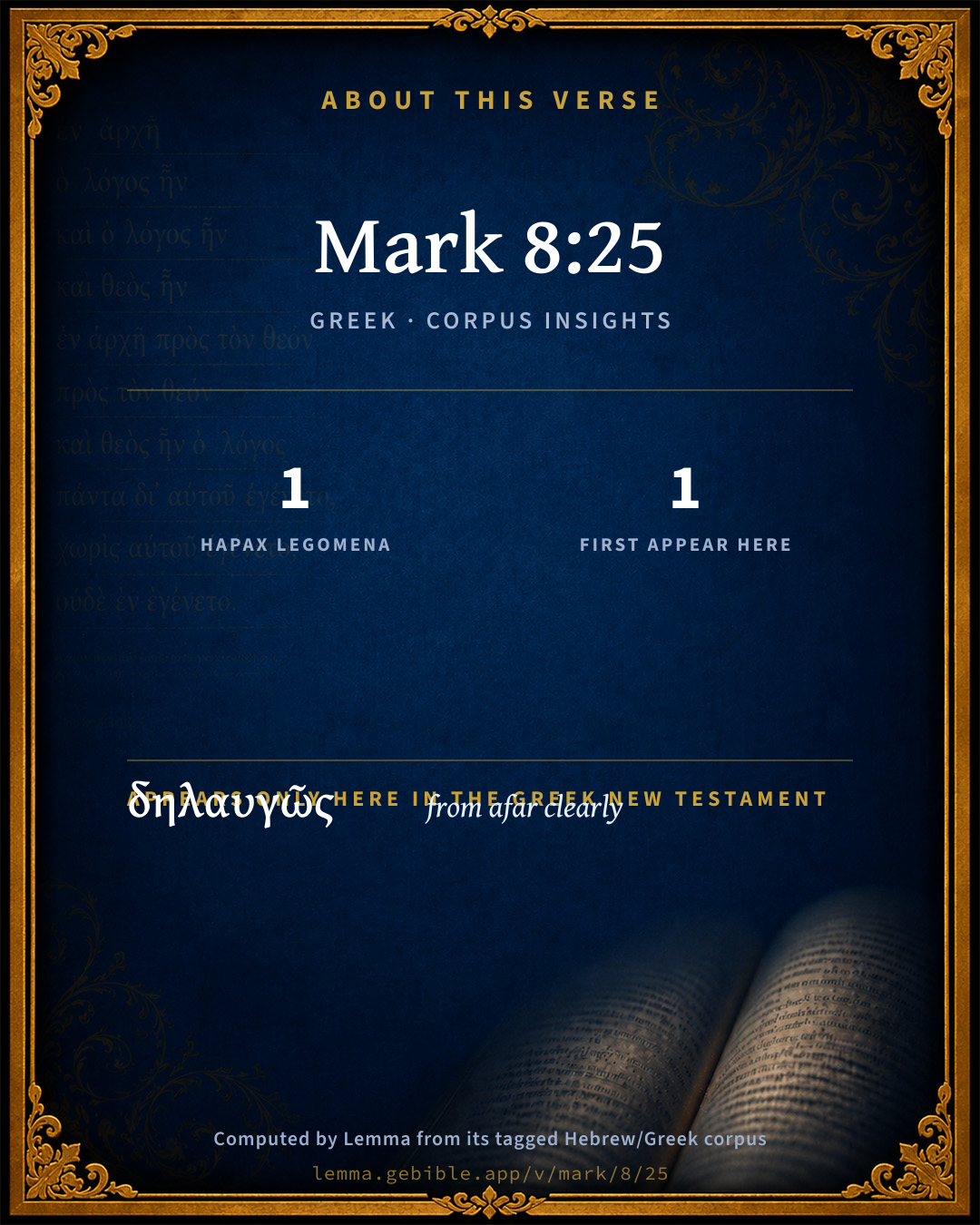
  • 1 hapax legomenon — only here in the Greek New Testament
  • 1 first appearance in the Greek New Testament
Full analysis ↓
Download a study sheet

One document with this verse’s original text, its word-by-word gloss line, the meaning frame, cross-references with their text, attributed commentary, and full source and license credits — printable, and it pastes into notes with its structure intact.

This verse Autodidact and up

Study sheet (.html) Plain text (.txt)

A passage Seminary Student

Up to 50 verses in one chapter. A passage sheet keeps up to 6 commentary sources and 12 cross-references per verse, in the order this page ranks them, and says so on the sheet whenever that leaves anything out. Ask for a single verse and you get the Autodidact verse sheet above.

Everything on this page stays free to read, with no account — the sheet is a download of what is already on screen, not access to it.

Want to remove ads? Support Godless Engineer
Compare translations 3

The same verse in 3 English versions, stacked beneath the original-language interlinear above. Click any original word for its lexicon entry.

Each is an independent rendering of the whole verse — the interlinear is not word-aligned to these translations.

Highlighted words mark where these versions differ — a whole-verse word diff, not a word-by-word alignment.

  • World English Bible Public Domain
    Then again he laid his hands on his eyes. He looked intently, and was restored, and saw everyone clearly.
  • King James Version Public Domain
    After that he put his hands again upon his eyes, and made him look up: and he was restored, and saw every man clearly.
  • unfoldingWord Literal Text CC BY-SA 4.0
    Then he again laid his hands upon his eyes, and he looked intently and was restored, and he was seeing everything clearly.

unfoldingWord Literal Text — © unfoldingWord, licensed CC BY-SA 4.0. Word-aligned USFM3 via Door43 (git.door43.org/unfoldingWord/en_ult).

Versions to compare (up to 4)

3 of 4 selected

Show all 19 translations

Every available English version of this verse, each an independent rendering of the whole verse.

  • World English Bible Public Domain
    Then again he laid his hands on his eyes. He looked intently, and was restored, and saw everyone clearly.
  • Berean Standard Bible Public Domain
    Once again Jesus placed His hands on the man’s eyes, and when he opened them his sight was restored, and he could see everything clearly.
  • Majority Standard Bible Public Domain
    Once again Jesus placed His hands on the man’s eyes and made him look up, and his sight was restored, and he could see everything clearly.
  • King James Version Public Domain
    After that he put his hands again upon his eyes, and made him look up: and he was restored, and saw every man clearly.
  • American Standard Version (1901) Public Domain
    Then again he laid his hands upon his eyes; and he looked stedfastly, and was restored, and saw all things clearly.
  • Revised Version (1885) Public Domain
    Then again he laid his hands upon his eyes; and he looked stedfastly, and was restored, and saw all things clearly.
  • Geneva Bible (1599) Public Domain
    After that, he put his hands againe vpon his eyes, and made him looke againe. And hee was restored to his sight, and sawe euery man a farre off clearely.
  • Douay-Rheims (1899) Public Domain
    After that again he laid his hands upon his eyes, and he began to see, and was restored, so that he saw all things clearly.
  • Young's Literal Translation Public Domain
    Afterwards again he put `his' hands on his eyes, and made him look up, and he was restored, and discerned all things clearly,
  • Literal Standard Version CC BY-SA 4.0
    Afterward again He put [His] hands on his eyes, and made him look up, and he was restored, and discerned all things clearly,
  • Unlocked Literal Bible CC BY-SA 4.0
    Then he again laid his hands upon his eyes, and the man opened his eyes, his sight was restored, and he saw all things clearly.
  • unfoldingWord Literal Text CC BY-SA 4.0
    Then he again laid his hands upon his eyes, and he looked intently and was restored, and he was seeing everything clearly.
  • Darby Bible Public Domain
    Then he laid his hands again upon his eyes, and he saw distinctly, and was restored and saw all things clearly.
  • World Messianic Bible Public Domain
    Then again he laid his hands on his eyes. He looked intently, and was restored, and saw everyone clearly.
  • Webster's Bible Public Domain
    After that, he put his hands again upon his eyes, and made him look up: and he was restored, and saw every man clearly.
  • Free Bible Version CC BY-SA 4.0
    So Jesus touched the man's eyes again. He could see properly—he was cured and his sight was clear.
  • Bible in Basic English Public Domain
    Then again he put his hands on his eyes; and looking hard, he was able to see, and saw all things clearly.
  • Text-Critical English NT CC BY 4.0
    So Jesus put his hands on the man's eyes again and had him look up. Then the man's sight was restored, and he saw everyone clearly.
  • Tyndale New Testament (1534) Public Domain
    After that he put his hondes agayne apon his eyes and made him see. And he was restored to his sight and sawe every man clerly.

Literal Standard Version (2020), Covenant Press — licensed CC BY-SA 4.0. Text via the HelloAO Bible API (eBible.org). Unlocked Literal Bible (unfoldingWord) — licensed CC BY-SA 4.0. Text via the HelloAO Bible API (eBible.org). unfoldingWord Literal Text — © unfoldingWord, licensed CC BY-SA 4.0. Word-aligned USFM3 via Door43 (git.door43.org/unfoldingWord/en_ult). Free Bible Version, Dr. Jonathan Gallagher — licensed CC BY-SA 4.0. Text via the HelloAO Bible API (eBible.org).

Word by word

More ways to search: Search by grammar → Find every occurrence → Compare this word →

Practice this passage: Drill this verse → Learn its vocabulary →

δηλαυγῶς
tēlaugōs
G5081
“from afar clearly”
Adverb
Part of Speech
Adverb
Full Thayer's Definition

Origin: from a compound of a derivative of G5056 and G827

TDNT: None

1. at a distance and clearly
  1. εἶτα eîta G1534 “then” Adverb
  2. πάλιν pálin G3825 “again” Adverb
  3. ἐπέθηκεν epitíthēmi G2007 “voice” Verb, Aorist, Active, Indicative, 3rd person, Singular
  4. τὰς ho G3588 “the” Article, Accusative, Plural, Feminine
  5. χεῖρας cheír G5495 “hand” Noun, Accusative, Plural, Feminine
  6. ἐπὶ epí G1909 “upon” Preposition
  7. τοὺς ho G3588 “the” Article, Accusative, Plural, Masculine
  8. ὀφθαλμοὺς ophthalmós G3788 “eye” Noun, Accusative, Plural, Masculine
  9. αὐτοῦ autós G846 “he” Personal pronoun, Genitive, Singular, Masculine
  10. καὶ kaí G2532 “and” Conjunction
  11. διέβλεψεν diablépō G1227 “to look through” Verb, Aorist, Active, Indicative, 3rd person, Singular
  12. καὶ kaí G2532 “and” Conjunction
  13. ἀπεκατέστη apokathístēmi G600 “to restore” Verb, Aorist, Active, Indicative, 3rd person, Singular
  14. καὶ kaí G2532 “and” Conjunction
  15. ἐνέβλεπεν emblépō G1689 “to look at” Verb, Imperfect, Active, Indicative, 3rd person, Singular
  16. ἅπαντα hápas G537 “all” Adjective, Accusative, Plural, Neuter

About this verse

These counts appear in no published source. They are computed here, from the morphology-tagged text and Lemma’s own curated glosses. What Lemma adds →

17
words
14
distinct lemmas
Gospels
section

Notable vocabulary

1 hapax legomenon — a word that appears only here in the entire Greek New Testament:

  • δηλαυγῶς from afar clearly G5081

First appearance in Scripture

This word makes its first canonical appearance in the Greek New Testament here:

  • δηλαυγῶς from afar clearly G5081

Shared distinctive vocabulary

διέβλεψεν to look through G1227 occurs in 3 verses of the Greek New Testament. Also found in:
Repetition

Words recur within this verse:

Cross-references

5

Topical passages linked to Mark 8:25 in the Treasury of Scripture Knowledge — connected by theme and wording, ordered by reader-vote popularity; previews shown in the World English Bible.

  • Proverbs 4:18 But the path of the righteous is like the dawning light, That shines more and more until the perfect day.
  • Philippians 1:6 being confident of this very thing, that he who began a good work in you will complete it until the day of Jesus Christ.
  • 1 Peter 2:9 But you are a chosen race, a royal priesthood, a holy nation, a people for God's own possession, that you may show forth the excellencies of him who called you out of darkness into his marvelous light:
  • 2 Peter 3:18 But grow in the grace and knowledge of our Lord and Savior Jesus Christ. To him be the glory both now and forever. Amen.
  • Matthew 13:12 For whoever has, to him will be given, and he will have abundance, but whoever doesn't have, from him will be taken away even that which he has.

Cross-references courtesy of OpenBible.info (CC BY 4.0).

Where the printed editions differ

2 variants

Places in this verse where the major printed Greek editions disagree on the wording in a way that affects the translation — a comparison of editions, not a manuscript-by-manuscript collation. The editions are the modern critical texts (Nestlé-Aland 28/27, SBL, Westcott-Hort, Tregelles, Tyndale House) and the traditional texts behind the KJV (the Textus Receptus and the Byzantine/Majority text). It is not a claim about which reading is original.

  1. Extra text
    ἐποίησεν αὐτὸν

    “made him”

    In TRByz Not in NA28NA27TynSBLWHTreg

    ἐποίησεν αὐτὸν (epoiēsen auton) 'made him' is only in traditional manuscripts (TR+Byz)

  2. Different wording
    διέβλεψεν

    “look”

    In NA28NA27TynSBLWHTreg Not in TRByz

    ἀναβλέψαι (anablepsai) 'he to see again' occurs in traditional manuscripts (TR+Byz) instead of διέβλεψεν (dieblepsen) 'look' in older manuscripts (NA28+NA27+Tyn+SBL+WH+Treg)

Textual data: Translators Amalgamated Greek New Testament (STEPBible TAGNT) · CC BY 4.0.

Commentary

Notes on Mark 8:25 from classic Christian and Jewish commentators (each source and its license shown beneath its notes). The classic Christian expositions comment on the surrounding passage and are grouped to its opening verse, so a note may address several verses; the Jewish commentaries on the Tanakh (Rashi and others) are per-verse, so they appear only where the commentator wrote on this verse.

Lemma curates 59 commentaries, every one of them public domain or Creative Commons licensed, each selected and text-cleaned for this edition rather than reprinted as found. About our sources →

Bengel's Gnomon

Johann Albrecht Bengel

Mar 8:25. Ἀναβλέψαι, lift up his eyes) and try them.

Bengel's Gnomon of the New Testament — English translation (T&T Clark, Edinburgh, 1860) — public domain. Text from a community e-Sword module.

Expositor's Greek Testament

ed. W. Robertson Nicoll

Mar 8:25 . A second touch brings better vision, so that διέβλεψεν , and he was now restored to full use of his eyes; the result being permanent perfect vision ἐνέβλεπεν , imperfect. διέβλεψεν points to the first act of distinct seeing. τηλαυγῶς ( τῆλε , αὐγή here only), shining from afar. He saw distant objects distinctly as if they were near; did not need to go near them to see them.

The Expositor's Greek Testament, edited by W. Robertson Nicoll (1897–1910) — public domain. Text from a community e-Sword module.

Geneva Bible (1599)

Geneva Bible translators

He commanded him again, to try indeed, whether he could see well or no.

Geneva Bible (1599) marginal notes — public domain. Text via Bolls.life.

Adam Clarke's Commentary

Verse 25. And saw every man clearly.] But instead of απαντας, all men, several excellent MSS., and the principal versions, have απαντα, all things, every object; for the view he had of them before was indistinct and confused. Our Lord could have restored this man to sight in a moment; but he chose to do it in the way mentioned in the text, to show that he is sovereign of his own graces; and to point out that, however insignificant means may appear in themselves, they are divinely efficacious when he chooses to work by them; and that, however small the first manifestations of mercy may be, they are nevertheless the beginnings of the fulness of the blessings of the Gospel of peace. Reader, art thou in this man's state? Art thou blind? Then come to Jesus that he may restore thee. Hast thou a measure of light? Then pray that he may lay his hands again on thee, that thou mayest be enabled to read thy title clear to the heavenly inheritance.

Adam Clarke's Commentary on the Bible (1810–1826) — public domain. Text from a community e-Sword/MySword module.

Ellicott's Commentary for English Readers

(25) Every man.—The better MSS. give “all things.” Clearly.—This is probably the right rendering of the true reading; but the received text gives a word which implies that he was far, as well as clear, sighted.

A Bible Commentary for English Readers, edited by Charles John Ellicott (1878–1897) — public domain. Text from a community e-Sword module.

The Cambridge Bible for Schools and Colleges

gen. ed. J. J. S. Perowne

25. saw every man clearly] or rather, began to see all things clearly, “So that he syy clerely alle thingis,” Wyclif. The word translated “clearly” literally = “far-shining,” “far-beaming.” The man meant that he could now see clearly far and near. This is one of the few instances of a strictly progressive cure recorded in the Gospels. “His friends asked that He would touch him. To this demand for an instant act followed by an instant cure, the Lord opposed His own slow and circumstantial method of procedure.” Lange. Comp. the cure of Naaman, 2Ki_5:10-11; 2Ki_5:14.

The Cambridge Bible for Schools and Colleges (gen. ed. J. J. S. Perowne; Cambridge University Press, 1878–1918) — public domain. Text from a community e-Sword module.

John Gill's Exposition

After that he had put his hands again upon his eyes,.... By the former account it does not appear on what part of him he put his hands; but this determines it; and from hence it seems plain, that he first spit on his eyes, and then closed them, and put his hands on them; which last action of his he repeated, though not the former:

and made him look up. This is omitted in the Syriac, Persic, and Ethiopic versions. The Vulgate Latin reads it, "he began to see"; and so Beza's ancient copy: but this he did before, upon the first imposition of hands on him. The Arabic version renders it, "he saw well": this is expressed afterwards. The words are an order, or command of Christ to the man to lift up his eyes, and try again how he could see, and whether any better than before, which he did:

and he was restored; his sight was restored to him as before, and he was perfectly cured of his blindness;

and saw every man clearly; or "all things", as the Vulgate Latin, Syriac, Arabic, Persic, and Ethiopic versions read: he saw every object distinctly, and afar off, as the word used also signifies; he could distinguish men from trees, and trees from men. This man, as before observed, was a very lively emblem of one that is spiritually enlightened by the grace of God: Christ first separated this man from the rest of the multitude; and such are first distinguished from others in election, and redemption, and calling, who are illuminated by the Spirit of God: means were made use of by Christ for healing this man; though the bare actions, without a divine power, would have been insufficient, as the spittle of his mouth, and the imposition of his hands: and, generally speaking, in the illumination of a sinner the word of Christ's mouth is a means; though this, without the efficacy of his grace, is not of itself sufficient. This man, upon his first reception of sight, had a very dim, obscure, and imperfect view of things; could not well distinguish one thing from another, though he saw. As at first conversion, the enlightened soul has but a very glimmering view of things, particularly of Christ, the glory and fulness of his person, the efficacy of his blood, the excellency of his righteousness, of his ability, willingness, and suitableness as a Saviour; and especially of those doctrines of the Gospel, that are more sublime and distinguishing. But as this man afterwards had a more clear, and distinct view of objects; so it is with true believers in Christ; their shining light increases, and shines more and more unto the perfect day. For Gospel light at present is not perfect in any such who have the clearest views of things, have some darkness and imperfection in them; though they may be said to see all things clearly in comparison of what they sometimes did, and others do: particularly saints, under the Gospel dispensation see more clearly than those under the legal dispensation did; the object was at a greater distance from them; they saw the promises afar off; and the medium of their sight or through which they saw were obscure types shadows and sacrifices and dark prophecies. Moses, and his law, had a veil over them; but New Testament saints with open face without a veil behold as in a glass the glory of the Lord Jesus and of Gospel truths: indeed, they that know most see things most clearly and speak of them most distinctly know but in part and prophesy but in part in comparison of the beatific vision; when saints shall see face to face and know, as they are known; they now see but through a glass darkly. How clearly will all things be seen in the new Jerusalem state when there will be no need of the light of the sun or moon of ordinances; but Christ, the Lamb will be the everlasting light thereof in which the nations of them that are saved shall walk!

John Gill's Exposition of the Whole Bible (1746–1763) — public domain (CC PDM 1.0). Text via the HelloAO Bible API.

Trapp's Complete Commentary

John Trapp

25 After that he put his hands again upon his eyes, and made him look up: and he was restored, and saw every man clearly.

Ver. 25. He saw every man clearly] τηλαυγως, Procul et dilucide, longe lateque. When we come to heaven, we shall see as we are seen, who now see but as in a glass obscurely, as old men do through spectacles, 1Co 13:12.

John Trapp, A Commentary or Exposition upon All the Books of the Old and New Testament (1647–1656) — public domain. Text from a community e-Sword module.

Albert Barnes' Notes on the Bible

Every man clearly - Could see their form and features. His sight was completely restored. Though our Lord did not by this, probably, “intend” to teach any lesson in regard to the way in which the mind of a sinner is enlightened, yet it affords a striking illustration of it. Sinners are by nature blind, 2Co 4:4; 1Jo 2:11; Joh 9:39. The effect of religion, or of the influence of the Holy Spirit, is to open the eyes, to show the sinner his condition and his danger, and to lead him to “look” on him as a Saviour. Yet at first he sees indistinctly. He does not soon learn to distinguish objects. When converted he is in a new world. Light is shed on every object, and he sees the Scriptures, the Saviour, and the works of creation, the sun, the stars, the hills, the vales, in a new light. He sees the beauty of the plan of salvation, and wonders that he has not seen it before. Yet he sees at first indistinctly. It is only by repeated applications to the Source of light that he sees all things clearly. At first religion appears full of mysteries. Doctrines and facts are brought before his mind that he cannot fully comprehend. He is still perplexed, and he may doubt whether he has ever seen anything aright, or has been ever renewed. Yet let him not despair. Light, in due time, will be shed on these obscure and mysterious truths. Faithful and repeated application to the Father of lights in prayer, and in searching the Scriptures, and in the ordinances of religion, will dissipate these doubts, and he will see all things clearly, and the universe will appear to be filled with one broad flood of light.

Albert Barnes' Notes on the Bible (1834–1885) — public domain. Text from a community e-Sword/MySword module.

Haydock's Catholic Bible Commentary

Our Saviour made use of exterior signs in the performance of his miracles to command attention, and to signify the inward effects of the favours grants: these the Catholic Church, after the example of her Founder and Model, also uses in the celebration of her sacraments, and for the same purposes. Nor ought any supercilious and superficial reasoner to undervalue and contemn the corporal and external application of holy things, under the hollow plea, that we are exclusively to attend to the spirit and faith.

George Leo Haydock (1774–1849), Haydock's Catholic Family Bible and Commentary, 1859 edition — public domain. Excludes Psalms (Douay-Rheims chapter numbering differs from Protestant) and Deuterocanonical books (Catholic canon only).

The Pulpit Commentary

Then again he laid his hands upon his eyes, and made him look up this is the Authorized Version rendering of epoihsen auton anableqai : but the better authenticated reading is simply kai diebleqe , and he looked steadfastlyand was restored, and saw all things clearly. Now, here it pleased our Lord, not suddenly, but by degrees, to give perfect sight to this blind man. And this he did

(1) that he might give examples of different kinds of miracles, showing that" there are differences of operations," and that he, as sovereign Lord, was not absolutely tied to any one particular method of working; and

(2) that he might administer his power in increasing measures, as the faith of the recipient waxed stronger; that so he might gradually kindle greater hope and desire in him. It may be that the spiritual condition of this blind man was one which specially needed this gradual method of treatment. Our Lord was a wise and skillful Physician. At first he healed him in part, as one who imperfectly believed; that he who as yet saw little with a little sight, might believe more perfectly, and so be healed at last more perfectly; and thus by this miracle Christ teaches us that for the most part the unbeliever and the sinner is by degrees illuminated by God, so as to advance step by step in the knowledge and worship of God. "By this miracle," says Bede, "Christ teaches us how great is the spiritual blindness of man, which only by degrees, and by successive stages, can come to the light of Divine knowledge." The experiences of this blind man in gradually recovering his eyesight show as in a parable the stages of the spiritual change from absolute darkness to glimmering light, and thence to bright and clear vision. Cornelius a Lapide says, "We see an example of this in children and scholars, who must be taught and instructed by degrees. Otherwise, if the master, impatient of delay and labour, seeks to deliver all things to them at once, he will overwhelm their mind and their memory, so that they will take in nothing; as wine, when it is poured into a narrow-necked vessel, if you attempt to pour in the whole at once, scarcely any will enter, but almost all is wasted." A Lapide adds the well-known Italian proverb, "Piano, piano, siva lontano."

The Pulpit Commentary (1880–1919), ed. H.D.M. Spence-Jones & Joseph S. Exell — public domain. Text from a community e-Sword module.

The People's New Testament

B. W. Johnson

25. Then again he laid his hands upon his eyes. This is the only example of a progressive cure. I suppose that it was an example of progressive faith. The Lord could have healed him with a word, but he wished to save the soul as well as the body.

B. W. Johnson's The People's New Testament with Notes (1889–1891) — public domain. Electronic text from the Christian Classics Ethereal Library (CCEL) ThML edition.

Cambridge Greek Testament for Schools and Colleges

25. ἐνέβλεπεν ([1700]c[1701][1702][1703]) rather than ἐνέβλεψεν ([1704][1705][1706][1707]). ἅπαντα ([1708][1709][1710][1711][1712]) rather than ἅπαντας ([1713][1714]2[1715][1716]).

[1700] Codex Sinaiticus. 4th cent. Discovered by Tischendorf in 1859 at the Monastery of St Katharine on Mount Sinai. Now at St Petersburg. The whole Gospel, ending at Mar 16:8. Photographic facsimile, 1911.

[1701] Codex Vaticanus. 4th cent., but perhaps a little later than א. In the Vatican Library almost since its foundation by Pope Nicolas V., and one of its greatest treasures. The whole Gospel, ending at Mar 16:8. Photographic facsimile, 1889.

[1702] Codex Regius. 8th cent. An important witness. At Paris. Contains Mar 1:1 to Mar 10:15; Mar 10:30 to Mar 15:1; Mar 15:20 to Mar 16:20, but the shorter ending is inserted between Mar 16:8 and Mar 16:9, showing that the scribe preferred it to the longer one.

[1703] Codex Sangallensis. 9th or 10th cent. Contains the Gospels nearly complete, with an interlinear Latin translation. The text of Mark is specially good, agreeing often with CL. At St Gall.

[1704] Codex Alexandrinus. 5th cent. Brought by Cyril Lucar, Patriarch of Constantinople, from Alexandria, and afterwards presented by him to King Charles I. in 1628. In the British Museum. The whole Gospel. Photographic facsimile, 1879.

[1705] Codex Ephraemi. 5th cent. A palimpsest: the original writing has been partially rubbed out, and the works of Ephraem the Syrian have been written over it; but a great deal of the original writing has been recovered; of Mark we have Mar 1:17 to Mar 6:31, Mar 8:5 to Mar 12:29, Mar 13:19 to Mar 16:20. In the National Library at Paris.

[1706] Codex Oxoniensis. 9th cent. Contains Mark, except Mar 3:35 to Mar 6:20.

[1707] Codex Petropolitanus. 9th cent. Gospels almost complete. Mar 16:18-20 is in a later hand.

[1708] Codex Sinaiticus. 4th cent. Discovered by Tischendorf in 1859 at the Monastery of St Katharine on Mount Sinai. Now at St Petersburg. The whole Gospel, ending at Mar 16:8. Photographic facsimile, 1911.

[1709] Codex Vaticanus. 4th cent., but perhaps a little later than א. In the Vatican Library almost since its foundation by Pope Nicolas V., and one of its greatest treasures. The whole Gospel, ending at Mar 16:8. Photographic facsimile, 1889.

[1710] An asterisk denotes that the word is not found elsewhere in N.T., and such words are included in the index, even if there is no note on them in the commentary.

[1711] Codex Regius. 8th cent. An important witness. At Paris. Contains Mar 1:1 to Mar 10:15; Mar 10:30 to Mar 15:1; Mar 15:20 to Mar 16:20, but the shorter ending is inserted between Mar 16:8 and Mar 16:9, showing that the scribe preferred it to the longer one.

[1712] Codex Sangallensis. 9th or 10th cent. Contains the Gospels nearly complete, with an interlinear Latin translation. The text of Mark is specially good, agreeing often with CL. At St Gall.

[1713] Codex Alexandrinus. 5th cent. Brought by Cyril Lucar, Patriarch of Constantinople, from Alexandria, and afterwards presented by him to King Charles I. in 1628. In the British Museum. The whole Gospel. Photographic facsimile, 1879.

[1714] Codex Ephraemi. 5th cent. A palimpsest: the original writing has been partially rubbed out, and the works of Ephraem the Syrian have been written over it; but a great deal of the original writing has been recovered; of Mark we have Mar 1:17 to Mar 6:31, Mar 8:5 to Mar 12:29, Mar 13:19 to Mar 16:20. In the National Library at Paris.

[1715] Codex Oxoniensis. 9th cent. Contains Mark, except Mar 3:35 to Mar 6:20.

[1716] Codex Petropolitanus. 9th cent. Gospels almost complete. Mar 16:18-20 is in a later hand.

25. διέβλεψεν κ.τ.λ. The aorists and the imperf. are accurate, and the three verbs form a climax; “he saw (what he then looked at) perfectly (Mat 7:5; Luk 6:42), there was complete restoration of sight (Mar 3:5, Mar 9:12), and he continued to discern (Mar 10:21; Mar 10:27, Mar 14:67) all things, even at a distance, clearly.” The adv. is rare and late. It is possible that the gradual restoration of the man’s sight was meant as a lesson to the Twelve, symbolizing the gradual removal of their mental blindness.

Cambridge Greek Testament for Schools and Colleges (Cambridge University Press, 1896; 21 vols, various authors incl. Carr, Maclear, Plummer, Farrar, Lumby, Moule, M. R. James, Simcox) — public domain. Text from a community e-Sword module.

Alford’s Greek Testament

Henry Alford

25.] The distinction in the text here adopted, between διέβλεψεν and ἐνέβλεπεν, would be he saw clearly (the work of that instant), and was thoroughly restored, and (thence-forward) saw all things plainly. But the text is in much uncertainty.

Henry Alford, The Greek Testament (1849–1861) — public domain. Text from a community e-Sword module.

International Critical Commentary

25. Εἶτα πάλιν ἐπέθηκε (ἔθηκεν)—then again he laid.

ἔθηκεν, instead of ἐπέθηκε, Treg. WH. BL.

καὶ διέβλεψεν, καὶ ἀπεκατέστη, καὶ ἐνέβλεπεν δηλαυγῶς ἅπαντα—and he looked fixedly, and was restored, and saw all things clearly.

διέβλεψεν, instead of ἐποίησεν αὐτὸν ἀναβλέψαι, he made him look up, Tisch. Treg. WH. RV. א BC* L Δ 1, 28, 209, 346 (one ms. Lat. Vet. Memph.). ἀπεκατέστη, instead of ἀποκατεστάθη, Tisch. Treg. WH. א BCL Δ. δηλαυγῶς, instead of τηλαυγῶς, Tisch. WH. marg. א* CL Δ (33 δήλως). ἅπαντα, all things, instead of ἄπαντας, all men, Tisch. Treg. WH. א BC* DLM ? Δ 1, 13, 69, mss. Lat. Vet. Vulg. Syrr. Memph.

διέβλεψεν denotes the act of fixing his eyes on things, by which he would be able to distinguish them. δηλαυγῶς is compounded of δῆλος and αὐγή, and denotes clearness of vision. τηλαυγῶς, TR., denotes distant sight.1

International Critical Commentary — older volumes (1896–1929), various authors — public domain. Text from a community e-Sword module.

Vincent's Word Studies in the New Testament

Marvin R. Vincent

Made him look up. The best texts omit, and substitute die bleyen, he looked stedfastly. See on Mt 7:5. Instead of vaguely staring, he fixed his eyes on definite objects.

He saw [ενεβλεπεν] . Imperfect tense. Continuous action. He saw and continued to see. Compare the aorist tense above : He looked stedfastly, fastened his eyes, denoting the single act, the first exercise of his restored sight.

Every man. Following the reading apantav. But the best texts read apanta, all things. So Rev.

Clearly [τηλαυγως] . From thle, far, aujgh, shining. The farthest things were clearly seen.

Marvin R. Vincent, Word Studies in the New Testament (1887–1900) — public domain. Text from a community e-Sword/MySword module.

Lesson kit

Teaching starters — assembled from the data on this page, not authored interpretation. Every prompt links to the verse data it draws on. Edit before teaching.

Mark, in the Gospels, opens this verse with 17 words (14 distinct Greek lemmas). Its most distinctive word is tēlaugōs (“from afar clearly”). A historical commentator’s framing appears above. Read the whole chapter for the surrounding context.

Discussion questions

  1. The word tēlaugōs carries the sense “from afar clearly.” How does it shape the verse?
  2. This verse holds 1 word here found nowhere else in the Greek New Testament. What might the rare word draw attention to?
  3. The word “from afar clearly” first appears here in Scripture. What is being introduced at this debut?
  4. Matthew 7:5 shares the word «to look through» with this verse. How do the two illuminate each other?
  5. “and” occurs 3× in this one verse. What is the effect of the repetition?
  6. The translations on this page render this verse differently — a whole-verse word diff, not a word-by-word alignment. What might account for the different wordings?
  7. Reading how Bengel's Gnomon and Expositor's Greek Testament read this verse, where do the two commentators agree and where do they part?

Things to notice

  • 1 word in this verse appears nowhere else in the Greek New Testament.
  • 1 word makes its first canonical appearance in Scripture here.
  • These translations choose different wording for 16 words in this verse.
  • “and” occurs 3× in this single verse.
  • 14 distinct Greek lemmas span 17 words in this verse.

Reading settings

Reading text

Shown beneath each verse's original-language words.

Old Testament
Old Testament edition

Read the OT as the Masoretic Hebrew (MT) or the Greek Septuagint (LXX).

English shown for the Greek Septuagint (in the Hebrew ↔ Greek comparison).

Comparing translations? Open the Compare panel on any verse page to stack up to four side by side.