Acts 2:23

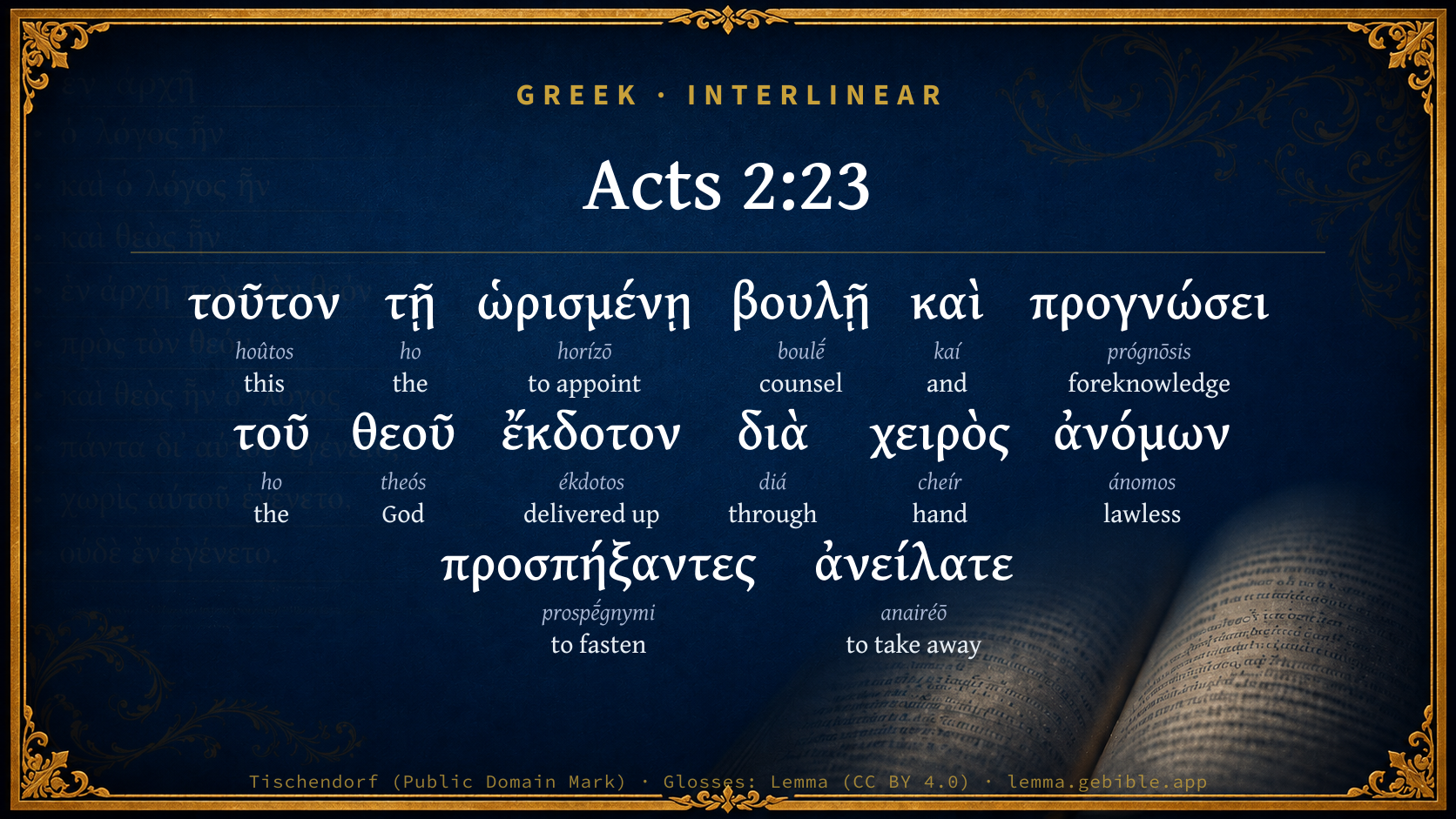
Greek (Tischendorf 8th ed.) Acts 2:23 appears in the Greek New Testament. The text above is from the Tischendorf 8th edition. Each word links to its Strong’s number and a concise gloss. Click any word for its full Thayer’s Greek Lexicon entry.
Download image
Cite this verse

Acts 2:23 (World English Bible). Public Domain. Lemma interlinear Bible study tool, https://lemma.gebible.app/v/acts/2/23.

Show BibTeX & RIS
BibTeX
RIS
English Translation
him, being delivered up by the determined counsel and foreknowledge of God, you have taken by the hand of lawless men, crucified and killed;
World English Bible · Public Domain
Highlights
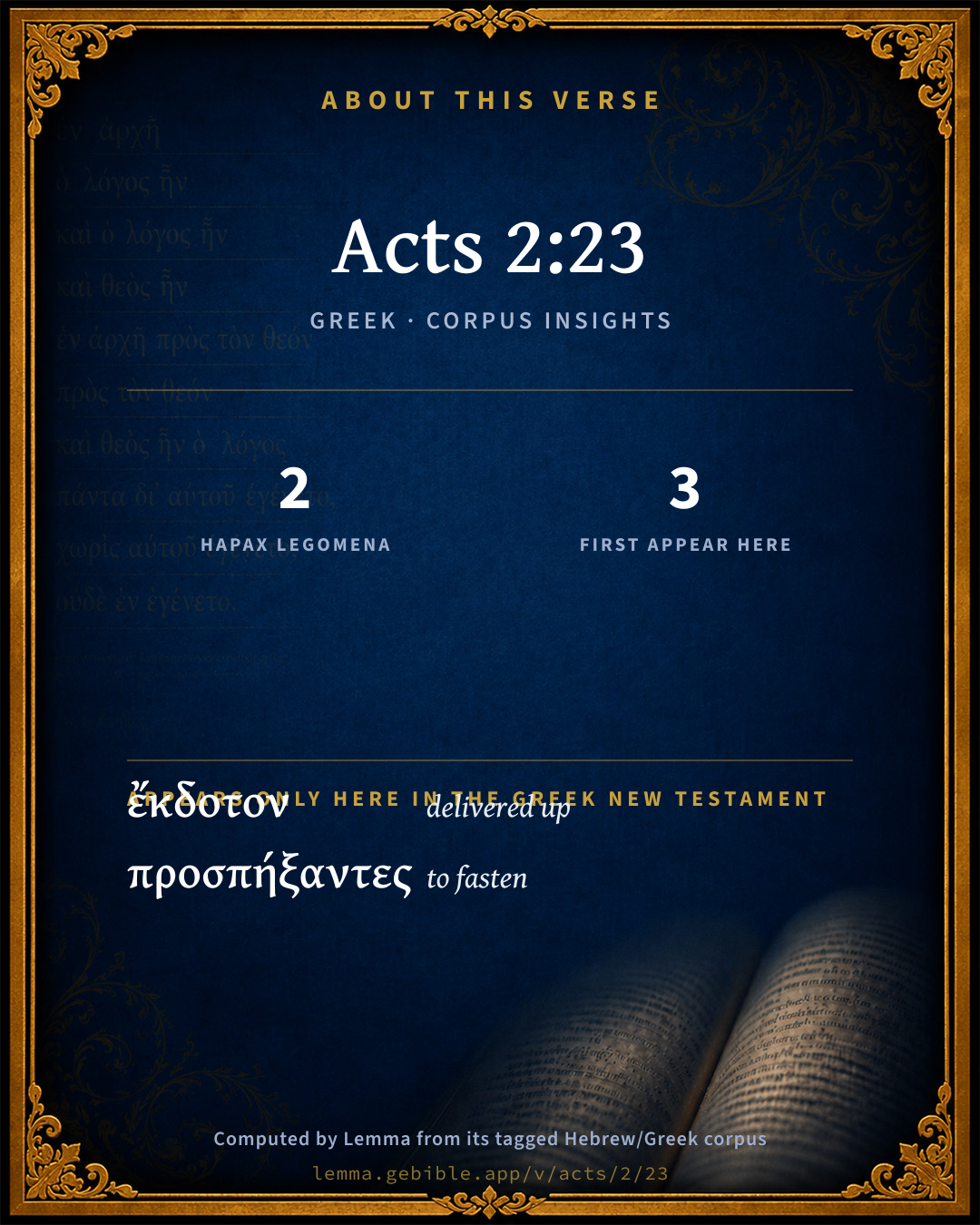
  • 2 hapax legomena — only here in the Greek New Testament
  • 3 first appearances in the Greek New Testament
Full analysis ↓
Download a study sheet

One document with this verse’s original text, its word-by-word gloss line, the meaning frame, cross-references with their text, attributed commentary, and full source and license credits — printable, and it pastes into notes with its structure intact.

This verse Autodidact and up

Study sheet (.html) Plain text (.txt)

A passage Seminary Student

Up to 50 verses in one chapter. A passage sheet keeps up to 6 commentary sources and 12 cross-references per verse, in the order this page ranks them, and says so on the sheet whenever that leaves anything out. Ask for a single verse and you get the Autodidact verse sheet above.

Everything on this page stays free to read, with no account — the sheet is a download of what is already on screen, not access to it.

Want to remove ads? Support Godless Engineer
Compare translations 3

The same verse in 3 English versions, stacked beneath the original-language interlinear above. Click any original word for its lexicon entry.

Each is an independent rendering of the whole verse — the interlinear is not word-aligned to these translations.

Highlighted words mark where these versions differ — a whole-verse word diff, not a word-by-word alignment.

  • World English Bible Public Domain
    him, being delivered up by the determined counsel and foreknowledge of God, you have taken by the hand of lawless men, crucified and killed;
  • King James Version Public Domain
    Him, being delivered by the determinate counsel and foreknowledge of God, ye have taken, and by wicked hands have crucified and slain:
  • unfoldingWord Literal Text CC BY-SA 4.0
    This one, given up by the determined counsel and foreknowledge of God, you killed by the hand of the lawless, having fastened,

unfoldingWord Literal Text — © unfoldingWord, licensed CC BY-SA 4.0. Word-aligned USFM3 via Door43 (git.door43.org/unfoldingWord/en_ult).

Versions to compare (up to 4)

3 of 4 selected

Show all 19 translations

Every available English version of this verse, each an independent rendering of the whole verse.

  • World English Bible Public Domain
    him, being delivered up by the determined counsel and foreknowledge of God, you have taken by the hand of lawless men, crucified and killed;
  • Berean Standard Bible Public Domain
    He was delivered up by God’s set plan and foreknowledge, and you, by the hands of the lawless, put Him to death by nailing Him to the cross.
  • Majority Standard Bible Public Domain
    He was delivered up by God’s set plan and foreknowledge, and you, by the hands of the lawless, took and put Him to death by nailing Him to the cross.
  • King James Version Public Domain
    Him, being delivered by the determinate counsel and foreknowledge of God, ye have taken, and by wicked hands have crucified and slain:
  • American Standard Version (1901) Public Domain
    him, being delivered up by the determinate counsel and foreknowledge of God, ye by the hand of lawless men did crucify and slay:
  • Revised Version (1885) Public Domain
    him, being delivered up by the determinate counsel and foreknowledge of God, ye by the hand of lawless men did crucify and slay:
  • Geneva Bible (1599) Public Domain
    Him, I say, being deliuered by the determinate counsell, and foreknowledge of God, after you had taken, with wicked handes you haue crucified and slaine.
  • Douay-Rheims (1899) Public Domain
    This same being delivered up, by the determinate counsel and foreknowledge of God, you by the hands of wicked men have crucified and slain.
  • Young's Literal Translation Public Domain
    this one, by the determinate counsel and foreknowledge of God, being given out, having taken by lawless hands, having crucified -- ye did slay;
  • Literal Standard Version CC BY-SA 4.0
    this One, by the determinate counsel and foreknowledge of God, being given out, having been taken by lawless hands, having been crucified—you slew,
  • Unlocked Literal Bible CC BY-SA 4.0
    This man was handed over by God's predetermined plan and foreknowledge; and you, by the hand of lawless men, put him to death by nailing him to a cross.
  • unfoldingWord Literal Text CC BY-SA 4.0
    This one, given up by the determined counsel and foreknowledge of God, you killed by the hand of the lawless, having fastened,
  • Darby Bible Public Domain
    -- him, given up by the determinate counsel and foreknowledge of God, ye, by [the] hand of lawless [men], have crucified and slain.
  • World Messianic Bible Public Domain
    him, being delivered up by the determined counsel and foreknowledge of God, you have taken by the hand of lawless men, crucified and killed;
  • Webster's Bible Public Domain
    Him, being delivered by the determinate counsel and foreknowledge of God, ye have taken, and by wicked hands have crucified and slain:
  • Free Bible Version CC BY-SA 4.0
    God, knowing beforehand what would happen, followed his plan and resolved to hand him over to you. By means of the hands of wicked men, you killed him by nailing him to a cross.
  • Bible in Basic English Public Domain
    Him, when he was given up, by the decision and knowledge of God, you put to death on the cross, by the hands of evil men:
  • Text-Critical English NT CC BY 4.0
    this man, who was delivered up by the deliberate plan and foreknowledge of God, you took and put to death, having him nailed to the cross by the hands of lawless men.
  • Tyndale New Testament (1534) Public Domain
    him have ye taken by the hondes of vnrightewes persones after he was delivered by the determinat counsell and foreknoweledge of God and have crucified and slayne:

Literal Standard Version (2020), Covenant Press — licensed CC BY-SA 4.0. Text via the HelloAO Bible API (eBible.org). Unlocked Literal Bible (unfoldingWord) — licensed CC BY-SA 4.0. Text via the HelloAO Bible API (eBible.org). unfoldingWord Literal Text — © unfoldingWord, licensed CC BY-SA 4.0. Word-aligned USFM3 via Door43 (git.door43.org/unfoldingWord/en_ult). Free Bible Version, Dr. Jonathan Gallagher — licensed CC BY-SA 4.0. Text via the HelloAO Bible API (eBible.org).

Word by word

More ways to search: Search by grammar → Find every occurrence → Compare this word →

Practice this passage: Drill this verse → Learn its vocabulary →

ἔκδοτον
ékdotos
G1560
“delivered up”
Adjective, Accusative, Singular, Masculine
Part of Speech
Adjective
Case
Accusative
Number
Singular
Gender
Masculine
Full Thayer's Definition

Origin: from G1537 and a derivative of G1325

TDNT: None

1. given over, delivered up a. to enemies, or to the power, the will, of some one
  1. τοῦτον hoûtos G3778 “this” Demonstrative pronoun, Accusative, Singular, Masculine
  2. τῇ ho G3588 “the” Article, Dative, Singular, Feminine
  3. ὡρισμένῃ horízō G3724 “to appoint” Verb, Perfect, Passive, Participle, Dative, Singular, Feminine
  4. βουλῇ boulḗ G1012 “counsel” Noun, Dative, Singular, Feminine
  5. καὶ kaí G2532 “and” Conjunction
  6. προγνώσει prógnōsis G4268 “foreknowledge” Noun, Dative, Singular, Feminine
  7. τοῦ ho G3588 “the” Article, Genitive, Singular, Masculine
  8. θεοῦ theós G2316 “God” Noun, Genitive, Singular, Masculine
  9. διὰ diá G1223 “through” Preposition
  10. χειρὸς cheír G5495 “hand” Noun, Genitive, Singular, Feminine
  11. ἀνόμων ánomos G459 “lawless” Adjective, Genitive, Plural, Masculine
  12. προσπήξαντες prospḗgnymi G4362 “to fasten” Verb, Aorist, Active, Participle, Nominative, Plural, Masculine
  13. ἀνείλατε anairéō G337 “to take away” Verb, Aorist, Active, Indicative, 2nd person, Plural

About this verse

These counts appear in no published source. They are computed here, from the morphology-tagged text and Lemma’s own curated glosses. What Lemma adds →

14
words
13
distinct lemmas
Acts
section

Notable vocabulary

2 hapax legomena — words that appear only here in the entire Greek New Testament:

  • ἔκδοτον delivered up G1560
  • προσπήξαντες to fasten G4362

First appearance in Scripture

These words make their first canonical appearance in the Greek New Testament here:

  • προγνώσει foreknowledge G4268
  • ἔκδοτον delivered up G1560
  • προσπήξαντες to fasten G4362

Shared distinctive vocabulary

προγνώσει foreknowledge G4268 occurs in 2 verses of the Greek New Testament. Also found in:

Repetition

A word recurs within this verse:

Cross-references

29

Topical passages linked to Acts 2:23 in the Treasury of Scripture Knowledge — connected by theme and wording, ordered by reader-vote popularity; previews shown in the World English Bible.

  • Acts 4:28 to do whatever your hand and your council foreordained to happen.
  • Genesis 50:20 As for you, you meant evil against me, but God meant it for good, to bring to pass, as it is this day, to save many people alive.
  • Luke 22:22 The Son of Man indeed goes, as it has been determined, but woe to that man through whom he is betrayed!"
  • Acts 3:18 But the things which God announced by the mouth of all his prophets, that Christ should suffer, he thus fulfilled.
  • Isaiah 46:10–11 declaring the end from the beginning, and from ancient times things that are not [yet] done; saying, My counsel shall stand, and I will do all my pleasure;
  • 1 Peter 1:20 who was foreknown indeed before the foundation of the world, but was revealed at the end of times for your sake,
  • Acts 3:13–15 The God of Abraham, Isaac, and Jacob, the God of our fathers, has glorified his Servant Jesus, whom you delivered up, and denied in the presence of Pilate, when he had determined to release him.
  • Matthew 26:24 The Son of Man goes, even as it is written of him, but woe to that man through whom the Son of Man is betrayed! It would be better for that man if he had not been born."
  • Acts 5:30 The God of our fathers raised up Jesus, whom you killed, hanging him on a tree.
  • Acts 13:27 For those who dwell in Jerusalem, and their rulers, because they didn't know him, nor the voices of the prophets which are read every Sabbath, fulfilled them by condemning him.
  • Psalms 76:10 Surely the wrath of man praises you. The survivors of your wrath are restrained.
  • Daniel 4:35 All the inhabitants of the earth are reputed as nothing; and he does according to his will in the army of heaven, and among the inhabitants of the earth; and none can stay his hand, or tell him, What do you?
  • Luke 22:37 For I tell you that this which is written must still be fulfilled in me: 'He was counted with the lawless.' For that which concerns me has an end."
  • Luke 24:20 and how the chief priests and our rulers delivered him up to be condemned to death, and crucified him.
  • Luke 24:44–46 He said to them, "This is what I told you, while I was still with you, that all things which are written in the law of Moses, the prophets, and the psalms, concerning me must be fulfilled."
  • John 19:31–37 Therefore the Jews, because it was the Preparation Day, so that the bodies wouldn't remain on the cross on the Sabbath (for that Sabbath was a special one), asked of Pilate that their legs might be broken, and that they might be taken away.
  • Acts 15:18 All his works are known to God from eternity.'
  • Romans 4:17 As it is written, "I have made you a father of many nations." This is in the presence of him whom he believed: God, who gives life to the dead, and calls the things that are not, as though they were.
  • Jude 1:4 For there are certain men who crept in secretly, even those who were long ago written about for this condemnation: ungodly men, turning the grace of our God into lasciviousness, and denying our only Master, God, and Lord, Jesus Christ.
  • Revelation 13:8 All who dwell on the earth will worship him, everyone whose name has not been written from the foundation of the world in the book of life of the Lamb who has been killed.
  • Isaiah 10:6–7 I will send him against a profane nation, and against the people of my wrath will I give him a charge, to take the spoil, and to take the prey, and to tread them down like the mire of the streets.
  • Daniel 9:24–27 Seventy weeks are decreed on your people and on your holy city, to finish disobedience, and to make an end of sins, and to make reconciliation for iniquity, and to bring in everlasting righteousness, and to seal up vision and prophecy, and to anoint the most holy.
  • John 19:24 Then they said to one another, "Let's not tear it, but cast lots for it to decide whose it will be," that the Scripture might be fulfilled, which says, "They parted my garments among them. For my cloak they cast lots." Therefore the soldiers did these things.
  • 1 Peter 1:2 according to the foreknowledge of God the Father, in sanctification of the Spirit, that you may obey Jesus Christ and be sprinkled in his blood: Grace to you and peace be multiplied.
  • Acts 4:10–11 be it known to you all, and to all the people of Israel, that in the name of Jesus Christ of Nazareth, whom you crucified, whom God raised from the dead, in him does this man stand here before you whole.
  • Acts 7:52 Which of the prophets didn't your fathers persecute? They killed those who foretold the coming of the Righteous One, of whom you have now become betrayers and murderers.
  • Romans 11:33–36 Oh the depth of the riches both of the wisdom and the knowledge of God! How unsearchable are his judgments, and his ways past tracing out!
  • 1 Peter 2:8 and, "A stone of stumbling, and a rock of offense." For they stumble at the word, being disobedient, whereunto also they were appointed.
  • Matthew 27:20–25 Now the chief priests and the elders persuaded the multitudes to ask for Barabbas, and destroy Jesus.

Cross-references courtesy of OpenBible.info (CC BY 4.0).

Where the printed editions differ

1 variant

Places in this verse where the major printed Greek editions disagree on the wording in a way that affects the translation — a comparison of editions, not a manuscript-by-manuscript collation. The editions are the modern critical texts (Nestlé-Aland 28/27, SBL, Westcott-Hort, Tregelles, Tyndale House) and the traditional texts behind the KJV (the Textus Receptus and the Byzantine/Majority text). It is not a claim about which reading is original.

  1. Extra text
    λαβόντες

    “having taken”

    In TRByz Not in NA28NA27TynSBLWHTreg

    λαβόντες (labontes) 'having taken' is only in traditional manuscripts (TR+Byz)

Textual data: Translators Amalgamated Greek New Testament (STEPBible TAGNT) · CC BY 4.0.

Commentary

Notes on Acts 2:23 from classic Christian and Jewish commentators (each source and its license shown beneath its notes). The classic Christian expositions comment on the surrounding passage and are grouped to its opening verse, so a note may address several verses; the Jewish commentaries on the Tanakh (Rashi and others) are per-verse, so they appear only where the commentator wrote on this verse.

Lemma curates 59 commentaries, every one of them public domain or Creative Commons licensed, each selected and text-cleaned for this edition rather than reprinted as found. About our sources →

Joseph Benson's Commentary

Act 2:23-24. Him, being delivered — Unto death, by God his heavenly Father, who not only permitted him to be put to death, but delivered him up for us all. Rom 8:32; devoted and gave him up; and yet he was approved of God: and there was nothing in this that implied, in any degree, the disapproving of him. For it was done by the determinate counsel and foreknowledge of God — In infinite wisdom, and for holy ends, in which, and in the means leading to them, Jesus himself freely and fully concurred. For it was necessary that thus divine justice should be satisfied, God and man reconciled, sinners saved, and Christ himself glorified. It must be observed, the apostle here anticipates an objection. Why did God suffer such a person to be so treated? Did he not know what wicked men intended to do? And had he not power to prevent it? Yea, he knew all that those wicked men intended to do. And he had power to blast all their designs in a moment. But he did not exert that power, because he so loved the world! Because it was the determinate counsel of his love to redeem mankind from eternal death, by the death of his only-begotten Son. Ye have taken, and by wicked hands have crucified, &c. — Thus the apostle speaks, because neither God’s foreknowing what they would do, nor his designing that his Son should be offered as a sacrifice to expiate the sins of mankind, nor his bringing unspeakable and everlasting good out of this fact, could in the least excuse their sin who were agents in it; for it was their voluntary act and deed, proceeding from a principle morally evil, and therefore they are justly said to have perpetrated it with wicked hands. It is probable some of those who had cried, Crucify him, crucify him, or who had been otherwise aiding and abetting in the murder, were here present, and that Peter knew it. Be this as it may, it was justly looked upon as a national act, because done by the vote of the great council, and by the voice of the great crowd, clamouring for his blood. He charges it particularly upon them, as a part of the nation on which it would be peculiarly visited, the more effectually to bring them to repentance and faith, because that was the only way to distinguish themselves from the guilty that were about to perish in their sins, and to discharge themselves from the guilt of so dreadful a crime, and save themselves from the coming vengeance due to it. Whom God hath raised up — Whose honour God hath abundantly vindicated, and to whose innocence, truth, and dignity he hath borne a most glorious testimony; having loosed the pains of death — Or the bonds in which he lay, when the pains of death had done their work upon him; because it was not possible that he — The Prince of life, and a person who had never sinned, and therefore was not liable to the penalty of death, only due to sinners; should be finally holden of it — Or detained under its power. The word ωδινας, here rendered pains, properly means, the pains of a woman in travail, an expression which seems to be here used to signify the agony which Christ suffered in his soul before he was nailed to the cross: and the extreme anguish he afterward endured, before he bowed his head and gave up the ghost. The word, however, seems to be used by the LXX. for cords and bands, Psa 18:4; and Dr. Hammond thinks, that from them the apostle here used it in the same sense, to which, indeed, the metaphor of being held and loosing best agrees. Christ was imprisoned for our debt, was thrown into the bonds of death; but divine justice being satisfied, it was not possible he should be detained there, either by right or by force, for he had life in himself, and in his own power, and had conquered the prince of death.

Joseph Benson's Commentary on the Old and New Testaments (1811–1818) — public domain. Text from a community e-Sword module.

Tyndale Open Study Notes

Tyndale Open Resources

2:23-28 While cruel men had crucified Jesus, this action had not defeated God’s prearranged plan for salvation. In fact, God raised him back to life, which David had foretold (2:25-28).

Tyndale Open Study Notes — © Tyndale Open Resources, licensed CC BY-SA 4.0. Text via the HelloAO Bible API.

Bengel's Gnomon

Johann Albrecht Bengel

Act 2:23. Ὡρισμένῃ, determinate, defined) An anticipation of the objection, why the Jews were permitted to act so toward so great a man: and also a preparatory consolation to the perpetrators: ch. Act 3:17-18; with which comp. Gen 45:5, Joseph to his brethren, “Be not grieved, nor be angry with yourselves, that ye sold me hither; for God did send me before you to preserve life.”—βουλῇ καὶ προγνώσει, by the counsel and foreknowledge or providence) The counsel (concerning which comp. ch. Act 4:28, “Thy hand and Thy counsel determined:” His hand is felt before His counsel is perceived; therefore hand is put before counsel) is here put before the providence or foresight of God. Therefore ‘providence’ expresses very much. Prediction also followed it: ch. Act 3:18.—ἔκδοτον) delivered up.—ἀνόμων, unjust, iniquitous) Iniquitous, i.e. void of law (νόμος), were Pilate and his Gentile associates, through whom the Jews perpetrated the deed.

Bengel's Gnomon of the New Testament — English translation (T&T Clark, Edinburgh, 1860) — public domain. Text from a community e-Sword module.

Meyer's Critical & Exegetical Commentary

Heinrich August Wilhelm Meyer

Act_2:23. Τοῦτον] an emphatic repetition. See Schaef. Melet. p. 84; Dissen, ad Dem. de cor. p. 225. There is to be no parenthesis before it. This one … delivered up, ye have by the hand of lawless men[128] affixed and made way with: Act_10:39; Luk_22:2; Luk_23:32. By the ἈΝΌΜΟΙ are to be understood Gentiles (1Co_9:21; Rom_1:14), and it is here more especially the Roman soldiers that are meant, by whose hand Christ was affixed (nailed to the cross), and thereby put to death. On ἜΚΔΟΤΟΝ, comp. Drac. 26, and examples from Greek writers in Raphel and Kypke, also Lobeck, Paral. p. 531. It refers to the delivering up of Jesus to the Jews, which took place on the part of Judas. This was no work of men, no independent success of the treachery (which would, in fact, testify against the Messiahship of Jesus!), but it happened in virtue of the fixed (therefore unalterable) resolve and (in virtue of the) foreknowledge of God. On βουλή, comp. the Homeric Διὸς δʼ ἐτελείετο βουλή, Il. i. 5, Od. xi. 297.

πρόγνωσις is here usually taken as synonymous with ΒΟΥΛΉ; but against all linguistic usage.[129] Even in 1Pe_1:2, comp. Act_2:20, the meaning praescientia (Vulgate) is to be retained. See generally on Rom_8:29. Gods βουλή (comp. Act_4:28) was, that Jesus was to delivered up, and the mode of it was present to Him in His prescience, which, therefore, is placed after the βουλή. Objectively, no doubt, the two are not separate in God, but the relation is conceived of after the analogy of the action of the human mind.

The dative is, as in Act_15:1, that in which the ἔκδοτον has its ground. Without the divine βουλὴ κ.τ.λ. it would not have taken place.

The question, How Peter could say to those present: Ye have put Him to death, is solved by the remark that the execution of Christ was a public judicial murder, resolved on by the Sanhedrim in the name of the whole nation, demanded from and conceded by the Gentiles, and accomplished under the direction of the Sanhedrim (Joh_19:16); comp. Act_3:13 f. The view of Olshausen, that the death of Christ was a collective act of the human race, which had contracted a collective guilt, is quite foreign to the context.

[128] διὰ χειρός (see the critical remarks) is here not to be taken, like בְּיַד, for the mere per (see Fritzsche, ad Marc. p. 199), but, as it is a manual action that is spoken of, in its concrete, literal meaning. It belongs to vivid rhetorical delineation. Comp. Dorville, ad Charit. p. 273.

[129] This reason must operate also against Lampings (Pauli de praedestinat. decreta, 1858, p. 102 ff.) defence of the common explanation, in which he specifies, as the distinction between βουλή and πρόγνωσις, merely this: illud adumbrat Dei voluntatem, hoc inde profectum decretum. It is arbitrary, with Holsten, z. Ev. d. Paul. u. Pet. p. 146, to refer βουλή not to the saving will, but merely to the will as regards destiny. See, in opposition to this, Act_3:18, where the suffering of Christ is the fulfilment of divine prophecy; comp. Act_8:32 f., Act_10:43.

Meyer — Critical and Exegetical Commentary on the New Testament — English translation by Peter Christie, edited by Frederick Crombie (T&T Clark, 1880) — public domain. Text from a community e-Sword module.

Expositor's Greek Testament

ed. W. Robertson Nicoll

Act 2:23 . τοῦτον , emphatic, ἔκδοτον delivered up, by Judas, not by God; only here in the N.T., but see instances from Josephus, also from classical Greek, in Wetstein. In Dan., Theod., Bel and the Dragon Act 2:22 . ὡρισμένῃ βουλῇ : both favourite words of St. Luke: ὡρις . used by him five times in the Act 10:42 ; Act 11:29 ; Act 17:26 ; Act 17:31 ; once by St. Paul, Rom 1:4 ; once in Hebrews, Heb 4:7 , and only in St. Luke amongst the Evangelists, Luk 22:22 , where our Lord Himself speaks of the events of His betrayal by the same word, κατὰ τὸ ὡρισμένον ( cf. Act 24:26 ). βουλῇ : Wendt compares the Homeric Διὸς δʼ ἐτελείετο βουλή . The phrase βουλή τοῦ Θ . is used only by St. Luke; once in his Gospel, Act 7:30 , and three times in Act 13:36 ; Act 20:27 (whilst βουλή is used twice in the Gospel, eight times in the Acts, and only three times elsewhere in the N.T., 1Co 4:5 , Eph 1:2 , Heb 6:17 ), but cf. Wis 6:4 ; Wis 9:13 , and often ἡ βουλή Κυρίου in LXX. προγνώσει : the word is only found again in 1Pe 1:2 . and its occurrence in that place, and the thoughts which it expresses, may be classed amongst the points of contact between Acts and 1 Peter (see at end of chap. 3). In the Passion and Resurrection of Christ, which at one time seemed to Peter impossible, cf. Mat 16:22 , he now sees the full accomplishment of God’s counsel, cf. Act 3:20 , and 1Pe 1:20 (Nösgen, Apostelgeschichte , p. 53, and also 48 52). In this spiritual insight now imparted to the Apostle we see a further proof of the illuminating power of the Holy Ghost, the gift of Pentecost, which he himself so emphatically acknowledges in his first epistle (Act 1:1-12 ). διὰ χειρῶν , best explained as a Hebraism. Cf. for the frequent use of this Hebraistic expression, Blass, Grammatik des N. G. , pp. 126, 127; and Simcox, Language of the N. T. , p. 141. In the LXX, cf. 2Ki 14:27 , 1Ch 11:3 ; 1Ch 29:5 . St. Luke is very fond of these paraphrases with πρόσωπον and χείρ see Friedrich, Das Lukasevangelium , pp. 8, 9, and Lekebusch, Apostelgeschichte , p. 77; cf. Act 5:12 , Act 7:25 , Act 11:30 , Act 14:3 , Act 15:23 , Act 19:11 , so ἐν χειρί , εἰς χεῖρας . ἀνόμων : “lawless,” R.V., generally taken to refer to the Roman soldiers who crucified our Lord, i.e. , Gentiles without law, as in 1Co 9:21 , Rom 2:14 . In Wis 17:2 the same word is used of the Egyptians who thought to oppress the holy nation they are described as ἄνομοι . προσπήξαντες , sc. , τῷ σταυρῷ : a graphic word used only here, with which we may compare the vivid description also by St. Peter in Act 5:29-32 , Act 10:39 , cf. 1Pe 2:24 the language of one who could justly claim to be a witness of the sufferings of Christ, 1Pe 5:1 . The word is not found in LXX, cf. Dio Cassius. ἀνείλατε : an Alexandrian form, see for similar instances, Kennedy, Sources of N. T. Greek , pp. 159, 160. The verb is a favourite with St. Luke, nineteen times in Acts, twice in the Gospel, and only once elsewhere in the Evangelists, viz. , Mat 2:16 , and the noun ἀναίρεσις is only found in Act 8:10 (Act 22:20 ), cf. its similar use in classical Greek and in the LXX. The fact that St. Peter thus describes the Jewish people as the actual murderers of Jesus is not a proof that in such language we have an instance of anti-Judaism quite inconsistent with the historical truth of the speech (Baur, Renan, Overbeck), but the Apostle sees vividly before his eyes essentially the same crowd at the Feast as had demanded the Cross of Jesus before the judgment-seat of Pilate, Nösgen, Apostelgeschichte , p. 103. ὃν ὁ Θεὸς ἀνέστησε , “est hoc summum orationis,” Blass, cf. Act 5:32 , and Act 1:22 .

Act 2:24 . λύσας τὰς ὠδῖνας τοῦ θαν .: R.V. “pangs” instead of “pains” (all previous versions) approaches nearer to the literal form of the word “birth-pangs,” the resurrection of Christ being conceived of as a birth out of death, as the Fathers interpreted the passage. The phrase is found in the Psalms, LXX Psa 17:4 , Psa 114:3 , but it is most probable that the LXX has here mistaken the force of the Hebrew חבל which might mean “birth-pangs,” or the cords of a hunter catching his prey. In the Hebrew version the parallelism, such a favourite figure in Hebrew poetry, decides in favour of the latter meaning, as in R.V. Psa 18:4-5 (LXX 18), Sheol and Death are personified as hunters lying in wait for their prey with nooses and nets (Kirkpatrick, Psalms , in loco , the word מוֹקְשֵׁי meaning snares by which birds or beasts are taken (Amo 3:5 )). In the previous verse the parallelism is also maintained if we read “the waves of death” ( cf. 2Sa 22:5 ) “compassed me, the floods of ungodliness made me afraid”. It is tempting to account for the reading ὠδῖνας by supposing that St. Luke had before him a source for St. Peter’s speech, and that he had given a mistaken rendering of the word חבל . But it would certainly seem that λύσας and κρατεῖσθαι are far more applicable to the idea of the hunter’s cords, in which the Christ could not be bound, since He was Himself the Life. A similar mistake in connection with the same Hebrew word חבל may possibly occur in 1Th 5:3 and Luk 21:34 . There is no occasion to find in the word any reference to the death-pains of Christ (so Grotius, Bengel), or to render ὠδῖνες pains and snares (Olshausen, Nösgen), and it is somewhat fanciful to explain with St. Chrysostom (so Theophylact and Oecumenius) ὁ θάνατος ὤδινε κατέχων αὐτὸν καὶ τὰ δεινὰ ἔπασχε . καθότι : only found in St. Luke, in Gospel twice, and in Acts four times (Friedrich); generally in classical Greek καθʼ ὅ τι ( cf. Tob 1:12 ; Tob 13:4 ). οὐκ ἦν δυνατὸν … γὰρ : the words primarily refer to the proof which St. Peter was about to adduce from prophecy, and the Scripture could not be broken. But whilst Baur sees in such an expression, as also in Act 3:15 , a transition to Johannine conceptions of the Person of Jesus, every Christian gladly recognises in the words the moral impossibility that the Life could be holden by Death. On the impersonal construction, see Viteau, Le Grec du N. T. , p. 151 (1893). κρατεῖσθαι … ὑπʼ , cf. Luk 24:16 (Joh 20:23 ), only in these passages in passive voice in N.T., but cf. for similar use of the passive voice, Mal 2:9Mal 2:9 , and so in Dem. Schmid compares this verse where the internal necessity of Christ’s resurrection is thus stated with 1Pe 3:18 , showing that the πνεῦμα in Him possessed this power of life ( Biblische Theologie des N. T. , p. 402).

The Expositor's Greek Testament, edited by W. Robertson Nicoll (1897–1910) — public domain. Text from a community e-Sword module.

Geneva Bible (1599)

Geneva Bible translators

The fault is said to be theirs, by whose counsel and egging forward it is done.

God’s everlasting knowledge going before, which can neither be separated from his determinate counsel, as the Epicureans say, neither yet be the cause of evil: for God in his everlasting and unchangeable counsel, appointed the wicked act of Judas to an excellent end: and God doeth that well which the instruments do ill.

God’s counsel doth not excuse the Jews, whose hands were wicked.

Geneva Bible (1599) marginal notes — public domain. Text via Bolls.life.

Jamieson, Fausset & Brown

Robert Jamieson, A. R. Fausset & David Brown

determinate counsel and foreknowledge--God's fixed plan and perfect foresight of all the steps involved in it.

ye have taken, and by wicked hands have crucified and slain--How strikingly is the criminality of Christ's murderers here presented in harmony with the eternal purpose to surrender Him into their hands!

Jamieson, Fausset & Brown — Commentary Critical and Explanatory on the Whole Bible (1871) — public domain (CC PDM 1.0). Text via the HelloAO Bible API.

Adam Clarke's Commentary

Verse 23. Him, being delivered by the determinate counsel] Bp. Pearce paraphrases the words thus: Him having been given forth; i.e. sent into the world, and manifested by being made flesh, and dwelling among you, as it is said in Joh 1:14; see also Ac 4:28.

Kypke contends that εκδοτον, delivered, does not refer to GOD, but to Judas the traitor "the Jews received Jesus, delivered up to them by Judas; the immutable counsel of God so permitting."

By the determinate counsel, ωρισμενηβουλη; that counsel of God which defined the time, place, and circumstance, according (προγνωσει) to his foreknowledge, which always saw what was the most proper time and place for the manifestation and crucifixion of his Son; so that there was nothing casual in these things, God having determined that the salvation of a lost world should be brought about in this way; and neither the Jews nor Romans had any power here, but what was given to them from above. It was necessary to show the Jews that it was not through Christ's weakness or inability to defend himself that he was taken; nor was it through their malice merely that he was slain; for God had determined long before, from the foundation of the world, Re 13:8, to give his Son a sacrifice for sin; and the treachery of Judas, and the malice of the Jews were only the incidental means by which the great counsel of God was fulfilled: the counsel of God intending the sacrifice, but never ordering that it should be brought about by such wretched means. This was permitted; the other was decreed. See the observations at the end of this chapter. See Clarke on Ac 2:47.

By wicked hands have crucified and slain] I think this refers to the Romans, and not to the Jews; the former being the agents, to execute the evil purposes of the latter. It is well known that the Jews acknowledged that they had no power to put our Lord to death, Joh 18:31, and it is as well known that the punishment of the cross was not a Jewish, but a Roman, punishment: hence we may infer that by δια χειρων ανομων, by the hands of the wicked, the Romans are meant, being called ανομοι, without law, because they had no revelation from God; whereas the others had what was emphatically termed ο νομος του θεου, the law of God, by which they professed to regulate their worship and their conduct. It was the Jews, therefore, who caused our Lord to be crucified by the hands of the heathen Romans.

Adam Clarke's Commentary on the Bible (1810–1826) — public domain. Text from a community e-Sword/MySword module.

John Calvin's Commentaries

23. Him have ye slain. He maketh mention of the death of Christ for this cause chiefly, that the resurrection might the more assuredly be believed. It was a thing full well known among the Jews that Christ was crucified. Therefore, in that he rose again, it is a great and wonderful token of his Divine power. In the mean season, to the end he may prick their consciences with the feeling of sin, he saith that they slew him; not that they crucified him with their own hands, but because the people, with one voice, desired to have him put to death. And although many of the hearers unto whom he speaketh did not consent unto that wicked and ungodly cruelty, yet doth he justly impute the same to the nation; because all of them had defiled themselves either with their silence, or else through their carelessness. Neither hath the cloak and color of ignorance any place, forasmuch as he was showed before of God. This guiltiness, therefore, under which he bringeth them, is a preparation unto repentance.

By the determinate counsel He removeth a stumbling-block; because it seemeth, at the first blush, to be a thing very inconvenient, [unaccountable,] that that man whom God had so greatly adorned, being afterward laid open to all manner of mocking, doth suffer so reproachful a death. Therefore, because the cross of Christ doth commonly use to trouble us at the first sight, for this cause Peter declareth that he suffered nothing by chance, or because he wanted power to deliver himself, but because it was so determined (and appointed) by God. For this knowledge alone, that the death of Christ was ordained by the eternal counsel of God, did cut off all occasion of foolish and wicked cogitation’s, and did prevent all offenses which might otherwise be conceived. For we must know this, that God doth decree nothing in vain or rashly; whereupon it followeth that there was just cause for which he would have Christ to suffer. The same knowledge of God’s providence is a step to consider the end and fruit of Christ’s death. For this meeteth us by and by in the counsel of God, that the just was delivered for our sins, and that his blood was the price of our death.

And here is a notable place touching the providence of God, that we may know that as well our life as our death is governed by it. Luke intreateth, indeed, of Christ; but in his person we have a mirror, which doth represent unto us the universal providence of God, which doth stretch itself throughout the whole world; yet doth it specially shine unto us who are the members of Christ. Luke setteth down two things in this place, the foreknowledge and the decree of God. And although the foreknowledge of God is former in order, (because God doth first see what he will determine, before he doth indeed determine the same,) yet doth he put the same after the counsel and decree of God, to the end we may know that God would nothing, neither appointed anything, save that which he had long before directed to his [its] end. For men do oftentimes rashly decree many things, because they decree them suddenly. Therefore, to the end Peter may teach that the counsel of God is not without reason, he coupleth also therewithal his foreknowledge. Now, we must distinguish these two, and so much the more diligently, because many are deceived in this point. For passing over the counsel of God, wherewith he doth (guide and) govern the whole world, they catch at his bare foreknowledge. Thence cometh that common distinction, that although God doth foresee all things, yet doth he lay no necessity upon his creatures. And, indeed, it is true that God doth know this thing or that thing before, for this cause, because it shall come to pass; but as we see that Peter doth teach that God did not only foresee that which befell Christ, but it was decreed by him. And hence must be gathered a general doctrine; because God doth no less show his providence in governing the whole world, than in ordaining and appointing the death of Christ. Therefore, it belongeth to God not only to know before things to come, but of his own will to determine what he will have done. This second thing did Peter declare when he said, that he was delivered by the certain and determinate counsel of God. Therefore, the foreknowledge of God is another thing than the will of God, whereby he governeth and ordereth all things.

Some, which are of quicker sight, confess that God doth not only foreknow, but also govern with his beck what things soever are done in this world. Nevertheless, they imagine a confused government, as if God did give liberty to his creatures to follow their own nature. They say that the sun is ruled by the will of God, because, in giving light to us, he doth his duty, which was once enjoined him by God. They think that man hath free-will after this sort left him, because his nature is disposed or inclined unto the free choice of good and evil. But they which think so do feign that God sitteth idle in heaven. The Scripture teacheth us far otherwise, which ascribeth unto God a special government in all things, and in man’s actions. Notwithstanding, it is our duty to ponder and consider to what end it teacheth this; for we must beware of doting speculations, wherewith we see many carried away. The Scripture will exercise our faith, that we may know that we are defended by the hand of God, lest we be subject to the injuries of Satan and the wicked. It is good for us to embrace this one thing; neither did Peter mean anything else in this place. Yea, we have an example set before us in Christ, whereby we may learn to be wise with sobriety. For it is out of question, that his flesh was subject to corruption, according to nature. But the providence of God did set the same free. If any man ask, whether the bones of Christ could be broken or no? it is not to be denied, that they were subject to breaking naturally, yet could there no bone be broken, because God had so appointed and determined, (John 19:36.) By this example (I say) we are taught so to give the chiefest room to God’s providence, that we keep ourselves within our bounds, and that we thrust not ourselves rashly and indiscreetly into the secrets of God, whither our eyesight doth not pierce.

By the hands of the wicked Because Peter seemeth to grant that the wicked did obey God, hereupon followeth two absurdities; the one, either that God is the author of evil, or that men do not sin, what wickedness soever they commit. I answer, concerning the second, that the wicked do nothing less than obey God, howsoever they do execute that which God hath determined with himself. For obedience springeth from a voluntary affection; and we know that the wicked have a far other purpose. Again, no man obeyeth God save he which knoweth his will. Therefore, obedience dependeth upon the knowledge of God’s will. Furthermore, God hath revealed unto us his will in the law; wherefore, those men do obey God, who do that alone which is agreeable to the law of God; and, again, which submit themselves willingly to his government. We see no such thing in all the wicked, whom God doth drive hither and thither, they themselves being ignorant. No man, therefore, will say that they are excusable under this color, because they obey God; forasmuch as both the will of God must be sought in his law, and they, so much as in them lieth, do to resist God. As touching the other point, I deny that God is the author of evil; because there is a certain noting of a wicked affection in this word. For the wicked deed is esteemed according to the end whereat a man aimeth. When men commit theft or murder, they offend for this cause, because they are thieves or murderers; and in theft and murder there is a wicked purpose. God, who useth their wickedness, is to be placed in the higher degree. For he hath respect unto a far other thing, because he will chastise the one, and exercise the patience of the other; and so he doth never decline from his nature, that is, from perfect righteousness. So that, whereas Christ was delivered by the hands of wicked men, whereas he was crucified, it came to pass by the appointment and ordinance of God. But treason, which is of itself wicked, and murder, which hath in it so great wickedness, must not be thought to be the works of God.

John Calvin's Commentaries (1540-1563) — public domain. Text from the Calvin Translation Society English edition (1840s-50s) via the Christian Classics Ethereal Library (ccel.org). Calvin's coverage is partial (roughly two-thirds of the Bible); uncommented books and verses are honest gaps, never fabricated. The 19th-century editor's footnotes and remarks are omitted so the notes are faithfully Calvin's own voice.

Ellicott's Commentary for English Readers

(23) By the determinate counsel and fore knowledge of God.—The adjective meets us again in St. Peter’s speech in Act_10:42; the word for “foreknowledge in his Epistle (1Pe_1:2), and there only in the New Testament. The coincidence is not without its force as bearing on the genuineness both of the speech and of the letter. It has now become the habit of the Apostle’s mind to trace the working of a divine purpose, which men, even when they are most bent on thwarting it, are unconsciously fulfilling. In Act_1:16, he had seen that purpose in the treachery of Judas; he sees it now in the malignant injustice of priests and people.

Ye have taken. . . .—Better, ye took, and by lawless hands crucified and slew. Stress is laid on the priests having used the hands of one who was “without law” (1Co_9:21), a heathen ruler, to inflict the doom which they dared not inflict themselves.

A Bible Commentary for English Readers, edited by Charles John Ellicott (1878–1897) — public domain. Text from a community e-Sword module.

The Cambridge Bible for Schools and Colleges

gen. ed. J. J. S. Perowne

23. him, being delivered, &c.] i.e. given up unto you, as God had decreed for the sake of man’s redemption.

ye have taken, and by wicked hands, &c.] The best MSS. omit the word rendered have taken. Read, ye by the hand of wicked men have crucified and slain. By the hand of is a Hebrew formula for by means of. Cp. Lev_8:36, “things which the Lord commanded by the hand of Moses.” So 2Ki_14:25, &c.

wicked] Lit. lawless.

The Cambridge Bible for Schools and Colleges (gen. ed. J. J. S. Perowne; Cambridge University Press, 1878–1918) — public domain. Text from a community e-Sword module.

John Gill's Exposition

Him being delivered,.... By himself, according to his own will, for he gave, or delivered himself for his people; and by his Father, who spared him not, but delivered him up for us all; and by Judas, one of his disciples, who, for a sum of money, delivered him into the hands of the Jews; and by them he was delivered up to Pilate, the Roman governor; and by him back again to the Jews, and to the soldiers, to crucify him: and all this

by the determinate counsel and foreknowledge of God; God not only foreknew that it would be, but determined that it should be, who does all things after the counsel of his own will; and this for the salvation of his people, and for the glorifying of his divine perfections: though this fixed resolution, settled purpose, and wise determination of God, did not in the least excuse the sin of Judas in betraying him, or of Pilate in condemning him, or of the Jews in crucifying him; nor did it at all infringe the liberty of their wills in acting, who did what they did, not by force, but voluntarily:

ye have taken, and by wicked hands have crucified and slain; they took him in the garden, and bound him, and had him first before the high priest, then before Pilate, the Roman governor, and cried out with one voice, in a most vehement manner, for the crucifying of him, which, at their importunity, was granted, though no fault was found in him; and therefore are justly charged with slaying, or murdering him.

John Gill's Exposition of the Whole Bible (1746–1763) — public domain (CC PDM 1.0). Text via the HelloAO Bible API.

Trapp's Complete Commentary

John Trapp

23 Him, being delivered by the determinate counsel and foreknowledge of God, ye have taken, and by wicked hands have crucified and slain:

Ver. 23. And by wicked hands, &c.] Facinus vincire civem Romanum, It is a crime to bind a Roman citizen, saith the orator. It was much (may we say) for the Son of God to be bound, more to be beaten, most of all to be slain. Quid dicam in crucem tolli? Let me say what is destroyed in the cross. (Cicero in Ver.)

John Trapp, A Commentary or Exposition upon All the Books of the Old and New Testament (1647–1656) — public domain. Text from a community e-Sword module.

Albert Barnes' Notes on the Bible

Him, being delivered - ἔκδοτον ekdoton. This word, delivered, is used commonly of those who are surrendered or delivered into the hands of enemies or adversaries. It means that Jesus was surrendered, or given up to his enemies by those who should have been his protectors. Thus, he was delivered to the chief priests, Mar 10:33. Pilate released Barabbas, and delivered Jesus to their will, Mar 15:15; Luk 23:25. He was delivered unto the Gentiles, Luk 18:32; the chief priests delivered him to Pilate, Mat 27:2; and Pilate delivered him to be crucified, Mat 27:26; Joh 19:16. In this manner was the death of Jesus accomplished, by being surrendered from one tribunal to another, and one demand of his countrymen to another, until they succeeded in procuring his death. It may also be implied here that he was given or surrendered by God Himself to the hands of people. Thus, he is represented to have been given by God, Joh 3:16; 1Jo 4:9-10. The Syriac translates this, “Him, who was destined to this by the foreknowledge and will of God, you delivered into the hands of wicked men,” etc. The Arabic, “Him, delivered to you by the hands of the wicked, you received, and after you had mocked him you slew him.”

By the determinate counsel - The word translated “determinate” - τῇ ὡρίσμένῃ tē hōrismenē - mean, properly, “what is defined, marked out, or bounded; as, to mark out or define the boundary of a field,” etc. See Rom 1:1, Rom 1:4. In Act 10:42, it is translated “ordained of God”; denoting His purpose that it should be so, that is, that Jesus should be the Judge of quick and dead; Luk 22:22, “The Son of man goeth as it is determined of him,” that is, as God has purposed or determined beforehand that he should go; Act 11:29, “The disciples ...determined to send relief unto the brethren which dwelt in Judea,” that is, they resolved or purposed beforehand to do it; Act 17:26, “God ...‘hath determined’ the times before appointed and fixed,” etc. In all these places there is the idea of a purpose, intention, or plan implying intention, and marking out or fixing the boundaries to some future action or evens. The word implies that the death of Jesus was resolved by God before it took place. And this truth is established by all the predictions made in the Old Testament, and by the Saviour himself. God was not compelled to give up his Son. There was no claim on him for it. He had a right, therefore, to determine when and how it should be done. The fact, moreover, that this was predicted, shows that it was fixed or resolved on. No event can be foretold, evidently, unless it be certain that it will take place. The event, therefore, must in some way be fixed or resolved on beforehand,

Counsel - βουλή boulē. This word properly denotes “purpose, decree, will.” It expresses the act of the mind in willing, or the purpose or design which is formed. Here it means the purpose or will of God; it was his plan or decree that Jesus should be delivered: Act 4:28, “For to do whatsoever thy hand and thy counsel ἡ βουλή σου hē boulē sou determined before to be done”; Eph 1:11, “Who worketh all things after the counsel of his own will”; Heb 6:17, “God willing ...to show ...the immutability of his counsel.” See Act 20:27; 1Co 4:5; Luk 23:51. The word here, therefore, proves that Jesus was delivered by the deliberate purpose of God; that it was according to his previous intention and design. The reason why this was insisted on by Peter was that he might convince the Jews that Jesus was not delivered by weakness, or because he was unable to rescue himself. Such an opinion would have been inconsistent with the belief that he was the Messiah. It was important, then, to assert the dignity of Jesus, and to show that his death was in accordance with the fixed design of God, and therefore that it did not interfere in the least with his claims to be the Messiah. The same thing our Saviour has himself expressly affirmed, Joh 19:10-11; Joh 10:18; Mat 26:53.

Foreknowledge - This word denotes “the seeing beforehand of an event yet to take place.” It implies:

Omniscience; and, That the event is fixed and certain.

To foresee a contingent event, that is, to foresee that an event will take place when it may or may not take place, is an absurdity. Foreknowledge, therefore, implies that for some reason the event will certainly take place. What that reason As, however, God is represented in the Scriptures as purposing or determining future events; as they could not be foreseen by him unless he had so determined, so the word sometimes is used in the sense of determining beforehand, or as synonymous with decreeing, Rom 8:29; Rom 11:2. In this place the word is used to denote that the delivering up of Jesus was something more than a bare or naked decree. It implies that God did it according to his foresight of what would be the best time, place, and manner of its being done. It was not the result merely of will; it was will directed by a wise foreknowledge of what would be best. And this is the case with all the decrees of God. It follows from this that the conduct of the Jews was foreknown. God was not disappointed in anything respecting their treatment of his Son, nor will he be disappointed in any of the actions of people. Notwithstanding the wickedness of the world, his counsel shall stand, and he will do all his pleasure, Isa 46:10.

Ye have taken - See Mat 26:57. Ye Jews have taken. It is possible that some were present on this occasion who had been personally concerned in taking Jesus, and many who had joined in the cry, “Crucify him, Luk 23:18-21. It was, at any rate, the act of the Jewish people by which this had been done. This was a striking instance of the fidelity of that preaching which says, as Nathan did to David, “Thou art the man!” Peter, once so timid that he denied his Lord, now charged this atrocious crime to his countrymen, regardless of their anger and his own danger. He did not deal in general accusations, but brought the charges home, and declared that they were the people who had been concerned in this amazing crime. No preaching can be successful that does not charge to people their personal guilt, and that does not fearlessly proclaim their ruin and danger.

By wicked hands - Greek: “through or by the hands of the lawless or wicked.” This refers, doubtless, to Pilate and the Roman soldiers, through whose instrumentality this had been done. The reasons for supposing that this is the true interpretation of the passage are these:

The Jews had not the power of inflicting death themselves.

(2)The term used here, “wicked,” ἀνόμων anomōn, is not applicable to the Jews, but to the Romans. It properly means lawless, or those who had not the Law, and is often applied to the pagan, Rom 2:12, Rom 2:14; 1Co 9:21.

(3)The punishment which was inflicted was a Roman punishment.

(4)It was a matter of fact that the Jews, though they had condemned him, yet had not put him to death themselves, but had demanded it of the Romans. But, though they had employed the Romans to do it, still they were the prime movers in the deed; they had plotted, and compassed, and demanded his death, and they were, therefore, not the less guilty. The maxim of the common law and of common sense is, “He who does a deed by the instrumentality of another is responsible for it.” It was from no merit of the Jews that they had not put him to death themselves. It was simply because the power was taken away from them.

Have crucified - Greek: “Having affixed him to the cross, ye have put him to death.” Peter here charges the crime fully on them. Their guilt was not diminished because they had employed others to do it. From this we may remark:

1. That this was one of the most amazing and awful crimes that could be charged to any people. It was malice, and treason, and hatred, and murder combined. Nor was it any common murder. It was their own Messiah whom they had put to death; the hope of their fathers; he who had been long promised by God, and the prospect of whose coming had so long cheered and animated the nation. They had now imbrued their hands in his blood, and stood charged with the awful crime of having murdered the Prince of Peace.

2. It is no mitigation of guilt that we do it by the instrumentality of others. It is often, if not always, a deepening and extending of the crime.

3. We have here a striking and clear instance of the doctrine that the decrees of God do not interfere with the free agency of people. This event was certainly determined beforehand. Nothing is clearer than this. It is here expressly asserted; and it had been foretold with undeviating certainty by the prophets. God had, for wise and gracious purposes, purposed or decreed in his own mind that his Son should die at the time and in the manner in which he did; for all the circumstances of his death, as well as of his birth and his life, were foretold; and yet in this the Jews and the Romans never supposed or alleged that they were compelled or cramped in what they did. They did what they chose. If in this case the decrees of God were not inconsistent with human freedom, neither can they be in any case. Between those decrees and the freedom of man there is no inconsistency, unless it could be shown - what never can be that God compels people to act contrary to their own will. In such a case there could be no freedom. But that is not the case with regard to the decrees of God. An act is what it is in itself; it can be contemplated and measured by itself. That it was foreseen, foreknown, or purposed does not alter its nature, anymore than it does that it be remembered after it is performed. The memory of what we have done does not destroy our freedom. “Our own purposes” in relation to our conduct do not destroy our freedom; nor can the purposes or designs of any other being violate one free moral action, unless he compels us to do a thing against our will.

4. We have here a proof that the decrees of God do not take away the moral character of an action. It does not prove that an action is innocent if it is shown that it is a part of the wise plan of God to permit it, Never was there a more atrocious crime than the crucifixion of the Son of God; and yet it was determined on in the divine counsels. So with all the deeds of human guilt. The purpose of God to permit them does not destroy their nature or make them innocent. They are what they are in themselves. The purpose of God does not change their character; and if it is right to push them in fact, they will be punished. If it is right for God to punish them, it was right to resolve to do it. The sinner must answer for his sins, not for the plans of his Maker; nor can he take shelter in the day of wrath against what he deserves in the plea that God has determined future events. If any people could have done it, it would have been those whom Peter addressed; yet neither he nor they felt that their guilt was in the least diminished by the fact that Jesus was “delivered by the determinate counsel and foreknowledge of God.”

5. If this event was predetermined; if that act of amazing wickedness, when the Son of God was put to death, was fixed by the determinate counsel of God, then all the events leading to it, and the circumstances attending it, were also a part of the decree. The one could not be determined without the other.

6. If that event was determined, then others may also be consistently with human freedom and responsibility. There can be no deed of wickedness that will surpass that of crucifying the Son of God, and if the acts of his murderers were a part of the wise counsel of God, then on the same principle are we to suppose that all events are under his direction, and ordered by a purpose infinitely wise and good.

7. If the Jews could not take shelter from the charge of wickedness under the plea that it was foreordained, then no stoners can do it. This was as clear a case as can ever occur; and yet the apostle did not intimate that an excuse or mitigation for their sin could be pled from this cause. This case, therefore, meets all the excuses of sinners from this plea, and proves that those excuses will not avail them or save them in the day of judgment.

Albert Barnes' Notes on the Bible (1834–1885) — public domain. Text from a community e-Sword/MySword module.

Matthew Poole's English Annotations

Him, being delivered by the determinate counsel and foreknowledge of God: that the apostle might take away the offence of the cross of Christ, he declares unto them that he did not suffer by chance, but by the wise and holy providence of God, who had ordered, and by his prophets foretold, what he should suffer before he did enter into glory, Luk 24:26. Yet this did no way excuse those who were instrumental in his death; for notwithstanding God’s determinate counsel concerning it, he tells the Jews, ye have taken, &c. The determination of God, as it does not necessitate to, so it does not excuse any from sin.

Have crucified, by the Romans, who were truly ανομοι, without any law of God. What the Jews urged or occasioned the Romans to do, is charged justly upon them as their act.

Matthew Poole's English Annotations on the Holy Bible (1683–1685) — public domain. Text from a community e-Sword/MySword module.

Whedon's Commentary on the Bible

Daniel D. Whedon

23. Determinate—This Greek participle is derived from a noun signifying boundary line; hence, the determinate counsel is the well-defined counsel, the definite counsel, namely, his counsel that Christ should redeem the world by voluntarily dying for it. The term counsel in Greek, βουλη, is the word from which our words volition and will are derived, but signifies a counsel or decree.

Wicked hands—The best reading omits have taken. For with wicked hands the preferable reading is with the hands of lawless men. They had used the instrumentality of a Gentile (without law, Rom_2:12) soldiery for the deed. The apostle discriminates with delicacy between the act of God and the act of man. He is no fatalist or predestinarian. The delivery of Christ was His act; the wicked slaying was their responsible act, foreseen by the foreknowledge of God. There were thousands of ways in which Christ could have died without being obliged to these wicked hands for its accomplishment God needs not any man’s sin. But God selected that point in human history where the most wicked men were ready to show how far wickedness could go, to place his consenting Son at the post of duty and death. Hence, he was holily delivered by God’s counsel, but wickedly slain by wicked hands. And now, graceful and respectful as is the style in which our apostle has addressed these men, he firmly reveals to them, in the light of prophecy and well-known fact, that they have committed the greatest crime in human history. See note on Act_4:28, and Rom_8:29-30.

Daniel D. Whedon (gen. ed.), Commentary on the Old and New Testaments (1874–1909) — public domain. Text from a community e-Sword module.

The Pulpit Commentary

Delivered up for delivered, A.V.; by the hand of lawless men did crucify and slay for have taken and by wicked hands have crucified and slain, A.V. and T.R. The determinate counsel. God"s counsel, that Christ should suffer for sins, was not a vague, indistinct purpose, leaving much to accident and the fluctuating will of man; it was determinate and defined in respect of time and manner and the instruments used for carrying it out. Foreknowledge is coupled with counsel or will, perhaps in order to show us that the counsel or will of God, as far as it comprehends the action of free agents, is indissolubly connected with his foreknowledge, and does not involve any force put upon the will of man. (Compare, with Chrysostom, the saying of Joseph to his brethren, "Be not angry with yourselves, that ye sold me hither: for God did send me before you to preserve life"; (Gen_45:5) also Jud_1:14:4; kdoton, 1Ki_12:15, etc. Delivered up (e only found here) is by many understood of the action of Judas in betraying Jesus into the hands of his enemies (Joh_19:11) ekdoton being taken as equivalent to what prodoton would mean if it were in use. But it may with equal propriety be applied to the action of the chief priests and elders in delivering Jesus to Pontius Pilate. (Mat_27:2 to be crucified Mat_27:26) Our Lord himself alludes to Pilate"s power as circumscribed by the will of God (Joh_19:11, oJ paradidou me soi: comp. Mat_26:45) By the hand of lawless men. "By the hand of" is the common Hebrew phrase ryb, by means of, through the agency of. The Jewish nation (and rev jIoudaioi) had crucified the Lord of glory by the hand of the heathen Romans. Lawless, equivalent to the sinners of Mat_26:45. (comp., for the special application of the term to the heathen, Gal_2:15 1Co_9:21)

The Pulpit Commentary (1880–1919), ed. H.D.M. Spence-Jones & Joseph S. Exell — public domain. Text from a community e-Sword module.

John Wesley's Explanatory Notes

Him, being delivered by the determinate counsel and foreknowledge of God - The apostle here anticipates an objection, Why did God suffer such a person to be so treated? Did he not know what wicked men intended to do? And had he not power to prevent it? Yea. He knew all that those wicked men intended to do. And he had power to blast all their designs in a moment. But he did not exert that power, because he so loved the world! Because it was the determined counsel of his love, to redeem mankind from eternal death, by the death of his only-begotten Son.

John Wesley, Explanatory Notes Upon the Whole Bible (1754–1765) — public domain. Text via the GEBible commentary corpus.

McGarvey & Pendleton's Commentaries

J. W. McGarvey

See notes on verse 22

J. W. McGarvey (with Philip Y. Pendleton), Commentaries on the New Testament (The Fourfold Gospel, 1914; Acts; and the epistles) — public domain. Text from a community e-Sword/MySword module.

The People's New Testament

B. W. Johnson

23. Being delivered by the determinate counsel. It was the will of the Father that he should die, and was known to the Father before his coming. See Isaiah, chapter 53. By wicked hands have crucified. By the hands of wicked Romans, whom they caused to crucify the Lord.

B. W. Johnson's The People's New Testament with Notes (1889–1891) — public domain. Electronic text from the Christian Classics Ethereal Library (CCEL) ThML edition.

Cambridge Greek Testament for Schools and Colleges

23. Omit λαβόντες with אABC and Vulg.

23. ἔκδοτον. Given up onto you as God had decreed He should be, for the sake of man’s redemption.

διὰ χειρὸς ἀνόμων, by the hand of wicked (lit. lawless) men. διὰ χειρός is a literal translation of a Hebrew expression = by means of. Cf. Lev 8:36 ‘Things which the Lord commanded by the hand of Moses.’ See also 2Ki 14:25, though in both those passages the LXX. has ἐν χειρί. But διὰ χειρός in the same sense is found 2Ki 14:27; 1Ch 11:3; 1Ch 29:5, &c.

Cambridge Greek Testament for Schools and Colleges (Cambridge University Press, 1896; 21 vols, various authors incl. Carr, Maclear, Plummer, Farrar, Lumby, Moule, M. R. James, Simcox) — public domain. Text from a community e-Sword module.

Alford’s Greek Testament

Henry Alford

23.] βουλή and πρόγνωσις are not the same: the former designates the counsel of God—His Eternal Plan, by which He has arranged (cf. ὡρισμένῃ) all things; the latter, the omniscience, by which every part of this plan is foreseen and unforgotten by Him.

ἔκδοτον] by whom, is not said, but was supplied by the hearers. τῇ ὡρισμ. &c. are not to be joined to ἔκδοτον as agents—the dative is that of accordance and appointment, not of agency:—see Winer, edn. 6, § 31. 6, b, and ch. 15:1; 2Pe 1:21.

δ. χειρὸς ἀνόμων] viz. of the Roman soldiers, see reff.

προσπήξαντες] The harshness and unworthiness of the deed are strongly set forth by a word expressing the mechanical act merely, having nailed up, as in contrast with the former clause, from Ἰησοῦν to ὑμῶν.

Peter lays the charge on the multitude, because they abetted their rulers,—see ch. 3:17, where this is fully expressed: not for the far-fetched reason given by Olshausen, that ‘all mankind were in fact guilty of the death of Jesus:’ in which case, as Meyer well observes (and the note in Olsh.’s last edn. ii. p. 666, does not answer this), Peter must have said ‘we,’ not ‘you.’

Henry Alford, The Greek Testament (1849–1861) — public domain. Text from a community e-Sword module.

Vincent's Word Studies in the New Testament

Marvin R. Vincent

Being delivered [εκδοτον] . An adjective : given forth, betrayed.

Ye have taken. The best texts omit.

Wicked hands. The best texts read by the hand of lawless men.

Crucified [προσπηζαντες] . Only here in New Testament. The verb simply means to affix to or on anything. The idea of the cross is left to be supplied.

Have slain [ανειλετε] . See on Luk 23:32. Rev., rendering the aorist more closely, did slay.

Marvin R. Vincent, Word Studies in the New Testament (1887–1900) — public domain. Text from a community e-Sword/MySword module.

Lesson kit

Teaching starters — assembled from the data on this page, not authored interpretation. Every prompt links to the verse data it draws on. Edit before teaching.

Acts, in the Acts, opens this verse with 14 words (13 distinct Greek lemmas). Its most distinctive word is ékdotos (“delivered up”). A historical commentator’s framing appears above. Read the whole chapter for the surrounding context.

Discussion questions

  1. How does “delivered up” (ékdotos) shape what this verse is saying?
  2. This verse holds 2 words here found nowhere else in the Greek New Testament. What might the rare words draw attention to?
  3. 3 words here appear for the first time in Scripture. What is being introduced at this debut?
  4. 1 Peter 1:2 shares the word «foreknowledge» with this verse. How do the two illuminate each other?
  5. “the” occurs 2× in this one verse. What is the effect of the repetition?
  6. The translations on this page render this verse differently — a whole-verse word diff, not a word-by-word alignment. What might account for the different wordings?
  7. Reading how Joseph Benson's Commentary and Tyndale Open Study Notes read this verse, where do the two commentators agree and where do they part?

Things to notice

  • 2 words in this verse appear nowhere else in the Greek New Testament.
  • 3 words make their first canonical appearance in Scripture here.
  • These translations choose different wording for 21 words in this verse.
  • “the” occurs 2× in this single verse.
  • 13 distinct Greek lemmas span 14 words in this verse.

Reading settings

Reading text

Shown beneath each verse's original-language words.

Old Testament
Old Testament edition

Read the OT as the Masoretic Hebrew (MT) or the Greek Septuagint (LXX).

English shown for the Greek Septuagint (in the Hebrew ↔ Greek comparison).

Comparing translations? Open the Compare panel on any verse page to stack up to four side by side.