
Acts 4:3

Greek (Tischendorf 8th ed.) Acts 4:3 appears in the Greek New Testament. The text above is from the Tischendorf 8th edition. Each word links to its Strong’s number and a concise gloss. Click any word for its full Thayer’s Greek Lexicon entry.
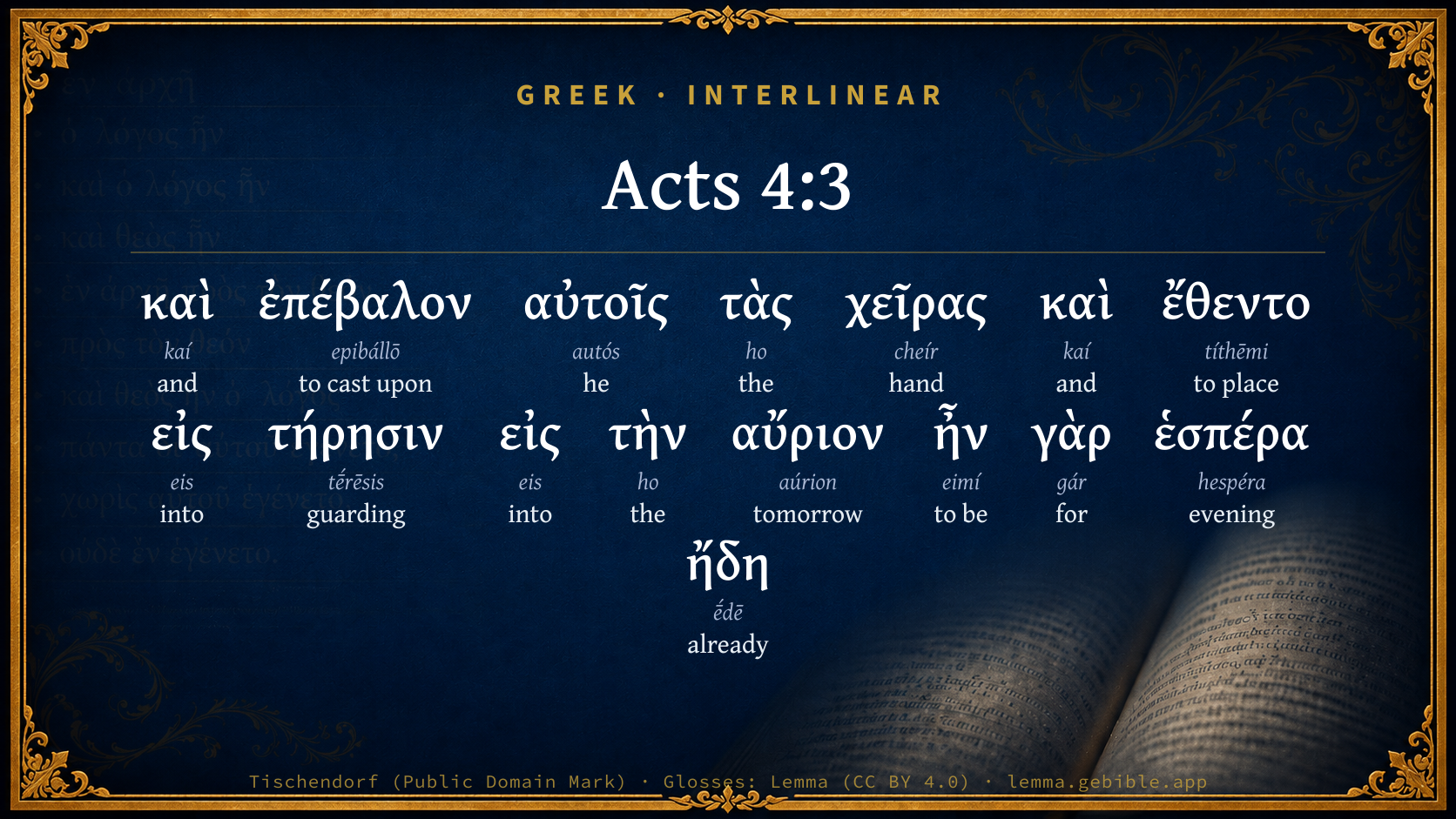
Download image
Cite this verse

Acts 4:3 (World English Bible). Public Domain. Lemma interlinear Bible study tool, https://lemma.gebible.app/v/acts/4/3.

Show BibTeX & RIS
BibTeX
RIS
English Translation
They laid hands on them, and put them in custody until the next day, for it was now evening.
World English Bible · Public Domain
Highlights
  • 1 first appearance in the Greek New Testament
Full analysis ↓
Download a study sheet

One document with this verse’s original text, its word-by-word gloss line, the meaning frame, cross-references with their text, attributed commentary, and full source and license credits — printable, and it pastes into notes with its structure intact.

This verse Autodidact and up

Study sheet (.html) Plain text (.txt)

A passage Seminary Student

Up to 50 verses in one chapter. A passage sheet keeps up to 6 commentary sources and 12 cross-references per verse, in the order this page ranks them, and says so on the sheet whenever that leaves anything out. Ask for a single verse and you get the Autodidact verse sheet above.

Everything on this page stays free to read, with no account — the sheet is a download of what is already on screen, not access to it.

Want to remove ads? Support Godless Engineer
Compare translations 3

The same verse in 3 English versions, stacked beneath the original-language interlinear above. Click any original word for its lexicon entry.

Each is an independent rendering of the whole verse — the interlinear is not word-aligned to these translations.

Highlighted words mark where these versions differ — a whole-verse word diff, not a word-by-word alignment.

  • World English Bible Public Domain
    They laid hands on them, and put them in custody until the next day, for it was now evening.
  • King James Version Public Domain
    And they laid hands on them, and put them in hold unto the next day: for it was now eventide.
  • unfoldingWord Literal Text CC BY-SA 4.0
    And they laid hands on them and put them in custody until the next day, since it was already evening.

unfoldingWord Literal Text — © unfoldingWord, licensed CC BY-SA 4.0. Word-aligned USFM3 via Door43 (git.door43.org/unfoldingWord/en_ult).

Versions to compare (up to 4)

3 of 4 selected

Show all 19 translations

Every available English version of this verse, each an independent rendering of the whole verse.

  • World English Bible Public Domain
    They laid hands on them, and put them in custody until the next day, for it was now evening.
  • Berean Standard Bible Public Domain
    They seized Peter and John, and because it was evening, they put them in custody until the next day.
  • Majority Standard Bible Public Domain
    They seized Peter and John, and because it was evening, they put them in custody until the next day.
  • King James Version Public Domain
    And they laid hands on them, and put them in hold unto the next day: for it was now eventide.
  • American Standard Version (1901) Public Domain
    And they laid hands on them, and put them in ward unto the morrow: for it was now eventide.
  • Revised Version (1885) Public Domain
    And they laid hands on them, and put them in ward unto the morrow: for it was now eventide.
  • Geneva Bible (1599) Public Domain
    And they layde handes on them, and put them in holde, vntill the next day: for it was now euentide.
  • Douay-Rheims (1899) Public Domain
    And they laid hands upon them, and put them in hold till the next day; for it was now evening.
  • Young's Literal Translation Public Domain
    and they laid hands upon them, and did put them in custody unto the morrow, for it was evening already;
  • Literal Standard Version CC BY-SA 4.0
    and they laid hands on them, and put them in custody until the next day, for it was evening already;
  • Unlocked Literal Bible CC BY-SA 4.0
    They arrested them and put them in jail until the next morning, since it was now evening.
  • unfoldingWord Literal Text CC BY-SA 4.0
    And they laid hands on them and put them in custody until the next day, since it was already evening.
  • Darby Bible Public Domain
    and they laid hands on them, and put them in ward till the morrow; for it was already evening.
  • World Messianic Bible Public Domain
    They laid hands on them, and put them in custody until the next day, for it was now evening.
  • Webster's Bible Public Domain
    And they laid hands on them, and put them in custody to the next day: for it was now evening.
  • Free Bible Version CC BY-SA 4.0
    They arrested them and placed them under guard until the following day since it was already evening.
  • Bible in Basic English Public Domain
    And they took them and put them in prison till the morning, for it was now evening.
  • Text-Critical English NT CC BY 4.0
    So they arrested them and took them into custody until the next day, for it was already evening.
  • Tyndale New Testament (1534) Public Domain
    And they layde hondes on them and put them in holde vntill the nexte daye: for it was now even tyde.

Literal Standard Version (2020), Covenant Press — licensed CC BY-SA 4.0. Text via the HelloAO Bible API (eBible.org). Unlocked Literal Bible (unfoldingWord) — licensed CC BY-SA 4.0. Text via the HelloAO Bible API (eBible.org). unfoldingWord Literal Text — © unfoldingWord, licensed CC BY-SA 4.0. Word-aligned USFM3 via Door43 (git.door43.org/unfoldingWord/en_ult). Free Bible Version, Dr. Jonathan Gallagher — licensed CC BY-SA 4.0. Text via the HelloAO Bible API (eBible.org).

Word by word

More ways to search: Search by grammar → Find every occurrence → Compare this word →

Practice this passage: Drill this verse → Learn its vocabulary →

τήρησιν
tḗrēsis
G5084
“guarding”
Noun, Accusative, Singular, Feminine
Part of Speech
Noun
Case
Accusative
Number
Singular
Gender
Feminine
Full Thayer's Definition

Origin: from G5083

TDNT: 10:26,1

1. a watching a. of prisoners b. a place where prisoners are kept, a prison 2. a keeping a. complying with, obeying
  1. καὶ kaí G2532 “and” Conjunction
  2. ἐπέβαλον epibállō G1911 “to cast upon” Verb, Aorist, Active, Indicative, 3rd person, Plural
  3. αὐτοῖς autós G846 “he” Personal pronoun, Dative, Plural, Masculine
  4. τὰς ho G3588 “the” Article, Accusative, Plural, Feminine
  5. χεῖρας cheír G5495 “hand” Noun, Accusative, Plural, Feminine
  6. καὶ kaí G2532 “and” Conjunction
  7. ἔθεντο títhēmi G5087 “to place” Verb, Aorist, Middle, Indicative, 3rd person, Plural
  8. εἰς eis G1519 “into” Preposition
  9. εἰς eis G1519 “into” Preposition
  10. τὴν ho G3588 “the” Article, Accusative, Singular, Feminine
  11. αὔριον aúrion G839 “tomorrow” Adverb
  12. ἦν eimí G1510 “to be” Verb, Imperfect, Active, Indicative, 3rd person, Singular
  13. γὰρ gár G1063 “for” Conjunction
  14. ἑσπέρα hespéra G2073 “evening” Noun, Nominative, Singular, Feminine
  15. ἤδη ḗdē G2235 “already” Adverb

About this verse

These counts appear in no published source. They are computed here, from the morphology-tagged text and Lemma’s own curated glosses. What Lemma adds →

16
words
13
distinct lemmas
Acts
section

Notable vocabulary

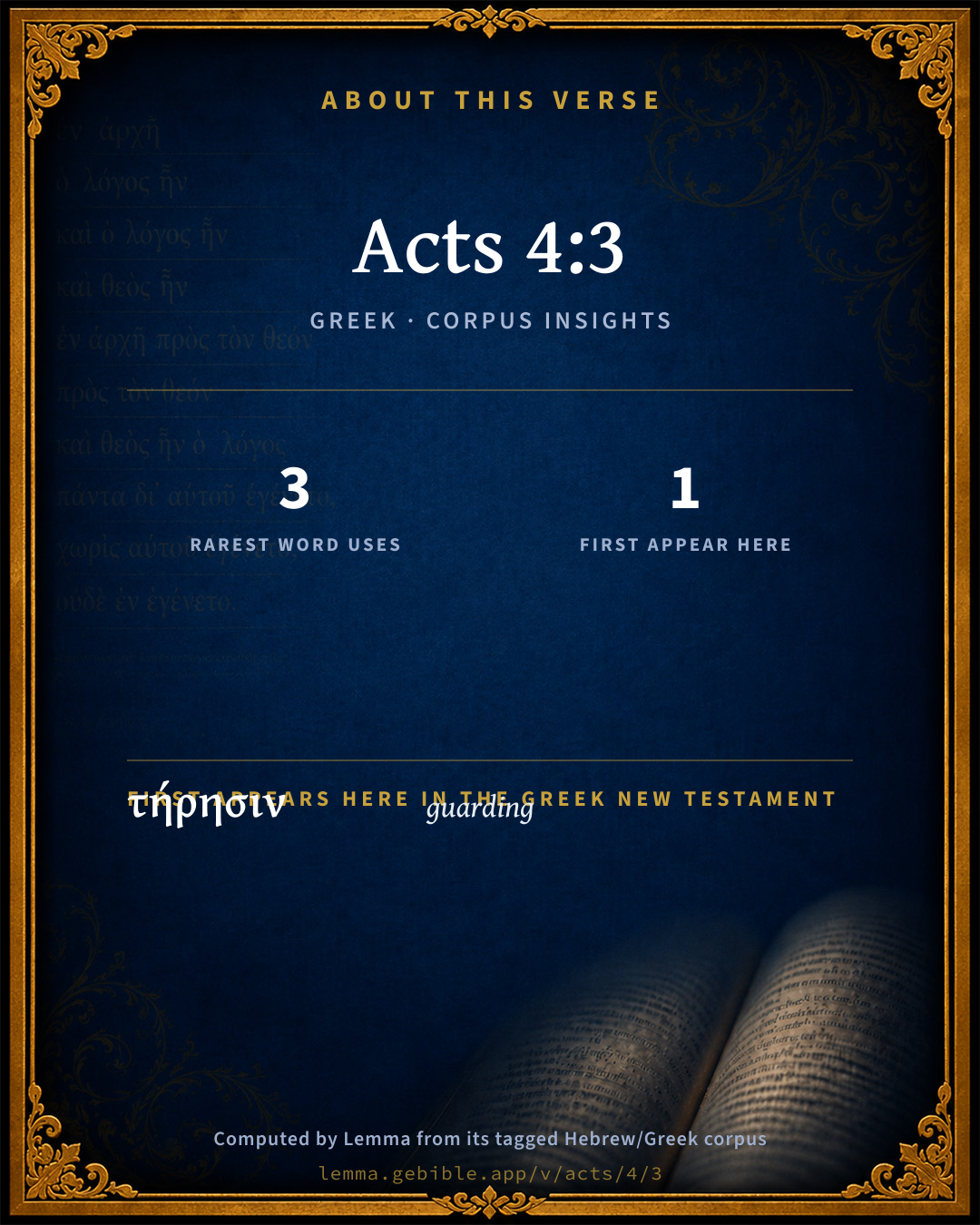
The rarest word here is τήρησιν guarding G5084 — appearing just 3 times in the whole Greek New Testament.

First appearance in Scripture

This word makes its first canonical appearance in the Greek New Testament here:

  • τήρησιν guarding G5084

Shared distinctive vocabulary

τήρησιν guarding G5084 occurs in 3 verses of the Greek New Testament. Also found in:
Repetition

Words recur within this verse:

Cross-references

10

Topical passages linked to Acts 4:3 in the Treasury of Scripture Knowledge — connected by theme and wording, ordered by reader-vote popularity; previews shown in the World English Bible.

  • Acts 5:18 and laid hands on the apostles, and put them in public custody.
  • Matthew 10:16–17 "Behold, I send you out as sheep in the midst of wolves. Therefore be wise as serpents, and harmless as doves.
  • Acts 16:19–24 But when her masters saw that the hope of their gain was gone, they seized Paul and Silas, and dragged them into the marketplace before the rulers.
  • Luke 22:52 Jesus said to the chief priests, captains of the temple, and elders, who had come against him, "Have you come out as against a robber, with swords and clubs?
  • John 18:12 So the detachment, the commanding officer, and the officers of the Jews, seized Jesus and bound him,
  • Acts 6:12 They stirred up the people, the elders, and the scribes, and came against him and seized him, and brought him in to the council,
  • Acts 8:3 But Saul ravaged the assembly, entering into every house, and dragged both men and women off to prison.
  • Acts 9:2 and asked for letters from him to the synagogues of Damascus, that if he found any who were of the Way, whether men or women, he might bring them bound to Jerusalem.
  • Acts 12:1–3 Now about that time, Herod the king stretched out his hands to oppress some of the assembly.
  • Luke 22:54 They seized him, and led him away, and brought him into the high priest's house. But Peter followed from a distance.

Cross-references courtesy of OpenBible.info (CC BY 4.0).

Commentary

Notes on Acts 4:3 from classic Christian and Jewish commentators (each source and its license shown beneath its notes). The classic Christian expositions comment on the surrounding passage and are grouped to its opening verse, so a note may address several verses; the Jewish commentaries on the Tanakh (Rashi and others) are per-verse, so they appear only where the commentator wrote on this verse.

Lemma curates 59 commentaries, every one of them public domain or Creative Commons licensed, each selected and text-cleaned for this edition rather than reprinted as found. About our sources →

The Biblical Illustrator

Joseph S. Exell

Act_4:3-4

And they laid hands upon them … Howbeit many of them which heard the Word believed.

The impotence and benefit of persecution

1. Peter had boasted, I am ready to go with Thee to prison. He was not ready then, and hence the folly of his boast. He was ready now, and so did not boast, but doubtless reflected on his Masters words, Thou shalt follow Me afterwards.

2. The time-honoured method of the opponents of truth was here practised, No case; abuse defendants attorney. You cant refute the preacher; lock him up. The only answer that pagan Rome had for Christians was prison and death; the only answer that papal Rome has is the same.

3. But the policy does not answer. The preachers as cheerfully accept the prison as the pulpit when their Master bids them, and may take as theirs the crest--an ox with the plough on one side and the altar on the other, with the legend, Ready for either. Ready for work or for sacrifice, Nor does the policy answer in another sense. You may silence the teacher, but you cannot silence the truth. In the case before us many believed.

I. In spite of the apostles imprisonment. Gods work goes on whether His agents are bound or free, living or dead. It is independent of its best and worthiest supporters. Peter and John are in prison, but the fact that many believed shows that even the chief among the apostles are not indispensable. How foolish, then, the unbelieving anxiety expressed in the question about this or that distinguished minister, Who can take his place? Plenty, if God wills; if not the Holy Ghost will take his place.

1. The preacher is imprisoned or dead, but the Word which does the work is not. Fragments of the Bible left behind by the missionaries in Madagascar did more for Christianity than their vocal teaching.

2. The preacher is imprisoned or dead, but his teaching and example are not. They remain in the memory to influence the life. The stone sinks in the water, but the ripples on the lake extend till they reach either shore.

II. Because of the apostles imprisonment. Their endurance of persecution for the truth was a guarantee of their sincerity, and an exhibition of the power of the gospel on themselves. It is an easy thing to preach when Christianity is popular, but when unpopular, and when men notwithstanding are prepared to endure bonds or death rather than be silent about it--this shows that they believe in and enjoy the mighty power they preach. So in the milder forms of affliction. How many powerful sermons are silently preached from sick beds! (J. W. Burn.)

Persecution a stimulus

A certain amount of persecution rouses a mans defiance, stirs his blood for magnificent battle, and makes him fifty times more a man than he would have been without the persecution. So it was with the great reformer when he said, I will not be put down; I will be heard. And so it was with Millard, the preacher, in the time of Louis XI. When Louis XI. sent word to him that unless he stopped preaching in that style he would throw him into the river, he replied, Tell the king that I will reach heaven sooner by water than he will reach it by fast horses. (T. De Witt Talmage, D. D.)

Persecution for well-doing

Sad, that so good news should find so bad entertainment! but happy for some, that as it was raised for so good a Word (Mat_13:21), so occasioned by so good a deed done to an impotent man. Such may ever our sufferings be, that if a black shadow must needs follow us, it may be only because we walk in the light; and that if it prove our lot to hear and fare ill, it may be for doing well (1Pe_3:17; 1Pe_4:16; Joh_10:32). (A. Tuckney, D. D.)

Peter and John before the council

I. The arrest was brought about--

1. While the service was being held (verse 1). The devil has a keen aversion to the proclaiming of the gospel, and will stop it if he can.

2. By ecclesiastical officials. In proportion as Christ is exalted, the Jewish idea of an official priesthood must lose its hold upon the minds of men.

3. By men who felt deeply--grieved. The preaching of the gospel causes heaven to rejoice, and it brings joy to those who receive it, but these men were grieved because of it. How thoroughly even religious men may be out of touch with sympathies that emanate from God! What a pity there should be so much deep feeling wrongly directed! There has been quite a Niagara of human emotion, which, during the Christian ages, has spent itself in win in dashing against the impregnable rock of Christian verities.

II. The detention. Tim apostles had started out to visit the temple at the hour of the evening sacrifice, but as that evening closed they themselves offered a sacrifice with which the Lord would be well pleased. The bars and bolts of the strong door might keep them in, but they could not keep Jesus out. Even on earth suffering saints have Often found what Thomas Cooper calls the paradise of martyrs.

III. The trial.

1. Christ was honoured.

2. There was a word for the rulers.

3. There was a word for everybody.

IV. The result.

1. The rulers were impressed.

2. The apostles were threatened.

3. The apostles were released.

4. God was glorified. To Peter and John this would be an all-sufficient recompense. (H. Thorne.)

The Biblical Illustrator, edited by Joseph S. Exell (c. 1880s–1900s) — public domain. Text from a community e-Sword module.

Bengel's Gnomon

Johann Albrecht Bengel

Act 4:3. Εἰς τήρησιν, in confinement, custody) So Peter and John were sharpened (exercised) in faith.—αὔριον, the morrow, the next day) The morrow is here put for the next day, by Mimesis (i.e. using the words which were probably used by the persons committing the apostles to prison: Append.). [On that night what great things we may suppose occurred (passed) in the souls of those great apostles!—V. g.]—ἑσπέρα, evening) of that day, the morning of which is in ch. Act 3:1.

Bengel's Gnomon of the New Testament — English translation (T&T Clark, Edinburgh, 1860) — public domain. Text from a community e-Sword module.

Meyer's Critical & Exegetical Commentary

Heinrich August Wilhelm Meyer

Act_4:3. Εἰς τήρησιν] into custody, i.e. into prison. Comp. Thuc. vii. 86. 1; Act_5:18.

ἑσπέρα] as they had gone to the temple at the ninth hour, and so at the beginning of the first evening (Act_3:1), the second evening, which commenced at the twelfth hour, had probably already begun. See on Mat_14:15.

Meyer — Critical and Exegetical Commentary on the New Testament — English translation by Peter Christie, edited by Frederick Crombie (T&T Clark, 1880) — public domain. Text from a community e-Sword module.

Expositor's Greek Testament

ed. W. Robertson Nicoll

Act 4:3 . ἐπέβαλον αὐτοῖς τὰς χεῖρας : the verb is always as here joined with the same noun in Acts, and twice in the Gospel; the phrase is found once in Matthew and Mark, and twice in John; see Luk 20:19 ; Luk 21:12 , Act 4:3 ; Act 5:18 ; Act 12:1 ; Act 21:27 , cf. in LXX, Gen 22:12 , 2Sa 18:12 ; Est 6:2 , so also in Polybius. τήρησιν , cf. Act 5:18 , only used elsewhere in N.T. by St. Paul, 1Co 7:19 ; in Thuc., vii., 86 (Wendt), it denotes not only the act of guarding, but also a place of custody. Five times in LXX, but in the former sense. For another instance of its meaning as a place of custody (see Deissmann, Neue Bibelstudien , p. 55), on papyrus in Egypt, second or third century after Christ. ἦν γὰρ ἑσπέρα ἤδη , cf. Act 3:1 , the judicial examination must therefore be postponed until the next day, see Jer 21:12 , on which it appears that the Rabbis founded this prohibition against giving judgment in the night (Lumby and Felten, in loco ). ἑσπέρα : only in St. Luke in the N.T., Luk 24:29 , Act 4:3 (Act 20:15 , W.H [147] margin) and Act 28:23 .

[147] Westcott and Hort’s The New Testament in Greek: Critical Text and Notes.

The Expositor's Greek Testament, edited by W. Robertson Nicoll (1897–1910) — public domain. Text from a community e-Sword module.

Ellicott's Commentary for English Readers

(3) It was now eventide.—The narrative started, it will be remembered, from 3 P.M. (Act_3:1). The “eventide” began at 6 P.M.

Put them in hold.—Literally, in custody. In Act_5:18, the word is translated “prison.” The old noun survives in our modern word “strong-hold.”

A Bible Commentary for English Readers, edited by Charles John Ellicott (1878–1897) — public domain. Text from a community e-Sword module.

The Cambridge Bible for Schools and Colleges

gen. ed. J. J. S. Perowne

3. and put them in hold] i.e. in prison. The word means ward, safe keeping. And it is worth noticing on the use of it, that the Jews only employed imprisonment for this precautionary purpose. It was not a mode of punishment with them, and where we find mention of it so used in the Scripture records, the authorities who inflicted it were not Jewish.

unto the next day: for it was now eventide] The Jews were not allowed to give judgment in the night, and their day ceased with the twelfth hour. It was already about the ninth hour when Peter and John were going up to the Temple (Act_3:1), so that before the address of Peter and the arrest of him and John was completed it would be too late to enter on a judicial enquiry. The Rabbis founded the prohibition on Jer_21:12, “O house of David, thus saith the Lord, Execute judgment in the morning.” In Mishna Sanhedrin iv. 1 it is said: “Judgments about money may be commenced in the day and concluded in the night, but judgments about life must be begun in the day and concluded in the day.” And even the rule about the declaration of the new moon, which was looked on as a judicial proceeding, is similarly regulated (Mishna Rosh ha-Shanah iii. 1), and it may not be declared unless the examination of the witnesses, and all other preliminaries enjoined before its proclamation, be completed before dark.

The Cambridge Bible for Schools and Colleges (gen. ed. J. J. S. Perowne; Cambridge University Press, 1878–1918) — public domain. Text from a community e-Sword module.

John Gill's Exposition

And they laid hands on them,.... The Arabic version renders it, "on both"; on Peter and John; seized them by force, and drew them out of the temple:

and put them in hold unto the next day; not in the common public prison, as in Act 5:18 but they put them into the hands, and under the care and custody of a set of men, to keep and guard them; that they might not go away, until they had an opportunity of bringing them before the sanhedrim, to be examined and punished by them:

for it was now eventide; it was at the ninth hour, or about three o'clock in the afternoon, when Peter and John went up to the temple, where they healed the lame man; after which, both of them preached to the people; so that it must now be evening; at least, as the Syriac version renders it, "the evening was near", or was drawing on.

John Gill's Exposition of the Whole Bible (1746–1763) — public domain (CC PDM 1.0). Text via the HelloAO Bible API.

Trapp's Complete Commentary

John Trapp

3 And they laid hands on them, and put them in hold unto the next day: for it was now eventide.

Ver. 3. Put them in hold] In the sergeant’s ward, τηρησις, not in the jail or dungeon. God doth by degrees inure his to suffer hardship. Pauciores (saith Cajuto in an epistle to the brethren of Basilea) vobiscum perimuntur, quod ita Domino visum est, ut stabiliantur seu lenibus pluviis, et sementis mollioribus plantulae in arbores maximas proditurae. God tempteth not his above what they are able, 1Co 10:13.

John Trapp, A Commentary or Exposition upon All the Books of the Old and New Testament (1647–1656) — public domain. Text from a community e-Sword module.

Albert Barnes' Notes on the Bible

Put them in hold - That is, they took them into “custody,” or into safe keeping. Probably they committed them to the care of a guard.

Eventide - Evening. It was not convenient to assemble the council at night. This was, moreover, the time for the evening prayer or sacrifice, and it was not usual to assemble the Sanhedrin at that hour.

Albert Barnes' Notes on the Bible (1834–1885) — public domain. Text from a community e-Sword/MySword module.

Matthew Poole's English Annotations

Put them in hold; some think this not to have been so strait a custody as that of a prison, but that rather the apostles were delivered to some who promised that they should be forthcoming. The prediction of our Saviour began now to be fulfilled, Luk 21:12.

They shall lay their hands on you, and persecute you. Howsoever, God was pleased to suffer persecution to come by degrees on his church; after the sun was down, (Christ was gone from them), it was not presently pitch darkness with them. God always remembers his people’s condition, and his own promise, and lays no more upon them than they are able to bear.

Matthew Poole's English Annotations on the Holy Bible (1683–1685) — public domain. Text from a community e-Sword/MySword module.

Whedon's Commentary on the Bible

Daniel D. Whedon

3. In hold—Detention or imprisonment.

Eventide—Evening time. The old word tide signified time. The Jews had a double eve; the one beginning at about three o’clock, prayer time, (see note on Act_3:1,) and the other at six o’clock or sundown. The proceeding at this time had just filled the interval between the two.

Daniel D. Whedon (gen. ed.), Commentary on the Old and New Testaments (1874–1909) — public domain. Text from a community e-Sword module.

The Pulpit Commentary

Ward for hold, A.V. (see ver. 18); morrow for next day, A.V. They laid hands on them. The harsh persecution of the disciples at Jerusalem at this time when the Sadducees were in power is in exact accordance with Josephus"s statement in the passage just referred to, that the Sadducees were more severe and cruel in their administration of justice than any other Jews. Their tenet of no life to come made them look to severe punishments in this life.

HOMILIES BY R. TUCK.

The first prisoners for Christ.

It appears that by this time the movements of the apostles were beginning to be an object of serious concern to the religious authorities in Jerusalem. Probably the Sadducee party, which succeeded in securing our Lord"s death, was still predominant in the great council; this is indicated by the prominence given to the Resurrection" by the enemies of the disciples. In addition to the general annoyance at the public preaching of the apostles, the officials of the temple were grieved at the crowding of the people round the new teachers in the temple courts. So in the name of order, but really in the spirit of jealousy, they were arrested, late in the evening, and put in safe keeping until the next day. Jewish rules did not allow judgment to be given at night. Imprisonment was only a precautionary measure; the Jews did not punish by imprisonment. Where mention is made of it, as used for punishment, in the Scripture records, the authorities who inflicted it were not Jewish. The point to which we now direct attention is, that a confession of moral impotence is made in all physical attempts to stop and crush teachers. Intellectual and moral error can only be fairly met by the teaching of the corrective truth. O nly when men fail to conquer by reasoning, can they wish to take up material weapons of any kind. When reason fails then men imprison, and beat, and torture, and kill. And physical forces never can succeed in crushing moral ones. It has been true for every age, and is as true as ever today, that "the blood of the martyrs is the seed of the Church." Physical restraints are only proper in relation to wrongs that disturb the social order. They are wholly out of place in connection with matters of opinion.

I THESE PRISONERS WERE ONLY TEACHERS. They only talked to the people. They only appealed to mind and judgment. They only announced some new truths. They only invited the people"s belief. Part of the offence against them arose from the known fact that they were unlearned and ignorant men; not specially trained rabbis, and so not regarded as fit to preach. An instance of the class-prejudice which sadly prevails still. Illustrate from the story of great missionaries. They have only been teachers, yet how often, in different countries, they have excited prejudice and suffered persecution! The same is still, in measure, true of all great thought-leaders; all men who are "before their time" must expect to be misunderstood and persecuted.

II THESE PRISONERS TAUGHT NOTHING AFFECTING SOCIAL ORDER. They did not encourage vice or lawlessness. They did not interfere with family life, local government, social customs, or politics. Like their Master, they dealt with broad and general principles, expecting these, when implanted, to gain their own growth and expressions. Even their little excitement in the temple courts, and temporary interference with the temple order, was a matter of no moment. There was no occasion for the temple police to interfere with them.

III THESE PRISONERS TAUGHT NOTHING AFFECTING CEREMONIAL RITES. There were, indeed, personal examples of diligent and devout Mosaism; strict in all matters of ceremonial duty. They never uttered a word that could be regarded as disrespectful to the temple or the Jewish system. They never tried to break one single person away from his ceremonial duties. Their teachings were within Judaism, and the most jealous conservators of the old system had no good reason for fearing their influence. This, however, applies to true Mosaism, and not to the burdensome ritual added by the rabbis, against which both our Lord and his disciples vigorously pleaded. But on this particular occasion the apostles had not even attacked the rabbinical system.

IV THE TEACHINGS OF THESE PRISONERS ACTUALLY TENDED TO PRESERVE SOCIAL ORDER AND MAKE BETTER CITIZENS. Such is everywhere the natural results of the preaching of Christ and the teaching of Christianity. Loyalty to Christ helps to secure loyalty to the earthly ruler, and the virtues Christianity cultivates find their expression in the social and national spheres. Then why were these men arrested? Because the men in power were jealous of the influence they were gaining, and feared they would lose their own authority and influence on the people. Self-seeking is at the root of all religious persecution. And because the men who opposed them could not meet and answer them in argument, they had to fall back upon the unworthy weapons of threatening and force (see vers. 16, 17). Impress that no physical bonds have ever yet been forged that could bind in the truth. R.T.

The Pulpit Commentary (1880–1919), ed. H.D.M. Spence-Jones & Joseph S. Exell — public domain. Text from a community e-Sword module.

McGarvey & Pendleton's Commentaries

J. W. McGarvey

See notes on verse 1

J. W. McGarvey (with Philip Y. Pendleton), Commentaries on the New Testament (The Fourfold Gospel, 1914; Acts; and the epistles) — public domain. Text from a community e-Sword/MySword module.

The People's New Testament

B. W. Johnson

3. Put them in hold. In prison until the next day, for it was now late in the evening.

B. W. Johnson's The People's New Testament with Notes (1889–1891) — public domain. Electronic text from the Christian Classics Ethereal Library (CCEL) ThML edition.

Cambridge Greek Testament for Schools and Colleges

3. τήρησιν, ward, safe keeping, i.e. in a prison-house. And it is worth noticing on the use of it, that the Jews only employed imprisonment for this precautionary purpose. It was not a mode of punishment with them, and where we find mention of it so used in the Scripture records, the authorities who inflicted it were not Jewish.

ἑσπέρα ἤδη, already eventide. The Apostles had gone up to the Temple about the ninth hour, so sundown would soon come on, and the Jews were not allowed to give judgment in the night, while their day ceased at the twelfth hour. The Rabbis founded the prohibition on Jer 21:12, ‘O house of David, thus saith the Lord, Execute judgment in the morning.’ In Mishna Sanhedrin IV. 1 it is said: ‘Judgments about money may be commenced in the day and concluded in the night, but judgments about life must be begun in the day and concluded in the day.’ And even the rule about the declaration of the new moon, which was looked on as a judicial proceeding, is similarly regulated (Mishna Rosh ha-Shanah III. 1), and it may not be declared unless the examination of the witnesses and all other preliminaries enjoined before its proclamation be completed before dark.

Cambridge Greek Testament for Schools and Colleges (Cambridge University Press, 1896; 21 vols, various authors incl. Carr, Maclear, Plummer, Farrar, Lumby, Moule, M. R. James, Simcox) — public domain. Text from a community e-Sword module.

Alford’s Greek Testament

Henry Alford

3.] ἑσπέρα, perhaps, from their adjourning the case till the next day, the second evening, beginning with the twelfth hour: see Mat 14:15, and note.

Henry Alford, The Greek Testament (1849–1861) — public domain. Text from a community e-Sword module.

Vincent's Word Studies in the New Testament

Marvin R. Vincent

In hold [εις τηρησιν] . A somewhat antiquated rendering. Better, as Rev., in ward. See on 1Pe 1:4.

Marvin R. Vincent, Word Studies in the New Testament (1887–1900) — public domain. Text from a community e-Sword/MySword module.

Lesson kit

Teaching starters — assembled from the data on this page, not authored interpretation. Every prompt links to the verse data it draws on. Edit before teaching.

Acts, in the Acts, opens this verse with 16 words (13 distinct Greek lemmas). Its most distinctive word is tḗrēsis (“guarding”). A historical commentator’s framing appears above. Read the whole chapter for the surrounding context.

Discussion questions

  1. The word tḗrēsis carries the sense “guarding.” How does it shape the verse?
  2. The word “guarding” first appears here in Scripture. What is being introduced at this debut?
  3. Acts 5:18 shares the word «guarding» with this verse. How do the two illuminate each other?
  4. “into” occurs 2× in this one verse. What is the effect of the repetition?
  5. The translations on this page render this verse differently — a whole-verse word diff, not a word-by-word alignment. What might account for the different wordings?
  6. Reading how The Biblical Illustrator and Bengel's Gnomon read this verse, where do the two commentators agree and where do they part?

Things to notice

  • 1 word makes its first canonical appearance in Scripture here.
  • These translations choose different wording for 8 words in this verse.
  • “into” occurs 2× in this single verse.
  • 13 distinct Greek lemmas span 16 words in this verse.

Reading settings

Reading text

Shown beneath each verse's original-language words.

Old Testament
Old Testament edition

Read the OT as the Masoretic Hebrew (MT) or the Greek Septuagint (LXX).

English shown for the Greek Septuagint (in the Hebrew ↔ Greek comparison).

Comparing translations? Open the Compare panel on any verse page to stack up to four side by side.