
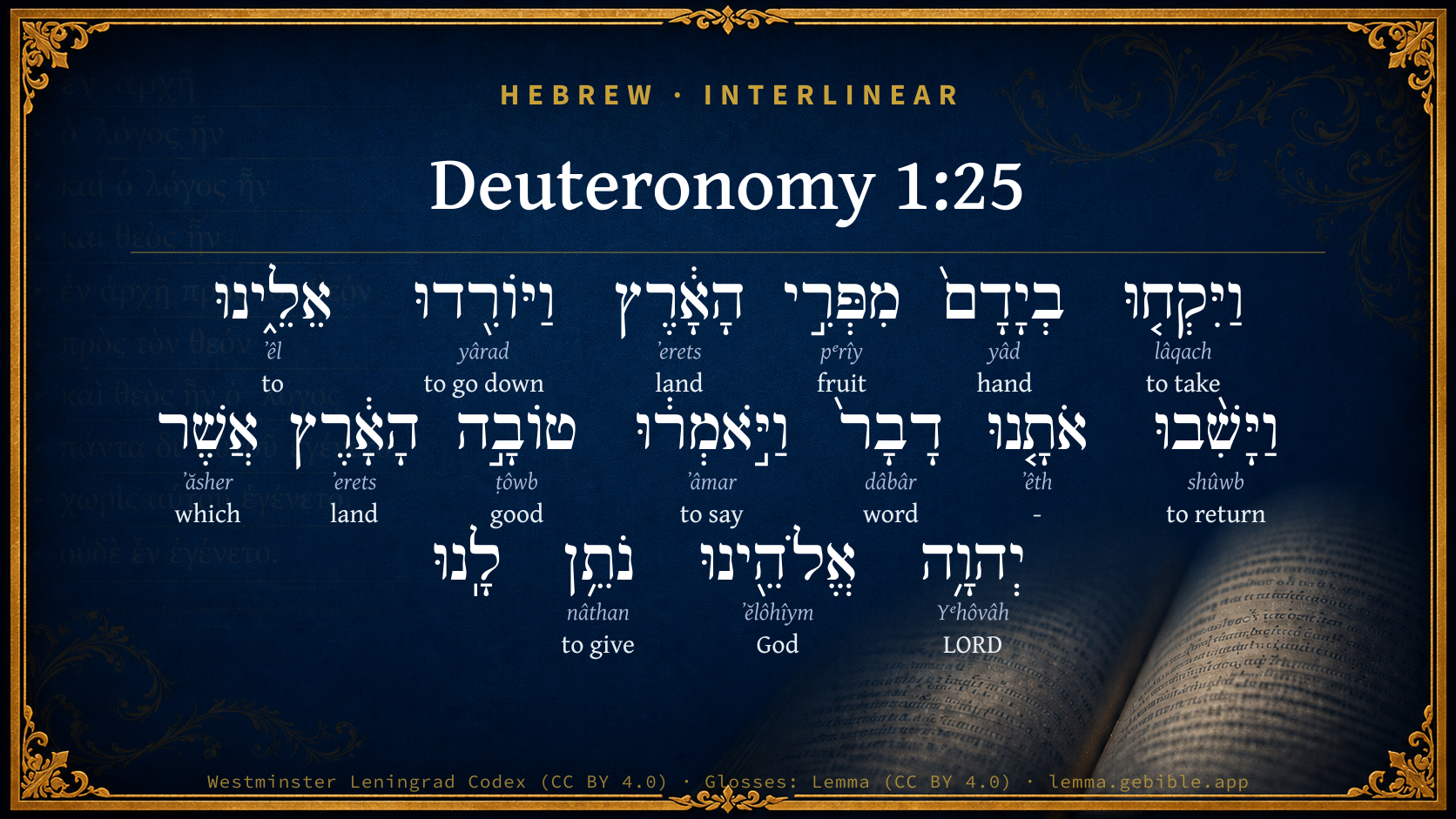
Deuteronomy 1:25

Hebrew (Westminster Leningrad Codex) Deuteronomy 1:25 appears in the Hebrew Old Testament. The text above is from the Westminster Leningrad Codex. Each word links to its Strong’s number, a concise gloss, and parsing drawn from the Open Scriptures Hebrew Bible morphology. Click any word for its full Brown-Driver-Briggs (BDB) entry.
Download image
Cite this verse

Deuteronomy 1:25 (World English Bible). Public Domain. Lemma interlinear Bible study tool, https://lemma.gebible.app/v/deuteronomy/1/25.

Show BibTeX & RIS
BibTeX
RIS
English Translation
They took of the fruit of the land in their hands, and brought it down to us, and brought us word again, and said, It is a good land which Yahweh our God gives to us.
World English Bible · Public Domain
Download a study sheet

One document with this verse’s original text, its word-by-word gloss line, the meaning frame, cross-references with their text, attributed commentary, and full source and license credits — printable, and it pastes into notes with its structure intact.

This verse Autodidact and up

Study sheet (.html) Plain text (.txt)

A passage Seminary Student

Up to 50 verses in one chapter. A passage sheet keeps up to 6 commentary sources and 12 cross-references per verse, in the order this page ranks them, and says so on the sheet whenever that leaves anything out. Ask for a single verse and you get the Autodidact verse sheet above.

Everything on this page stays free to read, with no account — the sheet is a download of what is already on screen, not access to it.

Want to remove ads? Support Godless Engineer
Compare translations 3

The same verse in 3 English versions, stacked beneath the original-language interlinear above. Click any original word for its lexicon entry.

Each is an independent rendering of the whole verse — the interlinear is not word-aligned to these translations.

Highlighted words mark where these versions differ — a whole-verse word diff, not a word-by-word alignment.

  • World English Bible Public Domain
    They took of the fruit of the land in their hands, and brought it down to us, and brought us word again, and said, It is a good land which Yahweh our God gives to us.
  • King James Version Public Domain
    And they took of the fruit of the land in their hands, and brought it down unto us, and brought us word again, and said, It is a good land which the LORD our God doth give us.
  • unfoldingWord Literal Text CC BY-SA 4.0
    And they took with their hands from the fruit of the land and brought down to us. And they returned to us a word and said, ‘Good the land that Yahweh our God is giving to us.’

unfoldingWord Literal Text — © unfoldingWord, licensed CC BY-SA 4.0. Word-aligned USFM3 via Door43 (git.door43.org/unfoldingWord/en_ult).

Versions to compare (up to 4)

3 of 4 selected

Show all 18 translations

Every available English version of this verse, each an independent rendering of the whole verse.

  • World English Bible Public Domain
    They took of the fruit of the land in their hands, and brought it down to us, and brought us word again, and said, It is a good land which Yahweh our God gives to us.
  • Berean Standard Bible Public Domain
    They took some of the fruit of the land in their hands, carried it down to us, and brought us word: “It is a good land that the LORD our God is giving us.”
  • Majority Standard Bible Public Domain
    They took some of the fruit of the land in their hands, carried it down to us, and brought us word: “It is a good land that the LORD our God is giving us.”
  • King James Version Public Domain
    And they took of the fruit of the land in their hands, and brought it down unto us, and brought us word again, and said, It is a good land which the LORD our God doth give us.
  • American Standard Version (1901) Public Domain
    And they took of the fruit of the land in their hands, and brought it down unto us, and brought us word again, and said, It is a good land which Jehovah our God giveth unto us.
  • Revised Version (1885) Public Domain
    And they took of the fruit of the land in their hands, and brought it down unto us, and brought us word again, and said, It is a good land which the LORD our God giveth unto us.
  • Geneva Bible (1599) Public Domain
    And tooke of the fruite of the land in their hands, and brought it vnto vs, and brought vs worde againe, and sayd, It is a good land, which the Lord our God doeth giue vs.
  • Douay-Rheims (1899) Public Domain
    And because the saying pleased me, I sent of you twelve men, one of every tribe:
  • Young's Literal Translation Public Domain
    and they take with their hand of the fruit of the land, and bring down unto us, and bring us back word, and say, Good is the land which Jehovah our God is giving to us.
  • Literal Standard Version CC BY-SA 4.0
    and they take in their hand from the fruit of the land, and bring [it] down to us, and bring us back word, and say, The land is good which our God YHWH is giving to us.
  • Unlocked Literal Bible CC BY-SA 4.0
    They took some of the produce of the land in their hands and brought it down to us. They also brought us word and said, 'It is a good land that Yahweh our God is giving to us.'
  • unfoldingWord Literal Text CC BY-SA 4.0
    And they took with their hands from the fruit of the land and brought down to us. And they returned to us a word and said, ‘Good the land that Yahweh our God is giving to us.’
  • Darby Bible Public Domain
    And they took of the fruit of the land in their hand, and brought it down unto us, and brought us answer, and said, The land is good that Jehovah our God hath given us.
  • World Messianic Bible Public Domain
    They took some of the fruit of the land in their hands and brought it down to us, and brought us word again, and said, “It is a good land which the LORD our God gives to us.”
  • Webster's Bible Public Domain
    And they took of the fruit of the land in their hands, and brought it down to us, and brought us word again, and said, It is a good land which the LORD our God doth give us.
  • Free Bible Version CC BY-SA 4.0
    They brought back some of the country's fruit, carrying it down to us, and gave us the report: “The Lord our God is giving us good land.”
  • Bible in Basic English Public Domain
    And taking in their hands some of the fruit of the land, they came down again to us, and gave us their account, saying, It is a good land which the Lord our God is giving us.
  • JPS Tanakh (1917) Public Domain
    And they took of the fruit of the land in their hands, and brought it down unto us, and brought us back word, and said: 'Good is the land which the LORD our God giveth unto us.'

Literal Standard Version (2020), Covenant Press — licensed CC BY-SA 4.0. Text via the HelloAO Bible API (eBible.org). Unlocked Literal Bible (unfoldingWord) — licensed CC BY-SA 4.0. Text via the HelloAO Bible API (eBible.org). unfoldingWord Literal Text — © unfoldingWord, licensed CC BY-SA 4.0. Word-aligned USFM3 via Door43 (git.door43.org/unfoldingWord/en_ult). Free Bible Version, Dr. Jonathan Gallagher — licensed CC BY-SA 4.0. Text via the HelloAO Bible API (eBible.org).

Word by word

More ways to search: Search by grammar → Find every occurrence → Compare this word →

Practice this passage: Drill this verse → Learn its vocabulary →

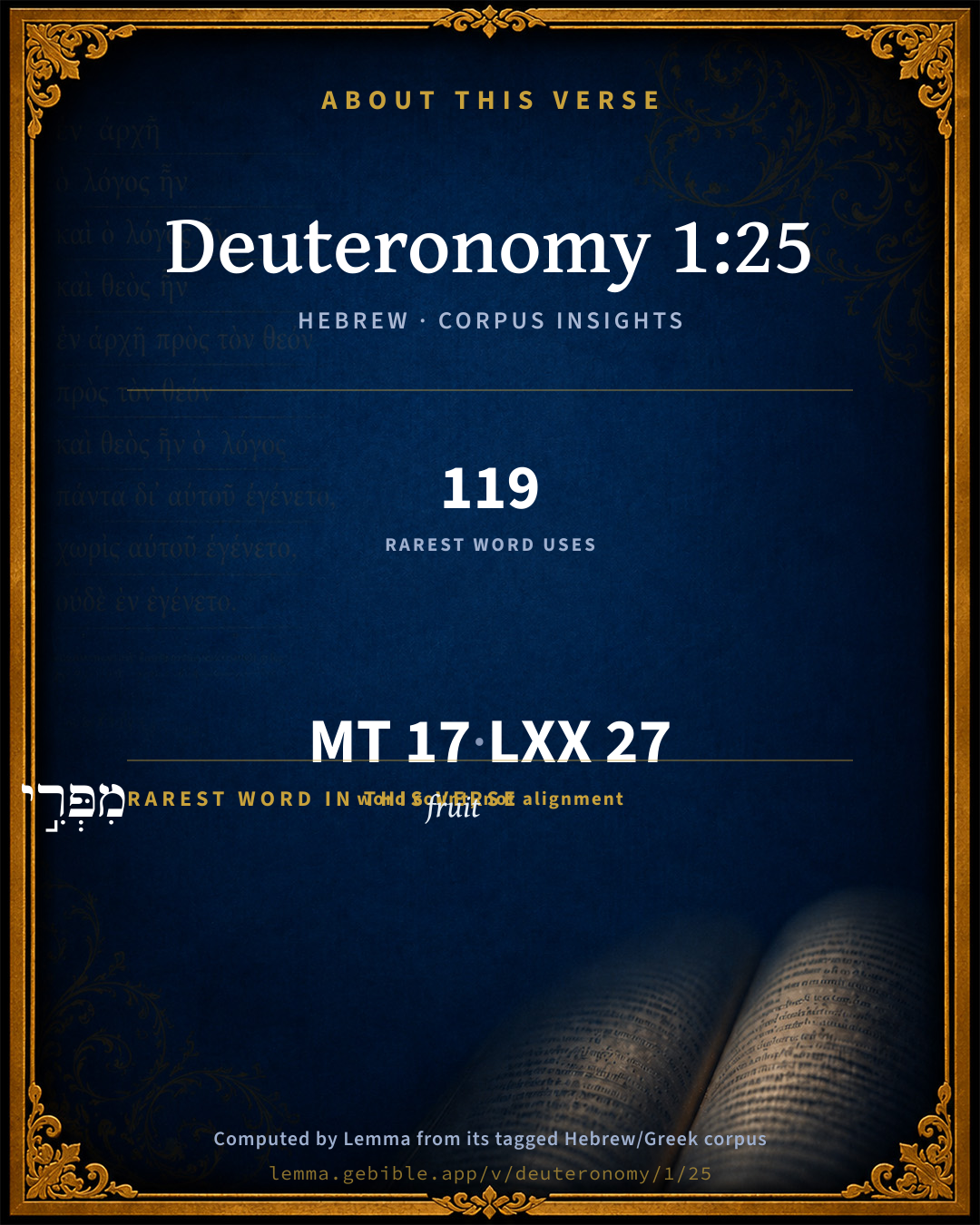
מִפְּרִ֣י
pᵉrîy
H6529
“from · fruit of”
Preposition + Noun, Common, Masculine, Singular, Construct
Part of Speech
Preposition + Noun
Type
Common
Gender
Masculine
Number
Singular
State
Construct
Full BDB Definition

Origin: from H6509

TWOT: 1809a

fruit - fruit, produce (of the ground) - fruit, offspring, children, progeny (of the womb) - fruit (of actions) (figuratively)
  1. וַיִּקְח֤וּ lâqach H3947 “and · to take” Conjunction + Verb, Qal, Sequential Imperfect, 3rd Person, Masculine, Plural
  2. בְיָדָם֙ yâd H3027 “in/at · hand · their” Preposition + Noun, Common, Both, Singular, Construct + Suffix, Personal, 3rd Person, Masculine, Plural
  3. הָאָ֔רֶץ ʼerets H776 “the · land” Particle, Definite Article + Noun, Common, Both, Singular, Absolute
  4. וַיּוֹרִ֖דוּ yârad H3381 “and · to go down” Conjunction + Verb, Hiphil, Sequential Imperfect, 3rd Person, Masculine, Plural
  5. אֵלֵ֑ינוּ ʼêl H413 “to · us” Preposition + Suffix, Personal, 1st Person, Common, Plural
  6. וַיָּשִׁ֨בוּ shûwb H7725 “and · to return” Conjunction + Verb, Hiphil, Sequential Imperfect, 3rd Person, Masculine, Plural
  7. אֹתָ֤נוּ ʼêth H853 “- · us” Particle, Direct Object + Suffix, Personal, 1st Person, Common, Plural
  8. דָבָר֙ dâbâr H1697 “word” Noun, Common, Masculine, Singular, Absolute
  9. וַיֹּ֣אמְר֔וּ ʼâmar H559 “and · to say” Conjunction + Verb, Qal, Sequential Imperfect, 3rd Person, Masculine, Plural
  10. טוֹבָ֣ה ṭôwb H2896 “good” Adjective, Adjective, Feminine, Singular, Absolute
  11. הָאָ֔רֶץ ʼerets H776 “the · land” Particle, Definite Article + Noun, Common, Both, Singular, Absolute
  12. אֲשֶׁר ʼăsher H834 “which” Particle, Relative
  13. יְהוָ֥ה Yᵉhôvâh H3068 “LORD” Noun, Proper
  14. אֱלֹהֵ֖ינוּ ʼĕlôhîym H430 “God(s) · our” Noun, Common, Masculine, Plural, Construct + Suffix, Personal, 1st Person, Common, Plural
  15. נֹתֵ֥ן nâthan H5414 “giving” Verb, Qal, Participle Active, Masculine, Singular, Absolute

About this verse

These counts appear in no published source. They are computed here, from the morphology-tagged text and Lemma’s own curated glosses. What Lemma adds →

17
words
15
distinct lemmas
Pentateuch
section

Grammatical profile

  • 5 verbs
  • 7 nouns
  • 1 adjective
  • 2 prepositions
  • 2 particles

Verb forms

  • וַיִּקְח֤וּ Qal · Sequential Imperfect
  • וַיּוֹרִ֖דוּ Hiphil · Sequential Imperfect
  • וַיָּשִׁ֨בוּ Hiphil · Sequential Imperfect
  • וַיֹּ֣אמְר֔וּ Qal · Sequential Imperfect
  • נֹתֵ֥ן Qal · Participle Active

Repetition

A word recurs within this verse — often emphatic in Hebrew:

  • הָאָ֔רֶץ land H776 ×2

Hebrew & Septuagint length

In English translation the verse runs 36 words from the Hebrew and 30 from the Septuagint (LXX English) — closely comparable.

A rough comparison of the two English renderings, which tokenize alike — not a word-level alignment.

Word counts can differ between the Hebrew and the Greek without any difference in meaning — e.g. the Hebrew direct-object marker אֵת has no separate Greek word, and Greek often adds the article ὁ.

In the original languages it is 17 Hebrew tokens and 27 Greek tokens — but the two are counted differently (Hebrew bundles its prefixes and suffixes into one token; the Greek is in lemma form), so that isn’t a like-for-like length.

Hebrew and Greek witnesses Masoretic Hebrew ↔ Greek Septuagint

The same verse in the two great witnesses to the Old Testament, shown verse-for-verse.

These are two independent witnesses, not word-aligned to each other, and the Septuagint is shown in lemma (dictionary) form.

Hebrew Deuteronomy 1:25 Masoretic · Westminster Leningrad Codex

וַיִּקְח֤וּ בְיָדָם֙ מִפְּרִ֣י הָאָ֔רֶץ וַיּוֹרִ֖דוּ אֵלֵ֑ינוּ וַיָּשִׁ֨בוּ אֹתָ֤נוּ דָבָר֙ וַיֹּ֣אמְר֔וּ טוֹבָ֣ה הָאָ֔רֶץ אֲשֶׁר יְהוָ֥ה אֱלֹהֵ֖ינוּ נֹתֵ֥ן לָֽנוּ

They took of the fruit of the land in their hands, and brought it down to us, and brought us word again, and said, It is a good land which Yahweh our God gives to us.

World English Bible · Public Domain

Greek LXX Deuteronomy 1:25 Septuagint · lemma form

καί λαμβάνω ἐν ὁ χείρ αὐτός ἀπό ὁ καρπός ὁ γῆ καί καταφέρω πρός ἐγώ καί λέγω ἀγαθός ὁ γῆ ὅς κύριος ὁ θεός ἐγώ δίδωμι ἐγώ

And they took in their hands of the fruit of the land, and brought it to you, and said, The land is good which the Lord our God gives us.

LXX2012 (modern English Septuagint) · Public Domain

Hebrew: Westminster Leningrad Codex (CC BY 4.0). Greek: Septuagint (public domain); English from LXX2012 (modern English Septuagint) (Public Domain). How the Septuagint differs from the Hebrew →

Targum (Aramaic paraphrase)

2

The Targum is the ancient Jewish Aramaic paraphrase of the Hebrew Scriptures — an interpretive translation, not the Hebrew text itself. Onkelos (literal) and Pseudo-Jonathan (expansive) render the Torah, and Jonathan the Prophets. Coverage is partial: where no permissively-licensed English translation exists for a verse, only the Aramaic is shown. This is verse-level text, not a word-by-word alignment to the Hebrew.

  1. Targum Onkelos Torah (Genesis–Deuteronomy)
    וּנְסִיבוּ בִידֵיהוֹן מֵאִבָּא דְאַרְעָא וְאַחִיתוּ לָנָא וַאֲתִיבוּ יָתָנָא פִּתְגָמָא וַאֲמָרוּ טָבָא אַרְעָא דַיְיָ אֱלָהָנָא יָהֵיב לָנָא

    (no public-domain English translation for this verse)

    Targum Onkelos — Aramaic: “Onkelos Genesis” (public domain); “Onkelos Exodus” (public domain); “Onkelos Leviticus” (public domain); “Onkelos Numbers” (public domain); “Onkelos Deuteronomy” (public domain). English: “Sefaria Community Translation” (CC0 1.0 (public-domain dedication)); “J.W. Etheridge. The Targums of Onkelos and Jonathan Ben Uzziel on the Pentateuch. London: Longmans, Green, 1862” (public domain). Text via Sefaria.

  2. Targum Pseudo-Jonathan Torah (Genesis–Deuteronomy)
    וּנְסִיבוּ בִּידֵיהוֹן מִן אִיבָּא דְאַרְעָא וְאָחִיתוּ לְוָתָנָא וְאָתִיבוּ יָתָנָא פִּתְגָמָא וַאֲמָרוּ כָּלֵב וִיהוֹשֻׁעַ טָבָא אַרְעָא דַיְיָ אֱלָהָנָא יָהֵיב לָנָא

    And they took in their hands of the produce of the land and brought to us. And they returned us word; and Kaleb and Jehoshua said, The land which the Lord our God hath given us is good.

    Targum Pseudo-Jonathan — Aramaic: “Targum Jonathan on Genesis” (public domain); “Targum Jonathan on Exodus” (public domain); “Targum Jonathan on Leviticus” (public domain); “Targum Jonathan on Numbers” (public domain); “Targum Jonathan on Deuteronomy” (public domain). English: “The Targum of Jonathan ben Uzziel, trans. J. W. Etheridge, London, 1862” (public domain). Text via Sefaria.

Commentary

Notes on Deuteronomy 1:25 from classic Christian and Jewish commentators (each source and its license shown beneath its notes). The classic Christian expositions comment on the surrounding passage and are grouped to its opening verse, so a note may address several verses; the Jewish commentaries on the Tanakh (Rashi and others) are per-verse, so they appear only where the commentator wrote on this verse.

Lemma curates 59 commentaries, every one of them public domain or Creative Commons licensed, each selected and text-cleaned for this edition rather than reprinted as found. About our sources →

Trapp's Complete Commentary

John Trapp

Deu 1:25 And they took of the fruit of the land in their hands, and brought [it] down unto us, and brought us word again, and said, [It is] a good land which the LORD our God doth give us.

Ver. 25. And brought us word again.] Joshua and Caleb did; for the rest are not here reckoned of; God counts of men by the goodness that is in them.

John Trapp, A Commentary or Exposition upon All the Books of the Old and New Testament (1647–1656) — public domain. Text from a community e-Sword module.

Geneva Bible (1599)

Geneva Bible translators

To wit, Caleb, and Joshua: Moses preferreth the better part to the greater, that is, two to ten.

Geneva Bible (1599) marginal notes — public domain. Text via Bolls.life.

Ellicott's Commentary for English Readers

(25) It is a good land.—In Num_13:27 they all say, “Surely it floweth with milk and honey, and this is the fruit of it.” In Num_14:7 Joshua and Caleb describe it as an “exceeding good land.”

A Bible Commentary for English Readers, edited by Charles John Ellicott (1878–1897) — public domain. Text from a community e-Sword module.

The Cambridge Bible for Schools and Colleges

gen. ed. J. J. S. Perowne

25. And they took of the fruit of the land in their hands] Summary of E, Num_13:23; Num_13:26 b; a branch with one cluster (eshkol) of grapes … pomegranates and figs … and showed them the fruit of the land.

a good land] J, Num_13:27 f., surely it flows with milk and honey, and this is its fruit; but the people are strong, the cities fenced and great, etc. P, Num_13:32 : they brought up an evil report of the land … a land that eateth up its inhabitants. Yet later, Num_14:7, P ascribes a good report to Joshua and Kaleb.

The Cambridge Bible for Schools and Colleges (gen. ed. J. J. S. Perowne; Cambridge University Press, 1878–1918) — public domain. Text from a community e-Sword module.

John Gill's Exposition

And they took of the fruit of the land in their hands,.... Besides the cluster of grapes, which was carried between two men on a staff; even pomegranates and figs, Num 13:23,

and brought it down unto us; who lay encamped at the bottom of the mountain:

and brought us word again; what sort of a land it was:

and said, it is a good land which the Lord our God doth give us; that is, Caleb and Joshua, two of the spies, said this, as the Targum of Jonathan expresses it, and so Jarchi; yea, all of them agreed in this, and said at first that it was a land flowing with milk and honey, Num 13:27.

John Gill's Exposition of the Whole Bible (1746–1763) — public domain (CC PDM 1.0). Text via the HelloAO Bible API.

Matthew Poole's English Annotations

The fruit; grapes, pomegranates, and figs, Num 13:23.

It is a good land; which acknowledgment, coming from its enemies, should have prevailed with you to go in, more than their discouraging words should have beat you off, because the Lord who had given you this land, was unquestionably able to settle you in it in spite of all opposition.

Matthew Poole's English Annotations on the Holy Bible (1683–1685) — public domain. Text from a community e-Sword/MySword module.

unfoldingWord translationNotes

Door43 World Missions Community

General Information:

Moses continues reminding the people of Israel what the previous generation of Israelites did.

They took

"The 12 men took"

took some of the produce of the land in their hands

"picked some of the produce of the land"

brought us word and said

The speaker speaks as if a "word" were a physical object that someone could bring. AT: "told us" (See: Metaphor)

said, 'It is a good land that Yahweh our God is giving to us.'

The direct quotation can be translated as an indirect quotation. AT: "said that the land that Yahweh our God was giving to us was good"

translationWords

word

Yahweh

God

unfoldingWord translationNotes — © Distant Shores Media and the Door43 World Missions Community, licensed CC BY-SA 4.0. Source: git.door43.org/Door43/en_tn.

Rashi

Rabbi Shlomo Yitzchaki (Rashi)

ויורדו אלינו AND THEY BROUGHT IT DOWN TO US — This tells us that the land of Israel is situated higher than all other countries (Sifrei Devarim 23:2).

ויאמרו טובה הארץ AND THEY SAID, THE LAND IS GOOD — Who were they who spoke of it being good? Joshua and Caleb (Sifrei Devarim 23:3).

Rashi on the Tanakh — English translations: “The Judaica Press complete Tanach with Rashi, translated by A. J. Rosenberg” (CC BY 4.0); “Pentateuch with Rashi's commentary by M. Rosenbaum and A.M. Silbermann, 1929-1934” (public domain); “The Metsudah Tanach series, Lakewood, N.J” (CC BY 4.0); and “The Book of Joshua, Metsudah Publications, 1997” (CC BY 4.0). Text via Sefaria.

Ramban (Nachmanides)

Rabbi Moshe ben Nachman (Ramban / Nachmanides)

AND THEY SAID: ‘GOOD IS THE LAND WHICH THE ETERNAL OUR G-D GIVETH UNTO US.’ “Who were those who spoke well of the Land? Joshua and Caleb.” This is Rashi’s language quoting the Sifre. 23. But I wonder. If so, what is this complaint against them [the people]? It was proper that they should believe ten people more than two? Perhaps Moses complained against them: “Since the Holy One, blessed be He, had informed you that it is a good Land, and the leading emissaries and the most righteous among them had also testified to that effect, you should have believed that the others spoke their piece out of lack of courage.”The correct interpretation is as I have already explained there: All the spies admitted before Moses and Aaron and the whole congregation, saying, We came unto the Land whither thou sentest us, and surely it floweth with milk and honey; and this is the fruit of it., Verse 27. Thus they were all in consensus on the goodness of the Land itself, but, with reference to the strength of those nations living there, they melted the people’s hearts. Then, when [the ten spies] saw that Joshua and Caleb were encouraging the people to wage war, the spies came to the children of Israel not in the presence of Moses and they disseminated a slanderous report about the Land to the effect that it is a Land that eateth up the inhabitants thereof. This is [what Moses meant when he stated here], and ye murmured in your tents. clearly indicates that the murmuring was done surreptitiously. The ten wicked spies did not confront Moses with this charge. The people also did not mention this slander in the presence of Moses for he would refute them because they [the spies themselves] did not say so at first [that the Land kills its inhabitants]; instead they admitted that it is a good Land, and surely it floweth with milk and honey., Verse 27. Rather, they said to Moses, Whither are we going up? our brethren have made our heart to melt, saying: The people is greater and taller than we. Therefore, Moses now said to them: “It is true as you say that that people is great and tall, but the Eternal will fight for you according to all that He did for you from Egypt even till now.” This, then, is the sense of the verse, Yet in this thing ye do not believe the Eternal your G-d, which means that the hindrance [to your immediate entry into the Land] was only a result of insufficient faith [you had in G-d]. Thus the whole section is explained in accordance with the simple meaning of Scripture and its purport.

Ramban (Nachmanides) on the Tanakh — English translation: “Commentary on the Torah by Ramban (Nachmanides). Translated and annotated by Charles B. Chavel. New York, Shilo Pub. House, 1971-1976” (CC BY 4.0). Text via Sefaria.

Lesson kit

Teaching starters — assembled from the data on this page, not authored interpretation. Every prompt links to the verse data it draws on. Edit before teaching.

Deuteronomy, in the Pentateuch, opens this verse with 17 words (15 distinct Hebrew lemmas). Its most distinctive word is pᵉrîy (“fruit”). A historical commentator’s framing appears above. Read the whole chapter for the surrounding context.

Discussion questions

  1. What does “fruit” (pᵉrîy) contribute to the verse as a whole?
  2. What does the repetition of “land” (2× in this one verse) do in this verse?
  3. These translations render this verse differently. What is at stake in choosing one wording over another?
  4. «וַיִּקְח֤וּ» is a Qal Sequential Imperfect verb. How does that grammatical form shape the action described?
  5. Compare how Trapp's Complete Commentary and Geneva Bible (1599) read this verse. Where do they agree or differ?

Things to notice

Reading settings

Reading text

Shown beneath each verse's original-language words.

Old Testament
Old Testament edition

Read the OT as the Masoretic Hebrew (MT) or the Greek Septuagint (LXX).

English shown for the Greek Septuagint (in the Hebrew ↔ Greek comparison).

Comparing translations? Open the Compare panel on any verse page to stack up to four side by side.