Acts 28:3

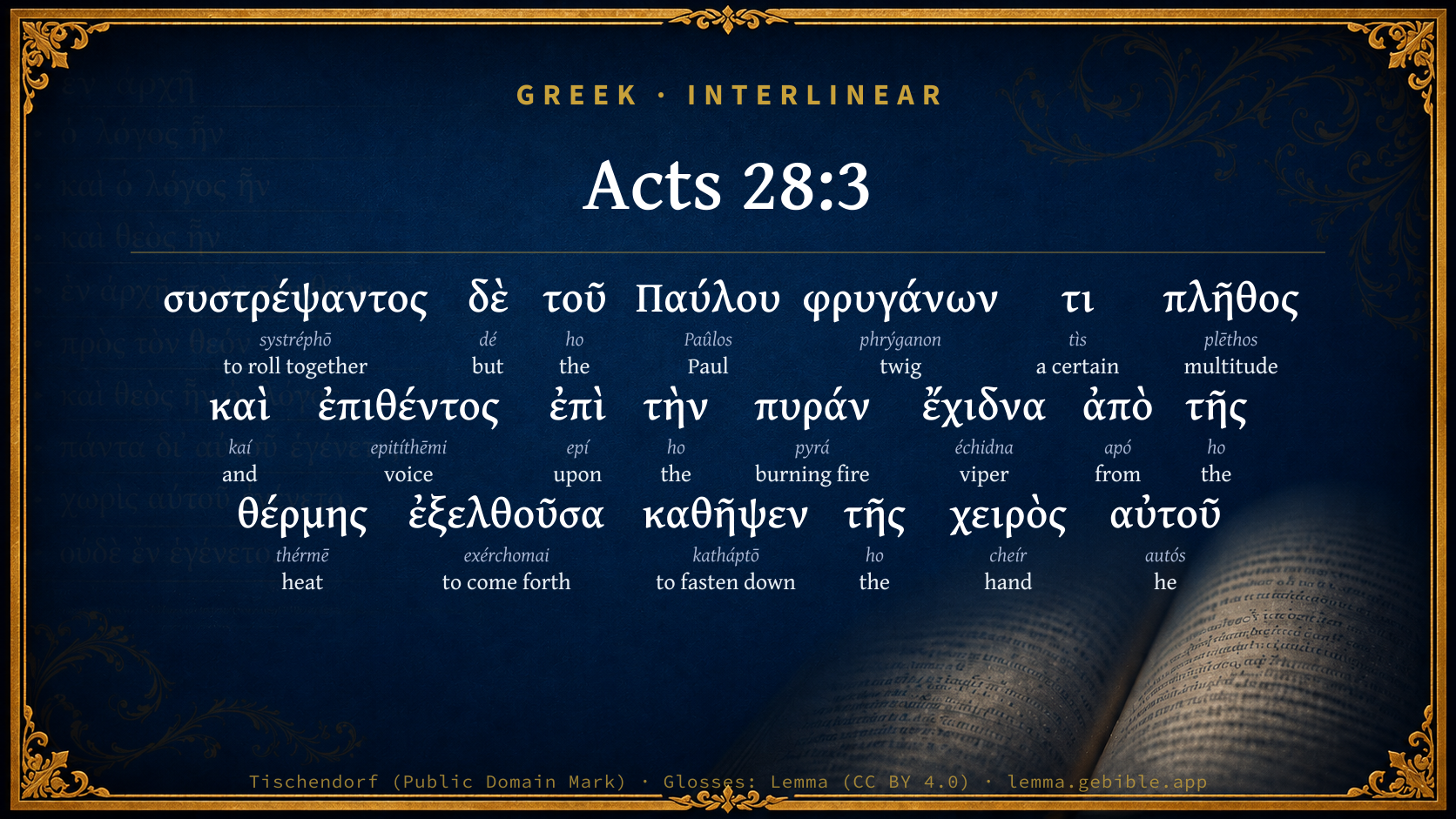
Greek (Tischendorf 8th ed.) Acts 28:3 appears in the Greek New Testament. The text above is from the Tischendorf 8th edition. Each word links to its Strong’s number and a concise gloss. Click any word for its full Thayer’s Greek Lexicon entry.
Download image
Cite this verse

Acts 28:3 (World English Bible). Public Domain. Lemma interlinear Bible study tool, https://lemma.gebible.app/v/acts/28/3.

Show BibTeX & RIS
BibTeX
RIS
English Translation
But when Paul had gathered a bundle of sticks and laid them on the fire, a viper came out because of the heat, and fastened on his hand.
World English Bible · Public Domain
Highlights
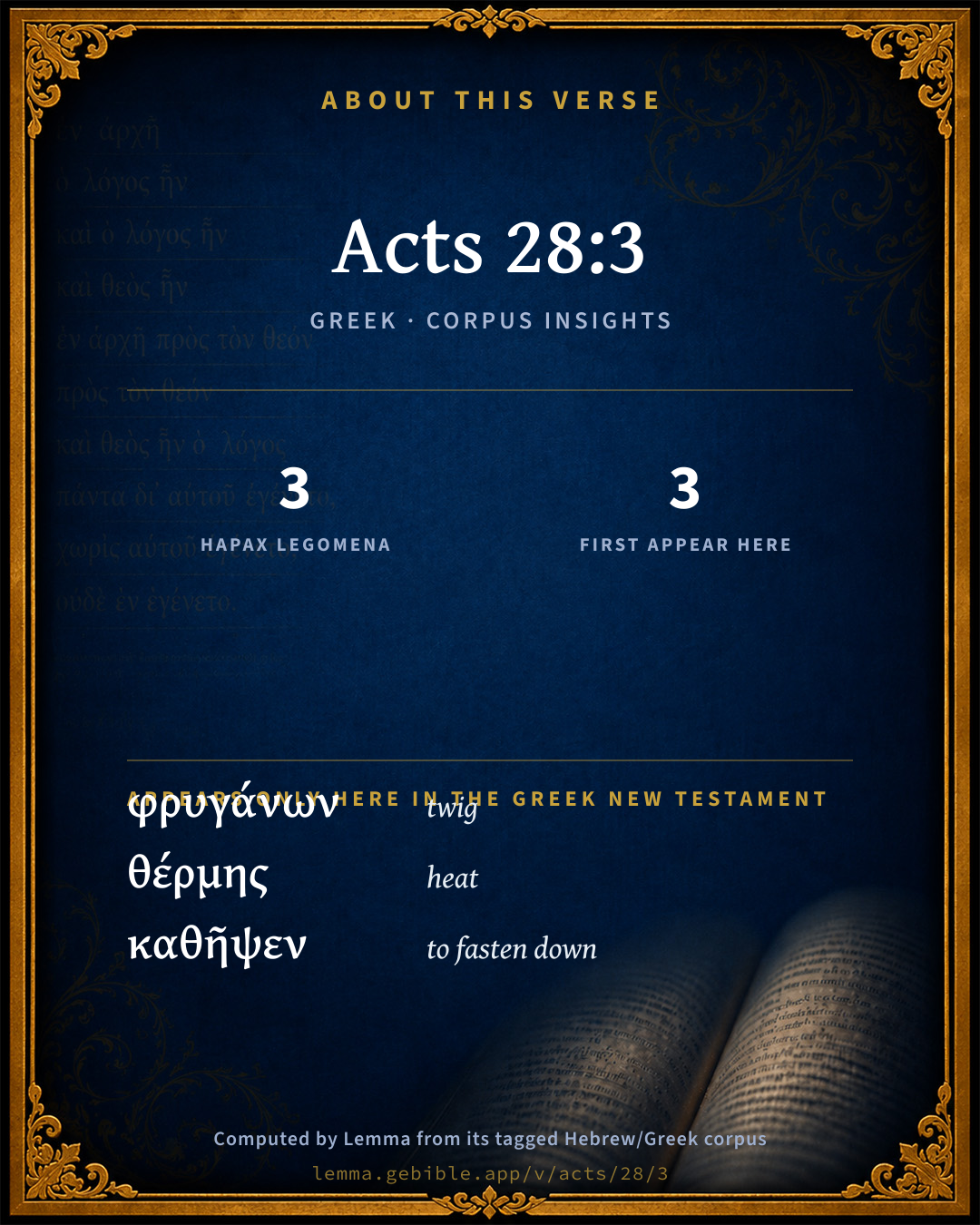
  • 3 hapax legomena — only here in the Greek New Testament
  • 3 first appearances in the Greek New Testament
Full analysis ↓
Download a study sheet

One document with this verse’s original text, its word-by-word gloss line, the meaning frame, cross-references with their text, attributed commentary, and full source and license credits — printable, and it pastes into notes with its structure intact.

This verse Autodidact and up

Study sheet (.html) Plain text (.txt)

A passage Seminary Student

Up to 50 verses in one chapter. A passage sheet keeps up to 6 commentary sources and 12 cross-references per verse, in the order this page ranks them, and says so on the sheet whenever that leaves anything out. Ask for a single verse and you get the Autodidact verse sheet above.

Everything on this page stays free to read, with no account — the sheet is a download of what is already on screen, not access to it.

Want to remove ads? Support Godless Engineer
Compare translations 3

The same verse in 3 English versions, stacked beneath the original-language interlinear above. Click any original word for its lexicon entry.

Each is an independent rendering of the whole verse — the interlinear is not word-aligned to these translations.

Highlighted words mark where these versions differ — a whole-verse word diff, not a word-by-word alignment.

  • World English Bible Public Domain
    But when Paul had gathered a bundle of sticks and laid them on the fire, a viper came out because of the heat, and fastened on his hand.
  • King James Version Public Domain
    And when Paul had gathered a bundle of sticks, and laid them on the fire, there came a viper out of the heat, and fastened on his hand.
  • unfoldingWord Literal Text CC BY-SA 4.0
    But when Paul had gathered a certain quantity of sticks and had placed them on the fire, a viper, coming out from the heat, seized his hand.

unfoldingWord Literal Text — © unfoldingWord, licensed CC BY-SA 4.0. Word-aligned USFM3 via Door43 (git.door43.org/unfoldingWord/en_ult).

Versions to compare (up to 4)

3 of 4 selected

Show all 19 translations

Every available English version of this verse, each an independent rendering of the whole verse.

  • World English Bible Public Domain
    But when Paul had gathered a bundle of sticks and laid them on the fire, a viper came out because of the heat, and fastened on his hand.
  • Berean Standard Bible Public Domain
    Paul gathered a bundle of sticks, and as he laid them on the fire, a viper, driven out by the heat, fastened itself to his hand.
  • Majority Standard Bible Public Domain
    Paul gathered a bundle of sticks, and as he laid them on the fire, a viper, driven out by the heat, fastened itself to his hand.
  • King James Version Public Domain
    And when Paul had gathered a bundle of sticks, and laid them on the fire, there came a viper out of the heat, and fastened on his hand.
  • American Standard Version (1901) Public Domain
    But when Paul had gathered a bundle of sticks and laid them on the fire, a viper came out by reason of the heat, and fastened on his hand.
  • Revised Version (1885) Public Domain
    But when Paul had gathered a bundle of sticks, and laid them on the fire, a viper came out by reason of the heat, and fastened on his hand.
  • Geneva Bible (1599) Public Domain
    And when Paul had gathered a nomber of stickes, and laid them on the fire, there came a viper out of the heate, and leapt on his hand.
  • Douay-Rheims (1899) Public Domain
    And when Paul had gathered together a bundle of sticks, and had laid them on the fire, a viper coming out of the heat, fastened on his hand.
  • Young's Literal Translation Public Domain
    but Paul having gathered together a quantity of sticks, and having laid `them' upon the fire, a viper -- out of the heat having come -- did fasten on his hand.
  • Literal Standard Version CC BY-SA 4.0
    but Paul having gathered together a quantity of sticks, and having laid [them] on the fire, a viper—having come out of the heat—fastened on his hand.
  • Unlocked Literal Bible CC BY-SA 4.0
    But when Paul had gathered a bundle of sticks and placed them on the fire, a viper came out because of the heat, and fastened onto his hand.
  • unfoldingWord Literal Text CC BY-SA 4.0
    But when Paul had gathered a certain quantity of sticks and had placed them on the fire, a viper, coming out from the heat, seized his hand.
  • Darby Bible Public Domain
    And Paul having gathered a [certain] quantity of sticks together in a bundle and laid [it] on the fire, a viper coming out from the heat seized his hand.
  • World Messianic Bible Public Domain
    But when Paul had gathered a bundle of sticks and laid them on the fire, a viper came out because of the heat and fastened on his hand.
  • Webster's Bible Public Domain
    And when Paul had gathered a bundle of sticks, and laid them on the fire, there came a viper out of the heat, and fastened on his hand.
  • Free Bible Version CC BY-SA 4.0
    Paul collected a bundle of firewood and threw it on the fire. But a poisonous snake was driven out of the bundle because of the heat and bit him, fastening itself on his hand.
  • Bible in Basic English Public Domain
    But when Paul had got some sticks together and put them on the fire, a snake came out, because of the heat, and gave him a bite on the hand.
  • Text-Critical English NT CC BY 4.0
    Paul gathered a bundle of sticks, and when he was putting them on the fire, a viper came out because of the heat and fastened on his hand.
  • Tyndale New Testament (1534) Public Domain
    And when Paul had gaddered a boundle of stickes and put them into the fyre ther came a viper out of the heet and lept on his honde.

Literal Standard Version (2020), Covenant Press — licensed CC BY-SA 4.0. Text via the HelloAO Bible API (eBible.org). Unlocked Literal Bible (unfoldingWord) — licensed CC BY-SA 4.0. Text via the HelloAO Bible API (eBible.org). unfoldingWord Literal Text — © unfoldingWord, licensed CC BY-SA 4.0. Word-aligned USFM3 via Door43 (git.door43.org/unfoldingWord/en_ult). Free Bible Version, Dr. Jonathan Gallagher — licensed CC BY-SA 4.0. Text via the HelloAO Bible API (eBible.org).

Word by word

More ways to search: Search by grammar → Find every occurrence → Compare this word →

Practice this passage: Drill this verse → Learn its vocabulary →

φρυγάνων
phrýganon
G5434
“twig”
Noun, Genitive, Plural, Neuter
Part of Speech
Noun
Case
Genitive
Number
Plural
Gender
Neuter
Full Thayer's Definition

Origin: from a presumed derivative of phrugo (to roast or parch, akin to the base of G5395 )

TDNT: None

1. a dry stick, a twig 2. all dry sticks, bush wood, fire wood, or similar material used as fuel a. of straw, stubble
  1. συστρέψαντος systréphō G4962 “to roll together” Verb, Aorist, Active, Participle, Genitive, Singular, Masculine
  2. δὲ dé G1161 “but” Conjunction
  3. τοῦ ho G3588 “the” Article, Genitive, Singular, Masculine
  4. Παύλου Paûlos G3972 “Paul” Noun, Genitive, Singular, Masculine
  5. τι tìs G5100 “a certain” Indefinite pronoun, Accusative, Singular, Neuter
  6. πλῆθος plēthos G4128 “multitude” Noun, Accusative, Singular, Neuter
  7. καὶ kaí G2532 “and” Conjunction
  8. ἐπιθέντος epitíthēmi G2007 “voice” Verb, Aorist, Active, Participle, Genitive, Singular, Masculine
  9. ἐπὶ epí G1909 “upon” Preposition
  10. τὴν ho G3588 “the” Article, Accusative, Singular, Feminine
  11. πυράν pyrá G4443 “burning fire” Noun, Accusative, Singular, Feminine
  12. ἔχιδνα échidna G2191 “viper” Noun, Nominative, Singular, Feminine
  13. ἀπὸ apó G575 “from” Preposition
  14. τῆς ho G3588 “the” Article, Genitive, Singular, Feminine
  15. θέρμης thérmē G2329 “heat” Noun, Genitive, Singular, Feminine
  16. ἐξελθοῦσα exérchomai G1831 “to come forth” Verb, Aorist, Active, Participle, Nominative, Singular, Feminine
  17. καθῆψεν katháptō G2510 “to fasten down” Verb, Aorist, Active, Indicative, 3rd person, Singular
  18. τῆς ho G3588 “the” Article, Genitive, Singular, Feminine
  19. χειρὸς cheír G5495 “hand” Noun, Genitive, Singular, Feminine
  20. αὐτοῦ autós G846 “he” Personal pronoun, Genitive, Singular, Masculine

About this verse

These counts appear in no published source. They are computed here, from the morphology-tagged text and Lemma’s own curated glosses. What Lemma adds →

21
words
18
distinct lemmas
Acts
section

Notable vocabulary

3 hapax legomena — words that appear only here in the entire Greek New Testament:

  • φρυγάνων twig G5434
  • θέρμης heat G2329
  • καθῆψεν to fasten down G2510

First appearance in Scripture

These words make their first canonical appearance in the Greek New Testament here:

  • φρυγάνων twig G5434
  • θέρμης heat G2329
  • καθῆψεν to fasten down G2510

Shared distinctive vocabulary

συστρέψαντος to roll together G4962 occurs in 2 verses of the Greek New Testament. Also found in:

Repetition

A word recurs within this verse:

Cross-references

10

Topical passages linked to Acts 28:3 in the Treasury of Scripture Knowledge — connected by theme and wording, ordered by reader-vote popularity; previews shown in the World English Bible.

  • Matthew 23:33 You serpents, you offspring of vipers, how will you escape the judgment of Gehenna?
  • Matthew 12:34 You offspring of vipers, how can you, being evil, speak good things? For out of the abundance of the heart, the mouth speaks.
  • Acts 28:4 When the natives saw the creature hanging from his hand, they said one to another, "No doubt this man is a murderer, whom, though he has escaped from the sea, yet Justice has not allowed to live."
  • 2 Corinthians 11:23 Are they servants of Christ? (I speak as one beside himself) I am more so; in labors more abundantly, in prisons more abundantly, in stripes above measure, in deaths often.
  • Job 20:16 He shall suck cobra venom. The viper's tongue shall kill him.
  • Isaiah 30:6 The burden of the animals of the South. Through the land of trouble and anguish, from whence come the lioness and the lion, the viper and fiery flying serpent, they carry their riches on the shoulders of young donkeys, and their treasures on the humps of camels, to a people that shall not profit [them].
  • Isaiah 41:24 Behold, you are of nothing, and your work is of nothing; an abomination is he who chooses you.
  • Isaiah 59:5 They hatch adders' eggs, and weave the spider's web: he who eats of their eggs dies; and that which is crushed breaks out into a viper.
  • Matthew 3:7 But when he saw many of the Pharisees and Sadducees coming for his baptism, he said to them, "You offspring of vipers, who warned you to flee from the wrath to come?
  • 2 Corinthians 6:9 as unknown, and yet well known; as dying, and behold, we live; as punished, and not killed;

Cross-references courtesy of OpenBible.info (CC BY 4.0).

Commentary

Notes on Acts 28:3 from classic Christian and Jewish commentators (each source and its license shown beneath its notes). The classic Christian expositions comment on the surrounding passage and are grouped to its opening verse, so a note may address several verses; the Jewish commentaries on the Tanakh (Rashi and others) are per-verse, so they appear only where the commentator wrote on this verse.

Lemma curates 59 commentaries, every one of them public domain or Creative Commons licensed, each selected and text-cleaned for this edition rather than reprinted as found. About our sources →

The Biblical Illustrator

Joseph S. Exell

Act_28:3-6

And when Paul had gathered a bundle of sticks, and laid them on the fire.

How to keep up the fire

If a man wants a fire kept up, he must do his share in supplying its fuel. It will not burn long unless it is replenished. Those who need its warmth, because of the present rain, and because of the cold, are the ones to gather sticks for it. It was down on the coast of Florida, in war time. A little band of Christian soldiers held a weekly prayer meeting in a church building, deserted of its ordinary congregation. One evening a new voice was heard there. An officer who had been in frequent attendance, but who had not before taken part in the exercises, said: I am not accustomed to speak in prayer meetings. I do not feel competent to that service. But I have so greatly enjoyed these meetings, week after week, that I have thought it was hardly fair for me to be always warming myself by this Christian fire without ever furnishing an armful of fuel; so I rise to tell you that your Saviour is my Saviour, and that I am very grateful for all the help and cheer you have been to me in His service, at these week night prayer meetings. And as that little bundle of sticks was thrown into that army prayer meeting fire, the flame flashed up there in new light and warmth, and more than one soldier present rejoiced afresh in its glow. When did you gather the last bundle of sticks for the fire of your church or neighbourhood prayer meeting? It may be by timely words of exhortation or prayer, that you supply your share of the fuel. It may be by a part in the service of song. Or it may be by the responsive look in your face, which helps him who leads, through its assurance that one at least of those before him is all aglow with love for the truth he emphasizes. In one way or another, you ought to supply a bundle of sticks to keep your prayer meeting fire a-going. (H. Trumbull, D.)

There came a viper out of the heat and fastened on his hand.

Vipers and hands

There are certain hands that the viper does not mind to fasten upon. It pays little heed to the idle, greedy, or prayerless hand; it has poisoned these already, and can leave them alone. Let us look at--

I. The viper and the busy hand. It was when Pauls hand was busy that the viper fastened on it. Satan finds some mischief still for idle hands to do, or rather allows them to find mischief for themselves. But he hates the busy hand and tries to poison it and make it idle. When you are diligent at any task look out for the viper. Whenever you say, Oh I whats the use! or, Never do today what can be done tomorrow, beware of the viper on the busy hand. Shake it off! It will sting you into idleness, and then Satan will have no difficulty in getting you to do what he likes.

II. The viper and the open hand. Satan likes close-fistedness; but when he sees an open, generous hand, the old serpent fastens on it. I will tell you how you may know when it is there. Here is a lad who yesterday got his weeks wages. When in church he hears the minister pleading on behalf of some heathen children, he begins to ask, What have I to do with them? The money is my own. Or on your way to the Sabbath school you may be tempted to halve the penny you had determined to put into the mission box. Satan does not wish you to give anything to carry the gospel to your brothers and sisters afar off. He knows that you are helping Christ to bruise his head. There is a beautiful legend of an old English open-handed king. After King Oswald learned Christ, he was feasting one day with Aidan the Bishop, when he was told that a hungry multitude waited around his door. He sent out to them the untasted feast, and divided among them the silver dishes, so that Aidan blessed his hand, saying, May this hand never grow old. Some time afterwards Oswald fell in battle, and, as his limbs were cruelly cut up and hung upon stakes by the enemy, it was observed that the hand that Aidan had blessed--the open hand of Oswald--remained white and uncorrupted. God loves the open hand, but the viper fastens on it. Look to God and shake it off!

III. The viper and the praying hand. We are told to lift up holy hands of prayer without wrath and doubting. Satan hates the hands of prayer. The praying boy or girl keeps so near Christ that Satan can scarcely do any harm. He wishes you to stop praying, in order to get the better of you. Have you never felt weary, or heard a voice saying to you, What does God care for a boy or girl like you? or, How can He hear you in the heavens? The viper has fastened on your hand. Pray all the more earnestly for power to shake it off! (W. Dickie, M.)

The shipwrecked apostle

Luke puts the personality of Paul before us with great vividness. He was the foremost of the apostles.

1. Notice this conspicuousness of Paul in its many features.

2. The personal qualities of Paul. He was a born leader, a many-sided man. Again, we notice that with this promptness, readiness and power of controlling circumstances there is also a cheerfulness of spirit. Some look only on the dark side. They seem unwilling to admit that the moon itself has a bright side. Pauls cheerfulness is contagious. He tells the men that they will be saved. The face of Keats wore the radiance of an angel. Lord Holland each morning looked as if he had just received good news. I think that they must have prayed, Lord, lift Thou the light of Thy countenance upon us. Though smarting, bleeding, hungering, and oppressed, Paul was always rejoicing in hope and making others glad.

3. The usefulness of St. Paul is seen in his building a fire. He gathers a bundle of sticks. He is foremost in service. He does not say that this is the work of a servant. The higher a man is, the more a minister he comes to be. Nobility obliges. He does not preach to them, but gathers fuel. He is useful when away from home. See how this usefulness worked out. The barbarians--that is, the bearded people, as the shaven Greek looked on the unshaven foreigner--showed us no common kindness. Paul healed the sick among them, and yet said that he was debtor to them. In doing good you reap a benefit.

4. Finally, see the terrible irony of life. The hands are stretched out for warmth, and poison enters. We look for good, and behold evil is ours. This is the sarcasm of life. Hezekiah has the added years he prays for, and finds in them added sorrow. Samson carries off the gates of Gaza that vainly held him, but comes eyeless and woful into a Philistine prison at the end. Abraham has a son, but is told to slay him. David has the crown, but weeps over the treason of Absalom and finally over his dishonourable death. (H. Gallaher, D.)

The deadly viper

There are a great many vipers with deadly poison in their fangs, ready to fasten on the hand of any Christian man or woman who gathers a bundle of sticks, i.e., has to do with secular affairs. There are--

I. The viper to which the business man is exposed. How many hands, busy in trade, that old serpent fastens on, and will not let go! If he does not kill them outright with his poisonous principles and temptations, he at least wounds their honour, peace, usefulness, and Christian standing. Shake off the viper into the fire, man of business! Hesitate not, or you are a dead man!

II. The viper of indifference has fastened itself on the hand of very many nominal Christians. Woe unto them that are at ease in Zion! And how many there are, and what peril they are in! I would thou wert cold or hot, etc.

III. The viper of unbelief. To reject and cast away Gods Word, as many do, is to uncover a nest of vipers and lie down in the midst of them.

IV. The viper of prejudice. This, when it gets firm hold of a man, is a terrible power, a most malign influence, and if he do not shake it off into the fire, it will poison his life, warp his judgment, and kill his influence. How intense is the power of prejudice in social life, in politics, in matters theological and ecclesiastical!

V. The vipers of evil habits, such as gambling, drunkenness, tippling, Sabbath desecration, social dissipation at the theatre, are of the deadliest sort. Few escape on whom they once fasten. Their sting is deadly. Shake off into the fire that venomous serpent which has wriggled out of the bundle of sticks you have gathered; or, as sure as the wages of sin is death, you are doomed, and that speedily! (Homiletic Monthly.)

The vipers dart

I. Everywhere in the pursuit of duty we must expect the viper or the serpent to dart out upon us. Everywhere in the path of obedience to the higher calls of life we shall find ourselves beset by difficulties and assaults which will probably succeed too well in doing what the viper failed to do to the apostle. We shall find ourselves often wounded in the hand, at any rate according to the old prophecy, in the heel. Well for us if we are on our guard and ready instinctively to shake off the attacks and, God-protected by Divine grace, to feel no harm!

1. Professional life, business life, trade, or work well illustrates what I mean. It is one of the most necessary things in the world. It supplies the needs of human life. It is the method by which the members of the human family perform their duties as members one of another. It creates some of the most valuable parts of human character. Energy, quickness, power of organisation, invention, discovery, method, calculation, experience, soberness of mind--these are some of its results on character. But how often do we see the viper dart out from the midst, and fasten on a mans hand! How often do we see trade or business blunting the higher and nobler faculties of human life, blinding the soul to the spiritual world, exhausting all the natural energies in merely material interests, and sometimes--alas! too often--undermining the uprightness and honesty of a hitherto spotless character! How often do we see the hand or the heel wounded, while all power to shake off the venomous beast seems to have deserted the soul!

2. Or look at knowledge in its many branches. What is more fascinating or delightful? It moves at will up and down the history of the world, entering into all great events, revealing the motives and actions of the greatest of mankind, making the past almost as real as the present. It penetrates into the deepest and closest recesses of mans being--his instincts, his motives, his intellectual powers, his loves, his joys, his sorrows. But even here, my friends, be on your guard; even here the viper darts out and is ready to fasten on the hand. For there are spheres of truth which reason can only enter hand in hand with faith, and reason is apt to rise in rebellion, and flash scorn on that which is beyond its ken, and glory in its ignorance or, as it prefers to phrase it, its agnosticism.

3. Or is there anything more beautiful than friendship in its many forms? It is on its widest score the bond of society, and without society of some sort life would be intolerable. It is in narrower limits the bond of that home life of which we in England are so justly proud. In its deepest and intensest forms it is one of the dearest bonds we know on earth. Grow on, dear friends, deeper and deeper into the joys of friendship and of love; make your homes more homelike; let society be worthy of the name; but still beware of the trail of the serpent. Under the guise of friendship and of love how many evil influences are at work, you all know too well. Too often the viper has fastened on the hand, and desolate homes and ruined lives and wasted love have been the last results.

4. The serpent has penetrated paradise, and all mans life is henceforth lived in his presence. The Church is the paradise of God on earth; the nearest meeting place of man with God; the home of grace; the refuge of penitent sinners; the resting place of Gods revelation; the souls best and truest home. It is here that you can do the greatest works for God; that you can lead others to know the happiness which you have found. It is here that you may be the light of the world, and the salt of the earth. It is here that you may be Gods band of labourers, fellow workers with God. Yet here, too, beware the dart of the serpent. Here he fastens upon and wounds the hand. Here sometimes narrowness, and bitterness, and obstinacy, and self-will, and proud contemptuousness, and prejudice, and jealousy, and littleness of spirit may mar and spoil what God intended.

II. St. Paul shook off the venomous beast into the fire, and felt no harm, because he did it instinctively the moment the dart was made, and because he was God-protected by the last promise of our Lord to His disciples. It is only by the religion of Jesus Christ that we can cast off the serpent. It can only he through high communion with God and a constant sense of His loving presence that you and all can dwell safely and have the blessings of life. (J. Weston Townroe.)

Paul and the viper

Or the servant of God, the conqueror of serpents in the power of his Lord (Mar_16:18). He casts from him,

1. The venomous serpent of slander (verses 3, 4).

2. The shining adder of flattery (verse 6).

3. The dangerous reptile of worldly anxiety and cares (verses 8, 9).

4. The old serpent of sin (with application to verse 4, a murderer). (K. Gerok.)

Paul bitten by a viper, and uninjured

I. In what light it was viewed by the people present.

1. As a judgment for a heinous crime.

2. As an evidence that he was a god.

II. In what light it should be viewed. It was intended by God as--

1. A means to awaken their attention to the gospel.

2. A standing memorial of His care over His faithful servants.

Conclusion: Learn from hence--

1. Justice to man.

2. Confidence in God. (C. Simeon.)

They said … no doubt this man is a murderer whom … vengeance suffereth not to live.--

Uncharitable judgments

How easy it is to be sure that other people deserve punishment, and are getting it. If we are in trouble, we wonder why God afflicts us. At all events, we are not to blame for our misfortunes. If the trouble is at our next-door neighbours, it is plain enough where the fault lies. If their house is robbed, there is no doubt that they were very careless in leaving their doors and windows unfastened. If their children are disobedient or graceless, there is no doubt that the parents sadly neglected them. If those neighbours lose their property, there is no doubt that they are always extravagant or shiftless. With what guileless simplicity the disciples came to Jesus, asking about the blind man, Master, who did sin, this man, or his parents, that he was born blind? After all, those Maltese barbarians were not so different from the rest of us. It is good enough for him, or, It is what we might have expected, is the judgment we too often pass upon one whom, without good reason, we esteem smitten of God, and afflicted. Who art thou that judgest another? (H. Trumbull, D.)

The general belief in justice and retribution

I. There is a general sense of divine justice among men.

1. This conviction exists, often imperfect and perverted, but still so manifesting itself, as it did on this occasion, as to show that it lies deep in the human mind. There are things remaining in fallen man--perceptions of what is right, and promptings to what is right, which show what he originally was, and which show also the character of the government under which he is placed. These things resemble the half-effaced inscriptions found on ancient tombs and monuments. The letters and dates are half-obliterated; but skill may enable us to fill up the inscription; to put in a letter here, and a figure there, so as to leave no doubt that the true words are restored. In like manner, there are in the soul, half-effaced records of mans original nature and dignity. From them alone we never could know entirely what man originally was. Yet when they are filled up with the knowledge imparted by revelation, the record becomes complete. Among these traces left upon the hearts of men, are--

(1) The belief in some form of a Divinity, or Divine government, as was indicated in the case of these islanders.

(2) A sense of justice, and a feeling that the guilty deserve to be punished.

2. Whenever men have embodied their sentiments in codes of morals, it has been done in accordance with this view. There are no books on morals, in any language, or age, which do not make a distinction between right and wrong; and for the most part, in regard to the same actions.

3. The same views are found in a community before there are regular laws in regard to the administration of justice. There never has been a nation or tribe which had not some notions that the guilty should be punished, and especially that a murderer ought not to escape. In the earliest ages it was a universal conviction that the duty of avenging the blood of the slain devolved on the nearest of kin (Num_35:19, seq.; Deu_19:6; Deu_19:12; Jos_20:3; 2Sa_14:11). Such a person was recognised in all Oriental nations, and among American savages. The avenger of blood was the minister of justice--one who represented that every man felt to be a carrying out of the Divine purpose in the infliction of vengeance.

4. The same thing is true in regard to the laws of men. As the world advances in civilisation, arrangements for the punishment of crime enter into all laws.

II. There is an arrangement under the divine government by which crime will be detected and punished. This was evidently the belief of these islanders; and it was founded on a state of things which was then open to observation, and which exists everywhere. This might be proved in reference to all forms of guilt. The boy at school who does a wrong on the supposition that it will be undiscovered, or the boy who robs an orchard at night, is often surprised to find that there was some observer, or that some circumstance of which he was not aware has brought his deed to light. But it will be more appropriate to illustrate this in reference to murder. These islanders believed that the goddess of vengeance would not suffer the murderer to go unpunished, although he had survived one peril. They were in error in supposing that this particular thing was proof; but they were in the right in believing that there is an arrangement designed to find out the murderer. Murder will out. There is--

1. The awakened vigilance in every community, making every man feel that he has a personal responsibility in securing, it he can, the punishment of the murderer.

2. The difficulty of concealing the crime. In itself considered, it would not seem to be difficult to obliterate all traces of a murder; to place the knife where it could not be found; to burn a garment so that it should not reveal the stain; or to dispose of the body so that no traces of it could be found. Yet nothing is more difficult.

3. The slight circumstances through which detection occurs--a lock of hair, a footprint, an unguarded remark, the possession of some article of little value, etc.

4. The madness of him who has committed the crime. Remorse, compelling him to confess; troubled dreams; the fear of every man.

III. There is a general conviction that it is proper and right that this should be so. These islanders acquiesced in the arrangement, and saw in the fastening of the viper on Pauls hand that which was right in the case. On no subject have the sentiments of men been more decided and unanimous than on this. We may observe here that punishment is not primarily for the reformation of the guilty, nor for the mere security of a community against the commission of crime. There is a higher idea, which is founded on the fact that justice demands it; and when punishment is inflicted--when the murderer dies, the world at large acquiesces in it as right. Conclusion:

1. These things have been written in the human heart by the hand of God Himself.

2. The sinner lives in a world over which a just Being presides, and where justice demands punishment.

3. Wherever the sinner goes, this demand will follow him.

4. The universe will assent to the final punishment of the sinner.

5. There is a way in which the guilty may escape from impending judgment (Isa_53:4-6). In Christ the guilty may find pardon; through Him the pardoned sinner will be safe on sea or land; whoso believeth on Him will be no more exposed to wrath in this world or in the world to come. (A. Barnes, D.)

Why we suffer

I. For sin.

1. This exclamation would not have been less impressive or natural had these Maltese been barbarians in our sense of the word. But they were barbarians only in the sense in which we should be barbarians in France or Germany if we did not understand the language. The conviction they expressed was universal. Neither barbarism nor civilisation had anything to do with it. A Jew, no less than a pagan, a Roman, or a Greek, would have jumped to the same conclusion. The very apostles themselves, over a much less striking and dramatic instance, asked: Who did sin, this man or his parents, that he was born blind? And no modern advance of thought has eradicated, or will eradicate, the stubborn instinct which teaches men to connect suffering with guilt. Even the most advanced thinkers admit, not only that there is some connection between sin and suffering, but also that the connection is one of cause and effect. It is a natural and primitive instinct, and it is only by a resolute use of our reasoning faculty that we have been able to control it.

2. Admitting the instinct, we ought also to admit its testimony. We are so made and bred that we cannot, without a supreme effort, attribute the ordering of events to chance or accident. We feel instinctively that a Divine Nemesis manifests itself both in the order of the world at large and in the lot of individual men. Before a man can get rid of this wholesome religious conviction he must both unmake and remake himself: and then he will be very apt, despite the prevalent petticoat positivism, to revert to his original type.

3. For the conviction is a true one, though it often assumes questionable forms. It is true that all suffering springs from sin and bears witness against it, though it is not true either that we can always trace the suffering to its cause, or that the effects of a sin are always confined to the person who commits it. St. Paul traces death, e.g., to sin; yet not every mans death to every mans sin. On the contrary he argues--one sinned, all died. And it is at this point that men have always been apt to go wrong. The broad fact is true, but men have commonly misinterpreted it. They have assumed that they can invariably trace the physical effect to its immediate ethical cause, and that the cause is invariably to be found in the conduct of those who suffer the effect. You know how impossible it proved for our Lord Himself to dislodge these assumptions from the minds of the men of His own day. Suppose ye, He said, that these Galileans were sinners above all the Galileans, etc. An hour before the tower of Siloam fell, many of them, I dare say, would have shrunk from placing themselves high above those on whom it crashed down. But the moment the tower fell, that question was settled for them by God Himself, and their escape was a most gratifying proof of their moral superiority, though of course they were very sorry for the poor people who had been killed. Let us learn, then, that suffering, either personal, domestic, or national, is not always the result of sin; Job suffered many calamities; yet Job was a perfect man and an upright. If men always suffered for or in proportion to their sins we should be driven to the intolerable conclusion that the Greatest Sufferer was also the Greatest Sinner; that He who knew no sin was the very Chief of Sinners!

II. For our good. We are purged, not because we do not bring forth fruit unto holiness, but that we may bring forth more fruit. The greater welfare of Job, e.g., was both an intention, and an effect, of the sufferings inflicted on him. In like manner St. Paul long writhed on the stake in his flesh, in order that the unsuspected resources both of his own nature and of the grace of God might be developed in and upon him. And, still in the like manner, we are taught that the Man Christ Jesus learned by the things which He suffered; and that He was the more highly exalted because He humbled Himself to pain, and grief, and death.

III. For the good of others.

1. If Christ suffered more than other men, it was that He might become the Saviour of all men. If St. Paul long writhed in agony, it was that the power and grace of God might shine the more conspicuously through him on the world around. The affliction of Job was designed for the teaching of his friends and neighbours, and for ours. The blind man about whose sin the disciples were perplexed suffered that the works of God should be made manifest in him--not because he was a sinner, but that he might first open his eyes on the Friend and Saviour of sinners, and get sight for his spirit as well as for his body. And through this man the enlightening and redeeming power of Christ has been set forth, in an impressive figure, to all the world.

2. By calling our attention to him, Christ has taught us to look, in all our own sufferings, for some similar Divine intention and work. They may, or may not, be the consequences of, or the correction for, our sins. But they are always designed for the manifestation of some work of God Which will promote our welfare and that of those around us.

3. Now we all see, I think, that if, when we suffer, we were to fling away, as St. Paul flung off the venomous beast, all that is evil in suffering, all in it that tempts us to distrust or complaint, and to recognise the loving work and intention of God in it, we should be the gainers by it. And we can also see that, were we to take our suffering patiently, bravely, cheerfully, we should be teaching a valuable lesson and giving valuable help to others; that even those who once thought we were sinners above other men because we suffered such things would come to think we were braver and better because we suffered them so patiently, and be led to ask whence we got our patience and our courage.

4. This suffering for the good of others is, indeed, demanded of all who follow Christ. For if any man will follow Him, he must take up his cross, etc. Now the very commonest form of affliction is the pain we feel at the loss of those whom we love. Is it love, is it not rather self-love, which makes us so bitterly regret our loss that we refuse to be comforted? If, for them, to die is gain, shall we grudge them the gain because it involves loss for us, and yet call ourselves the servants and friends of Christ, who loved not Himself, but lived in and for others? If we had more of the spirit of Christ, love would teach us a joy in our friends gain which would more than counterbalance our grief for their own loss. And common as this kind of affliction is, it affords us a rare opportunity of bearing witness to the power and grace of God. (S. Cox, D.)

Howbeit … after they … saw no harm come to him, they changed their minds, and said he was a God.--

Heathen conclusions from portents

This was quite in accordance with heathen modes of thought. The whole story of the wanderings of the wine god, Dionysus, is little more than a record of how the god came to this or that place and was received as a man, till, astounded by some portent, the people changed their minds, and said that he was a god. Thus, when he came to Argos, the people would not acknowledge him; but, after he displayed his divine powers in the punishment of certain offenders, they hailed him as a god, and erected temples in his honour. How large a place was occupied in heathen thought by portents is shown in the list given for Dionysuss voyage from Icaria to Naxos. The sailors decided to sell him as a slave, and so abandoned the proper route. Thereupon the masts and oars became serpents, ivy grew up around the vessel, the sound of invisible flutes was heard, Dionysus transformed himself into a lion, and the sailors, struck with madness, flung themselves into the sea. The people would also have a certain selfish element in their recognition of Paul as a god. Doubtless many of them remembered how Jupiter and Mercury came down to earth as men, and how those who refused to receive them were destroyed by an inundation, while only Philemon and Baucis, their kindly host and hostess, were saved. (S. Times.)

The fickleness of popular opinion

When a good man is roundly abused by the public, he may find comfort, if he needs it, in the conviction that the pendulum of popular opinion will doubtless soon swing as far toward the other extremity of its are as it now swings toward this. Illustrations of this truth are innumerable. If the ten Americans of our first century, who in their day had most of denunciation from press and platform, were now to be designated, it would perhaps be found that bronze statues of no less than six of them are already in our public parks, and that the names of at least as many are popularly counted synonyms of political pretty or of personal integrity. But, after all, popular opinion is as likely to be extreme and unfair in one direction as in another. We may well hesitate to believe that a political candidate, a representative official, or a religious teacher, is either a murderer or a god--merely because editors or other people say so. (H. Trumbull, D.)

The Biblical Illustrator, edited by Joseph S. Exell (c. 1880s–1900s) — public domain. Text from a community e-Sword module.

Joseph Benson's Commentary

Act 28:3-4. And when Paul — Who had learned to make himself servant of all, and would stoop to any thing by which he might be serviceable, was laying on the fire a bundle of sticks — Which he had gathered; there came a viper — Which had been concealed among the wood; out of the heat, and fastened on his hand — Round which it probably twisted itself, and bit it. And when the barbarians saw the venomous beast — Or the fierce animal, as θηριον should rather be translated; the word beast being a very improper term for it; they said — Seeing also his chains; No doubt this man is a murderer — “They concluded he was a murderer, (says Elsner,) rather than a person guilty of any other crime, because they saw the viper hanging on his hand, which therefore they judged to have been the offending member, according to the rule which prevailed among the ancients, that persons were often remarkably punished in that part of the body which had been the immediate instrument of their sin;” whom, though he hath escaped the sea — Hath not been destroyed by the tempest and shipwreck; yet vengeance suffereth not (Greek, ουκ ειασεν, hath not suffered) to live — They looked upon him as, in effect, a dead man already, after having been bit by that venomous creature. The poison of a viper so inflames the blood, that a person infected with it is usually tormented as with fire, and quickly dies. For this reason, the ancient Scythians, in war, used to dip their arrows in the blood and gaul of vipers, that their enemies wounded by them might die a painful and sudden death. And, in some remote times, some condemned criminals were put to death by vipers set to their breasts: by this means Cleopatra despatched herself. Though δικη, (justice, or judgment,) here rendered vengeance, may be understood of the divine vengeance in general; yet, as these were the words of heathen idolaters, possibly they might refer to a deity worshipped among them under that name; as we know the Greeks and Romans had a goddess whom they termed Νεμεσις, Nemesis, the daughter of Justice, who, they supposed, punished the wicked. It must give us pleasure to trace among these barbarians the force of conscience, and the belief of a particular providence; which some people of more learning have stupidly thought it philosophy to despise. But they erred in imagining that calamities must always be interpreted as judgments. Let us guard against this error, lest, like them, we condemn, not only the innocent, but the excellent of the earth.

Joseph Benson's Commentary on the Old and New Testaments (1811–1818) — public domain. Text from a community e-Sword module.

Tyndale Open Study Notes

Tyndale Open Resources

28:3-6 The locals of Malta understood justice as a personified power or deity carrying out judgment on a criminal. When nothing bad happened to Paul, the natives understood him as having power over snakes and concluded that he himself was a god (cp. 14:11-12). In fact, Paul’s survival demonstrated God’s protection (cp. Mark 16:17-18).

Tyndale Open Study Notes — © Tyndale Open Resources, licensed CC BY-SA 4.0. Text via the HelloAO Bible API.

Bengel's Gnomon

Johann Albrecht Bengel

Act 28:3. Συστρέψαντος, when Paul had gathered) An example of his working with his own hands (αὐτουργία): ch. Act 27:19. He did the office of a prisoner submissively, helping others also thereby.—φρυγάνων, of sticks, brushwood) in which the viper lay hid in the cold season.—τὶ πλῆθος) τὶ is omitted by more modern copies.[155]—ἀπὸ) ἐκ is the reading of more recent copies.[156] Ἀπὸ τῆς θέρμης, from the heat [owing to the heat], is considered by Grotius to be clearer. So, saith he, ἀπὸ τοῦ ἰοῦ, ἀπὸ τῆς λύπης, are often used among the Greeks in signifying a cause.—καθῆψς) viz. ἑαυτὴν, attached itself to his hand. See Suicer’s Thesaurus. Presently there follows κρεμάμενον, hanging, Act 28:4.

[155] ABC support τί. Vulg. Amiat. MS. omits it. as also later Syr. and Rec. Text.—E. and T.

[156] ABC, ἀπό. Rec. Text, ἐκ.—E. and T.

Bengel's Gnomon of the New Testament — English translation (T&T Clark, Edinburgh, 1860) — public domain. Text from a community e-Sword module.

Meyer's Critical & Exegetical Commentary

Heinrich August Wilhelm Meyer

Act_28:3. Ἀπὸ τ. θέρμ.] (see the critical remarks) on account of the heat.[176] See Winer, p. 348 [E. T.465]; Hermann, ad Arist. Nub. 834. The reading ἐκ would have to be rendered: from out of the heat.

διεξελθοῦσα] Plat. Pol. iii. p. 405 C; Phaed. p. 109 E; Xen. Anab. vi. 6. 38; 2Sa_2:23. It denotes that the viper came out from the brushwood in which it was, and through the layer of the same which was above it. See Bornemann, and Kühner, ad Xen. Anab. vi. 6. 38.

καθῆψε τῆς χειρὸς αὐτοῦ] it seized on his hand. Comp. Arr. Epict. iii. 10. 20; Lobeck, ad Aj. 700. The reading καθήψατο, recommended by Griesbach, following C, min. Chrysostom, al., appears to be an emendation. That this καθῆψε took place by means of a bite, Luke himself makes sufficiently evident in Act_28:4 by κρεμάμενον … ἐκ τῆς χειρὸς αὐτοῦ; but it follows decidedly, and without rashly leaping to a conclusion, from the judgment, from the expectation, and from the subsequent ἜΛΕΓΟΝ ΘΕῸΝ ΑὐΤ. ΕἾΝΑΙ of the Melitenses, Act_28:4; Act_28:6, in all which it is necessarily presupposed that they, the near bystanders, had actually seen the bite of the serpent. From this at the same time it follows just as certainly, that the animal must have been definitely known to the islanders as a poisonous viper. Hence we must reject the view of Bochart, Hieroz. ii. 3, p. 369: illigavit se etc., nempe ut … morderet, sed earn cohibuit Deus, sicut leones illos, Dan_4:22, and of Kuinoel (comp. Heinrichs): erat autem vipera ista aut non venenata, etsi Melitenses eam pro venenata habuerint, aut si erat, insinuavit quidem se Pauli manui, non vero momordit. The latter (also hinted at by Ewald) follows least of all from ἔπαθεν οὐδὲν κακόν, Act_28:5, by which the very absence of result (brought about by special divine help) is placed in contrast with the poisonous bite. Nevertheless, Lange (apost. Zeitalt. II. p. 344 f.) supposes that the reptile may have hung encircling his hand without biting, and Lekebusch, p. 382, that Luke had in view the alternative contained in Kuinoels explanation. Indeed, according to Hausrath, the judgment in Act_28:5 is only ascribed to the islanders by Luke. They were, as he thinks, aware that there were no poisonous serpents with them, and that thus the bite was not dangerous.

[176] On the late form θέρμη, instead of θέρμη, see Lobeck, ad Phryn. p. 331.

Meyer — Critical and Exegetical Commentary on the New Testament — English translation by Peter Christie, edited by Frederick Crombie (T&T Clark, 1880) — public domain. Text from a community e-Sword module.

Expositor's Greek Testament

ed. W. Robertson Nicoll

Act 28:3 . συστρέψαντος : here only in Acts, but cf. Act 11:27 , Act 16:39 , in [425] text; = exemplum αὐτουργίας , Bengel. Cf. Mat 17:22 , W.H [426] , R.V. margin; of collecting men, 2Ma 14:30 . φρυγάνων : brushwood, copse; the furze still growing near St. Paul’s Bay would well afford material for a fire (Lewin), and it may be quite true that wood is found nowhere else but in a place at a distance from the Bay; in classical Greek used in plural for dry sticks, especially firewood; here only in N.T., but several times in LXX, for straw, stubble, and bramble. τι before πλῆθος , see critical note: implying as much as he could carry, Weiss; πλ . used elsewhere of persons. ἔχιδνα : the objection that no poisonous serpents are found to-day in Malta, like that based on the absence of wood in Act 28:2 , may well be dismissed as “too trivial to deserve notice; such changes are natural and probable in a small island, populous and long civilised,” Ramsay, St. Paul , p. 343, Breusing, p. 191, Vars, p. 243; so too J. Smith, p. 151, 4th edition, refers to the gradual disappearance of the viper in Arran as the island became more frequented, and cf. Hackett’s note for similar proof. Mr. Lewin, as late as 1853, believed that he saw a viper near St. Paul’s Bay, St. Paul , ii. 200. ἐκ : “out of,” but if ἀπό “by reason of,” R.V. margin, “from the heat,” the viper numbed by the cold felt the sudden heat, and was restored to activity, cf. on its habits (Hackett), ἀπό “in causæ significatu sæpe apud Græcos,” Grotius, Bengel. cf. Act 20:9 , and Luk 21:26 . ἐξελθοῦσα , see critical note. διεξ . supported by Meyer and Alford, as if the serpent glided out through the sticks. θέρμης : only in Luke in N.T., but in classics and in LXX, Job 6:17 , Psa 18 (19):6, Ecc 4:11 , Sir 38:28 ; often used in medical writers instead of θερμότης (Hobart), but the latter is also used in Hipp. καθῆψε : only here in N.T., but frequent in classical Greek, and usually in middle, although not found in LXX, cf. however Symm., καθάπτεσθαι , Cant. i. 6, cf. Epict., Diss. , iii., 20, 10, i.e. , τοῦ τραχήλου : (Grimm): Blass, Page, Felten render “bit,” momordit . So Nösgen and Zöckler, who think that this is evidently meant from the context, although not necessarily contained in the verb itself; Dioscorides used it of poisonous matter introduced into the body (Hobart, p. 288). Blass thus expresses the force of the aorist, “momento temporis hoc factum est, priusquam . manum retraxisset”.

[425] R(omana), in Blass, a first rough copy of St. Luke.

[426] Westcott and Hort’s The New Testament in Greek: Critical Text and Notes.

The Expositor's Greek Testament, edited by W. Robertson Nicoll (1897–1910) — public domain. Text from a community e-Sword module.

Geneva Bible (1599)

Geneva Bible translators

The godly are sure to have danger upon danger, but they have always a glorious issue.

Geneva Bible (1599) marginal notes — public domain. Text via Bolls.life.

Jamieson, Fausset & Brown

Robert Jamieson, A. R. Fausset & David Brown

when Paul had gathered a bundle of sticks--"a quantity of dry sticks." The vigorous activity of Paul's character is observable in this comparatively trifling action [WEBSTER and WILKINSON].

and laid them on the fire, there came a viper out of the heat--Having laid itself up among the sticks on the approach of the cold winter season, it had suddenly recovered from its torpor by the heat.

and fastened--its fangs.

on his hand--Vipers dart at their enemies sometimes several feet at a bound. They have now disappeared from Malta, owing to the change which cultivation has produced.

Jamieson, Fausset & Brown — Commentary Critical and Explanatory on the Whole Bible (1871) — public domain (CC PDM 1.0). Text via the HelloAO Bible API.

Adam Clarke's Commentary

Verse 3. There came a viper out of the heat] We may naturally suppose that there had been fuel laid before on the fire, and that the viper was in this fuel, and that it had been revived by the heat; and, when St. Paul laid his bundle on the fire, the viper was then in a state to lay hold on his hand.

Adam Clarke's Commentary on the Bible (1810–1826) — public domain. Text from a community e-Sword/MySword module.

Ellicott's Commentary for English Readers

(3) And when Paul had gathered a bundle of sticks . . .—The act was characteristic of the cheerful energy which had been shown throughout the previous night. The fact thus mentioned has been dwelt on as militating against the identity of Melita and Malta, no wood being now found in the island except at one spot (Bosquetta), not near St. Paul’s Bay. The Greek word, however, is applied to the dry stalks of herbaceous plants rather than to the branches of trees, and, as such, exactly describes the stout, thorny heather that still grows near the bay. It is clear, however, apart from this, that the people of Malta did not live without fire, and, not having coal, must therefore have had wood of some kind as fuel.

There came a viper out of the heat.—There are said to be no venomous serpents now in Malta, and this again has been pressed into the question of the identity of the island. Mr. Lewin, however (St. Paul, ii. 208), states that he saw a serpent, near St. Paul’s Bay, that looked very like a viper; and even if he were mistaken in this, it would be natural enough that venomous snakes should disappear under the influence of culture, as they have done elsewhere, in the course of 1800 years.

A Bible Commentary for English Readers, edited by Charles John Ellicott (1878–1897) — public domain. Text from a community e-Sword module.

The Cambridge Bible for Schools and Colleges

gen. ed. J. J. S. Perowne

3. And [R. V. But] when Paul had gathered] This is only another sign of the active spirit of the Apostle. Whatever was to be done, if he were able to take a part in it, he was never wanting, whether it was in counselling about a difficulty, in comforting under danger, or helping by bodily labour to relieve the general distress.

a bundle of sticks] The word in the original would apply very fitly to the brushwood and furze which is said to be the only material growing near St Paul’s Bay of which a fire could be made.

there came a viper] Dr Farrar (Life of St Paul, ii. 384, note) has noticed that the viper has disappeared from the isle of Arran, as it is now said to have done from Malta.

out of the heat] [R. V. by reason of the heat] The original has the preposition usually rendered “from.” The R.V. gives the better explanation of its meaning here. The creature had been numbed by the cold, and feeling the sudden warmth, woke up and sprang away from it.

The Cambridge Bible for Schools and Colleges (gen. ed. J. J. S. Perowne; Cambridge University Press, 1878–1918) — public domain. Text from a community e-Sword module.

John Gill's Exposition

And when Paul had gathered a bundle of sticks,.... Had picked up some sticks, and put them in a bundle fit for the fire, as everyone was busy to assist in this extremity; nor did the apostle think such an action below him, who in all things was a man of great humility and condescension:

and laid them on the fire; to increase it:

there came a viper out of the heat: a viper is a kind of serpent, which brings forth its young living, to the number of twenty, only one in a day, which come forth wrapped up in thin skins, which break on the third day, and set them at liberty; and so is reckoned among viviparous animals, from whence it seems to have its name, whereas other serpents lay eggs and hatch them. It is said (k), that this remarkable reptile has the biggest and flattest head of all the serpent kind; its usual length is about half an ell, and its thickness an inch; its snout is not unlike that of a hog; it has sixteen small immovable teeth in each jaw, besides two other large, sharp, hooked, hollow, transparent, canine teeth, situate at each side of the upper jaw, which are those that do the mischief: these are flexible in their articulation, and are ordinarily laid flat along the jaw, the animal never raising them but when it would bite The roots or bases of these teeth, or fangs, are encompassed with a vesicle or bladder, containing the quantity of a large drop of a yellow insipid salivous juice.--It has only one row of teeth, whereas all other serpents have two; its body is not at all fetid, whereas the inner parts of the bodies of other serpents are intolerable.--It creeps very slowly, and never leaps like other serpents, though it is nimble enough to bite when provoked.--Its body is of two colours, ash coloured or yellow, and the ground speckled with longish brown spots; the scales under its belly are of the colour of well polished steel. Its bite is exceeding venomous, and its poison the most dangerous. Now when this viper here is said to come out of the heat, the meaning is, that it came out from the sticks, which were laid upon the fire, being forced from thence by the heat of it: and so the Syriac version renders it, "there came out of them" (the sticks) "a viper, because of the heat of the fire"; it lay quiet among the sticks, among which, and such like things, this creature often lies; but when the fire began to heat it, it sprung out:

and fastened on his hand; or wrapped itself about his hand: the Syriac and Arabic versions render it, "bit his hand"; but that does not seem so likely, since he felt no harm by it; the Ethiopic version, "hung upon his hand"; which agrees with what follows; nor is it inconsistent with its wrapping itself about his hand, which is the more proper signification of the word used.

(k) Chambers's Cyclopaedia in the word "Viper".

John Gill's Exposition of the Whole Bible (1746–1763) — public domain (CC PDM 1.0). Text via the HelloAO Bible API.

Trapp's Complete Commentary

John Trapp

3 And when Paul had gathered a bundle of sticks, and laid them on the fire, there came a viper out of the heat, and fastened on his hand.

Ver. 3. And fastened on his hand] Thus, many are the troubles of the righteous; but out of them all the Lord delivereth them. No country hath more venomous creatures than Egypt, none more antidotes; so godliness hath many troubles, and as many helps against trouble. The devil’s design here was to have destroyed Paul, but he was deceived. So he desired to have Peter, Luk 22:31, sc. to hell, but that was more than he could do.

John Trapp, A Commentary or Exposition upon All the Books of the Old and New Testament (1647–1656) — public domain. Text from a community e-Sword module.

Albert Barnes' Notes on the Bible

Had gathered a bundle of sticks - For the purpose of making a fire.

There came a viper - A poisonous serpent. See the notes on Mat 3:7. The viper was doubtless in the bundle of sticks or limbs of trees which Paul had gathered, but was concealed, and was torpid. But when the bundle was laid on the fire, the viper became warmed by the heat, and came out and fastened on the hand of Paul.

And fastened on his hand - καθῆψεν kathēpsen. This word properly means to join oneself to; to touch; to adhere to. It might have been by coiling around his hand and arm, or by fastening its fangs in his hand. It is not expressly affirmed that Paul was bitten by the viper, yet it is evidently implied; and it is wholly incredible that a viper, unless miraculously prevented, should fasten himself to the hand without biting.

Albert Barnes' Notes on the Bible (1834–1885) — public domain. Text from a community e-Sword/MySword module.

Matthew Poole's English Annotations

A viper; a creature so venomous, that not only its biting, but (some say) its breath, is deadly: this, upon the warmth of the fire, being benumbed with the cold, and now refreshed, began to stir itself.

Fastened on his hand; as it used to do when it biteth. God by this miracle prepares this people not only to be civil and courteous unto Paul, but to believe the gospel which he preached, wheresoever he went. And this wonderful work of God was (as God’s seal to his ministry) to show his authority to be from him.

Matthew Poole's English Annotations on the Holy Bible (1683–1685) — public domain. Text from a community e-Sword/MySword module.

Whedon's Commentary on the Bible

Daniel D. Whedon

3. Paul had gathered—The prisoners, safe on an island from which they could not escape, were probably not yet chained again.

A viper—The viper is the only viviparous species of serpent, and very venomous. There are no vipers at the present day in Malta. On that island, as in our own country, the increased density of a civilized population exterminates venomous reptiles.

Out of the heat—The viper stiffens with a small degree of cold, and recovers his activity with warmth. Supposing himself assaulted, he made a fierce assault. The enraged viper will dart several feet upon his victim.

Fastened—With his teeth, and, as appears by the next verse, hung to Paul’s hand until flung off.

Daniel D. Whedon (gen. ed.), Commentary on the Old and New Testaments (1874–1909) — public domain. Text from a community e-Sword module.

The Pulpit Commentary

But for and, A.V.; a viper came for there came a viper, A.V.; by reason of for out of, A.V.. Had gathered; sustreyantov, only here and in the LXX of Jud_1:11:3 and Jud_1:12:4, for "to collect," "gather together." But sustrofh (Act_19:40 Act_23:12) means "a concourse," "a conspiracy." In classical Greek sustrefein is "to twist up together," to "form into a compact body," and the like. A bundle of sticks; fruganwn plhqov. The word only occurs in the New Testament here; it means "dry sticks," "kindlers," any combustible material. In the LXX it is used as the equi- valent of vq, straw or stubble, (Isa_40:24 Isa_41:2, etc.) and for"nettles". (Job_30:7) Theophrastus seems to use it for plants smaller than a shrub ("Hist.," Plant., 1:3, 1, quoted by Hobart). Lewin (vol. it. p. 208) writes as follows: in Malta in 1853, I went to St. Paul"s Bay at the same season of the year as when the wreck occurred .... We noticed eight or nine stacks of small faggots, they consisted of a kind of thorny heather, and had evidently been cut for firewood." This is a conclusive answer, if any were needed, to the objection to Melita being Malta, drawn from the absence of wood in the island. But besides this, it is not a fact that even now there is no wood at all (see Lewin). A viper came out. It is objected that there are no vipers in Malta. But it is obvious that the condition of Malta now, a very thickly inhabited island (one thousand two hundred people to the square mile, Lewin, p. 208), is very different from what it was with a sparse population in the days of St. Paul. Vipers may well have been destroyed during one thousand eight hundred and sixty years. Lewin mentions that his traveling companions in 1853 started what they thought was a viper, which escaped into one of the bundles of heather.

Came out. Diexelqousa is the reading of Tischendorf, Alford, Meyer, eta., "came out through the sticks." It is a frequent medical term. The heat; thv qermhv. This form of the word is only used here in the New Testament, instead of the more common qermothv. It occurs, however, repeatedly in the LXX Job_6:17; Psa_19:7; Ecc 38:34, etc.), and was the usual medical word for feverish heat. Fastened; kaqhye, here only in the Bible; but not uncommon in classical Greek, and of general use among medical writers.

The Pulpit Commentary (1880–1919), ed. H.D.M. Spence-Jones & Joseph S. Exell — public domain. Text from a community e-Sword module.

McGarvey & Pendleton's Commentaries

J. W. McGarvey

3-6. While they were endeavoring to make themselves comfortable around the fire, an incident occurred which had an important bearing upon the future welfare of the travelers. (3) " Now Paul, having gathered a bundle of sticks, and laid them on the fire, a viper came out from the heat, and fastened on his hand. (4) And when the barbarians saw the beast hanging from his hand, they said one to another, No doubt this man is a murderer; whom, though he has escaped from the sea, Justice permits not to live. (5) Then he shook off the beast into the fire, and suffered no harm. (6) But they were waiting for him to swell up, or suddenly fall down dead. And when they had waited a great while, and saw that no harm came to him, they turned about, and said that he was a god. " This scene is like that at Lystra reversed. There the people first took Paul for a god, and afterward stoned him. Here they first suppose him to be a murderer, and then a god. Their bad opinion of him had not been based upon the mere fact that he was bitten by a serpent, for they knew that innocent men were liable to the same misfortune, but by the occurrence of this incident in so close connection with his safe escape from an almost hopeless shipwreck. The fact that he was a prisoner helped them to the conclusion that he had committed murder, and was now receiving a just retribution in a violent death. They attributed his punishment to the goddess of justice, using the Greek term Dike, the name of that goddess. When, after watching a long time, they found that the bite, so fatal to other men, had no effect on him, their heathen education led them irresistibly to the conclusion that he was god.

It is almost universally conceded that the island here called Melita is the modern Malta, which lies directly south of Sicily. The evidence for this conclusion is fully summed up by Mr. Howson, to whom the inquisitive reader is referred.

J. W. McGarvey (with Philip Y. Pendleton), Commentaries on the New Testament (The Fourfold Gospel, 1914; Acts; and the epistles) — public domain. Text from a community e-Sword/MySword module.

unfoldingWord translationNotes

Door43 World Missions Community

a viper came out

"a poisonous snake came out of the bundle of sticks"

fastened onto his hand

"bit Paul's hand and did not let go"

This man certainly is a murderer

"For sure, this man is a murderer" or "This man is truly a murderer"

yet justice

The word "justice" refers to the name of a god that they worshiped. AT: "the god called Justice" (See: Assumed Knowledge and Implicit Information)

translationWords

Paul

just

unfoldingWord translationNotes — © Distant Shores Media and the Door43 World Missions Community, licensed CC BY-SA 4.0. Source: git.door43.org/Door43/en_tn.

Cambridge Greek Testament for Schools and Colleges

3. συστρέψαντος δὲ τοῦ Παύλου, but when Paul had gathered. This is only another sign of the active spirit of the Apostle. Whatever was to be done, if he were able to take a part in it, he was never wanting, whether it was in counselling about a difficulty, in comforting under danger, or helping by bodily labour to relieve the general distress.

The verb is used of gathering men together, 2Ma 14:30.

φρυγάνων τι πλῆθος, a bundle of sticks. φρύγανα applies very fitly to the brushwood and furze which is said to be the only material growing near St Paul’s Bay of which a fire could be made.

Chrysostom exclaims: ὅρα αὐτὸν ἐνεργοῦντα καὶ οὐδαμοῦ θαυματουργοῦντα ἁπλῶς ἁλλ’ ἀπὸ χρείας· καὶ ἐν τῷ χειμῶνι γὰρ αἰτίας οὔσης προεφήτευσεν, ἀλλ’ οὐχ ἁπλῶς, καὶ ἐνταῦθα πάλιν φρύγανα συλλέγει καὶ ἐπιτίθησιν.

ἔχιδνα ἀπὸ τῆς θέρμης ἐξελθοῦσα, a viper coming out by reason of the heat. Dr Farrar (Life of St Paul, II. 384 note) has remarked that the viper has disappeared from the isle of Arran, as it is now said to have done from Malta.

The viper in this case had been numbed by the cold, and on feeling the sudden heat woke up and sprang away from it.

In καθῆψεν we have an instance of the active voice used for the middle, which became not uncommon in later Greek. Cf. Act 27:43, note.

Cambridge Greek Testament for Schools and Colleges (Cambridge University Press, 1896; 21 vols, various authors incl. Carr, Maclear, Plummer, Farrar, Lumby, Moule, M. R. James, Simcox) — public domain. Text from a community e-Sword module.

Alford’s Greek Testament

Henry Alford

3. συστρέψαντος] “vincti officium fuciebat submisse, aliis quoque inserviens.” Bengel.

φρυγάνων] From the circumstance of the concealed viper, these were probably heaps of neglected wood gathered in the forest.

ἐπιθέντος κ.τ.λ.] The difficulty here is, that there are now no venomous serpents in Malta. But as Mr. Smith observes, “no person who has studied the changes which the operations of man have produced on the animals of any country, will be surprised that a particular species of reptiles should have disappeared from Malta. My friend, the Rev. Mr. Landsborough, in his interesting excursions in Arran, has repeatedly noticed the gradual disappearance of the viper from the island since it has become more frequented. Perhaps there is no where a surface of equal extent in so artificial a state as that of Malta is at the present day,—and no where has the aboriginal forest been more completely cleared. We need not therefore be surprised that, with the disappearance of the woods, the noxious reptiles which infested them should also have disappeared.” pp. 111, 112.

The reading ἐκ τ. θέρμ. has been an explanation of ἀπό, which here signifies from locally, not ‘on account of.’ To suppose the converse (“the ἀπό was adopted by those who thought the sense was ‘on account of the fire,’ ” Dr. Bloomf.),—is simply absurd; for 1) no man ever could suppose the sense of ἐκ in such a connexion to be this: and 2) even if any one did, he would not have substituted another ambiguous preposition, ἀπό. Paul had placed the faggot on the fire, and was settling or arranging it in its place, when the viper glided out of the heat and fixed on his hand.

διεξελθ. gives the more precise sense, and is a less usual word than ἐξελθ. The serpent glided out through the sticks.

καθῆψεν] attached itself: a usage unexampled in earlier Greek. The narrative leaves no doubt that the bite did veritably take place.

Henry Alford, The Greek Testament (1849–1861) — public domain. Text from a community e-Sword module.

Vincent's Word Studies in the New Testament

Marvin R. Vincent

Of sticks [φρυγανων] . Only here in New Testament. From ajpo to roast or parch. Hences dry sticks.

Out of [εκ] . The best texts read ajpo, by reason of.

Marvin R. Vincent, Word Studies in the New Testament (1887–1900) — public domain. Text from a community e-Sword/MySword module.

Lesson kit

Teaching starters — assembled from the data on this page, not authored interpretation. Every prompt links to the verse data it draws on. Edit before teaching.

Acts, in the Acts, opens this verse with 21 words (18 distinct Greek lemmas). Its most distinctive word is phrýganon (“twig”). A historical commentator’s framing appears above. Read the whole chapter for the surrounding context.

Discussion questions

  1. How does “twig” (phrýganon) shape what this verse is saying?
  2. This verse holds 3 words here found nowhere else in the Greek New Testament. What might the rare words draw attention to?
  3. 3 words here appear for the first time in Scripture. What is being introduced at this debut?
  4. Matthew 17:22 shares the word «to roll together» with this verse. How do the two illuminate each other?
  5. “the” occurs 4× in this one verse. What is the effect of the repetition?
  6. These translations render this verse differently. What is at stake in choosing one wording over another?
  7. Reading how The Biblical Illustrator and Joseph Benson's Commentary read this verse, where do the two commentators agree and where do they part?

Things to notice

  • 3 words in this verse appear nowhere else in the Greek New Testament.
  • 3 words make their first canonical appearance in Scripture here.
  • These translations choose different wording for 11 words in this verse.
  • “the” occurs 4× in this single verse.
  • 18 distinct Greek lemmas span 21 words in this verse.

Reading settings

Reading text

Shown beneath each verse's original-language words.

Old Testament
Old Testament edition

Read the OT as the Masoretic Hebrew (MT) or the Greek Septuagint (LXX).

English shown for the Greek Septuagint (in the Hebrew ↔ Greek comparison).

Comparing translations? Open the Compare panel on any verse page to stack up to four side by side.