Acts 15:23

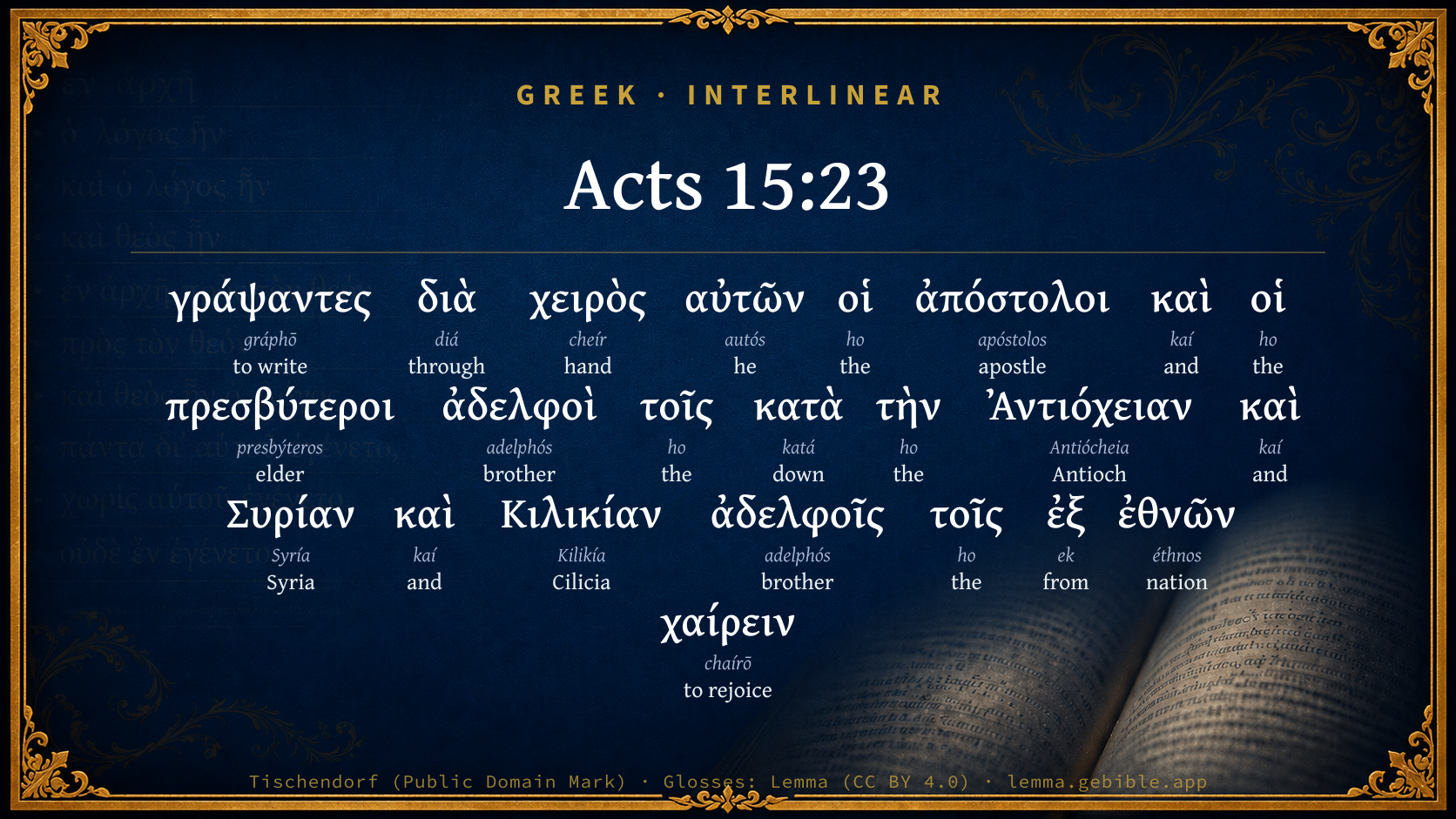
Greek (Tischendorf 8th ed.) Acts 15:23 appears in the Greek New Testament. The text above is from the Tischendorf 8th edition. Each word links to its Strong’s number and a concise gloss. Click any word for its full Thayer’s Greek Lexicon entry.
Download image
Cite this verse

Acts 15:23 (World English Bible). Public Domain. Lemma interlinear Bible study tool, https://lemma.gebible.app/v/acts/15/23.

Show BibTeX & RIS
BibTeX
RIS
English Translation
They wrote these things by their hand: "The apostles, the elders, and the brothers, to the brothers who are of the Gentiles in Antioch, Syria, and Cilicia: greetings.
World English Bible · Public Domain
Download a study sheet

One document with this verse’s original text, its word-by-word gloss line, the meaning frame, cross-references with their text, attributed commentary, and full source and license credits — printable, and it pastes into notes with its structure intact.

This verse Autodidact and up

Study sheet (.html) Plain text (.txt)

A passage Seminary Student

Up to 50 verses in one chapter. A passage sheet keeps up to 6 commentary sources and 12 cross-references per verse, in the order this page ranks them, and says so on the sheet whenever that leaves anything out. Ask for a single verse and you get the Autodidact verse sheet above.

Everything on this page stays free to read, with no account — the sheet is a download of what is already on screen, not access to it.

Want to remove ads? Support Godless Engineer
Compare translations 3

The same verse in 3 English versions, stacked beneath the original-language interlinear above. Click any original word for its lexicon entry.

Each is an independent rendering of the whole verse — the interlinear is not word-aligned to these translations.

Highlighted words mark where these versions differ — a whole-verse word diff, not a word-by-word alignment.

  • World English Bible Public Domain
    They wrote these things by their hand: "The apostles, the elders, and the brothers, to the brothers who are of the Gentiles in Antioch, Syria, and Cilicia: greetings.
  • King James Version Public Domain
    And they wrote letters by them after this manner; The apostles and elders and brethren send greeting unto the brethren which are of the Gentiles in Antioch and Syria and Cilicia.
  • unfoldingWord Literal Text CC BY-SA 4.0
    writing by their hand: “The apostles and the elders, brothers, to the brothers among the Gentiles throughout Antioch and Syria and Cilicia: Greetings!

unfoldingWord Literal Text — © unfoldingWord, licensed CC BY-SA 4.0. Word-aligned USFM3 via Door43 (git.door43.org/unfoldingWord/en_ult).

Versions to compare (up to 4)

3 of 4 selected

Show all 19 translations

Every available English version of this verse, each an independent rendering of the whole verse.

  • World English Bible Public Domain
    They wrote these things by their hand: "The apostles, the elders, and the brothers, to the brothers who are of the Gentiles in Antioch, Syria, and Cilicia: greetings.
  • Berean Standard Bible Public Domain
    and sent them with this letter: The apostles and the elders, your brothers, To the brothers among the Gentiles in Antioch, Syria, and Cilicia: Greetings.
  • Majority Standard Bible Public Domain
    and sent them with this letter: The apostles, elders, and brothers, To the brothers among the Gentiles in Antioch, Syria, and Cilicia: Greetings.
  • King James Version Public Domain
    And they wrote letters by them after this manner; The apostles and elders and brethren send greeting unto the brethren which are of the Gentiles in Antioch and Syria and Cilicia.
  • American Standard Version (1901) Public Domain
    and they wrote `thus' by them, The apostles and the elders, brethren, unto the brethren who are of the Gentiles in Antioch and Syria and Cilicia, greeting:
  • Revised Version (1885) Public Domain
    and they wrote thus by them, The apostles and the elder brethren unto the brethren which are of the Gentiles in Antioch and Syria and Cilicia, greeting:
  • Geneva Bible (1599) Public Domain
    And wrote letters by them after this maner, THE APOSTLES, and the Elders, and the brethren, vnto the brethren which are of the Gentiles in Antiochia, and in Syria, and in Cilicia, send greeting.
  • Douay-Rheims (1899) Public Domain
    Writing by their hands: The apostles and ancients, brethren, to the brethren of the Gentiles that are at Antioch, and in Syria and Cilicia, greeting.
  • Young's Literal Translation Public Domain
    having written through their hand thus: `The apostles, and the elders, and the brethren, to those in Antioch, and Syria, and Cilicia, brethren, who `are' of the nations, greeting;
  • Literal Standard Version CC BY-SA 4.0
    having written through their hand thus: “The apostles, and the elders, and the brothers, to those in Antioch, and Syria, and Cilicia, brothers, who [are] of the nations, greeting;
  • Unlocked Literal Bible CC BY-SA 4.0
    They wrote this: “From the apostles and elders, your brothers, to the Gentile brothers in Antioch, Syria, and Cilicia: Greetings!
  • unfoldingWord Literal Text CC BY-SA 4.0
    writing by their hand: “The apostles and the elders, brothers, to the brothers among the Gentiles throughout Antioch and Syria and Cilicia: Greetings!
  • Darby Bible Public Domain
    having by their hand written [thus]: The apostles, and the elders, and the brethren, to the brethren who are from among [the] nations at Antioch, and [in] Syria and Cilicia, greeting:
  • World Messianic Bible Public Domain
    They wrote these things by their hand: “The emissaries, the elders, and the brothers, to the brothers who are of the Gentiles in Antioch, Syria, and Cilicia: greetings.
  • Webster's Bible Public Domain
    And they wrote letters by them after this manner; The apostles, and elders, and brethren, send greeting to the brethren who are of the Gentiles in Antioch, and Syria, and Cilicia.
  • Free Bible Version CC BY-SA 4.0
    and sent them with this letter: “Greetings from us, the apostles and elders and brothers, to the non-Jewish brothers in Antioch, Syria, and Cilicia:
  • Bible in Basic English Public Domain
    And they sent a letter by them, saying, The Apostles and the older brothers, to the brothers who are of the Gentiles in Antioch and Syria and Cilicia, may joy be with you:
  • Text-Critical English NT CC BY 4.0
    and to send with them this letter they had written: “The apostles, elders, and brothers, to the Gentile brothers in Antioch, Syria, and Cilicia: Greetings.
  • Tyndale New Testament (1534) Public Domain
    and gave them lettres in their hondes after this maner. The Apostles elders and brethren send gretynges vnto the brethren which are of the gentyls in Antioche Siria and Celicia.

Literal Standard Version (2020), Covenant Press — licensed CC BY-SA 4.0. Text via the HelloAO Bible API (eBible.org). Unlocked Literal Bible (unfoldingWord) — licensed CC BY-SA 4.0. Text via the HelloAO Bible API (eBible.org). unfoldingWord Literal Text — © unfoldingWord, licensed CC BY-SA 4.0. Word-aligned USFM3 via Door43 (git.door43.org/unfoldingWord/en_ult). Free Bible Version, Dr. Jonathan Gallagher — licensed CC BY-SA 4.0. Text via the HelloAO Bible API (eBible.org).

Word by word

More ways to search: Search by grammar → Find every occurrence → Compare this word →

Practice this passage: Drill this verse → Learn its vocabulary →

Συρίαν
Syría
G4947
“Syria”
Noun, Accusative, Singular, Feminine
Part of Speech
Noun
Case
Accusative
Number
Singular
Gender
Feminine
Full Thayer's Definition

Origin: probably of hebrew origin H6865

TDNT: None

Syria = "exalted" 1. a region of Asia bounded on the north by Taurus and Amanus ranges, on the east by the Euphrates and Arabia, on the south by Palestine, and the west by Phoenicia and the Mediterranean
  1. γράψαντες gráphō G1125 “to write” Verb, Aorist, Active, Participle, Nominative, Plural, Masculine
  2. διὰ diá G1223 “through” Preposition
  3. χειρὸς cheír G5495 “hand” Noun, Genitive, Singular, Feminine
  4. αὐτῶν autós G846 “he” Personal pronoun, Genitive, Plural, Masculine
  5. οἱ ho G3588 “the” Article, Nominative, Plural, Masculine
  6. ἀπόστολοι apóstolos G652 “apostle” Noun, Nominative, Plural, Masculine
  7. καὶ kaí G2532 “and” Conjunction
  8. οἱ ho G3588 “the” Article, Nominative, Plural, Masculine
  9. πρεσβύτεροι presbýteros G4245 “elder” Adjective, Nominative, Plural, Masculine, Comparative
  10. ἀδελφοὶ adelphós G80 “brother” Noun, Nominative, Plural, Masculine
  11. τοῖς ho G3588 “the” Article, Dative, Plural, Masculine
  12. κατὰ katá G2596 “down” Preposition
  13. τὴν ho G3588 “the” Article, Accusative, Singular, Feminine
  14. Ἀντιόχειαν Antiócheia G490 “Antioch” Noun, Accusative, Singular, Feminine
  15. καὶ kaí G2532 “and” Conjunction
  16. καὶ kaí G2532 “and” Conjunction
  17. Κιλικίαν Kilikía G2791 “Cilicia” Noun, Accusative, Singular, Feminine
  18. ἀδελφοῖς adelphós G80 “brother” Noun, Dative, Plural, Masculine
  19. τοῖς ho G3588 “the” Article, Dative, Plural, Masculine
  20. ἐξ ek G1537 “from” Preposition
  21. ἐθνῶν éthnos G1484 “nation” Noun, Genitive, Plural, Neuter
  22. χαίρειν chaírō G5463 “to rejoice” Verb, Present, Active, Infinitive

About this verse

These counts appear in no published source. They are computed here, from the morphology-tagged text and Lemma’s own curated glosses. What Lemma adds →

23
words
16
distinct lemmas
Acts
section

Notable vocabulary

The rarest word here is Συρίαν Syria G4947 — appearing just 8 times in the whole Greek New Testament.

Shared distinctive vocabulary

Συρίαν Syria G4947 occurs in 8 verses of the Greek New Testament. Also found in:

Repetition

Words recur within this verse:

  • ἀδελφοὶ brother G80 ×2
  • οἱ the G3588 ×5
  • καὶ and G2532 ×3

Cross-references

17

Topical passages linked to Acts 15:23 in the Treasury of Scripture Knowledge — connected by theme and wording, ordered by reader-vote popularity; previews shown in the World English Bible.

  • Acts 23:26 "Claudius Lysias to the most excellent governor Felix: Greetings.
  • Galatians 1:21 Then I came to the regions of Syria and Cilicia.
  • James 1:1 James, a servant of God and of the Lord Jesus Christ, to the twelve tribes which are in the Dispersion: Greetings.
  • Acts 15:22 Then it seemed good to the apostles and the elders, with the whole assembly, to choose men out of their company, and send them to Antioch with Paul and Barnabas: Judas called Barsabbas, and Silas, chief men among the brothers.
  • Romans 16:3–16 Greet Prisca and Aquila, my fellow workers in Christ Jesus,
  • Acts 14:27 When they had arrived, and had gathered the assembly together, they reported all the things that God had done with them, and that he had opened a door of faith to the Gentiles.
  • Acts 15:1 Some men came down from Judea and taught the brothers, "Unless you are circumcised after the custom of Moses, you can't be saved."
  • Acts 15:4 When they had come to Jerusalem, they were received by the assembly and the apostles and the elders, and they reported all things that God had done with them.
  • Acts 15:41 He went through Syria and Cilicia, strengthening the assemblies.
  • 2 John 1:3 Grace, mercy, and peace will be with us, from God the Father, and from the Lord Jesus Christ, the Son of the Father, in truth and love.
  • 2 John 1:10 If anyone comes to you, and doesn't bring this teaching, don't receive him into your house, and don't welcome him,
  • 2 John 1:13 The children of your chosen sister greet you. Amen.
  • 3 John 1:14 but I hope to see you soon, and we will speak face to face. Peace be to you. The friends greet you. Greet the friends by name.
  • Acts 11:18 When they heard these things, they held their peace, and glorified God, saying, "Then God has also granted to the Gentiles repentance to life!"
  • Acts 18:18 Paul, having stayed after this many more days, took his leave of the brothers, and sailed from there for Syria, together with Priscilla and Aquila. He shaved his head in Cenchreae, for he had a vow.
  • Acts 21:3 When we had come in sight of Cyprus, leaving it on the left hand, we sailed to Syria, and landed at Tyre, for there the ship was to unload her cargo.
  • Acts 21:25 But concerning the Gentiles who believe, we have written our decision that they should observe no such thing, except that they should keep themselves from food offered to idols, from blood, from strangled things, and from sexual immorality."

Cross-references courtesy of OpenBible.info (CC BY 4.0).

Where the printed editions differ

1 variant

Places in this verse where the major printed Greek editions disagree on the wording in a way that affects the translation — a comparison of editions, not a manuscript-by-manuscript collation. The editions are the modern critical texts (Nestlé-Aland 28/27, SBL, Westcott-Hort, Tregelles, Tyndale House) and the traditional texts behind the KJV (the Textus Receptus and the Byzantine/Majority text). It is not a claim about which reading is original.

  1. Extra text
    καὶ οἱ

    “and the”

    In TRByz Not in NA28NA27TynSBLWHTreg

    καὶ οἱ (kai hoi) 'and the' is only in traditional manuscripts (TR+Byz)

Textual data: Translators Amalgamated Greek New Testament (STEPBible TAGNT) · CC BY 4.0.

Commentary

Notes on Acts 15:23 from classic Christian and Jewish commentators (each source and its license shown beneath its notes). The classic Christian expositions comment on the surrounding passage and are grouped to its opening verse, so a note may address several verses; the Jewish commentaries on the Tanakh (Rashi and others) are per-verse, so they appear only where the commentator wrote on this verse.

Lemma curates 59 commentaries, every one of them public domain or Creative Commons licensed, each selected and text-cleaned for this edition rather than reprinted as found. About our sources →

The Biblical Illustrator

Joseph S. Exell

Act_15:23-29

And they wrote letters.

The Apostolic letter

1. A model of brotherly love and Divine wisdom.

2. A pattern for the modern Church.

3. A great standing deliverance from all ceremonial and ritualistic observances.

Improvement--

(1) Be not narrow-minded.

(2) Trust in Christ and not ordinances. (J. Dowse.)

The yoke broken

I. The relation of Christianity to Judaism. The decision was an admission that the Jewish ordinances were not permanent or essential. That old system had only a shadow of good things to come. It educated for the gospel, and having accomplished this its work really ended. The gospel succeeded. Christ was declared to be the end of the law to everyone that believeth; and the apostle to the Gentiles said, He is not a Jew which is one outwardly, but We are the circumcision which worship God, etc. To insist on the continued obligation of the Mosaic customs would be like drilling a reader in the alphabet. As well might the butterfly keep up its caterpillar existence--fly and crawl at the same time. For the Gentiles to practise the customs of the Old Law would be both irksome and also liable to lead to the error that salvation was dependent on these observances. Against this danger Paul most carefully guarded. The epistles to the Romans and to the Galatians are the strong ramparts which were erected to oppose it.

II. The tolerant spirit of Christianity. It seems strange to have such an example in the infant Church, since toleration is usually the fruit of long experience. Even more surprising is it, when we consider the antecedents of the men who displayed it. They were Jews, of a most bigoted race. One of the hardest lessons for men to learn is to unlearn, and act contrary to early convictions. Though they themselves, through force of habit, continued to observe the national customs, they would not bind the Gentiles to do the same. It is strange that this decision should have been ever forgotten. The intolerance which has resulted from losing sight of it has been the disgrace of Christianity. The greatest names have been in fault here. As an old divine says, Whilst we wrangle here in the dark, we are dying and passing to that world which will decide all controversies: the safest passage thither is by peaceable righteousness.

III. Christianity, while tolerant in spirit, has its self-denials (verse 29). If, after their conversion from heathenism to Christianity, they still continued to eat meat offered to idols, and to frequent the idolatrous feasts where it was served, they were more likely to relapse into their old heathen life. Evil communications corrupt good manners. The same thing in effect has to be perpetually guarded against. The Christian of today must, for his own spiritual good, beware of certain worldly habits and indulgences, lest he go back to the world. (A. H. Currier.)

Saying, ye must be circumcised and keep the law.--

Legal Christians

Thousands and tens of thousands of Christians yet live in the dreary shadow of legalism. God is only Lawgiver and Judge to them; and their experience is limited, first, to self-condemnation and suffering, then to violent endeavours of the spirit, or of the body, or of both to throw off this suffering, with results, sometimes of exhaustion, and sometimes of unnatural peace, and then to reaction into moral indifference, arising from a totally unsatisfied heart and soul. There are thousands of persons who think that they are Christians because they are endeavouring to live aright, but they are Christians because they are endeavouring to live aright no more than a person is at home because he is trying to go there, though he does not know the way. A child that has lost its fathers house, and that is striving to find it, is not at home, but is a wanderer; and the person that is simply endeavouring to live aright, and nothing more, and that when he measures his life by the law of God, as interpreted to him through his own conscience, is conscious of daily breaking that law in every direction, is no more a Christian than a wanderer is a child at home. For a Christian is one that has found his way home, and to the fatherhood of God, and not one that is merely seeking to do his duty. A Christian is a child under the parental roof, saying, Abba, Father. (H. W. Beecher.)

Our beloved Barnabas and Paul, men that have hazarded their lives for the name of our Lord Jesus Christ.

Two heroes

I. The principles by which they were actuated.

1. The highest admiration for their Lord and Master.

2. An entire consecration to His service. We must honour Christ--

(1) From gratitude.

(2) From duty.

II. The work they undertook. To proclaim the name, etc. This was--

1. An arduous duty.

2. A disagreeable toil.

3. A continuous self-sacrifice.

III. The reward they attained.

1. A reward of their magnanimity.

2. The approbation of God.

3. An immortal crown.

IV. The instruction they impart.

1. That there is something more precious than life or pleasure--Christ.

2. That however humble our sphere we may hope to accomplish something for our Lord and Master.

3. That whatever efforts we may make for our Masters glory shall be acknowledged and rewarded by God. (Preachers Analyst.)

The motto of Christian service

During the American war with England, a young midshipman named Joel Abbot was serving under the United States flag. Winning the good opinion of the commander, he was put in the way of promotion by being commended to Macdonough, then controlling the forces on Lake Champlain. Reports were received that the English were accumulating a large supply of spars at Sorel. Could not the spars be destroyed? Who would undertake the task? Joel Abbot was sent for. Grimly the commander asked him if he were willing to die for his country. Certainly, sir: that is what I came into the service for, was the prompt reply. Entrusted with the dangerous commission, Joel Abbot fulfilled it in the spirit of his words. The perils and privations of his exploit were so great, that although he came back alive, he was completely prostrate for a considerable time, and his recovery was slow. Later, a sword of honour was voted him for his gallantry. How is it with soldiers of the Great King--workers for Christ? The test word of this service is Self-surrender for Christ.

A life hazarded for Christ

A touching story is told as characteristic of the missionary spirit by a friendly writer in the Contemporary. Rev. John Robinson was suddenly summoned one day to the Leper asylum to baptise a dying convert. My friend went in fear and trembling, baptised the dying man, consoled him, and then was seized with a throe of mental agony. It is the custom of many missionaries on receiving a neophyte, especially if sick, to give him the kiss of peace. Mr. Robinson thought this his bounden duty, but he was himself a half-breed, and he was absolutely persuaded of the Indian theory that leprosy, though non-contagious in the case of a white man, is frightfully contagious in the case of one with native blood in his veins. He hesitated, walked to the door, and returned to kiss the leper on the lips and then to lie for days in his own house, prostrated with an uncontrollable and not an unreasonable nervous terror. A superstitious fool, the doctor thought him. True soldier of Christ, say I, who, when his duty called him, faced something far worse than shot.

Christian self-devotion

For some time after Mr. Hunt settled in Somasoma, one of the Fejee Islands, his life was in daily danger from the hostile and cannibal savages. But he went on with his Christian work, and when the captain of an American warship heard of their threats to kill and eat the missionary, and sent to offer him an asylum on board his vessel, Mr. Hunt declined with thanks, saying that he regarded the horrible depravity of the natives as only an additional reason for risking his life to convert them.

Life hazarded in Christs cause

I. The spirit which is described in the text. Several particulars are included here.

1. Their ardent love for Christ Jesus. It was not always thus with these men. Pauls object was to root out the name of the Saviour. What occasioned then this marvellous change? In his case they were very extraordinary means. In other cases, the means are ordinary. The Spirit of God convinces them of sin, shows them that they have no help in themselves; but must accept Christ and His cross. And then they love Christ. They love Him

(1) For dignity of His person.

(2) For the perfection of His atonement. They love Him because He first loved them.

(3) Because He has taken their nature and their cause to heaven. When they see this, it is impossible but their hearts should glow with love to such a Saviour. The life He so dearly bought becomes His, and they hazard it willingly in His service.

2. Their high estimation of the gospel. Man is a depraved creature. This depravity exhibits itself in different forms; in one country in idolatry, in another in blasphemy, etc. Philosophers have bent over the scene and wept, and politicians have devised innumerable schemes to recover fallen creatures. But they have failed. Now God sent the gospel to redeem and sanctify man. Now the men, that hazarded their lives for the name of the Lord Jesus, believed that there was no other name whereby men might be saved; and therefore they published it. They had the conviction of an enlightened understanding, and an experimental enjoyment of the truth.

3. Their tender compassion for lost souls. Christs value met their enlightened judgment. What shall it profit a man, etc. They saw millions of immortal spirits, hurrying on to irremediable woe. Now when the men had this remedy, and saw souls in this condition, and had their hearts lighted with the heavenly fire, you do not wonder that they went forth and hazarded their lives to communicate it to lost souls.

4. The aggressive spirit in which they attempted to set up Christs kingdom. They did not wait till a petition came from these miserable souls, requesting them to send the gospel; or till a door was opened by some special act of the government of the country, or a change of opinion took place among the people; but wherever they could open their lips for Jesus Christ, there they went, though edicts were issued against them, and they were imprisoned and reviled and threatened with death.

5. Their exalted character in the opinion of the Church. They selected them to go on an important embassy, as men who copied most of their Masters spirit. It appeared to them, that the chief excellency was in hazarding their lives for Him. Doubtless many in their day considered them very visionary men, and thought they had better not plunge rashly into things; but the apostles and elders, those who had love to Christ, thought their zeal their glory, and held it up to the imitation and approbation of the Church.

II. Lessons.

1. We see in the text a picture of fallen and of regenerated humanity; and among which class are you? Here is one class of men, opposing those who come to them with the gospel; here is another, ready to die for the name of the Lord Jesus. He that is not with Me is against Me.

2. A suitable apology for all those who exhibit the same conduct. By many it has been upbraided as zeal without knowledge. But here is the answer; it is done for the name of our Lord Jesus Christ. A soldier hazards his life, it may be, for fortune, for fame, for honour. But here are men who hazard their lives, without honour, fame or fortune, for the name of Jesus Christ.

3. One of the modes by which God augments the number of His servants and the efficiency of their service. The blood of the martyrs is the seed of the Church. It is not the cold, calculating, cautious men, who carry measures either in Church or in state; but the men who hazard their lives for the cause which they undertake.

4. The honour which God puts upon us by permitting us to send out such men to evangelise the world.

5. A spirit worthy of imitation. Who is willing to hazard his life for the name of our Lord Jesus? (J. Sherman.)

The true missionary

Once, in lifting from its shelf a certain folio, there fluttered out from between its leaves a paper dated 1763. It had evidently been mislaid as soon as it was written, and one hundred years after, just where the writer left it, I found it. It ran thus, We beg to certify that the bearer, Mr. John Wyers, is well known to us, and we do hereby commend him to all Christian Churches where, in Providence, he may come as a godly minister who hath much devoted himself to the service of our Lord Jesus Christ. This was signed David Fermie, Thomas Blackett. My text is a line out of an old letter of introduction written by the elders of the Church at Jerusalem. Now, this old certificate is not to be torn up for waste paper as a thing that is now dead and done with. It is a live thing, it is wanted now, to show what kind of missionaries are wanted, and how the armies of Christ in the field of foreign service are to win the day. Just take the words as they stand.

I. Men. An ancient lawgiver said, that what Sparta wanted was not a wall of bricks but a wall of men. Men, said a certain sarcastic journalist, are cheap. No. If men be what is meant by certain advocates of muscular Christianity, then men are cheap, but when I look at Paul I remember that it is not muscle that makes a man. If you mean by a man, an undesigned result of molecular forces, then men are cheap, and they ought to be, but a man is not the consummation of a tadpole. If by men you mean an average human being, men ought to be cheap; but many a human being passes for a man who is not so much a person as a thing. What I mean by man is a son of Adam, who has been born again, and who is therefore a Son of God by faith in Christ Jesus, and of whom we may say, Like father, like son. I want to blow into infinite space the mean, false notion that anything will do for a missionary; anything will not do. Before you are a missionary you must be a man.

II. That have hazarded their lives. This, in itself, is not matter for plaudit. Most extreme must be the case, when the author of life sanctions the hazard of life. But, while grace makes us understand the sanctity of life, grace inspires us with a will to give ourselves to the service of something higher than life. That man is not worth calling a man who lives to save himself. The man who answers to the standard we are now looking at, is a man who, being called to the service of Christ, is prepared, if need be, to hazard his life for that service.

III. For the name of our Lord Jesus Christ. This means that the men hazarded their lives--

1. Out of love to Christ. The name of a person is the person to whom that name belongs. We all know the rousing, or soothing, or melting magic of a name. But no name has such power to stir the hearts of men as the name of Jesus Christ. When it was first uttered to the Jews, it stirred their hearts to hatred. Among the most inexorable and deep haters was Paul. He breathed out threatenings and slaughters till Jesus stopped him. After that, the love of Christ set his life on fire. What have we hazarded for Christ? Where is your love to Christ? Is that the thing you call love? Then love knows how to take care of itself; looks upon religion as a question of safe investment and social respectability; sometimes joins the Church like a traveller taking his ticket who books himself quite through, wraps his rug around him, and goes to sleep till the train stops; hates originality like the plague. What you call love I call prudence. But love, whether to God or man, tends to scorn of consequence, and to the forgetfulness of self.

2. Out of obedience to Christ. If ye love Me keep My commandments. The commandment now waiting for our obedience is, Go, make disciples of all nations. Now it is strange the first thing men in general do is to give their opinion about this. One man is of opinion that it is unnecessary; another, that it is impossible; another, that we should look at home; another, that we should civilise first; another, that every nation has already its own religion fitted to its own nationality. But Christ waits not for our opinion but our obedience. The question is how we can best obey. Some can best obey in this way, some in that. The principle is not that Christians should leave work at home for work abroad, but that all Christians are charged with the evangelisation of the world to do it between them. Though the difficulties may be massive, they are not your concern. Charge, is the captains cry. Say, as the negro said, Does Jesus Christ ask me to jump through that stone wall? Here I go at it.

3. In the service of their fellow men. It is a great service to save lives, and a noble thing when men do it at the hazard of their own. Lady Edgeworth, in the days of King Charles II, had suddenly to defend the family castle at Lissom, in the absence Of her husband. In doing so she had to go down and fetch powder from the castle vaults. On her return she said to the woman who had gone with her, Where did you put the candle? I left it stuck in the barrel of black salt. Then did that glorious lady go down to the spot where the candle was burning into the powder, and put her hand round it like a cup, and lift it up and take it out, and so at the hazard of her own life saved the lives of others. Dear, glorious lady, that was well done. The lifeboat with its brave crew shoots out into the night over the swaying hills of water, to snatch twenty men off from a wreck. On their return, when the cry comes on the wind, All saved, my heart gives a great bound, and I say, There is a noble service nobly done. The Son of Man came not t¢ destroy mens lives, but to save them; and if it be a great thing to save the lives of bodies through the hazard of our own bodily life, it is a small thing to hazard it to save the lives of souls. Conclusion: We learn from these men--

1. How our faithful and mighty Master through all hazards keeps His servants alive until their work is done.

2. Only men like these hazard their lives, and the men who at Christs call to service most totally give themselves up, most totally let themselves go, are the men whom the King delighteth to honour. (C. Stanford, D. D.)

Who shall also tell you the same things by mouth.--

Preference for the spoken word

The Dean of Rochester said: A woman said about a certain preacher, Hes a very nice gentleman, but he has no deliverance. He himself had been wont for years to preach written sermons. One night, to his horror, the church was so dark that it was impossible to read his sermon. He passed through a brief period of anxiety. Then, thinking, Have I nothing to say to these people? Am I really a servant of God? He threw himself on the Holy Spirits help, and spoke as best he could. The churchwarden apologetically told him that the people said It was the best sermon he had ever preached, and they hoped he would never read another. Nor did I, said the Dean; and then I awoke not to find myself famous, but at any rate more useful than I had been before.

The spoken word

A preacher is, in some degree, a reproduction of the truth in personal form. The truth must exist in him as a living experience, a glowing enthusiasm: an intense reality. The Word of God in the Book is a dead letter, it is paper, type, and ink. In the preacher that Word becomes again as it was when first spoken by prophet, priest, or apostle. It springs up in him as if it were first kindled in his heart, and he were moved by the Holy Ghost to give it forth. He is so moved. (H. W. Beecher.)

The Biblical Illustrator, edited by Joseph S. Exell (c. 1880s–1900s) — public domain. Text from a community e-Sword module.

Bengel's Gnomon

Johann Albrecht Bengel

Act 15:23. Γράψαντες, having written) Who dictated the Epistle, or wrote it, and in what language, is not expressed. There could be no suspicion as to its genuineness. No other epistle given by the primitive Church is extant at the present day, although there were many given: ch. Act 18:27; 1Co 7:1; 2Co 3:1. Γράψαντες, in the nominative case, coheres with πέμψαι. Comp. 2Co 10:2; 2Co 8:23, εἴτε ὑπὲρ Τίτου, κοινωνὸς ἐμός, etc., note.—διὰ, by) An abbreviated expression for, they wrote, and by their hand (διὰ χειρὸς αὐτῶν) sent.—τάδε, these things) Many things are put down in this letter out of the speeches of Peter and James.—Συρίαν, Syria) It is not to be wondered at, that the books of the New Testament were soon (early) translated into the Syriac language.—χαίρειν) wish joy (‘greeting’), in truth: see Act 15:31. Believers do not always use very warm forms of compliment, but sometimes employ every-day forms in a more elevated sense. So Act 15:29, ἔῤῥωσθε, farewell. So Jas 1:1, χαίρειν, greeting (bids salutation). Peter employs other words. From this we may infer, that this epistle was composed by James in the Council, as being especially in consonance with the speech of James; for instance, παρενοχλεῖν, to trouble unnecessarily, Act 15:19, and ταράττειν, to trouble, Act 15:24, ἀπέχεσθαι, to abstain, Act 15:20; Act 15:29.

Bengel's Gnomon of the New Testament — English translation (T&T Clark, Edinburgh, 1860) — public domain. Text from a community e-Sword module.

Meyer's Critical & Exegetical Commentary

Heinrich August Wilhelm Meyer

Act_15:23-24. Γράψαντες] while they wrote, should properly agree in case with ἐκλεξαμένους. Anacoluthia in carrying out the construction by participles is frequent; here it conforms to the logical subject of ἔδοξε τοῖς κ.τ.λ. See Bernhardy, p. 463; Winer, p. 527 [E. T. 709]; also Pflugk, ad Eur. Hec. 970.

διὰ χειρὸς αὐτῶν] so that they were to be the bearers of the letter.

As the letter was directed not only to Antioch and to Syria (whose capital and chief church was Antioch), but also to Cilicia, we are to infer that in this province also similar dissensions between Jewish and Gentile Christians had taken place, and had come to the knowledge of the apostolic assembly.

The genuineness of the letter is supported as well by its whole formwhich, with all distinctness as to the things forbidden (the designation of which is repeated exactly in Act_21:25), yet has otherwise so little official circumstantiality, that it evidently appears intended to be orally supplemented as regards the particularsas also by the natural supposition that this important piece of writing would soon be circulated in many copies (Act_21:25), and therefore might easily, in an authentic form, pass into the collection of Lukes sources.[40]

καὶ οἱ ἀδελφοί] i.e. the whole church, Act_15:22.

Χαίρειν] the well-known epistolary salutation of the Greeks.[41] Comp. Act_23:26. The letter addressed to Greek Christians was certainly written in Greek. But that it was actually composed by James (Bengel, Bleek in the Stud. u. Krit. 1836, p. 1037) does not follow at least from Jam_1:1, although it is in itself possible, and indeed from his position in Jerusalem even probable. The similarity in the expression of the decree with Luk_1:1, does not justify us in doubting the originality of that expression (Schwegler, Zeller), as the subdivision in the protasis and apodosis was very natural, and the use of ἔδοξεν almost necessary.

ἈΝΑΣΚΕΥΆΖΟΝΤΕς] destroying, subverting, elsewhere neither in the N.T. nor in the LXX. and Apocrypha; but see Xen. Cyr. vi. 2. 25; Polyb. ix. 31. 6, ix. 32. 8; Dem. 895. 5. Non parcunt iis, qui dubitationes invexerant, Bengel.

λέγοντες περιτέμν.] without ΔΕῖΝ, because in ΛΈΓ. the sense of commanding is implied. Kühner, ad Xen. Anab. v. 7. 34. Comp. on Act_14:14.

The τηρεῖν τ. νόμον is the ΖΥΓΌς, Act_15:10, which was imposed with circumcision, Gal_5:3. And the ΝΌΜΟς is the whole law, not merely the ceremonial part.

ΟἿς Οὐ ΔΙΕΣΤΕΙΛ.] So arbitrarily had they acted.

[40] According to Schwanbeck, the letter is derived from the Memoirs of Silas. In this view, of course, it must be assumed that ἄνδρας ἡγουμ., ver. 22, did not stand in the text at all, or not here.

[41] See Otto in the Jahrb. f. D. Theol. 1867, p. 678 ff.

Meyer — Critical and Exegetical Commentary on the New Testament — English translation by Peter Christie, edited by Frederick Crombie (T&T Clark, 1880) — public domain. Text from a community e-Sword module.

Expositor's Greek Testament

ed. W. Robertson Nicoll

Act 15:23 . οἱ ἀπόστ . καὶ οἱ πρεσβ . καὶ οἱ ἀδελ ., but in R.V. “the Apostles and the elder brethren,” see critical notes. The phrase as it stands in R.V. has been called meaningless (Page), but Hort, Ecclesia , p. 71, while admitting that the phrase is unusual, defends it as indicating that they who held the office of elder were to be regarded as bearing the characteristic from which the title itself had arisen, and that they were but elder brethren at the head of a great family of brethren ( cf. Knabenbauer in loco ). It is of course quite possible that ἀδελ . is merely to be taken as in apposition to ἀπόστ . and πρεσβ ., meaning that as brethren they sent a message to brethren (Wendt, Felten, Page). τοῖς κατὰ τὴν Ἀ . κ . τ . λ ., see below. χαίρειν : amongst the Epistles of the N.T. only that of St. James thus commences, as has been often pointed out by Bengel and others. The coincidence may be a chance one, but it is the more remarkable, since the letter may well have been written and dictated by St. James in his authoritative position. On the phrase in letters see Mayor’s interesting note on Jas 1:1 . It occurs again in Act 23:26 , but nowhere else in N.T.

The Expositor's Greek Testament, edited by W. Robertson Nicoll (1897–1910) — public domain. Text from a community e-Sword module.

Jamieson, Fausset & Brown

Robert Jamieson, A. R. Fausset & David Brown

And they wrote . . . by them--This is the first mention in the New Testament history of writing as an element in its development. And the combination here of written and oral transmission of an important decision reminds us of the first occasion of writing mentioned in the Old Testament, where a similar combination occurs (Exo 17:14). But whereas there it is the deep difference between Israel and the Gentiles which is proclaimed, here it is the obliteration of that difference through faith in the Lord Jesus [BAUMGARTEN].

greeting--The only other place in the New Testament where this word occurs (except in the letter of Lysias, Act 23:26) is Jam 1:1, which seems to show that both letters were drawn up by the same hand [BENGEL].

the Gentiles in Antioch, and Syria, and Cilicia--showing that churches then existed in Cilicia as well as Syria, which owed their existence, in all likelihood, to Paul's labors during the interval between his return to Tarsus (Act 9:30) and his departure in company with Barnabas for Antioch (see on Act 11:25).

Jamieson, Fausset & Brown — Commentary Critical and Explanatory on the Whole Bible (1871) — public domain (CC PDM 1.0). Text via the HelloAO Bible API.

Adam Clarke's Commentary

Verse 23. Send greeting unto the brethren - of the Gentiles] There was no occasion to send such a letter to the brethren which were of the Jews, because that law which had been so long read in their synagogues taught them all those things; and therefore the epistle is sent exclusively to the Gentiles. The word greeting is in the original χαιρειν, to be well, to be safe; a very usual form in Greek epistles, the word ευχομαι being understood, I wish thee to be well.

Adam Clarke's Commentary on the Bible (1810–1826) — public domain. Text from a community e-Sword/MySword module.

Ellicott's Commentary for English Readers

(23) And they wrote letters by them.—Literally, wrote letters by their hands. What follows, unless we assume a deliberate fraud, is clearly the transcript of a document—the first in the long list of decrees and canons and encyclical letters which mark the Church’s history.

The apostles and elders and brethren.—The MSS. present a singular variation of readings, some of the earliest omitting the conjunction and article before the last noun, and giving “the Apostles and elders, brethren.” Such a mode of speech, however, is foreign to the usage of the New Testament, and it is probable that this reading originated in a desire to bring the text into harmony with the later practice of the Church, which excluded the laity from all participation in its synods. (See Note on Act_15:22.)

Send greeting.—Literally, wish joy. The formula was common in Greek epistles, but is not used in the New Testament, except here and in Jas_1:1. As it is reasonable to suppose that this letter was written or dictated by him, its occurrence is primâ facie evidence of the authorship of the Epistle that bears his name, and which, on the view taken in these Notes, had been already written to the Church of the Circumcision.

Unto the brethren which are of the Gentiles.—The letter was therefore addressed to them exclusively (see Note on Act_15:20), as the Epistle of St. James had probably been previously addressed to the Jews of the “dispersion,” and not to the Gentiles.

In Antioch and Syria and Cilicia.—The mention of the latter country is important as showing the extent of St. Paul’s work there prior to his joining Barnabas at Antioch (Act_11:25). There also he had founded churches in which Gentile converts were admitted as such to full communion.

A Bible Commentary for English Readers, edited by Charles John Ellicott (1878–1897) — public domain. Text from a community e-Sword module.

The Cambridge Bible for Schools and Colleges

gen. ed. J. J. S. Perowne

23. And they wrote letters by them after this manner] From the form in which the document is here given, we should judge that the original was in Greek. A translation from a Hebrew original would hardly have begun with a greeting and ended with “Fare ye well.” It seems likely that this was so too, because the population of Antioch, the chief town in Syria, would use Greek much more than Hebrew, at this date. The construction of the Greek in the beginning of this verse is not strictly grammatical, but such irregularities are not unusual in a passage which begins impersonally, as does Act_15:22.

by them (lit. by their hand)] This is a Hebraism. The letter was not delivered to Paul and Barnabas, but to the two ambassadors from Jerusalem. It is the oldest synodical circular letter in existence, and the only one of Apostolic times which has come down to us. Bengel suggests that it was composed by James, in the name and at the request of the assembly.

The apostles and elders and brethren] The oldest MSS. omit the second and, thus making the Epistle run in the name of the apostles and elder brethren, and this rendering is adopted in R. V. The conjunction of the two last words to signify ‘the elders’ is very unusual, and after what has been said in the previous verse about the decree expressing the voice of the whole church as well as of the apostles and elders, it seems much more in accord with the rest of the narrative to adhere to the Text. Rec. which has a large amount of good MS. support.

in Antioch and Syria and Cilicia] As we have no mention of this decree of the synod of Jerusalem in St Paul’s Epistles, we may suppose that the agitation on the subject, begun at Antioch, had spread only into Syria and Cilicia, and that the authoritative decision of the mother church quieted the controversy there, while it did not arise in the same form in other places.

The Cambridge Bible for Schools and Colleges (gen. ed. J. J. S. Perowne; Cambridge University Press, 1878–1918) — public domain. Text from a community e-Sword module.

John Gill's Exposition

And wrote letters by them after this manner,.... Not that they made use of them as their amanuenses, to write their letters for them; but being written they put them into their hands, and sent them by them, and they were written in the following form:

the apostles, and elders, and brethren; which belonged to, or were members of the church at Jerusalem; they are severally set in their proper place and order: the apostles, Peter, and James, and John, and it may be some others first; for these God had set in the first place in the church; then the elders, or preachers of the Gospel, such as were Judas and Silas: and then the brethren, or private members of the church; who are called so, because they are of one family, and have one Father, and are partakers of the same grace and privileges: these,

send greeting; or their Christian salutation, wishing all peace and prosperity, both for soul and body, temporal, spiritual and eternal:

unto the brethren which are of the Gentiles in Antioch, and Syria and Cilicia; the brethren or members of the several churches in these parts, who were Gentiles, are particularly sent to; and not the brethren who were Jews; because they were especially concerned, and to them is the advice directed: Antioch is first mentioned, that being the place where the controversy began; but there being other churches in Syria, besides Antioch, in which were many Gentiles, and also in Cilicia, and particularly at Tarsus, Paul's native place, and where he had preached, Act 9:30 they are therefore mentioned, and being countries near to one another, it is very likely that the controversy had spread itself among them.

John Gill's Exposition of the Whole Bible (1746–1763) — public domain (CC PDM 1.0). Text via the HelloAO Bible API.

Trapp's Complete Commentary

John Trapp

23 And they wrote letters by them after this manner; The apostles and elders and brethren send greeting unto the brethren which are of the Gentiles in Antioch and Syria and Cilicia:

Ver. 23. And wrote letters by them] For the better confirmation of the weak and confutation of the wilful, to be as a standing monument.

John Trapp, A Commentary or Exposition upon All the Books of the Old and New Testament (1647–1656) — public domain. Text from a community e-Sword module.

Albert Barnes' Notes on the Bible

And wrote letters - Greek: “Having written.” It does not mean that they wrote more than one epistle.

By them - Greek: by their hand.”

After this manner - Greek: these things.

Send greeting - A word of salutation, expressing their desire of the happiness (χαίρειν chairein) of the persons addressed. Compare Mat 26:49; Mat 27:29; Luk 1:28; Joh 19:3.

In Antioch - Where the difficulty first arose.

And Syria - Antioch was the capital of Syria, and it is probable that the dispute was not confined to the capital.

And Cilicia - See the notes on Act 6:9. Cilicia was adjacent to Syria. Paul and Barnabas had traveled through it, and it is probable that the same difficulty would exist there which had disturbed the churches in Syria.

Albert Barnes' Notes on the Bible (1834–1885) — public domain. Text from a community e-Sword/MySword module.

Haydock's Catholic Bible Commentary

The brethren of the Gentiles. Hence we see, that he letter, with the decree of the Council, only regarded those converts, who had been Gentiles; neither are they forbidden to use the Jewish ceremonies, but a declaration is made, that they have no obligation to follow the said ceremonies and precepts, as it will appear by other places. (Witham)

George Leo Haydock (1774–1849), Haydock's Catholic Family Bible and Commentary, 1859 edition — public domain. Excludes Psalms (Douay-Rheims chapter numbering differs from Protestant) and Deuterocanonical books (Catholic canon only).

Matthew Poole's English Annotations

The apostles and elders and brethren; the letter was wrote in the name of them all, that it might have the greater force, and better acceptance; that so strong a cord might not be broken by the false apostles.

Of the Gentiles; such as out of Gentilism, or paganism, were converted unto Christ; to whom the determination of this case was of the greatest concern; their right of belonging unto Christ, and having any hopes of salvation, being questioned, unless they would be circumcised.

Matthew Poole's English Annotations on the Holy Bible (1683–1685) — public domain. Text from a community e-Sword/MySword module.

Whedon's Commentary on the Bible

Daniel D. Whedon

23. Apostles… elders… brethren—Clerical and lay are here associated.

Syria—Including here all between the Mediterranean and the Lebanon range, but excluding Judea and Samaria.

Greeting—It is a curious “undesigned coincidence” that the word greeting is used but once more in the New Testament, and that in the Epistle of James. We may safely from this infer that this letter is also an epistle written by James, and that both are by this same hand.

Daniel D. Whedon (gen. ed.), Commentary on the Old and New Testaments (1874–1909) — public domain. Text from a community e-Sword module.

The Pulpit Commentary

Wrote thus by them for wrote letters by them after this manner, A.V.; the elder brethren for elders and brethren, A.V.; unto... greeting for send greeting unto, etc., A.V., as Act_23:26. The elder brethren, etc. The grammar of the sentence is irregular, as there is nothing for grayantev to agree with. But "the elder brethren" is a phrase unknown to the Scriptures, and it is much more in accordance with the feeling of the times that "the brethren," i.e. the whole Church, should be included in the salutation. Greeting. It is remarkable that the only other place in the New Testament where this Greek salutation occurs is Jam_1:1.

The Pulpit Commentary (1880–1919), ed. H.D.M. Spence-Jones & Joseph S. Exell — public domain. Text from a community e-Sword module.

John Wesley's Explanatory Notes

Writing thus, and sending it by their hand - The whole conduct of this affair plainly shows that the Church in those days had no conception of St. Peter's primacy, or of his being the chief judge in controversies. For the decree is drawn up, not according to his, but the Apostle James's proposal and direction: and that in the name, not of St. Peter, but of all the apostles and elders, and of the whole Church. Nay, St. Peter's name is not mentioned at all, either in the order for sending to Jerusalem on the question, ver. 2, or in the address of the messengers concerning it, ver. 4, or in the letter which was written in answer.

John Wesley, Explanatory Notes Upon the Whole Bible (1754–1765) — public domain. Text via the GEBible commentary corpus.

McGarvey & Pendleton's Commentaries

J. W. McGarvey

See notes on verse 22

J. W. McGarvey (with Philip Y. Pendleton), Commentaries on the New Testament (The Fourfold Gospel, 1914; Acts; and the epistles) — public domain. Text from a community e-Sword/MySword module.

Cambridge Greek Testament for Schools and Colleges

23. τάδε after αὐτῶν omitted with אAB. Vulg. has only ‘per manus eorum.’

καὶ οἱ before ἀδελφοὶ omitted with אABCD. Vulg. has ‘et seniores fratres.’

23. γράψαντες, having written. From the form in which the document is here given, we should judge that the original was in Greek. A translation from a Hebrew original would hardly have begun with a greeting and ended with ἔρρωσθε. It seems likely that this was so too, because the population of Antioch, the chief town in Syria, would use Greek much more than Hebrew, at this date. The nominative case γράψαντες is a construction to accord with sense rather than strict grammar. It stands as if it had been preceded by some such words as καὶ τοῦτο ἐποίησαν.

διὰ χειρὸς αὐτῶν. Literally, ‘by their hand.’ This is a Hebrew form of saying, by them. Cf. Lev 10:11, ἅπαντα τὰ νόμιμα ἅ ἐλάλησε κύριος πρὸς αὐτοὺς διὰ χειρὸς Μωυσῆ. So Mal 1:1, &c. The letter was not delivered to Paul and Barnabas, but to the two ambassadors from Jerusalem. It is the oldest synodical circular letter in existence, and the only one of Apostolic times which has come down to us. Bengel suggests that it was composed by James, in the name and at the request of the assembly.

οἱ ἀπόστολοι καὶ οἱ πρεσβύτεροι ἀδελφοί, the Apostles and elder brethren. This reading, supported by the oldest MSS., brings the text into more complete harmony with what has gone before. Hitherto, though the whole Church came together only two sets of persons have been spoken of as to be consulted or as having authority. These are οἱ ἀπόστολοι καὶ οἱ πρεσβύτεροι (Act 15:2; Act 15:6; Act 15:22). It seems most natural therefore that the decree should run in the names of these two bodies.

κατὰ τὴν Ἀντιόχειαν καὶ Συρίαν καὶ Κιλικίαν, in Antioch and Syria and Cilicia. As we have no mention of this decree of the synod of Jerusalem in St Paul’s Epistles, we may suppose that the agitation on the subject, begun at Antioch, had spread only into Syria and Cilicia, and that the authoritative decision of the mother Church quieted the controversy there, while it did not arise in the same form in other places.

χαίρειν, greeting. The infinitive is dependent on λέγουσι understood, but in a formula of this kind the governing verb never appears.

Cambridge Greek Testament for Schools and Colleges (Cambridge University Press, 1896; 21 vols, various authors incl. Carr, Maclear, Plummer, Farrar, Lumby, Moule, M. R. James, Simcox) — public domain. Text from a community e-Sword module.

Alford’s Greek Testament

Henry Alford

23.] The omission of καὶ οὶ before ἀδελφοί, found (see var. read.) in all the first mss., can (as Neander observes against De Wette) hardly have been occasioned by hierarchical considerations, seeing that it occurs as early as Irenæus, and that it would be equally against the strong hierarchical view to call the presbyters πρεσβ. ἀδελφοί, writing, as they were, to the ἀδελφοῖς. It seems very much more probable to me that the words καὶ οἱ were inserted to bring the decree into exact harmony with the beginning of ver. 22. In this, the first official mention of πρεσβυτεροι, it is very natural that the import of the term should be thus given by attaching ἀδελφοί to it. See, on the whole, Bp. Wordsw.’s note.

Κιλικίαν] This mention of churches in Cilicia, coupled with the fact of Paul’s stay at Tarsus (ch. 9:30-11:25: see also Gal 1:21), makes it probable that Paul preached the gospel there, and to Gentiles, in accordance with the vision which he had in the temple (ch. 22:21).

χαίρειν] Not a rendering by Luke of the Hebrew שלום, as Grotius; for the Epistle was certainly written in Greek, as intended for Gentiles. The only other place where this Greek form of salutation occurs in an apostolic document (we have it in the letter of the chief captain Lysias, ch. 23:26) is in Jas 1:1, which Bleek has remarked as a coincidence serving to shew his hand in the drawing up of this Epistle.

Henry Alford, The Greek Testament (1849–1861) — public domain. Text from a community e-Sword module.

Vincent's Word Studies in the New Testament

Marvin R. Vincent

Greeting [χαιρειν] . The usual Greek form of salutation. It occurs nowhere else in the salutation of a New Testament epistle save in the Epistle of James (i. 1). See note there. It appears in the letter of Claudius Lysias (ch. 23 26).

Marvin R. Vincent, Word Studies in the New Testament (1887–1900) — public domain. Text from a community e-Sword/MySword module.

Lesson kit

Teaching starters — assembled from the data on this page, not authored interpretation. Every prompt links to the verse data it draws on. Edit before teaching.

Acts, in the Acts, opens this verse with 23 words (16 distinct Greek lemmas). Its most distinctive word is Syría (“Syria”). A historical commentator’s framing appears above. Read the whole chapter for the surrounding context.

Discussion questions

  1. The word Syría carries the sense “Syria.” How does it shape the verse?
  2. Matthew 4:24 shares the word «Syria» with this verse. How do the two illuminate each other?
  3. “brother” occurs 2× in this one verse. What is the effect of the repetition?
  4. These translations render this verse differently. What is at stake in choosing one wording over another?
  5. Reading how The Biblical Illustrator and Bengel's Gnomon read this verse, where do the two commentators agree and where do they part?

Things to notice

Reading settings

Reading text

Shown beneath each verse's original-language words.

Old Testament
Old Testament edition

Read the OT as the Masoretic Hebrew (MT) or the Greek Septuagint (LXX).

English shown for the Greek Septuagint (in the Hebrew ↔ Greek comparison).

Comparing translations? Open the Compare panel on any verse page to stack up to four side by side.