1 Peter 5:6

Greek (Tischendorf 8th ed.) 1 Peter 5:6 appears in the Greek New Testament. The text above is from the Tischendorf 8th edition. Each word links to its Strong’s number and a concise gloss. Click any word for its full Thayer’s Greek Lexicon entry.
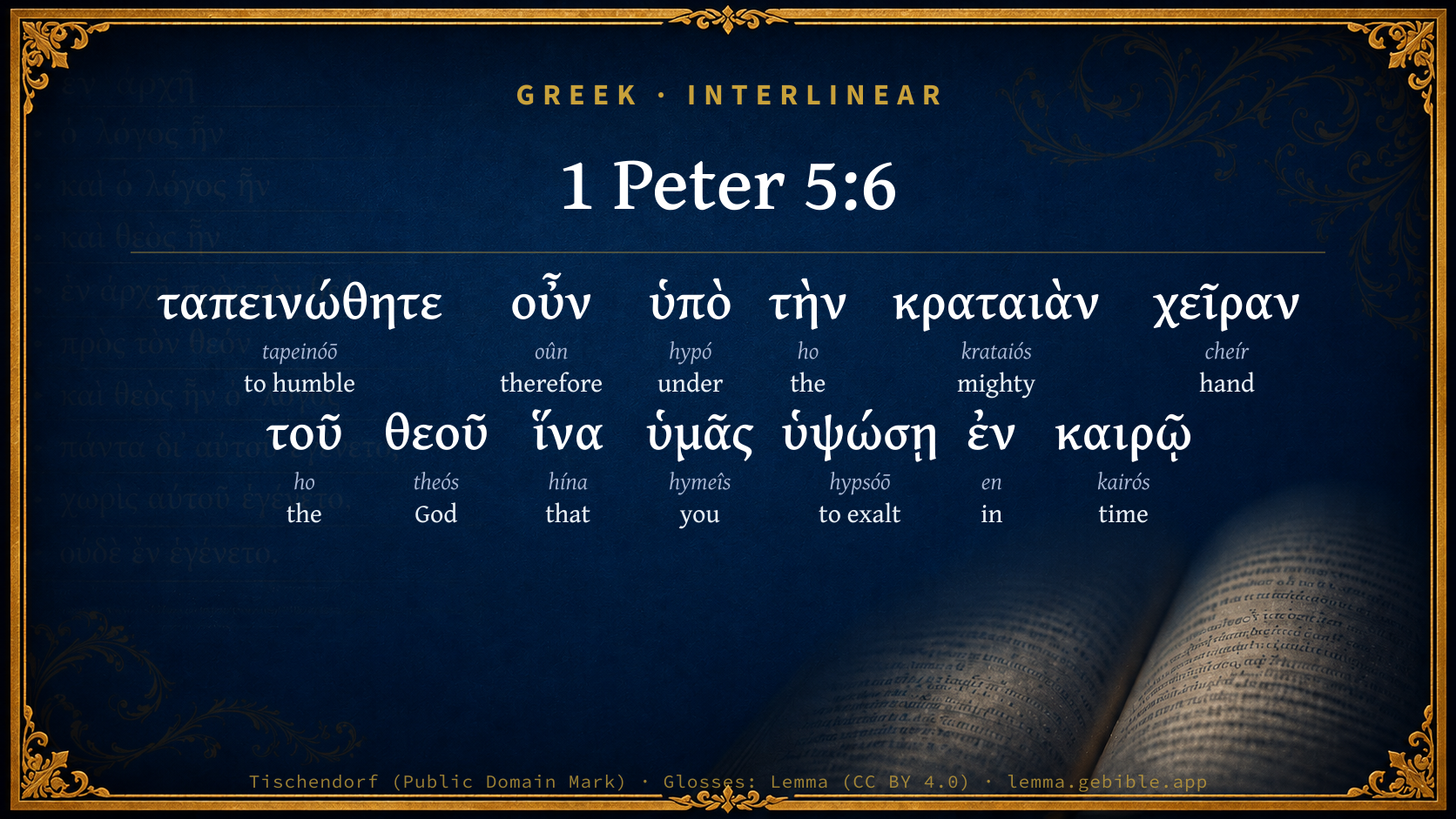
Download image
Cite this verse

1 Peter 5:6 (World English Bible). Public Domain. Lemma interlinear Bible study tool, https://lemma.gebible.app/v/1-peter/5/6.

Show BibTeX & RIS
BibTeX
RIS
English Translation
Humble yourselves therefore under the mighty hand of God, that he may exalt you in due time;
World English Bible · Public Domain
Highlights
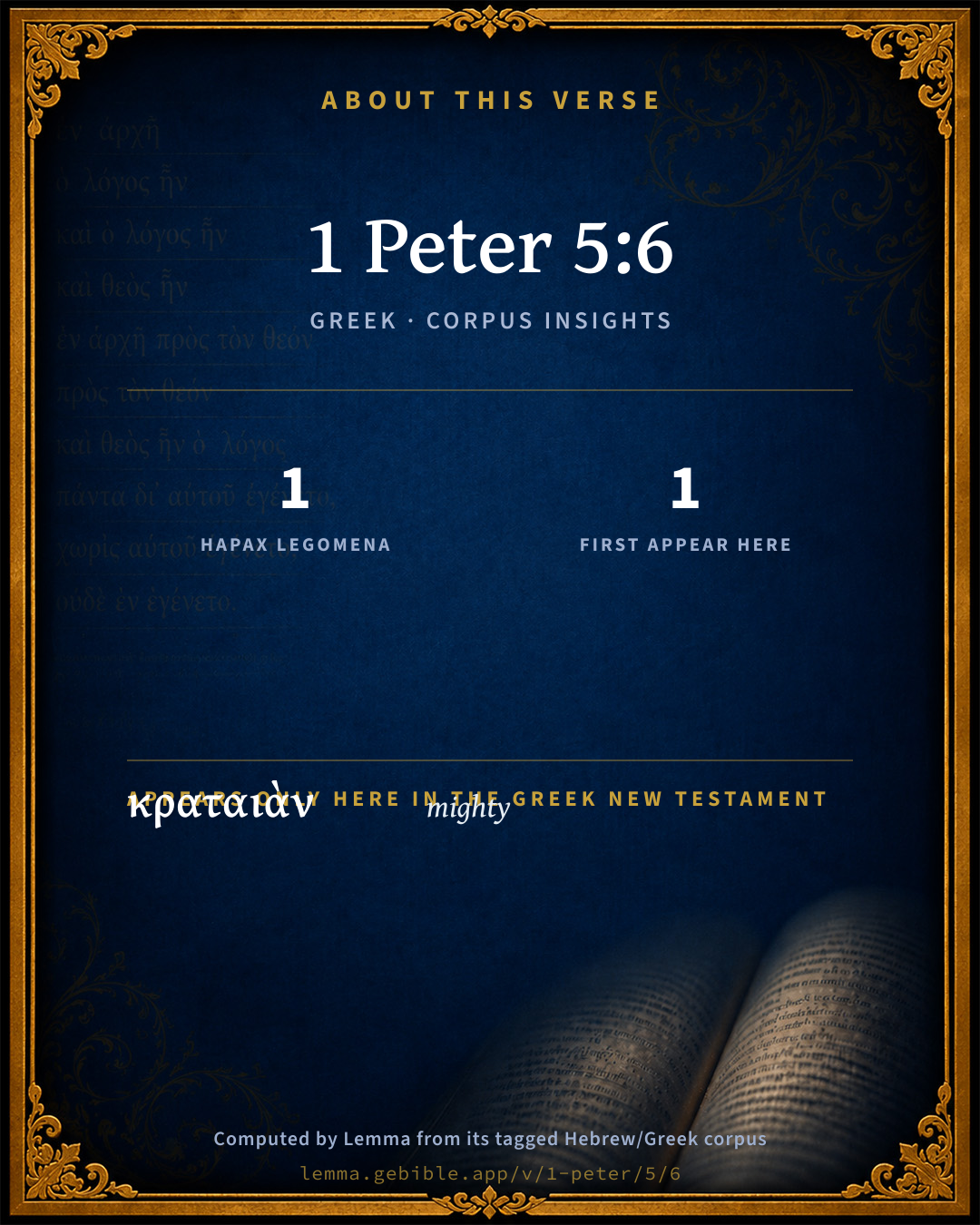
  • 1 hapax legomenon — only here in the Greek New Testament
  • 1 first appearance in the Greek New Testament
Full analysis ↓
Download a study sheet

One document with this verse’s original text, its word-by-word gloss line, the meaning frame, cross-references with their text, attributed commentary, and full source and license credits — printable, and it pastes into notes with its structure intact.

This verse Autodidact and up

Study sheet (.html) Plain text (.txt)

A passage Seminary Student

Up to 50 verses in one chapter. A passage sheet keeps up to 6 commentary sources and 12 cross-references per verse, in the order this page ranks them, and says so on the sheet whenever that leaves anything out. Ask for a single verse and you get the Autodidact verse sheet above.

Everything on this page stays free to read, with no account — the sheet is a download of what is already on screen, not access to it.

Want to remove ads? Support Godless Engineer
Compare translations 3

The same verse in 3 English versions, stacked beneath the original-language interlinear above. Click any original word for its lexicon entry.

Each is an independent rendering of the whole verse — the interlinear is not word-aligned to these translations.

Highlighted words mark where these versions differ — a whole-verse word diff, not a word-by-word alignment.

  • World English Bible Public Domain
    Humble yourselves therefore under the mighty hand of God, that he may exalt you in due time;
  • King James Version Public Domain
    Humble yourselves therefore under the mighty hand of God, that he may exalt you in due time:
  • unfoldingWord Literal Text CC BY-SA 4.0
    Therefore, humble yourselves under the powerful hand of God so that he may lift you up at a time,

unfoldingWord Literal Text — © unfoldingWord, licensed CC BY-SA 4.0. Word-aligned USFM3 via Door43 (git.door43.org/unfoldingWord/en_ult).

Versions to compare (up to 4)

3 of 4 selected

Show all 19 translations

Every available English version of this verse, each an independent rendering of the whole verse.

  • World English Bible Public Domain
    Humble yourselves therefore under the mighty hand of God, that he may exalt you in due time;
  • Berean Standard Bible Public Domain
    Humble yourselves, therefore, under God’s mighty hand, so that in due time He may exalt you.
  • Majority Standard Bible Public Domain
    Humble yourselves, therefore, under God’s mighty hand, so that in due time He may exalt you.
  • King James Version Public Domain
    Humble yourselves therefore under the mighty hand of God, that he may exalt you in due time:
  • American Standard Version (1901) Public Domain
    Humble yourselves therefore under the mighty hand of God, that he may exalt you in due time;
  • Revised Version (1885) Public Domain
    Humble yourselves therefore under the mighty hand of God, that he may exalt you in due time;
  • Geneva Bible (1599) Public Domain
    Humble your selues therefore vnder the mightie hand of God, that he may exalt you in due time.
  • Douay-Rheims (1899) Public Domain
    Be you humbled therefore under the mighty hand of God, that he may exalt you in the time of visitation:
  • Young's Literal Translation Public Domain
    be humbled, then, under the powerful hand of God, that you He may exalt in good time,
  • Literal Standard Version CC BY-SA 4.0
    be humbled, then, under the powerful hand of God, that He may exalt you in good time,
  • Unlocked Literal Bible CC BY-SA 4.0
    Therefore humble yourselves under God's mighty hand so that he may lift you up in due time.
  • unfoldingWord Literal Text CC BY-SA 4.0
    Therefore, humble yourselves under the powerful hand of God so that he may lift you up at a time,
  • Darby Bible Public Domain
    Humble yourselves therefore under the mighty hand of God, that he may exalt you in [the due] time;
  • World Messianic Bible Public Domain
    Humble yourselves therefore under the mighty hand of God, that he may exalt you in due time,
  • Webster's Bible Public Domain
    Humble yourselves therefore under the mighty hand of God, that he may exalt you in due time:
  • Free Bible Version CC BY-SA 4.0
    Humble yourself before God's powerful hand so that he will lift you up at the appropriate time.
  • Bible in Basic English Public Domain
    For this cause make yourselves low under the strong hand of God, so that when the time comes you may be lifted up;
  • Text-Critical English NT CC BY 4.0
    Humble yourselves therefore under the mighty hand of God, so that he may exalt you in due time,
  • Tyndale New Testament (1534) Public Domain
    Submit youre selves therfore vnder the myghty honde of god that he maye exalt you when the tyme is come.

Literal Standard Version (2020), Covenant Press — licensed CC BY-SA 4.0. Text via the HelloAO Bible API (eBible.org). Unlocked Literal Bible (unfoldingWord) — licensed CC BY-SA 4.0. Text via the HelloAO Bible API (eBible.org). unfoldingWord Literal Text — © unfoldingWord, licensed CC BY-SA 4.0. Word-aligned USFM3 via Door43 (git.door43.org/unfoldingWord/en_ult). Free Bible Version, Dr. Jonathan Gallagher — licensed CC BY-SA 4.0. Text via the HelloAO Bible API (eBible.org).

Word by word

More ways to search: Search by grammar → Find every occurrence → Compare this word →

Practice this passage: Drill this verse → Learn its vocabulary →

About this verse

These counts appear in no published source. They are computed here, from the morphology-tagged text and Lemma’s own curated glosses. What Lemma adds →

13
words
12
distinct lemmas
General Epistles
section

Notable vocabulary

1 hapax legomenon — a word that appears only here in the entire Greek New Testament:

  • κραταιὰν mighty G2900

First appearance in Scripture

This word makes its first canonical appearance in the Greek New Testament here:

  • κραταιὰν mighty G2900

Shared distinctive vocabulary

ταπεινώθητε to humble G5013 occurs in 11 verses of the Greek New Testament. Also found in:

Repetition

A word recurs within this verse:

Cross-references

40

Topical passages linked to 1 Peter 5:6 in the Treasury of Scripture Knowledge — connected by theme and wording, ordered by reader-vote popularity; previews shown in the World English Bible.

  • James 4:10 Humble yourselves in the sight of the Lord, and he will exalt you.
  • Luke 14:11 For everyone who exalts himself will be humbled, and whoever humbles himself will be exalted."
  • Proverbs 29:23 A man's pride brings him low, But one of lowly spirit gains honor.
  • Matthew 23:12 Whoever exalts himself will be humbled, and whoever humbles himself will be exalted.
  • Luke 18:14 I tell you, this man went down to his house justified rather than the other; for everyone who exalts himself will be humbled, but he who humbles himself will be exalted."
  • 2 Chronicles 32:26 Notwithstanding Hezekiah humbled himself for the pride of his heart, both he and the inhabitants of Jerusalem, so that the wrath of Yahweh didn't come on them in the days of Hezekiah.
  • Luke 1:52 He has put down princes from their thrones. And has exalted the lowly.
  • 2 Chronicles 12:12 When he humbled himself, the wrath of Yahweh turned from him, so as not to destroy him altogether: and moreover in Judah there were good things [found].
  • 2 Chronicles 33:12 When he was in distress, he begged Yahweh his God, and humbled himself greatly before the God of his fathers.
  • Isaiah 40:4 Every valley shall be exalted, and every mountain and hill shall be made low; and the uneven shall be made level, and the rough places a plain:
  • Jeremiah 44:10 They are not humbled even to this day, neither have they feared, nor walked in my law, nor in my statutes, that I set before you and before your fathers.
  • Psalms 75:10 I will cut off all the horns of the wicked, But the horns of the righteous shall be lifted up.
  • 2 Kings 22:19 because your heart was tender, and you did humble yourself before Yahweh, when you heard what I spoke against this place, and against the inhabitants of it, that they should become a desolation and a curse, and have torn your clothes, and wept before me; I also have heard you, says Yahweh.
  • Isaiah 2:11 The lofty looks of man will be brought low, The haughtiness of men will be bowed down, And Yahweh alone will be exalted in that day.
  • 2 Chronicles 12:6–7 Then the princes of Israel and the king humbled themselves; and they said, Yahweh is righteous.
  • 1 Kings 21:29 See you how Ahab humbles himself before me? because he humbles himself before me, I will not bring the evil in his days; but in his son's days will I bring the evil on his house.
  • Isaiah 57:15 For thus says the high and lofty One who inhabits eternity, whose name is Holy: I dwell in the high and holy place, with him also who is of a contrite and humble spirit, to revive the spirit of the humble, and to revive the heart of the contrite.
  • Jeremiah 13:18 Say you to the king and to the queen-mother, Humble yourselves, sit down; for your headdresses are come down, even the crown of your glory.
  • Micah 6:8 He has shown you, O man, what is good. What does Yahweh require of you, but to act justly, To love mercy, and to walk humbly with your God?
  • Psalms 89:13 You have a mighty arm. Your hand is strong, and your right hand is exalted.
  • Exodus 10:3 Moses and Aaron went in to Pharaoh, and said to him, "This is what Yahweh, the God of the Hebrews, says: 'How long will you refuse to humble yourself before me? Let my people go, that they may serve me.
  • 2 Chronicles 33:23 He didn't humble himself before Yahweh, as Manasseh his father had humbled himself; but this same Amon trespassed more and more.
  • Psalms 89:16–17 In your name they rejoice all day. In your righteousness, they are exalted.
  • 2 Chronicles 30:11 Nevertheless certain men of Asher and Manasseh and of Zebulun humbled themselves, and came to Jerusalem.
  • Daniel 5:22 You his son, Belshazzar, have not humbled your heart, though you knew all this,
  • Romans 5:6 For while we were yet weak, at the right time Christ died for the ungodly.
  • 2 Chronicles 36:12 and he did that which was evil in the sight of Yahweh his God; he didn't humble himself before Jeremiah the prophet [speaking] from the mouth of Yahweh.
  • James 1:9–10 But let the brother in humble circumstances glory in his high position;
  • 2 Chronicles 33:19 His prayer also, and how [God] was entreated of him, and all his sin and his trespass, and the places in which he built high places, and set up the Asherim and the engraved images, before he humbled himself: behold, they are written in the history of Hozai.
  • Deuteronomy 32:35 Vengeance is mine, and recompense, At the time when their foot shall slide: For the day of their calamity is at hand, The things that are to come on them shall make haste.
  • Ezekiel 17:21 All his fugitives in all his bands shall fall by the sword, and those who remain shall be scattered toward every wind: and you shall know that I, Yahweh, have spoken it.
  • Exodus 3:19 I know that the king of Egypt won't give you permission to go, no, not by a mighty hand.
  • Exodus 32:11 Moses begged Yahweh his God, and said, "Yahweh, why does your wrath burn hot against your people, that you have brought forth out of the land of Egypt with great power and with a mighty hand?
  • Leviticus 26:41 I also walked contrary to them, and brought them into the land of their enemies: if then their uncircumcised heart is humbled, and they then accept the punishment of their iniquity;
  • Job 36:22 Behold, God is exalted in his power. Who is a teacher like him?
  • Ezekiel 21:6 Sigh therefore, you son of man; with the breaking of your loins and with bitterness shall you sigh before their eyes.
  • 1 Corinthians 10:22 Or do we provoke the Lord to jealousy? Are we stronger than he?
  • James 5:10 Take, brothers, for an example of suffering and of patience, the prophets who spoke in the name of the Lord.
  • 1 Timothy 2:6 who gave himself as a ransom for all; the testimony in its own times;
  • Titus 1:3 but in his own time revealed his word in the message with which I was entrusted according to the commandment of God our Savior;

Cross-references courtesy of OpenBible.info (CC BY 4.0).

Commentary

Notes on 1 Peter 5:6 from classic Christian and Jewish commentators (each source and its license shown beneath its notes). The classic Christian expositions comment on the surrounding passage and are grouped to its opening verse, so a note may address several verses; the Jewish commentaries on the Tanakh (Rashi and others) are per-verse, so they appear only where the commentator wrote on this verse.

Lemma curates 59 commentaries, every one of them public domain or Creative Commons licensed, each selected and text-cleaned for this edition rather than reprinted as found. About our sources →

Bengel's Gnomon

Johann Albrecht Bengel

1Pe 5:6. Κραταιὰν χεῖρα, the powerful hand) The hand of God establishes different ranks; He depresses the proud, and exalts the humble. He who is subject to the ordinances of man for the Lord’s sake, ch. 1Pe 2:13, submits himself also to the Lord Himself. Comp. Rom 13:2.—ἐν καιρῷ, in due time) at the befitting time. Comp. ὀλίγον, 1Pe 5:10. Peter often looks to the day of judgment.

Bengel's Gnomon of the New Testament — English translation (T&T Clark, Edinburgh, 1860) — public domain. Text from a community e-Sword module.

Meyer's Critical & Exegetical Commentary

Heinrich August Wilhelm Meyer

1Pe_5:6. Conclusion drawn from the Old Testament passage, ταπεινώθητε οὖν ὑπὸ κ.τ.λ.] see Jam_4:6; not: become humble, as Wiesinger interprets, on account of the passive (for if the meaning must be passive, in accordance with the form, it ought to be: be made humble), but in a middle sense: humble yourselves. 1Pe_5:7 shows that this self-humbling here refers to the lowly and submissive bearing of afflictions (otherwise in Luk_14:11).

τὴν κραταιὰν χεῖρα] Old Testament expression denoting the power of God which rules and judges all; cf. Deu_3:24, LXX.; it does not refer here to the laying on of afflictions only (de Wette), but to the being exalted out of them (so, too, Brückner); cf. Luk_1:51 : ἐποίησε κράτος ἐν βραχίονι αὐτοῦ· διεσκόρπισεν ὑπερηφάνους … καὶ ὕψωσε ταπεινούς. The purpose of this subordination: ἵνα ὑμᾶς ὕψωσῃ, is the glory which follows upon the sufferings; ἵνα is not put ἐκβατικῶς (Pott), but τελικῶς.

ἐν καιρῷ] Mat_24:45 : tempore statuto; Erasmus: ut vos extollat, cum erit opportunum, cum judicabit id vobis expedire vel in hoc saeculo, vel in die judicii; this last is here the principal point of view.

Meyer — Critical and Exegetical Commentary on the New Testament — English translation by Peter Christie, edited by Frederick Crombie (T&T Clark, 1880) — public domain. Text from a community e-Sword module.

Expositor's Greek Testament

ed. W. Robertson Nicoll

1Pe 5:6 . ταπεινώθητε οὖν echoes the exhortation and its accompanied scripture in 1Pe 5:5 obey in order that the promise (Luk 14:11 ) may be fulfilled for you, he that humbleth himself shall be exalted ( sc. by God). So too St. James, subject yourselves therefore to God (1Pe 4:7 ). τὴν κραταιὰν χεῖρα . God’s mighty hand is a common O.T. expression; see Exo 3:19 , etc. for connexion with deliverance and especially Eze 20:33 f., ἐν χειρὶ κραταιᾷ καὶ … ἐν θυμῷ κεχυμένῳ βασιλεύσω ἐφʼ ὑμᾶς .

The Expositor's Greek Testament, edited by W. Robertson Nicoll (1897–1910) — public domain. Text from a community e-Sword module.

Geneva Bible (1599)

Geneva Bible translators

Because those proud and lofty spirits threaten the modest and humble, the Apostle warneth us to set the power of God against the vanity of proud men, and to hang wholly upon his providence.

Geneva Bible (1599) marginal notes — public domain. Text via Bolls.life.

Jamieson, Fausset & Brown

Robert Jamieson, A. R. Fausset & David Brown

under the mighty hand--afflicting you (Pe1 3:15): "accept" His chastisements, and turn to Him that smiteth you. He depresses the proud and exalts the humble.

in due time--Wait humbly and patiently for His own fit time. One oldest manuscript and Vulgate read, "In the season of visitation," namely, His visitation in mercy.

Jamieson, Fausset & Brown — Commentary Critical and Explanatory on the Whole Bible (1871) — public domain (CC PDM 1.0). Text via the HelloAO Bible API.

Adam Clarke's Commentary

Verse 6. Humble yourselves] Those who submit patiently to the dispensations of God's providence he lifts up; those who lift themselves up, God thrusts down.

If we humble not ourselves under God's grace, he will humble us under his judgments. Those who patiently submit to him, he exalts in due time; if his hand be mighty to depress, it is also mighty to exalt.

Adam Clarke's Commentary on the Bible (1810–1826) — public domain. Text from a community e-Sword/MySword module.

John Calvin's Commentaries

6 Humble yourselves therefore. We must ever bear in mind for what end he bids us to be humble before God, even that we may be more courteous and kind to our brethren, and not refuse to submit to them as far as love demands. Then they who are haughty and refractory towards men, are, he says, acting insolently towards God. He therefore exhorts all the godly to submit to God’s authority; and he calls God’s power his hand, that he might make them to fear the more. For though hand is often applied to God, yet it is to be understood here according to the circumstances of the passage. But as we are wont commonly to fear, lest our humility should be a disadvantage to us, and others might for this reason grow more insolent, Peter meets this objection, and promises eminency to all who humble themselves.

But he adds, in due time, that he might at the same time obviate too much haste. He then intimates that it is necessary for us to learn humility now, but that the Lord well knows when it is expedient for us to be elevated. Thus it behoves us to yield to his counsel.

John Calvin's Commentaries (1540-1563) — public domain. Text from the Calvin Translation Society English edition (1840s-50s) via the Christian Classics Ethereal Library (ccel.org). Calvin's coverage is partial (roughly two-thirds of the Bible); uncommented books and verses are honest gaps, never fabricated. The 19th-century editor's footnotes and remarks are omitted so the notes are faithfully Calvin's own voice.

Ellicott's Commentary for English Readers

(6) Humble yourselves therefore.—This, too, looks an amplification of a proverb, when we compare it with Jas_4:10. The humility here recommended is not merely a submissive bearing of the strokes which it pleased God to let fall upon them, but it was to be shown, as we see in the former verse, in their bearing toward one another. And “the mighty hand of God” is not to be regarded as that which is chastising them, but as the protecting shelter which they are humbly to seek.

In due time.—St. Peter probably means, in the day of judgment, which seemed so instant.

A Bible Commentary for English Readers, edited by Charles John Ellicott (1878–1897) — public domain. Text from a community e-Sword module.

The Cambridge Bible for Schools and Colleges

gen. ed. J. J. S. Perowne

6. Humble yourselves therefore under the mighty hand of God] The parallelism with St James (Jas_4:10) will again be noticed, but the thought is one which occurs in many forms elsewhere (Job_22:29; Pro_29:23; Mat_23:12; Luk_1:52; Luk_14:11; Luk_18:14). The plural “the mighty hand of God,” reproduces the LXX. version of Deu_3:24.

in due time] The promise is purposely left in this vague indeterminate form. St Peter does not say that the exaltation of victory will come in this life. He does not say either, that it will not come till the Resurrection. He is certain, with the full assurance of faith, that this is God’s law of retribution, and he is content to leave “the times and the seasons” in the Father’s hands, certain that the season chosen will be the right one.

The Cambridge Bible for Schools and Colleges (gen. ed. J. J. S. Perowne; Cambridge University Press, 1878–1918) — public domain. Text from a community e-Sword module.

John Gill's Exposition

Humble yourselves therefore,.... Or be ye humbled before God, and in his sight; quietly submit to his will; patiently bear every affliction without murmuring, repining, or replying against him; be still under the rod, and despise not the chastening of the Lord; mourn over sin as the cause, acknowledge your vileness and unworthiness, and stand in awe of his majesty, considering yourselves as

under the mighty hand of God a phrase expressive of his omnipotence which cannot be stayed, and it would be madness to oppose it; and which is able to cast down the proud, and dash them to pieces, as well as to exalt the humble. His hand, upon men, in a way of chastisement, presses sore, and, in a way of punishment, presses down, and crushes to pieces; but to be under it in an humble manner is safe and profitable; such are hid as in the hollow of his hand, and are safe as in a pavilion, and comfortable under the shadow of his wings; and such humiliation and submission to him, and putting themselves under his mighty hand and care, is the way to exaltation:

that he may exalt you in due time: the Arabic version reads, "in the time of exaltation": when his time to exalt is come, either in this world, or more especially at the appearance of Christ and his kingdom. The Vulgate Latin version, and two copies of Beza's, one of Stephens's, and the Alexandrian, read, "in the time of visitation"; and so the Ethiopic version, "when he shall have visited you"; which seems to be taken out of Pe1 2:12 sooner or later such who are humbled shall be exalted; it is the usual way and method which God takes to abase the proud, and exalt the humble; for humble souls honour him, and therefore such as honour him he will honour; and this he does in his own time, in a time that makes most for his glory, and their good; oftentimes he does it in this life, and always in that which is to come.

John Gill's Exposition of the Whole Bible (1746–1763) — public domain (CC PDM 1.0). Text via the HelloAO Bible API.

Trapp's Complete Commentary

John Trapp

6 Humble yourselves therefore under the mighty hand of God, that he may exalt you in due time:

Ver. 6. Under the mighty hand of God] If God can blow us to destruction, Job 4:9, nod us to destruction, Psa 18:16, what is the weight of that mighty hand of his that spans the heavens and holds the earth in the hollow of them?

That he may exalt you] The lower the ebb, the higher is the tide. A deluge of sorrows may assault us, but they shall exalt as. And the lower the foundation of virtue is laid, the higher shall the roof of glory be overlaid.

In due time] In the opportunity of time, in a fit season. The very Turks, though remorseless to those that bear up, yet receive humiliation with much sweetness.

John Trapp, A Commentary or Exposition upon All the Books of the Old and New Testament (1647–1656) — public domain. Text from a community e-Sword module.

Albert Barnes' Notes on the Bible

Humble yourselves therefore - Be willing to take a low place - a place such as becomes you. Do not arrogate to yourselves what does not belong to you; do not evince pride and haughtiness in your manner; do not exalt yourselves above others. See the notes at Luk 14:7-11. Compare Pro 15:33; Pro 18:12; Pro 22:4; Mic 6:8; Phi 2:8.

Under the mighty hand of God - This refers probably to the calamities which he had brought upon them, or was about to bring upon them; represented here, as often elsewhere, as the infliction of his hand - the hand being that by which we accomplish anything. When that hand was upon them they were not to be lifted up with pride and with a spirit of rebellion, but were to take a lowly place before him, and submit to him wish a calm mind, believing that he would exalt them in due time. There is no situation in which one will be more likely to feel humility than in scenes of affliction.

That he may exalt you in due time - When he shall see it to be a proper time:

They might be assured that this would be done at some time. He would not always leave them in this low and depressed condition. He would take off his heavy hand, and raise them up from their state of sadness and suffering.

(2)This would be in due time; that is, in the proper time, in the best time:

It might be in the present life. It would certainly be in the world to come. There they would be exalted to honors which will be more than an equivalent for all the persecution, poverty, and contempt which are suffered in this world. He may well afford to be humble here who is to be exalted to a throne in heaven.

Albert Barnes' Notes on the Bible (1834–1885) — public domain. Text from a community e-Sword/MySword module.

Matthew Poole's English Annotations

The mighty hand of God; by this he means God’s omnipotence, which sometimes is called a strong hand, Exo 3:19, a mighty hand, Exo 32:11; Deu 3:24, the right hand of power, Mat 26:64; by which he is able to beat down those that are proud and high, and to defend or exalt those that are humble and lowly.

In due time; Greek, in season, viz. that which God sees most fit and conducing to his own glory and your real welfare.

Matthew Poole's English Annotations on the Holy Bible (1683–1685) — public domain. Text from a community e-Sword/MySword module.

Whedon's Commentary on the Bible

Daniel D. Whedon

6. Humble yourselves therefore—Because God thus resists the proud and gives grace to the lowly-minded, enabling them to endure, and lifting them up in times of trouble and persecution, they are exhorted to receive with perfect submission all things that befall them under the government of the Lord, in the full assurance that soon or late, in his own way and time, he will exalt them in the removal of the trouble, or in taking them to himself.

Daniel D. Whedon (gen. ed.), Commentary on the Old and New Testaments (1874–1909) — public domain. Text from a community e-Sword module.

The Pulpit Commentary

Humble yourselves therefore under the mighty hand of God, that he may exalt you in due time. The Alexandrine Manuscript and some ancient versions add ejpiskophv, "in the time of visitation," probably from Luk_19:44. For "the mighty hand of God," comp. Deu_3:24; Luk_1:51. St. Peter was doubtless thinking of the well-remembered words of the Lord, "He that humbleth himself shall be exalted.

Vers. 6-11.

Counsels for troubled Christians.

yourselves therefore under the mighty hand of God," etc. Approaching the end of his letter, the apostle condenses into two or three almost electric sentences some most momentous practical directions for troubled Christian men. In these directions we learn

I THE TRUE SPIRIT FOR CHRISTIAN MEN TO CHERISH IN LIFE"S TRIALS. Here is:

1. Devout humility, and with it freedom from anxiety. The two are more closely,associated than we sometimes imagine. Let us look at them separately, and then in their combination. "Humble yourselves.., under the mighty hand of God.

(1) Self-humbling is true humility. To be crushed by others or by circumstances may be only humiliation.

(2) Humbling of self before God is true humility. Towards God first and chiefly the emotion is to be cherished, the attitude maintained.

(3) Humbling of self before a personal, great, and loving God is true humility. "Mighty hand of God." Not a force, but a "hand a hand as gentle as mighty.

(4) Humbling of self before, such a God will lead to exaltation "in due time he will exalt." "Casting all your anxiety upon him, because he careth for you." "Anxiety;" perplexing, dividing, cutting thought. "Cast;" by a brave and resolute and simple act of will. "For he careth." Not anxiety now, but clear, loving, constant interest. Now, we can see how true humility leads to freedom from anxiety. The relationship and attitude of the soul towards God is the key to both.

2. Sober watchfulness, and with it stern conflict. "Be sober," etc. Note the need for the watchfulness.

(1) An enemy. "Your adversary the devil.

(2) An active enemy. "Walketh about.

(3) A destructive enemy. "Whom he may devour.

(4) An enemy who can be resisted. "Whom withstand.

(5) An enemy whom others have contended with and conquered. "The same sufferings are accomplished in your brethren who are in the world.

Into that trial and battle and storm all the brotherhood, even the great elder Brother, have gone.

II THE FINAL PURPOSE OF GOD WITH REGARD TO MEN WHO CHERISH SUCH A SPIRIT" IN LIFE"S TRIALS.

1. A destiny that is wonderful. "God of grace compassion, favor, help. "Called." God compels rivers, oceans, in their courses, etc., but calls souls to their high destiny. "Eternal glory in Christ;" such as is

1. revealed in Christ;

2. shared with Christ;

3. inherited through Christ.

4. A trial that is transient. "Alter ye have suffered a little while." Often it seems long. "Life, an age to the miserable, a moment to the happy." But it is a "little while" comparatively to eternity, and absolute in itself.

1. A character that is complete. "Perfect;" no deficiency or defect. "Stablish;" all this to be made permanent. Not goodness like the early cloud and morning dew. "Strengthen;" inspire with force to overcome all hostile influences.

2. A character that calls for praise to God. "To him be the dominion for ever and ever. Amen." Peter exulted that God reigned, and yearned for him to have empire that was universal and perpetual, and acknowledged by all with the "Amen," not only of all men, but of all the powers in every man.

U.R.T.

The Pulpit Commentary (1880–1919), ed. H.D.M. Spence-Jones & Joseph S. Exell — public domain. Text from a community e-Sword module.

John Wesley's Explanatory Notes

The hand of God - Is in all troubles.

John Wesley, Explanatory Notes Upon the Whole Bible (1754–1765) — public domain. Text via the GEBible commentary corpus.

Kretzmann's Popular Commentary

Paul E. Kretzmann

Humility and vigilance enjoined:

v. 6. Humble yourselves, therefore, under the mighty hand of God that he may exalt you in due time;

v. 7. casting all your care upon Him, for he careth for you.

v. 8. Be sober, be vigilant, because your adversary, the devil, as a roaring Lion, walketh about, seeking whom he may devour;

v. 9. whom resist steadfast in the faith, knowing that the same afflictions are accomplished in your brethren that are in the world.

The lesson which the apostle opened in the first paragraph he here concludes with an urgent appeal: Humble yourselves, then, under the mighty hand of God, so that He may exalt you in His time. The reference is to the suffering which He sends His Christians. The pride of the human heart is inclined to resent this chastisement, to murmur, and to grumble. But true Christians will repress this tendency, will willingly bow themselves under the chastening hand of their almighty Lord and Master, will cheerfully bear all the misfortunes which He thinks it best to inflict. If this is the case, then God, in His mercy, will also lift up them that are His out of the slough of despondency which threatens to engulf them, and will make them feel the fullness of His goodness in Christ Jesus.

In thus bearing the misfortunes, and even the chastisements which fall to their lot, with meekness and patience, the apostle suggests to the Christians: Casting your every care upon Him, for He cares for you. All the cares and worries of this present life, everything that bothers the Christians, in its entirety, and once and for always, they should simply cast upon their heavenly Father, making a recurrence of foolish care and worry impossible. See Psa 55:23; Mat 6:25-34, If Christians thus, by the prayer of faith, put everything that worries them into the care of their heavenly Father, they will realize and experience the truth of His many promises; they will find out that God takes a personal interest in every one of them, that without His will or permission not a hair of their head will fall to the ground.

But while yielding to God’s almighty hand, we should stand firm against the attacks and blows of Satan: Be sober, be vigilant; your adversary, the devil, like a roaring lion, is walking about, seeking whom he may devour: to whom offer resistance, firm in the faith, knowing that the selfsame sufferings are befalling your brotherhood in the world. That is the attitude of mind, the disposition, which we must find in the Christians at all times, to keep a clear mind, unclouded with the cares of this life, to be on the lookout against dangers and enemies all the time, never to slacken in vigilance for so much as a moment. For the most powerful enemy, the most mighty adversary, is the devil, the murderer from the beginning. Just as the roaring of the lion is intended to terrorize and intimidate the animals, as he goes forth to seek his prey, making them cower before him in cringing helplessness, thus the devil makes use of similar schemes. By the enmity and the threats of the children of the world he tries to reduce the Christians to a state of helpless terror, when they will be unable to resist his attack and will become a prey to him and to eternal damnation. He does not easily attack an entire congregation, but he singles out such as seem to offer the best chance for a successful onslaught. And it is the culmination of his joy if he succeeds in drawing some poor soul down into his kingdom of darkness. There is only one approved way for the Christians, individually and collectively, to save their souls at such a time, namely, by offering unyielding resistance, by being firm in the faith. For faith clings to Christ and to His Word, knowing that a single word taken from God’s eternal truth is sufficient to fell Satan with all his power. And in this resistance another thought will serve to strengthen the believers, namely, that the very same kind of sufferings is being accomplished in the case of the entire brotherhood, the entire Christian Church in the world. This world is the devil’s stamping-ground, here he exercises his power; hence we may expect that he will try with all his might to regain control also of our souls. The consciousness, therefore, that others are in the same condition, that all the other children of God in the world are suffering and battling in the same way as we are, will serve to comfort and to strengthen us.

Paul E. Kretzmann, Popular Commentary of the Bible (1921–1924) — public domain. Text from a community e-Sword module.

Burkitt's Expository Notes on the New Testament

William Burkitt

By the hand of God, understand his judgments, his almighty power, which it is our duty to submit unto, and to be humble under, in the day of our affliction; and this profound submission and deep humility is the way to glory and exaltation. He can exalt us, and will do it here, if it be good for us: but sometimes God sees abasement better for his people: better, because safer, and accordingly they shall have it.

Learn hence, That the strength and power of God should oblige us very greatly to humble ourselves before him, and subject ourselves unto him: Humble yourselves under the mighty hand of God.

Secondly, That God will exalt the humble in due time, either here or hereafter; either in time or in eternity, as it shall most and best conduce to his own glory and their good.

William Burkitt's Expository Notes on the New Testament (1700–1703) — public domain. Text from a community e-Sword module.

The People's New Testament

B. W. Johnson

6. Humble yourselves. Because “God giveth grace to the humble.” Under the mighty hand. God exalts as well as casts down. He lifts up the humble, therefore, “Humble yourselves that he may exalt you.” In due time. In God's own time; not our time, but God's.

B. W. Johnson's The People's New Testament with Notes (1889–1891) — public domain. Electronic text from the Christian Classics Ethereal Library (CCEL) ThML edition.

Cambridge Greek Testament for Schools and Colleges

6–14. 6 The way therefore to attain true greatness, to be exalted in God’s good time, is to humble yourselves under the mighty hand of God, submitting patiently to whatever trials He sends you; 7 casting all the burden of your anxiety upon Him in full assurance of His loving care for you.

8 But this does not justify any neglect of precaution on your part. You must have all your faculties under perfect control and be on the watch, for you have an active opponent to deal with. The devil, like a roaring lion, is ever prowling round you, hunting for some prey to devour. (Do not let the fear of suffering terrify you into submission.) 9 Stand your ground against him with the solid front which faith can give. Remember that you do not stand alone. You are part of a band of brothers, stationed like yourselves in the world. Your experience is not peculiar. The same discipline of suffering is being carried out by God’s will in their case also. 10 But however painful your experience may be, remember that it is sent by God whose every thought is loving favour. His final purpose for you, to which He called you, is to share His own eternal glory as members of Christ (your glorified Head). After passing through a short period of suffering He Himself will equip you fully, He will stablish you, He will give you the needful strength for the fight. 11 To Him be the might of victory to all eternity. Amen. Silvanus, 12 the bearer of this short letter, is one whom I regard as a faithful brother to you. My object in writing to you is to encourage you and to give my testimony to the fact that your position as Christians and the sufferings which it involves are in very truth a sign of God’s loving favour. Stand fast then to maintain it.

13 The sister Church in Rome, the new Babylonish exile of the new Israel of God, which shares with you God’s call to be His chosen people, sends you her greeting, as also does Mark, my son in the faith.

14 Greet one another with a kiss of love. May God give the blessing of peace to all of you as members of Christ.

6. ταπεινώθητε οὖν. Such humility towards fellow-Christians is only the outward expression of humility towards God, just as obedience to rulers, masters or husbands was shewn to be based upon fear and subjection towards God. In their present circumstances of “trial by fire” such humility towards God must be shewn by patient, trustful acceptance of suffering as part of His loving purpose. They must not resent it as “a strange chance” or be fretful with anxiety (μέριμνα). Suffering for Christ is in itself a position of favour (cf. Php 1:29). To bear it humbly is the condition for being exalted to full and final favour.

κραταιὰν χεῖρα τοῦ θεοῦ. The “mighty hand” of God is generally used in the LXX. of God’s power in deliverance, e.g. from Egypt, Exo 3:19; Deu 9:29, etc., but in Eze 20:34 it is used of God’s power in judgment, in scattering His people in exile. So here God’s “mighty hand” is shewn in judgment, but that same “mighty hand” will exalt those who humbly submit to His discipline.

ὑψώσῃ, for the exaltation of the lowly cf. Mat 23:12; Luk 1:52; Luk 14:11; Luk 18:14.

ἐν καιρῷ. AP and some cursives and versions add ἐπισκοπῆς from 1Pe 2:12. Here it means in His own good time. Christians must not be impatient if God seems “to tarry long with them.”

Cambridge Greek Testament for Schools and Colleges (Cambridge University Press, 1896; 21 vols, various authors incl. Carr, Maclear, Plummer, Farrar, Lumby, Moule, M. R. James, Simcox) — public domain. Text from a community e-Sword module.

Alford’s Greek Testament

Henry Alford

6.] Humble yourselves (on the medial signification of some verbs in the aor. 1 pass. in the N. T., see Winer, § 39. 2. The commonest example is ἀποκριθείς. Cf. also διεκρίθη, Mat 21:21; Rom 4:20, &c.) therefore (the same spirit as before continues through this and the following verses: the μέριμνα here, and the παθήματα, ver. 9, keeping in mind their persecutions and anxieties, as also does κραταιὰν χεῖρα, see below) under the mighty hand of God (on the expression, see reff., LXX. The strong hand of God is laid on the afflicted and suffering, and it is for them to acknowledge it in lowliness of mind), that He may exalt you (the Apostle refers to the often repeated saying of our Lord, Mat 23:13, Luk 14:11, Luk 18:14. The same is also found in the O. T., Psa 18:27; Pro 29:23) in (the) time (appointed) (ἐν καιρῷ is one of those phrases in which the article is constantly omitted: see reff., and Winer, § 19. 1. This humility implies patience, waiting God’s time: “ut nimiæ festinationi simul obviam eat,” Calv. The καιρός need not necessarily be understood as Bengel (“Petrus sæpe spectat diem judicii”) of the end; it is more general: cf. ἐν καιροῖς ἰδίοις, 1Ti 6:15):

Henry Alford, The Greek Testament (1849–1861) — public domain. Text from a community e-Sword module.

Vincent's Word Studies in the New Testament

Marvin R. Vincent

Mighty hand [κραταιαν χειρα] . A phrase found nowhere else in the New Testament, but occurring in the Septuagint, Exo 3:19; Deu 3:24; Job 30:21. The adjective kratrian, mighty, is, moreover, used only here. Compare Luk 1:51, 52.

Marvin R. Vincent, Word Studies in the New Testament (1887–1900) — public domain. Text from a community e-Sword/MySword module.

Lesson kit

Teaching starters — assembled from the data on this page, not authored interpretation. Every prompt links to the verse data it draws on. Edit before teaching.

1 Peter, in the General Epistles, opens this verse with 13 words (12 distinct Greek lemmas). Its most distinctive word is krataiós (“mighty”). A historical commentator’s framing appears above. Read the whole chapter for the surrounding context.

Discussion questions

  1. How does “mighty” (krataiós) shape what this verse is saying?
  2. This verse holds 1 word here found nowhere else in the Greek New Testament. What might the rare word draw attention to?
  3. The word “mighty” first appears here in Scripture. What is being introduced at this debut?
  4. Matthew 18:4 shares the word «to humble» with this verse. How do the two illuminate each other?
  5. “the” occurs 2× in this one verse. What is the effect of the repetition?
  6. These translations render this verse differently. What is at stake in choosing one wording over another?
  7. Reading how Bengel's Gnomon and Meyer's Critical & Exegetical Commentary read this verse, where do the two commentators agree and where do they part?

Things to notice

  • 1 word in this verse appears nowhere else in the Greek New Testament.
  • 1 word makes its first canonical appearance in Scripture here.
  • These translations choose different wording for 6 words in this verse.
  • “the” occurs 2× in this single verse.
  • 12 distinct Greek lemmas span 13 words in this verse.

Reading settings

Reading text

Shown beneath each verse's original-language words.

Old Testament
Old Testament edition

Read the OT as the Masoretic Hebrew (MT) or the Greek Septuagint (LXX).

English shown for the Greek Septuagint (in the Hebrew ↔ Greek comparison).

Comparing translations? Open the Compare panel on any verse page to stack up to four side by side.