
Acts 4:28

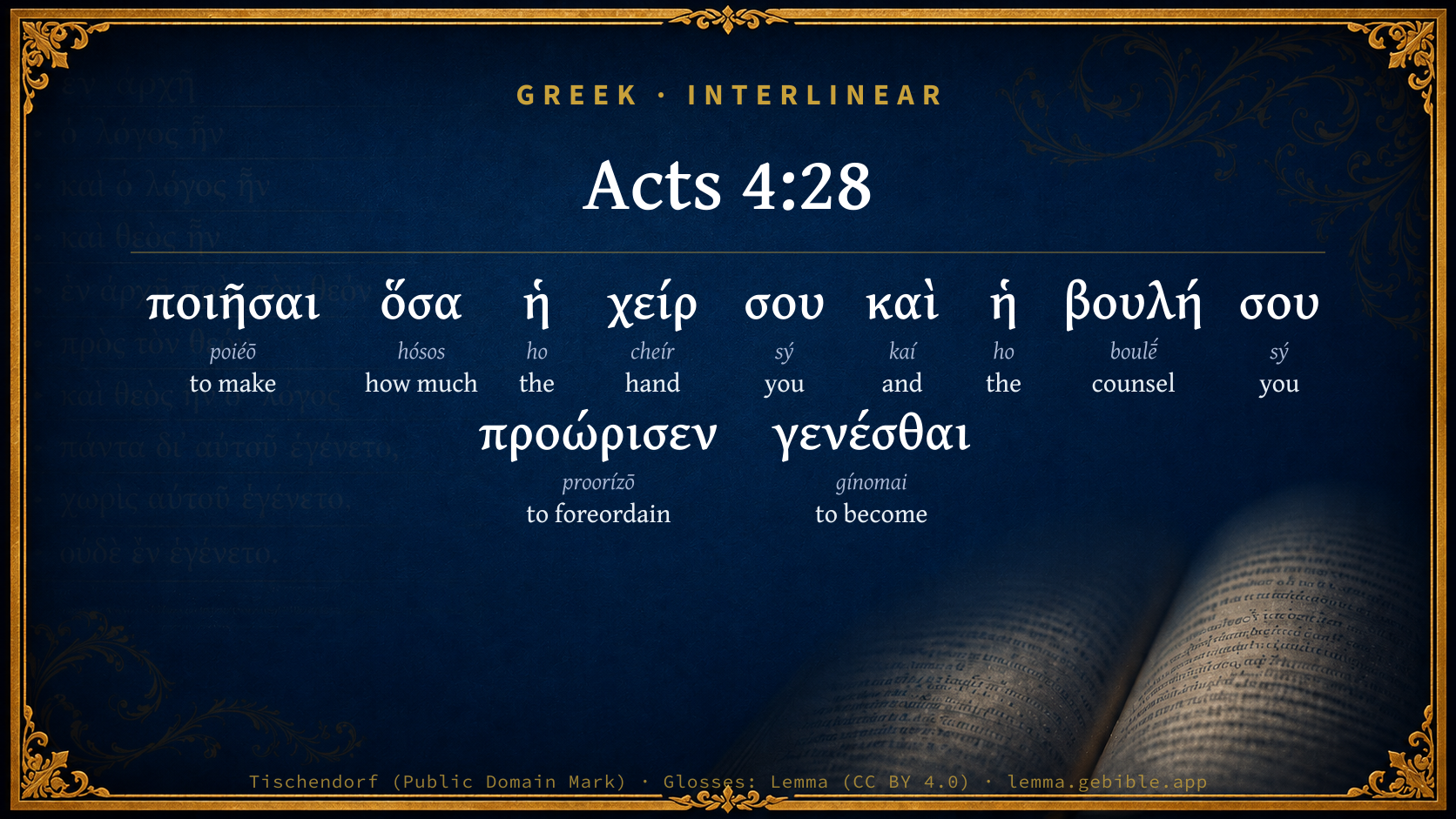
Greek (Tischendorf 8th ed.) Acts 4:28 appears in the Greek New Testament. The text above is from the Tischendorf 8th edition. Each word links to its Strong’s number and a concise gloss. Click any word for its full Thayer’s Greek Lexicon entry.
Download image
Cite this verse

Acts 4:28 (World English Bible). Public Domain. Lemma interlinear Bible study tool, https://lemma.gebible.app/v/acts/4/28.

Show BibTeX & RIS
BibTeX
RIS
English Translation
to do whatever your hand and your council foreordained to happen.
World English Bible · Public Domain
Highlights
  • 1 first appearance in the Greek New Testament
Full analysis ↓
Download a study sheet

One document with this verse’s original text, its word-by-word gloss line, the meaning frame, cross-references with their text, attributed commentary, and full source and license credits — printable, and it pastes into notes with its structure intact.

This verse Autodidact and up

Study sheet (.html) Plain text (.txt)

A passage Seminary Student

Up to 50 verses in one chapter. A passage sheet keeps up to 6 commentary sources and 12 cross-references per verse, in the order this page ranks them, and says so on the sheet whenever that leaves anything out. Ask for a single verse and you get the Autodidact verse sheet above.

Everything on this page stays free to read, with no account — the sheet is a download of what is already on screen, not access to it.

Want to remove ads? Support Godless Engineer
Compare translations 3

The same verse in 3 English versions, stacked beneath the original-language interlinear above. Click any original word for its lexicon entry.

Each is an independent rendering of the whole verse — the interlinear is not word-aligned to these translations.

Highlighted words mark where these versions differ — a whole-verse word diff, not a word-by-word alignment.

  • World English Bible Public Domain
    to do whatever your hand and your council foreordained to happen.
  • King James Version Public Domain
    For to do whatsoever thy hand and thy counsel determined before to be done.
  • unfoldingWord Literal Text CC BY-SA 4.0
    to do all that your hand and your counsel had predetermined to happen.

unfoldingWord Literal Text — © unfoldingWord, licensed CC BY-SA 4.0. Word-aligned USFM3 via Door43 (git.door43.org/unfoldingWord/en_ult).

Versions to compare (up to 4)

3 of 4 selected

Show all 19 translations

Every available English version of this verse, each an independent rendering of the whole verse.

  • World English Bible Public Domain
    to do whatever your hand and your council foreordained to happen.
  • Berean Standard Bible Public Domain
    They carried out what Your hand and will had decided beforehand would happen.
  • Majority Standard Bible Public Domain
    They carried out what Your hand and will had decided beforehand would happen.
  • King James Version Public Domain
    For to do whatsoever thy hand and thy counsel determined before to be done.
  • American Standard Version (1901) Public Domain
    to do whatsoever thy hand and thy council foreordained to come to pass.
  • Revised Version (1885) Public Domain
    to do whatsoever thy hand and thy counsel foreordained to come to pass.
  • Geneva Bible (1599) Public Domain
    To doe whatsoeuer thine hand, and thy counsell had determined before to be done.
  • Douay-Rheims (1899) Public Domain
    To do what thy hand and thy counsel decreed to be done.
  • Young's Literal Translation Public Domain
    to do whatever Thy hand and Thy counsel did determine before to come to pass.
  • Literal Standard Version CC BY-SA 4.0
    to do whatever Your hand and Your counsel determined before to come to pass.
  • Unlocked Literal Bible CC BY-SA 4.0
    They gathered together to do all that your hand and your plan had decided in advance would happen.
  • unfoldingWord Literal Text CC BY-SA 4.0
    to do all that your hand and your counsel had predetermined to happen.
  • Darby Bible Public Domain
    to do whatever thy hand and thy counsel had determined before should come to pass.
  • World Messianic Bible Public Domain
    to do whatever your hand and your counsel foreordained to happen.
  • Webster's Bible Public Domain
    To do whatever thy hand and thy counsel determined before to be done.
  • Free Bible Version CC BY-SA 4.0
    They did whatever you had already decided because you had the power and the will to do it.
  • Bible in Basic English Public Domain
    To do that which had been fixed before by your hand and your purpose.
  • Text-Critical English NT CC BY 4.0
    to do whatever yoʋr hand and yoʋr plan had foreordained to take place.
  • Tyndale New Testament (1534) Public Domain
    forto do whatsoever thy honde and thy counsell determined before to be done.

Literal Standard Version (2020), Covenant Press — licensed CC BY-SA 4.0. Text via the HelloAO Bible API (eBible.org). Unlocked Literal Bible (unfoldingWord) — licensed CC BY-SA 4.0. Text via the HelloAO Bible API (eBible.org). unfoldingWord Literal Text — © unfoldingWord, licensed CC BY-SA 4.0. Word-aligned USFM3 via Door43 (git.door43.org/unfoldingWord/en_ult). Free Bible Version, Dr. Jonathan Gallagher — licensed CC BY-SA 4.0. Text via the HelloAO Bible API (eBible.org).

Word by word

More ways to search: Search by grammar → Find every occurrence → Compare this word →

Practice this passage: Drill this verse → Learn its vocabulary →

About this verse

These counts appear in no published source. They are computed here, from the morphology-tagged text and Lemma’s own curated glosses. What Lemma adds →

11
words
9
distinct lemmas
Acts
section

Notable vocabulary

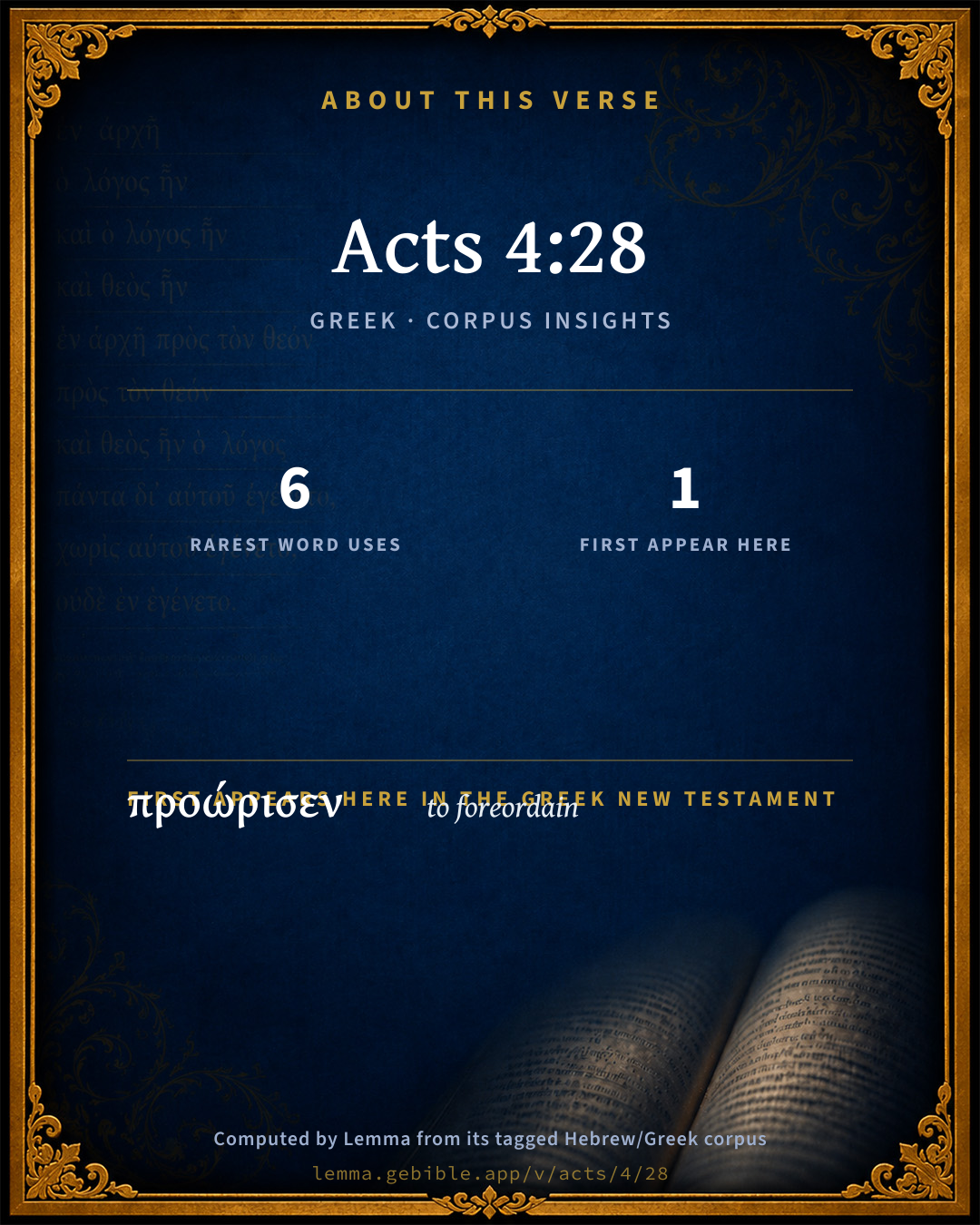
The rarest word here is προώρισεν to foreordain G4309 — appearing just 6 times in the whole Greek New Testament.

First appearance in Scripture

This word makes its first canonical appearance in the Greek New Testament here:

  • προώρισεν to foreordain G4309

Shared distinctive vocabulary

προώρισεν to foreordain G4309 occurs in 6 verses of the Greek New Testament. Also found in:
Repetition

Words recur within this verse:

Cross-references

19

Topical passages linked to Acts 4:28 in the Treasury of Scripture Knowledge — connected by theme and wording, ordered by reader-vote popularity; previews shown in the World English Bible.

  • Acts 2:23 him, being delivered up by the determined counsel and foreknowledge of God, you have taken by the hand of lawless men, crucified and killed;
  • Genesis 50:20 As for you, you meant evil against me, but God meant it for good, to bring to pass, as it is this day, to save many people alive.
  • Isaiah 46:10 declaring the end from the beginning, and from ancient times things that are not [yet] done; saying, My counsel shall stand, and I will do all my pleasure;
  • Matthew 26:24 The Son of Man goes, even as it is written of him, but woe to that man through whom the Son of Man is betrayed! It would be better for that man if he had not been born."
  • Isaiah 53:10 Yet it pleased Yahweh to bruise him; he has put him to grief: when you shall make his soul an offering for sin, he shall see [his] seed, he shall prolong his days, and the pleasure of Yahweh shall prosper in his hand.
  • Luke 24:44–46 He said to them, "This is what I told you, while I was still with you, that all things which are written in the law of Moses, the prophets, and the psalms, concerning me must be fulfilled."
  • Acts 3:18 But the things which God announced by the mouth of all his prophets, that Christ should suffer, he thus fulfilled.
  • Acts 13:27–29 For those who dwell in Jerusalem, and their rulers, because they didn't know him, nor the voices of the prophets which are read every Sabbath, fulfilled them by condemning him.
  • Job 12:13 "With God is wisdom and might. He has counsel and understanding.
  • Psalms 76:10 Surely the wrath of man praises you. The survivors of your wrath are restrained.
  • Proverbs 21:30 There is no wisdom nor understanding Nor counsel against Yahweh.
  • Isaiah 5:19 Who say, "Let him make speed, let him hasten his work, that we may see it; And let the counsel of the Holy One of Israel draw near and come, That we may know it!"
  • Isaiah 28:29 This also comes forth from Yahweh of Hosts, who is wonderful in counsel, and excellent in wisdom.
  • Isaiah 40:13 Who has directed the Spirit of Yahweh, or being his counselor has taught him?
  • Matthew 26:54 How then would the Scriptures be fulfilled that it must be so?"
  • Luke 22:22 The Son of Man indeed goes, as it has been determined, but woe to that man through whom he is betrayed!"
  • Ephesians 1:11 in whom also we were assigned an inheritance, having been foreordained according to the purpose of him who works all things after the counsel of his will;
  • Hebrews 6:17 In this way God, being determined to show more abundantly to the heirs of the promise the immutability of his counsel, interposed with an oath;
  • 1 Peter 2:7–8 For you therefore who believe is the honor, but for such as are disobedient, "The stone which the builders rejected, Has become the chief cornerstone,"

Cross-references courtesy of OpenBible.info (CC BY 4.0).

Commentary

Notes on Acts 4:28 from classic Christian and Jewish commentators (each source and its license shown beneath its notes). The classic Christian expositions comment on the surrounding passage and are grouped to its opening verse, so a note may address several verses; the Jewish commentaries on the Tanakh (Rashi and others) are per-verse, so they appear only where the commentator wrote on this verse.

Lemma curates 59 commentaries, every one of them public domain or Creative Commons licensed, each selected and text-cleaned for this edition rather than reprinted as found. About our sources →

Scofield Reference Notes

C. I. Scofield

determined

Predestination, trans. predestinated. Rom 8:29; Act 4:28; Eph 1:5; Eph 1:11.

The Scofield Reference Bible (1917 edition), notes by C. I. Scofield — public domain. Text from a community e-Sword module.

Tyndale Open Study Notes

Tyndale Open Resources

4:28 God’s hand had been directing events all along in order to achieve his purpose. A similar awareness of God’s hand guiding the affairs of his people is found in the Old Testament (cp. Ezra 7:6, 9, 28; 8:18, 31; Neh 2:8, 18; Eccl 9:1; Ezek 8:1; Rom 8:28; 1 Pet 5:6).

Tyndale Open Study Notes — © Tyndale Open Resources, licensed CC BY-SA 4.0. Text via the HelloAO Bible API.

Bengel's Gnomon

Johann Albrecht Bengel

Act 4:28. Ποιῆσαι, to do) They could not do more, though they wished it. Construe this with, were gathered together, not with, Thou hast anointed: for the subject of the verb to do are the enemies gathered together, concerning whom the prediction had been given. Comp. ch. Act 2:23, “Him, being delivered by the determinate counsel and foreknowledge of God:” Act 3:18.—ὅσα, whatsoever things) not fewer things, but not more.—ἡ χείρ σου καὶ ἡ βουλή σου, Thy hand and Thy counsel) The order of the words is worthy of observation. The hand of God is felt sooner than His counsel. His power and His wisdom are meant.—προώρισε) determined before.

Bengel's Gnomon of the New Testament — English translation (T&T Clark, Edinburgh, 1860) — public domain. Text from a community e-Sword module.

Expositor's Greek Testament

ed. W. Robertson Nicoll

Act 4:28 . ποιῆσαι , infinitive of purpose, see on Act 3:2 ; but even this purpose was overruled by God to the accomplishment of His will, cf. Luk 22:22 ; Luk 24:26 , συνῆλθον μὲν γὰρ ἐκεῖνοι ὡς ἐχθροὶ … ἐποίουν δὲ ἃ σὺ ἐβούλου , Oecum. ἡ χείρ σου , a common expression to signify the controlling power of God, cf. in the N.T. (peculiar to St. Luke’s Gospel and the Acts) the phrases χεὶρ Κυρίου , Luk 1:66 , Act 11:21 ; Act 13:11 . ἡ βουλὴ : only used by St. Luke, cf. Luk 7:30 , Act 2:23 ; Act 13:36 ; Act 20:27 . προώρισε : only in St. Luke and St. Paul, but never in LXX or Apocrypha, Rom 8:29-30 , 1Co 2:7 , Eph 1:5 ; Act 1:11 , but the thought which it contains is in striking harmony with St. Peter’s words elsewhere; cf. Act 2:23 , Act 10:42 , and 1Pe 1:2 ; 1Pe 1:20 ; 1Pe 2:4-6 see above on Peter’s speeches cf. Ignat., Ephes. , tit. ἡ χείρ connected with β . by Zeugma, since only βουλή directly suits the verb; cf. 1Co 3:2 , and Luk 1:64 . (The two verses (Act 4:27-28 ) are referred by Hilgenfeld to the “author to Theophilus”. In his view there is a want of fitness in introducing into the Church’s prayer the words of the Psalm, and their reference to the closing scenes of the life of Jesus; he thinks with Weiss that in the αὐτῶν of Act 4:29 there is quite sufficient reference to the words of the Psalm.)

The Expositor's Greek Testament, edited by W. Robertson Nicoll (1897–1910) — public domain. Text from a community e-Sword module.

Geneva Bible (1599)

Geneva Bible translators

The wicked execute God’s counsel, though they think nothing of it, but they are not therefore without fault.

Thou hadst determined of thine absolute authority and power.

Geneva Bible (1599) marginal notes — public domain. Text via Bolls.life.

Jamieson, Fausset & Brown

Robert Jamieson, A. R. Fausset & David Brown

thy hand and thy counsel determined . . . to be done--that is, "Thy counsel" determined to be done by "Thy hand."

Jamieson, Fausset & Brown — Commentary Critical and Explanatory on the Whole Bible (1871) — public domain (CC PDM 1.0). Text via the HelloAO Bible API.

John Calvin's Commentaries

28. That they might do. I have already declared to what end this is spoken; that the kingdom of Christ was so far from being overrun by that conspiracy, that in truth it did then flourish. Notwithstanding herein is contained a singular doctrine, that God doth so govern and guide all things by his secret counsel, that, he doth bring to pass those things which he hath determined, even by the wicked. Not that they are ready willingly to do him such service, but because he turneth their counsels and attempts backward; so that on the one side appeareth great equity and most great righteousness; on the other appeareth nought but wickedness and iniquity. Which matter we have handled more at large in the second chapter. Let us learn here, by the way, that we must so consider the providence of God, that we know that it is the chief and only guider of all things which are done in the world, that the devil and all the wicked are kept back with God’s bridle, lest they should do us any harm; that when they rage fastest, yet are they not at liberty to do what they list, but have the bridle given them, yet so far forth as is expedient to exercise us. Those men which do acknowledge the foreknowledge of God alone, and yet confess not that all things are done as it pleaseth him, are easily convict by these words, That God hath appointed before that thing to be done which was done. Yea, Luke being not contented with the word counsel, addeth also hand, improperly, yet to the end he might the more plainly declare that the events of things are not only governed by the counsel of God, but that they are also ordered by his power and hand.

John Calvin's Commentaries (1540-1563) — public domain. Text from the Calvin Translation Society English edition (1840s-50s) via the Christian Classics Ethereal Library (ccel.org). Calvin's coverage is partial (roughly two-thirds of the Bible); uncommented books and verses are honest gaps, never fabricated. The 19th-century editor's footnotes and remarks are omitted so the notes are faithfully Calvin's own voice.

Ellicott's Commentary for English Readers

(28) To do whatsoever thy hand. . . .—The great problem of the relation of the divine purpose to man’s free agency is stated (as before in Act_1:16; Act_2:23), without any attempt at a philosophical solution. No such solution is indeed possible. If we admit a Divine Will at all, manifesting itself in the government of the world, in the education of man kind, in the salvation of individual souls, we must follow the example of the Apostle, and hold both the facts of which consciousness and experience bear their witness, without seeking for a logical formula of reconciliation. In every fact of history, no less than in the great fact of which St. Peter speaks, the will of each agent is free, and he stands or falls by the part he has taken in it; and yet the outcome of the whole works out some law of evolution, some “increasing purpose,” which we recognise as we look back on the course of the events, the actors in which were impelled by their own base or noble aims, their self-interest or their self-devotion. As each man looks back on his own life he traces a sequence visiting him with a righteous retribution, and leading him, whether he obeyed the call, or resisted it, to a higher life, an education no less than a probation. “Man proposes, God disposes.” “God works in us, therefore we must work.” Aphorisms such as these are the nearest approximation we can make to a practical; though not a theoretical, solution of the great mystery.

A Bible Commentary for English Readers, edited by Charles John Ellicott (1878–1897) — public domain. Text from a community e-Sword module.

The Cambridge Bible for Schools and Colleges

gen. ed. J. J. S. Perowne

28. for to do, &c.] God made the passions, which the enemies of Jesus indulged, to be the instruments for working out His will. So men when they suppose they are choosing their own way, have the ends thereof shapen by God “rough-hew them how they will.” Their misdeeds are made to execute the will of God, yet they are not on that account exempt from blame.

The Cambridge Bible for Schools and Colleges (gen. ed. J. J. S. Perowne; Cambridge University Press, 1878–1918) — public domain. Text from a community e-Sword module.

John Gill's Exposition

For to do whatsoever thy hand,.... It was not the end of their gathering together against Christ, or it was not their intention and design, to fulfil the purposes and decrees of God, but to fulfil their own lusts, and satiate their rage and malice against him; but it was so in the event, according to the wise disposal of providence, that by their gathering together, by their consultations and conspiracies, they brought about what God in his everlasting council had decreed. By "the hand" of the Lord here is not meant, the grace and favour of God; or the power and providence of God; or his word of precept, his revealed will; but his secret will, the counsel of his will, the hidden purpose of his heart, the wise consultation of his mind, which is formed according to his infinite wisdom: so in Sa2 14:19 it is said, "is not the hand of Joab with thee in all this?" that is, the head of Joab, the wise counsel of Joab; and so the Jewish writers interpret it, "his counsel" (o): and so the word is explained here immediately; for it follows,

and thy counsel determined before to be done: God's decrees are from eternity; there is nothing comes to pass in time but what he has beforetime determined should be done, either by effecting it himself, or doing it by others, or suffering it to be done, as in the case here. Whatever was done to Christ, either by Jews or Gentiles, by Herod or Pontius Pilate, was according to the secret will of God, the covenant he made with Christ, and the council of peace that was between them both: what they wickedly did, God designed for good, and hereby brought about the redemption and salvation of his people: this neither makes God the author of sin, nor excuses the sinful actions of men, or infringes the liberty of their wills in acting.

(o) Kimchi in loc. & R. Sol. Urbin. Ohel Moed, fol. 36. 2.

John Gill's Exposition of the Whole Bible (1746–1763) — public domain (CC PDM 1.0). Text via the HelloAO Bible API.

Trapp's Complete Commentary

John Trapp

28 For to do whatsoever thy hand and thy counsel determined before to be done.

Ver. 28. For to do whatsoever, &c.] Divinum consilium dum devitatur, impletur. Humana sapientia dum reluctatur, comprehenditur. (Greg.)

John Trapp, A Commentary or Exposition upon All the Books of the Old and New Testament (1647–1656) — public domain. Text from a community e-Sword module.

Albert Barnes' Notes on the Bible

For to do ... - See the notes on Act 2:23; Act 3:18. The facts which are brought to view in these verses are among the most remarkable on record. They are briefly these:

That the Jewish rulers were opposed to the Messiah, and slew him.

(2)That the very people to whom he came, and for whose benefit he labored, joined in the opposition, so that it became the act of a united people.

(3)That the Romans, who were there as a sort of representation of all pagan nations, were easily prevailed on to join in the persecution, and to become the executioners.

(4)That thus opposite factions, and dissimilar and prejudiced people, became united in opposing the Messiah.

(5)That the rulers of the Roman people, the emperors, the statesmen, the philosophers, and the rulers of other nations, united to oppose the gospel, and brought all the power of persecution to stay its progress.

(6)That the people of the empire, the mass of people, were easily prevailed upon to join in the persecution, and to endeavor to arrest its progress. It may be added,

That the gospel has encountered similar difficulties and opposition wherever it has been faithfully presented to the attention of people. It has become a very serious question why this has been; on what pretence this opposition has been vindicated, or how it can be accounted for - a question which it is of as much importance for the infidel as for the Christian to settle. We know that accusations of the corrupt lives of the early Christians were freely circulated, and that most gross accounts of their scandalous conduct were propagated by those who chose to persecute them. (See Lardner’s “Credibility.”) But such accounts are not now believed, and it is not certain that they were ever seriously believed by the rulers of the pagan people. It is certain that it was not on things account that the first opposition arose to Christ and his religion.

It is not proper here to enter into an examination of the causes of this opposition. We may state the outlines, however, in few words:

(1) The Jewish rulers were mortified, humbled, and moved with envy, that one so poor and despised should claim to be the Messiah. They had expected a Messiah of a different rank and character; and all their prejudices rose at once against his claims to this high office, Mat 27:18; Mar 15:10.

(2) The common people, disposed extensively to acknowledge his claims, were urged on by the enraged and vindictive priests to demand his death, Mat 27:20.

(3) Pilate was pressed on against his will by the impetuous and enraged multitude to deliver one whom he regarded as innocent.

(4) The Christian religion, in its advances, struck at once at the whole fabric of superstition in the Roman empire and throughout the world. It did not, like other religions, ask a place amidst the religions already existing. It was exclusive in its claims. It denounced all other systems as idolatry or superstition, and sought to overthrow them. Those religions were interwoven with all the habits of the people; they were connected with all the departments of the state; they gave occupation to a vast number of priests and other officer who obtained their livelihood by the existing superstitions, and who brought, of course, all the supposed sacredness of their character to support them. A religion which attempted to overthrow the whole fabric, therefore, at once excited all their malice. The monarchs whose thrones were based on the existing state of things, and the people who venerated the religion of their ancestors, would be opposed to the new system.

(5) Christianity was despised. It was regarded as one form of the superstition of the Jews, and there were no people who were regarded with so much contempt by other nations as the Jews. The writings of the Romans on this point are full proof.

(6) The new religion was opposed to all the crimes of the world. It began its career in a time of eminent wickedness. It plunged at once into the midst of that wickedness; sought the great cities where crimes and pollutions were concentrated, and boldly reproved every form of prevailing impiety. At Athens, at Corinth, at Ephesus, at Rome itself, it denounced the judgment of God against every form of guilt. Whatever may be charged on the apostles, it will not be alleged that they were timid in denouncing the sins of the world. From all these causes it is not wonderful that the early Christians were persecuted. If it be asked.

(7) Why the same religion meets with opposition now in lands that are nominally Christian, it may be remarked:

(a)That the human heart is the same that it always was, opposed to truth and righteousness;

(b)That religion encounters still a host of sins that are opposed to it - pride, envy, malice, passion, and the love of the world;

(c)That there has always been a special opposition in the human heart to receiving salvation as the gift of God through a crucified Redeemer; and,

(d)That all the forms of vice, and lust, and profaneness that exist in the world, are opposed, and ever will be, to a religion of purity, self-denial, and love.

On the whole, we may remark here:

That the fact that Christianity has been thus opposed, and has triumphed, is no small proof of its divine origin. It has been fairly tried, and still survives. It was well to put it to the rest, and to bring to bear on it everything which had a tendency to crush it, and thus to furnish the highest proof that it is from God.

(2)This religion cannot be destroyed; it will triumph; opposition to it is vain; it will make its way throughout the world; and the path of safety is not to oppose what God is intending to establish in the earth. Sinners who stand opposed to the gospel should tremble and be afraid, for sooner or later they must fall before its triumphant advances. It is not safe to oppose what has already been opposed by kings and rulers in every form, and yet has triumphed. It is not wise to risk one’s eternal welfare on the question of successful opposition to what God has, in so many ages and ways, pledged himself to protect; and when God has solemnly declared that the Son, the Messiah, whom he would set on his holy hill of Zion, should “break” his enemies “with a rod of iron, and dash them in pieces like a potter’s vessel,” Psa 2:9.

Albert Barnes' Notes on the Bible (1834–1885) — public domain. Text from a community e-Sword/MySword module.

Matthew Poole's English Annotations

The apostles mind not so much second causes in what my Saviour or themselves suffered, but see and acknowledge God in all; who makes a straight line with a crooked stick; and is holy, wise, and good in overruling and permitting the greatest evils; and does deserve to have praise for all things, Eph 5:20; see Act 2:23.

Thy hand and thy counsel; thy power and right to dispose of all persons and things; alluding to Lev 16:8; as the lot cast for the two goats (the disposing of which being from the Lord, Pro 16:33) did determine which of the goats should be sacrificed, and which should escape; so it was not without a Divine disposition, that Christ was made a sin offering for us; though this no way excuses the wicked instruments of his death and suffering.

Matthew Poole's English Annotations on the Holy Bible (1683–1685) — public domain. Text from a community e-Sword/MySword module.

Whedon's Commentary on the Bible

Daniel D. Whedon

28. To do… thy counsel—Happily, most happily, the rage of all these elements is limited and mastered, though not inspired or impelled, by the God which made heaven, Act_4:24. Upon the rulers there is an Overruler. Here, as in Act_2:23, (on which see our notes,) the dividing line between the human side and the divine side is so exquisitely drawn that God as Overruler is not made author or predeterminer of man’s sin. “It is not said,” Limborch well remarks, “that these powers gathered to do what thy hand and counsel decreed that they should do, or should by them be done, but simply to be done. God decreed that his Son Jesus should redeem the human race by his own sacrificial death, and that the Christian Church should be led through crosses and sufferings to life eternal. To this end it was not necessary that God should by his own decree or providence determine and powerfully direct the wills of certain particular men that they should slay Jesus or persecute his followers. But inasmuch as the kingdoms and powers of this world are, without divine prevention, in the hands of the wicked, to their power he simply leaves his Son. The very piety of Jesus and his followers becomes an incitement to men’s free voluntary malice, so that of their own wicked wills they accomplish the divine counsel of the sacrifice of Jesus, although God has neither foreordained their actions by his decree nor secured them by his providence.” And this distinction, we may add, is so carefully drawn by the disciples as to be plainly intentional. (See note on Act_2:23.)

Daniel D. Whedon (gen. ed.), Commentary on the Old and New Testaments (1874–1909) — public domain. Text from a community e-Sword module.

The Pulpit Commentary

To do for for to do, A.V.; foreordained to come to pass for determined before to be done, A.V. To do. (for the sentiment, comp. Act_2:23 Act_3:18) They were gathered together for the purpose of executing, their own will, as they thought, but really to fulfil the purpose of God. (see also Isa_10:5-15 Isa_37:26, Isa_37:27) See here the comfort to the Church of looking upon God as the despothv of the whole earth.

Vers. 28-31. The two kingdoms in array against one another.

I THE SCRIPTURAL REPRESENTATION RECOGNIZED. The Holy Ghost spake it. The view given in Psalm 2. corresponds with that which pervades the Bible. The Babel power over against the kingdom of God. God making all things to work together for his purposes. The history of Jesus Christ a wonderful confirmation of this view. The disciples in their faith and fellowship following their Master and accepting the responsibilities of the position.

II THE SPIRITUAL SUPREMACY ASSERTED.

1. By prayer. Appeal to God to justify the faith of his people. Martin Luther, "God must save his own Church." As the Lord of heaven and earth, the Revealer of his own truth and will, the God of history, which shows his faithfulness.

2. By renewed self-consecration. "Grant to thy servants boldness." They did not shrink from the conflict, but laid hold of Divine strength.

3. By expectation of manifestation of power. The miracle already done was but the beginning of great things. We must not be satisfied with mere moral order as a testimony to Christianity. We should pray for and expect moral miracles; not a repetition of ancient signs and wonders, but marvels of spiritual life souls healed, the dead raised to life.

III THE KING ENCOURAGING THE SERVANTS OF HIS KINGDOM. Before the battle closes the commander speaks the word of appeal and encouragement along the line of his army. When God has appointed us to do a real work, he prepares us for it by the special gifts of his Spirit. External sign: "The place shaken to remind them that earthly powers were in God"s hand. Spiritual grace vouchsafed: "All filled." These sense of a brotherhood, of an army going forth to fight, deepened by the outpouring of gifts upon all. The word spoken" with boldness." Force being made manifest; perfect, love casting out fear. We commence from this time a new stage of the history. Persecution is doing its work calling out the graces of the brotherhood, turning weak men in-to heroes. The simple, devout dependence of those primitive believers a great example to us.

The Church is lacking in boldness. We must be prepared to grapple with the enemy. We must bring their threatenings to God and pray that he will look upon them. Above all, we must ask to be filled with the Holy Ghost. R.

The Pulpit Commentary (1880–1919), ed. H.D.M. Spence-Jones & Joseph S. Exell — public domain. Text from a community e-Sword module.

John Wesley's Explanatory Notes

The sense is, but they could do no more than thou wast pleased to permit, according to thy determinate counsel, to save mankind by the sufferings of thy Son. And what was needful for this end, thou didst before determine to permit to be done.

John Wesley, Explanatory Notes Upon the Whole Bible (1754–1765) — public domain. Text via the GEBible commentary corpus.

MacLaren's Expositions of Holy Scripture

Alexander MacLaren

Acts

OBEDIENT DISOBEDIENCE

Act 4:19 - Act 4:31.

The only chance for persecution to succeed is to smite hard and swiftly. If you cannot strike, do not threaten. Menacing words only give courage. The rulers betrayed their hesitation when the end of their solemn conclave was but to ‘straitly threaten’; and less heroic confessors than Peter and John would have disregarded the prohibition as mere wind. None the less the attitude of these two Galilean fishermen is noble and singular, when their previous cowardice is remembered. This first collision with civil authority gives, as has been already noticed, the main lines on which the relations of the Church to hostile powers have proceeded.

I. The heroic refusal of unlawful obedience.

We shall probably not do injustice to John if we suppose that Peter was spokesman. If so, the contrast of the tone of his answer with all previously recorded utterances of his is remarkable. Warm-hearted impulsiveness, often wrong-headed and sometimes illogical, had been their mark; but here we have calm, fixed determination, which, as is usually its manner, wastes no words, but in its very brevity impresses the hearers as being immovable. Whence did this man get the power to lay down once for all the foundation principles of the limits of civil obedience, and of the duty of Christian confession? His words take rank with the ever-memorable sayings of thinkers and heroes, from Socrates in his prison telling the Athenians that he loved them, but that he must ‘obey God rather than you,’ to Luther at Worms with his ‘It is neither safe nor right to do anything against conscience. Here I stand; I can do nothing else. God help me! Amen.’ Peter’s words are the first of a long series.

This first instance of persecution is made the occasion for the clear expression of the great principles which are to guide the Church. The answer falls into two parts, in the first of which the limits of obedience to civil authority are laid down in a perfectly general form to which even the Council are expected to assent, and in the second an irresistible compulsion to speak is boldly alleged as driving the two Apostles to a flat refusal to obey.

It was a daring stroke to appeal to the Council for an endorsement of the principle in Act 4:19, but the appeal was unanswerable; for this tribunal had no other ostensible reason for existence than to enforce obedience to the law of God, and to Peter’s dilemma only one reply was possible. But it rested on a bold assumption, which was calculated to irritate the court; namely, that there was a blank contradiction between their commands and God’s, so that to obey the one was to disobey the other. When that parting of the ways is reached, there remains no doubt as to which road a religious man must take.

The limits of civil obedience are clearly drawn. It is a duty, because ‘the powers that be are ordained of God,’ and obedience to them is obedience to Him. But if they, transcending their sphere, claim obedience which can only be rendered by disobedience to Him who has appointed them, then they are no longer His ministers, and the duty of allegiance falls away. But there must be a plain conflict of commands, and we must take care lest we substitute whims and fancies of our own for the injunctions of God. Peter was not guided by his own conceptions of duty, but by the distinct precept of his Master, which had bid him speak. It is not true that it is the cause which makes the martyr, but it is true that many good men have made themselves martyrs needlessly. This principle is too sharp a weapon to be causelessly drawn and brandished. Only an unmistakable opposition of commandments warrants its use; and then, he has little right to be called Christ’s soldier who keeps the sword in the scabbard.

The articulate refusal in Act 4:20 bases itself on the ground of irrepressible necessity: ‘We cannot but speak.’ The immediate application was to the facts of Christ’s life, death, and glory. The Apostles could not help speaking of these, both because to do so was their commission, and because the knowledge of them and of their importance forbade silence. The truth implied is of wide reach. Whoever has a real, personal experience of Christ’s saving power, and has heard and seen Him, will be irresistibly impelled to impart what he has received. Speech is a relief to a full heart. The word, concealed in the prophet’s heart, burned there ‘like fire in his bones, and he was weary of forbearing.’ So it always is with deep conviction. If a man has never felt that he must speak of Christ, he is a very imperfect Christian. The glow of his own heart, the pity for men who know Him not, his Lord’s command, all concur to compel speech. The full river cannot be dammed up.

II. The lame and impotent conclusion of the perplexed Council.

How plain the path is when only duty is taken as a guide, and how vigorously and decisively a man marches along it! Peter had no hesitation, and his resolved answer comes crashing in a straight course, like a cannon-ball. The Council had a much more ambiguous oracle to consult in order to settle their course, and they hesitate accordingly, and at last do a something which is a nothing. They wanted to trim their sails to catch popular favour, and so they could not do anything thoroughly. To punish or acquit was the only alternative for just judges. But they were not just; and as Jesus had been crucified, not because Pilate thought Him guilty, but to please the people, so His Apostles were let off, not because they were innocent, but for the same reason. When popularity-hunters get on the judicial bench, society must be rotten, and nearing its dissolution. To ‘decree unrighteousness by a law’ is among the most hideous of crimes. Judges ‘willing to wound, and yet afraid to strike,’ are portents indicative of corruption. We may remark here how the physician’s pen takes note of the patient’s age, as making his cure more striking, and manifestly miraculous.

III. The Church’s answer to the first assault of the world’s power.

How beautifully natural that is, ‘Being let go, they went to their own,’ and how large a principle is expressed in the naive words! The great law of association according to spiritual affinity has much to do in determining relations here. It aggregates men, according to sorts; but its operation is thwarted by other conditions, so that companionship is often misery. But a time comes when it will work unhindered, and men will be united with their like, as the stones on some sea-beaches are laid in rows, according to their size, by the force of the sea. Judas ‘went to his own place,’ and, in another world, like will draw to like, and prevailing tendencies will be increased by association with those who share them.

The prayer of the Church was probably the inspired outpouring of one voice, and all the people said ‘Amen,’ and so made it theirs. Whose voice it was which thus put into words the common sentiment we should gladly have known, but need not speculate. The great fact is that the Church answered threats by prayer. It augurs healthy spiritual life when opposition and danger neither make cheeks blanch with fear nor flush with anger. No man there trembled nor thought of vengeance, or of repaying threats with threats. Every man there instinctively turned heavenwards, and flung himself, as it were, into God’s arms for protection. Prayer is the strongest weapon that a persecuted Church can use. Browning makes a tyrant say, recounting how he had tried to crush a man, that his intended victim

‘Stood erect, caught at God’s skirts, and prayed,

So I was afraid.’

The contents of the prayer are equally noteworthy. Instead of minutely studying it verse by verse, we may note some of its salient points. Observe its undaunted courage. That company never quivered or wavered. They had no thought of obeying the mandate of the Council. They were a little army of heroes. What had made them so? What but the conviction that they had a living Lord at God’s right hand, and a mighty Spirit in their spirits? The world has never seen a transformation like that. Unique effects demand unique causes for their explanation, and nothing but the historical truth of the facts recorded in the last pages of the Gospels and first of the Acts accounts for the demeanour of these men.

Their courage is strikingly marked by their petition. All they ask is ‘boldness’ to speak a word which shall not be theirs, but God’s. Fear would have prayed for protection; passion would have asked retribution on enemies. Christian courage and devotion only ask that they may not shrink from their duty, and that the word may be spoken, whatever becomes of the speakers. The world is powerless against men like that. Would the Church of to-day meet threats with like unanimity of desire for boldness in confession? If not, it must be because it has not the same firm hold of the Risen Lord which these first believers had. The truest courage is that which is conscious of its weakness, and yet has no thought of flight, but prays for its own increase.

We may observe, too, the body of belief expressed in the prayer. First it lays hold on the creative omnipotence of God, and thence passes to the recognition of His written revelation. The Church has begun to learn the inmost meaning of the Old Testament, and to find Christ there. David may not have written the second Psalm. Its attribution to him by the Church stands on a different level from Christ’s attribution of authorship, as, for instance, of the hundred and tenth Psalm. The prophecy of the Psalm is plainly Messianic, however it may have had a historical occasion in some forgotten revolt against some Davidic king; and, while the particular incidents to which the prayer alludes do not exhaust its far-reaching application, they are rightly regarded as partly fulfilling it. Herod is a ‘king of the earth,’ Pilate is a ‘ruler’; Roman soldiers are Gentiles; Jewish rulers are the representatives of ‘the people.’ Jesus is ‘God’s Anointed.’ The fact that such an unnatural and daring combination of rebels was predicted in the Psalm bears witness that even that crime at Calvary was foreordained to come to pass, and that God’s hand and counsel ruled. Therefore all other opposition, such as now threatened, will turn out to be swayed by that same Mighty Hand, to work out His counsel. Why, then, should the Church fear? If we can see God’s hand moving all things, terror is dead for us, and threats are like the whistling of idle wind.

Mark, too, the strong expression of the Church’s dependence on God. ‘Lord’ here is an unusual word, and means ‘Master,’ while the Church collectively is called ‘Thy servants,’ or properly, ‘slaves.’ It is a different word from that of ‘servant’ {rather than ‘child’} applied to Jesus in Act 4:27 - Act 4:30. God is the Master, we are His ‘slaves,’ bound to absolute obedience, unconditional submission, belonging to Him, not to ourselves, and therefore having claims on Him for such care as an owner gives to his slaves or his cattle. He will not let them be maltreated nor starved. He will defend them and feed them; but they must serve him by life, and death if need be. Unquestioning submission and unreserved dependence are our duties. Absolute ownership and unshared responsibility for our well-being belong to Him.

Further, the view of Christ’s relationship to God is the same as occurs in other of the early chapters of the Acts. The title of ‘Thy holy Servant Jesus’ dwells on Christ’s office, rather than on His nature. Here it puts Him in contrast with David, also called ‘Thy servant.’ The latter was imperfectly what Jesus was perfectly. His complete realisation of the prophetic picture of the Servant of the Lord in Isaiah is emphasised by the adjective ‘holy,’ implying complete devotion or separation to the service of God, and unsullied, unlimited moral purity. The uniqueness of His relation in this aspect is expressed by the definite article in the original. He is the Servant, in a sense and measure all His own. He is further the Anointed Messiah. This was the Church’s message to Israel and the stay of its own courage, that Jesus was the Christ, the Anointed and perfect Servant of the Lord, who was now in heaven, reigning there. All that this faith involved had not yet become clear to their consciousness, but the Spirit was guiding them step by step into all the truth; and what they saw and heard, not only in the historical facts of which they were the witnesses, but in the teaching of that Spirit, they could not but speak.

The answer came swift as the roll of thunder after lightning. They who ask for courage to do God’s will and speak Christ’s name have never long to wait for response. The place ‘was shaken,’ symbol of the effect of faithful witness-bearing, or manifestation of the power which was given in answer to their prayer. ‘They were all filled with the Holy Ghost,’ who now did not, as before, confer ability to speak with other tongues, but wrought no less worthily in heartening and fitting them to speak ‘in their own tongue, wherein they were born,’ in bold defiance of unlawful commands.

The statement of the answer repeats the petition verbatim: ‘With all boldness they spake the word.’ What we desire of spiritual gifts we get, and God moulds His replies so as to remind us of our petitions, and to show by the event that these have reached His ear and guided His giving hand.

Alexander MacLaren, Expositions of Holy Scripture (1904–1910) — public domain. Text from a community e-Sword module.

McGarvey & Pendleton's Commentaries

J. W. McGarvey

See notes on verse 23

J. W. McGarvey (with Philip Y. Pendleton), Commentaries on the New Testament (The Fourfold Gospel, 1914; Acts; and the epistles) — public domain. Text from a community e-Sword/MySword module.

The People's New Testament

B. W. Johnson

28. To do whatsoever … thy counsel determined before to be done. It is not said that God decreed that Pilate, Herod and the rulers should do what they did, but that they did what God had decreed should be done. It was God's will that Christ should die, but they chose, of their own malignity, to slay him. Their will was free.

B. W. Johnson's The People's New Testament with Notes (1889–1891) — public domain. Electronic text from the Christian Classics Ethereal Library (CCEL) ThML edition.

Cambridge Greek Testament for Schools and Colleges

28. ποιῆσαι, to accomplish. God made the passions, which the enemies of Jesus indulged, to be the instruments for working out His will. So men, when they suppose they are choosing their own way, have the ends thereof shapen by God, ‘rough hew them how they will.’ Their misdeeds are made to execute the will of God, yet they are not on that account exempt from blame.

ἡ χείρ σον. The verb (προώρισεν, = preordained) which follows is due to the intervening noun βουλή = counsel. Such a zeugma is not uncommon. And in χείρ is conveyed the idea of grandeur and majesty, so that the need for a different verb is scarcely felt. For an instance of zeugma, cf. Acta Pauli et Theclæ 43, ᾤκησεν ἐν σπηλαίῳ ἐσθίουσα βοτάνας καὶ ὕδωρ.

Cambridge Greek Testament for Schools and Colleges (Cambridge University Press, 1896; 21 vols, various authors incl. Carr, Maclear, Plummer, Farrar, Lumby, Moule, M. R. James, Simcox) — public domain. Text from a community e-Sword module.

Alford’s Greek Testament

Henry Alford

28.] There is an ellipsis in the thought between ποιῆσαι and ὅσα: ποιῆσαι, (ὡς μὲν ἐδόκει, τὴν ἰδίαν βουλήν, ὄντως δὲ) ὅσα … As De Wette well remarks, συνήχθησαν ποιῆσαι) is used subjectively, ‘they were collected, to do,’ and then the speaker changes his ground to an objective one in ὅσα—(as they believed—but really) as many things as Thy hand, &c.

ποιῆσαι must not be rendered, with Kuinoel, ‘ita ut facerent.’ It does not express the result, but the intention, of their assembling. Still worse is it to take ποιῆσαι with ἔχρισας, ‘Whom Thou hast anointed, … to do,’ &c., as some have proposed: the parenthesis, as well as the whole train of thought, forbidding it.

ἡ χείρ σ. κ. ἡ βουλή] not a ἓν διὰ δυοῖν (Kuinoel): χείρ indicates the Power, βουλή the Wisdom of God. The Wisdom decreed, the Hand performed: but the same word προώρισεν is used of both by what grammarians call zeugma—as in γάλα ὑμᾶς ἐπότισα‚ οὐ βρῶυα, 1Co 3:2. See Winer, edn. 6, § 66. 2, e.

Henry Alford, The Greek Testament (1849–1861) — public domain. Text from a community e-Sword module.

Vincent's Word Studies in the New Testament

Marvin R. Vincent

Thy hand. Thy disposing power.

Marvin R. Vincent, Word Studies in the New Testament (1887–1900) — public domain. Text from a community e-Sword/MySword module.

Lesson kit

Teaching starters — assembled from the data on this page, not authored interpretation. Every prompt links to the verse data it draws on. Edit before teaching.

Acts, in the Acts, opens this verse with 11 words (9 distinct Greek lemmas). Its most distinctive word is proorízō (“to foreordain”). A historical commentator’s framing appears above. Read the whole chapter for the surrounding context.

Discussion questions

  1. The word proorízō carries the sense “to foreordain.” How does it shape the verse?
  2. This is the first place “to foreordain” appears in Scripture (first appears here). What does its debut here establish?
  3. How does Romans 8:29, which shares the word «to foreordain», read alongside this verse?
  4. What does the repetition of “the” (2× in this one verse) do in this verse?
  5. These translations render this verse differently; the difference is in the English rendering, not the original. What questions does that raise?
  6. Compare how Scofield Reference Notes and Tyndale Open Study Notes read this verse. Where do they agree or differ?

Things to notice

  • 1 word makes its first canonical appearance in Scripture here.
  • These translations choose different wording for 12 words in this verse.
  • “the” occurs 2× in this single verse.
  • 9 distinct Greek lemmas span 11 words in this verse.

Reading settings

Reading text

Shown beneath each verse's original-language words.

Old Testament
Old Testament edition

Read the OT as the Masoretic Hebrew (MT) or the Greek Septuagint (LXX).

English shown for the Greek Septuagint (in the Hebrew ↔ Greek comparison).

Comparing translations? Open the Compare panel on any verse page to stack up to four side by side.