Genesis 24:9

Hebrew (Westminster Leningrad Codex) Genesis 24:9 appears in the Hebrew Old Testament. The text above is from the Westminster Leningrad Codex. Each word links to its Strong’s number, a concise gloss, and parsing drawn from the Open Scriptures Hebrew Bible morphology. Click any word for its full Brown-Driver-Briggs (BDB) entry.
Download image
Cite this verse

Genesis 24:9 (World English Bible). Public Domain. Lemma interlinear Bible study tool, https://lemma.gebible.app/v/genesis/24/9.

Show BibTeX & RIS
BibTeX
RIS
English Translation
The servant put his hand under the thigh of Abraham his master, and swore to him concerning this matter.
World English Bible · Public Domain
Download a study sheet

One document with this verse’s original text, its word-by-word gloss line, the meaning frame, cross-references with their text, attributed commentary, and full source and license credits — printable, and it pastes into notes with its structure intact.

This verse Autodidact and up

Study sheet (.html) Plain text (.txt)

A passage Seminary Student

Up to 50 verses in one chapter. A passage sheet keeps up to 6 commentary sources and 12 cross-references per verse, in the order this page ranks them, and says so on the sheet whenever that leaves anything out. Ask for a single verse and you get the Autodidact verse sheet above.

Everything on this page stays free to read, with no account — the sheet is a download of what is already on screen, not access to it.

Want to remove ads? Support Godless Engineer
Compare translations 3

The same verse in 3 English versions, stacked beneath the original-language interlinear above. Click any original word for its lexicon entry.

Each is an independent rendering of the whole verse — the interlinear is not word-aligned to these translations.

Highlighted words mark where these versions differ — a whole-verse word diff, not a word-by-word alignment.

  • World English Bible Public Domain
    The servant put his hand under the thigh of Abraham his master, and swore to him concerning this matter.
  • King James Version Public Domain
    And the servant put his hand under the thigh of Abraham his master, and sware to him concerning that matter.
  • unfoldingWord Literal Text CC BY-SA 4.0
    Then the servant put his hand under the thigh of Abraham his master and swore to him concerning this matter.

unfoldingWord Literal Text — © unfoldingWord, licensed CC BY-SA 4.0. Word-aligned USFM3 via Door43 (git.door43.org/unfoldingWord/en_ult).

Versions to compare (up to 4)

3 of 4 selected

Show all 18 translations

Every available English version of this verse, each an independent rendering of the whole verse.

  • World English Bible Public Domain
    The servant put his hand under the thigh of Abraham his master, and swore to him concerning this matter.
  • Berean Standard Bible Public Domain
    So the servant placed his hand under the thigh of his master Abraham and swore an oath to him concerning this matter.
  • Majority Standard Bible Public Domain
    So the servant placed his hand under the thigh of his master Abraham and swore an oath to him concerning this matter.
  • King James Version Public Domain
    And the servant put his hand under the thigh of Abraham his master, and sware to him concerning that matter.
  • American Standard Version (1901) Public Domain
    And the servant put his hand under the thigh of Abraham his master, and sware to him concerning this matter.
  • Revised Version (1885) Public Domain
    And the servant put his hand under the thigh of Abraham his master, and sware to him concerning this matter.
  • Geneva Bible (1599) Public Domain
    Then the seruant put his hand vnder the thigh of Abraham his master, and sware to him for this matter.
  • Douay-Rheims (1899) Public Domain
    The servant therefore put his hand under the thigh of Abraham his lord, and swore to him upon this word.
  • Young's Literal Translation Public Domain
    And the servant putteth his hand under the thigh of Abraham his lord, and sweareth to him concerning this matter.
  • Literal Standard Version CC BY-SA 4.0
    And the servant puts his hand under the thigh of Abraham his lord, and swears to him concerning this matter.
  • Unlocked Literal Bible CC BY-SA 4.0
    So the servant put his hand under the thigh of Abraham his master, and swore to him concerning this matter.
  • unfoldingWord Literal Text CC BY-SA 4.0
    Then the servant put his hand under the thigh of Abraham his master and swore to him concerning this matter.
  • Darby Bible Public Domain
    And the servant put his hand under the thigh of Abraham his master, and swore unto him concerning that matter.
  • World Messianic Bible Public Domain
    The servant put his hand under the thigh of Abraham his master, and swore to him concerning this matter.
  • Webster's Bible Public Domain
    And the servant put his hand under the thigh of Abraham his master, and swore to him concerning that matter.
  • Free Bible Version CC BY-SA 4.0
    The servant put his hand under the thigh of his master Abraham and swore an oath to do as he had been told.
  • Bible in Basic English Public Domain
    And the servant put his hand under Abraham's leg, and gave him his oath about this thing.
  • JPS Tanakh (1917) Public Domain
    And the servant put his hand under the thigh of Abraham his master, and swore to him concerning this matter.

Literal Standard Version (2020), Covenant Press — licensed CC BY-SA 4.0. Text via the HelloAO Bible API (eBible.org). Unlocked Literal Bible (unfoldingWord) — licensed CC BY-SA 4.0. Text via the HelloAO Bible API (eBible.org). unfoldingWord Literal Text — © unfoldingWord, licensed CC BY-SA 4.0. Word-aligned USFM3 via Door43 (git.door43.org/unfoldingWord/en_ult). Free Bible Version, Dr. Jonathan Gallagher — licensed CC BY-SA 4.0. Text via the HelloAO Bible API (eBible.org).

Word by word

More ways to search: Search by grammar → Find every occurrence → Compare this word →

Practice this passage: Drill this verse → Learn its vocabulary →

יֶ֥רֶךְ
yârêk
H3409
“thigh of”
Noun, Common, Feminine, Singular, Construct
Part of Speech
Noun
Type
Common
Gender
Feminine
Number
Singular
State
Construct
Full BDB Definition

Origin: from an unused root meaning to be soft

TWOT: 916a

thigh, side, loin, base - thigh - outside of thigh (where sword was worn) - loins (as the seat of procreative power) - side (flank) (of object) - base
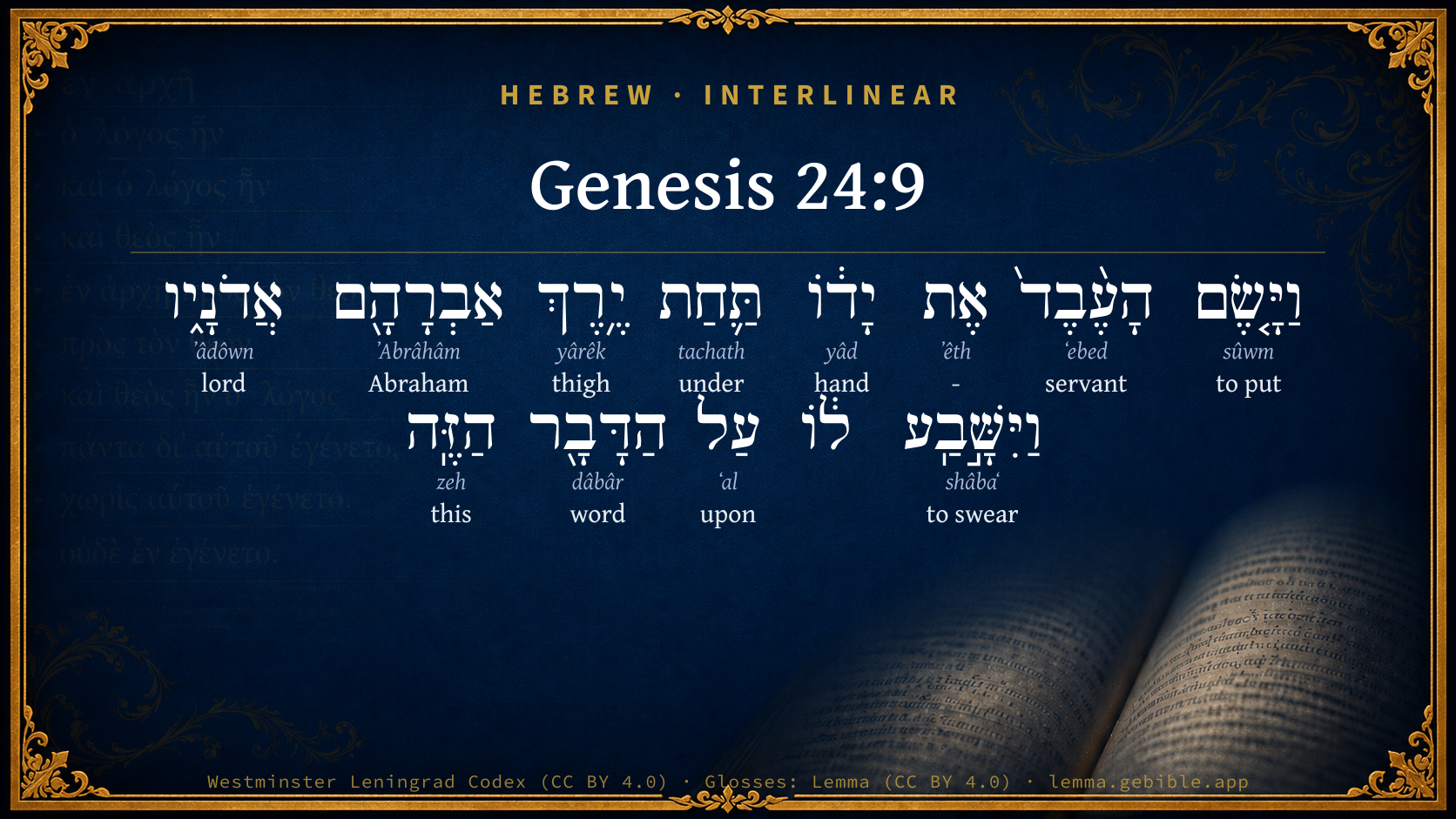
  1. וַיָּ֤שֶׂם sûwm H7760 “and · to put” Conjunction + Verb, Qal, Sequential Imperfect, 3rd Person, Masculine, Singular
  2. הָעֶ֨בֶד֙ ʻebed H5650 “the · servant” Particle, Definite Article + Noun, Common, Masculine, Singular, Absolute
  3. אֶת ʼêth H853 “-” Particle, Direct Object
  4. יָד֔וֹ yâd H3027 “hand · his” Noun, Common, Both, Singular, Construct + Suffix, Personal, 3rd Person, Masculine, Singular
  5. תַּ֛חַת tachath H8478 “under” Preposition
  6. אַבְרָהָ֖ם ʼAbrâhâm H85 “Abraham” Noun, Proper
  7. אֲדֹנָ֑יו ʼâdôwn H113 “lords · his” Noun, Common, Masculine, Plural, Construct + Suffix, Personal, 3rd Person, Masculine, Singular
  8. וַיִּשָּׁ֣בַֽע shâbaʻ H7650 “and · to swear” Conjunction + Verb, Niphal, Sequential Imperfect, 3rd Person, Masculine, Singular
  9. עַל ʻal H5921 “upon” Preposition
  10. הַדָּבָ֖ר dâbâr H1697 “the · word” Particle, Definite Article + Noun, Common, Masculine, Singular, Absolute
  11. הַזֶּֽה zeh H2088 “the · this” Particle, Definite Article + Pronoun, Demonstrative, Masculine, Singular

About this verse

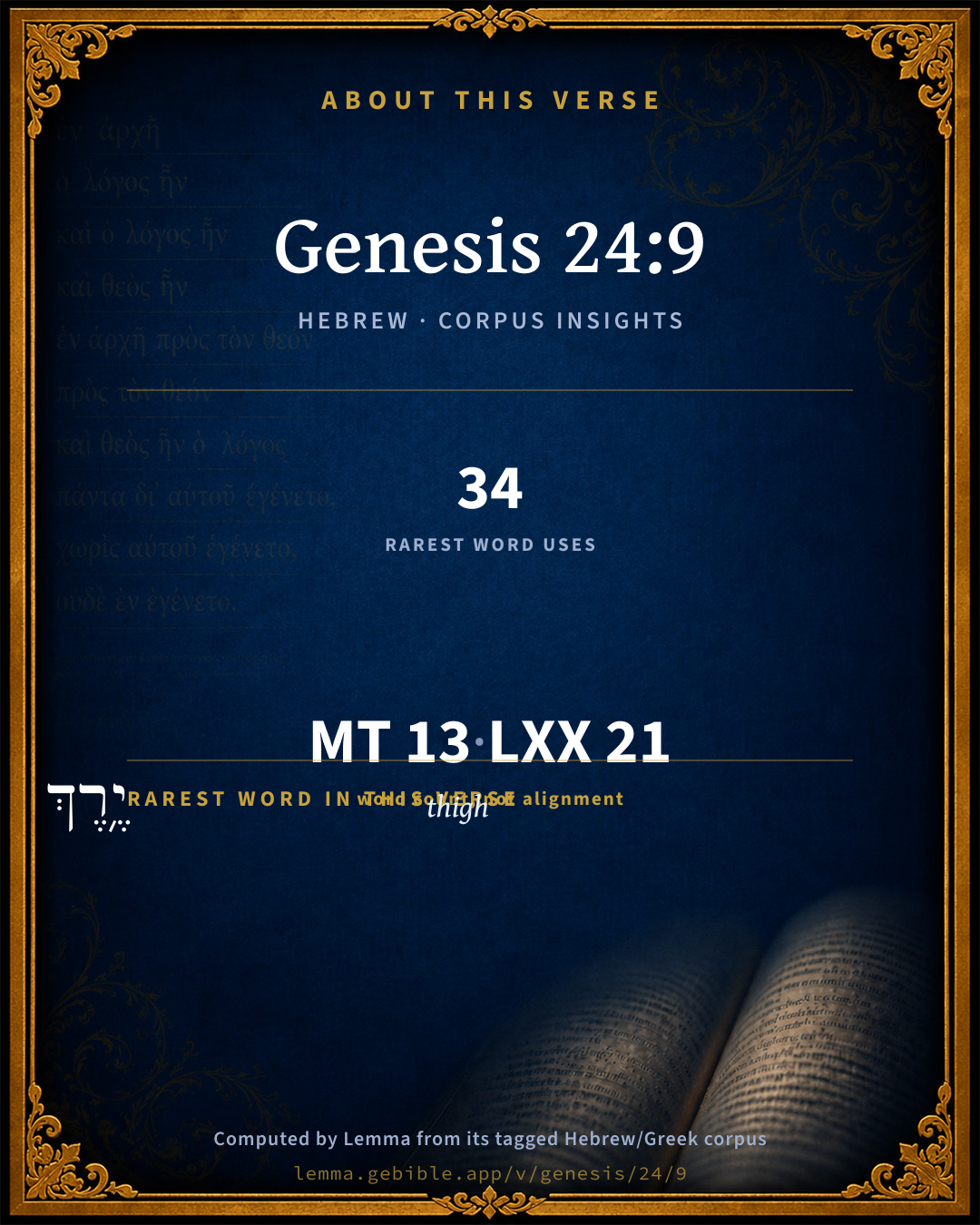
These counts appear in no published source. They are computed here, from the morphology-tagged text and Lemma’s own curated glosses. What Lemma adds →

13
words
12
distinct lemmas
Pentateuch
section

Shared distinctive vocabulary

יֶ֥רֶךְ thigh H3409 occurs in 32 verses of the Hebrew Bible. Also found in:

Grammatical profile

  • 2 verbs
  • 6 nouns
  • 1 pronoun
  • 3 prepositions
  • 1 particle

Verb forms

  • וַיָּ֤שֶׂם Qal · Sequential Imperfect
  • וַיִּשָּׁ֣בַֽע Niphal · Sequential Imperfect

Hebrew & Septuagint length

In English translation the verse runs 19 words from the Hebrew and 20 from the Septuagint (LXX English) — closely comparable.

A rough comparison of the two English renderings, which tokenize alike — not a word-level alignment.

Word counts can differ between the Hebrew and the Greek without any difference in meaning — e.g. the Hebrew direct-object marker אֵת has no separate Greek word, and Greek often adds the article ὁ.

In the original languages it is 13 Hebrew tokens and 21 Greek tokens — but the two are counted differently (Hebrew bundles its prefixes and suffixes into one token; the Greek is in lemma form), so that isn’t a like-for-like length.

Cross-references

1

Topical passages linked to Genesis 24:9 in the Treasury of Scripture Knowledge — connected by theme and wording, ordered by reader-vote popularity; previews shown in the World English Bible.

  • Genesis 24:2 Abraham said to his servant, the elder of his house, who ruled over all that he had, "Please put your hand under my thigh.

Cross-references courtesy of OpenBible.info (CC BY 4.0).

Hebrew and Greek witnesses Masoretic Hebrew ↔ Greek Septuagint

The same verse in the two great witnesses to the Old Testament, shown verse-for-verse.

These are two independent witnesses, not word-aligned to each other, and the Septuagint is shown in lemma (dictionary) form.

Hebrew Genesis 24:9 Masoretic · Westminster Leningrad Codex

וַיָּ֤שֶׂם הָעֶ֨בֶד֙ אֶת יָד֔וֹ תַּ֛חַת יֶ֥רֶךְ אַבְרָהָ֖ם אֲדֹנָ֑יו וַיִּשָּׁ֣בַֽע ל֔וֹ עַל הַדָּבָ֖ר הַזֶּֽה

The servant put his hand under the thigh of Abraham his master, and swore to him concerning this matter.

World English Bible · Public Domain

Greek LXX Genesis 24:9 Septuagint · lemma form

καί τίθημι ὁ παῖς ὁ χείρ αὐτός ὑπό ὁ μηρός αβρααμ ὁ κύριος αὐτός καί ὄμνυμι αὐτός περί ὁ ῥῆμα οὗτος

And the servant put his hand under the thigh of his master Abraam, and swore to him concerning this matter.

LXX2012 (modern English Septuagint) · Public Domain

Hebrew: Westminster Leningrad Codex (CC BY 4.0). Greek: Septuagint (public domain); English from LXX2012 (modern English Septuagint) (Public Domain). How the Septuagint differs from the Hebrew →

Targum (Aramaic paraphrase)

2

The Targum is the ancient Jewish Aramaic paraphrase of the Hebrew Scriptures — an interpretive translation, not the Hebrew text itself. Onkelos (literal) and Pseudo-Jonathan (expansive) render the Torah, and Jonathan the Prophets. Coverage is partial: where no permissively-licensed English translation exists for a verse, only the Aramaic is shown. This is verse-level text, not a word-by-word alignment to the Hebrew.

  1. Targum Onkelos Torah (Genesis–Deuteronomy)
    וְשַׁוִּי עַבְדָא יָת יְדֵהּ תְּחוֹת יַרְכָא דְאַבְרָהָם רִבּוֹנֵהּ וְקַיֵּם לֵהּ עַל פִּתְגָּמָא הָדֵין

    (no public-domain English translation for this verse)

    Targum Onkelos — Aramaic: “Onkelos Genesis” (public domain); “Onkelos Exodus” (public domain); “Onkelos Leviticus” (public domain); “Onkelos Numbers” (public domain); “Onkelos Deuteronomy” (public domain). English: “Sefaria Community Translation” (CC0 1.0 (public-domain dedication)); “J.W. Etheridge. The Targums of Onkelos and Jonathan Ben Uzziel on the Pentateuch. London: Longmans, Green, 1862” (public domain). Text via Sefaria.

  2. Targum Pseudo-Jonathan Torah (Genesis–Deuteronomy)
    וְשַׁוֵי עַבְדָא יַת יְדֵיהּ בְּגִזְרַת מְהוּלְתָּא דְאַבְרָהָם רִבּוֹנֵיהּ וְקַיֵים לֵיהּ (עַל) עֵיסַק פִּתְגָמָא הָדֵין

    And the servant put his hand upon the circumcised part of Abraham his lord, and sware to him according to this thing.

    Targum Pseudo-Jonathan — Aramaic: “Targum Jonathan on Genesis” (public domain); “Targum Jonathan on Exodus” (public domain); “Targum Jonathan on Leviticus” (public domain); “Targum Jonathan on Numbers” (public domain); “Targum Jonathan on Deuteronomy” (public domain). English: “The Targum of Jonathan ben Uzziel, trans. J. W. Etheridge, London, 1862” (public domain). Text via Sefaria.

Commentary

Notes on Genesis 24:9 from classic Christian and Jewish commentators (each source and its license shown beneath its notes). The classic Christian expositions comment on the surrounding passage and are grouped to its opening verse, so a note may address several verses; the Jewish commentaries on the Tanakh (Rashi and others) are per-verse, so they appear only where the commentator wrote on this verse.

Lemma curates 59 commentaries, every one of them public domain or Creative Commons licensed, each selected and text-cleaned for this edition rather than reprinted as found. About our sources →

Trapp's Complete Commentary

John Trapp

Gen 24:9 And the servant put his hand under the thigh of Abraham his master, and sware to him concerning that matter.

Ver. 9. And the servant put his hand., &c.] That, and the lifting up of the hand to heaven, {Gen 14:22} was the ceremony of old, as now it is, laying the hand upon the book. Let it be what it will, if not wicked, we need not scruple it. Henry III of England, undertaking the crusade, in taking his oath laid his right hand on his breast (according i to the manner of a priest, saith the history); {a} and after on the book, and kissed it as a layman. The Moors, when they swear to be faithful to any, put their swords to their own throats. {b} At the siege of Norwich by Ket and his complices in Edward VI’s time, the Earl of Warwick, general for the king, drew his sword, and caused others to do the like; and (according to a soldierly custom in cases of extremity) by interchange of a kiss by everyone of them upon the swords of others, they bound themselves, as by an oath, to maintain the place? {c}

{a} Daniel’s Chro.

{b} Turk. Hist., fol. 747.

{c} Life of Edward VI., by Sir Jo. Heywood, p. 75.

John Trapp, A Commentary or Exposition upon All the Books of the Old and New Testament (1647–1656) — public domain. Text from a community e-Sword module.

Adam Clarke's Commentary

Verse 9. Put his hand under the thigh of Abraham] This form of swearing has greatly puzzled the commentators; but it is useless to detail opinions which I neither believe myself, nor would wish my readers to credit. I believe the true sense is given in the Targum of Jonathan ben Uzziel, and that called the Jerusalem Targum. In the former it is said, Put now thy hand בגזית מהולתי bigzirath mehulathi, in sectione circumcisionis meoe; in the latter תחות ירך קימי techoth yerech keyami, sub femore foederis mei. When we put the circumstances mentioned in this and the third verse together, we shall find that they fully express the ancient method of binding by oath in such transactions as had a religious tendency. 1. The rite or ceremony used on the occasion: the person binding himself put his hand under the thigh of the person to whom he was to be bound; i.e., he put his hand on the part that bore the mark of circumcision, the sign of God's covenant, which is tantamount to our kissing the book, or laying the hand upon the New Testament or covenant of our Lord Jesus Christ. 2. The form of the oath itself: the person swore by Jehovah, the God of heaven and the God of the earth. Three essential attributes of God are here mentioned:

1. His self-existence and eternity in the name Jehovah.

2. His dominion of glory and blessedness in the kingdom of heaven.

3. His providence and bounty in the earth.

The meaning of the oath seems to be this: "As God is unchangeable in his nature and purposes, so shall I be in this engagement, under the penalty of forfeiting all expectation of temporal prosperity, the benefits of the mystical covenant, and future glory." An oath of this kind, taken at such a time, and on such an occasion, can never be deemed irreligious or profane. Thou shalt swear by his name - shalt acknowledge and bind thyself unto the true God, as the just Judge of thy motives and actions, is a command of the Most High; and such an oath as the above is at once (on such an occasion) both proper and rational. The person binding himself proposes for a pattern the unchangeable and just God; and as HE is the avenger of wrong and the punisher of falsehood, and has all power in the heavens and in the earth, so he can punish perjury by privation of spiritual and temporal blessings, by the loss of life, and by inflicting the perdition due to ungodly men, among whom liars and perjured persons occupy the most distinguished rank. Our ideas of delicacy may revolt from the rite used on this occasion; but, when the nature of the covenant is considered, of which circumcision was the sign, we shall at once perceive that this rite could not be used without producing sentiments of reverence and godly fear, as the contracting party must know that the God of this covenant was a consuming fire.

Adam Clarke's Commentary on the Bible (1810–1826) — public domain. Text from a community e-Sword/MySword module.

The Cambridge Bible for Schools and Colleges

gen. ed. J. J. S. Perowne

9. concerning this matter] Lit. “according to this word.”

It has been supposed that the account of Abraham’s death, according to J, followed at this point, and, if so, it was omitted by the compiler, who inserted by preference the account from P, in Gen_25:7-11. It is pointed out that (1) the oath is administered to the servant, instead of a simple order, in expectation of immediate death, cf. Gen_47:31; (2) the difficulties in Gen_24:67 suggest that some alteration of the text has there been made, in order to harmonize the narrative with the subsequent mention of Abraham’s death in chap. 25.

The Cambridge Bible for Schools and Colleges (gen. ed. J. J. S. Perowne; Cambridge University Press, 1878–1918) — public domain. Text from a community e-Sword module.

John Gill's Exposition

And the servant put his hand under the thigh of Abraham his master,.... Or "then" or "therefore the servant", &c. (n) being satisfied of the nature and extent of his oath, and thoroughly understanding how he was to act upon it, readily took it by using this rite; see Gill on Gen 24:2,

and sware to him concerning that matter; of taking a wife to his son, engaging to do everything he had directed and enjoined him relative to it.

(n) "posuit ergo", V. L. "igitur", Tigurine version; "itaque", Junius & Tremellius, Piscator; "ita", Drusius; "tum", Schmidt.

John Gill's Exposition of the Whole Bible (1746–1763) — public domain (CC PDM 1.0). Text via the HelloAO Bible API.

The Pulpit Commentary

And the servant (understanding the nature of his mission, and feeling satisfied on the points that impinged upon his conscience) put his hand under the thigh of Abraham his master, and sware to him concerning that matter to be true to his master and his mission, and to the hope and promise of the covenant.

The Pulpit Commentary (1880–1919), ed. H.D.M. Spence-Jones & Joseph S. Exell — public domain. Text from a community e-Sword module.

Radak

Rabbi David Kimhi (Radak)

וישם, the meaning is clear. (verse 2)

Radak on the Tanakh — English translations: “Sefaria Community Translation” (CC0 1.0 (public-domain dedication)); “Eliyahu Munk, HaChut Hameshulash” (CC BY 4.0); “Rabbi Mike Feuer, Jerusalem Anthology” (CC BY 4.0); and “R. David Kimhi on the first book of Psalms, Translated by R.G. Finch, London, 1919” (public domain). Text via Sefaria.

Lesson kit

Teaching starters — assembled from the data on this page, not authored interpretation. Every prompt links to the verse data it draws on. Edit before teaching.

Genesis, in the Pentateuch, opens this verse with 13 words (12 distinct Hebrew lemmas). Its most distinctive word is yârêk (“thigh”). A historical commentator’s framing appears above. Read the whole chapter for the surrounding context.

Discussion questions

  1. The word yârêk carries the sense “thigh.” How does it shape the verse?
  2. How does Genesis 24:2, which shares the word «thigh», read alongside this verse?
  3. The translations on this page render this verse differently — a whole-verse word diff, not a word-by-word alignment. What might account for the different wordings?
  4. «וַיָּ֤שֶׂם» is a Qal Sequential Imperfect verb. How does that grammatical form shape the action described?
  5. Compare how Trapp's Complete Commentary and Adam Clarke's Commentary read this verse. Where do they agree or differ?

Things to notice

Reading settings

Reading text

Shown beneath each verse's original-language words.

Old Testament
Old Testament edition

Read the OT as the Masoretic Hebrew (MT) or the Greek Septuagint (LXX).

English shown for the Greek Septuagint (in the Hebrew ↔ Greek comparison).

Comparing translations? Open the Compare panel on any verse page to stack up to four side by side.