
Acts 12:7

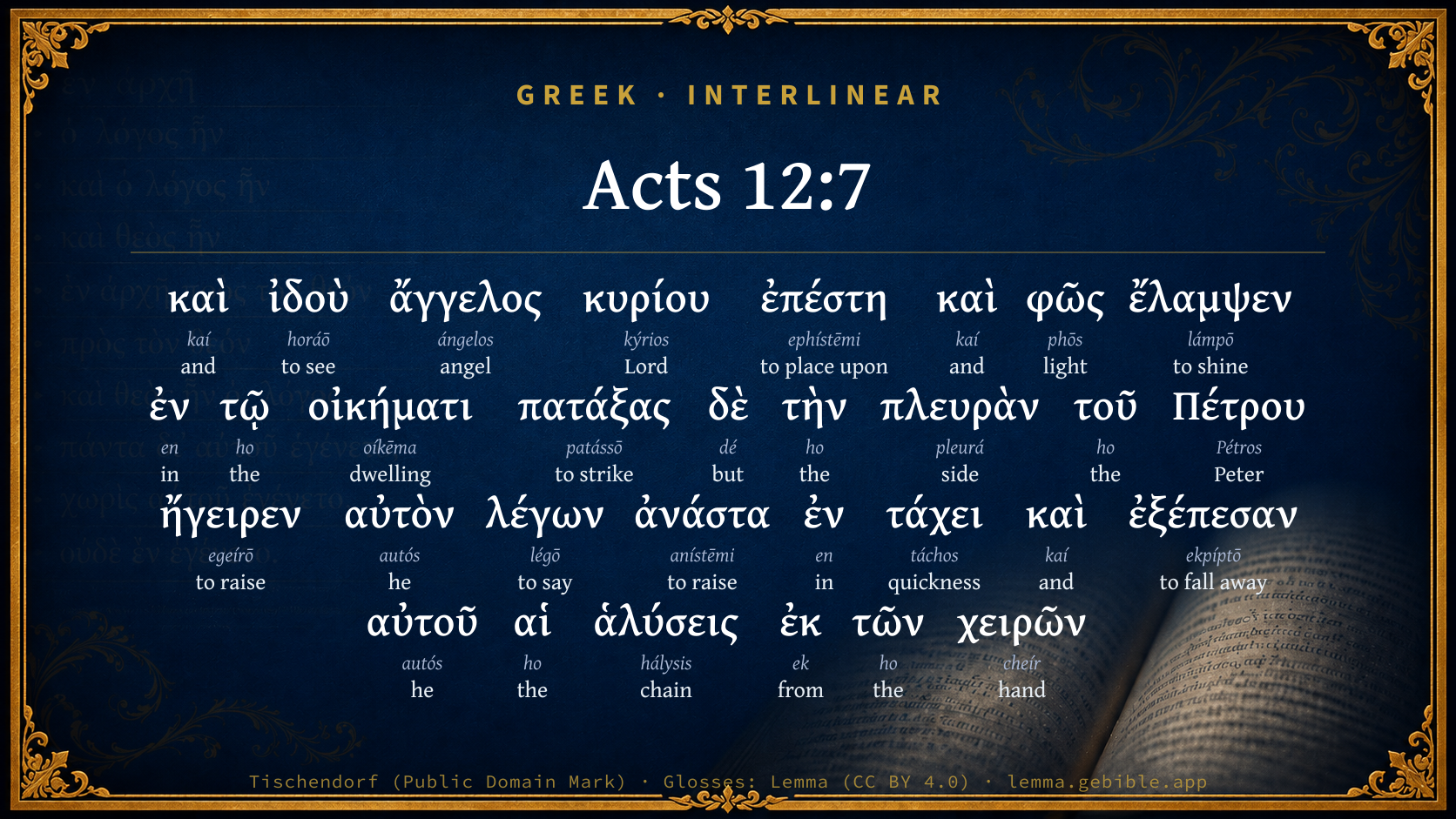
Greek (Tischendorf 8th ed.) Acts 12:7 appears in the Greek New Testament. The text above is from the Tischendorf 8th edition. Each word links to its Strong’s number and a concise gloss. Click any word for its full Thayer’s Greek Lexicon entry.
Download image
Cite this verse

Acts 12:7 (World English Bible). Public Domain. Lemma interlinear Bible study tool, https://lemma.gebible.app/v/acts/12/7.

Show BibTeX & RIS
BibTeX
RIS
English Translation
And behold, an angel of the Lord stood by him, and a light shone in the cell. He struck Peter on the side, and woke him up, saying, "Stand up quickly!" His chains fell off from his hands.
World English Bible · Public Domain
Highlights
  • 1 hapax legomenon — only here in the Greek New Testament
  • 2 first appearances in the Greek New Testament
Full analysis ↓
Download a study sheet

One document with this verse’s original text, its word-by-word gloss line, the meaning frame, cross-references with their text, attributed commentary, and full source and license credits — printable, and it pastes into notes with its structure intact.

This verse Autodidact and up

Study sheet (.html) Plain text (.txt)

A passage Seminary Student

Up to 50 verses in one chapter. A passage sheet keeps up to 6 commentary sources and 12 cross-references per verse, in the order this page ranks them, and says so on the sheet whenever that leaves anything out. Ask for a single verse and you get the Autodidact verse sheet above.

Everything on this page stays free to read, with no account — the sheet is a download of what is already on screen, not access to it.

Want to remove ads? Support Godless Engineer
Compare translations 3

The same verse in 3 English versions, stacked beneath the original-language interlinear above. Click any original word for its lexicon entry.

Each is an independent rendering of the whole verse — the interlinear is not word-aligned to these translations.

Highlighted words mark where these versions differ — a whole-verse word diff, not a word-by-word alignment.

  • World English Bible Public Domain
    And behold, an angel of the Lord stood by him, and a light shone in the cell. He struck Peter on the side, and woke him up, saying, "Stand up quickly!" His chains fell off from his hands.
  • King James Version Public Domain
    And, behold, the angel of the Lord came upon him, and a light shined in the prison: and he smote Peter on the side, and raised him up, saying, Arise up quickly. And his chains fell off from his hands.
  • unfoldingWord Literal Text CC BY-SA 4.0
    And behold, an angel of the Lord stood by him, and a light shone in the prison cell. And striking the side of Peter, he awakened him, saying, “Get up in haste,” and his chains fell away from hands.

unfoldingWord Literal Text — © unfoldingWord, licensed CC BY-SA 4.0. Word-aligned USFM3 via Door43 (git.door43.org/unfoldingWord/en_ult).

Versions to compare (up to 4)

3 of 4 selected

Show all 19 translations

Every available English version of this verse, each an independent rendering of the whole verse.

  • World English Bible Public Domain
    And behold, an angel of the Lord stood by him, and a light shone in the cell. He struck Peter on the side, and woke him up, saying, "Stand up quickly!" His chains fell off from his hands.
  • Berean Standard Bible Public Domain
    Suddenly an angel of the Lord appeared and a light shone in the cell. He tapped Peter on the side and woke him up, saying, “Get up quickly.” And the chains fell off his wrists.
  • Majority Standard Bible Public Domain
    Suddenly an angel of the Lord appeared and a light shone in the cell. He tapped Peter on the side and woke him up, saying, “Get up quickly.” And the chains fell off his wrists.
  • King James Version Public Domain
    And, behold, the angel of the Lord came upon him, and a light shined in the prison: and he smote Peter on the side, and raised him up, saying, Arise up quickly. And his chains fell off from his hands.
  • American Standard Version (1901) Public Domain
    And behold, an angel of the Lord stood by him, and a light shined in the cell: and he smote Peter on the side, and awoke him, saying, Rise up quickly. And his chains fell off from his hands.
  • Revised Version (1885) Public Domain
    And behold, an angel of the Lord stood by him, and a light shined in the cell: and he smote Peter on the side, and awoke him, saying, Rise up quickly. And his chains fell off from his hands.
  • Geneva Bible (1599) Public Domain
    And behold the Angel of the Lord came vpon them, and a light shined in the house, and he smote Peter on the side, and raysed him vp, saying, Arise quickely. And his chaines fell off from his handes.
  • Douay-Rheims (1899) Public Domain
    And behold an angel of the Lord stood by him: and a light shined in the room: and he striking Peter on the side, raised him up, saying: Arise quickly. And the chains fell off from his hands.
  • Young's Literal Translation Public Domain
    and lo, a messenger of the Lord stood by, and a light shone in the buildings, and having smitten Peter on the side, he raised him up, saying, `Rise in haste,' and his chains fell from off `his' hands.
  • Literal Standard Version CC BY-SA 4.0
    and behold, a messenger of the LORD stood by, and a light shone in the buildings, and having struck Peter on the side, he raised him up, saying, “Rise in haste,” and his chains fell from off [his] hands.
  • Unlocked Literal Bible CC BY-SA 4.0
    Behold, an angel of the Lord suddenly appeared by him, and a light shone in the prison cell. He struck Peter on the side and woke him and said, “Get up quickly,” and his chains fell off his hands.
  • unfoldingWord Literal Text CC BY-SA 4.0
    And behold, an angel of the Lord stood by him, and a light shone in the prison cell. And striking the side of Peter, he awakened him, saying, “Get up in haste,” and his chains fell away from hands.
  • Darby Bible Public Domain
    And lo, an angel of [the] Lord came there, and a light shone in the prison: and having smitten the side of Peter, he roused him up, saying, Rise up quickly. And his chains fell off his hands.
  • World Messianic Bible Public Domain
    And behold, an angel of the Lord stood by him, and a light shone in the cell. He struck Peter on the side and woke him up, saying, “Stand up quickly!” His chains fell off his hands.
  • Webster's Bible Public Domain
    And behold, the angel of the Lord came upon him, and a light shined in the prison; and he smote Peter on the side, and raised him up, saying, Arise quickly. And his chains fell off from his hands.
  • Free Bible Version CC BY-SA 4.0
    Suddenly an angel of the Lord appeared, and a light shone in the cell. The angel shook Peter awake, saying “Quick! Get up!” The chains fell from his wrists,
  • Bible in Basic English Public Domain
    And a great light was seen shining in the room, and an angel of the Lord came to Peter and, touching him on his side so that he came out of his sleep, said, Get up quickly. And his chains came off his hands.
  • Text-Critical English NT CC BY 4.0
    And behold, an angel of the Lord stood before Peter, and a light shone in the cell. The angel struck Peter on the side and woke him up, saying, “Get up quickly!” And the chains fell off Peter's hands.
  • Tyndale New Testament (1534) Public Domain
    And beholde the angell of the Lorde was there present and a lyght shyned in the lodge. And smote Peter on the syde and steryd him vp sayinge: aryse vp quyckly. And his cheynes fell of from his hondes.

Literal Standard Version (2020), Covenant Press — licensed CC BY-SA 4.0. Text via the HelloAO Bible API (eBible.org). Unlocked Literal Bible (unfoldingWord) — licensed CC BY-SA 4.0. Text via the HelloAO Bible API (eBible.org). unfoldingWord Literal Text — © unfoldingWord, licensed CC BY-SA 4.0. Word-aligned USFM3 via Door43 (git.door43.org/unfoldingWord/en_ult). Free Bible Version, Dr. Jonathan Gallagher — licensed CC BY-SA 4.0. Text via the HelloAO Bible API (eBible.org).

Word by word

More ways to search: Search by grammar → Find every occurrence → Compare this word →

Practice this passage: Drill this verse → Learn its vocabulary →

οἰκήματι
oíkēma
G3612
“dwelling”
Noun, Dative, Singular, Neuter
Part of Speech
Noun
Case
Dative
Number
Singular
Gender
Neuter
Full Thayer's Definition

Origin: from G3611

TDNT: None

1. a dwelling place, habitation 2. euphemistically a prison
  1. καὶ kaí G2532 “and” Conjunction
  2. ἰδοὺ horáō G3708 “to see” Verb, Aorist, Middle, Imperative, 2nd person, Singular
  3. ἄγγελος ángelos G32 “angel” Noun, Nominative, Singular, Masculine
  4. κυρίου kýrios G2962 “Lord” Noun, Genitive, Singular, Masculine
  5. ἐπέστη ephístēmi G2186 “to place upon” Verb, Aorist, Active, Indicative, 3rd person, Singular
  6. καὶ kaí G2532 “and” Conjunction
  7. φῶς phōs G5457 “light” Noun, Nominative, Singular, Neuter
  8. ἔλαμψεν lámpō G2989 “to shine” Verb, Aorist, Active, Indicative, 3rd person, Singular
  9. ἐν en G1722 “in” Preposition
  10. τῷ ho G3588 “the” Article, Dative, Singular, Neuter
  11. πατάξας patássō G3960 “to strike” Verb, Aorist, Active, Participle, Nominative, Singular, Masculine
  12. δὲ dé G1161 “but” Conjunction
  13. τὴν ho G3588 “the” Article, Accusative, Singular, Feminine
  14. πλευρὰν pleurá G4125 “side” Noun, Accusative, Singular, Feminine
  15. τοῦ ho G3588 “the” Article, Genitive, Singular, Masculine
  16. Πέτρου Pétros G4074 “Peter” Noun, Genitive, Singular, Masculine
  17. ἤγειρεν egeírō G1453 “to raise” Verb, Aorist, Active, Indicative, 3rd person, Singular
  18. αὐτὸν autós G846 “he” Personal pronoun, Accusative, Singular, Masculine
  19. λέγων légō G3004 “to say” Verb, Present, Active, Participle, Nominative, Singular, Masculine
  20. ἀνάστα anístēmi G450 “to raise” Verb, Aorist, Active, Imperative, 2nd person, Singular
  21. ἐν en G1722 “in” Preposition
  22. τάχει táchos G5034 “quickness” Noun, Dative, Singular, Neuter
  23. καὶ kaí G2532 “and” Conjunction
  24. ἐξέπεσαν ekpíptō G1601 “to fall away” Verb, Aorist, Active, Indicative, 3rd person, Plural
  25. αὐτοῦ autós G846 “he” Personal pronoun, Genitive, Singular, Masculine
  26. αἱ ho G3588 “the” Article, Nominative, Plural, Feminine
  27. ἁλύσεις hálysis G254 “chain” Noun, Nominative, Plural, Feminine
  28. ἐκ ek G1537 “from” Preposition
  29. τῶν ho G3588 “the” Article, Genitive, Plural, Feminine
  30. χειρῶν cheír G5495 “hand” Noun, Genitive, Plural, Feminine

About this verse

These counts appear in no published source. They are computed here, from the morphology-tagged text and Lemma’s own curated glosses. What Lemma adds →

31
words
23
distinct lemmas
Acts
section

Notable vocabulary

1 hapax legomenon — a word that appears only here in the entire Greek New Testament:

  • οἰκήματι dwelling G3612

First appearance in Scripture

These words make their first canonical appearance in the Greek New Testament here:

  • οἰκήματι dwelling G3612
  • ἐξέπεσαν to fall away G1601

Shared distinctive vocabulary

πλευρὰν side G4125 occurs in 5 verses of the Greek New Testament. Also found in:
Repetition

Words recur within this verse:

Cross-references

32

Topical passages linked to Acts 12:7 in the Treasury of Scripture Knowledge — connected by theme and wording, ordered by reader-vote popularity; previews shown in the World English Bible.

  • Acts 5:19 But an angel of the Lord opened the prison doors by night, and brought them out, and said,
  • Acts 16:26 Suddenly there was a great earthquake, so that the foundations of the prison were shaken; and immediately all the doors were opened, and everyone's bonds were loosened.
  • Psalms 146:7 Who executes justice for the oppressed; Who gives food to the hungry. Yahweh frees the prisoners.
  • Psalms 105:18–20 They bruised his feet with shackles. His neck was locked in irons,
  • Psalms 142:6–7 Listen to my cry, For I am in desperate need. Deliver me from my persecutors, For they are stronger than me.
  • Genesis 19:15–16 When the morning arose, then the angels hurried Lot, saying, "Arise, take your wife, and your two daughters who are here, lest you be consumed in the iniquity of the city."
  • Acts 27:23–24 For there stood by me this night an angel, belonging to the God whose I am and whom I serve,
  • Psalms 34:7 The angel of Yahweh encamps round about those who fear him, And delivers them.
  • Psalms 107:14 He brought them out of darkness and the shadow of death, And broke their bonds in sunder.
  • Acts 10:30 Cornelius said, "Four days ago, I was fasting until this hour, and at the ninth hour, I prayed in my house, and behold, a man stood before me in bright clothing,
  • Daniel 6:22 My God has sent his angel, and has shut the lions' mouths, and they have not hurt me; because as before him innocence was found in me; and also before you, O king, have I done no hurt.
  • Micah 7:9 I will bear the indignation of Yahweh, Because I have sinned against him, Until he pleads my case, and executes judgment for me. He will bring me forth to the light. I will see his righteousness.
  • Luke 2:9 Behold, an angel of the Lord stood by them, and the glory of the Lord shone around them, and they were terrified.
  • Luke 24:4 It happened, while they were greatly perplexed about this, behold, two men stood by them in dazzling clothing.
  • Acts 2:24 whom God raised up, having freed him from the agony of death, because it was not possible that he should be held by it.
  • Ephesians 5:14 Therefore he says, "Awake, you who sleep, and arise from the dead, and Christ will shine on you."
  • 1 Kings 19:7 The angel of Yahweh came again the second time, and touched him, and said, Arise and eat, because the journey is too great for you.
  • Daniel 3:24–25 Then Nebuchadnezzar the king was astonished, and rose up in haste: he spoke and said to his counselors, Didn't we cast three men bound into the midst of the fire? They answered the king, True, O king.
  • Acts 12:23 Immediately an angel of the Lord struck him, because he didn't give God the glory, and he was eaten by worms and died.
  • 1 Kings 19:5 He lay down and slept under a juniper tree; and, behold, an angel touched him, and said to him, Arise and eat.
  • Psalms 37:32–33 The wicked watches the righteous, And seeks to kill him.
  • Psalms 116:16 Yahweh, truly I am your servant. I am your servant, the son of your handmaid. You have freed me from my chains.
  • Isaiah 60:1 Arise, shine; for your light is come, and the glory of Yahweh is risen on you.
  • Ezekiel 43:2 Behold, the glory of the God of Israel came from the way of the east: and his voice was like the sound of many waters; and the earth shined with his glory.
  • Habakkuk 3:4 His splendor is like the sunrise. Rays shine from his hand, where his power is hidden.
  • Acts 9:3 As he traveled, it happened that he got close to Damascus, and suddenly a light from the sky shone around him.
  • 2 Samuel 22:29 For you are my lamp, Yahweh; Yahweh will lighten my darkness.
  • Isaiah 37:30 This shall be the sign to you: you shall eat this year that which grows of itself, and in the second year that which springs of the same; and in the third year sow you, and reap, and plant vineyards, and eat the fruit of it.
  • Habakkuk 3:11 The sun and moon stood still in the sky, At the light of your arrows as they went, At the shining of your glittering spear.
  • Acts 12:6 The same night when Herod was about to bring him out, Peter was sleeping between two soldiers, bound with two chains. Guards in front of the door kept the prison.
  • Hebrews 1:14 Aren't they all ministering spirits, sent out to do service for the sake of those who will inherit salvation?
  • Revelation 18:1 After these things, I saw another angel coming down out of the sky, having great authority. The earth was illuminated with his glory.

Cross-references courtesy of OpenBible.info (CC BY 4.0).

Commentary

Notes on Acts 12:7 from classic Christian and Jewish commentators (each source and its license shown beneath its notes). The classic Christian expositions comment on the surrounding passage and are grouped to its opening verse, so a note may address several verses; the Jewish commentaries on the Tanakh (Rashi and others) are per-verse, so they appear only where the commentator wrote on this verse.

Lemma curates 59 commentaries, every one of them public domain or Creative Commons licensed, each selected and text-cleaned for this edition rather than reprinted as found. About our sources →

The Biblical Illustrator

Joseph S. Exell

Act_12:7-10

And behold the angel of the Lord came upon him.

The tender offices of angels towards the saints of God

It enhances the moral dignity of the Christian that he should have such exalted beings in constant attendance upon him. It seems to bring God nearer to us, to bridge over the measureless void between the finite and the infinite, to feel that in sickness or in sorrow, or in mental darkness, they are present with us who have just come from Gods presence. The hand supports us which a moment before had been tuning to lofty melody the harps of God. They bring themselves to our doors, that we may have a bright and hallowing presence in our houses and among our children; they are witnesses in the place of our holy assemblies; they stand as weeping friends stand by the bedside of the departing righteous, while in the end of time they shall arrest the ministers of desolation in their worldwide havoc, saying, Hurt not the earth, neither the sea, nor the trees, till we have sealed the servants of God on their foreheads. So near, so loving, so constant are the tender offices of angels towards the saints of God. No worship do we offer them; they will have none. They ask only to be loved by us as guardian friends, to be honoured by our consistent walk, to be thought of as humble servants of the Lord Jesus, sent forth to minister unto them who shall be heirs of salvation. (D. Moore, M. A.)

Angel visits in the night

1. When we climb to some mountain height, and look forth upon the broad landscape in the blaze of the bright moon, it seems as if our earth were the universe, and the sun were a single globe of fire hung in the heavens to give it light. When we stand upon the deck of the ship in mid ocean it seems impossible that there can be anything else but the sun and the sea. When we look up to the silent sky at night, it seems as if the bright array of stars were only campfires kindled on the plains of heaven to guide some wanderer through the solitudes of earth. When we go down into the depths of the cavern it seems as if we were alone in the universe, and when we mingle with the multitude it seems as if man and earth were everything. All these natural and uninstructed impressions conspire to narrow the range of our thought, and shut us up to the occupations of man alone. It is, therefore, a salutary disclosure that we are not the only actors in the busy scenes of daily life. There is no solitude where we may not have the unseen companionship of beings that think and feel and work more mightily and constantly than ourselves.

2. And these invisible partners of our toil, and sharers of our spiritual life, have sometimes stepped forth from behind the curtain to show us that we may have witnesses of our conduct when we think ourselves most alone. And these celestial visitants have shown themselves better acquainted with human history, and better able to do our work, than we ourselves. They have defeated great armies, overthrown populous cities, sent forth and arrested the pestilence. They have rested under the shadow of oaks at noon, as if weary, eaten bread, as if hungry, received hospitality, as if coming in from a journey, guided and protected travellers, rolled away the stone from the tomb, kindled the fire of the altar, clothed themselves in garments that shone like the lightning, and appeared in so common a garb as to be taken for wayfaring men needing lodgings for the night. It gives us a higher and truer estimate of our own place in the great commonwealth of intelligent beings, to find that we are objects of intense interest to the inhabitants of other worlds. It enlarges the range of our thought, and lifts our desires and aspirations above all earthly and perishable things, to know that our present habitation is only one little province of a universe of worlds; and that this mighty empire is bound together by ties of intelligence, cooperation, and sympathy, to its utmost extent.

3. The deliverance of Peter shows that these mighty visitants have little regard for the pomp and splendours of earthly state. Suppose a prophet had said the day before that on that night a mighty being from the central province in Gods great empire would visit Jerusalem, and only one man in all that city would be honoured by receiving that celestial messenger--could any have guessed that that man would be found in prison? There were many other persons besides Peter, many other places besides a prison for an angel to visit. But the angel did not show himself in the palace of the king. He did not enter the temple. He did not address himself to the pilgrims at the feast. The one man, whom that mighty servant of God had come to see, was shut up in stone walls, asleep on a stone floor, bound with iron chains, etc. If the very chain with which Peter was bound were now kept in Jerusalem, every intelligent traveller would wish to see it. And not necessarily from any superstitious regard, but from the feeling that Christian faith and suffering consecrate everything they touch. If the cell were preserved any intelligent traveller would think it something to remember and to tell of, that he had entered that cell. So much consecration do rude homes and vile dungeons derive from the faith and toil and suffering of the servants of God. Let love to Christ become the law and the life of everything we do, and then the place where we toil, and the home where we rest, will become as attractive to angels as the dungeons where the martyrs suffered.

4. Peter slept so soundly that only the sound of the angel voice, and the touch of the angel hand could awake him. A man with a good conscience can sleep on a very hard bed, and in the midst of very great danger. The anxieties and perils of life and the dread of death would not weary and wear us out so much if we went to our daily duties with such high and happy faith in God as martyrs have shown in the prison and the flames. If we fully believed that God has given his angels charge over us to keep us in all our ways, we could fulfil our day of duty without fear, and we could gratefully accept such sleep as God gives to his beloved when the night comes. I know the doctors say that sound sleep comes of a good digestion. And while I do not deny that, I know another--that a good digestion depends greatly upon a good conscience. To be in the best health of both body and mind, we must be at peace with God. And it makes very little difference how humble or exalted the chamber in which we lie down to rest, if we have done our duty well, and trust wholly in Him who giveth His beloved sleep. The sleep that renews the life, and restores the soul, and gives a foretaste of heavenly rest, is the sleep which God gives to them that love Him. The time is not far distant when the sleep of death will steal upon us all. What strange and bewildering joy it will be to be waked from that last sleep by the touch of an angels hand! What surprise it will be to the soul to find itself able to obey that command, Rise up quickly, and to follow the angel guide to the paradise of God!

5. The care with which Peter was kept was a confession that even Herod was afraid of him. And we have much reason to be obliged to the king for making the guard so strong; just as the sealing of the stone and the setting of the watch over the sepulchre of Jesus, only helped and confirmed the demonstration of His resurrection; just as we may well thank the proud and passionate Voltaire for saying he was tired of hearing that twelve men established Christianity throughout the world, and he would yet live to hear it said that one man had banished Christianity from the face of the earth. We may count ourselves debtors to the remorseless criticism which has exhausted the resources of learning and industry in the endeavour to shake our confidence in the sacred records, for all its efforts have only served to lay bare the everlasting foundations on which our faith rests. We may be thankful for the bigotry which determined to crush out the spirit of Christian liberty.

6. Peter was accustomed to see miracles; and yet I do not wonder that he was bewildered and thought he had seen a vision that night. If we try to imagine the circumstances, we shall the better understand his feelings. At last he has time to think. The bewildered man begins to come to himself. He recognises the place. And so Gods angel shall come in the appointed time to deliver the disciple of Jesus from the prison of the flesh. And oh, how much more glorious than the change which so bewildered the mind of the apostle! We try in vain to express in words the blessed bewilderment of the happy soul in the first moment of waking from the sleep of death to the life of heaven. It is here that we sleep and dream. The great reality of life is yet to come. Here the soul is bound, like Peter in the prison, with two chains--one the burden and sorrow of life, the other the fear of death. Faith in Christ alone delivers us from the double bondage. Faith in Christ alone can prepare us to be waked by the touch of the angel of death, and to see ourselves surrounded with a greater light than shone in the prison of the apostle when his angel deliverer said to him, Arise, follow me. (D. March, D. D.)

The ministry of angels

I. With James they were employed to convey his soul to glory.

II. With Peter they were instruments to deliver him from bonds.

III. With Herod they were agents of Gods vengeance.

The iron gate.

Difficulties giving way

This incident may be used to illustrate certain important truths.

I. That matter is the servant of spirit. Matter is found in diverse forms. But we can only win the use by conquest. Take iron as a sample. It is stored up in the earth. Its discovery an era. From that moment man rose in power. What countless uses are now made of iron! And as with iron, so with other materials: everything has its use. There have been great discoveries in the past, there may be greater in the future. But mark our responsibilities. We are the heirs of all the ages. If much given, much required (Luk_12:48). Such is the law; always, matter should be made subordinate to the good of man: the lower should serve the higher.

II. That difficulties give way before men that are moving in the path of duty. The ministry of angels still goes on. They are for us, and not against us; and often, in ways unknown to us, they may be employed for our good. Be this as it may, the release of Peter shows us how we too may obtain deliverance. First, we must put ourselves under the guidance of God, and at His call we must go forward bravely, without faltering (Psa_37:5). Difficulties are a test. They show what spirit we are of. Difficulties are a challenge; they appeal to our manhood; courage mounteth with occasion. Difficulties are an education. It is not ease, but effort that makes men. Our antagonist is our helper, said Burke.

III. That, walking under the guidance of God, our path shall ever be toward what is higher. Peter and the angel. So ever--Onward; from darkness to light; from restraint to liberty; from the presence of the evil to the companionship of the saints; from fear of death to glory, honour, and immortality in the city of God. How striking the contrast in the case of Herod! His pride had a terrible fall. An angel was sent to him; but in judgment. The oppressor is dealt with differently from the oppressed. Dr. Watts says: Death to a good man is but the passing through a dark entry, out of one little room in his Fathers house into another which is fair and large, lightsome and glorious, and divinely entertaining. Oh! may the rays and splendours of my heavenly apartment shoot far downward, and gild the dark entry with such a cheerful gloom as to banish any fear when I shall be called to pass through. (William Forsyth, A. M.)

The Biblical Illustrator, edited by Joseph S. Exell (c. 1880s–1900s) — public domain. Text from a community e-Sword module.

Joseph Benson's Commentary

Act 12:7-10. And behold, the angel of the Lord came upon him — Greek, επεστη, stood over him; and a light shined in the prison — Εν τω οικηματι, in the house, the whole house in which he was confined; and he smote — Greek, παταξας, having smote, Peter on the side — He awoke him; saying, Arise up quickly. And, in that moment, his chains — With which his right arm was bound to one of the soldiers, and his left to the other, fell off — The soldiers, in the mean time, being by a miraculous power kept so fast asleep, that they were not at all alarmed by the noise of their fall. And the angel said, Gird thyself, &c. — Probably Peter had put off his girdle, sandals, and upper garment before he lay down to sleep. And he went out — Of the prison, as he was guided by the angel, meeting with no opposition in his way; and wist not — That what appeared to him to be done was real, but supposed that he was in a dream, or saw a vision. When they were past the first and second ward — At each of which, doubtless, was a guard of soldiers, who, however, were all asleep; they came unto the iron gate leading into the city — Which, though a heavy gate, and very strongly fastened, yet was no hinderance in their way; but opened of its own accord — Without Peter or the angel touching it. And they passed on through one street — That Peter might know which way to go. And forthwith the angel — Having done all that was requisite for his deliverance, and set him at full liberty; departed from him — Peter being himself sufficient for what remained to be done.

Joseph Benson's Commentary on the Old and New Testaments (1811–1818) — public domain. Text from a community e-Sword module.

MacLaren's Expositions of Holy Scripture

Alexander MacLaren

Acts

THE ANGEL’S TOUCH

Act 12:7, Act 12:23.

The same heavenly agent performs the same action on Peter and on Herod. To the one, his touch brings freedom and the dropping off of his chains; to the other it brings gnawing agonies and a horrible death. These twofold effects of one cause open out wide and solemn thoughts, on which it is well to look.

I. The one touch has a twofold effect.

So it is always when God’s angels come, or God Himself lays His hand on men. Every manifestation of the divine power, every revelation of the divine presence, all our lives’ experiences, are charged with the solemn possibility of bringing us one or other of two directly opposite results. They all offer us an alternative, a solemn ‘either -or.’

The Gospel too comes charged with that double possibility, and is the intensest and most fateful example of the dual effect of all God’s messages and dealings. Just as the ark maimed Dagon and decimated the Philistine cities and slew Uzzah, but brought blessing and prosperity to the house of Obed-edom, just as the same pillar was light to Israel all the night long, but cloud and darkness to the Egyptians, so is Christ set ‘for the fall of’ some and ‘for the rising of’ others amidst the ‘many in Israel,’ and His Gospel is either ‘the savour of life unto life or of death unto death,’ but in both cases is in itself ‘unto God,’ one and the same ‘sweet savour in Christ.’

II. These twofold effects are parts of one plan and purpose.

Peter’s liberation and Herod’s death tended in the same direction-to strengthen and conserve the infant Church, and thus to prepare the way for the conquering march of the Gospel. And so it is in all God’s self-revelations and manifested energies, whatever may be their effects. They come from one source and one motive, they are fundamentally the operations of one changeless Agent, and, as they are one in origin and character, so they are one in purpose. We are not to separate them into distinct classes and ascribe them to different elements in the divine nature, setting down this as the work of Love and that as the outcome of Wrath, or regarding the acts of deliverance as due to one part of that great whole and the acts of destruction as due to another part of it. The angel was the same, and his celestial fingers were moved by the same calm, celestial will when he smote Peter into liberty and life, and Herod to death.

God changes His ways, but not His heart. He changes His acts, but not His purposes. Opposite methods conduce to one end, as winter storms and June sunshine equally tend to the yellowed harvest.

III. The character of the effects depends on the men who are touched.

As is the man, so is the effect of the angel’s touch. It could only bring blessing to the one who was the friend of the angel’s Lord, and it could bring only death to the other, who was His enemy. It could do nothing to the Apostle but cause his chains to drop from his wrists, nor anything to the vainglorious king but bring loathsome death.

This, too, is a universal truth. It is we ourselves who settle what God’s words and acts will be to us. The trite proverb, ‘One man’s meat is another man’s poison,’ is true in the highest regions. It is eminently, blessedly or tragically true in our relation to the Gospel, wherein all God’s self-revelation reaches its climax, wherein ‘the arm of the Lord’ is put forth in its most blessed energy, wherein is laid on each of us the touch, tender and more charged with blessing than that of the angel who smote the calmly sleeping Apostle. That Gospel may either be to us the means of freeing us from our chains, and leading us out of our prison-house into sunshine and security, or be the fatal occasion of condemnation and death. Which it shall be depends on ourselves. Which shall I make it for myself?

Alexander MacLaren, Expositions of Holy Scripture (1904–1910) — public domain. Text from a community e-Sword module.

Tyndale Open Study Notes

Tyndale Open Resources

12:7-11 See “Angels” Theme Note.

Tyndale Open Study Notes — © Tyndale Open Resources, licensed CC BY-SA 4.0. Text via the HelloAO Bible API.

Bengel's Gnomon

Johann Albrecht Bengel

Act 12:7. Φῶς, a light) miraculous.—οἰκήματι, in the dwelling) A general term for the special one, prison.

Bengel's Gnomon of the New Testament — English translation (T&T Clark, Edinburgh, 1860) — public domain. Text from a community e-Sword module.

Meyer's Critical & Exegetical Commentary

Heinrich August Wilhelm Meyer

Act_12:7-11. The narrative of this deliverance falls to be judged of in the same way as the similar event recorded in Act_5:19-20. From the mixture of what is legendary with pure history, which, marks Lukes report of the occurrence, the purely historical state of the miraculous fact in its individual details cannot be surely ascertained, and, in particular, whether the angelic appearance, which suddenly took place (ἐπέστη, see on Luk_2:9), is to be referred to the internal vision of the apostle,a view to which Act_12:9 may give a certain support.[272] But as the narrative lies before us, every attempt to constitute it a natural occurrence must be excluded. See Storr, Opusc. III. p. 183 ff. This holds good not only of the odd view of Hezel, that a flash of lightning had undone the chains, but also of the opinion of Eichhorn and Heinrichs, that the jailor himself, or others with his knowledge, had effected the deliverance, without Peter himself being aware of the exact circumstances; as also, in fine, of the hypothesis of Baur, that the king himself had let the apostle free, because he had become convinced in the interval (? Act_12:3) how little the execution of James had met with popular approval. According to Ewald,[273] Peter was delivered in such a surprising manner, that his first word after his arrival among his friends was, that he thought he was rescued by an angel of God; and our narrative is an amplified presentation of this thought.

Act_12:7. φῶς] whether emanating from the angel (Mat_28:3), or as a separate phenomenon, cannot be determined.

οἴκημα] generally denoting single apartments of the house (Valck. ad Ammon. iii. 4; Dorvill. ad Charit. p. 587), is, in the special sense: place of custody of prisoners, i.e. prison, a more delicate designation for the δεσμωτήριον, frequent particularly among Attic writers. Dem. 789, 2. 890, 13. 1284, 2; Thuc. iv. 47. 2, 48. 1; Kypke, II. p. 57. Comp. Valck. ad Herod., vii. 119.

And the chains fell from his hands, round which, namely, they were entwined.

Act_12:9. He was so overpowered by the wonderful course of his deliverance and confused in his consciousness, that what had been done by the angel was not apprehended by him as something actual (ἀληθές), as a real fact, but that he fancied himself to have seen a vision (comp. Act_16:9).

Act_12:10. τὴν φέρουσαν εἰς τὴν πόλιν] Nothing can be determined from this as to the situation of the prison (Fessel holds that it was situated in the court of Herods castle; Walch and Kuinoel, that Peter was imprisoned in a tower of the inner wall of the city, and that the πύλη was the door of this tower). If the prison-house was in the city, which is to be assumed from καὶ ἐξελθόντες κ.τ.λ., its iron gate still in fact led from the house εἰς τὴν πόλιν.

Examples of αὐτόματος, used not only of persons, but of things, may be seen in Wetstein in loc, and on Mar_4:28. Comp. Hom. Il. v. 749; Eur. Bacch. 447: αὐτόματα δεσμὰ διελύθη. Apollon. Rhod. iv. 41: αὐτόματοι θυρέων ὑπόειξαν ὀχῆες. Ovid. Met. iii. 699.

ῥύμην μίαν] not several.

Act_12:11. γενόμενος ἐν ἑαυτῷ] when he had become (present) in himself, i.e. had come to himself (Luk_15:17; Xen. Anab. i. 5. 17; Soph. Phil. 938), cum animo ex stupore ob rem inopinatam iterum collecto satis sibi conscius esset. Kypke, comp. Wetstein and Dorville, ad Charit. p. 81; Herm. ad Vig. p. 749.

καὶ πάσμς τῆς προσδοκ. τοῦ λαοῦ τ. ʼΙονδ.] For he had now ceased to be the person, in whose execution the people were to see their whole expectation hostile to Christianity gratified.

[272] Lange, apostol. Zeitalt. II. p. 150, supposes that the help had befallen the apostle in the condition of second consciousness, in an extraordinary healthy disengagement of the higher life [Geniusleben], and that the angel was a reflected image of the glorified Christ: that the latter Himself, in an angelic form, came within the sphere of Peters vision; that Christ Himself thus undertook the responsibility; and that the action of the apostle transcended the condition of responsible consciousness. There is nothing of all this in the passage. And Christ in an angelic form is without analogy in the N. T.; is, indeed, at variance with the N. T. conception of the δόξα of the glorified Lord.

[273] Who (p. 202) regards our narrative as more historical than the similar narratives in chap. 5. and 16.

Meyer — Critical and Exegetical Commentary on the New Testament — English translation by Peter Christie, edited by Frederick Crombie (T&T Clark, 1880) — public domain. Text from a community e-Sword module.

Expositor's Greek Testament

ed. W. Robertson Nicoll

Act 12:7 . ἐπέστη : often as here with the notion of coming suddenly, in classical Greek it is often used of dreams, as in Homer; or of the coming of heavenly visitors, very frequent in Luke, and with the same force as here, Friedrich, pp. 7 and 87, and almost always in second aorist, see also Plummer on Luk 2:9 . οἰκήματι : only here in N.T., used in Wis 13:15 (and perhaps in Tob 2:4 ), but not in same sense. Dem. and Thuc. use it for a prison: R.V. “the cell,” lit [249] , the chamber. πατάξας δὲ τὴν πλευρὰν : to rouse him, an indication of the sound and quiet sleep which, the prisoner slept in spite of the fateful morrow (so Weiss); cf. Act 7:24 , and Act 7:33 ).

[249] literal, literally.

The Expositor's Greek Testament, edited by W. Robertson Nicoll (1897–1910) — public domain. Text from a community e-Sword module.

Geneva Bible (1599)

Geneva Bible translators

In the prison.

Geneva Bible (1599) marginal notes — public domain. Text via Bolls.life.

Jamieson, Fausset & Brown

Robert Jamieson, A. R. Fausset & David Brown

the angel of the Lord--rather, "an angel."

came upon him--so in Luk 2:9, expressive of the unexpected nature of the visit.

smote Peter on the side . . . Arise up quickly. And his chains fell off . . . Gird thyself . . . And so he did . . . Cast thy garment--tunic, which he had thrown off for the night.

Jamieson, Fausset & Brown — Commentary Critical and Explanatory on the Whole Bible (1871) — public domain (CC PDM 1.0). Text via the HelloAO Bible API.

Adam Clarke's Commentary

Verse 7. Smote Peter on the side] He struck him in such a way as was just sufficient to awake him from his sleep.

His chains fell off from his hands.] The chains mentioned above, by which he was bound to the two soldiers.

Adam Clarke's Commentary on the Bible (1810–1826) — public domain. Text from a community e-Sword/MySword module.

John Calvin's Commentaries

7. A light shined, It is to be thought that Peter alone saw this light, and that the soldiers did either sleep so soundly, or else were so amazed, that they neither felt nor perceived any thing, And there might be two causes why God would have the light to shine; either that Peter might have the use thereof, and that the darkness might be no hindrance to him, or that it might be to him a sign and token of the heavenly glory. For we read oftentimes that the angels appeared with glistering brightness, even when the sun did shine, Assuredly, Peter might have gathered by the strange light that God was present, and also he ought to have made his profit thereof. When as the angel smiteth Peter’s side, it appeareth hereby what a care God hath for his, who watcheth over them when they sleep, and raiseth them when they are drowsy. And surely there were nothing more miserable than we, if the continuance of our prayers alone did keep God in his watching over us; for such is the infirmity of our flesh that we faint and quail, and we stand most of all in need of his help when our minds, being drawn away, do not seek him. Sleep is a certain image of death, and doth choke and drown all the senses, what should become of us if God should then cease to have respect to us? But forasmuch as when the faithful go to sleep, they commit their safety to God, it cometh to pass by this means, that even their sleep doth call upon God.

Whereas he saith, that immediately after the angel had said the word the chains were loosed, we gather by this, that there is power enough in the commandment of God alone to remove all manner [of] lets, when all ways seem to be stopt on all sides, so that if he intend to appease the motions and tumults of war, although the whole world were appointed in armor, their spears and swords shall forthwith fall out of their hands; on the other side, if he be determined to punish us and our sins with war, in a moment, (in the twinkling of an eye,) their minds, which were before given to peace, shall wax hot, and they shall lay hand on their swords. Whereas Luke setteth down severally both the words of the angel, and also the course of the matter, it serveth for the more certainty of the history, that it may in every respect appear that Peter was delivered by God.

John Calvin's Commentaries (1540-1563) — public domain. Text from the Calvin Translation Society English edition (1840s-50s) via the Christian Classics Ethereal Library (ccel.org). Calvin's coverage is partial (roughly two-thirds of the Bible); uncommented books and verses are honest gaps, never fabricated. The 19th-century editor's footnotes and remarks are omitted so the notes are faithfully Calvin's own voice.

Ellicott's Commentary for English Readers

(7) The angel of the Lord came upon him.—The phrase is identical with that of Luk_2:9. The absence of the article in the Greek leaves it open to render it either as “the angel” or “an angel.” The “light” in this instance corresponds to the “glory of the Lord” in that.

In the prison.—Literally, in the dwelling, or chamber. The term appears to be used as an euphemism for “prison.”

A Bible Commentary for English Readers, edited by Charles John Ellicott (1878–1897) — public domain. Text from a community e-Sword module.

The Cambridge Bible for Schools and Colleges

gen. ed. J. J. S. Perowne

7. And behold, the [an] angel of the Lord came upon him] The verb is the same which is used (Luk_2:9) of the angel appearing to the shepherds. The idea conveyed is that the heavenly visitor appeared over those to whom he was sent. The passage just quoted continues “and the glory of the Lord shone round about them,” words which are strikingly parallel with this description of St Peter’s release, “and a light shined in the prison.”

in the prison] The word is not the same as in the last verse. To make the distinction clear read here “cell” or “chamber.” The light was due to the presence of the angel who came with the glory of the Lord.

and he smote Peter on the side, and raised him up] Rather, roused him up. The verb indicates that he awoke him from his sleep, but not that he helped him to arise.

The Cambridge Bible for Schools and Colleges (gen. ed. J. J. S. Perowne; Cambridge University Press, 1878–1918) — public domain. Text from a community e-Sword module.

John Gill's Exposition

And behold, the angel of the Lord came upon him,.... Suddenly and at once, and stood by him; this was one of the ministering spirits sent forth by Christ, to minister to a servant of his:

and a light shined in the prison; the Syriac version renders it, "in the whole house"; and the word that is used does signify an habitation, or a dwelling house properly, but is used also by the Greek writers (f) for a prison: this was an uncommon light produced by the angel, partly as an emblem of the presence, majesty, and power of God, who was present, to work a great deliverance; and partly for the use of Peter, that when being awaked he might see to rise and walk by:

and he smote Peter on the side, and raised him up; he touched him on that side which lay uppermost, or punched him on it, in order to awake him, and raise him out of his sleep:

saying arise up quickly; without delay, make haste:

and his chains fell off from his hands; from both his hands, and were left with the soldiers, between whom he slept; which must be ascribed to an almighty power, which caused them to drop off.

(f) Vid Harpocratian Lex. p. 212.

John Gill's Exposition of the Whole Bible (1746–1763) — public domain (CC PDM 1.0). Text via the HelloAO Bible API.

Trapp's Complete Commentary

John Trapp

7 And, behold, the angel of the Lord came upon him, and a light shined in the prison: and he smote Peter on the side, and raised him up, saying, Arise up quickly. And his chains fell off from his hands.

Ver. 7. And a light shined in the prison] Gr. εν τω οικηματι, in the habitacle or conclave. So Solon first called the prison at Athens. So Petronius told Csesar he had rather be with Cato εν οικηματι, in the prison house, than with him in the senate house.

And he smote Peter on the side, &c.] Cuthbert Simon, a martyr in Queen Mary’s days, about midnight, being in prison (whether in a slumber or awake, I cannot tell, saith Mr Fox), heard one coming in, first opening the outward door, then the second, afterward the third, and so looking in to the said Cuthbert, having no candle or torch that he could see, but giving a brightness or light most comfortable to his heart, saying Ha unto him, and departed again. Who it was he could not tell, nor I dare define. This that he saw he declared often to many; at the sight whereof he received such joyful comfort, that he also expressed no little solace in telling and declaring the same.

His chains fell from off his hands] Prisoners were bound with one or two chains to one or two soldiers, who (as keepers) were also bound with the same chains.

John Trapp, A Commentary or Exposition upon All the Books of the Old and New Testament (1647–1656) — public domain. Text from a community e-Sword module.

Albert Barnes' Notes on the Bible

And, behold, the angel of the Lord - See the notes on Act 5:19.

Came upon him - Greek: was present with him; stood near him ἐπέστη epestē.

And a light shined in the prison - Many have supposed that this was lightning. But light, and splendor, and shining apparel are commonly represented as the accompaniments of the heavenly beings when they visit the earth, Luk 2:9; Luk 24:4; compare Mar 9:3. It is highly probable that this light was discerned only by Peter; and it would be to him an undoubted proof of the divine interposition in his behalf.

And he smote Peter on the side - This was, doubtless, a gentle blow or stroke to arouse him from sleep.

And his chains ... - This could have been only by divine power. No natural means were used, or could have been used without arousing the guard. It is a sublime expression of the ease with which God can deliver from danger, and rescue his friends. Compare Act 16:26.

Albert Barnes' Notes on the Bible (1834–1885) — public domain. Text from a community e-Sword/MySword module.

Haydock's Catholic Bible Commentary

An Angel. This was probably his Angel guardian. It has always been the constant belief of the Church, that each individual is put under the protection of a tutelar Angel. (Haydock) --- St. Bernard, on these words of the psalm, he has given his Angels charge over thee, thus expresses himself: Wonderful condescension! and truly great love! He has given his Angels charge over thee, to guard thee in all thy ways. What is man, O God, that thou shouldst thus be mindful of him, or the son of man, that thou shouldst look upon him! What reverence, devotion, and confidence, should this word inspire in us! Reverence their presence, be grateful for their good will; have confidence in their protection; walk with circumspection; your Angel is present. In every abode, in every place, respect his presence. Let us love them too, destined to be in future our co-heirs; in the mean time, our guardians and patrons. What have we to fear under such guides? They cannot be overcome nor seduced; much less can they lead us astray. They are faithful, they are prudent, they are powerful. Why do we fear? Let us follow them; let us stick close to them; and we shall dwell under the protection of the God of heaven. If a grievous temptation urges; if great tribulation hangs over you; call upon your leader your helper in opportunities, in tribulations; call upon him, and say, save us, or we perish, &c. (St. Bernard, Serm. in Psalm. Qui habitat.) --- A light shined in the room. To Peter only; not to the rest. (Witham)

George Leo Haydock (1774–1849), Haydock's Catholic Family Bible and Commentary, 1859 edition — public domain. Excludes Psalms (Douay-Rheims chapter numbering differs from Protestant) and Deuterocanonical books (Catholic canon only).

Matthew Poole's English Annotations

The angel of the Lord, whose office it is to minister for the heirs of salvation, Heb 1:14, and who willingly fulfil this will of the Lord.

Came upon him, as Luk 2:9, suddenly and unexpectedly.

A light shined in the prison; whether this light was from the bright body the angel assumed, or from some other cause, we are not told, and therefore it is not necessary for us to know; but it was a light only to Peter, but darkness to his keepers; as the pillar of fire enlightened only the Israelites; which made them both the more strange and miraculous.

The angel smote Peter (as one jogs, or gently strikes another) to awaken him; thus God was waking, though Peter slept; and by his providence watches over all his people for their preservation.

His chains fell off from his hands; chains could not hold any whom God will have free; every thing loses its force when God suspends or withdraws his concurrence.

Matthew Poole's English Annotations on the Holy Bible (1683–1685) — public domain. Text from a community e-Sword/MySword module.

Whedon's Commentary on the Bible

Daniel D. Whedon

7. A light shined—The angel brings to the prisoner no lantern, lamp, or candle; yet he brings a light, the beaming of his own person. Peter sees by it his prison, his chains, his cloak, his sandals, and his emancipator.

Daniel D. Whedon (gen. ed.), Commentary on the Old and New Testaments (1874–1909) — public domain. Text from a community e-Sword module.

The Pulpit Commentary

An angel for the angel, A.V.; (see note on Act_5:19) stood by him for came upon him, A.V.; (comp. Luk_2:9) cell for prison, A.V; awoke him for raised him up, A.V. (hgeiren aujton); rise for arise, A.V. Cell. The word oikhma, a dwelling, was used by the Athenians as an euphemism for a prison. It only occurs here in the New Testament, though it is a common Greek word. His chains fell off from his hands, showing that each hand bad been chained to a soldier. The loosening of the chains would enable him to rise without necessarily awakening the soldiers to whom he was fastened, and who would feel no difference in the chain which was attached to them.

Vers. 7-10. Miraculous deliverances.

The series of miracles wrought by our Lord during his ministry, and the miracles associated with the history and work of his apostles, require to be very carefully compared, Sometimes miracles were wrought by the apostles as agents, and sometimes for them as teachers whose ministry it was important to preserve. And yet, when God would secure the deliverance of his imperiled servants, he did not always employ miraculous agencies. Paul and Sirius were imprisoned at Philippi, but they were rescued by natural means; an earthquake proved effective to the loosening of their bonds, and the jolting open of the prison doors. There must have been some special reasons for the miraculous form in which St. Peter"s deliverance was effected. Two things require attention, as introductory to this subject.

1. The nature of New Testament miracles, and their particular mission to the age in which they were wrought.

2. The ideas of angelic ministry which had passed over to the apostles from Judaic associations. The intervention of angels had occurred again and again in the earlier history, and such an event as St. Peter"s rescue would not start doubts in a Jewish mind. God"s revelations to men, in sundry ways and in divers manners," were better apprehended by Jews then than by Christians now. From this incident we may be led to consider

I THE EMPLOYMENT OF THE MIRACULOUS. Here should be given a historical review of Divine interventions, with some classification of their character and of the circumstances under which the miracles were wrought. It will be found that there are cases in which

(1) natural agencies sufficed, under the ordering of Divine providence, to remove the difficulty;

(2) in which miraculous intervention did not come when we might reasonably have expected;

(3) and in which miraculous agencies were used when we did not expect them. These points may be illustrated to show that the employment of the miraculous is

(a) a matter of Divine sovereignty, and never offered in response to any compulsion of man or of circumstances; and

(b) that it is therefore still a Divine reserve, and we dare not affirm that the age of miracles is past, because the employment of them is to be regarded as entirely dependent on the Divine judgment and will; and as that will acts upon considerations of the higher and spiritual well-being of man, it may quite conceivably be that in some of man"s moral states the miraculous may be the most efficient moral force. It is true that miracles may not be wisely employed in a characteristically scientific age such as ours may be called; but the scientific is only a passing feature, and from it there may conceivably come a rebound to a characteristically imaginative, or as some might call it superstitious, age, to which miracle might again make efficient appeal.

The incident of St. Peter"s release is a peculiar case of employment of the miraculous peculiar in that

(1) it differs materially from all the other apostolic miracles; and

(2) in that it carries the style of Old Testament miracles over into the New, and is to be classed with the deliverance of the three Hebrew youths from the furnace, and of Daniel from the lions.

II THE LIMITATIONS OF THE MIRACULOUS. These are even more striking than the uses. In the case of our Lord"s miracles the general principle of the limitation is indicated. Miracles he never wrought for the supply of his own needs, only for the exertion of a gracious moral influence on others. These two limitations may be illustrated.

1. A miracle is never wrought unless it can be made the enforcement or illustration of some moral truth.

2. A miracle is never wrought unless those in whose behalf it is wrought are in a duly receptive state of mind and feeling, and so can be benefited by the miracle. It does not affect this principle of limitation that some of those who are related to a miracle may be rather hardened by it than taught and blessed. St. Peter was not miraculously delivered for his own sake, but for the sake of the confidence which the praying Church might gain from such a proof of the Divine defense and care.

III THE ADAPTATIONS OF THE MIRACULOUS.

1. To the particular occasion.

2. To the tone and sentiment of the age.

3. To the Divine dispensation, with which it has to be in harmony.

4. To the precise underlying purpose for the sake of which it is wrought.

On these principles we may even discern miraculous workings in these our times, though they take forms of adaptation to our thought anti associations, and are not after the precise Old Testament or New Testament patterns. We look for direct Divine agencies in the moral and spiritual rather than in the physical and material world.

IV THE RESULTS ATTAINED BY THE MIRACULOUS. How far it can be used as evidence or proof needs to be carefully considered. Wiser men only use miracles as auxiliary evidence of the truth of Christianity.

And for this use the character of the miracle rather than the power in the miracle are of chief importance. In connection with our text we find one result on which it may be profitable to dwell in conclusion. The Divine rescue of St. Peter brought to the praying and persecuted Church a sense of God"s protective presence. So suddenly had persecution burst upon them, so over-whelming did it seem, that they were for the moment paralyzed with fear just as the servant of Elisha was when the Syrian army surrounded the house and nothing could so immediately and efficiently recall them to calmness and trust as this wonderful rescue of St. Peter, convincing them, as it did, how tenderly near to them was their living and almighty Lord. Such a moral result will in every age suffice to explain a Divine miraculous revelation or intervention. R.T.

The Pulpit Commentary (1880–1919), ed. H.D.M. Spence-Jones & Joseph S. Exell — public domain. Text from a community e-Sword module.

John Wesley's Explanatory Notes

His chains - With which his right arm was bound to one of the soldiers, and his left arm to the other.

John Wesley, Explanatory Notes Upon the Whole Bible (1754–1765) — public domain. Text via the GEBible commentary corpus.

Burkitt's Expository Notes on the New Testament

William Burkitt

Observe here, 1. That God hath sometimes made use of the ministry of angels to effect deliverance for his people.

Observe, 2. That several food offices which the angels now did for Peter, in order to his enlargement. Peter is asleep, and angel awakes him; he is laid, the angel raises him; he is amazed, the angel directs him; he is bound, the angel unties him; he knows not where he is, the angel goes before him, and guides him; he is to pass through many difficulties, the angel conducts him.

Lord! How innumerable are the good offices which at thy command the holy angels do for us, though they are not sensibly in this manner apprehended by us! What love and service do we owe to thee! What honour and respect should we pay to them for their care over us, and attendance upon us!

Observe, 3. Peter must arise, gird himself, bind on his sandals, cast his garment about him, follow the angel, and use his own endeavours in order to his own deliverance. God will have him use the means, even then when he was about to work a miracle for him.

What a tempting of God is it then to neglect the means, when we cannot expect miracles!

As to trust to means, is to neglect God, so to neglect the means, is to tempt God. We must always subserve the providence of God in the use of such means as his wisdom has appointed and directed us unto.

Observe lastly, That this deliverance was so amazing and surprizing, that Peter thought it a dream only, Act 12:9. "He wist not that it was true, but thought he saw a vision."

Learn hence, that sometimes the deliverance of the godly from imminent and apparent dangers, are so very wonderful, and attended with such a crowd of improbabilities, that they have much ado to believe them, though they see them with their eyes. When God turned the captivity of Peter, he was like unto them that dream, Psa 126:1.

William Burkitt's Expository Notes on the New Testament (1700–1703) — public domain. Text from a community e-Sword module.

McGarvey & Pendleton's Commentaries

J. W. McGarvey

7-11. Though Peter undoubtedly expected to die the next day, he seems to have slept as soundly as the soldiers to whom he was chained. All was dark and still within the prison until a late hour of the night, when the scene suddenly changed. (7) " And behold, an angel of the Lord, stood by, and a light shone in the prison; and striking Peter on the side, he raised him up, saying, Rise up quickly. His chains fell from his hands. (8) And the angel said to him, Gird yourself, and bind on your sandals. He did so. And he said to him, Cast your mantle about you and follow me. (9) And he followed him, going out, and did not know that what was done by the angel was real, but thought he was seeing a vision. (10) But having passed through the first and second guard, they came to the iron gate which leads into the city, which opened to them of its own accord; and going out, they went forward one street, and immediately the angel departed from him. (11) Then Peter, coming to himself, said, Now I know in reality that the Lord has sent his angel, and delivered me from the hand of Herod, and from all the expectation of the Jewish people. " It is not at all strange that Peter thought, at first, that he was dreaming; for the deliverance was entirely unexpected, and was effected in the most wonderful manner, and amid the bewilderment usual upon being suddenly aroused from deep sleep. When he found himself alone in the street, and had collected his senses, he knew that it was a reality, and felt like one waking from a singular dream.

J. W. McGarvey (with Philip Y. Pendleton), Commentaries on the New Testament (The Fourfold Gospel, 1914; Acts; and the epistles) — public domain. Text from a community e-Sword/MySword module.

The People's New Testament

B. W. Johnson

7, 8. The angel of the Lord. Coming in answer to prayer. Smote Peter. To arouse him.

Gird thyself. In other words, Dress thyself. His girdle was unfastened while sleeping, and his sandals laid off. The garment to be cast about him was a cloak. There was no haste.

B. W. Johnson's The People's New Testament with Notes (1889–1891) — public domain. Electronic text from the Christian Classics Ethereal Library (CCEL) ThML edition.

unfoldingWord translationNotes

Door43 World Missions Community

General Information:

The words "him" and "his" refer to Peter.

Behold

This word alerts us to pay attention to the surprising information that follows.

by him

"next to him" or "beside him"

in the prison cell

"in the prison room"

He struck Peter

"The angel tapped Peter" or "The angel poked Peter." Peter was evidently sleeping deeply enough that this was required to wake him.

his chains fell off his hands

The angel caused the chains to fall from Peter without touching them.

Peter did so

"Peter did what the angel told him to do" or "Peter obeyed"

translationWords

angel

lord

light

Peter

sandal

unfoldingWord translationNotes — © Distant Shores Media and the Door43 World Missions Community, licensed CC BY-SA 4.0. Source: git.door43.org/Door43/en_tn.

Cambridge Greek Testament for Schools and Colleges

7. καὶ ἰδοὺ ἄγγελος κυρίου ἐπέστη, and behold an angel of the Lord came upon him. The phrase is word for word the same as in Luk 2:9, and the words which follow there καὶ δόξα κυρίου περιέλαμψεν αὐτοὺς have much resemblance to the further description here.

καὶ … ἐν τῷ οἰκήματι, and a light shined in the cell. οἴκημα, though applicable to any dwelling-place, is used in classical Greek for such places as a tavern, a cage for birds, a store-room, and for a prison (as here) in Thuc. IV. 47, παραλαβόντες δὲ αὐτοὺς οἱ Κερκυραῖοι ἐς οἴκημα μέγα καθεῖρξαν. The light in the cell was due to the presence of the angel who came in the glory of the Lord.

ἤγειρεν αὐτόν, he roused him up. The verb indicates that the angel woke Peter from his sleep, not that he helped him to arise, as might be supposed from the A.V.

Cambridge Greek Testament for Schools and Colleges (Cambridge University Press, 1896; 21 vols, various authors incl. Carr, Maclear, Plummer, Farrar, Lumby, Moule, M. R. James, Simcox) — public domain. Text from a community e-Sword module.

Alford’s Greek Testament

Henry Alford

7.] οἰκήματι, the chamber. It is in St. Luke’s manner to relate simultaneously the angelic appearance and the shining of a light around: cf. Luk 2:9; Luk 24:4; ch. 10:30. The light accompanied, or perhaps, as suggested here in syr-marg, shone from, the angel.

Henry Alford, The Greek Testament (1849–1861) — public domain. Text from a community e-Sword module.

Vincent's Word Studies in the New Testament

Marvin R. Vincent

Came upon [επεστη] . Better, as Rev., stood by. See on ch. Act 4:1; and compare Luk 2:9.

Prison [οικηματι] . Not the prison, but the cell where Peter was confined. So, rightly, Rev.

Marvin R. Vincent, Word Studies in the New Testament (1887–1900) — public domain. Text from a community e-Sword/MySword module.

Lesson kit

Teaching starters — assembled from the data on this page, not authored interpretation. Every prompt links to the verse data it draws on. Edit before teaching.

Acts, in the Acts, opens this verse with 31 words (23 distinct Greek lemmas). Its most distinctive word is oíkēma (“dwelling”). A historical commentator’s framing appears above. Read the whole chapter for the surrounding context.

Discussion questions

  1. The word oíkēma carries the sense “dwelling.” How does it shape the verse?
  2. 1 word here appears nowhere else in the Greek New Testament. Why might the author reach for such rare wording?
  3. 2 words make their first appearance in Scripture here. What does this debut establish?
  4. How does John 19:34, which shares the word «side», read alongside this verse?
  5. What does the repetition of “the” (5× in this one verse) do in this verse?
  6. These translations render this verse differently. What is at stake in choosing one wording over another?
  7. Compare how The Biblical Illustrator and Joseph Benson's Commentary read this verse. Where do they agree or differ?

Things to notice

  • 1 word in this verse appears nowhere else in the Greek New Testament.
  • 2 words make their first canonical appearance in Scripture here.
  • These translations choose different wording for 20 words in this verse.
  • “the” occurs 5× in this single verse.
  • 23 distinct Greek lemmas span 31 words in this verse.

Reading settings

Reading text

Shown beneath each verse's original-language words.

Old Testament
Old Testament edition

Read the OT as the Masoretic Hebrew (MT) or the Greek Septuagint (LXX).

English shown for the Greek Septuagint (in the Hebrew ↔ Greek comparison).

Comparing translations? Open the Compare panel on any verse page to stack up to four side by side.