
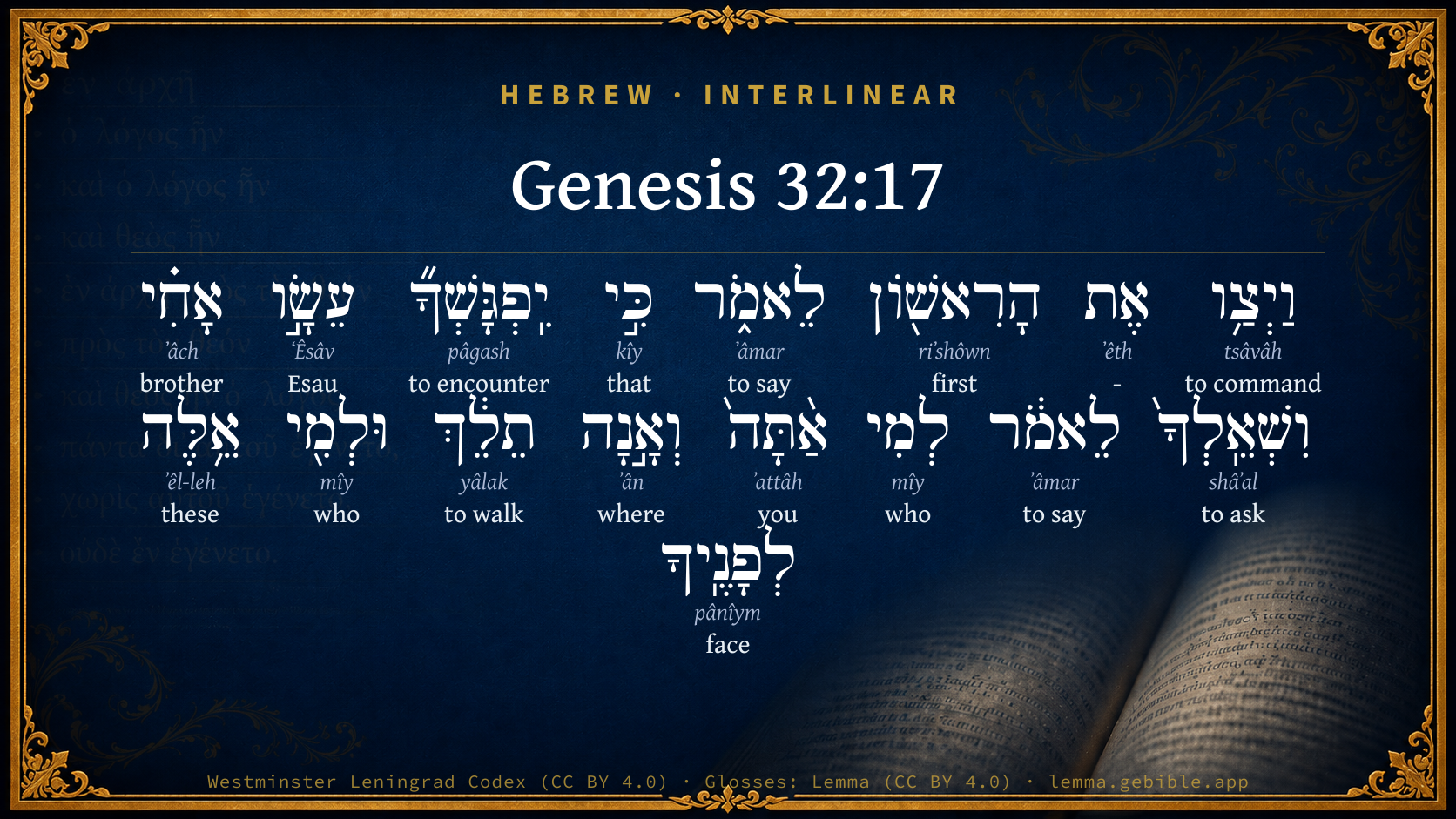
Genesis 32:17

Hebrew (Westminster Leningrad Codex) Genesis 32:17 appears in the Hebrew Old Testament. The text above is from the Westminster Leningrad Codex. Each word links to its Strong’s number, a concise gloss, and parsing drawn from the Open Scriptures Hebrew Bible morphology. Click any word for its full Brown-Driver-Briggs (BDB) entry.
Download image
Cite this verse

Genesis 32:17 (World English Bible). Public Domain. Lemma interlinear Bible study tool, https://lemma.gebible.app/v/genesis/32/17.

Show BibTeX & RIS
BibTeX
RIS
English Translation
He commanded the foremost, saying, "When Esau, my brother, meets you, and asks you, saying, 'Whose are you? Where are you going? Whose are these before you?'
World English Bible · Public Domain
Highlights
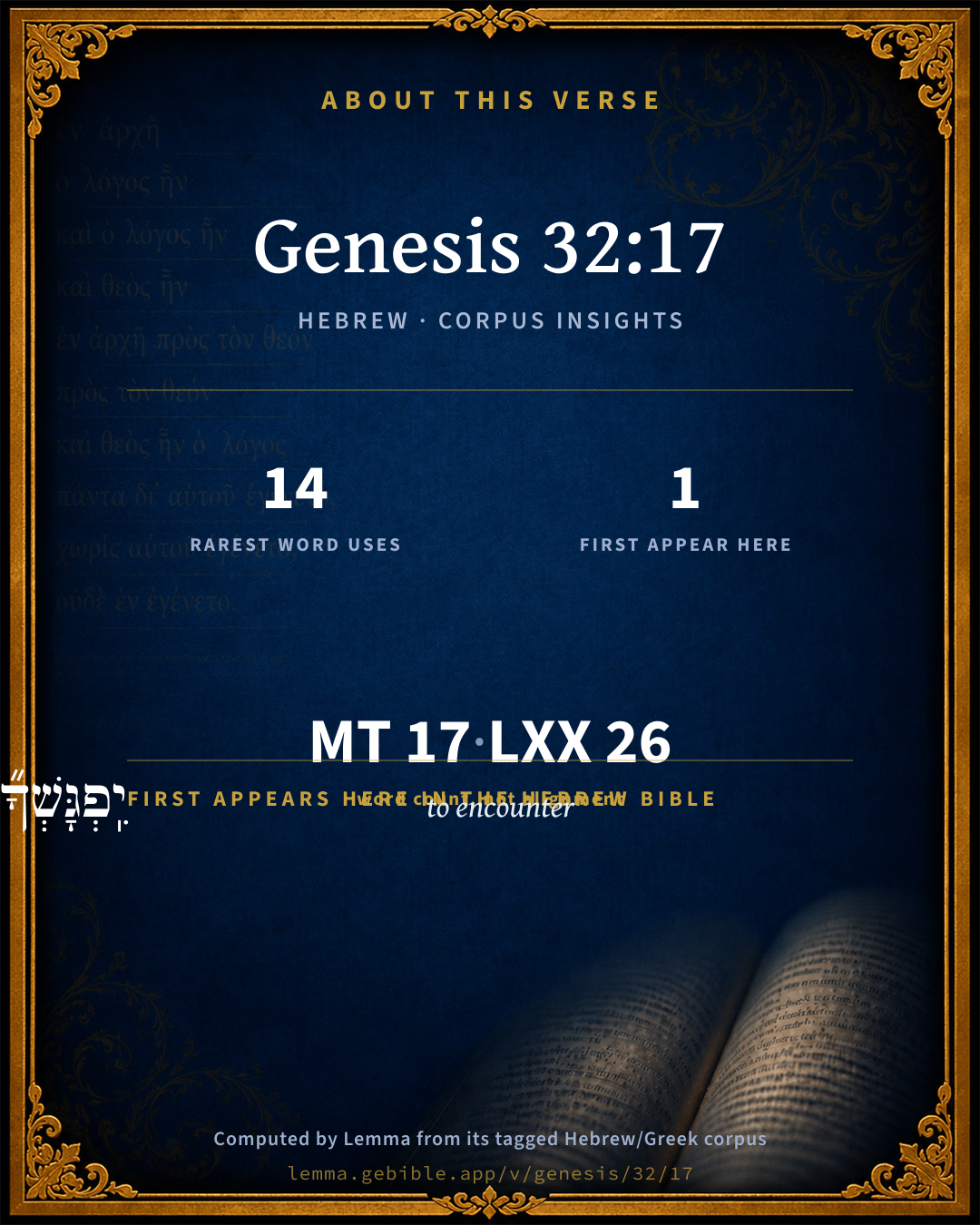
  • 1 first appearance in the Hebrew Bible
Full analysis ↓
Download a study sheet

One document with this verse’s original text, its word-by-word gloss line, the meaning frame, cross-references with their text, attributed commentary, and full source and license credits — printable, and it pastes into notes with its structure intact.

This verse Autodidact and up

Study sheet (.html) Plain text (.txt)

A passage Seminary Student

Up to 50 verses in one chapter. A passage sheet keeps up to 6 commentary sources and 12 cross-references per verse, in the order this page ranks them, and says so on the sheet whenever that leaves anything out. Ask for a single verse and you get the Autodidact verse sheet above.

Everything on this page stays free to read, with no account — the sheet is a download of what is already on screen, not access to it.

Want to remove ads? Support Godless Engineer
Compare translations 3

The same verse in 3 English versions, stacked beneath the original-language interlinear above. Click any original word for its lexicon entry.

Each is an independent rendering of the whole verse — the interlinear is not word-aligned to these translations.

Highlighted words mark where these versions differ — a whole-verse word diff, not a word-by-word alignment.

  • World English Bible Public Domain
    He commanded the foremost, saying, "When Esau, my brother, meets you, and asks you, saying, 'Whose are you? Where are you going? Whose are these before you?'
  • King James Version Public Domain
    And he commanded the foremost, saying, When Esau my brother meeteth thee, and asketh thee, saying, Whose art thou? and whither goest thou? and whose are these before thee?
  • unfoldingWord Literal Text CC BY-SA 4.0
    And he commanded the first, saying, “When Esau my brother meets you and asks you, saying, ‘Whom do you to, and where are you going? And whom do these to before you?’

unfoldingWord Literal Text — © unfoldingWord, licensed CC BY-SA 4.0. Word-aligned USFM3 via Door43 (git.door43.org/unfoldingWord/en_ult).

Versions to compare (up to 4)

3 of 4 selected

Show all 18 translations

Every available English version of this verse, each an independent rendering of the whole verse.

  • World English Bible Public Domain
    He commanded the foremost, saying, "When Esau, my brother, meets you, and asks you, saying, 'Whose are you? Where are you going? Whose are these before you?'
  • Berean Standard Bible Public Domain
    He instructed the one in the lead, “When my brother Esau meets you and asks, ‘To whom do you belong, where are you going, and whose animals are these before you?’
  • Majority Standard Bible Public Domain
    He instructed the one in the lead, “When my brother Esau meets you and asks, ‘To whom do you belong, where are you going, and whose animals are these before you?’
  • King James Version Public Domain
    And he commanded the foremost, saying, When Esau my brother meeteth thee, and asketh thee, saying, Whose art thou? and whither goest thou? and whose are these before thee?
  • American Standard Version (1901) Public Domain
    And he commanded the foremost, saying, When Esau my brother meeteth thee, and asketh thee, saying, Whose art thou? and whither goest thou? and whose are these before thee?
  • Revised Version (1885) Public Domain
    And he commanded the foremost, saying, When Esau my brother meeteth thee, and asketh thee, saying, Whose art thou? and whither goest thou? and whose are these before thee?
  • Geneva Bible (1599) Public Domain
    And he commanded the formost, saying, If Esau my brother meete thee, and aske thee, saying, Whose seruant art thou? And whither goest thou? And whose are these before thee?
  • Douay-Rheims (1899) Public Domain
    And he commanded the first, saying: If thou meet my brother Esau, and he ask thee: Whose art thou? or whither goest thou? or whose are these before thee?
  • Young's Literal Translation Public Domain
    And he commandeth the first, saying, `When Esau my brother meeteth thee, and hath asked thee, saying, Whose `art' thou? and whither goest thou? and whose `are' these before thee?
  • Literal Standard Version CC BY-SA 4.0
    And he commands the first, saying, “When my brother Esau meets you, and has asked you, saying, Whose [are] you? And to where do you go? And whose [are] these before you?
  • Unlocked Literal Bible CC BY-SA 4.0
    He instructed the first servant, saying, “When Esau my brother meets you and asks you, saying, 'To whom do you belong? Where are you going? Whose animals are these that are in front of you?'
  • unfoldingWord Literal Text CC BY-SA 4.0
    And he commanded the first, saying, “When Esau my brother meets you and asks you, saying, ‘Whom do you to, and where are you going? And whom do these to before you?’
  • Darby Bible Public Domain
    And he commanded the foremost, saying, When Esau my brother meets thee, and asks thee, saying, Whose art thou, and where goest thou, and whose are these before thee?
  • World Messianic Bible Public Domain
    He commanded the foremost, saying, “When Esau, my brother, meets you, and asks you, saying, ‘Whose are you? Where are you going? Whose are these before you?’
  • Webster's Bible Public Domain
    And he commanded the foremost, saying, When Esau, my brother, meeteth thee, and asketh thee, saying, Whose art thou? and whither goest thou? and whose are these before thee?
  • Free Bible Version CC BY-SA 4.0
    He gave these instructions to those with the first herd: “When my brother Esau meets you and asks, ‘Who is your master, and where are you going, and whose are these animals with you?’
  • Bible in Basic English Public Domain
    And he gave orders to the first, saying, When my brother Esau comes to you and says, Whose servant are you, and where are you going, and whose are these herds?
  • JPS Tanakh (1917) Public Domain
    (32-18) And he commanded the foremost, saying: 'When Esau my brother meeteth thee, and asketh thee, saying: Whose art thou? and whither goest thou? and whose are these before thee?

Literal Standard Version (2020), Covenant Press — licensed CC BY-SA 4.0. Text via the HelloAO Bible API (eBible.org). Unlocked Literal Bible (unfoldingWord) — licensed CC BY-SA 4.0. Text via the HelloAO Bible API (eBible.org). unfoldingWord Literal Text — © unfoldingWord, licensed CC BY-SA 4.0. Word-aligned USFM3 via Door43 (git.door43.org/unfoldingWord/en_ult). Free Bible Version, Dr. Jonathan Gallagher — licensed CC BY-SA 4.0. Text via the HelloAO Bible API (eBible.org).

Word by word

More ways to search: Search by grammar → Find every occurrence → Compare this word →

Practice this passage: Drill this verse → Learn its vocabulary →

יִֽפְגָּשְׁךָ֞
pâgash
H6298
“to encounter · you”
Verb, Qal, Imperfect, 3rd Person, Masculine, Singular + Suffix, Personal, 2nd Person, Masculine, Singular
Part of Speech
Verb
Stem
Qal
Form
Imperfect
Person
3rd Person
Gender
Masculine
Number
Singular
Full BDB Definition

Origin: a primitive root

TWOT: 1733

to meet, join, encounter - (Qal) to meet, encounter - (Niphal) to meet together, meet each other - (Piel) to meet, encounter
  1. וַיְצַ֥ו tsâvâh H6680 “and · to command” Conjunction + Verb, Piel, Sequential Imperfect, 3rd Person, Masculine, Singular
  2. אֶת ʼêth H853 “-” Particle, Direct Object
  3. הָרִאשׁ֖וֹן riʼshôwn H7223 “the · first” Particle, Definite Article + Adjective, Ordinal number, Masculine, Singular, Absolute
  4. לֵאמֹ֑ר ʼâmar H559 “to say” Preposition + Verb, Qal, Infinitive Construct
  5. כִּ֣י kîy H3588 “that” Conjunction
  6. עֵשָׂ֣ו ʻÊsâv H6215 “Esau” Noun, Proper
  7. אָחִ֗י ʼâch H251 “brother · my” Noun, Common, Masculine, Singular, Construct + Suffix, Personal, 1st Person, Common, Singular
  8. וִשְׁאֵֽלְךָ֙ shâʼal H7592 “and · to ask · you” Conjunction + Verb, Qal, Sequential Perfect, 3rd Person, Masculine, Singular + Suffix, Personal, 2nd Person, Masculine, Singular
  9. לֵאמֹ֔ר ʼâmar H559 “to say” Preposition + Verb, Qal, Infinitive Construct
  10. לְמִי mîy H4310 “to/for · who” Preposition + Particle, Interrogative
  11. אַ֨תָּה֙ ʼattâh H859 “you” Pronoun, Personal, 2nd Person, Masculine, Singular
  12. וְאָ֣נָה ʼân H575 “and · where” Conjunction + Particle, Interrogative
  13. תֵלֵ֔ךְ yâlak H3212 “to walk” Verb, Qal, Imperfect, 2nd Person, Masculine, Singular
  14. וּלְמִ֖י mîy H4310 “and · to/for · who” Conjunction + Preposition + Particle, Interrogative
  15. אֵ֥לֶּה ʼêl-leh H428 “these” Pronoun, Demonstrative, Common, Plural
  16. לְפָנֶֽיךָ pânîym H6440 “to/for · face(s) · your” Preposition + Noun, Common, Both, Plural, Construct + Suffix, Personal, 2nd Person, Masculine, Singular

About this verse

These counts appear in no published source. They are computed here, from the morphology-tagged text and Lemma’s own curated glosses. What Lemma adds →

17
words
15
distinct lemmas
Pentateuch
section

Notable vocabulary

The rarest word here is יִֽפְגָּשְׁךָ֞ to encounter H6298 — appearing just 14 times in the whole Hebrew Bible.

First appearance in Scripture

This word makes its first canonical appearance in the Hebrew Bible here:

  • יִֽפְגָּשְׁךָ֞ to encounter H6298

Shared distinctive vocabulary

יִֽפְגָּשְׁךָ֞ to encounter H6298 occurs in 14 verses of the Hebrew Bible. Also found in:

Grammatical profile

  • 6 verbs
  • 3 nouns
  • 1 adjective
  • 2 pronouns
  • 1 conjunction
  • 4 particles

Verb forms

  • וַיְצַ֥ו Piel · Sequential Imperfect
  • לֵאמֹ֑ר Qal · Infinitive Construct
  • יִֽפְגָּשְׁךָ֞ Qal · Imperfect
  • וִשְׁאֵֽלְךָ֙ Qal · Sequential Perfect
  • לֵאמֹ֔ר Qal · Infinitive Construct
  • תֵלֵ֔ךְ Qal · Imperfect

Repetition

Words recur within this verse — often emphatic in Hebrew:

  • לֵאמֹ֑ר to say H559 ×2
  • לְמִי who H4310 ×2

Hebrew & Septuagint length

In English translation the verse runs 27 words from the Hebrew and 33 from the Septuagint (LXX English) — closely comparable.

A rough comparison of the two English renderings, which tokenize alike — not a word-level alignment.

Word counts can differ between the Hebrew and the Greek without any difference in meaning — e.g. the Hebrew direct-object marker אֵת has no separate Greek word, and Greek often adds the article ὁ.

In the original languages it is 17 Hebrew tokens and 26 Greek tokens — but the two are counted differently (Hebrew bundles its prefixes and suffixes into one token; the Greek is in lemma form), so that isn’t a like-for-like length.

Cross-references

1

Topical passages linked to Genesis 32:17 in the Treasury of Scripture Knowledge — connected by theme and wording, ordered by reader-vote popularity; previews shown in the World English Bible.

  • Genesis 33:3 He himself passed over in front of them, and bowed himself to the ground seven times, until he came near to his brother.

Cross-references courtesy of OpenBible.info (CC BY 4.0).

Hebrew and Greek witnesses Masoretic Hebrew ↔ Greek Septuagint

The same verse in the two great witnesses to the Old Testament, shown verse-for-verse.

These are two independent witnesses, not word-aligned to each other, and the Septuagint is shown in lemma (dictionary) form.

Hebrew Genesis 32:17 Masoretic · Westminster Leningrad Codex

וַיְצַ֥ו אֶת הָרִאשׁ֖וֹן לֵאמֹ֑ר כִּ֣י יִֽפְגָּשְׁךָ֞ עֵשָׂ֣ו אָחִ֗י וִשְׁאֵֽלְךָ֙ לֵאמֹ֔ר לְמִי אַ֨תָּה֙ וְאָ֣נָה תֵלֵ֔ךְ וּלְמִ֖י אֵ֥לֶּה לְפָנֶֽיךָ

He commanded the foremost, saying, "When Esau, my brother, meets you, and asks you, saying, 'Whose are you? Where are you going? Whose are these before you?'

World English Bible · Public Domain

Greek LXX Genesis 32:17 Septuagint · lemma form

καί δίδωμι διά χείρ ὁ παῖς αὐτός ποίμνιον κατά μόνος εἶπον δέ ὁ παῖς αὐτός προπορεύομαι ἔμπροσθεν ἐγώ καί διάστημα ποιέω ἀνά μέσος ποίμνη καί ποίμνη

And he charged the first, saying, If Esau my brother meet you, and he ask you, saying, Whose are you? and whither would you go, and whose are these possessions advancing before you?

LXX2012 (modern English Septuagint) · Public Domain

Hebrew: Westminster Leningrad Codex (CC BY 4.0). Greek: Septuagint (public domain); English from LXX2012 (modern English Septuagint) (Public Domain). How the Septuagint differs from the Hebrew →

Targum (Aramaic paraphrase)

2

The Targum is the ancient Jewish Aramaic paraphrase of the Hebrew Scriptures — an interpretive translation, not the Hebrew text itself. Onkelos (literal) and Pseudo-Jonathan (expansive) render the Torah, and Jonathan the Prophets. Coverage is partial: where no permissively-licensed English translation exists for a verse, only the Aramaic is shown. This is verse-level text, not a word-by-word alignment to the Hebrew.

  1. Targum Onkelos Torah (Genesis–Deuteronomy)
    וִיהַב בְּיַד עַבְדּוֹהִי עֶדְרָא עֶדְרָא בִּלְחוֹדוֹהִי וַאֲמַר לְעַבְדּוֹהִי עִבָּרוּ קֳדָמַי וּרְוָחָא תְּשַׁווּן בֵּין עֶדְרָא וּבֵין עֶדְרָא

    (no public-domain English translation for this verse)

    Targum Onkelos — Aramaic: “Onkelos Genesis” (public domain); “Onkelos Exodus” (public domain); “Onkelos Leviticus” (public domain); “Onkelos Numbers” (public domain); “Onkelos Deuteronomy” (public domain). English: “Sefaria Community Translation” (CC0 1.0 (public-domain dedication)); “J.W. Etheridge. The Targums of Onkelos and Jonathan Ben Uzziel on the Pentateuch. London: Longmans, Green, 1862” (public domain). Text via Sefaria.

  2. Targum Pseudo-Jonathan Torah (Genesis–Deuteronomy)
    וְזַמִין בְּיַד עַבְדוֹי עֶדְרָא עֶדְרָא בִּלְחוֹדוֹי וְאָמַר לְעַבְדוֹי עִבְרוּ קֳדָמַי וְנִיפַשׁ תְּשַׁווּן בֵּינֵי עֶדְרָא וּבֵינֵי עֶדְרָא

    And he made them ready by the hand of his servants in flocks apart, and said to his servants, Pass over before me, and put much (room) between flock and flock.

    Targum Pseudo-Jonathan — Aramaic: “Targum Jonathan on Genesis” (public domain); “Targum Jonathan on Exodus” (public domain); “Targum Jonathan on Leviticus” (public domain); “Targum Jonathan on Numbers” (public domain); “Targum Jonathan on Deuteronomy” (public domain). English: “The Targum of Jonathan ben Uzziel, trans. J. W. Etheridge, London, 1862” (public domain). Text via Sefaria.

Commentary

Notes on Genesis 32:17 from classic Christian and Jewish commentators (each source and its license shown beneath its notes). The classic Christian expositions comment on the surrounding passage and are grouped to its opening verse, so a note may address several verses; the Jewish commentaries on the Tanakh (Rashi and others) are per-verse, so they appear only where the commentator wrote on this verse.

Lemma curates 59 commentaries, every one of them public domain or Creative Commons licensed, each selected and text-cleaned for this edition rather than reprinted as found. About our sources →

Trapp's Complete Commentary

John Trapp

Gen 32:17 And he commanded the foremost, saying, When Esau my brother meeteth thee, and asketh thee, saying, Whose [art] thou? and whither goest thou? and whose [are] these before thee?

Ver. 17. Whose art thou? &c.] Short questions, such as great ones used to ask {a} {See Trapp on "Gen 33:12"}

{a} Imperatoria usus est brevitate.

John Trapp, A Commentary or Exposition upon All the Books of the Old and New Testament (1647–1656) — public domain. Text from a community e-Sword module.

Jamieson, Fausset & Brown

Robert Jamieson, A. R. Fausset & David Brown

he commanded the foremost--The messengers were strictly commanded to say the same words [Gen 32:18, Gen 32:20], that Esau might be more impressed and that the uniformity of the address might appear more clearly to have come from Jacob himself.

Jamieson, Fausset & Brown — Commentary Critical and Explanatory on the Whole Bible (1871) — public domain (CC PDM 1.0). Text via the HelloAO Bible API.

John Gill's Exposition

And he commanded the foremost,.... He that had the care of the first drove, which consisted of goats, male and female:

saying, when Esau my brother meeteth thee; as there was reason to believe he would, being on the road, and him first of all, being the foremost:

and asketh thee, saying, what art thou? that is, whose servant art thou? to whom dost thou belong?

and whither goest thou? what place art thou travelling to?

and whose are these before thee? whose are these goats? to whom do they belong thou art driving? for in driving and travelling on the road, sheep and goats went before those that had the care of them; whereas, in leading out to pastures, the shepherds went before, and the flocks followed, Joh 10:4.

John Gill's Exposition of the Whole Bible (1746–1763) — public domain (CC PDM 1.0). Text via the HelloAO Bible API.

The Pulpit Commentary

Vers. 17-20. And he commanded the foremost, saying (with admirable tact and prudence), When Esau my brother meeteth thee, and asketh thee, saying, Whose art thou? and whither goest thou? and whose are these before thee! then thou shalt say, They be thy servant Jacob"s; it is a present sent unto my lord Esau: and, behold, also he (Jacob) is behind us. And so commanded he the second, and the third, and all that followed the droves, saying, On this manner shall ye speak unto Esau, when ye find him literally, in your finding of him. And say ye (literally, and ye shall say) moreover, Behold, thy servant Jacob is Behind us" for he thought that this would convince Esau that he Went to "meet him with complete confidence, and without apprehension" (Kalisch)for he said (the historian adds the motive which explained Jacob"s singular behavior), I will appease him (literally, I will cover his face, meaning I will prevent him from seeing my past offences, i.e. I will turn away his anger or pacify him, as in Pro_16:14 with the present that goeth before me, literally, going before my face. So Abigail appeased David with a present (1Sa_25:18-32) and afterward I will see his face; peradventure he will accept of me literally, lift up my face; a proverbial expression for granting a favorable reception (cf. Gen_19:21; Job_42:8) "Jacob did not miscalculate the influence of his princely offerings, and I verily believe there is not an emeer or sheikh in all Gilead at this day who would not be appeased by such presents; and from my personal knowledge of Orientals, I should say that Jacob need not have been in such great terror, following in their rear. Far less will now "make room," as Solomon says, for any offender, however atrocious, and bring him before great men with acceptance" ("Land and Book," p. 371).

The Pulpit Commentary (1880–1919), ed. H.D.M. Spence-Jones & Joseph S. Exell — public domain. Text from a community e-Sword module.

John Wesley's Explanatory Notes

He sent him also a very humble message, which he ordered his servants to deliver in the best manner. They must call Esau their Lord, and Jacob his servant: they must tell him the cattle they had was a small present which Jacob had sent him. They must especially take care to tell him that Jacob was coming after, that he might not suspect him fled. A friendly confidence in mens goodness may help to prevent the mischief designed us by their badness.

John Wesley, Explanatory Notes Upon the Whole Bible (1754–1765) — public domain. Text via the GEBible commentary corpus.

unfoldingWord translationNotes

Door43 World Missions Community

He instructed

"He commanded"

asks you ... that are in front of you?'

This is a quotation within a quotation. It can be stated as an indirect quotation. AT: "asks you who your master is, where you are going, and who owns these animals that are ahead of you" (See: Quotes Within Quotes and Direct and Indirect Quotations)

To whom do you belong?

"Who is your master?"

Whose animals are these that are in front of you?

"Who owns these animals that are in front of you?"

Then you will say, 'They are your servant Jacob's. They are a gift sent to my master Esau. See, he is also coming after us.'

This is a quotation within a quotation. It can be stated as an indirect quotation. AT: "Then I want you to tell him that all of these things belong to Jacob, his servant, and he his giving them to his master, Esau. And tell him that Jacob is on the way to meet him" (See: Quotes Within Quotes and Direct and Indirect Quotations)

your servant Jacob's

Jacob is referring to himself in a polite way as Esau's servant.

to my master Esau

Jacob is referring to Esau is a polite way as his master.

coming after us

Here "us" refers to the servant speaking and the other servants bringing herds to Esau. (See: Exclusive and Inclusive "We")

translationWords

servant

gift

lord

unfoldingWord translationNotes — © Distant Shores Media and the Door43 World Missions Community, licensed CC BY-SA 4.0. Source: git.door43.org/Door43/en_tn.

Rashi

Rabbi Shlomo Yitzchaki (Rashi)

עדר עדר לבדו EVERY DROVE BY ITSELF — each species forming a drove by itself.

עברו לפני PASS ON BEFORE ME, a day’s journey or less and I shall follow you).

ורוח תשימו AND PUT A SPACE — one drove before the other at a distance as far as the eye can see, in order to satisfy the eye (the cupidity) of that wicked man and to amaze him by the size of the gift (Genesis Rabbah 76:8).

Rashi on the Tanakh — English translations: “The Judaica Press complete Tanach with Rashi, translated by A. J. Rosenberg” (CC BY 4.0); “Pentateuch with Rashi's commentary by M. Rosenbaum and A.M. Silbermann, 1929-1934” (public domain); “The Metsudah Tanach series, Lakewood, N.J” (CC BY 4.0); and “The Book of Joshua, Metsudah Publications, 1997” (CC BY 4.0). Text via Sefaria.

Ramban (Nachmanides)

Rabbi Moshe ben Nachman (Ramban / Nachmanides)

AND PUT A SPACE BETWEEN DROVE AND DROVE. I.e., in order to satisfy the covetous eye of that wicked man and to amaze him by the size of the gift. In Bereshith Rabbah the Rabbis express the opinion that there is an allusion to the future in this matter: “Jacob said before the Holy One, blessed be He, ‘O Master of the universe! If troubles will come upon my children, do not bring them one after another, but allow them intervals from their troubles.’” On the basis of this verse, the Rabbis thus hinted that the tributes and taxes which the children of Esau will collect from Jacob’s seed will have intervals and cessations between one another.

Ramban (Nachmanides) on the Tanakh — English translation: “Commentary on the Torah by Ramban (Nachmanides). Translated and annotated by Charles B. Chavel. New York, Shilo Pub. House, 1971-1976” (CC BY 4.0). Text via Sefaria.

Radak

Rabbi David Kimhi (Radak)

ויתן, he set

ורוח, according to Bereshit Rabbah the רוח mentioned here was Yaakov’s prayer to G’d that if and when his descendants would be punished by G’d for collective wrongdoing, such punishments would be meted out at intervals and not all at once, to give the people a chance to recover from the previous disaster’s impact.

Radak on the Tanakh — English translations: “Sefaria Community Translation” (CC0 1.0 (public-domain dedication)); “Eliyahu Munk, HaChut Hameshulash” (CC BY 4.0); “Rabbi Mike Feuer, Jerusalem Anthology” (CC BY 4.0); and “R. David Kimhi on the first book of Psalms, Translated by R.G. Finch, London, 1919” (public domain). Text via Sefaria.

Lesson kit

Teaching starters — assembled from the data on this page, not authored interpretation. Every prompt links to the verse data it draws on. Edit before teaching.

Genesis, in the Pentateuch, opens this verse with 17 words (15 distinct Hebrew lemmas). Its most distinctive word is pâgash (“to encounter”). A historical commentator’s framing appears above. Read the whole chapter for the surrounding context.

Discussion questions

  1. How does “to encounter” (pâgash) shape what this verse is saying?
  2. This is the first place “to encounter” appears in Scripture (first appears here). What does its debut here establish?
  3. How does Genesis 33:8, which shares the word «to encounter», read alongside this verse?
  4. What does the repetition of “to say” (2× in this one verse) do in this verse?
  5. These translations render this verse differently. What is at stake in choosing one wording over another?
  6. «וַיְצַ֥ו» is a Piel Sequential Imperfect verb. How does that grammatical form shape the action described?
  7. Compare how Trapp's Complete Commentary and Jamieson, Fausset & Brown read this verse. Where do they agree or differ?

Things to notice

Reading settings

Reading text

Shown beneath each verse's original-language words.

Old Testament
Old Testament edition

Read the OT as the Masoretic Hebrew (MT) or the Greek Septuagint (LXX).

English shown for the Greek Septuagint (in the Hebrew ↔ Greek comparison).

Comparing translations? Open the Compare panel on any verse page to stack up to four side by side.