
2 Corinthians 11:33

Greek (Tischendorf 8th ed.) 2 Corinthians 11:33 appears in the Greek New Testament. The text above is from the Tischendorf 8th edition. Each word links to its Strong’s number and a concise gloss. Click any word for its full Thayer’s Greek Lexicon entry.
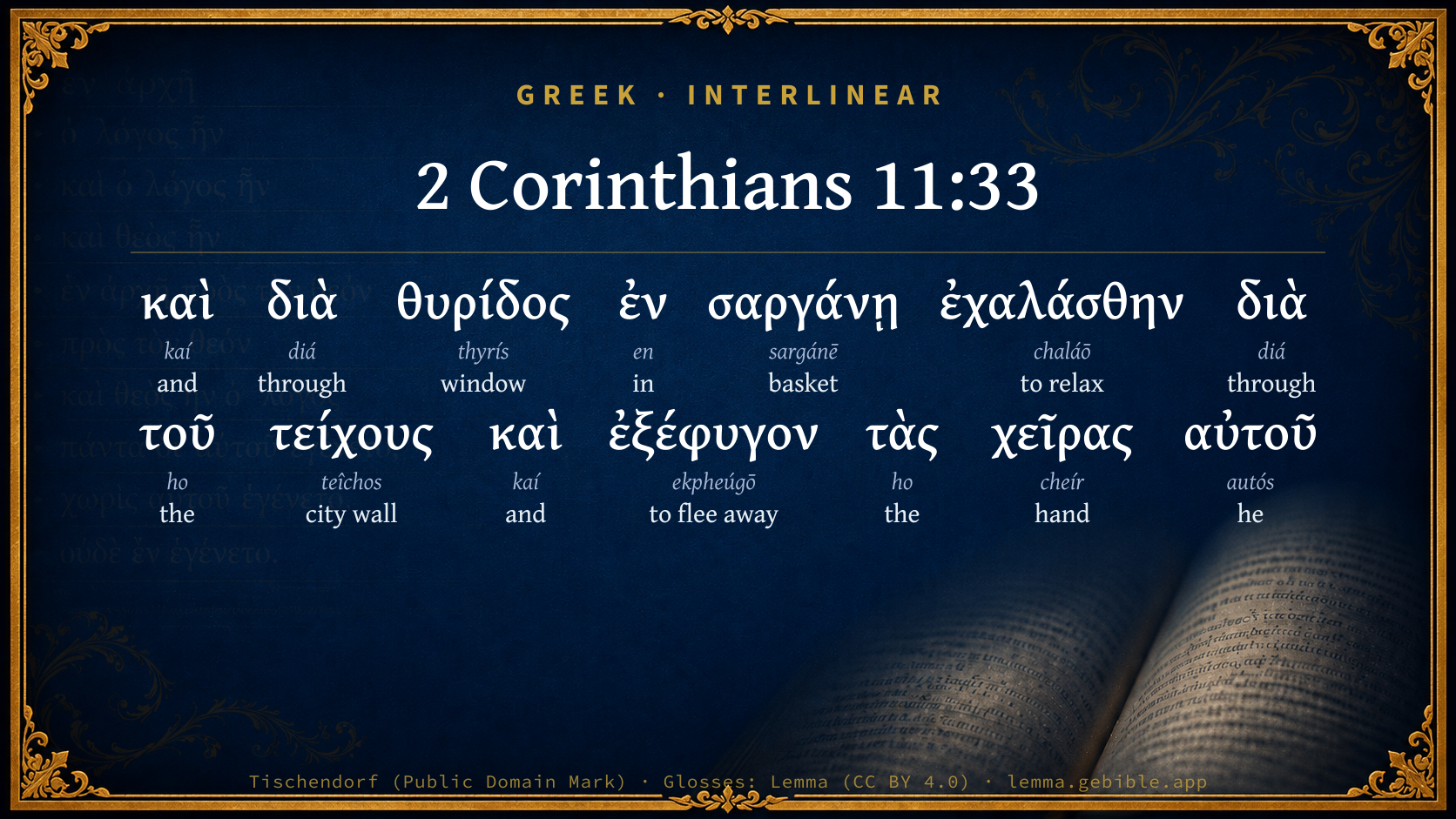
Download image
Cite this verse

2 Corinthians 11:33 (World English Bible). Public Domain. Lemma interlinear Bible study tool, https://lemma.gebible.app/v/2-corinthians/11/33.

Show BibTeX & RIS
BibTeX
RIS
English Translation
Through a window I was let down in a basket by the wall, and escaped his hands.
World English Bible · Public Domain
Highlights
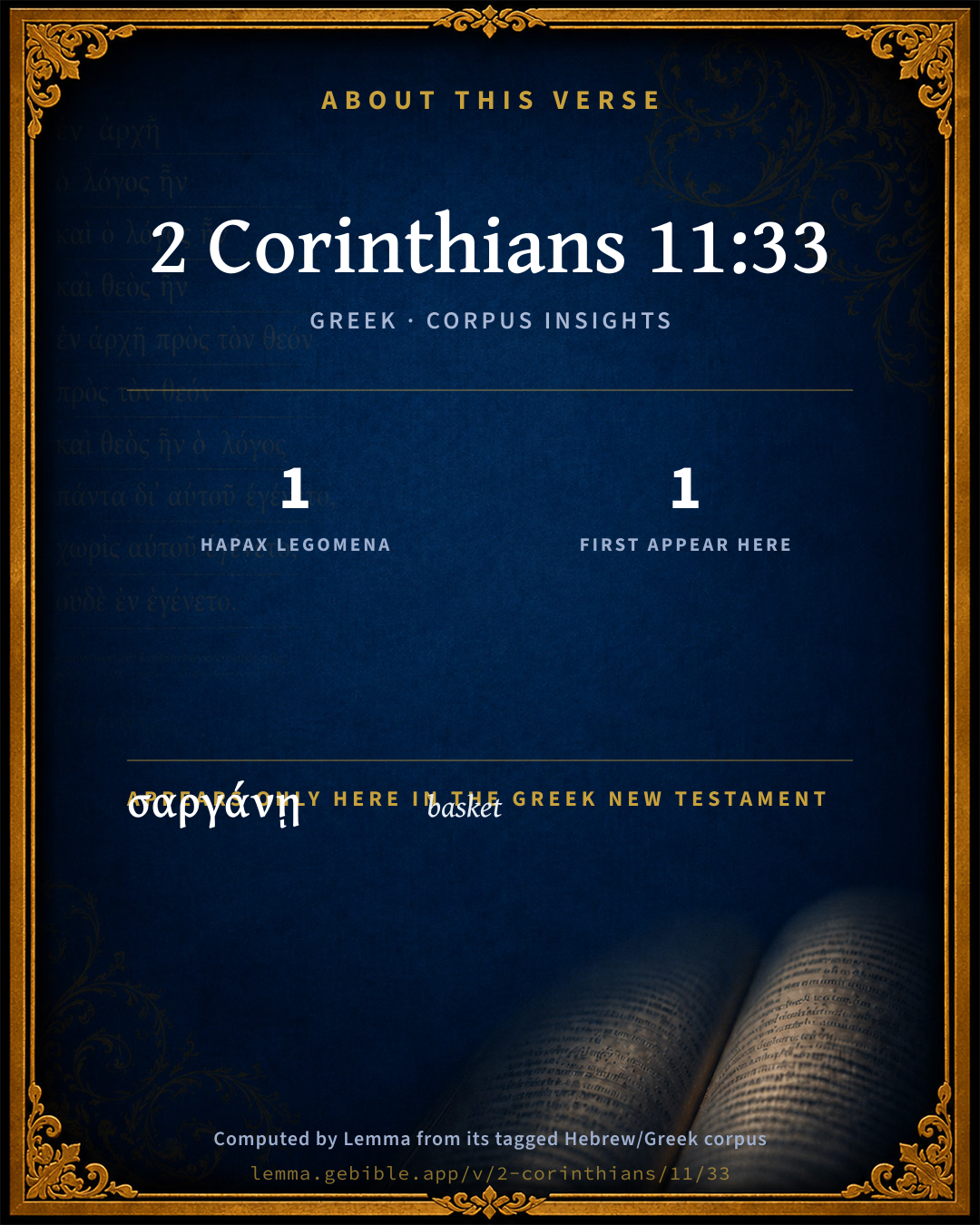
  • 1 hapax legomenon — only here in the Greek New Testament
  • 1 first appearance in the Greek New Testament
Full analysis ↓
Download a study sheet

One document with this verse’s original text, its word-by-word gloss line, the meaning frame, cross-references with their text, attributed commentary, and full source and license credits — printable, and it pastes into notes with its structure intact.

This verse Autodidact and up

Study sheet (.html) Plain text (.txt)

A passage Seminary Student

Up to 50 verses in one chapter. A passage sheet keeps up to 6 commentary sources and 12 cross-references per verse, in the order this page ranks them, and says so on the sheet whenever that leaves anything out. Ask for a single verse and you get the Autodidact verse sheet above.

Everything on this page stays free to read, with no account — the sheet is a download of what is already on screen, not access to it.

Want to remove ads? Support Godless Engineer
Compare translations 3

The same verse in 3 English versions, stacked beneath the original-language interlinear above. Click any original word for its lexicon entry.

Each is an independent rendering of the whole verse — the interlinear is not word-aligned to these translations.

Highlighted words mark where these versions differ — a whole-verse word diff, not a word-by-word alignment.

  • World English Bible Public Domain
    Through a window I was let down in a basket by the wall, and escaped his hands.
  • King James Version Public Domain
    And through a window in a basket was I let down by the wall, and escaped his hands.
  • unfoldingWord Literal Text CC BY-SA 4.0
    But I was lowered in a basket through a window through the wall, and I escaped from his hands.

unfoldingWord Literal Text — © unfoldingWord, licensed CC BY-SA 4.0. Word-aligned USFM3 via Door43 (git.door43.org/unfoldingWord/en_ult).

Versions to compare (up to 4)

3 of 4 selected

Show all 19 translations

Every available English version of this verse, each an independent rendering of the whole verse.

  • World English Bible Public Domain
    Through a window I was let down in a basket by the wall, and escaped his hands.
  • Berean Standard Bible Public Domain
    But I was lowered in a basket through a window in the wall and escaped his grasp.
  • Majority Standard Bible Public Domain
    But I was lowered in a basket through a window in the wall and escaped his grasp.
  • King James Version Public Domain
    And through a window in a basket was I let down by the wall, and escaped his hands.
  • American Standard Version (1901) Public Domain
    and through a window was I let down in a basket by the wall, and escaped his hands.
  • Revised Version (1885) Public Domain
    and through a window was I let down in a basket by the wall, and escaped his hands.
  • Geneva Bible (1599) Public Domain
    But at a window was I let downe in a basket through the wall, and escaped his handes.
  • Douay-Rheims (1899) Public Domain
    And through a window in a basket was I let down by the wall, and so escaped his hands.
  • Young's Literal Translation Public Domain
    and through a window in a rope basket I was let down, through the wall, and fled out of his hands.
  • Literal Standard Version CC BY-SA 4.0
    and I was let down through a window in a rope basket, through the wall, and fled out of his hands.
  • Unlocked Literal Bible CC BY-SA 4.0
    But I was lowered in a basket through a window in the wall, and I escaped from his hands.
  • unfoldingWord Literal Text CC BY-SA 4.0
    But I was lowered in a basket through a window through the wall, and I escaped from his hands.
  • Darby Bible Public Domain
    and through a window in a basket I was let down by the wall, and escaped his hands.
  • World Messianic Bible Public Domain
    I was let down in a basket through a window by the wall, and escaped his hands.
  • Webster's Bible Public Domain
    And through a window in a basket I was let down by the wall, and escaped his hands.
  • Free Bible Version CC BY-SA 4.0
    But I was lowered in a basket from a window in the city wall, and so I escaped from him.
  • Bible in Basic English Public Domain
    And being let down in a basket from the wall through a window, I got free from his hands.
  • Text-Critical English NT CC BY 4.0
    but I was let down in a basket through a window in the city wall and escaped from his hands.
  • Tyndale New Testament (1534) Public Domain
    and at a wyndowe was I let doune in a basket thorowe the wall and so scaped his hondes.

Literal Standard Version (2020), Covenant Press — licensed CC BY-SA 4.0. Text via the HelloAO Bible API (eBible.org). Unlocked Literal Bible (unfoldingWord) — licensed CC BY-SA 4.0. Text via the HelloAO Bible API (eBible.org). unfoldingWord Literal Text — © unfoldingWord, licensed CC BY-SA 4.0. Word-aligned USFM3 via Door43 (git.door43.org/unfoldingWord/en_ult). Free Bible Version, Dr. Jonathan Gallagher — licensed CC BY-SA 4.0. Text via the HelloAO Bible API (eBible.org).

Word by word

More ways to search: Search by grammar → Find every occurrence → Compare this word →

Practice this passage: Drill this verse → Learn its vocabulary →

About this verse

These counts appear in no published source. They are computed here, from the morphology-tagged text and Lemma’s own curated glosses. What Lemma adds →

14
words
11
distinct lemmas
Pauline Epistles
section

Notable vocabulary

1 hapax legomenon — a word that appears only here in the entire Greek New Testament:

  • σαργάνῃ basket G4553

First appearance in Scripture

This word makes its first canonical appearance in the Greek New Testament here:

  • σαργάνῃ basket G4553

Shared distinctive vocabulary

θυρίδος window G2376 occurs in 2 verses of the Greek New Testament. Also found in:
Repetition

Words recur within this verse:

Cross-references

3

Topical passages linked to 2 Corinthians 11:33 in the Treasury of Scripture Knowledge — connected by theme and wording, ordered by reader-vote popularity; previews shown in the World English Bible.

  • Acts 9:25 but his disciples took him by night, and let him down through the wall, lowering him in a basket.
  • Joshua 2:18 Behold, when we come into the land, you shall bind this line of scarlet thread in the window which you did let us down by: and you shall gather to you into the house your father, and your mother, and your brothers, and all your father's household.
  • 1 Samuel 19:12 So Michal let David down through the window: and he went, and fled, and escaped.

Cross-references courtesy of OpenBible.info (CC BY 4.0).

Commentary

Notes on 2 Corinthians 11:33 from classic Christian and Jewish commentators (each source and its license shown beneath its notes). The classic Christian expositions comment on the surrounding passage and are grouped to its opening verse, so a note may address several verses; the Jewish commentaries on the Tanakh (Rashi and others) are per-verse, so they appear only where the commentator wrote on this verse.

Lemma curates 59 commentaries, every one of them public domain or Creative Commons licensed, each selected and text-cleaned for this edition rather than reprinted as found. About our sources →

Adam Clarke's Commentary

Verse 33. Through a window in a basket] Probably the house was situated on the wall of the city. See the notes on this history, Ac 9:23-25.

IN ver. 2 of this chapter 2Co 11:2 the apostle most evidently alludes to the history of the temptation, and fall of Adam and Eve, as related in Ge 3:1, c. and which fall is there attributed to the agency of a being called נחש nachash, here, and in other places, translated οφις, serpent. In my notes on Genesis I have given many, and, as I judge, solid reasons, why the word cannot be understood literally of a serpent of any kind; and that most probably a creature of the simia or ape genus was employed by the devil on this occasion. The arguments on this subject appeared to me to be corroborated by innumerable probabilities; but I left the conjecture afloat, (for I did not give it a more decisive name,) and placed it in the hands of my readers to adopt, reject, or amend, as their judgments might direct them. To several this sentiment appeared a monstrous heresy! and speedily the old serpent had a host of defenders. The very modest opinion, or conjecture, was controverted by some who were both gentlemen and scholars, and by several who were neither; by some who could not affect candour because they had not even the appearance of it, but would affect learning because they wished to be reputed wise. What reason and argument failed to produce they would supply with ridicule; and as monkey was a convenient term for this purpose, they attributed it to him who had never used it. What is the result? They no doubt believe that they have established their system; and their arguments are to them conclusive. They have my full consent; but I think it right to state that I have neither seen nor heard of any thing that has the least tendency to weaken my conjecture, or produce the slightest wavering in my opinion. Indeed their arguments, and mode of managing them, have produced a very different effect on my mind to what they designed. I am now more firmly persuaded of the probability of my hypothesis than ever. I shall, however, leave the subject as it is: I never proposed it as an article of faith; I press it on no man. I could fortify it with many additional arguments if I judged it proper; for its probability appears to me as strong as the utter improbability of the common opinion, to defend which its abettors have descended to insupportable conjectures, of which infidels have availed themselves, to the discredit of the sacred writings. To those who choose to be wise and witty, and wish to provoke a controversy, this is my answer: I am doing a great work, so that I cannot come down. Why should the work cease, while I leave it and come DOWN to YOU? Ne 6:3.

Adam Clarke's Commentary on the Bible (1810–1826) — public domain. Text from a community e-Sword/MySword module.

Ellicott's Commentary for English Readers

(33) Through a window in a basket . . .—On the mode of escape, see Notes on Act_9:24-25. So the spies escaped from the house of Rahab (Jos_2:15), and David from the pursuit of Saul (1Sa_19:12). The word which St. Paul uses for “basket” (sarganè) implies, perhaps, a more vivid personal recollection, as meaning specifically a rope-work hamper. St. Luke employs the more general term, spuris. (See Note on Mat_15:32.)

A Bible Commentary for English Readers, edited by Charles John Ellicott (1878–1897) — public domain. Text from a community e-Sword module.

The Cambridge Bible for Schools and Colleges

gen. ed. J. J. S. Perowne

33. in a basket] The word literally means a plaited cord. Hence a basket made of cords. The word in Act_9:25 is not the same.

was I let down by the wall] Theodoret well remarks, “He shews the greatness of the danger by the mode of his flight.” The peroration of Chrysostom’s homily here is an eloquent picture of the magnanimity of the great Apostle.

The Cambridge Bible for Schools and Colleges (gen. ed. J. J. S. Perowne; Cambridge University Press, 1878–1918) — public domain. Text from a community e-Sword module.

Trapp's Complete Commentary

John Trapp

33 And through a window in a basket was I let down by the wall, and escaped his hands.

Ver. 33. And through a window, &c.] An honest shift, though against the Roman law of leaping over the walls. Quia leges semper ad aequitatem flectendae sunt, saith Cicero. The sense of the law is the law, and not always the letter. Apices iuris non sunt ius.

And escaped his hands] Of the lawfulness of flight in some cases. {See Trapp on "Mat 10:23"} {See Trapp on "Act 9:24"}

John Trapp, A Commentary or Exposition upon All the Books of the Old and New Testament (1647–1656) — public domain. Text from a community e-Sword module.

Albert Barnes' Notes on the Bible

And through a window - That is, through a little door or aperture in the wall; perhaps something like an embrasure, that might have been large enough to allow a man to pass through it. Luke says Act 9:25 that they let him down “by the wall.” But there is no inconsistency. They doubtless first passed him through the embrasure or loop-hole in the wall, and then let him down gently by the side of it. Luke does not say it was over the top of the wall, but merely that he descended by the wall. It is not probable that an embrasure or opening would be near the bottom, and consequently there would be a considerable distance for him to descend by the side of the wall after he had passed through the window. Bloomfield, however, supposes that the phrase employed by Luke and rendered “by the wall,” means properly “through the wall.” But I prefer the former interpretation.

In a basket - The word used here (σαργάνη sarganē) means anything braided or twisted; hence, a rope-basket, a net-work of cords, or a wicker hamper. It might have been such an one as was used for catching fish, or it might have been made for the occasion. The word used by Luke Act 9:25 is σπυρὶς spuris - a word usually meaning a basket for storing grain, provisions, etc. Where Paul went immediately after he had escaped them, he does not here say. From Gal 1:17, it appears that he went into Arabia, where he spent some time, and then returned to Damascus, and after three years he went up to Jerusalem. It would not have been safe to have gone to Jerusalem at once, and he therefore waited for the passions of the Jews to have time to cool, before he ventured himself again in their hands.

Remarks

1. There may be circumstances, but they are rare, in which it may be proper to speak of our own attainments, and of our own doings; 2Co 11:1. Boasting is in general nothing but folly - the fruit of pride - but there may be situations when to state what we have done may be necessary to the vindication of our own character, and may tend to honor God. Then we should do it; not to trumpet forth our own fame, but to glorify God and to advance his cause. Occasions occur however but rarely in which it is proper to speak in this manner of ourselves.

2. The church should be pure. It is the bride of the Redeemer; the “Lamb’s wife;” 2Co 11:2. It is soon to be presented to Christ, soon to be admitted to his presence. How holy should be that church which sustains such a relation! How anxious to be worthy to appear before the Son of God!

3. All the individual members of that church should be holy; 2Co 11:2. They as individuals are soon to be presented in heaven as the fruit of the labors of the Son of God, and as entitled to his eternal love. How pure should be the lips that are soon to speak his praise in heaven; how pure the eyes that are soon to behold his glory; how holy the feet that are soon to tread his courts in the heavenly world!

4. There is great danger of being corrupted from the simplicity that is in Christ; 2Co 11:3. Satan desires to destroy us; and his great object is readily accomplished if he can seduce Christians from simple devotedness to the Redeemer; if he can secure corruption in doctrine or in the manner of worship, and can produce conformity in dress and in the style of living to this world. Formerly, he excited persecution. But in that he was foiled. The more the church was persecuted the more it grew. Then he changed his ground. What he could not do by persecution he sought to do by corrupting the church; and in this he has been by far more successful. This can be done slowly but certainly; effectually but without exciting suspicion. And it matters not to Satan whether the church is crippled by persecution or its zeal destroyed by false doctrine and by conformity to the world. His aim is secured; and the power of the church destroyed. The form in which he now assails the church is by attempting to seduce it from simple and hearty attachment to the Saviour. And, O! in how many instances is he successful.

5. Our religion has cost much suffering. We have in this chapter a detail of extraordinary trials and sorrows in establishing it; and we have reason to be thankful, in some degree, that the enemies of Paul made it necessary for him to boast in this manner. We have thus some most interesting details of facts of which otherwise we should have been ignorant; and we see that the life of Paul was a life of continual self-denial and toil. By sea and land; at home and abroad; among his own countrymen and strangers, he was subjected to continued privations and persecution. So it has been always in regard to the establishment of the gospel. It began its career in the sufferings of its great Author, and the foundation of the church was laid in his blood. It progressed amidst sufferings, for all the apostles, except John, it is supposed were martyrs. It continued to advance amidst sufferings - for 10 fiery persecutions raged throughout the Roman Empire, and thousands died in consequence of their professed attachment to the Saviour. It has been always propagated in pagan lands by self-denials and sacrifices, for the life of a missionary is that of sacrifice and toil. How many such people as David Brainerd and Henry Martyn have sacrificed their lives in order to extend the true religion around the world!

6. All that we enjoy is the fruit of the sufferings, toils, and sacrifices of others. We have not one Christian privilege or hope which has not cost the life of many a martyr. How thankful should we be to God that he was pleased to raise up people who would be willing thus to suffer, and that he sustained and kept them until their work was accomplished!

7. We may infer the sincerity of the people engaged in propagating the Christian religion. What had Paul to gain in the sorrows which he endured? Why did he not remain in his own land and reap the honors which were then fully within his grasp? The answer is an easy one. It was because he believed that Christianity was true; and believing that, he believed that it was of importance to make it known to the world. Paul did not endure these sorrows, and encounter these perils for the sake of pleasure, honor, or gain. No man who reads this chapter can doubt that he was sincere, and that he was an honest man.

8. The Christian religion is, therefore, true. Not because the first preachers were sincere for the advocates of error are often sincere, and are willing to suffer much or even to die as martyrs; but because this was a case when their sincerity proved the facts in regard to the truth of Christianity. It was not sincerity in regard to opinions merely, it was in regard to facts. They not only believed that the Messiah had come and died and risen again, but they saw him - saw him when he lived; saw him die; saw him after he was risen; and it was in relation to these facts that they were sincere. But how could they be deceived here? People may be deceived in their opinions; but how could John, e. g., be deceived in affirming that he was intimately acquainted - the bosom friend - with Jesus of Nazareth; that he saw him die; and that he conversed with him after he had died? In this he could not be mistaken; and sooner than deny this, John would have spent his whole life in a cave in Patmos, or have died on the cross or at the stake. But if John saw all this, then the Christian religion is true.

9. We should be willing to suffer now. If Paul and the other apostles were willing to endure so much, why should not we be? If they were willing to deny themselves so much in order that the gospel should be spread among the nations, why should not we be? It is now just as important that it should be spread as it was then; and the church should be just as willing to sacrifice its comforts to make the gospel known as it was in the days of Paul. We may add, also, that if there was the same devotedness to Christ evinced by all Christians now which is described in this chapter; if there was the same zeal and self-denial, the time would not be far distant when the gospel would be spread all around the world. May the time soon come when all Christians shall have the same self-denial as Paul; and especially when all who enter the ministry shall be willing to forsake country and home, and to encounter peril in the city and the wilderness; on the sea and the land; to meet cold, and nakedness, hunger, thirst, persecution, and death in any way in order that they may make known the name of the Saviour to a lost world.

Albert Barnes' Notes on the Bible (1834–1885) — public domain. Text from a community e-Sword/MySword module.

Whedon's Commentary on the Bible

Daniel D. Whedon

33. Window—Or, kiosk, based upon and projecting over the wall. From a similar window Eutychus fell to the ground, as stated Act_20:9.

Basket—Bloomfield describes it as a very strong netting made of cords, for the purpose of a net for taking fish, or, rather, a hamper for carrying fish, “a fish-hamper.” Stanley says: “There is a spot still pointed out on the eastern wall, itself modern, as the scene of Paul’s escape. Close by is a cavity in the ancient burial ground, where he is said, in the local legends, to have concealed himself; and formerly a tomb was shown of a St. George, who was martyred in furthering the escape. It is curious that in the present traditions of Damascus the incidents of this escape have almost entirely eclipsed the story of his conversion.” And, we may add, that the popular interest in such an incident very probably gave it that notoriety in his own day which rendered it an effective reminder against his opponents that any sufferings he had to narrate were credible. “An apostle in a basket” is an object quite likely to attract attention, and suggestive of some reflections and lessons. Let no man be ashamed of any predicament, however humble, in which he may be found in a career of good-doing. Alford, we think, mistakes the point when he supposes Paul tells this story of the basket as a self-humbling fact, likely to be quoted ever after to his disgrace. The infirmity of the narrative in which St. Paul glories is simply the fact that he was the object of united Gentile and Jewish hostility for Christ, and a refugee from their hands; not especially because he escaped in a basket. The man who could work at tent making for the glory of a gratuitous gospel, would see slight disgrace in a rope-hamper; far less the man who could boast of being five times striped with Jewish thongs, and thrice with the Roman rods.

Daniel D. Whedon (gen. ed.), Commentary on the Old and New Testaments (1874–1909) — public domain. Text from a community e-Sword module.

The Pulpit Commentary

Through a window. A "little door," or lattice in some house which abutted on the wall. In a basket. (comp. Jos_2:15; 1Sa_19:12) The word used by St. Luke in Act_9:25 is spuris, which is a general name for a large basket. The word here used is sargane, which is defined by Hesychius to be a basket of wickerwork, but which may also mean a rope basket. This particular incident, no doubt, seems to be less perilous and trying than many which St. Paul has already mentioned. We must, however, remember that escape from a window in the lofty wall of a city guarded by patrols was very perilous, and also that such a method of concealment was very trying to the dignity of an Oriental rabbi, such as St. Paul had been. Further, it is clear that St. Paul only mentions this as the earliest incident in along line of perils which it had been his original intention to recount. But at this point he was interrupted, and laid aside his task of dictation an incident which has not unfrequently had its effect in literature. When next he resumed, the Epistle, he was no longer in the mood to break through his rule of reticence on these subjects. He had played "the fool" and "the madman," as he says of himself with indignant irony, enough; and he proceeds to speak of other personal claims which he regards as more Important and more Divine. Of all "chapters of unwritten history," not one is more deeply to be regretted than the one which we have them lost.

The Pulpit Commentary (1880–1919), ed. H.D.M. Spence-Jones & Joseph S. Exell — public domain. Text from a community e-Sword module.

John Wesley's Explanatory Notes

Through a window - Of an house which stood on the city wall.

John Wesley, Explanatory Notes Upon the Whole Bible (1754–1765) — public domain. Text via the GEBible commentary corpus.

McGarvey & Pendleton's Commentaries

J. W. McGarvey

and through a window was I let down in a basket by the wall, and escaped his hands . [In the walled cities of the Orient, houses were often built against the walls so that the windows projected over them. No doubt in Paul's mind an apostle in a basket seemed the depth of humiliation. Aretas was king of Arabia from B. C. 7 to A. D. 40. Damascus belonged to Rome, and it has puzzled some to find it at this time under the control of the king of Arabia. But it will be remembered that Aretas engaged in war with Herod, because he dismissed the Arab's daughter and took his niece, Herodias, for a wife. Aretas defeated Herod, and the Romans took up the quarrel, and it seems likely that in the ensuing contest the city of Damascus fell, for a time, into the hands of the Arabians.]

J. W. McGarvey (with Philip Y. Pendleton), Commentaries on the New Testament (The Fourfold Gospel, 1914; Acts; and the epistles) — public domain. Text from a community e-Sword/MySword module.

The People's New Testament

B. W. Johnson

33. Through a window in a basket was I let down. Houses in these Oriental walled cities are built against walls with windows looking out over them. It was, no doubt, from such a window that he was let down and thus escaped.

Dean Stanley says that the catalogue of sufferings given in this chapter shows that Paul's life was then without precedent in the history of the world. The only explanation of such a life, continued now for more than fourteen years, is that given by himself: “The love of Christ constraineth us.”

B. W. Johnson's The People's New Testament with Notes (1889–1891) — public domain. Electronic text from the Christian Classics Ethereal Library (CCEL) ThML edition.

Cambridge Greek Testament for Schools and Colleges

33. διὰ θυρίδος. Literally, ‘a little door, small opening,’ dim. of θύρα; elsewhere in the N.T. only Act 20:9. An aperture in the wall is still shown as the place. “In the traditions of Damascus the incidents of this escape have almost entirely eclipsed the story of his conversion” (Stanley). Comp. the cases of the spies (Jos 2:15), and of David (1Sa 19:12), in both of which διὰ τῆς θυρίδος occurs.

ἐν σαργάνῃ. In Act 9:25 we have ἐν σφυρίδι, the word invariably used of the ‘baskets’ at the Feeding of the 4000 (Mat 15:37; Mat 16:10; Mar 8:8; Mar 8:20), while κόφινος is equally invariably used of the 5000 (Mat 14:20; Mat 16:9; Mar 6:43; Mar 8:19; Luk 9:17; Joh 6:13). The σφυρίς or σπυρίς, and also the rare word used here, seem to have meant a basket made of twisted or braided material, a rope-basket or wicker basket. In Aesch. Suppl. 788 σαργάνη means a plait or braid; elsewhere a basket. Theodoret remarks, τὸ τοῦ κινδύνου μέγεθος τῷ τρόπῳ τῆς φυγῆς παρεδήλωσεν. But the incident could be made to look laughable, and it had probably been used as a means of ridiculing the Apostle. This letter shows that years afterwards he regarded it as a humiliation, a typical instance of τὰ τῆς ἀσθενείας, marking the very outset of his career, and turning the persecutor into the persecuted in the very place of his intended persecution. Possibly it was because he found the recollection of such things so painful that he gave no more instances. Nevertheless, if it was in his mind to add the σκόλοψ ἐν τῇ σαρκί (2Co 12:7) as another example, the account of the Rapture is required as an introduction to it. Thus we get a sequence; the flight from Damascus, the σκόλοψ, and the summary in 2Co 12:10. But the Rapture seems to be introduced for its own sake, and not as a mere explanation of the σκόλοψ. For χαλάω comp. Act 9:25; Act 27:17; Act 27:30; Mar 2:4; Luk 5:4 ff.; Jeremiah 45[38]:6. For διὰ τοῦ τείχους comp. Act 9:25; 2Sa 20:21.

The flight from Damascus probably took place, not immediately after his conversion, as the narrative in Acts might lead one to suppose, but after the return from Arabia (Gal 1:17). S. Luke omits the retirement into Arabia altogether. But there is room for it in the middle of Act 9:19, where Ἐγένετο δέ (so frequent in Luke, and peculiar to him in the N.T.) marks a fresh start in the story. See the division of paragraphs in the R.V. and in WH.

Cambridge Greek Testament for Schools and Colleges (Cambridge University Press, 1896; 21 vols, various authors incl. Carr, Maclear, Plummer, Farrar, Lumby, Moule, M. R. James, Simcox) — public domain. Text from a community e-Sword module.

Alford’s Greek Testament

Henry Alford

33.] On the fact, and historical difficulty, see note, Act 9:24.

Henry Alford, The Greek Testament (1849–1861) — public domain. Text from a community e-Sword module.

International Critical Commentary

33. διὰ θυρίδος. A small opening in the wall is still shown as the ‘little door’ through which St Paul was let down. Διὰ τῆς θυριδος occurs Jos 2:15 of the escape of the spies from the city wall at Jericho, and 1Sa 19:12 of the escape of David from his own house, when Saul sent men to watch him and slay him.

ἐν σαργάνῃ. Act 9:25 says ἐν σφυρίδι, the word always used respecting the Feeding of the 4000 (Mar 8:8, Mar 8:20; Mat 15:37, Mat 16:10), while κόφινος is always used of the Feeding of the 5000. The rare word σαρλάνη, like σφυρίς or στυρίς, probably means a basket made of plaited or woven material. It is said to be used in the Δηθή of the comic poet Timocles for a fish basket. As stated above, the mode of escape, for which Theodoret thinks it necessary to apologize by pointing out the greatness of the danger, had probably been in some way used to the discredit of the Apostle, and hence his abrupt and dry mention of it here. But there is nothing to show that he was then “in a state of nervous prostration” and merely “passively acquiesced in the action of his disciples” (Rackam). At any rate he himself regards it as a leading illustration of τὰ τῆς ἀσθενίας. For us it is a remarkable thing that the city to which he had set out as a persecutor was the scene of the first persecution that was directed against himself; and six centuries later it was the first Christian city that was captured by the Moslem invaders, a.d. 634. Among cities that are still inhabited, Damascus is probably the oldest in the world. It is possible that, when he began to dictate these two verses, St Paul meant to record instances of humiliating perils in other cities; but having given this one he passes on quickly to a very different subject for glorying.

It is impossible to be certain whether this escape from ‘the city of the Damascenes’ took place before or after the retirement into Arabia (Gal 1:17). Luke in Act_9. does not mention the retirement, possibly because, when he wrote, he was not aware of it, but more probably because it was not an incident on which he cared to lay stress. Some place it before v. 19; others refer it to the ἡμέραι ἱκαναί in v. 23; others again place it after v. 25, i.e. after the escape from Damascus. It is more probable that this famous incident took place after the return from Arabia,* and in that case the best position for it in Acts is in the middle of 9:19, where both WH. and RV., and also Souter, begin a new paragraph. Ἐγένετο δέ in N.T. is peculiar to Lk. and Acts, and is freq. in both writings to mark a fresh start in the narrative. This, however, is no proof that Luke at this point was consciously passing over the Arabian interval. See A. T. Robertson, Epochs in the Life of St Paul, pp. 76-79; Redlich, S. Paul and His Companions, pp. 22:23; Ramsay, St Paul the Traveller, p. 380; Emmet on Gal 1:17.

διὰ τοῦ τείχους. Why should διὰ θυρίδος be ‘through a window’ and διὰ τοῦ τείχους be ‘by the wall’ (AV, RV)? ‘Through’ is probably right in both cases; he was let down (Mar 2:4) through an opening through the wall. In Act 9:25 RV. has ‘through the wall’ for διὰ τοῦ τείχους. Epictetus (Dis. ii. 6 sub init.) says that, when he finds the door closed, he must either go away again or enter through the window (διὰτῆς θυρίδος). It is said that the wall in which is the aperture that is now shown as the place of escape is a modern one.

ἐξέφυγον τὰς χεῖρας αὐτοῦ. This is the usual constr. after ἐκφεύγω (Rom 2:3; Act 16:27; etc.), but we sometimes have ἐκ (Act 19:16) or ἀπό (Ecclus. 40:6). Cf. οὐκ ἐκφεύξομαι τὰς χεῖπας ὑμῶν (Sus. 22). It would certainly be strange if, after so narrow an escape, he had, a year or two later, returned to Damascus again; and those who place the escape before the retirement to Arabia have to meet this difficulty. St Paul was courageous enough to risk his life again, if need required it; but he was not so fanatical as to risk it without very good reason; and what reason could there be? His return to a place that had been friendly to him is natural enough.

* Lietzmann contends that if ἀνέχεσθε had not followed, no one would have taken the first μου with ἀνείχεσθε, and that St Paul does not mean this; in the second sentence he has without thinking changed his construction.

אԠא (Fourth century). Codex Sinaiticus; now at Petrograd, the only uncial MS. containing the whole N.T.

B B (Fourth century). Codex Vaticanus.

M M (Ninth century). Codex Ruber, in bright red letters; two leaves in the British Museum contain 2Co 10:13-5.

P P (Ninth century). Codex Porfirianus Chiovensis, formerly possessed by Bishop Porfiri of Kiev, and now at Petrograd.

D D (Sixth century). Codex Claromontanus; now at Paris. A Graeco-Latin MS. The Latin (d) is akin to the Old Latin. Many subsequent hands (sixth to ninth centuries) have corrected the MS.

F F (Late ninth century). Codex Augiensis (from Reichenau); now at Trinity College, Cambridge.

G G (Late ninth century). Codex Boernerianus; at Dresden. Interlined with the Latin (in minluscules). The Greek text is almost the same as that of F, but the Latin (g) shows Old Latin elements.

K K (Ninth century). Codex Mosquensis; now at Moscow.

L L (Ninth century). Codex Angelicus; now in the Angelica Library at Rome.

E E (Ninth century). At Petrograd. A copy of D, and unimportant

17 17. (Evan. 33, Act_13. Ninth century). Now at paris. “The queen of the cursives” and the best for the Pauline Epistles; more than any other it preserves Pre-Syrian readings and agrees with B D L.

† ,μνηστείας γάρ ἐστι καιρὸς ὁ παρὼν καιρός ὁ δὲ τῶν παστάδων ἕτερος, ὅταν λέγωσιν, ἀνέστη ὁ νυμφίος Chrys.).

* ,There is no trace of this legend in Enoch 33:6, 69:12 or Jubilees 3:18-26, or the Apocalypse of Baruch 48:42, or 4 Esdras 1:5, 6, 21-26, or Tobit 8:6. See Bachmann, ad loc. p.361 Is it a priari probable that St Paul would allude to such legends in writing to Gentiles?

† ,Aquila had ὸ ὄφις ἦν πανοῦργος. It was perhaps part of the πανουργία of the Judaizers, that in Corinth they did not attempt to enfore circimcision, an attempt which had not been very successful in Galatia and which would not be likely to succeed at Corinth.

* information respecting the commentator is to be found in the volume on the First Epistle, pp. lxvi f.

d d The Latin companion of D

e d The Latin companion of E

g d The Latin companion of G

r r (Sixth century). Codex Frisingensis; at Munich. Fragments.

f d The Latin companion of F

* “The same remark applies to ‘theosophy,’ ‘spiritualism,’ and other ‘gospels.’ It will be time to take them seriously when they utter one wise or true word on God or the soul which is not an echo of something in the old familiar Scriptures” (Denney, p. 324).

* RV. retains ‘very chiefest,’ which commits one to the theory that some of the Twelve are meant. The Latin renderings vary. Vulg. has simply magni; others have praegrandes, qui supra modum, qui valde, qui supra quam valde, apostoli sunt. Beza has summi.

* ὑπερλιαν is quoted as occuring in Eustathius, 1184, 19.

† Among the surprising things in the Bampton Lectures of 1913 is the contention that “Peter had been paying a visit of such duration to Corinth as to have created a following who boasted themselves distinctively, as being the discipies of one whom they looked upon as a ‘super-eminent Apostle’” (p. 78). That St Peter had visited Corinth is assumed from 1Co 1:12, 1Co 1:9:5; and from 1Co 9:6 it is assumed that Barnabas had been there also. The evidence is not strong.

* Bachmann doubts this; but why does the Apostle defend the practice, if he had not been censured for it? See Ramsay, Cities of St Paul, p. 231.

* Aquila had it Exo 3:22, where LXX has σκυλεύσατε τοὺς Αίγυπτίους.

* Both ἑσύλησα and ὀΨώνιον are military words, and St Paul may be resuming the thought that missionary work is a campaign (10:3-6). An invading army must have supplies, and sometimes has to employ strong measures to obtain them.

* The conjectural interpretation of Oecumenius and Theoplylact, οὐκ ἠμέλησα ἦ π̔ᾳθυμότερος πρὸς τό κήρυγμα γέγονα does not suit either this passage or 12:13, 14. Beza has non obtorpui cum cujusquam incommodo, which is equally faulty.

* Calvin remarks that in these verses (10,11) we have the equivalents of two oaths. It is fanatical to maintain that oaths may never be taken.

* It is a truism to say that, in order to tempt us, evil must be made to look attractive. The point here is that it can be made to look like innocence or like virtue.

R R (Eighth century). Codex Cryptoferratensis. One leaf at Grotta Ferrata contains 2Co 11:9-19.

m m (Ninth century). Speculum pseudo-Augustinianum; at Rome. Fragments.

* Here, as in v. 1, Vulg. has modicum quid; Beza has paulisper in v. 1 and paululum quiddam here: aliquantulum might be better in both places.

* Cf. οὐ κατʼ ἐπιταγὴν λέγω (8:8): οὐχ ὄτι καθʼ ὑστέρησιν λέγω (Php 4:11). Winer, p. 502. ‘If to your disgrace’ is the meaning (1Co 6:5, 1Co 15:34), then there is no irony.

† For ἀτιμία Vulg. has ignobilitas here, 6:8, and 1Co 15:43, but 1Co 11:14 and Rom 1:26 ignominia, and Rom 9:21 conlumelia. Ignominia would be better throughout.

* Cf. Gen 14:13, where Abraham is called ὀ περάτης as the equivalent of ‘Hebrew.’

† The statement of jerome (De. Vir. ill.), that St Paul was born at Gischala in Galilee, may safety be disregarded, but his parents may have come from Gischala as emigrants or prisoners of war.

* We may compare the action of Christ, who does not challenge the confident statement of either the rich man (Mar 10:20.) or the sons of Zebedee (10:39), but answers as if it were true.

† Minus sapiens dico (Vulg.) is wrong of both words; delirans loqauor would be right, but Vulg. tanslates the reading λέγω..

* Ueber die Massen (Bachman) or überrichlich (Bousset) rather than viel reichlicher (Lietzmann).

* Clement of Rome (Cor. 5) speaks of St Paul’s sufferings thus; “Through jealousy and strife Paul too made attestation of the prize of stead, fast endurance. Seven times the suffered bonds, he was driven into exile, he was stoned.’ It is manifest that Clement did not know 2Co 11:24 f. Kennedy, p. 150; Rendall, p. 90.

† In the Mishna, in the section called Makkoth, Rabbinical thoroughness provides for such an event, which might occur from heart failure, but it cannot have been common. Roman scourgings sometimes were fatal. The tractate Makkoth is now very accessible in two small editions, Strack, Leipzig, 1910, and Hö Tübingen, 1910. Deissmann (St Paul, p. 64) calls it “a thrilling commentary on that simple line in 2 Corinthians.”

* Button § Blass, § 59. 3, and Simcox, Lang. of the N. T. p. 104, take other views of this perfect. If it points to a recent occurrence, we might assign it to the intermediate and painful visit.

* Wetstein quotes from Ovid, multa prius pelago, multaque passeis humo: and from Plutarch, πλάνας ἐν ἐρημίᾳ καὶ κινδύνους ἐν θαλανσσῃ.

* Its place in the list is against this interpretation. If that were the meaning, it should have come at the end. It is not supposed that ‘cold and nakedness’ refer to self-discipline.

* There seems to he no passage in which παρεκτός means ‘outside,’ extinsecus (Vulg.).

† πλείονα τὰ παραλειφθέντα τῶν ἀπαριθμηθέντων.

* Μέριμνα significat curam sollicitam et dubiam, quae mentem in partes divisas uclut dividet, a μερίζω τὸν νοῦν. This derivation, though probable, is not niversally accepted. Vulg. has sollicitudo here, Mat 13:22, and 1Pe 5:7, aeriemna, Mar 4:19, and cura, Luk 21:34. Other Latin texts have cogitatio. See on Luk 21:34, and Scrivener, Codex Besae, pp. xliv. f.

37 37. (Evan. 69, Acts 69, Rev_14. Fifteenth century). The well-known Leicester codex; belongs to the Ferrar group.

* This proposal, as Lietzmann points out, is based on the asaumption that the Apostle’s thoughts must proceed in a logically consecutive manner, and this they frequently do not do.

* Lewin, Fasti Sairi, pp. 254, 263.

International Critical Commentary — older volumes (1896–1929), various authors — public domain. Text from a community e-Sword module.

Vincent's Word Studies in the New Testament

Marvin R. Vincent

Through a window [δια θυριδος] . Only here and Act 20:9.

Diminutive of qura a door. The same expression is used in Sept., Jos 2:15, of the escape of the spies from Jericho, and 1Sa 19:12, of David 's escape from Saul by the aid of Michal.

Basket [σαργανη] . Lit., braided work; a rope - basket or hamper. Luke, in his narrative of the incident, uses spuriv, for which see on Mt 14:20.

Marvin R. Vincent, Word Studies in the New Testament (1887–1900) — public domain. Text from a community e-Sword/MySword module.

Lesson kit

Teaching starters — assembled from the data on this page, not authored interpretation. Every prompt links to the verse data it draws on. Edit before teaching.

2 Corinthians, in the Pauline Epistles, opens this verse with 14 words (11 distinct Greek lemmas). Its most distinctive word is sargánē (“basket”). A historical commentator’s framing appears above. Read the whole chapter for the surrounding context.

Discussion questions

  1. The word sargánē carries the sense “basket.” How does it shape the verse?
  2. This verse holds 1 word here found nowhere else in the Greek New Testament. What might the rare word draw attention to?
  3. The word “basket” first appears here in Scripture. What is being introduced at this debut?
  4. Acts 20:9 shares the word «window» with this verse. How do the two illuminate each other?
  5. “through” occurs 2× in this one verse. What is the effect of the repetition?
  6. These translations render this verse differently. What is at stake in choosing one wording over another?
  7. Reading how Adam Clarke's Commentary and Ellicott's Commentary for English Readers read this verse, where do the two commentators agree and where do they part?

Things to notice

  • 1 word in this verse appears nowhere else in the Greek New Testament.
  • 1 word makes its first canonical appearance in Scripture here.
  • These translations choose different wording for 3 words in this verse.
  • “through” occurs 2× in this single verse.
  • 11 distinct Greek lemmas span 14 words in this verse.

Reading settings

Reading text

Shown beneath each verse's original-language words.

Old Testament
Old Testament edition

Read the OT as the Masoretic Hebrew (MT) or the Greek Septuagint (LXX).

English shown for the Greek Septuagint (in the Hebrew ↔ Greek comparison).

Comparing translations? Open the Compare panel on any verse page to stack up to four side by side.