Hebrews 6:2

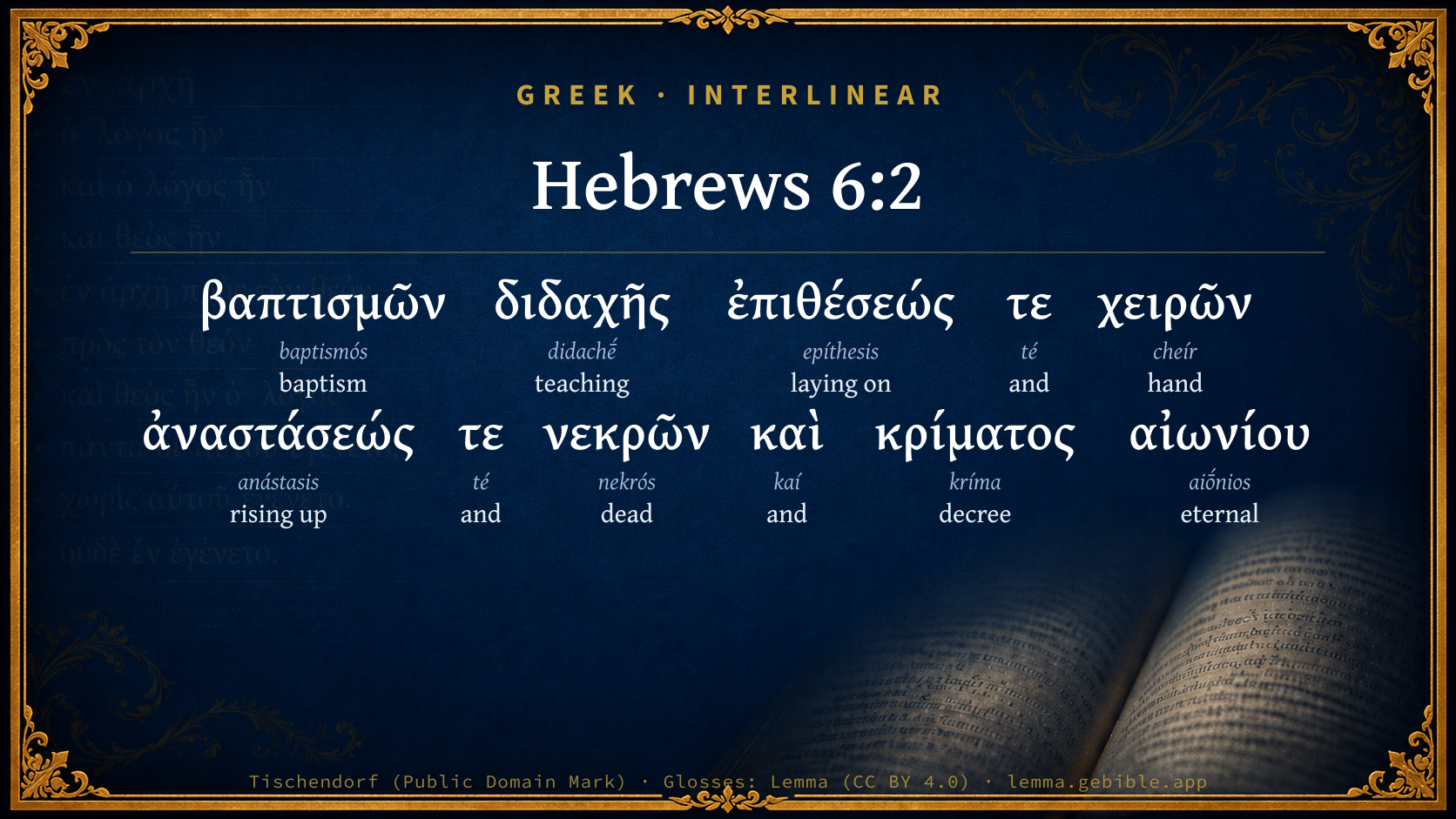
Greek (Tischendorf 8th ed.) Hebrews 6:2 appears in the Greek New Testament. The text above is from the Tischendorf 8th edition. Each word links to its Strong’s number and a concise gloss. Click any word for its full Thayer’s Greek Lexicon entry.
Download image
Cite this verse

Hebrews 6:2 (World English Bible). Public Domain. Lemma interlinear Bible study tool, https://lemma.gebible.app/v/hebrews/6/2.

Show BibTeX & RIS
BibTeX
RIS
English Translation
of the teaching of baptisms, of laying on of hands, of resurrection of the dead, and of eternal judgment.
World English Bible · Public Domain
Download a study sheet

One document with this verse’s original text, its word-by-word gloss line, the meaning frame, cross-references with their text, attributed commentary, and full source and license credits — printable, and it pastes into notes with its structure intact.

This verse Autodidact and up

Study sheet (.html) Plain text (.txt)

A passage Seminary Student

Up to 50 verses in one chapter. A passage sheet keeps up to 6 commentary sources and 12 cross-references per verse, in the order this page ranks them, and says so on the sheet whenever that leaves anything out. Ask for a single verse and you get the Autodidact verse sheet above.

Everything on this page stays free to read, with no account — the sheet is a download of what is already on screen, not access to it.

Want to remove ads? Support Godless Engineer
Compare translations 3

The same verse in 3 English versions, stacked beneath the original-language interlinear above. Click any original word for its lexicon entry.

Each is an independent rendering of the whole verse — the interlinear is not word-aligned to these translations.

Highlighted words mark where these versions differ — a whole-verse word diff, not a word-by-word alignment.

  • World English Bible Public Domain
    of the teaching of baptisms, of laying on of hands, of resurrection of the dead, and of eternal judgment.
  • King James Version Public Domain
    Of the doctrine of baptisms, and of laying on of hands, and of resurrection of the dead, and of eternal judgment.
  • unfoldingWord Literal Text CC BY-SA 4.0
    teaching about baptisms and laying on of hands and resurrection of the dead and eternal judgment.

unfoldingWord Literal Text — © unfoldingWord, licensed CC BY-SA 4.0. Word-aligned USFM3 via Door43 (git.door43.org/unfoldingWord/en_ult).

Versions to compare (up to 4)

3 of 4 selected

Show all 19 translations

Every available English version of this verse, each an independent rendering of the whole verse.

  • World English Bible Public Domain
    of the teaching of baptisms, of laying on of hands, of resurrection of the dead, and of eternal judgment.
  • Berean Standard Bible Public Domain
    instruction about baptisms, the laying on of hands, the resurrection of the dead, and eternal judgment.
  • Majority Standard Bible Public Domain
    instruction about baptisms, the laying on of hands, the resurrection of the dead, and eternal judgment.
  • King James Version Public Domain
    Of the doctrine of baptisms, and of laying on of hands, and of resurrection of the dead, and of eternal judgment.
  • American Standard Version (1901) Public Domain
    of the teaching of baptisms, and of laying on of hands, and of resurrection of the dead, and of eternal judgment.
  • Revised Version (1885) Public Domain
    of the teaching of baptisms, and of laying on of hands, and of resurrection of the dead, and of eternal judgment.
  • Geneva Bible (1599) Public Domain
    Of the doctrine of baptismes, and laying on of hands, and of the resurrection from the dead, and of eternall iudgement.
  • Douay-Rheims (1899) Public Domain
    Of the doctrine of baptisms, and imposition of hands, and of the resurrection of the dead, and of eternal judgment.
  • Young's Literal Translation Public Domain
    of the teaching of baptisms, of laying on also of hands, of rising again also of the dead, and of judgment age-during,
  • Literal Standard Version CC BY-SA 4.0
    of the teaching of immersions, also of laying on of hands, also of [the] resurrection of the dead, and of continuous judgment,
  • Unlocked Literal Bible CC BY-SA 4.0
    nor the foundation of teaching about baptisms, laying on of hands, the resurrection of the dead, and eternal judgment.
  • unfoldingWord Literal Text CC BY-SA 4.0
    teaching about baptisms and laying on of hands and resurrection of the dead and eternal judgment.
  • Darby Bible Public Domain
    of [the] doctrine of washings, and of imposition of hands, and of resurrection of [the] dead, and of eternal judgment;
  • World Messianic Bible Public Domain
    of the teaching of immersions, of laying on of hands, of resurrection of the dead, and of eternal judgment.
  • Webster's Bible Public Domain
    Of the doctrine of baptisms, and of laying on of hands, and of the resurrection of the dead, and of eternal judgment.
  • Free Bible Version CC BY-SA 4.0
    or teachings about baptism, the laying on of hands, the resurrection of the dead, and eternal judgment.
  • Bible in Basic English Public Domain
    The teaching of baptisms, and of the putting on of hands, and of the future life of the dead, and of the judging on the last day.
  • Text-Critical English NT CC BY 4.0
    and of instruction about baptisms, the laying on of hands, the resurrection of the dead, and eternal judgment.
  • Tyndale New Testament (1534) Public Domain
    of baptyme of doctryne and of layinge on of hondes and of resurreccion from deeth and of eternall iudgement.

Literal Standard Version (2020), Covenant Press — licensed CC BY-SA 4.0. Text via the HelloAO Bible API (eBible.org). Unlocked Literal Bible (unfoldingWord) — licensed CC BY-SA 4.0. Text via the HelloAO Bible API (eBible.org). unfoldingWord Literal Text — © unfoldingWord, licensed CC BY-SA 4.0. Word-aligned USFM3 via Door43 (git.door43.org/unfoldingWord/en_ult). Free Bible Version, Dr. Jonathan Gallagher — licensed CC BY-SA 4.0. Text via the HelloAO Bible API (eBible.org).

Word by word

More ways to search: Search by grammar → Find every occurrence → Compare this word →

Practice this passage: Drill this verse → Learn its vocabulary →

About this verse

These counts appear in no published source. They are computed here, from the morphology-tagged text and Lemma’s own curated glosses. What Lemma adds →

11
words
10
distinct lemmas
General Epistles
section

Notable vocabulary

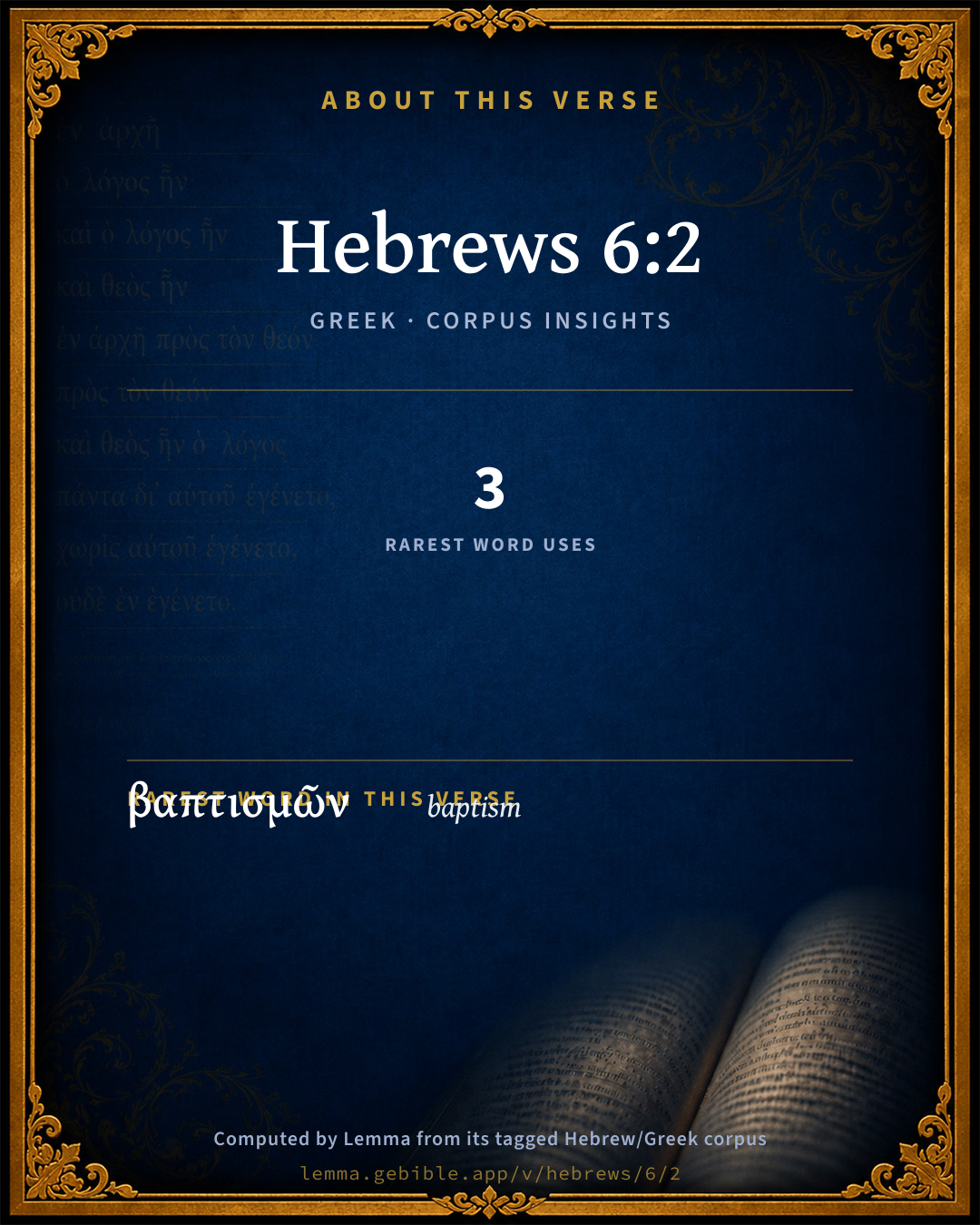
The rarest word here is βαπτισμῶν baptism G909 — appearing just 3 times in the whole Greek New Testament.

Shared distinctive vocabulary

βαπτισμῶν baptism G909 occurs in 3 verses of the Greek New Testament. Also found in:

Repetition

A word recurs within this verse:

Cross-references

57

Topical passages linked to Hebrews 6:2 in the Treasury of Scripture Knowledge — connected by theme and wording, ordered by reader-vote popularity; previews shown in the World English Bible.

  • 1 Corinthians 15:13–57 But if there is no resurrection of the dead, neither has Christ been raised.
  • Acts 17:31–32 because he has appointed a day in which he will judge the world in righteousness by the man whom he has ordained; of which he has given assurance to all men, in that he has raised him from the dead."
  • Romans 6:3–5 Or don't you know that all we who were baptized into Christ Jesus were baptized into his death?
  • Acts 6:6 whom they set before the apostles. When they had prayed, they laid their hands on them.
  • Ecclesiastes 12:14 For God will bring every work into judgment, with every hidden thing, whether it is good, or whether it is evil.
  • Ezekiel 37:1–14 The hand of Yahweh was on me, and he brought me out in the Spirit of Yahweh, and set me down in the midst of the valley; and it was full of bones.
  • Daniel 12:2 Many of those who sleep in the dust of the earth shall awake, some to everlasting life, and some to shame and everlasting contempt.
  • Matthew 22:23–32 On that day Sadducees (those who say that there is no resurrection) came to him. They asked him,
  • Matthew 28:19 Therefore go, and make disciples of all nations, baptizing them in the name of the Father and of the Son and of the Holy Spirit,
  • Mark 16:16 He who believes and is baptized will be saved; but he who disbelieves will be condemned.
  • John 1:33 I didn't recognize him, but he who sent me to baptize in water, he said to me, 'On whomever you will see the Spirit descending, and remaining on him, the same is he who baptizes in the Holy Spirit.'
  • John 3:25–26 There arose therefore a questioning on the part of John's disciples with some Jews about purification.
  • John 4:1–2 Therefore when the Lord knew that the Pharisees had heard that Jesus was making and baptizing more disciples than John
  • Acts 2:38 Peter said to them, "Repent, and be baptized, everyone of you, in the name of Jesus Christ for the forgiveness of sins, and you will receive the gift of the Holy Spirit.
  • Acts 2:41 Then those who gladly received his word were baptized. There were added that day about three thousand souls.
  • Acts 8:12–18 But when they believed Philip preaching good news concerning the Kingdom of God and the name of Jesus Christ, they were baptized, both men and women.
  • Acts 10:47 "Can any man forbid the water, that these who have received the Holy Spirit as well as we should not be baptized?"
  • Acts 16:15 When she and her household were baptized, she begged us, saying, "If you have judged me to be faithful to the Lord, come into my house, and stay." So she persuaded us.
  • Acts 16:33 He took them the same hour of the night, and washed their stripes, and was immediately baptized, he and all his household.
  • Acts 17:18 Some of the Epicurean and Stoic philosophers also were conversing with him. Some said, "What does this babbler want to say?" Others said, "He seems to be advocating foreign deities," because he preached Jesus and the resurrection.
  • Acts 19:2–6 He said to them, "Did you receive the Holy Spirit when you believed?" They said to him, "No, we haven't even heard that there is a Holy Spirit."
  • Acts 23:6 But when Paul perceived that the one part were Sadducees and the other Pharisees, he cried out in the council, "Men and brothers, I am a Pharisee, a son of Pharisees. Concerning the hope and resurrection of the dead I am being judged!"
  • Acts 24:25 As he reasoned about righteousness, self-control, and the judgment to come, Felix was terrified, and answered, "Go your way for this time, and when it is convenient for me, I will summon you."
  • 1 Corinthians 10:2 and were all baptized into Moses in the cloud and in the sea;
  • Hebrews 9:10 being only (with meats and drinks and various washings) fleshly ordinances, imposed until a time of reformation.
  • Matthew 3:14 But John would have hindered him, saying, "I need to be baptized by you, and you come to me?"
  • Matthew 20:22–23 But Jesus answered, "You don't know what you are asking. Are you able to drink the cup that I am about to drink, and be baptized with the baptism that I am baptized with?" They said to him, "We are able."
  • Matthew 25:31–46 "But when the Son of Man comes in his glory, and all the holy angels with him, then he will sit on the throne of his glory.
  • Mark 7:4 They don't eat when they come from the marketplace, unless they bathe themselves, and there are many other things, which they have received to hold to: washings of cups, pitchers, bronze vessels, and couches.)
  • Mark 7:8 "For you set aside the commandment of God, and hold tightly to the tradition of men--the washing of pitchers and cups, and you do many other such things."
  • Luke 3:16 John answered them all, "I indeed baptize you with water, but he comes who is mightier than I, the latchet of whose sandals I am not worthy to loosen. He will baptize you in the Holy Spirit and fire,
  • Luke 11:38 When the Pharisee saw it, he marveled that he had not first washed himself before dinner.
  • Luke 12:50 But I have a baptism to be baptized with, and how distressed I am until it is accomplished!
  • Luke 14:14 and you will be blessed, because they don't have the resources to repay you. For you will be repaid in the resurrection of the righteous."
  • John 5:29 and will come out; those who have done good, to the resurrection of life; and those who have done evil, to the resurrection of judgment.
  • John 11:24–25 Martha said to him, "I know that he will rise again in the resurrection at the last day."
  • Acts 4:2 being upset because they taught the people and proclaimed in Jesus the resurrection from the dead.
  • Acts 8:36–38 As they went on the way, they came to some water, and the eunuch said, "Behold, here is water. What is keeping me from being baptized?"
  • Acts 24:15 having hope toward God, which these also themselves look for, that there will be a resurrection of the dead, both of the just and unjust.
  • Acts 24:21 unless it is for this one thing that I cried standing among them, 'Concerning the resurrection of the dead I am being judged before you today!'"
  • Acts 26:8 Why is it judged incredible with you, if God does raise the dead?
  • Romans 2:5–10 But according to your hardness and unrepentant heart you are treasuring up for yourself wrath in the day of wrath, revelation, and of the righteous judgment of God;
  • Romans 2:16 in the day when God will judge the secrets of men, according to my Gospel, by Jesus Christ.
  • 1 Corinthians 1:12–17 Now I mean this, that each one of you says, "I follow Paul," "I follow Apollos," "I follow Cephas," and, "I follow Christ."
  • 1 Corinthians 12:13 For in one Spirit we were all baptized into one body, whether Jews or Greeks, whether bond or free; and were all given to drink into one Spirit.
  • Philippians 3:21 who will change the body of our humiliation to be conformed to the body of his glory, according to the working by which he is able even to subject all things to himself.
  • Colossians 2:12 having been buried with him in baptism, in which you were also raised with him through faith in the working of God, who raised him from the dead.
  • 1 Thessalonians 4:14–18 For if we believe that Jesus died and rose again, even so those who have fallen asleep in Jesus will God bring with him.
  • 2 Timothy 2:18 men who have erred concerning the truth, saying that the resurrection is already past, and overthrowing the faith of some.
  • 2 Peter 3:7 But the heavens that now are, and the earth, by the same word have been stored up for fire, being reserved against the day of judgment and destruction of ungodly men.
  • Jude 1:14–15 About these also Enoch, the seventh from Adam, prophesied, saying, "Behold, the Lord came with ten thousands of his holy ones,
  • Isaiah 26:19 Your dead shall live; my dead bodies shall arise. Awake and sing, you who dwell in the dust; for your dew is [as] the dew of herbs, and the earth shall cast forth the dead.
  • Acts 13:3 Then, when they had fasted and prayed and laid their hands on them, they sent them away.
  • 2 Corinthians 5:10 For we must all be revealed before the judgment seat of Christ; that each one may receive the things in the body, according to what he has done, whether good or bad.
  • Hebrews 11:35 Women received their dead by resurrection. Others were tortured, not accepting their deliverance, that they might obtain a better resurrection.
  • 1 Peter 3:20–21 who before were disobedient, when God waited patiently in the days of Noah, while the ark was being built. In it, few, that is, eight souls, were saved through water.
  • Revelation 20:10–15 The devil who deceived them was thrown into the lake of fire and sulfur, where the beast and the false prophet are also. They will be tormented day and night forever and ever.

Cross-references courtesy of OpenBible.info (CC BY 4.0).

Commentary

Notes on Hebrews 6:2 from classic Christian and Jewish commentators (each source and its license shown beneath its notes). The classic Christian expositions comment on the surrounding passage and are grouped to its opening verse, so a note may address several verses; the Jewish commentaries on the Tanakh (Rashi and others) are per-verse, so they appear only where the commentator wrote on this verse.

Lemma curates 59 commentaries, every one of them public domain or Creative Commons licensed, each selected and text-cleaned for this edition rather than reprinted as found. About our sources →

Tyndale Open Study Notes

Tyndale Open Resources

6:2 The term baptisms (or washings) is plural, so it must mean more than just Christian baptism. Instruction about various washings was prevalent in first-century Judaism (see Matt 15:2; Mark 7:3). The author might also have in mind the cleansing rituals of the Old Testament (cp. Heb 9:13; 10:22). • The laying on of hands was associated with healing (Mark 5:22-23; Luke 13:13), ritual blessing (Matt 19:13, 15), reception of the Holy Spirit (Acts 8:17; 9:17; 19:6), and acknowledgement of a person’s ministry (Acts 6:6; 13:3). • resurrection of the dead: See “The Resurrection of the Dead” Theme Note. • eternal judgment: See Rev 20:11-15.

Tyndale Open Study Notes — © Tyndale Open Resources, licensed CC BY-SA 4.0. Text via the HelloAO Bible API.

Bengel's Gnomon

Johann Albrecht Bengel

Heb 6:2. Βαπτισμῶν διδαχῆς) Καὶ is not put before βαπτισμῶν; for three pairs of chief particulars (heads) are enumerated, and the second particular (head) in every pair has the conjunction; but only the third pair is similarly connected: from which it is also evident, that βαπτισμῶν and διδαχῆς must not be separated. Βαπτισμοὶ διδαχῆς[39] were baptisms which were received by those who devoted themselves to the sacred doctrine of the Jews; therefore, by the addition of διδαχῆς, they are distinguished from the other Levitical washings; ch. Heb 9:10.—κρίματος αἰωνίου) of eternal judgment. See Mar 3:29, note.

[39] Bengel evidently understands these words, baptisms of or into doctrine, not as Engl. Vers., the doctrine of baptisms.—ED.

Bengel's Gnomon of the New Testament — English translation (T&T Clark, Edinburgh, 1860) — public domain. Text from a community e-Sword module.

Meyer's Critical & Exegetical Commentary

Heinrich August Wilhelm Meyer

Heb_6:2. Βαπτισμῶν διδαχῆς] We have not to divide by a comma, with Cajetan, Luther, Hyperius, Sykes, Semler, Morus, Heinrichs, Schulz, de Wette, Conybeare, and others [after the Syriac], in such wise that βαπτισμοί and διδαχή are each separately enumerated as a particular subject for elementary instruction in Christianity. Διδαχή must in this case mean the elementary instruction in Christianity connected with baptism, imparted either before or after the same. But since, at the close of the verse, the ἀνάστασις νεκρῶν and the κρίμα αἰώνιον are mentioned, while the treatment of these subjects for teaching belonged equally to the first stage of instruction in Christianity, it is not easy to perceive why, in addition to that διδαχή, these two points, presupposed in the same, should be brought into special relief by the author. Then there is the consideration that all the particulars which are mentioned before and after as constituent parts of the θεμέλιον, are designated by a double expression. Seeing the care bestowed by the author upon the symmetrical proportions of his discourse, we should therefore naturally be led to regard βαπτισμῶν διδαχῆς as a corresponding double expression. But even as thus apprehended the expression is capable of a twofold explanation. The question, namely, is whether the author is speaking of βαπτισμοὶ διδαχῆς or of a βαπτισμῶν διδαχή. In the first case baptisms with a view to doctrine are meant, in the second instruction concerning baptisms. In the first acceptation the term is taken by Bengel, Michaelis, Maier, Kurtz, as also Winer, Gramm., 7 Aufl. p. 181 (less decidedly, 5 Aufl. p. 217); in the last, by Bleek and the majority. Against the first view pleads, on the one hand, the fact that the addition διδαχῆς would be something too little characteristic, almost unmeaning, since a Christian baptism, not preceded, accompanied, of followed by instruction in the fundamental doctrines of Christianity, would be something inconceivable; on the other hand, that in this way the erroneous secondary meaning would arise, that there were, in addition to the Christian baptisms with a view to doctrine, also other Christian baptisms. We follow, therefore, the second mode of interpretation. In connection with this the plural βαπτισμῶν still presents some difficulty. Gerhard, Dorscheus, Ernesti, MLean Stuart, and others arbitrarily set aside this difficulty, in that they suppose just the plural to be placed for the singular But neither is the plural to be explained by the assumption that respect is had to the proneness of the Hebrews for often repeating the Christian baptism, in conformity with the many βαπτισμοί in Judaism (Oeoumenius, Theophylact), or, at the same time, to the outward and inner baptism (Grotius, Whitby, Braun, Brochmann; Reuss: la différence du baptême deau et du baptême desprit). Just as little by the supposition that reference is made to a plurality of baptismal candidates or baptismal acts (Theodoret, Primasius, Beza, Er. Schmid, Owen, Heinrichs, al.), or to a repeated immersing of the candidate. Most in its favour has the opinion of Jac. Cappellus, Seb. Schmidt, Schöttgen, Wolf, and others, in which more recently also Böhme, Kuinoel, Klee, Bleek, Stengel, Tholuck, Bloomfield, Bisping, Delitzsch, Riehm (Lehrbegr. des Hebräerbr. p. 724), Alford, and Moll have concurred; namely, that the author is thinking not so much of Christian baptism a itself, or exclusively, as along with it at the same time of the relation of the same to the Jewish lustrations, and perhaps also to the baptism of John. This view appears at least to acquire a point of support from Heb_9:10, according to which the readers still continued to esteem the washings enjoined by the Mosaic law as of importance for Christians too. Yet it seems to be precarious, with Jac. Cappellus, Bleek, and others, to urge in favour of this acceptation the distinction that in the N. T. only βάπτισμα is used for Christian baptism in the proper sense of the term, βαπτισμός, on the other hand, being in the N. T. a word of wider signification (Heb_9:10; Mar_7:4); precarious, because the expression βάπτισμα not occurring at all with the author of the Epistle to the Hebrews [as also Josephus designates the rite of John only by βαπτισμός, the action by βάπτισις, Antiq. xviii. 5. 2], with regard to his usage in this respect thus nothing can be determined.

In close inner connection with the βαπτισμοί stands the ἐπίθεσις χειρῶν. As therefore the readers ought no longer to be in need of teaching concerning the nature of the former (and concerning its pre-eminence over the kindred institutions of Judaism), so was it also to be reasonably expected that they should experience a necessity for being instructed concerning the nature of the latter (and concerning the eminent blessings which attend thereon). The reference is to that laying on of hands by which those previously baptized were fully received into the communion, and through which the reception of the Holy Ghost was wont to be vouchsafed to them. Comp. Act_8:17 ff; Act_19:6. From this close inner connectedness of the ἐπίθεσις χειρῶν with the βαπτισμοί results that, also as regards the external arrangement of words, the genitive ἐπιθέσεως does not depend immediately upon θεμέλιον, but like βαπτισμῶν upon διδαχῆς. But, moreover, even the following genitives, ἀναστάσεως and κρίματος, are, as rightly apprehended by Storr, Böhme, Ebrard, Bisping,[78] Delitzsch, Alford, Moll, and Woerner, governed by διδαχῆς. For not by the resurrection of the dead, and the everlasting judgment itself, since these facts will first unfold themselves in the future, but only by the doctrine thereof can the foundation be laid in Christianity. It would, however, be arbitrary to assign to the words ἈΝΆΣΤΑΣΙς and ΚΡΊΜΑ in themselves signification which they can only have in combination with the foregoing ΔΙΔΑΧῆς. A grammatical harshness (de Wette) is not to be discovered in this construction, on account of the close connection of the last clauses by means of ΤΕ and ΤΕ … ΚΑΊ; any more than de Wette is right in regarding ΒΑΠΤΙΣΜῶΝ ΔΙΔΑΧῆς, in the mode of interpretation above followed, as an unnatural trajection without an example the writings of our author; for ΒΑΠΤΙΣΜῶΝ is preposed because the emphasis rests on that word, and an analogon in our epistle is already afforded by the ΠΝΕΎΜΑΤΟς ἉΓΊΟΥ ΜΕΡΙΣΜΟῖς, Heb_2:4.

ἈΝΑΣΤΆΣΕΏς ΤΕ ΝΕΚΡῶΝ ΚΑῚ ΚΡΊΜΑΤΟς ΑἸΩΝΊΟΥ] Two dogmas already belonging to the Jews theology, which obtained by means of Christianity only their more definite, concrete signification. The expression in both these clauses is used quite generally. We have therefore no warrant for limiting, with Estius, Schlichting, Schöttgen, Chr. Fr. Schmid, Storr, and others, the ἈΝΆΣΤΑΣΙς to the godly, the ΚΡΊΜΑ to the ungodly. On the contrary, both have reference to the pious or believers, and the ungodly or unbelievers in common.

[78] Wrongly, however, is it supposed by Bisping (as before his time by Gennadius in Oecumenius, and Klee) that μετανοίας and πίστεως, ver. 1, already dependent upon διδαχῆς.Just as wrongly would Calvin, who is followed by Piscator and Owen, enclose βαπτισμῶν διδαχῆς, ἐπιθέσεώς τε χειρῶν within a parenthesis, ut sit appositio … hoc sensu. Non jacientes rursun fundamentum poenitentiae, fidei in Deum, mortuorum resurrectionis, quae doctrina est baptismi et impositionis manuum … Nisi enim appositive legas, hoc erit absurdi, quod bis idem repetet. Quae enim baptismatis est doctrina, nisi quam hic recenset de fide in Deum, de poenitentia et de judici similibus?Both views are deprived of their support by the reflection that μετάνοια and πίστις, ver. 1, denote not a doctrine, but an act [against Stuart].

Meyer — Critical and Exegetical Commentary on the New Testament — English translation by Peter Christie, edited by Frederick Crombie (T&T Clark, 1880) — public domain. Text from a community e-Sword module.

Expositor's Greek Testament

ed. W. Robertson Nicoll

Heb 6:2 . The next pair, βαπτισμῶν διδαχῆς ἐπιθέσεώς τε χειρῶν “instruction regarding washings and laying on of hands”. “The historical sequence is followed in the enumeration”. Some interpreters make all three conditions directly dependent on θεμέλιον , “foundation of baptisms, teaching, and laying on of hands”. Bengel makes διδαχῆς dependent on βαπτ . He says: “ βαπτισμοὶ διδαχῆς erant baptismi , quos qui suscipiebant, doctrinae sacrae Judaeorum sese addicebant. Itaque adjecto διδαχῆς doctrinae distinguuntur a lotionibus ceteris leviticis”. Similarly Winer ( Gramm. , p. 240): “If we render βαπτ . διδ . baptisms of doctrine or instruction , as distinguished from the legal baptisms (washings) of Judaism, we find a support for this designation, as characteristically Christian, in Mat 28:19 , βαπτίσαντες αὐτούς … διδάσκοντες αὐτούς ”. It is better to take the words as equivalent to διδαχῆς περὶ βαπτισμῶν . In N.T. βάπτισμα is regularly used of Christian baptism or of John’s baptism, while βαπτισμός is used of ceremonial washings as in Heb 9:10 and Mar 7:4 . [ Cf. Blass, Gramm. , p. 62. Josephus, ( Ant. , xviii. 5, 2) uses βαπτισμός of John’s baptism.] Probably, therefore, “teaching about washings” would include instruction in the distinction between the various Jewish washings, John’s baptism and that of Christ ( cf. Act 19:2 ); and this would involve instruction in the cleansing efficacy of the Atonement made by Christ as well as in the work of the Holy Spirit. It was very necessary for a convert from Judaism to understand the difference between symbolic and real lustration. The reference of the plural must, therefore, not be restricted to the distinction of outward and inward baptism (Grotius), nor of water and spirit baptism (Reuss) nor of infant and adult baptism, nor of the threefold immersion nor, as Primasius, “pro varietate accipientium”. ἐπιθέσεώς τε χειρῶν closely conjoined to the foregoing by τε because the “laying on of hands” was the accompaniment of baptism in Apostolic times. “As through baptism the convert became a member of the House of God, through the laying on of hands he received endowments fitting him for service in the house, and an earnest of his relation to the world to come (Heb 6:5 )” (Davidson, cf. Delitzsch). The laying on of hands was normally accompanied by prayer. Prayer was the essential element in the transaction, the laying on of hands designating the person to whom the prayer was to be answered and for whom the gift was designed. Cf. Act 19:1-6 ; Act 8:14-17 ; Act 13:3 ; Act 6:6 ; and Lepine’s The Ministers of Jesus Christ , p. 141 4. In Apostolic times baptism apparently meant that the baptised believed in and gave himself to Christ, while the laying on of hands meant that the Holy Ghost was conferred upon him. In baptism as now administered both these facts are outwardly represented. ἀναστάσεως νεκρῶν καὶ κρίματος αἰωνίου : “resurrection of the dead and eternal judgment,” “constituting the believer’s outlook under which he was to live” (Davidson). The genitives depend on διδαχῆς , not on θεμέλιον , as Vaughan. The phrase ἀνάστασις νεκρῶν naturally includes all the dead both righteous and unrighteous (see Joh 5:29 and Act 24:15 . κρίμα though properly the result of κρίσις is not always distinguished from it, see Joh 9:39 ; Act 24:25 ; and cf. Heb 9:27 ). It is “eternal,” timeless in its results. These last-named doctrines, although not specifically Christian, yet required to be brought before the notice of a Jewish convert that he might disentangle the Christian idea from the Jewish Messianic expectation of a resurrection of Israel to the enjoyment of the Messianic Kingdom, and of a judgment on the enemies of Israel ( Cf. Weiss).

The Expositor's Greek Testament, edited by W. Robertson Nicoll (1897–1910) — public domain. Text from a community e-Sword module.

Jamieson, Fausset & Brown

Robert Jamieson, A. R. Fausset & David Brown

the doctrine of baptisms--paired with "laying on of hands," as the latter followed on Christian baptism, and answers to the rite of confirmation in Episcopal churches. Jewish believers passed, by an easy transition, from Jewish baptismal purifications (Heb 9:10, "washings"), baptism of proselytes, and John's baptism, and legal imposition of hands, to their Christian analogues, baptism, and the subsequent laying on of hands, accompanied by the gift of the Holy Ghost (compare Heb 6:4). Greek, "baptismoi," plural, including Jewish and Christian baptisms, are to be distinguished from baptisma, singular, restricted to Christian baptism. The six particulars here specified had been, as it were, the Christian Catechism of the Old Testament; and such Jews who had begun to recognize Jesus as the Christ immediately on the new light being shed on these fundamental particulars, were accounted as having the elementary principles of the doctrine of Christ [BENGEL]. The first and most obvious elementary instruction of Jews would be the teaching them the typical significance of their own ceremonial law in its Christian fulfilment [ALFORD].

resurrection, &c.--held already by the Jews from the Old Testament: confirmed with clearer light in Christian teaching or "doctrine."

eternal judgment--judgment fraught with eternal consequences either of joy or of woe.

Jamieson, Fausset & Brown — Commentary Critical and Explanatory on the Whole Bible (1871) — public domain (CC PDM 1.0). Text via the HelloAO Bible API.

Adam Clarke's Commentary

Verse 2. Of the doctrine of baptisms] "There were two things," says Dr. Owen, "peculiar to the Gospel, the doctrine of it and the gifts of the Holy Ghost. Doctrine is called baptism, De 32:2; hence the people are said to be baptized to Moses, when they were initiated into his doctrines, 1Cor 11:2. The baptism of John was his doctrine, Ac 19:3; and the baptism of Christ was the doctrine of Christ, wherewith he was to sprinkle many nations, Isa 52:15. This is the first baptism of the Gospel, even its doctrine. The other was the communication of the gifts of the Holy Ghost, Ac 1:5; and this alone is what is intended by the laying on of hands; and then the sense will be the foundation of the Gospel baptisms, namely preaching and the gifts of the Holy Ghost."

I am afraid, with all this great man's learning, he has not hit the meaning of the apostle. As teaching is the means by which we are to obtain the gifts of the Holy Ghost, surely the apostle never designed to separate them, but to lead men immediately through the one to the possession of the other. Nor is the word baptism mentioned in the passage in Deuteronomy which he quotes; nor, indeed, any word properly synonymous. Neither βαπτισμος, baptism, ραντισμος, sprinkling, nor any verb formed from them, is found in the Septuagint, in that place. But the other proofs are sufficiently in point, viz. that by baptism in the other places referred to, doctrine or TEACHING is meant; but to call TEACHING one baptism, and the gifts of THE HOLY GHOST another baptism, and to apply this to the explanation of the difficulty here, is very far from being satisfactory.

I am inclined to think that all the terms in this verse, as well as those in the former, belong to the Levitical law, and are to be explained on that ground.

Baptisms, or immersions of the body in water, sprinklings, and washings, were frequent as religious rites among the Hebrews, and were all emblematical of that purity which a holy God requires in his worshippers, and without which they cannot be happy here, nor glorified in heaven.

Laying on of hands] Was also frequent, especially in sacrifices: the person bringing the victim laid his hands on its head, confessed his sins over it, and then gave it to the priest to be offered to God, that it might make atonement for his transgressions. This also had respect to Jesus Christ, that Lamb of God who takes away the sins of the world.

The doctrine also of the resurrection of the dead and of eternal judgment, were both Jewish, but were only partially revealed, and then referred to the Gospel. Of the resurrection of the dead there is a fine proof in Isa 26:19, where it is stated to be the consequence of the death and resurrection of Christ, for so I understand the words, Thy dead shall live; with my dead body shall they arise: awake and sing, ye that dwell in the dust; for thy dew is as the dew of herbs, and the earth shall cast out the dead. The valley of dry bones, Eze 37:1, c., is both an illustration and proof of it. And Daniel has taught both the resurrection and the eternal judgment, Da 12:2: And many of them that sleep in the dust of the earth shall awake some to everlasting life, and some to shame and everlasting contempt.

Now the foundation of all these doctrines was laid in the Old Testament, and they were variously represented under the law, but they were all referred to the Gospel for their proof and illustration. The apostle, therefore, wishes them to consider the Gospel as holding forth these in their full spirit and power. It preaches,

1. Repentance, unto life.

2. Faith in God through Christ, by whom we receive the atonement.

3. The baptism by water, in the name of the holy Trinity; and the baptism of the Holy Ghost.

4. The imposition of hands, the true sacrificial system; and, by and through it, the communication of the various gifts of the Holy Spirit, for the instruction of mankind, and the edification of the Church.

5. The resurrection of the dead, which is both proved and illustrated by the resurrection of Christ.

6. The doctrine of the eternal or future judgment, which is to take place at the bar of Christ himself, God having committed all judgment to his Son, called here κριμα αιωνιον, eternal or ever during judgment, because the sentences then pronounced shall be irreversible.

Some understand the whole of the initiation of persons into the Church, as the candidates for admission were previously instructed in those doctrines which contained the fundamental principles of Christianity. The Hebrews had already received these; but should they Judaize, or mingle the Gospel with the law, they would thereby exclude themselves from the Christian Church, and should they be ever again admitted, they must come through the same gate, or lay a second time, παλιν, this foundation. But should they totally apostatize from Christ, and finally reject him, then it would be impossible to renew them again to repentance - they could no more be received into the Christian Church, nor have any right to any blessing of the Gospel dispensation; and, finally rejecting the Lord who bought them, would bring on themselves and their land swift destruction. See the 4th and following verses, and particularly the notes on verses 8 and 9. "Heb 6:8"; "Heb 6:9"

Adam Clarke's Commentary on the Bible (1810–1826) — public domain. Text from a community e-Sword/MySword module.

John Calvin's Commentaries

2. Of the doctrine of baptisms, etc. Some read them separately, “of baptisms and of doctrine;” but I prefer to connect them, though I explain them differently from others; for I regard the words as being in apposition, as grammarians say, according to this form, “Not laying again the foundation of repentance, of faith in God, of the resurrection of the dead, which is the doctrine of baptisms and of the laying on of hands.” If therefore these two clauses, the doctrine of baptisms and of the laying on of hands, be included in a parenthesis, the passage would run better; for except you read them as in apposition, there would be the absurdity of a repetition. For what is the doctrine of baptism but what he mentions here, faith in God, repentance, judgment, and the like?

Chrysostom thinks that he uses “baptisms” in the plural number, because they who returned to first principles, in a measure abrogated their first baptism: but I cannot agree with him, for the doctrine had no reference to many baptisms, but by baptisms are meant the solemn rites, or the stated days of baptizing.

With baptism he connects the laying on of hands; for as there were two sorts of catechumens, so there were two rites. There were heathens who came not to baptism until they made a profession of their faith. Then as to these, these, the catechizing was wont to precede baptism. But the children of the faithful, as they were adopted from the womb, and belonged to the body of the Church by right of the promise, were baptized in infancy; but after the time of infancy, they having been instructed in the faith, presented themselves as catechumens, which as to them took place after baptism; but another symbol was then added, the laying on of hands.

This one passage abundantly testifies that this rite had its beginning from the Apostles, which afterwards, however, was turned into superstition, as the world almost always degenerates into corruptions, even with regard to the best institutions. They have indeed contrived the fiction, that it is a sacrament by which the spirit of regeneration is conferred, a dogma by which they have mutilated baptism for what was peculiar to it, they transferred to the imposition of hands. Let us then know, that it was instituted by its first founders that it might be an appointed rite for prayer, as Augustine calls it. The profession of faith which youth made, after having passed the time of childhood, they indeed intended to confirm by this symbol, but they thought of nothing less than to destroy the efficacy of baptism. Wherefore the pure institution at this day ought to be retained, but the superstition ought to be removed. And this passage tends to confirm pedobaptism; for why should the same doctrine be called as to some baptism, but as to others the imposition of hands, except that the latter after having received baptism were taught in the faith, so that nothing remained for them but the laying on of hands?

John Calvin's Commentaries (1540-1563) — public domain. Text from the Calvin Translation Society English edition (1840s-50s) via the Christian Classics Ethereal Library (ccel.org). Calvin's coverage is partial (roughly two-thirds of the Bible); uncommented books and verses are honest gaps, never fabricated. The 19th-century editor's footnotes and remarks are omitted so the notes are faithfully Calvin's own voice.

Ellicott's Commentary for English Readers

(2) Of the doctrine of baptisms.—The meaning of these words has been much controverted. The order of the Greek has been thought to require the rendering baptisms of doctrine (or, teaching); and it has been believed that the writer in this manner seeks to characterise Christian baptism as contrasted with the Jewish lustrations. Mat_28:19, “baptising them . . . teaching them,” is often quoted in favour of this view. The whole question of baptism amongst the Jews of the Apostolic age is full of difficulty, since the first references to the rite in connection with proselytes belong to a much later date. But, waiving this, we must surely regard it as most unlikely that the baptism specifically Christian would be marked as “baptism of teaching.” Teaching would rather be the point of resemblance than the point of contrast between the Jewish and the Christian rite. We must, therefore, adhere to the ordinary view. The word doctrine, or teaching, seems to be introduced in order to avoid the ambiguity which would lie in the words, “a foundation of repentance, faith, baptism,” &c.; not a doctrine, but the repetition of a rite might seem to be intended. But what are we to understand by teaching regarding baptisms? Both the word itself and the use of the plural are remarkable. The word (which is not the ordinary term baptisma, but baptismus) occurs in Heb_9:10, Mar_7:4, in the plural, and in Col_2:12 in the singular; in the last of these passages it denotes Christian baptism, but in the others the ceremonial washings of the Jews. We must not forget the importance which of right belonged to these washings in the Levitical law, as one of the appointed modes of removing that uncleanness which excluded from every sacred place. The baptism of John attached itself to passages in the Scriptures in which this symbol was taken up by the prophets with profound spiritual application (Ezekiel 36, et al.). Both John’s baptism and that of Christ, therefore, would, from the Hebrew point of view, be “washings”; and the teaching which every new convert must receive would include instruction on the symbolical purifications of the Old Covenant and the New. (See the very interesting Notes in Vol. II. on Act_18:24-25; Act_19:4.)

And of laying on of hands.—This ceremony is repeatedly mentioned in the Old Testament, and also in the New. Besides the sacrificial use of the symbol, we find imposition of hands connected with blessing (Gen_48:14; Mat_19:13, et al.); with works of healing (2Ki_5:11; Mar_8:23; Mar_16:18, et al.); with ordination (Num_27:18; Deu_34:9; 1Ti_4:14, et al.); and with the gift of the Holy Spirit (Act_8:17; Act_19:6). In every case the figure denotes either a transfer, or the communication of a gift from (or, through the medium of) the person who lays his hands upon another. Neither transfer of guilt, nor blessing, nor miracle can be in point here; nor is it conceivable that ordination could be referred to in such a context. As the passages quoted from the Acts of the Apostles agree with this in closely connecting the rite with baptism, we can have little doubt that the meaning in all is substantially the same. The believers in Samaria had been baptised by Philip; when Peter and John came, they “prayed for them that they might receive the Holy Ghost; then laid they their hands on them, and they received the Holy Ghost.” In the second case, which in other respects is similar (whether Paul himself baptised, or not, we are not informed), there is reference to the special gifts of the Holy Ghost which were bestowed: “they spake with tongues and prophesied.” There seems no reason for believing that there was a designed connection between the imposition of hands and the bestowal of miraculous powers; such imposition was rather the recognised symbol of the gift of the Holy Spirit to those who were baptised in the name of the Lord Jesus, in whatever manner the Spirit might be pleased to work in those who received His influence. The early Church naturally retained the rite, making it the complement or adjunct of baptism; whilst the one symbolised the putting away of sin, the other was the emblem of the reception of new spiritual life. Historical testimonies extend as far back as Tertullian (A.D. 200): “Then the hand is laid on, calling for and inviting the Holy Spirit.” To trace the relation between this imposition of hands and the later practice of confirmation would lead us beyond our limits.

The two points which remain do not require an extended notice. We know (Act_23:8) that, though the Sadducees denied that there was any resurrection of the dead (and the Alexandrian philosophy seems to have held only the immortality of the soul), yet by the most influential amongst Jewish teachers this doctrine was held and enforced, as indeed it was plainly taught in their Scriptures (Dan_12:2). On the nature and extent of the resurrection—whether it would be universal, and whether it would precede or follow the Messianic age—varying opinions prevailed. Nor were the Pharisees less clear in their teaching of a future “judgment,” the reward of which should be “eternal” bliss for the godly, punishment for the sinners in Israel and for Israel’s enemies. These doctrines, then, would place no obstacles in the way of a convert to the Christian faith. Instead of vagueness and discordant opinion he now received a clear statement of truth: the Messiah, Jesus, in whom he has placed his trust, will judge the world; and of this God has given a pledge “in that He hath raised Him from the dead” (Act_17:31). It is noteworthy that, of the four particulars which are mentioned after repentance and faith, two relate to the commencement and two to “the last things” of the Christian life.

A Bible Commentary for English Readers, edited by Charles John Ellicott (1878–1897) — public domain. Text from a community e-Sword module.

The Cambridge Bible for Schools and Colleges

gen. ed. J. J. S. Perowne

2. of the doctrine of baptisms] Perhaps rather, “of ablutions” (Heb_9:10; Mar_7:3-4), both (1) from the use of the plural (which cannot be explained either physically of “triple immersion,” or spiritually of the baptisms of “water, spirit, blood”); and (2) because baptismos is never used of Christian baptism, but only baptisma. If, as we believe, the writer of this Epistle was Apollos, he, as an original adherent “of John’s baptism,” might feel all the more strongly that the doctrine of “ablutions” belonged, even in its highest forms, to the elements of Christianity. Perhaps he, like Josephus (Antt. xviii. 5, § 2), would have used the word baptismos, and not baptisma, even of John’s baptism. But the word probably implies the teaching which enable Christian catechumens to discriminate beween Jewish washings and Christian baptism.

of laying on of hands] For ordination (Num_8:10-11; Act_6:6; Act_13:2-3; Act_19:6, &c.), confirmation (Act_8:17), healings (Mar_16:18), &c. Dr Mill observes that the order of doctrines here enumerated corresponds with the system of teaching respecting them in the Acts of the Apostles—Repentance, Faith, Baptism, Confirmation, Resurrection, Judgment.

and of resurrection of the dead] These topics had been severally prominent in the early Apostolic teaching (Act_2:38; Act_3:19-21; Act_26:20). Even the doctrine of the resurrection belonged to Judaism (Luk_20:37-38; Dan_12:2; Act_23:8).

and of eternal judgment] The doctrine respecting that sentence (krima, “doom”), whether of the good or of the evil, which shall follow the judgment (krisis) in the future life. This was also known under the Old Covenant, Dan_7:9-10.—The surprise with which we first read this passage only arises from our not realising the Author’s meaning, which is this,—your Christian maturity (τελείοτης, Heb_6:1) demands that you should rise far above your present vacillating condition. You would have no hankering after Judaism if you understood the more advanced teaching about the Melchisedek Priesthood—that is the Eternal Priesthood—of Christ which I am going to set before you. It is then needless that we should dwell together on the topics which form the training of neophytes and catechumens, the elements of religious teaching which even belonged to your old position as Jews; but let us enter upon topics which belong to the instruction of Christian manhood. The verse has its value for those who think that “Gospel” teaching consists exclusively in the iteration of threadbare shibboleths. We may observe that of these six elements of catechetical instruction two are spiritual qualities—repentance, faith; two are significant and symbolic acts—washings and laying on of hands; two are eschatological truths—resurrection and judgment.

The Cambridge Bible for Schools and Colleges (gen. ed. J. J. S. Perowne; Cambridge University Press, 1878–1918) — public domain. Text from a community e-Sword module.

John Gill's Exposition

Of the doctrine of baptisms,.... Some read this divisively, "baptism and doctrine", as the Ethiopic version; as if the one respected the ordinance of baptism, and the other the ministry of the word; but it is best to read them conjunctively: and by which most understand the Gospel ordinance of water baptism, so called by a change of number, the plural for the singular, as the Syriac and Ethiopic versions, who render it baptism; or because of the different persons baptized, and times of baptizing, as some; or because of the trine immersion, as others; or because of the threefold baptism of spirit, blood, and water, which have some agreement with each other; or because of the baptism of John, and Christ, though they are one and the same; or because of the inward and outward baptism, the one fitting and qualifying for the other; and so the doctrine of it is thought to respect the necessity, use, and end of it; but since there is but one baptism, and the above reasons for the plural expression are not solid, and sufficiently satisfying, it is best to interpret this of the divers baptisms among the Jews, spoken of in Heb 9:10 which had a doctrine in them, to that people; teaching them the cleansing virtue of the blood of Christ, and leading them to it, to wash in for sin, and for uncleanness; but now, since this blood was shed, they were no more to teach nor learn the doctrine of cleansing by the blood of Christ this way; nor any more to be led unto it through these divers baptisms, ablutions, and purifications.

And of laying on of hands; the foundation of this was to be no more laid, nor the doctrine of it to be any longer taught and learned in the way it had been; for not the rite, but the doctrine of laying on of hands is here intended; and it has no reference to the right of laying on of hands by the apostles, either in private persons, or officers of churches; for what was the doctrine of such a rite, is not easy to say; but to the rite of laying on of hands of the priests, and of the people, upon the head of sacrifices; which had a doctrine in it, even the doctrine of the imputation of sin to Christ, the great sacrifice. It was usual with the Jews (g) to call the imposition of hands upon the sacrifice, simply, "laying on of hands"; and they understood by it the transferring of sin from the persons that laid on hands, to the sacrifice, on which they were laid; and that hereby, as they express it, sins were separated from them, and, as it were, put upon the sacrifice (h); but now believers were no longer to be taught and learn the great doctrine of the imputation of sin, by this rite and ceremony, since Christ has been made sin for them, and has had sins imputed to him, and has bore them in his own body on the tree:

and of resurrection of the dead, and of eternal judgment: articles of faith, which distinguished the Jews from the Gentiles, who were greatly strangers to a future state, the resurrection of the dead, and judgment to come: these are doctrines of pure revelation, and were taught under the Old Testament, and were believed by the generality of the Jews, and are articles which they hold in common with us Christians; yet the believing Hebrews were not to rest in the knowledge of these things, and in the smaller degrees of light they had in them, under the former dispensation; but were to go on to perfection, and bear forward towards a greater share of knowledge of these, and other more sublime doctrines of grace; since life and immortality are more clearly brought to light by Christ through the Gospel.

(g) Misn. Kiddushin, c. 2. sect. 8. & Bartenora in ib. (h) R. Levi ben Gersom in Exod. fol. 109. 1. & in Lev. fol. 117. 2.

John Gill's Exposition of the Whole Bible (1746–1763) — public domain (CC PDM 1.0). Text via the HelloAO Bible API.

Trapp's Complete Commentary

John Trapp

2 Of the doctrine of baptisms, and of laying on of hands, and of resurrection of the dead, and of eternal judgment.

Ver. 2. Doctrine of baptisms] Inward and outward. Flaminis et fluminis, of water and of the Spirit, that "washing of regeneration and renewing of the Holy Ghost," Tit 3:5. Calvin thinks the apostle meaneth the solemn rites or set days of baptizing. Others, the doctrine of both the sacraments; one being figuratively put for both, and the mention of the Lord’s supper omitted, because the doctrine thereof was not anciently propounded to the catechumeni, or young Christians; neither were they suffered to see it administered.

And of laying on of hands] Hereby is meant the whole ministry and order of Church government, as prescribed by the word. The Scripture is to be taken in the largest sense, if nothing hinder, neither matter, phrase, nor scope. (Wilson’s Theol. Rules.)

John Trapp, A Commentary or Exposition upon All the Books of the Old and New Testament (1647–1656) — public domain. Text from a community e-Sword module.

Albert Barnes' Notes on the Bible

Of the doctrine of baptisms - This is mentioned as the third element or principle of the Christian religion. The Jews made much of various kinds of “washings,” which were called “baptisms;” see the note on Mar 7:4. It is supposed also, that they were in the practice of baptizing proselytes to their religion; see the note on Mat 3:6. Since they made so much of various kinds of ablution, it was important that the true doctrine on the subject should be stated as one of the elements of the Christian religion, that they might be recalled from superstition, and that they might enjoy the benefits of what was designed to be an important aid to piety - the true doctrine of baptisms. It will be observed that the plural form is used here - “baptisms.” There are two baptisms whose necessity is taught by the Christian religion - baptism by water, and by the Holy Spirit; the first of which is an emblem of the second.

These are stated to be among the “elements” of Christianity, or the things which Christian converts would first learn. The necessity of both is taught. He that believeth and is “baptized” shall be saved; Mar 16:16. “Except a man be born of water and of the Spirit, he cannot enter into the kingdom of God,” Joh 3:5. On the baptism of the Holy Spirit, see the Mat 3:11 note; Act 1:5 note; compare Act 19:1-6. To understand the true doctrine respecting baptism was one of the first principles to be learned then as it is now, as baptism is the rite by which we are “initiated” into the Church. This was supposed to be so simple that young converts could understand it as one of the elements of the true religion, and the teaching on that subject now should be made so plain that the humblest disciple may comprehend it. If it was an element or first principle of religion; if it was presumed that anyone who entered the Church could understand it, can it be believed that it was then so perplexing and embarrassing as it is often made now? Can it be believed that a vast array of learning, and a knowledge of languages and a careful inquiry into the customs of ancient times, was needful in order that a candidate for baptism should understand it? The truth is, that it was probably regarded as among the most simple and plain matters of religion; and every convert was supposed to understand that the application of water to the body in this ordinance, in any mode, was designed to be merely emblematic of the influences of the Holy Spirit.

And of laying on of hands - This is the FourTH element or principle of religion. The Jews practiced the laying on of hands on a great variety of occasions. It was done when a blessing was imparted to anyone; when prayer was made for one; and when they offered sacrifice they laid their hands on the head of the victim, confessing their sins; Lev 16:21; Lev 24:14; Num 8:12. It was done on occasions of solemn consecration to office, and when friend supplicated the divine favor on friend. In like manner, it was often done by the Saviour and the apostles. The Redeemer laid his hands on children to bless them, and on the sick when he healed them; Mat 19:13; Mar 5:23; Mat 9:18. In like manner the apostles laid hands on others in the following circumstances:

In healing the sick; Act 28:8.

(2)In ordination to office; 1Ti 5:22; Act 6:6.

In imparting the miraculous influences of the Holy Spirit; Act 8:17, Act 8:19; Act 19:6.

The true doctrine respecting the design of laying on the hands, is said here to be one of the elements of the Christian religion. That the custom of laying on the hands as symbolical of imparting spiritual gifts, prevailed in the Church in the time of the apostles, no one can doubt. But on the question whether it is to be regarded as of perpetual obligation in the Church, we are to remember:

(1) That the apostles were endowed with the power of imparting the influences of the Holy Spirit in a miraculous or extraordinary manner. It was with reference to such an imparting of the Holy Spirit that the expression is used in each of the cases where it occurs in the New Testament.

(2) The Saviour did not appoint the imposition of the hands of a “bishop” to be one of the rites or ceremonies to be observed perpetually in the Church. The injunction to be baptized and to observe his supper is positive, and is universal in its obligation. But there is no such command respecting the imposition of hands.

(3) No one now is intrusted with the power of imparting the Holy Spirit in that manner There is no class of officers in the Church, that can make good their claim to any such power. What evidence is there that the Holy Spirit is imparted at the rite of “confirmation?”

(4) It is liable to be abused, or to lead persons to substitute the form for the thing; or to think that because they have been “confirmed,” that therefore they are sure of the mercy and favor of God.

Still, if it be regarded as a “simple form of admission to a church,” without claiming that it is enjoined by God, or that it is connected with any authority to impart the Holy Spirit, no objection can be made to it any more than there need be to any other form of recognizing Church membership. Every pastor has a right, if he chooses, to lay his hands on the members of his flock, and to implore a blessing on them; and such an act on making a profession of religion would have much in it that would be appropriate and solemn.

And of resurrection of the dead - This is mentioned as the fifth element or principle of the Christian religion. This doctrine was denied by the Sadducees Mar 12:18; Act 23:8, and was ridiculed by philosophers; Act 17:32. It was, however, clearly taught by the Saviour, Joh 5:28-29, and became one of the cardinal doctrines of his religion. By the resurrection of the dead, however, in the New Testament, there is more intended than the resurrection of the “body.” The question about the resurrection included the whole inquiry about the future state, or whether man would live at all in the future world; compare the Mat 22:23 note; Act 23:6 note. This is one of the most important subjects that can come before the human mind, and one on which man has felt more perplexity than any other. The belief of the resurrection of the dead is an elementary article in the system of Christianity. It lies at the foundation of all our hopes. Christianity is designed to prepare us for a future state; and one of the first things, therefore, in the preparation, is to “assure” us there is a future state, and to tell us what it is. It is, moreover, a unique doctrine of Christianity. The belief of the resurrection is found in no other system of religion, nor is there a ray of light shed upon the future condition of man by any other scheme of philosophy or religion.

And of eternal judgment - This is the sixth element or principle of religion. It is, that there will be a judgment whose consequences will be eternal. It does not mean, of course, that the process of the judgment will be eternal, or that the judgment day will continue forever; but that the results or consequences of the decision of that day will continue for ever. There will be no appeal from the sentence, nor will there be any reversal of the judgment then pronounced. What is decided then will be determined forever. The approval of the righteous will fix their state eternally in heaven, and in like manner the condemnation of the wicked will fix their doom forever in hell. This doctrine was one of the earliest that was taught by the Saviour and his apostles, and is inculcated in the New Testament perhaps with more frequency than any other; see Matt. 25; Act 17:31. That the consequences or results of the judgment will be “eternal,” is abundantly affirmed; see Mat 25:46; Joh 5:29;; 2Th 1:9; Mar 9:45, Mar 9:48.

Albert Barnes' Notes on the Bible (1834–1885) — public domain. Text from a community e-Sword/MySword module.

Matthew Poole's English Annotations

Of the doctrine of baptisms: the third fundamental doctrine in which these Hebrews were initiated was, the doctrine of baptisms; containing in it the doctrine which baptism teacheth, as that of the covenant of grace, of which it is a sign and seal, and of their entering into it who partake of it, which, as to its duties and privileges, is sealed and confirmed: and the doctrine in which baptisms are taught, as that of Christ by water and by the Spirit, Mat 3:6 Joh 3:5; and containing in it the doctrine of the seals of God’s testament, distinct from the other doctrines of faith; by the use of which, such who had solemnly professed their repentance, and faith and obedience to the gospel, were sealed and confirmed.

Baptisms, in the plural, raiseth the doubt, whether it immediately concern the initial seal of the covenant, which some say is so styled as a Hebraism, the plural number being put for the singular; or, from the numerous partakers of it at set times, which were called days of baptisms, or from divers administrators, and the baptisms of believers and their seed, and that so they were many. Others would make these to be Jewish baptisms, frequently used by these Hebrews, as elements to teach faith and repentance, and leading them to the further knowledge of Christ. And the more they suspect this, because these baptisms are used but four times in the New Testament, and always signifying Jewish ones, as Heb 9:10, and Mar 7:4,8.

And of laying on of hands: the fourth fundamental doctrine, or principle, was, the imposition of hands, which by Christ and his apostles were used either for healing diseases, Mar 6:5; Luk 4:40; Act 28:8, or communication of blessing, Mat 19:13,15, or for the communication of the extraordinary gifts of the Holy Ghost, to such who were separated for Christ’s service in his church, Act 6:6; 8:17; 8:3; 19:5,6; and so take in all the saving fruits of the Holy Ghost, by which they are renewed, increased, strengthened, and built up into everlasting life. Others would make this a primitive rite of confirming the baptized grown up, on the confession of their faith, and renewing their covenant with God, which was made for and with them in their infancy, and so was a preparatory admission of them to communicate with the church in the Lord’s supper. If other places of Scripture did concur with it, it would be more clear and satisfactory. Some look on them, as baptisms before, to be Jewish rites, which should here lead them to Christ; but, on their neglect of him, became beggarly elements, and such as they are called from here unto higher attainments in Christ.

And of resurrection of the dead: the fifth fundamental principle and doctrine of Christianity, in which they were initiated, is, the doctrine of resurrection from the dead. This, as to the propriety and fulness of it, is at the last day; yet the entrance into this is begun in a new life effected by the resurrection of Jesus Christ, Joh 5:25-29; Rom 6:3-13. From this entrance are they called to make out to the full resurrection of the just, as the apostle did himself, Phi 3:10-12. This article of the gospel doctrine all Christians were to be founded in, and especially these Hebrews, because it was denied by the Sadducees among them, Mat 22:23; Act 23:6-8, derided by the Athenian philosophers, Act 17:18,31,32, and perverted by heretics, 2Ti 2:17,18; and is therefore particularly asserted, as described by this apostle, 1Co 15:1-58.

And of eternal judgment; the sixth fundamental doctrine and principle of Christianity, into which they were to be initiated, was that of the general judgment, finally determining the believers of it to their rewards, the deniers of it to their eternal punishment, because the one hath observed, the other violated, the covenant of grace. These Hebrews had begun to reach this truth, by being reconciled to their Judge, and therefore are to proceed to perfect their work to the Lord’s glorious appearance, Heb 9:27,28; Ac 17:31; 2Pe 3:7,10,15; Jude 1:6,14,15; Re 20:11-15.

Matthew Poole's English Annotations on the Holy Bible (1683–1685) — public domain. Text from a community e-Sword/MySword module.

Whedon's Commentary on the Bible

Daniel D. Whedon

2. Of—Foundation is understood before this of. The doctrine, or teaching, is understood before each of the four ofs in the verse.

Baptisms—Washings. The Greek word for Christian baptism is baptisma, this word is baptismos, and genetically includes all ritual lustrations, baptism included. The plural here is used, not, as some think, to indicate trine immersion, (which was not a New Testament practice;) nor to include the baptism of water and of the Spirit; nor to imply the baptizing of many individuals; but because by Jewish doctrine there were many lustrations, while by Christian doctrine there is but one, namely, baptism. Closely coupled (by a conjunctive τε, which is a tighter connexion than και, and) with baptisms is the laying on of hands. The laying on of hands was, therefore, retained as distinctively a Christian institute, taught as Christian doctrine. Under the old dispensation it was a mode of blessing and of conferring office. Num_8:10; Num_27:18; Num_27:23; Deu_34:9. By it, under the new, the Holy Ghost was imparted after baptism, and office was conferred. Act_8:17; Act_19:6; Act_6:6; Act_13:3; 1Ti_4:14; 1Ti_5:22. In regard to this last purpose it seems, from the New Testament and the practice of the primitive Church, that before the polity of the Church crystallized into form under the new effusion of the Spirit, a great variety of persons exercised their various gifts, (Eph_4:11-12,) but that there gradually emerged three grades of ministry. And hence the episcopal form of government; initially represented by James at Jerusalem, by Timothy, and by Titus, being divinely sanctioned but not enjoined, became early prevalent in most Churches, and before the close of the second century universal in Christendom. The laying on of hands here, closely coupled with baptism, drawn from the original manual impartation of the sensible gift of the Holy Ghost, seems to have become an established institute, symbolizing that impartation of the Spirit by which the candidate was individualized as one in the individual body of Christ. Delitzsch maintains, with good show of argument, that the institute of imposition of hands has still a rightful place in the Christian Church, as the final recognition of that ultimate incorporation into the Church of which baptism is the initial sign. The laying on of hands, in its twofold use as confirmation of the people and as ordination of the ministry, indicates the one, yet twofold, priesthood of both ministry and people, each in its own order. Hoffman, as quoted by Delitzsch, suggests that baptism is correlated to the judgment as laying on of hands to the resurrection. But the close connexion in the Greek by a τε of the resurrection with the imposition indicates just the converse. Baptism more properly represents the resurrection, and so emblematizes us as the final, glorified, new creature; while the imposition symbolizes the final judgment which forever confirms us into the Church of the glorified.

Resurrection of the dead—Dead, without the article, and plural, deads. It does not, therefore, positively express the universal dead. See our note on Luk_20:35; 1Co_15:12. Probably the resurrection of the righteous is really what St. Paul here intends. The resurrection of the wicked has no symbol in baptism.

Judgment—Rather meaning the sentence than the process of judging; and the sentence is eternal in its force and effect, being irreversible and final. These six fundamental points of Christianity, in comparison with the Jewish foundation, are selected specimens, not an exhaustive enumeration. The Lord’s supper, based on the passover, and the Christian Lord’s day, based on the old sabbath, are omitted.

Daniel D. Whedon (gen. ed.), Commentary on the Old and New Testaments (1874–1909) — public domain. Text from a community e-Sword module.

Burkitt's Expository Notes on the New Testament

William Burkitt

Still our apostle pursues his metaphor, in comparing Christianity to a building, and the first rudiments of principles of the Christian religion to a foundation which supports the superstructure. Next he summarily declares what these fundamental doctrines, and first principles of the Christian religion are, namely, these six.

1. Repentance, or a turning from all singul works, called dead works, because they end in death; dead, because deadly; they proceed from death spiritual, and end in death eternal.

2. Faith towards God, or faith in God; that is, in the whole Trinity, Father, Son, and Holy Ghost. Particularly, faith in the first original promise of God, to send Christ into the world to save us from our sins, and granting remission of sins by him.

Here not, How closely repentance and faith are united and knit together; where the one is, there is the other; and where either is not, there is neither. He repenteth not, who hath not faith towards God, who repenteh not.

3. The doctrine of baptisms: that is, of both the Christian sacraments, as also of the covenant of grace, of which the sacraments are seals. Persons admitted into the church by baptism, ought to be well instrusted, as soon as capable of it, in the nature, use, and end of the sacraments; acquainting them not only with the nature of the outward sign, but with the necessity of the inward grace.

4. The doctrine of laying on of hands, to confirm the baptized persons in the faith, and to oblige and enable them to keep the covenant they entered into with God, when they were baptized; which was done before their admission to the Lord’s table.

Imposition, or laying on of hands, was on ancient and veverable rite, used in the primitive church upon several occasions; particularly, in ordination, in absolution of penitents, in healing the sick, in conferring the gifts of the Holy Ghost, Act 8:17.

And lastly, in confirmation, when baptized persons were brought before the church to acknowledge, confirm, and renew their baptismal covenant with God; and to receive the benefit of public prayer and episcopal benediction, in order to the further endowments of grace to perform their vows, adorn their profession, and be admitted to the Lord’s table, as complete members of the visible church of Christ.

5. The ressurection of the dead, a doctrine denied by the Sadducees, derided by the Athenian phiposophers, and perverted by heretics; but is a fundamental principle of the gospel; the faith whereof is indispensibly necessary unto our consolation, and has a peculiar influence upon our obedience. This is the animating principle of gospel-obedience, because we are assured that our services shall not only be remembered, but rewarded also.

6. The eternal judgement, which wiil doom men to everlasting rewards and punishments in a future state. The ministers of the gospel ought to dwell much upon this fundamental principle of religion, to represent the dread and terror of that eternal day to all men, to the intent they may be excited and stirred up to take effectual care that they fall not under the vengeance of that fatal day.

These six principles being laid down by the apostle, he tells them his resolution, to endeavour the carrying of them on to a more perfect degree and measure of knowledge in the mysteries of the gospel; in order to their becoming skillful in the word of righteousness; "Leaving the principles of the doctrine of Christ, let us go on unto perfection; which we will do, if God permit."

William Burkitt's Expository Notes on the New Testament (1700–1703) — public domain. Text from a community e-Sword module.

The People's New Testament

B. W. Johnson

2. Of the doctrine of baptisms. The third of these first principles which belong to the “foundation” relates to baptism. See Acts 2:38, also Eph. 4:5; Matt. 28:19, etc. But why is the plural used? There is but one baptism in water when the penitent is baptized into Christ (Eph. 4:5; Gal. 3:27). There is, however, another baptism which was promised before Christ came which was not of water. See Matt. 3:12. Christ also promised it before his ascension. Hence there is not only the baptism of the body in water, but of the spirit in the Holy Spirit, as fulfilled on the day of Pentecost.

Laying on of hands. In the primitive church the extraordinary operation of the Holy Spirit was imparted by the laying on of the Apostolic hands (Acts 8:17). Of the resurrection of the dead. One of the fundamental but primary principles of Christian teaching. Of eternal judgment. This was comprehended in teaching the resurrection. All were to be rewarded according to the deeds of this life.

B. W. Johnson's The People's New Testament with Notes (1889–1891) — public domain. Electronic text from the Christian Classics Ethereal Library (CCEL) ThML edition.

Cambridge Greek Testament for Schools and Colleges

2. βαπτισμῶν διδαχῆς. Not “doctrine of baptisms” as in A. V., but “teaching about ablutions.” The gen. βαπτ. is objective and the διδ. depends on θεμέλιον. That “ablutions” (Heb 9:10; Mar 7:3-4) are meant, is clear both (1) from the use of the plural (which cannot be explained either physically of “triple immersion,” or spiritually of the baptisms of “water, spirit, blood”); and (2) because βαπτισμός is never used of Christian baptism, but only βάπτισμα. If, as we believe, the writer of this Epistle was Apollos, he, as an original adherent “of John’s baptism,” might feel all the more strongly that the doctrine of “ablutions” belonged, even in its highest forms, to the elements of Christianity. Perhaps he, like Josephus (Antt. XVIII. 5, § 2), would have used the word βαπτισμὸς “a washing,” and not βάπτισμα, even of John’s baptism. But the word probably implies the teaching which enables Christian catechumens to discriminate between Jewish washings and Christian baptism. On the construction see Winer, pp. 240, 690.

ἐπιθέσεώς τε χειρῶν. For ordination (Num 8:10-11; Act 6:6; Act 13:2-3; Act 19:6, &c.), confirmation (Act 8:17), healings (Mar 16:18), &c. Dr Mill observes that the order of doctrines here enumerated corresponds with the system of teaching respecting them in the Acts of the Apostles—Repentance, Faith, Baptism, Confirmation, Resurrection, Judgement.

ἀναστάσεώς τε νεκρῶν. These topics had been severally prominent in the early Apostolic teaching (Act 2:38; Act 3:19-21; Act 26:20). Even the doctrine of the resurrection belonged to Judaism (Luk 20:37-38; Dan 12:2; Act 23:8).

καὶ κρίματος αἰωνίου. The doctrine respecting that Sentence (κρῖμα), whether of the good or of the evil, which shall follow the Judgement (κρίσις) in the future life. This was also known under the Old Covenant, Dan 7:9-10.—The surprise with which we first read this passage only arises from our not realising the Author’s meaning, which is this,—your Christian maturity (τελειότης, Heb 6:1) demands that you should rise far above your present vacillating condition. You would have no hankering after Judaism if you understood the more advanced teaching about the Melchisedek Priesthood—that is the Eternal Priesthood—of Christ which I am going to set before you. It is then needless that we should dwell together on the topics which form the training of neophytes and catechumens, the elements of religious teaching which even belonged to your old position as Jews; but let us enter upon topics which belong to the instruction of Christian manhood. The verse has its value and its warning for those who think that “Gospel” teaching consists exclusively in the iteration of threadbare shibboleths. We may observe that of these six elements of catechetical instruction two are spiritual qualities—repentance, faith; two are significant and symbolic acts—washings and laying on of hands; two are eschatological truths—resurrection and judgement.

Cambridge Greek Testament for Schools and Colleges (Cambridge University Press, 1896; 21 vols, various authors incl. Carr, Maclear, Plummer, Farrar, Lumby, Moule, M. R. James, Simcox) — public domain. Text from a community e-Sword module.

Alford’s Greek Testament

Henry Alford

2.] of the doctrine of washings (not baptisms: βάπτισμα is generally the N. T. word for both Christian baptism and that of John. In reff., the word is used as here of washing, or lustration with water. On the meaning, see below. Our first question is, respecting the construction. The words are taken in two other ways besides that given above. 1. Some have taken βαπτισμῶν and διδαχῆς as two distinct genitives: so Chrys, (apparently, for he says, εἰ γὰρ πάλιν αὐτοὺς ἐβάπτισε καὶ ἄνωθεν κατήχησε, καὶ πάλιν ἐξ ἀρχῆς βαπτισθέντες ἐδιδάσκοντο τὰ πρακτέα κ.τ.λ.), an interp. given in Œc., … λόγον· ποῖον δὴ τοῦτον; τὸν τῶν βαπτισμῶν καὶ διδαχῆς καὶ ἐπιθέσεως τῶν χειρῶν κ.τ.λ.: and so Cajetan, Luther, Semler, Michaelis, al., and De Wette. But this seems very improbable. The rhythm of the sentence, which in all the other cases has two substantives in a clause, seems to forbid insulating the two words and forming a clause out of each: besides which, a double objection arises from the words themselves; that thus the plural βαπτισμῶν would not be accounted for, and that thus also διδαχή would have to bear a meaning which it is very doubtful if it can bear. 2. The two substantives being taken together, διδαχῆς is made the genitive dependent on βαπτισμῶν,—those baptisms which were accompanied with διδαχή, in distinction from those other washings, which were not so accompanied. This view is taken by Bengel (“β. δ. erant baptismi quos qui suscipiebant, doctrinæ sacræ Judæorum sese addicebant; itaque adjecto διδαχῆς distinguuntur a lotionibus cæteris leviticis”), Winer (making however the distinction between Christian and Jewish baptism, § 30. 3, Rem. 4, edn. 6), Michaelis, al. Still it cannot be denied that this would be a very strange expression, and that thus the plur. βαπτισμῶν would be more unaccountable than ever, seeing that it would apply to one kind of baptism only, viz. the Christian. As regards the plur. βαπτισμῶν, it has been very variously taken: by some as put for the singular, in which number the Syr. translates it: by Chrys. (to whom Calv. assents), as implying the repetition of baptism involved in the πάλιν,—τί αὐτὸ πληθυντικῶς εἶπε; διὰ τὸ εἰπεῖν, μὴ πάλιν θεμ. καταβ. μετανοίας. εἰ γὰρ πάλιν αὐτοὺς ἐβάπτισε, καὶ ἄνωθεν κατήχησε, καὶ πάλιν ἐξ ἀρχῆς βαπτισθέντες ἐδιδάσκοντο τἀ πρακτέα, καὶ τὰ μὴ πρακτέα, διηνεκῶς ἔμελλον ἀδιόρθωτοι μένειν: by Thl. and Œc. as pointing to a practice among the Hebrews of frequently repeating baptism (ἴσως δὲ οὗτοι ὡς ἔτι τοῦ νόμου ἀντεχόμενοι πολλοὺς βαπτισμοὺς Ἰουδαϊκῶς καὶ ἐν τῇ χάριτι ἐπρέσβευον, Thl.): by others, as referring to the threefold immersion in baptism: by Grot., al., “de duplice baptismo, interiore et exteriore:” by Thdrt. of the plurality of the recipients, ἐπειδὴ πολλοὶ τῆς τοῦ βαπτίσματος ἀπολαύουσι χάριτος: so Primas., Beza, Erasm. Schmid. But none of these seem to reach the point so well as that given above, which includes in the idea those various washings which were under the law, the baptism of John and even Christian baptism also perhaps included, the nature of which, and their distinctions from one another, would naturally be one of the fundamental and primary objects of teaching to Hebrew converts. This meaning, which is that of Jac. Cappellus, Seb. Schmidt, Schöttg., Wolf, al., and Böhme, Kuinoel, Klee, Bleek, Tholuck, al., is strongly combated by Lünemann, and the insecurity of the consideration arising from the different form of βαπτισμός and -μα is urged on the ground that the Writer never uses βάπτισμα: but against this we may fairly allege that he does use βαπτισμός again (ch. 9:10), and in the ordinary sense of Jewish washings, not in that of Christian baptism. When it is objected to the view (as e. g. by Stuart) that the doctrine of Jewish washings would have had nothing to do with the elements of Christian teaching, we may fairly say that such objection is brought in mere thoughtlessness. The converts being Jews, their first and most obviously elementary instruction would be, the teaching them the typical significance of their own ceremonial law in its Christian fulfilment. It is obvious from what has been above said, that we must not, as Erasm., Calv., Beza, Schlichting, al., understand “the teaching given as introductory to baptism:” Calvin identifying it with the other genitive terms of the sentence: “Quæ enim baptismatis est doctrina, nisi quam hic recenset de fide in Deum, de pœnitentia et de judicio, ac similibus?”) and of laying on of hands (first, it is almost necessary, on account of the transposed place of βαπτισμῶν, and the coupling by τε, to understand ἐπιθέσεώς τε as gen. after διδαχῆς, and not after θεμέλιον (of the succeeding genitives, see below). And thus the doctrine of laying on of hands, like that of washings, not being confined to any one special rite, will mean, the reference and import of all that imposition of hands which was practised under the law, and found in some cases its continuance under the gospel. By laying on of hands, the sick were healed, Mar 16:18: Act 9:12, Act 9:17; 28:8: cf. 2Ki 5:11: Mat 9:18 al.; officers and teachers of the Church were admitted to their calling, Act 6:6; Act 13:3, 1Ti 4:14; 1Ti 5:22: Num 8:10; Num 27:18, Num 27:23: Deu 34:9; converts were fully admitted into the Christian Church after baptism, Act 8:17; Act 19:6:2Ti 1:6. And there can be little doubt that it is mainly to this last that the attention of the readers is here called, as the Writer is speaking of the beginning of Christian teaching: so Chrys., οὕτω γὰρ τὸ πνεῦμα ἐλάμβανον: and Thdrt., διὰ τῆς ἱερατικῆς χειρὸς ὑποδέχονται τὴν χάριν τοῦ πνεύματος. Some have thought that the principal reference is to the laying of hands on the scapegoat as a type of our Lord’s taking our sins upon Him: but this is unlikely) and of resurrection of the dead and eternal judgment (these words, as well as the foregoing clause, depend on διδαχῆς. This would be evident, were it merely for the sense, seeing that it is not the facts themselves of the resurrection and the judgment which would be laid as the foundation of the τοῦ χριστοῦ λὁγος, but the doctrine of these, that apprehension and recognition of them consequent on their being taught, as διδαχή implies. And then notice, that these also were points of Jewish doctrine, confirmed and brought into clearer light by the Gospel. Some, as Est., Schlicht., Schöttg., Michaelis, Storr, al., have supposed ἀναστ. νεκρῶν to refer only to the righteous, as in Joh 6:39, Joh 6:40, Joh 6:44, Joh 6:54,—κρίματος αἰωνίου only to the wicked. But it is more probable, in a passage of such very general reference, that the Writer speaks generally, without any such distinction here in view, of the two doctrines: of the ἀνάστασις ζωῆς and the ἀνάστασις κρίσεως of Joh 5:29. And it is probable that he uses κρίματος in the same indefinite meaning. Cf. ref. Acts.

κρῖμα, properly the result of κρίσις, gradually became in later Greek, as other substantives in -μα, confounded with the process in σις, and the two used convertibly. Our Writer has both: cf. ch. 10:27.

αἰωνίου, probably as part of the proceedings of eternity, and thus bearing the character and stamp of eternal: or perhaps as Thl., τουτέστι, τῆς κρίσεως τῆς αἰώνια διδούσης ἢ ἀγαθὰ ἢ κολάσεις. So Erasm. (par.) and many others).

Henry Alford, The Greek Testament (1849–1861) — public domain. Text from a community e-Sword module.

Vincent's Word Studies in the New Testament

Marvin R. Vincent

Doctrine of baptisms [βαπτισμων διδαχην] . 192 Not laying again as a foundation the teaching [διδαχην] of baptisms. baptismov only here, ch. 9 10, and Mr 7:4. The common form is baptisma. Neither word in LXX or Class. The meaning here is lustral rites in general, and may include the baptism of John and Christian baptism. The teaching would cover all such rites, their relations and comparative significance, and it would be necessary in the case of a Jewish convert to Christianity who might not perceive, for example, any difference between Jewish lustrations and Christian baptism.

Laying on of hands. See on 1Ti 4:14. A Jewish and a Christian practice.

Resurrection - eternal judgment. Both resurrection and future judgment were Jewish tenets requiring exposition to Jewish converts as regarded their relations to the same doctrines as taught by Christianity. The resurrection of Christ as involving the resurrection of believers would, of itself, change the whole aspect of the doctrine of resurrection as held by a Few. jAiwniou eternal certainly cannot here signify everlasting. It expresses rather a judgment which shall transcend all temporal judgments; which shall be conducted on principles different from those of earthly tribunals, and the decisions of which shall be according to the standards of the economy of a world beyond time. See additional note on 2Th 1:9. The phrase eternal judgment N. T. o. Comp. krima to mellon the judgment to come, Act 24:25.

Marvin R. Vincent, Word Studies in the New Testament (1887–1900) — public domain. Text from a community e-Sword/MySword module.

Westcott on Hebrews & the Epistles of John

Brooke Foss Westcott

2. βαπτισμῶν διδαχῆς (διδαχήν)] Vulg. baptismatum doctrina, impositionis quogue manuum. The construction of διδαχῆς, if this rending he adopted, has boon variously oxplained. It has boen takon either (1) absolutoly: baptisms, teachings, and laying on of hands; or, (2) in connexion with βαπτισμῶν, Cither as (a) doponding on it and qualifying it; baptiems of teaching, baptisms involving teaching and not mere ceremonial lustrations; or of baptisms.

The construction and sense of the whole passage are decidedly in favour of the last view. The order is decisive against taking the word διδαχῆς absolutely. There is no special propriety in speaking of Christian baptism as ‘a baptism of teaching’; and on the other hand ‘baptisms,’ ‘laying on of hands,’ ‘resurrection,’ ‘judgment,’ form charactoristic subjects of teaching. This construction is also supported by the

ν. HH?

It soems to express more completely the contents, the substance, of tho teaching than the preposition which would give merely tho subject.

The plural and the peculiar form seom to bo used to include Christjan Baptism with other lustral rites. Tho ‘teaching’ would naturally be

Κρίμα describes the sentence and not the process. Compare John ix. 39 note; Matt. vii. 2; Acts xxiv. 25; and contrast c. ix. 27; x. 27 (xplors).

For αἰώνιος see ©. v. 9 note.

Brooke Foss Westcott (1825–1901), The Epistle to the Hebrews (1889) and The Epistles of St John (1883) — public domain (pre-1929). Text recovered from Internet Archive / Google Books OCR scans. Westcott’s Gospel of John commentary is not included (its OCR lost the chapter running-heads required for reliable verse-keying). Some Greek quoted in the Hebrews volume is imperfectly rendered by the OCR.

Lesson kit

Teaching starters — assembled from the data on this page, not authored interpretation. Every prompt links to the verse data it draws on. Edit before teaching.

Hebrews, in the General Epistles, opens this verse with 11 words (10 distinct Greek lemmas). Its most distinctive word is baptismós (“baptism”). A historical commentator’s framing appears above. Read the whole chapter for the surrounding context.

Discussion questions

  1. The word baptismós carries the sense “baptism.” How does it shape the verse?
  2. Mark 7:4 shares the word «baptism» with this verse. How do the two illuminate each other?
  3. “and” occurs 2× in this one verse. What is the effect of the repetition?
  4. These translations render this verse differently; the difference is in the English rendering, not the original. What questions does that raise?
  5. Reading how Tyndale Open Study Notes and Bengel's Gnomon read this verse, where do the two commentators agree and where do they part?

Things to notice

Reading settings

Reading text

Shown beneath each verse's original-language words.

Old Testament
Old Testament edition

Read the OT as the Masoretic Hebrew (MT) or the Greek Septuagint (LXX).

English shown for the Greek Septuagint (in the Hebrew ↔ Greek comparison).

Comparing translations? Open the Compare panel on any verse page to stack up to four side by side.