
Acts 3:7

Greek (Tischendorf 8th ed.) Acts 3:7 appears in the Greek New Testament. The text above is from the Tischendorf 8th edition. Each word links to its Strong’s number and a concise gloss. Click any word for its full Thayer’s Greek Lexicon entry.
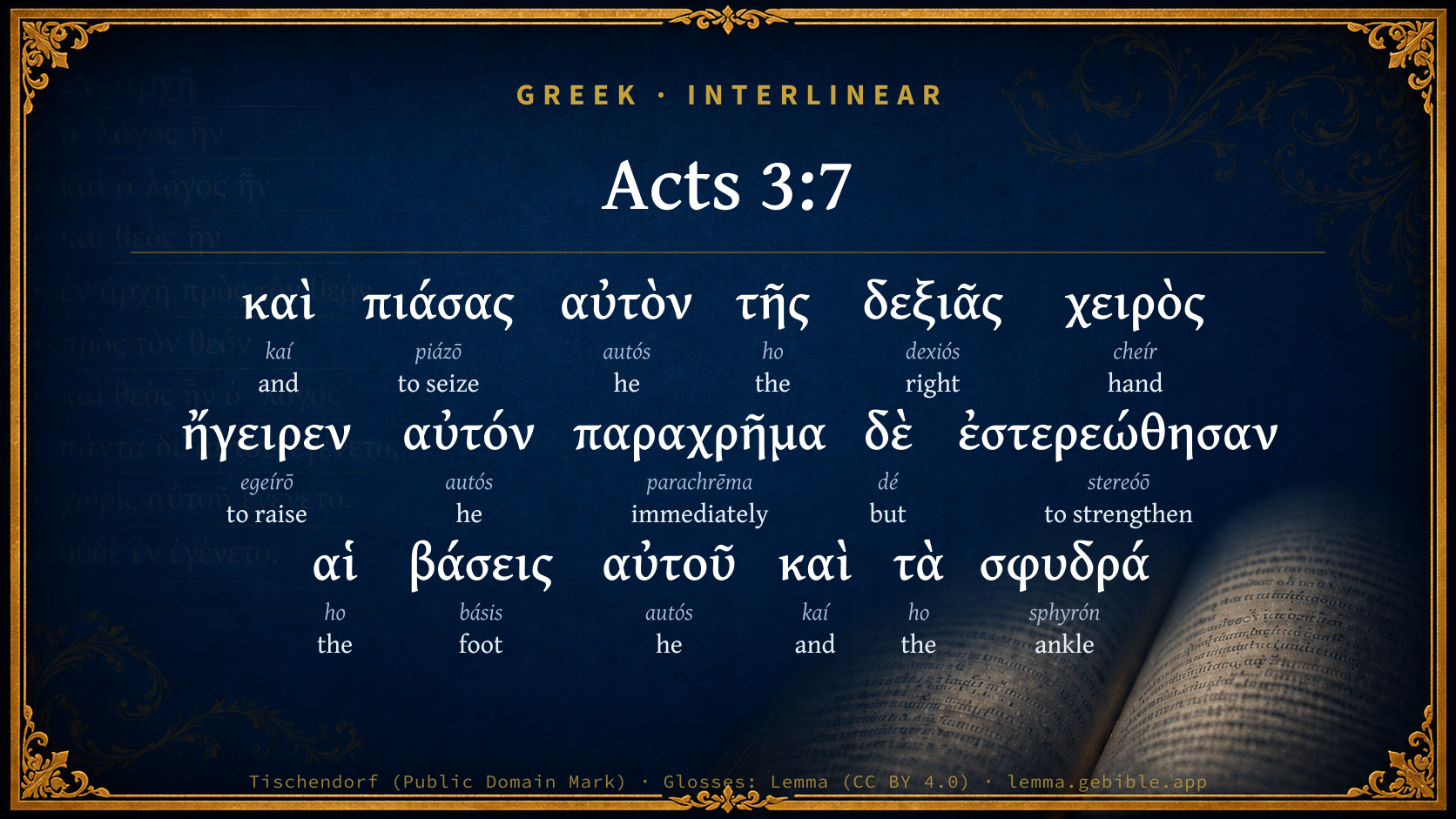
Download image
Cite this verse

Acts 3:7 (World English Bible). Public Domain. Lemma interlinear Bible study tool, https://lemma.gebible.app/v/acts/3/7.

Show BibTeX & RIS
BibTeX
RIS
English Translation
He took him by the right hand, and raised him up. Immediately his feet and his ankle bones received strength.
World English Bible · Public Domain
Highlights
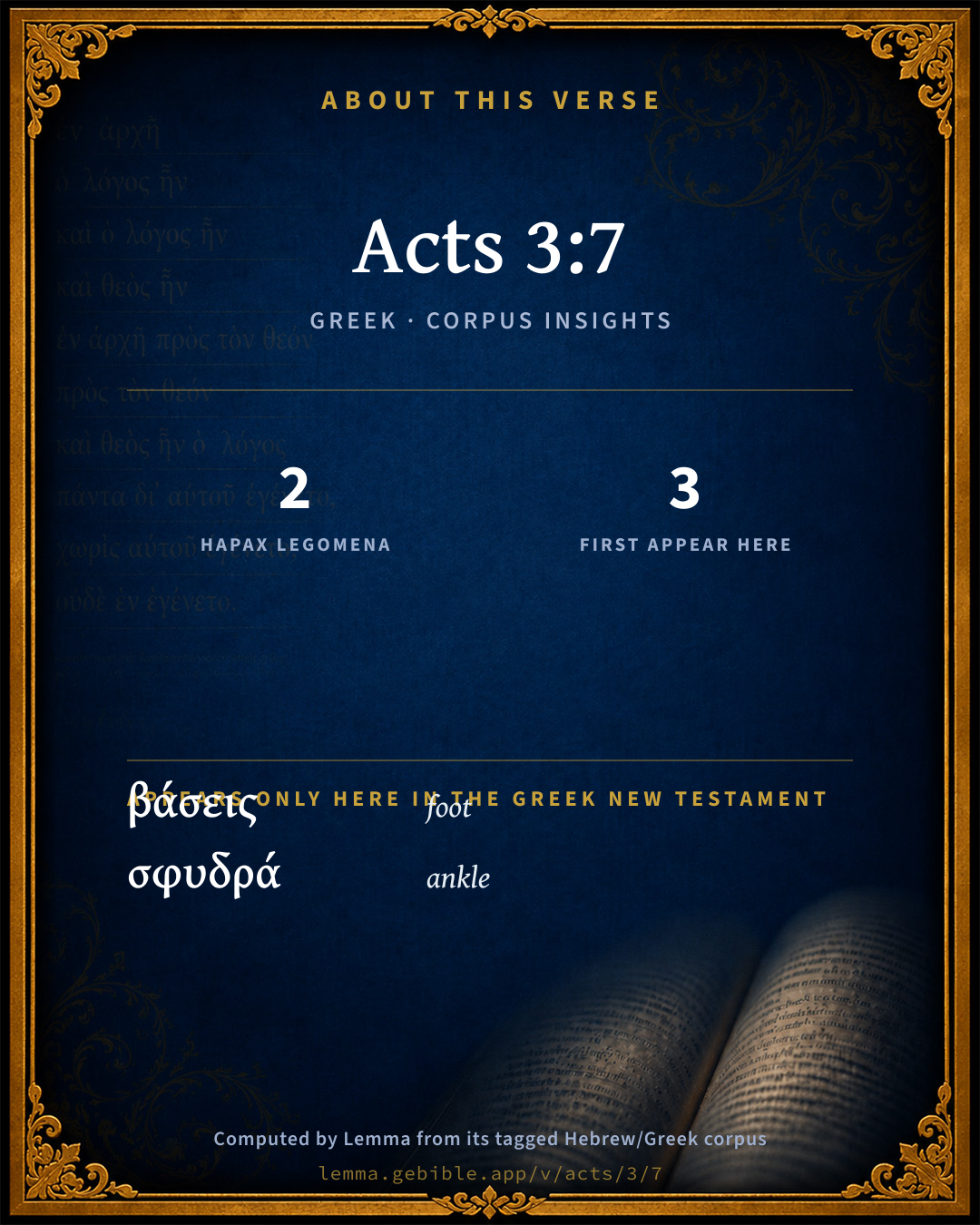
  • 2 hapax legomena — only here in the Greek New Testament
  • 3 first appearances in the Greek New Testament
Full analysis ↓
Download a study sheet

One document with this verse’s original text, its word-by-word gloss line, the meaning frame, cross-references with their text, attributed commentary, and full source and license credits — printable, and it pastes into notes with its structure intact.

This verse Autodidact and up

Study sheet (.html) Plain text (.txt)

A passage Seminary Student

Up to 50 verses in one chapter. A passage sheet keeps up to 6 commentary sources and 12 cross-references per verse, in the order this page ranks them, and says so on the sheet whenever that leaves anything out. Ask for a single verse and you get the Autodidact verse sheet above.

Everything on this page stays free to read, with no account — the sheet is a download of what is already on screen, not access to it.

Want to remove ads? Support Godless Engineer
Compare translations 3

The same verse in 3 English versions, stacked beneath the original-language interlinear above. Click any original word for its lexicon entry.

Each is an independent rendering of the whole verse — the interlinear is not word-aligned to these translations.

Highlighted words mark where these versions differ — a whole-verse word diff, not a word-by-word alignment.

  • World English Bible Public Domain
    He took him by the right hand, and raised him up. Immediately his feet and his ankle bones received strength.
  • King James Version Public Domain
    And he took him by the right hand, and lifted him up: and immediately his feet and ankle bones received strength.
  • unfoldingWord Literal Text CC BY-SA 4.0
    And seizing him by the right hand, he raised him up, and immediately his feet and ankles were made strong.

unfoldingWord Literal Text — © unfoldingWord, licensed CC BY-SA 4.0. Word-aligned USFM3 via Door43 (git.door43.org/unfoldingWord/en_ult).

Versions to compare (up to 4)

3 of 4 selected

Show all 19 translations

Every available English version of this verse, each an independent rendering of the whole verse.

  • World English Bible Public Domain
    He took him by the right hand, and raised him up. Immediately his feet and his ankle bones received strength.
  • Berean Standard Bible Public Domain
    Taking him by the right hand, Peter helped him up, and at once the man’s feet and ankles were made strong.
  • Majority Standard Bible Public Domain
    Taking him by the right hand, Peter helped him up, and at once the man’s feet and ankles were made strong.
  • King James Version Public Domain
    And he took him by the right hand, and lifted him up: and immediately his feet and ankle bones received strength.
  • American Standard Version (1901) Public Domain
    And he took him by the right hand, and raised him up: and immediately his feet and his ankle-bones received strength.
  • Revised Version (1885) Public Domain
    And he took him by the right hand, and raised him up: and immediately his feet and his ankle-bones received strength.
  • Geneva Bible (1599) Public Domain
    And hee tooke him by the right hand, and lift him vp, and immediately his feete and ankle bones receiued strength.
  • Douay-Rheims (1899) Public Domain
    And taking him by the right hand, he lifted him up, and forthwith his feet and soles received strength.
  • Young's Literal Translation Public Domain
    And having seized him by the right hand, he raised `him' up, and presently his feet and ankles were strengthened,
  • Literal Standard Version CC BY-SA 4.0
    And having seized him by the right hand, he raised [him] up, and instantly his feet and ankles were strengthened,
  • Unlocked Literal Bible CC BY-SA 4.0
    Taking him by the right hand, Peter raised him up, and immediately the man's feet and ankle were made strong.
  • unfoldingWord Literal Text CC BY-SA 4.0
    And seizing him by the right hand, he raised him up, and immediately his feet and ankles were made strong.
  • Darby Bible Public Domain
    And having taken hold of him [by] the right hand he raised him up, and immediately his feet and ankle bones were made strong.
  • World Messianic Bible Public Domain
    He took him by the right hand and raised him up. Immediately his feet and his ankle bones received strength.
  • Webster's Bible Public Domain
    And he took him by the right hand, and lifted him up: and immediately his feet and ankle bones received strength.
  • Free Bible Version CC BY-SA 4.0
    Peter took him by the right hand and helped him up. Right away his feet and ankles became strong.
  • Bible in Basic English Public Domain
    And he took him by his right hand, lifting him up; and straight away his feet and the bones of his legs became strong,
  • Text-Critical English NT CC BY 4.0
    Then Peter took hold of him by the right hand and raised him up, and at once his feet and ankles were made strong.
  • Tyndale New Testament (1534) Public Domain
    And he toke him by the right honde and lifte him vp. And immediatly his fete and ancle bones receaved strenght.

Literal Standard Version (2020), Covenant Press — licensed CC BY-SA 4.0. Text via the HelloAO Bible API (eBible.org). Unlocked Literal Bible (unfoldingWord) — licensed CC BY-SA 4.0. Text via the HelloAO Bible API (eBible.org). unfoldingWord Literal Text — © unfoldingWord, licensed CC BY-SA 4.0. Word-aligned USFM3 via Door43 (git.door43.org/unfoldingWord/en_ult). Free Bible Version, Dr. Jonathan Gallagher — licensed CC BY-SA 4.0. Text via the HelloAO Bible API (eBible.org).

Word by word

More ways to search: Search by grammar → Find every occurrence → Compare this word →

Practice this passage: Drill this verse → Learn its vocabulary →

βάσεις
básis
G939
“foot”
Noun, Nominative, Plural, Feminine
Part of Speech
Noun
Case
Nominative
Number
Plural
Gender
Feminine
Full Thayer's Definition

Origin: from baino (to walk)

TDNT: None

1. a stepping, walking 2. that with which one steps, the foot
  1. καὶ kaí G2532 “and” Conjunction
  2. πιάσας piázō G4084 “to seize” Verb, Aorist, Active, Participle, Nominative, Singular, Masculine
  3. αὐτὸν autós G846 “he” Personal pronoun, Accusative, Singular, Masculine
  4. τῆς ho G3588 “the” Article, Genitive, Singular, Feminine
  5. δεξιᾶς dexiós G1188 “right” Adjective, Genitive, Singular, Feminine
  6. χειρὸς cheír G5495 “hand” Noun, Genitive, Singular, Feminine
  7. ἤγειρεν egeírō G1453 “to raise” Verb, Aorist, Active, Indicative, 3rd person, Singular
  8. αὐτόν autós G846 “he” Personal pronoun, Accusative, Singular, Masculine
  9. παραχρῆμα parachrēma G3916 “immediately” Adverb
  10. δὲ dé G1161 “but” Conjunction
  11. ἐστερεώθησαν stereóō G4732 “to strengthen” Verb, Aorist, Passive, Indicative, 3rd person, Plural
  12. αἱ ho G3588 “the” Article, Nominative, Plural, Feminine
  13. αὐτοῦ autós G846 “he” Personal pronoun, Genitive, Singular, Masculine
  14. καὶ kaí G2532 “and” Conjunction
  15. τὰ ho G3588 “the” Article, Nominative, Plural, Neuter
  16. σφυδρά sphyrón G4974 “ankle” Noun, Nominative, Plural, Neuter

About this verse

These counts appear in no published source. They are computed here, from the morphology-tagged text and Lemma’s own curated glosses. What Lemma adds →

17
words
12
distinct lemmas
Acts
section

Notable vocabulary

2 hapax legomena — words that appear only here in the entire Greek New Testament:

  • βάσεις foot G939
  • σφυδρά ankle G4974

First appearance in Scripture

These words make their first canonical appearance in the Greek New Testament here:

  • ἐστερεώθησαν to strengthen G4732
  • βάσεις foot G939
  • σφυδρά ankle G4974

Shared distinctive vocabulary

ἐστερεώθησαν to strengthen G4732 occurs in 3 verses of the Greek New Testament. Also found in:
Repetition

Words recur within this verse:

  • αὐτὸν he G846 ×3
  • τῆς the G3588 ×3
  • καὶ and G2532 ×2

Cross-references

5

Topical passages linked to Acts 3:7 in the Treasury of Scripture Knowledge — connected by theme and wording, ordered by reader-vote popularity; previews shown in the World English Bible.

  • Mark 1:31 He came and took her by the hand, and raised her up. The fever left her, and she served them.
  • Mark 9:27 But Jesus took him by the hand, and raised him up; and he arose.
  • Mark 5:41 Taking the child by the hand, he said to her, "Talitha cumi;" which means, being interpreted, "Girl, I tell you, get up."
  • Acts 9:41 He gave her his hand, and raised her up. Calling the saints and widows, he presented her alive.
  • Luke 13:13 He laid his hands on her, and immediately she stood up straight, and glorified God.

Cross-references courtesy of OpenBible.info (CC BY 4.0).

Commentary

Notes on Acts 3:7 from classic Christian and Jewish commentators (each source and its license shown beneath its notes). The classic Christian expositions comment on the surrounding passage and are grouped to its opening verse, so a note may address several verses; the Jewish commentaries on the Tanakh (Rashi and others) are per-verse, so they appear only where the commentator wrote on this verse.

Lemma curates 59 commentaries, every one of them public domain or Creative Commons licensed, each selected and text-cleaned for this edition rather than reprinted as found. About our sources →

Bengel's Gnomon

Johann Albrecht Bengel

Act 3:7. Αὐτὸν, him) It was the part of the blind man merely to give himself up to the power which was entering into him.—αἱ βάσεις καὶ τὰ σφυρὰ) As to both Greek words there is much disputation. Luke implies that all the parts in the lame man were strengthened, so as to enable him to walk. Βάσεις are the Feet, which have their principal strength in the knees: σφυρὰ, by a catachresis, are used to express the ankles, as in Callimachus, οὐδὲν ἐπὶ σφυρὸν ὀρθὸν ἀνέστη: strictly, little mallets, or the lowest parts of the leg. Luke, as being a physician, expressed himself accurately. Comp. Psa 18:36, “Thou hast enlarged my steps under me, that my feet (margin, ankles) did not slip.”

Bengel's Gnomon of the New Testament — English translation (T&T Clark, Edinburgh, 1860) — public domain. Text from a community e-Sword module.

Meyer's Critical & Exegetical Commentary

Heinrich August Wilhelm Meyer

Act_3:7-8. Αὐτὸν τῆς δεξιᾶς] comp. Mar_9:27, and see Valckenaer, ad Theocr. iv. 35.

ἐστερεῶθησαν] his feet were strengthened, so that they now performed their function, for which they had been incapacitated in the state of lameness, of supporting the body in its movements.

αἱ βάσεις are the feet, as in Wis_13:18; Joseph. Antt. vii. 5. 5; Plat. Tim. p. 92 A, and in later Greek writers.

τὰ σφυρά: the anklebones, tali (very frequent in the classics), after the general expression subjoining the particular.

ἐξαλλόμενος] springing up, leaping into the air. Xen. Cyr. vii. 1. 32; Anab. vii. 3. 33; LXX. Isa_55:12. Not: exsiliens, videlicet e grabbato (Casaubon), of which last there is no mention.

καὶ εἰσῆλθε … τὸν θεόν] This behaviour bears the most natural impress of grateful attachment (comp. Act_3:11), lively joy (περιπατ. καὶ ἁλλόμενος,at the same time as an involuntary proof of his complete cure for himself and for others), and religious elevation. The view of Thiessthat the beggar was only a pretended cripple who was terrified by the threatening address of Peter into using his feet, and afterwards, for fear of the rage of the people, prudently attached himself to the apostleschanges the entire narrative, and makes the apostle himself (Act_3:12; Act_3:16; Act_4:9-10) the deceiver. Peter had wrought the cure in the possession of that miraculous power of healing which Jesus had imparted to His apostles (Luk_9:1), and the supernatural result cannot in that case, any more than in any other miracle, warrant us to deny its historical character, as is done by Zeller, who supposes that the general χωλοὶ περιπατοῦσιν, Luk_7:22, Mat_15:31, has here been illustrated in an individual instance.

Meyer — Critical and Exegetical Commentary on the New Testament — English translation by Peter Christie, edited by Frederick Crombie (T&T Clark, 1880) — public domain. Text from a community e-Sword module.

Expositor's Greek Testament

ed. W. Robertson Nicoll

Act 3:7 . πιάσας , cf. Act 12:4 : so in LXX, Son 2:15 , Sir 23:21 , A. al . χειρὸς very similar to, if not exactly, a partitive genitive, found after verbs of touching, etc., inasmuch as the touching affects only a part of the object (Mar 5:30 ), and so too often after verbs of taking hold of , the part or the limit grasped is put in the genitive, Mar 5:41 (accusative being used when the whole person is seized, Mat 14:3 ), Blass, Grammatik des N. G. , p. 100, cf. classical use in Eurip., Hec. , 523. The meaning of πιάζω in N.T. and in the LXX has passed into modern Greek = πιάνω = seize, apprehend (Kennedy). For a similar use see also 2Co 11:32 , Rev 19:20 , and Joh 7:30 ; Joh 7:32-33 ; Joh 7:44 ; Joh 8:20 ; Joh 10:39 ; Joh 11:57 ; Joh 21:3 ; Joh 21:10 . παραχρῆμα , i.e. , παρὰ τὸ χρῆμα , forthwith, immediately, auf der Stelle , on the spot, specially characteristic of St. Luke, both in Gospel and Acts ( cf. εὐθύς of St. Mark). It is found no less than ten times in the Gospel, and six to seven times in Acts, elsewhere in N.T. only twice, Mat 21:19-20 ; several times in LXX, Wis 18:17 , Tob 8:3 , ., 2Ma 4:34 ; 2Ma 4:38 , etc., 4Ma 14:9 , Bel and the Dragon, ver. 39, 42, Theod., and in Num 6:9 ; Num 12:4 , [138] [139] [140] ., Isa 29:5 , for Hebrew, פִּתְאֹם ; frequent in Attic prose; see also Dalman, Die Worte Jesu , pp. 22, 29. But as the word is so manifestly characteristic of St. Luke it is noteworthy that in the large majority of instances it is employed by him in connection with miracles of healing or the infliction of disease and death, and this frequency of use and application may be paralleled by the constant employment of the word in an analogous way in medical writers; see, e.g. , Hobart, Medical Language of St. Luke , and instances in Hippocrates, Galen, Dioscorides. ἐστερεώθησαν : στερεόω = to make firm or solid; it cannot by any means be regarded only as a technical medical term, but as a matter of fact it was often employed in medical language (so also the adjective στερεός ), and this use of the word makes it a natural one for a medical man to employ here, especially in connection with βάσεις and σφυρά . It is used only by St. Luke in the N.T. (Act 3:16 and Act 16:5 ), but very frequently in the LXX. The nearest approach to a medical use of the word is given perhaps by Wetstein, in loco , Xen., Pæd. , viii. αἱ βάσεις , “the feet” ( βαίνω ). The word is constantly used in LXX, but for the most part in the sense of something upon which a thing may rest, but it is found in the same sense as here in Wis 13:18 ; cf. also Jos., Ant. , vii., 3, 5, so in Plato, Timæus , 92, A. It was in frequent use amongst medical men, and its employment here, and here only in the N.T., with the mention of the other details, e.g. , the more precise σφυρά , “anklebones,” also only found in this one passage in N.T., has been justly held to point to the technical description of a medical man; see not only Hobart, p. 34 ff., u. s. , and Belcher’s Miracles of Healing , p. 41, but Bengel, Zöckler, Rendall, Zahn.

[138] Codex Alexandrinus (sæc. v.), at the British Museum, published in photographic facsimile by Sir E. M. Thompson (1879).

[139] Codex Vaticanus (sæc. iv.), published in photographic facsimile in 1889 under the care of the Abbate Cozza-Luzi.

[140] Codex Cryptoferratensis (sæc. vii.), a palimpsest fragment containing chap. Act 11:9-19 , edited by Cozza in 1867, and cited by Tischendorf.

The Expositor's Greek Testament, edited by W. Robertson Nicoll (1897–1910) — public domain. Text from a community e-Sword module.

Jamieson, Fausset & Brown

Robert Jamieson, A. R. Fausset & David Brown

And he took . . . and lifted him up--precisely what his Lord had done to his own mother-in-law (Mar 1:31).

his feet--"soles."

and ankle bones, &c.--the technical language of a physician (Col 4:14).

Jamieson, Fausset & Brown — Commentary Critical and Explanatory on the Whole Bible (1871) — public domain (CC PDM 1.0). Text via the HelloAO Bible API.

Adam Clarke's Commentary

Verse 7. Immediately his feet and ancle bones received strength] The suddenness of the cure was the proof of the miracle: his walking and leaping were the evidences of it.

Adam Clarke's Commentary on the Bible (1810–1826) — public domain. Text from a community e-Sword/MySword module.

Ellicott's Commentary for English Readers

(7) His feet.—Better, his soles. The precision with which the process is described is characteristic of the medical historian. Both this term and the “ankle bones” employed are more or less technical, as is also the word rendered “received strength,” literally, were consolidated, the flaccid tissues and muscles being rendered firm and vigorous.

A Bible Commentary for English Readers, edited by Charles John Ellicott (1878–1897) — public domain. Text from a community e-Sword module.

The Cambridge Bible for Schools and Colleges

gen. ed. J. J. S. Perowne

7. his feet and ankle bones] The words in the original are found nowhere else in the N. T. They are of a technical character, and their use, together with the other features of exact description of the cripple’s case, indicate that we have before us the language of the physician (Col_4:14). And it is hardly possible to dwell too strongly on indications of this kind, which indirectly mark in the history something which is likewise noted in the Epistles. Those who would assign the second century as the date of the composition of the Acts, must assume for their supposed writer the keenest appreciation of every slight allusion in the letters of St Paul, and at the same time an ability to let his knowledge peep out only in hints like that which we find in this verse. Such persons, while rejecting all that is miraculous in the story as we have it, ask us to believe in such a writer as would himself be almost a miracle, for his powers of observation and the skill with which he has employed them.

received strength] Though from want of use, they must have been withered before.

The Cambridge Bible for Schools and Colleges (gen. ed. J. J. S. Perowne; Cambridge University Press, 1878–1918) — public domain. Text from a community e-Sword module.

John Gill's Exposition

And he took him by the right hand,.... In imitation of Christ, whom he had often seen using the same action on such occasions:

and lift him up; believing he was cured, and that it might be manifest. The word him is expressed in the Alexandrian copy, and in some others, and in the Oriental versions, which is a supplement in our translation:

and immediately his feet and ankle bones received strength; where, it seems, his lameness lay. The Vulgate Latin renders it, his bases and soles, which may include his legs and thighs, as well as feet; and the Syriac version, "his feet and soles"; and the Arabic version, "his soles, and the muscles adjoining to his heels"; and the Ethiopic version furthest off of all, "he was strengthened in his feet, and in his loins"; his disorder might be of the paralytic kind.

John Gill's Exposition of the Whole Bible (1746–1763) — public domain (CC PDM 1.0). Text via the HelloAO Bible API.

Trapp's Complete Commentary

John Trapp

7 And he took him by the right hand, and lifted him up: and immediately his feet and ankle bones received strength.

Ver. 7. His feet and ankle bones] "The Lord raiseth them that are crooked," but (as a further favour, and far better than that former) "he loveth the righteous," Psa 146:8, as he did this cripple, whom he healed on the inside also.

John Trapp, A Commentary or Exposition upon All the Books of the Old and New Testament (1647–1656) — public domain. Text from a community e-Sword module.

Albert Barnes' Notes on the Bible

And he took him - He took hold of his hand. To take hold of the hand in such a ease was an offer of aid, an indication that Peter was sincere, and was an inducement to him to make an effort. This may be employed as a beautiful illustration of the manner of God when he commands people to repent and believe. He does not leave them alone; he extends help, and aids their efforts. If they tremble, and feel that they are weak, and needy, and helpless, his hand is stretched out and his power exerted to impart strength and grace.

His feet and ankle-bones - The fact that strength was immediately imparted; that the feet, long lame, were now made strong, was a full and clear proof of miraculous power.

Albert Barnes' Notes on the Bible (1834–1885) — public domain. Text from a community e-Sword/MySword module.

Matthew Poole's English Annotations

He took him by the right hand; not disdaining to take hold of a poor cripple or beggar; as also being fully persuaded of Christ’s presence with him for his cure.

And immediately, that it might the more evidently appear that this was the work of God, who can without means, and on a sudden, bring aught to perfection,

his feet and ankle bones, whence his lameness did proceed, received strength: thus God can say unto the weak, Be strong.

Matthew Poole's English Annotations on the Holy Bible (1683–1685) — public domain. Text from a community e-Sword/MySword module.

Whedon's Commentary on the Bible

Daniel D. Whedon

7. And lifted him up—This clause is of doubtful genuineness, and may well be omitted. The man was not raised up, but, according to the next verse, when touched by the apostle’s hand sprang up.

Daniel D. Whedon (gen. ed.), Commentary on the Old and New Testaments (1874–1909) — public domain. Text from a community e-Sword module.

The Pulpit Commentary

Raised for lifted, A.V.; his ankle-bones for ancle bones, A.V. St. Luke"s medical knowledge discerns the cause of the lameness a weakness in the anklebones.

The Pulpit Commentary (1880–1919), ed. H.D.M. Spence-Jones & Joseph S. Exell — public domain. Text from a community e-Sword module.

McGarvey & Pendleton's Commentaries

J. W. McGarvey

See notes on verse 1

J. W. McGarvey (with Philip Y. Pendleton), Commentaries on the New Testament (The Fourfold Gospel, 1914; Acts; and the epistles) — public domain. Text from a community e-Sword/MySword module.

The People's New Testament

B. W. Johnson

7. He took him by the right hand. To encourage and strengthen his faith. He was bidden to “arise and walk in the name of Jesus Christ,” and thus to show his faith in act. He did, and was healed in doing so.

B. W. Johnson's The People's New Testament with Notes (1889–1891) — public domain. Electronic text from the Christian Classics Ethereal Library (CCEL) ThML edition.

unfoldingWord translationNotes

Door43 World Missions Community

Peter raised him up

"Peter caused him to stand"

he entered ... into the temple

He did not go inside the temple building where only the priests were allowed. AT: "he entered ... the temple area" or "he entered ... into the temple courtyard"

translationWords

strength

temple

praise

unfoldingWord translationNotes — © Distant Shores Media and the Door43 World Missions Community, licensed CC BY-SA 4.0. Source: git.door43.org/Door43/en_tn.

Cambridge Greek Testament for Schools and Colleges

7. ἤγειρεν αὐτόν with אABCG. The Vulg. has the pronoun twice expressed.

7. αἱ βάσεις αὐτοῦ καὶ τὰ σφυρά. These words are found nowhere else in the N.T. They are of a technical character, and their use, together with the other features of exact description of the cripple’s case, indicate that we have before us the language of the physician (Col 4:14). And it is hardly possible to dwell too strongly on indications of this kind, which indirectly mark in the history something which is likewise noted in the Epistles. Those who would assign the second century as the date of the composition of the Acts, must assume for their supposed writer the keenest appreciation of every slight allusion in the letters of St Paul, and at the same time an ability to let his knowledge peep out only in hints like that which we find in this verse. Such persons, while rejecting all that is miraculous in the story as we have it, ask us to believe in such a writer as would himself be almost a miracle, for his powers of observation and the skill with which he has employed them.

βάσις in the LXX. is generally used of some basement or foundation on which a thing may rest, but it occurs with the meaning of this verse in Wis 13:18, where, in speaking of an idolater, it is said he makes petitions περὶ ὁδοιποιρίας [ἱκετεύει] τὸ μηδὲ βάσει χρῆσθαι δυνάμενον, ‘for a good journey unto that which cannot set a foot forward.’

Cambridge Greek Testament for Schools and Colleges (Cambridge University Press, 1896; 21 vols, various authors incl. Carr, Maclear, Plummer, Farrar, Lumby, Moule, M. R. James, Simcox) — public domain. Text from a community e-Sword module.

Alford’s Greek Testament

Henry Alford

7. πιάσας … ἤγειρεν] οὕτω καὶ ὁ χριστὸς ἐποίησε· πολλάκις λόγῳ ἐθεράπευσε, πολλάκις ἔργῳ, πολλάκις καὶ τὴν χεῖρα προήγαγεν, ὅπου ἦσαν ἀσθενέστεροι κατὰ τὴν πίστιν· ἵνα μὴ δόξῃ ἀπὸ ταυτομάτου γενέσθαι. Chrys. in Act. Hom. viii. p. 63. See Mar 9:27.

βάσεις are the soles of the feet,—σφυρά, the ankles. Luke, the physician, had made himself acquainted with the peculiar kind of weakness, and described it accordingly.

Henry Alford, The Greek Testament (1849–1861) — public domain. Text from a community e-Sword module.

Vincent's Word Studies in the New Testament

Marvin R. Vincent

He took [πιασας] . The verb means originally to press or squeeze; and hence implies taking hold with a firm grasp.

Feet [βασεις] . A peculiar, technical word, used by Luke only, and described by Galen as the part of the foot lying beneath the leg, upon which the leg directly rests, as distinguished from the tarsov, the flat of the foot between the toes and heel, and pedion, the part next the toes. Ankle - bones [σφυρα] . Only here in New Testament. Also technical. Some of the best texts read sfudra, but the meaning is the same. Received strength [εστερεωθησαν] . Used by Luke only. Compare " the churches were established (ch. 16 5), and the kindred noun sterewma, steadfastness (Col 2:5). In medical language applied to the bones in particular.

Marvin R. Vincent, Word Studies in the New Testament (1887–1900) — public domain. Text from a community e-Sword/MySword module.

Lesson kit

Teaching starters — assembled from the data on this page, not authored interpretation. Every prompt links to the verse data it draws on. Edit before teaching.

Acts, in the Acts, opens this verse with 17 words (12 distinct Greek lemmas). Its most distinctive word is básis (“foot”). A historical commentator’s framing appears above. Read the whole chapter for the surrounding context.

Discussion questions

  1. What does “foot” (básis) contribute to the verse as a whole?
  2. 2 words here appear nowhere else in the Greek New Testament. Why might the author reach for such rare wording?
  3. 3 words make their first appearance in Scripture here. What does this debut establish?
  4. How does Acts 3:16, which shares the word «to strengthen», read alongside this verse?
  5. What does the repetition of “he” (3× in this one verse) do in this verse?
  6. These translations render this verse differently; the difference is in the English rendering, not the original. What questions does that raise?
  7. Compare how Bengel's Gnomon and Meyer's Critical & Exegetical Commentary read this verse. Where do they agree or differ?

Things to notice

  • 2 words in this verse appear nowhere else in the Greek New Testament.
  • 3 words make their first canonical appearance in Scripture here.
  • These translations choose different wording for 11 words in this verse.
  • “he” occurs 3× in this single verse.
  • 12 distinct Greek lemmas span 17 words in this verse.

Reading settings

Reading text

Shown beneath each verse's original-language words.

Old Testament
Old Testament edition

Read the OT as the Masoretic Hebrew (MT) or the Greek Septuagint (LXX).

English shown for the Greek Septuagint (in the Hebrew ↔ Greek comparison).

Comparing translations? Open the Compare panel on any verse page to stack up to four side by side.