
Acts 13:11

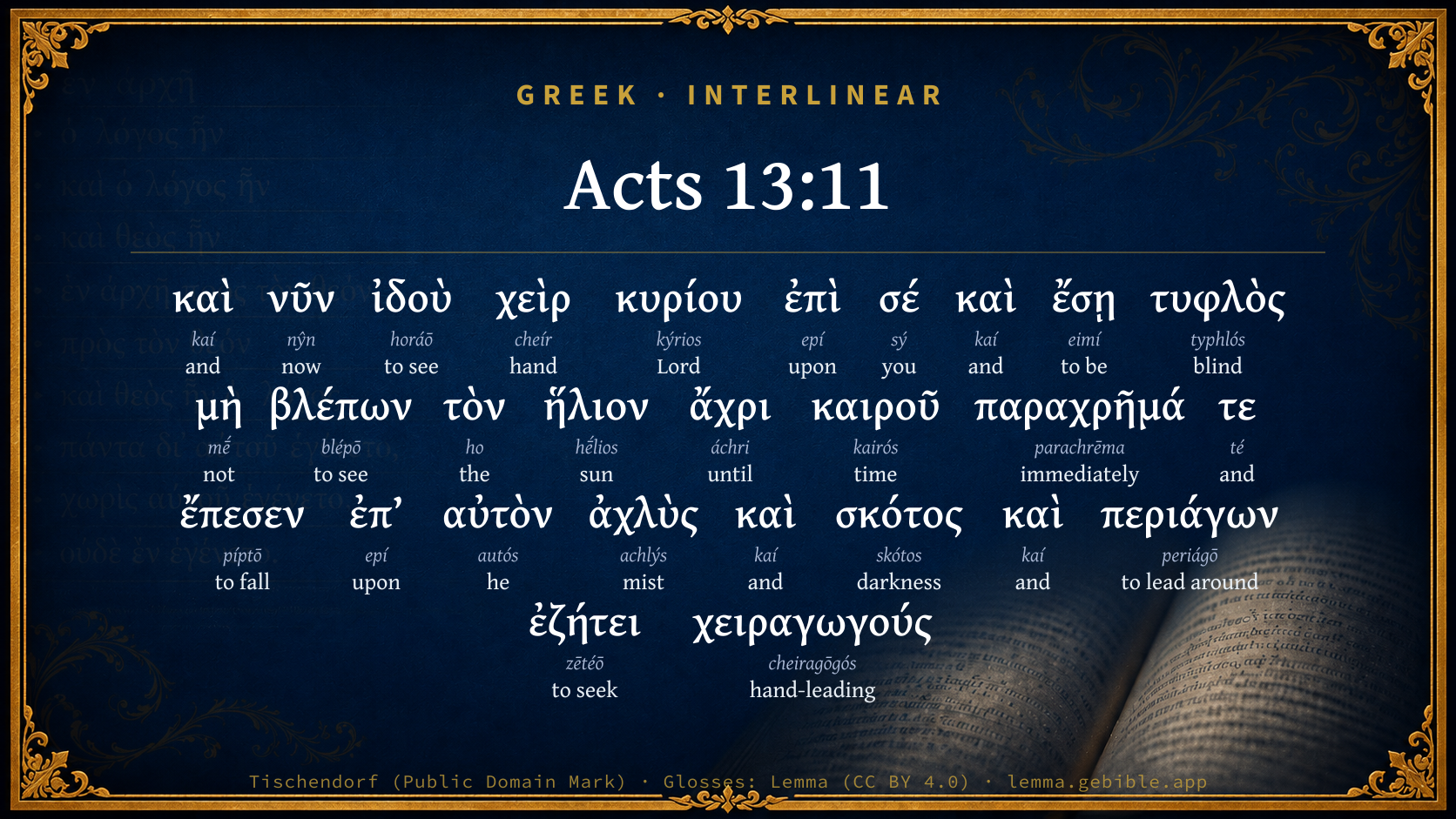
Greek (Tischendorf 8th ed.) Acts 13:11 appears in the Greek New Testament. The text above is from the Tischendorf 8th edition. Each word links to its Strong’s number and a concise gloss. Click any word for its full Thayer’s Greek Lexicon entry.
Download image
Cite this verse

Acts 13:11 (World English Bible). Public Domain. Lemma interlinear Bible study tool, https://lemma.gebible.app/v/acts/13/11.

Show BibTeX & RIS
BibTeX
RIS
English Translation
Now, behold, the hand of the Lord is on you, and you will be blind, not seeing the sun for a season!" Immediately there fell on him a mist and darkness. He went around seeking someone to lead him by the hand.
World English Bible · Public Domain
Highlights
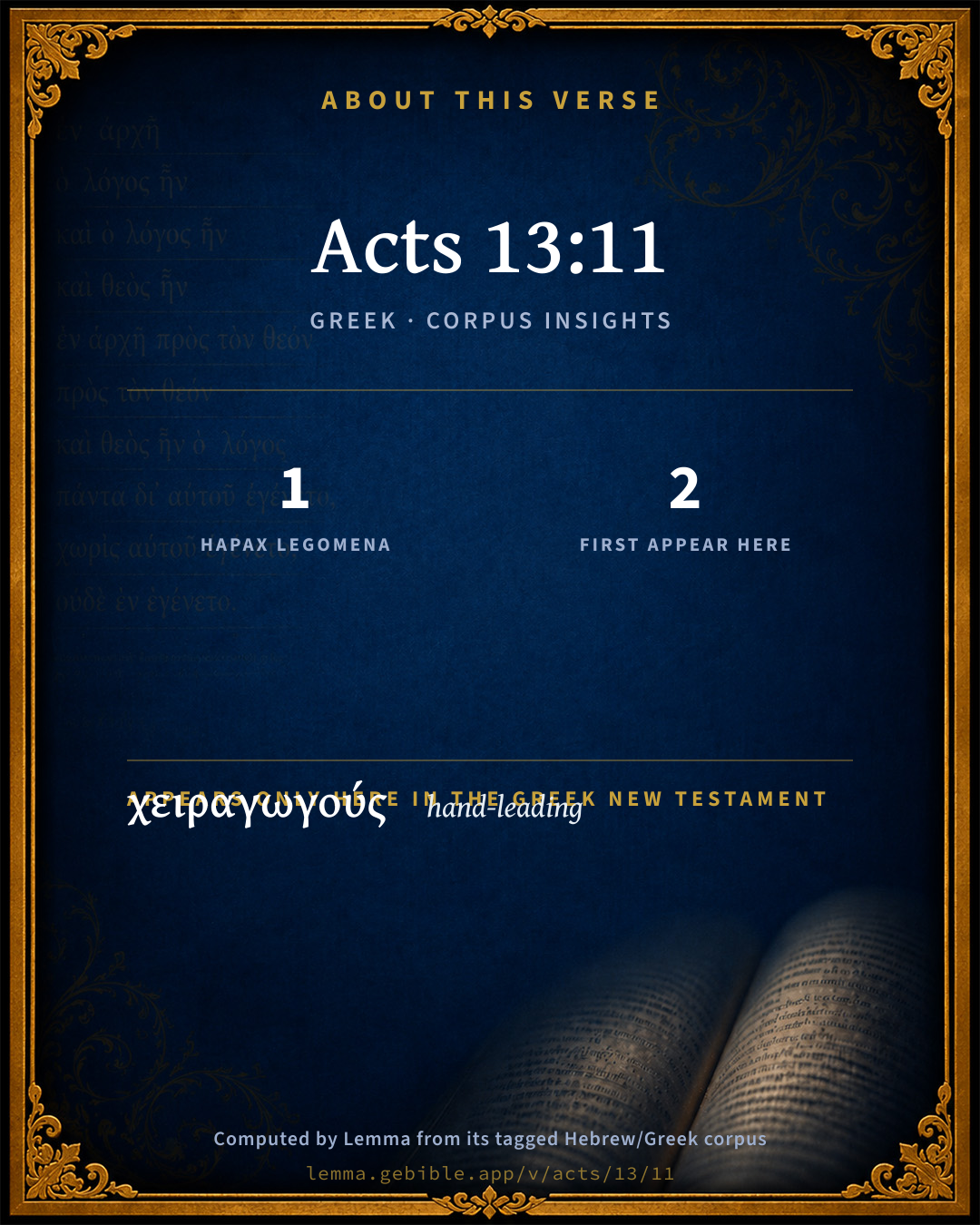
  • 1 hapax legomenon — only here in the Greek New Testament
  • 2 first appearances in the Greek New Testament
Full analysis ↓
Download a study sheet

One document with this verse’s original text, its word-by-word gloss line, the meaning frame, cross-references with their text, attributed commentary, and full source and license credits — printable, and it pastes into notes with its structure intact.

This verse Autodidact and up

Study sheet (.html) Plain text (.txt)

A passage Seminary Student

Up to 50 verses in one chapter. A passage sheet keeps up to 6 commentary sources and 12 cross-references per verse, in the order this page ranks them, and says so on the sheet whenever that leaves anything out. Ask for a single verse and you get the Autodidact verse sheet above.

Everything on this page stays free to read, with no account — the sheet is a download of what is already on screen, not access to it.

Want to remove ads? Support Godless Engineer
Compare translations 3

The same verse in 3 English versions, stacked beneath the original-language interlinear above. Click any original word for its lexicon entry.

Each is an independent rendering of the whole verse — the interlinear is not word-aligned to these translations.

Highlighted words mark where these versions differ — a whole-verse word diff, not a word-by-word alignment.

  • World English Bible Public Domain
    Now, behold, the hand of the Lord is on you, and you will be blind, not seeing the sun for a season!" Immediately there fell on him a mist and darkness. He went around seeking someone to lead him by the hand.
  • King James Version Public Domain
    And now, behold, the hand of the Lord is upon thee, and thou shalt be blind, not seeing the sun for a season. And immediately there fell on him a mist and a darkness; and he went about seeking some to lead him by the hand.
  • unfoldingWord Literal Text CC BY-SA 4.0
    And now, behold, the hand of the Lord upon you, and you will be blind, not seeing the sun for a time.” And immediately a mist and darkness fell upon him, and going around, he was seeking someone to lead him by the hand.

unfoldingWord Literal Text — © unfoldingWord, licensed CC BY-SA 4.0. Word-aligned USFM3 via Door43 (git.door43.org/unfoldingWord/en_ult).

Versions to compare (up to 4)

3 of 4 selected

Show all 19 translations

Every available English version of this verse, each an independent rendering of the whole verse.

  • World English Bible Public Domain
    Now, behold, the hand of the Lord is on you, and you will be blind, not seeing the sun for a season!" Immediately there fell on him a mist and darkness. He went around seeking someone to lead him by the hand.
  • Berean Standard Bible Public Domain
    Now look, the hand of the Lord is against you, and for a time you will be blind and unable to see the light of the sun.” Immediately mist and darkness came over him, and he groped about, seeking someone to lead him by the hand.
  • Majority Standard Bible Public Domain
    Now look, the hand of the Lord is against you, and for a time you will be blind and unable to see the light of the sun.” Immediately mist and darkness fell over him, and he groped about, seeking someone to lead him by the hand.
  • King James Version Public Domain
    And now, behold, the hand of the Lord is upon thee, and thou shalt be blind, not seeing the sun for a season. And immediately there fell on him a mist and a darkness; and he went about seeking some to lead him by the hand.
  • American Standard Version (1901) Public Domain
    And now, behold, the hand of the Lord is upon thee, and thou shalt be blind, not seeing the sun for a season. And immediately there fell on him a mist and a darkness; and he went about seeking some to lead him by the hand.
  • Revised Version (1885) Public Domain
    And now, behold, the hand of the Lord is upon thee, and thou shalt be blind, not seeing the sun for a season. And immediately there fell on him a mist and a darkness; and he went about seeking some to lead him by the hand.
  • Geneva Bible (1599) Public Domain
    Nowe therefore behold, the hand of the Lord is vpon thee, and thou shalt be blinde, and not see the sunne for a season. And immediately there fel on him a mist and a darknes; and he went about, seeking some to leade him by the hand.
  • Douay-Rheims (1899) Public Domain
    And now behold, the hand of the Lord is upon thee, and thou shalt be blind, not seeing the sun for a time. And immediately there fell a mist and darkness upon him, and going about, he sought some one to lead him by the hand.
  • Young's Literal Translation Public Domain
    and now, lo, a hand of the Lord `is' upon thee, and thou shalt be blind, not seeing the sun for a season;' and presently there fell upon him a mist and darkness, and he, going about, was seeking some to lead `him' by the hand;
  • Literal Standard Version CC BY-SA 4.0
    And now, behold, a hand of the LORD [is] on you, and you will be blind, not seeing the sun for a season”; and instantly there fell on him a mist and darkness, and he, going around, was seeking some to lead [him] by the hand;
  • Unlocked Literal Bible CC BY-SA 4.0
    Now look, the hand of the Lord is upon you, and you will become blind. You will not see the sun for a while.” Immediately there fell on Elymas a mist and darkness; he started going around asking people to lead him by the hand.
  • unfoldingWord Literal Text CC BY-SA 4.0
    And now, behold, the hand of the Lord upon you, and you will be blind, not seeing the sun for a time.” And immediately a mist and darkness fell upon him, and going around, he was seeking someone to lead him by the hand.
  • Darby Bible Public Domain
    And now behold, [the] Lord's hand [is] upon thee, and thou shalt be blind, not seeing the sun for a season. And immediately there fell upon him a mist and darkness; and going about he sought persons who should lead him by the hand.
  • World Messianic Bible Public Domain
    Now, behold, the hand of the Lord is on you, and you will be blind, not seeing the sun for a season!” Immediately a mist and darkness fell on him. He went around seeking someone to lead him by the hand.
  • Webster's Bible Public Domain
    And now behold, the hand of the Lord is upon thee, and thou shalt be blind, not seeing the sun for a season. And immediately there fell on him a mist and a darkness; and he went about seeking some to lead him by the hand.
  • Free Bible Version CC BY-SA 4.0
    Look, the Lord's hand is on you and you will become blind. You will not see the sun for some time.” Immediately mist and darkness fell on him, and he had to find someone who could lead him by the hand.
  • Bible in Basic English Public Domain
    And now, see, the hand of the Lord is on you, and you will be blind and not able to see the sun for a time. And straight away a dark mist came down on him; and he went about looking for a guide.
  • Text-Critical English NT CC BY 4.0
    And now, behold, the hand of the Lord is against yoʋ, and yoʋ will be blind, unable to see the sun for a period of time.” Immediately a mist and darkness fell upon him, and he was going around seeking people to lead him by the hand.
  • Tyndale New Testament (1534) Public Domain
    And now beholde the honde of the Lorde is vpon the and thou shalt be blinde and not se the sunne for a season. And immediatly ther fell on him a myste and a darcknes and he went aboute sekinge them that shuld leade him by the honde.

Literal Standard Version (2020), Covenant Press — licensed CC BY-SA 4.0. Text via the HelloAO Bible API (eBible.org). Unlocked Literal Bible (unfoldingWord) — licensed CC BY-SA 4.0. Text via the HelloAO Bible API (eBible.org). unfoldingWord Literal Text — © unfoldingWord, licensed CC BY-SA 4.0. Word-aligned USFM3 via Door43 (git.door43.org/unfoldingWord/en_ult). Free Bible Version, Dr. Jonathan Gallagher — licensed CC BY-SA 4.0. Text via the HelloAO Bible API (eBible.org).

Word by word

More ways to search: Search by grammar → Find every occurrence → Compare this word →

Practice this passage: Drill this verse → Learn its vocabulary →

χειραγωγούς
cheiragōgós
G5497
“hand-leading”
Noun, Accusative, Plural, Masculine
Part of Speech
Noun
Case
Accusative
Number
Plural
Gender
Masculine
Full Thayer's Definition

Origin: from G5495 and a reduplicated form of G71

TDNT: 16:15,1

1. leading one by the hand
  1. καὶ kaí G2532 “and” Conjunction
  2. νῦν nŷn G3568 “now” Adverb
  3. ἰδοὺ horáō G3708 “to see” Verb, Aorist, Middle, Imperative, 2nd person, Singular
  4. χεὶρ cheír G5495 “hand” Noun, Nominative, Singular, Feminine
  5. κυρίου kýrios G2962 “Lord” Noun, Genitive, Singular, Masculine
  6. ἐπὶ epí G1909 “upon” Preposition
  7. σέ sý G4771 “you” Personal pronoun, 2nd person, Accusative, Singular
  8. καὶ kaí G2532 “and” Conjunction
  9. ἔσῃ eimí G1510 “to be” Verb, Future, Middle deponent, Indicative, 2nd person, Singular
  10. τυφλὸς typhlós G5185 “blind” Adjective, Nominative, Singular, Masculine
  11. μὴ mḗ G3361 “not” Particle, Negative
  12. βλέπων blépō G991 “to see” Verb, Present, Active, Participle, Nominative, Singular, Masculine
  13. τὸν ho G3588 “the” Article, Accusative, Singular, Masculine
  14. ἥλιον hḗlios G2246 “sun” Noun, Accusative, Singular, Masculine
  15. ἄχρι áchri G891 “until” Adverb
  16. καιροῦ kairós G2540 “time” Noun, Genitive, Singular, Masculine
  17. παραχρῆμά parachrēma G3916 “immediately” Adverb
  18. τε té G5037 “and” Particle
  19. ἔπεσεν píptō G4098 “to fall” Verb, Aorist, Active, Indicative, 3rd person, Singular
  20. ἐπ’ epí G1909 “upon” Preposition
  21. αὐτὸν autós G846 “he” Personal pronoun, Accusative, Singular, Masculine
  22. ἀχλὺς achlýs G887 “mist” Noun, Nominative, Singular, Feminine
  23. καὶ kaí G2532 “and” Conjunction
  24. σκότος skótos G4655 “darkness” Noun, Nominative, Singular, Neuter
  25. καὶ kaí G2532 “and” Conjunction
  26. περιάγων periágō G4013 “to lead around” Verb, Present, Active, Participle, Nominative, Singular, Masculine
  27. ἐζήτει zētéō G2212 “to seek” Verb, Imperfect, Active, Indicative, 3rd person, Singular

About this verse

These counts appear in no published source. They are computed here, from the morphology-tagged text and Lemma’s own curated glosses. What Lemma adds →

28
words
24
distinct lemmas
Acts
section

Notable vocabulary

1 hapax legomenon — a word that appears only here in the entire Greek New Testament:

  • χειραγωγούς hand-leading G5497

First appearance in Scripture

These words make their first canonical appearance in the Greek New Testament here:

  • ἀχλὺς mist G887
  • χειραγωγούς hand-leading G5497

Shared distinctive vocabulary

ἀχλὺς mist G887 occurs in 2 verses of the Greek New Testament. Also found in:
Repetition

Words recur within this verse:

Cross-references

18

Topical passages linked to Acts 13:11 in the Treasury of Scripture Knowledge — connected by theme and wording, ordered by reader-vote popularity; previews shown in the World English Bible.

  • Exodus 9:3 behold, the hand of Yahweh is on your cattle which are in the field, on the horses, on the donkeys, on the camels, on the herds, and on the flocks with a very grievous pestilence.
  • Psalms 32:4 For day and night your hand was heavy on me. My strength was sapped in the heat of summer. Selah.
  • 1 Samuel 5:11 They sent therefore and gathered together all the lords of the Philistines, and they said, Send away the ark of the God of Israel, and let it go again to its own place, that it not kill us and our people. For there was a deadly confusion throughout all the city; the hand of God was very heavy there.
  • Hebrews 10:31 It is a fearful thing to fall into the hands of the living God.
  • Job 19:21 "Have pity on me, have pity on me, you my friends; For the hand of God has touched me.
  • John 9:39 Jesus said, "I came into this world for judgment, that those who don't see may see; and that those who see may become blind."
  • 2 Peter 2:17 These are wells without water, clouds driven by a storm; for whom the blackness of darkness has been reserved forever.
  • Genesis 19:11 They struck the men who were at the door of the house with blindness, both small and great, so that they wearied themselves to find the door.
  • 1 Samuel 5:6–7 But the hand of Yahweh was heavy on them of Ashdod, and he destroyed them, and struck them with tumors, even Ashdod and the borders of it.
  • 1 Samuel 5:9 It was so, that after they had carried it about, the hand of Yahweh was against the city with a very great confusion: and he struck the men of the city, both small and great; and tumors broke out on them.
  • 2 Kings 6:8 Now the king of Syria was warring against Israel; and he took counsel with his servants, saying, In such and such a place shall be my camp.
  • Psalms 38:2 For your arrows have pierced me, Your hand presses hard on me.
  • Psalms 39:10–11 Remove your scourge away from me. I am overcome by the blow of your hand.
  • Isaiah 29:10 For Yahweh has poured out on you the spirit of deep sleep, and has closed your eyes, the prophets; and your heads, the seers, has he covered.
  • Acts 9:8–9 Saul arose from the ground, and when his eyes were opened, he saw no one. They led him by the hand, and brought him into Damascus.
  • Acts 9:17 Ananias departed, and entered into the house. Laying his hands on him, he said, "Brother Saul, the Lord, who appeared to you on the road by which you came, has sent me, that you may receive your sight, and be filled with the Holy Spirit."
  • Romans 11:7–10 What then? That which Israel seeks for, that he didn't obtain, but the chosen ones obtained it, and the rest were hardened.
  • Romans 11:25 For I don't desire, brothers, to have you ignorant of this mystery, so that you won't be wise in your own conceits, that a partial hardening has happened to Israel, until the fullness of the Gentiles has come in,

Cross-references courtesy of OpenBible.info (CC BY 4.0).

Commentary

Notes on Acts 13:11 from classic Christian and Jewish commentators (each source and its license shown beneath its notes). The classic Christian expositions comment on the surrounding passage and are grouped to its opening verse, so a note may address several verses; the Jewish commentaries on the Tanakh (Rashi and others) are per-verse, so they appear only where the commentator wrote on this verse.

Lemma curates 59 commentaries, every one of them public domain or Creative Commons licensed, each selected and text-cleaned for this edition rather than reprinted as found. About our sources →

Bengel's Gnomon

Johann Albrecht Bengel

Act 13:11. Τὸν ἥλιον) the sun, and light. It is probable, that the sorcery of Elymas was much directed to observations of the sun.—ἄχρι καιροῦ, for a season) There was no need that the time should be definitely indicated by Luke. A double miracle: blindness was inflicted, and there was a limiting of its duration (of the time).—ἀχλὺς, a mist) internally.—σκότος, darkness) externally.—ἐζήτει, he was seeking) A criterion of blindness.

Bengel's Gnomon of the New Testament — English translation (T&T Clark, Edinburgh, 1860) — public domain. Text from a community e-Sword module.

Meyer's Critical & Exegetical Commentary

Heinrich August Wilhelm Meyer

Act_13:11. Χεὶρ Κυρίου] a designation, borrowed according to constant usage from the O.T. (LXX. Jdg_2:15; Job_19:21; 2Ma_6:26; Sir_33:2), of Gods hand, Luk_1:66, Act_11:21, and here, indeed, of the punitive hand of God, Heb_10:31.

ἐπὶ σέ] sc. ἐστι, is directed against thee.

ἔσῃ] The future is not imperative, but decided prediction; comp. Act_5:9.

μὴ βλέπων τ. ἥλιον] self-evident, but auget manifestam sententiam, Quinctil. ix. 3. 45. To the blind the sun is φῶς ἀφεγγές, Soph. O. C. 1546.

ἄχρι καιροῦ] for a season. Comp. Luk_4:13. His blindness was not to be permanent; the date of its termination is not given, but it must have been in so far known by Paul, seeing that this penal consequence would cease with the cause, namely, with the withstanding, Act_13:8. Comp. on Act_13:12. With the announcement of the divine punishment is combined, by ἄχρι καιροῦ, the hint of future possible forgiveness. Chrysostom well remarks: τὸ ἄχρι καιροῦ δὲ οὐ κολάζοντος ἦν τὸ ῥῆμα, ἀλλʼ ἐπιστρέφοντος· εἰ γὰρ κολάζοντος ἦν, διαπαντὸς ἂν αὐτὸν ἐποίησε τυφλόν. Comp. Oecumenius.

παραχρῆμα δὲ ἐπέπεσεν κ.τ.λ] We are as little to inquire what kind of blindness occurred, as to suppose (with Heinrichs) that with the sorcerer there was already a tendency to blindness, and that this blindness actually now set in through fright. The text represents the blindness as a punishment of God without any other cause, announced by Paul as directly cognizant of its occurrence.

ἀχλὺς καὶ σκότος] dimness and darkness, in the form of a climax. See on ἀχλύς (only here in the N.T.), Duncan, Lex. Hom., ed. Rost, p. 193.

The text assigns no reason why the sorcerer was punished with blindness (as, for instance, that he might be humbled under the consciousness of his spiritual blindness; comp. Baumgarten). We must abstain from any such assertion all the more, that this punishment did not befall the similar sorcerer Simon. Rom_11:34.

Meyer — Critical and Exegetical Commentary on the New Testament — English translation by Peter Christie, edited by Frederick Crombie (T&T Clark, 1880) — public domain. Text from a community e-Sword module.

Expositor's Greek Testament

ed. W. Robertson Nicoll

Act 13:11 . καὶ νῦν ἰδοὺ , cf. Hort, Ecclesia , p. 179. μὴ βλέπων τὸν ἥλιον : emphasising the punishment, as it would imply that he should be stone-blind (Weiss). ἄχρι καιροῦ : “until a season,” R.V. margin, “until the time” (Rendall), i.e. , the duly appointed time when it should please God to restore his sight, cf. Luk 4:13 ; Luk 21:24 (Act 24:25 ). The exact expression is only found here and in Luk 4:13 . Wendt (1899) asks if the ceasing of the punishment is conceived of as ceasing with the opposition in Act 13:8 . See his earlier edition, 1888, and the comment of Chrys., so Oecumenius: οῦκ ἄρα τιμωρία ἦν ἀλλʼ ἴασις : so too Theophylact. παραχρῆμα , see above on p. 106. ἐπέπεσεν , see critical notes. If we retain T.R. with Weiss, the word may be called characteristic of St. Luke, see above on p. 216 its use as denoting an attack of disease is quite medical, Hobart, p. 44. ἀχλὺς : only here in N.T., not in LXX. Galen in describing diseases of the eye mentions ἀχλύς amongst them. So Dioscorides uses the word of a cataract, and Hippocrates also employs it, Hobart, p. 44. The word is no doubt frequent in Homer, sometimes of one deprived of sight by divine power, and it also occurs in Polyb. and Josephus. But here it is used in conjunction with other words which may also be classed as medical, παραχ ., σκότος , to say nothing of ( ἐπ ) έπεσεν . σκότος : marks the final stage of blindness the word is no doubt a common one, but it is used, as also some of its derivatives, by medical writers in a technical sense, and Dioscorides in one place connects σκοτώματα and ἀχλύς together. περιάγων : only absolutely here in N.T., so sometimes in classical Greek, and sometimes with acc [259] loci, as also in N.T. ( cf. Mat 4:23 ; Mat 9:35 , etc.). ἐζήτει , imperf., he sought but did not find. χειραγωγούς : only here in N.T., not in LXX, cf. the verb in Act 9:8 , Act 22:11 , and in LXX, Jdg 16:26 A, Tob 11:16 (but not A, ); used by Plutarch, etc.

[259] accusative case.

The Expositor's Greek Testament, edited by W. Robertson Nicoll (1897–1910) — public domain. Text from a community e-Sword module.

Geneva Bible (1599)

Geneva Bible translators

His power which he showeth in striking and beating down his enemies.

Geneva Bible (1599) marginal notes — public domain. Text via Bolls.life.

Jamieson, Fausset & Brown

Robert Jamieson, A. R. Fausset & David Brown

the hand of the Lord is upon thee, and thou shalt be blind for a season--the judgment being mercifully designed to lead him to repentance. The tradition that it did is hardly to be depended on.

there fell on him a mist, &c.--This is in Luke's medical style.

Jamieson, Fausset & Brown — Commentary Critical and Explanatory on the Whole Bible (1871) — public domain (CC PDM 1.0). Text via the HelloAO Bible API.

Adam Clarke's Commentary

Verse 11. The hand of the Lord is upon thee] The power of God is now about to deal with thee in the way of justice.

Thou shalt be blind] Every word here proves the immediate inspiration of Paul. He was full of the Holy Ghost when he began this address: by the light of that Spirit he discerned the state of Elymas, and exposed his real character; and, by the prophetic influence of that same Spirit, he predicted the calamity that was about to fall upon him, while as yet there was no sign of his blindness! Mark this!

Not seeing the sun for a season.] In the midst of judgment God remembers mercy. This blindness was not to be perpetual: it was intended to be the means of awakening and softening the hard heart of this poor sinner. There is an ancient tradition, and it is mentioned both by Origen and Chrysostom, that Elymas, in consequence of this became a sincere convert to the religion of Christ. Origen says: "And Paul by a word striking him blind, who was with the proconsul, Sergius Paul, δια των πονων επιστρεφει αυτον εις θεοσεβειαν, by anguish converted him to godliness." And, commenting on-Thou shalt be blind, not seeing the sun, αχρι καιρου, for a season, asks, "And why for a season? That, being smitten on account of his transgressions, and brought to repentance, he might at last be deemed worthy to see the sun, not only with his body, but with his mind; that the Divine virtue might be proclaimed in restoring him to sight, and his soul, believing, might receive godliness." Com. in Exod., vol. i. p. 117, edit. de la Rue, Par. 1733.

There fell on him a mist and darkness] αχλυς, achlus, is a disordered state of the eye, in which the patient sees through a thick mist. This thick mist, or perturbed state of the eye, took place first: it increased, and σκοτος, thick, positive darkness, was the issue.

He went about] πεπιαγων. Not knowing how to take a right step, he groped about in great uncertainty; and, not being able to find his way, he sought for some persons to lead him by the hand. This state of Elymas is inimitably expressed in one of the cartoons of Raphael, now at Hampton-court, (and lately engraved, in the true spirit of the original, by Mr. Thomas Holloway,) in which his whole figure expresses the depth of distress, concern, uncertainty, and confusion; and, to use a word common in exhibiting this matchless piece of painting, he is blind from head to foot. In this manner the text authorizes the painter to express the state of this miserable culprit.

Adam Clarke's Commentary on the Bible (1810–1826) — public domain. Text from a community e-Sword/MySword module.

John Calvin's Commentaries

11. Behold the hand. The hand is put here to punish; a whereby he doth signify that God is the author of this punishment, and that he is only the minister. Furthermore, I think that this hability is that which Paul calleth δυναμις, or power, (1 Corinthians 12:28.) For as they did excel in power of the Spirit to help the faithful with miracles, so had they the whip in their hand to tame the rebellious and obstinate withal. Such vengeance of God did Peter show upon Ananias and Sapphira, (Acts 5:5.) But because miracles ought, for the most part, to resemble the nature of Christ, who is all gentle, sweet, bountiful, and merciful; therefore he would seldom have the apostles to show examples of the contrary power. Neither must we think that they were endued with this power to punish any man so often as it seemeth good in their own eyes, but the same Spirit of God, which did thus arm them, did direct them unto the lawful and right use. Therefore we must remember that which we had before, that Paul spake by inspiration of the Spirit. Furthermore, it was a very fit kind of punishment. For seeing that the sorcerer essayed to darken the sun, and to take from others the benefit of the light, he was, by good right, cast into horrible darkness.

But now, forasmuch as many of the Papists do far exceed this sorcerer at this day in ungodliness, it is a wonder why they be suffered to be so bold without being punished. Is the hand of God weakened? Is he less careful for his glory? Hath he no care to revenge the gospel? I answer, that this visible punishment which was once laid upon the sorcerer, and such as this, are perpetual examples of God’s wrath against all those who are not afraid either to corrupt and deprave, or openly with slanders to resist the pure doctrine of the gospel. For we do know that miracles were wrought for a time to this end, that they may continually be in force, and be fresh before our eyes, and that they may give us light to behold the judgments of God, which we cannot see so plainly; but it is not for us to prescribe God this or that way to punish his enemies. Sergius Paulus, who, before he came to man’s estate, had no taste of true religion, who, from his childhood, was infected with diverse superstitions, and had very hard lets, which kept him back from embracing the faith; lastly, who was bewitched with the dotings of the sorcerer, that he could scarce come to the faith, had need of no small helps. Hereby it came to pass that God did, as it were, reach his hand out of heaven manifestly, though he helped us all in his person; for the same gospel, the authority whereof was then established, is at this day preached to us, and yet, notwithstanding, God doth not so linger, but that he showeth his fearful power diverse ways against the enemies of the gospel, unless our eyes were so dull when he showeth his judgments that we cannot see.

John Calvin's Commentaries (1540-1563) — public domain. Text from the Calvin Translation Society English edition (1840s-50s) via the Christian Classics Ethereal Library (ccel.org). Calvin's coverage is partial (roughly two-thirds of the Bible); uncommented books and verses are honest gaps, never fabricated. The 19th-century editor's footnotes and remarks are omitted so the notes are faithfully Calvin's own voice.

Ellicott's Commentary for English Readers

(11) The hand of the Lord is upon thee.—The anthromorphic phrase would convey to every Jew the thought of a chastisement which was the direct result of the will of God. (Comp. 1Ki_18:46; Eze_1:3; Eze_8:1.)

Thou shalt be blind, not seeing the sun for a season.—The form of the punishment may have been, in part, determined by the Apostle’s choice as manifested in prayer. If so, it suggests the thought that he had looked back on his own blindness, the exclusion of the outward light, as being that which had been to him the process by which he was led to the Sun of Righteousness and the Light that lighteth every man, and hoped that it might be so now. (See Note on Act_9:8-9.) In any case, there was a moral fitness in blindness as the penalty of the sin the very essence of which was that the man was fighting against light. That the blindness was to be “for a season” only implies that it was designed to be remedial and not simply retributive.

There fell on him a mist and a darkness . . .—Here, as in the “scales” of Act_9:13, we seem to trace something of the precision of the trained physician. The first effect of the loss of the power to see was, as in the case of St. Paul, that Elymas, who had selfishly used his knowledge to guide others to his own advantage, now had to seek for others to guide his own steps. The tense of the Greek verb (he was seeking) seems to imply that he sought and did not find. He had no friends to help him, and was left to his fate unpitied.

A Bible Commentary for English Readers, edited by Charles John Ellicott (1878–1897) — public domain. Text from a community e-Sword module.

The Cambridge Bible for Schools and Colleges

gen. ed. J. J. S. Perowne

11. the hand of the Lord] Of the Jehovah whose ways he had perverted, for it could only have been after the Jewish faith that Sergius Paulus had made his enquiries of Elymas, who instead of teaching him to know the Lord, seduced him by his own pretensions. For the expression cp. Exo_9:3 and Jdg_2:15, “The hand of the Lord was against them for evil.”

for a season] The punishment inflicted on Elymas is lighter than that of Ananias and Sapphira, because in their case the hypocrisy of their conduct would have brought ruin on the Church, if it had not been severely punished, and their sin was against greater light and gifts of grace than had been bestowed on the magician of Cyprus.

a mist and a darkness] There is a gradation in the words which implies that the withdrawal of his sight was somewhat gradual. At first the eyes began to cloud over, and as the film increased upon them he became quite blind.

and he went about seeking some to lead him by the hand] As he perceives the darkness closing in upon him he turns in the direction where he had last noticed some friend, and endeavours to get a guide. For such a man would wish to shew as little as possible how exactly the Apostle’s words had come to pass.

The Cambridge Bible for Schools and Colleges (gen. ed. J. J. S. Perowne; Cambridge University Press, 1878–1918) — public domain. Text from a community e-Sword module.

John Gill's Exposition

And now behold the hand of the Lord is upon thee,.... That is, the power of God was just ready to be exerted on him in a way of punishment, by striking him with blindness:

and thou shall be blind, not seeing the sun for a season: so blind as not to see the sun, when it shined ever so brightly: this punishment seems to be but for a time; and some say that Elymas repented, and had his sight restored to him; and after that he returned to his sorcery, and again greatly opposed Barnabas in the island of Cyprus:

and immediately there fell on him a mist and darkness; as soon as ever the apostle had said the above words, a dark mist fell upon his eyes, which began the blindness, and issued in a total one:

and he went about seeking some to lead him by the hand; he groped about the room, if he could find, and lay hold on some person to lead him: for he was quickly stone blind, so that he could not guide himself, as the men of Sodom were, when smitten with blindness by the angel; wherefore, though they groped about for the door of the house till they were weary, they could not find it, Gen 19:11 of which the Jews say, as here, that it was , "a stroke from God" (u). Blind men need one to hold them by the hand, and lead them, as Samson, Jdg 16:26 and Saul, Act 9:8. The striking this man with blindness is an instance of the power the apostles were endued with, for the punishing of offenders: so Ananias and Sapphira were struck dead for telling a lie: and the incestuous person was delivered to Satan to undergo a corporeal punishment for his incest; as Hymenaeus and Alexander were for their blasphemy, Act 5:5.

(u) Tzeror Hammor, fol. 20. 3.

John Gill's Exposition of the Whole Bible (1746–1763) — public domain (CC PDM 1.0). Text via the HelloAO Bible API.

Trapp's Complete Commentary

John Trapp

11 And now, behold, the hand of the Lord is upon thee, and thou shalt be blind, not seeing the sun for a season. And immediately there fell on him a mist and a darkness; and he went about seeking some to lead him by the hand.

Ver. 11. Not seeing the sun] A philosopher being asked whether it were not a pleasant thing to see the sun? answered, that is τυφλου το ερωτημα, a blind man’s question. Life without light is a lifeless life.

John Trapp, A Commentary or Exposition upon All the Books of the Old and New Testament (1647–1656) — public domain. Text from a community e-Sword module.

Albert Barnes' Notes on the Bible

The hand of the Lord is upon thee - God shall punish thee. By this sudden and miraculous punishment he would be awed and humbled, and the proconsul and others would be convinced that he was an impostor, and that the gospel was true. His wickedness deserved such punishment; and at the same time that due punishment was inflicted, it was designed that the gospel should be extended by this means. In all this there was the highest evidence that Paul was under the inspiration of God. He was full of the Holy Spirit; he detected the secret feelings and desires of the heart of Elymas; and he inflicted on him a punishment that could have proceeded from none but God. That the apostles had the power of inflicting punishment is apparent from various places in the New Testament, 1Co 5:5; 1Ti 1:20. The punishment inflicted on Elymas, also, would be highly emblematic of the darkness and perverseness of his conduct.

Not seeing the sun for a season - For how long a time this blindness was to continue is nowhere specified. It was, however, in mercy ordained that the blindness should not be permanent and final; and though it was a punishment, it was at the same time benevolent, for nothing would be more likely to lead him to reflection and repentance than such a state of blindness. It was such a manifest proof that God was opposed to him it was such a sudden divine judgment; it so completely cut him off from all possibility of practicing his arts of deception, that it was adapted to bring him to repentance. Accordingly there is a tradition in the early church that he became a Christian. Origen says that “Paul, by a word striking him blind, by anguish converted him to godliness” (Clark).

A mist - The word used here properly denotes “a darkness or obscurity of the air; a cloud,” etc. But it also denotes “an extinction of sight by the drying up or disturbance of the tumors of the eye” (Hippocrates, as quoted by Schleusner).

And a darkness - Blindness, night. What was the precise cause or character of this miracle is not specified.

And he went about ... - This is a striking account of the effect of the miracle. The change was so sudden that he knew not where to go. He sought someone to guide him in the paths with which he had before been familiar. How soon can God bring down the pride of man, and make him as helpless as an infant! How easily can He touch our senses, the organs of our most exquisite pleasures, and wither away all our enjoyments! How dependent are we upon Him for the inestimable blessing of sight! And how easily can He annihilate all the sinner’s pleasures, break up all his plans, and humble him in the dust! Sight is his gift; and it is a mercy unspeakably great that He does not overwhelm us in thick darkness, and destroy forever all the pleasure that through this organ is conveyed to the soul.

Albert Barnes' Notes on the Bible (1834–1885) — public domain. Text from a community e-Sword/MySword module.

Matthew Poole's English Annotations

The hand of the Lord is put for any powerful action of God, whether in mercy or judgment: here it is put for the Divine power wherewith God strikes his enemies. God did in judgment remember mercy, inflicting this blindness only for a season, that it might be rather a medicine than a punishment.

Matthew Poole's English Annotations on the Holy Bible (1683–1685) — public domain. Text from a community e-Sword/MySword module.

Whedon's Commentary on the Bible

Daniel D. Whedon

11. And now—Most of the miracles of the New Testament are miracles of direct mercy; this was one of justice in that it was a due yet slight penalty for sin; but also of mercy, as it converted the proconsul, and may have ultimately resulted in the conversion of the sorcerer himself.

For a season—Mercy in judgment. Proof that the apostle spake not in personal resentment. Perhaps it intimated that, like Saul himself, the sorcerer should find his blindness of body result in light both to soul and body.

Immediately—So instantly as to prove the connection between the apostle’s words and the sorcerer’s ill.

A mist—Deepening to a darkness.

Seeking… hand—Titus showing how little fit he was to lead men by the hand to the true light. The original is very expressive: He, groping about, was seeking for hand-guides; a line which has furnished a subject for one of the masterpieces of Raphael’s pencil.

Daniel D. Whedon (gen. ed.), Commentary on the Old and New Testaments (1874–1909) — public domain. Text from a community e-Sword module.

The Pulpit Commentary

Is upon thee; or rather, against thee. (Mat_10:21; Luk_11:17; and ver. 50 of this chapter) For a season. It has been well observed that this limitation in time is an indication that there was place for repentance. It was a remedial chastisement. A mist (ajcluv); only here in the New Testament; but it is a medical term, very common in Hippocrates, to express a darkening and dimming of the eyes by cataract or other disease. As regards the reason why the particular punishment of blindness was inflicted upon Elymas, it might be to put a forcible interruption upon those observations of the stars and clouds by which the magician pretended to foresee the future. It would exhibit, too, to Sergius, Paulus the utter helplessness of the great necromancer. Some to lead him by the hand (ceiragwgouv), as Saul had needed ceiragwgountav when he was struck blind by the vision of the Savior"s glory. (Act_9:8)

Vers. 11, 12. Obstruction of the truth summarily visited: the blighter blighted.

We can imagine something of the earnestness of Barnabas and Saul as they set out on their new mission, feeling that they had "the fullness of the blessing of the gospel of Christ" in their charge. Others felt this too, or, if they did not feel it, feared it. And one, in his iniquitous attempt to neutralize the force of it, courts his own discomfiture and strengthens the cause he had designed to undermine. Notice

I THE GUILT HERE PUNISHED. It has been already in trenchant language denounced (vers. 9, 13), but deed is to follow word. The guilt had certain aggravations.

1. It is the guilt of a man averse himself to light and conviction.

2. It is the guilt of a man who was thus averse chiefly because he saw true light, would stop his dark ways and probably put an end "to his gains.

3. It is the guilt of a man who had loved it long, and long habituated himself to a career of deception of others and taking Heaven"s Name in vain.

4. It is the guilt of one who, misled himself, sets himself to mislead others.

5. It is the guilt of one who would mislead another in matter of deepest, dearest, tenderest moment to him. 6. It is the guilt of one who will do this in those sensitive, critical moments when decision trembles in the balance, and his fellow man is looking to the light and inclining to 2:7. It is the guilt of a man who will lay himself out to crush with tenfold vigor the events of the conversion of one whose good character, position, and influence would count for much if he should turn to the light. So correspondingly great would be the forfeiture and destruction of good, the responsibility of which would lie at the door of the tempter.

II THE PUNISHMENT ITSELF.

1. Elymas has pretended, probably for a long, long time, to work signs and wonders among a deluded people. He shall now in punishment, incurred by the filling up of the full measure of his iniquities, learn what a real sign and wonder and miracle are, in his own painful experience. How much had he taken out of others in money and in credulity. He shall be reminded of the past.

2. He tried to keep another in the dark and amid the groping and the wandering. He himself shall know the grievousness of darkness and the humiliation of groping and the bitter dissatisfaction of the wanderer.

3. He tried to take away from another the help of a good strong hand divinely proffered him. He shall know what it is to have to beg the leading of even a human hand himself.

4. Yet hope and "room for repentance" are not pronounced for ever closed for Elymas. And the punishment awarded him is less than the injury he had sought to inflict less by far.

III THE LEADING EFFECTS OF THE PUNISHMENT.

1. It removes the transgressor off the ground.

2. It effectually confounds his endeavors, and turns him into an impressive witness to that truth which he had resisted for himself and tried to take the comfort of from another.

3. It produces strong faith and admiring astonishment and grateful acceptance of "the truth as it is in Jesus," on the part of the deputy threatened in his highest interests.

4. It leaves a long warning, in the stricken blindness of Elymas, though it was but temporary, of the verdict that Christ passes on the heinousness of that sin which consists in attempting to blight the opening religious growth and knowledge of any.

5. In the temporary character of the blindness of Elymas, provision was secured for a certain resuscitation of the whole matter, in his own memory and in that of many others, whensoever he might regain vision.

6. An evident proof is given how God both rules and overrules, can convert and does convert, all the efforts of his opponents against him "to the furtherance of the gospel." For this was literally the issue of the conduct of one whom not the bitterness of a prejudiced tongue, but the sober truth of an inspired apostle, describes as "full of all subtilty and mischief, a child of the devil, an enemy of all righteousness, and an unceasing perverter of the right ways of the Lord. B.

The Pulpit Commentary (1880–1919), ed. H.D.M. Spence-Jones & Joseph S. Exell — public domain. Text from a community e-Sword module.

John Wesley's Explanatory Notes

And immediately a mist - Or dimness within, and darkness without, fell upon him.

John Wesley, Explanatory Notes Upon the Whole Bible (1754–1765) — public domain. Text via the GEBible commentary corpus.

Godbey's Commentary on the New Testament

William B. Godbey

11, 12. Now Paul, in the name of the Lord, pronounces on him an awful anathema of physical blindness, symbolic of his spiritual darkness, which immediately supervenes, beginning with a mist and developing into total darkness. Consequently the people are convinced that Elymas (an Arabic word, meaning “wise man,” by himself assumed) is wrong, and Paul is right. Therefore the proconsul is happily converted, as the Greek says, “delighted with the doctrine of the Lord.”

SAUL VERSUS PAUL

He was honored with the royal name of Israel’s first king. It suited him well to be called Saul, i. e., “the grand one,” while standing at the head of the fallen church and persecuting the poor holiness people. But when he got sanctified the name no longer had the right ring. So he did a thing very common with scholars even down to Luther’s day, i. e., he changed his name into Greek. Paulus is a Greek word, and means “little,” i. e., “the little one.” Saulus versus Paulus only changes one letter. Sanctification takes the royalty out of you and makes you so little the devil can not find you, and never will while you keep sanctified. Hence he finds it convenient to make this little change in the form of the word and call himself Paulus, instead of Saulus, i. e., Paul, “the little one.” Hence in the Pauline writings we hear no more of King Saul. He died in Arabia and Paul buried him in the sand, where I buried a college president, Freemason, and Odd Fellow, and have never gone back to pay homage at their graves.

William B. Godbey, Commentary on the New Testament (1896–1900) — public domain. Text from a community e-Sword module.

McGarvey & Pendleton's Commentaries

J. W. McGarvey

See notes one verse 8

J. W. McGarvey (with Philip Y. Pendleton), Commentaries on the New Testament (The Fourfold Gospel, 1914; Acts; and the epistles) — public domain. Text from a community e-Sword/MySword module.

unfoldingWord translationNotes

Door43 World Missions Community

Connecting Statement:

Paul finishes speaking to Elymas.

General Information:

The words "you" and "him" refer to Elymas, the magician.

General Information:

The word "he" refers to the Sergius Paulus, proconsul (governor of Paphos).

the hand of the Lord is upon you

Here "hand' represents the power of God and "upon you" implies punishment. AT: "The Lord will punish you" (See: Metonymy)

you will become blind

This can be stated in active form. AT: "God will make you blind" (See: Active or Passive)

You will not see the sun

Elymas will be so completely blind that he not even be able to see the sun. AT: "You will not even see the sun"

for a while

"for a period of time" or "until the time appointed by God"

there fell on Elymas a mist and darkness

"the eyes of Elymas became blurry and then dark" or "Elymas started seeing unclearly and then he could not see anything"

he started going around

"Elymas wandered around" or "Elymas started feeling around and"

proconsul

This was a governor in charge of a Roman province. AT: "governor"

he believed

"he believed in Jesus"

he was astonished at the teaching about the Lord

This can be stated in active form. AT: "the teaching about the Lord amazed him" (See: Active or Passive)

translationWords

hand

lord

govern

unfoldingWord translationNotes — © Distant Shores Media and the Door43 World Missions Community, licensed CC BY-SA 4.0. Source: git.door43.org/Door43/en_tn.

Cambridge Greek Testament for Schools and Colleges

11. χεὶρ κυρίου, the hand of the Lord, i.e. of that Jehovah whose ways Elymas had perverted, for it could only have been after the Jewish faith that Sergius Paulus had made his inquiries of Elymas, who instead of teaching him to know the Lord, seduced him by his own pretensions.

For the expression cf. LXX. Exo 9:3, ἰδοὺ χεὶρ κυρίου ἐπέσται ἐν τοῖς κτήνεσί σου, and 1Sa 12:15, καὶ ἔσται χεὶρ κυρίου ἐφ’ ὑμᾶς.

τυφλὸς μὴ βλέπων, blind, not seeing. As the infliction is still in the future, and so only a conception in the mind of St Paul, however firmly settled, it is reasonable to use the subjective negative μὴ. Cf. for an exactly similar expression Luk 1:20, σιωπῶν καὶ μὴ δυνάμενος λαλῆσαι.

ἄχρι καιροῦ, for a season. The punishment inflicted on Elymas is lighter than that of Ananias and Sapphira, because in their case the hypocrisy of their conduct would have brought ruin to the Church, if it had not been severely punished, and their sin was against greater light and gifts of grace than had been bestowed on the magician of Cyprus.

ἀχλὺς καὶ σκότος, a mist and a darkness. There is a gradation in the words which implies that the withdrawal of his sight was somewhat gradual. At first the eyes began to cloud over, and as the film increased upon them he became quite blind.

καὶ περιάγων ἐζήτει χειραγωγούς, and he went about seeking some to lead him by the hand.

περιάγειν = to lead about, is also used in N.T. in the intransitive sense, ‘to go about,’ cf. Mar 6:6, καὶ περιῆγεν τὰς κώμας κύκλῳ διδάσκων.

χειραγωγός is rare, and only here in N.T. The verb is found in the LXX. (some texts) Jdg 16:26.

As Elymas perceives the darkness closing in upon him he turns in the direction where he had last noticed some friend, and endeavours to get a guide. For such a man would wish to shew as little as possible how exactly the Apostle’s words had come to pass.

Cambridge Greek Testament for Schools and Colleges (Cambridge University Press, 1896; 21 vols, various authors incl. Carr, Maclear, Plummer, Farrar, Lumby, Moule, M. R. James, Simcox) — public domain. Text from a community e-Sword module.

Alford’s Greek Testament

Henry Alford

11. ἄχρι καιροῦ] The punishment was only temporary, being accompanied with a gracious purpose to the man himself, to awaken repentance in him. The sense given to ἄχρι κ. by Tittmann and Meyer here and at ref. Luke, of ἕως τέλους, is one of which it seems to me incapable.

ἀχλὺς κ. σκότος] In the same precise and gradual manner is the healing of the lame man, ch. 3:8, described: ἔστη (first), κ. περιεπάτει. So here, first a dimness came on him,—then total darkness. And we may conceive this to have been evinced by his gestures and manner under the infliction.

Henry Alford, The Greek Testament (1849–1861) — public domain. Text from a community e-Sword module.

Vincent's Word Studies in the New Testament

Marvin R. Vincent

Mist [αχλυς] . Only here in New Testament. The word is used by medical writers as a name for a disease of the eyes. The mention of the successive stages, first dimness, then total darkness, are characteristic of the physician. "The first miracle which Paul performed was the infliction of a judgment; and that judgment the same which befell himself when arrested on his way to Damascus" (Gloag).

Marvin R. Vincent, Word Studies in the New Testament (1887–1900) — public domain. Text from a community e-Sword/MySword module.

Lesson kit

Teaching starters — assembled from the data on this page, not authored interpretation. Every prompt links to the verse data it draws on. Edit before teaching.

Acts, in the Acts, opens this verse with 28 words (24 distinct Greek lemmas). Its most distinctive word is cheiragōgós (“hand-leading”). A historical commentator’s framing appears above. Read the whole chapter for the surrounding context.

Discussion questions

  1. What does “hand-leading” (cheiragōgós) contribute to the verse as a whole?
  2. 1 word here appears nowhere else in the Greek New Testament. Why might the author reach for such rare wording?
  3. 2 words make their first appearance in Scripture here. What does this debut establish?
  4. How does 2 Peter 2:17, which shares the word «mist», read alongside this verse?
  5. What does the repetition of “upon” (2× in this one verse) do in this verse?
  6. These translations render this verse differently; the difference is in the English rendering, not the original. What questions does that raise?
  7. Compare how Bengel's Gnomon and Meyer's Critical & Exegetical Commentary read this verse. Where do they agree or differ?

Things to notice

  • 1 word in this verse appears nowhere else in the Greek New Testament.
  • 2 words make their first canonical appearance in Scripture here.
  • These translations choose different wording for 12 words in this verse.
  • “upon” occurs 2× in this single verse.
  • 24 distinct Greek lemmas span 28 words in this verse.

Reading settings

Reading text

Shown beneath each verse's original-language words.

Old Testament
Old Testament edition

Read the OT as the Masoretic Hebrew (MT) or the Greek Septuagint (LXX).

English shown for the Greek Septuagint (in the Hebrew ↔ Greek comparison).

Comparing translations? Open the Compare panel on any verse page to stack up to four side by side.