
Acts 17:25

Greek (Tischendorf 8th ed.) Acts 17:25 appears in the Greek New Testament. The text above is from the Tischendorf 8th edition. Each word links to its Strong’s number and a concise gloss. Click any word for its full Thayer’s Greek Lexicon entry.
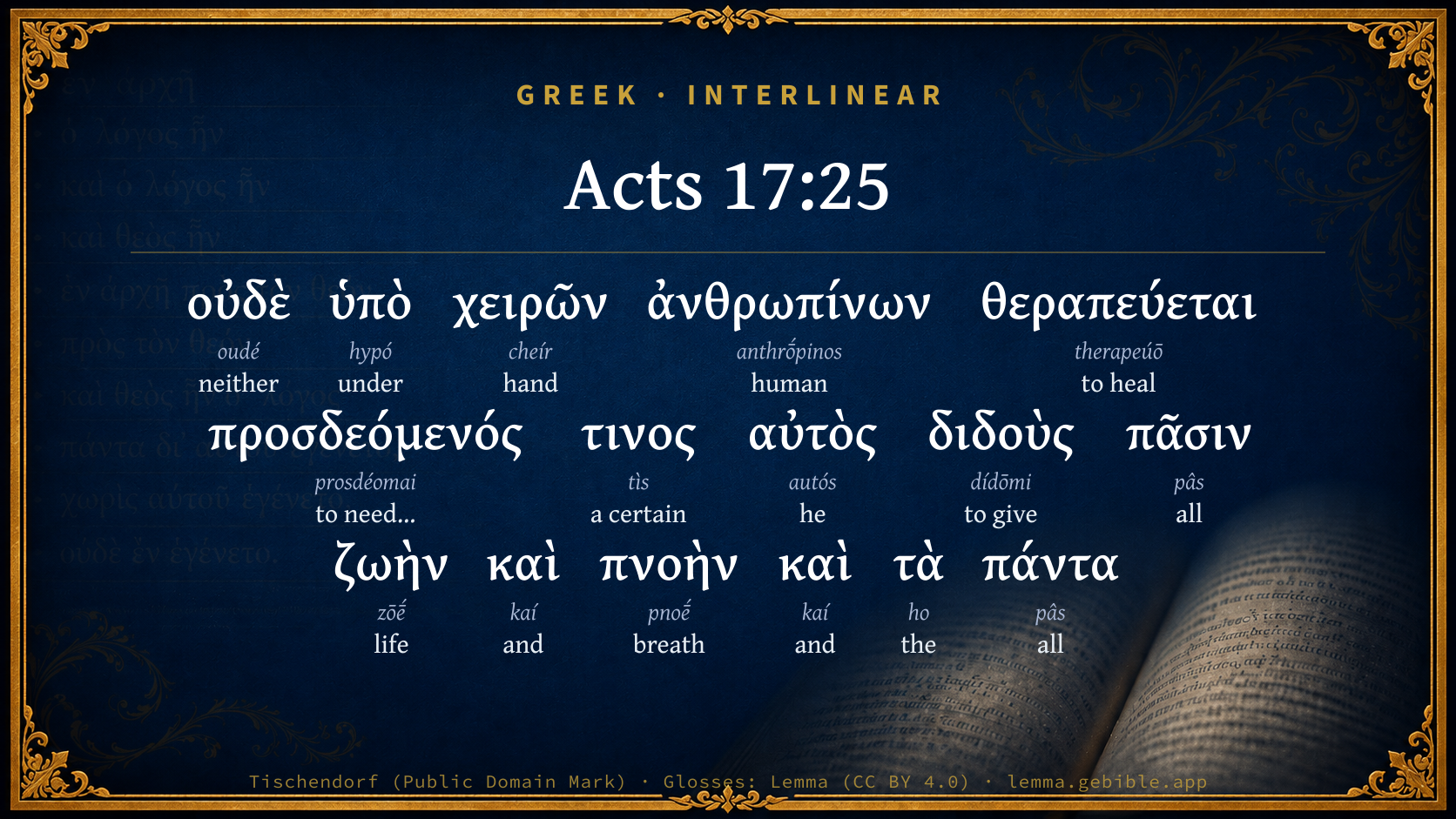
Download image
Cite this verse

Acts 17:25 (World English Bible). Public Domain. Lemma interlinear Bible study tool, https://lemma.gebible.app/v/acts/17/25.

Show BibTeX & RIS
BibTeX
RIS
English Translation
neither is he served by men's hands, as though he needed anything, seeing he himself gives to all life and breath, and all things.
World English Bible · Public Domain
Highlights
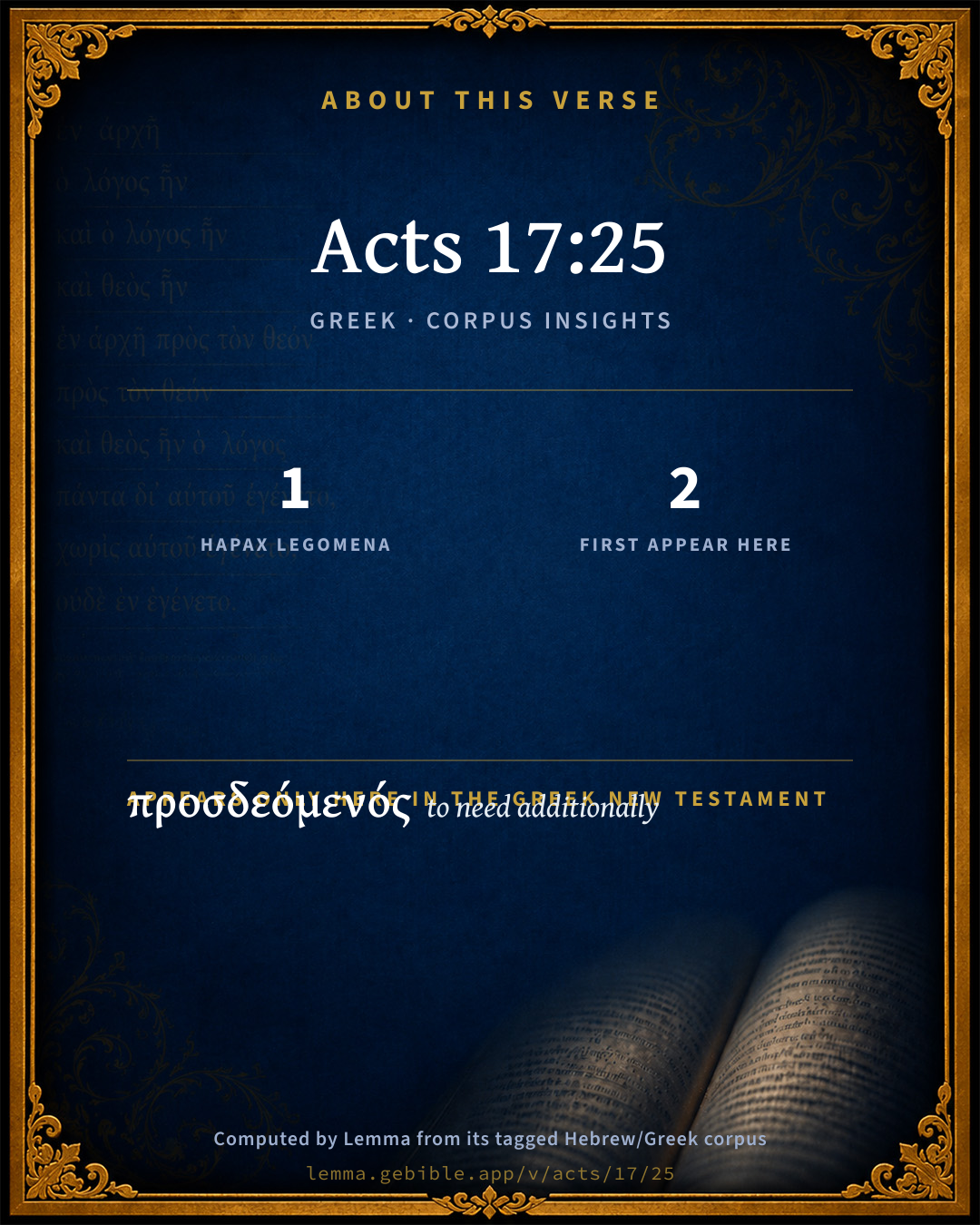
  • 1 hapax legomenon — only here in the Greek New Testament
  • 2 first appearances in the Greek New Testament
Full analysis ↓
Download a study sheet

One document with this verse’s original text, its word-by-word gloss line, the meaning frame, cross-references with their text, attributed commentary, and full source and license credits — printable, and it pastes into notes with its structure intact.

This verse Autodidact and up

Study sheet (.html) Plain text (.txt)

A passage Seminary Student

Up to 50 verses in one chapter. A passage sheet keeps up to 6 commentary sources and 12 cross-references per verse, in the order this page ranks them, and says so on the sheet whenever that leaves anything out. Ask for a single verse and you get the Autodidact verse sheet above.

Everything on this page stays free to read, with no account — the sheet is a download of what is already on screen, not access to it.

Want to remove ads? Support Godless Engineer
Compare translations 3

The same verse in 3 English versions, stacked beneath the original-language interlinear above. Click any original word for its lexicon entry.

Each is an independent rendering of the whole verse — the interlinear is not word-aligned to these translations.

Highlighted words mark where these versions differ — a whole-verse word diff, not a word-by-word alignment.

  • World English Bible Public Domain
    neither is he served by men's hands, as though he needed anything, seeing he himself gives to all life and breath, and all things.
  • King James Version Public Domain
    Neither is worshipped with men's hands, as though he needed any thing, seeing he giveth to all life, and breath, and all things;
  • unfoldingWord Literal Text CC BY-SA 4.0
    Neither is he cared for by hands of men, needing anything, himself giving life and breath and all things to all.

unfoldingWord Literal Text — © unfoldingWord, licensed CC BY-SA 4.0. Word-aligned USFM3 via Door43 (git.door43.org/unfoldingWord/en_ult).

Versions to compare (up to 4)

3 of 4 selected

Show all 19 translations

Every available English version of this verse, each an independent rendering of the whole verse.

  • World English Bible Public Domain
    neither is he served by men's hands, as though he needed anything, seeing he himself gives to all life and breath, and all things.
  • Berean Standard Bible Public Domain
    Nor is He served by human hands, as if He needed anything, because He Himself gives everyone life and breath and everything else.
  • Majority Standard Bible Public Domain
    Nor is He served by the hands of men, as if He needed anything, because He Himself gives everyone life and breath and everything else.
  • King James Version Public Domain
    Neither is worshipped with men's hands, as though he needed any thing, seeing he giveth to all life, and breath, and all things;
  • American Standard Version (1901) Public Domain
    neither is he served by men's hands, as though he needed anything, seeing he himself giveth to all life, and breath, and all things;
  • Revised Version (1885) Public Domain
    neither is he served by men’s hands, as though he needed anything, seeing he himself giveth to all life, and breath, and all things;
  • Geneva Bible (1599) Public Domain
    Neither is worshipped with mens handes, as though he needed any thing, seeing hee giueth to all life and breath and all things,
  • Douay-Rheims (1899) Public Domain
    Neither is he served with men's hands, as though he needed any thing; seeing it is he who giveth to all life, and breath, and all things:
  • Young's Literal Translation Public Domain
    neither by the hands of men is He served -- needing anything, He giving to all life, and breath, and all things;
  • Literal Standard Version CC BY-SA 4.0
    neither is He served by the hands of men—needing anything, He giving life to all, and breath, and all things;
  • Unlocked Literal Bible CC BY-SA 4.0
    Neither is he served by men's hands, as though he needed anything, since he himself gives people life and breath and everything else.
  • unfoldingWord Literal Text CC BY-SA 4.0
    Neither is he cared for by hands of men, needing anything, himself giving life and breath and all things to all.
  • Darby Bible Public Domain
    nor is served by men's hands as needing something, himself giving to all life and breath and all things;
  • World Messianic Bible Public Domain
    He isn’t served by men’s hands, as though he needed anything, seeing he himself gives to all life and breath and all things.
  • Webster's Bible Public Domain
    Neither is worshiped with men's hands, as though he needed any thing, seeing he giveth to all life, and breath, and all things;
  • Free Bible Version CC BY-SA 4.0
    He doesn't need to be served by us as if he needed anything, since he is the source of all life for every living being.
  • Bible in Basic English Public Domain
    And he is not dependent on the work of men's hands, as if he had need of anything, for he himself gives to all life and breath and all things;
  • Text-Critical English NT CC BY 4.0
    neither is he served by the hands of men, as though he needed anything. Rather, he himself continually gives life and breath to all mankind.
  • Tyndale New Testament (1534) Public Domain
    nether is worshipped with mennes hondes as though he neded of eny thinge seinge he him selfe geveth lyfe and breeth to all men every where

Literal Standard Version (2020), Covenant Press — licensed CC BY-SA 4.0. Text via the HelloAO Bible API (eBible.org). Unlocked Literal Bible (unfoldingWord) — licensed CC BY-SA 4.0. Text via the HelloAO Bible API (eBible.org). unfoldingWord Literal Text — © unfoldingWord, licensed CC BY-SA 4.0. Word-aligned USFM3 via Door43 (git.door43.org/unfoldingWord/en_ult). Free Bible Version, Dr. Jonathan Gallagher — licensed CC BY-SA 4.0. Text via the HelloAO Bible API (eBible.org).

Word by word

More ways to search: Search by grammar → Find every occurrence → Compare this word →

Practice this passage: Drill this verse → Learn its vocabulary →

προσδεόμενός
prosdéomai
G4326
“to need additionally”
Verb, Present, Middle or Passive deponent, Participle, Nominative, Singular, Masculine
Part of Speech
Verb
Tense
Present
Voice
Middle or Passive deponent
Mood
Participle
Case
Nominative
Number
Singular
Gender
Masculine
Full Thayer's Definition

Origin: from G4314 and G1189

TDNT: 02:41,1

1. to want besides, need in addition
  1. οὐδὲ oudé G3761 “neither” Conjunction, Negative
  2. ὑπὸ hypó G5259 “under” Preposition
  3. χειρῶν cheír G5495 “hand” Noun, Genitive, Plural, Feminine
  4. ἀνθρωπίνων anthrṓpinos G442 “human” Adjective, Genitive, Plural, Masculine
  5. θεραπεύεται therapeúō G2323 “to heal” Verb, Present, Passive, Indicative, 3rd person, Singular
  6. τινος tìs G5100 “a certain” Indefinite pronoun, Genitive, Singular, Neuter
  7. αὐτὸς autós G846 “he” Personal pronoun, Nominative, Singular, Masculine
  8. διδοὺς dídōmi G1325 “to give” Verb, Present, Active, Participle, Nominative, Singular, Masculine
  9. πᾶσιν pâs G3956 “all” Adjective, Dative, Plural, Neuter
  10. ζωὴν zōḗ G2222 “life” Noun, Accusative, Singular, Feminine
  11. καὶ kaí G2532 “and” Conjunction
  12. πνοὴν pnoḗ G4157 “breath” Noun, Accusative, Singular, Feminine
  13. καὶ kaí G2532 “and” Conjunction
  14. τὰ ho G3588 “the” Article, Accusative, Plural, Neuter
  15. πάντα pâs G3956 “all” Adjective, Accusative, Plural, Neuter

About this verse

These counts appear in no published source. They are computed here, from the morphology-tagged text and Lemma’s own curated glosses. What Lemma adds →

16
words
14
distinct lemmas
Acts
section

Notable vocabulary

1 hapax legomenon — a word that appears only here in the entire Greek New Testament:

  • προσδεόμενός to need additionally G4326

First appearance in Scripture

These words make their first canonical appearance in the Greek New Testament here:

  • ἀνθρωπίνων human G442
  • προσδεόμενός to need additionally G4326

Shared distinctive vocabulary

πνοὴν breath G4157 occurs in 2 verses of the Greek New Testament. Also found in:
Repetition

Words recur within this verse:

Cross-references

23

Topical passages linked to Acts 17:25 in the Treasury of Scripture Knowledge — connected by theme and wording, ordered by reader-vote popularity; previews shown in the World English Bible.

  • Psalms 50:8–13 I don't rebuke you for your sacrifices. Your burnt offerings are continually before me.
  • Genesis 2:7 Yahweh God formed man from the dust of the ground, and breathed into his nostrils the breath of life; and man became a living soul.
  • Isaiah 42:5 Thus says God Yahweh, he who created the heavens, and stretched them forth; he who spread abroad the earth and that which comes out of it; he who gives breath to the people on it, and spirit to those who walk therein:
  • Job 33:4 The Spirit of God has made me, And the breath of the Almighty gives me life.
  • Acts 17:28 'For in him we live, and move, and have our being.' As some of your own poets have said, 'For we are also his offspring.'
  • Romans 11:35 "Or who has first given to him, And it will be repaid to him again?"
  • Job 22:2 "Can a man be profitable to God? Surely he who is wise is profitable to himself.
  • Job 35:6–7 If you have sinned, what effect do you have against him? If your transgressions are multiplied, what do you do to him?
  • Job 12:10 In whose hand is the life of every living thing, The breath of all mankind?
  • Psalms 104:27–30 These all wait for you, That you may give them their food in due season.
  • Job 27:3 (For the length of my life is still in me, And the spirit of God is in my nostrils);
  • Psalms 16:2 My soul, you have said to Yahweh, "You are my Lord. Apart from you I have no good thing."
  • 1 Timothy 6:17 Charge those who are rich in this present world that they not be haughty, nor have their hope set on the uncertainty of riches, but on the living God, who richly provides us with everything to enjoy;
  • Zechariah 12:1 An oracle. The word of Yahweh concerning Israel. Yahweh, who stretches out the heavens, and lays the foundation of the earth, and forms the spirit of man within him says:
  • Numbers 27:16 Let Yahweh, the God of the spirits of all flesh, appoint a man over the congregation,
  • Job 34:14 If he set his heart on himself, If he gathered to himself his spirit and his breath;
  • Isaiah 57:16 For I will not contend forever, neither will I be always angry; for the spirit would faint before me, and the souls who I have made.
  • Jeremiah 7:20–23 Therefore thus says the Lord Yahweh: Behold, my anger and my wrath shall be poured out on this place, on man, and on animal, and on the trees of the field, and on the fruit of the ground; and it shall burn, and shall not be quenched.
  • Amos 5:21–23 I hate, I despise your feasts, And I can't stand your solemn assemblies.
  • Matthew 5:45 that you may be children of your Father who is in heaven. For he makes his sun to rise on the evil and the good, and sends rain on the just and the unjust.
  • Matthew 9:13 But you go and learn what this means: 'I desire mercy, and not sacrifice,' for I came not to call the righteous, but sinners to repentance."
  • Acts 14:17 Yet he didn't leave himself without witness, in that he did good and gave you rains from the sky and fruitful seasons, filling our hearts with food and gladness."
  • Numbers 16:22 They fell on their faces, and said, God, the God of the spirits of all flesh, shall one man sin, and will you be angry with all the congregation?

Cross-references courtesy of OpenBible.info (CC BY 4.0).

Where the printed editions differ

1 variant

Places in this verse where the major printed Greek editions disagree on the wording in a way that affects the translation — a comparison of editions, not a manuscript-by-manuscript collation. The editions are the modern critical texts (Nestlé-Aland 28/27, SBL, Westcott-Hort, Tregelles, Tyndale House) and the traditional texts behind the KJV (the Textus Receptus and the Byzantine/Majority text). It is not a claim about which reading is original.

  1. Editions differ
    καὶ

    “and”

    In NA28NA27TynSBLWHTregTR»1Byz»1 Not in TRByz

Textual data: Translators Amalgamated Greek New Testament (STEPBible TAGNT) · CC BY 4.0.

Commentary

Notes on Acts 17:25 from classic Christian and Jewish commentators (each source and its license shown beneath its notes). The classic Christian expositions comment on the surrounding passage and are grouped to its opening verse, so a note may address several verses; the Jewish commentaries on the Tanakh (Rashi and others) are per-verse, so they appear only where the commentator wrote on this verse.

Lemma curates 59 commentaries, every one of them public domain or Creative Commons licensed, each selected and text-cleaned for this edition rather than reprinted as found. About our sources →

The Biblical Illustrator

Joseph S. Exell

Act_17:25

Neither is worshipped with mens hands.

Contrast between God and idols

Idols certainly require the care of human hands. There are still shops in the cities of India and China, with this inscription on their sign boards, Here old gods are repaired and renovated. (Leonhard.)

As though He needed anything.

God has no needs

The idol was supposed to be a needy, dependent being, fed by the hands of man. God not so (Psa_50:1-23). Notice the main points of comparison.

I. Idols are dead; God lives of Himself and by Himself. He gives--

1. Life. What a gift is life! And what a giver the Author of life!

2. Breath.

3. All things necessary for the sustentation and continuance of both. It is not matter that lives, but God in matter. This living God is the Being with whom we have to do; there is a living eye on thee, a judge taking account now.

II. God is the builder of His own temple. The idol is made, then a temple is built, and the idol is put there and chained, that he might not be stolen. God too has a temple; but He is the architect of His own temple, erected it not for Himself but for us; worship is for the benefit of man. It is getting, not giving; receiving, not imparting. Worship may be regarded--

1. As the highest exercise of mans nature. Man can never be greater than when he stands before God; a creature can never perform a nobler office than when thus holding communion with God.

2. As the purest influence of mans nature. Sin is put down by this. We must look up, not down; the glance of the eye on the infinite is worth all the talking and troubling our minds about non-essentials in religion. But we must get the principles from the habit of looking up.

3. As the truest happiness. Have you ever felt happiness corresponding to the high demands of your nature? When your soul has been with God, how little did this world appear then!

III. God is the proprietor of His own sacrifice. All dead matter, silver and gold, our body, soul, intellect, affections, hopes, fears, are Gods. When we worship we are teaching ourselves a great truth, instructing ourselves in our own dependence on God.

IV. God is the father of His own worshippers.

1. Paul shows the nature of man. We are also His offspring. The tree, the elephant, birds, stars, etc., are not like God. They are far from Him, they are matter; He is mind. They are dead; He is living. But we are like God. We have power to think as He thinks, to love as He loves, to be felicitous as He is felicitous.

2. We have the destiny of this nature. Seek the Lord, if haply they might find Him. Seek Him, so as to feel Him touch the soul. Are you in search after God? Whatever pursuit fails, this will not. It is the only study worthy the soul of man. (Caleb Morris.)

God has no needs

I. This declaration sheds considerable light on God Himself, who is underived, unconditioned, everlasting, and the source of all other life throughout the universe. We have to do with a living God; therefore let us have no dead souls or dead services.

II. How may this truth apply to the scheme of redemption? God is all fulness of being, excellency, and blessing; yet He has condescended to propose reconciliation to men. The advantage here is altogether on the side of men. And what an advantage it is f It is the fulness, the power, of the rich God spreading Himself out through the entire nature of man; so that he feels he is invested with every attribute God possesses. When man is thus brought into union with the rich God, he receives two things which constitute his spiritual life.

1. A consciousness of his relationship to God. A living consciousness that we are His offspring, in whom we live and move and have our being. That feeling is worth the universe. Man is a child of God, whether he feels it or not; he has not lost his relationship to God. What has he lost by sin?

(1) The filial character. All likeness to Gods character.

(2) Sympathy to the Father. He does not love what God loves, nor hate what God hates.

(3) The knowledge of God to a great extent. Not altogether. He is far from God, as an isolated being. Man has not the slightest formal knowledge of Him as his Father.

(4) Every disposition to return to God.

2. But when the poor sinner comes to the rich God what takes place?

(1) There is a quickening sense of his relationship. He says, I am not worthy to be called Thy son. Then he says, Talk to me about my Father. The soul sympathises with God till it has impressed on it Gods character.

(2) There is a right in all the privileges involved in the relationship (Rom_8:17). Think how Christ is the heir of God; think of His position, offices, glory; then imagine yourselves to be in a state of approximation to Him; and then feel what it is to be enriched with the riches of God.

III. God has no needs. Then He is more than adequate to finish the work of redemption. If He has all power, He is able to work out mens salvation. Man has not a fixed purpose. God has a clear, definite conception of the Divine scheme of salvation. God is so in love with His purpose of saving man there is no fear of His giving it up. Men often fail in their purposes in consequence of impediments. God, who is the Creator of heaven and earth, has dominion over all things.

IV. God has no needs. Then He could have no motives in redemption but generosity. (Caleb Morris.)

Seeing that He giveth to all life.--

Gods bounty

He giveth--

I. Life, and none but He, the Living One. It is a rill from the Fountain of Life. Growth and other qualities belong to plants, such as circulation of sap and respiration by their leaves; but life characterises man--with its voluntary and involuntary functions, its enjoyments and capabilities, its appetites and instincts, its operations on the world without it, and its conscious possession of its powers within it. Pleasure, glory, and usefulness are bound up with its prolongation. So sweet is it that few choose to part with it, and the cessation of it was regarded by the apostles hearers as the direst of calamities. He who is our life confers and supports it in His ineffable goodness--for man liveth not by bread alone.

II. Breath, Which, as the condition and means of life, is, therefore, singled out. Even then the atmosphere was popularly valued as the first of necessary gifts, and, when scientifically examined, its preciousness is not only confirmed, but it becomes a powerful proof of Divine unceasing goodness. For the air we breathe is endowed with many qualities, the loss or disturbance of which must be fatal to life. If it lose its gravity, or if its elasticity be changed or become changeable; if it thicken, and darken, and cease to be an invisible medium; if it be deprived of its compressibility, or if any amount of cold could condense it; if the gases composing it were to vary in their proportions: or if it were not universally present, and what is vitiated by respiration purified and restored--animal existence would be extinguished on the face of the earth.

III. And His bounty is immense, for He giveth all things. Whatever we have He has given us--the food on our table, and the raiment on our persons, with ability to win them and health to enjoy them. Nor let any man boast of being the architect of his own fortune; for the materials out of which he builds it, the skill with which he constructs it, and the propitious season which enables him to rear it without pause or discomfiture--are each of them the gift of the one sovereign Benefactor. Discovery, invention, science, art, adventure, commercial shrewdness, literary power, mechanical skill, and political success; the sharp eye that is first to perceive the tide in the affairs of men; and the wary enterprise that launches the vessel upon it--are not self-originated. Every good gift and every perfect gift is from above, and cometh down from the Father of Lights. (Prof. Eadie.)

The Biblical Illustrator, edited by Joseph S. Exell (c. 1880s–1900s) — public domain. Text from a community e-Sword module.

Bengel's Gnomon

Johann Albrecht Bengel

Act 17:25. Οὐδὲ, neither) The negation belongs to προσδεόμενος. He is said προσδεῖσθαι, who has something, but accompanied with some degree of need (of it): 2Ma 14:35, σὺ, κύριε, τῶν ὅλων ἀπροσδεὴς ὑπάρχων, εὐδόκησας ναὸν, κ.τ.λ.—θεραπεύεται) Middle.—τινός) There is a double antithesis to this, πᾶσι and πάντα. The masculine is included in the signification of the neuter τινός.—διδοὺς) He hath given and gives.—πᾶσι) to all who live and breathe, who are in the highest degree προσδεόμενοι, in need. As to man specially, see the foll. ver.—ζωὴν, life) To this refer we live, Act 17:28.—πνοὴν, breath) spirit. To this refer we move, Act 17:28. It is by the spirit, or breath, that the life is continued. This moment I breathe, the very next moment that follows is not in my power.—τὰ πάντα, all that they have) To this refer we have our being, Act 17:28.

Bengel's Gnomon of the New Testament — English translation (T&T Clark, Edinburgh, 1860) — public domain. Text from a community e-Sword module.

Expositor's Greek Testament

ed. W. Robertson Nicoll

Act 17:25 . οὐδὲ … θεραπεύεται : used in LXX and in classical Greek of the service of the Gods, significantly twice in Epist. Jer [313] , 17:27, 39, of the worshippers and priests of the idols overlaid with silver and gold, which are contrasted with the true God in that they can save no man from death, or show mercy to the widow and the fatherless, before which the worshippers set offerings and meat as before dead men. “Non quærit ministros Deus. Quidni? ipse humano generi ministrat,” Seneca, Epist. , 95, and instances in Wetstein; but St. Chrysostom’s comment must also be noted, λέγων δέ , μὴ ὑπὸ χ . ἀνθ . θεραπεύεσθαι τὸν θεόν , αἰνίττεται ὅτι διανοίᾳ καὶ νῷ θεραπεύεται . προσδεόμενός τινος : only here in N.T., to need in addition, as if necessary to perfection, “qui habet quidem aliquid, sed non satis, qui insuper eget,” Wetstein, so “cum … nullius boni desideret accessionem ,” Erasmus; a close parallel is found in 2Ma 14:35 ( 3MMal 2:9 ); in both passages the word ἀπροσδεής is used of God, and in the former reference is made to the fact that God was pleased that the temple of His habitation should be amongst the Jews, cf. also Ecclus. 52:21. Blass and Wetstein both quote a striking Pythagorean saying from Hierocles, see in loco , and to this αὐτάρκεια of the divine nature both the Jewish philosopher Philo and the Roman Epicurean Lucretius from their varying standpoints bore witness, see the instances in Wetstein ( cf. Psa 51:9 ). Luther takes τινος as masculine, which as Wendt admits corresponds well to the preceding and also to the following πᾶσι , but it seems best to take it as neuter, of the service which men render, cf. Clem., Cor [314] , lii., 1, ἀπροσδεής , ἀδελφοί , ὁ δεσπότης ὑπάρχει τῶν ἁπάντων , οὐδὲν οὐδενὸς χρῄζει εἰ μὴ τὸ ἐξομολογεῖσθαι αὐτῷ , and Epist. ad Diognetum , iii., 5. αὐτὸς διδοὺς : “seeing he himself giveth,” R.V., so Vulgate ipse , but although αὐτός is so emphatic it was unfortunately ignored in Wycl., Genevan and A.V. The best commentary on the words is in David’s words, 1Ch 29:14 , cf. the striking passage in Epist. ad Diognetum , iii., 4. πᾶσι : taken as neuter or masculine, but perhaps with Bengel “omnibus viventibus et spirantibus, summe προσδεομένοις indigentibus . De homine speciatim, v. seq.” ζωὴν καὶ πνοὴν , cf. Gen 2:7 , not a mere hendiadys, vitam animalem, or spiritum vitalem, but the first word = life in itself, existence; and the second the continuance of life, “per spiritum (halitum) continuatur vita,” Bengel: on the paronomasia, see Winer-Moulton, lxviii., 1. For πνοή LXX, Psa 150:6 , Job 27:3 , Isa 42:5 , Ecclus. 30:29 ( Sir 33:20 ), 2Ma 3:31 ; 2Ma 7:9 , etc. τὰ πάντα : omnia quæcumque , Rom 8:32 , the expression need not be limited with Bethge to all things necessary for the preservation of life and breath.

[313] Jerome, Hieronymus.

[314] Corinth, Corinthian or Corinthians.

The Expositor's Greek Testament, edited by W. Robertson Nicoll (1897–1910) — public domain. Text from a community e-Sword module.

Jamieson, Fausset & Brown

Robert Jamieson, A. R. Fausset & David Brown

Neither is worshipped with--ministered unto, served by

men's hands, as though he needed anything--No less familiar as this thought also is to us, even from the earliest times of the Old Testament (Job 35:6, Job 35:8; Psa 16:2-3; Psa 50:12-14; Isa 40:14-18), it would pour a flood of light upon any candid heathen mind that heard it.

seeing he--He Himself.

giveth to all life, and breath, and all things--The Giver of all cannot surely be dependent for aught upon the receivers of all (Ch1 29:14). This is the culminating point of a pure Theism.

Jamieson, Fausset & Brown — Commentary Critical and Explanatory on the Whole Bible (1871) — public domain (CC PDM 1.0). Text via the HelloAO Bible API.

Adam Clarke's Commentary

Verse 25. Neither is worshiped with men's hands] This is an indirect stroke against making of images, and offering of sacrifices: he is not worshipped with human hands, as if he needed any thing, or required to be represented under a particular form or attitude; nor has he required victims for his support; for it is impossible that he should need any thing who himself gives being, form, and life, to all creatures.

Giveth-life, and breath, and all things] These words are elegantly introduced by St. Paul: God gives life, because he is the fountain of it: he gives breath, the faculty of breathing or respiration, by which this life is preserved; and though breathing or respiration, be the act of the animal, yet the πνοην, the faculty of breathing, and extracting from the atmosphere what serves as a pabulum of life, is given by the influence of God, and the continued power thus to respire, and extract that pure oxygen gas which is so evident a support of animal life, is as much the continued gift of God as life itself is. But, as much more is necessary to keep the animal machine in a state of repair, God gives the ταπαντα, all the other things which are requisite for this great and important purpose, that the end for which life was given may be fully answered. St. Paul also teaches that Divine worship is not enacted and established for GOD, but for the use of his creatures: he needs nothing that man can give him; for man has nothing but what he has received from the hand of his Maker.

Adam Clarke's Commentary on the Bible (1810–1826) — public domain. Text from a community e-Sword/MySword module.

John Calvin's Commentaries

25. Neither is he worshipped with man’s hands. The same question which was answered of late concerning the temple, may now be objected touching ceremonies. For it seemeth that that may be translated unto the worshippings of the law of Moses, which Paul condemneth in the ceremonies of the Gentiles. But we may readily answer, that the faithful did never properly place the worship of God in ceremonies; but they did only count them helps wherewith they might exercise themselves according to their infirmity. When they did slay beasts, offered bread and drink offerings, light torches and other lights, they knew that godliness was not placed in these things, but being holpen by these, they did always look unto the spiritual worship of God, and they made account of it alone. And God himself saith plainly in many places, that he doth not pass for any external or visible thing, that ceremonies are of themselves of no importance, and that he is worshipped no otherwise but by faith, a pure conscience, by prayer and thankfulness. What did the Gentiles then? to wit, when they erected images, they offered incense, they set forth plays, and laid their cushions before their idols, they thought they had fulfilled the offices of godliness excellent well. Not only the philosophers, but also the poets, do sometimes deride the folly of the common people, because they did disorderly place the worship of God in the pomp and gorgeousness of ceremonies. That I may omit infinite testimonies, that of Persius is well known:

“Tell me, ye priests to sacred rites, what profit gold doth bring? The same which Venus’ puppets fine, certes no other thing. Why give not we to gods that which the blear-eyed issue could of great Messiah never give from out their dish of gold? Right justly deem’d a conscience clear, and heavenly thoughts of mind, A breast with mildness such adorn’d, as virtue hath assign’d, Let me in temples offer these, Then sacrifice the gods shall please.”

And, undoubtedly, the Lord caused profane men to utter such speeches, that they might take away all color of ignorance. But it doth plainly appear, that those who spake thus did straightway slide back again unto common madness; yea, that they did never thoroughly understand what this meant. For though those who pass the common people in wit be enforced to confess that bare ceremonies are in no estimation, yet it is impossible to pull from them this persuasion, but that they will think that they be a part of the divine worship. Therefore, the more diligently they give themselves to such vanities, they do not doubt but that they do the duties of godliness well. Therefore, because all mortal men, from the highest to the lowest, do think that God is pacified with external things, and they will, with their own works, fulfill their duty towards him, that doth Paul refute. There is also a reason added, because, seeing he is Lord of heaven and earth, he needeth nothing, because, seeing that he giveth bread and life to men, he can receive nothing of them again. For what can they bring of their own, who, being destitute of all good things, have nothing but of his free goodness, yea, who are nothing but by his mere grace, who shall forthwith be brought to nought, if he withdraw the Spirit whereby they live? Whereupon it followeth, that they are not only dull, but too proud, if they thrust in themselves to worship God with the works of their own hands.

For whereas he saith, that alms and the duties of love are sweet-smelling sacrifices, that must be distinguished from the matter which we have now in hand, where Paul doth only intreat of the ceremonies which the unbelievers put in place of the spiritual worship of God. By life and breath is mean the life which men live so long as the soul and body are joined together. Touching the end of the sentence, though some Greek books agree in this reading, [κατα παντα], “through all things;” yet that seemeth to me more agreeable which the old interpreter hath, [κατα παντα], “and all things,” because it is both plainer, and doth also contain a more perfect and full doctrine. For thence we do better gather that men have nothing of their own; and also certain Greek copies agree thereto.

John Calvin's Commentaries (1540-1563) — public domain. Text from the Calvin Translation Society English edition (1840s-50s) via the Christian Classics Ethereal Library (ccel.org). Calvin's coverage is partial (roughly two-thirds of the Bible); uncommented books and verses are honest gaps, never fabricated. The 19th-century editor's footnotes and remarks are omitted so the notes are faithfully Calvin's own voice.

Ellicott's Commentary for English Readers

(25) Neither is worshipped with men’s hands, as though he needed any thing.—Literally, as needing anything in addition. The previous words had struck at a false theory of temples, this strikes at a false theory of worship. Men have to think of God as the supreme Giver, not as requiring anything at their hands but justice, mercy, and truth. Both Jewish and heathen writers had borne their witness of the same truth: David had said, “Thou desirest not sacrifice; else would I give it” (Psa_51:16), and the Latin Epicurean poet had written of the Divine nature, that it was—

“Ipsa suis pollens opibus, nihil indiga nostri,

Nec bene promeritis capitur, nec tangitur ira.”

[“Strong in itself, it needeth nought of ours,

Is neither won by gifts, nor moved by wrath.”]

Lucret. ii. 649-50.

The passage is found also in some editions in i. 61, 62.

Life and breath.—If we can draw a distinction between the two words, the first may be held to mean the higher element of man’s life, the latter that which he shares, by virtue of his organization, with other animals. Stoics and Epicureans would, probably, both of them, so far, accept a teaching which echoed much that was taught in their own schools.

A Bible Commentary for English Readers, edited by Charles John Ellicott (1878–1897) — public domain. Text from a community e-Sword module.

The Cambridge Bible for Schools and Colleges

gen. ed. J. J. S. Perowne

25. neither is worshipped with (served by) men’s hands] The verb implies the sort of service yielded by a steward to his master, or a minister to his King, a service in which the superior is not independent of his inferior, and could not well do without him. This is seen in the next clause. God is not like earthly masters and kings. He gives all, and men can only offer to Him themselves in return. Cp. Psalms 50, 51 for like teaching.

The Cambridge Bible for Schools and Colleges (gen. ed. J. J. S. Perowne; Cambridge University Press, 1878–1918) — public domain. Text from a community e-Sword module.

John Gill's Exposition

Neither is worshipped with men's hands,.... Or "served" with them; or "ministered unto" by them, as the Syriac version renders it: and the sense is, that men by worshipping God do not give anything to him, that can be of any use or service to him; he, being God all sufficient, stands in need of nothing; for external worship is not here intended by worshipping with men's hands, in distinction from, and opposition to, internal worship, or to the worship of God with the heart; but that whether it be with the one or with the other, or both, nothing is given to God, as adding any thing to his essential glory and happiness:

as though he needed anything; for he does not, he is "El Shaddai", God all sufficient; nor can anything be given to him, he has not; or otherwise all perfection would not be in him: but that he cannot be indigent of anything, appears from hence,

seeing he giveth to all life and breath; or "the breath of life", as the Ethiopic version renders it; this God breathed into man at first, and he became a living soul; and every animate creature, everyone that has life and breath, have them from God; he gives them to them, and continues them:

and all things; that are enjoyed by them, and are necessary for their subsistence, and for the comfort of life, and for both their use and profit, and for their delight and pleasure; wherefore he that gives them all things, cannot want anything himself, nor receive anything at their hands. This clause is left out in the Syriac, Arabic, and Ethiopic versions.

John Gill's Exposition of the Whole Bible (1746–1763) — public domain (CC PDM 1.0). Text via the HelloAO Bible API.

Trapp's Complete Commentary

John Trapp

25 Neither is worshipped with men’s hands, as though he needed any thing, seeing he giveth to all life, and breath, and all things;

Ver. 25. Neither is worshipped] Colitur vel delinitur, collogued with, or complimented. Colendi verbum απο του κολακευειν, dictum volant eo quod plerunque Dei hominumque cultus cum adulatione et hypocrisi est coniunctus. Sic a λατρευειν, Gallicum flatter. Some derive the word here used, θεραπευω, of the Hebrew Taraph or Teraphim, idols or images, Gen 31:30; Jdg 17:5. God is not so worshipped. (Stuchius de Sacrif. Gentil.; Avenarius; Ainsworth.)

John Trapp, A Commentary or Exposition upon All the Books of the Old and New Testament (1647–1656) — public domain. Text from a community e-Sword module.

Albert Barnes' Notes on the Bible

Neither is worshipped with men’s hands - The word here rendered “worshipped” (θεραπέυεται therapeuetai) denotes to “serve”; to wait upon; and then to render religious service or homage. There is reference here, undoubtedly, to a notion prevalent among the pagan, that the gods were fed or nourished by the offerings made to them. The idea is prevalent among the Hindus that the sacrifices which are made, and which are offered in the temples, are consumed by the gods themselves. Perhaps, also, Paul had reference to the fact that so many persons were employed in their temples in serving them with their hands; that is, in preparing sacrifices and feasts in their honor. Paul affirms that the great Creator of all things cannot be thus dependent on his creatures for happiness, and consequently, that that mode of worship must be highly absurd. The same idea occurs in Psa 50:10-12;

For every beast of the forest is mine;

And the cattle upon a thousand hills.

I know all the fowls of the mountain;

And the wild beasts of the field are mine.

If I were hungry, I would not tell thee;

For the world is mine, and the fulness thereof.

Seeing he giveth - Greek: he having given to all, etc.

Life - He is the source of life, and therefore he cannot be dependent on that life which he has himself imparted.

And breath - The power of breathing, by which life is sustained. He not only originally gave life, but he gives it at each moment; he gives the power of drawing each breath by which life is supported. It is possible that the phrase “life and breath may be the figure hendyades, by which one thing is expressed by two words. It is highly probable that Paul here had reference to Gen 2:7; “And the Lord God breathed into his nostrils the breath of life.” The same idea occurs in Job 12:10;

In whose hand is the life (margin) of every living thing;

And the breath of all mankind.

And all things - All things necessary to sustain life. We may see here how dependent man is on God. There can be no more absolute dependence than that for every breath. How easy it would be for God to suspend our breathing! How incessant the care, how unceasing the providence, by which, whether we sleep or wake - whether we remember or forget him, he heaves our chest, fills our lungs, restores the vitality of our blood, and infuses vigor into our frame! Compare the notes on Rom 11:36.

Albert Barnes' Notes on the Bible (1834–1885) — public domain. Text from a community e-Sword/MySword module.

Matthew Poole's English Annotations

As though he needed any thing; God is not worshipped or served by holy men, because he wants their service, or any thing that can be offered unto him by them; but because it is their duty and advantage to be employed in his service and worship, Psa 50:10,11.

Life, and breath; the breath of life, Gen 2:7. And in this respect God is called the God of the spirits of all flesh, Num 16:22; as the cause of life and breath in all creatures, but especially in man; which made that charge so great against Belshazzar, Dan 5:23, that his breath was in God’s hand, and yet he had not glorified him.

Matthew Poole's English Annotations on the Holy Bible (1683–1685) — public domain. Text from a community e-Sword/MySword module.

Whedon's Commentary on the Bible

Daniel D. Whedon

25. As though he needed any thing—A fatal blow at the whole system of pagan rituals, which assumed that its sacrifices and incense gratified the appetites and senses of the human-like deities.

Daniel D. Whedon (gen. ed.), Commentary on the Old and New Testaments (1874–1909) — public domain. Text from a community e-Sword module.

The Pulpit Commentary

Is he served by for is worshipped with, A.V; he himself for he, A.V. Served by men"s hands. Qerapeuetai, is "waited upon," as a man is waited upon by his servant, who ministers to his wants; qerapwn and qerapeuthv are "an attendant." So in Hebrew: db to serve God; dbe; a servant of God; hdwOb service as of the Levites in the temple, etc. Anything; or as some take it, as if he needed anybody"s help or service. The argument, as Chrysostom suggests, is similar to that in Ps

1.

The Pulpit Commentary (1880–1919), ed. H.D.M. Spence-Jones & Joseph S. Exell — public domain. Text from a community e-Sword module.

John Wesley's Explanatory Notes

Neither is he served as though he needed any thing - or person - The Greek word equally takes in both. To all - That live and breathe;-in him we live; and breathe - In him we move. By breathing life is continued. I breathe this moment: the next is not in my power: and all things - For in him we are. So exactly do the parts of this discourse answer each other.

John Wesley, Explanatory Notes Upon the Whole Bible (1754–1765) — public domain. Text via the GEBible commentary corpus.

McGarvey & Pendleton's Commentaries

J. W. McGarvey

See notes on verse 22

J. W. McGarvey (with Philip Y. Pendleton), Commentaries on the New Testament (The Fourfold Gospel, 1914; Acts; and the epistles) — public domain. Text from a community e-Sword/MySword module.

Cambridge Greek Testament for Schools and Colleges

25. οὐδὲ ὑπὸ χειρῶν ἀνθρωπίνων θεραπεύεται neither is served by men’s hands. θεραπεύειν implies the sort of service yielded by a steward to his master, or a minister to his king, a service in which the superior is not independent of his inferior, and could not well do without him. This is seen in the next clause. God is not like earthly masters and kings. He gives all, and men can only offer to Him themselves in return. Cf. Psalms 50, 51 for like teaching. See also Chrysostom on this verse, λέγων δέ, μὴ ὑπὸ χειρῶν ἀνθρώπων θεραπεύεσθαι τὸν θεόν, αἰνίττεται ὅτι διανοίᾳ καὶ νῷ θεραπεύεται.

ζωὴν καὶ πνοὴν καὶ τὰ πάντα, life and breath and all things. The Apostle in the paronomasia seems to be adapting his style somewhat to his audience. Such similarity of sound was thought to give elegance.

Cambridge Greek Testament for Schools and Colleges (Cambridge University Press, 1896; 21 vols, various authors incl. Carr, Maclear, Plummer, Farrar, Lumby, Moule, M. R. James, Simcox) — public domain. Text from a community e-Sword module.

Alford’s Greek Testament

Henry Alford

25.] θεραπεύεται, is (really and truly) served.

So θεὸς οὐ μυκτηρίζεται, Gal 6:7.

προσδ.] ἐνδεῖσθαι μέν ἐστι τὸ παντελῶς μὴ ἔχειν· προσδεῖσθαι δὲ τὸ ἔχειν μὲν μέρος, ἔτι δὲ δεῖσθαι πρὸς τὸ τέλειον. Ulpian (in Wetst.).

As the assertion of Creation contradicted the Epicurean error, so this laid hold of that portion of truth, which, however disguised, that school had apprehended: ‘Omnis enim per se divûm natura necesse est | Immortali ævo summa cum pace fruatur. |.… | Ipsa suis pollens opibus, nihil indiga nostri,’ Lucret. i. 57. There is a verse in 2 Macc. 14:35, remarkable, as compared with the thoughts and words of Paul here: σύ, κύριε, τῶν ὅλων ἀπροσδεὴς ὑπάρχων, εὐδοκήσας ναὸν τῆς σῆς κατασκηνώσεως ἐν ἡμῖν γενέσθαι.

τινός] neuter, as referring to the temples and statues offered by the Athenians.

ζωὴν κ. πνοήν] He is the Preserver, as well as the Creator, of all; and all things come to us from Him. Compare, on τὰ πάντα, David’s words, 1Ch 29:14, σὰ τὰ πάντα, καὶ ἐκ τῶν σῶν δεδώκαμέν σοι.

Henry Alford, The Greek Testament (1849–1861) — public domain. Text from a community e-Sword module.

Vincent's Word Studies in the New Testament

Marvin R. Vincent

Is worshipped [θεραπευεται] . Incorrect. Rendel; as Rev., served. Luke often uses the word in the sense of to heal or cure; but this is its primary sense. See on Luke verse 15. It refers to the clothing of the images of the gods in splendid garments, and bringing them costly gifts and offerings of food and drink.

As though he needed [προσδεομενος] . Properly, "needed anything in addition [προς] to what he already has."

Marvin R. Vincent, Word Studies in the New Testament (1887–1900) — public domain. Text from a community e-Sword/MySword module.

Lesson kit

Teaching starters — assembled from the data on this page, not authored interpretation. Every prompt links to the verse data it draws on. Edit before teaching.

Acts, in the Acts, opens this verse with 16 words (14 distinct Greek lemmas). Its most distinctive word is prosdéomai (“to need additionally”). A historical commentator’s framing appears above. Read the whole chapter for the surrounding context.

Discussion questions

  1. What does “to need additionally” (prosdéomai) contribute to the verse as a whole?
  2. This verse holds 1 word here found nowhere else in the Greek New Testament. What might the rare word draw attention to?
  3. 2 words here appear for the first time in Scripture. What is being introduced at this debut?
  4. Acts 2:2 shares the word «breath» with this verse. How do the two illuminate each other?
  5. “all” occurs 2× in this one verse. What is the effect of the repetition?
  6. These translations render this verse differently; the difference is in the English rendering, not the original. What questions does that raise?
  7. Reading how The Biblical Illustrator and Bengel's Gnomon read this verse, where do the two commentators agree and where do they part?

Things to notice

  • 1 word in this verse appears nowhere else in the Greek New Testament.
  • 2 words make their first canonical appearance in Scripture here.
  • These translations choose different wording for 16 words in this verse.
  • “all” occurs 2× in this single verse.
  • 14 distinct Greek lemmas span 16 words in this verse.

Reading settings

Reading text

Shown beneath each verse's original-language words.

Old Testament
Old Testament edition

Read the OT as the Masoretic Hebrew (MT) or the Greek Septuagint (LXX).

English shown for the Greek Septuagint (in the Hebrew ↔ Greek comparison).

Comparing translations? Open the Compare panel on any verse page to stack up to four side by side.