
Matthew 8:3

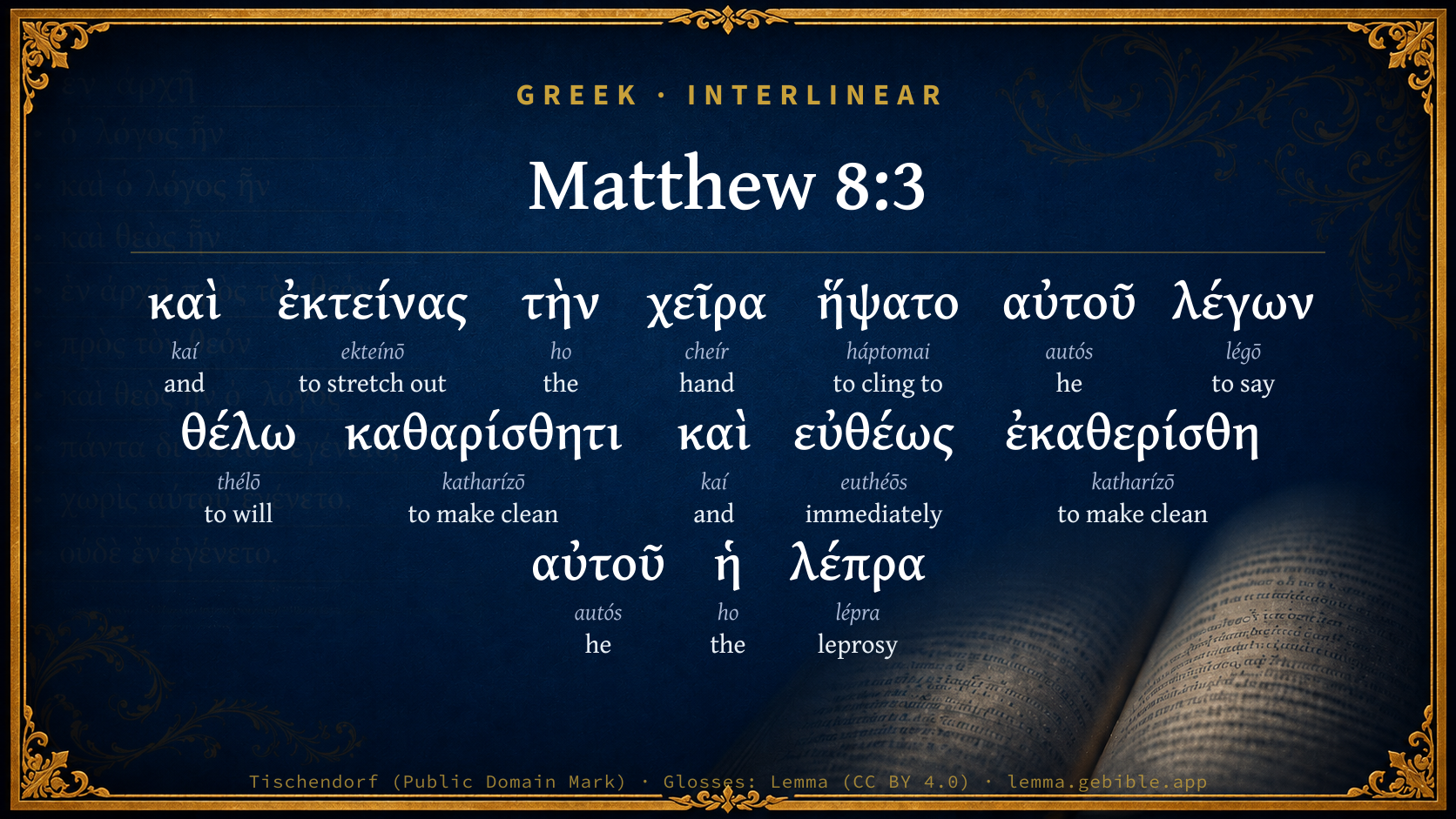
Greek (Tischendorf 8th ed.) Matthew 8:3 appears in the Greek New Testament. The text above is from the Tischendorf 8th edition. Each word links to its Strong’s number and a concise gloss. Click any word for its full Thayer’s Greek Lexicon entry.
Download image
Cite this verse

Matthew 8:3 (World English Bible). Public Domain. Lemma interlinear Bible study tool, https://lemma.gebible.app/v/matthew/8/3.

Show BibTeX & RIS
BibTeX
RIS
English Translation
Jesus stretched out his hand, and touched him, saying, "I want to. Be made clean." Immediately his leprosy was cleansed.
World English Bible · Public Domain
Highlights
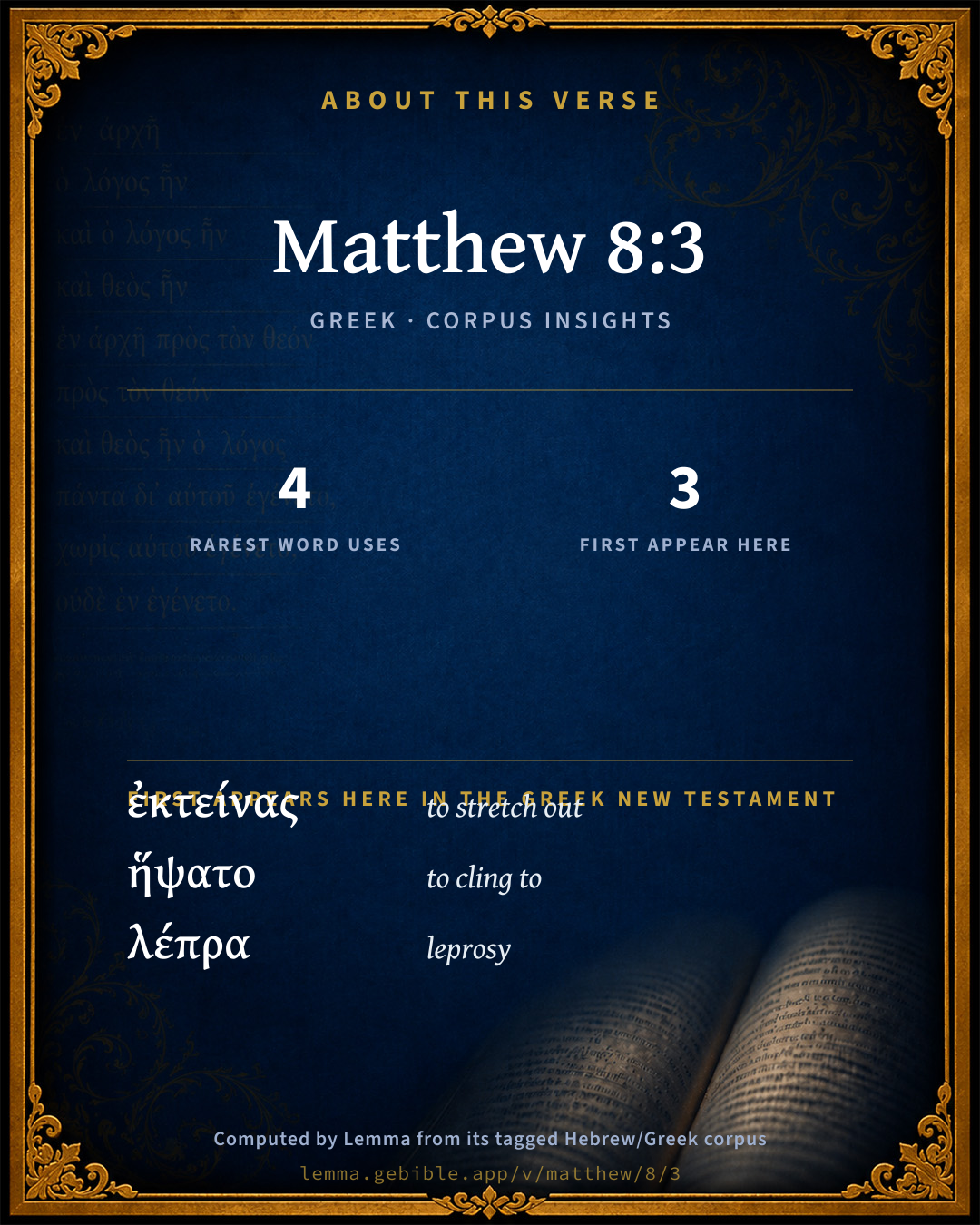
  • 3 first appearances in the Greek New Testament
Full analysis ↓
Download a study sheet

One document with this verse’s original text, its word-by-word gloss line, the meaning frame, cross-references with their text, attributed commentary, and full source and license credits — printable, and it pastes into notes with its structure intact.

This verse Autodidact and up

Study sheet (.html) Plain text (.txt)

A passage Seminary Student

Up to 50 verses in one chapter. A passage sheet keeps up to 6 commentary sources and 12 cross-references per verse, in the order this page ranks them, and says so on the sheet whenever that leaves anything out. Ask for a single verse and you get the Autodidact verse sheet above.

Everything on this page stays free to read, with no account — the sheet is a download of what is already on screen, not access to it.

Want to remove ads? Support Godless Engineer
Compare translations 3

The same verse in 3 English versions, stacked beneath the original-language interlinear above. Click any original word for its lexicon entry.

Each is an independent rendering of the whole verse — the interlinear is not word-aligned to these translations.

Highlighted words mark where these versions differ — a whole-verse word diff, not a word-by-word alignment.

  • World English Bible Public Domain
    Jesus stretched out his hand, and touched him, saying, "I want to. Be made clean." Immediately his leprosy was cleansed.
  • King James Version Public Domain
    And Jesus put forth his hand, and touched him, saying, I will; be thou clean. And immediately his leprosy was cleansed.
  • unfoldingWord Literal Text CC BY-SA 4.0
    And having reached out his hand, he touched him, saying, “I am willing. Be clean.” And immediately his leprosy was cleansed.

unfoldingWord Literal Text — © unfoldingWord, licensed CC BY-SA 4.0. Word-aligned USFM3 via Door43 (git.door43.org/unfoldingWord/en_ult).

Versions to compare (up to 4)

3 of 4 selected

Show all 19 translations

Every available English version of this verse, each an independent rendering of the whole verse.

  • World English Bible Public Domain
    Jesus stretched out his hand, and touched him, saying, "I want to. Be made clean." Immediately his leprosy was cleansed.
  • Berean Standard Bible Public Domain
    Jesus reached out His hand and touched the man. “I am willing,” He said. “Be clean!” And immediately his leprosy was cleansed.
  • Majority Standard Bible Public Domain
    Jesus reached out His hand and touched the man. “I am willing,” He said. “Be clean!” And immediately his leprosy was cleansed.
  • King James Version Public Domain
    And Jesus put forth his hand, and touched him, saying, I will; be thou clean. And immediately his leprosy was cleansed.
  • American Standard Version (1901) Public Domain
    And he stretched forth his hand, and touched him, saying, I will; be thou made clean. And straightway his leprosy was cleansed.
  • Revised Version (1885) Public Domain
    And he stretched forth his hand, and touched him, saying, I will; be thou made clean. And straightway his leprosy was cleansed.
  • Geneva Bible (1599) Public Domain
    And Iesus putting foorth his hand, touched him, saying, I will, be thou cleane: and immediatly his leprosie was clensed.
  • Douay-Rheims (1899) Public Domain
    And Jesus stretching forth his hand, touched him, saying: I will, be thou made clean. And forthwith his leprosy was cleansed.
  • Young's Literal Translation Public Domain
    and having stretched forth the hand, Jesus touched him, saying, `I will, be thou cleansed,' and immediately his leprosy was cleansed.
  • Literal Standard Version CC BY-SA 4.0
    and having stretched forth the hand, Jesus touched him, saying, “I will, be cleansed,” and immediately his leprosy was cleansed.
  • Unlocked Literal Bible CC BY-SA 4.0
    Jesus reached out his hand and touched him, saying, “I am willing. Be clean.” Immediately he was cleansed of his leprosy.
  • unfoldingWord Literal Text CC BY-SA 4.0
    And having reached out his hand, he touched him, saying, “I am willing. Be clean.” And immediately his leprosy was cleansed.
  • Darby Bible Public Domain
    And he stretched out his hand and touched him, saying, I will; be cleansed. And immediately his leprosy was cleansed.
  • World Messianic Bible Public Domain
    Yeshua stretched out his hand and touched him, saying, “I want to. Be made clean.” Immediately his leprosy was cleansed.
  • Webster's Bible Public Domain
    And Jesus put forth his hand, and touched him, saying, I will; be thou clean. And immediately his leprosy was cleansed.
  • Free Bible Version CC BY-SA 4.0
    Jesus reached out and touched him with his hand. “I am willing,” he said. “Be healed!” Immediately he was healed from his leprosy.
  • Bible in Basic English Public Domain
    And he put his hand on him, saying, It is my pleasure; be clean. And straight away he was made clean.
  • Text-Critical English NT CC BY 4.0
    So Jesus stretched out his hand and touched him, saying, “I am willing; be made clean.” Immediately his leprosy was cleansed.
  • Tyndale New Testament (1534) Public Domain
    And Iesus put forthe hys hond and touched hym sayinge: I wyll be thou clene and immediatly hys leprosie was clensed.

Literal Standard Version (2020), Covenant Press — licensed CC BY-SA 4.0. Text via the HelloAO Bible API (eBible.org). Unlocked Literal Bible (unfoldingWord) — licensed CC BY-SA 4.0. Text via the HelloAO Bible API (eBible.org). unfoldingWord Literal Text — © unfoldingWord, licensed CC BY-SA 4.0. Word-aligned USFM3 via Door43 (git.door43.org/unfoldingWord/en_ult). Free Bible Version, Dr. Jonathan Gallagher — licensed CC BY-SA 4.0. Text via the HelloAO Bible API (eBible.org).

Word by word

More ways to search: Search by grammar → Find every occurrence → Compare this word →

Practice this passage: Drill this verse → Learn its vocabulary →

λέπρα
lépra
G3014
“leprosy”
Noun, Nominative, Singular, Feminine
Part of Speech
Noun
Case
Nominative
Number
Singular
Gender
Feminine
Full Thayer's Definition

Origin: from the same as G3013

TDNT: 07:53,5

1. leprosy 2. a most offensive, annoying, dangerous, cutaneous disease, the virus of which generally pervades the whole body, common in Egypt and the East
  1. καὶ kaí G2532 “and” Conjunction
  2. ἐκτείνας ekteínō G1614 “to stretch out” Verb, Aorist, Active, Participle, Nominative, Singular, Masculine
  3. τὴν ho G3588 “the” Article, Accusative, Singular, Feminine
  4. χεῖρα cheír G5495 “hand” Noun, Accusative, Singular, Feminine
  5. ἥψατο háptomai G680 “to cling to” Verb, Aorist, Middle deponent, Indicative, 3rd person, Singular
  6. αὐτοῦ autós G846 “he” Personal pronoun, Genitive, Singular, Masculine
  7. λέγων légō G3004 “to say” Verb, Present, Active, Participle, Nominative, Singular, Masculine
  8. θέλω thélō G2309 “to will” Verb, Present, Active, Indicative, 1st person, Singular
  9. καθαρίσθητι katharízō G2511 “to make clean” Verb, Aorist, Passive, Imperative, 2nd person, Singular
  10. καὶ kaí G2532 “and” Conjunction
  11. εὐθέως euthéōs G2112 “immediately” Adverb
  12. ἐκαθερίσθη katharízō G2511 “to make clean” Verb, Aorist, Passive, Indicative, 3rd person, Singular
  13. αὐτοῦ autós G846 “he” Personal pronoun, Genitive, Singular, Masculine
  14. ἡ ho G3588 “the” Article, Nominative, Singular, Feminine

About this verse

These counts appear in no published source. They are computed here, from the morphology-tagged text and Lemma’s own curated glosses. What Lemma adds →

15
words
11
distinct lemmas
Gospels
section

Notable vocabulary

The rarest word here is λέπρα leprosy G3014 — appearing just 4 times in the whole Greek New Testament.

First appearance in Scripture

These words make their first canonical appearance in the Greek New Testament here:

  • ἐκτείνας to stretch out G1614
  • ἥψατο to cling to G680
  • λέπρα leprosy G3014

Shared distinctive vocabulary

λέπρα leprosy G3014 occurs in 4 verses of the Greek New Testament. Also found in:
Repetition

Words recur within this verse:

  • καθαρίσθητι to make clean G2511 ×2
  • καὶ and G2532 ×2
  • τὴν the G3588 ×2
  • αὐτοῦ he G846 ×2

Cross-references

16

Topical passages linked to Matthew 8:3 in the Treasury of Scripture Knowledge — connected by theme and wording, ordered by reader-vote popularity; previews shown in the World English Bible.

  • Psalms 33:9 For he spoke, and it was done. He commanded, and it stood firm.
  • Luke 5:13 He stretched out his hand, and touched him, saying, "I want to. Be made clean." Immediately the leprosy left him.
  • 2 Kings 5:14 Then went he down, and dipped [himself] seven times in the Jordan, according to the saying of the man of God; and his flesh came again like the flesh of a little child, and he was clean.
  • Matthew 11:4–5 Jesus answered them, "Go and tell John the things which you hear and see:
  • Mark 1:41 Being moved with compassion, he stretched out his hand, and touched him, and said to him, "I want to. Be made clean."
  • Genesis 1:3 God said, "Let there be light," and there was light.
  • 2 Kings 5:11 But Naaman was angry, and went away, and said, Behold, I thought, He will surely come out to me, and stand, and call on the name of Yahweh his God, and wave his hand over the place, and recover the leper.
  • Mark 4:39 He awoke, and rebuked the wind, and said to the sea, "Peace! Be still!" The wind ceased, and there was a great calm.
  • John 5:21 For as the Father raises the dead and gives them life, even so the Son also gives life to whom he desires.
  • Mark 5:41 Taking the child by the hand, he said to her, "Talitha cumi;" which means, being interpreted, "Girl, I tell you, get up."
  • Mark 9:25 When Jesus saw that a multitude came running together, he rebuked the unclean spirit, saying to him, "You mute and deaf spirit, I command you, come out of him, and never enter him again!"
  • Luke 7:14 He came near and touched the coffin, and the bearers stood still. He said, "Young man, I tell you, arise!"
  • Luke 17:14–15 When he saw them, he said to them, "Go and show yourselves to the priests." It happened that as they went, they were cleansed.
  • John 11:43 When he had said this, he cried with a loud voice, "Lazarus, come out!"
  • Mark 7:34 Looking up to heaven, he sighed, and said to him, "Ephphatha!" that is, "Be opened!"
  • John 15:24 If I hadn't done among them the works which no one else did, they wouldn't have had sin. But now have they seen and also hated both me and my Father.

Cross-references courtesy of OpenBible.info (CC BY 4.0).

Where the printed editions differ

1 variant

Places in this verse where the major printed Greek editions disagree on the wording in a way that affects the translation — a comparison of editions, not a manuscript-by-manuscript collation. The editions are the modern critical texts (Nestlé-Aland 28/27, SBL, Westcott-Hort, Tregelles, Tyndale House) and the traditional texts behind the KJV (the Textus Receptus and the Byzantine/Majority text). It is not a claim about which reading is original.

  1. Extra text
    Ἰησοῦς

    “Jesus”

    In TRByz Not in NA28NA27TynSBLWHTreg

    Ἰησοῦς (Iēsous) 'Jesus' is only in traditional manuscripts (TR+Byz)

Textual data: Translators Amalgamated Greek New Testament (STEPBible TAGNT) · CC BY 4.0.

Commentary

Notes on Matthew 8:3 from classic Christian and Jewish commentators (each source and its license shown beneath its notes). The classic Christian expositions comment on the surrounding passage and are grouped to its opening verse, so a note may address several verses; the Jewish commentaries on the Tanakh (Rashi and others) are per-verse, so they appear only where the commentator wrote on this verse.

Lemma curates 59 commentaries, every one of them public domain or Creative Commons licensed, each selected and text-cleaned for this edition rather than reprinted as found. About our sources →

Tyndale Open Study Notes

Tyndale Open Resources

8:3 Be healed: Jesus’ healing of lepers was tangible evidence of the Kingdom in his person and ministry (11:2-6).

Tyndale Open Study Notes — © Tyndale Open Resources, licensed CC BY-SA 4.0. Text via the HelloAO Bible API.

Bengel's Gnomon

Johann Albrecht Bengel

Mat 8:3. Τήν χεῖρα, His hand) to which the leprosy, that would have polluted others, was compelled to yield.—θέλω, I will) corresponding to, If thou wilt. A prompt echo to the matured faith of the leper. The very prayer of the leper contained the words of the desired reply. The expression, I will, implies the highest authority. Our Lord performed His first miracles immediately, that He might not appear to have had any difficulty in performing them: but after He had established His authority, He frequently interposed a delay salutary to men.

Bengel's Gnomon of the New Testament — English translation (T&T Clark, Edinburgh, 1860) — public domain. Text from a community e-Sword module.

Cambridge Greek Testament for Schools and Colleges

3. The name Ἰησοῦς occurs in this chapter four times against MS. authority,—Mat 8:3; Mat 8:5; Mat 8:7; Mat 8:29. Such insertions are principally due to the Church lectionaries, the proper name being introduced at the commencement of a passage selected for reading.

3. ἥψατο. An act that would bring with it legal defilement. St Mark gives the motive of Jesus in the cure σπλαγχνισθείς, ‘from compassion;’ both he and St Luke express the healing somewhat more vividly: ἀπῆλθεν ἀπʼ αὐτοῦ ἡ λέπρα.

Cambridge Greek Testament for Schools and Colleges (Cambridge University Press, 1896; 21 vols, various authors incl. Carr, Maclear, Plummer, Farrar, Lumby, Moule, M. R. James, Simcox) — public domain. Text from a community e-Sword module.

Jamieson, Fausset & Brown

Robert Jamieson, A. R. Fausset & David Brown

And Jesus--or "He," according to another reading,--"moved with compassion," says Mark (Mar 1:41); a precious addition.

put forth his hand, and touched him--Such a touch occasioned ceremonial defilement (Lev 5:3); even as the leper's coming near enough for contact was against the Levitical regulations (Lev 13:46). But as the man's faith told him there would be no case for such regulations if the cure he hoped to experience should be accomplished, so He who had healing in His wings transcended all such statutes.

saying, I will; be thou clean--How majestic those two words! By not assuring the man of His power to heal him, He delightfully sets His seal to the man's previous confession of that power; and by assuring him of the one thing of which he had any doubt, and for which he waited--His will to do it--He makes a claim as divine as the cure which immediately followed it.

And immediately his leprosy was cleansed--Mark, more emphatic, says (Mar 1:42), "And as soon as He had spoken, immediately the leprosy departed from him, and he was cleansed"--as perfectly as instantaneously. What a contrast this to modern pretended cures!

Jamieson, Fausset & Brown — Commentary Critical and Explanatory on the Whole Bible (1871) — public domain (CC PDM 1.0). Text via the HelloAO Bible API.

Adam Clarke's Commentary

Verse 3. Jesus put forth his hand - I will; be thou clean.] The most sovereign authority is assumed in this speech of our blessed Lord-I WILL: there is here no supplication of any power superior to his own; and the event proved to the fullest conviction, and by the clearest demonstration, that his authority was absolute, and his power unlimited. Be thou cleansed, καθαρισθητι; a single word is enough.

And immediately his leprosy was cleansed.] What an astonishing sight! A man whose whole body was covered over with the most loathsome disease, cleansed from it in a moment of time! Was it possible for any soul to resist the evidence of this fact? This action of Christ is a representation of that invisible hand which makes itself felt by the most insensible heart; of that internal word which makes itself heard by the most deaf; and of that supreme will which works every thing according to its own counsel.

Adam Clarke's Commentary on the Bible (1810–1826) — public domain. Text from a community e-Sword/MySword module.

Ellicott's Commentary for English Readers

(3) Jesus put forth his hand, and touched him.—The act was itself a proof at once of the will and the power to heal. He did not fear becoming unclean by that contact, and was therefore not subject to the law that forbade the touch. And He met the one element of doubt in the sufferer’s mind by the words—yet more, perhaps, the tone or look that told of pity—“I will; be thou clean.” St. Mark adds, “Had compassion on him.”

Immediately his leprosy was cleansed.—We may venture to picture the process to our minds: the skin cleansed, the sores closed, the diseased whiteness giving way to the tints and tones of health.

A Bible Commentary for English Readers, edited by Charles John Ellicott (1878–1897) — public domain. Text from a community e-Sword module.

John Gill's Exposition

And Jesus put forth his hand, and touched him,.... This is a wonderful instance both of the grace, and goodness of Christ, in touching this loathsome creature; and of his unspotted purity and holiness, which could not be defiled by it; and of his mighty power in healing by a touch, and with a word of his mouth,

saying, I will, be thou clean: in which he expresses at once his willingness, "I will", of which the leper before was not certain; and his power by a word of command, "be thou clean"; and in which also is shown the readiness of Christ to do it: he did not stand parleying with the man, or making any further trial of his faith, or objecting to him his uncleanness; but at once stretches out his hand, touches his filthy flesh, and commands off the disorder. A great encouragement this, for poor sensible sinners to betake themselves to Christ, under a sense of their guilt and filth; who readily receives such, in no wise casts them out, but gives immediate discoveries of his power and grace unto them:

And immediately his leprosy was cleansed, or he was cleansed from it; he was not only pronounced clean, but was made so; he was thoroughly healed of the disease of leprosy. The Jews, themselves acknowledge this fact; for so they tell us in their wicked and blasphemous book (e), that Jesus should say,

"bring me a leper, and I will heal him; and they brought him a leper, and he healed him also by Shemhamphorash,''

i.e. by the ineffable name Jehovah. Though they greatly misrepresent the matter; for this man was not brought by others, at the request of Christ, but came of his own accord; nor was he healed by the use of any name, as if it was done by a sort of magic, but by a touch of his hand, and the word of his mouth. Whether this was the same man with Simon the leper, Mat 26:6 as some have thought, is not certain.

(e) Toldos Jesu, p. 8.

John Gill's Exposition of the Whole Bible (1746–1763) — public domain (CC PDM 1.0). Text via the HelloAO Bible API.

Trapp's Complete Commentary

John Trapp

3 And Jesus put forth his hand, and touched him, saying, I will; be thou clean. And immediately his leprosy was cleansed.

Ver. 3. And Jesus put forth his hand, &c.] The law forbade contactum contagionis, non sanationis. The high priest might enter a leprous house, &c. "We have not an high priest that cannot be touched with the feeling of our infirmities," Heb 4:15. Better might he say, than St Cyprian, Cum singulis pectus meum copulo, moeroris et funeris pondera luctuosa participo, cum plangentibus plango, cum deflentibus defleo, &c. Than St Paul, "Who is weak, and I am not weak? Who is afflicted, and I burn not?" 2Co 11:29. It was held a great condescension in King Alphonsus to use his skill for the recovery of one of his sick subjects: what was it here in Christ the King of kings and Lord of lords?

John Trapp, A Commentary or Exposition upon All the Books of the Old and New Testament (1647–1656) — public domain. Text from a community e-Sword module.

Albert Barnes' Notes on the Bible

And Jesus ...touched him - It was an offence to the Jews to “touch” a leprous person, and was regarded as making him who did it ceremonially impure, Lev 13:3. The act of putting forth his hand and “touching” him, therefore, expressed the intention of Jesus to cure him, and was a pledge that he “was,” in fact, already cured.

Albert Barnes' Notes on the Bible (1834–1885) — public domain. Text from a community e-Sword/MySword module.

Haydock's Catholic Bible Commentary

Jesus, stretching forth his hand, touched him. By the law of Moses, whosoever touched a leper, contracted a legal uncleanness: but not by touching in order to heal him, says Theophylactus. Besides, Christ would teach them that he was not subject to this law. (Witham) --- "Touched him." To shew, says St. Cyprian, that his body being united to the Divinity, had the power of healing and giving life. Also to shew that the old law, which forbad the touching of lepers, had no power over him; and that so far from being defiled by touching him, he even cleansed him who was defiled with it. (St. Ambrose) --- When the apostles healed the lame man, they did not attribute it to their own power, but said to the Jews: Why do you wonder at this? But when our Saviour heals the leper, stretching out his hand, to shew he was going to act of his own power, and independently of the law, he said: "I will. Be thou clean;" to evince that the cure was effected by the operation of his own divine will. (St. John Chrysostom, hom. xxvi.)

George Leo Haydock (1774–1849), Haydock's Catholic Family Bible and Commentary, 1859 edition — public domain. Excludes Psalms (Douay-Rheims chapter numbering differs from Protestant) and Deuterocanonical books (Catholic canon only).

Matthew Poole's English Annotations

By the law of God, Lev 5:3, he that touched another who was unclean (as the leper was, Lev 13:1-14:57) was unclean; how then doth Christ (who was subject to the law) touch the leper? Some say he did not touch the unclean leper, but him that was a leper, and by his touch made clean. But it is a better answer, that by what Christ did as he was God (such were his miraculous operations) he could not contract any ritual uncleanness; and possibly under the law the priest was exempted from that uncleanness, for he came very near the leper in his office about him, expressed Lev 13:1-14:57. Nor do we read of any uncleanness contracted by Aaron in his performance of his office to Miriam under her leprosy, nor by the priests, 2Ch 26:20, though it be said they thrust out Uzziah. Christ, by putting forth his hand, showed his kindness to this miserable creature; by healing him with a touch, he showed his Divine power.

Saying, I will; be thou clean: he answereth him in his own term, I will, and then commands the thing. How acceptable is faith to God!

And immediately his leprosy was cleansed, that is, removed; the word immediately confirms the miracle, it was not only a thing done without ordinary means, but without the ordinary time requisite for such a cure.

Matthew Poole's English Annotations on the Holy Bible (1683–1685) — public domain. Text from a community e-Sword/MySword module.

Whedon's Commentary on the Bible

Daniel D. Whedon

3. Touched him — It was contrary to law to touch the unclean leper. But here was a finger which could contract no uncleanness; impurity fled from its approach; it purified what it touched.

Immediately his leprosy was cleansed — How sweet must have been the sensations of renewing health and wholeness. The crumbling limbs renew their shape, the blood flows quickly through the system, the eye recovers its brightness, and the voice its music. He stands up once more in his pure, vigorous manhood; and scarce can he wait the Lord’s commands, before he must rush through the country, a living wonder, to tell the story of his salvation.

Contrary to the order of Harmonists generally, yet without making any alteration in the Synopsis, I have supposed in my notes upon this miracle, that it was performed in the order followed by Matthew, namely, immediately after the Sermon on the Mount. For proof that this is uncontradicted by either evangelist, see supplementary note, page 351 (End of Matthew).

Daniel D. Whedon (gen. ed.), Commentary on the Old and New Testaments (1874–1909) — public domain. Text from a community e-Sword module.

The Pulpit Commentary

And Jesus put forth (and he stretched forth, Revised Version) his hand, and touched him. The careful record of the twofold action may be either a trace of the increasing astonishment of the bystanders or a means of indicating that this was no accidental touch, but the result of deliberate will. (cf. Mat_14:31) According to the Law, (Lev_13:46 with Lev_11:40) our Lord by this action would become unclean until the evening. But of this there is no hint. That indeed he could not by it contract any real impurity, or even any ceremonial impurity in the eyes of God, is self-evident. But how could he himself justify his exemption from the Law? and how could the people justify it? Probably both he and they felt that as the priests, in their contact with the leper to be adjudged, were exempted from the law of defilement," much more was the One who "cleansed" him. "He says, I will ," to meet the heresy of Photinus. He commands, because of Afius. He touches, because of Manichseus" (Ambrose, in Ford). Saying, I will (yelw). Synchronous with the action. Be thou clean ; be thou made clean (Revised Version); kayarisyhti . The external power which the man had himself acknowledged was now applied to him, and he was made clean by it, physically and therefore ceremonially (cf. Bishop Westcott, on "Hebrews," p. 346). And immediately his leprosy was cleansed. (On the parallel passage in Mark and Luke, "departed from him," see Professor Marshall, in Expositor, June, 1891, p. 464).

The Pulpit Commentary (1880–1919), ed. H.D.M. Spence-Jones & Joseph S. Exell — public domain. Text from a community e-Sword module.

Kretzmann's Popular Commentary

Paul E. Kretzmann

The miracle:

v. 3. And Jesus put forth His hand, and touched him, saying, I will; be thou clean. And immediately his leprosy was cleansed.

v. 4. And Jesus saith unto him, See thou tell no man, but go thy way, show thyself to the priest, and offer the gift that Moses commanded, for a testimony unto them.

Jesus was touched with compassion, Mar 1:41. His sympathy and willingness to help cause Him to stretch forth His hand and touch the leper, an intimate gesture showing complete understanding and begetting confidence. And His almighty "I will" quietly assumed the sovereign authority for a clear demonstration of unlimited power. Not a mere pronouncing clean, as the rationalists will have it, but a miracle: The leprosy that had even now rendered the leper a hideous, misshapen travesty of God’s creature disappeared at once, without delay. He was clean. Christ had reasons for avoiding a false popularity at this time. The people were wrought up to such a pitch of excitement on account of His teaching and because of His many miracles that they might have been prompted to hail Him, according to their false understanding of the Messianic kingdom, as their earthly king. This would have excited the hatred of the Jewish leaders too early and caused suspicion and jealousy on the part of the government, all of which would have hindered His ministry. Besides, a premature spreading of the news might reach the ears of the priests before the leper actually presented himself, and their enmity might cause them to refuse a recognition of cleanness. And Jesus wanted to observe the precepts of the official religion. Mat 3:15. See to it, look you! He says: a prompt, decisive, though cordial command. Lose no time in unnecessary and useless conversation by the way; hurry is essential. Fulfill the injunctions prescribed in your case, Lev 14:10-32; sacrifice the gift which the Law demands, get a clean bill of health from the constituted authorities. This would be a testimony, not only for the legalists, but also or all men. In this way might the former leper spread the news of the miracle properly, as he probably also did, Mar 1:45.

Paul E. Kretzmann, Popular Commentary of the Bible (1921–1924) — public domain. Text from a community e-Sword module.

The People's New Testament

B. W. Johnson

3. Touched him … straitway his leprosy was cleansed. To touch a leper was forbidden, and carried ceremonial defilement, but at the touch of Jesus the source of the defilement fled, and the leper was clean. At the touch of Jesus all impurity flees.

B. W. Johnson's The People's New Testament with Notes (1889–1891) — public domain. Electronic text from the Christian Classics Ethereal Library (CCEL) ThML edition.

Alford’s Greek Testament

Henry Alford

3. ἥψατο αὐτοῦ] He who just now expansively fulfilled the law by word and commands, now does the same by act and deed: the law had forbidden the touching of the leper, Lev 5:3. It was an act which stood on the same ground as the healing on the Sabbath, of which we have so many instances. So likewise the prophets Elijah and Elisha touched the dead in the working of a miracle on them (1Ki 17:21: 2Ki 4:34). The same almighty power which suspends natural laws, supersedes ceremonial laws.

Here is a noble example illustrating His own precept so lately delivered, ‘Give to him that asketh thee.’ Again, we can hardly forbear to recognize, in His touching the leper, a deed symbolic of His taking on him, touching, laying hold of, our nature. Compare Luk 14:4, καὶ ἐπιλαβόμενος ἰάσατο αὐτόν, with Heb 2:16, σπέρματος Ἀβραὰμ ἐπιλαμβάνεται.

θέλω] ‘Echo prompta ad fidem leprosi maturam.’ Bengel ad loc.

ἐκαθ. αὐτ. ἡ λέπ.] Luke’s words (ver. 13), ἡ λέπρα ἀπῆλθεν ἀπʼ αὐτοῦ, are more strictly correct in construction. See also Mar 1:42. A curious instance of the theological littleness which has been shewn in treating our Lord’s great acts of Divine Love, is cited here by Bp. Wordsw. from Ambrose: “Dicit ‘volo’ propter Photinum (who said that our Lord was a mere man): imperat propter Arium (who denied His equality with the Father): tangit propter Manichæum (who said that Christ had not human flesh, but was only a phantom).”

Henry Alford, The Greek Testament (1849–1861) — public domain. Text from a community e-Sword module.

International Critical Commentary

3. And stretching out the hand, He touched him, saying, I will; be cleansed. And immediately his leprosy was cleansed.] Mk. has: “And having compassion (D a ff2 Tat Eph. “being angry”), He stretched out His hand and touched (him), and saith to him, I will; be cleansed.” Since Mt. elsewhere omits words descriptive of human emotion in the case of Christ (see Introduction, p. xxxi), with the exception of σπλαγχνίζεσθαι which he has four times, it is probable that his copy of Mk. had ὀργισθείς, and that he intentionally omitted it.—ἥψατο αὐτοῦ λέγων] Mk. has ἥψατο καὶ λέγει; Mt. prefers subordinate to co-ordinate clauses; cf. 8:25 = Mar 4:38, Mar 9:14 = 2:18, 14:27 = 6:50, 20:30 = 10:47, 21:1, 2 = 11:1, 2, 26:67, 68 = 14:65, 21:23 = 11:27, 28.—ἐκαθαρίσθη αὐτοῦ ἡ λέπρα] Mt. combines two clauses in Mk. He elsewhere omits one of two synonymous clauses; see Introduction, p. xxiv.

(M)

International Critical Commentary — older volumes (1896–1929), various authors — public domain. Text from a community e-Sword module.

Lesson kit

Teaching starters — assembled from the data on this page, not authored interpretation. Every prompt links to the verse data it draws on. Edit before teaching.

Matthew, in the Gospels, opens this verse with 15 words (11 distinct Greek lemmas). Its most distinctive word is lépra (“leprosy”). A historical commentator’s framing appears above. Read the whole chapter for the surrounding context.

Discussion questions

  1. What does “leprosy” (lépra) contribute to the verse as a whole?
  2. 3 words make their first appearance in Scripture here. What does this debut establish?
  3. How does Mark 1:42, which shares the word «leprosy», read alongside this verse?
  4. What does the repetition of “to make clean” (2× in this one verse) do in this verse?
  5. The translations on this page render this verse differently — a whole-verse word diff, not a word-by-word alignment. What might account for the different wordings?
  6. Compare how Tyndale Open Study Notes and Bengel's Gnomon read this verse. Where do they agree or differ?

Things to notice

  • 3 words make their first canonical appearance in Scripture here.
  • These translations choose different wording for 12 words in this verse.
  • “to make clean” occurs 2× in this single verse.
  • 11 distinct Greek lemmas span 15 words in this verse.

Reading settings

Reading text

Shown beneath each verse's original-language words.

Old Testament
Old Testament edition

Read the OT as the Masoretic Hebrew (MT) or the Greek Septuagint (LXX).

English shown for the Greek Septuagint (in the Hebrew ↔ Greek comparison).

Comparing translations? Open the Compare panel on any verse page to stack up to four side by side.