Revelation 14:9

Greek (Tischendorf 8th ed.) Revelation 14:9 appears in the Greek New Testament. The text above is from the Tischendorf 8th edition. Each word links to its Strong’s number and a concise gloss. Click any word for its full Thayer’s Greek Lexicon entry.
Download image
Cite this verse

Revelation 14:9 (World English Bible). Public Domain. Lemma interlinear Bible study tool, https://lemma.gebible.app/v/revelation/14/9.

Show BibTeX & RIS
BibTeX
RIS
English Translation
Another angel, a third, followed them, saying with a great voice, "If anyone worships the beast and his image, and receives a mark on his forehead, or on his hand,
World English Bible · Public Domain
Download a study sheet

One document with this verse’s original text, its word-by-word gloss line, the meaning frame, cross-references with their text, attributed commentary, and full source and license credits — printable, and it pastes into notes with its structure intact.

This verse Autodidact and up

Study sheet (.html) Plain text (.txt)

A passage Seminary Student

Up to 50 verses in one chapter. A passage sheet keeps up to 6 commentary sources and 12 cross-references per verse, in the order this page ranks them, and says so on the sheet whenever that leaves anything out. Ask for a single verse and you get the Autodidact verse sheet above.

Everything on this page stays free to read, with no account — the sheet is a download of what is already on screen, not access to it.

Want to remove ads? Support Godless Engineer
Compare translations 3

The same verse in 3 English versions, stacked beneath the original-language interlinear above. Click any original word for its lexicon entry.

Each is an independent rendering of the whole verse — the interlinear is not word-aligned to these translations.

Highlighted words mark where these versions differ — a whole-verse word diff, not a word-by-word alignment.

  • World English Bible Public Domain
    Another angel, a third, followed them, saying with a great voice, "If anyone worships the beast and his image, and receives a mark on his forehead, or on his hand,
  • King James Version Public Domain
    And the third angel followed them, saying with a loud voice, If any man worship the beast and his image, and receive his mark in his forehead, or in his hand,
  • unfoldingWord Literal Text CC BY-SA 4.0
    And another angel, a third, followed them, saying in a loud voice, “If anyone worships the beast and his image and receives a mark on his forehead or on his hand,

unfoldingWord Literal Text — © unfoldingWord, licensed CC BY-SA 4.0. Word-aligned USFM3 via Door43 (git.door43.org/unfoldingWord/en_ult).

Versions to compare (up to 4)

3 of 4 selected

Show all 19 translations

Every available English version of this verse, each an independent rendering of the whole verse.

  • World English Bible Public Domain
    Another angel, a third, followed them, saying with a great voice, "If anyone worships the beast and his image, and receives a mark on his forehead, or on his hand,
  • Berean Standard Bible Public Domain
    And a third angel followed them, calling out in a loud voice, “If anyone worships the beast and its image, and receives its mark on his forehead or on his hand,
  • Majority Standard Bible Public Domain
    And a third angel followed them, calling out in a loud voice, “If anyone worships the beast and its image and receives its mark on his forehead or on his hand,
  • King James Version Public Domain
    And the third angel followed them, saying with a loud voice, If any man worship the beast and his image, and receive his mark in his forehead, or in his hand,
  • American Standard Version (1901) Public Domain
    And another angel, a third, followed them, saying with a great voice, If any man worshippeth the beast and his image, and receiveth a mark on his forehead, or upon his hand,
  • Revised Version (1885) Public Domain
    And another angel, a third, followed them, saying with a great voice, If any man worshippeth the beast and his image, and receiveth a mark on his forehead, or upon his hand,
  • Geneva Bible (1599) Public Domain
    And the third Angel followed them, saying with a loude voyce, If any man worship the beast and his image, and receiue his marke in his forehead, or on his hand,
  • Douay-Rheims (1899) Public Domain
    And the third angel followed them, saying with a loud voice: If any man shall adore the beast and his image, and receive his character in his forehead, or in his hand;
  • Young's Literal Translation Public Domain
    And a third messenger did follow them, saying in a great voice, `If any one the beast doth bow before, and his image, and doth receive a mark upon his forehead, or upon his hand,
  • Literal Standard Version CC BY-SA 4.0
    And a third messenger followed them, saying in a great voice, “If anyone worships the beast and his image, and receives a mark on his forehead or on his hand,
  • Unlocked Literal Bible CC BY-SA 4.0
    Another angel—a third angel—followed them, saying with a loud voice, “If anyone worships the beast and his image, and receives a mark on his forehead or on his hand,
  • unfoldingWord Literal Text CC BY-SA 4.0
    And another angel, a third, followed them, saying in a loud voice, “If anyone worships the beast and his image and receives a mark on his forehead or on his hand,
  • Darby Bible Public Domain
    And another, a third, angel followed them, saying with a loud voice, If any one do homage to the beast and its image, and receive a mark upon his forehead or upon his hand,
  • World Messianic Bible Public Domain
    Another angel, a third, followed them, saying with a great voice, “If anyone worships the beast and his image, and receives a mark on his forehead or on his hand,
  • Webster's Bible Public Domain
    And the third angel followed them, saying with a loud voice, If any man worshipeth the beast and his image, and receiveth his mark in his forehead, or in his hand,
  • Free Bible Version CC BY-SA 4.0
    A third angel followed the first two, and cried out in a loud voice, “If anyone worships the beast and his image and receives a mark on their forehead or on their hand,
  • Bible in Basic English Public Domain
    And a third angel came after them, saying with a loud voice, If any man gives worship to the beast and his image, and has his mark on his brow or on his hand,
  • Text-Critical English NT CC BY 4.0
    A third angel followed them, saying with a loud voice, “If anyone worships the beast and his image, and receives a mark on his forehead or his hand,
  • Tyndale New Testament (1534) Public Domain
    And the thyrde angell folowed them sayinge with aloude voyce: Yf eny man worshippe the beest and his ymage and receave hie marke in his forhed or on his honde

Literal Standard Version (2020), Covenant Press — licensed CC BY-SA 4.0. Text via the HelloAO Bible API (eBible.org). Unlocked Literal Bible (unfoldingWord) — licensed CC BY-SA 4.0. Text via the HelloAO Bible API (eBible.org). unfoldingWord Literal Text — © unfoldingWord, licensed CC BY-SA 4.0. Word-aligned USFM3 via Door43 (git.door43.org/unfoldingWord/en_ult). Free Bible Version, Dr. Jonathan Gallagher — licensed CC BY-SA 4.0. Text via the HelloAO Bible API (eBible.org).

Word by word

More ways to search: Search by grammar → Find every occurrence → Compare this word →

Practice this passage: Drill this verse → Learn its vocabulary →

χάραγμα
cháragma
G5480
“engraved mark”
Noun, Accusative, Singular, Neuter
Part of Speech
Noun
Case
Accusative
Number
Singular
Gender
Neuter
Full Thayer's Definition

Origin: from the same as G5482

TDNT: 15:56,1

1. a stamp, an imprinted mark a. of the mark stamped on the forehead or the right hand as the badge of the followers of the Antichrist b. the mark branded upon horses 2. thing carved, sculpture, graven work a. of idolatrous images
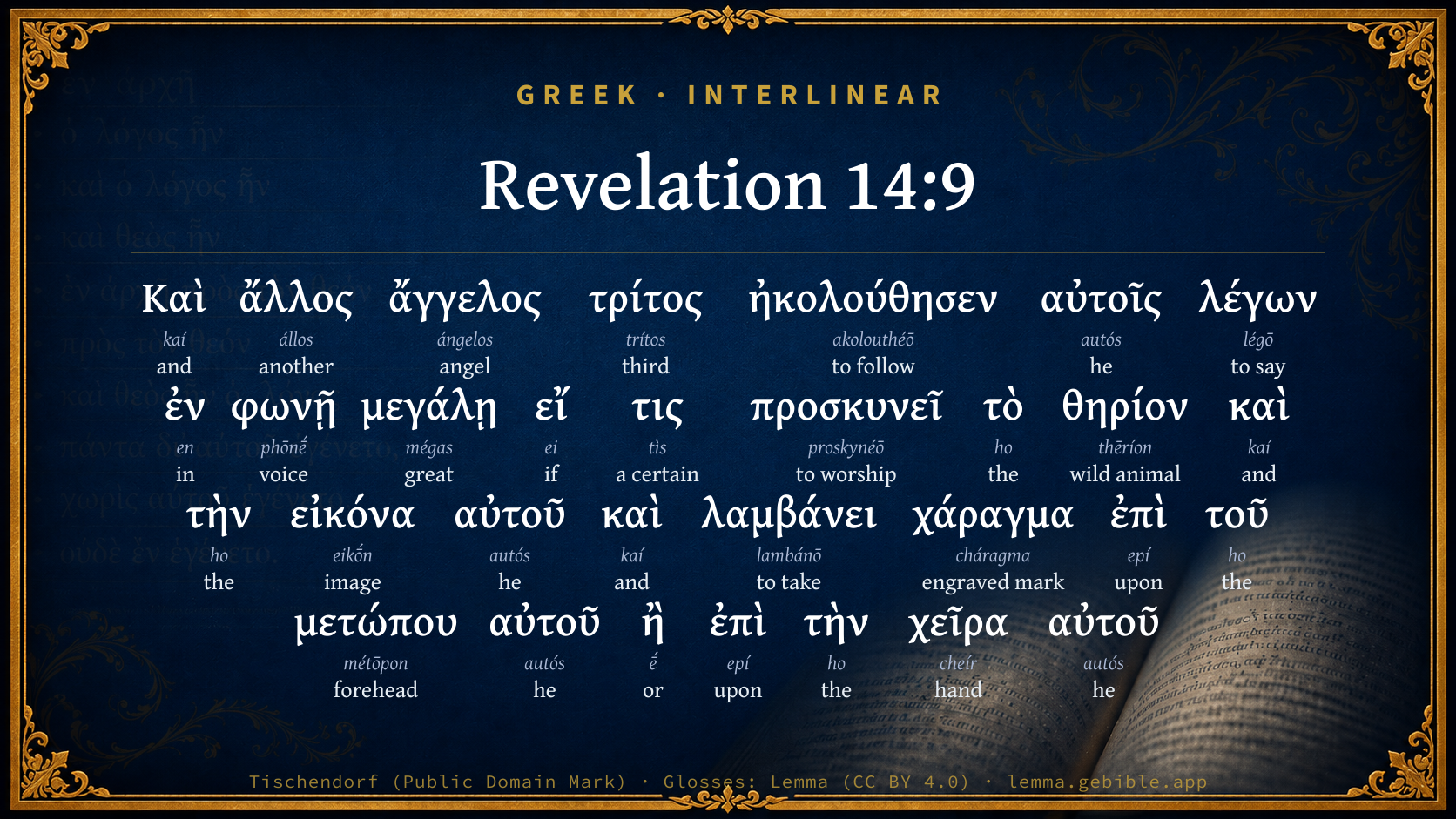
  1. Καὶ kaí G2532 “and” Conjunction
  2. ἄλλος állos G243 “another” Adjective, Nominative, Singular, Masculine
  3. ἄγγελος ángelos G32 “angel” Noun, Nominative, Singular, Masculine
  4. τρίτος trítos G5154 “third” Adjective, Nominative, Singular, Masculine
  5. ἠκολούθησεν akolouthéō G190 “to follow” Verb, Aorist, Active, Indicative, 3rd person, Singular
  6. αὐτοῖς autós G846 “he” Personal pronoun, Dative, Plural, Masculine
  7. λέγων légō G3004 “to say” Verb, Present, Active, Participle, Nominative, Singular, Masculine
  8. ἐν en G1722 “in” Preposition
  9. φωνῇ phōnḗ G5456 “voice” Noun, Dative, Singular, Feminine
  10. μεγάλῃ mégas G3173 “great” Adjective, Dative, Singular, Feminine
  11. εἴ ei G1487 “if” Conditional
  12. τις tìs G5100 “a certain” Indefinite pronoun, Nominative, Singular, Masculine
  13. προσκυνεῖ proskynéō G4352 “to worship” Verb, Present, Active, Indicative, 3rd person, Singular
  14. τὸ ho G3588 “the” Article, Accusative, Singular, Neuter
  15. θηρίον thēríon G2342 “wild animal” Noun, Accusative, Singular, Neuter
  16. καὶ kaí G2532 “and” Conjunction
  17. τὴν ho G3588 “the” Article, Accusative, Singular, Feminine
  18. εἰκόνα eikṓn G1504 “image” Noun, Accusative, Singular, Feminine
  19. αὐτοῦ autós G846 “he” Personal pronoun, Genitive, Singular, Neuter
  20. καὶ kaí G2532 “and” Conjunction
  21. λαμβάνει lambánō G2983 “to take” Verb, Present, Active, Indicative, 3rd person, Singular
  22. ἐπὶ epí G1909 “upon” Preposition
  23. τοῦ ho G3588 “the” Article, Genitive, Singular, Neuter
  24. μετώπου métōpon G3359 “forehead” Noun, Genitive, Singular, Neuter
  25. αὐτοῦ autós G846 “he” Personal pronoun, Genitive, Singular, Masculine
  26. ἢ ḗ G2228 “or” Particle
  27. ἐπὶ epí G1909 “upon” Preposition
  28. τὴν ho G3588 “the” Article, Accusative, Singular, Feminine
  29. χεῖρα cheír G5495 “hand” Noun, Accusative, Singular, Feminine
  30. αὐτοῦ autós G846 “he” Personal pronoun, Genitive, Singular, Masculine

About this verse

These counts appear in no published source. They are computed here, from the morphology-tagged text and Lemma’s own curated glosses. What Lemma adds →

31
words
22
distinct lemmas
Revelation
section

Notable vocabulary

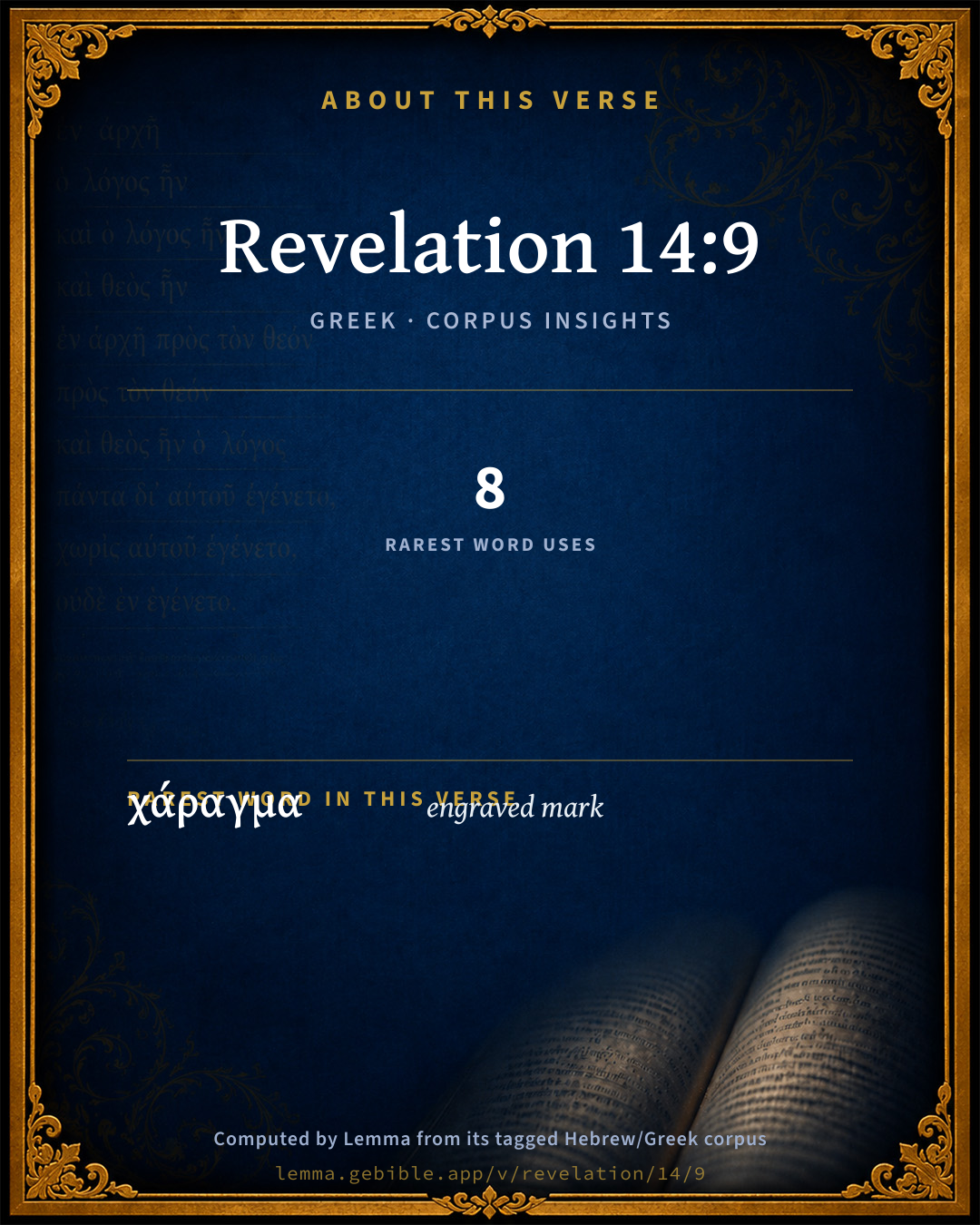
The rarest word here is χάραγμα engraved mark G5480 — appearing just 8 times in the whole Greek New Testament.

Shared distinctive vocabulary

χάραγμα engraved mark G5480 occurs in 8 verses of the Greek New Testament. Also found in:

Repetition

Words recur within this verse:

Cross-references

5

Topical passages linked to Revelation 14:9 in the Treasury of Scripture Knowledge — connected by theme and wording, ordered by reader-vote popularity; previews shown in the World English Bible.

  • Revelation 14:11 The smoke of their torment goes up forever and ever. They have no rest day and night, those who worship the beast and his image, and whoever receives the mark of his name.
  • Revelation 14:6–8 I saw an angel flying in mid heaven, having an eternal Gospel to proclaim to those who dwell on the earth, and to every nation, tribe, language, and people.
  • Jeremiah 44:4 However I sent to you all my servants the prophets, rising up early and sending them, saying, Oh, don't do this abominable thing that I hate.
  • Revelation 13:3–6 One of his heads looked like it had been wounded fatally. His fatal wound was healed, and the whole earth marveled at the beast.
  • Revelation 13:11–17 I saw another beast coming up out of the earth. He had two horns like a lamb, and he spoke like a dragon.

Cross-references courtesy of OpenBible.info (CC BY 4.0).

Commentary

Notes on Revelation 14:9 from classic Christian and Jewish commentators (each source and its license shown beneath its notes). The classic Christian expositions comment on the surrounding passage and are grouped to its opening verse, so a note may address several verses; the Jewish commentaries on the Tanakh (Rashi and others) are per-verse, so they appear only where the commentator wrote on this verse.

Lemma curates 59 commentaries, every one of them public domain or Creative Commons licensed, each selected and text-cleaned for this edition rather than reprinted as found. About our sources →

The Biblical Illustrator

Joseph S. Exell

Rev_14:9-12

And the third angel followed them, saying with a loud voice, If any man worship the beast and his image.

Soul prostitution and soul loyalty

I. Soul prostitution.

1. The prostitution of the soul to wrong is an alarming crime.

2. The prostitution of the soul to wrong always incurs lamentable suffering. The metaphors here are borrowed from the sacred books of the Hebrew people, and they convey the idea of suffering of an alarming kind, suggesting--

(1) A consciousness of Divine antagonism. Wine of the wrath of God. In the sense of malignant passion there is no wrath in Him who is love. But it is a psychological fact that the man who suffers because he has done another an injury, has a consciousness that the one he has offended is angry with him, and this consciousness is the chief element in his suffering.

(2) A sense of intense agony. Shall be tormented with fire and brimstone. Brimstone adds intensity to the heat and fury to the flames of fire. My punishment is greater than I can bear, said Cain. A guilty conscience has its Tartarus or Gehenna within itself.

(3) A state of constant restlessness. They have no rest day nor (and) night. There is no rest in sin. The wicked are like the troubled sea.

II. Soul loyalty. Here is the patience of the saints. What is patience? It is not insensibility. Some people are lauded for their patience who should be denounced for their stoicism and indifference. Patience implies at least two things.

(1) The existence of trials. Patience lives only in difficulty and danger, in storms and tempests.

(2) The highest mental power. Mans highest power of mind is seen not in unsurpassed mechanical inventions, or the sublimest productions of art, not in the most baffling and confounding strategies of bloody war, but in the successful effort to govern all the impulses and master all the boisterous passions of the human soul. (D. Thomas, D. D.)

The smoke of their torment ascendeth up for ever and ever.--

Hell

I. We affirm there is a hell; punishments finite in degree, but infinite in duration.

1. Scripture gives no countenance to this absurd opinion, that the wicked shall have no part in resurrection and judgment (Rom_3:4-5; 2Co_5:10; Rev_20:12-13; Rev_20:15; Joh_5:28-29).

2. Scripture clearly affirms that the punishment of the damned shall not consist of annihilation, but of real and sensible pain (Mat_26:24; Mat_11:24). Scripture-images of hell, which are many, will not allow us to confine future punishment to annihilation. It is a worm, a fire, a darkness; they are chains--weeping, wailing, and gnashing of teeth.

3. It appears by Scripture that future punishment will be eternal (Mat_25:41; Mar_9:44; Mat_18:8; Rev_20:10).

II. If the doctrine of eternal punishment imply a contradiction, it must either regard man, the sufferer of the pain, or God, who threatens to inflict it.

1. The nature of man hath nothing incongruous with that degree and duration of punishment of which we speak.

2. Let us attend now to objections taken from the nature of God. A man, who opposeth our doctrine, reasons in this manner. Which way soever I consider a Being supremely perfect, I cannot persuade myself that He will expose His creatures to eternal torments. All His perfections secure me from such terrors as this doctrine seems to inspire. In short, when I consider God under the idea of an equitable legislator, I cannot comprehend how sins committed in a finite period can deserve an infinite punishment.

(1) Observe this general truth. It is not probable God would threaten mankind with a punishment, the infliction of which would be incompatible with His perfections.

(2) Take each part of the objection drawn from the attributes of God, and said to destroy our doctrine, and consider it separately. The argument taken from the liberty of God would carry us from error to error, and from one absurdity to another. For, if God be free to relax any part of the punishment denounced, He is equally free to relax the whole. The difficulty taken from the goodness of God vanisheth when we rectify popular notions of this excellence of the Divine nature. Goodness in men is a virtue of constitution which makes them suffer when they see their fellow creatures in misery, and which excites them to relieve them. In God it is a perfection independent in its origin, free in its execution, and always restrained by laws of inviolable equity and exact severity. Justice is not incompatible with eternal punishment. It is not to be granted that a sin committed in a limited time ought not to be punished through an infinite duration. It is not the length of time employed in committing a crime that determines the degree and the duration of its punishment, it is the turpitude and atrociousness of it. The justice of God, far from opposing the punishment of the impenitent, requires it. Were we to examine in this manner each part of the objection opposed against our doctrine, we should open a second source of solutions to answer it.

(3) The doctrine of degrees of punishment affords us a third. There is an extreme difference between a heathen and a Jew; there is an extreme distance between a Jew and a Christian; and a greater still between a Christian and a heathen. The gospel-rule is, Unto whomsoever much is given, of him shall be much required. Take this principle which Scripture establisheth in the clearest manner; press home all its consequences; extend it as far as it can be carried; give scope even to your imagination till the punishments which such and such persons suffer in hell are reduced to a degree that may serve to solve the difficulty of the doctrine of their eternity; whatever system ye adopt on this article, I will even venture to say whatever difficulty ye may meet with in following it, it will be always more reasonable, I think, to make of one doctrine clearly revealed a clue to guide through the difficulties of another doctrine clearly revealed too, than rashly to deny the formal decisions of Scripture. I mean to say, it would be more rational to stretch the doctrine of degrees too far, if I may venture to speak so, than to deny that of their eternity.

(4) The fourth source of solutions is a maxim from which a divine ought never to depart, and which we wish particularly to inculcate among those who extend the operations of reason too far in matters of religion. Our maxim is this. We know, indeed, in general, what are the attributes of God, but we are extremely ignorant of their sphere, we cannot determine how far they extend. We know, in general, God is free, He is just, He is merciful. But we are too ignorant to determine how far these perfections must go, because the infinity of them absorbs the capacity of our minds. Apply this to our subject. The idea of hell seems to you repugnant to the attributes of God, you cannot comprehend how a just God can punish finite sins with infinite pain; how a merciful God can abandon His creature to eternal miseries. Your difficulties have some probability, I grant. Your reasons, I allow, seem well grounded. But dost thou remember the attributes of God are infinite? Remember, thy knowledge is finite. You think future punishment inconsistent with the attributes of God, but your notion of inconsistence ought to vanish at the appearance of Scripture-light.

III. Observe the quality and the duration of the punishments of hell.

1. The quality of the punishments of hell is expressed in these terms--smoke, torment. These metaphorical terms include five ideas. Privation of heavenly happiness, sensation of pain, remorse of conscience, horror of society, increase of crime.

2. It remains only that we consider the length and duration of them. But by what means shall we describe these profound articles of contemplation? Can we number the innumerable and measure that which is beyond all mensuration? Can we make you comprehend the incomprehensible? And shall we amuse you with our imaginations? (J. Saurin.)

The Biblical Illustrator, edited by Joseph S. Exell (c. 1880s–1900s) — public domain. Text from a community e-Sword module.

Joseph Benson's Commentary

Rev 14:9-12. And the third angel followed — At no great distance of time; saying — As the two former had done; with a loud voice — With authority and earnestness; If any man worship the beast, &c. — The commission of this angel reaches further than that of the preceding; it extends not only to the capital city, not only to the principal agents and promoters of idolatry, but to all the subjects of the beast, whom it consigns over to everlasting punishment. If any man worship the beast — That is, embrace and profess the religion of the beast; or, what is the same, the religion of the Papal hierarchy; the same shall drink, &c. — The worship against which judgment is here denounced, consists partly in an inward submission to the beast, a persuasion that all who are subject to Christ must be subject to the beast, or they cannot receive the influences of divine grace; or, as their expression is, “There is no salvation out of the church;” and partly in a suitable outward reverence to the beast and his image — the antichristian kingdom, and the pope that rules in it. The same shall drink of the wine of the wrath of God — The wine of God’s indignation, tempered with various ingredients of wrath; which is poured out without mixture — Namely, of mercy, and without hope. Bishop Newton renders the expression, the poisonous wrath of God; observing, “His punishment shall correspond with his crime; as he drank of the poisonous wine of Babylon, so he shall be made to drink of the poisonous wine of God; του κεκερασμενου ακρατου, which is mixed unmixed, the poisonous ingredients being stronger when mixed with mere, or unmixed wine;” in the cup of his indignation; and he shall be tormented with fire and brimstone — In the day of God’s future vengeance; in the presence of the holy angels — From hence some conjecture that possibly the torments of the damned may, at certain seasons, through eternal ages, become a spectacle to the inhabitants of the blessed world above; and in the presence of the Lamb — This signifies that their punishment shall not only be appointed by the infinite majesty of God, but approved moreover by men and angels, and by him also who loved us unto death, even Christ, our merciful and compassionate High-Priest. In all the Scriptures there is not another threatening so terrible as this. And God, by this greater fear, intended to arm his servants against the fear of the beast. The smoke of their torment ascendeth up for ever and ever — “When I seriously reflect on this text,” says Doddridge, “and how directly the force of it lies against those who, contrary to the light of their consciences, continue in the communion of the Church of Rome for secular advantage, or to avoid the terror of persecution, it almost makes me tremble.” By this third angel following the others with a loud voice, we may understand principally Luther and his fellow-reformers, who, with a loud voice, protested against the corruptions of the Church of Rome, and declared them to be destructive of salvation to all who obstinately continued in the practice and profession of them. This would be a time of great trial, Rev 14:12. Here is the patience of the saints — Manifested in suffering all things, rather than receive this mark of the beast, the badge of their devotedness to him, and making an open profession of his religion; who keep the commandments of God, and the faith of Jesus — The character of all true saints. It is very well known that this was a time of great trial and persecution; the Reformation was not introduced and established without much bloodshed; there were many martyrs in every country, but they were comforted with a solemn declaration from heaven in the next words.

Joseph Benson's Commentary on the Old and New Testaments (1811–1818) — public domain. Text from a community e-Sword module.

Whedon's Commentary on the Bible

Daniel D. Whedon

3. Third angel pours forth a volume of divine malediction against Babylon and her devotees for martyring the saints, Rev_14:9-12.

9. The third angel—Most terrible and full of all, this angel crowns the climax of menace with denouncing judgments on all the Babylonic peoples, Rev_14:9-13.

Beast… image… mark—Note Rev_15:2.

Daniel D. Whedon (gen. ed.), Commentary on the Old and New Testaments (1874–1909) — public domain. Text from a community e-Sword module.

Tyndale Open Study Notes

Tyndale Open Resources

14:9-11 The third angel announces God’s judgment (14:7) on the counterfeit worship of the beast and his statue (see 13:12-18; 19:20; 20:4). God’s response to the rebellion against his reign is anger or wrath, pictured as a cup of bitter wine (see ch 16; 19:15). • fire and burning sulfur . . . smoke: This description of judgment (see also 19:20; 20:10, 14-15) echoes God’s judgment of Sodom and Gomorrah (Gen 18:16–19:28). • Those condemned to a fiery end will suffer in the presence of the holy angels and the Lamb (cp. Luke 16:22-24).

Tyndale Open Study Notes — © Tyndale Open Resources, licensed CC BY-SA 4.0. Text via the HelloAO Bible API.

Bengel's Gnomon

Johann Albrecht Bengel

Rev 14:9. Ἄλλος, another) The preaching of the angel with the everlasting Gospel is a good, that of the second and third is also a good: but yet the second and the third angel are distinct from each other. Spener, for instance, properly confined himself within his own limits; see Canstein, in his Life, § 32. But if any one should suppose that the investigation and testimony to the truth of prophecy is to be confined within the same limits on the part of posterity, he would commit an error. There is a variety both in gifts and times. See Erkl. Offenb. pp. 145, 158, 159, 166, 167, 176, etc., 1041, 1042, 1117.—εἴ τις, κ.τ.λ.) If any man shall worship the beast and his image, and shall receive his mark in his forehead, or in his hand, he also shall drink of the wine of the wrath of God, which is poured out without mixture in the cup of His indignation; and he shall be tormented with fire and brimstone in the presence of the angels, and before the presence of the Lamb. And the smoke of their torments shall ascend up for ever and ever; and they have no rest day and night, who have worshipped the beast, and whosoever shall have received the mark of his name. This threatening stands by it self, and is the most dreadful of all contained in the whole of the Scripture. The fear of Him, who is able to destroy both soul and body, banishes the fear of those who slay the body: Luk 12:4-5.

Bengel's Gnomon of the New Testament — English translation (T&T Clark, Edinburgh, 1860) — public domain. Text from a community e-Sword module.

Meyer's Critical & Exegetical Commentary

Heinrich August Wilhelm Meyer

Rev_14:9-11. That the wine of fornication is at the same time a wine of Divine wrath (Rev_14:8), follows from the message of the third angel, inasmuch as this expressly announces to the worshippers of the beast the impending Divine retribution: καὶ αὐτὸς πίεται ἐκ τοῦ οἰνου τοῦ θυμοῦ τοῦ θεοῦ, κ.τ.λ., for the words εἴ τις προσκυνεὶ, κ.τ.λ., describe, according to the measure of ch. 13,[3503] the meaning of the figurative expression πορνεία, Rev_14:8.

[3503] It really makes no difference that in Rev_13:16 the ἐπι τ. χειρ. precedes, and in this passage the ἐπὶ τ. μετώπ. But with respect to change of case (cf. Winer, p. 382), it cannot be disregarded that in both places (cf. also Rev_13:1) the genitive precedes. Cf. Rev_7:1, where, however, a modification of the idea is recognizable in ἐπὶ τῆς γ., τῆς θ. (on the earth, the sea) and ἑπι τι δενδρον (on any tree, against any tree). The accus. occurs twice, Rev_20:4.

Meyer — Critical and Exegetical Commentary on the New Testament — English translation by Peter Christie, edited by Frederick Crombie (T&T Clark, 1880) — public domain. Text from a community e-Sword module.

Expositor's Greek Testament

ed. W. Robertson Nicoll

Rev 14:9-11 . The third angel proclaims that the deliberate adherents of the Imperial cultus are to be held responsible for their actions, and punished accordingly. The object is that these votaries may be “scared into faith by warning of sin’s pains”. The plea of force (Rev 13:12 ) is no excuse ( cf Mat 10:28 ).

The Expositor's Greek Testament, edited by W. Robertson Nicoll (1897–1910) — public domain. Text from a community e-Sword module.

Geneva Bible (1599)

Geneva Bible translators

That is, shall not worship God alone, but shall transfer his divine honor unto this beast, whether he doeth it with his heart or counterfeiting in show. For he (saith Christ) that denieth me before men, him will I deny before my Father, and his Angels, Matt. 10:32. And this is that voice of the holy ministry; which at this time is very much used of the holy and faithful servants of God. For having now sufficiently found out the public obstinacy of Babylon they labor not any longer to thunder out as against the same but to save some particular members by terror (as S. Jude speaketh) and to pluck them out of the public flame, or else by a vehement commiseration of their state to lead them away, they set before them eternal death, into which they rush unawares, unless in good time they return unto God, but the godly which are of their own flock, they exhort unto patience, obedience, and faith in the Lord Jesus, and charge them to give light by their good example, of good life unto others.

Geneva Bible (1599) marginal notes — public domain. Text via Bolls.life.

Jamieson, Fausset & Brown

Robert Jamieson, A. R. Fausset & David Brown

A, B, C, and ANDREAS read, "another, a third angel." Compare with this verse Rev 13:15-16.

Jamieson, Fausset & Brown — Commentary Critical and Explanatory on the Whole Bible (1871) — public domain (CC PDM 1.0). Text via the HelloAO Bible API.

Adam Clarke's Commentary

Verse 9. And the third angel followed] Bishop Bale considers these three angels as three descriptions of preachers, who should bear their testimony against the corruptions of the papal Church.

The beast and his image] See the notes on Re 13:1-18.

Mark in his forehead] Such as the sectarial marks of the idolatrous Hindoos, as has been observed before.

Adam Clarke's Commentary on the Bible (1810–1826) — public domain. Text from a community e-Sword/MySword module.

Ellicott's Commentary for English Readers

(9) And the third angel . .—Better, And another angel, a third, followed them, saying in a loud voice, If any man worship the wild beast and his image, and a mark upon his forehead or upon his hand, he also himself shall drink of the wine of the wrath of God, which is mingled pure (in full strength, undiluted, e.g., “He shall have judgment without mercy that hath showed no mercy,” Jas_2:13) in the cup of his indignation, and shall be tormented in fire, &c., &c. This third angel naturally follows the other two, which describe the powers which are in conflict: the word of God, and the Babylon of the world; the gospel will triumph; Babylon is doomed; hence comes the warning that men should not identify themselves with the city of worldliness, falsehood, and sin. The reference to the wild beast, the image, and the mark, carries us back to the last chapter, and shows us that Babylon is only another aspect of the work of God’s enemies: it is the city of the world-power. The warning not to receive the mark is a declaration that man, individual man, is responsible: there is no necessity for his receiving the mark, the hall-mark of a cowardly connivance at wrong-doing, or for setting his judgments by the fashions of the world.

A Bible Commentary for English Readers, edited by Charles John Ellicott (1878–1897) — public domain. Text from a community e-Sword module.

The Cambridge Bible for Schools and Colleges

gen. ed. J. J. S. Perowne

9. the third angel] Read, another angel, a third.

The Cambridge Bible for Schools and Colleges (gen. ed. J. J. S. Perowne; Cambridge University Press, 1878–1918) — public domain. Text from a community e-Sword module.

John Gill's Exposition

And the third angel followed them,.... The two preceding ones, and that very quickly; by whom is meant not Luther, and his associates in the Reformation, as some think; nor his successors, or the ministers of the Gospel in general from his time till Christ's second coming, as others have thought; but a set of Gospel ministers in the spiritual reign of Christ: the first set of them publish the everlasting Gospel, which leads on to the ruin of antichrist; the second set proclaim the downfall of Rome, and this third set denounce the wrath of God upon all that have professed the Popish religion:

saying with a loud voice; as the first angel did, with like authority and vehemence, in order to strike terror, and express indignation:

if any man worship the beast and his image; give in to the idolatries of the church of Rome, and embrace, maintain, and defend the Popish religion, which bears a resemblance to the worship of the Heathens, and is the very image of Rome Pagan; see Rev 13:4

and receive his mark in his forehead, or in his hand; openly profess Popery, and swear allegiance to the man of sin, and do all they can to support his interest; see Rev 13:16.

John Gill's Exposition of the Whole Bible (1746–1763) — public domain (CC PDM 1.0). Text via the HelloAO Bible API.

Trapp's Complete Commentary

John Trapp

9 And the third angel followed them, saying with a loud voice, If any man worship the beast and his image, and receive his mark in his forehead, or in his hand,

Ver. 9. And the third angel] Understand by this third angel, all the reformers and preachers of the gospel after Luther, to the end of the world.

If any man worship] See Mr Perkins’s Treatise. A Papist cannot go beyond a reprobate.

And receive his mark] He saith not this of those that have the name or the number of the beast. For we doubt not but many were carried away by him, as those 200 were by Absalom in the simplicity of their hearts, 2Sa 15:11, knowing nothing of his treason.

John Trapp, A Commentary or Exposition upon All the Books of the Old and New Testament (1647–1656) — public domain. Text from a community e-Sword module.

Albert Barnes' Notes on the Bible

And the third angel followed them - This was a new vision designed to represent the removal of all the obstructions to the final prevalence of the gospel. We are not necessarily to suppose that this event would succeed those mentioned before in the order of time, though this would be the natural construction. The design of this is to show that the worshippers of the beast and his image would be certainly and finally destroyed.

Saying with a loud voice - Making a loud proclamation. Rev 14:7.

If any man worship the beast and his image - See the notes on Rev 13:4, Rev 13:8, Rev 13:12, Rev 13:15. This declaration is universal, affirming of all who thus render idolatrous reverence to the power represented by the beast and his image that they should drink of the wine of the wrath of God. The general meaning is, that they were guilty of idolatry of a gross form; and wherever this existed they who were guilty of it would come under the denunciations in the Scriptures against idolaters. And why should not such denunciations fall on idolaters under the papacy as well as on others? Is it not true that there is as real idolatry there as in the pagan world? Is not the idolatry as gross and debasing? Is it not attended with as real corruption in the heart and the life? Is it not encompassed with as many things to inflame the passions, corrupt the morals, and alienate the soul from God? And is it not all the worse for being a perversion of Christianity, and practiced under the forms of the religion of the Saviour? On what principle should idolatry be denounced and condemned anywhere if it is not in papal Rome? Compare the notes on 2Th 2:4.

And receive his mark in his forehead or in his hand - See the notes on Rev 13:16. The word “receive” here implies that there was, on their part, some degree of voluntariness: it was not a mark impressed by force, but a mark received. This is true in respect to all idolatry; and this lays the ground for condemnation. Whatever art is used to induce people to worship the beast and his image, it is still true that the worshippers are voluntary, and that, being voluntary, it is right that they should be treated as such. It is on this ground only that any idolaters, or any sinners of any kind, can be, in the proper sense of that term, published.

Albert Barnes' Notes on the Bible (1834–1885) — public domain. Text from a community e-Sword/MySword module.

Haydock's Catholic Bible Commentary

The third Angel followed....if any man shall adore the beast,...he also shall drink of the wine of the wrath of God, which is mingled with pure wine, &c. That is, he shall drink of the bitter cup of God’s indignation, not mixed with water, or any thing to diminish its force, but with wine and wine; i.e. with punishments upon punishments for ever and ever. (Witham)

George Leo Haydock (1774–1849), Haydock's Catholic Family Bible and Commentary, 1859 edition — public domain. Excludes Psalms (Douay-Rheims chapter numbering differs from Protestant) and Deuterocanonical books (Catholic canon only).

Matthew Poole's English Annotations

God letteth his servant John know, that during the reign and rage of antichrist, as he would have ministers of the gospel that should preach the truth, and mind men to keep themselves from idols, worshipping God alone; and others that should assure them the papacy should go down, mystical Babylon should fall; so he would have others that should give warning to men and women of those dreadful plagues that should come upon them that entered themselves in this great city, either worshipping the devil after the pagan manner, or the image of the beast, i.e. committing idolatry after the antichristian, popish fashion, or that should either be subject to this idolatrous head, or be a soldier to fight for it. What those judgments should be, God showeth in Rev 14:10, and possibly there is not a more severe denunciation of judgment in the whole book of God.

Matthew Poole's English Annotations on the Holy Bible (1683–1685) — public domain. Text from a community e-Sword/MySword module.

The Pulpit Commentary

And the third angel followed them, saying with a loud voice; and another, a third angel, etc. (see on ver. 8). (On "loud voice," see on ver. 7) If any man worship the beast and his image. Here those who worship the beast and those who worship his image are regarded as one class, which they practically are. (but see on Rev_13:14) This is the fornication referred to in ver. 8, the retribution for which follows in ver. 10. And receive his mark in his forehead, or in his hand; a mark; but doubtless the mark of the beast alluded to in Rev_13:16 (which see). In his forehead, etc.. (see on Rev_13:16)

Vers. 9-12. "The most awful threatening the Bible contains

(Bengel). Undoubtedly it is so. It makes our flesh creep and our heart shudder as we read it. It is to be noted, that these three angels (vers. 6, 8, 9), who "excel. in strength" bear messages of increasing severity. The first bids us "fear." The second tells of the dread judgment upon Babylon. This third threatens all men everywhere with like and yet more awful doom, if they "worship the beast" or "receive his mark." Now

I WHAT DOES ALL THIS MEAN?

1. It seems to mean that the ungodly shall be punished with incessant and unspeakable torments in hell fire, and that forever and ever. This is the doctrine that has been deduced frown this passage again and again. It is one of the buttresses of the popular theology. It is always quoted in support of this doctrine, and is regarded as one of the chief of the proof texts. But if it do teach this, we ask:

(1) Would not the language be more clear? Who certainly knows what the two beasts, the first and second, stand for? Who can do more than guess, with more or less of probability, what St. John meant by them; much less what it was intended we, in our day, should understand by them? And what is "the mark of the beast "? and how do men receive it "in their forehead," or their "hand"? We may think we understand all this. But can any one be sure? But consequences so awful as are threatened here would not be told of in language so ambiguous. If we today be threatened with such doom, the offences that incur it will surely be set forth in words unmistakably plain, and not such as we find here.

(2) May not temporal judgments be so described? May not the same language be used for something quite different from what it is said this means? Yes, for Isaiah thus speaks of Edom: (Isa_34:8-14) "The smoke thereof shall go up forever." The temporal judgments that came upon Edom are thus described. And so, in Revelation 18., we have word for word the fulfilment on earth, not in Gehenna, of the threatenings we are now considering (cf. vers. 9, 15, 18). Why, then, may not temporal judgments be what are meant here?

(3) Why, in the closing vision of this book, are death, hell, and the lake of fire, pain, sorrow, death, and all such things, declared to have "passed away" and to be "no more"? (cf. Re 21) All these things have not been transferred to some other planet, to defile its surface and darken its heavens. They have "passed away," he alone abiding who "doeth the will of God.

(4) Why is the language of the Bible so constantly of such a kind as to lend the strongest colour to the belief that death, destruction, perishing not a never ending existence in suffering is the doom of the finally impenitent? That this is so can hardly be denied. The passage before us is, probably, the only one which seems to teach everlasting suffering.

(5) And, if it were a Divine doctrine, would it not, like all other Divine doctrines, "commend itself to every man"s conscience in the sight of God"? The truth that St. Paul preached did so commend itself. If this be part of it, why does it not also so commend itself? It is notorious that it does not. Conscience revolts against it, and insistence upon it has generated more unbelief and atheism than, perhaps, any other cause whatsoever. We, therefore, cannot believe that what this passage seems to many minds to mean, it actually does mean. But:

2. We note the following facts.

(1) The occasion of this threatening. Terrible persecution, when it was absolutely necessary to fortify and strengthen the minds of Christians with every consideration that would help them to be faithful under the dreadful trials that beset them.

(2) And in this way this threatening, and others like it (cf. Matthew 10), were used, and were no small help to the steadying of the wavering will and the strengthening of the feeble heart. "The ancient Cyprian often strengthened his exhortations to steadfastness under bloody persecutions with this word.

(3) The fulfilment of this word (cf. Re 18, and parallels). Therefore, whilst not limiting it to temporal punishments:

3. We regard it as telling of that everlasting destruction from the presence of the Lord, which shall be the doom of all apostates and all who persist in rebellion against the Lord.

II WHAT DOES IT TEACH? Amongst other lessons these:

1. The retribution of God upon unfaithful and wicked men is an awful reality.

2. That in the midst of temptation the remembrance of this will he a great help.

3. That it is the love of God which tells us the truth.

4. That they are fools and self destroyed who will not "come unto" Christ that they "might have life. S. C.

Vers. 9-12. Punishment.

The punishment threatened upon the worshippers of "the beast and his image" is represented by imagery of the most truly awful character. What that "beast" is, what is "his image," and what his "worship," are points not to be left in uncertainty; while the terrible denunciations of wrath must stand as an effectual warning against any such homage. "The beast" here must represent the utmost spirit of evil foul, filthy sin. It stands in opposition to the Lamb, the embodiment of all purity. It is the antagonist, the opposer of all good, whether ideally considered, or as found embodied in Satan the devil. It is the antithesis of holiness; it is an active opposition also to all holiness; it is an active opposition to God. The "image" may be any form which this essential evil, this anti-righteous spirit, may assume. The "worship" of such a spirit implies submission to it; an affirmation of its supremacy and worthiness and power; a giving honour to the beast the honour due to God. What a signal of unfaithfulness, of corruption, of sin! As such it is punishable with the utmost punishment. The figures in which this awful punishment is represented indicate the keenest severity of suffering. As the worship of the beast indicates the utmost devotion to sinfulness, so the punishment threatened denotes the utmost suffering. It includes

I THE DIREST EXPRESSION OF THE DIVINE DISPLEASURE. The worshipper shall "drink of the wine of the wrath of God.

II THE INFLICTION OF DIRECT PERSONAL SUFFERING. "He shall be tormented with fire and brimstone.

III AN ESPECIAL AGGRAVATION OF THE SUFFERING. It is endured in the presence of the holy angels, and in the presence of the Lamb.

IV IT IS A STATE OF CEASELESS DISTURBANCE. "They have no rest day nor night.

V IT IS UNENDING. "Forever and ever." Let any read this, and say if the consequences of devotion to evil are not in the highest degree dreadful. R. G.

Vers. 9-12. Soul prostitution and soul loyalty.

"And the third angel followed them, saying with a loud voice, If any man worship the beast and his image, and receive his mark in his forehead, or in his hand, the same shall drink of the wine of the wrath of God," etc. In this part of John"s wonderful mental vision, or dream, on the island of Patmos, we can find illustrations of two great subjects.

I SOUL PROSTITUTION. "And the third angel followed them, saying with a loud great voice, If any man worship the beast and his image, and receive receiveth his mark in his forehead, and in his hand," etc. (ver. 9). The "beast and his image." What meaneth this? Does it mean some king or pope? Or some great wrong institution, civil or religious? No one knows, and it matters not. I take the expression as a symbol of wrong in its spirit and forms. Two things are suggested in connection with this.

1. That the prostitution of the soul to wrong is an alarming crime. Here is a warning. "The angel followed, saying with a loud voice." Amongst the teeming populations of this earth there is nothing more terrible and alarming than to see human souls made in the image of God, rendering a practical devotion of all its spiritual powers to the morally unworthy, "the world, the flesh, and the devil;" because, according to a law of mind, the object of the soul"s devotion transfigures it into its own character. Hence the human spirit gets buried in the fleshly, absorbed in the selfish and the worldly. Thus everywhere we find minds that should expand into seraphs sinking into grubs, worshipping the "beast;" sordid sycophants, not soaring saints; the miserable creatures, not the mighty masters of circumstances.

2. That the prostitution of the soul to wrong always incurs lamentable suffering. It is said, "The same he also shall drink of the wine of the wrath of God, which is poured out without mixture prepared unmixed into the cup of his indignation anger; and he shall be tormented with fire and brimstone in the presence of the holy angels, and in the presence of the Lamb" (ver. 10). The metaphors here are borrowed from the sacred books of the Hebrew people, and they convey the idea of suffering of an alarming kind, suggesting:

(1) A consciousness of Divine antagonism. "Wine of the wrath of God." In the sense of malignant passion there is no wrath in him who is Love. But it is a psychological tact that the man who suffers because he has done another an injury, has a consciousness that the one he has offended is angry with him, and this consciousness is the chief element in his suffering.

(2) A sense of intense agony. "Shall be tormented with fire and brimstone." Brimstone adds intensity to the heat and fury to the flames of fire. "My punishment is greater than I can bear," said Cain. A guilty conscience has its Tartarus or Gehenna within itself.

(3) A state of constant restlessness. "They have no rest day nor and night" (ver. 11). There is no rest in sin. "The wicked are like the troubled sea." A guilty soul under a sense of sin is like Noah"s dove fluttering over tumultuous billows.

II SOUL LOYALTY. "Here is the patience of the saints" (ver. 12). "The meaning here," says Moses Stuart, "is either thus: here then in the dreadful punishment of the wicked every Christian may see of what avail his patience and obedient spirit and faith in Christ are; or here is a disclosure respecting the wicked which is adapted to encourage a patient endurance of the evils of persecution, and a constancy in obedience to the Divine commands and to the Christian faith." What is patience? It is not insensibility. Stone people are lauded for their patience who should be denounced for their stoicism and indifference. Patience implies at least two things.

1. The existence of trials. Where the path of life is all smooth, flowery, and pleasant, where all the winds of life are temperate, bright, and balmy, where all the echoes of life are free from discordant notes, and beating the sweetest melodies, where, in fact, life is entirely free from trial, there is no room for patience. Patience lives only in difficulty and danger, in storms and tempests.

2. The highest mental power. Man"s highest power of mind is seen, not in unsurpassed mechanical inventions, or the sublimest productions of art, not in the most baffling and confounding strategies of bloody war, hell"s own creation, but in the successful effort to govern all the impulses and master all the boisterous passions of the human soul. "The Lord is slow to anger, and great in power." This is a remarkable expression. It seems as if the Prophet Nahum meant that God is slow to anger because he is great in power; if he had less power he would be less patient. A man may be slow to auger and slow to deal out vengeance because he lacks power to do so. But God is slow to anger because he has abundance of power. His power of self control is infinite. Truly does Solomon say, "He that is slow to anger is better than the mighty; and he that ruleth his spirit than he that taketh a city." The greater the sinner and the greater the sneak, the better able to take cities; but it requires the greatest man to govern his own soul. "Be patient, oh be patient! Put your ear against the earth, Listen there how noiselessly the germ of the seed has birth; How noiselessly and gently it upheaves its little way, Till it parts the scarcely broken ground, and the blade stands up in day! "Be patient, oh be patient! The germs of mighty thought Must have their silent undergrowth, must underground be wrought. But as sure as there"s a power that makes the grass appear, Our land shall be green with liberty, the blade time shall be here. "Be patient, oh be patient! Go and watch the wheat ears grow, So imperceptibly that ye can mark nor change nor throe, Day after day, day after day, till the ear is fully grown. And then again, day after day, till the ripened field is brown. "Be patient, oh be patient! Though yet your hopes are green, The harvest fields of freedom shall be crowned with sunny sheen; Be ripening, be ripening, mature your silent way, Till the whole bread land is tongued with fire on freedom"s harvest day. (R. C. Trench.) D.T.

The Pulpit Commentary (1880–1919), ed. H.D.M. Spence-Jones & Joseph S. Exell — public domain. Text from a community e-Sword module.

John Wesley's Explanatory Notes

And a third angel followed - At no great distance of time. Saying, If any one worship the wild beast - This worship consists, partly in an inward submission, a persuasion that all who are subject to Christ must be subject to the beast or they cannot receive the influences of divine grace, or, as their expression is, there is no salvation out of their church; partly in a suitable outward reverence to the beast himself, and consequently to his image.

John Wesley, Explanatory Notes Upon the Whole Bible (1754–1765) — public domain. Text via the GEBible commentary corpus.

Scofield Reference Notes

C. I. Scofield

angel

(See Scofield "Heb 1:4")

The Scofield Reference Bible (1917 edition), notes by C. I. Scofield — public domain. Text from a community e-Sword module.

Burkitt's Expository Notes on the New Testament

William Burkitt

Observe here, the great and special care which Almighty God takes to warn men and women of those dreadful plagues which should most certainly come upon the heads of idolaters: a third angel followed, crying with a loud voice.

O how good is God in that he does always premonish before he punishes, warns before he strikes, and advises all not to partake with others their sins, lest they be partakers of their plagues!

Observe, 2. A most dreadful denunciation of the wrath of God, against all those who shall worship the beast and his image, that is, submit to the enjoined idolatry, and receive his mark in their foreheads or hands, that is, yield obedience to the beast as a servant, and openly own subjection to him as his slaves.

Lord! what a dreadful guiltiness is it to follow antichrist, and to continue obstinate in idolatry, after God has sent one angel after another, minister after minister, to acquaint them both with their sin and danger?

Observe, 3. The denunciation itself in the several parts of it,

1. They shall drink of the wine of the wrath of God, that is, for their sin shall partake of severe judgments, the effects of God’s wrath.

Mark, Here is wine for wine, for the wine of Babylon’s fornication, here is the wine of the wrath of God; the former wine was not so sweet, but the latter shall be as sharp.

2. Here is the quality of this wrath, it is poured out without mixture: its being poured out shows the abundance of it, and without mixture shows that it is without the least drop of mercy to allay the extremity of their torment.

3. It is called a cup of indignation, thereby intimating, that it is not the correction of a father, which is accompanied with lenity and love, but the vengeance of a judge that designs utter destruction.

4. Here is the effect of their drinking of this cup of the Lord’s indignation, their being torment with fire and brimstone: which expression denotes these sinners’ torments to be most exquisite, both intolerable and interminable, and their punishment both easeless and endless.

5. It is here said, that this their torments to be in the presence of the holy angels, before whom they had sinned, in worshipping the beast; they shall see them, but none shall help them.

6. The eternity as well as the extremity of their torments is here set forth: their smoke ascends for ever and ever; the torments of hell are here set forth as most acute and exquisite, and as endless and easeless, they have no rest day nor night, nor a moment’s ease.

It is well observed by Mr. Mede, that there is not a more terrible description of punishment in the whole book of God, than is here denounced against those idolaters which adhere to the beast; the smoke of their torment, that is, the fire and smoke wherewith they were tormented, ascendeth up for ever and ever, and they have no rest day nor night.

And if the church of Rome, or Papal Babylon, be here intended, and not Pagan, as most Protestents believe and affirm, then this shows that those of her communion, living and dying in a firm adherence to the chief doctrines of Popery, and framing their lives by them, after they have had, or might have had, sufficient means to convince them of their error and idolatry, so expose their salvation to extreme hazard and danger.

Blessed be God for our happy reformation, from the idolatry and superstition, from the tyranny and oppression, and the intolerable yoke, of the church of Rome. God grant we may be reformed in our lives as well as in our religion, otherwise our damnation is as sure as theirs is great, for the holiest doctrine and purest worship will be of no avail to impure worshippers and unholy livers; it matters not what church or what communion a bad man is of, for it is certain he cannot be saved by any.

William Burkitt's Expository Notes on the New Testament (1700–1703) — public domain. Text from a community e-Sword module.

The People's New Testament

B. W. Johnson

9. And the third angel followed. This angel proclaims God's judgment on all that worship the beast and his image. (See Ch. 13).

B. W. Johnson's The People's New Testament with Notes (1889–1891) — public domain. Electronic text from the Christian Classics Ethereal Library (CCEL) ThML edition.

unfoldingWord translationNotes

Door43 World Missions Community

with a loud voice

"loudly"

will also drink some of the wine of God's wrath

Drinking the wine of God's wrath is a symbol for being punished by God. AT: "will also drink some of the wine that represents God's wrath" (See: Symbolic Language)

that has been poured undiluted

This can be translated in active form. AT: "that God has poured full strength" (See: Active or Passive)

that has been poured undiluted

This means that the wine has no water mixed into it. It is strong, and a person who drinks much of it will get very drunk. As a symbol, it means that God will be extremely angry, not just a little angry. (See: Symbolic Language)

cup of his anger

This symbolic cup holds the wine that represents God's anger. (See: Symbolic Language)

translationWords

angel

voice

worship

beast

image

wine

wrath

anger

torment

fire

sulfur

holy

lamb

unfoldingWord translationNotes — © Distant Shores Media and the Door43 World Missions Community, licensed CC BY-SA 4.0. Source: git.door43.org/Door43/en_tn.

Cambridge Greek Testament for Schools and Colleges

9. αὐτοῖς. A and Primas[486] read αὐτῷ.

[486] Primasius, edited by Haussleiter.

θηρίον. A has θυσιαστήριον.

Cambridge Greek Testament for Schools and Colleges (Cambridge University Press, 1896; 21 vols, various authors incl. Carr, Maclear, Plummer, Farrar, Lumby, Moule, M. R. James, Simcox) — public domain. Text from a community e-Sword module.

Vincent's Word Studies in the New Testament

Marvin R. Vincent

The third angel [τριτος αγγελος] . Add allov another. Rev., another angel, a third.

Marvin R. Vincent, Word Studies in the New Testament (1887–1900) — public domain. Text from a community e-Sword/MySword module.

Lesson kit

Teaching starters — assembled from the data on this page, not authored interpretation. Every prompt links to the verse data it draws on. Edit before teaching.

Revelation, in the Revelation, opens this verse with 31 words (22 distinct Greek lemmas). Its most distinctive word is cháragma (“engraved mark”). A historical commentator’s framing appears above. Read the whole chapter for the surrounding context.

Discussion questions

  1. What does “engraved mark” (cháragma) contribute to the verse as a whole?
  2. How does Acts 17:29, which shares the word «engraved mark», read alongside this verse?
  3. What does the repetition of “upon” (2× in this one verse) do in this verse?
  4. These translations render this verse differently. What is at stake in choosing one wording over another?
  5. Compare how The Biblical Illustrator and Joseph Benson's Commentary read this verse. Where do they agree or differ?

Things to notice

Reading settings

Reading text

Shown beneath each verse's original-language words.

Old Testament
Old Testament edition

Read the OT as the Masoretic Hebrew (MT) or the Greek Septuagint (LXX).

English shown for the Greek Septuagint (in the Hebrew ↔ Greek comparison).

Comparing translations? Open the Compare panel on any verse page to stack up to four side by side.