James 4:8

Greek (Tischendorf 8th ed.) James 4:8 appears in the Greek New Testament. The text above is from the Tischendorf 8th edition. Each word links to its Strong’s number and a concise gloss. Click any word for its full Thayer’s Greek Lexicon entry.
Download image
Cite this verse

James 4:8 (World English Bible). Public Domain. Lemma interlinear Bible study tool, https://lemma.gebible.app/v/james/4/8.

Show BibTeX & RIS
BibTeX
RIS
English Translation
Draw near to God, and he will draw near to you. Cleanse your hands, you sinners; and purify your hearts, you double-minded.
World English Bible · Public Domain
Download a study sheet

One document with this verse’s original text, its word-by-word gloss line, the meaning frame, cross-references with their text, attributed commentary, and full source and license credits — printable, and it pastes into notes with its structure intact.

This verse Autodidact and up

Study sheet (.html) Plain text (.txt)

A passage Seminary Student

Up to 50 verses in one chapter. A passage sheet keeps up to 6 commentary sources and 12 cross-references per verse, in the order this page ranks them, and says so on the sheet whenever that leaves anything out. Ask for a single verse and you get the Autodidact verse sheet above.

Everything on this page stays free to read, with no account — the sheet is a download of what is already on screen, not access to it.

Want to remove ads? Support Godless Engineer
Compare translations 3

The same verse in 3 English versions, stacked beneath the original-language interlinear above. Click any original word for its lexicon entry.

Each is an independent rendering of the whole verse — the interlinear is not word-aligned to these translations.

Highlighted words mark where these versions differ — a whole-verse word diff, not a word-by-word alignment.

  • World English Bible Public Domain
    Draw near to God, and he will draw near to you. Cleanse your hands, you sinners; and purify your hearts, you double-minded.
  • King James Version Public Domain
    Draw nigh to God, and he will draw nigh to you. Cleanse your hands, ye sinners; and purify your hearts, ye double minded.
  • unfoldingWord Literal Text CC BY-SA 4.0
    Come near to God and he will come near to you. Cleanse your hands, you sinners, and purify your hearts, double-minded.

unfoldingWord Literal Text — © unfoldingWord, licensed CC BY-SA 4.0. Word-aligned USFM3 via Door43 (git.door43.org/unfoldingWord/en_ult).

Versions to compare (up to 4)

3 of 4 selected

Show all 19 translations

Every available English version of this verse, each an independent rendering of the whole verse.

  • World English Bible Public Domain
    Draw near to God, and he will draw near to you. Cleanse your hands, you sinners; and purify your hearts, you double-minded.
  • Berean Standard Bible Public Domain
    Draw near to God, and He will draw near to you. Cleanse your hands, you sinners, and purify your hearts, you double-minded.
  • Majority Standard Bible Public Domain
    Draw near to God, and He will draw near to you. Cleanse your hands, you sinners, and purify your hearts, you double-minded.
  • King James Version Public Domain
    Draw nigh to God, and he will draw nigh to you. Cleanse your hands, ye sinners; and purify your hearts, ye double minded.
  • American Standard Version (1901) Public Domain
    Draw nigh to God, and he will draw nigh to you. Cleanse your hands, ye sinners; and purify your hearts, ye doubleminded.
  • Revised Version (1885) Public Domain
    Draw nigh to God, and he will draw nigh to you. Cleanse your hands, ye sinners; and purify your hearts, ye doubleminded.
  • Geneva Bible (1599) Public Domain
    Drawe neere to God, and he will drawe neere to you. Clense your handes, ye sinners, and purge your hearts, ye double minded.
  • Douay-Rheims (1899) Public Domain
    Draw nigh to God, and he will draw nigh to you. Cleanse your hands, ye sinners: and purify your hearts, ye double minded.
  • Young's Literal Translation Public Domain
    draw nigh to God, and He will draw nigh to you; cleanse hands, ye sinners! and purify hearts, ye two-souled!
  • Literal Standard Version CC BY-SA 4.0
    draw near to God, and He will draw near to you; cleanse hands, you sinners! And purify hearts, you split-souled!
  • Unlocked Literal Bible CC BY-SA 4.0
    Come close to God, and he will come close to you. Cleanse your hands, you sinners, and purify your hearts, you double-minded.
  • unfoldingWord Literal Text CC BY-SA 4.0
    Come near to God and he will come near to you. Cleanse your hands, you sinners, and purify your hearts, double-minded.
  • Darby Bible Public Domain
    Draw near to God, and he will draw near to you. Cleanse [your] hands, sinners, and purify [your] hearts, ye double-minded.
  • World Messianic Bible Public Domain
    Draw near to God, and he will draw near to you. Cleanse your hands, you sinners. Purify your hearts, you double-minded.
  • Webster's Bible Public Domain
    Draw nigh to God, and he will draw nigh to you. Cleanse your hands, ye sinners, and purify your hearts, ye double-minded.
  • Free Bible Version CC BY-SA 4.0
    Come close to God and he will come close to you. Wash your hands, you sinners. Purify your way of thinking, you people with divided loyalties.
  • Bible in Basic English Public Domain
    Come near to God and he will come near to you. Make your hands clean, you evil-doers; put away deceit from your hearts, you false in mind.
  • Text-Critical English NT CC BY 4.0
    Draw near to God, and he will draw near to you. Cleanse your hands, you sinners, and purify your hearts, you double-minded.
  • Tyndale New Testament (1534) Public Domain
    Drawe nye to god and he will drawe nye to you. Clense youre hondes ye synners and pourdge youre hertes ye waverynge mynded.

Literal Standard Version (2020), Covenant Press — licensed CC BY-SA 4.0. Text via the HelloAO Bible API (eBible.org). Unlocked Literal Bible (unfoldingWord) — licensed CC BY-SA 4.0. Text via the HelloAO Bible API (eBible.org). unfoldingWord Literal Text — © unfoldingWord, licensed CC BY-SA 4.0. Word-aligned USFM3 via Door43 (git.door43.org/unfoldingWord/en_ult). Free Bible Version, Dr. Jonathan Gallagher — licensed CC BY-SA 4.0. Text via the HelloAO Bible API (eBible.org).

Word by word

More ways to search: Search by grammar → Find every occurrence → Compare this word →

Practice this passage: Drill this verse → Learn its vocabulary →

δίψυχοι
dípsychos
G1374
“double-minded”
Adjective, Vocative, Plural, Masculine
Part of Speech
Adjective
Case
Vocative
Number
Plural
Gender
Masculine
Full Thayer's Definition

Origin: from G1364 and G5590

TDNT: 20:05,1

1. double minded a. wavering, uncertain, doubting b. divided in interest
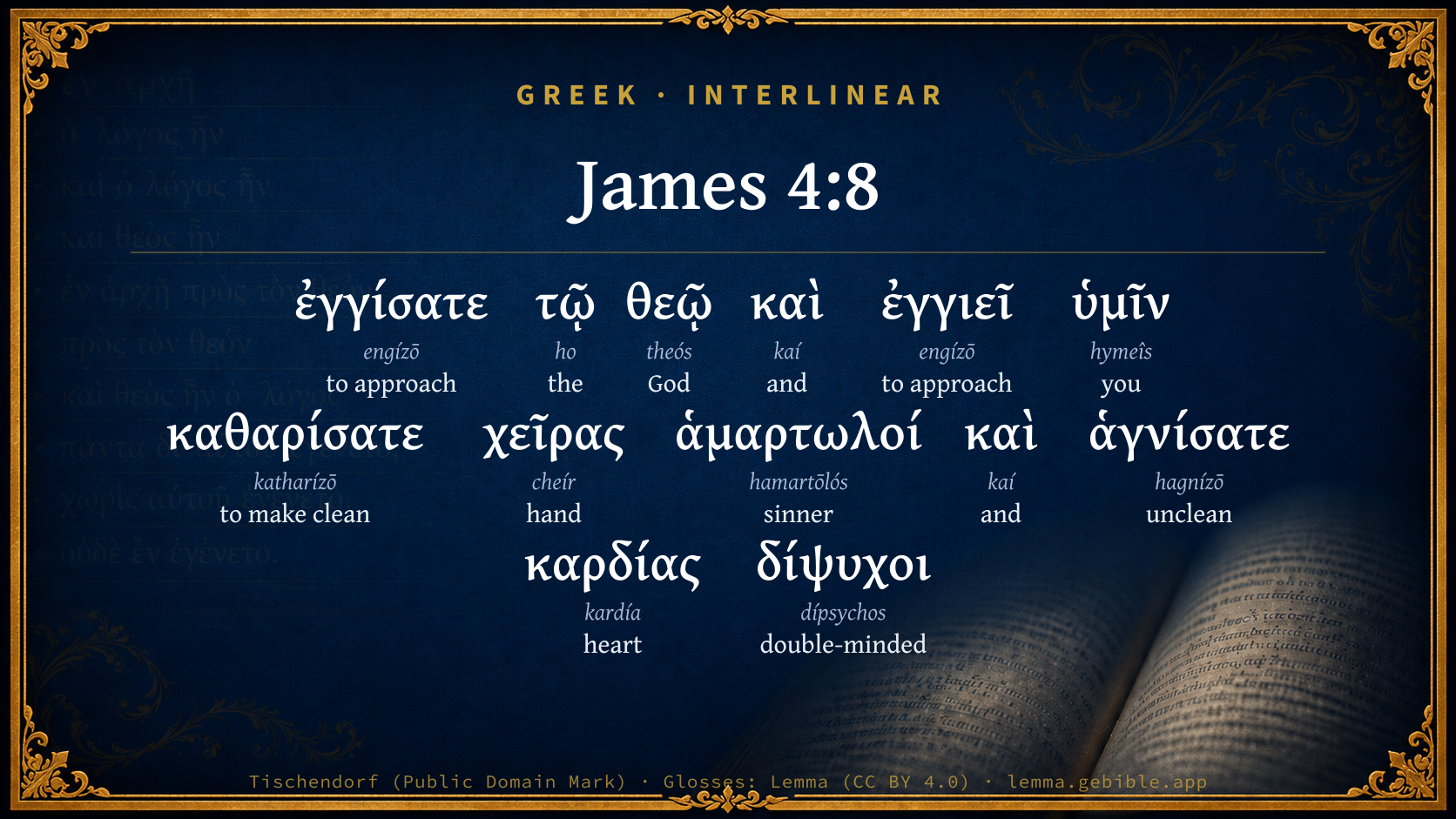
  1. ἐγγίσατε engízō G1448 “to approach” Verb, Aorist, Active, Imperative, 2nd person, Plural
  2. τῷ ho G3588 “the” Article, Dative, Singular, Masculine
  3. θεῷ theós G2316 “God” Noun, Dative, Singular, Masculine
  4. καὶ kaí G2532 “and” Conjunction
  5. ἐγγιεῖ engízō G1448 “to approach” Verb, Future, Active, Indicative, 3rd person, Singular
  6. ὑμῖν hymeîs G5210 “you” Personal pronoun, 2nd person, Dative, Plural
  7. καθαρίσατε katharízō G2511 “to make clean” Verb, Aorist, Active, Imperative, 2nd person, Plural
  8. χεῖρας cheír G5495 “hand” Noun, Accusative, Plural, Feminine
  9. ἁμαρτωλοί hamartōlós G268 “sinner” Adjective, Vocative, Plural, Masculine
  10. καὶ kaí G2532 “and” Conjunction
  11. ἁγνίσατε hagnízō G48 “unclean” Verb, Aorist, Active, Imperative, 2nd person, Plural
  12. καρδίας kardía G2588 “heart” Noun, Accusative, Plural, Feminine

About this verse

These counts appear in no published source. They are computed here, from the morphology-tagged text and Lemma’s own curated glosses. What Lemma adds →

13
words
11
distinct lemmas
General Epistles
section

Notable vocabulary

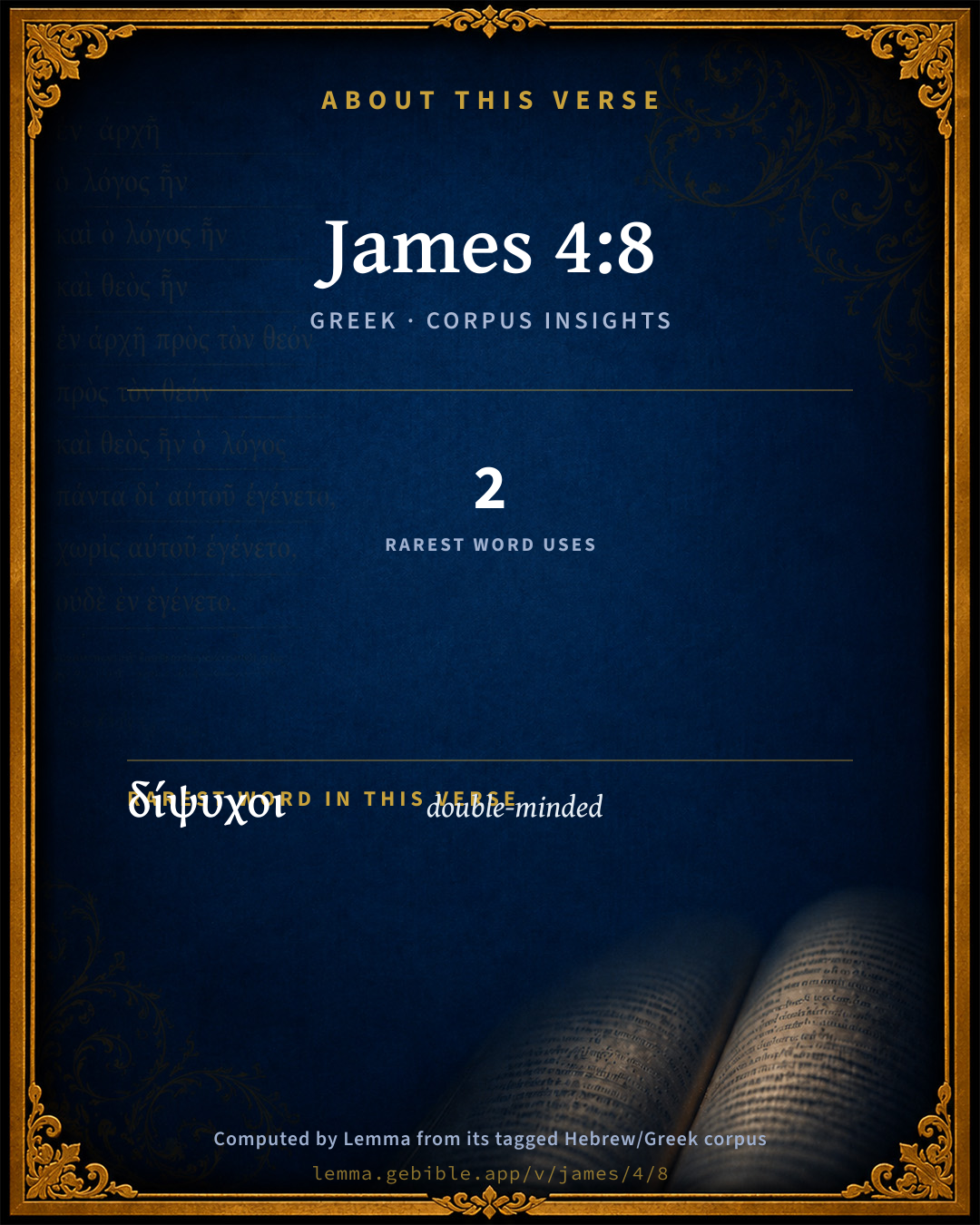
The rarest word here is δίψυχοι double-minded G1374 — appearing just 2 times in the whole Greek New Testament.

Shared distinctive vocabulary

δίψυχοι double-minded G1374 occurs in 2 verses of the Greek New Testament. Also found in:

Repetition

Words recur within this verse:

  • ἐγγίσατε to approach G1448 ×2
  • καὶ and G2532 ×2

Cross-references

39

Topical passages linked to James 4:8 in the Treasury of Scripture Knowledge — connected by theme and wording, ordered by reader-vote popularity; previews shown in the World English Bible.

  • Psalms 145:18 Yahweh is near to all those who call on him, To all who call on him in truth.
  • Hebrews 10:22 let's draw near with a true heart in fullness of faith, having our hearts sprinkled from an evil conscience, and having our body washed with pure water,
  • Malachi 3:7 From the days of your fathers you have turned aside from my ordinances, and have not kept them. Return to me, and I will return to you," says Yahweh of Hosts. "But you say, 'How shall we return?'
  • Zechariah 1:3 Therefore tell them: Thus says Yahweh of Hosts: 'Return to me,' says Yahweh of Hosts, 'and I will return to you,' says Yahweh of Hosts.
  • Isaiah 55:6–7 Seek you Yahweh while he may be found; call you on him while he is near:
  • 2 Chronicles 15:2 and he went out to meet Asa, and said to him, Hear you me, Asa, and all Judah and Benjamin: Yahweh is with you, while you are with him; and if you seek him, he will be found of you; but if you forsake him, he will forsake you.
  • Hosea 6:1–2 "Come, and let us return to Yahweh; For he has torn us to pieces, And he will heal us; He has injured us, And he will bind up our wounds.
  • Jeremiah 4:14 Jerusalem, wash your heart from wickedness, that you may be saved. How long shall your evil thoughts lodge within you?
  • Ezekiel 36:25–27 I will sprinkle clean water on you, and you shall be clean: from all your filthiness, and from all your idols, will I cleanse you.
  • Psalms 51:6–7 Behold, you desire truth in the inward parts. You teach me wisdom in the inmost place.
  • 1 John 3:3 Everyone who has this hope set on him purifies himself, even as he is pure.
  • Psalms 51:10 Create in me a clean heart, O God. Renew a right spirit within me.
  • Hebrews 7:19 (for the law made nothing perfect), and a bringing in thereupon of a better hope, through which we draw near to God.
  • Ezekiel 18:31 Cast away from you all your transgressions, in which you have transgressed; and make you a new heart and a new spirit: for why will you die, house of Israel?
  • Isaiah 1:15–16 When you spread forth your hands, I will hide my eyes from you; Yes, when you make many prayers, I will not hear. Your hands are full of blood.
  • Psalms 73:28 But it is good for me to come close to God. I have made the Lord Yahweh my refuge, That I may tell of all your works.
  • 2 Corinthians 7:1 Having therefore these promises, beloved, let us cleanse ourselves from all defilement of flesh and spirit, perfecting holiness in the fear of God.
  • 1 Chronicles 28:9 You, Solomon my son, know the God of your father, and serve him with a perfect heart and with a willing mind; for Yahweh searches all hearts, and understands all the imaginations of the thoughts: if you seek him, he will be found of you; but if you forsake him, he will cast you off forever.
  • 1 Peter 3:21 This is a symbol of baptism, which now saves you-- not the putting away of the filth of the flesh, but the answer of a good conscience toward God, through the resurrection of Jesus Christ,
  • Job 17:9 Yet shall the righteous hold on his way. He who has clean hands shall grow stronger and stronger.
  • Matthew 23:25–26 "Woe to you, scribes and Pharisees, hypocrites! For you clean the outside of the cup and of the platter, but within they are full of extortion and unrighteousness.
  • Matthew 12:33 "Either make the tree good, and its fruit good, or make the tree corrupt, and its fruit corrupt; for the tree is known by its fruit.
  • Psalms 24:4 He who has clean hands and a pure heart; Who has not lifted up his soul to falsehood, And has not sworn deceitfully.
  • Isaiah 29:13 The Lord said, Because this people draw near [to me], and with their mouth and with their lips to honor me, but have removed their heart far from me, and their fear of me is a commandment of men which has been taught [them];
  • 1 Timothy 2:8 I desire therefore that the men in every place pray, lifting up holy hands without wrath and doubting.
  • Psalms 18:20 Yahweh has rewarded me according to my righteousness. According to the cleanness of my hands has he recompensed me.
  • Luke 11:39–40 The Lord said to him, "Now you Pharisees cleanse the outside of the cup and of the platter, but your inward part is full of extortion and wickedness.
  • 1 Peter 1:22 Seeing you have purified your souls in your obedience to the truth through the Spirit in sincere brotherly affection, love one another from the heart fervently:
  • Psalms 26:6 I will wash my hands in innocence, So I will go about your altar, Yahweh;
  • Acts 15:9 He made no distinction between us and them, cleansing their hearts by faith.
  • James 1:8 He is a double-minded man, unstable in all his ways.
  • Genesis 18:23 Abraham drew near, and said, "Will you consume the righteous with the wicked?
  • Job 16:17 Although there is no violence in my hands, And my prayer is pure.
  • Matthew 15:2 "Why do your disciples disobey the tradition of the elders? For they don't wash their hands when they eat bread."
  • Jeremiah 4:11 At that time shall it be said to this people and to Jerusalem, A hot wind from the bare heights in the wilderness toward the daughter of my people, not to winnow, nor to cleanse;
  • Job 9:30 If I wash myself with snow, And cleanse my hands with lye,
  • Psalms 73:13 Surely in vain I have cleansed my heart, And washed my hands in innocence,
  • Isaiah 13:15 Everyone who is found shall be thrust through; and everyone who is taken shall fall by the sword.
  • Matthew 27:24 So when Pilate saw that nothing was being gained, but rather that a disturbance was starting, he took water, and washed his hands before the multitude, saying, "I am innocent of the blood of this righteous person. You see to it."

Cross-references courtesy of OpenBible.info (CC BY 4.0).

Commentary

Notes on James 4:8 from classic Christian and Jewish commentators (each source and its license shown beneath its notes). The classic Christian expositions comment on the surrounding passage and are grouped to its opening verse, so a note may address several verses; the Jewish commentaries on the Tanakh (Rashi and others) are per-verse, so they appear only where the commentator wrote on this verse.

Lemma curates 59 commentaries, every one of them public domain or Creative Commons licensed, each selected and text-cleaned for this edition rather than reprinted as found. About our sources →

The Biblical Illustrator

Joseph S. Exell

Jam_4:8

Draw nigh to God

Draw nigh to God

I.

THE DUTY here required of us by the apostle principally implies a life of prayer and devotedness to God, as contrasted with the careless indifference or the dull formality of nominal or pretended Christians.

II. THE ENCOURAGEMENT given to perform this duty. What great reason have we to be animated in our Christian warfare by the presence and support of the Lord of hosts!

III. THE IMPORTANCE of obeying this injunction to our final happiness and security. (John Grose, M. A.)

The reasonableness and blessedness of prayer

Worshipping with a pious heart is evidently the manner of drawing nigh to God, which the apostle had in mind when he penned the text. Under the Jewish dispensation, drawing near to God in worship was a more literal thing than it is under the Christian dispensation. In the temple, God had His dwelling-place as a King in His palace. It will not be understood from this that Jewish worship was only of this outward, ceremonial character. The heart was required of them as well as of us (Isa_29:13-14). Nevertheless, under the Christian dispensation, the worship of God is more strictly of a spiritual character. The duty of worshipping God is no less the dictate of reason and of common sense, than of Scripture. It has been the sentiment of mankind, universally, that children ought to cherish peculiar respect fur their parents. So men have always deemed it proper to specially regard and honour those high in authority. Can those who thus honour parents and magistrates deny the obligation to do homage to Him who is at once their Maker, their Sovereign, and their Judge? Prayer.

I. ITS REASONABLENESS.

1. God has enjoined it. It must be counted reasonable to do what God has commanded, and most unreasonable to disregard His positive injunctions. Men ought always to pray and not to faint.--Continuing instant in prayer.--Pray without ceasing.

2. The reasonableness of prayer may be shown from the example of the Saviour.

3. The reasonableness of prayer is manifest when we consider what we are--

(1) As needy and dependent creatures. Every hour of our lives brings with it wants which must be supplied, or we suffer and die.

(2) As sinful and unworthy creatures. No one has, or can have, any other idea of prayer, than as being addressed to the mercy of God; and when that mercy invites us freely to come and make known our desires, it is most unreasonable in us not to avail ourselves of the privilege.

(3) As dying and accountable creatures. Who can feel easy in view of future accountability, whose heart has never been sufficiently grateful to acknowledge the Divine goodness, nor sufficiently humble to confess its sins and seek the Divine forgiveness?

4. As showing the reasonableness of prayer, consider the benefits of a persevering attendance on this duty. Prayer is the way to a life of communion with God--a means of keeping up an acquaintance with, and of growing in the knowledge of God. It is a most excellent, yea, an essential means of nourishing the new nature, and of causing the soul to prosper. It is a good preservative from sin; as it is said, praying will make us leave sinning, or sinning will make us leave praying.

II. THE BLESSEDNESS OF PRAYER.

1. This may be seen by considering the nature of the exercise itself. Prayer usually embraces three things--praise, confession, and supplication. The ascription of praise to God is certainly a delightful exercise to every grateful heart. A grateful heart is burdened with a sense of obligation until it finds relief in rendering a tribute of thanks to Him who is the Giver of every good and every perfect gift. Confession of sin is a part of prayer full of blessedness. What a blessed hour was that to the poor prodigal when he came to himself, and said, I will arise and go to my father. Supplication, too, as a part of prayer, is a blessed exercise.

2. We may learn the blessedness of prayer by its effect on the character of him who offers it, and also by the blessings bestowed in answer to it. (F. Snyder.)

Draw nigh to God

I. SHOW WITH WHAT TEMPERS AND DISPOSITIONS OF MIND WE MUST DRAW NIGH TO GOD.

1. If we are truly and devoutly desirous of drawing nigh to God, one of our earliest considerations will naturally be, how unfit we are to come to Him. This will lead us to a serious examination of ourselves: to a review of our past conversation; and a comparison of it with the rule of His commandments.

2. We must draw nigh to God with firm resolutions of continuing, through His grace, in His service during our whole lives.

3. We must draw nigh with sincerity.

By sincerity I mean here a desire to know and do the whole will of God.

II. THERE ARE PROPER PLACES AND TIMES, AS WELL AS DUE DISPOSITIONS, OF DRAWING NIGH TO GOD.

1. Can we approach without ardent love?

2. It becomes us, when drawing nigh to Got, to cherish the spirit of obedience.

3. Our most intense desires should ascend above all temporal blessings.

II. THE PROMISE AFFORDED.

1. Several things are implied in this promise.

(1) It imports the manifestation of His presence. He is ever nigh, but He makes Himself known in a gracious manner only to those who seek Him.

(2) It implies infinite condescension.

2. Several benefits are imparted by the fulfilment of this promise.

(1) The mind derives from it pure and sacred pleasure. A soul in converse with her God is heaven.

(2) A state of security ensues. If God draw nigh to us, it is not to forsake us immediately afterwards. But if God be with us, we have nothing to fear.

III. CONSIDERATIONS ON THE PERFECTIONS OF GOD AND HIS RELATIONS TO US, AS MOTIVES AND INDUCEMENTS FOR DRAWING NIGH TO HIM.

1. In coming to God, we come to Him who is the blessed and only Potentate; the King of kings, the Lord of lords; who only hath immortality; who, by His word, framed the worlds; and, by the same word of power, upholdeth all things; in whom we live, and move, and have our being.

2. In coming to Him, we come to our Redeemer.

3. In coming to Him, we come to our Judge. (T. Townson, D. D.)

The approach of a devout mind to the Almighty

1. There are certain indispensable prerequisites.

(1) We must possess a knowledge of God.

(2) We must be convinced of our dependent state.

(3) We must embrace the plan of reconciliation by Jesus Christ.

2. There are certain dispositions which must be the accompaniments of prayer.

3. Communion begets resemblance. And can we have been often with the holy God, and not be holy? (O. A. Jeary.)

Drawing near to God

1. Touching the commandment, and the precept enjoined, is to draw near to God. That we are commanded to draw near unto God, doth it not insinuate unto us that naturally we are estranged and alienated from Him? Isa_59:2; Jer_5:25).

2. To which short precept is set down a like promise: draw near to God, and He will draw near to you. Which promise is as a reason to move us to draw near to God. He is ready to offer Himself, and is pressed at hand to all such as come near unto Him, to make them to feel the comfort of His presence. God may be said to draw near to man divers ways.

(1) By the manifestation of His majesty, as to Abraham, Isaac, Jacob, Moses, and others (Gen_12:7; Gen_17:1; Gen_18:1; Gen_26:1; Gen_28:13; Gen_32:24; Exo_33:23; Exo_24:1; Exo_3:2).

(2) He draweth near also unto man by the revelation of His will. He drew nearest thus to Israel His people, to whom He gave His law and statutes, whereby He became familiar unto them.

(3) By the graces of His Spirit, which imparting unto men He draweth near thereby unto them (Joh_14:18; Mat_28:20; Act_2:1; Act_3:3).

(4) God draweth near to men by pouring out His temporal benefits upon them, health, wealth, honour, and sending them deliverance out of their trouble (Deu_4:7; Php_4:5; Psa_69:18; Psa_119:151; Psa_34:18; Psa_46:1).

(5) God draweth near unto men in offering His mercy, showing His favour, assisting with His help, multiplying His livingkindness unto them.

(6) God finally draweth near unto us in a spiritual union with man, through the incarnation of Jesus Christ, whereby God is united unto us and we to Him, by which means God dwelleth among us, and is made manifest in the flesh, as St. John and St. Paul speak. And therefore Christ is Emmanuel. Where, then, the apostle saith draw near to God, and He will draw near to you, he speaketh chiefly of drawing near by His grace, favour, mercy; who enlargeth His lovingkindness towards all those which with reverence and fear draw near unto Him.

3. These things thus set down, in the last place we are taught how we should draw near to God, which the apostle expresseth in these words: Cleanse your hands, you sinners, and purge your hearts, you double-minded.

(1) Men draw near to God by outward profession, though it be not always in sincerity of heart. Thus did the people of Israel in outward profession, and with their mouths, draw near to God, which as a token of hypocrisy is condemned (Isa_24:13; Isa_58:2-3).

(2) Men also draw near to God by faith in Jesus Christ, whereby they have entrance unto Him (Rom_5:1).

(3) Men draw near to God also by prayer, whereby we ascend, as it were, to heaven, and approach near to the presence of God.

(4) Neither do men draw near to God by prayer only, but also by repentance, which is a returning again to God, whom, through the sins and iniquities of our lives, we have left and forsaken.

(5) Men are said, moreover, to draw near to God when they seek to His holy ark, when they run to His Word to ask counsel.

(6) By reposing all trust and confidence in God, and clinging constantly unto Him, whereof Psa_73:28.

(7) Of none of all these the apostle here seemeth to speak properly, but of another drawing near, which is by purity and sincereness of life, whereof chiefly in this place he speaketh, which be commendeth unto us in these words, Cleanse your hands, you sinners, and purge your hearts, you double-minded, which I take not for a new precept, but with Bede and others as the manner of performing that which is now enjoined.

Let us then consider the place--

1. In calling them sinners he meaneth not them which are subject by natural infirmity to the committing of sin, as all men are so long as they rest and remain upon the face of the earth, but hereby he noteth their heinous and horrible iniquities.

2. By wavering or double-minded he noteth the shameful hypocrisy which was crept in, even into their lives, which made some show of religion, And had a pretence of godliness, but in their hearts were full of ungodliness.

3. The words bearing this signification, the matter followeth, that men in purity and sincerity of their lives draw near unto God, which consisteth in two things.

(1) In cleaning of their hands.

(2) In purging of their hearts before God. (R. Turnbull.)

Communion with God

I. THE MEANING. We are to understand it as conveying a gracious promise of conscious and sensible communion with the Father of our spirits.

II. THE MANNER.

1. The sinner must draw nigh unto God by the way of His own appointment, and that way is Christ.

2. In drawing nigh unto God a sinner must have a sense not only of his own unrighteousness, but of his own helplessness.

3. You must draw nigh to God in all His ordinances.

4. With clean hands and a pure heart.

III. THE MOTIVES.

1. The graciousness of the invitation.

2. The greatness of the benefit to be secured.

3. The certainty of the result.

4. The dreadful consequences of continued estrangement. (Alex. Hislop.)

Communion with God

If you saw two persons working together in the same shop or the same field, both blessed with the faculty of speech, and delighting to converse with all others, but never conversing with each other, what would be your conclusion? That they loved each other? By no means; but the reverse. If you saw one person using every art to please another, and to draw him into conversation, and the second person avoided his presence, and refused intercourse, what would you think? That the second person loved the first? Surely not. It is our pleasure to be in the society of those we love, and to converse with them. Prayer is speaking to God. Worship is coming into His presence, and waiting upon Him--is listening to His voice.

Approaches to God

The mother of Artaxerxes was wont to say, that they who would address themselves unto princes must use silken words: surely he that would approach unto God must consider, and look as well to his words as to his feet. He is so holy and jealous of His worship, that he expects that there should be preparation in our accesses unto Him: preparation of our persons by purity of life (Job_11:13); preparation of our services by choice of matter (Joh_9:1); preparation of our hearts by finding them out, stirring them up, fixing them, fetching them in, and calling together all that is within us to prevail with God. (Bp. Reynolds.)

Let your laughter be turned to mourning

Carnal joy exchanged for godly sorrow

1. It is a good exchange to put away carnal joy for godly sorrow; for then we put away a sin for a duty, brass for gold; yea, we have that in the duty which we expected in the sin, and in a more pure, full, and sweet way. God will give us that in sorrow which the world cannot find in pleasure; serenity, and contentment of mind. When the world repenteth of their joy, you will never repent of your sorrow (2Co_7:10). The saddest duties are sweeter than the greatest triumphs, and the worst and most afflicted part of godliness is better than all the joys and comforts of the world. It is better to have your good things to come, than here (Luk_16:21).

2. An excellent way to moderate the excess of joy is to mix it with some weeping. The way to abate one passion is to admit the contrary: in abundance there is danger; therefore in your jollity think of some mournful objects. (T. Mouton.)

Mourning for sin

Mourn savourly and soakingly, with a deep and downright sorrow, so as a man would do in the death of his dearest friend. The Greek word, πενθήσατε, imports a funeral grief. (J. Trapp.)

Laughter turned to mourning

Turn all the streams into one channel, that may drive the will, that may grind the heart. Meal was offered of old, and not whole corn. (J. Trapp.)

Humble yourselves in the sight of the Lord and He shall lift you up

Lividly as in Gods sight

The heart is naturally at enmity with God. Hence humility is the first of Christian virtues: not that God wishes to see us debased, but that self-abasement is in accordance with the truth of our character, and is the way to exaltation. To use a very rude metaphor, just as a man cannot go up another hill till he has gone down the one on which he happens to be, so a soul cannot be exalted in God until it has thoroughly come down from self. And what is that exaltation which God accomplishes for the soul? It must be the only true and permanent exaltation. Exaltation in Satans kingdom must be debasement, for it is exaltation in sin, and sin depresses and debases. The exaltation, then, in this case must be an illusion. The true exaltation must be in the truth. It must be in the region where God dwells. It must be in righteousness and holiness. Such an exaltation implies satisfaction and joy. It also implies its own continuance, because of its Divine character. It is mans finality in the kingdom of God as contrasted with his finality in the kingdom of Satan. There is one phrase especially in our text on which we desire to lay stress: In the sight of the Lord. Our humility is to be wrought in His sight. This implies, in the first place--

1. That the humility is not a humbling of ourselves before our fellow-men. The abjectness and servility of one man to another are not pleasing to God. If we injure our fellow-man, we are to take the attitude of penitence before him. But, this exceptional case aside, no man is to humble himself before his fellow-man.

2. The believers humility is therefore, in the second place, a true humility. It will not do to present to God the outward prostration for the inward repentance, the words of humility for the self-renunciation of the heart. A true humility is alive, and bears fruit in a new and holy life. A true humility sees the truth regarding itself, that the heart is deceitful and desperately wicked, and cries out for God. The man abandons self for God. He abhors self, and finds a refuge in Jesus Christ, who is made unto him wisdom and righteousness and sanctification and redemption. This is the glorious lifting up which always accompanies a true humility. What! says an objector, is that a true humility which is humble in order to be exalted? Yes, it is. It would not be if the exaltation were to be in the line of the humility; that is, if the man was to be exalted in the very pride from which he humbles himself. But when the man is to be exalted by the Divine grace and the Divine Spirit, that is a true humility which foresees this exaltation, and acts in view of it. It is not a humility of despair, but of faith. It know its own worthlessness, but it knows also the Lords grace.

3. The believers humility, being in the sight of the Lord, implies a life in the sight of the Lord. He sees Him who is invisible, and his motives come from that source, so invisible to the world. The Lords light shines on him, and that light reveals sin in the heart. He is never found justifying himself, or flattering himself with human purity and excellence. His comfort comes from no such proud and false source, but from resting his evil heart on the pardoning and cleansing love of his Redeemer. And in that love he finds a true holiness springing up in his soul.

4. The believers humility implies a life of prayer. We cannot see God without praying to Him as the source of pardon and holiness, the only guardian and guide of the soul. (H. Crosby, D. D.)

Humility explained, and its necessity enforced

Humility stands opposed to pride. And as pride consists in our entertaining higher ideas of ourselves than truth will warrant, and in our presuming upon these, both in feeling and in practice, as if they were just and correct, so humility consists in our entertaining accurate notions of what we really are in relation to some one above us, and in preserving that station which a regard to our real merits requires us to occupy, as to the sentiments we cherish and the conduct we maintain, with respect to those under whom we are placed. The humility inculcated in my text is humility in reference, not to another creature more exalted than ourselves, but to God, who is immeasurably exalted above all creatures. And in this simple relation, even though we had done nothing to offend Him, humility is at once graceful and necessary; for, as we owe everything to Him, and as we depend upon Him for everything, it would be presumptuous, undutiful, to have one thought towards Him or to make one movement before Him, which proceeded on the supposition that we were not so indebted and so dependent. But the humility enjoined upon us not only respects our relation to God as His creatures, whose every faculty must be traced to Him--it also respects our relation to Him as His sinful creatures--who are thus removed at a still greater distance from Him than they naturally were, and liable to His high and holy indignation. When we exhort you to be humble, we do not exhort you to think yourselves worse or meaner than you really are. We only exhort you to form a just and precise valuation of what you really are, as compared with what you ought to be, according to the rule which has been Divinely enacted, and to maintain the conduct which such an appreciation is calculated to produce. And this exhortation is highly important in the first place, because, unless we have just notions of what we are as sinners, we can neither perceive the value, nor be prepared for the reception of any scheme that may be devised for our deliverance; and in the second place, because, among the principles of our fallen nature, pride is that which has perhaps the greatest ascendancy over our minds, and prevents us from giving heed to those considerations which go to determine what we really are, and by doing so, to fix us at our proper level. The great and vital fact with respect to you is, that you are stained with sin. There may be an endless variety in the mode and in the measure of sinning with which different individuals are chargeable. Do not suppose that you have any refuge in the paucity of your misdeeds. It is the nature of sin itself, and not its multiplicity merely, which subjects you to degradation. It is its power in the soul, and not its actual and manifold exhibition in the outward conduct, by which you are debased. But which of you can venture to say that your transgressions are few in number? Consider the extent--the strictness--the spirituality of that law to which you are subject. That is the measure of your sinfulness; and if your humility should be in proportion to your sinfulness, what limit can be set to it? Humility, however, is so mortifying to the human mind, that before it can obtain a settlement there, every attempt is made to discover reasons for believing that it is neither necessary nor appropriate. And one of the most common refuges in which the natural pride of man fortifies itself, is the self-righteous plea of what is called innocence and amiableness of character. Granting that you are as harmless as amiable, as deserving of esteem as you are thought to be, still it is all unavailing. The essential excellence of what is done by a moral agent, consists in its recognition of the existence, and in its submission to the will of Him who ruleth over all. And yet God has not been in all your thoughts, and God has not been in all your ways. And the pervading guilt which such a consideration throws into it is incalculably aggravated by your not only resting upon its merits with satisfaction, but actually supposing it sufficient to secure the favour of that very Being whom it has so dishonoured, neglected, and disowned. But we must not neglect to remind you of that affecting display of the evil of sin, and of the degradation of the sinner, as these appear in the sight of the Lord which has been made in the Cross of Christ. Could such a sacrifice as this, think you, have been demanded by the Father of mercies, the possessor of infinite wisdom, the God of righteousness and justice, if it had not been necessary for the purpose for which it was required--the expiation of human guilt, and the deliverance of those to whom it attached, from the degradation and the ruin into which it had brought them? Had we nothing more to tell you than that you are sinners, it would only fill you with mortification, hopelessness, and anguish. But after having told you all that we can add intelligence as pleasing as that which went before it was painful. We can speak of blessings that are to follow in its train, and that are sufficient to compensate you a thousandfold for all the distress which may have been inflicted upon your feelings by our delineations of the abject state to which you are reduced as transgressors. We would persuade you to humble yourselves in the sight of the Lord, that He may, in consequence, lift you up. This is the arrangement established by the Author of salvation. The humility that is enjoined is connected with the privilege that is to follow it, in another way than that of either natural or acquired right. The connection is just as necessary, but it is of a different kind. When the sinner is made humble, he is merely undergoing a part of that moral process which must take place, in order that he may be raised from the death of sin to the life of holiness and peace. If you feel and cherish that humbleness of mind which just conceptions of your guilty and depraved and wretched condition are calculated to generate; and if in the midst of this self-reproach you are ready to throw your fortunes unreservedly upon the merits of that dispensation which Divine grace offers to you as your all-sufficient refuge, then there is no insuperable barrier between you and the salvation which you need. The devices of Gods wisdom become acceptable to you, the offers of His mercy become welcome to you, the hopes of His favour become precious to you, the whole manifestation of His redeeming love becomes available to you. (A. Thomson, D. D.)

Humility in Gods sight

In one of our western cities is a physician who is very skilful in doctoring the human eye. I went one day into his office. On the wall was a large painting of an eye. It seemed to look at me when I went in. I could get into no part of the room without the eye seeing me; and the last thing that I saw as I went out was that eye looking at me. 1 have often thought of that picture, and said to myself, that in some such way Gods all-seeing eye follows me all my life through. And it makes me feel humble, and leads me to be careful; humble, because I must be so small, so weak, and so wicked in Gods sight; careful, for surely I shall want God to see only that which will please Him as He shall look me through and through. (J. G. Merrill.)

Deep root, tall growth

As a tree, the more deeply it is rooted in the earth, the taller it groweth and mounteth the higher; even so a man, the more humble and lowly that he is, the more and higher doth the Lord exalt him.

Christian humility the way of an exaltation

Our humiliations work out our most elevated joys. The way that a drop of rain comes to sing in the leaf that rustles in the top of the tree all the summer long, is by going down to the roots first, and from thence ascending to the bough. (H. W.Beecher.)

The Biblical Illustrator, edited by Joseph S. Exell (c. 1880s–1900s) — public domain. Text from a community e-Sword module.

Tyndale Open Study Notes

Tyndale Open Resources

4:8 Come close to God: This is the language of friendship (2:23) and loyalty (1:6-8). • Wash your hands . . . purify your hearts: The language of ceremonial cleansing is applied to the inner purity of one’s intentions (cp. Mark 7:1-23).

Tyndale Open Study Notes — © Tyndale Open Resources, licensed CC BY-SA 4.0. Text via the HelloAO Bible API.

Bengel's Gnomon

Johann Albrecht Bengel

Jas 4:8. Ἐγγίσατε, draw near) The flight of the devil is followed, in the order of nature rather than of time, by an approach to God, in holy prayer, Jas 4:2-3.—ἐγγιεῖ, He will draw near) as propitious. A most joyous word.—καθαρίσατε, cleanse) That you may be able to put to flight the devil.—ἁγνίσατε, purify) that ye may be able to approach God, having laid aside adultery of soul.—δίψυχοι, ye double-minded) who give yourselves both to God and to the world, Jas 4:4. The form of address varies in this Epistle; and at one time they are addressed as holy brethren, at another time as sinners, at another time as waverers. The double-minded man is at fault in heart; the sinner, in his hands likewise.

Bengel's Gnomon of the New Testament — English translation (T&T Clark, Edinburgh, 1860) — public domain. Text from a community e-Sword module.

Meyer's Critical & Exegetical Commentary

Heinrich August Wilhelm Meyer

Jam_4:8. In contrast to the last exhortation and promise is the exhortation ἐγγίσατε τῷ Θεῷ, united in a similar manner with a promise. Whilst the devil is to be kept at a distance by resistance, we are to draw nigh to God. ἐγγίζειν is not to be limited to prayer, but is to be understood generally of mans turning to God (Wiesinger). Comp. on ἐγγίζειν, Isa_29:13; Heb_7:19.

καὶ ἐγγιεῖ ὑμῖν] corresponding to the preceding φεύξεται ἀφʼ ὑμῶν. Similar expressions in 2Ch_15:2; Isa_57:15; Zec_1:3.

But in order to draw nigh to God, conversion from the former nature is necessary; therefore καθαρίσατε χεῖρας … ἀγνίσατε καρδίας. The cleansing of the hands consists in withdrawing them from evil and in employing them in good works; the sanctification of the heart, in contending with impure desires, and in the cultivation of a holy disposition. The external and the internal must correspond; comp. Psa_24:4 : ἀθῶος χερσὶ καὶ καθαρὸς τῇ καρδίᾳ. Pott erroneously supposes the first expression to be a symbolical designation of μετάνοια, and denies its reference to the externa vitae integritas (Carpzov). The reason why James names the hands is not only because they are the principal organa operandi, but also because that he, with ἐγγίζειν τῷ Θεῷ, does not think exclusively on prayer; see 1Ti_2:8. On ἁγνίσατε καρδίας, comp. 1Pe_1:22; 1Jn_3:3.

ἁμαρτωλοὶ … δίψυχοι] This address, designating the present condition of the addressed, shows the necessity of μετάνοια; ἁμαρτωλοί, because instead of God, who chose them for His possession, they serve the lusts (ἡδοναῖς, Jam_4:1) of the κόσμος, corresponding to μοιχαλίδες, Jam_4:4; δίψυχοι, because they would at the same time be Christians. De Wettes explanation is too weak: ye undecided (between God and the world); Schneckenburgers remark: hic sensu latiore sumendum quam, Jam_1:8, is incorrect, for διακρίνεσθαι there has its reason in the Christian giving his heart to the world instead of to God; see Test. Aser. III. p. 691: οἱ διπρόσωποι οὐ Θεῷ ἀλλὰ ταῖς ἐπιθυμίαις αὐτῶν δουλεύουσι.

Calvin correctly remarks: non duo hominum genera designat, sed eosdem vocat peccatores et duplices animo.[200]

[200] Kern: As James considers man in reference to the divine grace as the receiver, so, on the other hand, he takes into account the free self-activity of man as the condition by which a relation of unity of man with God takes place.

Meyer — Critical and Exegetical Commentary on the New Testament — English translation by Peter Christie, edited by Frederick Crombie (T&T Clark, 1880) — public domain. Text from a community e-Sword module.

Expositor's Greek Testament

ed. W. Robertson Nicoll

Jas 4:8 . ἐγγίσατε τῷ θεῷ , καὶ ἐγγίσει ὑμῖν : here, again, we have what to Christian ears sounds rather like a reversal of the order of things; we should expect the order to be that expressed in such words as, “Ye did not choose me, but I chose you” (Joh 15:16 ). The words before us seem to be a quotation (inexact) from Hos 12:6 (Sept.), … ἔγγιζε πρὸς τὸν θεόν σου διὰ παντός . The Hebrew phrase נגשׁ אל־ is a technical term for approaching God for the purpose of worship, e.g. , Exo 19:22 ; Jer 30:21 ; Eze 44:13 . There is an extraordinary passage in Test. of the Twelve Patriarchs , Dan. vi. 1, 2 which runs, “And now, fear the Lord, my children, and beware of Satan and his spirits. Draw near unto God and to the angel that intercedeth for you, for he is a mediator between God and man” (the latter part here is not a Christian interpolation). καθαρίσατε χεῖρας : Cf. Psa 24:4 , ἀθῷος χερσὶ καὶ καθαρὸς τῇ καρδίᾳ …; in Is. Jas 1:16 we have, λούσασθε , καθαροὶ γένεσθε , and in Sir 38:10 , ἀπόστησον πλημμελίαν καὶ εὔθυνον χεῖρας , καὶ ἀπὸ πάσης ἁμαρτίας καθάρισον καρδίαν . In each case it is a metaphorical use of language which otherwise expressed the literal ritual washing; the former, taken from the latter, was in use at least as early as exilic times. ἁμαρτωλοί : the close connection with this word and the δίψυχοι which follows almost immediately recalls the language in Sir 5:9 , … οὕτως ὁ ἁμαρτωλὸς ὁ δίγλωσσος . ἁγνίσατε καρδίας : the thought of these, as well as of the preceding words, is an adaptation of Psa 72 (73) 13, Ἄρα ματαίως ἐδικαίωσα τὴν καρδίαν μου , καὶ ἐνιψάμην ἐν ἀθῴοις τὰς χεῖράς μου . The verb ἁγνίζω ( התקדשׁ ) means originally to sanctify oneself preparatory to appearing before the Lord by separating oneself from everything that might cause uncleanness; the idea of separating oneself is still present in the passage before us, because mourning implied temporary withdrawal from the world and its doings. Mayor quotes in connection with this verse, Hermas, Mand. , ix. 7, καθάρισον τὴν καρδίαν σου ἀπὸ τῆς διψυχίας . δίψυχοι : Cf. Hos 10:2 , and in addition to the passages referred to above, Jas 1:8 , cf. Barnabas xix. 5, οὐ μὴ διψυχήσῃς , πότερον ἔσται ἢ οὔ , and the identical words in Did. iv. 4.

The Expositor's Greek Testament, edited by W. Robertson Nicoll (1897–1910) — public domain. Text from a community e-Sword module.

Jamieson, Fausset & Brown

Robert Jamieson, A. R. Fausset & David Brown

Draw nigh to God--So "cleave unto Him," Deu 30:20, namely, by prayerfully (Jam 4:2-3) "resisting Satan," who would oppose our access to God.

he will draw nigh--propitious.

Cleanse . . . hands--the outward instruments of action. None but the clean-handed can ascend into the hill of the Lord (justified through Christ, who alone was perfectly so, and as such "ascended" thither).

purify . . . hearts--literally "make chaste" of your spiritual adultery (Jam 4:4, that is, worldliness) "your hearts": the inward source of all impurity.

double-minded--divided between God and the world. The "double-minded" is at fault in heart; the sinner in his hands likewise.

Jamieson, Fausset & Brown — Commentary Critical and Explanatory on the Whole Bible (1871) — public domain (CC PDM 1.0). Text via the HelloAO Bible API.

Adam Clarke's Commentary

Verse 8. Draw nigh to God] Approach HIM, in the name of Jesus, by faith and prayer, and he will draw nigh to you-he will meet you at your coming. When a soul sets out to seek God, God sets out to meet that soul; so that while we are drawing near to him, he is drawing near to us. The delicacy and beauty of these expressions are, I think, but seldom noted.

Cleanse your hands, ye sinners] This I think to be the beginning of a new address, and to different persons; and should have formed the commencement of a new verse. Let your whole conduct be changed; cease to do evil learn to do well. Washing or cleansing the hands was a token of innocence and purity.

Purify your hearts] Separate yourselves from the world, and consecrate yourselves to God: this is the true notion of sanctification. We have often seen that to sanctify signifies to separate a thing or person from profane or common use, and consecrate it or him to God. This is the true notion of קדש kadash, in Hebrew, and αγιαζω in Greek. The person or thing thus consecrated or separated is considered to be holy, and to be God's property; and then God hallows it to himself. There are, therefore, two things implied in a man's sanctification:

1. That he separates himself from evil ways and evil companions, and devotes himself to God.

2. That God separates guilt from his conscience, and sin from his soul, and thus makes him internally and externally holy.

This double sanctification is well expressed in Sohar, Levit. fol. 33, col. 132, on the words, be ye holy, for I the Lord am holy: אותו מלמעלה ארס מקדש עצמו מלמטה מקישין, a man sanctifies himself on the earth, and then he is sanctified from heaven. As a man is a sinner, he must have his hands cleansed from wicked works; as he is double-minded, he must have his heart sanctified. Sanctification belongs to the heart, because of pollution of mind; cleansing belongs to the hands, because of sinful acts. See Clarke on Jas 1:8, for the signification of double-minded.

Adam Clarke's Commentary on the Bible (1810–1826) — public domain. Text from a community e-Sword/MySword module.

John Calvin's Commentaries

8 Draw nigh to God. He again reminds us that the aid of God will not be wanting to us, provided we give place to him. For when he bids us to draw nigh to God, that we may know him to be near to us, he intimates that we are destitute of his grace, because we withdraw from him. But as God stands on our side, there is no reason to fear succumbing. But if any one concludes from this passage, that the first part of the work belongs to us, and that afterwards the grace of God follows, the Apostle meant no such thing; for though we ought to do this, yet it does [not] immediately follow that we can. And the Spirit of God, in exhorting us to our duty, derogates nothing from himself, or from his own power; but the very thing he bids us to do, he himself fulfills in us.

In short, James meant no other thing in this passage, than that God is never wanting to us, except when we alienate ourselves from him. He is like one who brings the hungry to a table and the thirsty to a fountain. There is this difference, that our steps must be guided and sustained by the Lord, for our feet fail us. But what some cavil at, and say, that God’s grace is secondary to our preparation, and as it were the waiting-maid, is only frivolous; for we know that it is no new thing that he adds now to former graces and thus enriches more and more those to whom he has already given much.

Cleanse your hands. He here addresses all those who were alienated from God and he does not refer to two sorts of men, but he calls the same sinners and double-minded Nor does he understand every kind of sinners, but the wicked and those of a corrupt life. It is said in John 9:3,

“God does not hear sinners;”

in the same sense a woman is called a sinner by Luke. (Luke 7:39.) It is said by the same and the other evangelists, “He drinketh and eateth with sinners.” He, therefore, does not smite all indiscriminately to that sort of repentance mentioned here, but those who are wicked and corrupt in heart, and whose life is base and flagitious or at least wicked; it is from these he requires a purity of heart and outward cleanliness.

We hence learn what is the true character of repentance. It is not only an outward amendment of life, but its beginning is the cleansing of the heart. It is also necessary on the other hand that the fruits of inward repentance should appear in the brightness of our works.

John Calvin's Commentaries (1540-1563) — public domain. Text from the Calvin Translation Society English edition (1840s-50s) via the Christian Classics Ethereal Library (ccel.org). Calvin's coverage is partial (roughly two-thirds of the Bible); uncommented books and verses are honest gaps, never fabricated. The 19th-century editor's footnotes and remarks are omitted so the notes are faithfully Calvin's own voice.

Ellicott's Commentary for English Readers

(8) Draw nigh to God . . .—God waiteth to be gracious (Isa_30:18). Like the father of the prodigal son (Luke 15), He beholds us while we are “yet a great way off,” and runs, as it were, to hasten our return. He has “no pleasure in the death of him that dieth” (Eze_18:32). But who shall come “into the tabernacle of God, or rest upon His holy hill” (Psa_15:1), except the man “of uncorrupt life”? Surely, the penitent as well; the murderous hands “which all the perfumes of Arabia will not sweeten,” the hearts polluted with the most abominable lusts, may and must be cleansed; sinners and double-minded (refer to Jas_1:8) though they be, and both in one, the Lord of mercy will “draw nigh” to them, if they to Him: all their “transgressions shall not be mentioned,” they “shall live and not die” (Eze_18:21-22).

A Bible Commentary for English Readers, edited by Charles John Ellicott (1878–1897) — public domain. Text from a community e-Sword module.

The Cambridge Bible for Schools and Colleges

gen. ed. J. J. S. Perowne

8–10. The Call to Repentance

8. Draw nigh to God, and he will draw nigh to you] The “nearness to God,” to which the promise is attached, is primarily that which is involved in all true and earnest prayer, but it should not be forgotten that it includes also the approximation of character and life. We are to walk with God as Enoch walked (Gen_5:24). The former sense is prominent in the LXX. use of the verb employed by St James, as in Hos_12:6, where in the English we have “wait on thy God continually,” and Psa_119:169. An illustration of its meaning in the second clause is found in Job_19:21, where it answers to the English “have pity on me.”

Cleanse your hands, ye sinners …] The words contrast, with an implied reference to our Lord’s teaching in Mat_15:1-9, the true cleanness of hands, which consists in abstinence from the evil that defiles (Psa_24:4; 1Ti_2:8), with the merely ceremonial cleanness on which the Pharisees laid stress. Comp. Ch. Jas_1:27.

purify your hearts …] The verb implies the same kind of purity as the adjective used in Ch. Jas_3:17, primarily, that is, chastity of heart and life. It has here a special emphasis as contrasted with the “adulteresses” in Jas_4:4, and with the special aspect of the “double-mindedness” which that word implied. See note on Ch. Jas_1:8.

The Cambridge Bible for Schools and Colleges (gen. ed. J. J. S. Perowne; Cambridge University Press, 1878–1918) — public domain. Text from a community e-Sword module.

John Gill's Exposition

Draw nigh to God, and he will draw nigh to you,.... This must be understood consistently with the perfection of God's immensity and omnipresence: the saints draw nigh to God when they present their bodies in his sanctuary; when they tread in his courts, and attend his ordinances; where they always find it good for them to draw nigh unto him; and blessed is the man that approaches to him in faith and fear: they draw nigh to him when they come to the throne of his grace, for grace and mercy to help them; when they draw near to him in prayer with true hearts, and lift them up with their hands to God; when in the exercise of faith and hope they enter within the vail, and come up even to his seat; and lay hold on him as their covenant God and Father; and he draws nigh to them by granting them his gracious presence, by communicating his love to them, by applying the blessings of his grace, by helping them in times of need and distress, and by protecting them from their enemies; the contrary to which is expressed by standing afar off from them. Now this is not to be understood as if men could first draw nigh to God, before he draws nigh to them; for as God first loves, so he first moves; he takes the first step, and, in conversion, turns and draws men to himself; though this does not respect first conversion, but after acts in consequence of it; nor is it to be considered as a condition of the grace and favour of God, in drawing nigh to his people, but is expressive of what is their duty, and an encouragement to it:

cleanse your hands, ye sinners, and purify your hearts, ye double minded; the persons addressed are not the profane men of the world, but sinners in Zion, formal professors, hypocritical persons; who speak with a double tongue to men, and who draw nigh to God with their mouths, but not with their hearts; who halt between two opinions, and are unstable in all their ways: cleansing of their hands and hearts denotes the purity of outward conversation, and of the inward affections; and supposes impurity both of flesh and spirit, that the body and all its members, the soul and all its powers and faculties, are unclean; and yet not that men have a power to cleanse themselves, either from the filth of an external conversation, or from inward pollution of the heart; though a man attempts the one, he fails in it; and who can say he has done the other? Job 9:30. This is not to be done by ceremonial ablutions, moral services, or evangelical ordinances; this is God's work only, as appears from his promises to cleanse his people from their sins, by sprinkling clean water upon them; from the end of Christ's shedding his blood, and the efficacy of it; and from the prayers of the saints, that God would wash them thoroughly from their iniquity, and cleanse them from their sin, and create clean hearts in them: and yet such exhortations are not in vain, since they may be useful to convince men of their pollution, who are pure in their own eyes, as these hypocritical, nominal professors, might be; and to bring them to a sense of their inability to cleanse themselves, and of the necessity of being cleansed elsewhere; and to lead them to inquire after the proper means of cleansing, and so to the fountain of Christ's blood, which only cleanses from all sin.

John Gill's Exposition of the Whole Bible (1746–1763) — public domain (CC PDM 1.0). Text via the HelloAO Bible API.

Trapp's Complete Commentary

John Trapp

8 Draw nigh to God, and he will draw nigh to you. Cleanse your hands, ye sinners; and purify your hearts, ye double minded.

Ver. 8. Draw nigh to God] viz. In duty, and he will draw nigh to you in mercy. Sanctify him, Lev 10:3, and he will satisfy you, Psa 91:16. The very Turks are remorseless to those that bear up, but they receive humiliation with much sweetness.

Cleanse your hands] For there is no coming near God, Jos 24:19. The very heathens knew this; and had therefore their coena pura before their solemn sacrifices; and the sacrificers were appointed to purify themselves some days before. (Godw. Antiq. Demosth.) We wash our hands every day; but, when to dine with some great man, we scour them with balls. God will be sanctified in all them that draw nigh to him, Lev 10:3, he will be served like himself, he will be no loser by us.

Ye double minded] Ye that have your hearts divided between two, and as it were cloven asunder. Out with the corruption that cleaveth to your hearts; and then there will be a constancy and an evenness in your mouths and manners.

John Trapp, A Commentary or Exposition upon All the Books of the Old and New Testament (1647–1656) — public domain. Text from a community e-Sword module.

Albert Barnes' Notes on the Bible

Draw nigh to God, and he will draw nigh to you - Compare 2Ch 15:2. This declaration contains a great and important principle in religion. If we wish the favor of God, we must come to him; nor can we hope for his mercy, unless we approach him and ask him for it. We cannot come literally any nearer to God than we always are, for he is always round about us; but we may come nearer in a spiritual sense. We may address him directly in prayer; we may approach him by meditation on his character; we may draw near to him in the ordinances of religion. We can never hope for his favor while we prefer to remain at a distance from him; none who in fact draw near to him will find him unwilling to bestow on them the blessings which they need.

Cleanse your hands, ye sinners - There may possibly be an allusion here to Isa 1:15-16; “Your hands are full of blood; wash you, make you clean; put away the evil of your doings from before mine eyes; cease to do evil.” The heart is the seat of motives and intentions - that by which we devise anything; the hands, the instruments by which we execute our purposes. The hands here are represented as defiled by blood, or by acts of iniquity. To wash or cleanse the hands was, therefore, emblematic of putting away transgression, Mat 27:24. Compare Deu 21:6; Psa 26:6. The heathen and the Jews were accustomed to wash their hands before they engaged in public worship. The particular idea here is, that in order to obtain the favor of God, it is necessary to put away our sins; to approach him with a desire to be pure and holy. The mere washing of the hands, in itself, could not recommend us to his favor; but that of which the washing of the hands would be an emblem, would be acceptable in his sight. It may be inferred from what is said here that no one can hope for the favor of God who does not abandon his transgressions. The design of the apostle is, evidently, to state one of the conditions on which we can make an acceptable approach to God. It is indispensable that we come with a purpose and desire to wash ourselves from all iniquity, to put away from us all our transgressions. So David said, “I will wash my hands in innocency; so will I compass thine altar. O Lord,” Psa 26:6.

(“To obtain the favor of God, it is necessary to put away our sins” - is somewhat unguarded phraseology. If the favor of God were not obtained but on this condition, none ever would obtain it. The passage is a strong injunction to holiness and singleness of heart: it does not say, however, that by these we obtain acceptance with God. Of his favor, holiness is the fruit, the effect, and not the cause. The sinner must not think of getting quit of his sins to prepare him for going to God by Jesus; but he must first go to Jesus to prepare for laying aside his sins. Yet in every approach to God, it is true there must be a “desire “to be free from sin; and this doubtless is the view of the commentary; indeed it is so expressed, though some words are objectionable.)

And purify your hearts - That is, do not rest satisfied with a mere external reformation; with putting away your outward transgressions. There must be a deeper work than that; a work which shall reach to the heart, and which shall purify the affections. This agrees with all the requisitions of the Bible, and is in accordance with what must be the nature of religion. If the heart is wrong, nothing can be right. If, while we seek an external reformation, we still give indulgence to the secret corruptions of the heart, it is clear that we can have no true religion.

Ye double-minded - See the notes at Jam 1:8. The apostle here seems to have had his eye on those who were vacillating in their purposes; whose hearts were not decidedly fixed, but who were halting between good and evil. The heart was not right in such persons. It was not settled and determined in favor of religion, but vibrated between that and the world. The proper business of such persons, therefore, was to cleanse the heart from disturbing influences, that it might settle down in unwavering attachment to that which is good.

Albert Barnes' Notes on the Bible (1834–1885) — public domain. Text from a community e-Sword/MySword module.

Haydock's Catholic Bible Commentary

Purify your heart from the love of creatures, so that your affections be not divided betwixt God and this world, like persons of two minds [3] or two souls. (Witham)

===============================

[BIBLIOGRAPHY]

Duplices animo, Greek: dipsuchoi.

George Leo Haydock (1774–1849), Haydock's Catholic Family Bible and Commentary, 1859 edition — public domain. Excludes Psalms (Douay-Rheims chapter numbering differs from Protestant) and Deuterocanonical books (Catholic canon only).

Matthew Poole's English Annotations

Draw nigh to God; by faith, which is a coming to God, Heb 7:25; by true repentance, which is a returning to God, Hos 14:1; Mal 3:7; and by fervent prayer to him for the help of his grace, Psa 25:1.

And he will draw nigh to you; by the manifestation of his grace and favour to you, particularly giving you strength against the devil and your lusts.

Cleanse your hands; reform your actions, amend your lives. Hands, the principal instruments of bodily actions, being put for the actions themselves; cleanness of hands signifies the innocency of the outward conversation, Job 22:30; Psa 24:4; 26:6; Isa 33:15,16.

Ye sinners; you that are openly and notoriously vicious, whose wickedness appears in your ordinary practices: so such are called, Mat 11:19; Mar 2:15; Luk 7:37; 15:2; Joh 9:31.

And purify your hearts; your thoughts and inward affections, from whence the evils of your outward actions proceed, Isa 60:7; see 1Pe 1:22; 1Jo 3:3.

Ye double minded; either by the former he understands the profane, and by these, hypocrites, or the same by both, viz. such as had wicked hearts, and led wicked lives; only he shows wherein true repentance consists, viz. in the reformation both of the inward and outward man.

Matthew Poole's English Annotations on the Holy Bible (1683–1685) — public domain. Text from a community e-Sword/MySword module.

Whedon's Commentary on the Bible

Daniel D. Whedon

8. Draw nigh—The reverse of resist. The former should be done to God, the latter to the devil—the two sides of the great battle for possession of the human soul. The drawing nigh to God was ritually symbolized by the approach of the people, and especially the priests, to Jehovah in the holy of holies. But under the new dispensation, the holy of holies is wherever God’s omnipresence is, and the penitent heart is its own priest, able to offer an acceptable incense.

Cleanse… hands… sinners—The sinner is the actual transgressor; his hands are stained with blood or other blot of sin; he must cleanse by reformation that he may spread clean hands in prayer to God. In vain does the wild guerilla imagine that his sanguinary deeds are done in the divine behalf and winning the divine favour.

Hearts—Imply a deeper change, that the doubleminded, no longer serving the world, may have a single heart for God.

Daniel D. Whedon (gen. ed.), Commentary on the Old and New Testaments (1874–1909) — public domain. Text from a community e-Sword module.

The Pulpit Commentary

Draw nigh to God (ejggisate tw Qew). A phrase used of approach to God under the old covenant. (see Exo_19:22 Exo_34:30; (Lev_10:3) Equally necessary under the new covenant is it for those who draw near to God to have "clean hands and a pure heart". (Psa_24:4) Hence the following injunction: "Cleanse your hands, ye sinners; and purify your hearts, ye double-minded.

Draw nigh to God, and he will draw nigh to you.

A truth to which all experience bears witness, and a most important one in teaching the doctrine of repentance. God not only tempers the wind to the shorn lamb, but he also makes the path easy to the returning sinner and meets him half-way. The prodigal arose and came to his father, but while he was yet a great way off the father saw him and ran to meet him. It is the first step in repentance which is the difficult one, and yet even this is not taken without Divine assistance. It is God who first supplies the impulse to draw nigh to him, and then himself comes to meet the sinner who yields to the impulse. His spirit stirs the sinner to cry to him, and then himself listens to the cry, according to the psalmist"s saying, "Thou preparest their heart, and thine ear hearkeneth thereto."

The Pulpit Commentary (1880–1919), ed. H.D.M. Spence-Jones & Joseph S. Exell — public domain. Text from a community e-Sword module.

John Wesley's Explanatory Notes

Then draw nigh to God in prayer, and he will draw nigh unto you, will hear you; which that nothing may hinder, cleanse your hands - Cease from doing evil. And purify your hearts - From all spiritual adultery. Be no more double minded, vainly endeavouring to serve both God and mammon.

John Wesley, Explanatory Notes Upon the Whole Bible (1754–1765) — public domain. Text via the GEBible commentary corpus.

Scofield Reference Notes

C. I. Scofield

sinners

Sin. (See Scofield "Rom 3:23").

The Scofield Reference Bible (1917 edition), notes by C. I. Scofield — public domain. Text from a community e-Sword module.

Burkitt's Expository Notes on the New Testament

William Burkitt

Observe here, 1. Man by nature, since his fall, is afar off from God, not barely by a natural distance as a creature, but also by a moral distance as a sinner; God made man near him, but when man sinned, he departed from him; now we draw nigh to God by conversion, and in all the actings of repentance; there is a first and a second coversion; a first conversion from a sinful state, a second conversion from sinful acts, by both we draw nigh to God; but the drawing nigh to God here principally intended, is by approaching to him in prayer, and in the use of every holy ordinance: and humbling of the soul before God, is a drawing nigh unto him; hence it is that good men delight so much in prayer, and other holy duties; they meet with God in them, and draw near to God by them; and they that meet with God, meet with all delights.

Observe, 2. As the duty required, draw nigh to God, so the encouragement annexed, he will draw nigh to you: God will certainly draw nigh to that Christian, in a way of mercy, who prepareth his heart to approach and draw near to him in a way of duty; the Lord is nigh to all them that call upon him; nigh to comfort, nigh to quicken, nigh to guide, nigh to support.

Mark! to signify to us our deep pollution, and universal pollution; we are called upon both to cleanse and to purify, and that both our hands and our hearts.

Quest. But why is cleansing of the hands set before purifying the heart? Must we sweeten the streams before the fountain?

Ans. It is not unusual in scripture to put that first which is visible first, as calling before election, 2Pe 1:10. And because grace (having once entered the heart) discovers itself by an immediate cleansing of the hands; so that if we would have a holy life, we must get a clean heart.

Learn, 1. That unclean persons can have no communion with God.

2. That they who draw nigh to God, must cleanse their hands; because the sins of our hands do keep us at a distance from God, and God at a distance from us. Commerce with God in an ordinance is one thing, and communion with him is another; a man may have a commerce or trade with an enemy for profit sake, whilst he refuses to hold communion with him in a way of friendship and intimacy of acquaintance.

Learn, 3. That double-minded men have corrupt hearts: double- mindedness is a dividing of the heart between God and something else: whereas God calls for the whole heart, the whole mind, the whole soul, the whole strength.

Learn, 4. That this double-mindedness hinders both our drawing nigh to God, and God’s drawing nigh to us; a heart divided between God and the world, between conscience and lust, between religion and self interest, will hinder all intercourse and sweet communion betwixt God and us in the duty of prayer. Cleanse therefore your hands, ye sinners; and purify your hearts, ye double-minded.

William Burkitt's Expository Notes on the New Testament (1700–1703) — public domain. Text from a community e-Sword module.

The People's New Testament

B. W. Johnson

8. Draw nigh to God. If we wish God very near to us we must seek to dwell very near to him. Only sin keeps us afar off. Cleanse your hands. Of evil doing. Purify your hearts. Of evil thoughts.

B. W. Johnson's The People's New Testament with Notes (1889–1891) — public domain. Electronic text from the Christian Classics Ethereal Library (CCEL) ThML edition.

unfoldingWord translationNotes

Door43 World Missions Community

General Information:

The word "you" here is plural and refers to the scattered believers to whom James writes. (See: Forms of You)

Come close to God

Here the idea of coming close stands for becoming honest and open with God. (See: Metaphor)

Cleanse your hands, you sinners, and purify your hearts, you double-minded

These are two phrases in parallel with each other. (See: Parallelism)

Cleanse your hands

This expression is a command for people to do righteous acts instead of unrighteous acts. AT: "Behave in a way that honors God" (See: Metonymy)

purify your hearts

Here "hearts" refers to a person's thoughts and emotions. AT: "make your thoughts and intentions right" (See: Metonymy)

double-minded

The word "double-minded" refers to a person who cannot make a firm decision about something. AT: "double-minded people" or "people who cannot decide if you want to obey God or not" (See: Metaphor)

Grieve, mourn, and cry

These three words have similar meanings. James uses them together to emphasize that the people should be truly sorry for not obeying God. (See: Doublet and Exclamations)

Let your laughter turn into sadness and your joy into gloom

This is saying the same thing in different ways for emphasis. The abstract nouns "laughter," "sadness," "joy," and "gloom" can be translated as verbs or adjectives. AT: "Stop laughing and be sad. Stop being joyful and be gloomy" (See: Parallelism and Abstract Nouns)

Humble yourselves before the Lord

"Be humble toward God." Actions done with God in mind are often spoken of as being done in his physical presence. (See: Metaphor)

he will lift you up

James indicates that God will honor the humble person by saying God will pick that person up off the ground physically from where that person had prostrated himself in humility. AT: "he will honor you" (See: Metaphor)

translationWords

God

clean

sin

pure

heart

joy

humble

lord

unfoldingWord translationNotes — © Distant Shores Media and the Door43 World Missions Community, licensed CC BY-SA 4.0. Source: git.door43.org/Door43/en_tn.

Cambridge Greek Testament for Schools and Colleges

8. καθαρίσατε χεῖρας κ.τ.λ. Comp. Psa 24:4 ἀθῶος χερσὶ καὶ καθαρὸς τῇ καρδίᾳ κ.τ.λ. and 1Pe 1:22 τὰς ψυχὰς ὑμῶν ἡγνικότες ἐν τῇ ὑπακοῇ τῆς ἀληθείας.

ἁμαρτωλοί … δίψυχοι. Those addressed in this paragraph are either worldly men outside the Christian brotherhood, or else those of the brethren who had become worldly. Laughter and joy are now characteristic of them.

Cambridge Greek Testament for Schools and Colleges (Cambridge University Press, 1896; 21 vols, various authors incl. Carr, Maclear, Plummer, Farrar, Lumby, Moule, M. R. James, Simcox) — public domain. Text from a community e-Sword module.

Alford’s Greek Testament

Henry Alford

8.] draw near to God, and He will draw near (here better ‘will:’ in speaking of the divine dealings, positive declarations are better softened: cf. Joh 16:23, E. V. Not that this is always observed: cf. Rev 7:17, E. V.) to you. But it is only the pure in heart and hand that can approach God: therefore—Purify your hands (the hands being the external organs of action, and becoming polluted by the act, as e. g. by blood in the act of murder: cf. Isa 1:15, αἱ γὰρ χεῖρες ὑμῶν αἵματος πλήρεις: 59:3: 1Ti 2:8. And, for both the particulars here mentioned, Psa 23:4, ἀθῷος χερσὶ καὶ καθαρὸς τῇ καρδίᾳ), ye sinners: and make chaste your hearts (in allusion to μοιχαλίδες above), ye double-minded (ye whose affections are divided between God and the world. The Apostle is addressing not two classes of persons, but one and the same: “Eosdem vocat peccatores et duplices animo,” Calv.).

Henry Alford, The Greek Testament (1849–1861) — public domain. Text from a community e-Sword module.

International Critical Commentary

8. ἐγγίσατε, as those who wish to be in the closest possible relation to God.

It is assumed throughout that the ostensible purpose of the persons addressed is right. They intend to be God’s servants, but by yielding to natural inclinations they are in practise verging toward a state of ἔχθρα τοῦ θεοῦ.

To draw near to God is used of the priests in the temple, Exo 19:22, Eze 44:13. It is half figurative in Exo 24:2, Isa 29:13, and wholly so in such passages as the following: Hos 12:6, Wisd. 6:19 (20), Judith 8:27, Heb 7:19 (cf. 4:16); cf. Psa 145:18, Deu_4, and Philo’s comment in De migr. Abr. 11, M. p. 445. Test. XII Patr. Dan 6:2 ἐγγίσατε τῷ θεῷ, is an instructive parallel.

ἐγγίσει corresponds to μείζονα δίδωσιν χάριν, v. 6; as well as to φεύξεται, v. 7.

Cf. Zec 1:3, on which James is very likely dependent, 2Ch 15:2, Mal 3:7, Psa 145:18.

καθαρίσατε χεῖρας, “make your outward conduct pure.” From the ritual washing to make fit for religious duties (e.g. Gen 35:2, Exo 30:17-21), which was perfectly familiar in N. T. times (cf. Mar 7:3), sprang a figurative use of language, e.g. Isa 1:16, Job 17:9, 22:30, 1Ti 2:8, Clem. Rom. 29:1. In Psa 23:4 ἀθῷος χερσὶν καὶ καθαρὸς τῇ καρδίᾳ, and in Ecclus. 38:10 the combination found in James is already complete.

χεῖρας, καρδίας. For the omission of the article, cf. Schmiedel-Winer, § 19. 7, where it is explained under the rule that pairs of nouns often omit the article.

ἁμαρτωλοί. A sharp term is used to strike the conscience of the reader, and is then partly explained by the parallel δίψυχοι. Half-hearted Christians, such as James desires to stir to better things, are in reality nothing but “world’s people”—a reproach meant to startle and sting. δίψυχοι, “doubters,” is entirely parallel.

The word ἁμαρτωλός is very rare in secular Greek, but there, as in the O. T. and N. T., has the sense of “hardened sinner,” “bad man,” cf. Plutarch, De aud. poet. 7, p. 25 C, the standing phrase τελῶναι καὶ ἁμαρτωλοί, Mat 9:10 f., etc., and the application of ἁμαρτωλός to heathen, 1 Macc. 1:34, Gal 2:15, etc. Cf. Enoch 5:6, 38:1, 45:2, 94:11, 95:2, 3, 7, 96:1, 2, 4. Suidas defines ἁμαρτωλοί as οἱ παρανομίᾳ συζῆν προαιρούμενοι καὶ βίον διεφθαρμένον ἀσπαζόμενοι.

ἁγνίσατε καρδίας. ἁγνός means “clean,” “pure,” ceremonially (Joh 11:55), and so morally. The latter development had already been made (otherwise than in the case of ἅγιος) in secular Greek use.

Cf. 1Pe 1:22 τὰς ψυχὰς ὑμῶν ἡγνικότες ἐν τῇ ὑπακοῆ τῆς ἀληθείας Isa 1:16, and especially Psa 24:4, Psa 73:13.

δίψυχοι. It is here implied that διψυχία involves some defilement from the world, cf. Hermas, Mand. ix, 7 καθάρισον τὴν καρδίαν σου ἀπὸ τῆς διψυχίας. Test. XII Patr. Aser 3:2, οἱ διπρόσωποι οὐκ εἰσὶ τοῦ θεοῦ ἀλλὰ ταῖς ἐπιθυμίαις αὐτῶν δουλεύουσιν, is an excellent commentary on this verse.

International Critical Commentary — older volumes (1896–1929), various authors — public domain. Text from a community e-Sword module.

Vincent's Word Studies in the New Testament

Marvin R. Vincent

Purify [αγνισατε] . One of the three instances in the New Testament in which the word is not used of ceremonial purification. The others are 1Pe 1:22; 1Jo 3:3.

Double minded [διψυχοι] . Compare ch. 1 8.

Marvin R. Vincent, Word Studies in the New Testament (1887–1900) — public domain. Text from a community e-Sword/MySword module.

Lesson kit

Teaching starters — assembled from the data on this page, not authored interpretation. Every prompt links to the verse data it draws on. Edit before teaching.

James, in the General Epistles, opens this verse with 13 words (11 distinct Greek lemmas). Its most distinctive word is dípsychos (“double-minded”). A historical commentator’s framing appears above. Read the whole chapter for the surrounding context.

Discussion questions

  1. The word dípsychos carries the sense “double-minded.” How does it shape the verse?
  2. James 1:8 shares the word «double-minded» with this verse. How do the two illuminate each other?
  3. “to approach” occurs 2× in this one verse. What is the effect of the repetition?
  4. These translations render this verse differently; the difference is in the English rendering, not the original. What questions does that raise?
  5. Reading how The Biblical Illustrator and Tyndale Open Study Notes read this verse, where do the two commentators agree and where do they part?

Things to notice

  • These translations choose different wording for 7 words in this verse.
  • “to approach” occurs 2× in this single verse.
  • 11 distinct Greek lemmas span 13 words in this verse.

Reading settings

Reading text

Shown beneath each verse's original-language words.

Old Testament
Old Testament edition

Read the OT as the Masoretic Hebrew (MT) or the Greek Septuagint (LXX).

English shown for the Greek Septuagint (in the Hebrew ↔ Greek comparison).

Comparing translations? Open the Compare panel on any verse page to stack up to four side by side.