Revelation 1:16

Greek (Tischendorf 8th ed.) Revelation 1:16 appears in the Greek New Testament. The text above is from the Tischendorf 8th edition. Each word links to its Strong’s number and a concise gloss. Click any word for its full Thayer’s Greek Lexicon entry.
Download image
Cite this verse

Revelation 1:16 (World English Bible). Public Domain. Lemma interlinear Bible study tool, https://lemma.gebible.app/v/revelation/1/16.

Show BibTeX & RIS
BibTeX
RIS
English Translation
He had seven stars in his right hand. Out of his mouth proceeded a sharp two-edged sword. His face was like the sun shining at its brightest.
World English Bible · Public Domain
Download a study sheet

One document with this verse’s original text, its word-by-word gloss line, the meaning frame, cross-references with their text, attributed commentary, and full source and license credits — printable, and it pastes into notes with its structure intact.

This verse Autodidact and up

Study sheet (.html) Plain text (.txt)

A passage Seminary Student

Up to 50 verses in one chapter. A passage sheet keeps up to 6 commentary sources and 12 cross-references per verse, in the order this page ranks them, and says so on the sheet whenever that leaves anything out. Ask for a single verse and you get the Autodidact verse sheet above.

Everything on this page stays free to read, with no account — the sheet is a download of what is already on screen, not access to it.

Want to remove ads? Support Godless Engineer
Compare translations 3

The same verse in 3 English versions, stacked beneath the original-language interlinear above. Click any original word for its lexicon entry.

Each is an independent rendering of the whole verse — the interlinear is not word-aligned to these translations.

Highlighted words mark where these versions differ — a whole-verse word diff, not a word-by-word alignment.

  • World English Bible Public Domain
    He had seven stars in his right hand. Out of his mouth proceeded a sharp two-edged sword. His face was like the sun shining at its brightest.
  • King James Version Public Domain
    And he had in his right hand seven stars: and out of his mouth went a sharp twoedged sword: and his countenance was as the sun shineth in his strength.
  • unfoldingWord Literal Text CC BY-SA 4.0
    and having seven stars in his right hand and a sharp, double-edged sword coming out of his mouth, and his face as the sun shines in its strength.

unfoldingWord Literal Text — © unfoldingWord, licensed CC BY-SA 4.0. Word-aligned USFM3 via Door43 (git.door43.org/unfoldingWord/en_ult).

Versions to compare (up to 4)

3 of 4 selected

Show all 19 translations

Every available English version of this verse, each an independent rendering of the whole verse.

  • World English Bible Public Domain
    He had seven stars in his right hand. Out of his mouth proceeded a sharp two-edged sword. His face was like the sun shining at its brightest.
  • Berean Standard Bible Public Domain
    He held in His right hand seven stars, and a sharp double-edged sword came from His mouth. His face was like the sun shining at its brightest.
  • Majority Standard Bible Public Domain
    He held in His right hand seven stars, and a sharp double-edged sword came from His mouth. His face was like the sun shining at its brightest.
  • King James Version Public Domain
    And he had in his right hand seven stars: and out of his mouth went a sharp twoedged sword: and his countenance was as the sun shineth in his strength.
  • American Standard Version (1901) Public Domain
    And he had in his right hand seven stars: and out of his mouth proceeded a sharp two-edged sword: and his countenance was as the sun shineth in his strength.
  • Revised Version (1885) Public Domain
    And he had in his right hand seven stars: and out of his mouth proceeded a sharp two-edged sword: and his countenance was as the sun shineth in his strength.
  • Geneva Bible (1599) Public Domain
    And he had in his right hand seuen starres: and out of his mouth went a sharpe two edged sword: and his face shone as the sunne shineth in his strength.
  • Douay-Rheims (1899) Public Domain
    And he had in his right hand seven stars. And from his mouth came out a sharp two edged sword: and his face was as the sun shineth in his power.
  • Young's Literal Translation Public Domain
    and having in his right hand seven stars, and out of his mouth a sharp two-edged sword is proceeding, and his countenance `is' as the sun shining in its might.
  • Literal Standard Version CC BY-SA 4.0
    and having seven stars in His right hand, and out of His mouth a sharp two-edged sword is proceeding, and His countenance—as the sun shining in its might.
  • Unlocked Literal Bible CC BY-SA 4.0
    He had seven stars in his right hand, and a sword with two sharp edges was coming out of his mouth. His face was shining like the sun at its strongest.
  • unfoldingWord Literal Text CC BY-SA 4.0
    and having seven stars in his right hand and a sharp, double-edged sword coming out of his mouth, and his face as the sun shines in its strength.
  • Darby Bible Public Domain
    and having in his right hand seven stars; and out of his mouth a sharp two-edged sword going forth; and his countenance as the sun shines in its power.
  • World Messianic Bible Public Domain
    He had seven stars in his right hand. Out of his mouth proceeded a sharp two-edged sword. His face was like the sun shining at its brightest.
  • Webster's Bible Public Domain
    And he had in his right hand seven stars: and out of his mouth went a sharp two-edged sword: and his countenance was as the sun shineth in his strength.
  • Free Bible Version CC BY-SA 4.0
    He was holding seven stars in his right hand, and a sharp double-edged sword came out of his mouth. His face shone like the sun at its brightest.
  • Bible in Basic English Public Domain
    And he had in his right hand seven stars: and out of his mouth came a sharp two-edged sword: and his face was like the sun shining in its strength.
  • Text-Critical English NT CC BY 4.0
    In his right hand he held seven stars, out of his mouth came a sharp two-edged sword, and his face was like the sun shining in its strength.
  • Tyndale New Testament (1534) Public Domain
    And he had in his right honde vii. starres. And out of his mouth wet a sharpe twoo edged swearde. And his face shone even as the sonne in his strength.

Literal Standard Version (2020), Covenant Press — licensed CC BY-SA 4.0. Text via the HelloAO Bible API (eBible.org). Unlocked Literal Bible (unfoldingWord) — licensed CC BY-SA 4.0. Text via the HelloAO Bible API (eBible.org). unfoldingWord Literal Text — © unfoldingWord, licensed CC BY-SA 4.0. Word-aligned USFM3 via Door43 (git.door43.org/unfoldingWord/en_ult). Free Bible Version, Dr. Jonathan Gallagher — licensed CC BY-SA 4.0. Text via the HelloAO Bible API (eBible.org).

Word by word

More ways to search: Search by grammar → Find every occurrence → Compare this word →

Practice this passage: Drill this verse → Learn its vocabulary →

δίστομος
dístomos
G1366
“double-mouthed”
Adjective, Nominative, Singular, Masculine
Part of Speech
Adjective
Case
Nominative
Number
Singular
Gender
Masculine
Full Thayer's Definition

Origin: from G1364 and G4750

TDNT: None

1. having a double mouth as a river a. used of the edge of the sword and of other weapons, so has the meaning of two-edged
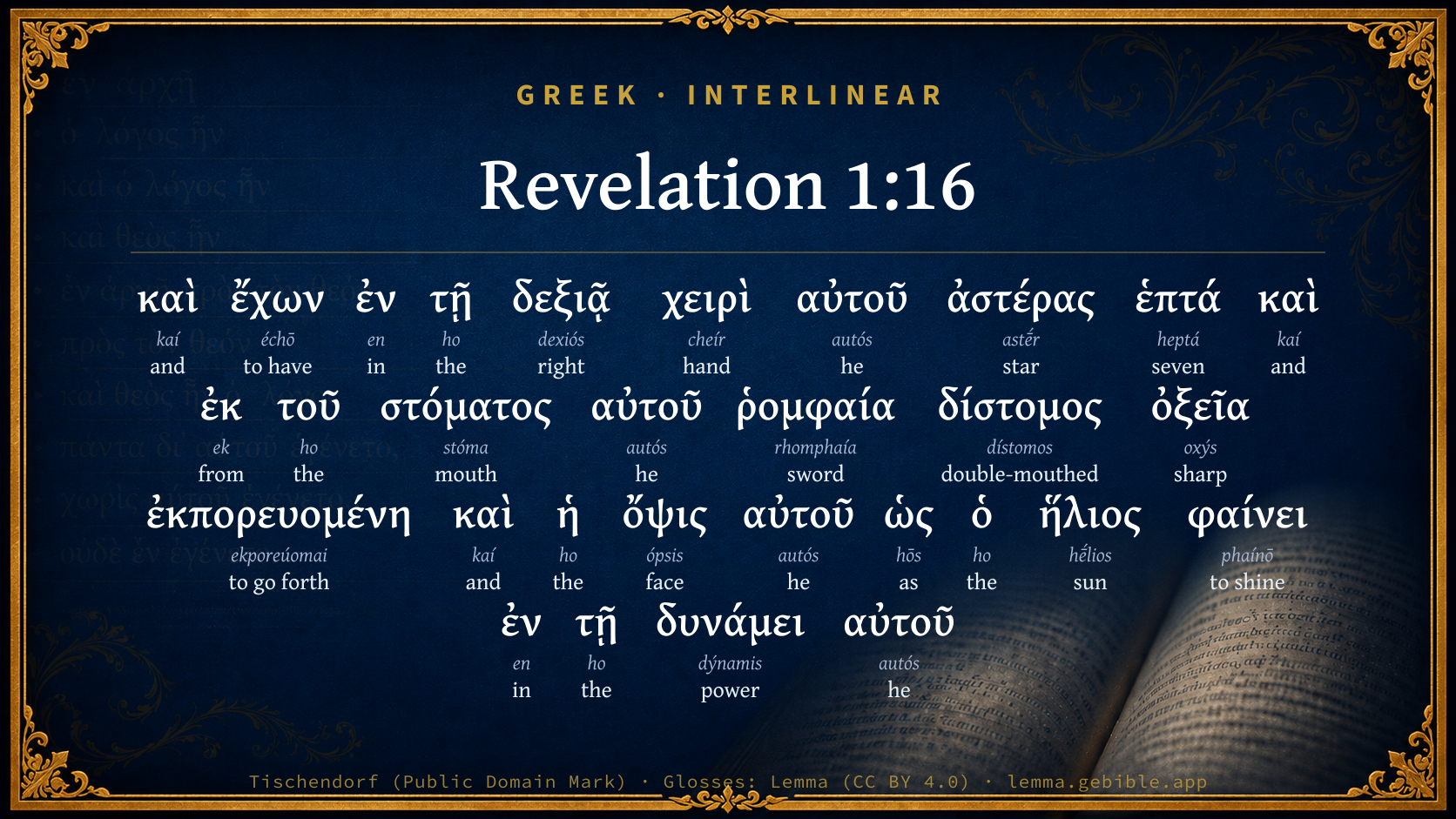
  1. καὶ kaí G2532 “and” Conjunction
  2. ἔχων échō G2192 “to have” Verb, Present, Active, Participle, Nominative, Singular, Masculine
  3. ἐν en G1722 “in” Preposition
  4. τῇ ho G3588 “the” Article, Dative, Singular, Feminine
  5. δεξιᾷ dexiós G1188 “right” Adjective, Dative, Singular, Feminine
  6. χειρὶ cheír G5495 “hand” Noun, Dative, Singular, Feminine
  7. αὐτοῦ autós G846 “he” Personal pronoun, Genitive, Singular, Masculine
  8. ἀστέρας astḗr G792 “star” Noun, Accusative, Plural, Masculine
  9. ἑπτά heptá G2033 “seven” Adjective, Numeral (indeclinable)
  10. καὶ kaí G2532 “and” Conjunction
  11. ἐκ ek G1537 “from” Preposition
  12. τοῦ ho G3588 “the” Article, Genitive, Singular, Neuter
  13. στόματος stóma G4750 “mouth” Noun, Genitive, Singular, Neuter
  14. αὐτοῦ autós G846 “he” Personal pronoun, Genitive, Singular, Masculine
  15. ῥομφαία rhomphaía G4501 “sword” Noun, Nominative, Singular, Feminine
  16. ὀξεῖα oxýs G3691 “sharp” Adjective, Nominative, Singular, Feminine
  17. ἐκπορευομένη ekporeúomai G1607 “to go forth” Verb, Present, Middle or Passive deponent, Participle, Nominative, Singular, Feminine
  18. καὶ kaí G2532 “and” Conjunction
  19. ἡ ho G3588 “the” Article, Nominative, Singular, Feminine
  20. ὄψις ópsis G3799 “face” Noun, Nominative, Singular, Feminine
  21. αὐτοῦ autós G846 “he” Personal pronoun, Genitive, Singular, Masculine
  22. ὡς hōs G5613 “as” Adverb
  23. ὁ ho G3588 “the” Article, Nominative, Singular, Masculine
  24. ἥλιος hḗlios G2246 “sun” Noun, Nominative, Singular, Masculine
  25. φαίνει phaínō G5316 “to shine” Verb, Present, Active, Indicative, 3rd person, Singular
  26. ἐν en G1722 “in” Preposition
  27. τῇ ho G3588 “the” Article, Dative, Singular, Feminine
  28. δυνάμει dýnamis G1411 “power” Noun, Dative, Singular, Feminine
  29. αὐτοῦ autós G846 “he” Personal pronoun, Genitive, Singular, Masculine

About this verse

These counts appear in no published source. They are computed here, from the morphology-tagged text and Lemma’s own curated glosses. What Lemma adds →

30
words
20
distinct lemmas
Revelation
section

Notable vocabulary

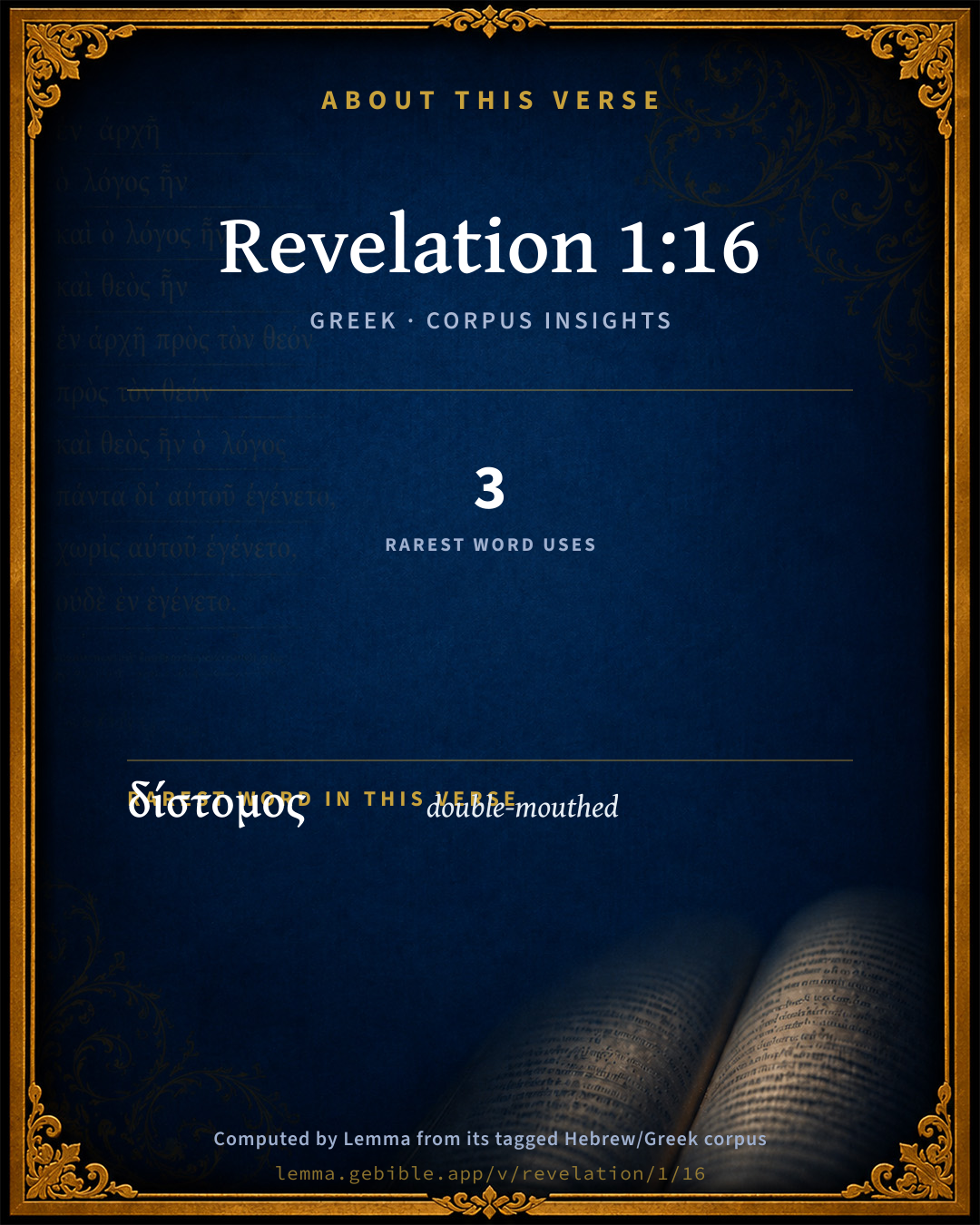
The rarest word here is δίστομος double-mouthed G1366 — appearing just 3 times in the whole Greek New Testament.

Shared distinctive vocabulary

δίστομος double-mouthed G1366 occurs in 3 verses of the Greek New Testament. Also found in:

Repetition

Words recur within this verse:

Cross-references

21

Topical passages linked to Revelation 1:16 in the Treasury of Scripture Knowledge — connected by theme and wording, ordered by reader-vote popularity; previews shown in the World English Bible.

  • Hebrews 4:12 For the word of God is living, and active, and sharper than any two-edged sword, and piercing even to the dividing of soul and spirit, of both joints and marrow, and is able to discern the thoughts and intentions of the heart.
  • Revelation 2:12 "To the angel of the assembly in Pergamum write: "He who has the sharp two-edged sword says these things:
  • Revelation 2:16 Repent therefore, or else I am coming to you quickly, and I will make war against them with the sword of my mouth.
  • Revelation 19:15 Out of his mouth proceeds a sharp, double-edged sword, that with it he should strike the nations. He will rule them with a rod of iron. He treads the winepress of the fierceness of the wrath of God, the Almighty.
  • Isaiah 49:2 and he has made my mouth like a sharp sword; in the shadow of his hand has he hid me: and he has made me a polished shaft; in his quiver has he kept me close:
  • Ephesians 6:17 And take the helmet of salvation, and the sword of the Spirit, which is the word of God;
  • Revelation 19:21 The rest were killed with the sword of him who sat on the horse, the sword which came forth out of his mouth. All the birds were filled with their flesh.
  • Matthew 17:2 He was transfigured before them. His face shone like the sun, and his garments became as white as the light.
  • Isaiah 60:19–20 The sun shall be no more your light by day; neither for brightness shall the moon give light to you: but Yahweh will be to you an everlasting light, and your God your glory.
  • Malachi 4:2 But to you who fear my name shall the sun of righteousness arise with healing in its wings. You will go out, and leap like calves of the stall.
  • Acts 26:13 at noon, O King, I saw on the way a light from the sky, brighter than the sun, shining around me and those who traveled with me.
  • Revelation 1:20–2:1 the mystery of the seven stars which you saw in my right hand, and the seven golden lampstands. The seven stars are the angels of the seven assemblies. The seven lampstands are seven assemblies.
  • Job 38:7 When the morning stars sang together, And all the sons of God shouted for joy?
  • Daniel 12:3 Those who are wise shall shine as the brightness of the expanse; and those who turn many to righteousness as the stars forever and ever.
  • Revelation 3:1 "And to the angel of the assembly in Sardis write: He who has the seven Spirits of God, and the seven stars says these things: "I know your works, that you have a reputation of being alive, but you are dead.
  • Isaiah 11:4 but with righteousness shall he judge the poor, and decide with equity for the humble of the earth; and he shall strike the earth with the rod of his mouth; and with the breath of his lips shall he kill the wicked.
  • Isaiah 24:23 Then the moon shall be confounded, and the sun ashamed; for Yahweh of Hosts will reign on Mount Zion, and in Jerusalem; and before his elders shall be glory.
  • Daniel 8:10 It grew great, even to the host of the sky; and some of the host and of the stars it cast down to the ground, and trampled on them.
  • Revelation 10:1 I saw a mighty angel coming down out of the sky, clothed with a cloud. A rainbow was on his head. His face was like the sun, and his feet like pillars of fire.
  • Revelation 12:1 A great sign was seen in heaven: a woman clothed with the sun, and the moon under her feet, and on her head a crown of twelve stars.
  • Judges 5:31 So let all your enemies perish, Yahweh: But let those who love him be as the sun when he goes forth in his might. The land had rest forty years.

Cross-references courtesy of OpenBible.info (CC BY 4.0).

Commentary

Notes on Revelation 1:16 from classic Christian and Jewish commentators (each source and its license shown beneath its notes). The classic Christian expositions comment on the surrounding passage and are grouped to its opening verse, so a note may address several verses; the Jewish commentaries on the Tanakh (Rashi and others) are per-verse, so they appear only where the commentator wrote on this verse.

Lemma curates 59 commentaries, every one of them public domain or Creative Commons licensed, each selected and text-cleaned for this edition rather than reprinted as found. About our sources →

Tyndale Open Study Notes

Tyndale Open Resources

1:16 The seven stars represent the complete church. The church is secure in the right hand (i.e., in the acceptance and blessing) of the Son of Man. • The sharp . . . sword coming from his mouth is his effective message and his judgment (see 19:15; Gen 3:24; Eph 6:17; Heb 4:12). Jesus proclaims both grace and judgment, but here the emphasis is that he carries out judgment (see Rev 2:12, 16; 19:15, 21; cp. Isa 11:4).

Tyndale Open Study Notes — © Tyndale Open Resources, licensed CC BY-SA 4.0. Text via the HelloAO Bible API.

Meyer's Critical & Exegetical Commentary

Heinrich August Wilhelm Meyer

Rev_1:16. καὶ ἔχων, κ.τ.λ. Not for καὶ είχε, κ.τ.λ.;[794] but the participle occurs in violation of syntax, while John with a few strong touches of his pencil[795] portrays the sublime manifestation.[796] Christ appears, having seven stars[797] in his right hand.[798] The stars are neither to be changed into precious stones which shine like stars, and to be sought in a ring, or seven rings, on Christs fingers,[799] nor is it to be said that the stars soar so easily, freely, and steadily, on or over his right hand, that he might confidently place them[800] upon Johns head.[801] To ask at all where these stars in Rev_1:17 must be regarded, is a question both paltry and unpoetic. That Christ has the stars in his right hand, shows that they are his property. This is presented for the consolation of believers,[802] but not in the sense as though the power of Christ over the churches, from which no one can deliver, should he wish to punish,[803] were portrayed. This is entirely foreign to the present passage, and even in Rev_2:1 sqq. is conceivable only as Christ, who graciously rules and defensively walks in the midst of the candlesticks, can cast a faithless church from its candlestick,[804] or even reject a star.

ΚΑῚ ἘΚ ΤΟῦ ΣΤΌΜΑΤΟς

ἘΚΠΟΡΕΥΟΜΈΝΗ. Again, a new feature of the sublime picture is stated in an asyntactical way. Who can portray this form? And yet it has occurred, alas! a thousand times, and the form of the God-man is represented as the most miserable cripple. Thus Herder; while Eichh.,[805] just in the present feature of the description, would find an offence against the laws of painting. The sharp two-edged sword which proceeds from the mouth of the Lord is, in a way similar to the feet like brass, a plastic representation of the divine power of Christ, in complete accordance with the image of the vision according to which he slays the godless with the rod of his mouth.[806] Of the power of the word of God, preached by Christs ministers, striking the conscience and otherwise divinely efficacious,[807] there is nothing said here. The entire description is purely personal. The sword from the mouth[808] of Christ is directed against his enemies both within[809] and without[810] the Church.[811] What a consolation for those whom he holds in his hands!

ΚΑῚ Ἡ ὌΨΙς ΑὐΤΟῦ designates not the countenance,[812] as ὌΨΙς is used in Joh_11:44 but not in Joh_7:24, but[813] the appearance in general. The description is not concluded by a single feature, but so that the entire form appears as surrounded with the brilliancy of the sun. We are forbidden to take ὌΨΙς in the sense of ΠΡΌΣΩΠΟΝ by the comparison of Rev_10:1, where this word, frequently found in the Apoc.,[814] is regularly used; also Dan_10:6, where ΠΡΌΣΩΠΟΝ occurs, and that, too, in the beginning of the detailed description, is throughout against Hengstenbergs opinion. In like manner, in the description, Dan_10:6, ΤῸ ΣῶΜΑ ΑὐΤΟῦ ὩΣΕΙ ΘΑΡΣΊς, the entire form of the Lord is to be regarded: ῶς Ὁ ἭΛΙΟς ΦΑΊΝΕΙ ἘΝ Τῇ ΔΥΝΆΜΕΙ. The additional designation,[815] of course, is not necessarily to be referred to the noonday brilliancy[816] of the sun, but is correctly paraphrased by De Wette: when its light is at the strongest.[817] The sun shines in its strength when neither mist nor clouds intercept its rays.[818]

[794] Eichh.

[795] De Wette.

[796] Cf. Rev_19:12, Rev_21:12; where, as here, the turning aside from the original construction is facilitated by the preceding features of the description.

[797] Cf. v. 20.

[798] Holding them, Rev_2:1.

[799] Eichh., Heinr.

[800] v. 17.

[801] Ebrard.

[802] Cf. Joh_10:28 sq.; Herder, Ebrard.

[803] Hengstenb.; also Ew. ii.

[804] Rev_2:5.

[805] Cf., also, De Wette.

[806] Isa_11:4; cf. Isa_49:2; Wis_18:15 sqq.; 2Th_2:8.

[807] Heb_4:12; Eph_6:17; Tichon., Primas., Arethas, Vitr., Calov., Stern; cf., also, De Wette, etc.

[808] The graphic idea lying at the foundation (cf., besides, Psa_55:22; Psa_57:5; Psa_59:8, etc.) is frequently expressed in the rabbins. Pirke Elies.: Moses removed him with the sword of his lips.Dathan said to him, Do you seek to slay me with the sword which is in thy mouth? Wetst., Schöttg., also on 2Th_2:8.

[809] Rev_2:12; Rev_2:16.

[810] Rev_19:15; Rev_19:21.

[811] Ebrard.

[812] Vulg., Luth., Calov., Herd., Hengstenb., Ebrard, De Wette.

[813] Valla, Erasm., Eichh., Ew., Züll.

[814] Cf. Rev_4:7, Rev_9:7, Rev_22:4, Rev_6:16, Rev_12:14, Rev_20:11.

[815] Cf. Jdg_5:31; LXX.: ὥς ἔξοδος ἡλίου ἐν δυνάμοι αὐτοῦ.

[816] Eichh., Heinr.

[817] Against Ebrard.

[818] Hengstenb.

Meyer — Critical and Exegetical Commentary on the New Testament — English translation by Peter Christie, edited by Frederick Crombie (T&T Clark, 1880) — public domain. Text from a community e-Sword module.

Expositor's Greek Testament

ed. W. Robertson Nicoll

Rev 1:16 . The care and control exercised by Christ over the churches only come forward after the suggestions of majesty and authority (13 15) which followed the initial idea of Christ’s central position ( ἐν μέσῳ ) among the churches. Cf. Rev 5:6 ( ἐν μέσῳ ) for another reference to Christ’s central authority ἔχων , κ . τ . λ . For the astrological background of this figure, cf. Jeremiah 24 f. The traditional symbol, of which an interpretation is given later (Rev 1:20 ), probably referred to the seven planets rather than to the Pleiades or any other constellation. If the description is to be visualised, the seven stars may be pictured as lying on Christ’s palm in the form of the stars in the constellation of Ursa Major ῥομφαία , κ . τ . λ . By a vivid objectifying of the divine word (corresponding to that, e.g. , in Isa 9:8 f., Rev 9:4 , and suggested by the tongue-shaped appearance of the short Roman sword or dagger), the figure of the sharp sword issuing from the mouth is applied (in Ps. Sol. 17:27, 39, as here) to the messiah, as in Jewish literature to God (Psa 149:6 , etc.) and to wisdom ( Sap. 18:15), elsewhere to the λόγος τοῦ θεοῦ (Heb 4:12 , cf. Rev 19:13-15 ): Christ’s power of reproof and punishment is to be directed against the church (Rev 2:12 f.) as well as against the world of heathen opposition (Rev 19:21 , where the trait is artistically more appropriate). As a nimbus or coronata radiata sometimes crowned the emperor (“image des rayons lumineux qu’il lance sur le monde,” Beurlier), so the face of Christ ( ὄψις as in Joh 11:44 , cf. below, Rev 10:1 ) is aptly termed, as in the usual description of angelic visitants (reff.), bright as sunshine unintercepted by mist or clouds. This is the climax of the delineation.

The Expositor's Greek Testament, edited by W. Robertson Nicoll (1897–1910) — public domain. Text from a community e-Sword module.

Jamieson, Fausset & Brown

Robert Jamieson, A. R. Fausset & David Brown

he had--Greek, "having." John takes up the description from time to time, irrespective of the construction, with separate strokes of the pencil [ALFORD].

in . . . right hand seven stars-- (Rev 1:20; Rev 2:1; Rev 3:1). He holds them as a star-studded "crown of glory," or "royal diadem," in His hand: so Isa 62:3. He is their Possessor and Upholder.

out of . . . mouth went--Greek, "going forth"; not wielded in the hand. His WORD is omnipotent in executing His will in punishing sinners. It is the sword of His Spirit. Reproof and punishment, rather than its converting winning power, is the prominent point. Still, as He encourages the churches, as well as threatens, the former quality of the Word is not excluded. Its two edges (back and front) may allude to its double efficacy, condemning some, converting others. TERTULLIAN [Epistle against Judaizers], takes them of the Old and the New Testaments. RICHARD OF ST. VICTOR, "the Old Testament cutting externally our carnal, the New Testament internally, our spiritual sins."

sword--Greek, "romphaia," the Thracian long and heavy broad sword: six times in Revelation, once only elsewhere in New Testament, namely, Luk 2:35.

sun . . . in his strength--in unclouded power. So shall the righteous shine, reflecting the image of the Sun of righteousness. TRENCH notices that this description, sublime as a purely mental conception, would be intolerable if we were to give it an outward form. With the Greeks, æsthecial taste was the first consideration, to which all others must give way. With the Hebrews, truth and the full representation ideally of the religious reality were the paramount consideration, that representation being designed not to be outwardly embodied, but to remain a purely mental conception. This exalting of the essence above the form marks their deeper religious earnestness.

Jamieson, Fausset & Brown — Commentary Critical and Explanatory on the Whole Bible (1871) — public domain (CC PDM 1.0). Text via the HelloAO Bible API.

Adam Clarke's Commentary

Verse 16. In his right hand seven stars] The stars are afterwards interpreted as representing the seven angels, messengers, or bishops of the seven Churches. Their being in the right hand of Christ shows that they are under his special care and most powerful protection. See below.

Out of his mouth went a sharp two-edged sword] This is no doubt intended to point out the judgments about to be pronounced by Christ against the rebellious Jews and persecuting Romans; God's judgments were just now going to fall upon both. The sharp two-edged sword may represent the word of God in general, according to that saying of the apostle, Heb 4:12: The word of God is quick and powerful, sharper than any two-edged sword, piercing even to the dividing asunder of soul and spirit, c. And the word of God is termed the sword of the Spirit, Eph 6:17.

And his countenance was as the sun shineth in his strength.] His face was like the disk of the sun in the brightest summer's day, when there were no clouds to abate the splendour of his rays. A similar form of expression is found in Judg 5:31: Let them that love him be as the sun when he GOETH FORTH IN HIS MIGHT. And a similar description may be found, Midrash in Yalcut Simeoni, part I., fol. 55, 4: "When Moses and Aaron came and stood before Pharaoh, they appeared like the ministering angels and their stature, like the cedars of Lebanon:- חמה לגלגלי דומים עיניהם וגלגלי vegalgilley eyneyhem domim legalgilley chammah, and the pupils of their eyes were like the wheels of the sun; and their beards were as the grape of the palm trees:- חמה כזיו פניהם וזיו veziv peneyhem keziv chammah, and the SPLENDOUR of THEIR FACES was as the SPLENDOUR of the SUN."

Adam Clarke's Commentary on the Bible (1810–1826) — public domain. Text from a community e-Sword/MySword module.

Ellicott's Commentary for English Readers

(16) And he had (or, having) in his right hand seven stars.—The stars are explained later on (Rev_1:20) to be the emblems of the angels of the seven churches; they are described as stars in His right hand; they, perhaps, appeared as a wreath, or as a royal and star-adorned diadem in His hand. (See Isa_62:3.) It expresses their preciousness in Christ’s sight, and the care He takes of them. A similar emblem is used of Coniah (Jer_22:24), where he is compared to the signet upon God’s right hand.

And out of his mouth went a sharp two-edged sword.—There need be no doubt about the meaning here: the imagery of the Bible elsewhere is too explicit to be mistaken; it is the sword of the Spirit, even the word of God, which is here described; it is that word which is sharper than any two-edged sword, and which lays bare the thoughts and intents of the soul (Eph_6:17; Heb_4:12. Comp. Isa_49:2). This is the weapon with which Christ will subdue His enemies; no carnal weapon is needed (2Co_10:4). Those that take any other sword in hand than this to advance His kingdom will perish with the weapon to which they have appealed (Rev_13:10; Mat_26:52), but those who arm themselves with this will find it mighty through God. With this weapon of His word He Himself fights against His adversaries (Rev_2:12; Rev_2:16; Rev_19:15; Rev_19:21); with this He lays bare the hidden hypocrisies of men, cuts off the diseased members, and wounds that He may heal.

“The sword wherewith Thou dost command,

Is in Thy mouth and not Thy hand.”

It is a two-edged sword; it has the double edge of the Old Testament and the New; “the Old Testament, cutting externally our carnal; the New Testament, internally our spiritual sins” (Richard of St. Victor). It has the double edge of its power to rebuke sin and self-righteousness; the evil of wrong-doing and the evil motives which wait on right-doing; the two edges of which will cut off sin from man, or else man in his sin. (Comp. Isa_11:4, and 2Th_2:8.) The Greek word here rendered “sword” is used six times in this book, and only once (Luk_2:35) elsewhere in the New Testament.

His countenance was as the sun shineth in his strength.—It is the spiritual truth which gives the splendour to such descriptions as these. The dazzling glory of Him who is the Sun of Righteousness is intolerable to human eyes. There is no marvel in this when we remember that He is the brightness of His Father’s glory, and that the Father dwells “in that light which no man can approach unto; whom no man hath seen, nor can see” (1Ti_6:16). It is the lustre of holiness and righteousness which is here signified, and which “the eye of sinful man may not see,” but of which saints and angel messengers may catch a faint reflection; so that the angel’s face may look like lightning (Mat_28:3), and “the righteous shine forth as the sun in the kingdom of their Father” (Mat_13:43). (Comp. the shining of Moses’ face, Exo_34:29.)

A Bible Commentary for English Readers, edited by Charles John Ellicott (1878–1897) — public domain. Text from a community e-Sword module.

The Cambridge Bible for Schools and Colleges

gen. ed. J. J. S. Perowne

16. he had] Lit. having, and so the sword “going” out of His mouth. Throughout the book, participles are used coordinately with finite verbs, especially in descriptions: perhaps rather by a Hebraism than a mere carelessness of construction.

out of his mouth, &c.] The image is perhaps suggested by Isa_49:2; but the application made of it in Rev_2:16, Rev_19:15; Rev_19:21 is more like in sense to Isa_11:4; 2Th_2:8. It is relevant to compare Eph_6:17; Heb_4:12; but the use of similar images by different Apostles must not be allowed to lead us into a sort of Christian mythology, as though the imagery were as absolutely and unalterably fixed as the doctrine symbolized by it. In ch. 19 we see plainly that not the sword but the Owner of it is “the Word of God:” in Rev_2:23 we have the same sense as in Heb. l. c., but the image of the sword is not there used to illustrate it.

his countenance] The same word is used in Joh_11:44 in the sense of “face,” and so it is best to take it here, though it might mean “appearance” generally. In Eze_1:27, the LXX. use the word for “colour” not for “appearance.”

The Cambridge Bible for Schools and Colleges (gen. ed. J. J. S. Perowne; Cambridge University Press, 1878–1918) — public domain. Text from a community e-Sword module.

John Gill's Exposition

And he had in his right hand seven stars,.... The angels or pastors of the seven churches, Rev 1:20. The ministers of the Gospel are compared to stars, because of their efficient cause, God, who has made them, and fixed them in their proper place, and for his glory; and because of the matter of them, being the same with the heavens, so ministers are of the same nature with the churches; and because of their form, light, which they receive from the sun, so preachers of the Gospel receive their light from Christ; and because of their multitude and variety, so the ministers of the Gospel are many, and their gifts different; and chiefly for their usefulness, to give light to others, to direct to Christ, and point out the way of salvation, and to rule over the churches: nor was it unusual with the Jews to compare good men to stars, and to the seven stars. The Targumist (r) says, the seven lamps in the candlestick answer to the seven stars to which the righteous are like. These are led and held in Christ's right hand; which shows that they are dear unto him, and highly valued by him; that they are his, in his possession, at his dispose, whom he uses as his instruments to do his work; and whom he upholds and sustains, that they shall not sink under their burdens; and whom he preserves from failing, and so holds them that they shall stand fast in the faith, and not be carried away with the error of the wicked:

and out of his mouth went a sharp twoedged sword; which designs the word of God; see Eph 6:17; This comes out of the mouth of Christ, it is the word of God, and not of man; and is a sharp sword, contains sharp reproofs for sin, severe threatenings against it, and gives cutting convictions of it, and is a twoedged one; and by its two edges may be meant law and Gospel; the law lays open the sins of men, fills with grief and anguish for them, yea, not only wounds, but kills; and the Gospel cuts down the best in man, his wisdom, holiness, righteousness, and carnal privileges, in which he trusts; and the worst in man, teaching him to deny ungodliness and worldly lusts: or the word of God may be so called, because it is a means both of saving and of destroying; it is the savour of life unto life to some, and the savour of death unto death to others; and is both an offensive and defensive weapon; it is for the defence of the saints, against Satan, false teachers, and every other enemy; and an offensive one to them, which cuts them down, and destroys them and their principles: or this may mean the judiciary sentence of Christ upon the wicked, which will be a fighting against them, and a smiting of the nations of the world; see Rev 2:16; which the Jews interpret of the law (s):

and his countenance was as the sun shineth in his strength; at noonday; such was the countenance of Christ at his transfiguration, Mat 17:2; and designs here the manifestation of himself in the glories of his person, and in the riches of his grace; who is the sun of righteousness that arises upon his people with light, heat, joy, and comfort; see the phrase in Jdg 5:31, which the Jewish writers understand of the strength of the sun both in the summer solstice, and in the middle of the day, or at noon, at which time its heat is strongest, and it usually shines brightest; the design of the metaphor is to set forth the glory and majesty of Christ,

(r) Jonathan ben Uzziel in Exod. xl. 4. (s) Yalkut Simeoni, par. 2. fol. 95. 4. & 131. 1.

John Gill's Exposition of the Whole Bible (1746–1763) — public domain (CC PDM 1.0). Text via the HelloAO Bible API.

Trapp's Complete Commentary

John Trapp

16 And he had in his right hand seven stars: and out of his mouth went a sharp twoedged sword: and his countenance was as the sun shineth in his strength.

Ver. 16. And he had in his right hand] See here the dignity and safety of a faithful minister. While a child hath his father by the hand, though he walk in the dark, he fears nothing. Godly ministers not only have Christ by the hand (who as he will not cast away a perfect man, so neither will he take the ungodly by the hand, saith Bildad, Job 8:20), but are held fast in Christ’s right hand, "that teacheth him terrible things," Psa 45:4, against such as seek to pull them thence. It is well observed by a worthy writer, that about the time of the silencing of ministers, many churches in England were torn at once (within our remembrance) with terrible lightning; and almost no place else but churches were touched, especially in the lower parts of Devonshire, where many were scorched, maimed, and many had their brains struck out, as they sat in churches; as at the church of Anthony in Cornwall, near Plymouth, on Whit Sunday, 1640. (See the account in print.)

A sharp two-edged sword] The word, like a sacrificing sword, slits open, and, as it were, unridgeth the conscience.

John Trapp, A Commentary or Exposition upon All the Books of the Old and New Testament (1647–1656) — public domain. Text from a community e-Sword module.

Albert Barnes' Notes on the Bible

And he had in his right hand seven stars - Emblematic of the angels of the seven churches. How he held them is not said. It may be that they seemed to rest on his open palm; or it may be that he seemed to hold them as if they were arranged in a certain order, and with some sort of attachment, so that they could be grasped. It is not improbable that, as in the case of the seven lamp-bearers (see the notes at Rev 1:13), they were so arranged as to represent the relative position of the seven churches.

And out of his mouth went a sharp two-edged sword - On the form of the ancient two-edged sword, see the notes on Eph 6:17. The two edges were designed to cut both ways; and such a sword is a striking emblem of the penetrating power of truth, or of words that proceed from the mouth; and this is designed undoubtedly to be the representation here - that there was some symbol which showed that his words, or his truth, had the power of cutting deep, or penetrating the soul. So in Isa 49:2, it is said of the same personage, “And he hath made my mouth like a sharp sword.” See the notes on that verse. So in Heb 4:12, “The Word of God is quick and powerful, sharper than any two-edged sword,” etc. So it is said of Pericles by Aristophanes:

“His powerful speech.

Pierced the hearer’s soul, and left behind.

Deep in his bosom its keen point infixt.”

A similar figure often occurs in Arabic poetry. “As arrows his words enter into the heart.” See Gesenius, Commentary zu, Isa 49:2. The only difficulty here is in regard to the apparently incongruous representation of a sword seeming to proceed from the mouth; but it is not perhaps necessary to suppose that John means to say that he saw such an image. He heard him speak; he felt the penetrating power of his words; and they were as if a sharp sword proceeded from his mouth. They penetrated deep into the soul, and as he looked on him it seemed as if a sword came from his mouth. Perhaps it is not necessary to suppose that there was even any visible representation of this - either of a sword or of the breath proceeding from his mouth appearing to take this form, as Prof. Stuart supposes. It may be wholly a figurative representation, as Heinrichs and Ewald suppose. Though there were visible and impressive symbols of his majesty and glory presented to the eyes, it is not necessary to suppose that there were visible symbols of his words.

And his countenance - His face. There had been before particular descriptions of some parts of his face - as of his eyes - but this is a representation of his whole aspect; of the general splendor and brightness of his countenance.

Was as the sun shineth in his strength - In his full splendor when unobscured by clouds; where his rays are in no way intercepted. Compare Jdg 5:31; “But let them that love him (the Lord) be as the sun when he goeth forth in his might”; 2Sa 23:4, “And he shall be as the light of the morning, when the sun ariseth, even a morning without clouds”; Psa 19:5, “Which (the sun) is as a bridegroom coming out of his chamber, and rejoiceth as a strong man to run a race.” There could be no more striking description of the majesty and glory of the countenance than to compare it with the overpowering splendor of the sun. This closes the description of the personage that appeared to John. The design was evidently to impress him with a sense of his majesty and glory, and to prepare the way for the authoritative nature of the communications which he was to make. It is obvious that this appearance must have been assumed.

The representation is not that of the Redeemer as he rose from the dead - a middle-aged man; nor is it clear that it was the same as on the mount of transfiguration - where, for anything that appears, he retained his usual aspect and form though temporarily invested with extraordinary brilliancy; nor is it the form in which we may suppose he ascended to heaven for there is no evidence that he was thus transformed when he ascended; nor is it that of a priest - for all the special habiliments of a Jewish priest are missing in this description. The appearance assumed is, evidently, in accordance with various representations of God as he appeared to Ezekiel, to Isaiah, and to Daniel - what was a suitable manifestation of a divine being - of one clothed in the majesty and power of God. We are not to infer from this, that this is in fact the appearance of the Redeemer now in heaven, or that this is the form in which he will appear when he comes to judge the world. Of his appearance in heaven we have no knowledge; of the aspect which he will assume when he comes to judge people we have no certain information. We are necessarily quite as ignorant of this as we are of what will be our own form and appearance after the resurrection from the dead.

Albert Barnes' Notes on the Bible (1834–1885) — public domain. Text from a community e-Sword/MySword module.

Haydock's Catholic Bible Commentary

In his right hand seven stars, which, as it is said, (ver. 20.) were the Angels, i.e. the bishops of the seven churches, by this comparison is expressed their dignity. --- And from his mouth came out a sharp two-edged sword. The word of God preached is compared to a two-edged sword. (Ephesians vi. 17. and Hebrews iv. 12.) It also signifies God’s severity in punishing sinners. (Witham)

George Leo Haydock (1774–1849), Haydock's Catholic Family Bible and Commentary, 1859 edition — public domain. Excludes Psalms (Douay-Rheims chapter numbering differs from Protestant) and Deuterocanonical books (Catholic canon only).

Matthew Poole's English Annotations

And he had in his right hand seven stars: the right hand is the hand of power, Psa 21:8; and of favour, Psa 44:3; and of honour and dignity, Psa 110:1. The seven stars are expounded, Rev 1:20, to be the ministers of the gospel, his messengers to his churches, who having in all times been most exposed to the malice and rage of enemies, Christ is said to hold them in his right hand, as to signify the dignity he hath put upon them and the favour he hath showed them, so also to show his resolution to protect them, according to his promise, Mat 28:20.

And out of his mouth went a sharp two-edged sword; either his gospel and word, compared to a two-edged sword, Heb 4:12; or a sword of justice, which he will use till he hath perfectly overcome and vanquished his enemies.

And his countenance was as the sun shineth in his strength; that is, was very glorious, so as the apostle was not able to behold him.

Matthew Poole's English Annotations on the Holy Bible (1683–1685) — public domain. Text from a community e-Sword/MySword module.

Whedon's Commentary on the Bible

Daniel D. Whedon

16. In his right hand—In Rev_1:20 it reads επι, upon his right hand. The in suggests the idea of retention, the upon, of support. Both together suggest the hand outspread, with the stars, of course of small diamond-like size, resting upon the palm.

Seven stars—Stars are an ordinary symbol for rulers.

Mouth… two-edged sword—Some commentators seem to entertain the crude conception that this sword was seen as a stiff, steel fixture projected from the Lord’s mouth! We view it as his divine and powerful breath, making itself, as it were, visible, often darting forth and brandishing in sword-like motion and form. Its active motion is described as εκπορευομενος, going forth—emanating in incessant flashes. So Heb_4:12 : “The word of God is… sharper than any twoedged sword, piercing even to the dividing asunder of soul and spirit, and of the joints and marrow, and is a discerner of the thoughts and intents of the heart.” The contents of the seven epistles display this powerful searching operation of this discriminating and sword-like word. See our note on 2Th_2:8. So in Hos_6:5, for Ephraim’s transient goodness Jehovah says: “Therefore have I hewed them by the prophets; I have slain them by the words of my mouth.” And so in Isa_49:2 : “He hath made my mouth like a sharp sword.” It is remarkable that the word for twoedged is repeatedly in the New Testament, twomouthed. This, Mr. Glasgow says, refers to its “power of cutting every way.” Perhaps it refers to its double power of destroying, either spiritually the old man, or corporeally the physical man. As a word of truth this spiritual sword corrects and converts the souls of men; as a word of retribution it destroys the bodies of the incorrigible. Note, Rev_2:16. See Stuart’s excellent note on the passage.

His countenance—As John gradually takes a full view of the glorious face, he is overwhelmed by its power. It is as the sun; not the sun beclouded and dim, but in its full strength. Compare this whole description with the scene of the transfiguration, beheld by our seer, Mat_17:2, “His face did shine as the sun, and his raiment was white as the light,” which was intended, like this, to form our conceptions of the glorified body of Christ, and subordinately of the glorified saints. We have not the gentle touches of beauty, such as would picture an Apollo, but dashes of glory, in comparison with which mere beauty is forgotten. So Dan_12:2, “They that be wise shall shine as the brightness of the firmament; and they that turn many to righteousness, as the stars forever.” Such language is above all material picture. And this same John also wrote, “It doth not yet appear what we shall be: but we know that, when he shall appear, we shall be like him; for we shall see him as he is.” 1Jn_3:2; where, see note.

Let us form a mental picture of the personality described. Before the eyes of the seer stands a colossal figure, robed entirely in white, his face and feet alone bare; the former of sun-like splendour, the latter of a white-heat brilliancy. Locks of snowy whiteness crown his head. He speaks, and his words flash like a double-edged sword from his mouth, and his voice resounds through the space like many waters. He extends his arm, and on his palm is resting a circle of seven stars, and he walks majestically between two rows of lamps blazing upon their stands.

Daniel D. Whedon (gen. ed.), Commentary on the Old and New Testaments (1874–1909) — public domain. Text from a community e-Sword module.

The Pulpit Commentary

He holds the Churches in his hand as a precious possession, which he sustains as a glory to himself. These Churches are as planets, which shine, not with their own light, but that of the sun; which shine most brightly in the night of "tribulation," which (like him who holds them in his right hand) are a guide to the wanderer, and are ever moving, yet ever at rest. Out of his mouth a sharp two-edged sword. This metaphor runs through both Old and New Testaments. It is frequent in this book. (Rev_2:12, 16 19:15, 21; comp. Luk_2:35 Eph_6:17 Heb_4:12 Psa_45:3 Psa_57:4 Psa_59:7 Psa_64:3 Psa_149:6 Pro_12:18 Isa_11:4 Isa_49:2, etc.) The sharp words of men and the searching words of God are both spoken of under this figure of the sword. Tertullian and Richard of St. Victor explain the two edges as the Law and the Gospel. Other still more fanciful explanations have been given. "Two-edged" (distomov) is literally "two-mouthed," and perhaps expresses no more than the thorough efficiency of the sword. It occurs in Rev_2:12 and Heb_4:12; also in classical Greek as equivalent to the more common amfhkhv . If a double meaning be insisted on, it may be found in the double character of God"s Word, which not only smites the wicked, but searches the good; which cuts sometimes to punish, sometimes to heal. Thus in these very epistles to the Churches, penetrating words both of blessing and condemnation are uttered. The word for "sword" (romfaia) occurs six times in Revelation; elsewhere in the New Testament only Luk_2:35. In classical Greek it is the heavy Thracian broadsword. In the LXX it is used of the "flaming sword" of the cherubim which kept the way of the tree of life; (Gen_3:24) also of the sword of Goliath. (1Ki_17:2-5) His countenance was as the sun shineth. It is the "Sun of Righteousness" and "the Light of the world." The exceptional glory of the Transfiguration has become constant now.

The Pulpit Commentary (1880–1919), ed. H.D.M. Spence-Jones & Joseph S. Exell — public domain. Text from a community e-Sword module.

John Wesley's Explanatory Notes

And he had in his right hand seven stars - In token of his favour and powerful protection. And out of his mouth went a sharp two-edged sword - Signifying his justice and righteous anger, continually pointed against his enemies as a sword; sharp, to stab; two-edged, to hew. And his countenance was as the sun shineth in his strength - Without any mist or cloud.

John Wesley, Explanatory Notes Upon the Whole Bible (1754–1765) — public domain. Text via the GEBible commentary corpus.

Godbey's Commentary on the New Testament

William B. Godbey

16. “Having in His right hand seven stars.” These stars are the faithful preachers of the gospel. So, if you want to be a star preacher, be sure the Savior holds you in His right hand. If you preach the truth, the whole truth, and nothing but the truth, fearless of men and devils, regardless of reputation, filthy lucre, ejectment, and decapitation, rest assured Jesus will hold you in His right hand, and you will have victory when the world is on fire. “Out of His mouth goes a sharp, two-edged sword.” This is the word of God revealed in the Bible. This wonderful sword has two edges, sharp as God’s lightning; i.e., the salvation edge and the damnation edge. If you receive the salvation edge, and permit it radically and intrinsically to dissect soul, spirit, heart, mind, and body, it will cut out every fiber of sin’s warp and woof, actual and original, and effect a complete purgation from all iniquity, investing you with the spotless robe of entire sanctification, and actually leading you out into the heavenly state, ready, watching and waiting for the Lord to descend, translate and take you up into the cloud. If you prove too cowardly to receive the salvation edge, and let it cut out of you all sin, you will have to take the damnation edge, which will cut all your hopes out of heaven. “His countenance appears as the sun in His power.” Joh 1:9 :

“He is the true light, which lighteth every man that cometh into the world.”

Thus we see that the world’s Savior shines on every human soul. Hence Paul says en the heathen are left without excuse (Rom 1:20). John says if we walk in the light, the blood cleanseth from all sin. Here is solved the problem of universal salvation. As the sun sends his light throughout the whole world, so the glorious Sun of righteousness illuminates the spiritual world, giving to every human being — saint, sinner, heathen, Jew, and Mohammedan — all the light they need to lead them to heaven. If they will only walk in all the light they have, His blood will cleanse them from all sin, and robe them for glory.

William B. Godbey, Commentary on the New Testament (1896–1900) — public domain. Text from a community e-Sword module.

The People's New Testament

B. W. Johnson

16. In his right hand seven stars. “The seven stars are the angels of the seven churches” (verse 20). And out of his mouth went a sharp two-edged sword. This two-edged sword is a symbol of the word by which Christ's conquests are won. See Eph. 6:17; Heb. 4:12, and compare Rev. 19:15. His countenance. The glory of his countenance is the same that was manifested at the Transfiguration.

B. W. Johnson's The People's New Testament with Notes (1889–1891) — public domain. Electronic text from the Christian Classics Ethereal Library (CCEL) ThML edition.

Cambridge Greek Testament for Schools and Colleges

16. ἔχων. The present participle of this verb here and in Rev 6:2; Rev 6:5, Rev 10:2, Rev 19:12, Rev 21:12 is used as fully equivalent to a present indicative: and here the construction of ἔχων must determine that of ἐκπορευομένη, which by itself would not be difficult. If present participles of all verbs were used in this way, it would be probable that the writer was “following the Hebrew usage, according to which what we call the participle is the nearest approach there is to a distinctive present tense.” Language of New Testament, Part II., p. 83.

ἐν τῇ δεξιᾷ χειρὶ αὐτοῦ. The general style of the writer is ἐν τῇ χειρὶ αὐτοῦ τῇ δεξιᾷ as B2 reads here; in ordinary Greek the form in the text is if anything commoner.

ἐκ τοῦ στόματος αὐτοῦ. The image is perhaps suggested by Isa 49:2; but the application made of it in Rev 2:10, Rev 19:15; Rev 19:21 is more like in sense to Isa 11:4; 2Th 2:8. It is relevant to compare Eph 6:17; Heb 4:12; but the use of similar images by different Apostles must not be allowed to lead us into a sort of Christian mythology, as though the imagery were as absolutely and unalterably fixed as the doctrine symbolized by it. In ch. 19 we see plainly that not the sword but the Owner of it is “the Word of God”: in Rev 2:23 we have the same sense as in Heb. l. c., but the image of the sword is not there used to illustrate it.

ἡ ὄψις. The same word is used in Joh 11:44 in the sense of “face,” and so it is best to take it here, though it might mean “appearance” generally. In Eze 1:27, the LXX. use the word for “colour,” not for “appearance.”

Cambridge Greek Testament for Schools and Colleges (Cambridge University Press, 1896; 21 vols, various authors incl. Carr, Maclear, Plummer, Farrar, Lumby, Moule, M. R. James, Simcox) — public domain. Text from a community e-Sword module.

Alford’s Greek Testament

Henry Alford

16.] And having (ἔχων, not = καὶ εἶχεν, but as in ref. St. John takes up the description from time to time irrespective of the construction, as if (De W.) with separate strokes of the pencil) in his right hand seven stars (not, as Heinr., on his right hand, as a number of jewelled rings, but in his right hand, as a wreath or garland held in it. De W. well remarks that this, which is the more natural rendering, is also required by the symbolism. If the seven churches which the seven stars symbolize, were on the Lord’s hand as rings, they would seem to be serving (adorning?) Him, and not to be the objects of his action: but now that He holds them in his hand, He appears as their Guardian, their Provider, their Nourisher: and, we may add, their Possessor, who brings them out and puts them forth to be seen when He pleases. His universal Church would hardly be thus represented, but only a portion of it which it pleases Him to take in his hand and hold forth as representing the rest): and out of his mouth a two-edged sharp sword going forth (cf. Isa 11:4, Isa 49:2 (ἔθηκε τὸ στόμα μου ὡς μάχαιραν ὀξεῖαν): also our ch. 2:16, and Wisd. 18:15, 16. The same figure occurs with reference to men in Psa 55:21, Psa 57:4, Psa 59:7: and Wetst. and Schöttg. give examples of it from the Rabbinical writings. The thing signified may perhaps be as in 2Th 2:8, ὁ ἄνομος ὃν ὁ κύριος Ἰησοῦς ἀνελεῖ τῷ πνεύματι τοῦ στόματος αὐτοῦ …: and in ch. 19:21; but clearly we must not exclude (as Düsterd.) the attributes of the word of God, Heb 4:12, Eph 6:17. And this all the more, inasmuch as 1) here the Lord is represented not as taking vengeance on his enemies, but as speaking with his own, both in the way of comforting and of threatening: and 2) in ch. 19:21, where this very sword is again alluded to as slaying the Lord’s enemies, His title as καθήμενος ἐπὶ τοῦ ἵππου is ὁ λόγος τοῦ θεοῦ): and his countenance (not, as Düsterd., who wrongly quotes De W. as supporting him, general appearance: so also Ewald, al. Had this been so, how should the Apostle have noted the details just mentioned? for the whole figure of our Lord would have been too dazzling for him to contemplate. It is natural that after describing the eyes, and that which proceeded from the mouth, he should give the general effect of the countenance. And as matter of usage, Joh 11:44 is decided, being spoken of a person, which ib. 7:24 is not) as the sun shineth in his strength (see ref. Judges:—that is, when unclouded and in full power: not necessarily at midday, but at any time. The construction is again broken: ὡς ὁ ἥλ. φαίνων would be the regular connexion).

17,

Henry Alford, The Greek Testament (1849–1861) — public domain. Text from a community e-Sword module.

Lesson kit

Teaching starters — assembled from the data on this page, not authored interpretation. Every prompt links to the verse data it draws on. Edit before teaching.

Revelation, in the Revelation, opens this verse with 30 words (20 distinct Greek lemmas). Its most distinctive word is dístomos (“double-mouthed”). A historical commentator’s framing appears above. Read the whole chapter for the surrounding context.

Discussion questions

  1. How does “double-mouthed” (dístomos) shape what this verse is saying?
  2. How does Hebrews 4:12, which shares the word «double-mouthed», read alongside this verse?
  3. What does the repetition of “the” (5× in this one verse) do in this verse?
  4. These translations render this verse differently; the difference is in the English rendering, not the original. What questions does that raise?
  5. Compare how Tyndale Open Study Notes and Meyer's Critical & Exegetical Commentary read this verse. Where do they agree or differ?

Things to notice

Reading settings

Reading text

Shown beneath each verse's original-language words.

Old Testament
Old Testament edition

Read the OT as the Masoretic Hebrew (MT) or the Greek Septuagint (LXX).

English shown for the Greek Septuagint (in the Hebrew ↔ Greek comparison).

Comparing translations? Open the Compare panel on any verse page to stack up to four side by side.