
Luke 24:39

Greek (Tischendorf 8th ed.) Luke 24:39 appears in the Greek New Testament. The text above is from the Tischendorf 8th edition. Each word links to its Strong’s number and a concise gloss. Click any word for its full Thayer’s Greek Lexicon entry.
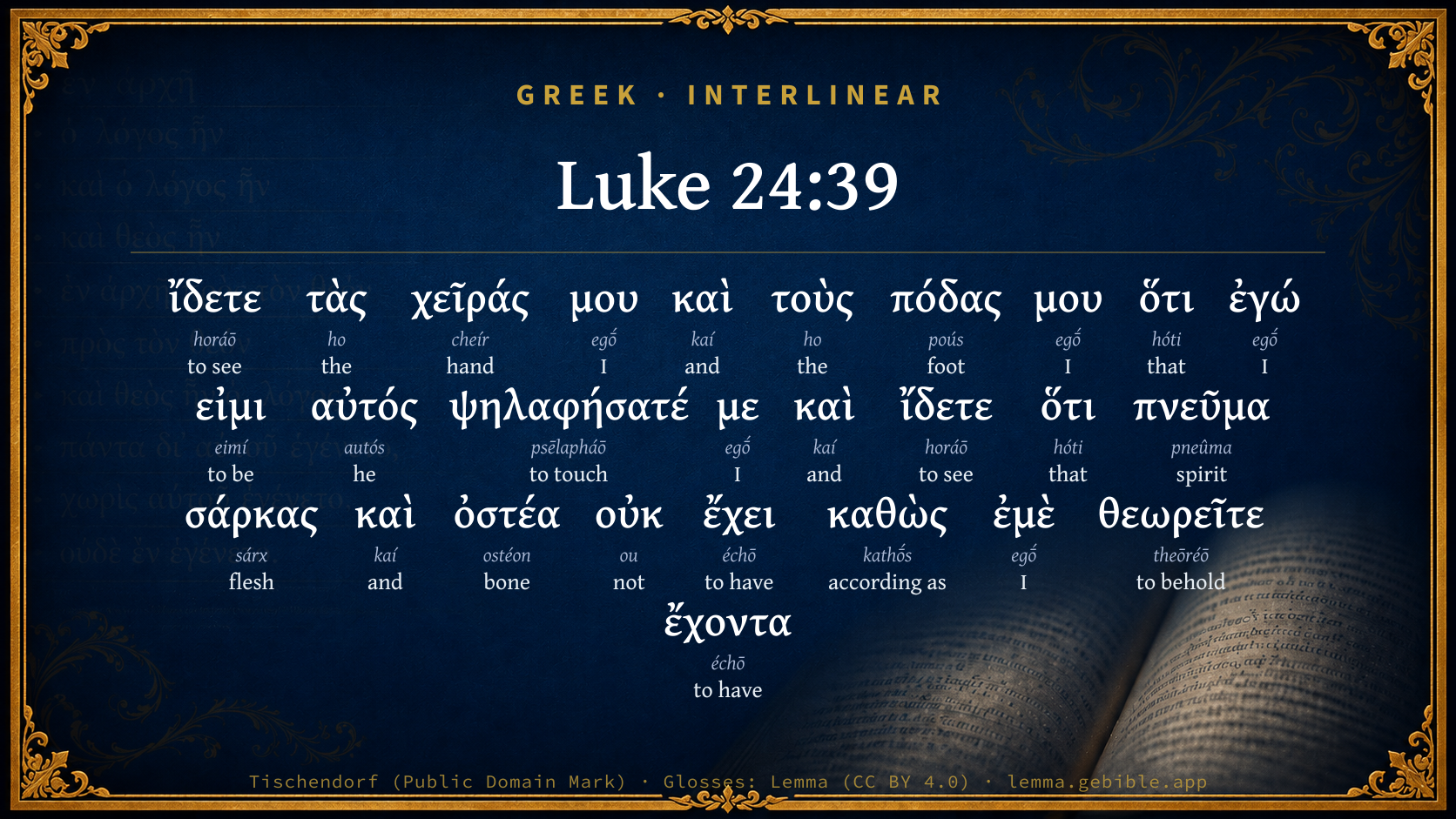
Download image
Cite this verse

Luke 24:39 (World English Bible). Public Domain. Lemma interlinear Bible study tool, https://lemma.gebible.app/v/luke/24/39.

Show BibTeX & RIS
BibTeX
RIS
English Translation
See my hands and my feet, that it is truly me. Touch me and see, for a spirit doesn't have flesh and bones, as you see that I have."
World English Bible · Public Domain
Highlights
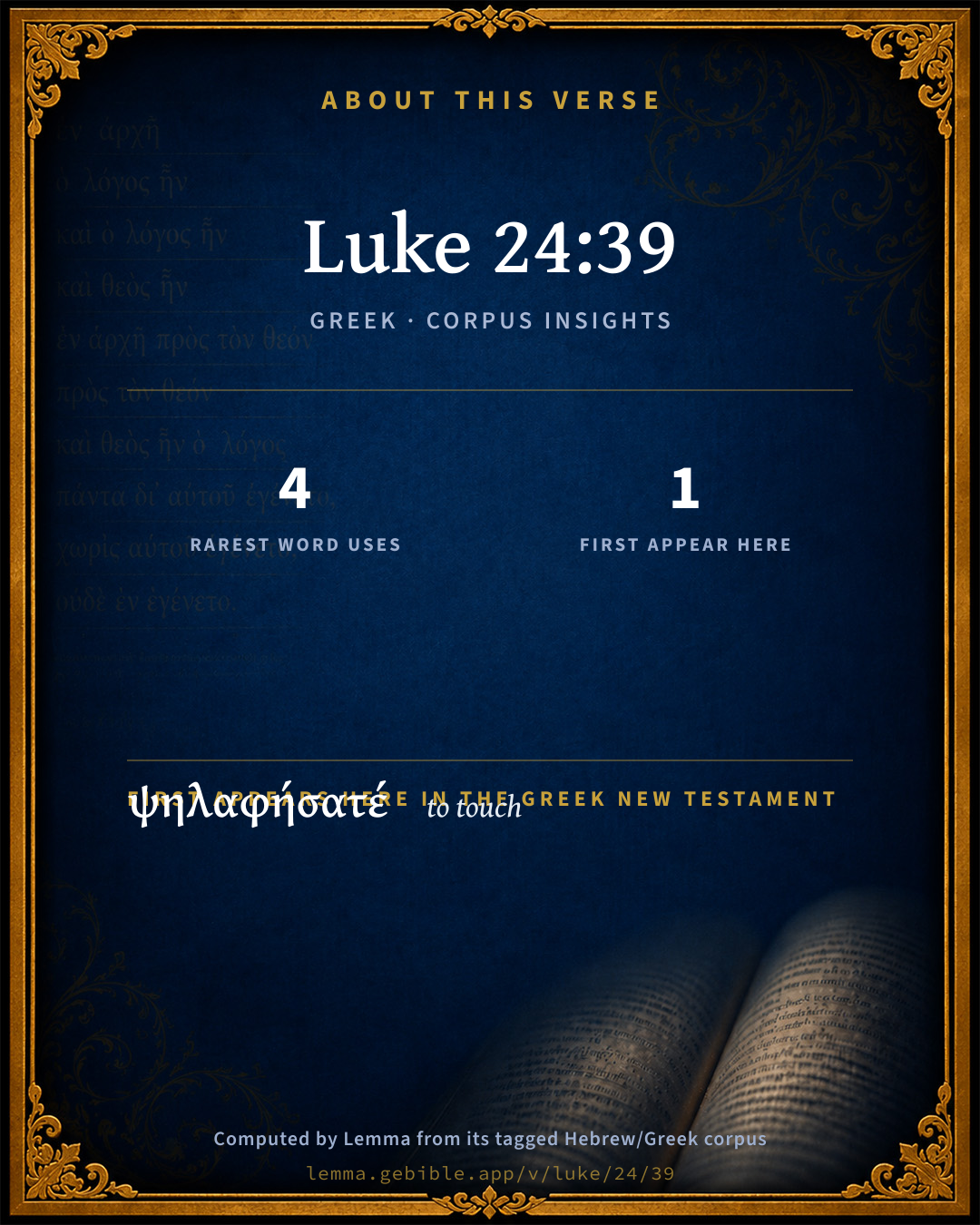
  • 1 first appearance in the Greek New Testament
Full analysis ↓
Download a study sheet

One document with this verse’s original text, its word-by-word gloss line, the meaning frame, cross-references with their text, attributed commentary, and full source and license credits — printable, and it pastes into notes with its structure intact.

This verse Autodidact and up

Study sheet (.html) Plain text (.txt)

A passage Seminary Student

Up to 50 verses in one chapter. A passage sheet keeps up to 6 commentary sources and 12 cross-references per verse, in the order this page ranks them, and says so on the sheet whenever that leaves anything out. Ask for a single verse and you get the Autodidact verse sheet above.

Everything on this page stays free to read, with no account — the sheet is a download of what is already on screen, not access to it.

Want to remove ads? Support Godless Engineer
Compare translations 3

The same verse in 3 English versions, stacked beneath the original-language interlinear above. Click any original word for its lexicon entry.

Each is an independent rendering of the whole verse — the interlinear is not word-aligned to these translations.

Highlighted words mark where these versions differ — a whole-verse word diff, not a word-by-word alignment.

  • World English Bible Public Domain
    See my hands and my feet, that it is truly me. Touch me and see, for a spirit doesn't have flesh and bones, as you see that I have."
  • King James Version Public Domain
    Behold my hands and my feet, that it is I myself: handle me, and see; for a spirit hath not flesh and bones, as ye see me have.
  • unfoldingWord Literal Text CC BY-SA 4.0
    See my hands and my feet, that I myself am. Touch me and see, for a spirit does not have flesh and bones as you see me having.”

unfoldingWord Literal Text — © unfoldingWord, licensed CC BY-SA 4.0. Word-aligned USFM3 via Door43 (git.door43.org/unfoldingWord/en_ult).

Versions to compare (up to 4)

3 of 4 selected

Show all 19 translations

Every available English version of this verse, each an independent rendering of the whole verse.

  • World English Bible Public Domain
    See my hands and my feet, that it is truly me. Touch me and see, for a spirit doesn't have flesh and bones, as you see that I have."
  • Berean Standard Bible Public Domain
    Look at My hands and My feet. It is I Myself. Touch Me and see—for a spirit does not have flesh and bones, as you see I have.”
  • Majority Standard Bible Public Domain
    Look at My hands and My feet. It is I Myself. Touch Me and see—for a spirit does not have flesh and bones, as you see I have.”
  • King James Version Public Domain
    Behold my hands and my feet, that it is I myself: handle me, and see; for a spirit hath not flesh and bones, as ye see me have.
  • American Standard Version (1901) Public Domain
    See my hands and my feet, that it is I myself: handle me, and see; for a spirit hath not flesh and bones, as ye behold me having.
  • Revised Version (1885) Public Domain
    See my hands and my feet, that it is I myself: handle me, and see; for a spirit hath not flesh and bones, as ye behold me having.
  • Geneva Bible (1599) Public Domain
    Beholde mine handes and my feete: for it is I my selfe: handle me, and see: for a spirit hath not flesh and bones, as ye see me haue.
  • Douay-Rheims (1899) Public Domain
    See my hands and feet, that it is I myself; handle, and see: for a spirit hath not flesh and bones, as you see me to have.
  • Young's Literal Translation Public Domain
    see my hands and my feet, that I am he; handle me and see, because a spirit hath not flesh and bones, as ye see me having.'
  • Literal Standard Version CC BY-SA 4.0
    See My hands and My feet, that I am He; handle Me and see, because a spirit does not have flesh and bones as you see Me having.”
  • Unlocked Literal Bible CC BY-SA 4.0
    See my hands and my feet, that it is I myself. Touch me and see. For a spirit does not have flesh and bones, as you see me having.”
  • unfoldingWord Literal Text CC BY-SA 4.0
    See my hands and my feet, that I myself am. Touch me and see, for a spirit does not have flesh and bones as you see me having.”
  • Darby Bible Public Domain
    behold my hands and my feet, that it is *I* myself. Handle me and see, for a spirit has not flesh and bones as ye see me having.
  • World Messianic Bible Public Domain
    See my hands and my feet, that it is truly me. Touch me and see, for a spirit doesn’t have flesh and bones, as you see that I have.”
  • Webster's Bible Public Domain
    Behold my hands and my feet, that it is I myself: handle me, and see; for a spirit hath not flesh and bones, as ye see me have.
  • Free Bible Version CC BY-SA 4.0
    “Look at my hands and my feet—you can see it's me. Touch me and you'll be certain, for a ghost doesn't have flesh and bones, as you see I have.”
  • Bible in Basic English Public Domain
    See; my hands and my feet: it is I myself; put your hands on me and make certain; for a spirit has not flesh and bones as you see that I have.
  • Text-Critical English NT CC BY 4.0
    Look at my hands and my feet and see that it is I myself. Touch me and look at me, for a spirit does not have flesh and bones as you see that I have.”
  • Tyndale New Testament (1534) Public Domain
    Beholde my hondes and my fete that it is even my selfe. Handle me and se: for spretes have not flesshe and bones as ye se me have.

Literal Standard Version (2020), Covenant Press — licensed CC BY-SA 4.0. Text via the HelloAO Bible API (eBible.org). Unlocked Literal Bible (unfoldingWord) — licensed CC BY-SA 4.0. Text via the HelloAO Bible API (eBible.org). unfoldingWord Literal Text — © unfoldingWord, licensed CC BY-SA 4.0. Word-aligned USFM3 via Door43 (git.door43.org/unfoldingWord/en_ult). Free Bible Version, Dr. Jonathan Gallagher — licensed CC BY-SA 4.0. Text via the HelloAO Bible API (eBible.org).

Word by word

More ways to search: Search by grammar → Find every occurrence → Compare this word →

Practice this passage: Drill this verse → Learn its vocabulary →

ψηλαφήσατέ
psēlapháō
G5584
“to touch”
Verb, Aorist, Active, Imperative, 2nd person, Plural
Part of Speech
Verb
Tense
Aorist
Voice
Active
Mood
Imperative
Person
2nd person
Number
Plural
Full Thayer's Definition

Origin: from the base of G5567 (cf G5586 )

TDNT: None

1. to handle, touch and feel 2. metaph. mentally to seek after tokens of a person or a thing
  1. ἴδετε horáō G3708 “to see” Verb, Aorist, Active, Imperative, 2nd person, Plural
  2. τὰς ho G3588 “the” Article, Accusative, Plural, Feminine
  3. χεῖράς cheír G5495 “hand” Noun, Accusative, Plural, Feminine
  4. μου egṓ G1473 “I” Personal pronoun, 1st person, Genitive, Singular
  5. καὶ kaí G2532 “and” Conjunction
  6. τοὺς ho G3588 “the” Article, Accusative, Plural, Masculine
  7. πόδας poús G4228 “foot” Noun, Accusative, Plural, Masculine
  8. μου egṓ G1473 “I” Personal pronoun, 1st person, Genitive, Singular
  9. ὅτι hóti G3754 “that” Conjunction
  10. ἐγώ egṓ G1473 “I” Personal pronoun, 1st person, Nominative, Singular
  11. εἰμι eimí G1510 “to be” Verb, Present, Active, Indicative, 1st person, Singular
  12. αὐτός autós G846 “he” Personal pronoun, Nominative, Singular, Masculine
  13. με egṓ G1473 “I” Personal pronoun, 1st person, Accusative, Singular
  14. καὶ kaí G2532 “and” Conjunction
  15. ἴδετε horáō G3708 “to see” Verb, Aorist, Active, Imperative, 2nd person, Plural
  16. ὅτι hóti G3754 “that” Conjunction
  17. πνεῦμα pneûma G4151 “spirit” Noun, Nominative, Singular, Neuter
  18. σάρκας sárx G4561 “flesh” Noun, Accusative, Plural, Feminine
  19. καὶ kaí G2532 “and” Conjunction
  20. ὀστέα ostéon G3747 “bone” Noun, Accusative, Plural, Neuter
  21. οὐκ ou G3756 “not” Particle, Negative
  22. ἔχει échō G2192 “to have” Verb, Present, Active, Indicative, 3rd person, Singular
  23. καθὼς kathṓs G2531 “according as” Adverb
  24. ἐμὲ egṓ G1473 “I” Personal pronoun, 1st person, Accusative, Singular
  25. θεωρεῖτε theōréō G2334 “to behold” Verb, Present, Active, Indicative, 2nd person, Plural
  26. ἔχοντα échō G2192 “to have” Verb, Present, Active, Participle, Accusative, Singular, Masculine

About this verse

These counts appear in no published source. They are computed here, from the morphology-tagged text and Lemma’s own curated glosses. What Lemma adds →

27
words
17
distinct lemmas
Gospels
section

Notable vocabulary

The rarest word here is ψηλαφήσατέ to touch G5584 — appearing just 4 times in the whole Greek New Testament.

First appearance in Scripture

This word makes its first canonical appearance in the Greek New Testament here:

  • ψηλαφήσατέ to touch G5584

Shared distinctive vocabulary

ψηλαφήσατέ to touch G5584 occurs in 4 verses of the Greek New Testament. Also found in:
Repetition

Words recur within this verse:

Cross-references

10

Topical passages linked to Luke 24:39 in the Treasury of Scripture Knowledge — connected by theme and wording, ordered by reader-vote popularity; previews shown in the World English Bible.

  • John 20:27 Then he said to Thomas, "Reach here your finger, and see my hands. Reach here your hand, and put it into my side. Don't be unbelieving, but believing."
  • 1 John 1:1 That which was from the beginning, that which we have heard, that which we have seen with our eyes, that which we saw, and our hands touched, concerning the Word of life
  • Ecclesiastes 12:7 And the dust returns to the earth as it was, And the spirit returns to God who gave it.
  • John 20:20 When he had said this, he showed them his hands and his side. The disciples therefore were glad when they saw the Lord.
  • Numbers 16:22 They fell on their faces, and said, God, the God of the spirits of all flesh, shall one man sin, and will you be angry with all the congregation?
  • 1 Thessalonians 5:23 May the God of peace himself sanctify you completely. May your whole spirit, soul, and body be preserved blameless at the coming of our Lord Jesus Christ.
  • John 20:25 The other disciples therefore said to him, "We have seen the Lord!" But he said to them, "Unless I see in his hands the print of the nails, and put my hand into his side, I will not believe."
  • Hebrews 12:9 Furthermore, we had the fathers of our flesh to chasten us, and we paid them respect. Shall we not much rather be in subjection to the Father of spirits, and live?
  • Luke 23:46 Jesus, crying with a loud voice, said, "Father, into your hands I commit my spirit!" Having said this, he breathed his last.
  • Acts 1:3 To these he also showed himself alive after he suffered, by many proofs, appearing to them over a period of forty days, and speaking about God's Kingdom.

Cross-references courtesy of OpenBible.info (CC BY 4.0).

Commentary

Notes on Luke 24:39 from classic Christian and Jewish commentators (each source and its license shown beneath its notes). The classic Christian expositions comment on the surrounding passage and are grouped to its opening verse, so a note may address several verses; the Jewish commentaries on the Tanakh (Rashi and others) are per-verse, so they appear only where the commentator wrote on this verse.

Lemma curates 59 commentaries, every one of them public domain or Creative Commons licensed, each selected and text-cleaned for this edition rather than reprinted as found. About our sources →

Tyndale Open Study Notes

Tyndale Open Resources

24:39 ghosts don’t have bodies, as you see that I do: In his resurrected state, Jesus was not an immaterial spirit, but had a real immortal and imperishable body. Believers will receive similar bodies at the final resurrection (1 Cor 15:35-57).

Tyndale Open Study Notes — © Tyndale Open Resources, licensed CC BY-SA 4.0. Text via the HelloAO Bible API.

Bengel's Gnomon

Johann Albrecht Bengel

Luk 24:39. Αὐτὸς) I Myself, Jesus.—πνεῦμα, a spirit) See Luk 24:37.

Bengel's Gnomon of the New Testament — English translation (T&T Clark, Edinburgh, 1860) — public domain. Text from a community e-Sword module.

Meyer's Critical & Exegetical Commentary

Heinrich August Wilhelm Meyer

Luk_24:39. In the first half of the verse Jesus desires to remove from His disciples their consternation, and that by means of their being required to convince themselves that it is He Himself (no other); in the second half He desires to oppose the notion of a πνεῦμα, and that in such a way that they should be persuaded that it is He bodily. The two parts of Luk_24:39 correspond, that is to say, to the two parts of Luk_24:38.

τὰς χεῖράς μου κ. τ. πόδας μ.] These, pointed to as a proof that it is He Himself, must afford this proof by the traces of the crucifixion, namely, by the wounds of the nails in the hands and feet (as to the nailing of the feet, see on Mat_27:35). Comp. Joh_20:20.[276] According to Paulus and de Wette, Jesus pointed to His hands and feet as the uncovered parts, in order to oppose the notion of a spirit. In this way αὐτὸς ἐγώ would have to be understood of the reality, not of the identity of His appearance. But the hands and the feet were seen even without special pointing to them; the latter presupposes a characteristic to be recognised by closer inspection. Even this characteristic, however, could not prove the reality (since it might appear as well in a φάντασμα or εἴδωλον), but probably the identity though apart from the reality, for which latter the conviction was to be added by means of touch.

ὅτι] is in both cases: that. On σάρκα κ. ὀστέα οὐκ ἔχει, comp. Hom. Od. xi. 219.

[276] Without reason Schleiermacher says of these wounds: they may have been two or four (p. 447). He has indeed taken up a position of great indifference about the question whether Jesus was actually or only apparently dead (in respect of which he sophistically misuses Act_2:27); but still a merely apparent death does not come to the same thing, and it is only opposed to the (true) view of the resurrection that the disciples took internal for external phenomena. See especially p. 471.

Meyer — Critical and Exegetical Commentary on the New Testament — English translation by Peter Christie, edited by Frederick Crombie (T&T Clark, 1880) — public domain. Text from a community e-Sword module.

Expositor's Greek Testament

ed. W. Robertson Nicoll

Luk 24:39 . τὰς χεῖράς μου , etc.: Jesus shows His hands and feet with the wounds to satisfy them of His identity ( ὅτι ἐγώ εἰμι αὐτός ). Then He bids them touch Him ( ψηλαφήσατέ με ) to satisfy themselves of His substantiality. ἴδετε , see with the mind; with the eye in case of the preceding ἴδετε . ὅτι : either that , or because .

The Expositor's Greek Testament, edited by W. Robertson Nicoll (1897–1910) — public domain. Text from a community e-Sword module.

Jamieson, Fausset & Brown

Robert Jamieson, A. R. Fausset & David Brown

Behold, &c.--lovingly offering them both ocular and tangible demonstration of the reality of His resurrection.

a spirit hath not--an important statement regarding "spirits."

flesh and bones--He says not "flesh and blood"; for the blood is the life of the animal and corruptible body (Gen 9:4), which "cannot inherit the kingdom of God" (Co1 15:50); but "flesh and bones," implying the identity, but with diversity of laws, of the resurrection body. (See on Joh 20:24-28).

Jamieson, Fausset & Brown — Commentary Critical and Explanatory on the Whole Bible (1871) — public domain (CC PDM 1.0). Text via the HelloAO Bible API.

Ellicott's Commentary for English Readers

(39) Behold my hands and my feet.—The test thus offered to the disciples, like that afterwards given to Thomas, was to be to them a proof that they were not looking on a spectre from the shadow-world of the dead. The Resurrection was a reality, not an appearance. In St. John’s words, “which our hands have handled” (1Jn_1:1), we have an interesting coincidence with the use of the same word here. The conditions of the problem must remain, however, transcendental and mysterious. There is a real corporeity, and yet there is a manifest exemption from the common conditions of corporeal existence. St. Luke’s narrative presents an undesigned coincidence with that of Joh_20:25. What Thomas asked for was the evidence which had, he heard, been given to others. Without that evidence he could not, he felt, believe.

A Bible Commentary for English Readers, edited by Charles John Ellicott (1878–1897) — public domain. Text from a community e-Sword module.

The Cambridge Bible for Schools and Colleges

gen. ed. J. J. S. Perowne

39. handle me, and see] Pselaphesate; “which we have looked upon and our hands have handled (epselaphesan) of the Word of Life,” 1Jn_1:1; comp. Joh_20:20; Joh_20:27. For other uses of the word see Act_17:27; Heb_12:18.

hath not flesh and bones] “I am not a bodiless spirit” are words attributed to Him in Ignatius (ad Smyrn. 3). Clemens of Alexandria has preserved a curious, but utterly baseless, legend, that St John, touching the body, found that his hands passed through it. From the omission of “blood” with “flesh and bones” very precarious inferences have been drawn.

The Cambridge Bible for Schools and Colleges (gen. ed. J. J. S. Perowne; Cambridge University Press, 1878–1918) — public domain. Text from a community e-Sword module.

John Gill's Exposition

And while they yet believed not for joy,.... Though they had been prepared for the belief of resurrection, by the report of the women, the relation of Simon Peter, and the account of the two disciples that came from Emmaus; yet such was the joy they were transported with, upon the evidence of it, the news was so good, and the favour and benefit so great, that they could scarcely believe their own senses of seeing and feeling:

and wondered; at the sight of their risen Lord, and at the power of God, which was seen herein: the thing was marvellous in their eyes, and was a wonderful confirmation of the truth of his deity, sonship, and Messiahship.

He said unto them, have ye any meat? not that he needed any, or was hungry and desirous of some to satisfy, or gratify his appetite, but to give them a further proof that he was not a spirit; and that he was risen from the dead in a true and real body, which was capable of eating and drinking.

John Gill's Exposition of the Whole Bible (1746–1763) — public domain (CC PDM 1.0). Text via the HelloAO Bible API.

Trapp's Complete Commentary

John Trapp

39 Behold my hands and my feet, that it is I myself: handle me, and see; for a spirit hath not flesh and bones, as ye see me have.

Ver. 39. Behold my hands, &c.] With those stamps of dishonour that the Jews did me with wicked hands. These he retained even after his resurrection, as for the confirmation of his apostles, so for our instruction, not to think much to suffer loss of honour for our brethren’s good and comfort.

John Trapp, A Commentary or Exposition upon All the Books of the Old and New Testament (1647–1656) — public domain. Text from a community e-Sword module.

Albert Barnes' Notes on the Bible

Behold my hands ... - Jesus proceeds to give them evidence that he was truly the same person that had been crucified. He first showed them his hands and his feet - still, pierced, and with the wounds made by the nails still open. Compare Joh 20:27. He told them to handle him and see him. He ate before them. All this was to satisfy them that he was not, as they supposed, a spirit. Nor could better evidence have been given. He appealed to their senses, and performed acts which a disembodied spirit could not do.

Handle me - Or touch me; feel of me. Compare Joh 20:27.

And see - Be convinced, for you could not thus handle a spirit. The object here was to convince them that his body had really come to life.

For a spirit ... - He appeals here to what they well knew; and this implies that the spirit may exist separate from the body. That was the view of the apostles, and our Saviour distinctly countenances that belief.

Luk 24:41

Believed not for joy - Their joy was so great, and his appearance was so sudden and unexpected, that they were bewildered, and still sought more evidence of the truth of what they “wished” to believe. This is nature. We have similar expressions in our language. “The news is too good to be true;” or, “I cannot believe it; it is too much for me.”

Any meat - This word does not mean “meat” in our sense of it, but in the old English sense, denoting “anything to eat.”

Luk 24:42

Honey-comb - Honey abounded in Palestine, and was a very common article of food. Bees lived in caves of the rocks, in the hollows of trees, and were also kept as with us. The disciples gave, probably, just what was their own common fare, and what was ready at the time.

Albert Barnes' Notes on the Bible (1834–1885) — public domain. Text from a community e-Sword/MySword module.

Haydock's Catholic Bible Commentary

A spirit hath not flesh and bones, as you see me to have. This was one argument of a true and real body. We may take notice, that Christ brought such proofs, as he knew were sufficient to convince them of his resurrection, though they were not of themselves demonstrations. For when they imagined they saw or touched a body, and that the eat with them, these things might apparently be done by a spirit. See Genesis xviii. ver. 9. and Genesis xix. ver. 3. and ver. 16. where we read that angels, in the shape of men, eat, and took Lot and his wife, and his daughters, by the hand, and led them away from Sodom. Our senses, therefore, may sometimes be deceived, as may be shewn by divers other instances. But the arguments which Christ made us of at this time, to induce the apostles to believe his resurrection, are to be taken with all the circumstances: as 1st, with the corroborating testimonies of the Holy Scriptures, in which his resurrection was foretold; 2ndly, they called to their minds what he himself had told them so often, that he would rise again the third day; 3rdly, concurred also the testimonies already given by the angels, that he was risen; 4thly, the miracles at his death and resurrection; 5thly, Christ himself at the same time opened their understanding, to know and believe this truth, that he was truly risen. (Witham)

George Leo Haydock (1774–1849), Haydock's Catholic Family Bible and Commentary, 1859 edition — public domain. Excludes Psalms (Douay-Rheims chapter numbering differs from Protestant) and Deuterocanonical books (Catholic canon only).

Whedon's Commentary on the Bible

Daniel D. Whedon

39. A spirit hath not flesh and bones—We have here, in opposition to materialism, the clearest possible assertion of the independent existence of spirit. There is no other explanation of these words which does not insult the Saviour and abuse his language.

In regard to the nature of our Lord’s risen body previous to the ascension, we may say that there are FOUR different opinions prevalent. The first supposes a body in substance entirely new substituted for the previous body; the second, a body the same in substance and attributes; just as Lazarus’s natural unchanged body was raised the same as before death; the third, a body the same in substance but endowed with new properties and powers; the fourth, the same body glorified as completely as after his ascension.

We reject the first as being no resurrection at all, but a creation; and doubt the fourth as not provable if true. That the third is preferable to the second may thus appear.

Perhaps all will grant that our Lord’s ordinary stay or abode between his resurrection and ascension was in the invisible; his visible appearances during the forty days being only occasional. His body possessed then normally, and perhaps we may say naturally, in its risen nature, the power of invisibility, at will. It possessed, also, a superiority to the control of gravitation, to the need of food, clothing, and other bodily necessities, and, probably, a superiority to disease and a second mortality. But these are all new powers; possible by miracle, but not belonging to man or to Jesus corporeally as a man. The third, therefore, seems the preferable view.

This view assumes, that although our Lord’s risen body had its own proper form and substance, and its own proper outline and limitation, yet that he was able, more or less, to modify it at will. so as to retain or resume traces, constituent parts, or substantive properties of its former self, such as wounds, limbs, flesh, and bones. However modified, temporarily or permanently, by will or by nature, it would be the same body; able to prove itself such to human eyes by resuming its old familiar peculiarities. So he could identify himself to Thomas, Joh_20:25; he could be grasped by the women, Joh_20:29; could (like the angels in Gen_18:8; Gen_19:3) invest himself with apparent garments, and eat and drink before his disciples. Luk_24:41-43.

By his self-modifying power he could not only enter the invisible instantaneously, (Luk_24:31,) but could appear under another form, (Mar_16:12;) could pass through any material impediments, doubtless by those interstices between particles which science has so amply revealed as belonging to solid bodies. Joh_20:19.* Nor was the rolling the stone from the tomb by angels necessary so far as his power was concerned; but necessary to render visible to the world’s perception, the external reality of the resurrection. So it was, apparently, that our Lord after his resurrection (as at no previous time) seemed often times unrecognisable to the best acquainted eyes. Joh_20:14; Joh_21:4; Joh_21:7; Joh_21:12. So his ready presence (Luk_24:36) at different places evinced his power of invisible and, probably, instantaneous transference through space at will.

[* In the most solid bodies the ultimate particles are supposed to be immensely smaller than the spaces between them. In a body as dense as water they are, proportionately, as “one hundred men distributed over the whole surface of England.”—Sir William Armstrong’s Presidential Address before the British Association, 1864.] All this involves not the idea either that his body was properly glorified, as after his ascension; or, as some imagine, that it underwent a gradual glorifying process through the forty days. The endowment with the properties belonging to a resurrection body (properties possessed even by the risen wicked) is one thing; his investiture at his enthronement with his full Mediatorial glories at God’s right hand is quite another thing.

Daniel D. Whedon (gen. ed.), Commentary on the Old and New Testaments (1874–1909) — public domain. Text from a community e-Sword module.

The Pulpit Commentary

Behold my hands and my feet, that it is I myself. "See," he says, inviting the terror-stricken disciples to a calm, unaffrighted contemplation my hands and my feet pierced with the nails which fastened them to the cross; it is I myself. " Handle me, and see; for a spirit hath not flesh and bones, as ye see me have. The first words quietly told the awe-struck ones to look closely at him, and to ascertain from the dread marks he bore that what they looked upon was Jesus their Master. Then he proceeded to bid them touch him, handle him, and so assure themselves that it was no phantom, no bodiless spirit, that stood before them. These words of the Lord, and the invitation, "handle me, and see," made the deepest impression on the hearers. These, then, were proofs of the Resurrection that admitted of no shadow of doubt. These words, this sight, changed their lives. What cared they afterwards for men and men"s threatenings? Death, life, to them were all one. They had seen the Lord, they had handled with their hands "that which was flora the beginning". (see 1Jn_1:1) Browning forcibly puts this thought which so influenced the first great teachers. The dying St. John is dwelling on the thought that when he is gone there will be none left with men who saw and touched the Lord. "If I live yet, it is for good, more love Through me to men: be nought but ashes here That keep awhile my semblance, who was John. Still, when they seater, there is left on earth No one alive who knew (consider this!), Saw with his eyes, and handled with his hands, That which was from the first, the Word of life. How will it be when none more saith, "I saw"? ("A Death in the Desert.")

The Pulpit Commentary (1880–1919), ed. H.D.M. Spence-Jones & Joseph S. Exell — public domain. Text from a community e-Sword module.

Cambridge Greek Testament for Schools and Colleges

39. ψηλαφήσατέ με. “Which we have looked upon and our hands have handled (ἐψηλάφησαν) of the Word of Life,” 1Jn 1:1; comp. Joh 20:20; Joh 20:27. For other uses of the word see Act 17:27; Heb 12:18.

σάρκα καὶ ὀστέα. “I am not a bodiless spirit” are words attributed to Him in Ignatius (ad Smyrn. 3). Clemens of Alexandria has preserved a curious, but utterly baseless, legend, that St John, touching the body, found that his hands passed through it. From the omission of “blood” with “flesh and bones” very precarious inferences have been drawn.

Cambridge Greek Testament for Schools and Colleges (Cambridge University Press, 1896; 21 vols, various authors incl. Carr, Maclear, Plummer, Farrar, Lumby, Moule, M. R. James, Simcox) — public domain. Text from a community e-Sword module.

Alford’s Greek Testament

Henry Alford

39.] There seems to be some doubt whether the reference to His hands and feet was on account of the marks of the nails, to prove His identity,—or as being the uncovered parts of His body, and to prove His corporeity. Both views seem supported by the text, and I think both were united. The sight of the Hands and Feet, which they recognized as His, might at once convince them of the reality of the appearance, and the identity of the Person. The account of John confirms the idea that He shewed them the marks of the nails, both by His side being added, and by the expressions of Thomas which followed. The same seems also implied in our ver. 40.

The assertion of the Lord must not be taken as representing merely ‘the popular notion concerning spirits’ (Dr. Burton); He who is the Truth, does not speak thus of that which He knows, and has created. He declares to us the truth, that those appearances to which He was now likened by the disciples, and spirits in general, have not flesh and bones. Observe σάρκα κ. ὀστέα—but not αἷμα. This the resurrection Body probably had not,—as being the animal life: see notes on Joh 6:51, and Joh 20:27.

Henry Alford, The Greek Testament (1849–1861) — public domain. Text from a community e-Sword module.

International Critical Commentary

39. ἴδετε τὰς χεῖράς μου καὶ τοὺς πόδας. This seems to imply that His feet as well as His hands had been nailed. Jesus first convinces them of His identity,—that He is the Master whom they supposed that they had lost; and secondly of the reality of His body,—that it is not merely the spirit of a dead Master that they see.

Tyn. Cov. Cran. Gen. AV. all have “Behold … see” for ἴδετε … ἴδετε. Wic. Rhem. RV. follow videte … videte of Vulg. with “See … see.” The first refers to the test of identity, the sight of the wound-prints, the second to the test of reality, the sense of touch.

ψηλαφήσατέ με. 1Jn 1:1 seems to be a direct reference to this passage: the same verb is used. The remarkable quotation in Igneous (Smyr. iii. 1) should be compared: ὅτε πρὸς τοὺς περὶ Πέτρου ἦλθεν, ἐφη αὐτοῖς· Λάβετε, ψηλαφήσατέ με, καὶ ἴδετε, ὅτι οὐκ εἰμὶ δαιμόνιον ἀσώματον. Eusebius (H.E. iii. 6, 11) does not know whence Ignatius got these words. Jerome more than once gives the Gospel according to the Hebrews as the source of the saying about the incorporale dæmonium. Origen says that it comes from the Teaching of Peter. As all three writers knew the Gospel according to Hebrews well, the testimony is perplexing. We may conjecture that Origen is right, that Eusebius had never seen the passage, and that Jerome’s memory has failed him. That it is quite possible to forget much of a book that one has translated, every translator will admit. See Lft. on Ign. Smyr. iii.

ὅτι πνεῦμα. Once more an ambiguous ὅτι: Comp. 19:31, 43, 22:70, etc. But “because” or “for” (AV. RV. Nösg. Godet, Weiss) is much more probable than “that” (Mey. Hahn). Comp οὐ γὰρ ἕτι σάρκας τε καὶ ὀστέα ἶνες ἔχυσιν (Hom. Od. xi. 219).

International Critical Commentary — older volumes (1896–1929), various authors — public domain. Text from a community e-Sword module.

Vincent's Word Studies in the New Testament

Marvin R. Vincent

Handle [ψηλαφησατε] . Compare 1Jo 1:1. The word occurs also Act 17:27; Heb 12:18. "It never expresses the so handling an object as to exercise a moulding, modifying influence upon it, but at most a feeling of its surface; this, it may be, with the intention of learning its composition (Gen 27:12, 21, 22); while, not seldom, it signifies no more than a feeling for or after an object, without any actual coming in contact with it at all" (Trench, " Synonyms "). Compare Act 17:27. Used of groping in the dark, Job 5:14; of the blind, Isa 49:10; Deu 28:29; Jud 16:26. See on Heb 12:18.

Marvin R. Vincent, Word Studies in the New Testament (1887–1900) — public domain. Text from a community e-Sword/MySword module.

Lesson kit

Teaching starters — assembled from the data on this page, not authored interpretation. Every prompt links to the verse data it draws on. Edit before teaching.

Luke, in the Gospels, opens this verse with 27 words (17 distinct Greek lemmas). Its most distinctive word is psēlapháō (“to touch”). A historical commentator’s framing appears above. Read the whole chapter for the surrounding context.

Discussion questions

  1. What does “to touch” (psēlapháō) contribute to the verse as a whole?
  2. This is the first place “to touch” appears in Scripture (first appears here). What does its debut here establish?
  3. How does Acts 17:27, which shares the word «to touch», read alongside this verse?
  4. What does the repetition of “to see” (2× in this one verse) do in this verse?
  5. These translations render this verse differently; the difference is in the English rendering, not the original. What questions does that raise?
  6. Compare how Tyndale Open Study Notes and Bengel's Gnomon read this verse. Where do they agree or differ?

Things to notice

  • 1 word makes its first canonical appearance in Scripture here.
  • These translations choose different wording for 10 words in this verse.
  • “to see” occurs 2× in this single verse.
  • 17 distinct Greek lemmas span 27 words in this verse.

Reading settings

Reading text

Shown beneath each verse's original-language words.

Old Testament
Old Testament edition

Read the OT as the Masoretic Hebrew (MT) or the Greek Septuagint (LXX).

English shown for the Greek Septuagint (in the Hebrew ↔ Greek comparison).

Comparing translations? Open the Compare panel on any verse page to stack up to four side by side.