Genesis 38:20

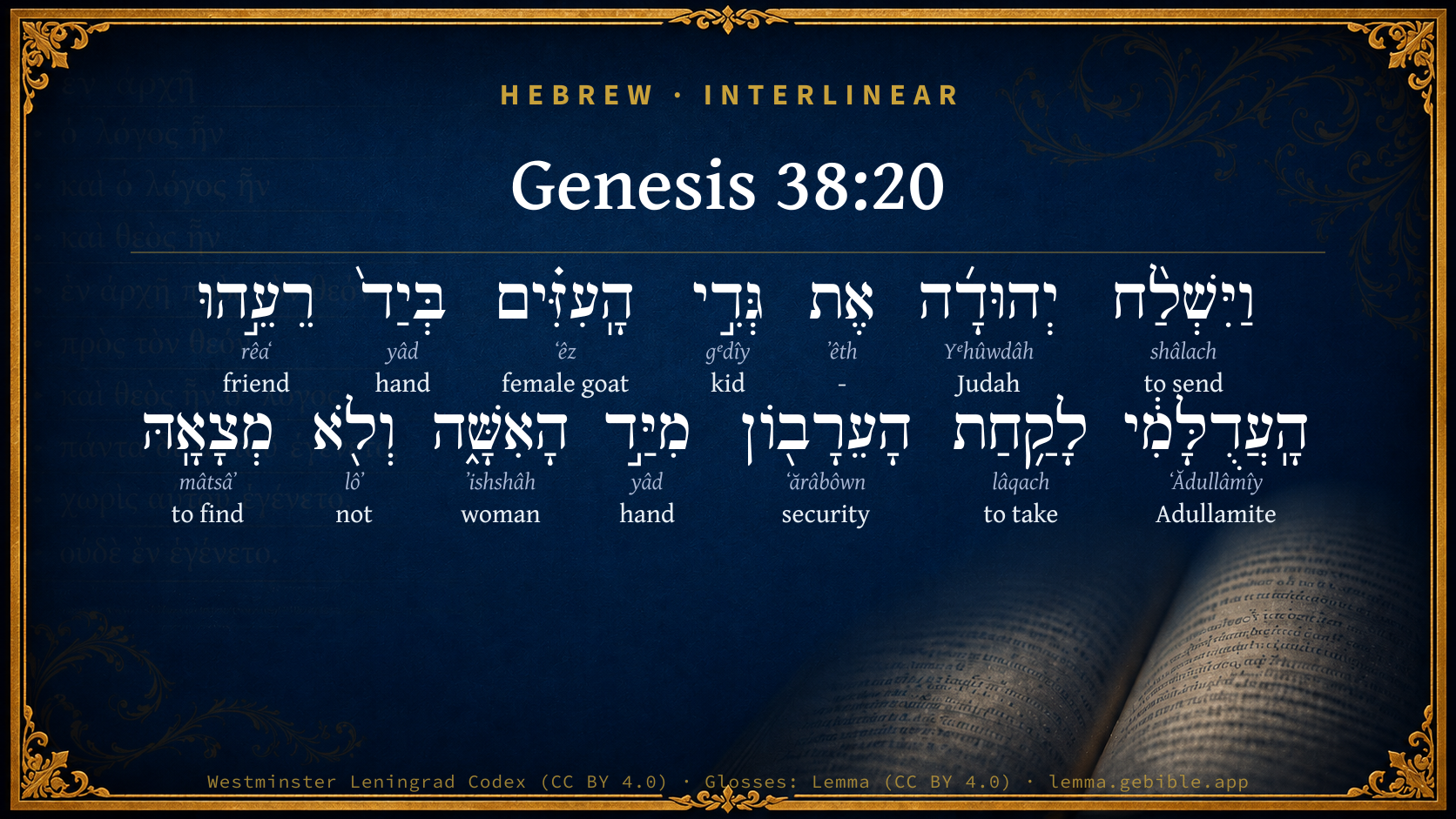
Hebrew (Westminster Leningrad Codex) Genesis 38:20 appears in the Hebrew Old Testament. The text above is from the Westminster Leningrad Codex. Each word links to its Strong’s number, a concise gloss, and parsing drawn from the Open Scriptures Hebrew Bible morphology. Click any word for its full Brown-Driver-Briggs (BDB) entry.
Download image
Cite this verse

Genesis 38:20 (World English Bible). Public Domain. Lemma interlinear Bible study tool, https://lemma.gebible.app/v/genesis/38/20.

Show BibTeX & RIS
BibTeX
RIS
English Translation
Judah sent the kid of the goats by the hand of his friend, the Adullamite, to receive the pledge from the woman's hand, but he didn't find her.
World English Bible · Public Domain
Download a study sheet

One document with this verse’s original text, its word-by-word gloss line, the meaning frame, cross-references with their text, attributed commentary, and full source and license credits — printable, and it pastes into notes with its structure intact.

This verse Autodidact and up

Study sheet (.html) Plain text (.txt)

A passage Seminary Student

Up to 50 verses in one chapter. A passage sheet keeps up to 6 commentary sources and 12 cross-references per verse, in the order this page ranks them, and says so on the sheet whenever that leaves anything out. Ask for a single verse and you get the Autodidact verse sheet above.

Everything on this page stays free to read, with no account — the sheet is a download of what is already on screen, not access to it.

Want to remove ads? Support Godless Engineer
Compare translations 3

The same verse in 3 English versions, stacked beneath the original-language interlinear above. Click any original word for its lexicon entry.

Each is an independent rendering of the whole verse — the interlinear is not word-aligned to these translations.

Highlighted words mark where these versions differ — a whole-verse word diff, not a word-by-word alignment.

  • World English Bible Public Domain
    Judah sent the kid of the goats by the hand of his friend, the Adullamite, to receive the pledge from the woman's hand, but he didn't find her.
  • King James Version Public Domain
    And Judah sent the kid by the hand of his friend the Adullamite, to receive his pledge from the woman's hand: but he found her not.
  • unfoldingWord Literal Text CC BY-SA 4.0
    Then Judah sent the kid goat by the hand of his friend the Adullamite to get back the pledge from the hand of the woman, but he did not find her.

unfoldingWord Literal Text — © unfoldingWord, licensed CC BY-SA 4.0. Word-aligned USFM3 via Door43 (git.door43.org/unfoldingWord/en_ult).

Versions to compare (up to 4)

3 of 4 selected

Show all 18 translations

Every available English version of this verse, each an independent rendering of the whole verse.

  • World English Bible Public Domain
    Judah sent the kid of the goats by the hand of his friend, the Adullamite, to receive the pledge from the woman's hand, but he didn't find her.
  • Berean Standard Bible Public Domain
    Now when Judah sent his friend Hirah the Adullamite with the young goat to collect the items he had left with the woman, he could not find her.
  • Majority Standard Bible Public Domain
    Now when Judah sent his friend Hirah the Adullamite with the young goat to collect the items he had left with the woman, he could not find her.
  • King James Version Public Domain
    And Judah sent the kid by the hand of his friend the Adullamite, to receive his pledge from the woman's hand: but he found her not.
  • American Standard Version (1901) Public Domain
    And Judah sent the kid of the goats by the hand of his friend the Adullamite, to receive the pledge from the woman's hand: but he found her not.
  • Revised Version (1885) Public Domain
    And Judah sent the kid of the goats by the hand of his friend the Adullamite, to receive the pledge from the woman’s hand: but he found her not.
  • Geneva Bible (1599) Public Domain
    Afterwarde Iudah sent a kid of the goates by the hande of his neighbour the Adullamite, for to receiue his pledge from the womans hand: but he found her not.
  • Douay-Rheims (1899) Public Domain
    And she arose and went her way: and putting off the apparel which she had taken, put on the garments of her widowhood.
  • Young's Literal Translation Public Domain
    And Judah sendeth the kid of the goats by the hand of his friend the Adullamite, to receive the pledge from the hand of the woman, and he hath not found her.
  • Literal Standard Version CC BY-SA 4.0
    And Judah sends the kid of the goats by the hand of his friend the Adullamite, to receive the pledge from the hand of the woman, and he has not found her.
  • Unlocked Literal Bible CC BY-SA 4.0
    Judah sent the young goat by his friend the Adullamite in order that he might receive the pledge back from the woman's hand, but he did not find her.
  • unfoldingWord Literal Text CC BY-SA 4.0
    Then Judah sent the kid goat by the hand of his friend the Adullamite to get back the pledge from the hand of the woman, but he did not find her.
  • Darby Bible Public Domain
    And Judah sent the kid of the goats by the hand of his friend the Adullamite, to receive the pledge from the woman's hand; but he found her not.
  • World Messianic Bible Public Domain
    Judah sent the young goat by the hand of his friend, the Adullamite, to receive the pledge from the woman’s hand, but he didn’t find her.
  • Webster's Bible Public Domain
    And Judah sent the kid by the hand of his friend the Adullamite, to receive his pledge from the woman's hand: but he found her not.
  • Free Bible Version CC BY-SA 4.0
    Judah sent his friend Hirah from Adullam with a young goat to get back his belongings he'd left as a guarantee from the woman, but he couldn't find her.
  • Bible in Basic English Public Domain
    Then Judah sent his friend Hirah with the young goat, to get back the things which he had given as a sign to the woman: but she was not there.
  • JPS Tanakh (1917) Public Domain
    And Judah sent the kid of the goats by the hand of his friend the Adullamite, to receive the pledge from the woman's hand; but he found her not.

Literal Standard Version (2020), Covenant Press — licensed CC BY-SA 4.0. Text via the HelloAO Bible API (eBible.org). Unlocked Literal Bible (unfoldingWord) — licensed CC BY-SA 4.0. Text via the HelloAO Bible API (eBible.org). unfoldingWord Literal Text — © unfoldingWord, licensed CC BY-SA 4.0. Word-aligned USFM3 via Door43 (git.door43.org/unfoldingWord/en_ult). Free Bible Version, Dr. Jonathan Gallagher — licensed CC BY-SA 4.0. Text via the HelloAO Bible API (eBible.org).

Word by word

More ways to search: Search by grammar → Find every occurrence → Compare this word →

Practice this passage: Drill this verse → Learn its vocabulary →

הָֽעֲדֻלָּמִ֔י
ʻĂdullâmîy
H5726
“the · Adullamite”
Particle, Definite Article + Noun, Gentilic, Masculine, Singular, Absolute
Part of Speech
Particle + Noun
Type
Gentilic
Gender
Masculine
Number
Singular
State
Absolute
Full BDB Definition

Origin: patrial from H5725

TWOT: TWOT

Adullamite = see Adullam " justice of the people" - an inhabitant of Adullam
  1. וַיִּשְׁלַ֨ח shâlach H7971 “and · to send” Conjunction + Verb, Qal, Sequential Imperfect, 3rd Person, Masculine, Singular
  2. יְהוּדָ֜ה Yᵉhûwdâh H3063 “Judah” Noun, Proper
  3. אֶת ʼêth H853 “-” Particle, Direct Object
  4. גְּדִ֣י gᵉdîy H1423 “kid of” Noun, Common, Masculine, Singular, Construct
  5. הָֽעִזִּ֗ים ʻêz H5795 “the · female goats” Particle, Definite Article + Noun, Common, Feminine, Plural, Absolute
  6. בְּיַד֙ yâd H3027 “in/at · hand of” Preposition + Noun, Common, Both, Singular, Construct
  7. רֵעֵ֣הוּ rêaʻ H7453 “friend · his” Noun, Common, Masculine, Singular, Construct + Suffix, Personal, 3rd Person, Masculine, Singular
  8. לָקַ֥חַת lâqach H3947 “to take” Preposition + Verb, Qal, Infinitive Construct
  9. הָעֵרָב֖וֹן ʻărâbôwn H6162 “the · security” Particle, Definite Article + Noun, Common, Masculine, Singular, Absolute
  10. מִיַּ֣ד yâd H3027 “from · hand of” Preposition + Noun, Common, Both, Singular, Construct
  11. הָאִשָּׁ֑ה ʼishshâh H802 “the · woman” Particle, Definite Article + Noun, Common, Feminine, Singular, Absolute
  12. וְלֹ֖א lôʼ H3808 “and · not” Conjunction + Particle, Negative
  13. מְצָאָֽהּ mâtsâʼ H4672 “to find · her” Verb, Qal, Perfect, 3rd Person, Masculine, Singular + Suffix, Personal, 3rd Person, Feminine, Singular

About this verse

These counts appear in no published source. They are computed here, from the morphology-tagged text and Lemma’s own curated glosses. What Lemma adds →

14
words
13
distinct lemmas
Pentateuch
section

Notable vocabulary

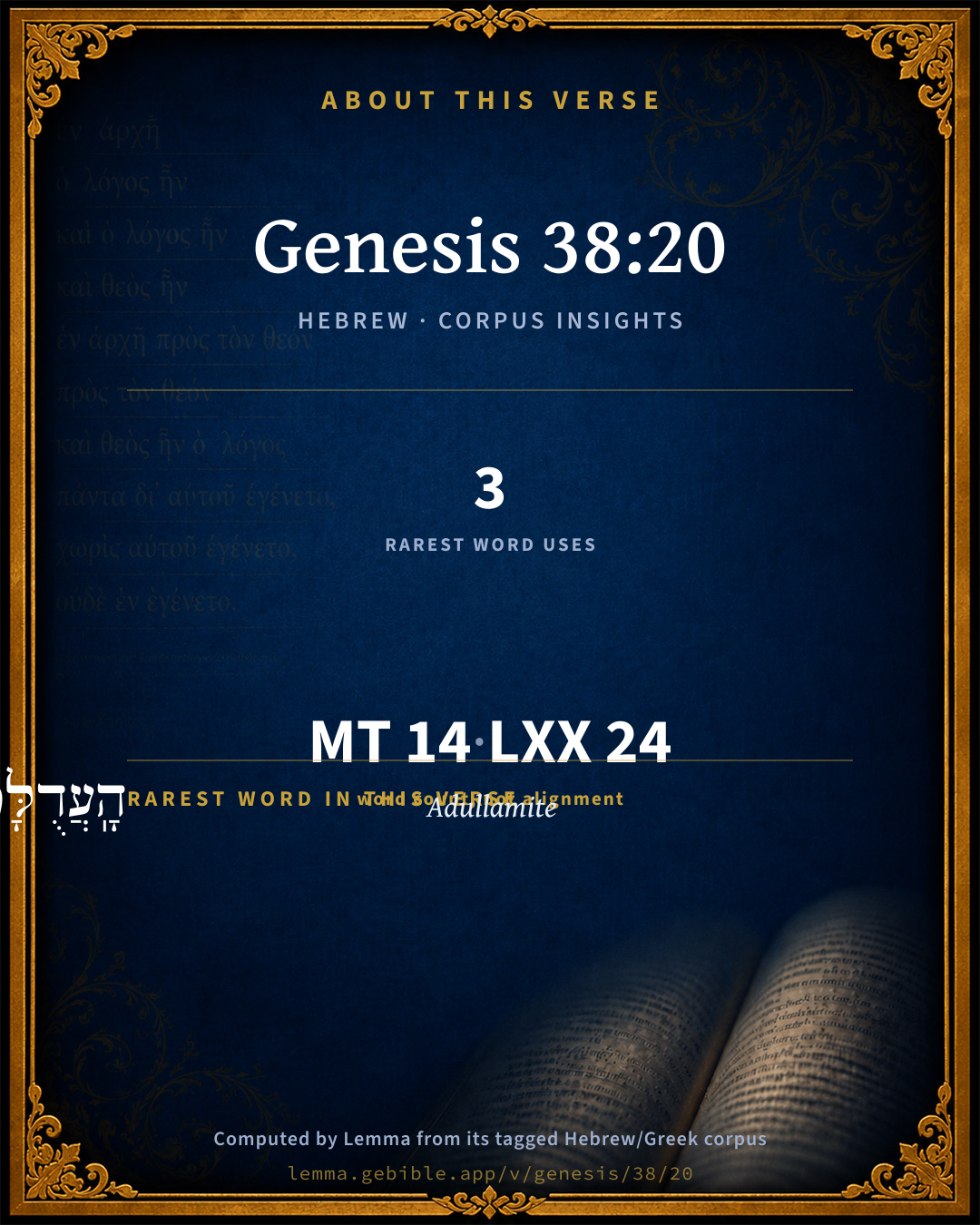
The rarest word here is הָֽעֲדֻלָּמִ֔י Adullamite H5726 — appearing just 3 times in the whole Hebrew Bible.

Shared distinctive vocabulary

הָֽעֲדֻלָּמִ֔י Adullamite H5726 occurs in 3 verses of the Hebrew Bible. Also found in:

Grammatical profile

  • 3 verbs
  • 9 nouns
  • 2 particles

Verb forms

  • וַיִּשְׁלַ֨ח Qal · Sequential Imperfect
  • לָקַ֥חַת Qal · Infinitive Construct
  • מְצָאָֽהּ Qal · Perfect

Repetition

A word recurs within this verse — often emphatic in Hebrew:

  • בְּיַד֙ hand H3027 ×2

Hebrew & Septuagint length

In English translation the verse runs 28 words from the Hebrew and 28 from the Septuagint (LXX English) — the same length.

A rough comparison of the two English renderings, which tokenize alike — not a word-level alignment.

Word counts can differ between the Hebrew and the Greek without any difference in meaning — e.g. the Hebrew direct-object marker אֵת has no separate Greek word, and Greek often adds the article ὁ.

In the original languages it is 14 Hebrew tokens and 24 Greek tokens — but the two are counted differently (Hebrew bundles its prefixes and suffixes into one token; the Greek is in lemma form), so that isn’t a like-for-like length.

Cross-references

5

Topical passages linked to Genesis 38:20 in the Treasury of Scripture Knowledge — connected by theme and wording, ordered by reader-vote popularity; previews shown in the World English Bible.

  • Genesis 20:9 Then Abimelech called Abraham, and said to him, "What have you done to us? How have I sinned against you, that you have brought on me and on my kingdom a great sin? You have done deeds to me that ought not to be done!"
  • Leviticus 19:17 "'You shall not hate your brother in your heart. You shall surely rebuke your neighbor, and not bear sin because of him.
  • Judges 14:20 But Samson's wife was [given] to his companion, whom he had used as his friend.
  • 2 Samuel 13:3 But Amnon had a friend, whose name was Jonadab, the son of Shimeah, David's brother; and Jonadab was a very subtle man.
  • Luke 23:12 Herod and Pilate became friends with each other that very day, for before that they were enemies with each other.

Cross-references courtesy of OpenBible.info (CC BY 4.0).

Hebrew and Greek witnesses Masoretic Hebrew ↔ Greek Septuagint

The same verse in the two great witnesses to the Old Testament, shown verse-for-verse.

These are two independent witnesses, not word-aligned to each other, and the Septuagint is shown in lemma (dictionary) form.

Hebrew Genesis 38:20 Masoretic · Westminster Leningrad Codex

וַיִּשְׁלַ֨ח יְהוּדָ֜ה אֶת גְּדִ֣י הָֽעִזִּ֗ים בְּיַד֙ רֵעֵ֣הוּ הָֽעֲדֻלָּמִ֔י לָקַ֥חַת הָעֵרָב֖וֹן מִיַּ֣ד הָאִשָּׁ֑ה וְלֹ֖א מְצָאָֽהּ

Judah sent the kid of the goats by the hand of his friend, the Adullamite, to receive the pledge from the woman's hand, but he didn't find her.

World English Bible · Public Domain

Greek LXX Genesis 38:20 Septuagint · lemma form

ἀποστέλλω δέ ἰούδας ὁ ἔριφος ἐκ αἴξ ἐν χείρ ὁ ποιμήν αὐτός ὁ οδολλαμίτης κομίζω ὁ ἀρραβών παρά ὁ γυνή καί οὐ εὑρίσκω αὐτός

And Judas sent the kid of the goats by the hand of his shepherd the Odollamite, to receive the pledge from the woman; and he found her not.

LXX2012 (modern English Septuagint) · Public Domain

Hebrew: Westminster Leningrad Codex (CC BY 4.0). Greek: Septuagint (public domain); English from LXX2012 (modern English Septuagint) (Public Domain). How the Septuagint differs from the Hebrew →

Targum (Aramaic paraphrase)

2

The Targum is the ancient Jewish Aramaic paraphrase of the Hebrew Scriptures — an interpretive translation, not the Hebrew text itself. Onkelos (literal) and Pseudo-Jonathan (expansive) render the Torah, and Jonathan the Prophets. Coverage is partial: where no permissively-licensed English translation exists for a verse, only the Aramaic is shown. This is verse-level text, not a word-by-word alignment to the Hebrew.

  1. Targum Onkelos Torah (Genesis–Deuteronomy)
    וְשַׁדַּר יְהוּדָה יָת גַּדְיָא בַר עִזֵּי בִּידָא דְרַחֲמֵהּ עֲדֻלָּמָאָה לְמִסַּב מַשְׁכּוֹנָא מִידָא דְאִתְּתָא וְלָא אַשְׁכְּחַהּ

    (no public-domain English translation for this verse)

    Targum Onkelos — Aramaic: “Onkelos Genesis” (public domain); “Onkelos Exodus” (public domain); “Onkelos Leviticus” (public domain); “Onkelos Numbers” (public domain); “Onkelos Deuteronomy” (public domain). English: “Sefaria Community Translation” (CC0 1.0 (public-domain dedication)); “J.W. Etheridge. The Targums of Onkelos and Jonathan Ben Uzziel on the Pentateuch. London: Longmans, Green, 1862” (public domain). Text via Sefaria.

  2. Targum Pseudo-Jonathan Torah (Genesis–Deuteronomy)
    וְשַׁדַר יְהוּדָה יַת גִידֵי בַּר עִזֵי בְּיַד רַחֲמֵיהּ עֲדוּלְמָאָה לְמִסַב מַשְׁכּוֹנָא מִידָא דְאִיתְּתָא וְלָא אַשְׁכְּחָה

    And Jehuda sent the kid of the goats by the hand of his friend the Adullemite, to bring back the pledge from the hand of the woman; but he found her not.

    Targum Pseudo-Jonathan — Aramaic: “Targum Jonathan on Genesis” (public domain); “Targum Jonathan on Exodus” (public domain); “Targum Jonathan on Leviticus” (public domain); “Targum Jonathan on Numbers” (public domain); “Targum Jonathan on Deuteronomy” (public domain). English: “The Targum of Jonathan ben Uzziel, trans. J. W. Etheridge, London, 1862” (public domain). Text via Sefaria.

Commentary

Notes on Genesis 38:20 from classic Christian and Jewish commentators (each source and its license shown beneath its notes). The classic Christian expositions comment on the surrounding passage and are grouped to its opening verse, so a note may address several verses; the Jewish commentaries on the Tanakh (Rashi and others) are per-verse, so they appear only where the commentator wrote on this verse.

Lemma curates 59 commentaries, every one of them public domain or Creative Commons licensed, each selected and text-cleaned for this edition rather than reprinted as found. About our sources →

Trapp's Complete Commentary

John Trapp

Gen 38:20 And Judah sent the kid by the hand of his friend the Adullamite, to receive [his] pledge from the woman’s hand: but he found her not.

Ver. 20. By the hand of hls friend.] His broker. Fie upon such Adullamites! Such coal carriers as this, saith one, be good to scour a hot oven with. Such another was Jonadab to Amnon. How much better that heathen, that answered, Amicus tibi sum, sed usque ad aras.

John Trapp, A Commentary or Exposition upon All the Books of the Old and New Testament (1647–1656) — public domain. Text from a community e-Sword module.

Tyndale Open Study Notes

Tyndale Open Resources

38:20-23 Judah had gone in to Tamar as a regular prostitute (Hebrew zonah, 38:15), whereas Hirah was mistakenly looking for a shrine prostitute (Hebrew qedeshah), of which there were none.

Tyndale Open Study Notes — © Tyndale Open Resources, licensed CC BY-SA 4.0. Text via the HelloAO Bible API.

Geneva Bible (1599)

Geneva Bible translators

That his wickedness might not be known to others.

Geneva Bible (1599) marginal notes — public domain. Text via Bolls.life.

John Calvin's Commentaries

20. And Judah sent the kid. He sends by the hand of a friend, that he may not reveal his ignominy to a stranger. This is also the reason why he does not dare to complain of the lost pledges, lest he should expose himself to ridicule. For I do not approve the sense given, by some, to the words, Let her take it to her, lest we be shamed, as if Judah would excuse himself, as having fulfilled the promise he had given. Another meaning is far more suitable; namely, that Judah would rather lose the ring, than, by spreading the matter further, give occasion to the speeches of the vulgar; because lighter is the loss of money than of character. He might also fear being exposed to ridicule for having been so credulous. But he was chiefly afraid of the disgrace arising from his fornication. Here we see that men who are not governed by the Spirit of God are always more solicitous about the opinion of the world than about the judgment of God. For why, when the lust of the flesh excited him, did it not come into his mind, “Behold now I shall become vile in the sight of God and of angels?” Why, at least, after his lust has cooled, does he not blush at the secret knowledge of his sin? But he is secure, if only he can protect himself from public infamy. This passage, however, teaches, what I have said before, that fornication is condemned by the common sense of men, lest any one should seek to excuse himself on the ground of ignorance.

John Calvin's Commentaries (1540-1563) — public domain. Text from the Calvin Translation Society English edition (1840s-50s) via the Christian Classics Ethereal Library (ccel.org). Calvin's coverage is partial (roughly two-thirds of the Bible); uncommented books and verses are honest gaps, never fabricated. The 19th-century editor's footnotes and remarks are omitted so the notes are faithfully Calvin's own voice.

John Gill's Exposition

Then he asked the men of that place,.... Or "of her place" (d), of the woman's place, supposing that she dwelt somewhere thereabout:

saying, where is the harlot that was openly by the wayside? that sat there very publicly some little time ago: the word for "harlot" (e) comes from another, which signifies to sanctify or separate to holy uses; and harlots were so called, either by an antiphrasis, by way of contradiction, being unholy; or because, as Jarchi observes, they were separated and destined to whoredom; or because they were such as were devoted to Venus, and the worshippers of her, and prostitutes in her temple, and in the temples of other Heathen deities; but it is questionable whether such practices as yet were used:

and they said, there was no harlot in this place; they had not known any harlot to frequent that place lately, and Tamar sat there so small a time as not to have been observed by them.

(d) "viros loci ejus, scil mulieris", Piscator, Schimdt. (e)

John Gill's Exposition of the Whole Bible (1746–1763) — public domain (CC PDM 1.0). Text via the HelloAO Bible API.

The Pulpit Commentary

And Judah sent the kid literally, the kid of the goats, which he had promised (ver. 17)by the hand of his friend the Adullamite, to receive his pledge from the woman"s hand: but (literally, and) he (i.e. Hirah) found her not.

The Pulpit Commentary (1880–1919), ed. H.D.M. Spence-Jones & Joseph S. Exell — public domain. Text from a community e-Sword module.

Lesson kit

Teaching starters — assembled from the data on this page, not authored interpretation. Every prompt links to the verse data it draws on. Edit before teaching.

Genesis, in the Pentateuch, opens this verse with 14 words (13 distinct Hebrew lemmas). Its most distinctive word is ʻĂdullâmîy (“Adullamite”). A historical commentator’s framing appears above. Read the whole chapter for the surrounding context.

Discussion questions

  1. How does “Adullamite” (ʻĂdullâmîy) shape what this verse is saying?
  2. How does Genesis 38:1, which shares the word «Adullamite», read alongside this verse?
  3. What does the repetition of “hand” (2× in this one verse) do in this verse?
  4. The translations on this page render this verse differently — a whole-verse word diff, not a word-by-word alignment. What might account for the different wordings?
  5. «וַיִּשְׁלַ֨ח» is a Qal Sequential Imperfect verb. How does that grammatical form shape the action described?
  6. Compare how Trapp's Complete Commentary and Tyndale Open Study Notes read this verse. Where do they agree or differ?

Things to notice

Reading settings

Reading text

Shown beneath each verse's original-language words.

Old Testament
Old Testament edition

Read the OT as the Masoretic Hebrew (MT) or the Greek Septuagint (LXX).

English shown for the Greek Septuagint (in the Hebrew ↔ Greek comparison).

Comparing translations? Open the Compare panel on any verse page to stack up to four side by side.