Genesis 24:2

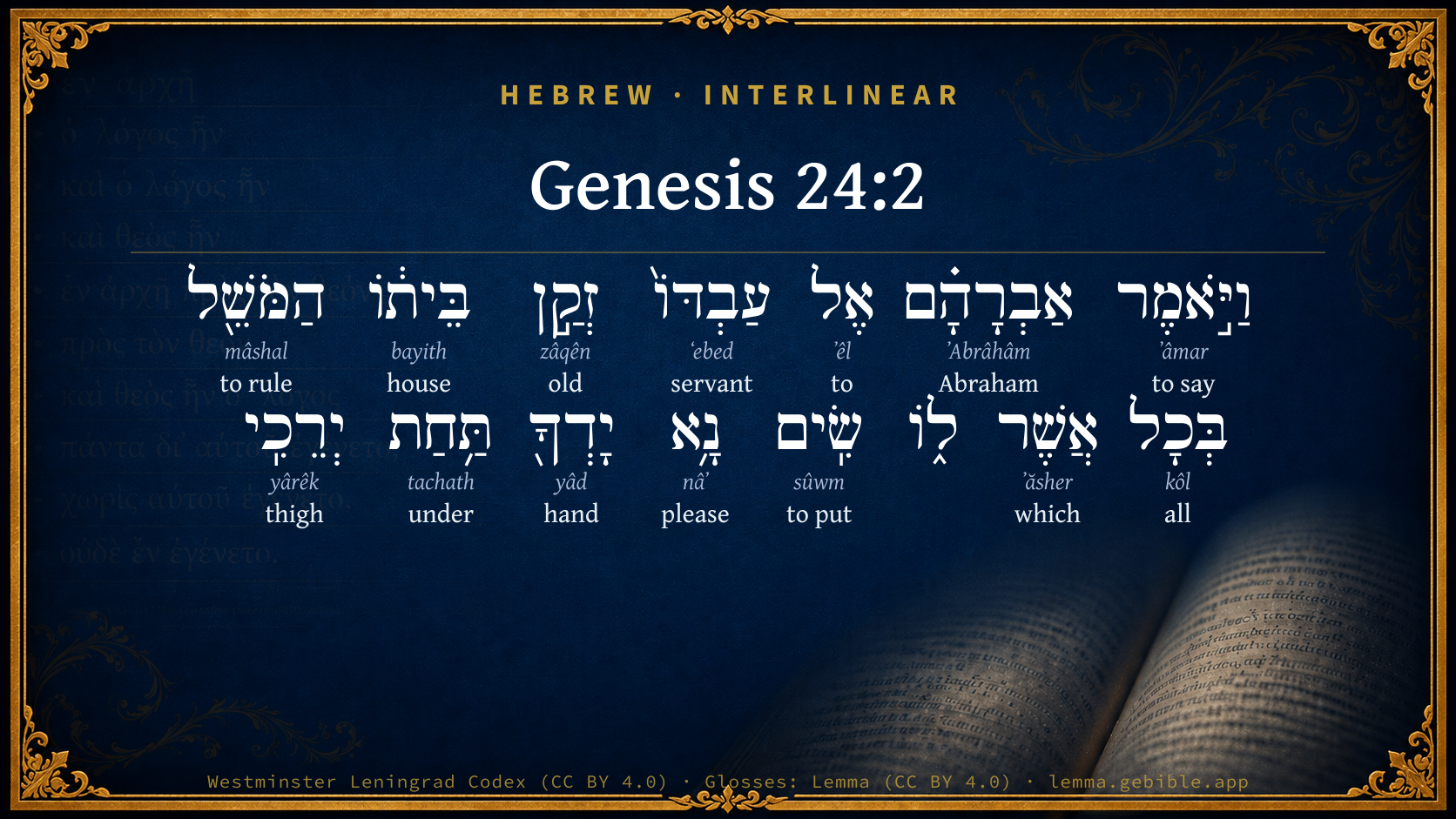
Hebrew (Westminster Leningrad Codex) Genesis 24:2 appears in the Hebrew Old Testament. The text above is from the Westminster Leningrad Codex. Each word links to its Strong’s number, a concise gloss, and parsing drawn from the Open Scriptures Hebrew Bible morphology. Click any word for its full Brown-Driver-Briggs (BDB) entry.
Download image
Cite this verse

Genesis 24:2 (World English Bible). Public Domain. Lemma interlinear Bible study tool, https://lemma.gebible.app/v/genesis/24/2.

Show BibTeX & RIS
BibTeX
RIS
English Translation
Abraham said to his servant, the elder of his house, who ruled over all that he had, "Please put your hand under my thigh.
World English Bible · Public Domain
Highlights
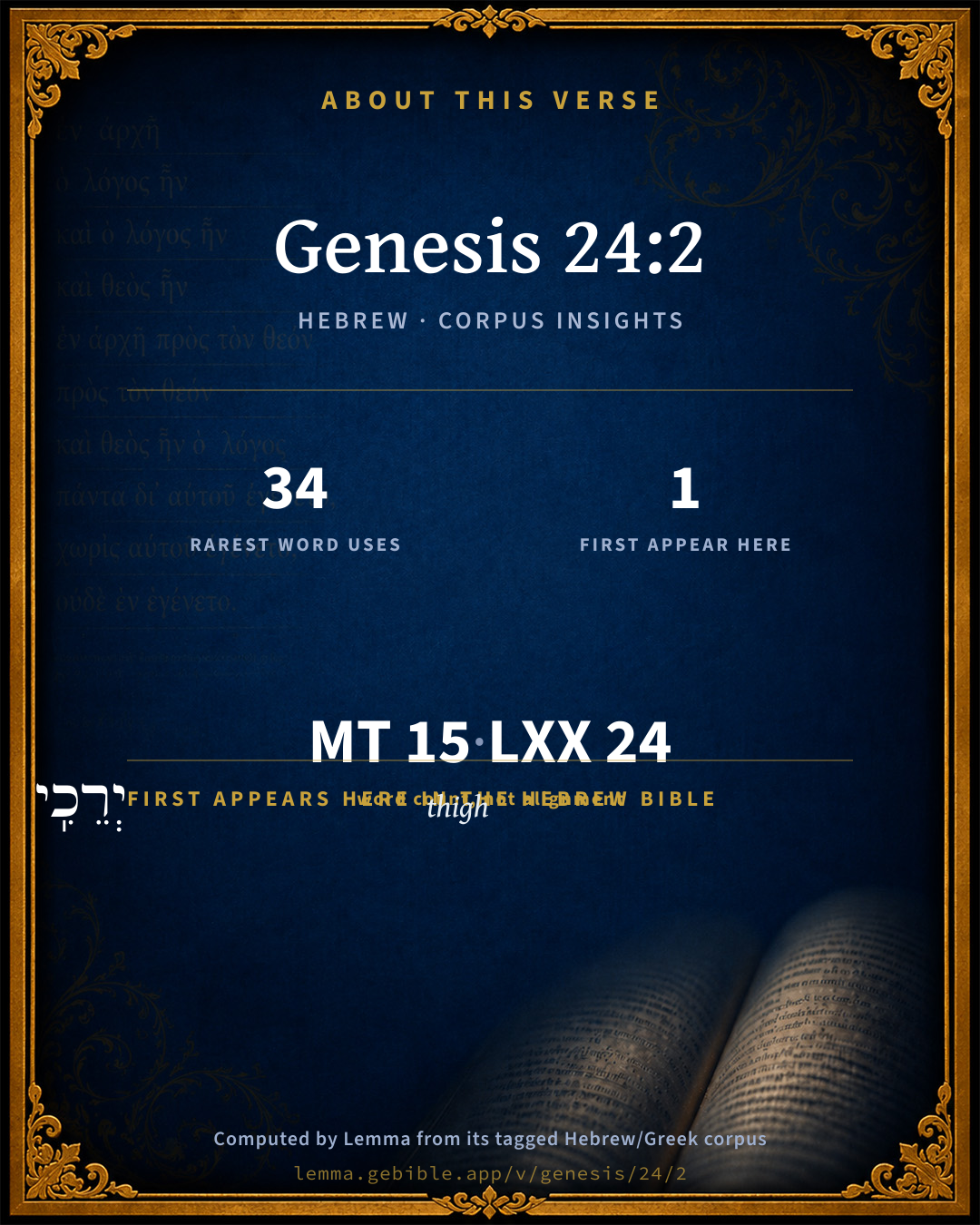
  • 1 first appearance in the Hebrew Bible
Full analysis ↓
Download a study sheet

One document with this verse’s original text, its word-by-word gloss line, the meaning frame, cross-references with their text, attributed commentary, and full source and license credits — printable, and it pastes into notes with its structure intact.

This verse Autodidact and up

Study sheet (.html) Plain text (.txt)

A passage Seminary Student

Up to 50 verses in one chapter. A passage sheet keeps up to 6 commentary sources and 12 cross-references per verse, in the order this page ranks them, and says so on the sheet whenever that leaves anything out. Ask for a single verse and you get the Autodidact verse sheet above.

Everything on this page stays free to read, with no account — the sheet is a download of what is already on screen, not access to it.

Want to remove ads? Support Godless Engineer
Compare translations 3

The same verse in 3 English versions, stacked beneath the original-language interlinear above. Click any original word for its lexicon entry.

Each is an independent rendering of the whole verse — the interlinear is not word-aligned to these translations.

Highlighted words mark where these versions differ — a whole-verse word diff, not a word-by-word alignment.

  • World English Bible Public Domain
    Abraham said to his servant, the elder of his house, who ruled over all that he had, "Please put your hand under my thigh.
  • King James Version Public Domain
    And Abraham said unto his eldest servant of his house, that ruled over all that he had, Put, I pray thee, thy hand under my thigh:
  • unfoldingWord Literal Text CC BY-SA 4.0
    Then Abraham said to his oldest servant of his house, who was in charge of everything that to him, “Please put your hand under my thigh,

unfoldingWord Literal Text — © unfoldingWord, licensed CC BY-SA 4.0. Word-aligned USFM3 via Door43 (git.door43.org/unfoldingWord/en_ult).

Versions to compare (up to 4)

3 of 4 selected

Show all 18 translations

Every available English version of this verse, each an independent rendering of the whole verse.

  • World English Bible Public Domain
    Abraham said to his servant, the elder of his house, who ruled over all that he had, "Please put your hand under my thigh.
  • Berean Standard Bible Public Domain
    So Abraham instructed the chief servant of his household, who managed all he owned, “Place your hand under my thigh,
  • Majority Standard Bible Public Domain
    So Abraham instructed the chief servant of his household, who managed all he owned, “Place your hand under my thigh,
  • King James Version Public Domain
    And Abraham said unto his eldest servant of his house, that ruled over all that he had, Put, I pray thee, thy hand under my thigh:
  • American Standard Version (1901) Public Domain
    And Abraham said unto his servant, the elder of his house, that ruled over all that he had, Put, I pray thee, thy hand under my thigh.
  • Revised Version (1885) Public Domain
    And Abraham said unto his servant, the elder of his house, that ruled over all that he had, Put, I pray thee, thy hand under my thigh:
  • Geneva Bible (1599) Public Domain
    Therefore Abraham saide vnto his eldest seruant of his house, which had the rule ouer all that he had, Put nowe thine hand vnder my thigh,
  • Douay-Rheims (1899) Public Domain
    And he said to the elder servant of his house, who was ruler over all he had: Put thy hand under my thigh,
  • Young's Literal Translation Public Domain
    and Abraham saith unto his servant, the eldest of his house, who is ruling over all that he hath, `Put, I pray thee, thy hand under my thigh,
  • Literal Standard Version CC BY-SA 4.0
    and Abraham says to his servant, the eldest of his house, who is ruling over all that he has, “Please put your hand under my thigh,
  • Unlocked Literal Bible CC BY-SA 4.0
    Abraham said to his servant, the one who was the oldest of his household and who was in charge of all that he had, “Put your hand under my thigh
  • unfoldingWord Literal Text CC BY-SA 4.0
    Then Abraham said to his oldest servant of his house, who was in charge of everything that to him, “Please put your hand under my thigh,
  • Darby Bible Public Domain
    And Abraham said to his servant, the eldest of his house, who ruled over all that he had, Put thy hand, I pray thee, under my thigh,
  • World Messianic Bible Public Domain
    Abraham said to his servant, the elder of his house, who ruled over all that he had, “Please put your hand under my thigh.
  • Webster's Bible Public Domain
    And Abraham said to his eldest servant of his house, that ruled over all that he had, Put, I pray thee, thy hand under my thigh:
  • Free Bible Version CC BY-SA 4.0
    At that time Abraham told his oldest servant who was in charge of his whole household, “Put your hand under my thigh,
  • Bible in Basic English Public Domain
    And Abraham said to his chief servant, the manager of all his property, Come now, put your hand under my leg:
  • JPS Tanakh (1917) Public Domain
    And Abraham said unto his servant, the elder of his house, that ruled over all that he had: 'Put, I pray thee, thy hand under my thigh.

Literal Standard Version (2020), Covenant Press — licensed CC BY-SA 4.0. Text via the HelloAO Bible API (eBible.org). Unlocked Literal Bible (unfoldingWord) — licensed CC BY-SA 4.0. Text via the HelloAO Bible API (eBible.org). unfoldingWord Literal Text — © unfoldingWord, licensed CC BY-SA 4.0. Word-aligned USFM3 via Door43 (git.door43.org/unfoldingWord/en_ult). Free Bible Version, Dr. Jonathan Gallagher — licensed CC BY-SA 4.0. Text via the HelloAO Bible API (eBible.org).

Word by word

More ways to search: Search by grammar → Find every occurrence → Compare this word →

Practice this passage: Drill this verse → Learn its vocabulary →

יְרֵכִֽי
yârêk
H3409
“thigh · my”
Noun, Common, Feminine, Singular, Construct + Suffix, Personal, 1st Person, Common, Singular
Part of Speech
Noun
Type
Common
Gender
Feminine
Number
Singular
State
Construct
Full BDB Definition

Origin: from an unused root meaning to be soft

TWOT: 916a

thigh, side, loin, base - thigh - outside of thigh (where sword was worn) - loins (as the seat of procreative power) - side (flank) (of object) - base
  1. וַיֹּ֣אמֶר ʼâmar H559 “and · to say” Conjunction + Verb, Qal, Sequential Imperfect, 3rd Person, Masculine, Singular
  2. אַבְרָהָ֗ם ʼAbrâhâm H85 “Abraham” Noun, Proper
  3. אֶל ʼêl H413 “to” Preposition
  4. עַבְדּוֹ֙ ʻebed H5650 “servant · his” Noun, Common, Masculine, Singular, Construct + Suffix, Personal, 3rd Person, Masculine, Singular
  5. זְקַ֣ן zâqên H2205 “old of” Adjective, Adjective, Masculine, Singular, Construct
  6. בֵּית֔וֹ bayith H1004 “house · his” Noun, Common, Masculine, Singular, Construct + Suffix, Personal, 3rd Person, Masculine, Singular
  7. הַמֹּשֵׁ֖ל mâshal H4910 “the · ruling” Particle, Definite Article + Verb, Qal, Participle Active, Masculine, Singular, Absolute
  8. בְּכָל kôl H3605 “in/at · all of” Preposition + Noun, Common, Masculine, Singular, Construct
  9. אֲשֶׁר ʼăsher H834 “which” Particle, Relative
  10. שִֽׂים sûwm H7760 “put” Verb, Qal, Imperative, 2nd Person, Masculine, Singular
  11. נָ֥א nâʼ H4994 “please” Particle, Exhortation
  12. יָדְךָ֖ yâd H3027 “hand · your” Noun, Common, Both, Singular, Construct + Suffix, Personal, 2nd Person, Masculine, Singular
  13. תַּ֥חַת tachath H8478 “under” Preposition

About this verse

These counts appear in no published source. They are computed here, from the morphology-tagged text and Lemma’s own curated glosses. What Lemma adds →

15
words
14
distinct lemmas
Pentateuch
section

First appearance in Scripture

This word makes its first canonical appearance in the Hebrew Bible here:

  • יְרֵכִֽי thigh H3409

Shared distinctive vocabulary

יְרֵכִֽי thigh H3409 occurs in 32 verses of the Hebrew Bible. Also found in:

Grammatical profile

  • 3 verbs
  • 6 nouns
  • 1 adjective
  • 3 prepositions
  • 2 particles

Verb forms

  • וַיֹּ֣אמֶר Qal · Sequential Imperfect
  • הַמֹּשֵׁ֖ל Qal · Participle Active
  • שִֽׂים Qal · Imperative

Hebrew & Septuagint length

In English translation the verse runs 24 words from the Hebrew and 24 from the Septuagint (LXX English) — the same length.

A rough comparison of the two English renderings, which tokenize alike — not a word-level alignment.

Word counts can differ between the Hebrew and the Greek without any difference in meaning — e.g. the Hebrew direct-object marker אֵת has no separate Greek word, and Greek often adds the article ὁ.

In the original languages it is 15 Hebrew tokens and 24 Greek tokens — but the two are counted differently (Hebrew bundles its prefixes and suffixes into one token; the Greek is in lemma form), so that isn’t a like-for-like length.

Cross-references

7

Topical passages linked to Genesis 24:2 in the Treasury of Scripture Knowledge — connected by theme and wording, ordered by reader-vote popularity; previews shown in the World English Bible.

  • Genesis 47:29 The time drew near that Israel must die, and he called his son Joseph, and said to him, "If now I have found favor in your sight, please put your hand under my thigh, and deal kindly and truly with me. Please don't bury me in Egypt,
  • Genesis 39:4–6 Joseph found favor in his sight. He ministered to him, and he made him overseer over his house, and all that he had he put into his hand.
  • Genesis 15:2 Abram said, "Lord Yahweh, what will you give me, seeing I go childless, and he who will inherit my estate is Eliezer of Damascus?"
  • Genesis 24:9–10 The servant put his hand under the thigh of Abraham his master, and swore to him concerning this matter.
  • Genesis 39:8–9 But he refused, and said to his master's wife, "Behold, my master doesn't know what is with me in the house, and he has put all that he has into my hand.
  • Genesis 44:1 He commanded the steward of his house, saying, "Fill the men's sacks with food, as much as they can carry, and put every man's money in his sack's mouth.
  • 1 Chronicles 29:24 All the princes, the mighty men, and also all of the sons of king David submitted themselves to Solomon the king.

Cross-references courtesy of OpenBible.info (CC BY 4.0).

Hebrew and Greek witnesses Masoretic Hebrew ↔ Greek Septuagint

The same verse in the two great witnesses to the Old Testament, shown verse-for-verse.

These are two independent witnesses, not word-aligned to each other, and the Septuagint is shown in lemma (dictionary) form.

Hebrew Genesis 24:2 Masoretic · Westminster Leningrad Codex

וַיֹּ֣אמֶר אַבְרָהָ֗ם אֶל עַבְדּוֹ֙ זְקַ֣ן בֵּית֔וֹ הַמֹּשֵׁ֖ל בְּכָל אֲשֶׁר ל֑וֹ שִֽׂים נָ֥א יָדְךָ֖ תַּ֥חַת יְרֵכִֽי

Abraham said to his servant, the elder of his house, who ruled over all that he had, "Please put your hand under my thigh.

World English Bible · Public Domain

Greek LXX Genesis 24:2 Septuagint · lemma form

καί εἶπον αβρααμ ὁ παῖς αὐτός ὁ πρεσβύτερος ὁ οἰκία αὐτός ὁ ἄρχων πᾶς ὁ αὐτός τίθημι ὁ χείρ σύ ὑπό ὁ μηρός ἐγώ

And Abraam said to his servant the elder of his house, who had rule over all his possessions, Put your hand under my thigh,

LXX2012 (modern English Septuagint) · Public Domain

Hebrew: Westminster Leningrad Codex (CC BY 4.0). Greek: Septuagint (public domain); English from LXX2012 (modern English Septuagint) (Public Domain). How the Septuagint differs from the Hebrew →

Targum (Aramaic paraphrase)

2

The Targum is the ancient Jewish Aramaic paraphrase of the Hebrew Scriptures — an interpretive translation, not the Hebrew text itself. Onkelos (literal) and Pseudo-Jonathan (expansive) render the Torah, and Jonathan the Prophets. Coverage is partial: where no permissively-licensed English translation exists for a verse, only the Aramaic is shown. This is verse-level text, not a word-by-word alignment to the Hebrew.

  1. Targum Onkelos Torah (Genesis–Deuteronomy)
    וַאֲמַר אַבְרָהָם לְעַבְדֵהּ סָבָא דְבֵיתֵהּ דְּשַׁלִּיט בְּכָל דִי לֵהּ שַׁוִּי כְעַן יְדָךְ תְּחוֹת יַרְכִּי

    (no public-domain English translation for this verse)

    Targum Onkelos — Aramaic: “Onkelos Genesis” (public domain); “Onkelos Exodus” (public domain); “Onkelos Leviticus” (public domain); “Onkelos Numbers” (public domain); “Onkelos Deuteronomy” (public domain). English: “Sefaria Community Translation” (CC0 1.0 (public-domain dedication)); “J.W. Etheridge. The Targums of Onkelos and Jonathan Ben Uzziel on the Pentateuch. London: Longmans, Green, 1862” (public domain). Text via Sefaria.

  2. Targum Pseudo-Jonathan Torah (Genesis–Deuteronomy)
    וַאֲמַר אַבְרָהָם לֶאֱלִיעֶזֶר עַבְדֵיהּ סָבָא דְבֵיתֵיהּ דְשַׁלִיט בְּכָל אַפּוֹתִּיקֵי דִלֵיהּ שַׁוִי כְדוֹן יְדָךְ בִּגְזֵירַת מְהוּלְתִּי

    And Abraham said to Eliezer his servant, the senior of his house, who had rule over all his property, Put now thy hand upon the section of my circumcision.

    Targum Pseudo-Jonathan — Aramaic: “Targum Jonathan on Genesis” (public domain); “Targum Jonathan on Exodus” (public domain); “Targum Jonathan on Leviticus” (public domain); “Targum Jonathan on Numbers” (public domain); “Targum Jonathan on Deuteronomy” (public domain). English: “The Targum of Jonathan ben Uzziel, trans. J. W. Etheridge, London, 1862” (public domain). Text via Sefaria.

Commentary

Notes on Genesis 24:2 from classic Christian and Jewish commentators (each source and its license shown beneath its notes). The classic Christian expositions comment on the surrounding passage and are grouped to its opening verse, so a note may address several verses; the Jewish commentaries on the Tanakh (Rashi and others) are per-verse, so they appear only where the commentator wrote on this verse.

Lemma curates 59 commentaries, every one of them public domain or Creative Commons licensed, each selected and text-cleaned for this edition rather than reprinted as found. About our sources →

Trapp's Complete Commentary

John Trapp

Gen 24:2 And Abraham said unto his eldest servant of his house, that ruled over all that he had, Put, I pray thee, thy hand under my thigh:

Ver. 2. Put, I pray thee, thy hand under my thigh.] Either as a token of subjection, or for the honour of circumcision, quae erat in parte femoris; q.d., I adjure thee by the Lord of the covenant, whereof circumcision is a sign. Or (which is most likely) in reference to Christ, who was to come of Abraham, according to that phrase. "The souls that came out of Jacob’s thigh". {Gen 46:26}

John Trapp, A Commentary or Exposition upon All the Books of the Old and New Testament (1647–1656) — public domain. Text from a community e-Sword module.

Joseph Benson's Commentary

Gen 24:2. His eldest servant — Probably Eliezer of Damascus. Abraham spake of him, sixty years before this, as the steward of his house. He was, therefore, far advanced in years; and he appears, in this chapter, to have been a person of singular wisdom and piety. Thy hand under my thigh — A ceremony used in swearing by inferiors toward superiors, as a testimony of subjection, and a promise of faithful service; see also Gen 47:29.

Joseph Benson's Commentary on the Old and New Testaments (1811–1818) — public domain. Text from a community e-Sword module.

Tyndale Open Study Notes

Tyndale Open Resources

24:2 Putting his hand under Abraham’s thigh (cp. 47:29), the servant took a very solemn oath, assuming the burden of completing this mission.

Tyndale Open Study Notes — © Tyndale Open Resources, licensed CC BY-SA 4.0. Text via the HelloAO Bible API.

Geneva Bible (1599)

Geneva Bible translators

Which ceremony declared, the servant’s obedience towards his master, and the master’s power over the servant.

Geneva Bible (1599) marginal notes — public domain. Text via Bolls.life.

Jamieson, Fausset & Brown

Robert Jamieson, A. R. Fausset & David Brown

said unto his eldest servant--Abraham being too old, and as the heir of the promise not being at liberty to make even a temporary visit to his native land, was obliged to intrust this delicate mission to Eliezer, whom, although putting entire confidence in him, he on this occasion bound by a solemn oath. A pastoral chief in the present day would follow the same course if he could not go himself.

Jamieson, Fausset & Brown — Commentary Critical and Explanatory on the Whole Bible (1871) — public domain (CC PDM 1.0). Text via the HelloAO Bible API.

Adam Clarke's Commentary

Verse 2. Eldest servant] As this eldest servant is stated to have been the ruler over all that he had, it is very likely that Eliezer is meant. See Ge 15:2; Ge 15:3.

Put, I pray thee, thy hand] See Clarke on Ge 24:9.

Adam Clarke's Commentary on the Bible (1810–1826) — public domain. Text from a community e-Sword/MySword module.

John Calvin's Commentaries

2. And Abraham said unto his eldest servant. Abraham here fulfils the common duty of parents, in laboring for and being solicitous about the choice of a wife for his son: but he looks somewhat further; for since God had separated him from the Canaanites by a sacred covenant, he justly fears lest Isaac, by joining himself in affinity with them, should shake off the yoke of God. Some suppose that the depraved morals of those nations were so displeasing to him, that he conceived the marriage of his son must prove unhappy if he should take a wife from among them. But the special reason was, as I have stated, that he would not allow his own race to be mingled with that of the Canaanites, whom he knew to be already divinely appointed to destruction; yea, since upon their overthrow he was to be put into possession of the land, he was commanded to treat them with distrust as perpetual enemies. And although he had dwelt in tranquility among them for a time, yet he could not have a community of offspring with them without confounding things which, by the command of God, were to be kept distinct. Hence he wished both himself and his family to maintain this separation entire.

Put, I pray thee, thy hand. It is sufficiently obvious that this was a solemn form of swearing; but whether Abraham had first introduced it, or whether he had received it from his fathers, is unknown. The greater part of Jewish writers declare that Abraham was the author of it; because, in their opinion, this ceremony is of the same force as if his servant had sworn by the sanctity of the divine covenant, since circumcision was in that part of his person. But Christian writers conceive that the hand was placed under the thigh in honor of the blessed seed. Yet it may be that these earliest fathers had something different in view; and there are those among the Jews who assert that it was a token of subjection, when the servant was sworn on the thigh of his master. The more plausible opinion is, that the ancients in this manner swore by Christ; but because I do not willingly follow uncertain conjectures, I leave the question undecided. Nevertheless the latter supposition appears to me the more simple; namely, that servants, when they swore fidelity to their lords, were accustomed to testify their subjection by this ceremony, especially since they say that this practice is still observed in certain parts of the East. That it was no profane rite, which would detract anything from the glory of God, we infer from the fact that the name of God is interposed. It is true that the servant placed his hand under the thigh of Abraham, but he is adjured by God, the Creator of heaven and earth; and this is the sacred method of adjuration, whereby God is invoked as the witness and the judge; for this honor cannot be transferred to another without casting a reproach upon God. Moreover, we are taught, by the example of Abraham, that they do not sin who demand an oath for a lawful cause; for this is not recited among the faults of Abraham, but is recorded to his peculiar praise. It has already been shown that the affair was of the utmost importance, since it was undertaken in order that the covenant of God might be ratified among his posterity. He was therefore impelled, by just reasons, most anxiously to provide for the accomplishment of his object, by taking an oath of his servant: and beyond doubt, the disposition, and even the virtue of Isaac, were so conspicuous, that in addition to his riches, he had such endowments of mind and person, that many would earnestly desire affinity with him. His father, therefore, fears lest, after his own death, the inhabitants of the land should captivate Isaac by their allurements. Now, though Isaac has hitherto steadfastly resisted those allurements, the snares of which few young men escape, Abraham still fears lest, by shame and the dread of giving offense, he may be overcome. The holy man wished to anticipate these and similar dangers, when he bound his servant to fidelity, by interposing an oath; and it may be that some secret necessity also impelled him to take this course.

John Calvin's Commentaries (1540-1563) — public domain. Text from the Calvin Translation Society English edition (1840s-50s) via the Christian Classics Ethereal Library (ccel.org). Calvin's coverage is partial (roughly two-thirds of the Bible); uncommented books and verses are honest gaps, never fabricated. The 19th-century editor's footnotes and remarks are omitted so the notes are faithfully Calvin's own voice.

Ellicott's Commentary for English Readers

(2) Unto his eldest servant of his house.—Heb., his servant, the elder of his house. It is the name of an office; and though one holding so confidential a post would be a man of ripe years, yet it is not probable that Abraham would send any one who was not still vigorous on so distant a journey. Eliezer of Damascus had held a similar office fifty-five years previously (Gen_15:2), but this was probably a younger man.

Put . . . thy hand under my thigh.—As Jacob requires that Joseph should swear to him in the same manner (Gen_47:29), this form of oath was evidently regarded as a very solemn one. The meaning of it has been much discussed, but we find the thigh in Gen_46:26, Exo_1:5—in both which places it is rendered loins—used as the source of posterity. Probably, therefore, as Tuch argues, it is an euphemistic manner of describing the circumcised member, which was to be touched by the hand placed beneath the thigh; and thus the oath was really by the holy covenant between Abraham and God, of which circumcision was the symbol.

Beware thou that thou bring not my son thither again.—The betrothal of Isaac and Rebekah is told with the utmost exactness of detail, because it contained two principles of primary importance to Abraham’s posterity: the first, that they were not to allow themselves to be merged among the Canaanites, but remain a distinct people; for this intermarriage with women of their own race was only a means to an end, and not a binding law, to be observed for its own sake. And secondly, that under no circumstances might they return to Mesopotamia, but must cling devotedly to the land of which God had promised them the possession. We learn from Gen_24:8 that this second point was regarded by Abraham as even more important than the first; and with reason. For the race might remain distinct even if Isaac took a woman of Palestine to wife, though there would be the risk of religious deterioration; but if they returned to Padanaram they were certain to be absorbed, and could look for no higher lot than that attained to by Laban’s descendants.

Land of my kindred.—Rather, of my nativity; and so in Gen_24:4. (See Note on Gen_12:1.) It is a different word from that rightly translated kindred in Gen_24:38. Jewish interpreters say that by his father’s house here, and by his country in Gen_24:4, Abraham meant Charran: but by his birthplace he meant Ur of the Chaldees. If, therefore, the servant failed in obtaining a wife at Charran, he was to continue his journey to Ur, where Abraham, doubtless, had many relatives.

A Bible Commentary for English Readers, edited by Charles John Ellicott (1878–1897) — public domain. Text from a community e-Sword module.

The Cambridge Bible for Schools and Colleges

gen. ed. J. J. S. Perowne

2. his servant, the elder of his house] This servant has very generally been identified with the Eliezer mentioned in Gen_15:2. The identity is nowhere explicitly stated; but it should be noted that chap. 15 is derived from E, while this chapter comes from J, and the absence of any reference to Eliezer by name need not surprise us.

“The elder of his house,” not necessarily the “eldest” of his house servants, but the one of chief authority and dignity (cf. Gen_50:7), who, if there was no heir, would succeed to the property.

that ruled over all that he had] i.e. a trusted slave who acted as the steward of Abraham’s property: see note on Gen_15:4. Cf. the description of Joseph in Gen_39:4; Gen_39:22; Psa_105:21; and of Ziba in 2Sa_9:2-13; 2Sa_16:1-4.

Put … under my thigh] For this symbolical act, compare the request made by Jacob in Gen_47:29, where, in the expectation of death, he binds Joseph by the solemn pledge of this sign. Presumably Abraham is expecting his death; and he causes his servant to swear in the most solemn way that he will carry out his master’s wish.

The words “under my thigh” probably contain a survival of a very ancient piece of symbolism. The word “thigh” is rendered “loins” in Gen_46:26, Exo_1:5. The phrase here seems to refer to the organs of generation, and also, possibly, to the covenant rite of circumcision. The appeal is made to those who hereafter should be born, on the one hand, to attest the oath, and, on the other, to avenge its violation. Similar symbolic acts have been found to exist among other primitive races. A custom like this long outlives the recollection of its original significance. The ritual remains binding; its purpose may be forgotten.

The Cambridge Bible for Schools and Colleges (gen. ed. J. J. S. Perowne; Cambridge University Press, 1878–1918) — public domain. Text from a community e-Sword module.

John Gill's Exposition

And Abraham said unto his eldest servant of his house,.... To Eliezer his servant, according to the Targum of Jonathan, and as is generally thought; and who may well be called an old servant, and his oldest servant, since he must have lived with him fifty years and upwards; one may trace him near sixty years in Abraham's family, and it is highly probable he lived much longer; he was his servant when he had the vision between the pieces, Gen 15:2; and then he was the steward of his house, and bid fair to be his heir; which was some time before Hagar was given to Abraham; and Ishmael his son by Hagar was fourteen years of age when Isaac was born, and he was now forty years old, which make fifty five years, or thereabout. Bishop Usher places the vision of the pieces in A. M. 2092, and the marriage of Isaac in 2148, some fifty six years from each other; and so long Eliezer, if he is the servant here meant, must have been in Abraham's family, and how much longer cannot with certainty be said:

that ruled over all that he had; had the care and management of his house, and the affairs of it under him; this agrees with the character of Eliezer in Gen 15:2,

put, I pray thee, thy hand under my thigh: as a token of his subjection to him as a servant, and of his readiness, willingness, and fidelity to execute any commands he should lay upon him, and in order to take an oath, as appears by what follows; for it seems this rite was used in swearing, and is still used in India, as Aben Ezra affirms; and some say among the Ethiopians. The Jewish writers are pretty much of opinion that respect is had to the covenant of circumcision, by which Abraham made his servant to swear, which is not likely: rather respect is had to his seed, the promised Messiah, that should spring from his thigh, by whom the adjuration was made, as follows: though Dr. Clayton (k) thinks this is no other than an equivalent term for approaching in an humble servile manner, and means no more than "come near me", and I will make thee swear; and that, as a respectable method of approach with the Egyptian, as Herodotus (l) relates, was by bowing the body reciprocally when they met, and saluted one another, and by carrying their hands to each other's knee; so some such like ceremony as embracing the knee, and putting the hand under or round the thigh, might be used by servants when they approached their masters; but it should be observed, that this same rite or ceremony was required of Joseph, governor of Egypt, by his father Jacob; see Gen 47:29.

(k) Chronology of the Hebrew Bible, p. 130, 131. (l) Euterpe sive, l. 2.

John Gill's Exposition of the Whole Bible (1746–1763) — public domain (CC PDM 1.0). Text via the HelloAO Bible API.

Haydock's Catholic Bible Commentary

Servant. Eliezer, or Damascus, whom he had once intended for his heir, chap. xv. 2. (Haydock) --- Under, &c. either to shew their subjection, (Sa.) or their faith in Christ, who should be born of Abraham, (St. Jerome, ep. 140) or to testify that their oath shall be no less binding than the covenant of circumcision. For this last reason, the Jews still observe the custom of sitting upon the hand of the person who takes an oath. (Menochius) See chap. xlvii. 29, where Jacob imitates the action of his grand-father. These two patriarchs, progenitors of Christ are the only ones in Scripture whom we find practising it; whence St. Augustine and St. Ambrose conclude, that it had a reference to the mysterious birth or our Redeemer. (Bonfrere.)

George Leo Haydock (1774–1849), Haydock's Catholic Family Bible and Commentary, 1859 edition — public domain. Excludes Psalms (Douay-Rheims chapter numbering differs from Protestant) and Deuterocanonical books (Catholic canon only).

Matthew Poole's English Annotations

His eldest servant of his house; viz. Eliezer, Gen 15:2. This ceremony was used in swearing, as now, so anciently in the eastern parts, as Gen 47:29, either as a testimony of subjection, and promise of faithful service, for this rite was used only by inferiors towards superiors; or, as some think, with respect to the blessed Seed, Christ, who was to come out of Abraham’s thigh, as the phrase is, Gen 46:26, because this rite was used only to believers.

Matthew Poole's English Annotations on the Holy Bible (1683–1685) — public domain. Text from a community e-Sword/MySword module.

Whedon's Commentary on the Bible

Daniel D. Whedon

2. His eldest servant of his house — Hebrews, his servant, the elder of his house. The word elder is here to be understood as an official title; the overseer, steward, prime minister of the household, who ruled over all that he had; had charge of all. The person was probably the Eliezer of Damascus, mentioned in Gen_15:2. See note there.

Why hand under my thigh — The thigh (ירךְ) is here used euphemistically for the genital member, regarded among the patriarchs as the most sacred part of the body. Compare, also, Gen_47:29. “This member,” says Ginsburg, “was the symbol of union in the tenderest relation of matrimonial life, and the seat whence all issue proceeds, and the perpetuity so much coveted by the ancients. Compare the phrase יוצאי ירךְ, ‘coming out of the loins,’ (Hebrews, issues of the thigh,) in Gen_46:26; Exo_1:5; Jdg_8:30. Hence the creative organ became the Symbol of the Creator, and the object of worship among all nations of antiquity; and it is for this reason that God claimed it as the sign of the covenant between himself and his chosen people in the rite of circumcision. Nothing, therefore, could render the oath more solemn in those days than touching the symbol of creation, the sign of the covenant, and the source of that issue who may, at any future period, avenge the breaking of the compact made with their progenitor. To this effect is the explanation of the Midrash, the Chaldee paraphrase of Jonathan ben Uzziel, Rashi, and the oldest Jewish expositors.” — See KITTO’S Biblical Cyclopaedia, Art., Oath.

Daniel D. Whedon (gen. ed.), Commentary on the Old and New Testaments (1874–1909) — public domain. Text from a community e-Sword module.

The Pulpit Commentary

Vers. 2-4. And Abraham said auto his eldest servant of his house, that ruled over all that he had, literally, to his servant, the old man, ancient or elder, of his house, the ruler over all which (sc. belonged) to him. The term qez; (an old man) is in most languages employed as a title of honor, cf. sheikh, senatus, gerwn, presbyter, signor, seigneur, senor, sir (Gesenius, p. 252), and is probably to be so understood here. Eliezer of Damascus, upwards of half a century previous regarded as heir presumptive to Abraham"s house, (Gen_15:2) is commonly considered the official meant, though the point is of no importancePut, I pray thee, thy hand under my thigh: and I will make thee swear.

This ancient form of adjuration, which is mentioned again only in chap. 47:29, and to which nothing analogous can elsewhere be discovered, the practice alleged to exist among the modern Egyptian Bedouins of placing the hand upon the membrum virile in solemn forms of asseveration not forming an exact parallel, was probably originated by the patriarch. The thigh, as the source of posterity (cf. Gen_35:11 Gen_46:26; Exo_1:5) has been regarded as pointing to Abraham"s future descendants (Keil, Kalisch, Lange), and in particular to Christ, the promised seed (Theodoret, Jerome, Augustine, Luther, Ainsworth, Bush, Wordsworth), and the oath to be equivalent to a swearing by him that was to come. By others the thigh has been viewed as euphemistically put for the generative organ, upon which the sign of circumcision was placed, and the oath as an adjuration by the sign of the covenant (Jonathan, Jarchi, Tuch). A third interpretation considers the thigh as symbolizing lordship or authority, and the placing of the hand under it as tantamount to an oath of fealty and allegiance to a superior (Aben Ezra, Rosenm Calvin, Murphy). Other explanations are modifications of the above. By the Lord (Jehovah; since the marriage to which this solemn adjuration was preliminary was not an ordinary alliance, such as might have taken place under the providence of Elohim, but the wedding of the heir of the promise), the God of heaven, and the God of the earth (a clause defining Jehovah as the supreme Lord of the universe, and therefore as the sole Arbiter of human destiny), that thou shalt not take a wife unto my son not investing him with authority to provide a wife for Isaac in the event of death carrying him (Abraham) off before his son"s marriage, but simply explaining the negative side of the commission with which he was about to be entrusted. If it evinced Isaac"s gentle disposition and submissive piety, that though forty years of age he neither thought of marriage, but mourned in devout contemplation for his mother (, Lange), nor offered resistance to his father s proposal, but suffered himself to be governed by a servant (Calvin), it was also quite in accordance with ancient practice that parents should dispose of their children in marriage (cf. Gen_28:2) of the daughters of the Canaanites, among whom I dwell. Being prompted to this partly by that jealousy with which all pastoral tribes of Shemitie origin have been accustomed to guard the purity of their race by intermarriage (Dykes; cf. Thomson, "Land and Book," p. 591), and partly no doubt by his perception of the growing licentiousness of the Canaanites, as well as his knowledge of their predicted doom, though chiefly, it is probable, by a desire to preserve the purity of the promised seed. Intermarriage with the Canaanites was afterwards forbidden by the Mosaic legislation (Exo_34:16; Deu_7:3) But (literally, for, i.e. the former thing must not be done because this must be done) thou shalt go unto my country (not Ur of the Chaldees, but the region beyond the Euphrates generally), and to my kindred, and take a wife unto my son Isaac. Though enforced by religious considerations, this injunction to bring none but a relative for Isaac"s bride "was in no sense a departure from established usages and social laws in regard to marriage" ("Land and Book," p. 591).

The Pulpit Commentary (1880–1919), ed. H.D.M. Spence-Jones & Joseph S. Exell — public domain. Text from a community e-Sword module.

John Wesley's Explanatory Notes

His eldest servant - Probably Eliezer of Damascus, one whose conduct and affection he had had long experience of: he trusted him with this great affair, and not Isaac himself, because he would not have Isaac go at all into that country, but marry thither by proxy; and no proxy so fit as the steward of his house. This matter is settled between the master and the servant with a great deal of care and solemnity. The servant is bound by an oath to do his utmost to get a wife for Isaac among his relations, ver. 3, 4. Abraham swears him to it, both for his own satisfaction, and for the engagement of his servant to all possible care and diligence. Thus God swears his servants to their work, that, having sworn, they may perform it. Swearing being an ordinance, not peculiar to the church, but common to mankind, is to be performed by such signs as are the common usages of our country.

John Wesley, Explanatory Notes Upon the Whole Bible (1754–1765) — public domain. Text via the GEBible commentary corpus.

Rashi

Rabbi Shlomo Yitzchaki (Rashi)

זקן ביתו THE ELDER OF HIS HOUSE — Because the noun is in the construct state the ק is punctuated with a Patach.

תחת ירכי UNDER MY THIGH — because whoever takes an oath must take in his hand some sacred object. such as a Scroll of the Law or Tefillin (Shevuot 38b). As circumcision was the first commandment given to him and became his only through much pain it was consequently dear to him and therefore he selected this as the object upon which to take the oath (Genesis Rabbah 59:8).

Rashi on the Tanakh — English translations: “The Judaica Press complete Tanach with Rashi, translated by A. J. Rosenberg” (CC BY 4.0); “Pentateuch with Rashi's commentary by M. Rosenbaum and A.M. Silbermann, 1929-1934” (public domain); “The Metsudah Tanach series, Lakewood, N.J” (CC BY 4.0); and “The Book of Joshua, Metsudah Publications, 1997” (CC BY 4.0). Text via Sefaria.

Radak

Rabbi David Kimhi (Radak)

ויאמר...זקן ביתו, the word zekan is a genitive (adjective) of the word zaken just as the word kevod is a genitive of the word kavod. Its meaning here is that this servant had grown up in Avraham’s household until he himself had become elderly. Or, its meaning could be that this servant was older (in the sense of senior) to all Avraham’s other servants. מושל בכל אשר לו, he deserved to be entrusted with this task.

שים נא ידך תחת ירכי, it was customary to make a person reinforce the promise that he would carry out an assignment by his placing his hand within the control of his master. This was a symbolic gesture meaning that just as his hand was under the control of his master so his personality would be under the control of his master to carry out his assignment. This was such a firmly established custom that the gesture itself was equivalent to swearing an oath. We find that in Genesis 47,29 when Yaakov wants an assurance from his son Joseph that he would not bury him in Egypt but in the land of Canaan, that he requests the same symbolic gesture from Joseph. There are commentators who understand this verse as Avraham requesting an oath from Eliezer. If that were correct, the Torah should have used the familiar formula of ואשביעך בה' אלוקי השמים, “I want you to swear in the name of the Lord of the Heavens to carry out this specific task.” [we must understand the author to mean that the oath and the symbol should have been part of the same verse if indeed placing his hand within the control of his master had been part of the oath. Ed.]

Radak on the Tanakh — English translations: “Sefaria Community Translation” (CC0 1.0 (public-domain dedication)); “Eliyahu Munk, HaChut Hameshulash” (CC BY 4.0); “Rabbi Mike Feuer, Jerusalem Anthology” (CC BY 4.0); and “R. David Kimhi on the first book of Psalms, Translated by R.G. Finch, London, 1919” (public domain). Text via Sefaria.

Ibn Ezra

Rabbi Abraham ibn Ezra

Under my thigh. This was the custom of the time. It was a way of indicating that the underling was under the master’s authority and his hand was his to do with as he wished.

Ibn Ezra on the Tanakh — English translations: “Sefaria Community Translation” (CC0 1.0 (public-domain dedication)); “Yalkut, Sifsei Chachomim Chumash, Metsudah Publications, 2009” (CC BY 4.0); and “Commentary of Ibn Ezra on Isaiah - trans. by M. Friedlander, 1873” (public domain). Text via Sefaria.

Lesson kit

Teaching starters — assembled from the data on this page, not authored interpretation. Every prompt links to the verse data it draws on. Edit before teaching.

Genesis, in the Pentateuch, opens this verse with 15 words (14 distinct Hebrew lemmas). Its most distinctive word is yârêk (“thigh”). A historical commentator’s framing appears above. Read the whole chapter for the surrounding context.

Discussion questions

  1. How does “thigh” (yârêk) shape what this verse is saying?
  2. The word “thigh” first appears here in Scripture. What is being introduced at this debut?
  3. Genesis 24:9 shares the word «thigh» with this verse. How do the two illuminate each other?
  4. These translations render this verse differently. What is at stake in choosing one wording over another?
  5. The verb «וַיֹּ֣אמֶר» is Qal Sequential Imperfect. How does its form color the action?
  6. Reading how Trapp's Complete Commentary and Joseph Benson's Commentary read this verse, where do the two commentators agree and where do they part?

Things to notice

Reading settings

Reading text

Shown beneath each verse's original-language words.

Old Testament
Old Testament edition

Read the OT as the Masoretic Hebrew (MT) or the Greek Septuagint (LXX).

English shown for the Greek Septuagint (in the Hebrew ↔ Greek comparison).

Comparing translations? Open the Compare panel on any verse page to stack up to four side by side.